

- Market Size (2026)
- USD 5.0 Bn
- Forecast (2036)
- USD 8.2 Bn
- CAGR (2026 to 2036)
- 5.1%
How Big is the Automotive Hollow Stabilizer Bars Market in 2026?
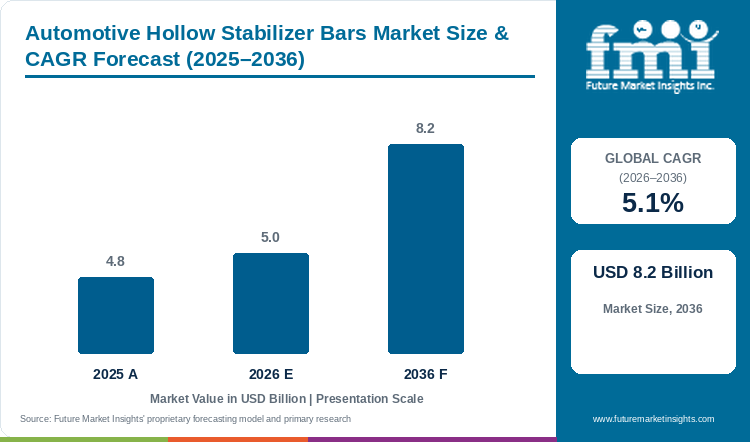
USD 5.0 Billion in 2026, against USD 4.8 Billion in 2025, is the starting value for hollow stabilizer bars, and platform weight targets will increase sales to USD 8.2 Billion by 2036. Growth will hold at a 5.1% CAGR across the 2026 to 2036 forecast.
Demand for automotive hollow stabilizer bars is projected to expand at 5.1% CAGR between 2026 and 2036, according to FMI. Industry value is estimated at USD 5.0 Billion in 2026, up from USD 4.8 Billion in 2025, and is expected to reach USD 8.2 Billion by 2036, an addition of USD 3.2 Billion over the forecast decade. Demand for hollow bars comes mainly from front bars on SUV and crossover platforms, and OEM direct programs are expected to carry 58% of sales in 2026. Increasing curb mass on SUV and electrified platforms is supporting the shift toward tubular bars, as carmakers are removing weight without losing roll stiffness.
Demand for hollow stabilizer bars is developing in line with the vehicle production mix of each country. Turkey is projected at 6.1% CAGR and Mexico at 5.8%, owing to plants weighted toward pickups, SUVs and commercial vehicles specifying heavier roll-control load cases. Japan is expected to grow slowest at 4%, due to stable vehicle size preferences and long ownership cycles. In Germany, electric registrations rose 23% to about 64,500 units in January 2026, and domestic passenger-car production fell 9% in the same month [1]. Due to this, demand for hollow bars in Germany will follow the electrification of the vehicle mix.
The same suppliers are also finding a wider sales base in adjacent suspension markets. Revenue in the automotive suspension system market is projected to increase from USD 53.2 Billion in 2026 to USD 79.5 Billion by 2036 at 4.1% CAGR, a slower pace than hollow bars. Sales of air suspension systems are expected to grow faster at 9.6%, from USD 6.9 Billion to USD 17.2 Billion, opening an opportunity of USD 10.3 Billion. Demand for automotive composite leaf springs is estimated to rise at 6.1% from USD 97.1 Million to USD 175.5 Million, as lightweight spring content is gaining share.
Key challenges in the hollow stabilizer bars market include validation cost, tooling cost and long platform cycles. A supplier change after tooling freeze requires new validation, due to which sales move mainly at each new platform award. Regional competition is also increasing, as NHK Spring decided in May 2025 to build a plant in Aurangabad, India, for coil springs and stabilizer bars, with production scheduled for 2027 [2]. According to FMI, tighter chassis weight targets on SUV and electric platforms will keep demand for hollow bars rising through 2036.
Key Takeaways
- By bar type, front hollow stabilizer bars are projected to account for 36% in 2026, owing to front-axle roll stiffness targets set early in chassis development.
- Carbon steel tube is estimated to hold 39% by material in 2026, as forming lines are already audited by OEMs, and SUVs/crossovers are expected at 33% by vehicle type.
- Notable companies in the automotive hollow stabilizer bars market include Mubea, Sogefi, NHK Spring, Thyssenkrupp, Chuo Spring, Schaeffler, Tinsley Bridge and Kilen Springs.
- Turkey is projected at 6.1% CAGR through 2036, followed by Mexico at 5.8%, as pickup, SUV and commercial vehicle plants need heavier roll-control load cases, and Japan is expected at 4%, the lowest among the seven profiled countries.
Analyst Perspective
“Disconnectable and tailored-wall hollow bars nominated on SUV and electrified programs before chassis targets freeze will form the clearest opportunity through 2036. Bar makers pairing tube forming with fatigue validation and local launch support will receive higher value per platform, as new plants such as NHK Spring's Aurangabad facility reset regional cost benchmarks once production begins in 2027.”
- Nikhil Kaitwade, Principal Consultant, Future Market Insights
How is the Automotive Hollow Stabilizer Bars Market Segmented?
The automotive hollow stabilizer bars market is segmented into bar type, material, vehicle type, sales channel, function and region.
As per FMI, the market is segmented by bar type into front hollow stabilizer bars, rear hollow stabilizer bars, active stabilizer bars, torsion-tuned hollow bars and lightweight tubular bars. By material, the market is segmented into carbon steel tube, high-strength steel, alloy spring steel and composite-reinforced bars. By vehicle type, the market is segmented into SUVs/crossovers, passenger cars, light commercial vehicles, performance vehicles and EV platforms. By sales channel, the market is segmented into OEM direct, chassis Tier-1 suppliers, aftermarket performance and replacement channel. By function, the market is segmented into roll control, weight reduction, ride-handling balance and active chassis support. The regional analysis covers seven regions and more than 30 countries.
Why Do Front Hollow Stabilizer Bars Lead the Automotive Hollow Stabilizer Bars Market by Bar Type?
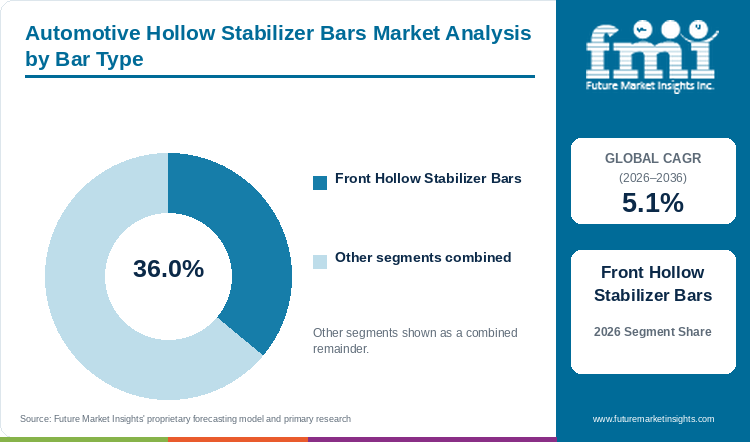
By bar type, front hollow stabilizer bars will account for 36% of market share in 2026.
Front hollow stabilizer bars are widely used on passenger and utility platforms, as the front end governs steering feel and takes the greater part of body roll. Chassis teams lock front anti-roll targets early in development and want a lighter part with the same stiffness, due to which OEMs spend the largest portion of bar budgets at the front position. Torsion-tuned hollow bars and lightweight tubular bars serve niche tuning and mass goals on fewer programs. Active stabilizer bars carry actuators and electronics, and this added cost limits fitment to luxury and SUV trims. Rear hollow bars add lower value per vehicle, as slimmer sections handle secondary tuning. However, program-level forming and fatigue testing will determine the pace at which these smaller formats gain volume.
- Front hollow stabilizer bars are estimated to hold 36% of demand by bar type in 2026, owing to roll-stiffness targets fixed for the front axle early in chassis development.
- NHK Spring states that hollow stabilizers made from high-grade ERW pipe can be 20% to 50% lighter than solid types [3].
Why Does Carbon Steel Tube Lead the Automotive Hollow Stabilizer Bars Market by Material?
Based on material, carbon steel tube will account for 39% of market share in 2026.
Rising use of tubular stabilizers on serial passenger programs is supporting the demand for carbon steel tube. Suppliers process this tube through bending, heat treatment, coating and bushing assembly on lines OEMs have already audited, owing to which carbon steel remains the lowest-risk choice for a new chassis award. Welded tube for these bars comes from the electric resistance welded pipes and tubes market. High-strength steel is growing at a slower pace, as slimmer walls call for extra durability testing and the raw tube costs more. Alloy spring steel goes mainly into heavier load cases that can absorb a premium grade price. Composite-reinforced bars sell in small numbers, as bonded joints and long-term durability need a fresh approval route. However, OEM weight targets will set the speed of any move from carbon steel to thinner-walled grades through 2036.
- Carbon steel tube is projected to account for 39% of demand by material in 2026, supported by tubular weight savings delivered on forming lines already approved by OEMs.
Why Do SUVs/Crossovers Lead the Automotive Hollow Stabilizer Bars Market by Vehicle Type?
In 2026, SUVs/crossovers will account for 33% of market share by vehicle type.
Car buyers are choosing more SUVs/crossovers for family and daily use, which is supporting the demand for hollow stabilizer bars in utility vehicles. Taller bodies and heavier curb weights cause more lean in corners, due to which OEMs specify a stiffer and higher-value bar on each utility model. EV platforms add volume from a small base, and many battery programs share SUV and crossover architectures with bars already approved on combustion and hybrid versions. Performance vehicles carry high content per unit, though build volumes are far smaller. Light commercial vehicles mostly stay with solid bars to protect cost and payload durability. Passenger cars ride lower and need less anti-roll stiffness, which keeps bar value per car lower. However, the carry-over of approved bars will shape the number of separate bar nominations on electric programs.
- SUVs/crossovers are expected to hold 33% of demand by vehicle type in 2026, supported by repeat bar nominations across combustion, hybrid and electric versions of one OEM architecture.
- INEGI reported that light trucks accounted for 77.2% of Mexico's 2025 light-vehicle production [4].
Why Does OEM Direct Lead the Automotive Hollow Stabilizer Bars Market by Sales Channel?
By sales channel, OEM direct will account for 58% of market share in 2026.
Vehicle makers buy most hollow stabilizer bars directly, as each bar is engineered to fit one suspension layout, mounting geometry and durability target. Bar tooling, testing and launch support are agreed with the supplier at the platform award, due to which the vehicle maker contracts most bar volume without an intermediary. Replacement sales come from cars already on the road, and volumes follow crash repairs and the average age of vehicles in use. Enthusiast owners buy upgraded bars through aftermarket performance outlets in small lots. Chassis Tier-1 suppliers purchase bars only on programs sourcing full corner or axle assemblies. However, the spread of complete corner-module contracts will decide the share of bar orders shifting to chassis Tier-1 suppliers.
- OEM direct is projected to account for 58% of demand by sales channel in 2026, supported by tooling, validation and launch support agreed during the original platform award.
- Chuo Spring reported in May 2025 that the ODDS disconnectable stabilizer, recognized with a JSAE award shared with Toyota, is used on the Land Cruiser 250 [5].
Why Does Roll Control Lead the Automotive Hollow Stabilizer Bars Market by Function?
Based on function, roll control will account for 41% of market share in 2026.
Increasing need for flat cornering with a comfortable ride is supporting the demand for hollow stabilizer bars in roll control. Carmakers set handling targets on every model, owing to which each bar program is first specified for the anti-roll job. Active chassis support wraps disconnect or actuator hardware around the same anti-roll task, as tracked in the automotive active suspension system market. Ride-handling balance comes from tuning shared with springs and shock absorbers. Weight reduction works as a design goal inside the same part and is seldom bought on separate terms. However, the price of actuator hardware will determine the pace at which active systems spread past luxury and off-road trims.
- Roll control is estimated to hold 41% of demand by function in 2026, owing to the anti-roll requirement built into every stabilizer program.
- Chuo Spring stated that ODDS can connect or disconnect the stabilizer by driver command, preserving on-road handling and raising off-road wheel articulation [5].
What are the Drivers, Restraints, and Opportunities in the Automotive Hollow Stabilizer Bars Market?
As per FMI's analysis, chassis mass targets will drive demand, platform qualification will slow supplier switching, and disconnectable and localized tubular bars will open the widest value pool through 2036.
- Driver: Heavier SUV and electrified platforms are raising the value of removing mass without losing roll stiffness, due to which hollow bars are gaining preference.
- Restraint: Vehicle-program validation and process qualification are making a change of supplier slow and costly for OEM buyers.
- Opportunity: Tailored-wall tubes, disconnectable bars and local supply can raise value per qualified platform for bar makers.
Increasing vehicle mass is the main driver of the automotive hollow stabilizer bars market, and lightweighting programs tracked in the automotive lightweight materials market are pushing the same logic down to suspension parts. Qualification remains the key challenge, as thyssenkrupp Automotive Technology describes stabilizer supply requirements running from project management and product development through testing and series production [6]. Switching becomes expensive for OEM buyers once tooling and calibration freeze. Due to this, the opening for suppliers will come on new platforms through tailored wall thickness and switchable bars such as Chuo Spring's ODDS on the Land Cruiser 250 [5].
Which Country CAGRs are Profiled in the Automotive Hollow Stabilizer Bars Market?
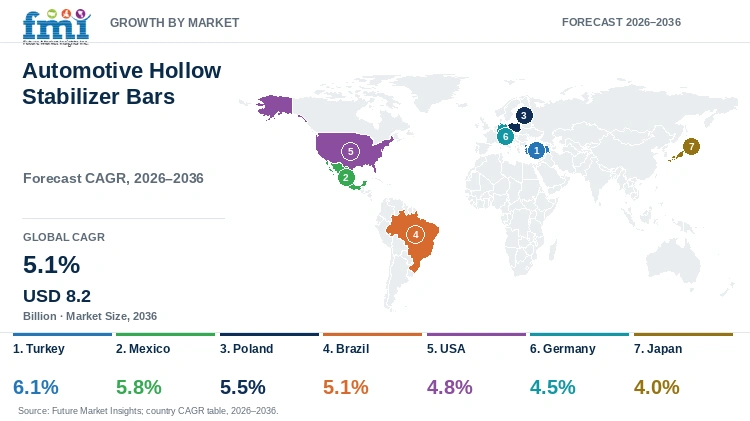
| Country | CAGR, 2026 to 2036 |
|---|---|
| Turkey | 6.1% |
| Mexico | 5.8% |
| Poland | 5.5% |
| Brazil | 5.1% |
| USA | 4.8% |
| Germany | 4.5% |
| Japan | 4% |
How do Country-level CAGRs Compare in the Automotive Hollow Stabilizer Bars Market?
As per FMI's analysis, growth in demand for hollow stabilizer bars across the seven profiled countries ranges from 6.1% CAGR in Turkey to 4% in Japan. The ranking reflects growth pace alone, and a slower-growing country such as Germany can still post larger absolute revenue through 2036.
- Turkey at 6.1% and Mexico at 5.8% offer the earliest payback on new capacity investment.
- Poland at 5.5% will open nomination windows ahead of a new domestic electric vehicle factory.
- Suppliers tying lightweighting to compliance will find openings in Brazil, growing at 5.1%, and in the USA at 4.8%.
- Germany at 4.5% and Japan at 4% will favor durability evidence and tight cost control.
Outside these seven markets, the full study tracks hollow bar CAGRs for more than 30 countries grouped into seven regions.
Country Outlook
- Turkey is projected at 6.1% CAGR, the fastest in the profiled set, as commercial vehicle output is increasing against lower total production. OSD reported in August 2026 that total vehicle production in Turkey fell 8% in January-July [7]. Commercial vehicle output rose 9% and light commercial output 10% in that period, due to which suppliers with adaptable tooling for passenger and commercial load cases are expected to gain most.
- The regulatory value of mass reduction in the USA is shifting. In December 2025, NHTSA proposed a CAFE recalibration for model years through 2031 with lower annual stringency increases [8]. Sales will rise at a 4.8% CAGR as suppliers prove mass and durability gains under changing compliance rules.
- Japan is projected at 4% CAGR, as buyers keep vehicles for long periods and size preferences change slowly. JAMA reported in April 2026 that about seven in ten prospective buyers preferred the same vehicle size [9]. Due to this, Japanese programs will reward quiet operation and incremental weight cuts that fit existing packages.
- Germany combines a rising electric mix with shrinking domestic vehicle output. VDA reported that January 2026 passenger-car production fell 9% and electric registrations rose 23% to about 64,500 units [1]. One bar design compatible with several powertrain variants will carry more value as demand grows at a 4.5% CAGR.
- Mexico produced 3,953,494 light vehicles in 2025, and light trucks made up 77.2% of that output, according to INEGI [4]. Pickup and SUV duty cycles set most load cases for bars sourced in the country. Localized tube forming will support a 5.8% CAGR through 2036.
- Demand for hollow bars in Poland is projected at 5.5% CAGR, supported by the planned Polish Electromobility Hub in Jaworzno. In May 2026, the European Funds portal announced PLN 4.5 billion of support for the hub, with vehicle production planned for 2029 [10]. Stabilizer qualification will need to precede that factory ramp by several years, due to which suppliers securing early platform nominations will receive most of the growth.
- Brazil's MOVER program has applied mandatory requirements for new-vehicle sales since June 2025, covering energy efficiency and recyclability [11]. Product carbon-footprint requirements are scheduled to follow from 2027 under the same program. Traceable high-strength tubular designs will connect mass reduction to those rules as demand rises at a 5.1% CAGR.
Who are the Notable Companies in the Automotive Hollow Stabilizer Bars Market?
A tiered supplier base led by Mubea, Sogefi, NHK Spring and Thyssenkrupp holds OE tubular programs in the FMI benchmark, with Chuo Spring and Schaeffler competing on adaptive roll control and requalification costs protecting incumbents.
Most OE tubular stabilizer programs are placed with Mubea, Sogefi, NHK Spring and Thyssenkrupp, due to which supply of hollow stabilizer bars remains concentrated at the top. Chuo Spring and Schaeffler are building a second tier around adaptive roll control, and Tinsley Bridge and Kilen Springs are serving heavy-duty and aftermarket buyers. OEMs select suppliers on bar geometry, tube forming, heat treatment and fatigue validation, and thyssenkrupp Automotive Technology describes stabilizer supply running from project management and product development through testing and series production [6]. This long qualification route keeps new suppliers out, and requalification after tooling freeze makes a supplier change costly for the carmaker. Owing to this, incumbents hold pricing during a program, and OEM buyers regain negotiating power at each new nomination. Leading groups are also simplifying operations, as Mubea announced in January 2026 the merger of three Czech companies in Prostějov, including Mubea Stabilizer Bar Systems, into one legal entity [12]. Spring makers covered in the automotive spring market use much of the same process base and are expected to bid for more programs. However, disconnectable designs will raise the engineering level needed for SUV and electrified nominations through 2036.
- OE Tubular and Lightweight Bar Specialists: Mubea, Sogefi, NHK Spring and Thyssenkrupp compete on stabilizer engineering and industrialized forming.
- Adaptive Chassis and Diversified Suspension Suppliers: Chuo Spring and Schaeffler hold adaptive roll-control roles, and Marelli and Fawer Automotive offer broader chassis portfolios.
- Heavy-Duty and Aftermarket Suspension Specialists: Tinsley Bridge and Kilen Springs bring torsion bar and aftermarket spring expertise.
Competitive Benchmarking
| Company | Tubular Bar Manufacturing | Weight Reduction | Adaptive Roll Control | Geographic Reach |
|---|---|---|---|---|
| Mubea | High | High | High | Europe, Americas, Asia |
| Sogefi | High | Medium | Low | Europe, Americas, Asia |
| NHK Spring | High | High | Low | Japan and international |
| Thyssenkrupp | High | High | High | Four regions |
| Chuo Spring | Medium | Medium | High | Japan and overseas |
| Schaeffler | Low | Low | High | Global |
| Marelli | Low | Low | Low | Global |
| Tinsley Bridge | Medium | Medium | Low | United Kingdom |
| Fawer Automotive | Low | Low | Low | Limited documentation |
| Kilen Springs | Low | Low | Low | European aftermarket |
Scoring basis: Tubular Bar Manufacturing scores serial production of hollow bars, Weight Reduction scores mass-optimized design, and Adaptive Roll Control scores disconnectable, split or active roll control. Each FMI benchmark grade reflects public evidence, with High for wide documented capability, Medium for narrower proof and Low for limited documentation.
Key Developments
- In May 2025, NHK Spring decided to build a suspension-springs plant in Aurangabad, Maharashtra, with a first phase of about JPY 2.0 billion for coil springs and stabilizer bars, production scheduled for 2027 and about 350 employees [2].
- In May 2025, Chuo Spring announced a first JSAE Technology Development Award, received jointly with Toyota for ODDS, the On Demand Disconnectable Stabilizer used on the Land Cruiser 250 [5].
- In June 2025, Thyssenkrupp announced an Automotive Technology realignment effective October 1, 2025, with Springs & Stabilizers kept outside the four new business units to continue separately [13].
- In January 2026, Mubea announced the merger of three Czech companies in Prostějov, including Mubea Stabilizer Bar Systems, bringing the local stabilizer-bar and spring wire activities into one legal entity [12].
Key Players
OE Tubular and Lightweight Bar Specialists
- Mubea
- Sogefi
- NHK Spring
- Thyssenkrupp
Adaptive Chassis and Diversified Suspension Suppliers
- Chuo Spring
- Schaeffler
- Marelli (formerly Magneti Marelli)
- Fawer Automotive
Heavy-Duty and Aftermarket Suspension Specialists
- Tinsley Bridge
- Kilen Springs
Report Scope and Methodology
| Coverage field | Report scope |
|---|---|
| Market breakdown | 5 categories plus Region, covering Bar Type (Front Hollow Stabilizer Bars, Rear Hollow Stabilizer Bars, Active Stabilizer Bars, Torsion-Tuned Hollow Bars, Lightweight Tubular Bars), Material (Carbon Steel Tube, High-Strength Steel, Alloy Spring Steel, Composite-Reinforced Bars), Vehicle Type (SUVs/Crossovers, Passenger Cars, Light Commercial Vehicles, Performance Vehicles, EV Platforms), Sales Channel (OEM Direct, Chassis Tier-1 Suppliers, Aftermarket Performance, Replacement Channel), and Function (Roll Control, Weight Reduction, Ride-Handling Balance, Active Chassis Support) |
| Quantitative units | USD Billion |
| Market definition | Revenue from hollow or tubular automotive stabilizer bars and bar-centered assemblies within the defined segmentation. Factory-integrated bushings or mounting elements are included only when sold as part of the stabilizer-bar assembly. Solid bars, coil or leaf springs, dampers, standalone links, bushings, actuators or control electronics, complete suspension systems and finished vehicles are excluded. |
| Regions covered | North America, Latin America, Western Europe, Eastern Europe, East Asia, South Asia and Pacific, Middle East and Africa |
| Countries covered | Turkey, the USA, Japan, Germany, Mexico, Poland and Brazil in detail, within a base of more than 30 countries |
| Key companies profiled | Mubea, Sogefi, NHK Spring, Thyssenkrupp, Chuo Spring, Schaeffler, Marelli, Tinsley Bridge, Fawer Automotive, and Kilen Springs, drawn from a wider pool of stabilizer and chassis suppliers in the study |
| Forecast period | 2026 to 2036 |
| Approach | Demand for stabilizer bars at component level is sized bottom-up and cross-checked top-down against vehicle-platform activity, channel structure, material mix and country operating conditions inside the defined revenue boundary. |
Research Methodology
| Method | Approach |
|---|---|
| Primary research | Structured discussions with stabilizer manufacturers, chassis suppliers, OEM purchasing and engineering teams, channel participants and technical specialists test product mix, qualification criteria, pricing boundaries, demand by platform and replacement activity. |
| Desk research | The analysis reviews government statistics, automotive industry associations, company filings and product documentation, policy material and technical literature, retaining only material relevant to hollow or tubular stabilizer scope. |
| Market sizing and forecasting | Indicators of demand for components, vehicle-platform activity, bar type and material mix, OE and aftermarket channels and country conditions are combined, and forecasts consider vehicle production, SUV and EV mix, lightweighting requirements and program qualification cycles. |
| Data validation | Demand and supply indicators are triangulated across source types and reconciled against the market boundary. Double counting, solid stabilizer bars, unrelated spring and damper revenue, downstream vehicle revenue and unsupported adjacent categories are excluded. |
Automotive Hollow Stabilizer Bars Market by Segments
Automotive Hollow Stabilizer Bars Market Segmented by Bar Type
- Front Hollow Stabilizer Bars
- Rear Hollow Stabilizer Bars
- Active Stabilizer Bars
- Torsion-Tuned Hollow Bars
- Lightweight Tubular Bars
Automotive Hollow Stabilizer Bars Market Segmented by Material
- Carbon Steel Tube
- High-Strength Steel
- Alloy Spring Steel
- Composite-Reinforced Bars
Automotive Hollow Stabilizer Bars Market Segmented by Vehicle Type
- SUVs/Crossovers
- Passenger Cars
- Light Commercial Vehicles
- Performance Vehicles
- EV Platforms
Automotive Hollow Stabilizer Bars Market Segmented by Sales Channel
- OEM Direct
- Chassis Tier-1 Suppliers
- Aftermarket Performance
- Replacement Channel
Automotive Hollow Stabilizer Bars Market Segmented by Function
- Roll Control
- Weight Reduction
- Ride-Handling Balance
- Active Chassis Support
Automotive Hollow Stabilizer Bars Market Segmented by Region
- North America
- Latin America
- Western Europe
- Eastern Europe
- East Asia
- South Asia and Pacific
- Middle East and Africa
Research Sources and Bibliography
- [1] German Association of the Automotive Industry (2026, February 4). Car production in Germany in January 2026.
- [2] NHK Spring Co., Ltd. (2025, May 26). Notice Concerning the Construction of a New Automotive Suspension Springs Plant in West India.
- [3] NHK Spring Co., Ltd. (2026, August 25). Hollow Stabilizers.
- [4] INEGI (2026, January 9). Registro administrativo de la industria automotriz de vehículos ligeros. Diciembre de 2025.
- [5] Chuo Spring Co., Ltd. (2025, May 7). Notice of First JSAE Technology Development Award.
- [6] thyssenkrupp Automotive Technology (2026, August 25). Springs & Stabilizers: Competence for the Chassis.
- [7] Automotive Manufacturers Association of Türkiye (2026, August 17). Temmuz 2026 Sonuçları Açıklandı!
- [8] U.S. Department of Transportation, NHTSA (2025, December 5). The Safer Affordable Fuel-Efficient (SAFE) Vehicles Rule III for Model Years 2022 to 2031 Passenger Cars and Light Trucks.
- [9] Japan Automobile Manufacturers Association (2026, April 14). 2025 Passenger Car Market Trends Survey.
- [10] Portal Funduszy Europejskich (2026, May 14). 4,5 mld zł z KPO na fabrykę polskich samochodów elektrycznych.
- [11] Ministério do Desenvolvimento, Indústria, Comércio e Serviços (2026, July 6). Programa MOVER.
- [12] Mubea (2026, January 1). Merger of the companies MUBEA-HZP s.r.o., Mubea IT Spring Wire s.r.o. and Mubea Stabilizer Bar Systems s.r.o.
- [13] MarketScreener (2025, June 24). Thyssenkrupp Revamps Automotive Division with Eye on Capital Market Readiness.
This bibliography is provided for reader reference and is not exhaustive. The full report contains the complete reference list and detailed citations.
This Report Answers
- What value will hollow stabilizer bar sales reach in 2026, and to what level will platform weight targets increase revenue by 2036?
- Which vehicle-mass and chassis-engineering pressures will keep OEM platforms specifying hollow stabilizer bars?
- Why will front hollow stabilizer bars stay first among bar types on 2026 platform programs?
- What role will carbon steel tube play in cost, qualification and material choices for hollow bars?
- Why will SUVs/crossovers lead demand by vehicle type and OEM direct sourcing lead the sales channel category?
- Which of Turkey, Mexico, Poland, Brazil, the USA, Germany and Japan will grow fastest, and by what margin, till 2036?
- Why will disconnectable and tailored-wall hollow bars raise value per qualified platform?
- Which validation, tooling and platform-switching costs will slow supplier changes?
- What will OEM chassis engineering and purchasing teams need to check before sourcing a hollow bar program?
Frequently Asked Questions
How Big Is the Automotive Hollow Stabilizer Bars Market Expected to Be in 2026?
USD 5.0 Billion is the FMI estimate for 2026 hollow stabilizer bar sales, against USD 4.8 Billion in 2025. SUV and electrified platform programs will increase the value to USD 8.2 Billion by 2036 as chassis weight targets tighten.
What Is the CAGR of the Automotive Hollow Stabilizer Bars Market from 2026 to 2036?
5.1% is the CAGR that FMI projects for hollow stabilizer bar sales from 2026 to 2036. OEM sourcing cycles will pace that growth, since volume moves to a new bar only after validation on a named vehicle platform.
Which Bar Type Holds the Largest Share of the Automotive Hollow Stabilizer Bars Market?
Front hollow stabilizer bars will lead with 36% of market share by bar type in 2026. Front-axle roll stiffness and steering balance will keep the position tied to early chassis development.
Which Material Leads the Automotive Hollow Stabilizer Bars Market?
Carbon steel tube will account for 39% of market share by material in 2026. Forming, heat treatment and coating routines already proven on serial platforms will keep this material ahead on cost and qualification.
Which Country Is Expected to Grow Fastest in the Automotive Hollow Stabilizer Bars Market?
6.1% is the CAGR Turkey will post till 2036, the quickest pace in the seven-country set, with Mexico next at 5.8%. Japan will record the slowest growth in the group at 4%.
What Notable Restraint Affects the Automotive Hollow Stabilizer Bars Market?
Key challenges will include model-specific qualification, since tube grade, wall thickness, bending and heat treatment will need validation against a vehicle duty cycle. Once tooling and calibration freeze, a change of supplier will add cost and program risk.
Which Are the Key Companies in the Automotive Hollow Stabilizer Bars Market?
Mubea, Sogefi, NHK Spring, Thyssenkrupp, Chuo Spring, Schaeffler, Marelli, Tinsley Bridge, Fawer Automotive and Kilen Springs head the supplier coverage for hollow stabilizer bars. Placement across three strategy groups runs from OE tubular specialists to adaptive chassis and aftermarket suppliers.
Preview the report firsthand - request a free sample
Get SampleGet the brochure for pricing and purchase details.
Get PDFTable of Content
- Key Takeaways
- Market Size and CAGR
- Top Growth Driver
- Fastest Growing Segment
- Leading Region
- Key Companies
- Emerging Opportunities
- Executive Summary
- Global Market Outlook
- Demand-side Trends
- Supply-side Trends
- Technology Roadmap Analysis
- Analysis and Recommendations
- Analyst Perspective (What is happening? Why now? What should investors know?)
- Key Questions Answered
- How large is the market?
- What is the CAGR?
- What are key trends?
- Which region dominates?
- Who are the leaders?
- Market Overview
- Market Coverage / Taxonomy
- Market Definition / Scope / Limitations
- Research Methodology
- Chapter Orientation
- Analytical Lens and Working Hypotheses
- Market Structure, Signals, and Trend Drivers
- Benchmarking and Cross-market Comparability
- Market Sizing, Forecasting, and Opportunity Mapping
- Research Design and Evidence Framework
- Desk Research Programme (Secondary Evidence)
- Expert Input and Fieldwork (Primary Evidence)
- Tooling, Models, and Reference Databases
- Data Engineering and Model Build
- Quality Assurance and Audit Trail
- Market Background
- Market Dynamics (Drivers, Restraints, Opportunity, Trends)
- Scenario Forecast (Optimistic, Likely, Conservative)
- Impact Analysis
- AI Impact
- Sustainability Impact
- Regulatory Impact
- Technology Impact
- Consumer / Buyer Analysis
- Purchase Drivers
- Adoption Barriers
- Buyer Journey
- Opportunity Map Analysis
- Product Life Cycle Analysis
- Supply Chain Analysis
- Investment Feasibility Matrix
- Value Chain Analysis
- PESTLE and Porter's Analysis
- Regulatory Landscape
- Regional Parent Market Outlook
- Production and Consumption Statistics
- Import and Export Statistics
- Global Market Analysis and Forecast, 2021 to 2036
- Historical Market Size Value (USD Billion) Analysis, 2021 to 2025
- Current and Future Market Size Value (USD Billion) Projections, 2026 to 2036
- Y-o-Y Growth Trend Analysis
- Absolute $ Opportunity Analysis
- Global Market Pricing Analysis, 2021 to 2036
- Global Market Analysis and Forecast, By Bar Type, 2021 to 2036
- Introduction / Key Findings
- Historical Market Size Value (USD Billion) Analysis By Bar Type, 2021 to 2025
- Current and Future Market Size Value (USD Billion) Analysis and Forecast By Bar Type, 2026 to 2036
- Front Hollow Stabilizer Bars
- Rear Hollow Stabilizer Bars
- Active Stabilizer Bars
- Torsion-Tuned Hollow Bars
- Lightweight Tubular Bars
- Y-o-Y Growth Trend Analysis By Bar Type, 2021 to 2025
- Absolute $ Opportunity Analysis By Bar Type, 2026 to 2036
- Global Market Analysis and Forecast, By Material, 2021 to 2036
- Introduction / Key Findings
- Historical Market Size Value (USD Billion) Analysis By Material, 2021 to 2025
- Current and Future Market Size Value (USD Billion) Analysis and Forecast By Material, 2026 to 2036
- Carbon Steel Tube
- High-Strength Steel
- Alloy Spring Steel
- Composite-Reinforced Bars
- Y-o-Y Growth Trend Analysis By Material, 2021 to 2025
- Absolute $ Opportunity Analysis By Material, 2026 to 2036
- Global Market Analysis and Forecast, By Vehicle Type, 2021 to 2036
- Introduction / Key Findings
- Historical Market Size Value (USD Billion) Analysis By Vehicle Type, 2021 to 2025
- Current and Future Market Size Value (USD Billion) Analysis and Forecast By Vehicle Type, 2026 to 2036
- SUVs/Crossovers
- Passenger Cars
- Light Commercial Vehicles
- Performance Vehicles
- EV Platforms
- Y-o-Y Growth Trend Analysis By Vehicle Type, 2021 to 2025
- Absolute $ Opportunity Analysis By Vehicle Type, 2026 to 2036
- Global Market Analysis and Forecast, By Sales Channel, 2021 to 2036
- Introduction / Key Findings
- Historical Market Size Value (USD Billion) Analysis By Sales Channel, 2021 to 2025
- Current and Future Market Size Value (USD Billion) Analysis and Forecast By Sales Channel, 2026 to 2036
- OEM Direct
- Chassis Tier-1 Suppliers
- Aftermarket Performance
- Replacement Channel
- Y-o-Y Growth Trend Analysis By Sales Channel, 2021 to 2025
- Absolute $ Opportunity Analysis By Sales Channel, 2026 to 2036
- Global Market Analysis and Forecast, By Function, 2021 to 2036
- Introduction / Key Findings
- Historical Market Size Value (USD Billion) Analysis By Function, 2021 to 2025
- Current and Future Market Size Value (USD Billion) Analysis and Forecast By Function, 2026 to 2036
- Roll Control
- Weight Reduction
- Ride-Handling Balance
- Active Chassis Support
- Y-o-Y Growth Trend Analysis By Function, 2021 to 2025
- Absolute $ Opportunity Analysis By Function, 2026 to 2036
- Global Market Analysis and Forecast, By Region, 2021 to 2036
- Introduction
- Historical Market Size Value (USD Billion) Analysis By Region, 2021 to 2025
- Current Market Size Value (USD Billion) Analysis and Forecast By Region, 2026 to 2036
- North America
- Latin America
- Western Europe
- Eastern Europe
- East Asia
- South Asia and Pacific
- Middle East and Africa
- Market Attractiveness Analysis By Region
- North America Market Analysis and Forecast, By Country, 2021 to 2036
- Historical Market Size Value (USD Billion) Trend Analysis By Market Taxonomy, 2021 to 2025
- Market Size Value (USD Billion) Forecast By Market Taxonomy, 2026 to 2036
- By Country
- By Bar Type
- By Material
- By Vehicle Type
- By Sales Channel
- By Function
- Market Attractiveness Analysis
- By Country
- By Bar Type
- By Material
- By Vehicle Type
- By Sales Channel
- By Function
- Key Takeaways
- Latin America Market Analysis and Forecast, By Country
- Historical Market Size Value (USD Billion) Trend Analysis By Market Taxonomy, 2021 to 2025
- Market Size Value (USD Billion) Forecast By Market Taxonomy, 2026 to 2036
- By Country
- By Bar Type
- By Material
- By Vehicle Type
- By Sales Channel
- By Function
- Market Attractiveness Analysis
- By Country
- By Bar Type
- By Material
- By Vehicle Type
- By Sales Channel
- By Function
- Key Takeaways
- Western Europe Market Analysis and Forecast, By Country
- Historical Market Size Value (USD Billion) Trend Analysis By Market Taxonomy, 2021 to 2025
- Market Size Value (USD Billion) Forecast By Market Taxonomy, 2026 to 2036
- By Country
- By Bar Type
- By Material
- By Vehicle Type
- By Sales Channel
- By Function
- Market Attractiveness Analysis
- By Country
- By Bar Type
- By Material
- By Vehicle Type
- By Sales Channel
- By Function
- Key Takeaways
- Eastern Europe Market Analysis and Forecast, By Country
- Historical Market Size Value (USD Billion) Trend Analysis By Market Taxonomy, 2021 to 2025
- Market Size Value (USD Billion) Forecast By Market Taxonomy, 2026 to 2036
- By Country
- By Bar Type
- By Material
- By Vehicle Type
- By Sales Channel
- By Function
- Market Attractiveness Analysis
- By Country
- By Bar Type
- By Material
- By Vehicle Type
- By Sales Channel
- By Function
- Key Takeaways
- East Asia Market Analysis and Forecast, By Country
- Historical Market Size Value (USD Billion) Trend Analysis By Market Taxonomy, 2021 to 2025
- Market Size Value (USD Billion) Forecast By Market Taxonomy, 2026 to 2036
- By Country
- By Bar Type
- By Material
- By Vehicle Type
- By Sales Channel
- By Function
- Market Attractiveness Analysis
- By Country
- By Bar Type
- By Material
- By Vehicle Type
- By Sales Channel
- By Function
- Key Takeaways
- South Asia and Pacific Market Analysis and Forecast, By Country
- Historical Market Size Value (USD Billion) Trend Analysis By Market Taxonomy, 2021 to 2025
- Market Size Value (USD Billion) Forecast By Market Taxonomy, 2026 to 2036
- By Country
- By Bar Type
- By Material
- By Vehicle Type
- By Sales Channel
- By Function
- Market Attractiveness Analysis
- By Country
- By Bar Type
- By Material
- By Vehicle Type
- By Sales Channel
- By Function
- Key Takeaways
- Middle East and Africa Market Analysis and Forecast, By Country
- Historical Market Size Value (USD Billion) Trend Analysis By Market Taxonomy, 2021 to 2025
- Market Size Value (USD Billion) Forecast By Market Taxonomy, 2026 to 2036
- By Country
- By Bar Type
- By Material
- By Vehicle Type
- By Sales Channel
- By Function
- Market Attractiveness Analysis
- By Country
- By Bar Type
- By Material
- By Vehicle Type
- By Sales Channel
- By Function
- Key Takeaways
- Key Countries Market Analysis
- Turkey
- Pricing Analysis
- Market Share Analysis, 2025
- By Bar Type
- By Material
- By Vehicle Type
- By Sales Channel
- By Function
- Mexico
- Pricing Analysis
- Market Share Analysis, 2025
- By Bar Type
- By Material
- By Vehicle Type
- By Sales Channel
- By Function
- Poland
- Pricing Analysis
- Market Share Analysis, 2025
- By Bar Type
- By Material
- By Vehicle Type
- By Sales Channel
- By Function
- Brazil
- Pricing Analysis
- Market Share Analysis, 2025
- By Bar Type
- By Material
- By Vehicle Type
- By Sales Channel
- By Function
- USA
- Pricing Analysis
- Market Share Analysis, 2025
- By Bar Type
- By Material
- By Vehicle Type
- By Sales Channel
- By Function
- Germany
- Pricing Analysis
- Market Share Analysis, 2025
- By Bar Type
- By Material
- By Vehicle Type
- By Sales Channel
- By Function
- Japan
- Pricing Analysis
- Market Share Analysis, 2025
- By Bar Type
- By Material
- By Vehicle Type
- By Sales Channel
- By Function
- Turkey
- Market Structure Analysis
- Competition Dashboard
- Competition Benchmarking
- Market Share Analysis of Top Players
- By Regional
- By Bar Type
- By Material
- By Vehicle Type
- By Sales Channel
- By Function
- Emerging Startups
- Innovation Benchmarking
- Competition Analysis
- Competition Deep Dive
- Mubea
- Overview
- Product Portfolio
- Profitability by Market Segments
- Sales Footprint
- Strategy Overview
- Marketing Strategy
- Product Strategy
- Channel Strategy
- Sogefi
- NHK Spring
- Thyssenkrupp
- Chuo Spring
- Schaeffler
- Marelli
- Tinsley Bridge
- Fawer Automotive
- Kilen Springs
- Marelli (formerly Magneti Marelli)
- Mubea
- Case Studies
- Success Stories
- Recent Developments
- Competition Deep Dive
- Assumptions & Acronyms Used


