

- Market Size (2026)
- USD 1.9 Bn
- Forecast (2036)
- USD 3.0 Bn
- CAGR (2026 to 2036)
- 4.8%
How big is Tin Stabilizer Additives Market in 2026?
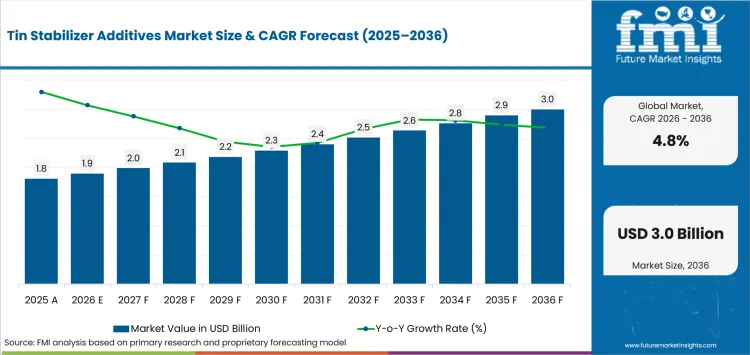
USD 1.9 billion in 2026 and USD 3.0 billion by 2036 at a 4.8% CAGR.
Tin stabilizer additives demand is projected to rise at 4.8% CAGR from 2026 to 2036, which means the valuation is expected to rise from USD 1.9 billion in 2026 to USD 3.0 billion by 2036. Rigid-PVC processors purchase heat stabilizer systems to limit resin degradation during extrusion and preserve qualified formulation performance. NSF product listings published for 2026 record nine Galata heat stabilizers within a 0.30 to 1.00 phr approved range for certified pressure-pipe formulations. Controlled use ranges tie repeat additive purchases to processor output instead of broad PVC capacity alone.
National infrastructure programs change the project pool that can reach PVC processors even though they do not prescribe tin chemistry. China reported in June 2026 that about 770,000 km of urban underground pipelines would be built or upgraded during 2026-2030. The program enlarges potential pipe systems demand before material selection and formulation qualification determine stabilizer chemistry. Tin orders rise where PVC wins projects and approved tin packages remain technically acceptable for repeat production.
Key Takeaways of Tin Stabilizer Additives Market
- Rigid-PVC extrusion creates recurring tin stabilizer demand where heat resistance and qualification remain tied to each maintained production recipe.
- Based on product type, butyltin stabilizers are projected to account for 33.0% in 2026 due to repeatable thermal behavior in qualified rigid-PVC formulations.
- PVC profiles are likely to capture 31.0% share in 2026 attributable to continuous output that rewards stable color across profile extrusion.
- By function, color hold is forecast to represent 35.0% in 2026 driven by appearance requirements across visible rigid-PVC products.
- Non-tin heat stabilizers and tighter organotin acceptance can displace tin where alternative packages pass the same application qualification.
- PMC Organometallix, Galata Chemicals, Reagens, Pau Tai Industrial, PT Timah Industri, Valtris Specialty Chemicals, SONGWON and Baerlocher represent key players in the sector.
Analyst Perspective
"Tin stabilizer suppliers should be compared on approved use ranges, processing stability and technical response under the converter’s actual extrusion conditions. Commercial value is earned where formulation continuity lowers qualification risk and local service keeps a proven recipe available during scheduled production."
- Nikhil Kaitwade, Principal Consultant, Future Market Insights
How is the Tin Stabilizer Additives Market segmented?
The tin stabilizer additives market is segmented by product type, PVC application, function, form, sales channel and region.
The tin stabilizer additives market is segmented by product type, PVC application, function, form, sales channel and region. Product type covers methyltin, butyltin and octyltin stabilizers plus tin mercaptides and carboxylates, while PVC applications include pipes, profiles, films and sheets, wire and cable, and medical or food-contact PVC. Functions cover heat stabilization, color hold, weatherability, processing stability and regulatory-compliant stabilization, while forms include liquid, powder, granules or pastilles and sales channels include compounders, direct processors, distributors and masterbatch suppliers.
Why do PVC profiles lead the PVC application category?
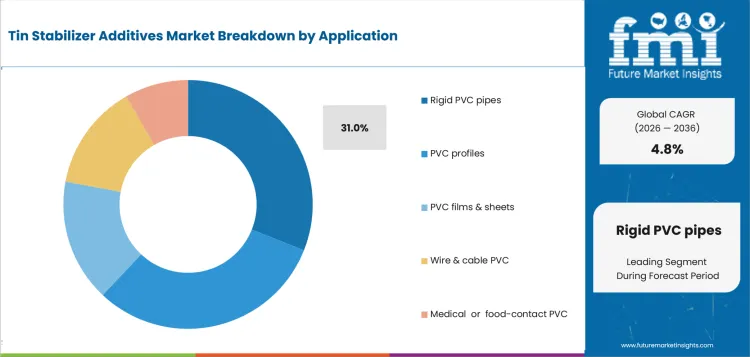
PVC profile extruders expose compounds to sustained heat on continuous lines before surface color becomes part of the finished specification. Exterior profiles may also use PVC UV stabilizers when weathering performance must survive long service under building specifications.
- By PVC application, PVC profiles are estimated to hold 31.0% in 2026 owing to continuous output that rewards stable color and predictable extrusion behavior.
- Renovation programs matter because they can convert building upgrades into additional window profile systems production. EPPA reported in December 2025 that the EU Affordable Housing Plan uses a renovation-first approach that creates tangible opportunities for PVC window-profile members.
What makes butyltin stabilizers central to the product type category?
Butyltin stabilizers remain practical in rigid-PVC recipes that need thermal control during extrusion and calendering. Pressure-pipe qualification also makes dosing discipline commercially relevant because allowable ingredient ranges become part of repeat formulation control. NSF’s 2026 listing records several PMC heat stabilizers for certified PVC pressure-pipe formulations with defined use ranges.
- Butyltin stabilizers are set to lead the product type category with 33.0% share in 2026 due to repeatable thermal behavior in established rigid-PVC formulations.
- Processors retain familiar butyltin packages when application data confirms color and thermal behavior at commercial throughput. Requalification costs make unnecessary chemistry changes less attractive on high-output lines with established customer specifications.
How does color hold lead the function category?
Color hold matters in profiles and clear rigid products because early discoloration can reject output that otherwise meets dimensional targets. Formulation screening now also considers emissions alongside appearance performance. Valtris announced in April 2026 that its ChinaPlas display would include low-emission stabilizer products within its plastic additives portfolio.
- The function category is forecast to be led by color hold at 35.0% share in 2026 due to appearance requirements across visible rigid-PVC products.
- Processors compare stabilizer packages against the actual heat history and line speed used for appearance-sensitive production. Grades that preserve initial color without destabilizing throughput remain easier to defend during formulation reviews.
What drives direct resin processors in the sales channel category?
Direct resin processors choose stabilizers inside their own compounding operation and connect additive selection directly with line performance. In-house formulation control also gives the same operating team responsibility for dosing changes and end-use requirements.
- In 2026, direct resin processors are expected to lead sales channel with 38.0% share because in-house compounding places additive decisions beside production control.
- Regional inventory becomes important when processors need technical access without maintaining large specialty-additive stocks for routine purchasing. SONGWON’s PVC stabilizer distribution partnership with Altek became effective in January 2025 across the Middle East and shortened that local channel route.
What are the drivers, restraints and opportunities in the Tin Stabilizer Additives Market?
PVC infrastructure demand sustains tin use where rigid formulations remain qualified, while non-tin substitution narrows addressable applications and specialized service creates defensible openings.
- Driver: Water-network construction expands the production base for rigid PVC pipe and raises recurring stabilization requirements after PVC wins a project.
- Restraint: Calcium-zinc substitution and tighter organotin acceptance can displace tin where processors can requalify another heat-stabilizer package.
- Opportunity: Application-specific technical support protects tin positions where processing stability, color control or approved use ranges justify chemistry retention.
Water-Network Projects Expand the Addressable PVC Conversion Base
Water-network construction expands the project base that may convert into rigid-PVC output after material selection. Thailand’s Provincial Waterworks Authority reported in July 2025 that a Chonburi expansion had installed 252 km of water distribution systems with 96,000 cubic meters per day of treatment capacity. Tin additive orders follow projects awarded to PVC systems and the continued qualification of tin-stabilized compounds.
Tin Replacement Raises the Burden of Defending Existing Formulations
Substitution pressure is strongest where non-tin heat stabilizers can meet the same processing window without repeating excessive qualification work. Baerlocher said in October 2025 that tin-based PVC stabilizers are being replaced by calcium-zinc systems as regulation and formulation priorities change. Tin producers need application evidence that quantifies processing stability and color retention at the converter’s actual dosing conditions during qualification.
Local Application Support Protects Qualified Tin Use
Commercial openings remain concentrated among processors that require technical help during formulation changes or difficult extrusion conditions. Valtris said in February 2026 that it would present low-emission stabilizer products for PVC at PLASTINDIA while discussing regional customer requirements. Local troubleshooting during routine production can protect qualified tin use where measured processing performance outweighs the cost and disruption of another formulation change.
Which country CAGRs are profiled in the Tin Stabilizer Additives Market?
| Country | CAGR |
|---|---|
| Thailand | 4.9% |
| Brazil | 4.6% |
| USA | 4.2% |
| Germany | 3.8% |
| Japan | 3.5% |
How do country-level CAGRs compare in the Tin Stabilizer Additives Market?
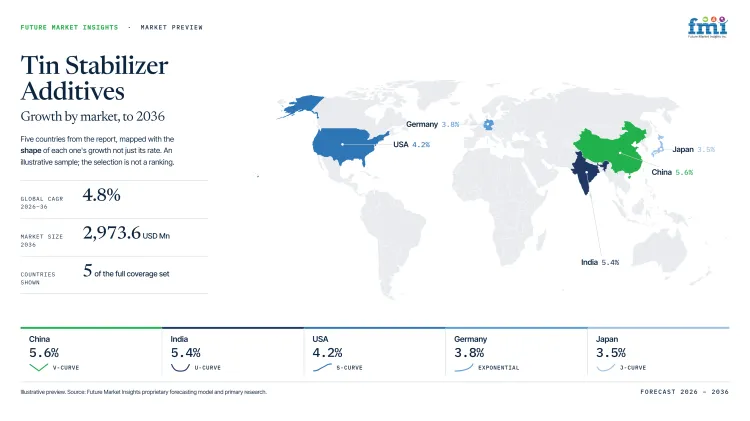
The five forecasts span 1.4 percentage points from Thailand at 4.9% to Japan at 3.5%. Thailand and Brazil form the upper band because active water-network programs can add pipe-conversion work during new utility projects. The USA holds the middle while Germany and Japan advance more slowly inside mature qualification systems.
- Thailand combines EEC water expansion with active utility construction around eastern industrial provinces.
- Brazil’s dispersed sanitation program makes inland specialty-additive logistics a practical order-conversion constraint.
- USA replacement programs operate inside established pressure-pipe qualification practices and certification routines.
- Germany’s drinking-water material rules directly screen eligible formulations before regulated-use price comparisons.
- Japan’s seismic reviews keep pipe-joint performance central to mature municipal replacement programs.
CAGR measures forecast pace instead of current revenue scale or installed conversion volume across countries.
The full report provides country-level CAGR analysis across North America, Latin America, Europe, East Asia, South Asia, Oceania and the Middle East and Africa.
Country-wise Analysis
- Thailand’s eastern industrial corridor combines utility expansion with local industrial converting demand that can pull rigid-PVC compounds into new water projects. The Provincial Waterworks Authority reported in February 2026 that its Ban Chang expansion completed more than 125 km of pipelines and added 2,000 cubic meters per hour of treatment capacity and tin stabilizer additives demand is projected to grow at 4.9% CAGR through 2036. Local technical service and available inventory help compounders respond quickly, but price-sensitive formulation changes and non-tin alternatives mean suppliers must defend dosing efficiency and qualification support before project activity converts into dependable repeat orders.
- Brazilian PVC converters serve sanitation projects across large inland states where project execution and specialty-additive logistics rarely move at the same speed. Casa Civil reported that 41 resumed water-supply projects were completed by the end of the first quarter of 2026, while tin stabilizer additives demand in Brazil is forecast to expand at 4.6% CAGR through 2036 as pipeline work reaches more municipalities. Domestic distribution near major converting clusters improves availability, but tender timing and long inland transport routes can interrupt specialty-additive replenishment and favor easier-to-source packages during temporary production changes or seasonal demand shifts at smaller regional converting sites.
- US pressure-pipe compounders operate across major municipal water programs where established certification practices make stabilizer changes a qualification decision instead of a routine purchasing switch. EPA announced nearly USD 2.9 billion for lead-service-line work in May 2026, while tin stabilizer additives demand in the USA is projected to rise at 4.2% CAGR through 2036 as municipal replacement projects sustain pipe activity without prescribing PVC chemistry. NSF and PPI qualification records support continuity for accepted formulations, but mature processors require documented use ranges and predictable technical service before changing chemistry on lines that already meet customer specifications and recurring production schedules.
- German drinking-water applications place material hygiene and documentation ahead of simple additive availability during material approval across pipe and fitting components that enter regulated contact uses. The German Environment Agency reported in November 2025 that a sixth amendment updated evaluation criteria for plastics and other organic drinking-water materials, while tin stabilizer additives demand is estimated to advance at 3.8% CAGR through 2036. Local technical competence helps suppliers interpret transition requirements, but tighter positive-list and conformity rules narrow addressable organotin uses and reward companies that document exact formulation eligibility before customer trials or specification changes begin at domestic processing sites across Germany.
- Japanese water utilities manage mature networks across aging municipal systems and earthquake-prone service areas where seismic performance and renewal planning influence the pace of pipe replacement. MLIT convened a March 2026 review of water-pipeline seismic suitability by pipe and joint type after Noto earthquake damage, while tin stabilizer additives demand is forecast to expand at 3.5% CAGR through 2036 as resilience work supports selective replacement. Established local technical networks favor proven formulations, but slow approval cycles and utility budget discipline require stabilizer suppliers to demonstrate lifecycle performance and stable local application support before processors change a qualified package during qualification reviews.
Who are the notable companies in the Tin Stabilizer Additives Market?
PMC Organometallix, Galata Chemicals, Reagens, Pau Tai Industrial, PT Timah Industri, Valtris Specialty Chemicals, SONGWON and Baerlocher are the notable companies profiled in this market.
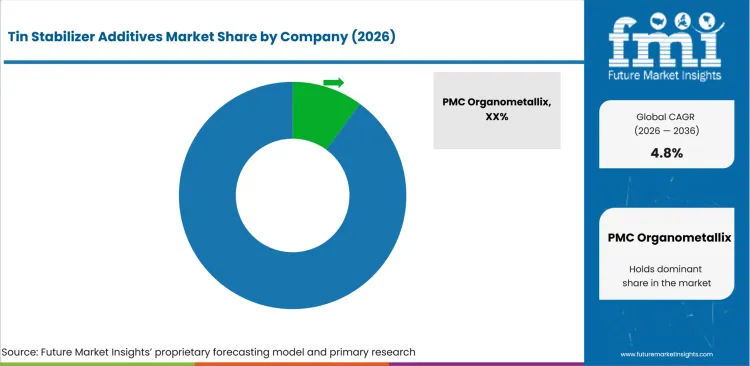
Competition separates direct organotin manufacturers from broader PVC stabilizer formulators that influence the same processing decision. Entry remains difficult in pressure-pipe and regulated-contact applications because documented chemistry and processor support precede formulation changes. The field remains moderately fragmented across global additive groups and regional tin specialists with different qualification depth.
- PMC Organometallix, Galata Chemicals and Reagens combine organotin chemistry with PVC application support and multinational operating coverage.
- Pau Tai Industrial and PT Timah Industri add Asia-based tin chemistry production with pipe, profile and export-oriented supply routes.
- Valtris Specialty Chemicals supplies tin and mixed-metal stabilizers, while SONGWON and Baerlocher compete through broader PVC stabilizer portfolios that include organotin or substitution routes.
Competitive Benchmarking: Tin Stabilizer Additives Market
| Company | Stabilizer Chemistry Breadth | PVC Application Coverage | Technical and Supply Coverage | Geographic Reach |
|---|---|---|---|---|
| PMC Organometallix | High | High | High | Americas, Europe and Asia |
| Galata Chemicals | High | High | High | North America, Europe and Asia |
| Reagens | High | High | High | Europe, North America and Asia |
| Pau Tai Industrial | High | High | High | East Asia and Southeast Asia |
| PT Timah Industri | Medium | High | Medium | Indonesia with exports across Asia and Middle East |
| Valtris Specialty Chemicals | High | High | High | Americas, Europe and Asia |
| SONGWON | High | High | High | Global |
| Baerlocher | Low | High | High | Global |
Key Developments in the Tin Stabilizer Additives Market
- In September 2025, Valtris Specialty Chemicals announced plans to extend its Thane production facility as customers in growth regions required more local polymer-additive supply.
- In August 2025, PT Timah Tbk reported that PT Timah Industri operated a 10,000 tonne-per-year tin stabilizer plant serving PVC pipe and construction uses.
- In July 2025, SONGWON reported its PVC stabilizer range included the SONGSTAB Calcium Organic family and expanded non-tin alternatives available to PVC processors.
Key Players in the Tin Stabilizer Additives Market
Direct Organotin Stabilizer Manufacturers
- PMC Organometallix
- Galata Chemicals
- Reagens
- Pau Tai Industrial
- PT Timah Industri
Broader PVC Stabilizer Platforms
- Valtris Specialty Chemicals
- SONGWON
Tin-Replacement Competitor
- Baerlocher
Tin Stabilizer Additives Market - Report Scope
| Coverage field | Report scope |
|---|---|
| Market breakdown | By product type, PVC application, function, form, sales channel and region. |
| Quantitative Units | Revenue in USD million and CAGR in %. |
| Market Definition | Tin-based PVC stabilizer additives used to control thermal degradation, color and processing performance across qualified rigid and selected flexible PVC formulations. |
| Regions Covered | North America, Latin America, Europe, East Asia, South Asia and Pacific and Middle East and Africa. |
| Countries Covered | Thailand, Brazil, USA, Germany, Japan, and 20+ countries included in the full report. |
| Key Companies Profiled | PMC Organometallix, Galata Chemicals, Reagens, Pau Tai Industrial, PT Timah Industri, Valtris Specialty Chemicals, SONGWON, Baerlocher. |
| Forecast Period | 2026 to 2036. |
| Approach | Primary and secondary research with market triangulation. |
Tin Stabilizer Additives Market - Research Methodology
| Method | Approach |
|---|---|
| Primary Research | FMI analysts gathered input from manufacturers, service providers, technology developers, distributors, end users, procurement teams, and subject-matter experts. Interviews examined purchasing decisions, product or service evaluation, adoption barriers, approval requirements, pricing considerations, and expectations for technical or commercial support. Respondents were also asked what evidence is required before a trial, pilot, or initial order develops into regular purchasing. |
| Desk Research | Desk research covered government statistics, regulatory publications, trade data, industry associations, technical literature, standards, company filings, product information, and official corporate announcements. Sources were reviewed for relevance, publication date, geographic coverage, and consistency with the defined market scope. Claims relating to performance, applications, approvals, capacity, investment, and commercial activity were retained only when supported by credible public evidence. |
| Market Sizing and Forecasting | The market model combined the baseline value with historical performance, segment structure, pricing and volume indicators, adoption levels, company participation, and country-level demand conditions. Forecast assumptions considered economic activity, investment trends, regulatory developments, technology adoption, purchasing cycles, supply availability, and barriers to wider market use. Segment and regional estimates were reconciled before the final market total was calculated. |
| Data Validation | Estimates were checked against multiple independent indicators, including public data, company activity, trade patterns, industry developments, and findings from primary interviews. Validation also tested whether products, services, applications, and company revenues fell within the defined market boundaries. Adjacent categories, unsupported claims, overlapping revenues, and activities without direct market relevance were excluded to reduce double counting and maintain consistency across segments and countries. |
Tin Stabilizer Additives Market by Segments
Tin Stabilizer Additives Market segmented by Product Type:
- Methyltin Stabilizers
- Butyltin Stabilizers
- Octyltin Stabilizers
- Tin Mercaptides
- Tin Carboxylates
Tin Stabilizer Additives Market segmented by PVC Application:
- Rigid PVC Pipes
- PVC Profiles
- PVC Films & Sheets
- Wire & Cable PVC
- Medical or Food-Contact PVC
Tin Stabilizer Additives Market segmented by Function:
- Heat Stabilization
- Color Hold
- Weatherability
- Processing Stability
- Regulatory-Compliant Stabilization
Tin Stabilizer Additives Market segmented by Form:
- Liquid
- Powder
- Granules or Pastilles
Tin Stabilizer Additives Market segmented by Sales Channel:
- PVC Compounders
- Direct Resin Processors
- Additive Distributors
- Masterbatch Suppliers
Tin Stabilizer Additives Market by Region:
- North America
- United States
- Canada
- Latin America
- Brazil
- Mexico
- Chile
- Rest of Latin America
- Western Europe
- Germany
- United Kingdom
- Italy
- Spain
- France
- Nordics
- Benelux
- Rest of Western Europe
- Eastern Europe
- Russia
- Poland
- Hungary
- Balkan and Baltic States
- Rest of Eastern Europe
- East Asia
- China
- Japan
- South Korea
- South Asia and Pacific
- India
- ASEAN
- Australia and New Zealand
- Rest of South Asia and Pacific
- Middle East and Africa
- Kingdom of Saudi Arabia
- Other GCC Countries
- Türkiye
- South Africa
- Other African Union Countries
- Rest of Middle East and Africa
Research Sources and Bibliography
- NSF International. (2026). NSF Product and Service Listings.
- The State Council of the People’s Republic of China. (2026, June 8). China to build, upgrade 770,000 km of urban underground pipelines during 2026-2030.
- NSF International. (2026). NSF Product and Service Listings.
- European PVC Window Profiles and Related Building Products Association. (2025, December 19). EPPA Welcomes EU Affordable Housing Plan.
- Valtris Specialty Chemicals. (2026, April 20). Valtris Specialty Chemicals to attend ChinaPlas 2026 and present our Sustainable Solutions at Hall 8.2, Booth G54.
- SONGWON Industrial Group. (2024, December 30). SONGWON partners with Altek International to distribute PVC in the Middle East.
- Provincial Waterworks Authority. (2025, July 9).
- Baerlocher. (2025, October 8). K Show 2025: Baerlocher showcases its Tin Replacement initiative for a more sustainable PVC industry.
- Valtris Specialty Chemicals. (2026, February 4). Valtris Specialty Chemicals to Attend PLASTINDIA 2026 and Present our Sustainable Solutions at Hall 5, Booth H5FF1.
- Provincial Waterworks Authority. (2026, February 18). กปภ. อัดงบกว่า 1,498 ล้านบาท ขยายศักยภาพประปาบ้านฉาง จ.ระยอง รองรับ 5 อำเภอและ EEC.
- Casa Civil. (2026). Abastecimento de água. Retrieved August 13, 2026.
- USA Environmental Protection Agency. (2026, May 20). EPA Announces $2.9 Billion for States to Reduce Lead in Drinking Water and Protect Americans’ Health.
- German Environment Agency. (2025, November 26). Expert information drinking water and swimming pool water - No.: 12/2025.
- Ministry of Land, Infrastructure, Transport and Tourism. (2026, March 24).
- PMC Organometallix. (2026). About Us. Retrieved August 13, 2026.
- Galata Chemicals. (2026). Chemical Manufacturing - Chemical Supplier. Retrieved August 13, 2026.
- Reagens Group. (2026). WHO WE ARe. Retrieved August 13, 2026.
- Pau Tai Industrial Corporation. (2026). PAU TAI INDUSTRIL CORPORATION. Retrieved August 13, 2026.
- PT Timah Tbk. (2025, August 16). Answering the Nation’s Aspirations, PT Timah Tbk Strengthens Downstreaming for a Sovereign Indonesia.
- Valtris Specialty Chemicals. (2025, September 16). Valtris Specialty Chemicals to attend K 2025 and present our sustainable solutions at Hall 6, Booth E15.
- SONGWON Industrial Group. (2025, July 10). SONGWON highlights its long-standing commitment to customers at K2025.
- Baerlocher. (2026, June 19). Baerlocher establishes Baerlocher Germany GmbH & Co. KG, focusing on the needs of European markets.
This bibliography is provided for reader reference and is not exhaustive. The full report contains the complete reference list and detailed citations
This Report Answers
- How does rigid-PVC conversion turn infrastructure activity into tin stabilizer additive demand?
- Why do butyltin stabilizers retain the leading product-type share in 2026?
- What makes PVC profiles the leading PVC application for tin stabilizer additives?
- How are non-tin stabilizers changing qualification and substitution decisions?
- Why do Thailand and Brazil post faster profiled growth than Germany and Japan?
- Which local frictions determine order conversion in the five profiled countries?
- How do leading companies differ in stabilizer chemistry, applications and technical coverage?
- Which recent company actions affect local supply or formulation competition?
- What should processors compare before changing a qualified tin stabilizer package?
Frequently Asked Questions
How big is the Tin Stabilizer Additives Market in 2026?
The tin stabilizer additives market is expected to be valued at USD 1.9 billion in 2026 and reach USD 3.0 billion by 2036. Qualified rigid-PVC processing remains the main commercial route because compounders need stable heat performance during repeat extrusion runs.
What is the CAGR of the Tin Stabilizer Additives Market from 2026 to 2036?
The tin stabilizer additives market is projected to expand at a 4.8% CAGR between 2026 and 2036. Growth follows PVC pipe and profile output where organotin chemistry retains acceptable use conditions and processing advantages.
Which product type leads the Tin Stabilizer Additives Market?
Butyltin stabilizers are projected to account for 31.0% of product type demand in 2026 within the tin stabilizer additives market. Their share reflects established rigid-PVC formulations that reward repeatable thermal protection and controlled processing behavior.
How much value will the Tin Stabilizer Additives Market add between 2026 and 2036?
The tin stabilizer additives market is expected to add USD 1,112.9 million in value between 2026 and 2036. The increase depends on qualified PVC output retaining tin chemistry despite expanding calcium-zinc substitution and tighter application requirements.
Which companies are active in the Tin Stabilizer Additives Market?
The tin stabilizer additives market includes PMC Organometallix, Galata Chemicals, Reagens, Pau Tai Industrial, PT Timah Industri, Valtris Specialty Chemicals, SONGWON and Baerlocher. Competition centers on organotin chemistry depth, qualification evidence and technical support for rigid-PVC processors in current applications.
Preview the report firsthand - request a free sample
Get SampleGet the brochure for pricing and purchase details.
Get PDFTable of Content
- Key Takeaways
- Market Size and CAGR
- Top Growth Driver
- Fastest Growing Segment
- Leading Region
- Key Companies
- Emerging Opportunities
- Executive Summary
- Global Market Outlook
- Demand-side Trends
- Supply-side Trends
- Technology Roadmap Analysis
- Analysis and Recommendations
- Analyst Perspective (What is happening? Why now? What should investors know?)
- Key Questions Answered
- How large is the market?
- What is the CAGR?
- What are key trends?
- Which region dominates?
- Who are the leaders?
- Market Overview
- Market Coverage / Taxonomy
- Market Definition / Scope / Limitations
- Research Methodology
- Chapter Orientation
- Analytical Lens and Working Hypotheses
- Market Structure, Signals, and Trend Drivers
- Benchmarking and Cross-market Comparability
- Market Sizing, Forecasting, and Opportunity Mapping
- Research Design and Evidence Framework
- Desk Research Programme (Secondary Evidence)
- Expert Input and Fieldwork (Primary Evidence)
- Tooling, Models, and Reference Databases
- Data Engineering and Model Build
- Quality Assurance and Audit Trail
- Market Background
- Market Dynamics (Drivers, Restraints, Opportunity, Trends)
- Scenario Forecast (Optimistic, Likely, Conservative)
- Impact Analysis
- AI Impact
- Sustainability Impact
- Regulatory Impact
- Technology Impact
- Consumer / Buyer Analysis
- Purchase Drivers
- Adoption Barriers
- Buyer Journey
- Opportunity Map Analysis
- Product Life Cycle Analysis
- Supply Chain Analysis
- Investment Feasibility Matrix
- Value Chain Analysis
- PESTLE and Porter's Analysis
- Regulatory Landscape
- Regional Parent Market Outlook
- Production and Consumption Statistics
- Import and Export Statistics
- Global Market Analysis and Forecast, 2021 to 2036
- Historical Market Size Value (USD Million) Analysis, 2021 to 2025
- Current and Future Market Size Value (USD Million) Projections, 2026 to 2036
- Y-o-Y Growth Trend Analysis
- Absolute $ Opportunity Analysis
- Global Market Pricing Analysis, 2021 to 2036
- Global Market Analysis and Forecast, By Product Type, 2021 to 2036
- Introduction / Key Findings
- Historical Market Size Value (USD Million) Analysis By Product Type, 2021 to 2025
- Current and Future Market Size Value (USD Million) Analysis and Forecast By Product Type, 2026 to 2036
- Methyltin stabilizers
- Butyltin stabilizers
- Octyltin stabilizers
- Tin mercaptides
- Tin carboxylates
- Methyltin stabilizers
- Y-o-Y Growth Trend Analysis By Product Type, 2021 to 2025
- Absolute $ Opportunity Analysis By Product Type, 2026 to 2036
- Global Market Analysis and Forecast, By Application, 2021 to 2036
- Introduction / Key Findings
- Historical Market Size Value (USD Million) Analysis By Application, 2021 to 2025
- Current and Future Market Size Value (USD Million) Analysis and Forecast By Application, 2026 to 2036
- Rigid PVC pipes
- PVC profiles
- PVC films & sheets
- Wire & cable PVC
- Medical or food-contact PVC
- Rigid PVC pipes
- Y-o-Y Growth Trend Analysis By Application, 2021 to 2025
- Absolute $ Opportunity Analysis By Application, 2026 to 2036
- Global Market Analysis and Forecast, By Function, 2021 to 2036
- Introduction / Key Findings
- Historical Market Size Value (USD Million) Analysis By Function, 2021 to 2025
- Current and Future Market Size Value (USD Million) Analysis and Forecast By Function, 2026 to 2036
- Heat stabilization
- Color hold
- Weatherability
- Processing stability
- Regulatory-compliant stabilization
- Heat stabilization
- Y-o-Y Growth Trend Analysis By Function, 2021 to 2025
- Absolute $ Opportunity Analysis By Function, 2026 to 2036
- Global Market Analysis and Forecast, By Form, 2021 to 2036
- Introduction / Key Findings
- Historical Market Size Value (USD Million) Analysis By Form, 2021 to 2025
- Current and Future Market Size Value (USD Million) Analysis and Forecast By Form, 2026 to 2036
- Liquid
- Powder
- Granules or pastilles
- Liquid
- Y-o-Y Growth Trend Analysis By Form, 2021 to 2025
- Absolute $ Opportunity Analysis By Form, 2026 to 2036
- Global Market Analysis and Forecast, By Sales Channel, 2021 to 2036
- Introduction / Key Findings
- Historical Market Size Value (USD Million) Analysis By Sales Channel, 2021 to 2025
- Current and Future Market Size Value (USD Million) Analysis and Forecast By Sales Channel, 2026 to 2036
- PVC compounders
- Direct resin processors
- Additive distributors
- Masterbatch suppliers
- PVC compounders
- Y-o-Y Growth Trend Analysis By Sales Channel, 2021 to 2025
- Absolute $ Opportunity Analysis By Sales Channel, 2026 to 2036
- Global Market Analysis and Forecast, By Region, 2021 to 2036
- Introduction
- Historical Market Size Value (USD Million) Analysis By Region, 2021 to 2025
- Current Market Size Value (USD Million) Analysis and Forecast By Region, 2026 to 2036
- North America
- Latin America
- Western Europe
- Eastern Europe
- East Asia
- South Asia and Pacific
- Middle East & Africa
- Market Attractiveness Analysis By Region
- North America Market Analysis and Forecast, By Country, 2021 to 2036
- Historical Market Size Value (USD Million) Trend Analysis By Market Taxonomy, 2021 to 2025
- Market Size Value (USD Million) Forecast By Market Taxonomy, 2026 to 2036
- By Country
- USA
- Canada
- By Product Type
- By Application
- By Function
- By Form
- By Sales Channel
- By Country
- Market Attractiveness Analysis
- By Country
- By Product Type
- By Application
- By Function
- By Form
- By Sales Channel
- Key Takeaways
- Latin America Market Analysis and Forecast, By Country
- Historical Market Size Value (USD Million) Trend Analysis By Market Taxonomy, 2021 to 2025
- Market Size Value (USD Million) Forecast By Market Taxonomy, 2026 to 2036
- By Country
- Brazil
- Mexico
- Chile
- Rest of Latin America
- By Product Type
- By Application
- By Function
- By Form
- By Sales Channel
- By Country
- Market Attractiveness Analysis
- By Country
- By Product Type
- By Application
- By Function
- By Form
- By Sales Channel
- Key Takeaways
- Western Europe Market Analysis and Forecast, By Country
- Historical Market Size Value (USD Million) Trend Analysis By Market Taxonomy, 2021 to 2025
- Market Size Value (USD Million) Forecast By Market Taxonomy, 2026 to 2036
- By Country
- Germany
- UK
- Italy
- Spain
- France
- Nordic
- BENELUX
- Rest of Western Europe
- By Product Type
- By Application
- By Function
- By Form
- By Sales Channel
- By Country
- Market Attractiveness Analysis
- By Country
- By Product Type
- By Application
- By Function
- By Form
- By Sales Channel
- Key Takeaways
- Eastern Europe Market Analysis and Forecast, By Country
- Historical Market Size Value (USD Million) Trend Analysis By Market Taxonomy, 2021 to 2025
- Market Size Value (USD Million) Forecast By Market Taxonomy, 2026 to 2036
- By Country
- Russia
- Poland
- Hungary
- Balkan & Baltic
- Rest of Eastern Europe
- By Product Type
- By Application
- By Function
- By Form
- By Sales Channel
- By Country
- Market Attractiveness Analysis
- By Country
- By Product Type
- By Application
- By Function
- By Form
- By Sales Channel
- Key Takeaways
- East Asia Market Analysis and Forecast, By Country
- Historical Market Size Value (USD Million) Trend Analysis By Market Taxonomy, 2021 to 2025
- Market Size Value (USD Million) Forecast By Market Taxonomy, 2026 to 2036
- By Country
- China
- Japan
- South Korea
- By Product Type
- By Application
- By Function
- By Form
- By Sales Channel
- By Country
- Market Attractiveness Analysis
- By Country
- By Product Type
- By Application
- By Function
- By Form
- By Sales Channel
- Key Takeaways
- South Asia and Pacific Market Analysis and Forecast, By Country
- Historical Market Size Value (USD Million) Trend Analysis By Market Taxonomy, 2021 to 2025
- Market Size Value (USD Million) Forecast By Market Taxonomy, 2026 to 2036
- By Country
- India
- ASEAN
- Australia & New Zealand
- Rest of South Asia and Pacific
- By Product Type
- By Application
- By Function
- By Form
- By Sales Channel
- By Country
- Market Attractiveness Analysis
- By Country
- By Product Type
- By Application
- By Function
- By Form
- By Sales Channel
- Key Takeaways
- Middle East & Africa Market Analysis and Forecast, By Country
- Historical Market Size Value (USD Million) Trend Analysis By Market Taxonomy, 2021 to 2025
- Market Size Value (USD Million) Forecast By Market Taxonomy, 2026 to 2036
- By Country
- Kingdom of Saudi Arabia
- Other GCC Countries
- Türkiye
- South Africa
- Other African Union
- Rest of Middle East & Africa
- By Product Type
- By Application
- By Function
- By Form
- By Sales Channel
- By Country
- Market Attractiveness Analysis
- By Country
- By Product Type
- By Application
- By Function
- By Form
- By Sales Channel
- Key Takeaways
- Key Countries Market Analysis
- USA
- Pricing Analysis
- Market Share Analysis, 2025
- By Product Type
- By Application
- By Function
- By Form
- By Sales Channel
- Canada
- Pricing Analysis
- Market Share Analysis, 2025
- By Product Type
- By Application
- By Function
- By Form
- By Sales Channel
- Mexico
- Pricing Analysis
- Market Share Analysis, 2025
- By Product Type
- By Application
- By Function
- By Form
- By Sales Channel
- Brazil
- Pricing Analysis
- Market Share Analysis, 2025
- By Product Type
- By Application
- By Function
- By Form
- By Sales Channel
- Chile
- Pricing Analysis
- Market Share Analysis, 2025
- By Product Type
- By Application
- By Function
- By Form
- By Sales Channel
- Germany
- Pricing Analysis
- Market Share Analysis, 2025
- By Product Type
- By Application
- By Function
- By Form
- By Sales Channel
- UK
- Pricing Analysis
- Market Share Analysis, 2025
- By Product Type
- By Application
- By Function
- By Form
- By Sales Channel
- Italy
- Pricing Analysis
- Market Share Analysis, 2025
- By Product Type
- By Application
- By Function
- By Form
- By Sales Channel
- Spain
- Pricing Analysis
- Market Share Analysis, 2025
- By Product Type
- By Application
- By Function
- By Form
- By Sales Channel
- France
- Pricing Analysis
- Market Share Analysis, 2025
- By Product Type
- By Application
- By Function
- By Form
- By Sales Channel
- India
- Pricing Analysis
- Market Share Analysis, 2025
- By Product Type
- By Application
- By Function
- By Form
- By Sales Channel
- ASEAN
- Pricing Analysis
- Market Share Analysis, 2025
- By Product Type
- By Application
- By Function
- By Form
- By Sales Channel
- Australia & New Zealand
- Pricing Analysis
- Market Share Analysis, 2025
- By Product Type
- By Application
- By Function
- By Form
- By Sales Channel
- China
- Pricing Analysis
- Market Share Analysis, 2025
- By Product Type
- By Application
- By Function
- By Form
- By Sales Channel
- Japan
- Pricing Analysis
- Market Share Analysis, 2025
- By Product Type
- By Application
- By Function
- By Form
- By Sales Channel
- South Korea
- Pricing Analysis
- Market Share Analysis, 2025
- By Product Type
- By Application
- By Function
- By Form
- By Sales Channel
- Russia
- Pricing Analysis
- Market Share Analysis, 2025
- By Product Type
- By Application
- By Function
- By Form
- By Sales Channel
- Poland
- Pricing Analysis
- Market Share Analysis, 2025
- By Product Type
- By Application
- By Function
- By Form
- By Sales Channel
- Hungary
- Pricing Analysis
- Market Share Analysis, 2025
- By Product Type
- By Application
- By Function
- By Form
- By Sales Channel
- Kingdom of Saudi Arabia
- Pricing Analysis
- Market Share Analysis, 2025
- By Product Type
- By Application
- By Function
- By Form
- By Sales Channel
- Türkiye
- Pricing Analysis
- Market Share Analysis, 2025
- By Product Type
- By Application
- By Function
- By Form
- By Sales Channel
- South Africa
- Pricing Analysis
- Market Share Analysis, 2025
- By Product Type
- By Application
- By Function
- By Form
- By Sales Channel
- USA
- Market Structure Analysis
- Competition Dashboard
- Competition Benchmarking
- Market Share Analysis of Top Players
- By Regional
- By Product Type
- By Application
- By Function
- By Form
- By Sales Channel
- Emerging Startups
- Innovation Benchmarking
- Competition Analysis
- Competition Deep Dive
- PMC Organometallix
- Overview
- Product Portfolio
- Profitability by Market Segments
- Sales Footprint
- Strategy Overview
- Marketing Strategy
- Product Strategy
- Channel Strategy
- Valtris Specialty Chemicals
- Baerlocher
- Galata Chemicals
- Reagens
- Songwon
- Pau Tai Industrial
- Patcham FZC
- MOMCPL
- Novista Group
- PMC Organometallix
- Case Studies
- Success Stories
- Recent Developments
- Competition Deep Dive
- Assumptions & Acronyms Used


