

- Market Size (2026)
- USD 25.5 Bn
- Forecast (2036)
- USD 41.1 Bn
- CAGR (2026 to 2036)
- 4.9%
How big is Automotive Interior Leather Market in 2026?
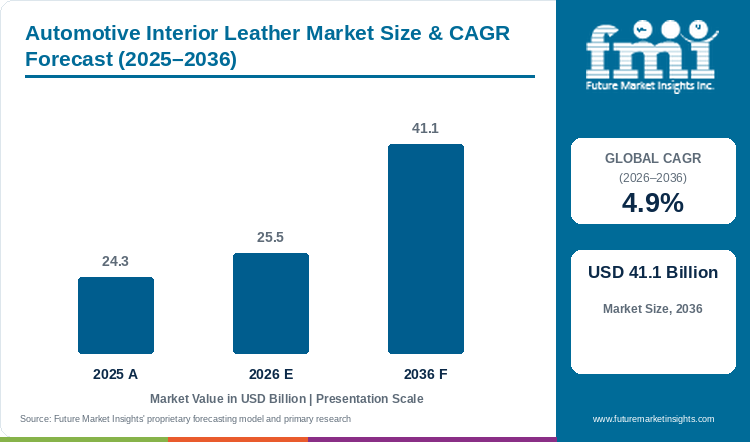
The automotive interior leather market is estimated at USD 24.3 billion in 2025 and is expected to reach USD 25.5 billion in 2026. Sales of automotive interior leather are projected to grow at a 4.9% CAGR between 2026 and 2036 and reach USD 41.1 billion by 2036.
Demand for automotive interior leather from carmakers and owners is estimated at USD 24.3 billion in 2025 and, with more trim packages on new models, is predicted to reach USD 25.5 billion in 2026. Through 2036, FMI's model shows a 4.9% CAGR that is likely to take automotive interior leather sales to USD 41.1 billion. An adoption review of new car programmes points to PU leather as the first pick on mid-priced electric models, since PU weighs less than hide and keeps one colour across large panels. Kolon Industries completed a PU synthetic leather line in South Korea in July 2026, after investing about KRW 24 billion, for seats, door trims and center consoles.[1] Coated-fabric makers are adding PU capacity close to car plants, so a carmaker can move a model from hide to PU at the next facelift.
Competition for cover business is moving into complete seat contracts. Lear reported Q2 2026 net sales of USD 6.2 billion, 3% higher, and named new seat programme awards with Audi.[2] A seat maker holding a full seat award chooses the cover material and can put several tanneries into one tender. Regional growth in automotive interior leather is following different paths, with European premium brands keeping hide on flagship trims and volume electric models moving to PU. Independent tanneries without cut-and-sew lines face the hardest squeeze, as each lost award removes hide volume for the life of a model.
Key Market Trends & Insights
- Lighter weight and steady colour put PU leather ahead on material type, with an expected 55% of 2026 sales against about 31.4% for genuine leather.
- Application sales in 2026 are likely to favour seats and center stack trim at 34.3%, and door panels and armrests follow at an estimated 21.6%. Lear named new seat programme awards with Audi in the July 2026 results release.[2]
- Owners replacing worn covers or upgrading cloth seats keep the aftermarket at an estimated 42% of channel sales in 2026, with carmaker supply holding the other 58%.
Regional Highlights
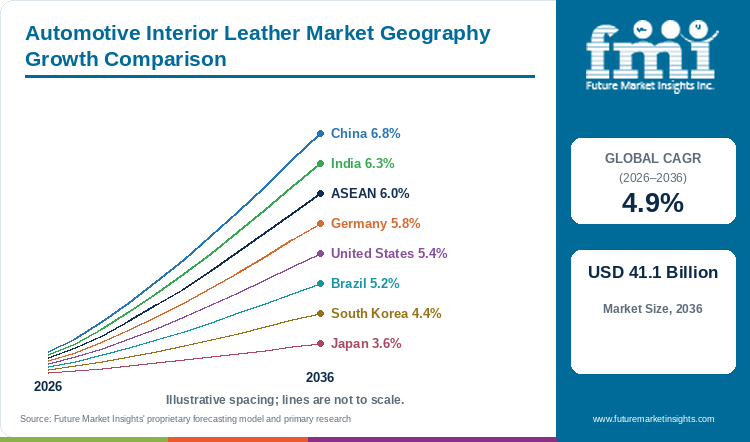
- China is first among the countries covered, with a 6.8% CAGR as electric car output and vehicle exports expand.
- India and ASEAN follow within one point of China, on fast passenger car growth and assembly incentives. Japan, with a flat home car market adding little new trim volume, is expected to grow at 3.6%, the lowest rate in the FMI country table.
- Vehicle plants in Brazil produced 2.17 million units in the nine months to September 2026, up 8.7% on the same months of 2025, Anfavea figures show.[3]
Market Size & Forecast
Table 1: Market Size and Forecast for the Automotive Interior Leather Market (USD billion and percentage), 2025 to 2036
| Metric | Value |
|---|---|
| 2025 Market Size | USD 24.3 billion |
| Estimated Market Size in 2026 | USD 25.5 billion |
| Projected Market Size by 2036 | USD 41.1 billion |
| CAGR, 2026 to 2036 | 4.9% |
| Added Revenue, 2026 to 2036 | USD 15.6 billion |
| Market Expansion Multiple | 1.6x |
Tanneries and coated-fabric makers receive leather orders once a carmaker nominates the seat supplier for a model, and volume then follows the build rate of that model. China built 23.246 million vehicles in January to September 2026, and output of new energy vehicles grew by over 10% to 12.483 million units, CAAM figures show.[4] Premium nameplates use the most hide per car, and with a 7.4% CAGR expected in the luxury car market, full-leather cabins keep a steady base among high-trim buyers. The FMI outlook gives the automotive interior leather market an added USD 15.6 billion by 2036, with sales expected to rise to 1.6 times the 2026 level. A slowdown in vehicle builds is the main risk, as leather volume per model is fixed once the seat supplier is chosen.
Electric Platforms, Seat Contracts and Hide Supply
Battery-electric cars accounted for 20% of EU registrations in January to May 2026, up from 15.3% in the same months of 2025, and hybrids for 37.8%, ACEA reported.[5] Quiet electric cabins with few buttons turn the seat and door surfaces into the main visible material, so carmakers pick finishes on look, weight and odour. The battery electric vehicle market is forecast to grow at a 15% CAGR, and every new BEV platform reopens the choice of cover material.
Hide supply for European car plants became simpler in July 2026. The European Commission adopted a delegated act that removes cattle hides, skins and leather, and also aircraft and motor vehicle seats, from the product list of the EU deforestation regulation, and the act entered a two-month scrutiny period.[6] Large operators face the regulation from 30 December 2026, so the change spares tanneries a due diligence step on each hide lot. Bridge of Weir, the Scottish Leather Group tannery, and Piston Interiors launched a complete leather interior service for US carmakers in October 2025, covering design, cutting, sewing and delivery of full cabins.[7] Tanneries are moving into cut-and-sew work, so a carmaker can buy a finished cover kit from one supplier.
Table 2: Vehicle Output, Supplier and Policy Indicators for the Automotive Interior Leather Market (units, growth and policy), 2026
| Indicator | Data Point | Relevance | Source |
|---|---|---|---|
| EU battery-electric share, January to May 2026 | 20%, up from 15.3% | New platforms reopen the cover choice. | [5] |
| China new energy vehicle output, January to September 2026 | 12.483 million units | Electric volume favours PU trim. | [4] |
| Lear net sales, Q2 2026 | USD 6,209.4 million; up 3% | Seat awards set cover volumes. | [2] |
| Kolon Industries PU line, Gimcheon Plant 1 | About KRW 24 billion invested | Korean PU capacity for seats and door trims. | [1] |
| India passenger vehicle sales, July to September 2026 | 1,360,687 units; up 30.7% | More cars need more seat covers. | [8] |
| Brazil vehicle production, January to September 2026 | 2.17 million units; up 8.7% | Latin American seat programmes grow. | [3] |
Analyst Perspective
“My read is that the seat award decides the cover material, and PU leather is gaining those awards on mid-priced electric cars as carmakers want low weight and one colour across large panels. Genuine leather will keep the flagship trims, and tanneries selling a finished, sewn cover in place of a raw hide will hold that business to the end of the forecast.”
- Nikhil Kaitwade, Principal Consultant, Future Market Insights.
How is the automotive interior leather market segmented?
The market is segmented into material type, application, sales channel, and region. PU leather is expected to lead material type with 55% share in 2026, and seats and center stack lead application with 34.3%.
By material type: genuine leather, PU leather, and PVC leather.
By application: seats and center stack, door panels and armrests, dashboards and instrument panels, steering wheels and gear knobs, headliners and pillars, and others.
By sales channel: OEM and aftermarket.
By region: car assembly, seat and trim plants in North America, Latin America, Western Europe, Eastern Europe, East Asia, South Asia and Pacific, and Middle East and Africa.
Why does PU leather lead automotive interior leather sales by material type?
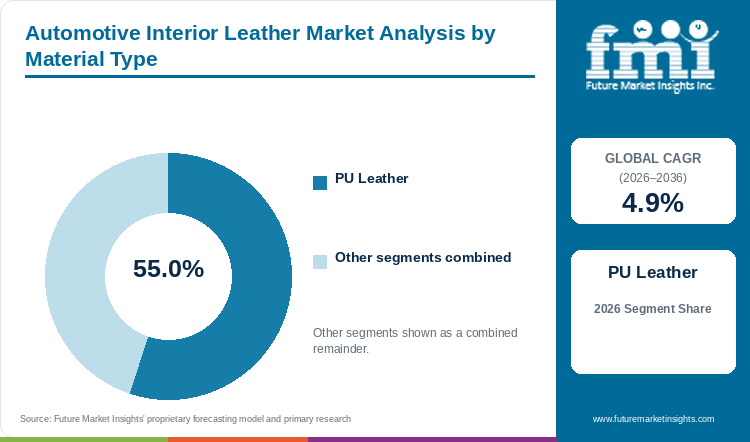
PU leather is expected to lead material type sales with 55% share in 2026, ahead of genuine leather at about 31.4% and PVC leather at roughly 13.6%.
Table 3: Material Type Share for the Automotive Interior Leather Market (percentage share), 2026
| Material Type | Estimated Share (2026) |
|---|---|
| PU Leather | 55% |
| Genuine Leather | 31.4% |
| PVC Leather | 13.6% |
| Total | 100.0% |
Table 4: Material Type Leadership and Market Growth for the Automotive Interior Leather Market (segment and CAGR percentage), 2026 to 2036
| Metric | Value |
|---|---|
| Global CAGR (2026 to 2036) | 4.9% |
| Leading Segment | PU Leather |
Weight and colour match decide the trim on mid-priced electric models, and on those programmes PU leather is expected to lead with 55% share in 2026. Against genuine leather, an estimated 31.4%, PU costs less per square metre, comes off a roll in even widths and has no scars or insect marks to cut around, so volume models choose PU for seat centres and door inserts. Genuine leather keeps the premium trims. Buyers of flagship cars pay for grain, smell and ageing, and Bridge of Weir now sells complete sewn interiors to US carmakers through Piston Interiors.[7] Against PVC leather, near 13.6%, PU feels softer and lets more air through on a seat, and PVC holds the low-cost end in vans, trucks and entry cars for wipe-clean wear. Kolon Industries added PU capacity in South Korea in July 2026 for seats, door trims and consoles.[1] A carmaker planning a mid-priced electric model will specify PU first and keep hide as a paid option.
- Seat inserts, door trims, armrests and console lids use most of the PU volume.
- Kolon Industries said the new Gimcheon line cuts benzene and toluene use and runs on continuous process equipment.[1]
Why do seats and center stack lead automotive interior leather sales by application?
With 34.3% of application sales likely in 2026, seats and center stack lead door panels and armrests at about 21.6% and dashboards and instrument panels at roughly 15.2%.
Table 5: Application Share for the Automotive Interior Leather Market (percentage share), 2026
| Application | Estimated Share (2026) |
|---|---|
| Seats and Center Stack | 34.3% |
| Door Panels and Armrests | 21.6% |
| Dashboards and Instrument Panels | 15.2% |
| Others | 10.4% |
| Steering Wheels and Gear Knobs | 10.3% |
| Headliners and Pillars | 8.2% |
| Total | 100.0% |
A seat uses the largest cut area in the cabin and the console lid meets the driver's arm on every trip, so seats and center stack are projected to lead with 34.3% share in 2026 across volume and premium models. Door panels and armrests, about 21.6%, take smaller inserts and often use PU even on cars with hide seats. Dashboards and instrument panels, near 15.2%, need a skin that resists sunlight and heat, and many carmakers use stitched PU there for that reason. Steering wheels and gear knobs, around 10.3%, use thick, hard-wearing hide in small pieces. Headliners and pillars, an estimated 8.2%, mostly use fabric or microfibre, and other parts account for 10.4%. Lear reported new and conquest seat awards with Audi and a complete seat award with Leapmotor in South America in July 2026.[2] Trim buyers will keep most of the leather budget on seats, since the seat is the first surface a buyer touches in the showroom.
- Front and rear seat cushions, backrests, bolsters and console lids make up the leading group.
- A complete seat award with Leapmotor in South America was among the Lear awards named for Q2 2026.[2]
Why does OEM supply lead automotive interior leather sales by sales channel?
OEM supply is expected to account for 58% of channel sales in 2026, against about 42% for the aftermarket.
Table 6: Sales Channel Share for the Automotive Interior Leather Market (percentage share), 2026
| Sales Channel | Estimated Share (2026) |
|---|---|
| OEM | 58% |
| Aftermarket | 42% |
| Total | 100.0% |
Every new car with a leather or PU trim package ships with covers fitted at the seat plant, and for that reason OEM supply is estimated to lead with 58% share in 2026. The aftermarket, about 42%, serves owners who replace worn covers, refit cloth seats with leather kits or restore classic cabins, and owners who personalise cabins keep the decorative car accessories market on a projected 5.9% CAGR. Vehicle sales in Brazil reached 281.4 thousand units in September 2026, the highest monthly figure since December 2014, and each sale adds a car that will need new covers later in life.[3] A tannery choosing between channels will chase OEM contracts for volume and serve the aftermarket for margin.
- Retrofit seat kits, steering wheel wraps and full cabin restorations form most aftermarket sales.
- Cutting, sewing, perforating and quilting of complete leather interiors are offered by Bridge of Weir and Piston Interiors, The Manufacturer reported in October 2025.[7]
What are the drivers, restraints, and opportunities in the automotive interior leather market?
Electric and premium cabins make seat and door surfaces the main design feature, which keeps carmakers paying for good trim. Flat car sales in mature markets cap growth of the automotive interior leather market, and recycled and low-emission covers give suppliers new contracts.
- Driver: Minimalist electric cabins put the seat and door covers in full view, so carmakers spend more design effort and budget on trim material.
- Restraint: Car sales growth in Japan and much of Europe is slow, which limits the number of new seats that need covers.
- Opportunity: Carmakers chasing recycled content and lower cabin emissions reward cover suppliers with cleaner PU processes and recycled backings.
Electric Cabins Put Seat Covers on Display
Electric car launches are changing what buyers see first inside a car. New energy vehicles accounted for 61.6% of new car sales in China in September 2026, the third month above 60%, CAAM said.[4] In the EU, battery-electric cars reached 20% of registrations in the first five months of 2026.[5] Each electric model brings a fresh interior design, and carmakers are using those launches to move trim from hide to PU on volume grades.
Slow Mature Car Markets Hold Back Volume
Tanneries and PU makers face flat home markets in Japan and parts of Europe. New vehicle sales in Japan rose only 1.3% to 433,683 units in September 2026, and passenger cars grew 0.9%, Just Auto reported from JAMA data.[9] Petrol car registrations in the EU fell 18.2% over January to May 2026.[5] With fewer new cars in mature markets, tanneries rely on model mix, and each premium launch carries more weight in annual order volume. Slow home car markets are one reason the FMI country table places Japan and South Korea below the global rate.
Recycled and Low-Emission Covers Open Contracts
Demand for cleaner cabin materials is giving cover suppliers a new reason to compete. Kolon Industries built hazardous-substance reduction technology into the Gimcheon PU line, reducing benzene and toluene.[1] Recycled trim is also spreading, and the automotive interior trim components using PCR market is forecast to expand at a 10.4% CAGR. Suppliers with low-solvent PU and recycled backings will gain specification as carmakers report cabin air and recycled content, unlocking fresh demand for cleaner cabin covers.
Which country CAGRs are profiled in the automotive interior leather market?
Table 7: Country CAGR Comparison for the Automotive Interior Leather Market (CAGR percentage), 2026 to 2036
| Country | CAGR (2026 to 2036) |
|---|---|
| China | 6.8% |
| India | 6.3% |
| ASEAN | 6% |
| Germany | 5.8% |
| United States | 5.4% |
| Brazil | 5.2% |
| South Korea | 4.4% |
| Japan | 3.6% |
How do country-level CAGRs compare in the automotive interior leather market?
Passenger vehicle sales in India grew 30.7% to 1,360,687 units in July to September 2026, after GST 2.0 price cuts, SIAM said.[8] FMI's model shows China ahead at 6.8%, with India close behind at 6.3% on that sales growth. ASEAN follows at 6%, helped by assembly incentives and wider use of synthetic trim in Indonesia and Vietnam. Germany is the quickest mature market at 5.8%, as luxury brands keep hide in flagship cabins. The United States grows at 5.4% on premium SUVs and pickups, and Brazil at 5.2% stays just 0.3 points over the global rate. Much Korean trim volume goes to export plants, leaving South Korea at 4.4%, half a point short of the world figure. Japan grows slowest at 3.6%. Country-level differences are shaping the automotive interior leather outlook, as electric volume in Asia raises PU orders and European premium brands protect hide.
- Electric car output and exports carry China.
- GST 2.0 price cuts brought more Indian buyers into showrooms.
- Incentives for local assembly favour synthetic trim across ASEAN.
- German luxury brands keep hide on top trims.
- Premium SUV and pickup cabins set the American pace.
- Brazil gains new seat programmes as Chinese brands build there.
- Korean coated-fabric makers supply export car plants.
- A flat home car market slows Japan.
Full report country CAGRs cover: Asian electric car production gives China, India and ASEAN the three highest rates in the table, and Germany, the United States and Brazil grow a little over the 4.9% global CAGR. South Korea and Japan are below that rate, and every other listed country is reported within the regional figures.
Country-wise Analysis
China Automotive Interior Leather Market Outlook (2026 to 2036)
Car plants in China built 2.99 million vehicles in September 2026 alone, and exports grew 61.4% to 1.053 million units in the month, CAAM data show.[4] Demand for automotive interior leather in China is projected to rise at a 6.8% CAGR. Export models built for Europe and Latin America carry fuller trim packages than many domestic entry cars, so each exported car adds cover volume.
Key takeaway: Exports and electric models make China the largest source of new cover volume.
India Automotive Interior Leather Market Outlook (2026 to 2036)
Lower car prices after GST 2.0 are drawing first-time buyers into Indian showrooms. Passenger vehicle sales reached 454,574 units in September 2026, up 21.8%, and SIAM also cited financing support and rural buying.[8] A 6.3% CAGR is projected for India, as carmakers offer PU and leatherette seats on mid-variant SUVs for buyers moving up from entry hatchbacks. Local coated-fabric makers supply most of that PU.
Key takeaway: Mid-variant SUVs with PU seats carry India.
ASEAN Automotive Interior Leather Market Outlook (2026 to 2036)
Car assembly in Indonesia and Vietnam is growing under local content incentives, and Japanese and Chinese brands are adding seat and trim suppliers near those plants. ASEAN is projected at a 6% CAGR, and PU and PVC covers make up most new volume, as local buyers favour price and easy cleaning in hot weather.
Key takeaway: Local assembly and synthetic trim lead growth in ASEAN.
Germany Automotive Interior Leather Market Outlook (2026 to 2036)
Battery-electric registrations in Germany rose 40.9% in January to May 2026, and petrol registrations fell 18.5%, ACEA reported.[5] For Germany, the FMI outlook gives a 5.8% CAGR, the highest among the mature markets. German premium brands keep Nappa hide on flagship electric saloons and SUVs, and tanneries such as Boxmark and Bader supply those programmes.
Key takeaway: Premium electric models keep hide in German cabins.
United States Automotive Interior Leather Market Outlook (2026 to 2036)
Michigan-based Lear raised the midpoint of the 2026 outlook and set full-year net sales guidance of USD 23,540 million to USD 24,010 million.[2] Premium SUVs, pickups and electric sedans carry American demand for automotive interior leather, which is expected to grow at a 5.4% CAGR. Every US-built Lincoln model uses Bridge of Weir hide.[7] Katzkin serves owners who add leather to dealer stock and used cars.
Key takeaway: Premium trucks and SUVs set the American outlook, and retrofit kits add aftermarket volume.
Brazil Automotive Interior Leather Market Outlook (2026 to 2036)
Anfavea counted 268.3 thousand vehicles built in Brazil in September 2026, 10.2% higher than a year earlier.[3] Chinese carmakers building in South America are placing complete seat contracts, and Lear named a Leapmotor award in the region.[2] New seat programmes bring PU and leather cover orders to local cut-and-sew plants, and the Brazilian outlook is a 5.2% CAGR.
Key takeaway: New seat programmes from new carmakers support Brazil.
South Korea Automotive Interior Leather Market Outlook (2026 to 2036)
Kolon Industries held the completion ceremony for a PU synthetic leather line at Gimcheon on 28 July 2026 and said the line will support overseas expansion.[1] Korean carmakers build a growing share of cars abroad, and South Korea is forecast at a 4.4% CAGR, below the global rate. Korean cover makers will follow those plants with exports and local lines.
Key takeaway: Export-led PU capacity keeps South Korea active despite slower home growth.
Japan Automotive Interior Leather Market Outlook (2026 to 2036)
Domestic new vehicle sales in Japan grew 2.3% to 3,545,421 units in the first nine months of 2026, including 1,128,193 Toyota vehicles, Just Auto reported.[9] Hybrids lead Japanese showrooms, and the hybrid vehicles market is predicted to grow at a 21.5% CAGR. Japanese hybrids mostly use fabric and synthetic leather, so hybrid growth adds little hide volume. Seiren supplies QUOLE synthetic leather to those programmes, and Japan closes the country table with a projected 3.6% CAGR.
Key takeaway: Flat car sales and fabric-heavy hybrids keep Japan slow.
Who are the notable companies in the automotive interior leather market?
Lear, Seiren, GST AutoLeather, Boxmark, Bader, DK Leather, Scottish Leather Group, Katzkin, Mayur Uniquoters and Kolon Industries are the profiled companies.
FMI profiles ten companies across seat makers, tanneries and synthetic leather producers. Lear, the seat maker behind Eagle Ottawa leather, reported Q2 2026 net income of USD 193 million against USD 165 million a year earlier.[2] Scottish Leather Group supplies luxury carmakers from Scotland through Bridge of Weir.[7] Kolon Industries invested about KRW 24 billion in a new PU line.[1] Seiren, GST AutoLeather, Boxmark, Bader, DK Leather, Katzkin and Mayur Uniquoters complete the group.
- Seat makers and integrated suppliers: Lear and Katzkin.
- Genuine leather tanneries: GST AutoLeather, Boxmark, Bader, DK Leather and Scottish Leather Group.
- Synthetic leather producers: Seiren, Kolon Industries and Mayur Uniquoters.
Competitive Benchmarking: Automotive Interior Leather Market
Table 8: Competitive Benchmarking for the Automotive Interior Leather Market (qualitative documentation ratings), 2026
| Company | Genuine Leather | Synthetic Leather | Cut and Sew | Recency |
|---|---|---|---|---|
| Lear | High | Medium | High | High |
| Scottish Leather Group | High | Low | High | Medium |
| Kolon Industries | Low | High | Low | High |
| Boxmark | High | Low | Medium | Low |
| Seiren | Low | High | Medium | Low |
Scores in the FMI benchmark are High when several dated releases from 2025 or 2026 describe that capability, and no score is a guide to share.
Key Developments in the Automotive Interior Leather Market
- On 15 October 2026, Autocar Professional reported SIAM data showing Indian passenger vehicle sales up 30.7% for July to September.[8]
- On 12 October 2026, CAAM said new energy vehicles reached 61.6% of new car sales in China in September.[4]
- On 7 October 2026, Anfavea reported the highest monthly vehicle sales in Brazil since December 2014.[3]
- On 7 October 2026, Just Auto reported Japanese new vehicle sales up 1.3% in September.[9]
- On 31 July 2026, Lear raised the midpoint of the full-year outlook and named Audi and Leapmotor seat awards.[2]
- On 28 July 2026, Kolon Industries opened the PU synthetic leather line at Gimcheon Plant 1.[1]
- In July 2026, the European Commission adopted a delegated act removing leather and vehicle seats from the deforestation regulation product list.[6]
- Battery-electric cars accounted for 20% of EU registrations from January to May 2026, ACEA said on 23 June 2026.[5]
- On 17 October 2025, Bridge of Weir and Piston Interiors launched a complete leather interior service for US carmakers.[7]
Key Players in the Automotive Interior Leather Market
Seat Makers and Integrated Suppliers
- Lear
- Katzkin
Genuine Leather Tanneries
- GST AutoLeather
- Boxmark
- Bader
- DK Leather
- Scottish Leather Group
Synthetic Leather Producers
- Seiren
- Kolon Industries
- Mayur Uniquoters
Automotive Interior Leather Market - Report Scope
Table 9: Report Scope for the Automotive Interior Leather Market (coverage fields and definitions), 2026 to 2036
| Coverage field | Report scope |
|---|---|
| Market breakdown | Material type; application; sales channel; region |
| Quantitative units | USD billion |
| Market definition | Genuine, PU and PVC leather supplied as cut covers, skins and wraps for car, van and truck seats, door panels, dashboards, steering wheels, headliners and other interior parts, through carmaker and aftermarket channels. |
| Regions covered | North America; Latin America; Western Europe; Eastern Europe; East Asia; South Asia and Pacific; Middle East and Africa |
| Countries covered | United States; Canada; Brazil; Mexico; Argentina; Chile; Germany; France; United Kingdom; Italy; Spain; Benelux; Nordics; Poland; Czech Republic; Romania; Hungary; China; Japan; South Korea; India; ASEAN; Australia and New Zealand; GCC Countries; South Africa; Türkiye; Israel |
| Key companies profiled | Lear, Seiren, GST AutoLeather, Boxmark, Bader, DK Leather, Scottish Leather Group, Katzkin, Mayur Uniquoters, Kolon Industries |
| Forecast period | 2026 to 2036 |
Automotive Interior Leather Market - Research Methodology
Table 10: Research Methodology for the Automotive Interior Leather Market (research methods and approach), 2026 edition
| Method | Approach |
|---|---|
| Data Sources | Seat maker results, tannery and coated-fabric company news, vehicle association releases, EU regulatory notices and trade press from May 2025 onward. |
| Desk Research | Desk research covers vehicle output and sales, electric car shares, seat awards and cover material choices. |
| Market Sizing and Forecasting | Sizing starts from the 2026 base of USD 25.5 billion and the 4.9% CAGR for the forecast decade. |
| Data Validation | Vehicle figures, company results and policy dates were matched to the association, company or publication that released each figure. |
Automotive Interior Leather Market by Segments
Automotive Interior Leather Market segmented by Material Type:
- Genuine Leather
- PU Leather
- PVC Leather
Automotive Interior Leather Market segmented by Application:
- Seats and Center Stack
- Door Panels and Armrests
- Dashboards and Instrument Panels
- Steering Wheels and Gear Knobs
- Headliners and Pillars
- Others
Automotive Interior Leather Market segmented by Sales Channel:
- OEM
- Aftermarket
Automotive Interior Leather Market by Region
- North America
- United States
- Canada
- Latin America
- Brazil
- Mexico
- Argentina
- Chile
- Western Europe
- Germany
- France
- United Kingdom
- Italy
- Spain
- Benelux
- Nordics
- Eastern Europe
- Poland
- Czech Republic
- Romania
- Hungary
- East Asia
- China
- Japan
- South Korea
- South Asia and Pacific
- India
- ASEAN
- Australia and New Zealand
- Middle East and Africa
- GCC Countries
- South Africa
- Türkiye
- Israel
Research Sources and Bibliography
- [1] The Herald Business. (2026, July 29). Kolon Industries invests W24b to build PU synthetic leather production line. https://mbiz.heraldcorp.com/article/10823977
- [2] Lear Corporation. (2026, July 31). Lear reports second quarter 2026 results; raises full-year guidance. https://www.lear.com/newsroom/lear-reports-second-quarter-2026-results
- [3] Jornal do Comércio. (2026, October 7). Produção de veículos sobe 10,2% em setembro e vendas têm maior volume em 12 anos, diz Anfavea. https://www.jornaldocomercio.com/economia/2026/10/1266139-producao-de-veiculos-sobe-102-em-setembro-e-vendas-tem-maior-volume-em-12-anos-diz-anfavea.html
- [4] China Daily Hong Kong. (2026, October 12). China's NEV share of new car sales hits record 61.6% in September. https://www.chinadailyhk.com/article/640957
- [5] European Automobile Manufacturers' Association. (2026, June 23). New car registrations: +4% in May 2026 year-to-date; battery-electric 20% market share. https://www.acea.auto/pc-registrations/new-car-registrations-4-in-may-2026-year-to-date-battery-electric-20-market-share/
- [6] World Footwear. (2026, July 15). European Commission formally removes leather from EUDR scope. https://www.worldfootwear.com/news/european-commission-formally-removes-leather-from-eudr-scope/11640.html
- [7] The Manufacturer. (2025, October 17). Bridge of Weir and Piston Interiors launch full-service leather interior solution for US auto brands. https://www.themanufacturer.com/articles/bridge-of-weir-and-piston-interiors-mark-20-year-partnership-with-launch-of-complete-leather-interior-service-for-us-automakers/
- [8] Autocar Professional. (2026, October 15). Auto sales up 18.2% in July-Sept, PV sales rise 30.7%. https://www.autocarpro.in/news/auto-sales-up-182-percent-in-july-sept-pv-sales-rise-307-percent-135256
- [9] Just Auto. (2026, October 7). Japan vehicle sales up slightly in September. https://www.just-auto.com/newsletters/japan-vehicle-sales-up-slightly-in-september
This bibliography is provided for reader reference. The full report contains the complete reference list and detailed citations.
This Report Answers
- How big is the automotive interior leather market during 2026?
- What market size is projected by 2036?
- Which material type holds notable share?
- Which application holds notable share?
- Which countries have notable growth?
- Which companies are notable in the market?
Frequently Asked Questions
How large is the automotive interior leather market expected in 2026?
In FMI sizing, automotive interior leather sales are expected at USD 25.5 billion in 2026, up from an estimated USD 24.3 billion in 2025. The automotive interior leather market is projected to reach USD 41.1 billion by 2036.
What CAGR is projected for the automotive interior leather market through 2036?
Automotive interior leather sales are forecast to grow at a 4.9% CAGR over the decade, as new electric models and premium cabins reopen the choice of seat cover. PU leather gains the most volume.
Which material type holds a notable market share in 2026?
Material type sales are led by PU leather, expected at 55% share in 2026. Genuine leather follows at an estimated 31.4%.
Which application holds a notable market share in 2026?
On application, seats and center stack are likely to hold 34.3% share in 2026. Door panels and armrests follow at about 21.6%.
Which country has a notable expansion outlook through 2036?
With a 6.8% CAGR in the FMI country table, China has the strongest outlook on electric car output and exports. India follows at 6.3%.
Who are the key companies in the automotive interior leather market?
Lear, Scottish Leather Group, Boxmark, Bader, GST AutoLeather and DK Leather lead the seat and tannery group. Seiren, Kolon Industries, Mayur Uniquoters and Katzkin complete the profiled list.
Preview the report firsthand - request a free sample
Get SampleGet the brochure for pricing and purchase details.
Get PDFTable of Content
- Key Takeaways
- Market Size and CAGR
- Top Growth Driver
- Fastest Growing Segment
- Leading Region
- Key Companies
- Emerging Opportunities
- Executive Summary
- Global Market Outlook
- Demand-side Trends
- Supply-side Trends
- Technology Roadmap Analysis
- Analysis and Recommendations
- Analyst Perspective (What is happening? Why now? What should investors know?)
- Key Questions Answered
- How large is the market?
- What is the CAGR?
- What are key trends?
- Which region dominates?
- Who are the leaders?
- Market Overview
- Market Coverage / Taxonomy
- Market Definition / Scope / Limitations
- Research Methodology
- Chapter Orientation
- Analytical Lens and Working Hypotheses
- Market Structure, Signals, and Trend Drivers
- Benchmarking and Cross-market Comparability
- Market Sizing, Forecasting, and Opportunity Mapping
- Research Design and Evidence Framework
- Desk Research Programme (Secondary Evidence)
- Expert Input and Fieldwork (Primary Evidence)
- Tooling, Models, and Reference Databases
- Data Engineering and Model Build
- Quality Assurance and Audit Trail
- Market Background
- Market Dynamics (Drivers, Restraints, Opportunity, Trends)
- Scenario Forecast (Optimistic, Likely, Conservative)
- Impact Analysis
- AI Impact
- Sustainability Impact
- Regulatory Impact
- Technology Impact
- Consumer / Buyer Analysis
- Purchase Drivers
- Adoption Barriers
- Buyer Journey
- Opportunity Map Analysis
- Product Life Cycle Analysis
- Supply Chain Analysis
- Investment Feasibility Matrix
- Value Chain Analysis
- PESTLE and Porter's Analysis
- Regulatory Landscape
- Regional Parent Market Outlook
- Production and Consumption Statistics
- Import and Export Statistics
- Global Market Analysis and Forecast, 2021 to 2036
- Historical Market Size Value (USD Billion) Analysis, 2021 to 2025
- Current and Future Market Size Value (USD Billion) Projections, 2026 to 2036
- Y-o-Y Growth Trend Analysis
- Absolute $ Opportunity Analysis
- Global Market Pricing Analysis, 2021 to 2036
- Global Market Analysis and Forecast, By Material Type, 2021 to 2036
- Introduction / Key Findings
- Historical Market Size Value (USD Billion) Analysis By Material Type, 2021 to 2025
- Current and Future Market Size Value (USD Billion) Analysis and Forecast By Material Type, 2026 to 2036
- Genuine Leather
- PU Leather
- PVC Leather
- Y-o-Y Growth Trend Analysis By Material Type, 2021 to 2025
- Absolute $ Opportunity Analysis By Material Type, 2026 to 2036
- Global Market Analysis and Forecast, By Application, 2021 to 2036
- Introduction / Key Findings
- Historical Market Size Value (USD Billion) Analysis By Application, 2021 to 2025
- Current and Future Market Size Value (USD Billion) Analysis and Forecast By Application, 2026 to 2036
- Seats and Center Stack
- Door Panels and Armrests
- Dashboards and Instrument Panels
- Steering Wheels and Gear Knobs
- Headliners and Pillars
- Others
- Y-o-Y Growth Trend Analysis By Application, 2021 to 2025
- Absolute $ Opportunity Analysis By Application, 2026 to 2036
- Global Market Analysis and Forecast, By Sales Channel, 2021 to 2036
- Introduction / Key Findings
- Historical Market Size Value (USD Billion) Analysis By Sales Channel, 2021 to 2025
- Current and Future Market Size Value (USD Billion) Analysis and Forecast By Sales Channel, 2026 to 2036
- OEM
- Aftermarket
- Y-o-Y Growth Trend Analysis By Sales Channel, 2021 to 2025
- Absolute $ Opportunity Analysis By Sales Channel, 2026 to 2036
- Global Market Analysis and Forecast, By Region, 2021 to 2036
- Introduction
- Historical Market Size Value (USD Billion) Analysis By Region, 2021 to 2025
- Current Market Size Value (USD Billion) Analysis and Forecast By Region, 2026 to 2036
- North America
- Latin America
- Western Europe
- Eastern Europe
- East Asia
- South Asia and Pacific
- Middle East and Africa
- Market Attractiveness Analysis By Region
- North America Market Analysis and Forecast, By Country, 2021 to 2036
- Historical Market Size Value (USD Billion) Trend Analysis By Market Taxonomy, 2021 to 2025
- Market Size Value (USD Billion) Forecast By Market Taxonomy, 2026 to 2036
- By Country
- United States
- Canada
- By Material Type
- By Application
- By Sales Channel
- By Country
- Market Attractiveness Analysis
- By Country
- By Material Type
- By Application
- By Sales Channel
- Key Takeaways
- Latin America Market Analysis and Forecast, By Country
- Historical Market Size Value (USD Billion) Trend Analysis By Market Taxonomy, 2021 to 2025
- Market Size Value (USD Billion) Forecast By Market Taxonomy, 2026 to 2036
- By Country
- Brazil
- Mexico
- Argentina
- Chile
- By Material Type
- By Application
- By Sales Channel
- By Country
- Market Attractiveness Analysis
- By Country
- By Material Type
- By Application
- By Sales Channel
- Key Takeaways
- Western Europe Market Analysis and Forecast, By Country
- Historical Market Size Value (USD Billion) Trend Analysis By Market Taxonomy, 2021 to 2025
- Market Size Value (USD Billion) Forecast By Market Taxonomy, 2026 to 2036
- By Country
- Germany
- France
- United Kingdom
- Italy
- Spain
- Benelux
- Nordics
- By Material Type
- By Application
- By Sales Channel
- By Country
- Market Attractiveness Analysis
- By Country
- By Material Type
- By Application
- By Sales Channel
- Key Takeaways
- Eastern Europe Market Analysis and Forecast, By Country
- Historical Market Size Value (USD Billion) Trend Analysis By Market Taxonomy, 2021 to 2025
- Market Size Value (USD Billion) Forecast By Market Taxonomy, 2026 to 2036
- By Country
- Poland
- Czech Republic
- Romania
- Hungary
- By Material Type
- By Application
- By Sales Channel
- By Country
- Market Attractiveness Analysis
- By Country
- By Material Type
- By Application
- By Sales Channel
- Key Takeaways
- East Asia Market Analysis and Forecast, By Country
- Historical Market Size Value (USD Billion) Trend Analysis By Market Taxonomy, 2021 to 2025
- Market Size Value (USD Billion) Forecast By Market Taxonomy, 2026 to 2036
- By Country
- China
- Japan
- South Korea
- By Material Type
- By Application
- By Sales Channel
- By Country
- Market Attractiveness Analysis
- By Country
- By Material Type
- By Application
- By Sales Channel
- Key Takeaways
- South Asia and Pacific Market Analysis and Forecast, By Country
- Historical Market Size Value (USD Billion) Trend Analysis By Market Taxonomy, 2021 to 2025
- Market Size Value (USD Billion) Forecast By Market Taxonomy, 2026 to 2036
- By Country
- India
- ASEAN
- Australia and New Zealand
- By Material Type
- By Application
- By Sales Channel
- By Country
- Market Attractiveness Analysis
- By Country
- By Material Type
- By Application
- By Sales Channel
- Key Takeaways
- Middle East and Africa Market Analysis and Forecast, By Country
- Historical Market Size Value (USD Billion) Trend Analysis By Market Taxonomy, 2021 to 2025
- Market Size Value (USD Billion) Forecast By Market Taxonomy, 2026 to 2036
- By Country
- GCC Countries
- South Africa
- Türkiye
- Israel
- By Material Type
- By Application
- By Sales Channel
- By Country
- Market Attractiveness Analysis
- By Country
- By Material Type
- By Application
- By Sales Channel
- Key Takeaways
- Key Countries Market Analysis
- United States
- Pricing Analysis
- Market Share Analysis, 2025
- By Material Type
- By Application
- By Sales Channel
- Canada
- Pricing Analysis
- Market Share Analysis, 2025
- By Material Type
- By Application
- By Sales Channel
- Mexico
- Pricing Analysis
- Market Share Analysis, 2025
- By Material Type
- By Application
- By Sales Channel
- Brazil
- Pricing Analysis
- Market Share Analysis, 2025
- By Material Type
- By Application
- By Sales Channel
- Chile
- Pricing Analysis
- Market Share Analysis, 2025
- By Material Type
- By Application
- By Sales Channel
- Germany
- Pricing Analysis
- Market Share Analysis, 2025
- By Material Type
- By Application
- By Sales Channel
- United Kingdom
- Pricing Analysis
- Market Share Analysis, 2025
- By Material Type
- By Application
- By Sales Channel
- Italy
- Pricing Analysis
- Market Share Analysis, 2025
- By Material Type
- By Application
- By Sales Channel
- Spain
- Pricing Analysis
- Market Share Analysis, 2025
- By Material Type
- By Application
- By Sales Channel
- France
- Pricing Analysis
- Market Share Analysis, 2025
- By Material Type
- By Application
- By Sales Channel
- India
- Pricing Analysis
- Market Share Analysis, 2025
- By Material Type
- By Application
- By Sales Channel
- ASEAN
- Pricing Analysis
- Market Share Analysis, 2025
- By Material Type
- By Application
- By Sales Channel
- Australia and New Zealand
- Pricing Analysis
- Market Share Analysis, 2025
- By Material Type
- By Application
- By Sales Channel
- China
- Pricing Analysis
- Market Share Analysis, 2025
- By Material Type
- By Application
- By Sales Channel
- Japan
- Pricing Analysis
- Market Share Analysis, 2025
- By Material Type
- By Application
- By Sales Channel
- South Korea
- Pricing Analysis
- Market Share Analysis, 2025
- By Material Type
- By Application
- By Sales Channel
- Poland
- Pricing Analysis
- Market Share Analysis, 2025
- By Material Type
- By Application
- By Sales Channel
- Hungary
- Pricing Analysis
- Market Share Analysis, 2025
- By Material Type
- By Application
- By Sales Channel
- Türkiye
- Pricing Analysis
- Market Share Analysis, 2025
- By Material Type
- By Application
- By Sales Channel
- South Africa
- Pricing Analysis
- Market Share Analysis, 2025
- By Material Type
- By Application
- By Sales Channel
- United States
- Market Structure Analysis
- Competition Dashboard
- Competition Benchmarking
- Market Share Analysis of Top Players
- By Regional
- By Material Type
- By Application
- By Sales Channel
- Emerging Startups
- Innovation Benchmarking
- Competition Analysis
- Competition Deep Dive
- Lear
- Overview
- Product Portfolio
- Profitability by Market Segments
- Sales Footprint
- Strategy Overview
- Marketing Strategy
- Product Strategy
- Channel Strategy
- Scottish Leather Group
- Kolon Industries
- Boxmark
- Seiren
- Katzkin
- GST AutoLeather
- Bader
- DK Leather
- Mayur Uniquoters
- Lear
- Case Studies
- Success Stories
- Recent Developments
- Competition Deep Dive
- Assumptions & Acronyms Used


