

- Market Size (2026)
- USD 14.3 Bn
- Forecast (2036)
- USD 23.1 Bn
- CAGR (2026 to 2036)
- 4.9%
How big is Bakery Ingredients & Flour Improver Market in 2026?
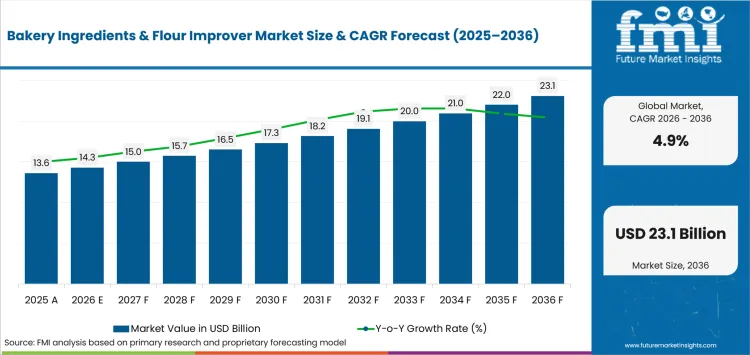
USD 14.3 billion in 2026 and USD 23.1 billion by 2036 at a 4.9% CAGR.
Sales of bakery ingredients and flour improver products are projected to expand at 4.9% CAGR from 2026 to 2036. Market value is expected to rise from USD 14.3 billion in 2026 to USD 23.1 billion by 2036. Industrial bakeries buy improvers when one formula keeps dough handling steady at normal line speed. USDA NASS reported in May 2026 that USA mills ground 222 million bushels of wheat for flour in the first quarter and produced 103 million hundredweight of flour.
Commercial approval rarely starts with a broad ingredient claim. Enzymes and emulsifiers are expected to prove that performance holds through storage and full production. EFSA published a February 2026 safety evaluation for an endo-1,4-beta-xylanase food enzyme from Trichoderma citrinoviride strain TCLSC. That shows why enzyme identity and intended use remain part of bakery ingredient approval. Sales are expected to expand when ingredient companies pair trial results with clear local regulatory files.
Key Takeaways of Bakery Ingredients & Flour Improver Market
- Demand for bakery ingredients and flour improvers is shaped by the need for consistent dough handling, product quality, shelf life, and process stability across changing flour batches and high-speed bakery production.
- By type, Flour Treatment Agents hold 42.1% share in 2026, while Bread accounts for 40.9% share in 2026 within application, reflecting the role of flour correction in dough processing and the high production frequency of bread lines.
- Enzymes, emulsifiers, and leavening systems serve targeted requirements involving dough strength, freshness, softness, and processing performance across bakery formulations.
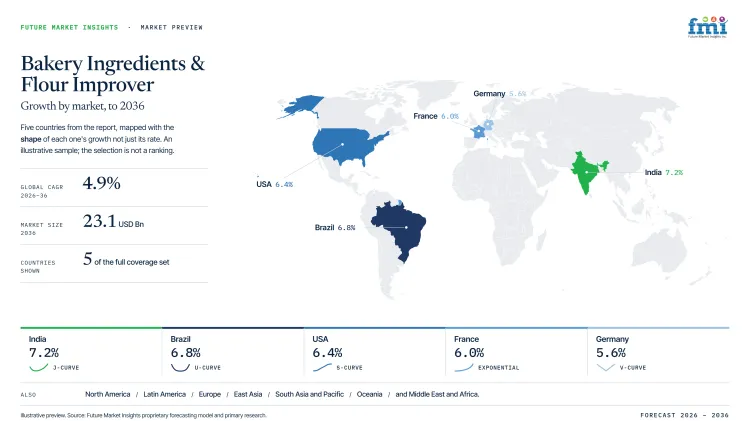
- India records the highest country CAGR at 7.2% through 2036, followed by Brazil at 6.8% and the United States at 6.4%, reflecting differences in packaged-bakery production, flour availability, industrial capacity, and ingredient qualification practices.
- Competition centers on Puratos, Corbion, Lesaffre, AB Mauri, IFF, Novonesis, Kerry, and dsm-firmenich, with competitive positioning spanning bakery improvers, yeast expertise, enzyme systems, functional ingredients, clean-label solutions, and technical application support.
- Flour variability, clean-label requirements, regulatory documentation, plant-scale validation, and the ability to maintain performance across production conditions remain key considerations for bakery ingredient selection.
Analyst Perspective
"The bakery ingredients & flour improver market is increasingly defined by consistent plant-scale performance rather than laboratory results alone. Bakeries are evaluating dough behavior, product quality, shelf life, and rejection rates across changing flour lots and production conditions. Suppliers that demonstrate formulation consistency, practical dose guidance, and reliable technical support will be better positioned to secure long-term customer adoption."
- Nandini Roy Choudhury, Principal Analyst at Future Market Insights
Source: FMI's proprietary forecasting model and primary research
How is the Bakery Ingredients & Flour Improver Market segmented?
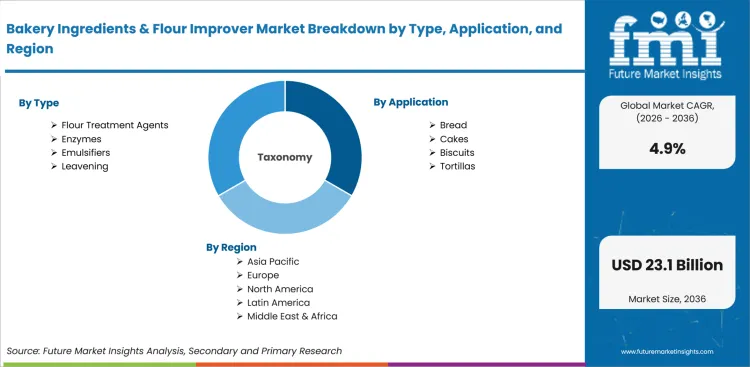
The bakery ingredients & flour improver industry is segmented by type, application, and region.
The segmentation framework separates ingredient function from the bakery product where performance is measured. Type analysis covers Flour Treatment Agents, Enzymes, Emulsifiers, and Leavening. Application analysis covers Bread, Cakes, Biscuits, and Tortillas. Regional analysis compares North America, Latin America, Europe, East Asia, South Asia and Pacific, Oceania, and the Middle East and Africa. This structure keeps formulation trials separate from approval cost and customer channel differences.
What supports demand for flour treatment agents within the type category?
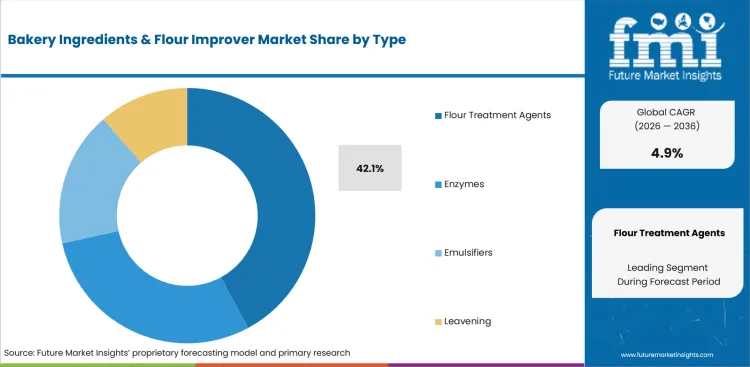
Flour Treatment Agents remain central because they address the first gap between flour specification and bakery output. The wider flour improvers offers a useful comparison for this function. Bakery teams test these systems through dough strength and proofing stability before regular supply is approved.
- Flour Treatment Agents are expected to hold 42.1% share in 2026 due to their role in correcting flour variation before the dough reaches high-speed processing. Plant trials are expected to show steady handling and finished-bread quality.
- Commercial approval is expected to depend on application evidence that covers storage and mixing. Baking teams look for the same result across wheat lots and routine production schedules.
Why does bread lead the application category?
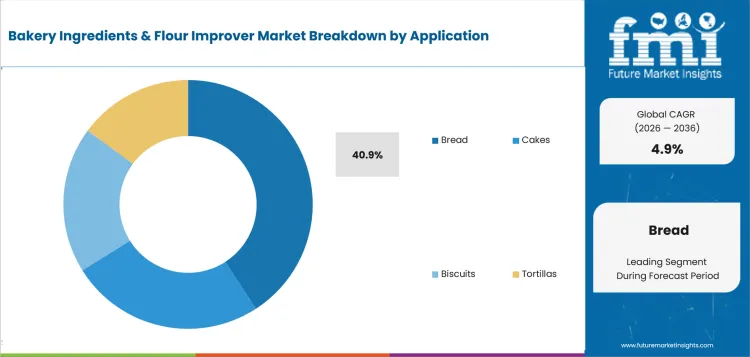
Bread remains the clearest application for improver trials because performance is measured through loaf volume and crumb softness. High-volume bread lines turn small handling gains into visible production benefits.
- Bread is estimated to hold 40.9% share in 2026 because it has repeat production cycles where improver performance is tested often. Plant managers are able to compare softness and slicing results without changing the full recipe.
- Bread producers are expected to approve ingredients faster when the dose matches a clear production outcome. Shelf-life evidence and line-speed stability make the buying case easier to defend.
What are the drivers, restraints, and opportunities in the Bakery Ingredients & Flour Improver Market?
Bakery plants are expected to invest in flour improvers when ingredient systems deliver measurable dough control and support clearer local approval.
- Driver: High-volume bread production is expected to support repeat demand for flour treatment agents that reduce dough variation.
- Restraint: Ingredient-company approval remains slower when enzyme safety files and local label rules are incomplete.
- Opportunity: Shelf-life systems are expected to gain attention where bakeries want quality control without full recipe redesign.
High-volume bread production supports repeat ingredient purchases because each line is able to test the same formula many times. USDA and Statistics Canada reported in May 2026 that USA mills ground 907.2 million bushels of wheat for flour in 2025. That milling base gives bakery ingredient companies a broad route for plant trials. Purchases become repeatable when results hold across flour lots and regular production pressure.
The main restraint is documentation cost. European Commission Regulation (EU) 2017/2158 set mitigation measures and benchmark levels for acrylamide in relevant foods. Bakery ingredient companies need clear enzyme identity and intended-use files when they address browning or heat-process outcomes. A sound improver may still move slowly if the local dossier is incomplete.
The primary opportunity is concentrated in systems that protect bread quality without a full recipe redesign. The fermented food enzymes shows how enzyme systems support higher-volume bakery lines when the use case is clearly defined. Dough conditioners and shelf-life blends are expected to receive more trials where bakeries want softness and fewer product rejects. Wider approval depends on storage performance and process yield.
Which country CAGRs are profiled in the Bakery Ingredients & Flour Improver Market?
| Country | CAGR |
|---|---|
| India | 7.2% |
| Brazil | 6.8% |
| USA | 6.4% |
| France | 6.0% |
| Germany | 5.6% |
How do country-level CAGRs compare in the Bakery Ingredients & Flour Improver Market?
The country comparison shows a measured spread across five markets. India leads at 7.2% CAGR through 2036 and Brazil follows at 6.8%. The USA is estimated at 6.4%. France is projected at 6.0% and Germany records 5.6%. The 1.6 percentage-point spread shows that country ranking is best read with approval cost and bakery plant scale.
- India and Brazil lead the comparison and point to faster adoption in markets where organized bakery capacity still has room to expand.
- The USA follows closely because large flour milling and packaged bakery networks make trial evidence easier to convert into repeat orders.
- France remains above Germany although both countries operate within the European Union regulatory framework.
- Germany records the lowest CAGR in the five-country set but remains attractive for companies that support strict documentation and repeatable plant trials.
- The pattern is gradual. Every country still requires local application evidence before market share is expected to shift.
Markets with similar CAGRs may still present different entry conditions due to flour supply and bakery channel structure. The full report provides country-level analysis across North America, Latin America, Europe, East Asia, South Asia and Pacific, Oceania, and the Middle East and Africa.
Country-wise Analysis
- The United States combines large milling scale with packaged bakery networks that require repeatable line performance. Demand in the USA is projected to rise at 6.4% CAGR through 2036 due to industrial bread production and established ingredient qualification processes. Ingredient companies gain trust by documenting dose range and storage behavior because bakery groups often approve formulas across several plants. Commercial contracts need clear technical support terms before a trial becomes routine supply.
- Germany combines a stable milling base with bakery customers that expect strong documentation before changing ingredient systems. Demand in Germany is forecast to advance at 5.6% CAGR from 2026 to 2036 under European Union approval and acrylamide-control expectations. Destatis reported in May 2026 that winter wheat including spelt covered 2.9 million hectares and accounted for 48% of Germany's cereal area. That crop base gives millers and bakeries room to compare flour performance across local wheat streams. Ingredient companies gain time by preparing product files early because German bakery customers often test compliance and repeatability together. Local service teams remain important when a flour treatment agent needs adjustment during plant trials.
- France has a sizable wheat and milling base together with bakery customers that value texture and label clarity. Demand in France is projected to expand at 6.0% CAGR through 2036 as industrial bread and pastry producers test improvers for softness and process stability. Agreste reported in July 2026 that French soft wheat production was expected at 32.0 million tonnes. The figure shows why flour quality and crop variation remain central to improver selection. Ingredient companies require application data from local flour streams before making broader claims. Retail and private-label customers are expected to favor systems that protect eating quality without making the ingredient statement harder to explain.
- Brazil combines expanding packaged bakery demand with flour quality conditions that vary by region and import requirement. Demand in Brazil is anticipated to rise at 6.8% CAGR during the forecast period due to bakery modernization and the need for stable dough handling. IBGE reported in June 2026 that wheat production was estimated at 7.2 million tonnes for 2026. The same release noted a 7.8% decline from 2025 which raises attention to flour consistency. Improver companies gain preference when they pair formulation support with dependable distribution. Procurement teams are expected to ask for stronger trials when imported enzymes and local flour costs move at different speeds.
- India combines rising organized bakery output with a large wheat base and uneven plant capability across cities. Demand in India is forecast to increase at 7.2% CAGR through 2036 as packaged bread and bakery snacks require more consistent dough control. India's Ministry of Agriculture reported through PIB in May 2026 that wheat production was estimated at 120.657 million tonnes for 2025-26. That supply base supports flour availability for bakery expansion and local formulation work. Application labs are expected to matter because flour quality and bakery equipment differ widely across customers. Modular improver systems are expected to reduce approval risk when producers expand from regional plants to higher-volume lines.
Who are the notable companies in the Bakery Ingredients & Flour Improver Market?
Puratos, Lesaffre, AB Mauri, Corbion, IFF, Novonesis, Kerry, and dsm-firmenich are the notable companies shaping this market.
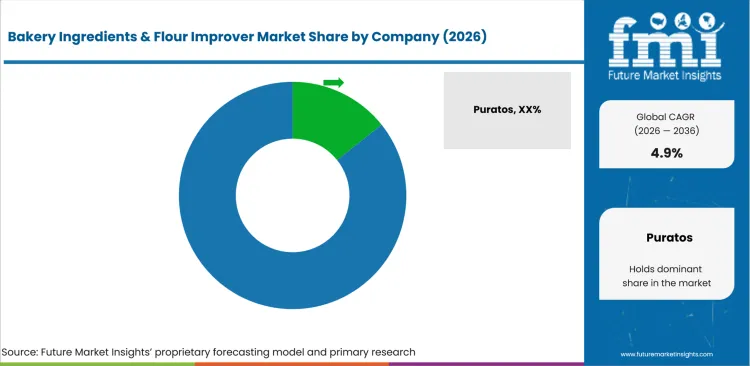
The competitive outlook combines bakery systems companies with yeast specialists and enzyme producers. Puratos competes through bakery improver systems and application support. Lesaffre and AB Mauri bring yeast-led baking capability and customer service. Corbion supports freshness and emulsifier replacement programs. IFF works with Novonesis and Kerry on enzyme and functional ingredient depth. dsm-firmenich adds capability for bakeries that need process control and documentation.
- Puratos and Corbion compete through bakery improvers and clean-label reformulation support. Their commercial advantage depends on proving softness and handling performance in normal customer plants.
- Lesaffre and AB Mauri support bakeries through yeast knowledge and breadmaking service. Their role is strongest when customers need flour analysis and process support during scale-up.
- IFF works with Novonesis and Kerry on enzyme depth. dsm-firmenich adds functional ingredient capability for bakery customers that require performance evidence before wider approval.
Competitive Benchmarking: Bakery Ingredients & Flour Improver Market
| Company | Flour Improver Strength | Bakery Application Support | Regulatory Readiness | Geographic Reach |
|---|---|---|---|---|
| Puratos | High | High | High | Global |
| Lesaffre | Medium | High | Medium | Global |
| AB Mauri | Medium | High | Medium | Global |
| Corbion | High | Medium | High | Global |
| IFF | High | Medium | High | Global |
| Novonesis | High | Medium | High | Global |
| Kerry | Medium | High | Medium | Global |
| dsm-firmenich | High | Medium | High | Global |
Key Developments in the Bakery Ingredients & Flour Improver Market
- In August 2025, IFF: IFF launched POWERFRESH ACE 2000 for the USA market. The company described it as a fresh-keeping enzyme for bread softness and resilience during shelf life.
- In September 2025, Corbion: Corbion introduced Ultra Fresh Plus 100 for bakeries working on cleaner labels. The company stated that the solution is designed to replace synthetic emulsifiers while preserving softness and sliceability.
- In December 2025, Lesaffre: Lesaffre opened an Industrial Baking Center in Shanghai. The center supports industrial customers with custom-formulated improvers and sensory analysis. It provides flour analysis for production-style testing.
Profiled Companies in the Bakery Ingredients & Flour Improver Market
Bakery Improver and Freshness Specialists
- Puratos
- Corbion
Yeast and Breadmaking Service Providers
- Lesaffre
- AB Mauri
Enzyme and Functional Ingredient Providers
- IFF
- Novonesis
- Kerry
- dsm-firmenich
Bakery Ingredients & Flour Improver Market - Report Scope
| Coverage field | Report scope |
|---|---|
| Market breakdown | Type, application, and region. |
| Quantitative Units | Revenue in USD Billion, CAGR in %. |
| Market Definition | Ingredients and improver systems used to improve dough handling, processing tolerance, volume, softness, shelf life, and consistency in bakery production. |
| Regions Covered | North America, Latin America, Europe, East Asia, South Asia and Pacific, Oceania, and Middle East and Africa. |
| Countries Covered | USA, Germany, France, Brazil, and India, with additional country coverage in the full report. |
| Key Companies Profiled | Puratos, Lesaffre, AB Mauri, Corbion, IFF, Novonesis, Kerry, and dsm-firmenich. |
| Forecast Period | 2026 to 2036. |
| Approach | Hybrid bottom-up and top-down market sizing supported by primary interviews and official desk research. |
Bakery Ingredients & Flour Improver Market - Research Methodology
| Method | Approach |
|---|---|
| Primary Research | FMI analysts gathered input from manufacturers, service providers, technology developers, distributors, end users, procurement teams, and subject-matter experts. Interviews examined purchasing decisions, product or service evaluation, adoption barriers, approval requirements, pricing considerations, and expectations for technical or commercial support. Respondents were also asked what evidence is required before a trial, pilot, or initial order develops into regular purchasing. |
| Desk Research | Desk research covered government statistics, regulatory publications, trade data, industry associations, technical literature, standards, company filings, product information, and official corporate announcements. Sources were reviewed for relevance, publication date, geographic coverage, and consistency with the defined market scope. Claims relating to performance, applications, approvals, capacity, investment, and commercial activity were retained only when supported by credible public evidence. |
| Market Sizing and Forecasting | The market model combined the baseline value with historical performance, segment structure, pricing and volume indicators, adoption levels, company participation, and country-level demand conditions. Forecast assumptions considered economic activity, investment trends, regulatory developments, technology adoption, purchasing cycles, supply availability, and barriers to wider market use. Segment and regional estimates were reconciled before the final market total was calculated. |
| Data Validation | Estimates were checked against multiple independent indicators, including public data, company activity, trade patterns, industry developments, and findings from primary interviews. Validation also tested whether products, services, applications, and company revenues fell within the defined market boundaries. Adjacent categories, unsupported claims, overlapping revenues, and activities without direct market relevance were excluded to reduce double counting and maintain consistency across segments and countries. |
Bakery Ingredients & Flour Improver Market by Segments
Bakery Ingredients & Flour Improver Market segmented by Type:
- Flour Treatment Agents
- Enzymes
- Emulsifiers
- Leavening
Bakery Ingredients & Flour Improver Market segmented by Application:
- Bread
- Cakes
- Biscuits
- Tortillas
Bakery Ingredients & Flour Improver Market by Region:
- North America
- United States
- Canada
- Latin America
- Brazil
- Mexico
- Argentina
- Chile
- Western Europe
- Germany
- France
- United Kingdom
- Italy
- Spain
- Benelux
- Nordics
- Eastern Europe
- Poland
- Czech Republic
- Romania
- Hungary
- East Asia
- China
- Japan
- South Korea
- South Asia and Pacific
- India
- ASEAN
- Australia and New Zealand
- Middle East and Africa
- GCC Countries
- South Africa
- Türkiye
- Israel
Research Sources and Bibliography
- Department of Agriculture, National Agricultural Statistics Service. (2026, May 1). Flour Milling Products.
- Department of Agriculture, National Agricultural Statistics Service, & Statistics Canada. (2026, May 13). North American Flour Milling Products 2025 Summary.
- European Food Safety Authority. (2026, February 26). Safety evaluation of the food enzyme endo-1,4-beta-xylanase from the non-genetically modified Trichoderma citrinoviride strain TCLSC.
- Statistisches Bundesamt. (2026, May). Cereal acreage in 2026 has stabilised further after its 2024 low.
- Brazilian Institute of Geography and Statistics. (2026, June). In May, IBGE forecasts harvest of 350.4 million tonnes for 2026.
- Puratos. (2025, May 7). Puratos brings a trio of transformative innovations to iba 2025.
- IFF. (2025, August 13). IFF launches POWERFRESH ACE 2000, a bread fresh-keeping solution that aces the shelf-life test.
- Corbion. (2025, September 2). Corbion leads clean-label reformulation forward at IBIE 2025.
- Lesaffre. (2025, December 15). Lesaffre opens new Industrial Baking Center in Shanghai.
This bibliography is provided for reader reference and is not exhaustive. The full report contains the complete reference list and detailed citations.
This Report Answers
- How large is the bakery ingredients & flour improver market in 2026 and 2036?
- Which type segment leads demand in 2026?
- Why does Bread hold the largest application share?
- How do enzymes and emulsifiers affect bakery formulation choices?
- Which country markets record the highest CAGRs through 2036?
- Which companies provide bakery improvers and enzyme support?
- What limits ingredient-company qualification and commercial rollout?
- How do clean-label and shelf-life requirements affect buying decisions?
Frequently Asked Questions
How big is the Bakery Ingredients and Flour Improver Market in 2026?
The bakery ingredients and flour improver market is valued at USD 14.3 billion in 2026 and is forecast to reach USD 23.1 billion by 2036, reflecting growing demand from industrial bakeries seeking consistent dough handling and finished-product quality across high-speed processing lines and changing flour batches.
What is the CAGR of the Bakery Ingredients and Flour Improver Market from 2026 to 2036?
The bakery ingredients and flour improver market is projected to grow at a CAGR of 4.9% between 2026 and 2036, supported by expanding industrial bakery production and the need to maintain consistent output through flour treatment agents, enzymes, and emulsifier systems across variable wheat supply conditions.
What is a notable restraint in the bakery ingredients & flour improver market?
Flour treatment agents account for 42.1% of the bakery ingredients and flour improver market by type in 2026, driven by their role in correcting flour variability before dough enters high-speed processing lines, reducing the operational impact of changing wheat quality and milling conditions.
Which country is growing fastest in the Bakery Ingredients and Flour Improver Market?
The bakery ingredients and flour improver market in India is projected to expand at a CAGR of 7.2% through 2036, ahead of Brazil at 6.8%, the USA at 6.4%, France at 6.0%, and Germany at 5.6%, reflecting rising packaged-bakery output, a large wheat supply base, and expanding organized production capacity.
Who are the leading companies in the Bakery Ingredients and Flour Improver Market?
Leading companies in the bakery ingredients and flour improver market include Puratos, Lesaffre, AB Mauri, Corbion, IFF, Novonesis, Kerry, and dsm-firmenich, spanning bakery improver systems, yeast-led breadmaking services, enzyme portfolios, and functional ingredient capabilities across global industrial bakery customers.
Preview the report firsthand - request a free sample
Get SampleGet the brochure for pricing and purchase details.
Get PDFTable of Content
- Key Takeaways
- Market Size and CAGR
- Top Growth Driver
- Fastest Growing Segment
- Leading Region
- Key Companies
- Emerging Opportunities
- Executive Summary
- Global Market Outlook
- Demand-side Trends
- Supply-side Trends
- Technology Roadmap Analysis
- Analysis and Recommendations
- Analyst Perspective (What is happening? Why now? What should investors know?)
- Key Questions Answered
- How large is the market?
- What is the CAGR?
- What are key trends?
- Which region dominates?
- Who are the leaders?
- Market Overview
- Market Coverage / Taxonomy
- Market Definition / Scope / Limitations
- Research Methodology
- Chapter Orientation
- Analytical Lens and Working Hypotheses
- Market Structure, Signals, and Trend Drivers
- Benchmarking and Cross-market Comparability
- Market Sizing, Forecasting, and Opportunity Mapping
- Research Design and Evidence Framework
- Desk Research Programme (Secondary Evidence)
- Expert Input and Fieldwork (Primary Evidence)
- Tooling, Models, and Reference Databases
- Data Engineering and Model Build
- Quality Assurance and Audit Trail
- Market Background
- Market Dynamics (Drivers, Restraints, Opportunity, Trends)
- Scenario Forecast (Optimistic, Likely, Conservative)
- Impact Analysis
- AI Impact
- Sustainability Impact
- Regulatory Impact
- Technology Impact
- Consumer / Buyer Analysis
- Purchase Drivers
- Adoption Barriers
- Buyer Journey
- Opportunity Map Analysis
- Product Life Cycle Analysis
- Supply Chain Analysis
- Investment Feasibility Matrix
- Value Chain Analysis
- PESTLE and Porter's Analysis
- Regulatory Landscape
- Regional Parent Market Outlook
- Production and Consumption Statistics
- Import and Export Statistics
- Global Market Analysis and Forecast, 2021 to 2036
- Historical Market Size Value (USD Billion) Analysis, 2021 to 2025
- Current and Future Market Size Value (USD Billion) Projections, 2026 to 2036
- Y-o-Y Growth Trend Analysis
- Absolute $ Opportunity Analysis
- Global Market Pricing Analysis, 2021 to 2036
- Global Market Analysis and Forecast, By Type, 2021 to 2036
- Introduction / Key Findings
- Historical Market Size Value (USD Billion) Analysis By Type, 2021 to 2025
- Current and Future Market Size Value (USD Billion) Analysis and Forecast By Type, 2026 to 2036
- Flour Treatment Agents
- Enzymes
- Emulsifiers
- Leavening
- Flour Treatment Agents
- Y-o-Y Growth Trend Analysis By Type, 2021 to 2025
- Absolute $ Opportunity Analysis By Type, 2026 to 2036
- Global Market Analysis and Forecast, By Application, 2021 to 2036
- Introduction / Key Findings
- Historical Market Size Value (USD Billion) Analysis By Application, 2021 to 2025
- Current and Future Market Size Value (USD Billion) Analysis and Forecast By Application, 2026 to 2036
- Bread
- Cakes
- Biscuits
- Tortillas
- Bread
- Y-o-Y Growth Trend Analysis By Application, 2021 to 2025
- Absolute $ Opportunity Analysis By Application, 2026 to 2036
- Global Market Analysis and Forecast, By Region, 2021 to 2036
- Introduction
- Historical Market Size Value (USD Billion) Analysis By Region, 2021 to 2025
- Current Market Size Value (USD Billion) Analysis and Forecast By Region, 2026 to 2036
- North America
- Latin America
- Western Europe
- Eastern Europe
- East Asia
- South Asia and Pacific
- Middle East & Africa
- Market Attractiveness Analysis By Region
- North America Market Analysis and Forecast, By Country, 2021 to 2036
- Historical Market Size Value (USD Billion) Trend Analysis By Market Taxonomy, 2021 to 2025
- Market Size Value (USD Billion) Forecast By Market Taxonomy, 2026 to 2036
- By Country
- USA
- Canada
- By Type
- By Application
- By Country
- Market Attractiveness Analysis
- By Country
- By Type
- By Application
- Key Takeaways
- Latin America Market Analysis and Forecast, By Country
- Historical Market Size Value (USD Billion) Trend Analysis By Market Taxonomy, 2021 to 2025
- Market Size Value (USD Billion) Forecast By Market Taxonomy, 2026 to 2036
- By Country
- Brazil
- Mexico
- Chile
- Rest of Latin America
- By Type
- By Application
- By Country
- Market Attractiveness Analysis
- By Country
- By Type
- By Application
- Key Takeaways
- Western Europe Market Analysis and Forecast, By Country
- Historical Market Size Value (USD Billion) Trend Analysis By Market Taxonomy, 2021 to 2025
- Market Size Value (USD Billion) Forecast By Market Taxonomy, 2026 to 2036
- By Country
- Germany
- UK
- Italy
- Spain
- France
- Nordic
- BENELUX
- Rest of Western Europe
- By Type
- By Application
- By Country
- Market Attractiveness Analysis
- By Country
- By Type
- By Application
- Key Takeaways
- Eastern Europe Market Analysis and Forecast, By Country
- Historical Market Size Value (USD Billion) Trend Analysis By Market Taxonomy, 2021 to 2025
- Market Size Value (USD Billion) Forecast By Market Taxonomy, 2026 to 2036
- By Country
- Russia
- Poland
- Hungary
- Balkan & Baltic
- Rest of Eastern Europe
- By Type
- By Application
- By Country
- Market Attractiveness Analysis
- By Country
- By Type
- By Application
- Key Takeaways
- East Asia Market Analysis and Forecast, By Country
- Historical Market Size Value (USD Billion) Trend Analysis By Market Taxonomy, 2021 to 2025
- Market Size Value (USD Billion) Forecast By Market Taxonomy, 2026 to 2036
- By Country
- China
- Japan
- South Korea
- By Type
- By Application
- By Country
- Market Attractiveness Analysis
- By Country
- By Type
- By Application
- Key Takeaways
- South Asia and Pacific Market Analysis and Forecast, By Country
- Historical Market Size Value (USD Billion) Trend Analysis By Market Taxonomy, 2021 to 2025
- Market Size Value (USD Billion) Forecast By Market Taxonomy, 2026 to 2036
- By Country
- India
- ASEAN
- Australia & New Zealand
- Rest of South Asia and Pacific
- By Type
- By Application
- By Country
- Market Attractiveness Analysis
- By Country
- By Type
- By Application
- Key Takeaways
- Middle East & Africa Market Analysis and Forecast, By Country
- Historical Market Size Value (USD Billion) Trend Analysis By Market Taxonomy, 2021 to 2025
- Market Size Value (USD Billion) Forecast By Market Taxonomy, 2026 to 2036
- By Country
- Kingdom of Saudi Arabia
- Other GCC Countries
- Türkiye
- South Africa
- Other African Union
- Rest of Middle East & Africa
- By Type
- By Application
- By Country
- Market Attractiveness Analysis
- By Country
- By Type
- By Application
- Key Takeaways
- Key Countries Market Analysis
- USA
- Pricing Analysis
- Market Share Analysis, 2025
- By Type
- By Application
- Canada
- Pricing Analysis
- Market Share Analysis, 2025
- By Type
- By Application
- Mexico
- Pricing Analysis
- Market Share Analysis, 2025
- By Type
- By Application
- Brazil
- Pricing Analysis
- Market Share Analysis, 2025
- By Type
- By Application
- Chile
- Pricing Analysis
- Market Share Analysis, 2025
- By Type
- By Application
- Germany
- Pricing Analysis
- Market Share Analysis, 2025
- By Type
- By Application
- UK
- Pricing Analysis
- Market Share Analysis, 2025
- By Type
- By Application
- Italy
- Pricing Analysis
- Market Share Analysis, 2025
- By Type
- By Application
- Spain
- Pricing Analysis
- Market Share Analysis, 2025
- By Type
- By Application
- France
- Pricing Analysis
- Market Share Analysis, 2025
- By Type
- By Application
- India
- Pricing Analysis
- Market Share Analysis, 2025
- By Type
- By Application
- ASEAN
- Pricing Analysis
- Market Share Analysis, 2025
- By Type
- By Application
- Australia & New Zealand
- Pricing Analysis
- Market Share Analysis, 2025
- By Type
- By Application
- China
- Pricing Analysis
- Market Share Analysis, 2025
- By Type
- By Application
- Japan
- Pricing Analysis
- Market Share Analysis, 2025
- By Type
- By Application
- South Korea
- Pricing Analysis
- Market Share Analysis, 2025
- By Type
- By Application
- Russia
- Pricing Analysis
- Market Share Analysis, 2025
- By Type
- By Application
- Poland
- Pricing Analysis
- Market Share Analysis, 2025
- By Type
- By Application
- Hungary
- Pricing Analysis
- Market Share Analysis, 2025
- By Type
- By Application
- Kingdom of Saudi Arabia
- Pricing Analysis
- Market Share Analysis, 2025
- By Type
- By Application
- Türkiye
- Pricing Analysis
- Market Share Analysis, 2025
- By Type
- By Application
- South Africa
- Pricing Analysis
- Market Share Analysis, 2025
- By Type
- By Application
- USA
- Market Structure Analysis
- Competition Dashboard
- Competition Benchmarking
- Market Share Analysis of Top Players
- By Regional
- By Type
- By Application
- Emerging Startups
- Innovation Benchmarking
- Competition Analysis
- Competition Deep Dive
- Puratos
- Overview
- Product Portfolio
- Profitability by Market Segments
- Sales Footprint
- Strategy Overview
- Marketing Strategy
- Product Strategy
- Channel Strategy
- Lesaffre
- AB Mauri
- Corbion
- IFF (Enzymes)
- Novonesis
- Kerry
- dsm-firmenich
- Puratos
- Case Studies
- Success Stories
- Recent Developments
- Competition Deep Dive
- Assumptions & Acronyms Used


