

- Market Size (2026)
- USD 1.7 Bn
- Forecast (2036)
- USD 3.6 Bn
- CAGR (2026 to 2036)
- 7.8%
How big is Sodium Reduction & Salt Replacement Ingredients Market in 2026?
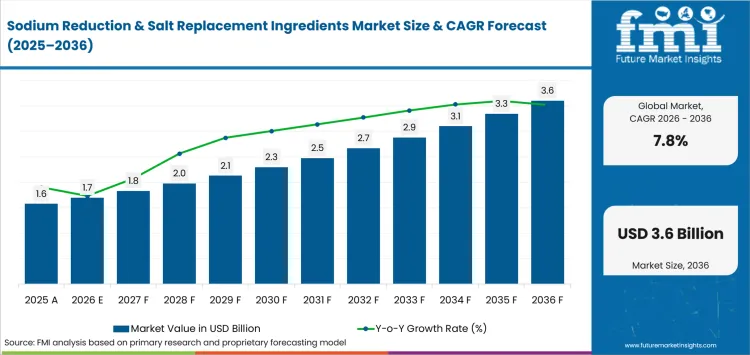
USD 1.7 billion in 2026 and USD 3.6 billion by 2036 at a 7.8% CAGR.
The sodium reduction and salt replacement ingredients industry is projected to expand at 7.8% CAGR between 2026 and 2036. Valuation is set to increase from USD 1.7 billion in 2026 to USD 3.6 billion by 2036. Food manufacturers are actively updating their recipes to meet strict nutrition targets for processed and prepared foods. In August 2024, USA Food and Drug Administration guidance established Phase II targets across 163 food groups. These new guidelines create additional formulation requirements for both ingredient suppliers and food-service operators. Resulting with supplier orders favoring mineral salts and specialized taste systems able to preserve delicious flavor during routine commercial production.
International food producers evaluate salt substitutes based on distinct regional priorities. Producers in the United States and Germany emphasize documented reformulation performance along with a dependable mineral-salt supply. Manufacturers in Japan and Australia favor locally adapted taste systems and responsive application assistance. Specialized flavor technologies prove highly effective in real-world food trials. In July 2025, Kerry reported for its application-specific Tastesense Salt formulations typically deliver a 25% to 30% sodium reduction in sauces. This proven performance offers a practical way to update recipes without losing flavor balance. Comparable application records helps producers move new formulations smoothly from test kitchens into scheduled commercial production batches.
Key Takeaways of Sodium Reduction & Salt Replacement Ingredients Market
- Demand for sodium reduction and salt replacement ingredients is driven by food producers balancing nutrition targets with flavour and texture, with preservation needs and processing performance guiding final supplier selection across familiar branded product reformulations.
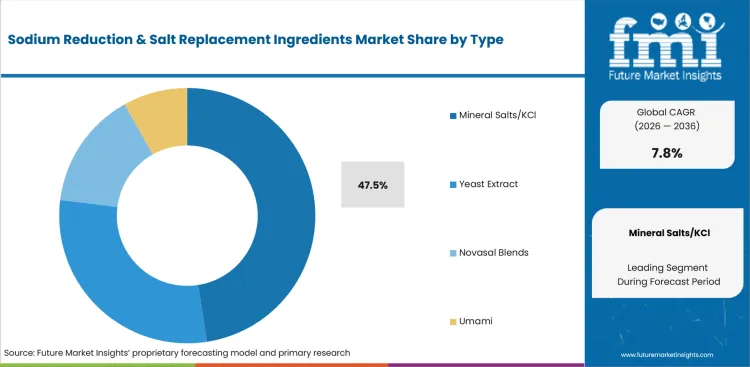
- Mineral salts and potassium chloride hold the leading share at 47.5% in 2026, backed by direct sodium substitution across bakery and meat recipes, with suppliers assessing masking performance and processing stability across complete formulas prior to commercial approval.
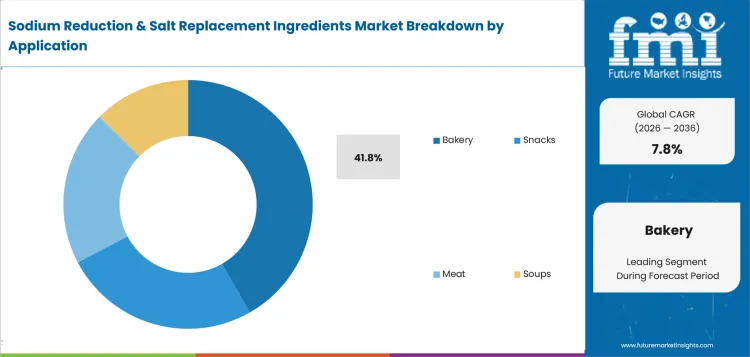
- Bakery leads the application category at 41.8% share in 2026, owing to frequent bread consumption and salt's functional role during dough processing, where formulation teams evaluate fermentation control and shelf performance across pilot and production batches.
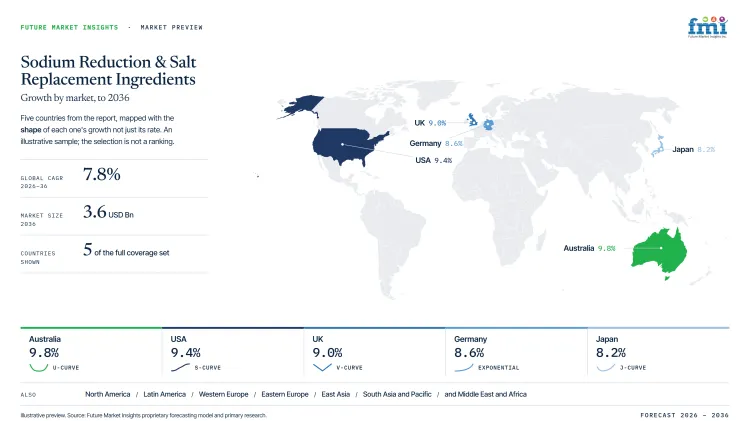
- Australia, the United States, and the United Kingdom record CAGRs of 9.8%, 9.4%, and 9.0% respectively through 2036, shaped by measured reformulation activity, federal sodium targets, and institutional menu specifications driving lower-sodium product development.
- Competition focuses on mineral-salt performance and taste rebuilding, with Nedmag and Tate & Lyle competing through mineral ingredients and formulation capability, Cargill and ADM serving customers through scaled production and international supply networks, and Kerry and dsm-firmenich competing through flavour modulation and application development.
Analyst Perspective
"The sodium reduction ingredients market is increasingly driven by formulation performance rather than sodium replacement alone. Food manufacturers are prioritizing ingredients that maintain taste, processing stability, and product quality while supporting nutrition objectives. Companies that demonstrate consistent application performance, regulatory compliance, and scalable manufacturing support will be better positioned to strengthen long-term commercial adoption."
— Nandini Roy Choudhury, Principal Consultant, Food and Beverages at Future Market Insights
Source: Future Market Insights analysis, 2026.
How is Sodium Reduction & Salt Replacement Ingredients Market segmented?
The sodium reduction and salt replacement ingredients industry is segmented by type, application, and region.
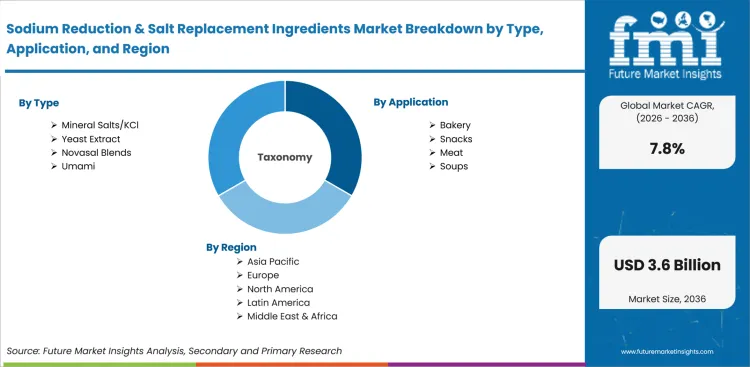
The sodium reduction and salt replacement ingredients market is segmented by type, application, and region. Type coverage includes Mineral Salts/KCl and Yeast Extract followed by Novasal Blends and Umami. Application coverage addresses Bakery and Snacks with Meat and Soups completing application analysis. Regional coverage includes North America and Latin America together with Western Europe and Eastern Europe. East Asia and South Asia and Pacific follow. Middle East and Africa complete geographic analysis across developing food-manufacturing systems.
Why do mineral salts/KCl shape type selection?
World Health Organization guidance published in January 2025 reported 23 of 26 randomized trials examined lower-sodium salts replacing sodium with potassium. Potassium substitution reduces sodium content across prepared foods and directs supplier attention toward bitterness control and consumer suitability. Yeast-based and umami systems follow a complementary route through savoury reinforcement during recipe reformulation.
- Mineral salts/KCl are projected to represent 47.5% share in 2026, backed by direct sodium substitution across bakery and meat recipes. Suppliers assess masking performance and processing stability across complete formulas prior to commercial approval.
- Yeast extract and umami flavors address distinct needs involving flavour depth and metallic-note control. Formula teams assess dosage stability and finished-product acceptance across snacks and soups.
Why does bakery shape application demand?
Snack and soup applications require separate validation under distinct seasoning and broth conditions. Li and colleagues reported in October 2025 stating hollow salt microspheres to have achieved 15% sodium reduction and improved bread quality. Faster salt release strengthened salt perception and preserved functional performance during dough development.
- Based on application, bakery is anticipated to secure 41.8% share in 2026 owing to frequent bread consumption and salt's functional role during dough processing. Formulation teams evaluate fermentation control and shelf performance across pilot and production batches involving bakery ingredients.
- Snacks require controlled surface seasoning and meat formulations need protein binding with preservation support. Soups require balanced broth intensity and bitter-note control during lower-sodium recipe development.
What are the drivers, restraints, and opportunities in Sodium Reduction & Salt Replacement Ingredients Market?
Food producers use mineral salts and taste-modulation ingredients to lower sodium and protect expected flavour. Commercial adoption reflects recipe evidence and regulatory documentation.
- Driver: Nutrition targets prompt packaged-food reformulation in staple products and food-service menus. Manufacturers favor ingredients preserving familiar taste and processing stability during recipe renovation.
- Restraint: Metallic notes from potassium-based substitutes complicate sensory approval and delay ingredient qualification. Safety screening and price differences lengthen commercial review.
- Opportunity: Particle engineering improves salt delivery at reduced sodium loading. Blended taste systems soften bitter notes and extend formulation options for several food applications.
Packaged-food reformulation promotes ingredient demand since most sodium intake originates beyond salt added at home. USA Food and Drug Administration information updated in August 2024 reported more than 70% of total sodium intake comes from food manufacturing and commercial food preparation. Ingredient suppliers gain commercial access by translating reduction targets into stable recipes. Documented taste and line performance help convert trials into routine orders.
Consumer knowledge and product availability create a commercial restraint for reduced-sodium salt adoption. Brand owners are likely to delay reformulation if sensory trials depart from established flavour. Kissock and colleagues reported online in November 2025 that public awareness ranged from 0% to 32%. Reported concerns covered availability and price differences. Taste variation created another barrier.
Particle engineering offers an opportunity to increase perceived saltiness without matching conventional sodium loading. Li and colleagues reported in June 2025 for sodium-ion release from HP-beta-CD hollow salt microspheres being nearly 6 times faster than ordinary sodium chloride. Prompt oral release is anticipated to permit lower-dose formulations under stable storage and industrial handling conditions.
How are country CAGRs aligned in Sodium Reduction & Salt Replacement Ingredients Market?
| Country | CAGR |
|---|---|
| Australia | 9.8% |
| USA | 9.4% |
| UK | 9.0% |
| Germany | 8.6% |
| Japan | 8.2% |
Source: Future Market Insights analysis, 2026.
How do country-level CAGRs compare in Sodium Reduction & Salt Replacement Ingredients Market?
Country comparison shows a gradual step-down across profiled markets. Australia occupies the upper end of the range, followed by United States. The United Kingdom and Germany form a closely grouped middle tier. Japan completes the disclosed comparison. A 1.6 percentage-point spread separates Australia and Japan. Forecast positions reflect different reformulation programs and label structures. National rates describe the profiled set and do not rank absolute demand.
- Australia leads the comparison and establishes Oceania as the upper-rate cluster among profiled markets.
- USA follows Australia and maintains a limited gap from first position.
- UK and Germany form the next rate band, indicating similar formulation activity across two established food markets.
- Japan completes the disclosed comparison and retains a positive forecast across the study period.
- The pattern forms a gradual downward slope instead of a sharp separation among national markets.
Markets carrying similar CAGRs are expected to present different entry conditions based on nutrition policy and formulation readiness. Full report coverage extends across North America, Latin America, Western Europe, Eastern Europe, East Asia, South Asia and Pacific, and Middle East and Africa.
Country-wise Analysis
- Sodium reduction and salt replacement ingredient market in Australia is projected to rise at 9.8% CAGR between 2026 and 2036, aided by active packaged-food reformulation. National reformulation programs create practical settings for mineral salts and taste systems across established food groups. Australian Government reporting updated in July 2026 recorded removal of 145 tonnes of sodium from participating-company products during a four-year program period, demonstrating measurable recipe change across targeted foods.
- USA Food and Drug Administration data issued in December 2024 reported 90% of people exceeded daily sodium recommendations, reinforcing reformulation pressure across frequently consumed foods. Federal targets and nutrition-claim rules guide ingredient documentation across packaged-food programs. Demand in the United States is estimated to scale at 9.4% CAGR from 2026 to 2036, helped by extensive manufacturing activity and defined nutrition policies.
- Institutional menu standards create recurring formulation needs across prepared meals and food-service supply. Sector in the United Kingdom is set to grow at 9.0% CAGR by 2036, driven by lower-salt purchasing specifications. Department for Education guidance updated in July 2026 defined low-salt foods at 0.3 grams or less per 100 grams, encouraging caterers to request nutrition information and select lower-salt products.
- Industry in Germany is forecast to record 8.6% CAGR during the study period, guided by structured reformulation commitments across processed foods. Bakery targets provide a direct evaluation setting for mineral replacement ingredients and dough-performance evidence. Federal Ministry information released in March 2025 stated industrial bakeries committed to average salt content of 1.1 grams per 100 grams across packaged bakery products, directing suppliers toward application-specific support.
- Kirin reported in September 2025 its Electric Salt technology enhanced perceived saltiness by approximately 1.5 times, documenting commercial interest in lower-sodium diets. Local taste expectations shape ingredient review across soup, seasoning, and prepared-food programs. Sales in Japan are anticipated to increase at 8.2% CAGR during the forecast period, influenced by sensory-led formulation priorities.
Who are notable companies in Sodium Reduction & Salt Replacement Ingredients Market?
Profiled companies include Nedmag B.V. (Novasal), Cargill, and Kerry. Jungbunzlauer and ADM complete the profile. dsm-firmenich and Tate & Lyle PLC add taste and ingredient coverage.
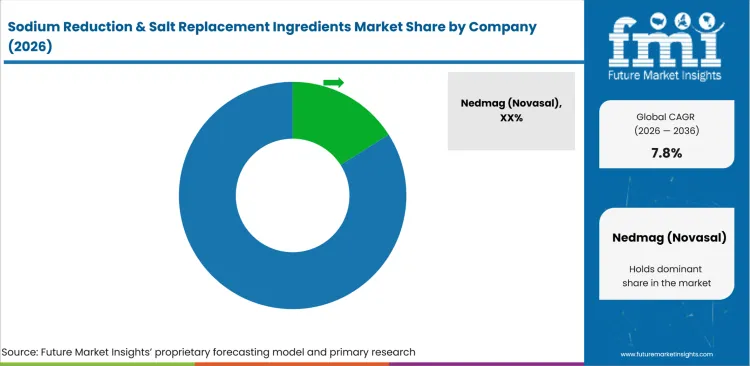
Competition in the sector combines mineral-salt producers and global ingredient groups. Taste specialists add application support across prepared-food programs. Supplier differentiation reflects sodium-reduction performance and bitter-note control. Food-function preservation and dependable supply influence contracts. Multi-application assistance is expected to improve customer retention across recipe-renovation programs.
- Nedmag B.V. (Novasal) and Tate & Lyle PLC form the core mineral and ingredient development group. Commercial review is expected to center on ingredient consistency and formula-transfer assistance.
- Cargill and ADM represent scaled manufacturing groups serving extensive food-production networks. Buyer confidence is anticipated to reflect dependable volume and specification control across manufacturing sites.
- Kerry and dsm-firmenich operate as taste-modulation specialists across prepared-food programs. Customer value is projected to arise from flavour rebuilding and recipe-specific technical assistance.
Competitive Benchmarking: Sodium Reduction & Salt Replacement Ingredients Market
| Company | Ingredient Breadth | Application Support | Regulatory Support | Service Reach |
|---|---|---|---|---|
| Nedmag B.V. (Novasal) | High | High | Medium | Europe and selected export markets |
| Cargill | High | High | High | Global |
| Kerry | High | High | High | Global |
| Jungbunzlauer | Medium | High | High | Global |
| ADM | High | High | High | Global |
| dsm-firmenich | High | High | High | Global |
| Tate & Lyle PLC | Medium | Medium | High | Global |
Source: Future Market Insights competitive analysis, 2026.
Key Developments in Sodium Reduction & Salt Replacement Ingredients Market
- In May 2025, Nedmag B.V. (Novasal) launched Novasal as a magnesium salt solution for bread and processed meat. Company information linked sodium reduction with retained taste and functionality across sauces and snacks.
- In September 2025, Kerry launched Smart Taste™, including Tastesense™ Salt among solutions addressing nutrition and regulatory pressures. Company information positioned application-led taste rebuilding for lower-sodium formulations across food groups.
- In April 2026, Nedmag B.V. (Novasal) introduced Novasal Blend for one-to-one salt replacement with a consistent 30% salt reduction and no recipe change. Company information confirmed completed first production and initial orders, moving the blend into commercial supply.
Key Companies in Sodium Reduction & Salt Replacement Ingredients Market
Core Mineral and Ingredient Developers
- Nedmag B.V. (Novasal)
- Jungbunzlauer
- Tate & Lyle PLC
Scaled Manufacturing and Supply Groups
- Cargill
- ADM
Application and Taste-Modulation Specialists
- Kerry
- dsm-firmenich
Sodium Reduction & Salt Replacement Ingredients Market Report Scope
| Coverage Field | Report Scope |
|---|---|
| Market Breakdown | Sodium Reduction & Salt Replacement Ingredients Market breakdown by type, application, and region |
| Quantitative Units | USD billion in 2026 to USD billion in 2036 at CAGR |
| Market Definition | Ingredients used directly to reduce sodium or replace conventional salt in food formulations. Coverage includes mineral salts and yeast extracts. Novasal Blends and umami ingredients complete type scope. |
| Regions Covered | North America, Latin America, Western Europe, Eastern Europe, East Asia, South Asia and Pacific, and Middle East and Africa |
| Countries Covered | Australia, USA, UK, Germany, Japan, and more than 25 additional national markets across covered regions |
| Key Companies Profiled | Nedmag B.V. (Novasal), Cargill, Kerry, Jungbunzlauer, ADM, dsm-firmenich, and Tate & Lyle PLC |
| Forecast Period | 2026 to 2036 |
| Approach | Hybrid bottom-up and top-down methodology using segment shares and country CAGRs. Company participation and regulatory evidence complete analysis. |
Source: Future Market Insights analysis, 2026.
Sodium Reduction & Salt Replacement Ingredients Market - Research Methodology
| Method | Approach |
|---|---|
| Primary Research | FMI analysts gathered input from manufacturers, service providers, technology developers, distributors, end users, procurement teams, and subject-matter experts. Interviews examined purchasing decisions, product or service evaluation, adoption barriers, approval requirements, pricing considerations, and expectations for technical or commercial support. Respondents were also asked what evidence is required before a trial, pilot, or initial order develops into regular purchasing. |
| Desk Research | Desk research covered government statistics, regulatory publications, trade data, industry associations, technical literature, standards, company filings, product information, and official corporate announcements. Sources were reviewed for relevance, publication date, geographic coverage, and consistency with the defined market scope. Claims relating to performance, applications, approvals, capacity, investment, and commercial activity were retained only when supported by credible public evidence. |
| Market Sizing and Forecasting | The market model combined the baseline value with historical performance, segment structure, pricing and volume indicators, adoption levels, company participation, and country-level demand conditions. Forecast assumptions considered economic activity, investment trends, regulatory developments, technology adoption, purchasing cycles, supply availability, and barriers to wider market use. Segment and regional estimates were reconciled before the final market total was calculated. |
| Data Validation | Estimates were checked against multiple independent indicators, including public data, company activity, trade patterns, industry developments, and findings from primary interviews. Validation also tested whether products, services, applications, and company revenues fell within the defined market boundaries. Adjacent categories, unsupported claims, overlapping revenues, and activities without direct market relevance were excluded to reduce double counting and maintain consistency across segments and countries. |
Source: Future Market Insights analysis, 2026.
Sodium Reduction & Salt Replacement Ingredients Market by Segments
Sodium Reduction & Salt Replacement Ingredients Market segmented by Type:
- Mineral Salts/KCl
- Yeast Extract
- Novasal Blends
- Umami
Sodium Reduction & Salt Replacement Ingredients Market segmented by Application:
- Bakery
- Snacks
- Meat
- Soups
Sodium Reduction & Salt Replacement Ingredients Market segmented by Region:
- North America
- United States
- Canada
- Latin America
- Brazil
- Mexico
- Argentina
- Chile
- Western Europe
- Germany
- France
- United Kingdom
- Italy
- Spain
- Benelux
- Nordics
- Eastern Europe
- Poland
- Czech Republic
- Romania
- Hungary
- East Asia
- China
- Japan
- South Korea
- South Asia and Pacific
- India
- ASEAN
- Australia and New Zealand
- Middle East and Africa
- GCC Countries
- South Africa
- Türkiye
- Israel
Research Sources and Bibliography
- Australian Government Department of Health, Disability and Ageing. (2026, July 15). Partnership Reformulation Program.
- Department for Education. (2026, July 9). Preparing varied and tasty menus.
- Federal Ministry of Food and Agriculture. (2025, March 28). The National Reduction and Innovation Strategy for Sugar, Fats and Salt in Processed Foods.
- Kirin Holdings Company, Limited. (2025, September 9). Kirin Launches New “Electric Salt Cup” and Upgraded Spoon to Support Delicious Low-Sodium Diets.
- Kissock, K. R., Ghammachi, N., Hoek, A. C., Bullen, J. D., Webster, J., Pettigrew, S., Garg, N., Neal, B., & Trieu, K. (2026). Knowledge, attitudes, and behaviours related to reduced-sodium salt: A systematic review. Journal of Human Hypertension, 40, 1-9. Advance online publication November 27, 2025.
- Kerry Group plc. (2025, July 22). The Hidden Complexity of Sodium Reduction in Sauces.
- Kerry Group plc. (2025, September 30). Kerry Launches Smart Taste™ to Help Customers Navigate Market Complexities Without Compromising on Taste.
- Li, W., Jiang, X., Fang, B., Li, H., Chang, C., & Wu, J. (2025, June). Preparation of hollow sodium chloride microspheres by spray drying: Effect of different polysaccharide carriers on salinity sensing performance. International Journal of Biological Macromolecules, 315, 144697.
- Li, W., Wang, W., Cao, Y., Fang, B., Li, H., Zhao, X., Wu, J., & Chang, C. (2025, October 15). Optimization of hollow salt microspheres using soybean soluble polysaccharides and hydroxypropyl-β-cyclodextrin: Evaluation of salt reduction in dough and bread. Food Chemistry: X, 31, 103160.
- Nedmag B.V. (2025, May 16). Novasal: The revolution in sodium reduction has begun!.
- Nedmag B.V. (2026, April 9). Novasal Blend for 1-to-1 salt replacement.
- USA Food and Drug Administration. (2024, August 15). FDA Starts Next Phase of Sodium Reduction Efforts.
- USA Food and Drug Administration. (2024, August). Sodium Reduction in the Food Supply.
- USA Food and Drug Administration. (2024, December 19). FDA Updates “Healthy” Claim, Providing a Refreshed Tool for Consumers.
- World Health Organization. (2025, January 27). Use of lower-sodium salt substitutes: WHO guideline.
This bibliography is provided for reader reference and is not exhaustive. The full report contains the complete reference list and detailed citations.
This Report Answers
- What conditions influence demand across type and application divisions?
- How do food producers evaluate sodium reduction ingredients prior to routine use?
- How do country CAGRs compare across key countries for the market?
- What companies compete through mineral ingredients and taste modulation?
- How are forecasts validated using bottom-up and top-down market analysis?
- What evidence do food manufacturers examine prior to multi-product recipe renovation?
- How do flavour and processing performance influence ingredient selection?
- What limits returns from lower-sodium formulation programs across packaged foods?
- How do labeling records and nutrition criteria influence commercial approval?
- What supplier capabilities improve long-term confidence and repeat purchasing?
Frequently Asked Questions
How big is the Sodium Reduction & Salt Replacement Ingredients Market in 2026?
The sodium reduction & salt replacement ingredients market is valued at USD 1.7 billion in 2026 and is forecast to reach USD 3.6 billion by 2036.
What is the CAGR of the Sodium Reduction & Salt Replacement Ingredients Market from 2026 to 2036?
The sodium reduction & salt replacement ingredients market is projected to grow at a CAGR of 7.8% between 2026 and 2036, supported by nutrition targets prompting packaged-food reformulation across staple products and food-service menus.
Which type leads the Sodium Reduction & Salt Replacement Ingredients Market?
Mineral salts and potassium chloride account for 47.5% of the sodium reduction & salt replacement ingredients market by type in 2026, driven by direct sodium substitution across bakery and meat recipes where suppliers assess masking performance and processing stability across complete formulas.
Which country segment is growing fastest in the Sodium Reduction & Salt Replacement Ingredients Market?
Australia is the fastest-growing segment in the sodium reduction & salt replacement ingredients market, expanding at a 9.8% CAGR through 2036, ahead of the market average of 7.8%.
Who are the leading companies in the Sodium Reduction & Salt Replacement Ingredients Market?
Leading companies in the sodium reduction & salt replacement ingredients market include Nedmag B.V. (Novasal), Cargill, Kerry, Jungbunzlauer, ADM, dsm-firmenich, and Tate & Lyle PLC, competing across mineral ingredient development, scaled manufacturing supply, and application-specific taste modulation programs.
Preview the report firsthand - request a free sample
Get SampleGet the brochure for pricing and purchase details.
Get PDFTable of Content
- Key Takeaways
- Market Size and CAGR
- Top Growth Driver
- Fastest Growing Segment
- Leading Region
- Key Companies
- Emerging Opportunities
- Executive Summary
- Global Market Outlook
- Demand-side Trends
- Supply-side Trends
- Technology Roadmap Analysis
- Analysis and Recommendations
- Analyst Perspective (What is happening? Why now? What should investors know?)
- Key Questions Answered
- How large is the market?
- What is the CAGR?
- What are key trends?
- Which region dominates?
- Who are the leaders?
- Market Overview
- Market Coverage / Taxonomy
- Market Definition / Scope / Limitations
- Research Methodology
- Chapter Orientation
- Analytical Lens and Working Hypotheses
- Market Structure, Signals, and Trend Drivers
- Benchmarking and Cross-market Comparability
- Market Sizing, Forecasting, and Opportunity Mapping
- Research Design and Evidence Framework
- Desk Research Programme (Secondary Evidence)
- Expert Input and Fieldwork (Primary Evidence)
- Tooling, Models, and Reference Databases
- Data Engineering and Model Build
- Quality Assurance and Audit Trail
- Market Background
- Market Dynamics (Drivers, Restraints, Opportunity, Trends)
- Scenario Forecast (Optimistic, Likely, Conservative)
- Impact Analysis
- AI Impact
- Sustainability Impact
- Regulatory Impact
- Technology Impact
- Consumer / Buyer Analysis
- Purchase Drivers
- Adoption Barriers
- Buyer Journey
- Opportunity Map Analysis
- Product Life Cycle Analysis
- Supply Chain Analysis
- Investment Feasibility Matrix
- Value Chain Analysis
- PESTLE and Porter's Analysis
- Regulatory Landscape
- Regional Parent Market Outlook
- Production and Consumption Statistics
- Import and Export Statistics
- Global Market Analysis and Forecast, 2021 to 2036
- Historical Market Size Value (USD Billion) Analysis, 2021 to 2025
- Current and Future Market Size Value (USD Billion) Projections, 2026 to 2036
- Y-o-Y Growth Trend Analysis
- Absolute $ Opportunity Analysis
- Global Market Pricing Analysis, 2021 to 2036
- Global Market Analysis and Forecast, By Type, 2021 to 2036
- Introduction / Key Findings
- Historical Market Size Value (USD Billion) Analysis By Type, 2021 to 2025
- Current and Future Market Size Value (USD Billion) Analysis and Forecast By Type, 2026 to 2036
- Mineral Salts/KCl
- Yeast Extract
- Novasal Blends
- Umami
- Mineral Salts/KCl
- Y-o-Y Growth Trend Analysis By Type, 2021 to 2025
- Absolute $ Opportunity Analysis By Type, 2026 to 2036
- Global Market Analysis and Forecast, By Application, 2021 to 2036
- Introduction / Key Findings
- Historical Market Size Value (USD Billion) Analysis By Application, 2021 to 2025
- Current and Future Market Size Value (USD Billion) Analysis and Forecast By Application, 2026 to 2036
- Bakery
- Snacks
- Meat
- Soups
- Bakery
- Y-o-Y Growth Trend Analysis By Application, 2021 to 2025
- Absolute $ Opportunity Analysis By Application, 2026 to 2036
- Global Market Analysis and Forecast, By Region, 2021 to 2036
- Introduction
- Historical Market Size Value (USD Billion) Analysis By Region, 2021 to 2025
- Current Market Size Value (USD Billion) Analysis and Forecast By Region, 2026 to 2036
- North America
- Latin America
- Western Europe
- Eastern Europe
- East Asia
- South Asia and Pacific
- Middle East & Africa
- Market Attractiveness Analysis By Region
- North America Market Analysis and Forecast, By Country, 2021 to 2036
- Historical Market Size Value (USD Billion) Trend Analysis By Market Taxonomy, 2021 to 2025
- Market Size Value (USD Billion) Forecast By Market Taxonomy, 2026 to 2036
- By Country
- USA
- Canada
- By Type
- By Application
- By Country
- Market Attractiveness Analysis
- By Country
- By Type
- By Application
- Key Takeaways
- Latin America Market Analysis and Forecast, By Country
- Historical Market Size Value (USD Billion) Trend Analysis By Market Taxonomy, 2021 to 2025
- Market Size Value (USD Billion) Forecast By Market Taxonomy, 2026 to 2036
- By Country
- Brazil
- Mexico
- Chile
- Rest of Latin America
- By Type
- By Application
- By Country
- Market Attractiveness Analysis
- By Country
- By Type
- By Application
- Key Takeaways
- Western Europe Market Analysis and Forecast, By Country
- Historical Market Size Value (USD Billion) Trend Analysis By Market Taxonomy, 2021 to 2025
- Market Size Value (USD Billion) Forecast By Market Taxonomy, 2026 to 2036
- By Country
- Germany
- UK
- Italy
- Spain
- France
- Nordic
- BENELUX
- Rest of Western Europe
- By Type
- By Application
- By Country
- Market Attractiveness Analysis
- By Country
- By Type
- By Application
- Key Takeaways
- Eastern Europe Market Analysis and Forecast, By Country
- Historical Market Size Value (USD Billion) Trend Analysis By Market Taxonomy, 2021 to 2025
- Market Size Value (USD Billion) Forecast By Market Taxonomy, 2026 to 2036
- By Country
- Russia
- Poland
- Hungary
- Balkan & Baltic
- Rest of Eastern Europe
- By Type
- By Application
- By Country
- Market Attractiveness Analysis
- By Country
- By Type
- By Application
- Key Takeaways
- East Asia Market Analysis and Forecast, By Country
- Historical Market Size Value (USD Billion) Trend Analysis By Market Taxonomy, 2021 to 2025
- Market Size Value (USD Billion) Forecast By Market Taxonomy, 2026 to 2036
- By Country
- China
- Japan
- South Korea
- By Type
- By Application
- By Country
- Market Attractiveness Analysis
- By Country
- By Type
- By Application
- Key Takeaways
- South Asia and Pacific Market Analysis and Forecast, By Country
- Historical Market Size Value (USD Billion) Trend Analysis By Market Taxonomy, 2021 to 2025
- Market Size Value (USD Billion) Forecast By Market Taxonomy, 2026 to 2036
- By Country
- India
- ASEAN
- Australia & New Zealand
- Rest of South Asia and Pacific
- By Type
- By Application
- By Country
- Market Attractiveness Analysis
- By Country
- By Type
- By Application
- Key Takeaways
- Middle East & Africa Market Analysis and Forecast, By Country
- Historical Market Size Value (USD Billion) Trend Analysis By Market Taxonomy, 2021 to 2025
- Market Size Value (USD Billion) Forecast By Market Taxonomy, 2026 to 2036
- By Country
- Kingdom of Saudi Arabia
- Other GCC Countries
- Türkiye
- South Africa
- Other African Union
- Rest of Middle East & Africa
- By Type
- By Application
- By Country
- Market Attractiveness Analysis
- By Country
- By Type
- By Application
- Key Takeaways
- Key Countries Market Analysis
- USA
- Pricing Analysis
- Market Share Analysis, 2025
- By Type
- By Application
- Canada
- Pricing Analysis
- Market Share Analysis, 2025
- By Type
- By Application
- Mexico
- Pricing Analysis
- Market Share Analysis, 2025
- By Type
- By Application
- Brazil
- Pricing Analysis
- Market Share Analysis, 2025
- By Type
- By Application
- Chile
- Pricing Analysis
- Market Share Analysis, 2025
- By Type
- By Application
- Germany
- Pricing Analysis
- Market Share Analysis, 2025
- By Type
- By Application
- UK
- Pricing Analysis
- Market Share Analysis, 2025
- By Type
- By Application
- Italy
- Pricing Analysis
- Market Share Analysis, 2025
- By Type
- By Application
- Spain
- Pricing Analysis
- Market Share Analysis, 2025
- By Type
- By Application
- France
- Pricing Analysis
- Market Share Analysis, 2025
- By Type
- By Application
- India
- Pricing Analysis
- Market Share Analysis, 2025
- By Type
- By Application
- ASEAN
- Pricing Analysis
- Market Share Analysis, 2025
- By Type
- By Application
- Australia & New Zealand
- Pricing Analysis
- Market Share Analysis, 2025
- By Type
- By Application
- China
- Pricing Analysis
- Market Share Analysis, 2025
- By Type
- By Application
- Japan
- Pricing Analysis
- Market Share Analysis, 2025
- By Type
- By Application
- South Korea
- Pricing Analysis
- Market Share Analysis, 2025
- By Type
- By Application
- Russia
- Pricing Analysis
- Market Share Analysis, 2025
- By Type
- By Application
- Poland
- Pricing Analysis
- Market Share Analysis, 2025
- By Type
- By Application
- Hungary
- Pricing Analysis
- Market Share Analysis, 2025
- By Type
- By Application
- Kingdom of Saudi Arabia
- Pricing Analysis
- Market Share Analysis, 2025
- By Type
- By Application
- Türkiye
- Pricing Analysis
- Market Share Analysis, 2025
- By Type
- By Application
- South Africa
- Pricing Analysis
- Market Share Analysis, 2025
- By Type
- By Application
- USA
- Market Structure Analysis
- Competition Dashboard
- Competition Benchmarking
- Market Share Analysis of Top Players
- By Regional
- By Type
- By Application
- Emerging Startups
- Innovation Benchmarking
- Competition Analysis
- Competition Deep Dive
- Nedmag (Novasal)
- Overview
- Product Portfolio
- Profitability by Market Segments
- Sales Footprint
- Strategy Overview
- Marketing Strategy
- Product Strategy
- Channel Strategy
- Cargill
- Kerry
- Jungbunzlauer
- ADM
- dsm-firmenich
- Tate & Lyle
- Nedmag (Novasal)
- Case Studies
- Success Stories
- Recent Developments
- Competition Deep Dive
- Assumptions & Acronyms Used


