

- Market Size (2026)
- USD 1640.8 Mn
- Forecast (2036)
- USD 5669.2 Mn
- CAGR (2026 to 2036)
- 13.2%
How big is the Ball Tracking System Market in 2026?
USD 1,640.8 million in 2026 and USD 5,669.2 million by 2036 at a 13.2% CAGR.
The ball tracking system market was valued at USD 1,449.47 million in 2025. It is expected to grow from USD 1,640.8 million in 2026 to USD 5,669.2 million in 2036 at a CAGR of 13.2%, led by elite sport venues using tracking data for broadcast overlays and performance review. Venue-installed systems are expected to secure 51.0% share in 2026, backed by stadium calibration needs and league-level service contracts. System sale is projected to hold 46.0% share in 2026, supported by league preference for owned stadium infrastructure and controlled match-data access
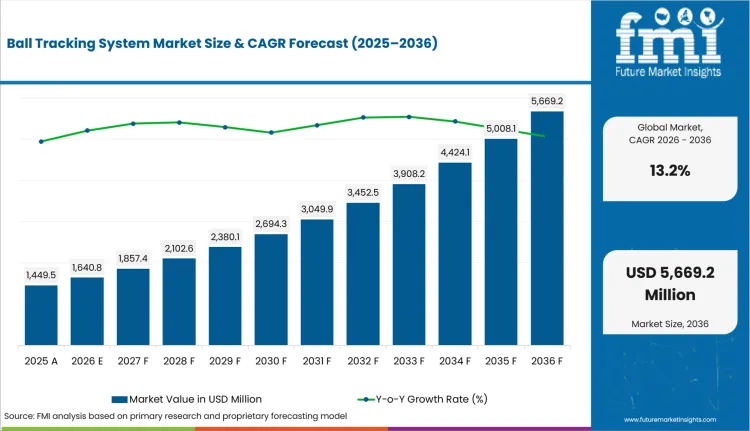
| Metric | Value |
|---|---|
| 2026 Market Size | USD 1,640.8 million |
| 2036 Market Size | USD 5,669.2 million |
| Forecast CAGR | 13.2% from 2026 to 2036 |
| Leading Deployment | Venue-installed |
| Venue-installed Share in 2026 | 51.0% |
| Leading Sales Model | System Sale |
| System Sale Share in 2026 | 46.0% |
| Leading CAGR Country | China |
| China CAGR | 15.4% by 2036 |
Summary of the Ball Tracking System Market
| Market Signal | Commercial Impact |
| Demand and Growth Drivers | Ball tracking system demand is increasing as sports organizations seek greater officiating accuracy, enhanced fan engagement, and data-driven player analysis.
|
| Product and Segment View | Venue-installed systems, direct system sales, and optical tracking technologies dominate the market.
|
| Geography and Growth Outlook | China and India are expected to remain the fastest-growing markets for ball tracking systems.
|
| Competitive Landscape | Competition is focused on officiating accuracy, real-time analytics, and integrated sports data platforms.
|
| Analyst Perspective | Ball tracking systems are evolving into critical decision-support platforms for officiating, broadcasting, and performance analysis.
— Sudip Saha, Principal Consultant, Technology, Future Market Insights |
Sports technology buying is strengthening around low-latency data flow and fan-facing graphics. FIFA’s 2026 testing criteria for semi-automated offside technology include 4 linked certification inputs covering skeletal tracking data and an automatic alert system. FIFA’s World Cup 2026 official match ball uses connected ball technology with a 500Hz motion sensor chip delivering movement data in real time.
Major League Baseball approved the ABS Challenge System for 2026 play, using 12 Hawk-Eye cameras around each field and a 5G private network.Ball tracking system demand is forecast to expand through 2036, supported by officiating automation and media-data monetization.
Which factors support expansion in the Ball Tracking System Market?
Finished decision accuracy and service-linked installation programs support market value across professional sport venues and training centers.
- Officiating accuracy supports market value as football and baseball buyers reduce manual review uncertainty.
- Permanent venue systems support adoption as calibrated cameras lower matchday risk across premium stadiums and broadcast-heavy events.
- Portable training units expand the buyer pool as academies and private coaches measure pitch and swing outcomes.
- Connected balls support new decision workflows as embedded sensors provide touch timing and movement data during live play.
Why is the Ball Tracking System Market growing?
High-value sport decisions need precise ball contact and flight data as manual review processes face time pressure and broadcast scrutiny.
Ball tracking suppliers gain acceptance as decision and media teams use a shared data layer. Hawk-Eye states that its sports technology covers 25 top sports and more than 100 countries, showing how tracking and replay systems have moved across multiple competition formats. Buyers now prefer certified systems able to move from pitch capture to replay room and venue screen without separate data preparation. Suppliers linking accuracy proof and matchday service gain stronger pricing power.
How is the Ball Tracking System Market segmented?
Ball Tracking System Market is segmented by tracking technology, sport type, application, deployment, and sales model.
- Optical tracking is projected to account for 42.5% share in 2026, influenced by stadium camera coverage and synchronized review feeds.
- Football / soccer is expected to represent 31.0% share in 2026, shaped by goal-line checks and broadcast graphics demand.
- Officiating is anticipated to account for 39.0% share in 2026, led by rule decisions needing certified evidence during match play.
- Venue-installed systems are projected to hold 51.0% share in 2026, guided by permanent calibration and lower matchday operating risk.
- System sale is expected to represent 46.0% share in 2026, supported by league preference for owned infrastructure and controlled data access.
Why does Optical Tracking dominate the Ball Tracking System Market by tracking technology?
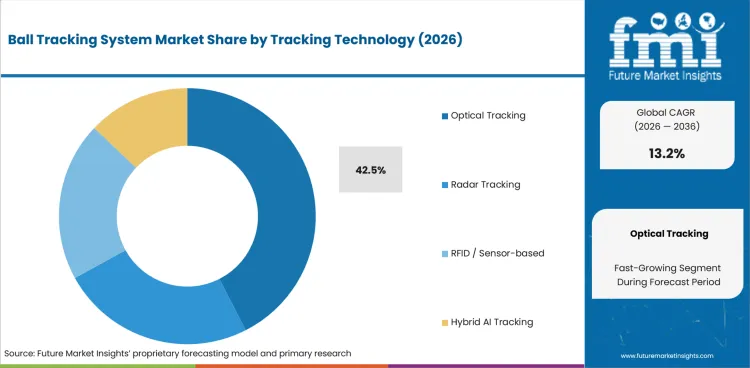
- Optical tracking is projected to account for 42.5% share in 2026, driven by calibrated camera arrays that support football and baseball use cases.
- Radar tracking gains demand as golf and baseball buyers need ball-flight measurement without full stadium camera infrastructure.
Which sport type leads the Ball Tracking System Market?
- Football / soccer is expected to represent 31.0% share in 2026, shaped by offside automation and connected-ball experimentation.
- Cricket remains active as ball path graphics and edge-detection style touch review strengthen match broadcast value.
Which application leads the Ball Tracking System Market?
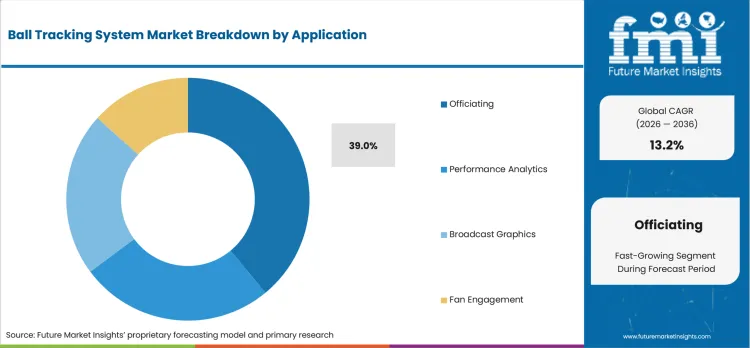
- Officiating is anticipated to account for 39.0% share in 2026, led by league investment in systems that support certified calls during live events.
- Performance analytics expands as academies and player-development teams use ball flight data for training feedback.
Which deployment leads the Ball Tracking System Market?
- Venue-installed systems are projected to hold 51.0% share in 2026, reflected by permanent calibration and stronger integration with replay rooms.
- Portable / temporary deployment remains active across touring events and smaller venues needing lower setup cost.
Which sales model leads the Ball Tracking System Market?
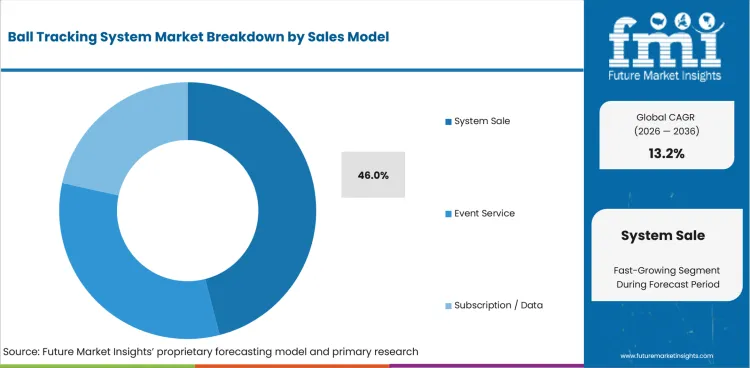
- System sale is expected to represent 46.0% share in 2026, guided by leagues seeking owned infrastructure and long-term data control.
- Subscription / data models gain attention as analytics dashboards and broadcast graphics generate recurring revenue.
What are the drivers, restraints, and opportunities in the Ball Tracking System Market?
Certified sports technology programs and media-data workflows are shaping ball tracking system buying decisions.
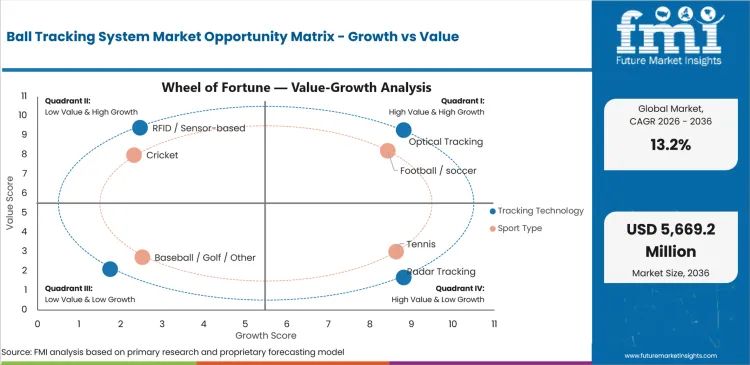
- Driver: Officiating bodies need repeatable ball-position evidence before close calls can be explained to players and fans.
- Restraint: Venue calibration and challenge timing can raise implementation burden for small events.
- Opportunity: Data feeds can create recurring value as leagues connect tracking outputs with broadcast and fan products.
Certified Officiating Demand Strengthens System Buying
Elite competitions are converting ball tracking into a certified decision workflow. Premier League stated that semi-automated offside technology was introduced on 12 April 2025 in Match Round 32 after non-live testing and live FA Cup operation. League adoption helps suppliers position tracking as a referee-support layer rather than a replay accessory. Stadium operators favor providers capable to prove line generation and graphics output across crowded match situations.
Challenge Timing and Calibration Burden Limit Smaller Buyers
Smaller events can delay purchases if systems add operating steps without clear payoff. MLB reported that its 2025 Spring Training ABS test added an average of 13.8 seconds per challenge and involved 4.1 challenges per game. Short delays are manageable for top leagues, but smaller venues need staffing and network support before matchday use feels practical. Vendors can reduce buyer hesitation through short setup routines and operator training packages.
Match Data Packaging Creates Expansion
Tracking data gains value after systems feed analytics and graphics products. Sportec Solutions reported in September 2025 that its stadium-camera workflow records more than 2,500 data points per game live or after the match. Such output allows leagues to package referee evidence and club analytics from one data stream. Suppliers offering clean data access and rights clarity can secure longer service renewals.
Which countries are growing in the Ball Tracking System Market?
China 15.4% CAGR, India 15.0% CAGR, South Korea 14.4% CAGR, United States 13.5% CAGR, United Kingdom 12.8% CAGR, Germany 12.5% CAGR, Japan 11.9% CAGR, and France 11.3% CAGR through 2036.
.webp "Top Country Growth Comparison Ball Tracking System Market Cagr (2026 2036)")
| Country | CAGR |
|---|---|
| China | 15.4% |
| India | 15.0% |
| South Korea | 14.4% |
| United States | 13.5% |
| United Kingdom | 12.8% |
| Germany | 12.5% |
| Japan | 11.9% |
| France | 11.3% |
Source: Future Market Insights, 2026.
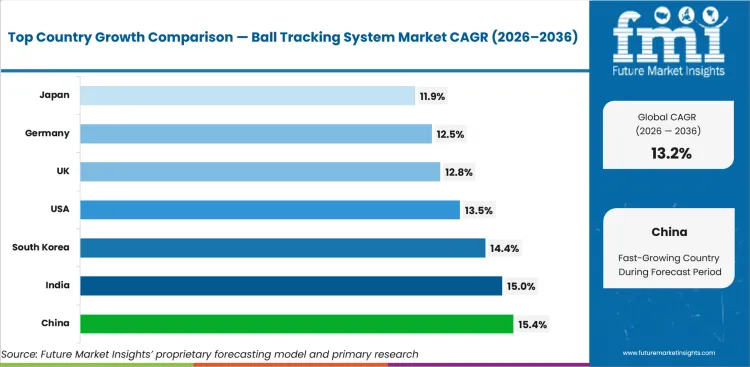
How do country-level CAGRs compare in the Ball Tracking System Market?
China leads country expansion while France records the most cautious pace among profiled markets.
- China is forecast to record 15.4% CAGR by 2036, aligned to smart venues and professional tennis service use.
- India is forecast to record 15.0% CAGR by 2036, supported by cricket review intensity and academy purchases.
- South Korea is forecast to record 14.4% CAGR by 2036, reflecting KBO ABS exposure and stadium data graphics.
- United States is forecast to record 13.5% CAGR by 2036, guided by MLB challenge deployment and training-center use.
- United Kingdom is forecast to record 12.8% CAGR by 2036, driven by Premier League SAOT and supplier depth.
- Germany is forecast to record 12.5% CAGR by 2036, backed by connected-ball trials and Bundesliga data packaging.
- Japan is forecast to record 11.9% CAGR by 2036, helped by tennis venue requirements and portable radar use.
- France is forecast to record 11.3% CAGR by 2036, influenced by football VAR workflows and selective tennis technology pilots.
How fast is the Ball Tracking System Market growing in China?
A 15.4% CAGR through 2036 reflects smart venue investment and professional event technology use.
Country Market Snapshot Table
| Parameter | Value |
|---|---|
| Market Size in 2025 (Value) | USD 232.2 million |
| Market Size in 2026 (Value) | USD 268.0 million |
| Market Forecast in 2036 (Value) | USD 1,122.6 million |
| CAGR (2026 to 2036) | 15.4% |
| Years Considered | 2021 to 2036 |
| Base Year | 2025 |
| Forecast Period | 2026 to 2036 |
| Units Considered | Value (USD million) |
| Leading Sub-Region | Yangtze River Delta, Beijing, and Guangdong sports technology corridors |
China Ball Tracking System Market Outlook
- China ball tracking system adoption develops around professional football and smart venue investment. Buyers need systems supporting broadcast teams and training staff without adding live-event disruption.
- Suppliers are expected to focus on venue calibration and data ownership clarity. Domestic video analytics firms can compete in camera-led deployments as stadium operators compare imported referee systems with local service depth.
Key Growth Drivers
- Professional tennis events give China an event-service route for ball tracking, evidenced by ATP listing the 2025 Rolex Shanghai Masters at Qizhong Forest Sports City Arena from 1-12 October 2025.
- National venue operators can test optical analytics at scale, reflected in the 2025 ATP media guide listing the China Open at National Tennis Center with 15,000 main-court seats.
- Local AI-camera suppliers can adapt optical tracking interfaces for Chinese-language broadcast rooms and venue control teams.
- Sports school and academy buyers need portable systems for tennis and baseball-style training applications.
Key Restraints
- Foreign providers can face extended approval cycles for data routing and event operations.
- Public contract disclosure remains limited for club-level ball tracking installations.
- Professional tennis venues need larger review setups before ELC use feels practical, specified through ATP's 2025 facilities chapter requiring existing courts before 2025 to measure at least 60 feet by 120 feet.
What makes China unique
China stands apart through smart venue investment and professional event exposure.
Key Companies
- SenseTime
- Hikvision Digital Technology
- Dahua Technology
- Megvii
- Uniview Technologies
- Leyard Sports
- China Sports Media
Sales & Marketing Channels
- Local venue integrators
- Sports bureau-linked tenders
- Tournament service contracts
- Broadcast technology partnerships
- Academy distributor networks
- Club performance departments
Country Segment Breakdown Table
| Segment | Sub-Segments |
|---|---|
| By Tracking Technology | Optical Tracking · Radar Tracking · RFID / Sensor-based · Hybrid AI Tracking |
| By Sport Type | Tennis · Cricket · Football / Soccer · Baseball / Golf / Other |
| By Application | Officiating · Performance Analytics · Broadcast Graphics · Fan Engagement |
| By Deployment | Venue-installed · Portable / Temporary · Cloud Analytics |
| By Sales Model | System Sale · Event Service · Subscription / Data |
| Key Sub-Regions Covered, Sports Corridors | Beijing · Shanghai · Guangzhou · Shenzhen · Hangzhou · Chengdu |
Frequently Asked Questions
How fast is China Ball Tracking System Market growing?
Sector in China is expected to record 15.4% CAGR through 2036, due to smart venue programs and tournament-service demand lifting optical deployments.
Who leads China Ball Tracking System Market?
SenseTime leads China Ball Tracking System Market, supported by Hikvision Digital Technology and Dahua Technology across local video analytics and venue technology supply.
What is driving adoption in China Ball Tracking System Market?
Tennis tournament service demand, and AI camera suppliers are moving buyers toward optical and hybrid tracking systems.
What is the Ball Tracking System Market outlook in India?
A 15.0% CAGR through 2036 reflects cricket review culture and academy-level training demand.
Country Market Snapshot Table
| Parameter | Value |
|---|---|
| Market Size in 2025 (Value) | USD 165.2 million |
| Market Size in 2026 (Value) | USD 190.0 million |
| Market Forecast in 2036 (Value) | USD 768.3 million |
| CAGR (2026 to 2036) | 15.0% |
| Years Considered | 2021 to 2036 |
| Base Year | 2025 |
| Forecast Period | 2026 to 2036 |
| Units Considered | Value (USD million) |
| Leading Sub-Region | Mumbai, Bengaluru, Chennai, and Delhi-NCR sports technology corridors |
India Ball Tracking System Market Outlook
- India ball tracking system demand is led by cricket review culture and professional broadcast exposure. Buyers need reliable ball-path data for officiating support and graphics used across televised matches.
- Factories are not the main route in this market. Leagues and event technology vendors are expected to begin with service contracts and portable units before selecting permanent installations for larger stadiums.
Key Growth Drivers
- Cricket league structure gives repeat demand for ball-path graphics, shown by BCCI's 2025 IPL format retaining 10 franchises.
- Event-service providers gain concentrated work around televised matches, mapped across IPL 2025 scheduling with 74 matches at 13 venues.
- Academy buyers use portable radar and camera units for bowling and golf feedback at lower budgets.
- Domestic sports media vendors can bundle ball tracking with video analysis and fan-engagement products.
Key Restraints
- Smaller cricket venues often lack permanent camera arrays and trained operators.
- Portable devices compete with lower-cost video-only coaching tools.
- Premium service opportunities remain concentrated around fewer events, illustrated through BCCI's May 2025 revised IPL plan covering 17 matches across 6 venues.
What makes India unique
India's distinct profile comes from cricket review culture and high broadcast intensity across domestic leagues.
Key Companies
- Sportz Interactive
- Stupa Sports Analytics
- Quidich Innovation Labs
- CricHeroes
- SportsMechanics India
- FanCode
- Merakii Group
Sales & Marketing Channels
- Cricket league service contracts
- Broadcast production partnerships
- Academy distributor networks
- Sports technology resellers
- Franchise analytics teams
- Event operations vendors
Country Segment Breakdown Table
| Segment | Sub-Segments |
|---|---|
| By Tracking Technology | Optical Tracking · Radar Tracking · RFID / Sensor-based · Hybrid AI Tracking |
| By Sport Type | Tennis · Cricket · Football / Soccer · Baseball / Golf / Other |
| By Application | Officiating · Performance Analytics · Broadcast Graphics · Fan Engagement |
| By Deployment | Venue-installed · Portable / Temporary · Cloud Analytics |
| By Sales Model | System Sale · Event Service · Subscription / Data |
| Key Sub-Regions Covered, Sports Corridors | Mumbai · Bengaluru · Chennai · Delhi-NCR · Hyderabad · Ahmedabad |
Frequently Asked Questions
How fast is India Ball Tracking System Market growing?
Industry in India is anticipated to reach 15.0% CAGR by 2036, helped by cricket review workflows and academy training purchases.
Who leads India Ball Tracking System Market?
Sportz Interactive leads India Ball Tracking System Market among local sports technology sellers, followed by Stupa Sports Analytics and Quidich Innovation Labs.
What is driving adoption in India Ball Tracking System Market?
Cricket review expectations and academy performance tools are creating buyer interest in ball tracking systems.
What is the Ball Tracking System Market outlook in South Korea?
A 14.4% CAGR through 2036 reflects professional baseball ABS use and league-led automation.
Country Market Snapshot Table
| Parameter | Value |
|---|---|
| Market Size in 2025 (Value) | USD 111.9 million |
| Market Size in 2026 (Value) | USD 128.0 million |
| Market Forecast in 2036 (Value) | USD 491.9 million |
| CAGR (2026 to 2036) | 14.4% |
| Years Considered | 2021 to 2036 |
| Base Year | 2025 |
| Forecast Period | 2026 to 2036 |
| Units Considered | Value (USD million) |
| Leading Sub-Region | Seoul, Incheon, Busan, and Daegu stadium corridors |
South Korea Ball Tracking System Market Outlook
- South Korea ball tracking system activity is influenced by professional baseball automation and high fan familiarity with live data graphics. Buyers need systems that can support umpire operations and broadcast explanation at match speed.
- League-level decisions are expected to guide adoption more than club-by-club purchasing. Suppliers with Korean-language operations and stable stadium service can gain preference.
Key Growth Drivers
- KBO's ABS gives suppliers a full-season professional baseball reference, supported by a 2025 Scientific Reports analysis noting each KBO team plays 144 games per season.
- League structure gives providers a standardized route for venue-level baseball technology deployment.
- Fan acceptance of automated strike-zone graphics supports added analytics products for broadcasters and clubs.
- League-led rollout supports consistent operating rules across stadiums and teams.
Key Restraints
- Full automation changes catcher value and can raise player adaptation concerns.
- Supplier transparency is narrower than public information from larger overseas leagues.
- ABS effects require extended evidence before performance conclusions are settled, validated through a 2025 Scientific Reports study evaluating 2,515 KBO games, 22,934 innings, 941 players, and 42 home-plate umpires.
What makes South Korea unique
South Korea differs through live professional baseball ABS use and league-level automation discipline.
Key Companies
- Sports2i
- QMIT
- GameOne
- Kakao VX
- Naver Sports Technology
- Wavve Sports Tech
- Creatz
Sales & Marketing Channels
- League technology contracts
- Stadium installation partners
- Broadcast graphics services
- Club analytics teams
- Umpire operations training
- Data service subscriptions
Country Segment Breakdown Table
| Segment | Sub-Segments |
|---|---|
| By Tracking Technology | Optical Tracking · Radar Tracking · RFID / Sensor-based · Hybrid AI Tracking |
| By Sport Type | Tennis · Cricket · Football / Soccer · Baseball / Golf / Other |
| By Application | Officiating · Performance Analytics · Broadcast Graphics · Fan Engagement |
| By Deployment | Venue-installed · Portable / Temporary · Cloud Analytics |
| By Sales Model | System Sale · Event Service · Subscription / Data |
| Key Sub-Regions Covered, Sports Corridors | Seoul · Incheon · Busan · Daegu · Gwangju · Daejeon |
Frequently Asked Questions
How fast is South Korea Ball Tracking System Market growing?
The market in South Korea is set to expand at 14.4% CAGR through 2036, backed by live ABS use in professional baseball.
Who leads South Korea Ball Tracking System Market?
Sports2i leads South Korea Ball Tracking System Market, supported by QMIT and GameOne across sports data and event service channels.
What is driving adoption in South Korea Ball Tracking System Market?
League-wide ABS experience and strike-zone graphics are pushing clubs and broadcasters toward certified tracking systems.
How is the Ball Tracking System Market performing in the United States?
A 13.5% CAGR through 2036 reflects sports entertainment scale and training technology adoption.
Country Market Snapshot Table
| Parameter | Value |
|---|---|
| Market Size in 2025 (Value) | USD 259.0 million |
| Market Size in 2026 (Value) | USD 294.0 million |
| Market Forecast in 2036 (Value) | USD 1,044.8 million |
| CAGR (2026 to 2036) | 13.5% |
| Years Considered | 2021 to 2036 |
| Base Year | 2025 |
| Forecast Period | 2026 to 2036 |
| Units Considered | Value (USD million) |
| Leading Sub-Region | New York, California, Texas, Florida, and Midwest sports corridors |
United States Ball Tracking System Market Outlook
- United States ball tracking system uptake centers on professional baseball automation and training-center adoption. Buyers focus on fan-facing display and data ownership terms.
- Stadium integrators and league data units are expected to shape high-value deals. Portable training brands will also remain active as baseball and softball coaches seek quick ball-flight feedback.
Key Growth Drivers
- MLB's challenge format creates repeatable fan-facing review, demonstrated by 2026 guidance stating each club starts with two challenges per game and retains a successful challenge.
- Sports entertainment scale supports stadium technology budgets, measured through BEA reporting 2024 GDP of USD 190,761 million for performing arts and related activities.
- College athletics and private academies support radar and camera-based training device demand.
- Stadium screens and regional sports networks increase the value of live ball-position graphics.
Key Restraints
- Short-run collegiate and local venues may delay systems without shared service models.
- Data ownership terms can slow adoption across broadcasters and betting partners.
- Use intensity can remain limited during trials, tempered by MLB Spring Training results showing players challenged 2.6% of called pitches and overturned 52.2% of calls.
What makes United States unique
United States stands out for league-scale data products and baseball training technology demand.
Key Companies
- Second Spectrum
- Diamond Kinetics
- SportsMEDIA Technology
- MLB Advanced Media
- Hudl
- ShotTracker
- Synergy Sports
Sales & Marketing Channels
- League technology contracts
- Stadium integrator channels
- College athletics purchasing
- Broadcast graphics partnerships
- Academy and training center resellers
- Data subscription platforms
Country Segment Breakdown Table
| Segment | Sub-Segments |
|---|---|
| By Tracking Technology | Optical Tracking · Radar Tracking · RFID / Sensor-based · Hybrid AI Tracking |
| By Sport Type | Tennis · Cricket · Football / Soccer · Baseball / Golf / Other |
| By Application | Officiating · Performance Analytics · Broadcast Graphics · Fan Engagement |
| By Deployment | Venue-installed · Portable / Temporary · Cloud Analytics |
| By Sales Model | System Sale · Event Service · Subscription / Data |
| Key Sub-Regions Covered, Sports Corridors | New York · California · Texas · Florida · Illinois · Georgia |
Frequently Asked Questions
How fast is United States Ball Tracking System Market growing?
United States demand is likely to rise at 13.5% CAGR through 2036, supported by MLB ABS deployment and training-center equipment buying.
Who leads United States Ball Tracking System Market?
Second Spectrum leads United States Ball Tracking System Market, supported by Diamond Kinetics and SportsMEDIA Technology across data, video, and event service channels.
What is driving adoption in United States Ball Tracking System Market?
MLB challenge use and portable training systems are supporting adoption.
How is the Ball Tracking System Market performing in the United Kingdom?
A 12.8% CAGR through 2036 reflects football officiating automation and local supplier depth.
Country Market Snapshot Table
| Parameter | Value |
|---|---|
| Market Size in 2025 (Value) | USD 101.1 million |
| Market Size in 2026 (Value) | USD 114.0 million |
| Market Forecast in 2036 (Value) | USD 380.7 million |
| CAGR (2026 to 2036) | 12.8% |
| Years Considered | 2021 to 2036 |
| Base Year | 2025 |
| Forecast Period | 2026 to 2036 |
| Units Considered | Value (USD million) |
| Leading Sub-Region | London, Manchester, Birmingham, and Glasgow sports technology corridors |
United Kingdom Ball Tracking System Market Outlook
- United Kingdom ball tracking system buying links cricket review workflows and broadcast service depth. Buyers value systems that can explain close decisions to stadium audiences and television viewers.
- Flexible service support will decide adoption outside the top competitions. Vendors with local matchday teams and graphics integration will gain stronger acceptance across federations and tournament operators.
Key Growth Drivers
- Premier League offside automation creates a top-flight reference point, introduced after the competition reported SAOT use from Matchweek 32 in April 2025.
- Hawk-Eye's local credibility helps cross-sport sales, backed by technology use across 25 sports and more than 100 countries.
- Cricket and tennis event owners need ball-position feeds serving replay rooms and broadcast graphics.
- Local broadcast service firms can package tracking data with graphics production and fan-facing explanation.
Key Restraints
- Technology glitches can affect trust if automated line-calling systems lose power during play.
- Grassroots clubs may not justify permanent camera arrays outside top competitions.
- Additional review layers can raise operating complexity, underlined by Wimbledon 2026 plans making Video Review available on 6 show courts while ELC visual indicators cover all courts.
What makes United Kingdom unique
United Kingdom has a distinct supplier base across football and broadcast services.
Key Companies
- Hawk-Eye Innovations
- Genius Sports
- Stats Perform
- IMG Arena
- Sportable Technologies
- Deltatre UK
- Pulselive
Sales & Marketing Channels
- League technology partnerships
- Broadcast data agreements
- Tournament service contracts
- Club analytics departments
- Venue installation projects
- Federation referee programs
Country Segment Breakdown Table
| Segment | Sub-Segments |
|---|---|
| By Tracking Technology | Optical Tracking · Radar Tracking · RFID / Sensor-based · Hybrid AI Tracking |
| By Sport Type | Tennis · Cricket · Football / Soccer · Baseball / Golf / Other |
| By Application | Officiating · Performance Analytics · Broadcast Graphics · Fan Engagement |
| By Deployment | Venue-installed · Portable / Temporary · Cloud Analytics |
| By Sales Model | System Sale · Event Service · Subscription / Data |
| Key Sub-Regions Covered, Sports Corridors | London · Manchester · Birmingham · Leeds · Glasgow · Cardiff |
Frequently Asked Questions
How fast is United Kingdom Ball Tracking System Market growing?
Sector in the United Kingdom is anticipated to grow at 12.8% CAGR through 2036, led by football offside automation and local officiating technology suppliers.
Who leads United Kingdom Ball Tracking System Market?
Hawk-Eye Innovations leads United Kingdom Ball Tracking System Market, followed by Genius Sports and Stats Perform across sports data and officiating services.
What is driving adoption in United Kingdom Ball Tracking System Market?
Premier League offside automation and cricket broadcast workflows are supporting adoption.
What is the Ball Tracking System Market forecast for Germany?
A 12.5% CAGR through 2036 reflects connected-ball proof and Bundesliga match-data operations.
Country Market Snapshot Table
| Parameter | Value |
|---|---|
| Market Size in 2025 (Value) | USD 94.2 million |
| Market Size in 2026 (Value) | USD 106.0 million |
| Market Forecast in 2036 (Value) | USD 344.9 million |
| CAGR (2026 to 2036) | 12.5% |
| Years Considered | 2021 to 2036 |
| Base Year | 2025 |
| Forecast Period | 2026 to 2036 |
| Units Considered | Value (USD million) |
| Leading Sub-Region | North Rhine-Westphalia, Bavaria, Berlin, and Hamburg sports corridors |
Germany Ball Tracking System Market Outlook
- Germany ball tracking system purchasing reflects football match-data operations and sensor engineering. Buyers expect precise data and low operating risk across permanent stadium deployments.
- Bundesliga data partners and sensor specialists are expected to influence system selection. Suppliers offering stadium-camera operations and official data packaging is likely to protect premium accounts.
Key Growth Drivers
- Germany's connected-ball proof supports sensor-linked officiating, proven through a 2024 engineering note describing 10 specialised cameras tracking 29 body points per player alongside the ball sensor.
- KINEXON Sports supports real-time player and ball tracking for football venues, captured via xBall streaming data to antennas at up to 500Hz and processing key metrics within 50-100 ms.
- Bundesliga match-data workflows create demand for packaged tracking feeds and broadcast analytics.
- Engineering-led buyers favor suppliers with documented testing and local service depth.
Key Restraints
- Smaller clubs can delay permanent installations due to service cost.
- Data ownership and league licensing terms can slow club-level buying decisions.
- High-grade optical tracking still requires deep stadium infrastructure, documented in a 2025 elite-soccer dataset describing 16 to 20 cameras operating at 25 Hz.
What makes Germany unique
Germany's position rests on connected-ball proof and sensor engineering depth.
Key Companies
- Sportec Solutions
- KINEXON Sports
- DFL Digital Sports
- GoalControl
- wige SOLUTIONS
- Aixponic Sports Tech
- Kinexon Industries
Sales & Marketing Channels
-
League technology partnerships
- Stadium camera installations
- Official match data licensing
- Club performance departments
- Tournament service contracts
- Broadcast graphics partnerships
Country Segment Breakdown Table
| Segment | Sub-Segments |
|---|---|
| By Tracking Technology | Optical Tracking · Radar Tracking · RFID / Sensor-based · Hybrid AI Tracking |
| By Sport Type | Tennis · Cricket · Football / Soccer · Baseball / Golf / Other |
| By Application | Officiating · Performance Analytics · Broadcast Graphics · Fan Engagement |
| By Deployment | Venue-installed · Portable / Temporary · Cloud Analytics |
| By Sales Model | System Sale · Event Service · Subscription / Data |
| Key Sub-Regions Covered, Sports Corridors | North Rhine-Westphalia · Bavaria · Berlin · Hamburg · Hesse · Baden-Wurttemberg |
Frequently Asked Questions
How fast is Germany Ball Tracking System Market growing?
The market in Germany is expected to grow at 12.5% CAGR through 2036, guided by connected-ball use and Bundesliga data operations.
Who leads Germany Ball Tracking System Market?
Sportec Solutions leads Germany Ball Tracking System Market, supported by KINEXON Sports and DFL Digital Sports across official data and tracking services.
What is driving adoption in Germany Ball Tracking System Market?
Bundesliga data packaging and sensor engineering are supporting buyer confidence.
What is the Ball Tracking System Market forecast for Japan?
An 11.9% CAGR through 2036 reflects baseball and premium training demand.
Country Market Snapshot Table
| Parameter | Value |
|---|---|
| Market Size in 2025 (Value) | USD 105.5 million |
| Market Size in 2026 (Value) | USD 118.0 million |
| Market Forecast in 2036 (Value) | USD 363.1 million |
| CAGR (2026 to 2036) | 11.9% |
| Years Considered | 2021 to 2036 |
| Base Year | 2025 |
| Forecast Period | 2026 to 2036 |
| Units Considered | Value (USD million) |
| Leading Sub-Region | Tokyo, Osaka, Aichi, and Fukuoka sports technology corridors |
Japan Ball Tracking System Market Outlook
- Japan ball tracking system activity draws from tennis events and premium venue expectations. Buyers value low-disruption systems and reliable service during live competition.
- Specialist distributors and event service firms are expected to hold importance. Portable radar units can gain attention across baseball and golf training centers before permanent stadium systems expand.
Key Growth Drivers
- Japan Open technology needs are linked to major tennis venues, listed in ATP's 2025 media guide with Ariake Tennis Park main-court seating of 10,000.
- Portable training buyers need compact radar units for baseball and golf, noted by TrackMan's B1 technical specification listing optically enhanced radar tracking and a unit weight around 3kg.
- Tennis and baseball academies use compact systems as lower-risk alternatives to permanent venue installations.
- Premium venues favor systems with local support and minimal match interruption.
Key Restraints
- Public supplier visibility remains limited for league-wide tracking installations.
- Buyers often need local support before approving match-critical technology.
- Regional compliance checks remain necessary for portable radar systems, bounded by TrackMan's B1 operating bands of 10.500-10.550GHz and 24.075-24.175GHz.
What makes Japan unique
Japan differs through high-reliability technology buying across tennis and football use cases.
Key Companies
- Sony Sports Innovations
- DataStadium Inc.
- NEC Sports Solutions
- Fujitsu Sports Analytics
- Rakuten Sports
- SoftBank Sports Technology
- Yamaha Sports Systems
Sales & Marketing Channels
- Event service contracts
- Sports academy distribution
- Golf simulator channels
- Baseball training centers
- Venue integrators
- OEM partnerships
Country Segment Breakdown Table
| Segment | Sub-Segments |
|---|---|
| By Tracking Technology | Optical Tracking · Radar Tracking · RFID / Sensor-based · Hybrid AI Tracking |
| By Sport Type | Tennis · Cricket · Football / Soccer · Baseball / Golf / Other |
| By Application | Officiating · Performance Analytics · Broadcast Graphics · Fan Engagement |
| By Deployment | Venue-installed · Portable / Temporary · Cloud Analytics |
| By Sales Model | System Sale · Event Service · Subscription / Data |
| Key Sub-Regions Covered, Sports Corridors | Tokyo · Osaka · Aichi · Fukuoka · Hokkaido · Kanagawa |
Frequently Asked Questions
How fast is Japan Ball Tracking System Market growing?
Sector in Japan is set to rise at 11.9% CAGR through 2036, helped by tennis events and portable baseball and golf training systems.
Who leads Japan Ball Tracking System Market?
Sony Sports Innovations leads Japan Ball Tracking System Market, supported by DataStadium Inc. and NEC Sports Solutions across sports analytics and venue technology.
What is driving adoption in Japan Ball Tracking System Market?
Japan Open venue needs and golf launch-monitor use are supporting adoption.
What is driving Ball Tracking System Market growth in France?
An 11.3% CAGR through 2036 reflects tennis event technology and video review use.
Country Market Snapshot Table
| Parameter | Value |
|---|---|
| Market Size in 2025 (Value) | USD 77.3 million |
| Market Size in 2026 (Value) | USD 86.0 million |
| Market Forecast in 2036 (Value) | USD 251.1 million |
| CAGR (2026 to 2036) | 11.3% |
| Years Considered | 2021 to 2036 |
| Base Year | 2025 |
| Forecast Period | 2026 to 2036 |
| Units Considered | Value (USD million) |
| Leading Sub-Region | Paris, Lyon, Marseille, and Lille sports technology corridors |
France Ball Tracking System Market Outlook
- France ball tracking system adoption follows football VAR workflows and selective broadcast graphics adoption. Buyers need systems supporting decision explanation while respecting event-specific operating traditions.
- Federations and event owners will control premium purchases. Service-led pilots can help suppliers prove surface accuracy and matchday support before permanent investments expand.
Key Growth Drivers
- French tennis events offer premium indoor infrastructure for tracking pilots, signaled through ATP's 2025 Paris Masters venue note citing a 17,500-seat centre court, 9,000 square metres of curtains, three additional match courts, and a practice court.
- Paris-hosted sport events increased venue technology attention, amplified by Olympic reporting that Paris 2024 featured 32 sports and 329 medal events.
- French sports technology firms support video review and match analytics near federation buyers.
- Football VAR workflows provide an entry point for optical tracking upgrades across premium venues.
Key Restraints
- Clay-court tradition can slow full line-call automation at premium tennis events.
- Public supplier evidence remains less transparent for country-level football tracking contracts.
- Clay-court automation still faces surface-specific trust limits, constrained by French Open officials saying electronic line calling is not 100% reliable on clay courts.
What makes France unique
France's profile reflects premium event technology and federation-led review.
Key Companies
- Footovision
- SkillCorner
- VOGO
- Sportall
- MyCoach Sport
- Kinomap
- Arenametrix
Sales & Marketing Channels
- Federation technology reviews
- Tennis tournament pilots
- Football league purchasing
- Broadcast graphics trials
- Venue integrator channels
- Referee training programs
Country Segment Breakdown Table
| Segment | Sub-Segments |
|---|---|
| By Tracking Technology | Optical Tracking · Radar Tracking · RFID / Sensor-based · Hybrid AI Tracking |
| By Sport Type | Tennis · Cricket · Football / Soccer · Baseball / Golf / Other |
| By Application | Officiating · Performance Analytics · Broadcast Graphics · Fan Engagement |
| By Deployment | Venue-installed · Portable / Temporary · Cloud Analytics |
| By Sales Model | System Sale · Event Service · Subscription / Data |
| Key Sub-Regions Covered, Sports Corridors | Paris Region · Auvergne-Rhone-Alpes · Hauts-de-France · Occitanie · Provence-Alpes-Cote d’Azur · Grand Est |
Frequently Asked Questions
How fast is France Ball Tracking System Market growing?
France is likely to scale at 11.3% CAGR through 2036, supported by football review workflows and selective tennis event technology.
Who leads France Ball Tracking System Market?
Footovision leads France Ball Tracking System Market, supported by SkillCorner and VOGO across football data and event service channels.
What is driving adoption in France Ball Tracking System Market?
Football review workflows and federation-led technology trials are guiding adoption.
Who are the leading companies in the Ball Tracking System Market?
Hawk-Eye Innovations, Genius Sports, Second Spectrum, and Sportec Solutions.
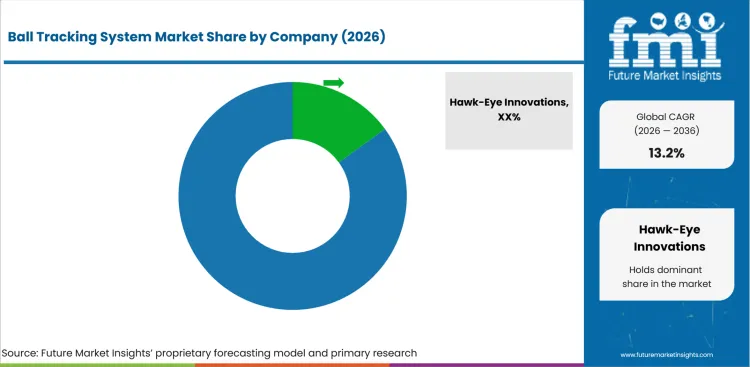
- Established sports technology companies hold an advantage led by certification experience and matchday service teams.
- Officiating-focused suppliers gain acceptance by combining replay room support and graphics output.
- Regional sports technology suppliers win in country markets based on local operators and venue integration partners.
- Service-ready suppliers improve renewal chances through calibration records and low-latency data delivery.
Sports technology companies compete by combining ball tracking systems and service programs. Hawk-Eye Innovations has a strong position depending on electronic line calling and match-officiating support. Genius Sports competes through official data services and league technology relationships. Second Spectrum holds value across basketball analytics and video-driven sports data products.
System reliability and technical service depth have become stronger competitive separators as leagues move beyond single-purpose replay tools. Sportec Solutions competes through official match-data operations in football. KINEXON Sports strengthens competition led by connected-ball and sensor-based tracking capability. TRACAB, Stats Perform, TrackMan, and Rapsodo extend competition across live data and portable training equipment.
Smaller and regional suppliers are anticipated to gain through local venue knowledge and faster field support. China, India, and South Korea create opportunities for suppliers operating event-service teams and trained technicians. United States and Europe promote demand for systems suited to professional league data rights and broadcast use. Companies proving accuracy under match speed should gain more durable customer relationships.
How do top Ball Tracking System companies compare?
Hawk-Eye Innovations and Genius Sports score on officiating depth while TrackMan and Rapsodo lead through portable training capability.
| Company | Relevance to Market Title | Tracking Portfolio Depth | Officiating Service Strength | Data Packaging Support | Channel Reach | Geographic Footprint |
|---|---|---|---|---|---|---|
| Hawk-Eye Innovations | Very High | Very Strong | Very Strong | Strong | Very Strong | Global |
| Genius Sports | Very High | Strong | Very Strong | Very Strong | Very Strong | Global |
| Second Spectrum | Very High | Strong | Strong | Very Strong | Strong | United States and global leagues |
| Sportec Solutions | High | Strong | Strong | Very Strong | Strong | Germany and Europe |
| KINEXON Sports | High | Strong | Strong | Strong | Strong | Europe and North America |
| TRACAB | High | Strong | Strong | Strong | Strong | Europe and global football |
| Stats Perform | High | Moderate | Moderate | Very Strong | Very Strong | Global |
| TrackMan | High | Strong | Moderate | Strong | Very Strong | Global |
| Rapsodo | Moderate to High | Strong | Moderate | Strong | Strong | Global |
| Diamond Kinetics | Moderate to High | Moderate | Moderate | Strong | Moderate | United States |
Source: Future Market Insights competitive analysis, 2026.
Who are the key players in the Ball Tracking System Market?
Hawk-Eye Innovations, Genius Sports, Second Spectrum, and Sportec Solutions are listed with KINEXON Sports and TrackMan among other suppliers.
Key global companies leading the Ball Tracking System Market include:
- Hawk-Eye Innovations
- Genius Sports
- Second Spectrum
- Sportec Solutions
- KINEXON Sports
- TRACAB
- Stats Perform
- Sportradar
- TrackMan
- Rapsodo
Key Developments in Ball Tracking System Market
- In November 2024, FIFA and Hawk-Eye Innovations established Football Technology Centre AG to develop algorithms that automate on-pitch event detection for decision support.
- In July 2025, TrackMan described its Portable B1 unit for baseball practice tracking, strengthening the portable training channel for pitching and hitting data.
- In February 2026, Rapsodo released a PRO 2.0 Pitching 50 Series firmware update designed to improve ball-flight capture and pitch-tracking accuracy.
Key Players in the Ball Tracking System Market
Officiating and Venue Systems
- Hawk-Eye Innovations
- Genius Sports
- Second Spectrum
- TRACAB
League Data and Sensor Platforms
- Sportec Solutions
- KINEXON Sports
- Stats Perform
- Sportradar
Portable Training and Launch Monitors
- TrackMan
- Rapsodo
- Diamond Kinetics
- DataStadium Inc.
Regional Sports Technology Suppliers
- Sportz Interactive
- Footovision
- Sports2i
- Sony Sports Innovations
Ball Tracking System Market - Scope & Definition
| Attribute | Detail |
|---|---|
| Market Definition | Optical, radar, sensor-based, and hybrid AI systems used to track ball position, movement, contact, and flight in organized sport |
| Functions Covered | Ball position measurement, ball flight tracking, touch timing, replay-room support, graphics output, data feeds, and coaching analytics |
| Applications Covered | Officiating, performance analytics, broadcast graphics, fan engagement, training feedback, and official match data workflows |
| End-Use Industries | Professional sport leagues, stadium operators, broadcasters, clubs, academies, training centers, and event-service providers |
| Grades Covered | Officiating-grade venue systems, professional training systems, portable launch monitors, sensor-based systems, and hybrid AI tracking platforms |
| Inclusions | All commercially traded and serviced ball tracking systems across tracking technology, sport type, application, deployment, sales model, and country-level sports use |
| Exclusions | General fitness wearables, scoreboard-only software, generic CCTV, ticketing platforms, athlete-only GPS systems, and non-sports industrial object tracking platforms |
Ball Tracking System Market - Research Methodology
| Method | Description |
|---|---|
| Primary Research | FMI analyst interviews with sports technology vendors, league operators, venue integrators, broadcast production teams, coaching analytics users, and event-service providers across selected markets |
| Desk Research | Review of sport technology rules, official league announcements, company product information, venue technology material, and country-level sports economy indicators |
| Market Sizing & Forecasting | Bottom-up equipment and service revenue approach using venue installations, portable device sales, event-service use, subscription revenue, sport mix, and adoption by buyer type |
| Data Validation | Cross-verification using official sport use cases, product specifications, venue readiness checks, company portfolios, and country-level sports technology signals |
Ball Tracking System Market - Report Scope
| Parameter | Details |
|---|---|
| Forecast period | 2026 to 2036 |
| Historical period | 2021 to 2025 |
| Quantitative unit | Revenue in USD million |
| By tracking technology | Optical Tracking, Radar Tracking, RFID / Sensor-based, Hybrid AI Tracking |
| By sport type | Tennis, Cricket, Football / Soccer, Baseball / Golf / Other |
| By application | Officiating, Performance Analytics, Broadcast Graphics, Fan Engagement |
| By deployment | Venue-installed, Portable / Temporary, Cloud Analytics |
| By sales model | System Sale, Event Service, Subscription / Data |
| Regions covered | North America, Latin America, Europe, East Asia, South Asia and Pacific, Middle East and Africa |
| Countries covered | China, India, South Korea, United States, United Kingdom, Germany, Japan, France |
| Key companies profiled | Hawk-Eye Innovations, Genius Sports, Second Spectrum, Sportec Solutions, KINEXON Sports, TRACAB, TrackMan, Rapsodo |
| Approach | Bottom-up equipment and service revenue approach using venue installations, event-service use, subscription data revenue, sport mix, and country-level technology readiness |
Source: Future Market Insights competitive analysis, 2026.
Ball Tracking System Market Breakdown by Tracking Technology, Sport Type, Application, Deployment, Sales Model, and Region
Ball Tracking System Market Segmented by Tracking Technology
- Optical Tracking
- Radar Tracking
- RFID / Sensor-based
- Hybrid AI Tracking
Ball Tracking System Market Segmented by Sport Type
- Tennis
- Cricket
- Football / Soccer
- Baseball / Golf / Other
Ball Tracking System Market Segmented by Application
- Officiating
- Performance Analytics
- Broadcast Graphics
- Fan Engagement
Ball Tracking System Market Segmented by Deployment
- Venue-installed
- Portable / Temporary
- Cloud Analytics
Ball Tracking System Market Segmented by Sales Model
- System Sale
- Event Service
- Subscription / Data
Ball Tracking System Market by Region
- North America
- Latin America
- Europe
- East Asia
- South Asia and Pacific
- Middle East and Africa
Research Sources and Bibliography
- ATP Tour. (2025, January 16). The 2025 ATP official rulebook.
- ATP Tour. (2025, September 26). Rolex Shanghai Masters 2025: Draws, dates, history and all you need to know.
- Baseball Savant. (2026, March 24). Five things fans need to know about ABS Challenge System.
- Fédération Internationale de Football Association. (2024, November 5). FIFA and Hawk-Eye Innovations establish joint venture to explore emerging football technologies.
- Fédération Internationale de Football Association. (2025, October 2). FIFA celebrates launch of official match ball of FIFA World Cup 26: TRIONDA.
- Fédération Internationale de Football Association. (2026, February 10). Testing criteria for semi-automated offside technology.
- Hawk-Eye Innovations. (2026, June 16). Is technology improving sport, or ruining it?
- Korean Baseball Organization. (2024, January 3). KBO New Year message and ABS introduction.
- Major League Baseball. (2025, March 26). MLB releases Spring Training ABS challenge results.
- Major League Baseball. (2025, September 23). MLB announces ABS Challenge System coming to the Major Leagues beginning in the 2026 season.
- Premier League. (2025, April 1). Semi-automated offside technology to be introduced in Matchweek 32.
- Premier League. (2025, August 14). What is new in 2025/26: IFAB laws and Premier League football principles.
- Rapsodo. (2026, February 11). Rapsodo PRO 2.0 updates: Major accuracy upgrades for PRO 2.0 pitch tracking.
- Sportec Solutions. (2025, September 5). Data.
- TrackMan. (2025, July 14). The TrackMan Baseball Portable B1 unit.
- TrackMan. (2026). B1 Portable Unit: Baseball technology specifications.
- UEFA. (2024, June 11). Football technologies at UEFA Euro 2024.
- USA Bureau of Economic Analysis. (2026, April 9). Gross output by industry.
- ATP Tour. (2025, January 16). The 2025 ATP media guide: Intro, administration, and tournaments.
- ATP Tour. (2025, October 30). New court, same energy: Inside the Rolex Paris Masters’ new home.
- ATP Tour. (2026, March 21). Wimbledon announces introduction of Video Review technology for 2026.
- Indian Premier League. (2025, February 16). BCCI announces schedule for TATA IPL 2025.
- Indian Premier League. (2025, May 13). Remainder of IPL 2025 to be held at six venues.
- Institution of Mechanical Engineers. (2024, July 10). The striking engineering inside the Euro 2024 ball.
- KINEXON Sports. (2026). Experience live handball and football tracking.
- Lee, K., Han, K., & Ko, J. (2025). Analyzing the impact of the automatic ball strike system in professional baseball through a case study on KBO league data. Scientific Reports.
- International Olympic Committee. (2024). Paris 2024 Summer Olympics: Athletes, medals and results.
- USA Bureau of Labor Statistics. (2025, August 28). Entertainment and sports occupations.
This bibliography is provided for reader reference and is not exhaustive. The full report contains the complete reference list and detailed citations.
This Report Answers
- Market size estimates for 2026 and forecasts through 2036 for the Ball Tracking System Market.
- Insights across regional and country-level sports technology markets.
- Analysis of demand drivers and purchasing behavior.
- Evaluation of tracking technologies, sport types, applications, deployments, and sales models.
- Assessment of officiating automation and match-data requirements.
- Identification of opportunities across connected balls and data feeds.
- Evaluation of system sale models, event services, and subscription data channels.
- Country-level analysis covering China, India, South Korea, United States, United Kingdom, Germany, Japan, and France.
- Assessment of competition, including officiating technology suppliers and portable training companies.
- Analysis of venue-level decision drivers and service criteria.
- Regional outlooks across North America, Europe, East Asia, South Asia and Pacific, Latin America, and Middle East and Africa.
- Delivery of market data, forecasts, and supporting analysis in report-ready format.
Frequently Asked Questions
What is the growth prospect for ball tracking systems?
Demand for ball tracking systems is expected to rise at a considerable pace as sports leagues automate close-call review and use ball-position data for media products.
Which companies are expected to shape the ball tracking system market?
Hawk-Eye Innovations, Genius Sports, Second Spectrum, Sportec Solutions, KINEXON Sports, TrackMan, and Rapsodo are expected to shape competition due to system portfolios and service support.
Why are sports technology companies investing in ball tracking systems?
Sports technology companies are investing in ball tracking systems to support officiating and fan-facing data products.
Why are system sale channels important in the ball tracking system market?
System sale channels support owned infrastructure and long-term match-data control.
Which tracking formats are gaining attention in ball tracking systems?
Optical tracking and connected-ball systems are gaining attention as competitions target live decision support and lower review uncertainty.
How does officiating automation influence ball tracking system demand?
Officiating automation influences demand through call consistency and stronger trust in replay-room decisions.
Why is deployment type important for ball tracking systems?
Deployment type is important since permanent venues and academies need different camera and software structures.
What role does System Sale play in ball tracking system adoption?
System sale supports adoption by combining hardware and operator training for premium venues.
Preview the report firsthand - request a free sample
Get SampleGet the brochure for pricing and purchase details.
Get PDFTable of Content
- Key Takeaways
- Market Size and CAGR
- Top Growth Driver
- Fastest Growing Segment
- Leading Region
- Key Companies
- Emerging Opportunities
- Executive Summary
- Global Market Outlook
- Demand-side Trends
- Supply-side Trends
- Technology Roadmap Analysis
- Analysis and Recommendations
- Analyst Perspective (What is happening? Why now? What should investors know?)
- Key Questions Answered
- How large is the market?
- What is the CAGR?
- What are key trends?
- Which region dominates?
- Who are the leaders?
- Market Overview
- Market Coverage / Taxonomy
- Market Definition / Scope / Limitations
- Research Methodology
- Chapter Orientation
- Analytical Lens and Working Hypotheses
- Market Structure, Signals, and Trend Drivers
- Benchmarking and Cross-market Comparability
- Market Sizing, Forecasting, and Opportunity Mapping
- Research Design and Evidence Framework
- Desk Research Programme (Secondary Evidence)
- Expert Input and Fieldwork (Primary Evidence)
- Tooling, Models, and Reference Databases
- Data Engineering and Model Build
- Quality Assurance and Audit Trail
- Market Background
- Market Dynamics (Drivers, Restraints, Opportunity, Trends)
- Scenario Forecast (Optimistic, Likely, Conservative)
- Impact Analysis
- AI Impact
- Sustainability Impact
- Regulatory Impact
- Technology Impact
- Consumer / Buyer Analysis
- Purchase Drivers
- Adoption Barriers
- Buyer Journey
- Opportunity Map Analysis
- Product Life Cycle Analysis
- Supply Chain Analysis
- Investment Feasibility Matrix
- Value Chain Analysis
- PESTLE and Porter's Analysis
- Regulatory Landscape
- Regional Parent Market Outlook
- Production and Consumption Statistics
- Import and Export Statistics
- Global Market Analysis and Forecast, 2021 to 2036
- Historical Market Size Value (USD Million) & Volume (Unit) Analysis, 2021 to 2025
- Current and Future Market Size Value (USD Million) & Volume (Unit) Projections, 2026 to 2036
- Y-o-Y Growth Trend Analysis
- Absolute $ Opportunity Analysis
- Global Market Pricing Analysis, 2021 to 2036
- Global Market Analysis and Forecast, By Tracking Technology, 2021 to 2036
- Introduction / Key Findings
- Historical Market Size Value (USD Million) & Volume (Unit) Analysis By Tracking Technology, 2021 to 2025
- Current and Future Market Size Value (USD Million) & Volume (Unit) Analysis and Forecast By Tracking Technology, 2026 to 2036
- Optical Tracking
- Radar Tracking
- RFID / Sensor-based
- Hybrid AI Tracking
- Optical Tracking
- Y-o-Y Growth Trend Analysis By Tracking Technology, 2021 to 2025
- Absolute $ Opportunity Analysis By Tracking Technology, 2026 to 2036
- Global Market Analysis and Forecast, By Sport Type, 2021 to 2036
- Introduction / Key Findings
- Historical Market Size Value (USD Million) & Volume (Unit) Analysis By Sport Type, 2021 to 2025
- Current and Future Market Size Value (USD Million) & Volume (Unit) Analysis and Forecast By Sport Type, 2026 to 2036
- Football / soccer
- Tennis
- Cricket
- Baseball / Golf / Other
- Football / soccer
- Y-o-Y Growth Trend Analysis By Sport Type, 2021 to 2025
- Absolute $ Opportunity Analysis By Sport Type, 2026 to 2036
- Global Market Analysis and Forecast, By Application, 2021 to 2036
- Introduction / Key Findings
- Historical Market Size Value (USD Million) & Volume (Unit) Analysis By Application, 2021 to 2025
- Current and Future Market Size Value (USD Million) & Volume (Unit) Analysis and Forecast By Application, 2026 to 2036
- Officiating
- Performance Analytics
- Broadcast Graphics
- Fan Engagement
- Officiating
- Y-o-Y Growth Trend Analysis By Application, 2021 to 2025
- Absolute $ Opportunity Analysis By Application, 2026 to 2036
- Global Market Analysis and Forecast, By Sales Model, 2021 to 2036
- Introduction / Key Findings
- Historical Market Size Value (USD Million) & Volume (Unit) Analysis By Sales Model, 2021 to 2025
- Current and Future Market Size Value (USD Million) & Volume (Unit) Analysis and Forecast By Sales Model, 2026 to 2036
- System Sale
- Event Service
- Subscription / Data
- System Sale
- Y-o-Y Growth Trend Analysis By Sales Model, 2021 to 2025
- Absolute $ Opportunity Analysis By Sales Model, 2026 to 2036
- Global Market Analysis and Forecast, By Region, 2021 to 2036
- Introduction
- Historical Market Size Value (USD Million) & Volume (Unit) Analysis By Region, 2021 to 2025
- Current Market Size Value (USD Million) & Volume (Unit) Analysis and Forecast By Region, 2026 to 2036
- North America
- Latin America
- Western Europe
- Eastern Europe
- East Asia
- South Asia and Pacific
- Middle East & Africa
- Market Attractiveness Analysis By Region
- North America Market Analysis and Forecast, By Country, 2021 to 2036
- Historical Market Size Value (USD Million) & Volume (Unit) Trend Analysis By Market Taxonomy, 2021 to 2025
- Market Size Value (USD Million) & Volume (Unit) Forecast By Market Taxonomy, 2026 to 2036
- By Country
- USA
- Canada
- Mexico
- By Tracking Technology
- By Sport Type
- By Application
- By Sales Model
- By Country
- Market Attractiveness Analysis
- By Country
- By Tracking Technology
- By Sport Type
- By Application
- By Sales Model
- Key Takeaways
- Latin America Market Analysis and Forecast, By Country
- Historical Market Size Value (USD Million) & Volume (Unit) Trend Analysis By Market Taxonomy, 2021 to 2025
- Market Size Value (USD Million) & Volume (Unit) Forecast By Market Taxonomy, 2026 to 2036
- By Country
- Brazil
- Chile
- Rest of Latin America
- By Tracking Technology
- By Sport Type
- By Application
- By Sales Model
- By Country
- Market Attractiveness Analysis
- By Country
- By Tracking Technology
- By Sport Type
- By Application
- By Sales Model
- Key Takeaways
- Western Europe Market Analysis and Forecast, By Country
- Historical Market Size Value (USD Million) & Volume (Unit) Trend Analysis By Market Taxonomy, 2021 to 2025
- Market Size Value (USD Million) & Volume (Unit) Forecast By Market Taxonomy, 2026 to 2036
- By Country
- Germany
- UK
- Italy
- Spain
- France
- Nordic
- BENELUX
- Rest of Western Europe
- By Tracking Technology
- By Sport Type
- By Application
- By Sales Model
- By Country
- Market Attractiveness Analysis
- By Country
- By Tracking Technology
- By Sport Type
- By Application
- By Sales Model
- Key Takeaways
- Eastern Europe Market Analysis and Forecast, By Country
- Historical Market Size Value (USD Million) & Volume (Unit) Trend Analysis By Market Taxonomy, 2021 to 2025
- Market Size Value (USD Million) & Volume (Unit) Forecast By Market Taxonomy, 2026 to 2036
- By Country
- Russia
- Poland
- Hungary
- Balkan & Baltic
- Rest of Eastern Europe
- By Tracking Technology
- By Sport Type
- By Application
- By Sales Model
- By Country
- Market Attractiveness Analysis
- By Country
- By Tracking Technology
- By Sport Type
- By Application
- By Sales Model
- Key Takeaways
- East Asia Market Analysis and Forecast, By Country
- Historical Market Size Value (USD Million) & Volume (Unit) Trend Analysis By Market Taxonomy, 2021 to 2025
- Market Size Value (USD Million) & Volume (Unit) Forecast By Market Taxonomy, 2026 to 2036
- By Country
- China
- Japan
- South Korea
- By Tracking Technology
- By Sport Type
- By Application
- By Sales Model
- By Country
- Market Attractiveness Analysis
- By Country
- By Tracking Technology
- By Sport Type
- By Application
- By Sales Model
- Key Takeaways
- South Asia and Pacific Market Analysis and Forecast, By Country
- Historical Market Size Value (USD Million) & Volume (Unit) Trend Analysis By Market Taxonomy, 2021 to 2025
- Market Size Value (USD Million) & Volume (Unit) Forecast By Market Taxonomy, 2026 to 2036
- By Country
- India
- ASEAN
- Australia & New Zealand
- Rest of South Asia and Pacific
- By Tracking Technology
- By Sport Type
- By Application
- By Sales Model
- By Country
- Market Attractiveness Analysis
- By Country
- By Tracking Technology
- By Sport Type
- By Application
- By Sales Model
- Key Takeaways
- Middle East & Africa Market Analysis and Forecast, By Country
- Historical Market Size Value (USD Million) & Volume (Unit) Trend Analysis By Market Taxonomy, 2021 to 2025
- Market Size Value (USD Million) & Volume (Unit) Forecast By Market Taxonomy, 2026 to 2036
- By Country
- Kingdom of Saudi Arabia
- Other GCC Countries
- Türkiye
- South Africa
- Other African Union
- Rest of Middle East & Africa
- By Tracking Technology
- By Sport Type
- By Application
- By Sales Model
- By Country
- Market Attractiveness Analysis
- By Country
- By Tracking Technology
- By Sport Type
- By Application
- By Sales Model
- Key Takeaways
- Key Countries Market Analysis
- USA
- Pricing Analysis
- Market Share Analysis, 2025
- By Tracking Technology
- By Sport Type
- By Application
- By Sales Model
- Canada
- Pricing Analysis
- Market Share Analysis, 2025
- By Tracking Technology
- By Sport Type
- By Application
- By Sales Model
- Mexico
- Pricing Analysis
- Market Share Analysis, 2025
- By Tracking Technology
- By Sport Type
- By Application
- By Sales Model
- Brazil
- Pricing Analysis
- Market Share Analysis, 2025
- By Tracking Technology
- By Sport Type
- By Application
- By Sales Model
- Chile
- Pricing Analysis
- Market Share Analysis, 2025
- By Tracking Technology
- By Sport Type
- By Application
- By Sales Model
- Germany
- Pricing Analysis
- Market Share Analysis, 2025
- By Tracking Technology
- By Sport Type
- By Application
- By Sales Model
- UK
- Pricing Analysis
- Market Share Analysis, 2025
- By Tracking Technology
- By Sport Type
- By Application
- By Sales Model
- Italy
- Pricing Analysis
- Market Share Analysis, 2025
- By Tracking Technology
- By Sport Type
- By Application
- By Sales Model
- Spain
- Pricing Analysis
- Market Share Analysis, 2025
- By Tracking Technology
- By Sport Type
- By Application
- By Sales Model
- France
- Pricing Analysis
- Market Share Analysis, 2025
- By Tracking Technology
- By Sport Type
- By Application
- By Sales Model
- India
- Pricing Analysis
- Market Share Analysis, 2025
- By Tracking Technology
- By Sport Type
- By Application
- By Sales Model
- ASEAN
- Pricing Analysis
- Market Share Analysis, 2025
- By Tracking Technology
- By Sport Type
- By Application
- By Sales Model
- Australia & New Zealand
- Pricing Analysis
- Market Share Analysis, 2025
- By Tracking Technology
- By Sport Type
- By Application
- By Sales Model
- China
- Pricing Analysis
- Market Share Analysis, 2025
- By Tracking Technology
- By Sport Type
- By Application
- By Sales Model
- Japan
- Pricing Analysis
- Market Share Analysis, 2025
- By Tracking Technology
- By Sport Type
- By Application
- By Sales Model
- South Korea
- Pricing Analysis
- Market Share Analysis, 2025
- By Tracking Technology
- By Sport Type
- By Application
- By Sales Model
- Russia
- Pricing Analysis
- Market Share Analysis, 2025
- By Tracking Technology
- By Sport Type
- By Application
- By Sales Model
- Poland
- Pricing Analysis
- Market Share Analysis, 2025
- By Tracking Technology
- By Sport Type
- By Application
- By Sales Model
- Hungary
- Pricing Analysis
- Market Share Analysis, 2025
- By Tracking Technology
- By Sport Type
- By Application
- By Sales Model
- Kingdom of Saudi Arabia
- Pricing Analysis
- Market Share Analysis, 2025
- By Tracking Technology
- By Sport Type
- By Application
- By Sales Model
- Türkiye
- Pricing Analysis
- Market Share Analysis, 2025
- By Tracking Technology
- By Sport Type
- By Application
- By Sales Model
- South Africa
- Pricing Analysis
- Market Share Analysis, 2025
- By Tracking Technology
- By Sport Type
- By Application
- By Sales Model
- USA
- Market Structure Analysis
- Competition Dashboard
- Competition Benchmarking
- Market Share Analysis of Top Players
- By Regional
- By Tracking Technology
- By Sport Type
- By Application
- By Sales Model
- Emerging Startups
- Innovation Benchmarking
- Competition Analysis
- Competition Deep Dive
- Hawk-Eye Innovations
- Overview
- Product Portfolio
- Profitability by Market Segments (Product/Region/Sales Channel)
- Sales Footprint
- Strategy Overview
- Marketing Strategy
- Product Strategy
- Channel Strategy
- Genius Sports
- Second Spectrum
- Sportec Solutions
- KINEXON Sports
- TRACAB
- Stats Perform
- TrackMan
- Rapsodo
- Diamond Kinetics
- Hawk-Eye Innovations
- Case Studies
- Success Stories
- Recent Developments
- Competition Deep Dive
- Assumptions & Acronyms Used


