

- Industry Size (2026)
- USD 5.4 Bn
- Forecast (2036)
- USD 15.2 Bn
- CAGR (2026 to 2036)
- 10.9%
Piece-Level Inventory Tracking and Vision Systems Market Size, Market Forecast and Outlook By FMI
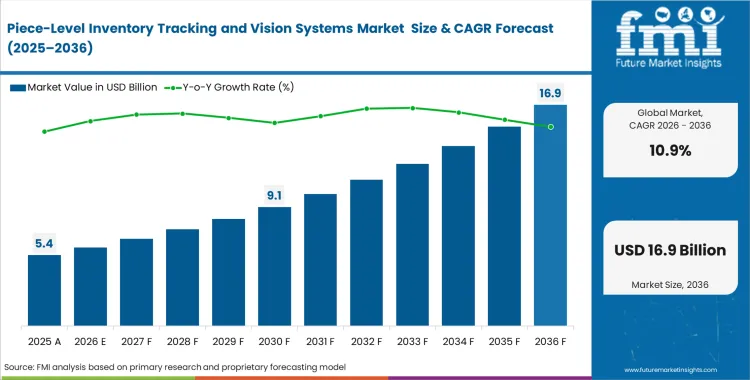
The Piece-Level Inventory Tracking and Vision Systems Market was valued at USD 4.9 billion in 2025. Sales in the Piece-Level Inventory Tracking and Vision Systems Market are set to reach USD 5.4 billion in 2026 and USD 15.2 billion by 2036, reflecting a 10.9% CAGR from 2026 to 2036. Labor shortages in distribution centers continue to increase spending on systems that automate cycle counting and inventory verification.
Operations directors are moving away from manual reconciliation and toward continuous location monitoring inside warehouses. Facilities that still depend on manual scanners often miss replenishment windows when inbound freight volumes rise. Installing industrial vision gateways at receiving docks helps create an immediate inventory record without manual input. Errors increase when warehouse teams skip scanning steps during peak operating periods.
Summary of Piece-Level Inventory Tracking and Vision Systems Market
- Market Snapshot
- The Piece-Level Inventory Tracking and Vision Systems Market is estimated at USD 4.87 billion in 2025 and is projected to reach USD 15.20 billion by 2036.
- Sales in the Piece-Level Inventory Tracking and Vision Systems Market are expected to rise at a 10.9% CAGR from 2026 to 2036, generating an incremental opportunity of USD 9.80 billion over the same period.
- This market includes RFID, barcode imaging, machine vision, and analytics systems that identify, count, verify, and trace individual products or serialized units across supply chains.
- Buyer decisions remain specification-focused, with purchasing criteria centered on inventory accuracy, read speed, software compatibility, serialization capability, and deployment suitability across warehouses, stores, and regulated product channels.
- Demand and Growth Drivers
- Demand for piece-level inventory tracking and vision systems is increasing as warehouse operators replace manual scanning with AI-enabled vision tools. Gartner indicates that 50% of companies with warehouse operations are likely to use these systems by 2027.
- RFID adoption is expanding as retailers and fulfillment operators push for stronger inventory visibility across multi-node networks. GS1 and NRF both associate RFID use with near-99% inventory tracking accuracy in these environments.
- The Piece-Level Inventory Tracking and Vision Systems Market is also supported by package-level traceability rules in healthcare and pharmaceuticals. Under the FDA’s DSCSA framework, certain prescription drugs must meet interoperable electronic identification and tracing requirements.
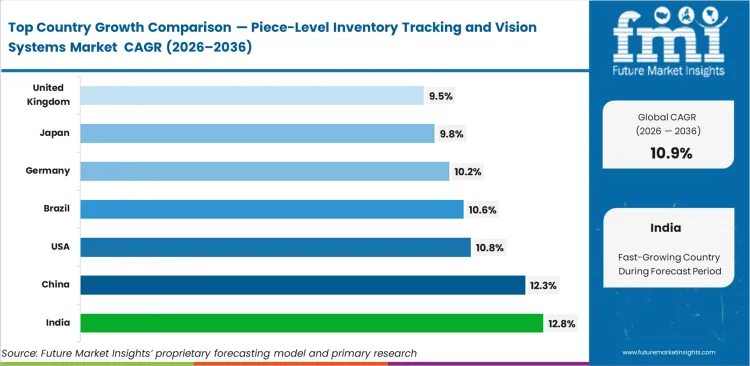
- India is projected to record the fastest growth in the Piece-Level Inventory Tracking and Vision Systems Market, with a 12.8% CAGR from 2026 to 2036. China follows at 12.3% CAGR, the United States at 10.8%, Brazil at 10.6%, Germany at 10.2%, Japan at 9.8%, and the United Kingdom at 9.5% over the same period.
- Market expansion is limited by system integration costs, data-model complexity, and the need to align readers, cameras, tags, and operating workflows across trading partners.
- Product and Segment View
- The market covers RFID systems, vision systems, barcode imaging, sensor fusion layers, and RTLS overlays, delivered as hardware, software, tags and labels, services, and analytics.
- These systems are used across warehouses, stores, hospitals, pharma distribution centers, and factories for cycle counting, traceability, replenishment, shrink control, and pick verification.
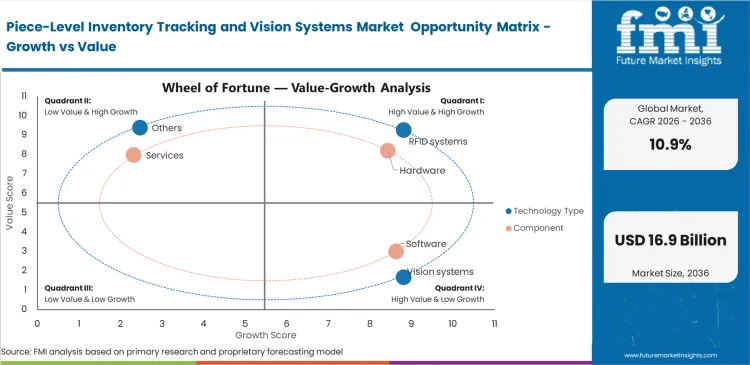
- RFID systems lead the Technology Type segment with 42.0% share, reflecting the current scale of item identity capture in retail, healthcare, and logistics workflows.
- Hardware leads the Component segment with 48.0% share, supported by spending on readers, cameras, handhelds, fixed scanners, and edge devices.
- Warehouses lead the Deployment Site segment with 38.0% share because stock counting, reconciliation, and verification have the clearest labor and accuracy payoff there.
- Cycle counting leads the Application segment with 31.0% share because it is the earliest use case where buyers can measure labor savings and inventory accuracy quickly.
- Retail leads the End User segment with 34.0% share, backed by item-level RFID expansion, omnichannel replenishment, and shrink reduction priorities.
- The scope includes serialized product tracking and vision-led inventory visibility systems, while excluding generic WMS software, broad enterprise ERP modules, and unrelated surveillance-only camera deployments.
- Geography and Competitive Outlook
- India, China, and Brazil are the fastest-growing national markets, while the United States remains the most stable high-value demand base.
- Competition is shaped by platform breadth and installed base, with Zebra Technologies, Avery Dennison, Impinj, Honeywell, Datalogic, Nedap, and SICK all active across some mix of readers, tags, vision, software, or analytics.
- The market is moderately fragmented, and Zebra Technologies holds an estimated 14.0% share because of its broad AIDC, RFID, scanner, mobile-computing, and software footprint.
- Competitive strength is increasingly tied to software integration, overhead and fixed-read architectures, cloud analytics, and proof of accuracy in live warehouse or store operations.
Adoption is also improving as suppliers standardize tag encoding across inbound merchandise. Pre-tagged products with common data structures reduce the need for relabeling at distribution centers. This shifts part of the capital burden upstream and improves receiving speed at the dock. Full conveyor-speed processing depends on broad interoperability across suppliers and warehouse systems.
India is anticipated to record the fastest growth in the Piece-Level Inventory Tracking and Vision Systems Market, with demand rising at a 12.8% CAGR from 2026 to 2036 as retail logistics networks formalize. China is projected to register 12.3% CAGR over the same period as exporters add spatial tracking to outbound shipment validation. Sales in the United States are expected to advance at 10.8% CAGR through 2036, supported by pharmaceutical serialization requirements. Brazil is poised to expand at 10.6% CAGR during the forecast period as e-commerce facilities modernize. Germany is set to grow at 10.2% CAGR from 2026 to 2036 as automotive parts suppliers automate replenishment signals. Japan is likely to record 9.8% CAGR by 2036 as workforce aging supports demand for robotic verification systems. The United Kingdom is estimated to rise at 9.5% CAGR during the assessment period, supported by retailer demand for real-time store-level visibility. Across these countries, spending remains divided between compliance-led upgrades and labor-reduction programs.
Segmental Analysis
Piece-Level Inventory Tracking and Vision Systems Market Analysis by Technology Type
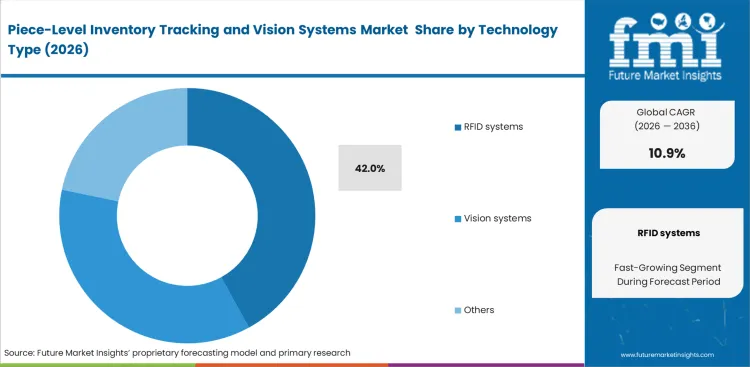
Optical line-of-sight limits have long slowed automated data capture in high-volume distribution centers. Facility managers often deal with false reads when labels are damaged or covered by plastic wrap. RFID systems are expected to account for 42.0% share of the Piece-Level Inventory Tracking and Vision Systems Market in 2026 because they do not depend on optical alignment. FMI analysis indicates that procurement teams value bulk-read capability, as it allows full pallets to move through receiving docks without opening individual cartons. Autonomous tracking drones with hybrid sensors are also being added to support fixed portal infrastructure during lower-traffic hours. Hardware suppliers may promote fully wireless setups, though warehouse engineers still prefer dual-sensor redundancy for shipments that arrive with coding errors. Sites that delay hybrid optical and radio deployment are more likely to face receiving slowdowns when vendor shipments fail to meet labeling standards.
- Initial qualification: High-density read capabilities determine initial vendor selection. Procurement directors evaluate transponder sensitivity metrics under heavy metal interference conditions.
- Performance validation: Middleware filtering algorithms prove decisive during pilot testing phases. Facility operations managers measure system ability to ignore stray reads from adjacent forklift lanes.
- Scale trigger: Enterprise standardization across multiple regional distribution centers cements contract renewals. Chief supply chain officers demand unified analytics dashboards summarizing performance.
Piece-Level Inventory Tracking and Vision Systems Market Analysis by Component
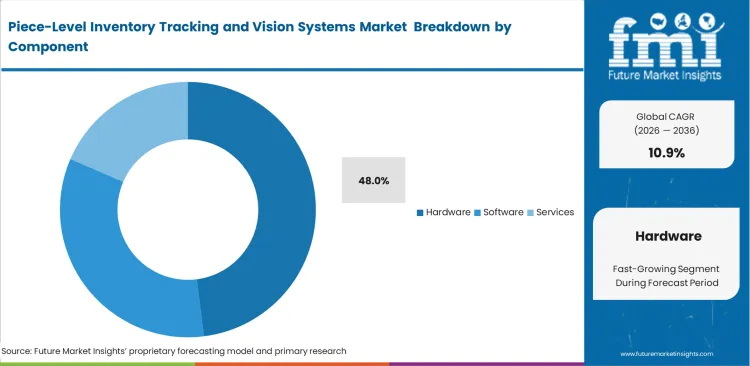
Hardware is expected to capture 48.0% share of the piece-level inventory tracking and vision systems market in 2026, as logistics operators continue installing antenna networks and optical portals across large warehouse footprints. FMI analysis suggests that purchasing teams view edge nodes as long-life assets and often plan around operating cycles of at least ten years. The addition of advanced vision sensor systems also requires major upfront investment in wiring and network infrastructure before software benefits begin to show. Vendor presentations often focus on hardware specifications, though system integrators know middleware licensing has a strong influence on long-term ownership cost. Companies that choose hardware platforms without open API support often face limits in how operational data can move across systems.
- Procurement phase: Capital budget allocation focuses entirely on physical sensor nodes. Purchasing managers negotiate bulk discounts on passive transponders to minimize recurring consumable costs.
- Operational reality: Hidden integration costs emerge during system calibration. Automation engineers spend extensive hours tuning antenna zones to prevent cross-dock interference.
- Lifecycle economics: Subscription fees for spatial analytics eventually surpass initial hardware outlay. Financial controllers recognize data platform lock-in prevents competitive vendor swapping.
Piece-Level Inventory Tracking and Vision Systems Market Analysis by Deployment Site
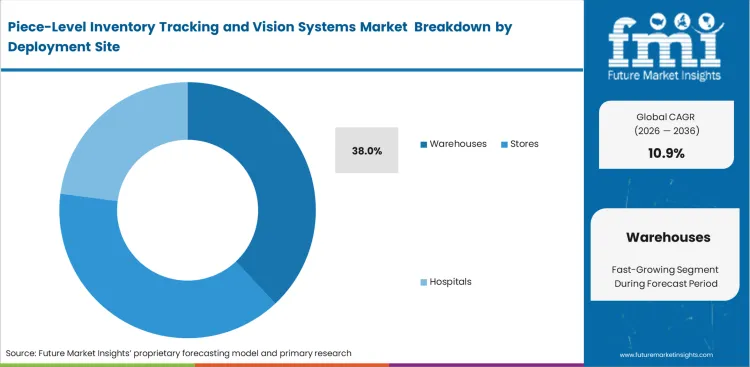
Centralized receiving sites remain the main focus for automation investment in large retail fulfillment networks. Enterprise teams are directing budgets toward these locations because they manage the highest inventory volumes and influence downstream accuracy. In the Piece-Level Inventory Tracking and Vision Systems Market, warehouses are estimated to account for 38.0% share in 2026. FMI analysis suggests that even small verification errors at primary distribution hubs can carry forward into regional replenishment and store-level inventory records. That is why smart warehouse technologies are being installed at busy dock doors where inbound freight must be checked without slowing internal movement. Retail gets much of the attention in industry coverage, yet pharmaceutical distribution sites continue to set a stricter operating benchmark because serialized product handling leaves little room for mismatch. When automated dock verification is missing, shipment discrepancies are harder to catch early and penalties from downstream partners become more likely.
- Discrepancy prevention: Automated receiving portals eliminate manual counting errors instantly. Warehouse operations managers rely on instant mismatch alerts to quarantine incorrect inbound freight.
- Residual vulnerability: Tag damage during transit still creates invisible inventory pockets. Dock supervisors must maintain manual exception-handling protocols for unscannable pallets.
- Capture maximization: Integrating overhead scanning arrays with existing conveyor systems guarantees total item capture. Facility engineers strictly enforce vendor tagging compliance to maximize automated routing efficiency.
Piece-Level Inventory Tracking and Vision Systems Market Drivers, Restraints, and Opportunities
Labor scarcity across high-volume distribution centers forces operations managers to aggressively automate manual cycle counting tasks. Facilities face severe operational bottlenecks when insufficient staffing prevents timely inbound freight verification. Delaying infrastructure upgrades leads directly to systemic receiving delays and downstream stockouts. Implementing automated spatial tracking arrays ensures continuous inventory visibility independent of workforce availability. Strict pharmaceutical serialization mandates further compel compliance officers to deploy unit-level warehouse robotics across global transit networks. Rapid expansion of micro-fulfillment business models simultaneously requires absolute real-time accuracy to prevent digital overselling.
Severe multipath interference generated by dense metal racking structures drastically limits radio frequency read reliability inside legacy facilities. Facility engineers struggle to maintain consistent signal capture when tracking wan asset tracking devices through liquid-heavy environments. Physical limitations require highly customized antenna tuning that delays initial pilot deployments significantly. Advanced filtering middleware offers partial mitigation but cannot fully overcome fundamental physics constraints in poorly optimized warehouse layouts.
Opportunities in the Piece-Level Inventory Tracking and Vision Systems Market
- Edge computing integration: Processing spatial data directly at scanning nodes eliminates network latency. IT directors achieve real-time tracking without overwhelming central cloud servers.
- Hybrid sensor arrays: Fusing radio frequency data with industrial machine vision guarantees complete read accuracy. Automation engineers eliminate false positives by requiring simultaneous optical and radio verification.
- Predictive maintenance analytics: Monitoring hardware health continuously prevents unexpected portal failures. Maintenance supervisors avoid catastrophic receiving delays by replacing degraded antennas proactively.
Regional Analysis
Based on regional analysis, piece-level inventory tracking and vision systems market is segmented into Americas, EMEA, and Asia Pacific across 40 plus countries.
.webp "Top Country Growth Comparison Piece Level Inventory Tracking And Vision Systems Market Cagr (2026 2036)")
| Country | CAGR (2026 to 2036) |
|---|---|
| India | 12.8% |
| China | 12.3% |
| United States | 10.8% |
| Brazil | 10.6% |
| Germany | 10.2% |
| Japan | 9.8% |
| United Kingdom | 9.5% |
Source: Future Market Insights (FMI) analysis, based on proprietary forecasting model and primary research
Americas Piece-Level Inventory Tracking and Vision Systems Market Analysis
Strict federal mandates demanding absolute unit-level drug serialization fundamentally alter capital deployment priorities across distribution networks. Facilities invest heavily in highly secure edge processing hardware to protect sensitive transit data from interception. Automation engineers prioritize robust middleware platforms capable of pushing real-time tracking updates directly to national regulatory databases. Based on FMI's estimates, massive regional fulfillment centers demand continuous system uptime to support guaranteed next-day delivery promises.
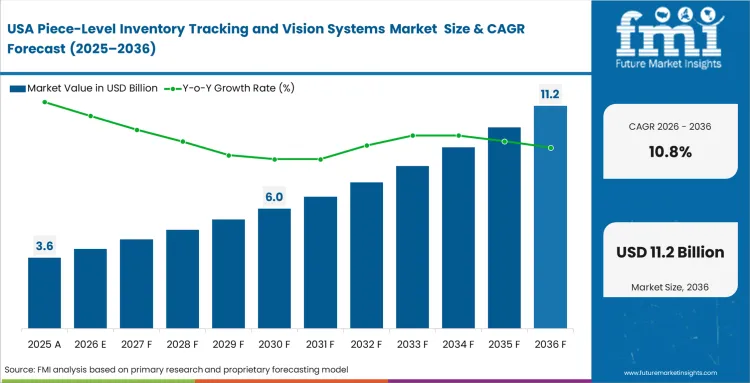
- United States: Demand for piece-level inventory tracking and vision systems in the United States is anticipated to rise at a 10.8% CAGR through 2036. Intense competition in omnichannel fulfillment is pushing national retail chains to maintain tighter unit-level accuracy across distribution networks. To address this, supply chain teams are deploying comprehensive warehouse RFID portals that help reduce phantom stockouts and improve inventory visibility. Facilities without real-time spatial analytics often struggle to identify discrepancies early, which increases exposure to vendor chargebacks from major e-commerce platforms. This is keeping accuracy-focused tracking investment high across large fulfillment operations.
- Brazil: Sales of piece-level inventory tracking and vision systems in Brazil are set to record 10.6% CAGR during the assessment period. Rapid e-commerce expansion is pushing fragmented regional logistics providers to replace older manual counting processes with more scalable tracking infrastructure. Operators are doing this to improve shipment visibility and reduce losses across complex transit networks. Companies that build stronger real-time data capture capabilities are gaining an advantage in third-party fulfillment contracting. This is supporting steady demand for advanced tracking systems across Brazil’s logistics sector.
FMI's report includes analysis of Canadian distribution network modernization. Cross-border freight tracking requires seamless interoperability between differing national data standards.
EMEA Piece-Level Inventory Tracking and Vision Systems Market Analysis
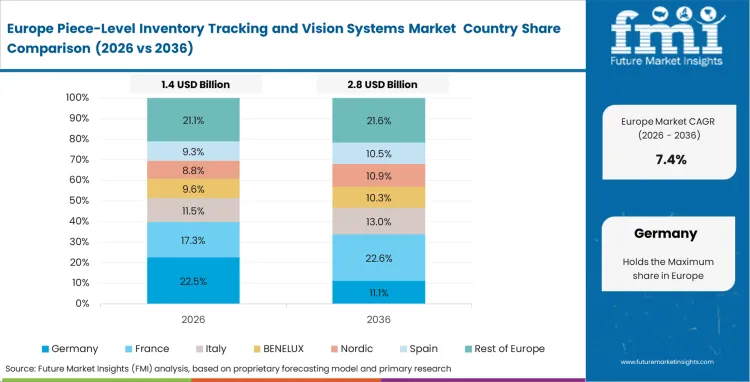
Stringent data privacy regulations severely restrict how facilities monitor worker movement alongside physical asset tracking. Integration teams must carefully tune sensor arrays to anonymize personnel while maintaining perfect product visibility. Operations directors focus investments heavily on reducing shrinkage across highly valuable luxury goods supply chains. According to FMI's assessment, established automotive manufacturing hubs demand ultra-precise location data to support complex just-in-time assembly schedules.
- Germany: Sales of piece-level inventory tracking and vision systems in Germany are poised to rise at a 10.2% CAGR through 2036. The country’s established automotive manufacturing base continues to support demand for continuous component visibility across production-linked supply chains. Procurement teams are increasingly integrating advanced inventory management software with legacy enterprise resource planning platforms to reduce the risk of assembly disruption. Regional operators also show stronger preference for local vendor ecosystems that align with strict data sovereignty requirements. This is reinforcing Germany’s position as a compliance-sensitive and integration-driven market.
- United Kingdom: Demand for piece-level inventory tracking and vision systems in the United Kingdom is anticipated to record 9.5% CAGR during the forecast period. Cross-border logistics friction is pushing distribution centers to improve internal efficiency and reduce delays across fulfillment operations. Facility managers are adopting automated portals to support documentation workflows tied to customs and shipment handling. Mid-sized distributors that delay spatial automation upgrades are finding it harder to remain cost-competitive in a tighter operating environment. This is keeping system adoption relevant across the United Kingdom’s distribution network.
FMI's report includes evaluation of French and Italian luxury goods tracing initiatives. Sustainability reporting mandates push facilities to track reusable transit packaging meticulously.
Asia Pacific Piece-Level Inventory Tracking and Vision Systems Market Analysis
Rapid formalization of previously fragmented logistics networks across massive population centers drives aggressive infrastructure modernization. Facilities bypass legacy manual scanning entirely to install continuous spatial monitoring arrays directly. Supply chain directors focus capital expenditure on scalable hardware capable of handling extreme volume spikes during regional commerce festivals. FMI's analysis indicates local vendor ecosystems prioritize low-cost tag production to accelerate broad adoption across thin-margin manufacturing sectors.
- India: Demand for piece-level inventory tracking and vision systems in India is anticipated to rise at 12.8% CAGR through 2036, supported by rapid consolidation across fragmented distribution networks under rising e-commerce volumes. Warehouse operators are moving away from manual ledger checks and adopting automated tagging systems to improve stock accuracy. Integrators are also strengthening their position by offering subscription-led models that reduce upfront investment pressure for large users.
- China: In China, sales of piece-level inventory tracking and vision systems are set to record 12.3% CAGR during the assessment period as export manufacturers embed tracking hardware into packaging lines to meet retailer compliance requirements. This shift helps facilities verify outbound goods without interrupting line speed. Strong manufacturing clusters are also pushing deployment further upstream, bringing tracking systems closer to early-stage assembly operations.
- Japan: Japan’s piece-level inventory tracking and vision systems industry is poised to expand at 9.8% CAGR by 2036 as labor shortages continue to reshape logistics operations. Distribution centers are introducing automated verification networks to maintain continuity in routine handling tasks. Space constraints across mature facilities are also encouraging greater dependence on algorithm-led throughput optimization, which keeps operations efficient within limited footprints. This keeps demand steady across advanced warehousing environments.
FMI's report includes detailed tracking metrics for South Korea and Australia. Regulatory environments across the region increasingly mandate strict pharmaceutical traceability standards.
Competitive Aligners for Market Players
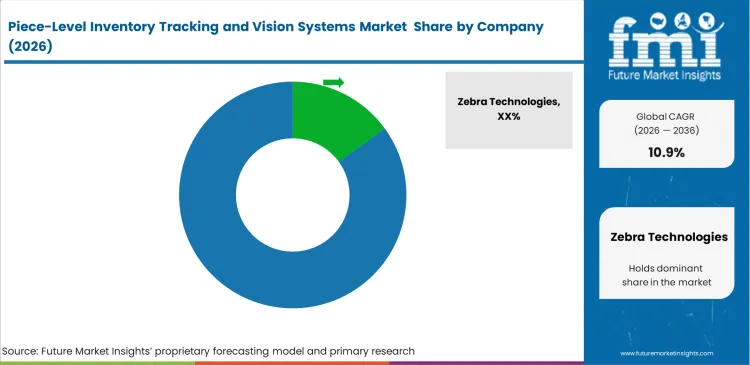
Hardware commoditization is compressing profit margins across physical sensor production. Impinj and Zebra Technologies win large enterprise contracts because their hardware connects directly to leading warehouse management platforms, which matters more to buyers than antenna performance alone. Purchasing directors often pass on cheaper offshore scanners because they do not come with pre-built connectors for enterprise analytics platforms, which adds integration cost and risk. Vendors that can demonstrate measurable labor savings through AI-assisted workflows are gaining an advantage during competitive pilot evaluations.
Patent portfolios covering spatial filtering algorithms make it harder for low-cost hardware producers to replicate the performance of established suppliers. Avery Dennison's production scale allows it to cut unit costs on tags, putting smaller competitors at a disadvantage in high-volume contract bids. Datalogic and SICK hold strong positions in industrial markets by building scanning equipment that can withstand chemical cleaning processes in pharmaceutical facilities. FMI notes that large libraries of pre-certified integration templates for legacy ERP systems give established vendors a significant head start that new hardware entrants find difficult to replicate.
Large logistics operators are pushing tracking suppliers to use open API standards so they can switch or add vendors without rebuilding their data infrastructure. Enterprise architecture teams will not renew contracts with vendors like Honeywell or Nedap if those platforms block third-party scanners from connecting to the central middleware. Buyers treat open connectivity as a baseline requirement, not a feature. Some facilities are testing open-source tracking platforms to strengthen their negotiating position when renewing contracts with full-stack vendors. Over the next decade, vendors that shift from hardware sales toward subscription-based pricing for analytics services are likely to build more stable revenue than those that depend on replacement cycles.
Key Players in Piece-Level Inventory Tracking and Vision Systems Market
- Zebra Technologies
- Avery Dennison
- Impinj
- Honeywell
- Datalogic
- Nedap
- SICK
Scope of the Report
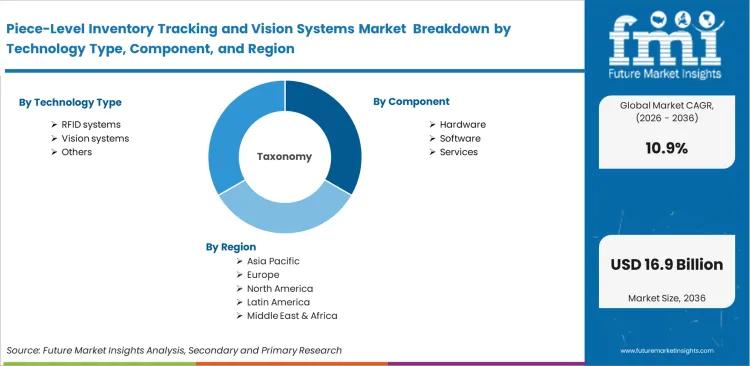
| Metric | Value |
|---|---|
| Quantitative Units | USD 5.4 billion to USD 15.2 billion, at a CAGR of 10.90% |
| Market Definition | Systematic deployment of automated sensor networks designed to digitize physical asset movement within commercial facilities. Architecture combines data capture hardware with algorithmic middleware to replace manual auditing. |
| Segmentation | Technology Type, Component, Deployment Site, Application, End User, Region |
| Regions Covered | North America, Latin America, Europe, Asia Pacific, Middle East and Africa |
| Countries Covered | United States, Brazil, Germany, United Kingdom, India, China, Japan |
| Key Companies Profiled | Zebra Technologies, Avery Dennison, Impinj, Honeywell, Datalogic, Nedap, SICK |
| Forecast Period | 2026 to 2036 |
| Approach | Hardware node deployment volume across top 500 global distribution centers establishes baseline metric. |
Source: Future Market Insights (FMI) analysis, based on proprietary forecasting model and primary research
Piece-Level Inventory Tracking and Vision Systems Market Analysis by Segments
Technology Type
- RFID systems
- Vision systems
- Barcode imaging
- Sensor fusion
- RTLS overlays
Component
- Hardware
- Software
- Tags and labels
- Services
- Analytics
Deployment Site
- Warehouses
- Stores
- Hospitals
- Pharma DCs
- Factories
Application
- Cycle counting
- Traceability
- Replenishment
- Shrink control
- Pick verification
End User
- Retail
- Logistics
- Healthcare
- Pharma
- Manufacturing
Region
- North America
- Latin America
- Europe
- Asia Pacific
- Middle East and Africa
Bibliography
- Food and Drug Administration. (2025, October 16). Drug Supply Chain Security Act (DSCSA).
- GS1 US. (2025, January 17). Implementation guideline for RFID in healthcare manufacturing (R1.1).
- Hasan Pranto, M. M., & Liu, J. (2024). A survey on automated inventory tracking systems. International Journal of Machine Learning, 14(3), 128-132.
- National Retail Federation. (2025, October 2). How RFID is helping transform the retail customer experience.
- Villegas-Ch, W., Maldonado Navarro, A., & Sanchez-Viteri, S. (2024). Optimization of inventory management through computer vision and machine learning technologies. Intelligent Systems with Applications, 23, Article 200438.
This bibliography is provided for reader reference. The full FMI report contains the complete reference list with primary source documentation.
This Report Addresses
- Specific impact of multipath radio interference on physical data capture reliability across liquid-heavy distribution facilities.
- Commercial consequences for logistics providers delaying spatial automation upgrades during high-velocity micro-fulfillment surges.
- Vendor qualification criteria utilized by enterprise architecture boards when evaluating open API middleware platforms.
- Structural transition from standalone optical barcode verification toward hybrid sensor arrays blending radio and vision data.
- Analytical capability gaps preventing legacy enterprise resource planning platforms from directly processing high-speed edge node data.
- Labor efficiency metrics achieved when automated cycle counting completely replaces weekend manual inventory auditing protocols.
- Strategic positioning of major hardware integrators shifting revenue models toward continuous subscription analytics billing.
- Regulatory pressures forcing pharmaceutical compliance officers to adopt absolute unit-level serialization across global transit hubs.
Frequently Asked Questions
What is the projected value of the Piece-Level Inventory Tracking and Vision Systems Market by 2036?
Total revenue scales to USD 15.2 billion by 2036. This expansion reflects a structural transition away from manual cycle counting toward continuous spatial asset monitoring.
What will the overall valuation reach in 2026?
Demand crosses USD 5.4 billion during 2026. Facilities must deploy robust hardware portals before middleware licensing generates meaningful operational savings.
What compound annual growth rate characterizes this forecast?
Growth maintains a 10.90% trajectory over the decade. This rate directly aligns with rapid modernization efforts across global omnichannel fulfillment networks.
Why do RFID systems capture dominant technology share?
Radio frequency arrays bypass physical line-of-sight constraints entirely. Receiving docks clear inbound freight pallets immediately without breaking down cartons for optical barcode scanning.
What forces hardware to command component spending?
Physical sensor nodes require massive capital deployment to cover expansive warehouse footprints. Integrators focus budget allocation on securing optimal transponder coverage before purchasing advanced analytics software.
Why do warehouses represent the primary deployment site?
Central distribution hubs process the highest concentration of commercial assets. Fixing discrepancy issues at centralized docks prevents compounding errors from cascading down to regional fulfillment centers.
How does strict serialization change adoption dynamics?
Pharmaceutical regulations mandate absolute unit-level tracing across entire distribution chains. Compliance officers adopt spatial tracking networks specifically to avoid severe governmental penalty clauses.
What role does labor scarcity play in accelerating deployment?
Distribution centers simply lack sufficient personnel to conduct manual weekend inventory audits. Automation engineers replace human-driven verification with continuous background scanning arrays.
Why does India lead regional growth rates?
Fragmented logistics networks undergo aggressive consolidation to handle massive e-commerce volume. Local supply chain directors leapfrog manual ledger systems directly into automated tracking arrays.
How does China differ structurally from Western adoption patterns?
Export manufacturers embed transponders directly into product packaging at the source. Upstream integration allows total outbound tracking without slowing continuous assembly operations.
What limits adoption speed in legacy facilities?
Dense metal racking generates severe multipath interference degrading signal reliability. Integration teams must spend extensive calibration hours tuning antennas specifically for unique architectural layouts.
Why do retailers force tracking requirements upstream?
Omnichannel fulfillment demands perfect inventory visibility to prevent digital overselling. Merchandising executives require vendors to source-tag merchandise to eliminate receiving bottlenecks at store locations.
How do edge computing platforms improve system utility?
Processing spatial data directly at scanning nodes eliminates network latency. Operations managers receive instant discrepancy alerts without waiting for central cloud servers to return verification results.
What advantage do hybrid sensor arrays offer over standalone units?
Combining optical recognition with radio frequency capture guarantees total read accuracy. Facility managers rely on redundant verification to handle vendor shipments missing proper digital encoding.
Why do procurement directors prioritize open API architecture?
Proprietary hardware ecosystems lock operational data inside vendor-controlled platforms. Enterprise architecture boards demand open middleware specifically to retain leverage during subscription renewal negotiations.
How does shrink control differ from cycle counting applications?
Shrink management focuses entirely on detecting unauthorized transit movement in real-time. Cycle auditing aims to maintain perpetual alignment between physical goods and central database records.
What causes tracking accuracy to degrade below vendor specifications?
Liquid-heavy merchandise absorbs radio frequency signals dramatically. Facility engineers must deploy significantly higher antenna density to maintain capture rates inside pharmaceutical or beverage environments.
How do AI workforce assistants alter competitive positioning?
Algorithmic tools demonstrate tangible labor reduction metrics directly to financial controllers. Hardware suppliers lacking integrated workforce optimization features struggle to justify premium equipment pricing.
Why is United States adoption heavily focused on omnichannel retail?
Consumer expectations dictate guaranteed next-day delivery availability. Logistics directors utilize automated portals to maintain absolute unit accuracy across massive regional distribution networks.
What structural barrier protects established integrators from startups?
Incumbent vendors possess extensive libraries of pre-certified enterprise resource planning connectors. Operations managers refuse to risk facility downtime integrating untested third-party middleware engines.
How do privacy regulations shape European deployment strategies?
Data sovereignty laws restrict monitoring personnel movement alongside physical assets. Automation engineers must configure sensor networks meticulously to anonymize workers while tracking products.
Why is cycle counting the most immediate trigger for investment?
Eliminating weekend manual audits removes massive overtime expenses instantly. Financial controllers approve infrastructure budgets primarily based on immediate labor cost reduction projections.
Preview the report firsthand - request a free sample
Get SampleGet the brochure for pricing and purchase details.
Get PDFTable of Content
- Executive Summary
- Global Market Outlook
- Supply-side Trends
- Technology Roadmap Analysis
- Analysis and Recommendations
- Market Overview
- Market Coverage / Taxonomy
- Market Definition / Scope / Limitations
- Research Methodology
- Chapter Orientation
- Market Sizing, Forecasting, and Opportunity Mapping
- Research Design and Evidence Framework
- Desk Research Programme (Secondary Evidence)
- Company Annual and Sustainability Reports
- Peer-reviewed Journals and Academic Literature
- Corporate Websites, Product Literature, and Technical Notes
- Earnings Decks and Investor Briefings
- Statutory Filings and Regulatory Disclosures
- Technical White Papers and Standards Notes
- Trade Journals, Industry Magazines, and Analyst Briefs
- Conference Proceedings, Webinars, and Seminar Materials
- Government Statistics Portals and Public Data Releases
- Press Releases and Reputable Media Coverage
- Specialist Newsletters and Curated Briefings
- Sector Databases and Reference Repositories
- FMI Internal Proprietary Databases and Historical Market Datasets
- Subscription Datasets and Paid Sources
- Social Channels, Communities, and Digital Listening Inputs
- Additional Desk Sources
- Expert Input and Fieldwork (Primary Evidence)
- Primary Modes
- Qualitative Interviews and Expert Elicitation
- Observational and In-context Research
- Social and Community Interactions
- Stakeholder Universe Engaged
- C-suite Leaders
- Board Members
- Presidents and Vice Presidents
- R&D and Innovation Heads
- Technical Specialists
- Domain Subject-matter Experts
- Scientists
- Physicians and Other Healthcare Professionals
- Governance, Ethics, and Data Stewardship
- Research Ethics
- Data Integrity and Handling
- Primary Modes
- Tooling, Models, and Reference Databases
- Desk Research Programme (Secondary Evidence)
- Data Engineering and Model Build
- Data Acquisition and Ingestion
- Cleaning, Normalisation, and Verification
- Synthesis, Triangulation, and Analysis
- Quality Assurance and Audit Trail
- Market Background
- Market Dynamics
- Drivers
- Restraints
- Opportunity
- Trends
- Scenario Forecast
- Demand in Optimistic Scenario
- Demand in Likely Scenario
- Demand in Conservative Scenario
- Opportunity Map Analysis
- Product Life Cycle Analysis
- Supply Chain Analysis
- Investment Feasibility Matrix
- Value Chain Analysis
- PESTLE and Porter’s Analysis
- Regulatory Landscape
- Regional Parent Market Outlook
- Production and Consumption Statistics
- Import and Export Statistics
- Market Dynamics
- Global Market Analysis 2021 to 2025 and Forecast, 2026 to 2036
- Historical Market Size Value (USD Million) Analysis, 2021 to 2025
- Current and Future Market Size Value (USD Million) Projections, 2026 to 2036
- Y-o-Y Growth Trend Analysis
- Absolute $ Opportunity Analysis
- Global Market Pricing Analysis 2021 to 2025 and Forecast 2026 to 2036
- Global Market Analysis 2021 to 2025 and Forecast 2026 to 2036, By Technology Type
- Introduction / Key Findings
- Historical Market Size Value (USD Million) Analysis By Technology Type , 2021 to 2025
- Current and Future Market Size Value (USD Million) Analysis and Forecast By Technology Type , 2026 to 2036
- RFID systems
- Vision systems
- Others
- RFID systems
- Y-o-Y Growth Trend Analysis By Technology Type , 2021 to 2025
- Absolute $ Opportunity Analysis By Technology Type , 2026 to 2036
- Global Market Analysis 2021 to 2025 and Forecast 2026 to 2036, By Component
- Introduction / Key Findings
- Historical Market Size Value (USD Million) Analysis By Component, 2021 to 2025
- Current and Future Market Size Value (USD Million) Analysis and Forecast By Component, 2026 to 2036
- Hardware
- Software
- Services
- Hardware
- Y-o-Y Growth Trend Analysis By Component, 2021 to 2025
- Absolute $ Opportunity Analysis By Component, 2026 to 2036
- Global Market Analysis 2021 to 2025 and Forecast 2026 to 2036, By Deployment Site
- Introduction / Key Findings
- Historical Market Size Value (USD Million) Analysis By Deployment Site, 2021 to 2025
- Current and Future Market Size Value (USD Million) Analysis and Forecast By Deployment Site, 2026 to 2036
- Warehouses
- Stores
- Hospitals
- Warehouses
- Y-o-Y Growth Trend Analysis By Deployment Site, 2021 to 2025
- Absolute $ Opportunity Analysis By Deployment Site, 2026 to 2036
- Global Market Analysis 2021 to 2025 and Forecast 2026 to 2036, By Region
- Introduction
- Historical Market Size Value (USD Million) Analysis By Region, 2021 to 2025
- Current Market Size Value (USD Million) Analysis and Forecast By Region, 2026 to 2036
- North America
- Latin America
- Western Europe
- Eastern Europe
- East Asia
- South Asia and Pacific
- Middle East & Africa
- Market Attractiveness Analysis By Region
- North America Market Analysis 2021 to 2025 and Forecast 2026 to 2036, By Country
- Historical Market Size Value (USD Million) Trend Analysis By Market Taxonomy, 2021 to 2025
- Market Size Value (USD Million) Forecast By Market Taxonomy, 2026 to 2036
- By Country
- USA
- Canada
- Mexico
- By Technology Type
- By Component
- By Deployment Site
- By Country
- Market Attractiveness Analysis
- By Country
- By Technology Type
- By Component
- By Deployment Site
- Key Takeaways
- Latin America Market Analysis 2021 to 2025 and Forecast 2026 to 2036, By Country
- Historical Market Size Value (USD Million) Trend Analysis By Market Taxonomy, 2021 to 2025
- Market Size Value (USD Million) Forecast By Market Taxonomy, 2026 to 2036
- By Country
- Brazil
- Chile
- Rest of Latin America
- By Technology Type
- By Component
- By Deployment Site
- By Country
- Market Attractiveness Analysis
- By Country
- By Technology Type
- By Component
- By Deployment Site
- Key Takeaways
- Western Europe Market Analysis 2021 to 2025 and Forecast 2026 to 2036, By Country
- Historical Market Size Value (USD Million) Trend Analysis By Market Taxonomy, 2021 to 2025
- Market Size Value (USD Million) Forecast By Market Taxonomy, 2026 to 2036
- By Country
- Germany
- UK
- Italy
- Spain
- France
- Nordic
- BENELUX
- Rest of Western Europe
- By Technology Type
- By Component
- By Deployment Site
- By Country
- Market Attractiveness Analysis
- By Country
- By Technology Type
- By Component
- By Deployment Site
- Key Takeaways
- Eastern Europe Market Analysis 2021 to 2025 and Forecast 2026 to 2036, By Country
- Historical Market Size Value (USD Million) Trend Analysis By Market Taxonomy, 2021 to 2025
- Market Size Value (USD Million) Forecast By Market Taxonomy, 2026 to 2036
- By Country
- Russia
- Poland
- Hungary
- Balkan & Baltic
- Rest of Eastern Europe
- By Technology Type
- By Component
- By Deployment Site
- By Country
- Market Attractiveness Analysis
- By Country
- By Technology Type
- By Component
- By Deployment Site
- Key Takeaways
- East Asia Market Analysis 2021 to 2025 and Forecast 2026 to 2036, By Country
- Historical Market Size Value (USD Million) Trend Analysis By Market Taxonomy, 2021 to 2025
- Market Size Value (USD Million) Forecast By Market Taxonomy, 2026 to 2036
- By Country
- China
- Japan
- South Korea
- By Technology Type
- By Component
- By Deployment Site
- By Country
- Market Attractiveness Analysis
- By Country
- By Technology Type
- By Component
- By Deployment Site
- Key Takeaways
- South Asia and Pacific Market Analysis 2021 to 2025 and Forecast 2026 to 2036, By Country
- Historical Market Size Value (USD Million) Trend Analysis By Market Taxonomy, 2021 to 2025
- Market Size Value (USD Million) Forecast By Market Taxonomy, 2026 to 2036
- By Country
- India
- ASEAN
- Australia & New Zealand
- Rest of South Asia and Pacific
- By Technology Type
- By Component
- By Deployment Site
- By Country
- Market Attractiveness Analysis
- By Country
- By Technology Type
- By Component
- By Deployment Site
- Key Takeaways
- Middle East & Africa Market Analysis 2021 to 2025 and Forecast 2026 to 2036, By Country
- Historical Market Size Value (USD Million) Trend Analysis By Market Taxonomy, 2021 to 2025
- Market Size Value (USD Million) Forecast By Market Taxonomy, 2026 to 2036
- By Country
- Kingdom of Saudi Arabia
- Other GCC Countries
- Turkiye
- South Africa
- Other African Union
- Rest of Middle East & Africa
- By Technology Type
- By Component
- By Deployment Site
- By Country
- Market Attractiveness Analysis
- By Country
- By Technology Type
- By Component
- By Deployment Site
- Key Takeaways
- Key Countries Market Analysis
- USA
- Pricing Analysis
- Market Share Analysis, 2025
- By Technology Type
- By Component
- By Deployment Site
- Canada
- Pricing Analysis
- Market Share Analysis, 2025
- By Technology Type
- By Component
- By Deployment Site
- Mexico
- Pricing Analysis
- Market Share Analysis, 2025
- By Technology Type
- By Component
- By Deployment Site
- Brazil
- Pricing Analysis
- Market Share Analysis, 2025
- By Technology Type
- By Component
- By Deployment Site
- Chile
- Pricing Analysis
- Market Share Analysis, 2025
- By Technology Type
- By Component
- By Deployment Site
- Germany
- Pricing Analysis
- Market Share Analysis, 2025
- By Technology Type
- By Component
- By Deployment Site
- UK
- Pricing Analysis
- Market Share Analysis, 2025
- By Technology Type
- By Component
- By Deployment Site
- Italy
- Pricing Analysis
- Market Share Analysis, 2025
- By Technology Type
- By Component
- By Deployment Site
- Spain
- Pricing Analysis
- Market Share Analysis, 2025
- By Technology Type
- By Component
- By Deployment Site
- France
- Pricing Analysis
- Market Share Analysis, 2025
- By Technology Type
- By Component
- By Deployment Site
- India
- Pricing Analysis
- Market Share Analysis, 2025
- By Technology Type
- By Component
- By Deployment Site
- ASEAN
- Pricing Analysis
- Market Share Analysis, 2025
- By Technology Type
- By Component
- By Deployment Site
- Australia & New Zealand
- Pricing Analysis
- Market Share Analysis, 2025
- By Technology Type
- By Component
- By Deployment Site
- China
- Pricing Analysis
- Market Share Analysis, 2025
- By Technology Type
- By Component
- By Deployment Site
- Japan
- Pricing Analysis
- Market Share Analysis, 2025
- By Technology Type
- By Component
- By Deployment Site
- South Korea
- Pricing Analysis
- Market Share Analysis, 2025
- By Technology Type
- By Component
- By Deployment Site
- Russia
- Pricing Analysis
- Market Share Analysis, 2025
- By Technology Type
- By Component
- By Deployment Site
- Poland
- Pricing Analysis
- Market Share Analysis, 2025
- By Technology Type
- By Component
- By Deployment Site
- Hungary
- Pricing Analysis
- Market Share Analysis, 2025
- By Technology Type
- By Component
- By Deployment Site
- Kingdom of Saudi Arabia
- Pricing Analysis
- Market Share Analysis, 2025
- By Technology Type
- By Component
- By Deployment Site
- Turkiye
- Pricing Analysis
- Market Share Analysis, 2025
- By Technology Type
- By Component
- By Deployment Site
- South Africa
- Pricing Analysis
- Market Share Analysis, 2025
- By Technology Type
- By Component
- By Deployment Site
- USA
- Market Structure Analysis
- Competition Dashboard
- Competition Benchmarking
- Market Share Analysis of Top Players
- By Regional
- By Technology Type
- By Component
- By Deployment Site
- Competition Analysis
- Competition Deep Dive
- Zebra Technologies
- Overview
- Product Portfolio
- Profitability by Market Segments (Product/Age /Sales Channel/Region)
- Sales Footprint
- Strategy Overview
- Marketing Strategy
- Product Strategy
- Channel Strategy
- Avery Dennison
- Impinj
- Honeywell
- Datalogic
- Nedap
- Zebra Technologies
- Competition Deep Dive
- Assumptions & Acronyms Used


