

- Market Size (2026)
- USD 286.0 Mn
- Forecast (2036)
- USD 474.8 Mn
- CAGR (2026 to 2036)
- 5.2%
How big is Barber Shop Equipment Market in 2026?
The barber shop equipment market size is USD 286.0 Million in 2026, up from USD 271.9 Million in 2025, and is projected to reach USD 474.8 Million by 2036 at 5.2% CAGR.
The market rises from USD 271.9 Million in 2025 to USD 286.0 Million in 2026, with USD 188.8 Million of additional revenue forecast between 2026 and 2036. Local conditions influence when equipment needs become orders. Germany's small-firm craft structure favors manageable lifecycle costs. Saudi male-barbering requirements and Dubai's salon-layout rules make specification and installation support part of the purchase. On the other hand, Japan's mature barbering network places greater weight on replacement and efficient use of space.
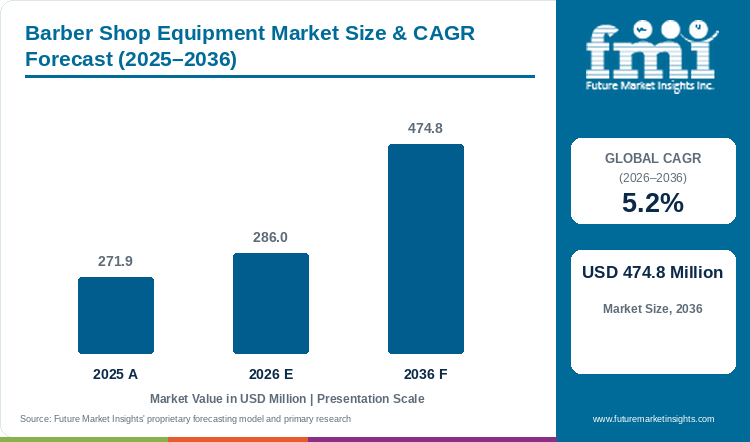
Barber Shop Equipment Market Size & CAGR Forecast (2025-2036)
| Year | Basis | Market value (USD million) |
|---|---|---|
| 2025 | Actual | 271.9 |
| 2026 | Estimate | 286.0 |
| 2036 | Forecast | 474.8 |
| CAGR, 2026 to 2036 | 5.2% | |
Source: Future Market Insights proprietary forecasting model and primary research.
Key Takeaways
- Core professional range leads Product Type with 41.0% of revenue in 2026, and Hair salons lead End User demand with 35.0%.
- Core equipment accounts for 41.0% of Offering revenue; Mid-range holds 46.0% of Price Tier revenue in 2026.
- Professional distributors lead Sales Channel revenue with 43.0%, supported by assortment, replenishment and service coordination.
- The ten profiled companies cover station systems, professional tools and recurring salon products.
- South Korea has the highest profiled CAGR at 6.5%; Japan is forecast at 4.2% over 2026 to 2036.
Analyst Perspective
Suppliers that document durability and cleanability are better positioned to clear owner-operator purchasing tests. Serviceability and downtime reduction strengthen the case. Compact and multifunctional systems can improve revenue per square meter where rent, plumbing, and chair count constrain expansion. Distributor strength remains commercially important because fragmented buyers often need replenishment, repair, and replacement support after the initial sale.
- Rahul Pandita, Principal Consultant, Future Market Insights
How is the barber shop equipment market segmented?
The market is segmented by Product Type, End User, Offering, Price Tier, Sales Channel and Region.
Product Type distinguishes Core professional range, Premium & specialist range, and Entry & value range. End User covers Hair salons, Spas & wellness centers, Nail salons, Medspas & clinics, and Barbershops. Offering separates Core equipment from Consumables & refills and Accessories. Price Tier and Sales Channel describe the budget and purchasing route. A salon may buy a mid-range chair through a distributor while an independent stylist orders a professional clipper online and replenishes blades separately.
What makes Core professional range central to the Product Type category?
Core professional range holds 41.0% of Product Type revenue in 2026.
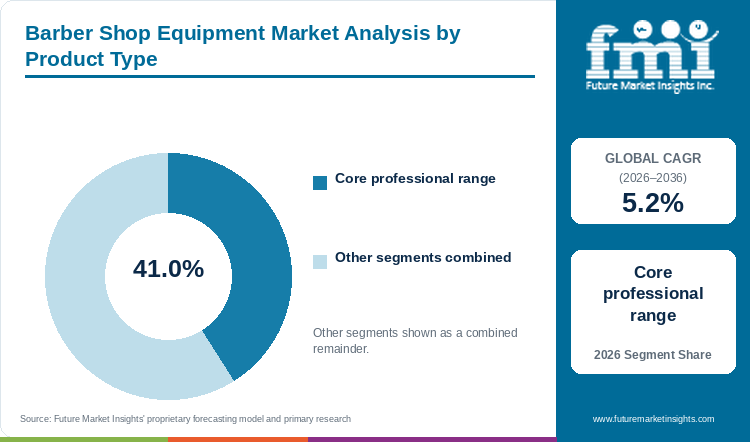
| Product type | Share (2026) |
|---|---|
| Core professional range | 41.0% |
| Other segments combined | 59.0%* |
| Total | 100.0% |
| Metric | Value |
|---|---|
| Global CAGR (2026-2036) | 5.2% |
| Leading segment | Core professional range |
Core professional equipment is bought for repeated daily use. Barbers and stylists need chairs, wash units and tools that withstand cleaning and can be repaired without a long interruption. These assets determine how many appointments a station can support. Specialist ranges add service options, while entry ranges lower the initial cost. The recurring replacement of batteries, mechanical parts, blades and upholstery supports demand across shop sizes. Within the professional hair clipper market, blade systems and motor performance address the same daily operating requirement.
- Core professional range accounts for 41.0% of 2026 Product Type revenue, reflecting the priority placed on dependable equipment that can support routine professional throughput.
Why do Hair salons lead the End User category?
Hair salons hold 35.0% of End User revenue in 2026.
Hair salons combine cutting with washing, coloring, styling and treatment. Each location needs a wider equipment mix and recurring supplies to support those services. The BLS reports 670,800 jobs across U.S. barbers, hairstylists, and cosmetologists in 2025, providing context for the professional buyer base. A new color service may prompt a replenishment order before a larger chair or wash-unit upgrade. The salon service market offers related context for the service mix behind these purchases. [1]
- Hair salons account for 35.0% of 2026 End User revenue because they combine the widest service menu with durable stations, professional tools, and recurring treatme
What are the drivers, restraints, and opportunities in the barber shop equipment market?
Replacement and service-menu demand support equipment spending, while fragmented operator economics restrain capital purchases and compact multifunctional systems create a productivity opportunity.
- Replacement demand comes from keeping revenue-producing stations available. Tools wear, batteries deteriorate, and furniture faces repeated hydraulic and cleaning cycles. Additional staff or services create another purchase trigger. The BLS projects about 80,300 annual openings across U.S. barbers, hairstylists, and cosmetologists over 2025 to 2035. This workforce turnover provides context for continued equipment use, alongside new-shop and refit activity. [1]
- Cash flow can delay a replacement even when demand for appointments remains steady. Destatis reported around 106,000 businesses in Germany's broader private-needs craft category in 2024, averaging roughly four people per business; the category includes hairdressers. UK guidance also recognizes chair-renting stylists who may buy their own products and equipment. Many purchases therefore fall to small businesses or individual professionals. Fixed systems can add plumbing and electrical costs, while uncertain parts availability raises the cost of downtime. [2, 4]
- Compact equipment offers a way to add service capacity within an existing floor plan. Takara Belmont's ONE unit combines a styling chair and shampoo stand and received a 2024 Good Design Award. Gharieni's Hair Swing wash point uses an articulated arm and rotation so one basin can serve two styling stations. These designs address space and plumbing constraints. Installation guidance and local repair support help buyers assess how much additional usable capacity a compact system can provide. [13, 15]
Which country CAGRs are profiled in the barber shop equipment market?
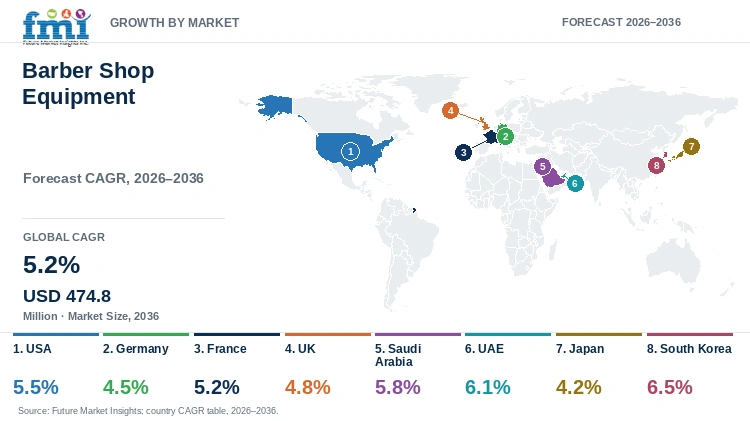
| Country | CAGR |
|---|---|
| USA | 5.5% |
| Germany | 4.5% |
| France | 5.2% |
| UK | 4.8% |
| Saudi Arabia | 5.8% |
| UAE | 6.1% |
| Japan | 4.2% |
| South Korea | 6.5% |
Country Outlook
- USA: FMI forecasts 5.5% CAGR from 2026 to 2036. Purchases are spread across self-employed professionals, small shops and larger salon groups. The BLS reports 670,800 jobs in the occupation group in 2025 and projects about 80,300 openings each year over 2025 to 2035. This fragmented buyer base favors dependable tools, accessible replacement parts and clear warranties. Distributor coverage and repair turnaround help small operators manage downtime. [1]
- Germany: Growth is forecast at 4.5% CAGR from 2026 to 2036. In its 2024 craft statistics, Destatis counted around 106,000 businesses in the broader private-needs category that includes hairdressers, with roughly four people per business. Small operators tend to assess equipment against cash flow and expected service life. Modular replacement, repairable tools and compact configurations can make an upgrade easier to fund and install. [2]
- France: FMI projects 5.2% CAGR from 2026 to 2036. INSEE's hairdressing classification covers washing, cutting and coloring alongside straightening, shaving and beard trimming. This service breadth supports a mix of stations, electrical tools and replenishment products. Its July 2026 turnover series also tracks continuing hairdressing activity. Monthly revenue changes can make discretionary upgrades harder to plan. Operators can expand capacity in stages with flexible professional ranges and manageable replacement costs. [3]
- UK: The market is forecast to grow at 4.8% CAGR from 2026 to 2036. HMRC's May 2025 guidance describes self-employed stylists renting chairs who may buy their own haircare products and equipment. The user of a portable tool can therefore be its purchaser, creating many small orders. Professional distribution and B2B e-commerce need readily available parts, transparent warranties and straightforward account terms. [4]
- Saudi Arabia: FMI forecasts 5.8% CAGR from 2026 to 2036. Revised male-barbering requirements issued in December 2024 replaced earlier municipal requirements and allowed existing establishments a 180-day correction period. Compliance affects fit-out specifications and the timing of refurbishment. Cleanable materials, technical documentation and local installation support help operators plan equipment upgrades. [5]
- UAE: The forecast CAGR is 6.1% from 2026 to 2036. Dubai Municipality's 2024 requirements ask salon and beauty-center plans to show services and equipment consistent with licensed activities. This makes the approved layout an early purchasing consideration. Compact systems, specification drawings and coordinated installation can reduce late changes, while finish options support the presentation requirements of premium urban shops. [6]
- Japan: FMI projects 4.2% CAGR from 2026 to 2036. Health ministry data show 110,297 barber establishments and 199,467 working barbers as of March 31, 2024, both below the prior year. Replacement and productivity are therefore important opportunities within a mature network. Compact multifunctional stations and ergonomic tools can help operators use existing space efficiently, supported by dependable service over long equipment lives. [7]
- South Korea: Growth is forecast at 6.5% CAGR from 2026 to 2036. Statistics Korea reported 5,024 hairdressing franchise outlets in 2024, up from 4,718 in 2023, with 23,246 employees. Franchise expansion creates demand for repeatable station configurations across locations. Equipment packages need consistent tools and finishes, backed by local stock, accessories and service coverage as chains add sites. [8]
Who are the notable companies in the barber shop equipment market?
REM UK, Wella Company, L'Oreal, Andis, Gharieni Group, Wahl, Henkel, Takara Belmont, Conair, and Kao Corporation.
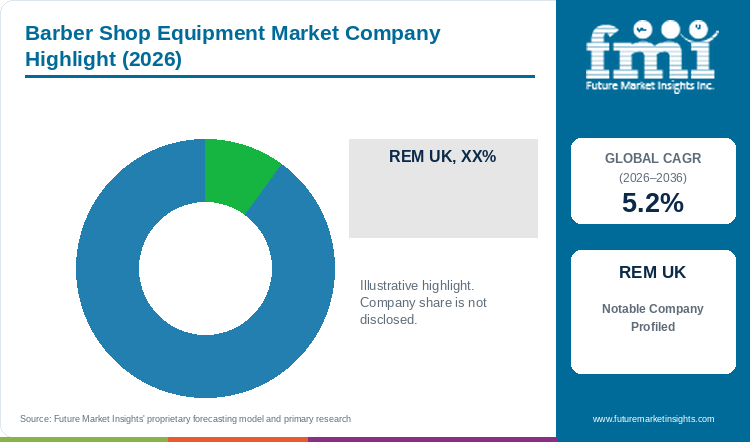
The profiled companies serve different parts of the professional workflow. REM UK, Gharieni Group and Takara Belmont supply furniture or station systems. Andis, Wahl and Conair supply tools, while Wella Company, L'Oreal, Henkel and Kao Corporation supply professional hair products and salon support. Shops often combine these suppliers: furniture from one company, cutting tools from another, and color or care from a third. For suppliers serving the hair dryer market, handling and repair access also influence tool replacement. [9, 10, 11, 12, 13, 14, 15]
- Station infrastructure: REM UK, Gharieni Group, and Takara Belmont compete through chairs, wash or backwash systems, treatment furniture, space planning, and fit-out oriented configurations. [9, 13, 15]
- Professional tools: Andis, Wahl, and Conair compete through clippers, trimmers, shavers, dryers, styling tools, blades, and related accessories used directly at the station. [11, 15]
- Recurring salon ecosystem: Wella Company, L'Oreal, Henkel, and Kao Corporation compete through professional color, care, styling, education, and salon-support programs that influence repeat purchasing. [10, 12, 14]
Competitive Benchmarking: Barber Shop Equipment Market
| Company | Station & wash systems | Cutting & styling tools | Refills & replacement | Geographic Reach |
|---|---|---|---|---|
| REM UK | High | Unscored | Unscored | UK-led with distributor and export support |
| Wella Company | Unscored | Medium | High | Global professional salon markets |
| L'Oreal | Unscored | Unscored | High | Global professional salon markets |
| Andis | Unscored | High | Medium | North America with international professional distribution |
| Gharieni Group | High | Unscored | Unscored | Europe with international spa and salon project coverage |
| Wahl | Unscored | High | Medium | North America with international professional markets |
| Henkel | Unscored | Unscored | High | Professional hair products sold in 140+ countries |
| Takara Belmont | High | Unscored | Medium | Japan plus overseas business locations |
| Conair | Unscored | High | Medium | International professional barber and stylist markets |
| Kao Corporation | Unscored | Unscored | High | Global salon business across multiple regions |
Portfolio ratings compare three categories: station and wash systems; cutting and styling tools; and recurring refills or replacement items. High indicates broad documented coverage and Medium indicates narrower coverage. Unscored means no capability rating is assigned for that category. Geographic Reach summarizes each company’s stated operating coverage. [9, 10, 11, 12, 13, 14, 15]
Key Developments in the Barber Shop Equipment Market
- In September 2024, Wahl introduced the Vapor professional clipper with an adjustable balding blade, 32 fine teeth and an 8,000 RPM brushless motor. The design addresses close cutting and fade work, with motor consistency and blade geometry central to daily use. [11]
- In March 2025, Henkel opened House of Hair in Hamburg, a 9,400-square-meter hub bringing together research and development, sales and marketing, a test salon and professional education. Around 320 experts work at the site, allowing salon feedback and product testing to share one location. [12]
- In July 2025, Takara Belmont USA launched the Dainty Diamond Stitch Chair for barbershops, salons and spas. The update adds a diamond-stitch finish to an established chair format, providing a different upholstery option alongside its existing operating features. [13]
- L'Oreal completed the Color Wow acquisition in September 2025 and consolidated it within Professional Products. The company reported that the deal strengthens its premium professional haircare and styling offer. Its divisional update also described e-commerce, selective distribution and tailored salon services. [14]
Key Players in the Barber Shop Equipment Market
Salon Furniture and Station Systems
- REM UK
- Gharieni Group
- Takara Belmont
Professional Cutting and Styling Tools
- Andis
- Wahl
- Conair
Professional Hair Consumables and Salon Support
- Wella Company
- L'Oreal
- Henkel
- Kao Corporation
Barber Shop Equipment Market - Report Scope
| Coverage field | Report scope |
|---|---|
| Market breakdown | Product Type, End User, Offering, Price Tier, and Sales Channel |
| Quantitative Units | USD Million |
| Market Definition | Revenue from professional barbering and salon equipment, related consumables or refills, and accessories sold within the defined end-user and channel universe. Service revenue, consumer retail revenue outside professional use, downstream finished-product revenue, and adjacent or substitute categories are excluded. |
| Regions Covered | North America; Latin America; Western Europe; Eastern Europe; East Asia; South Asia and Pacific; Middle East and Africa |
| Countries Covered | 30+ countries, including USA, Germany, France, UK, Saudi Arabia, UAE, Japan and South Korea. |
| Key Companies Profiled | REM UK, Wella Company, L'Oreal, Andis, Gharieni Group, Wahl, Henkel, Takara Belmont, Conair, Kao Corporation |
| Forecast Period | 2026 to 2036 |
| Approach | FMI applies a hybrid bottom-up and top-down sizing approach, reconciling buyer-universe estimates, supplier and channel evidence, replacement cycles, and country-level operating indicators. |
Barber Shop Equipment Market - Research Methodology
| Method | Approach |
|---|---|
| Primary Research | The primary research framework covers manufacturers, professional distributors, salon and barbershop owners, procurement roles and subject-matter specialists. Topics include replacement cycles, specification priorities, purchasing channels, price sensitivity and adoption constraints. |
| Desk Research | Government statistics, operating requirements, company filings and announcements, professional product documentation and technical information provide evidence on the buyer base, product capabilities and country conditions. |
| Market Sizing and Forecasting | The sizing framework reconciles buyer-universe estimates with equipment and consumable spending, replacement cycles, channel mix and price tiers. Forecast assumptions consider service formats and country conditions against the 2025 base and the 2026 to 2036 outlook. |
| Data Validation | Consistency checks reconcile totals and segment relationships across equipment, consumables and accessories. Market boundaries exclude service revenue, consumer-only sales and adjacent categories to limit overlapping revenue. |
Barber Shop Equipment Market by Segments
Barber Shop Equipment Market segmented by Product Type
- Core professional range
- Premium & specialist range
- Entry & value range
Barber Shop Equipment Market segmented by End User
- Hair salons
- Spas & wellness centers
- Nail salons
- Medspas & clinics
- Barbershops
Barber Shop Equipment Market segmented by Offering
- Core equipment
- Consumables & refills
- Accessories
Barber Shop Equipment Market segmented by Price Tier
- Mid-range
- Economy
- Premium
Barber Shop Equipment Market segmented by Sales Channel
- Professional distributors
- Direct sales
- B2B e-commerce
Barber Shop Equipment Market by Region
- North America
- United States
- Canada
- Latin America
- Brazil
- Mexico
- Argentina
- Chile
- Western Europe
- Germany
- France
- United Kingdom
- Italy
- Spain
- Benelux
- Nordics
- Eastern Europe
- Poland
- Czech Republic
- Romania
- Hungary
- East Asia
- China
- Japan
- South Korea
- South Asia and Pacific
- India
- ASEAN
- Australia and New Zealand
- Middle East and Africa
- GCC Countries
- South Africa
- Türkiye
- Israel
Research Sources and Bibliography
- [1] U.S. Bureau of Labor Statistics (2026, August 27). Barbers, Hairstylists, and Cosmetologists, Occupational Outlook Handbook.
- [2] Statistisches Bundesamt (Destatis) (2026, April 23). Handwerk: Strukturdaten 2024 and Handwerkszählung 2024.
- [3] INSEE (2025, December 19; 2026, September 22). NAF 96.02A Coiffure classification; monthly turnover index for hairdressing, including July 2026.
- [4] HM Revenue & Customs (2025, May 9). Check employment status if you work in hair and beauty.
- [5] Ministry of Municipalities and Housing, Saudi Arabia (2024, December). Male Barbering Requirements.
- [6] Dubai Municipality (2024, May 4). Technical Requirements for Health and Safety Activities, DM-HSD-SP06-NOPHSA1.
- [7] Ministry of Health, Labour and Welfare, Japan (n.d.). Barbering Industry Management Issues: establishment and workforce statistics through fiscal 2023.
- [8] Statistics Korea (2025, December). 2024 Franchise Statistics Results.
- REM UK (2025, January). REM 2025 Catalogue: Salon and Barber Equipment.
- Wella Company (2025, March 1). Wella Professionals Launches Color Xpress: a New 10-Minute Permanent Color for Xpress Root Touch-Up Services.
- [11] Andis Company and Wahl Clipper Corporation (accessed 2026, August 25). Professional Barber Tools and 5-Star Wahl Vapor product information.
- [12] Henkel (2025, March 4; 2025, August 7). House of Hair in Hamburg; Schwarzkopf Unveils Lindsay Lohan as Newest Brand Ambassador, including professional distributor activation.
- [13] Takara Belmont USA (2025, July 1) and Takara Belmont Corporation (n.d.). Dainty Diamond Stitch Chair launch; Hairdressing and Cosmetics Business profile; MINIMAL SALON UNIT ONE and its 2024 Good Design Award.
- [14] L'Oreal and Kao Corporation (2025; accessed 2026, August 25). Professional Products update, Color Wow acquisition, and professional hair-care portfolio materials.
- Gharieni Group and Conair LLC / BaBylissPRO (n.d.). Hair salon furniture and Wash Point Hair Swing; professional barbering and styling tool portfolios.
This Report Answers
- What is the Barber Shop Equipment Market size in 2026 and what value is forecast for 2036?
- Which professional-service pressures and replacement cycles support demand for barber shop equipment?
- Why does Core professional range hold the leading position within Product Type?
- How does Hair salons leadership influence demand for durable equipment, tools, and recurring salon inputs?
- Why does Core equipment hold the leading position within the Offering category?
- How do forecast CAGRs differ across USA, Germany, France, UK, Saudi Arabia, UAE, Japan, and South Korea?
- Which companies provide station systems, professional tools, or recurring salon products?
- What capital, installation, service, and compliance frictions can limit adoption?
- What should salon owners, barbershop operators, distributors, and procurement teams evaluate before purchasing professional equipment?
Frequently Asked Questions
How big is the barber shop equipment market in 2026?
FMI estimates the market at USD 286.0 Million in 2026, up from USD 271.9 Million in 2025. Revenue is forecast to reach USD 474.8 Million by 2036.
What is the forecast CAGR from 2026 to 2036?
The market is forecast to grow at 5.2% CAGR over 2026 to 2036.
Which Product Type leads in 2026?
Core professional range leads with 41.0% of Product Type revenue in 2026, supported by daily-use equipment and replacement demand.
Which End User holds the largest share?
Hair salons lead with 35.0% of End User revenue in 2026. Their cutting, washing, coloring and styling workflows require durable stations and recurring supplies.
Which country has the fastest forecast growth?
South Korea has the highest CAGR among the eight profiled countries at 6.5% from 2026 to 2036. The UAE follows at 6.1%, and Saudi Arabia at 5.8%.
What is driving growth in the Barber Shop Equipment Market?
Growth is supported by recurring replacement of high-use professional tools and furniture, plus new fit-outs and service-menu expansion. Purchases become more compelling when improved uptime and sanitation raise appointment throughput while better ergonomics and station capacity improve operating economics.
Who are the key players in the Barber Shop Equipment Market?
The profiled companies are REM UK, Wella Company, L'Oreal, Andis, Gharieni Group, Wahl, Henkel, Takara Belmont, Conair, and Kao Corporation. They compete across station infrastructure, professional cutting and styling tools, and recurring salon consumables or support ecosystems.
What notable restraint affects the Barber Shop Equipment Market?
Small-operator economics can delay replacement even when existing equipment is near the end of useful life. Installation and repair lead times can matter as much as purchase price because compatibility problems, fit-out obligations, and lost revenue during downtime raise the hurdle.
Why should executives track the Barber Shop Equipment Market?
The market links durable capital equipment with recurring replacement and consumable demand across fragmented professional service businesses. Executives can use channel and country differences to guide distributor investment and service coverage, while compact formats or professional education may call for different allocation choices.
What business problem does the Barber Shop Equipment Market address?
The market provides the physical stations and tools needed for paid hair and grooming services, with refills and accessories supporting the same workflow. It addresses appointment throughput and client positioning while hygiene and tool reliability determine when worn professional assets need replacement.
What should salon and barbershop procurement decision-makers evaluate in the Barber Shop Equipment Market?
Buyers should compare duty cycle and cleanability against expected utilization before assessing ergonomics, parts availability, and warranty response. They should confirm that equipment fits the licensed service scope and floor area because installation, plumbing, or electrical constraints can eliminate otherwise suitable options.
What limits return on investment in the Barber Shop Equipment Market?
Return falls when equipment sits idle or fails prematurely because costly installation changes and slow repairs create additional losses. A lower purchase price can disappoint when parts availability or compatibility is weak, especially if downtime reduces the appointments a station can support.
What supports long-term commercial confidence in the Barber Shop Equipment Market?
Professional hair and grooming services require a continuing base of physical tools and stations even in mature markets. Long-term confidence is strongest where suppliers combine replacement demand with reliable service, then use productivity gains and distributor coverage to support repeat purchasing of consumables or parts.
Preview the report firsthand - request a free sample
Get SampleGet the brochure for pricing and purchase details.
Get PDFTable of Content
- Key Takeaways
- Market Size and CAGR
- Top Growth Driver
- Fastest Growing Segment
- Leading Region
- Key Companies
- Emerging Opportunities
- Executive Summary
- Global Market Outlook
- Demand-side Trends
- Supply-side Trends
- Technology Roadmap Analysis
- Analysis and Recommendations
- Analyst Perspective (What is happening? Why now? What should investors know?)
- Key Questions Answered
- How large is the market?
- What is the CAGR?
- What are key trends?
- Which region dominates?
- Who are the leaders?
- Market Overview
- Market Coverage / Taxonomy
- Market Definition / Scope / Limitations
- Research Methodology
- Chapter Orientation
- Analytical Lens and Working Hypotheses
- Market Structure, Signals, and Trend Drivers
- Benchmarking and Cross-market Comparability
- Market Sizing, Forecasting, and Opportunity Mapping
- Research Design and Evidence Framework
- Desk Research Programme (Secondary Evidence)
- Expert Input and Fieldwork (Primary Evidence)
- Tooling, Models, and Reference Databases
- Data Engineering and Model Build
- Quality Assurance and Audit Trail
- Market Background
- Market Dynamics (Drivers, Restraints, Opportunity, Trends)
- Scenario Forecast (Optimistic, Likely, Conservative)
- Impact Analysis
- AI Impact
- Sustainability Impact
- Regulatory Impact
- Technology Impact
- Consumer / Buyer Analysis
- Purchase Drivers
- Adoption Barriers
- Buyer Journey
- Opportunity Map Analysis
- Product Life Cycle Analysis
- Supply Chain Analysis
- Investment Feasibility Matrix
- Value Chain Analysis
- PESTLE and Porter's Analysis
- Regulatory Landscape
- Regional Parent Market Outlook
- Production and Consumption Statistics
- Import and Export Statistics
- Global Market Analysis and Forecast, 2021 to 2036
- Historical Market Size Value (USD Million) Analysis, 2021 to 2025
- Current and Future Market Size Value (USD Million) Projections, 2026 to 2036
- Y-o-Y Growth Trend Analysis
- Absolute $ Opportunity Analysis
- Global Market Pricing Analysis, 2021 to 2036
- Global Market Analysis and Forecast, By Product Type, 2021 to 2036
- Introduction / Key Findings
- Historical Market Size Value (USD Million) Analysis By Product Type, 2021 to 2025
- Current and Future Market Size Value (USD Million) Analysis and Forecast By Product Type, 2026 to 2036
- Core professional range
- Premium & specialist range
- Entry & value range
- Y-o-Y Growth Trend Analysis By Product Type, 2021 to 2025
- Absolute $ Opportunity Analysis By Product Type, 2026 to 2036
- Global Market Analysis and Forecast, By End User, 2021 to 2036
- Introduction / Key Findings
- Historical Market Size Value (USD Million) Analysis By End User, 2021 to 2025
- Current and Future Market Size Value (USD Million) Analysis and Forecast By End User, 2026 to 2036
- Hair salons
- Spas & wellness centers
- Nail salons
- Medspas & clinics
- Barbershops
- Y-o-Y Growth Trend Analysis By End User, 2021 to 2025
- Absolute $ Opportunity Analysis By End User, 2026 to 2036
- Global Market Analysis and Forecast, By Offering, 2021 to 2036
- Introduction / Key Findings
- Historical Market Size Value (USD Million) Analysis By Offering, 2021 to 2025
- Current and Future Market Size Value (USD Million) Analysis and Forecast By Offering, 2026 to 2036
- Core equipment
- Consumables & refills
- Accessories
- Y-o-Y Growth Trend Analysis By Offering, 2021 to 2025
- Absolute $ Opportunity Analysis By Offering, 2026 to 2036
- Global Market Analysis and Forecast, By Price Tier, 2021 to 2036
- Introduction / Key Findings
- Historical Market Size Value (USD Million) Analysis By Price Tier, 2021 to 2025
- Current and Future Market Size Value (USD Million) Analysis and Forecast By Price Tier, 2026 to 2036
- Mid-range
- Economy
- Premium
- Y-o-Y Growth Trend Analysis By Price Tier, 2021 to 2025
- Absolute $ Opportunity Analysis By Price Tier, 2026 to 2036
- Global Market Analysis and Forecast, By Sales Channel, 2021 to 2036
- Introduction / Key Findings
- Historical Market Size Value (USD Million) Analysis By Sales Channel, 2021 to 2025
- Current and Future Market Size Value (USD Million) Analysis and Forecast By Sales Channel, 2026 to 2036
- Professional distributors
- Direct sales
- B2B e-commerce
- Y-o-Y Growth Trend Analysis By Sales Channel, 2021 to 2025
- Absolute $ Opportunity Analysis By Sales Channel, 2026 to 2036
- Global Market Analysis and Forecast, By Region, 2021 to 2036
- Introduction
- Historical Market Size Value (USD Million) Analysis By Region, 2021 to 2025
- Current Market Size Value (USD Million) Analysis and Forecast By Region, 2026 to 2036
- North America
- Latin America
- Western Europe
- Eastern Europe
- East Asia
- South Asia and Pacific
- Middle East and Africa
- Market Attractiveness Analysis By Region
- North America Market Analysis and Forecast, By Country, 2021 to 2036
- Historical Market Size Value (USD Million) Trend Analysis By Market Taxonomy, 2021 to 2025
- Market Size Value (USD Million) Forecast By Market Taxonomy, 2026 to 2036
- By Country
- United States
- Canada
- By Product Type
- By End User
- By Offering
- By Price Tier
- By Sales Channel
- By Country
- Market Attractiveness Analysis
- By Country
- By Product Type
- By End User
- By Offering
- By Price Tier
- By Sales Channel
- Key Takeaways
- Latin America Market Analysis and Forecast, By Country
- Historical Market Size Value (USD Million) Trend Analysis By Market Taxonomy, 2021 to 2025
- Market Size Value (USD Million) Forecast By Market Taxonomy, 2026 to 2036
- By Country
- Brazil
- Mexico
- Argentina
- Chile
- By Product Type
- By End User
- By Offering
- By Price Tier
- By Sales Channel
- By Country
- Market Attractiveness Analysis
- By Country
- By Product Type
- By End User
- By Offering
- By Price Tier
- By Sales Channel
- Key Takeaways
- Western Europe Market Analysis and Forecast, By Country
- Historical Market Size Value (USD Million) Trend Analysis By Market Taxonomy, 2021 to 2025
- Market Size Value (USD Million) Forecast By Market Taxonomy, 2026 to 2036
- By Country
- Germany
- France
- United Kingdom
- Italy
- Spain
- Benelux
- Nordics
- By Product Type
- By End User
- By Offering
- By Price Tier
- By Sales Channel
- By Country
- Market Attractiveness Analysis
- By Country
- By Product Type
- By End User
- By Offering
- By Price Tier
- By Sales Channel
- Key Takeaways
- Eastern Europe Market Analysis and Forecast, By Country
- Historical Market Size Value (USD Million) Trend Analysis By Market Taxonomy, 2021 to 2025
- Market Size Value (USD Million) Forecast By Market Taxonomy, 2026 to 2036
- By Country
- Poland
- Czech Republic
- Romania
- Hungary
- By Product Type
- By End User
- By Offering
- By Price Tier
- By Sales Channel
- By Country
- Market Attractiveness Analysis
- By Country
- By Product Type
- By End User
- By Offering
- By Price Tier
- By Sales Channel
- Key Takeaways
- East Asia Market Analysis and Forecast, By Country
- Historical Market Size Value (USD Million) Trend Analysis By Market Taxonomy, 2021 to 2025
- Market Size Value (USD Million) Forecast By Market Taxonomy, 2026 to 2036
- By Country
- China
- Japan
- South Korea
- By Product Type
- By End User
- By Offering
- By Price Tier
- By Sales Channel
- By Country
- Market Attractiveness Analysis
- By Country
- By Product Type
- By End User
- By Offering
- By Price Tier
- By Sales Channel
- Key Takeaways
- South Asia and Pacific Market Analysis and Forecast, By Country
- Historical Market Size Value (USD Million) Trend Analysis By Market Taxonomy, 2021 to 2025
- Market Size Value (USD Million) Forecast By Market Taxonomy, 2026 to 2036
- By Country
- India
- ASEAN
- Australia and New Zealand
- By Product Type
- By End User
- By Offering
- By Price Tier
- By Sales Channel
- By Country
- Market Attractiveness Analysis
- By Country
- By Product Type
- By End User
- By Offering
- By Price Tier
- By Sales Channel
- Key Takeaways
- Middle East and Africa Market Analysis and Forecast, By Country
- Historical Market Size Value (USD Million) Trend Analysis By Market Taxonomy, 2021 to 2025
- Market Size Value (USD Million) Forecast By Market Taxonomy, 2026 to 2036
- By Country
- GCC Countries
- South Africa
- Türkiye
- Israel
- By Product Type
- By End User
- By Offering
- By Price Tier
- By Sales Channel
- By Country
- Market Attractiveness Analysis
- By Country
- By Product Type
- By End User
- By Offering
- By Price Tier
- By Sales Channel
- Key Takeaways
- Key Countries Market Analysis
- United States
- Pricing Analysis
- Market Share Analysis, 2025
- By Product Type
- By End User
- By Offering
- By Price Tier
- By Sales Channel
- Canada
- Pricing Analysis
- Market Share Analysis, 2025
- By Product Type
- By End User
- By Offering
- By Price Tier
- By Sales Channel
- Mexico
- Pricing Analysis
- Market Share Analysis, 2025
- By Product Type
- By End User
- By Offering
- By Price Tier
- By Sales Channel
- Brazil
- Pricing Analysis
- Market Share Analysis, 2025
- By Product Type
- By End User
- By Offering
- By Price Tier
- By Sales Channel
- Chile
- Pricing Analysis
- Market Share Analysis, 2025
- By Product Type
- By End User
- By Offering
- By Price Tier
- By Sales Channel
- Germany
- Pricing Analysis
- Market Share Analysis, 2025
- By Product Type
- By End User
- By Offering
- By Price Tier
- By Sales Channel
- United Kingdom
- Pricing Analysis
- Market Share Analysis, 2025
- By Product Type
- By End User
- By Offering
- By Price Tier
- By Sales Channel
- Italy
- Pricing Analysis
- Market Share Analysis, 2025
- By Product Type
- By End User
- By Offering
- By Price Tier
- By Sales Channel
- Spain
- Pricing Analysis
- Market Share Analysis, 2025
- By Product Type
- By End User
- By Offering
- By Price Tier
- By Sales Channel
- France
- Pricing Analysis
- Market Share Analysis, 2025
- By Product Type
- By End User
- By Offering
- By Price Tier
- By Sales Channel
- India
- Pricing Analysis
- Market Share Analysis, 2025
- By Product Type
- By End User
- By Offering
- By Price Tier
- By Sales Channel
- ASEAN
- Pricing Analysis
- Market Share Analysis, 2025
- By Product Type
- By End User
- By Offering
- By Price Tier
- By Sales Channel
- Australia and New Zealand
- Pricing Analysis
- Market Share Analysis, 2025
- By Product Type
- By End User
- By Offering
- By Price Tier
- By Sales Channel
- China
- Pricing Analysis
- Market Share Analysis, 2025
- By Product Type
- By End User
- By Offering
- By Price Tier
- By Sales Channel
- Japan
- Pricing Analysis
- Market Share Analysis, 2025
- By Product Type
- By End User
- By Offering
- By Price Tier
- By Sales Channel
- South Korea
- Pricing Analysis
- Market Share Analysis, 2025
- By Product Type
- By End User
- By Offering
- By Price Tier
- By Sales Channel
- Poland
- Pricing Analysis
- Market Share Analysis, 2025
- By Product Type
- By End User
- By Offering
- By Price Tier
- By Sales Channel
- Hungary
- Pricing Analysis
- Market Share Analysis, 2025
- By Product Type
- By End User
- By Offering
- By Price Tier
- By Sales Channel
- Türkiye
- Pricing Analysis
- Market Share Analysis, 2025
- By Product Type
- By End User
- By Offering
- By Price Tier
- By Sales Channel
- South Africa
- Pricing Analysis
- Market Share Analysis, 2025
- By Product Type
- By End User
- By Offering
- By Price Tier
- By Sales Channel
- Saudi Arabia
- Pricing Analysis
- Market Share Analysis, 2025
- By Product Type
- By End User
- By Offering
- By Price Tier
- By Sales Channel
- UAE
- Pricing Analysis
- Market Share Analysis, 2025
- By Product Type
- By End User
- By Offering
- By Price Tier
- By Sales Channel
- United States
- Market Structure Analysis
- Competition Dashboard
- Competition Benchmarking
- Market Share Analysis of Top Players
- By Regional
- By Product Type
- By End User
- By Offering
- By Price Tier
- By Sales Channel
- Emerging Startups
- Innovation Benchmarking
- Competition Analysis
- Competition Deep Dive
- REM UK
- Overview
- Product Portfolio
- Profitability by Market Segments
- Sales Footprint
- Strategy Overview
- Marketing Strategy
- Product Strategy
- Channel Strategy
- Wella Company
- L'Oreal
- Andis
- Gharieni Group
- Wahl
- Henkel
- Takara Belmont
- Conair
- Kao Corporation
- REM UK
- Case Studies
- Success Stories
- Recent Developments
- Competition Deep Dive
- Assumptions & Acronyms Used


