

- Market Size (2026)
- USD 284.7 Mn
- Forecast (2036)
- USD 441.6 Mn
- CAGR (2026 to 2036)
- 4.5%
How big is Beverage Can Washer Systems Market in 2026?
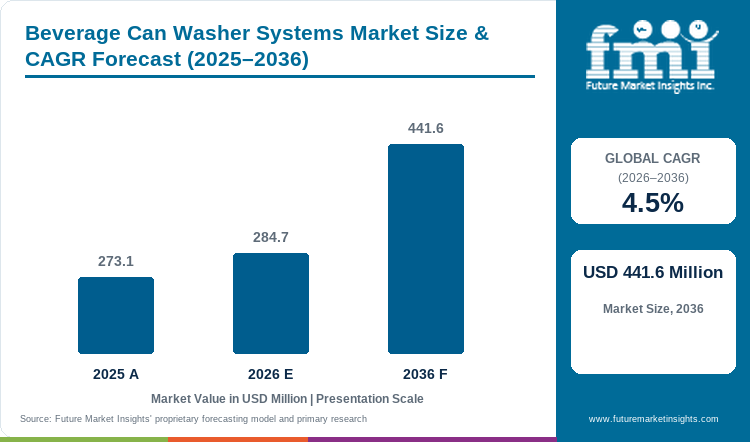
The beverage can washer systems market is valued at USD 284.7 million in 2026 and is projected to reach USD 441.6 million by 2036, expanding at a CAGR of 4.5% over the 2026-2036 period.
The global market for beverage can washer systems is valued at USD 284.7 million in 2026 and is projected to reach USD 441.6 million by 2036, expanding at a 4.5% CAGR over the forecast period (up from USD 273.1 million in 2025). These figures cover new units, major line rebuilds, controls retrofits, and heat-recovery packages across two-piece can manufacturing lines; downstream filler sanitizers and crate washers are excluded.
Capital spending here directly tracks the broader drink cans market, which FMI values at USD 69.4 billion in 2026. Investment cycles remain lumpy and capital-intensive, with plant outlays tied to greenfield line expansions, capacity rebuilds, or upgrades to cut water and natural gas consumption.
Key Takeaways
- The market is estimated at USD 284.7 million in 2026 and is projected to expand by USD 156.9 million over the decade to reach USD 441.6 million by 2036.
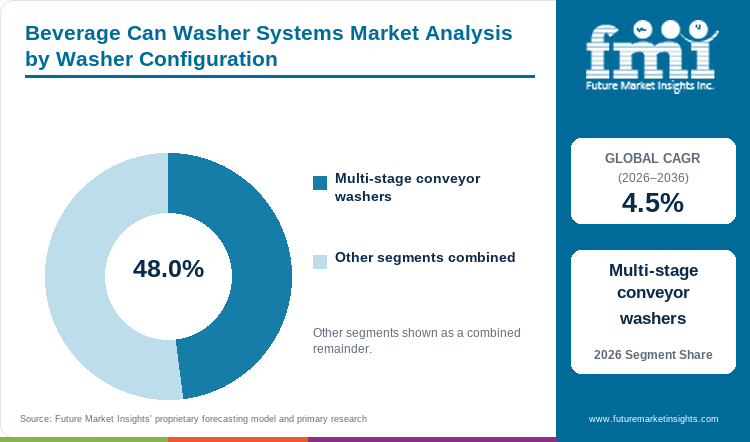
- Multi-stage conveyor washers are on track to command 48.0% of system demand in 2026, favored because sequential acid wash, deoxidizing, and DI rinse stages ensure clean can surfaces and dependable ink adhesion at the decorator.
- Aluminum containers account for 86.0% of processed substrate demand in 2026, driven by aluminum's near-total dominance across global two-piece beverage can manufacturing lines.
- of equipment Post-bodymaker, pre-decoration washers are set to take 57.0% demand in 2026, as removing coolant and forming lube is critical to creating a spotless, uniformly etched surface before printing and varnishing.
- Core original equipment manufacturers and engineering providers include International Thermal Systems, Cincinnati Industrial Machinery, Stolle Machinery, Belvac, CarnaudMetalbox Engineering, SLAC Precision Equipment, Can Systems Worldwide, Greenbank Technology, Prime Controls, and BW Integrated Systems.
Analyst Perspective
“"Washer ROI is realized at the decorator. Can bodies that leave the washer dry, deoxidized, and chemically inert protect print adhesion and line throughput. Conversely, minor chemical carryover or thermal variance in the dry-off oven compounds into severe yield loss when operating at high line speeds."
- Nandini Roy Choudhury, Principal Consultant, Future Market Insights
How is the beverage can washer systems market segmented?
The beverage can washer systems market is segmented in six ways: by washer configuration, can material, line position, rated throughput, buyer type, and region. Multi-stage conveyor washers lead the washer configuration category with 48.0% of 2026 revenue.
The global beverage can washer systems market is segmented across six core operational dimensions: by washer configuration into multi-stage conveyor washers, compact modular washers, single-pass specialty washers, and retrofit wash and rinse modules; by can material into aluminum cans, steel (DWI) cans, and specialty alloy containers; by line position into post-bodymaker pre-decoration, post-decoration specialty cleaning, end and component washing, and integrated line rewash; by rated throughput into up to 1,500 cans per minute, 1,501 to 3,000 cans per minute, and above 3,000 cans per minute; by buyer type into integrated can manufacturers, independent can plants, line integrators, and rebuild and service contractors;
Why do multi-stage conveyor washers lead configuration demand?
A bodymaker coats the drawn can with heavy forming lubricants, coolants, and microscopic metal fines. Multi-stage conveyor washers isolate consecutive pre-rinse, chemical cleaning, deoxidizing, and deionized rinse zones to eliminate these surface residues without disrupting continuous, high-speed line flow before printing.
- Multi-stage conveyor washers are estimated to account for 48.0% of configuration demand in 2026 because staged chemical baths and isolated rinse cascades prevent cross-contamination and protect decorator ink adhesion.
- Cincinnati Industrial Machinery positions the multi-stage washer directly between the bodymakers and the decorator on a standard two-piece DWI line to safeguard downstream print quality.
How do aluminum cans shape the material category?
Aluminum dominates modern two-piece DWI production, but the severe mechanical thinning of can walls leaves substantial drawing oil and reactive oxide films across the substrate. Ensuring strong adhesion for both external decoration inks and internal protective lacquers requires complete chemical cleaning and surface passivation at line speed.
- Aluminum cans are estimated to account for 86.0% of material demand in 2026, driven by aluminum's established dominance across global beverage packaging lines.
- Can Manufacturers Institute data indicates that roughly 142 billion food, beverage, and specialty cans are produced annually in the United States, highlighting the immense processing volume supported by aluminum can wash tunnels.
Why does the post-bodymaker stage lead line-position demand?
Trimming operations cut drawn shells to final height, releasing metal fines and coolant emulsions. If these impurities reach the dry-off oven, they bake onto the metal, creating surface defects, pinholes, and ink delamination at the decorator. Cleaning immediately after trimming isolates forming contaminants to the front end, protecting downstream equipment.
- Post-bodymaker, pre-decoration washers are estimated to account for 57.0% of line-position demand in 2026 because high-speed printing and coating require a spotless, uniformly etched, water-break-free can surface.
- Plant engineering layouts position the can washer immediately between the bodymakers and the decorator as the primary operational gate against process defects.
What supports systems above 3,000 cans per minute?
High-capacity plants aggregate the output of multiple bodymakers into a single processing line. To run above 3,000 cans per minute while maintaining proper chemical contact and rinse dwell times, washers require wider conveyors, higher-volume pumping packages, and vacuum hold-downs to keep lightweight cans stable under intense spray pressure.
- Systems rated above 3,000 cans per minute are estimated to account for 43.0% of throughput demand in 2026, matching the high-volume operational scale required by modern beverage lines.
- International Thermal Systems documents modular can washers designed for capacities ranging from several hundred up to 6,000 cans per minute, using dedicated hold-down mechanisms to ensure container stability.
Why do integrated can manufacturers lead buyer demand?
Integrated canmakers absorb the direct financial loss of both forming defects and decorator rejections. Because washer stability dictates overall plant scrap rates and conversion margins, corporate engineering teams specify chemical zones and maintenance access directly as part of the complete front-end line procurement.
- Integrated can manufacturers are estimated to account for 62.0% of buyer demand in 2026 because they control both upstream forming output and downstream decoration quality across their plant networks.
- Stolle Machinery markets complete two-piece beverage can lines that package washers alongside bodymakers, cuppers, and decorators to deliver end-to-end operational performance.
- Machinery providers like Stolle Machinery market complete turnkey front-end lines, integrating washers with bodymakers to deliver consistent operating throughput across the entire plant.
What are the drivers, restraints and opportunities in the Beverage Can Washer Systems Market?
The key driver is new beverage can lines and front-end rebuilds that require capacity matched to bodymaker output, the key restraint is high water, heat and chemical loads that increase operating costs and permitting work, and the key opportunity is heat recovery, vacuum carryover control and smarter rinse management that can justify brownfield upgrades.
- Driver: New beverage can lines and front-end rebuilds require washing capacity that matches bodymaker output.
- Restraint: High water, heat and chemical loads increase operating costs and add to permitting work.
- Opportunity: Heat recovery, vacuum carryover control and smarter rinse management can justify brownfield upgrades.
Growth in the aluminum cans market directly increases the gross volume of drawn can bodies requiring thorough surface treatment prior to print application. Can Manufacturers Institute production figures confirm that washer tunnels serve as a critical quality control gate rather than an optional plant utility.
Washer operational economics extend well beyond initial equipment procurement. Plants must continually manage the lifecycle costs of process water, chemical replenishment, natural gas heating, and downstream effluent treatment. Substandard stage isolation allows aggressive bath carryover to contaminate downstream rinses, meaning an underspecified retrofit typically shifts process instability rather than resolving it.
Capital allocation across the broader metal containers market creates commercial justification for targeted resource-efficiency retrofits. Closed-loop rinse recovery, high-efficiency heat exchangers, and optimized spray nozzle access enable operators to cut recurring utility expenses without committing to a full washer shell replacement.
Which country CAGRs are profiled in the Beverage Can Washer Systems Market?
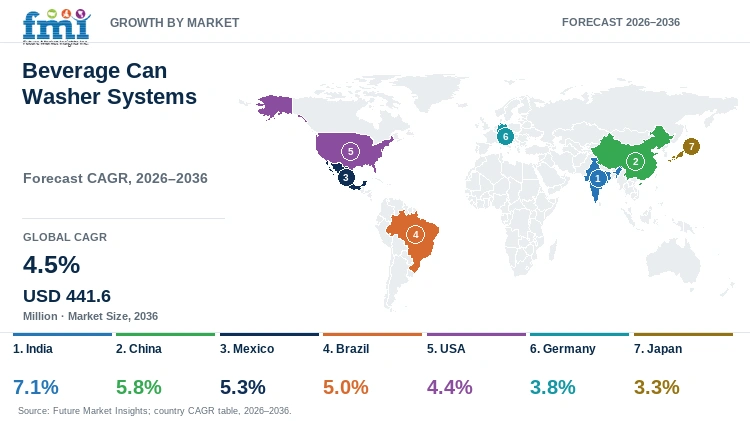
| Country | CAGR |
|---|---|
| India | 7.1% |
| China | 5.8% |
| Mexico | 5.3% |
| Brazil | 5.0% |
| USA | 4.4% |
| Germany | 3.8% |
| Japan | 3.3% |
How do country-level CAGRs compare in the Beverage Can Washer Systems Market?
India and China lead through capacity additions. Mexico and Brazil benefit from beverage-can investment, while USA demand is driven more by retrofits. Germany and Japan focus on resource use and reliability within established plants.
- India: Expanding beverage packaging infrastructure accelerates capital expenditure for turnkey, greenfield front-end lines.
- China: Extensive national container volumes sustain parallel procurement across brownfield replacement cycles and greenfield installations.
- Mexico: Integration with North American beverage supply networks anchors continuous capital allocation into high-speed canmaking capacity.
- Brazil: Resilient production volumes across beer and carbonated soft drink lines maintain high baseline capacity utilization for existing washer installations.
- USA: Mature production footprints prioritize brownfield retrofits focused on reducing per-can water, chemical, and thermal utility loads.
- Germany: Stringent circular economy mandates and industrial utility costs position resource conservation as the primary driver for capital replacement.
- Japan: High-speed operating discipline directs capital toward proven, high-reliability retrofits that preserve strict surface standards within established plant footprints.
Across the key countries in this market, these rates measure revenue within the defined product boundary and do not represent growth of the wider parent industry.
Country-wise Analysis
- India is projected to record a 7.1% CAGR through 2036. Rapid brand adoption of canned beverage formats is driving capital allocation into complete front-end lines where washers are procured alongside bodymakers and decorators, with contract awards heavily influenced by local technical field support.
- China is forecast to expand at a 5.8% CAGR through 2036. Domestic machinery manufacturers compete primarily on upfront capital cost, while facilities targeting international export standards mandate lower water consumption metrics.
- Mexico is expected to achieve a 5.3% CAGR through 2036. High line utilization across facilities serving regional supply chains makes dry-off oven thermal consistency and chemical recovery efficiency decisive criteria.
- Brazil is set to grow at a 5.0% CAGR through 2036. Capital expenditure favors robust washing systems engineered to handle variable local water hardness profiles while maintaining process stability during uninterrupted production campaigns.
- The United States is projected to advance at a 4.4% CAGR through 2036. A mature manufacturing footprint directs investment toward exhaust heat recovery with capital approvals contingent on demonstrable utility savings and spoilage reduction.
- Germany is forecast to register a 3.8% CAGR through 2036. Procurement teams evaluate effluent volume limits and energy consumption metrics in lockstep with rated line speeds, placing significant weight on exhaustive engineering validation.
- Japan is expected to deliver a 3.3% CAGR through 2036. Demand remains focused on high-reliability, incremental retrofits that protect zero-defect can surface standards while integrating seamlessly into existing plant layouts.
Who are the notable companies in the Beverage Can Washer Systems Market?
International Thermal Systems, Cincinnati Industrial Machinery, Stolle Machinery, Belvac, CarnaudMetalbox Engineering, SLAC Precision Equipment, Can Systems Worldwide, Greenbank Technology, Prime Controls, BW Integrated Systems are the notable companies profiled in this market.
The field is divided between dedicated washer builders and broader can-line suppliers. Direct washer evidence determines the benchmark score. Controls and integration companies remain relevant when plants upgrade chemistry management or conveying around an existing shell.
- Direct can washer suppliers include International Thermal Systems, Cincinnati Industrial Machinery and Stolle Machinery.
- Can-line equipment platforms include Belvac, CarnaudMetalbox Engineering, SLAC Precision Equipment and Can Systems Worldwide.
- Controls and integration specialists include Greenbank Technology, Prime Controls and BW Integrated Systems.
Competitive Benchmarking: Beverage Can Washer Systems Market
| Company | Direct Washer Evidence | Resource-Efficiency Options | Line Integration | Geographic Reach |
|---|---|---|---|---|
| International Thermal Systems | High | High | High | Global |
| Cincinnati Industrial Machinery | High | High | High | Americas, global projects |
| Stolle Machinery | High | High | High | Global |
| Belvac | Medium | High | High | Global |
| CarnaudMetalbox Engineering | Medium | High | High | Global |
| SLAC Precision Equipment | Medium | Medium | High | Asia, Americas |
| Can Systems Worldwide | Medium | High | Medium | Americas, export markets |
| Greenbank Technology | Low | Medium | Medium | Europe, global projects |
| Prime Controls | Low | High | Medium | North America |
| BW Integrated Systems | Low | High | High | Global |
Key Developments in the Beverage Can Washer Systems Market
- In August 2025, CMI issued guidance for calculating recycled content in aluminum can sheet, providing canmakers with a common reporting framework for production material.
- In March 2025, CMI stated that nearly 97.0% of recycled US aluminum beverage cans return to new cans, reinforcing investment in closed-loop can capacity.
- In December 2024, CMI and The Aluminum Association reported a 43.0% US aluminum beverage can recycling rate for 2023, increasing the focus on production efficiency alongside collection.
Key Players in the Beverage Can Washer Systems Market
Direct Can Washer Suppliers
- International Thermal Systems
- Cincinnati Industrial Machinery
- Stolle Machinery
Can-Line Equipment Platforms
- Belvac
- CarnaudMetalbox Engineering
- SLAC Precision Equipment
- Can Systems Worldwide
Controls and Integration Specialists
- Greenbank Technology
- Prime Controls
- BW Integrated Systems
Beverage Can Washer Systems Market - Report Scope
| Coverage field | Report scope |
|---|---|
| Market Size | USD 284.7 million in 2026 and USD 441.6 million by 2036 at 4.5% CAGR. |
| Market Definition | Multi-stage industrial systems that clean and prepare drawn beverage can bodies before coating or decoration, including new equipment and major rebuilds. |
| Segmentation | Washer configuration, can material, line position, rated throughput, buyer type and region. |
| Regional Coverage | North America, Latin America, Western Europe, Eastern Europe, East Asia, South Asia and Pacific, and Middle East and Africa. |
| Countries Covered | India, China, Mexico, Brazil, USA, Germany, Japan and more than 20 countries included in the full report. |
| Key Companies Profiled | International Thermal Systems, Cincinnati Industrial Machinery, Stolle Machinery, Belvac, CarnaudMetalbox Engineering, SLAC Precision Equipment, Can Systems Worldwide, Greenbank Technology, Prime Controls, BW Integrated Systems. |
| Forecast Period | 2026 to 2036. |
| Approach | Bottom-up model using can-line count, washer value, new-line additions, rebuild cycles and regional beverage-can output. |
Beverage Can Washer Systems Market - Research Methodology
| Method | Approach |
|---|---|
| Primary Research | FMI analysts gathered input from manufacturers, system integrators, distributors, plant engineers, procurement teams and application specialists. Interviews tested purchasing criteria, replacement cycles, qualification work and technical-service requirements. |
| Desk Research | Desk research covered government statistics, standards, industry associations, technical literature, patents, official product information and corporate announcements. Evidence was screened for scope, date and direct relevance. |
| Market Sizing and Forecasting | Bottom-up model using can-line count, washer value, new-line additions, rebuild cycles and regional beverage-can output. |
| Data Validation | Estimates were checked against parent-market activity, installed-base indicators, product specifications and supplier participation. Adjacent products without the defined function were excluded. |
Beverage Can Washer Systems Market by Segments
Beverage Can Washer Systems Market segmented by Washer Configuration:
- Multi-stage conveyor washers
- Compact modular washers
- Single-pass specialty washers
- Retrofit wash and rinse modules
Beverage Can Washer Systems Market segmented by Can Material:
- Aluminum cans
- Steel cans
- Specialty alloy containers
Beverage Can Washer Systems Market segmented by Line Position:
- Post-bodymaker pre-decoration
- Post-decoration specialty cleaning
- End and component washing
- Integrated line rewash
Beverage Can Washer Systems Market segmented by Rated Throughput:
- Up to 1,500 cans per minute
- 1,501 to 3,000 cans per minute
- Above 3,000 cans per minute
Beverage Can Washer Systems Market segmented by Buyer Type:
- Integrated can manufacturers
- Independent can plants
- Line integrators
- Rebuild and service contractors
Beverage Can Washer Systems Market by Region:
- North America
- United States
- Canada
- Latin America
- Brazil
- Mexico
- Argentina
- Chile
- Western Europe
- Germany
- France
- United Kingdom
- Italy
- Spain
- Benelux
- Nordics
- Eastern Europe
- Poland
- Czech Republic
- Romania
- Hungary
- East Asia
- China
- Japan
- South Korea
- South Asia and Pacific
- India
- ASEAN
- Australia and New Zealand
- Middle East and Africa
- GCC Countries
- South Africa
- Türkiye
- Israel
Research Sources and Bibliography
- Can Manufacturers Institute. (n.d.; accessed September 23, 2026). US metal can manufacturing statistics.
- Can Manufacturers Institute and The Aluminum Association. (2024, December 5). Aluminum Beverage Can Recycling Rate Report.
- Can Manufacturers Institute. (2025). Guidance for Calculating Recycled Content in Aluminum Beverage Can Sheet.
- International Aluminium Institute. (2024). Aluminium: The Sustainable Choice for Beverage Cans.
- United States Environmental Protection Agency. (n.d.; accessed September 23, 2026). Metal can manufacturing effluent guidelines.
- Future Market Insights. (2026). Drink Cans Market.
- Future Market Insights. (2026). Aluminum Cans Market.
- International Thermal Systems. (n.d.; accessed September 23, 2026). Can Washer.
- Cincinnati Industrial Machinery. (2021, April 6). The Process and Value of Can Washer Manufacturing.
- Stolle Machinery. (n.d.; accessed September 23, 2026). Beverage Can Line.
- Belvac. (n.d.; accessed September 23, 2026). Two-piece canmaking solutions.
This bibliography is provided for reader reference and is not exhaustive. The full report contains the complete reference list and detailed citations.
This Report Answers
- How large is the beverage can washer systems market in 2026 and 2036?
- Which product specification leads demand in 2026?
- What operating condition converts technical need into a purchase?
- Which constraint can delay qualification or replacement?
- How do country growth rates compare across the profiled markets?
- Which companies provide direct or adjacent market capability?
Frequently Asked Questions
How big is the beverage can washer systems market in 2026?
The beverage can washer systems market is valued at USD 284.7 million in 2026 and is projected to reach USD 441.6 million by 2036. The estimate covers revenue within the stated market definition and excludes adjacent equipment or chemicals sold without the required function.
What is the CAGR of the beverage can washer systems market from 2026 to 2036?
The market is projected to grow at 4.5% CAGR between 2026 and 2036. Expansion depends on end-market output together with the rate at which plants adopt higher-specification products.
Which washer configuration leads the beverage can washer systems market?
Multi-stage conveyor washers is expected to hold 48.0% share in 2026 because staged chemistry and rinsing protect decorator adhesion. The configuration matches continuous high-output bodymaking.
Which countries are projected to record higher growth?
India is projected at 7.1% CAGR, followed by China at 5.8% and Mexico at 5.3% through 2036. The comparison reflects local production investment and the timing of replacement or qualification cycles.
Which companies are active in the beverage can washer systems market?
The profiled group includes International Thermal Systems, Cincinnati Industrial Machinery, Stolle Machinery, Belvac, CarnaudMetalbox Engineering, SLAC Precision Equipment, Can Systems Worldwide, Greenbank Technology, Prime Controls, BW Integrated Systems. Capability differs by product range and application evidence.
Preview the report firsthand - request a free sample
Get SampleGet the brochure for pricing and purchase details.
Get PDFTable of Content
- Key Takeaways
- Market Size and CAGR
- Top Growth Driver
- Fastest Growing Segment
- Leading Region
- Key Companies
- Emerging Opportunities
- Executive Summary
- Global Market Outlook
- Demand-side Trends
- Supply-side Trends
- Technology Roadmap Analysis
- Analysis and Recommendations
- Analyst Perspective (What is happening? Why now? What should investors know?)
- Key Questions Answered
- How large is the market?
- What is the CAGR?
- What are key trends?
- Which region dominates?
- Who are the leaders?
- Market Overview
- Market Coverage / Taxonomy
- Market Definition / Scope / Limitations
- Research Methodology
- Chapter Orientation
- Analytical Lens and Working Hypotheses
- Market Structure, Signals, and Trend Drivers
- Benchmarking and Cross-market Comparability
- Market Sizing, Forecasting, and Opportunity Mapping
- Research Design and Evidence Framework
- Desk Research Programme (Secondary Evidence)
- Expert Input and Fieldwork (Primary Evidence)
- Tooling, Models, and Reference Databases
- Data Engineering and Model Build
- Quality Assurance and Audit Trail
- Market Background
- Market Dynamics (Drivers, Restraints, Opportunity, Trends)
- Scenario Forecast (Optimistic, Likely, Conservative)
- Impact Analysis
- AI Impact
- Sustainability Impact
- Regulatory Impact
- Technology Impact
- Consumer / Buyer Analysis
- Purchase Drivers
- Adoption Barriers
- Buyer Journey
- Opportunity Map Analysis
- Product Life Cycle Analysis
- Supply Chain Analysis
- Investment Feasibility Matrix
- Value Chain Analysis
- PESTLE and Porter's Analysis
- Regulatory Landscape
- Regional Parent Market Outlook
- Production and Consumption Statistics
- Import and Export Statistics
- Global Market Analysis and Forecast, 2021 to 2036
- Historical Market Size Value (USD Million) Analysis, 2021 to 2025
- Current and Future Market Size Value (USD Million) Projections, 2026 to 2036
- Y-o-Y Growth Trend Analysis
- Absolute $ Opportunity Analysis
- Global Market Pricing Analysis, 2021 to 2036
- Global Market Analysis and Forecast, By Washer Configuration, 2021 to 2036
- Introduction / Key Findings
- Historical Market Size Value (USD Million) Analysis By Washer Configuration, 2021 to 2025
- Current and Future Market Size Value (USD Million) Analysis and Forecast By Washer Configuration, 2026 to 2036
- Multi-stage conveyor washers
- Compact modular washers
- Single-pass specialty washers
- Retrofit wash and rinse modules
- Y-o-Y Growth Trend Analysis By Washer Configuration, 2021 to 2025
- Absolute $ Opportunity Analysis By Washer Configuration, 2026 to 2036
- Global Market Analysis and Forecast, By Can Material, 2021 to 2036
- Introduction / Key Findings
- Historical Market Size Value (USD Million) Analysis By Can Material, 2021 to 2025
- Current and Future Market Size Value (USD Million) Analysis and Forecast By Can Material, 2026 to 2036
- Aluminum cans
- Steel cans
- Specialty alloy containers
- Y-o-Y Growth Trend Analysis By Can Material, 2021 to 2025
- Absolute $ Opportunity Analysis By Can Material, 2026 to 2036
- Global Market Analysis and Forecast, By Line Position, 2021 to 2036
- Introduction / Key Findings
- Historical Market Size Value (USD Million) Analysis By Line Position, 2021 to 2025
- Current and Future Market Size Value (USD Million) Analysis and Forecast By Line Position, 2026 to 2036
- Post-bodymaker pre-decoration
- Post-decoration specialty cleaning
- End and component washing
- Integrated line rewash
- Y-o-Y Growth Trend Analysis By Line Position, 2021 to 2025
- Absolute $ Opportunity Analysis By Line Position, 2026 to 2036
- Global Market Analysis and Forecast, By Rated Throughput, 2021 to 2036
- Introduction / Key Findings
- Historical Market Size Value (USD Million) Analysis By Rated Throughput, 2021 to 2025
- Current and Future Market Size Value (USD Million) Analysis and Forecast By Rated Throughput, 2026 to 2036
- Up to 1,500 cans per minute
- 1,501 to 3,000 cans per minute
- Above 3,000 cans per minute
- Y-o-Y Growth Trend Analysis By Rated Throughput, 2021 to 2025
- Absolute $ Opportunity Analysis By Rated Throughput, 2026 to 2036
- Global Market Analysis and Forecast, By Buyer Type, 2021 to 2036
- Introduction / Key Findings
- Historical Market Size Value (USD Million) Analysis By Buyer Type, 2021 to 2025
- Current and Future Market Size Value (USD Million) Analysis and Forecast By Buyer Type, 2026 to 2036
- Integrated can manufacturers
- Independent can plants
- Line integrators
- Rebuild and service contractors
- Y-o-Y Growth Trend Analysis By Buyer Type, 2021 to 2025
- Absolute $ Opportunity Analysis By Buyer Type, 2026 to 2036
- Global Market Analysis and Forecast, By Region, 2021 to 2036
- Introduction
- Historical Market Size Value (USD Million) Analysis By Region, 2021 to 2025
- Current Market Size Value (USD Million) Analysis and Forecast By Region, 2026 to 2036
- North America
- Latin America
- Western Europe
- Eastern Europe
- East Asia
- South Asia and Pacific
- Middle East and Africa
- Market Attractiveness Analysis By Region
- North America Market Analysis and Forecast, By Country, 2021 to 2036
- Historical Market Size Value (USD Million) Trend Analysis By Market Taxonomy, 2021 to 2025
- Market Size Value (USD Million) Forecast By Market Taxonomy, 2026 to 2036
- By Country
- United States
- Canada
- By Washer Configuration
- By Can Material
- By Line Position
- By Rated Throughput
- By Buyer Type
- By Country
- Market Attractiveness Analysis
- By Country
- By Washer Configuration
- By Can Material
- By Line Position
- By Rated Throughput
- By Buyer Type
- Key Takeaways
- Latin America Market Analysis and Forecast, By Country
- Historical Market Size Value (USD Million) Trend Analysis By Market Taxonomy, 2021 to 2025
- Market Size Value (USD Million) Forecast By Market Taxonomy, 2026 to 2036
- By Country
- Brazil
- Mexico
- Argentina
- Chile
- By Washer Configuration
- By Can Material
- By Line Position
- By Rated Throughput
- By Buyer Type
- By Country
- Market Attractiveness Analysis
- By Country
- By Washer Configuration
- By Can Material
- By Line Position
- By Rated Throughput
- By Buyer Type
- Key Takeaways
- Western Europe Market Analysis and Forecast, By Country
- Historical Market Size Value (USD Million) Trend Analysis By Market Taxonomy, 2021 to 2025
- Market Size Value (USD Million) Forecast By Market Taxonomy, 2026 to 2036
- By Country
- Germany
- France
- United Kingdom
- Italy
- Spain
- Benelux
- Nordics
- By Washer Configuration
- By Can Material
- By Line Position
- By Rated Throughput
- By Buyer Type
- By Country
- Market Attractiveness Analysis
- By Country
- By Washer Configuration
- By Can Material
- By Line Position
- By Rated Throughput
- By Buyer Type
- Key Takeaways
- Eastern Europe Market Analysis and Forecast, By Country
- Historical Market Size Value (USD Million) Trend Analysis By Market Taxonomy, 2021 to 2025
- Market Size Value (USD Million) Forecast By Market Taxonomy, 2026 to 2036
- By Country
- Poland
- Czech Republic
- Romania
- Hungary
- By Washer Configuration
- By Can Material
- By Line Position
- By Rated Throughput
- By Buyer Type
- By Country
- Market Attractiveness Analysis
- By Country
- By Washer Configuration
- By Can Material
- By Line Position
- By Rated Throughput
- By Buyer Type
- Key Takeaways
- East Asia Market Analysis and Forecast, By Country
- Historical Market Size Value (USD Million) Trend Analysis By Market Taxonomy, 2021 to 2025
- Market Size Value (USD Million) Forecast By Market Taxonomy, 2026 to 2036
- By Country
- China
- Japan
- South Korea
- By Washer Configuration
- By Can Material
- By Line Position
- By Rated Throughput
- By Buyer Type
- By Country
- Market Attractiveness Analysis
- By Country
- By Washer Configuration
- By Can Material
- By Line Position
- By Rated Throughput
- By Buyer Type
- Key Takeaways
- South Asia and Pacific Market Analysis and Forecast, By Country
- Historical Market Size Value (USD Million) Trend Analysis By Market Taxonomy, 2021 to 2025
- Market Size Value (USD Million) Forecast By Market Taxonomy, 2026 to 2036
- By Country
- India
- ASEAN
- Australia and New Zealand
- By Washer Configuration
- By Can Material
- By Line Position
- By Rated Throughput
- By Buyer Type
- By Country
- Market Attractiveness Analysis
- By Country
- By Washer Configuration
- By Can Material
- By Line Position
- By Rated Throughput
- By Buyer Type
- Key Takeaways
- Middle East and Africa Market Analysis and Forecast, By Country
- Historical Market Size Value (USD Million) Trend Analysis By Market Taxonomy, 2021 to 2025
- Market Size Value (USD Million) Forecast By Market Taxonomy, 2026 to 2036
- By Country
- GCC Countries
- South Africa
- Türkiye
- Israel
- By Washer Configuration
- By Can Material
- By Line Position
- By Rated Throughput
- By Buyer Type
- By Country
- Market Attractiveness Analysis
- By Country
- By Washer Configuration
- By Can Material
- By Line Position
- By Rated Throughput
- By Buyer Type
- Key Takeaways
- Key Countries Market Analysis
- United States
- Pricing Analysis
- Market Share Analysis, 2025
- By Washer Configuration
- By Can Material
- By Line Position
- By Rated Throughput
- By Buyer Type
- Canada
- Pricing Analysis
- Market Share Analysis, 2025
- By Washer Configuration
- By Can Material
- By Line Position
- By Rated Throughput
- By Buyer Type
- Mexico
- Pricing Analysis
- Market Share Analysis, 2025
- By Washer Configuration
- By Can Material
- By Line Position
- By Rated Throughput
- By Buyer Type
- Brazil
- Pricing Analysis
- Market Share Analysis, 2025
- By Washer Configuration
- By Can Material
- By Line Position
- By Rated Throughput
- By Buyer Type
- Chile
- Pricing Analysis
- Market Share Analysis, 2025
- By Washer Configuration
- By Can Material
- By Line Position
- By Rated Throughput
- By Buyer Type
- Germany
- Pricing Analysis
- Market Share Analysis, 2025
- By Washer Configuration
- By Can Material
- By Line Position
- By Rated Throughput
- By Buyer Type
- United Kingdom
- Pricing Analysis
- Market Share Analysis, 2025
- By Washer Configuration
- By Can Material
- By Line Position
- By Rated Throughput
- By Buyer Type
- Italy
- Pricing Analysis
- Market Share Analysis, 2025
- By Washer Configuration
- By Can Material
- By Line Position
- By Rated Throughput
- By Buyer Type
- Spain
- Pricing Analysis
- Market Share Analysis, 2025
- By Washer Configuration
- By Can Material
- By Line Position
- By Rated Throughput
- By Buyer Type
- France
- Pricing Analysis
- Market Share Analysis, 2025
- By Washer Configuration
- By Can Material
- By Line Position
- By Rated Throughput
- By Buyer Type
- India
- Pricing Analysis
- Market Share Analysis, 2025
- By Washer Configuration
- By Can Material
- By Line Position
- By Rated Throughput
- By Buyer Type
- ASEAN
- Pricing Analysis
- Market Share Analysis, 2025
- By Washer Configuration
- By Can Material
- By Line Position
- By Rated Throughput
- By Buyer Type
- Australia and New Zealand
- Pricing Analysis
- Market Share Analysis, 2025
- By Washer Configuration
- By Can Material
- By Line Position
- By Rated Throughput
- By Buyer Type
- China
- Pricing Analysis
- Market Share Analysis, 2025
- By Washer Configuration
- By Can Material
- By Line Position
- By Rated Throughput
- By Buyer Type
- Japan
- Pricing Analysis
- Market Share Analysis, 2025
- By Washer Configuration
- By Can Material
- By Line Position
- By Rated Throughput
- By Buyer Type
- South Korea
- Pricing Analysis
- Market Share Analysis, 2025
- By Washer Configuration
- By Can Material
- By Line Position
- By Rated Throughput
- By Buyer Type
- Poland
- Pricing Analysis
- Market Share Analysis, 2025
- By Washer Configuration
- By Can Material
- By Line Position
- By Rated Throughput
- By Buyer Type
- Hungary
- Pricing Analysis
- Market Share Analysis, 2025
- By Washer Configuration
- By Can Material
- By Line Position
- By Rated Throughput
- By Buyer Type
- Türkiye
- Pricing Analysis
- Market Share Analysis, 2025
- By Washer Configuration
- By Can Material
- By Line Position
- By Rated Throughput
- By Buyer Type
- South Africa
- Pricing Analysis
- Market Share Analysis, 2025
- By Washer Configuration
- By Can Material
- By Line Position
- By Rated Throughput
- By Buyer Type
- United States
- Market Structure Analysis
- Competition Dashboard
- Competition Benchmarking
- Market Share Analysis of Top Players
- By Regional
- By Washer Configuration
- By Can Material
- By Line Position
- By Rated Throughput
- By Buyer Type
- Emerging Startups
- Innovation Benchmarking
- Competition Analysis
- Competition Deep Dive
- International Thermal Systems
- Overview
- Product Portfolio
- Profitability by Market Segments
- Sales Footprint
- Strategy Overview
- Marketing Strategy
- Product Strategy
- Channel Strategy
- Cincinnati Industrial Machinery
- Stolle Machinery
- Belvac
- CarnaudMetalbox Engineering
- SLAC Precision Equipment
- Can Systems Worldwide
- Greenbank Technology
- Prime Controls
- BW Integrated Systems
- International Thermal Systems
- Case Studies
- Success Stories
- Recent Developments
- Competition Deep Dive
- Assumptions & Acronyms Used


