

- Market Size (2026)
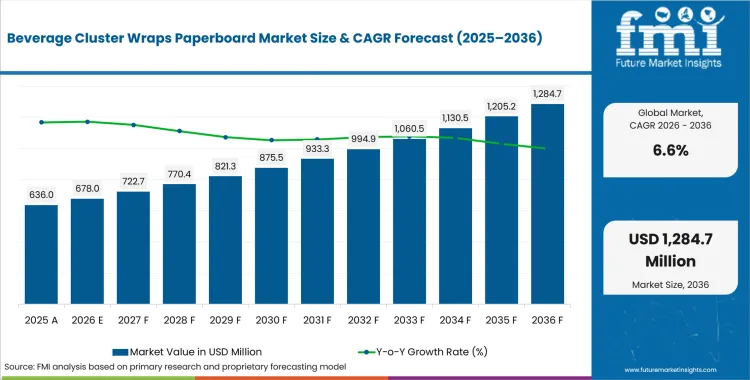
- USD 678.0 Mn
- Forecast (2036)
- USD 1284.7 Mn
- CAGR (2026 to 2036)
- 6.6%
How big is Beverage Cluster Wraps Paperboard Market in 2026?
USD 678.0 million in 2026 and USD 1,284.7 million by 2036 at a 6.6% CAGR.
Demand for beverage cluster wraps paperboard is projected to rise at a 6.6% CAGR by 2036 as beverage producers replace shrink film and rings without accepting slower secondary packing lines. Krones stated on March 17 2026 that Variopac Pro would demonstrate LitePac Top Strap holding six 1.5-liter PET bottles with a cardboard clip and strap. That equipment route makes fiber conversion credible because paperboard grouping can enter an existing beverage packaging line without creating a separate manual packing step.
Country conversion will depend on waste rules and local recycling obligations instead of one global material preference. Oregon DEQ launched statewide packaging and paper EPR on July 1, 2025, with producer fees funding recycling-system improvements. The policy changes the commercial calculation for paperboard packaging because brands need format data that fits local reporting and recycling requirements before wider rollout.
Key Takeaways
- Demand increases where paperboard carriers replace plastic grouping without reducing line speed or pack retention during distribution.
- Based on format type, standard formats are projected to account for 35.0% in 2026 due to lower qualification complexity for related beverage SKUs.
- In 2026, the PET & rPET segment is expected to lead material with 30.0% share as repeatable bottle geometry fits open carrier designs.
- By capacity, 250-750 ml is forecast to represent 34.0% in 2026 driven by common retail pack counts and manageable grouped weight.
- Moisture exposure and high-speed line trials can delay conversion since carrier failure raises downtime and product-damage costs during production.
- Some of the key players in this market include Graphic Packaging International, Smurfit Westrock plc, Krones AG, KHS GmbH, Hinojosa Packaging Group, International Paper Company, MM Group, and Metsä Board Corporation.
Analyst Perspective
"Paperboard cluster wraps earn account-level value once the carrier survives line speed and condensation without increasing pallet or retail handling losses. Applicator tuning protects economics because downtime or pack damage can erase a lower material cost during conversion."
- Nandini Roy Choudhury, Principal Consultant, Future Market Insights
How is the Beverage Cluster Wraps Paperboard Market segmented?
The market is segmented by format type, material, capacity, end use, sales channel, and region.
Format type includes standard formats, recyclable-optimized formats, premium & branded formats, and custom-engineered formats. Material covers PET & rPET, PP & HDPE, metal, and glass & other. Capacity includes below 250 ml, 250-750 ml, 750 ml-2 L, and above 2 L. End use covers food, beverage, home & personal care, and pharma & industrial. Sales channels include direct brand contracts, distributors, and online B2B.
What supports Direct brand contracts in the Sales channel category?
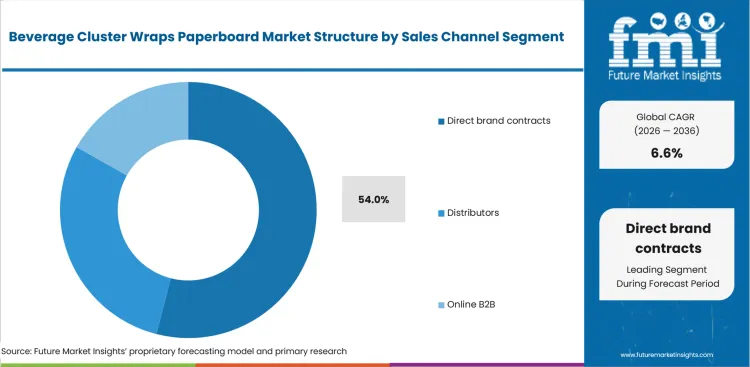
Direct contracts give beverage brands one technical route for structural drawings and line trials before a new carrier reaches multiple SKUs. The channel is valuable where paper packaging changes need coordinated graphics plus applicator settings and pallet checks.
- The sales channel is forecast to be led by direct brand contracts at 54.0% share in 2026 due to coordinated line qualification.
- Graphic Packaging stated on September 17 2025 that Get More Vits adopted its glue-free EnviroClip Beam paperboard format for four-packs of vitamin drinks.
What makes Standard formats central to the Format type category?
Standard formats let packaging engineers begin with familiar carrier geometry before introducing SKU-specific print or retention changes. That reduces trial variables for folding carton formats used on related can or bottle families.
- By format type, standard formats are estimated to hold 35.0% in 2026 owing to simpler line trials on related beverage SKUs.
- Graphic Packaging announced two beverage multipack systems on September 10, 2025, including a wrap that uses about 25% less paperboard than versions with an ad panel and runs on existing Marksman machinery.
Why does PET & rPET lead the Material category?
PET bottles give paperboard carriers repeatable neck and body geometry that supports open multipacks without fully enclosing the primary container. That geometry also lets PET packaging programs remove shrink film while keeping bottles visible at retail.
- The PET & rPET segment is set to lead the material category with 30.0% share in 2026 due to repeatable bottle interfaces.
- Hinojosa Packaging Group and KHS launched BottleClip Carrier on February 25, 2025, as a recyclable cardboard system for transporting bottles and replacing plastic film.
How does 250-750 ml anchor the Capacity category?
The 250-750 ml band covers many beverage sizes sold individually yet grouped into retail multipacks for shelf handling and transport. Carrier design must balance paper and paperboard stiffness with total pack weight at common can and bottle counts.
- 250-750 ml is projected to hold 34.0% share in 2026 owing to common multipack counts and manageable grouped weight.
- MM Packaging disclosed on September 10, 2025, that Kingsland Drinks adopted fully enclosed multipack cases for eight or 12 canned wine and ready-to-drink products.
What are the drivers, restraints and opportunities in the Beverage Cluster Wraps Paperboard Market?
Plastic-reduction rules raise interest in fiber grouping, line-speed qualification limits switching, and recycled-board capacity gives converters a clearer route to scale qualified formats.
- Driver: Plastic-reduction rules increase the cost and compliance exposure attached to avoidable plastic grouping formats.
- Restraint: High-speed application and chilled-distribution performance can delay conversion even after a fiber design meets material goals.
- Opportunity: Converters can pair recycled-fiber board with applicator support so beverage brands qualify material and line performance together.
Plastic-reduction rules shift the comparison from material preference toward the function performed by secondary grouping. Regulation (EU) 2025/40 entered the Official Journal in January 2025 and restricts specified single-use plastic grouped packaging from 2030. That timetable gives recycled paper packaging suppliers a defined conversion window for formats that can replace plastic collation without weakening unitization.
Line qualification remains the practical restraint since carrier failure during application can erase savings through downtime or damaged product. KHS documented in May 2026 that its Innopack Kisters TSP Advanced processes up to 7,200 packs per hour with BottleClip available on Advanced-series machines. Beverage converters therefore need retention and moisture tests at commercial speed before a plant accepts a format change.
Recycled-board capacity expands the supply base for converters that want fiber content and runnability qualified under one program. Graphic Packaging launched its Waco recycled paperboard facility on November 5 2025 after first commercial-grade output during October. The site gives larger beverage programs another North American board platform for scale trials before converting repeated multipack SKUs.
Which country CAGRs are profiled in the beverage cluster wraps paperboard market?
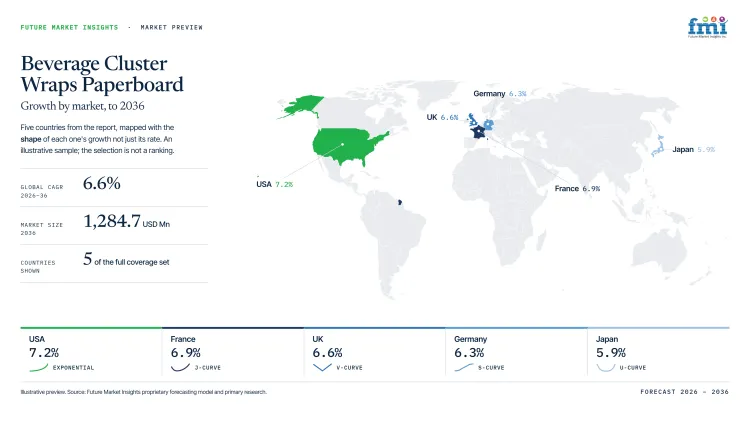
| Country | CAGR |
|---|---|
| USA | 7.2% |
| France | 6.9% |
| UK | 6.6% |
| Germany | 6.3% |
| Japan | 5.9% |
How do country-level CAGRs compare in the beverage cluster wraps paperboard market?
The five profiled markets span 1.3 percentage points from USA at 7.2% to Japan at 5.9%. USA leads the group as beverage output supports demand for recyclable packaging. France and the UK form the middle tier as recovery systems and packaging rules shape material choices. Germany follows with established recycling infrastructure, while Japan records slower growth amid mature packaging practices.
- USA combines large beverage filling capacity with increasingly diverse state-level packaging requirements.
- France emphasizes high paper recovery alongside stricter design requirements for recyclable packs.
- UK demand reflects evolving packaging regulations and growing pressure to improve recyclability.
- Germany benefits from established recycling systems and tighter material-efficiency expectations.
- Japan relies on mature packaging practices while advancing lightweighting and resource efficiency.
Similar CAGRs therefore lead to different qualification costs and entry routes for each market. The full report provides country-level CAGR analysis across North America, Latin America, Europe, East Asia, South Asia, Oceania and the Middle East and Africa.
Country-wise Analysis
- US beverage programs are commonly qualified plant by plant because retailer specifications and producer-responsibility rules differ between states. The Environmental Protection Agency updated its Recycling Infrastructure and Market Opportunities Map to Version 2.0 in June 2025 and included cardboard plus paper and PET bottles among 16 material types, giving packaging teams a national reference for recycling infrastructure. The USA beverage cluster wraps paperboard sector is projected to record 7.2% CAGR during the assessment period, attributable to brand plastic-reduction programs and the broad filling capacity even as state rules require local recycling documentation for multi-state rollouts using related USA folding cartons.
- French beverage brands operate within a mature EPR system where paperboard and plastic follow distinct recovery targets. Beverage cluster wraps paperboard sales in France are forecast to expand at 6.9% CAGR by 2036, supported by fiber substitution and stronger recycling targets. A December 2, 2025, French order established 2028 professional-packaging recycling targets of 75% for paper-cardboard and 50% for plastic. Coatings and adhesives remain key qualification considerations because carriers must maintain product retention without weakening recyclability.
- UK beverage producers face rising packaging compliance expectations alongside established recycling infrastructure and retailer sustainability requirements. The beverage cluster wraps paperboard market is estimated to grow at 6.6% CAGR through 2036, supported by continued substitution of plastic carriers with fiber-based formats. Extended producer responsibility requirements encourage brands to improve packaging recyclability and material efficiency. Qualification therefore focuses on board strength, moisture resistance, and adhesive performance while ensuring carriers remain compatible with collection and recycling systems.
- German beverage packers operate within a highly developed recycling ecosystem where packaging design, material efficiency, and recovery performance influence procurement decisions. Beverage cluster wraps paperboard demand is projected to expand at 6.3% CAGR through 2036, supported by established recycling infrastructure and continued emphasis on recyclable packaging formats. Converters benefit from mature paperboard supply chains, although coatings, inks, and adhesives must be selected carefully to preserve fiber recovery. Consistent performance across automated filling lines remains important for wider adoption.
- Japanese beverage producers operate in a mature packaging market where lightweighting, resource efficiency, and disciplined material specifications influence carrier adoption. The beverage cluster wraps paperboard sector is estimated to grow at 5.9% CAGR through 2036, reflecting gradual substitution toward efficient fiber-based formats rather than rapid structural change. Established beverage manufacturing capabilities support repeatable packaging qualification, while humidity resistance, dimensional stability, and high-speed line performance remain important technical requirements for broader commercial deployment.
Who are the notable companies in the Beverage Cluster Wraps Paperboard Market?
Graphic Packaging International, Smurfit Westrock plc, Krones AG, KHS GmbH, Hinojosa Packaging Group, International Paper Company, MM Group, and Metsä Board Corporation
Competition spans dedicated multipack converters, beverage-line equipment groups, and paperboard producers with direct beverage packaging programs. Entry barriers come from carrier patents plus line-trial records and customer-specific geometry rather than company size alone. Current corrugated folding cartons and PET material packaging relationships also matter because several beverage groups source secondary formats beside their existing bottle or can programs.
- Graphic Packaging International and Smurfit Westrock plc provide beverage paperboard formats and direct brand programs through regional converting networks.
- Krones AG and KHS GmbH integrate paperboard carrier application with high-speed beverage packaging lines and line-change support.
- Hinojosa Packaging Group and MM Group convert beverage carriers through European carton operations and direct food-and-beverage packaging programs. International Paper Company and Metsä Board Corporation supply broader paperboard platforms used by converters and packaging design teams.
Competitive Benchmarking: Beverage Cluster Wraps Paperboard Market
| Company | Carrier Format Breadth | Applicator Integration | Container Coverage | Geographic Reach |
|---|---|---|---|---|
| Graphic Packaging International | High | High | High | Global |
| Smurfit Westrock plc | High | Medium | High | Global |
| Krones AG | Medium | High | High | Global |
| KHS GmbH | High | High | High | Global |
| Hinojosa Packaging Group | Medium | Medium | Medium | Europe |
| International Paper Company | Medium | Medium | Medium | North America and EMEA |
| MM Group | High | Medium | Medium | Europe and international sales |
| Metsä Board Corporation | Medium | Low | Medium | Europe and international paperboard sales |
Scoring basis: High carrier breadth requires two or more verified paperboard multipack architectures and Medium requires one dedicated format. Low denotes material-only participation. High applicator integration requires proprietary multi-format machinery and Medium reflects one documented line integration. Low indicates no verified carrier applicator. High container coverage requires at least two verified container families and Medium covers one family with several pack configurations. Low covers one narrow use.
Key Developments in the Beverage Cluster Wraps Paperboard Market
- In March 2026, KHS GmbH introduced the BottleClip application option for its Innopack Kisters Advanced series and made the cardboard handle available on those machines.
- In September 2025, Metsä Board Corporation and Olutmylly brought a paperboard six-can tasting pack from rapid prototyping to a shelf-ready beverage carrier.
- In January 2025, International Paper Company completed its combination with DS Smith and expanded its packaging manufacturing footprint in North America and EMEA.
Key Players in the Beverage Cluster Wraps Paperboard Market
Paperboard Multipack Converters
- Graphic Packaging International
- Smurfit Westrock plc
- Hinojosa Packaging Group
- MM Group
Beverage Packaging Equipment Integrators
- Krones AG
- KHS GmbH
Paperboard and Packaging Platforms
- International Paper Company
- Metsä Board Corporation
Beverage Cluster Wraps Paperboard Market - Report Scope
| Coverage field | Report scope |
|---|---|
| Market breakdown | By format type, material, capacity, end use, sales channel and region. |
| Quantitative Units | USD Million. |
| Market Definition | Revenue includes paperboard cluster wraps and carriers sold to group rigid primary containers into multi-unit packs. It excludes primary-container revenue, packaging machinery, plastic rings, shrink film and adjacent cases outside the defined cluster-wrap scope. |
| Regions Covered | North America, Latin America, Western Europe, Eastern Europe, East Asia, South Asia and Pacific, Middle East and Africa. |
| Countries Covered | UAE, Saudi Arabia, South Korea, USA, France and 20+ countries included in the full report. |
| Key Companies Profiled | Graphic Packaging International, Smurfit Westrock plc, Krones AG, KHS GmbH, Hinojosa Packaging Group, International Paper Company, MM Group, and Metsä Board Corporation |
| Forecast Period | 2026 to 2036. |
| Approach | Primary and secondary research with market triangulation. |
Beverage Cluster Wraps Paperboard Market - Research Methodology
| Method | Approach |
|---|---|
| Primary Research | FMI analysts gathered input from manufacturers, service providers, technology developers, distributors, end users, procurement teams, and subject-matter experts. Interviews examined purchasing decisions, product or service evaluation, adoption barriers, approval requirements, pricing considerations, and expectations for technical or commercial support. Respondents were also asked what evidence is required before a trial, pilot, or initial order develops into regular purchasing. |
| Desk Research | Desk research covered government statistics, regulatory publications, trade data, industry associations, technical literature, standards, company filings, product information, and official corporate announcements. Sources were reviewed for relevance, publication date, geographic coverage, and consistency with the defined market scope. Claims relating to performance, applications, approvals, capacity, investment, and commercial activity were retained only when supported by credible public evidence. |
| Market Sizing and Forecasting | The market model combined the baseline value with historical performance, segment structure, pricing and volume indicators, adoption levels, company participation, and country-level demand conditions. Forecast assumptions considered economic activity, investment trends, regulatory developments, technology adoption, purchasing cycles, supply availability, and barriers to wider market use. Segment and regional estimates were reconciled before the final market total was calculated. |
| Data Validation | Estimates were checked against multiple independent indicators, including public data, company activity, trade patterns, industry developments, and findings from primary interviews. Validation also tested whether products, services, applications, and company revenues fell within the defined market boundaries. Adjacent categories, unsupported claims, overlapping revenues, and activities without direct market relevance were excluded to reduce double counting and maintain consistency across segments and countries. |
Beverage Cluster Wraps Paperboard Market by Segments
Beverage Cluster Wraps Paperboard Market segmented by Format Type:
- Standard formats
- Recyclable-optimized formats
- Premium & branded formats
- Custom-engineered formats
Beverage Cluster Wraps Paperboard Market segmented by Material:
- PET & rPET
- PP & HDPE
- Metal
- Glass & other
Beverage Cluster Wraps Paperboard Market segmented by Capacity:
- 250-750 ml
- Below 250 ml
- 750 ml-2 L
- Above 2 L
Beverage Cluster Wraps Paperboard Market segmented by End Use:
- Food
- Beverage
- Home & personal care
- Pharma & industrial
Beverage Cluster Wraps Paperboard Market segmented by Sales Channel:
- Direct brand contracts
- Distributors
- Online B2B
Beverage Cluster Wraps Paperboard Market by Region:
- North America
- United States
- Canada
- Latin America
- Brazil
- Mexico
- Argentina
- Chile
- Western Europe
- Germany
- France
- United Kingdom
- Italy
- Spain
- Benelux
- Nordics
- Eastern Europe
- Poland
- Czech Republic
- Romania
- Hungary
- East Asia
- China
- Japan
- South Korea
- South Asia and Pacific
- India
- ASEAN
- Australia and New Zealand
- Middle East and Africa
- GCC Countries
- South Africa
- Türkiye
- Israel
Research Sources and Bibliography
- Krones AG. (2026, March 17). Sustainable and fully automated packaging solutions.
- Oregon Department of Environmental Quality. (2025, July 1). Oregon leads the nation in implementing the Plastic Pollution and Recycling Modernization Act.
- Graphic Packaging International. (2025, September 10). Graphic Packaging debuts duo of beverage multipack innovations at drinktec 2025.
- Hinojosa Packaging Group. (2025, February 25). Hinojosa and KHS Group launch a new 100% cardboard packaging system to transport bottles.
- MM Group. (2025, September 10). MM Packaging’s multi-pack cartonboard solution protects Kingsland Drinks’ range of canned beverages.
- Graphic Packaging International. (2025, September 17). EnviroClip Beam takes the spotlight at the World Beverage Innovation Awards 2025.
- European Parliament and Council of the European Union. (2025, January 22). Regulation (EU) 2025/40 on packaging and packaging waste.
- KHS Group. (2026, May 12). The power of packaging.
- Graphic Packaging International. (2025, November 5). Graphic Packaging launches advanced recycled paperboard facility in Waco, Texas.
- Ministry of Climate Change and Environment, United Arab Emirates. (2025, January 2). التغير المناخي والبيئة تكشف تفاصيل دليل المنتجات البلاستيكية ذات الاستخدام الواحد.
- Saudi Standards, Metrology and Quality Organization. (2025, August 26). المواصفات السعودية تُلزم الموردّين بإصدار شهادة الإرسالية قبل البيان الجمركي اعتباراً من 1 أكتوبر 2025.
- National Law Information Center, Republic of Korea. (2025, January 7). 포장재 재활용 용이성 등급평가 기준.
- USA Environmental Protection Agency. (2025, June). Recycling Infrastructure and Market Opportunities Map.
- République française. (2025, December 2). Arrêté du 2 décembre 2025 portant cahier des charges des éco-organismes, des systèmes individuels et des organismes coordonnateurs de la filière à responsabilité élargie des producteurs d'emballages servant à commercialiser des produits consommés ou utilisés par des professionnels.
- KHS Group. (2026, March 10). From the packaging to the line.
- Metsä Board Corporation. (2025, September 29). V6-engine six-pack: Olutmylly’s tasting pack co-created with Metsä Board.
- International Paper Company. (2025, January 31). About the IP + DS Smith combination.
- Smurfit Westrock plc. (2026, July 7). Smurfit Westrock partners with Coca-Cola on World Cup packaging to capture spike in consumer demand.
- KHS Group. (2026, May 8). Round(ing) the corner.
- Graphic Packaging International. (2026, July 13). Graphic Packaging enters uncoated recycled paperboard market with launch of PaceSetter Ridgeline.
- Hinojosa Packaging Group. (2025, November 4). Hinojosa Packaging Group completes the acquisition of French group ASV Packaging.
- MM Group. (2026, August 17). MM Board & Paper signs agreement to acquire the operations of R.D.M. Arnsberg.
- Krones AG. (2025, August 5). New customer with family spirit: Finn Spring invests in Krones lines.
- International Paper Company. (2026, May 26). Breaking ground: New sustainable packaging facility coming to Mississippi.
- Metsä Board Corporation. (2026, March 3). Metsä Board introduces a new product and service concept for fast moving brand packaging in Europe.
This Report Answers
- How large is the beverage cluster wraps paperboard market in 2026 and 2036?
- What CAGR is projected for the beverage cluster wraps paperboard market between 2026 and 2036?
- Why do standard formats hold the largest format-type share in 2026?
- Why does PET & rPET hold the leading material share in 2026?
- Why does the 250-750 ml capacity band hold a large current share?
- What factors increase or slow conversion from plastic grouping to paperboard carriers?
- Which five countries carry the highest profiled CAGRs in this edition?
- Which companies are active in paperboard beverage multipacks and application equipment?
- How do carrier format breadth and applicator integration differ among notable companies?
Frequently Asked Questions
How big is the beverage cluster wraps paperboard market in 2026?
The beverage cluster wraps paperboard market is valued at USD 678.0 million in 2026 and is projected to reach USD 1,284.7 million by 2036. Growth follows beverage brands replacing plastic grouping with line-qualified paperboard carriers.The standard formats segment is expected to hold 35.0% of the beverage cluster wraps paperboard market in 2026, driven by repeatable carrier geometry that reduces qualification changes. Standard structures also fit related can and bottle SKUs more easily.
What is the CAGR of the beverage cluster wraps paperboard market from 2026 to 2036?
The beverage cluster wraps paperboard market is projected to grow at a CAGR of 6.6% between 2026 and 2036. Expansion is supported by plastic-reduction rules plus applicator systems that can run paperboard carriers at commercial beverage-line speeds.
Which format type leads the beverage cluster wraps paperboard market?
The standard formats segment is expected to hold 35.0% of the beverage cluster wraps paperboard market in 2026, driven by repeatable carrier geometry that reduces qualification changes. Standard structures also fit related can and bottle SKUs more easily.
Which material leads the beverage cluster wraps paperboard market?
The PET & rPET segment is expected to hold 30.0% of the beverage cluster wraps paperboard market in 2026, attributable to repeatable bottle geometry. Open paperboard carriers can use neck or body features without fully enclosing the primary container.
How much value will the beverage cluster wraps paperboard market add between 2026 and 2036?
The beverage cluster wraps paperboard market is expected to add USD 606.7 million in value between 2026 and 2036. Growth comes from wider fiber substitution where carriers pass line-speed and distribution qualification.
Which countries are projected to record the highest growth in the beverage cluster wraps paperboard market?
In the beverage cluster wraps paperboard market, UAE is projected to grow at 8.1% CAGR followed by Saudi Arabia at 7.8% and South Korea at 7.5% through 2036. Growth is tied to plastic-reduction policy and tighter packaging compliance.
Which companies are active in the beverage cluster wraps paperboard market?
Key companies operating in the beverage cluster wraps paperboard market include Graphic Packaging International, Smurfit Westrock plc, Krones AG, KHS GmbH, Hinojosa Packaging Group, International Paper Company, MM Group, and Metsä Board Corporation. These companies span carrier design, applicator integration, paperboard production, and beverage-line support.
Preview the report firsthand - request a free sample
Get SampleGet the brochure for pricing and purchase details.
Get PDFTable of Content
- Key Takeaways
- Market Size and CAGR
- Top Growth Driver
- Fastest Growing Segment
- Leading Region
- Key Companies
- Emerging Opportunities
- Executive Summary
- Global Market Outlook
- Demand-side Trends
- Supply-side Trends
- Technology Roadmap Analysis
- Analysis and Recommendations
- Analyst Perspective (What is happening? Why now? What should investors know?)
- Key Questions Answered
- How large is the market?
- What is the CAGR?
- What are key trends?
- Which region dominates?
- Who are the leaders?
- Market Overview
- Market Coverage / Taxonomy
- Market Definition / Scope / Limitations
- Research Methodology
- Chapter Orientation
- Analytical Lens and Working Hypotheses
- Market Structure, Signals, and Trend Drivers
- Benchmarking and Cross-market Comparability
- Market Sizing, Forecasting, and Opportunity Mapping
- Research Design and Evidence Framework
- Desk Research Programme (Secondary Evidence)
- Expert Input and Fieldwork (Primary Evidence)
- Tooling, Models, and Reference Databases
- Data Engineering and Model Build
- Quality Assurance and Audit Trail
- Market Background
- Market Dynamics (Drivers, Restraints, Opportunity, Trends)
- Scenario Forecast (Optimistic, Likely, Conservative)
- Impact Analysis
- AI Impact
- Sustainability Impact
- Regulatory Impact
- Technology Impact
- Consumer / Buyer Analysis
- Purchase Drivers
- Adoption Barriers
- Buyer Journey
- Opportunity Map Analysis
- Product Life Cycle Analysis
- Supply Chain Analysis
- Investment Feasibility Matrix
- Value Chain Analysis
- PESTLE and Porter's Analysis
- Regulatory Landscape
- Regional Parent Market Outlook
- Production and Consumption Statistics
- Import and Export Statistics
- Global Market Analysis and Forecast, 2021 to 2036
- Historical Market Size Value (USD Million) Analysis, 2021 to 2025
- Current and Future Market Size Value (USD Million) Projections, 2026 to 2036
- Y-o-Y Growth Trend Analysis
- Absolute $ Opportunity Analysis
- Global Market Pricing Analysis, 2021 to 2036
- Global Market Analysis and Forecast, By Format Type, 2021 to 2036
- Introduction / Key Findings
- Historical Market Size Value (USD Million) Analysis By Format Type, 2021 to 2025
- Current and Future Market Size Value (USD Million) Analysis and Forecast By Format Type, 2026 to 2036
- Standard formats
- Recyclable-optimized formats
- Premium & branded formats
- Custom-engineered formats
- Standard formats
- Y-o-Y Growth Trend Analysis By Format Type, 2021 to 2025
- Absolute $ Opportunity Analysis By Format Type, 2026 to 2036
- Global Market Analysis and Forecast, By Material, 2021 to 2036
- Introduction / Key Findings
- Historical Market Size Value (USD Million) Analysis By Material, 2021 to 2025
- Current and Future Market Size Value (USD Million) Analysis and Forecast By Material, 2026 to 2036
- PET & rPET
- PP & HDPE
- Metal
- Glass & other
- PET & rPET
- Y-o-Y Growth Trend Analysis By Material, 2021 to 2025
- Absolute $ Opportunity Analysis By Material, 2026 to 2036
- Global Market Analysis and Forecast, By Capacity, 2021 to 2036
- Introduction / Key Findings
- Historical Market Size Value (USD Million) Analysis By Capacity, 2021 to 2025
- Current and Future Market Size Value (USD Million) Analysis and Forecast By Capacity, 2026 to 2036
- 250-750 ml
- Below 250 ml
- 750 ml-2 L
- Above 2 L
- 250-750 ml
- Y-o-Y Growth Trend Analysis By Capacity, 2021 to 2025
- Absolute $ Opportunity Analysis By Capacity, 2026 to 2036
- Global Market Analysis and Forecast, By End Use, 2021 to 2036
- Introduction / Key Findings
- Historical Market Size Value (USD Million) Analysis By End Use, 2021 to 2025
- Current and Future Market Size Value (USD Million) Analysis and Forecast By End Use, 2026 to 2036
- Food
- Beverage
- Home & personal care
- Pharma & industrial
- Food
- Y-o-Y Growth Trend Analysis By End Use, 2021 to 2025
- Absolute $ Opportunity Analysis By End Use, 2026 to 2036
- Global Market Analysis and Forecast, By Sales Channel, 2021 to 2036
- Introduction / Key Findings
- Historical Market Size Value (USD Million) Analysis By Sales Channel, 2021 to 2025
- Current and Future Market Size Value (USD Million) Analysis and Forecast By Sales Channel, 2026 to 2036
- Direct brand contracts
- Distributors
- Online B2B
- Direct brand contracts
- Y-o-Y Growth Trend Analysis By Sales Channel, 2021 to 2025
- Absolute $ Opportunity Analysis By Sales Channel, 2026 to 2036
- Global Market Analysis and Forecast, By Region, 2021 to 2036
- Introduction
- Historical Market Size Value (USD Million) Analysis By Region, 2021 to 2025
- Current Market Size Value (USD Million) Analysis and Forecast By Region, 2026 to 2036
- North America
- Latin America
- Western Europe
- Eastern Europe
- East Asia
- South Asia and Pacific
- Middle East & Africa
- Market Attractiveness Analysis By Region
- North America Market Analysis and Forecast, By Country, 2021 to 2036
- Historical Market Size Value (USD Million) Trend Analysis By Market Taxonomy, 2021 to 2025
- Market Size Value (USD Million) Forecast By Market Taxonomy, 2026 to 2036
- By Country
- USA
- Canada
- By Format Type
- By Material
- By Capacity
- By End Use
- By Sales Channel
- By Country
- Market Attractiveness Analysis
- By Country
- By Format Type
- By Material
- By Capacity
- By End Use
- By Sales Channel
- Key Takeaways
- Latin America Market Analysis and Forecast, By Country
- Historical Market Size Value (USD Million) Trend Analysis By Market Taxonomy, 2021 to 2025
- Market Size Value (USD Million) Forecast By Market Taxonomy, 2026 to 2036
- By Country
- Brazil
- Mexico
- Chile
- Rest of Latin America
- By Format Type
- By Material
- By Capacity
- By End Use
- By Sales Channel
- By Country
- Market Attractiveness Analysis
- By Country
- By Format Type
- By Material
- By Capacity
- By End Use
- By Sales Channel
- Key Takeaways
- Western Europe Market Analysis and Forecast, By Country
- Historical Market Size Value (USD Million) Trend Analysis By Market Taxonomy, 2021 to 2025
- Market Size Value (USD Million) Forecast By Market Taxonomy, 2026 to 2036
- By Country
- Germany
- UK
- Italy
- Spain
- France
- Nordic
- BENELUX
- Rest of Western Europe
- By Format Type
- By Material
- By Capacity
- By End Use
- By Sales Channel
- By Country
- Market Attractiveness Analysis
- By Country
- By Format Type
- By Material
- By Capacity
- By End Use
- By Sales Channel
- Key Takeaways
- Eastern Europe Market Analysis and Forecast, By Country
- Historical Market Size Value (USD Million) Trend Analysis By Market Taxonomy, 2021 to 2025
- Market Size Value (USD Million) Forecast By Market Taxonomy, 2026 to 2036
- By Country
- Russia
- Poland
- Hungary
- Balkan & Baltic
- Rest of Eastern Europe
- By Format Type
- By Material
- By Capacity
- By End Use
- By Sales Channel
- By Country
- Market Attractiveness Analysis
- By Country
- By Format Type
- By Material
- By Capacity
- By End Use
- By Sales Channel
- Key Takeaways
- East Asia Market Analysis and Forecast, By Country
- Historical Market Size Value (USD Million) Trend Analysis By Market Taxonomy, 2021 to 2025
- Market Size Value (USD Million) Forecast By Market Taxonomy, 2026 to 2036
- By Country
- China
- Japan
- South Korea
- By Format Type
- By Material
- By Capacity
- By End Use
- By Sales Channel
- By Country
- Market Attractiveness Analysis
- By Country
- By Format Type
- By Material
- By Capacity
- By End Use
- By Sales Channel
- Key Takeaways
- South Asia and Pacific Market Analysis and Forecast, By Country
- Historical Market Size Value (USD Million) Trend Analysis By Market Taxonomy, 2021 to 2025
- Market Size Value (USD Million) Forecast By Market Taxonomy, 2026 to 2036
- By Country
- India
- ASEAN
- Australia & New Zealand
- Rest of South Asia and Pacific
- By Format Type
- By Material
- By Capacity
- By End Use
- By Sales Channel
- By Country
- Market Attractiveness Analysis
- By Country
- By Format Type
- By Material
- By Capacity
- By End Use
- By Sales Channel
- Key Takeaways
- Middle East & Africa Market Analysis and Forecast, By Country
- Historical Market Size Value (USD Million) Trend Analysis By Market Taxonomy, 2021 to 2025
- Market Size Value (USD Million) Forecast By Market Taxonomy, 2026 to 2036
- By Country
- Kingdom of Saudi Arabia
- Other GCC Countries
- Türkiye
- South Africa
- Other African Union
- Rest of Middle East & Africa
- By Format Type
- By Material
- By Capacity
- By End Use
- By Sales Channel
- By Country
- Market Attractiveness Analysis
- By Country
- By Format Type
- By Material
- By Capacity
- By End Use
- By Sales Channel
- Key Takeaways
- Key Countries Market Analysis
- USA
- Pricing Analysis
- Market Share Analysis, 2025
- By Format Type
- By Material
- By Capacity
- By End Use
- By Sales Channel
- Canada
- Pricing Analysis
- Market Share Analysis, 2025
- By Format Type
- By Material
- By Capacity
- By End Use
- By Sales Channel
- Mexico
- Pricing Analysis
- Market Share Analysis, 2025
- By Format Type
- By Material
- By Capacity
- By End Use
- By Sales Channel
- Brazil
- Pricing Analysis
- Market Share Analysis, 2025
- By Format Type
- By Material
- By Capacity
- By End Use
- By Sales Channel
- Chile
- Pricing Analysis
- Market Share Analysis, 2025
- By Format Type
- By Material
- By Capacity
- By End Use
- By Sales Channel
- Germany
- Pricing Analysis
- Market Share Analysis, 2025
- By Format Type
- By Material
- By Capacity
- By End Use
- By Sales Channel
- UK
- Pricing Analysis
- Market Share Analysis, 2025
- By Format Type
- By Material
- By Capacity
- By End Use
- By Sales Channel
- Italy
- Pricing Analysis
- Market Share Analysis, 2025
- By Format Type
- By Material
- By Capacity
- By End Use
- By Sales Channel
- Spain
- Pricing Analysis
- Market Share Analysis, 2025
- By Format Type
- By Material
- By Capacity
- By End Use
- By Sales Channel
- France
- Pricing Analysis
- Market Share Analysis, 2025
- By Format Type
- By Material
- By Capacity
- By End Use
- By Sales Channel
- India
- Pricing Analysis
- Market Share Analysis, 2025
- By Format Type
- By Material
- By Capacity
- By End Use
- By Sales Channel
- ASEAN
- Pricing Analysis
- Market Share Analysis, 2025
- By Format Type
- By Material
- By Capacity
- By End Use
- By Sales Channel
- Australia & New Zealand
- Pricing Analysis
- Market Share Analysis, 2025
- By Format Type
- By Material
- By Capacity
- By End Use
- By Sales Channel
- China
- Pricing Analysis
- Market Share Analysis, 2025
- By Format Type
- By Material
- By Capacity
- By End Use
- By Sales Channel
- Japan
- Pricing Analysis
- Market Share Analysis, 2025
- By Format Type
- By Material
- By Capacity
- By End Use
- By Sales Channel
- South Korea
- Pricing Analysis
- Market Share Analysis, 2025
- By Format Type
- By Material
- By Capacity
- By End Use
- By Sales Channel
- Russia
- Pricing Analysis
- Market Share Analysis, 2025
- By Format Type
- By Material
- By Capacity
- By End Use
- By Sales Channel
- Poland
- Pricing Analysis
- Market Share Analysis, 2025
- By Format Type
- By Material
- By Capacity
- By End Use
- By Sales Channel
- Hungary
- Pricing Analysis
- Market Share Analysis, 2025
- By Format Type
- By Material
- By Capacity
- By End Use
- By Sales Channel
- Kingdom of Saudi Arabia
- Pricing Analysis
- Market Share Analysis, 2025
- By Format Type
- By Material
- By Capacity
- By End Use
- By Sales Channel
- Türkiye
- Pricing Analysis
- Market Share Analysis, 2025
- By Format Type
- By Material
- By Capacity
- By End Use
- By Sales Channel
- South Africa
- Pricing Analysis
- Market Share Analysis, 2025
- By Format Type
- By Material
- By Capacity
- By End Use
- By Sales Channel
- USA
- Market Structure Analysis
- Competition Dashboard
- Competition Benchmarking
- Market Share Analysis of Top Players
- By Regional
- By Format Type
- By Material
- By Capacity
- By End Use
- By Sales Channel
- Emerging Startups
- Innovation Benchmarking
- Competition Analysis
- Competition Deep Dive
- CANPACK
- Overview
- Product Portfolio
- Profitability by Market Segments
- Sales Footprint
- Strategy Overview
- Marketing Strategy
- Product Strategy
- Channel Strategy
- Crown Holdings
- Ardagh Group
- Alpla
- Berry Global
- Amcor
- Ball Corporation
- Pactiv Evergreen
- Silgan Holdings
- Greiner Packaging
- CANPACK
- Case Studies
- Success Stories
- Recent Developments
- Competition Deep Dive
- Assumptions & Acronyms Used


