

- Market Size (2026)
- USD 141.1 Mn
- Forecast (2036)
- USD 293.5 Mn
- CAGR (2026 to 2036)
- 7.6%
How Big is the Black Sesame Paste Market in 2026?
The black sesame paste market is estimated at USD 141.1 million in 2026.
The global black sesame paste market was valued at USD 131.1 million in 2025 and is estimated to reach USD 141.1 million in 2026. The market is projected to reach USD 293.5 million by 2036, expanding at a compound annual growth rate (CAGR) of 7.6% between 2026 and 2036. Standard grade accounted for the largest share of the market, contributing 40.0% of total revenue in 2026. Demand is supported by the ingredient's dark colour and roasted flavour, which allow bakeries to differentiate breads, pastries and creams. Raw material supply is broad. According to FAOSTAT data, world sesame production reached 6.7 million tonnes in 2024, led by India, Myanmar and Sudan[6]. Black sesame commands a premium within this market. In September 2025, jet black sesame was quoted at USD 2,775.0 per metric ton FOB India, compared with USD 1,320.0 per metric ton for natural sesame and USD 1,635.0 for hulled sesame[5]. Demand in Asia remains strong. China consumes an estimated 1.5 million metric tons of sesame a year, and imported 1.13 million metric tons in 2024[5].
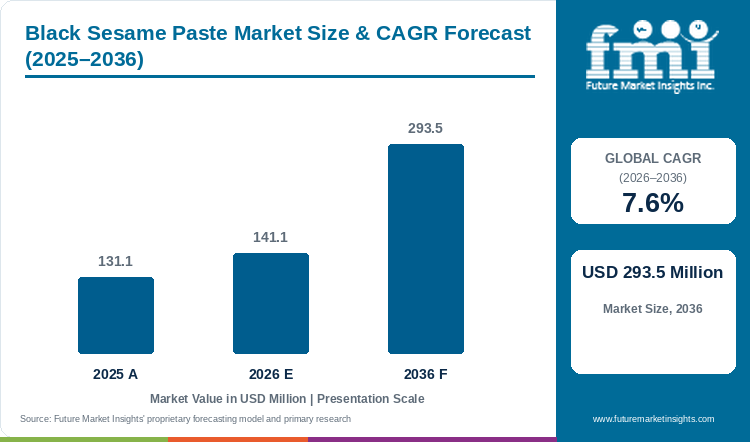
Table 1: Black Sesame Paste Market Size and Forecast (USD million), 2025 to 2036
| Market size and forecast | Value |
|---|---|
| 2025 market size | USD 131.1 million |
| Estimated market size in 2026 | USD 141.1 million |
| Projected market size by 2036 | USD 293.5 million |
| CAGR (2026-2036) | 7.6% |
| Added revenue, 2026 to 2036 | USD 152.4 million |
Key Market Trends & Insights
- By Product Type: The Standard grade segment accounted for the largest share of the black sesame paste market in 2026, representing 40.0% of total market revenue.
- By Form: Powder / dry products held the leading market position with a share of 47.0% in 2026.
- By Application: Bread & rolls remained the largest application segment, accounting for 34.0% of the market in 2026.
Regional Highlights
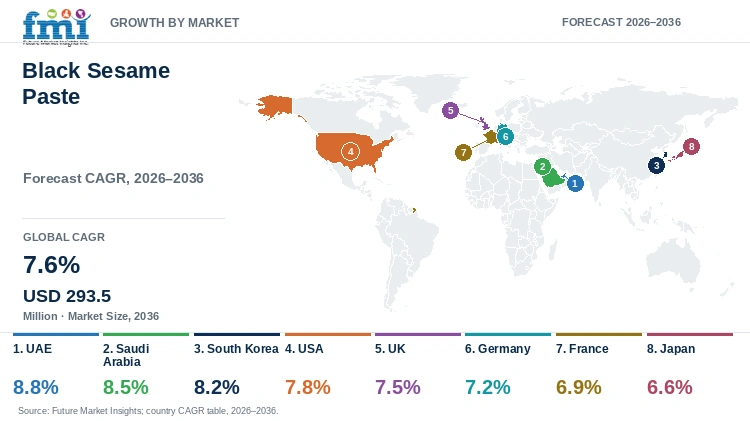
- Fastest-growing country: The UAE is expected to record the highest growth rate among the eight profiled countries, with a projected CAGR of 8.8% between 2026 and 2036.
- Growth across other countries: Saudi Arabia is projected to expand at a CAGR of 8.5%, followed by South Korea at 8.2% and the USA at 7.8%. Japan is expected to register comparatively slower growth, with a CAGR of 6.6% during the forecast period.
The availability of sesame seed remains an important factor influencing paste costs. FAOSTAT data show that India produced 866,111 tonnes in 2024, Myanmar 720,000 tonnes and Sudan 626,173 tonnes, with these three countries accounting for 33.0% of world output[6]. Prices eased during 2025. According to Mundus Agri, international sesame prices declined by USD 1,000.0 to 1,200 per metric ton ahead of the World Sesame & Peanut Conference in September 2025[5]. Lower seed prices can reduce the cost of black sesame paste, although black seed continues to trade at a premium of approximately 70.0% over hulled white sesame. Suppliers are also improving handling. Mitake's September 2025 exhibition announcement treated lasting smoothness as a development objective for sesame paste[3], which matters for bakery ingredients used from the same pack across several batches.
Asian demand provides important context for the market. China has an estimated sesame demand of 1.5 million metric tons a year but produces only 320,000 metric tons, so most of its supply is imported, mainly from African origins that benefit from zero tariffs[5]. The first shipments from Brazil were received in the summer of 2025, adding a new origin[5]. For bakery users, Kuki's professional paste range offers defined black sesame options, while Kadoya's shokupan recipe shows paste incorporated into a separate portion of dough[2][4]. Creams and centres place different demands on smoothness and sweetness, so a single roast profile does not serve every recipe equally well.
Allergen labelling is an important requirement. The US Food and Drug Administration's (FDA) January 2025 food-allergen guidance includes sesame among the major allergens addressed for covered foods[1]. Accurate composition records must therefore accompany the paste into a bakery recipe. Pure paste and sweetened cream also leave different amounts of formulation work with the bakery, affecting both ingredient information and flavour balance. When roast, composition and handling instructions remain stable, an approved recipe can move into regular purchasing without reopening its preparation method and declaration at each delivery.
Table 2: Supporting Industry Indicators for the Black Sesame Paste Market, 2024 to 2025
| Indicator | Data point | Why it matters | Source |
|---|---|---|---|
| World production | World sesame production reached 6.7 million tonnes in 2024, led by India, Myanmar and Sudan. | Broad global supply supports the availability of sesame for paste. | [6] |
| Leading producers | India produced 866,111 tonnes, Myanmar 720,000 tonnes and Sudan 626,173 tonnes in 2024. | The top three producers accounted for 33.0% of world output. | [6] |
| Black sesame price | Jet black sesame was quoted at USD 2,775.0 per metric ton FOB India in September 2025. | Black seed carries a premium over white sesame. | [5] |
| White sesame prices | Natural sesame was quoted at USD 1,320.0 and hulled sesame at USD 1,635.0 per metric ton FOB India. | The comparison shows the cost premium of black sesame. | [5] |
| Price trend | International sesame prices declined by USD 1,000.0 to 1,200 per metric ton by September 2025. | Lower seed prices can ease paste costs. | [5] |
| Chinese demand | China has an estimated demand of 1.5 million metric tons a year and imported 1.13 million metric tons in 2024. | Strong Asian demand competes for available supply. | [5] |
| Allergen information | FDA's January 2025 guidance addresses sesame among major allergens in covered foods. | Composition must be carried accurately into finished-product information. | [1] |
| Professional grades | Kuki offers black sesame pastes with defined professional aroma and texture. | Grade choice links roast and grind with the desired flavour. | [2] |
| Storage texture | Mitake highlighted persistent paste smoothness in September 2025. | Reduced hardening lowers conditioning work before dosing. | [3] |
| Bread application | Kadoya's shokupan recipe blends black sesame paste into one portion of dough. | The application links paste addition with a visible swirl. | [4] |
Demand Intensity Analysis
A comparison of FMI's market estimate with world sesame production provides a measure of the small share of sesame used in black sesame paste. World production reached approximately 6.68 million tonnes in 2024[6]. FMI estimated the black sesame paste market at USD 131.1 million in 2025, which is equivalent to approximately USD 19.6 for every tonne of sesame produced worldwide. At the September 2025 price for jet black sesame of USD 2,775.0 per metric ton[5], the market value corresponds to approximately 47,200 tonnes of black sesame seed, or about 0.7% of world sesame production, although the paste value also includes roasting, grinding and packaging costs.
The price structure provides another reference point. Jet black sesame traded at approximately 2.1 times the price of natural sesame and 1.7 times the price of hulled sesame in September 2025[5]. This premium makes black sesame paste a higher-value product than white sesame paste, and explains why grade and roast specifications receive close attention in purchasing.
A similar comparison can be made with Asian demand. China imported 1.13 million metric tons of sesame in 2024, which is equivalent to approximately 75.0% of its estimated annual demand of 1.5 million metric tons[5]. Asian demand therefore has a strong influence on global prices. FMI expects the black sesame paste market to grow at a CAGR of 7.6% between 2026 and 2036, with Japan growing at 6.6% and newer markets such as the UAE growing faster at 8.8%.
Segment values show where demand is concentrated. Standard grade accounted for USD 56.4 million of Product Type revenue in 2026, while Bread & rolls represented USD 48.0 million within Application. Direct to industrial bakeries represented USD 70.6 million of Sales Channel revenue. The market is projected to add USD 152.4 million from 2026 to 2036 and reach 2.1 times its 2026 value.
Table 3: Demand Intensity Metrics for the Black Sesame Paste Market, 2024 and 2025 Commodity Data Against 2025 and 2026 Market Values
| Demand intensity metric | Value | Basis |
|---|---|---|
| FMI market value, 2025 | USD 131.1 million | FMI estimate of black sesame paste revenue. |
| World sesame production, 2024 | 6.68 million tonnes | FAOSTAT. |
| FMI value per tonne of sesame produced | USD 19.6 | The calculation divides USD 131.1 million by 6.68 million tonnes. |
| Jet black sesame price, September 2025 | USD 2,775.0 per metric ton | FOB India. |
| Black sesame equivalent of FMI 2025 value | Approximately 47,200 tonnes | USD 131.1 million divided by USD 2,775.0 per metric ton. |
| Share of world sesame production | Approximately 0.7% | 47,200 tonnes divided by 6.68 million tonnes. |
| Black sesame premium over natural sesame | 2.1 times | USD 2,775.0 against USD 1,320.0 per metric ton. |
| China imports as a share of demand, 2024 | Approximately 75.0% | 1.13 million against 1.5 million metric tons. |
| FMI value CAGR, 2026 to 2036 | 7.6% | FMI market forecast. |
| Standard grade revenue, 2026 | USD 56.4 million | 40.0% of the market. |
| Direct industrial bakery revenue, 2026 | USD 70.6 million | 50.0% of the market. |
| Market expansion multiple | 2.1 times | Projected 2036 market value relative to 2026. |
Analyst Perspective
"Black sesame costs about twice as much as white seed, so buyers will keep paying for it only if the paste delivers a roast and colour they cannot get any other way."
- Nandini Roy Choudhury, Principal Analyst at Future Market Insights
How is the black sesame paste market segmented?
The black sesame paste market is segmented by product type, form, application, claim and sales channel. Product Type comprises Standard grade, Premium / specialty grade, Organic certified and Clean label grade. Form comprises Powder / dry, Liquid, Paste / semi-solid and Granules / pieces. Application comprises Bread & rolls, Cakes & muffins, Biscuits & cookies, Viennoiserie & pastry and Other bakery & snacks. Claim comprises Conventional, Clean label, Organic and Non-GMO / identity preserved. Sales Channel comprises Direct to industrial bakeries, Ingredient distributors, Foodservice & artisan supply and Online B2B.
What keeps Standard grade central to Product Type purchasing?
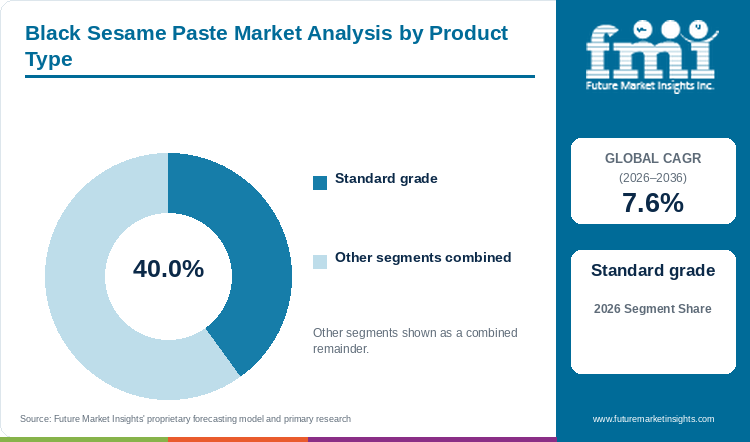
Standard grade holds 40.0% of Product Type in 2026.
How black sesame presents itself in a recipe depends on roast character and grind, and a standard specification records these properties alongside colour and microbiological criteria. Standard grade generated approximately USD 56.4 million in 2026. Specialty or certified grades add distinctions in positioning and sourcing, while their suitability still depends on the flavour and texture retained after processing. Given the price premium of black seed[5], a clear specification also helps buyers confirm that they are receiving genuine black sesame content. Routine deliveries can then be evaluated against the same reference.
- Standard grade holds 40.0% of Product Type in 2026.
- Roast and grind specifications provide a reference when a new lot enters the accepted recipe.
Why does Powder / dry lead the Form category?
Powder / dry accounts for 47.0% of Form in 2026.
Dry sesame products, including roasted powders, accounted for 47.0% of the Form classification, or approximately USD 66.3 million, in 2026. The preparation purchased is defined by its composition, working texture and the instructions attached to the grade. Professional paste offers differ in roast and smoothness, while blended creams include additional components. These distinctions affect the amount incorporated and the mixing required to achieve the intended flavour and colour. Pack handling and the consistency of successive portions also influence preparation, particularly when material remains open across several batches.
- Powder / dry accounts for 47.0% of Form in 2026.
- Equivalent flavour and colour in the finished item reveal the dose and preparation effort required by each form.
How do Bread & rolls sustain the largest Application position?
Bread & rolls represent 34.0% of Application in 2026.
Swirl breads and filled rolls are the largest application, with Bread & rolls accounting for approximately USD 48.0 million in 2026. Black sesame creates a visible contrast in the dough, as shown by Kadoya's published shokupan recipe[4]. Blending and shaping determine whether the dark component remains distinct within the plain crumb. A filling or flavour layer introduces different requirements, including the sweetness of surrounding ingredients. Baking and storage then influence the intensity and texture retained in the complete loaf, and once the method is established, it supports recurring production.
- Bread & rolls represent 34.0% of Application in 2026.
- The complete loaf shows whether sesame intensity and swirl definition remain balanced after storage.
What explains the Conventional lead within Claim?
Conventional holds 58.0% of Claim in 2026.
Conventional grades held 58.0% of the Claim segment in 2026, supplying the required seed identity, roast and colour without a separate certified sourcing programme. Pure sesame paste and sweetened sesame cream contain different components despite a similar appearance, so comparison depends on full composition and the work left to the bakery. Organic or identity-preserved options add documentation that must remain consistent with the delivered material. A sourcing or formulation change can alter both sweetness and working texture.
- Conventional holds 58.0% of Claim in 2026.
- Pure paste and sweetened cream need separate composition and preparation assessments.
Why is Direct to industrial bakeries the principal Sales Channel?
Direct to industrial bakeries contributes 50.0% of Sales Channel in 2026.
Industrial bakeries need to agree conditioning as well as composition, as stirring requirements affect consistency, and direct supply generated approximately USD 70.6 million in 2026. A direct relationship allows the bakery to establish preparation requirements alongside trials on mixing equipment and filling pumps, so that material from the beginning and end of a pack behaves consistently. Annual purchasing can also be coordinated with technical support. Distributors provide local stock or consolidated orders, while artisan supply serves smaller batches.
- Direct to industrial bakeries contributes 50.0% of Sales Channel in 2026.
- Conditioning instructions help keep the first and last portions from a pack consistent.
What are the drivers, restraints and opportunities in the black sesame paste market?
Dark colour and roasted flavour differentiate familiar bakery formats, but price premiums and handling issues restrain wider use, making clear specifications important in connecting specialist paste with industrial demand.
Dark colour and roasted flavour differentiate familiar bakery formats
Dark colour and roasted flavour allow black sesame to change the sensory profile of established bakery products. Kadoya's shokupan recipe demonstrates this by incorporating paste into one portion of dough before shaping[4]. Roast intensity interacts with sweetness and the other ingredients around the sesame, and development alongside bakery flavor ingredients can refine the balance while keeping sesame recognisable. Strong Asian demand for sesame, with China alone consuming an estimated 1.5 million metric tons a year[5], also supports familiarity with the flavour among consumers in Asia and in Asian-inspired bakery ranges elsewhere.
Price premiums and handling issues restrain wider use
Black sesame is considerably more expensive than white sesame, with jet black seed quoted at USD 2,775.0 per metric ton in September 2025 against USD 1,320.0 for natural sesame[5]. This premium limits use in price-sensitive products. Handling is a further restraint. Oil separation and hardening can alter the working consistency of paste during storage, so portions from the same pack may need different mixing. Mitake's 2025 exhibition announcement identified persistent smoothness as a development objective[3]. Composition information adds another condition, as sesame falls within major-allergen requirements for covered US foods[1].
Clear specifications can connect specialist paste with industrial demand
Specialist processors offer a route from sesame roasting and grinding to a defined industrial ingredient. Kuki's professional paste range, for example, provides options for selecting aroma and taste[2]. Larger bakery use depends on connecting that choice with the customer's mixing, filling or pumping operation. A pure paste can become part of sesame-based bakery centers while leaving sweetness under the formulator's control. The decline in international sesame prices during 2025[5] gives processors room to offer more competitive pricing to industrial customers that commit to regular volumes.
Which country CAGRs are profiled in the black sesame paste market?
Table 4: Country growth outlook for the black sesame paste market
| Country | CAGR |
|---|---|
| UAE | 8.8% |
| Saudi Arabia | 8.5% |
| South Korea | 8.2% |
| USA | 7.8% |
| UK | 7.5% |
| Germany | 7.2% |
| France | 6.9% |
| Japan | 6.6% |
UAE
- The UAE is the fastest-growing market among the profiled countries, with a forecast CAGR of 8.8% from 2026 to 2036. The contrast between black sesame and pale dough or dairy gives the ingredient a defined sensory role in UAE pastry, and roast intensity and dose determine whether that contrast stays balanced. Where an opened pack serves several recipes, blending and storage conditions affect the consistency of successive portions, while central bakeries emphasise bulk formats and a fixed dosing method.
Saudi Arabia
- In Saudi sesame-filled rolls and pastries, pure paste and prepared cream divide sweetness and blending work differently. Pure paste leaves more formulation control with the bakery, while a cream supplies additional components in a prepared format. Saudi Arabia is forecast to grow at a CAGR of 8.5% for 2026 to 2036. Pack convenience affects initial production, and consistency within an opened pack becomes more important as delivery quantities increase.
South Korea
- With a projected CAGR of 8.2% from 2026 to 2036, South Korea ranks third among the profiled countries. Black sesame used as a small, intense centre calls for a different balance from the same ingredient used in a large cream layer, and South Korean bakeries also incorporate it into dough. The final product needs to be tasted after its normal chilling or baking process. Consistent grinding makes the chosen preparation easier to reproduce across pastry formats.
USA
- Sesame's status as a major allergen is part of US ingredient qualification, alongside its appeal as a dark, roasted bakery flavour. FDA's January 2025 guidance addresses sesame in covered foods[1], so an industrial buyer needs accurate recipe information and a suitable handling procedure before extending use. The USA is forecast to grow at a CAGR of 7.8% from 2026 to 2036. Small line trials can establish dispersion and dose, with composition records tied to the grade tested.
UK
- UK specialty pastry and cake makers need black sesame grades that remain practical to mix and portion after opening, while retaining their roast beside cream, dough or chocolate. The UK is forecast to grow at a CAGR of 7.5% from 2026 to 2036. Composition records and usable preparation instructions preserve the basis of the assessment, and continued availability of the same grade allows sales to develop without changes to flavour intensity or conditioning work.
Germany
- For a German industrial bakery, selecting black sesame begins with the point at which it will enter the existing production sequence. Germany is projected to grow at a CAGR of 7.2% from 2026 to 2036. Blending a paste into cream or dough leaves different preparation work from using a dry ingredient, and dispersion, working time and dose all affect the comparison. Controlling roast and grind variation gives the plant a better basis for increasing batch size.
France
- In French pastry, butter, chocolate, fruit and dairy each change how black sesame is perceived, so the preparation must be selected within that combination. A smooth grind may suit a refined cream, whereas a more pronounced roast works in a small centre. France is forecast to grow at a CAGR of 6.9% for 2026 to 2036. Consistent samples and clear instructions allow the bakery to settle the balance during development, and stable composition keeps the sesame component familiar as other items change.
Japan
- Japan has a long tradition of black sesame use in bakery but is expected to register the slowest growth among the profiled countries, with a forecast CAGR of 6.6% from 2026 to 2036. Japanese formulators have identifiable professional grades in Kuki's range and a concrete bread application in Kadoya's swirl recipe[2][4]. Mitake's 2025 focus on lasting smoothness adds a handling consideration[3]. A clearly identified grade allows the preparation method to remain consistent between specialty batches and regular replenishment.
Who are the notable companies in the black sesame paste market?
Kuki Sangyo; Wadaman; Kadoya / Katagi; Mitake Food Manufacturing; Saniku Foods
Kuki Sangyo, Wadaman, Kadoya / Katagi, Mitake Food Manufacturing and Saniku Foods are the main profiled suppliers, all based in Japan, where roasting and grinding of sesame is a long-established specialism. Their black sesame preparations differ in composition, pack format and intended handling. Mitake has focused on paste that retains smoothness during storage[3], while Kuki offers professional grades with defined aroma and texture[2]. Lower international sesame prices in 2025[5] may improve margins for these processors.
The distinction between pure paste and prepared cream is particularly useful for buyers. Pure paste leaves sweetness under the formulator's control, while a cream reduces blending work. Roast intensity and smoothness then need to be compared after processing and storage.
Competitive Benchmarking: Black Sesame Paste Market
Table 5: Company capabilities in the black sesame paste market
| Company | Relevant offering | Purchasing consideration |
|---|---|---|
| Kuki Sangyo | Professional black sesame pastes | Select roast and texture within the paste range |
| Wadaman | Black sesame paste, including organic preparations | Match roast profile and grind to the application |
| Kadoya / Katagi | Black sesame paste and application recipes | Confirm the available commercial format |
| Mitake Food Manufacturing | Black sesame paste in professional packs | Assess smoothness and handling after storage |
| Saniku Foods | Pure black sesame paste | Distinguish pure paste from sweetened sesame cream |
Key Developments in the Black Sesame Paste Market
- In January 2025, FDA's food allergen guidance included sesame among the major allergens addressed in covered foods[1].
- In September 2025, Mitake announced a sesame paste designed to retain smoothness for the Food Development Exhibition[3].
- In September 2025, the World Sesame & Peanut Conference in Istanbul noted a decline of USD 1,000.0 to 1,200 per metric ton in international sesame prices and Chinese imports of 1.13 million metric tons in 2024[5].
Key Players in the Black Sesame Paste Market
- Kuki Sangyo
- Wadaman
- Kadoya / Katagi
- Mitake Food Manufacturing
- Saniku Foods
Black Sesame Paste Market - Report Scope
Table 6: Report scope for the black sesame paste market
| Coverage field | Report scope |
|---|---|
| Market breakdown | Product Type, Form, Application, Claim, Sales Channel |
| Quantitative Units | USD Million |
| Market Definition | Supplier revenue from black sesame paste ingredient preparations and black-sesame-derived powder or dry forms intended for processing into the named bakery and snack applications. Excludes finished-product sales, unprocessed seed traded as a commodity, stand-alone sesame oil and unrelated flavor or filling substitutes. Related ingredients bundled in a bakery formulation are counted only to the extent attributable to black sesame preparation revenue. |
| Regions Covered | North America; Latin America; Western Europe; Eastern Europe; East Asia; South Asia and Pacific; Middle East and Africa |
| Countries Covered | UAE; Saudi Arabia; South Korea; USA; UK; Germany; France; Japan |
| Key Companies Profiled | Kuki Sangyo; Wadaman; Kadoya / Katagi; Mitake Food Manufacturing; Saniku Foods |
| Forecast Period | 2026 to 2036 |
| Approach | Market assessment supported by official technical and regulatory publications, company product information and country operating conditions. |
Black Sesame Paste Market - Research Methodology
Table 7: Research approach for the black sesame paste market
| Method | Approach |
|---|---|
| Market definition | The assessment separates qualifying ingredient revenue from finished bakery products and unrelated formulation inputs. |
| Secondary evidence | Government publications, regulatory material, technical literature and first-party product documentation establish the operating context. |
| Commercial assessment | Product performance, supply continuity and customer qualification requirements are considered within each segment and country profile. |
| Comparability | Market values, segment shares and country forecasts use the stated revenue boundary, units and forecast period. |
Black Sesame Paste Market by Segments
Product Type
- Standard grade
- Premium / specialty grade
- Organic certified
- Clean label grade
Form
- Powder / dry
- Liquid
- Paste / semi-solid
- Granules / pieces
Application
- Bread & rolls
- Cakes & muffins
- Biscuits & cookies
- Viennoiserie & pastry
- Other bakery & snacks
Claim
- Conventional
- Clean label
- Organic
- Non-GMO / identity preserved
Sales Channel
- Direct to industrial bakeries
- Ingredient distributors
- Foodservice & artisan supply
- Online B2B
Black Sesame Paste Market by Region
- North America
- United States
- Canada
- Latin America
- Brazil
- Mexico
- Argentina
- Chile
- Western Europe
- Germany
- France
- United Kingdom
- Italy
- Spain
- Benelux
- Nordics
- Eastern Europe
- Poland
- Czech Republic
- Romania
- Hungary
- East Asia
- China
- Japan
- South Korea
- South Asia and Pacific
- India
- ASEAN
- Australia and New Zealand
- Middle East and Africa
- GCC Countries
- South Africa
- Türkiye
- Israel
Research Sources and Bibliography
- [1] U.S. Food and Drug Administration. (2025, January 6). Frequently asked questions: Food allergen labeling guidance for industry.
- [2] Kuki Sangyo. (n.d.). Sesame paste for professional use.
- [3] Mitake Food Manufacturing. (2025, September 29). Exhibiting at Food Development Exhibition 2025.
- [4] Kadoya Sesame Mills. (n.d.). Black sesame zebra swirl shokupan.
- [5] Mundus Agri. (2025, September 18). Sesame seeds: China's imports exceed 1 million mt.
- [6] Food and Agriculture Organization of the United Nations. (2026). FAOSTAT. Crops and livestock products: Sesame seed production, 2024.
Future Market Insights. (2026). Black Sesame Paste Market: Global Industry Analysis and Opportunity Assessment 2036.
This Report Answers
- How large is the black sesame paste market in 2026 and what is forecast for 2036?
- Which bakery-industry pressures support demand for black sesame ingredients?
- Why does Standard grade lead Product Type?
- What keeps Powder / dry ahead within Form?
- How do the eight profiled country growth rates compare?
- Which profiled companies offer adjacent bakery filling or flavor-paste capabilities?
Frequently Asked Questions
How big is the Black Sesame Paste Market in 2026, and what is projected for 2036?
The market is valued at USD 141.1 million in 2026 and is projected to reach USD 293.5 million by 2036. These figures cover black sesame ingredient revenue, not finished bakery sales.
What CAGR is forecast for the Black Sesame Paste Market from 2026 to 2036?
The market is forecast to grow at a CAGR of 7.6% from 2026 to 2036.
Which Product Type leads the Black Sesame Paste Market?
Standard grade leads with 40.0% in 2026, as predictable formulation behaviour and cost discipline govern routine production.
Which Form has the largest position in the Black Sesame Paste Market?
Powder / dry leads with 47.0% in 2026.
Which profiled countries are expected to grow fastest?
The UAE leads at 8.8%, followed by Saudi Arabia at 8.5% from 2026 to 2036. These are growth rates rather than rankings by sales.
Which companies are profiled in the Black Sesame Paste Market?
The report profiles Kuki Sangyo, Wadaman, Kadoya / Katagi, Mitake Food Manufacturing and Saniku Foods.
Preview the report firsthand - request a free sample
Get SampleGet the brochure for pricing and purchase details.
Get PDFTable of Content
- Key Takeaways
- Market Size and CAGR
- Top Growth Driver
- Fastest Growing Segment
- Leading Region
- Key Companies
- Emerging Opportunities
- Executive Summary
- Global Market Outlook
- Demand-side Trends
- Supply-side Trends
- Technology Roadmap Analysis
- Analysis and Recommendations
- Analyst Perspective (What is happening? Why now? What should investors know?)
- Key Questions Answered
- How large is the market?
- What is the CAGR?
- What are key trends?
- Which region dominates?
- Who are the leaders?
- Market Overview
- Market Coverage / Taxonomy
- Market Definition / Scope / Limitations
- Research Methodology
- Chapter Orientation
- Analytical Lens and Working Hypotheses
- Market Structure, Signals, and Trend Drivers
- Benchmarking and Cross-market Comparability
- Market Sizing, Forecasting, and Opportunity Mapping
- Research Design and Evidence Framework
- Desk Research Programme (Secondary Evidence)
- Expert Input and Fieldwork (Primary Evidence)
- Tooling, Models, and Reference Databases
- Data Engineering and Model Build
- Quality Assurance and Audit Trail
- Market Background
- Market Dynamics (Drivers, Restraints, Opportunity, Trends)
- Scenario Forecast (Optimistic, Likely, Conservative)
- Impact Analysis
- AI Impact
- Sustainability Impact
- Regulatory Impact
- Technology Impact
- Consumer / Buyer Analysis
- Purchase Drivers
- Adoption Barriers
- Buyer Journey
- Opportunity Map Analysis
- Product Life Cycle Analysis
- Supply Chain Analysis
- Investment Feasibility Matrix
- Value Chain Analysis
- PESTLE and Porter's Analysis
- Regulatory Landscape
- Regional Parent Market Outlook
- Production and Consumption Statistics
- Import and Export Statistics
- Global Market Analysis and Forecast, 2021 to 2036
- Historical Market Size Value (USD Million) Analysis, 2021 to 2025
- Current and Future Market Size Value (USD Million) Projections, 2026 to 2036
- Y-o-Y Growth Trend Analysis
- Absolute $ Opportunity Analysis
- Global Market Pricing Analysis, 2021 to 2036
- Global Market Analysis and Forecast, By Product Type, 2021 to 2036
- Introduction / Key Findings
- Historical Market Size Value (USD Million) Analysis By Product Type, 2021 to 2025
- Current and Future Market Size Value (USD Million) Analysis and Forecast By Product Type, 2026 to 2036
- Standard grade
- Premium / specialty grade
- Organic certified
- Clean label grade
- Y-o-Y Growth Trend Analysis By Product Type, 2021 to 2025
- Absolute $ Opportunity Analysis By Product Type, 2026 to 2036
- Global Market Analysis and Forecast, By Form, 2021 to 2036
- Introduction / Key Findings
- Historical Market Size Value (USD Million) Analysis By Form, 2021 to 2025
- Current and Future Market Size Value (USD Million) Analysis and Forecast By Form, 2026 to 2036
- Powder / dry
- Liquid
- Paste / semi-solid
- Granules / pieces
- Y-o-Y Growth Trend Analysis By Form, 2021 to 2025
- Absolute $ Opportunity Analysis By Form, 2026 to 2036
- Global Market Analysis and Forecast, By Application, 2021 to 2036
- Introduction / Key Findings
- Historical Market Size Value (USD Million) Analysis By Application, 2021 to 2025
- Current and Future Market Size Value (USD Million) Analysis and Forecast By Application, 2026 to 2036
- Bread & rolls
- Cakes & muffins
- Biscuits & cookies
- Viennoiserie & pastry
- Other bakery & snacks
- Y-o-Y Growth Trend Analysis By Application, 2021 to 2025
- Absolute $ Opportunity Analysis By Application, 2026 to 2036
- Global Market Analysis and Forecast, By Claim, 2021 to 2036
- Introduction / Key Findings
- Historical Market Size Value (USD Million) Analysis By Claim, 2021 to 2025
- Current and Future Market Size Value (USD Million) Analysis and Forecast By Claim, 2026 to 2036
- Conventional
- Clean label
- Organic
- Non-GMO / identity preserved
- Y-o-Y Growth Trend Analysis By Claim, 2021 to 2025
- Absolute $ Opportunity Analysis By Claim, 2026 to 2036
- Global Market Analysis and Forecast, By Sales Channel, 2021 to 2036
- Introduction / Key Findings
- Historical Market Size Value (USD Million) Analysis By Sales Channel, 2021 to 2025
- Current and Future Market Size Value (USD Million) Analysis and Forecast By Sales Channel, 2026 to 2036
- Direct to industrial bakeries
- Ingredient distributors
- Foodservice & artisan supply
- Online B2B
- Y-o-Y Growth Trend Analysis By Sales Channel, 2021 to 2025
- Absolute $ Opportunity Analysis By Sales Channel, 2026 to 2036
- Global Market Analysis and Forecast, By Region, 2021 to 2036
- Introduction
- Historical Market Size Value (USD Million) Analysis By Region, 2021 to 2025
- Current Market Size Value (USD Million) Analysis and Forecast By Region, 2026 to 2036
- North America
- Latin America
- Western Europe
- Eastern Europe
- East Asia
- South Asia and Pacific
- Middle East and Africa
- Market Attractiveness Analysis By Region
- North America Market Analysis and Forecast, By Country, 2021 to 2036
- Historical Market Size Value (USD Million) Trend Analysis By Market Taxonomy, 2021 to 2025
- Market Size Value (USD Million) Forecast By Market Taxonomy, 2026 to 2036
- By Country
- United States
- Canada
- By Product Type
- By Form
- By Application
- By Claim
- By Sales Channel
- By Country
- Market Attractiveness Analysis
- By Country
- By Product Type
- By Form
- By Application
- By Claim
- By Sales Channel
- Key Takeaways
- Latin America Market Analysis and Forecast, By Country
- Historical Market Size Value (USD Million) Trend Analysis By Market Taxonomy, 2021 to 2025
- Market Size Value (USD Million) Forecast By Market Taxonomy, 2026 to 2036
- By Country
- Brazil
- Mexico
- Argentina
- Chile
- By Product Type
- By Form
- By Application
- By Claim
- By Sales Channel
- By Country
- Market Attractiveness Analysis
- By Country
- By Product Type
- By Form
- By Application
- By Claim
- By Sales Channel
- Key Takeaways
- Western Europe Market Analysis and Forecast, By Country
- Historical Market Size Value (USD Million) Trend Analysis By Market Taxonomy, 2021 to 2025
- Market Size Value (USD Million) Forecast By Market Taxonomy, 2026 to 2036
- By Country
- Germany
- France
- United Kingdom
- Italy
- Spain
- Benelux
- Nordics
- By Product Type
- By Form
- By Application
- By Claim
- By Sales Channel
- By Country
- Market Attractiveness Analysis
- By Country
- By Product Type
- By Form
- By Application
- By Claim
- By Sales Channel
- Key Takeaways
- Eastern Europe Market Analysis and Forecast, By Country
- Historical Market Size Value (USD Million) Trend Analysis By Market Taxonomy, 2021 to 2025
- Market Size Value (USD Million) Forecast By Market Taxonomy, 2026 to 2036
- By Country
- Poland
- Czech Republic
- Romania
- Hungary
- By Product Type
- By Form
- By Application
- By Claim
- By Sales Channel
- By Country
- Market Attractiveness Analysis
- By Country
- By Product Type
- By Form
- By Application
- By Claim
- By Sales Channel
- Key Takeaways
- East Asia Market Analysis and Forecast, By Country
- Historical Market Size Value (USD Million) Trend Analysis By Market Taxonomy, 2021 to 2025
- Market Size Value (USD Million) Forecast By Market Taxonomy, 2026 to 2036
- By Country
- China
- Japan
- South Korea
- By Product Type
- By Form
- By Application
- By Claim
- By Sales Channel
- By Country
- Market Attractiveness Analysis
- By Country
- By Product Type
- By Form
- By Application
- By Claim
- By Sales Channel
- Key Takeaways
- South Asia and Pacific Market Analysis and Forecast, By Country
- Historical Market Size Value (USD Million) Trend Analysis By Market Taxonomy, 2021 to 2025
- Market Size Value (USD Million) Forecast By Market Taxonomy, 2026 to 2036
- By Country
- India
- ASEAN
- Australia and New Zealand
- By Product Type
- By Form
- By Application
- By Claim
- By Sales Channel
- By Country
- Market Attractiveness Analysis
- By Country
- By Product Type
- By Form
- By Application
- By Claim
- By Sales Channel
- Key Takeaways
- Middle East and Africa Market Analysis and Forecast, By Country
- Historical Market Size Value (USD Million) Trend Analysis By Market Taxonomy, 2021 to 2025
- Market Size Value (USD Million) Forecast By Market Taxonomy, 2026 to 2036
- By Country
- GCC Countries
- South Africa
- Türkiye
- Israel
- By Product Type
- By Form
- By Application
- By Claim
- By Sales Channel
- By Country
- Market Attractiveness Analysis
- By Country
- By Product Type
- By Form
- By Application
- By Claim
- By Sales Channel
- Key Takeaways
- Key Countries Market Analysis
- United States
- Pricing Analysis
- Market Share Analysis, 2025
- By Product Type
- By Form
- By Application
- By Claim
- By Sales Channel
- Canada
- Pricing Analysis
- Market Share Analysis, 2025
- By Product Type
- By Form
- By Application
- By Claim
- By Sales Channel
- Mexico
- Pricing Analysis
- Market Share Analysis, 2025
- By Product Type
- By Form
- By Application
- By Claim
- By Sales Channel
- Brazil
- Pricing Analysis
- Market Share Analysis, 2025
- By Product Type
- By Form
- By Application
- By Claim
- By Sales Channel
- Chile
- Pricing Analysis
- Market Share Analysis, 2025
- By Product Type
- By Form
- By Application
- By Claim
- By Sales Channel
- Germany
- Pricing Analysis
- Market Share Analysis, 2025
- By Product Type
- By Form
- By Application
- By Claim
- By Sales Channel
- United Kingdom
- Pricing Analysis
- Market Share Analysis, 2025
- By Product Type
- By Form
- By Application
- By Claim
- By Sales Channel
- Italy
- Pricing Analysis
- Market Share Analysis, 2025
- By Product Type
- By Form
- By Application
- By Claim
- By Sales Channel
- Spain
- Pricing Analysis
- Market Share Analysis, 2025
- By Product Type
- By Form
- By Application
- By Claim
- By Sales Channel
- France
- Pricing Analysis
- Market Share Analysis, 2025
- By Product Type
- By Form
- By Application
- By Claim
- By Sales Channel
- India
- Pricing Analysis
- Market Share Analysis, 2025
- By Product Type
- By Form
- By Application
- By Claim
- By Sales Channel
- ASEAN
- Pricing Analysis
- Market Share Analysis, 2025
- By Product Type
- By Form
- By Application
- By Claim
- By Sales Channel
- Australia and New Zealand
- Pricing Analysis
- Market Share Analysis, 2025
- By Product Type
- By Form
- By Application
- By Claim
- By Sales Channel
- China
- Pricing Analysis
- Market Share Analysis, 2025
- By Product Type
- By Form
- By Application
- By Claim
- By Sales Channel
- Japan
- Pricing Analysis
- Market Share Analysis, 2025
- By Product Type
- By Form
- By Application
- By Claim
- By Sales Channel
- South Korea
- Pricing Analysis
- Market Share Analysis, 2025
- By Product Type
- By Form
- By Application
- By Claim
- By Sales Channel
- Poland
- Pricing Analysis
- Market Share Analysis, 2025
- By Product Type
- By Form
- By Application
- By Claim
- By Sales Channel
- Hungary
- Pricing Analysis
- Market Share Analysis, 2025
- By Product Type
- By Form
- By Application
- By Claim
- By Sales Channel
- Türkiye
- Pricing Analysis
- Market Share Analysis, 2025
- By Product Type
- By Form
- By Application
- By Claim
- By Sales Channel
- South Africa
- Pricing Analysis
- Market Share Analysis, 2025
- By Product Type
- By Form
- By Application
- By Claim
- By Sales Channel
- UAE
- Pricing Analysis
- Market Share Analysis, 2025
- By Product Type
- By Form
- By Application
- By Claim
- By Sales Channel
- Saudi Arabia
- Pricing Analysis
- Market Share Analysis, 2025
- By Product Type
- By Form
- By Application
- By Claim
- By Sales Channel
- United States
- Market Structure Analysis
- Competition Dashboard
- Competition Benchmarking
- Market Share Analysis of Top Players
- By Regional
- By Product Type
- By Form
- By Application
- By Claim
- By Sales Channel
- Emerging Startups
- Innovation Benchmarking
- Competition Analysis
- Competition Deep Dive
- Kuki Sangyo
- Overview
- Product Portfolio
- Profitability by Market Segments
- Sales Footprint
- Strategy Overview
- Marketing Strategy
- Product Strategy
- Channel Strategy
- Wadaman
- Kadoya / Katagi
- Mitake Food Manufacturing
- Saniku Foods
- Kuki Sangyo
- Case Studies
- Success Stories
- Recent Developments
- Competition Deep Dive
- Assumptions & Acronyms Used


