

- Industry Size (2025)
- USD 20.4 Bn
- Forecast (2035)
- USD 29.9 Bn
- CAGR (2025 to 2035)
- 3.9%
Bulk Terminal Market Size, Market Forecast and Outlook By FMI
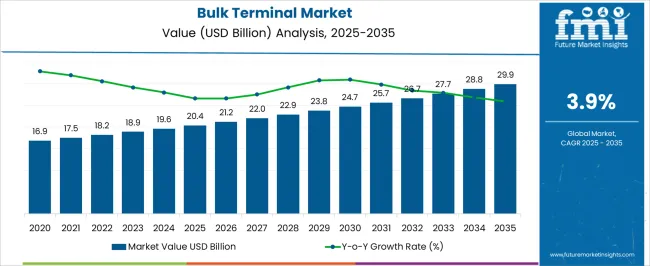
The bulk terminal market is expected to expand from USD 20.4 billion in 2025 to USD 29.9 billion by 2035. The market is anticipated to register a 3.9% CAGR during the forecast period. Dry type terminals are likely to lead with a 64.6% share in 2025, driven by high-volume movement of coal and grains across port networks.
Summary of the Bulk Terminal Market
- Demand and Growth Drivers
- Rising seaborne trade is expected to lift terminal demand across ports handling energy materials and industrial commodities.
- Port modernization programs are likely to increase spending on mechanized unloading systems and digital cargo planning tools.
- Infrastructure expansion across trade corridors is anticipated to raise throughput needs across bulk handling facilities.
- Product and Segment View
- Dry type terminals are expected to lead the bulk type segment as coal and grain volumes require large storage capacity.
- Liquid type terminals are likely to gain steady demand from crude oil handling and chemical logistics requirements.
- Automated equipment adoption is anticipated to improve cargo movement speed and reduce operating delays across terminal yards.
- Geography and Competitive Outlook
- Saudi Arabia is expected to record strong expansion as LNG infrastructure and petrochemical trade activity increase.
- India is likely to post steady demand as port development and commodity imports rise across industrial centers.
- Larger terminal operators are anticipated to strengthen their position through capacity additions and digital operating systems.
- Analyst Opinion
- Nikhil Kaitwade, Principal Consultant for Industrial Automation and Heavy Engineering at FMI, suggests, “The bulk terminal market is likely to favor operators investing in mechanized handling and higher berth efficiency. Dry bulk terminals are expected to retain leadership as commodity movement across energy and construction supply chains continues to require dependable port capacity.”
- Bulk Terminal Market Value Analysis
- The bulk terminal market is moving into a steadier investment phase as ports expand handling capacity.
- Demand is expected to rise as raw material trade increases across energy and construction industries.
- Adoption of automated cranes and cargo tracking tools is likely to improve terminal productivity across terminal operations.
- Spending is anticipated to increase as governments and private operators invest in stronger port infrastructure.
Key Takeaways, Market Size, and Forecast
- The bulk terminal market is expected to reach USD 20.4 billion in 2025, reflecting steady port infrastructure demand.
- By 2035, the bulk terminal market is anticipated to reach USD 29.9 billion across global trade networks.
- From 2025 to 2035, the market is likely to expand at a 3.9% CAGR.
- Dry type terminals are expected to account for 64.6% share of the bulk type segment in 2025.
- Liquid type terminals are anticipated to follow with 35.4% share of the bulk type segment in 2025.
- The Kingdom of Saudi Arabia is projected to record the fastest country-level expansion at 6.4% CAGR through 2035.
Segmental Analysis
The market is segmented by Bulk Type and region. By Bulk Type, the market is divided into Dry Type and Liquid Type. Regionally, the market is classified into North America, Latin America, Western Europe, Eastern Europe, Balkan & Baltic Countries, Russia & Belarus, Central Asia, East Asia, South Asia & Pacific, and the Middle East & Africa.
Insights into the Bulk Type Segment: Dry Type
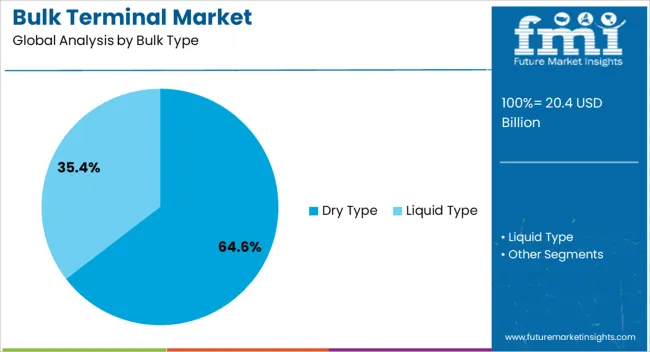
The Dry Type segment is projected to account for 64.6% of the bulk terminal market revenue in 2025, establishing it as the leading bulk type category. This dominance has been driven by the high volume movement of dry commodities such as iron ore, coal, grains, and fertilizers, which are fundamental to construction, power generation, and food production sectors.
Global trade data and logistics reports have highlighted that dry bulk cargo constitutes the largest share of maritime transport tonnage, reinforcing the importance of specialized dry terminals. The segment has also benefited from infrastructure investments in mechanized unloading systems, dust control technologies, and advanced stockyard management systems, which have improved throughput efficiency and environmental compliance.
Port authorities in Asia-Pacific, Latin America, and Africa have scaled up dry bulk terminal capacity to accommodate rising demand from mining and agricultural exports. As global commodity flows continue to rise and supply chain resilience remains a strategic focus, the Dry Type segment is expected to maintain its leadership in the bulk terminal market.
Key Industry Highlights
Increasing Trade of Natural Gas Worldwide
High emissions from power and automobile industries have led to the adoption of natural gas as an alternative fuel. Key consumer countries like Japan, the United States, and Europe are adopting natural gas due to low emissions and the abundant nature of natural gas. This factor is estimated to spur demand for cargo terminals.
Rising Focus on Sustainability to Surge Sales
The focus on sustainability is increasing, involving eco-friendly practices, renewable energy solutions, and emission reduction strategies to minimize environmental impact. This shift toward clean energy sources is fueling changes in bulk commodity handling and infrastructure in terminals.
High Initial Investment and Operational Cost to Impede Growth
Seaports are significant for global trade, handling heavy cargo and bulk materials. However, setting up a bulk terminal requires a rigid surface, reliable construction, and adequate berthing for ships and stevedoring facilities.
Dry bulk construction is time-consuming and requires significant investments, hindering growth. Land reclamation involves depositing millions of tons of rocks, cement, and materials to create elevated surfaces in shallow water conditions, ensuring proper land connectivity for inland transportation. The average cost of construction is set to pose business risks, potentially hampering growth.
Inadequate Infrastructure to Hamper Growth
Infrastructure constraints in terminal services are set to hinder growth due to outdated port infrastructure, inadequate capacity, and connectivity, affecting logistics efficiency and supply chains.
Bulk storage facilities often need more storage, causing congestion and restricted product variety, reducing industry flexibility and competitiveness. Inadequate connectivity poses a challenge for terminal service development, leading to high costs and limited access for potential customers.
2020 to 2025 Global Bulk Terminal Sales Analysis Compared to Demand Forecast for 2025 to 2035
The cargo terminal sector grew at a CAGR of 3% from 2020 and 2025. The market reached USD 18,940 million in 2025. Bulk terminals have evolved over time due to changes in demand and production patterns worldwide across several industries. In the historical period, the oil and gas sector led to increased investments in these terminals for petroleum products.
Technological developments improved efficiency, reduced labor costs, and surged safety in the sector. Environmental regulations further influenced the development of bulk terminals, requiring investments in pollution control technologies.
Bulk commodity dynamics, supply-demand dynamics, and geopolitical factors also influenced the investment decisions of several leading companies. Governments and private sector entities invested in port and terminal infrastructure to meet the growing demand and enhance global trade competitiveness.
Over the forecast period, the sector is poised to exhibit healthy growth, reaching USD 28,800 million by 2035. The outlook for the market appears promising, spurred by rising global trading activities, infrastructure projects, and surging export demand for effective solutions.
New investments in transportation and digitization are poised to enhance operational efficiency and competitiveness in the sector. The industry is set to witness steady growth as these terminals play a key role in facilitating logistics and supporting the global supply chain.
Country-wise Insights
The following table shows the estimated growth rates of the leading markets. The United States is anticipated to remain at the forefront in North America, with a CAGR of 2.6% through 2035. In South Asia and Pacific, India is projected to witness a CAGR of 4.5% by 2035, followed by China at 3.6%.
| Countries | CAGR 2025 to 2035 |
|---|---|
| Kingdom of Saudi Arabia | 6.4% |
| China | 3.6% |
| United States | 2.6% |
| ASEAN | 5.3% |
| India | 4.5% |
Increasing International Trade Activities to Propel Demand in the United States
Over the assessment period, demand in the United States is set to rise at 2.6% CAGR. There are numerous bulk terminals strategically located across the country. These handle various commodities like petroleum, chemicals, agricultural products, minerals, ores, coal, and industrial materials. Key ports along the East Coast, Gulf Coast, West Coast, and Great Lakes regions facilitate domestic and international trade through extensive coastline and transportation networks.
Rising Demand for LNG Pushes Growth in the Kingdom of Saudi Arabia
The Kingdom of Saudi Arabia is set to experience significant growth in the forecast period. This is due to abundant oil and petrochemical reserves, strategic location on maritime routes, strong infrastructure, and modern port facilities. Growing demand for liquefied natural gas (LNG) presents new opportunities for leading manufacturers in the kingdom.
As the Kingdom of Saudi Arabia continues to invest in LNG infrastructure and processing facilities, the need for specialized storage and export facilities is set to increase. This development is propelled by the kingdom’s strong infrastructure and modern port facilities. By 2035, the Kingdom of Saudi Arabia is projected to rise at a CAGR of 6.4%.
Surging Focus on Clean Energy to Create Opportunities for Players in China
China's transition to clean energy necessitates investments in wind farms and renewable energy components, fueling demand for bulk terminals. The country is anticipated to reach USD 2,658.2 million by 2035. Over the forecast period, demand in China is set to increase at a steady CAGR of 3.6%.
Category-wise Insights
The section below analyzes the leading segment of the market. In terms of bulk type, the dry type segment is estimated to account for a share of 64.6% in 2025. Further, the liquid type segment is anticipated to follow by holding a share of 35.4% in 2025.
High Demand for Grains and Coal to Propel Growth of Dry Bulk Type
| Segment | Dry Type (Bulk Type) |
|---|---|
| Value Share (2025) | 64.6% |
Over the forecast period, demand for dry bulk is forecast to rise at a CAGR of 3.5%. This growth is attributed to rising demand for dry goods, including grains and coal, which are significant raw materials for various industries. As population growth and urbanization increase, these resources are gaining traction in the arid region's resource sector.
Technological innovations and automation have transformed dry terminal operations, resulting in fast loading and unloading, improved safety standards, and reduced costs. The dry bulk sector offers attractive investment opportunities due to the resilience to industry fluctuations and robust long-term demand prospects.
The evolution of technology and automation is reshaping dry bulk terminal operations, leading to high productivity and reduced costs. The segment now has unique equipment for loading and unloading, enhancing the speed and safety of bulk handling. Over the forecast period, demand for dry bulk is forecast to rise at a CAGR of 3.5%. By 2035, the target segment is estimated to reach USD 17,138 million.
Transportation of Crude Oil and Chemicals to Require Liquid Bulk Type
| Segment | Liquid Type (Bulk Type) |
|---|---|
| Value Share (2025) | 35.4% |
Bulk terminals manage several types of liquid for storage and transportation, including crude oil, refined petroleum, chemicals, liquefied gas, vegetable oils, liquid fertilizers, and water. These liquids serve numerous industries like oil and gas, chemicals, agriculture, and renewable energy.
Bulk terminals ensure efficient handling, storage, and distribution while adhering to safety and regulatory standards and meeting industrial demands. By 2035, demand for bulk terminals from liquid type segment is anticipated to surge significantly.
Competition Outlook
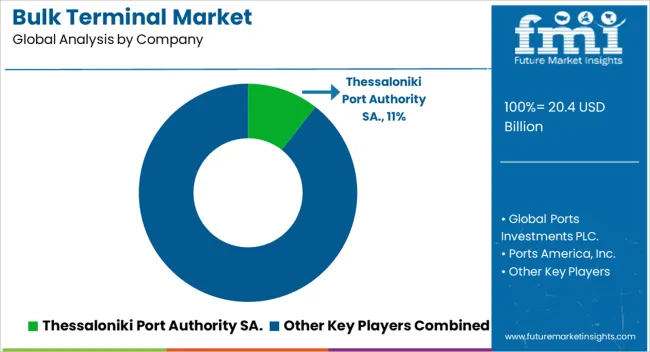
Leading service providers collectively hold a substantial share, comprising around 20% to 25% of the sector. Thessaloniki Port Authority SA, Global Ports Investments PLC, Ports America, Inc., China Merchants Port Holdings Co. Ltd., APM Terminals, and DP World Ltd. are the key service providers in the industry.
Key companies and manufacturers are investing in continuous research for producing new products and increasing production capacity to meet end-user demand. These companies are also showing an inclination toward adopting strategies, including acquisitions, partnerships, mergers, and facility growth, to strengthen footprint.
The sector is characterized by numerous large and medium-sized players, primarily investing and forming strategic agreements to capture a significant value.
Industry Updates
- In 2025, APM Terminals, headquartered in the Netherlands, announced a USD 500 million investment for a new container terminal in Louisiana.
- In 2025, AD Ports Group, a United Arab Emirates-based company, acquired Noatum's APM terminals in Spain.
- In 2025, Asyad Ports, headquartered in Oman, initiated operations at the newly constructed Asyad Container Terminal in Duqm, Oman.
- In 2025, The United States International Development Finance Corporation pledged USD 553 million to Adani Ports' Colombo Port Terminal project.
- In 2025, Port NOLA in the United States received a USD 226 million federal grant for the proposed St. Bernard terminal project.
Leading Bulk Terminal Brands
- Thessaloniki Port Authority SA.
- Global Ports Investments PLC.
- Ports America, Inc.
- China Merchants Port Holdings Co. Ltd.
- APM Terminals
- Euroports Holdings S.à r.l
- Puerto Ventanas S.A.
- HES International B.V.
- Yilport Holding Inc.
- DP World Ltd.
- Noatum Ports, S.L.U.
- Ultramar Group
Key Segments of Market Report
By Bulk Type:
As per bulk type, the industry has been categorized into dry type and liquid type. The dry type segment is further divided into grain, coal, iron ore, and others. Also, the liquid type segment is bifurcated into oil and gas.
By Region:
Industry analysis has been carried out in key countries of North America, Latin America, Western Europe, Eastern Europe, South Asia and Pacific, East Asia, and the Middle East and Africa.
Frequently Asked Questions
How big is the bulk terminal market in 2025?
The global bulk terminal market is estimated to be valued at USD 20.4 billion in 2025.
What will be the size of bulk terminal market in 2035?
The market size for the bulk terminal market is projected to reach USD 29.9 billion by 2035.
How much will be the bulk terminal market growth between 2025 and 2035?
The bulk terminal market is expected to grow at a 3.9% CAGR between 2025 and 2035.
What are the key product types in the bulk terminal market?
The key product types in bulk terminal market are dry type, _grain, _coal, _iron ore, _others, liquid type, _oil and _gas.
Which segment to contribute significant share in the bulk terminal market in 2025?
In terms of , segment to command 0.0% share in the bulk terminal market in 2025.
Preview the report firsthand - request a free sample
Get SampleGet the brochure for pricing and purchase details.
Get PDFTable of Content
- Executive Summary
- Global Market Outlook
- Demand-side Trends
- Supply-side Trends
- Technology Roadmap Analysis
- Analysis and Recommendations
- Market Overview
- Market Coverage / Taxonomy
- Market Definition / Scope / Limitations
- Market Background
- Market Dynamics
- Drivers
- Restraints
- Opportunity
- Trends
- Scenario Forecast
- Demand in Optimistic Scenario
- Demand in Likely Scenario
- Demand in Conservative Scenario
- Opportunity Map Analysis
- Product Life Cycle Analysis
- Supply Chain Analysis
- Investment Feasibility Matrix
- Value Chain Analysis
- PESTLE and Porter’s Analysis
- Regulatory Landscape
- Regional Parent Market Outlook
- Production and Consumption Statistics
- Import and Export Statistics
- Market Dynamics
- Global Market Analysis 2020 to 2024 and Forecast, 2025 to 2035
- Historical Market Size Value (USD Billion) Analysis, 2020 to 2024
- Current and Future Market Size Value (USD Billion) Projections, 2025 to 2035
- Y-o-Y Growth Trend Analysis
- Absolute $ Opportunity Analysis
- Global Market Pricing Analysis 2020 to 2024 and Forecast 2025 to 2035
- Global Market Analysis 2020 to 2024 and Forecast 2025 to 2035, By Bulk Type
- Introduction / Key Findings
- Historical Market Size Value (USD Billion) Analysis By Bulk Type , 2020 to 2024
- Current and Future Market Size Value (USD Billion) Analysis and Forecast By Bulk Type , 2025 to 2035
- Dry Type
- Grain
- Coal
- Iron Ore
- Others
- Liquid Type
- Oil
- Gas
- Dry Type
- Y-o-Y Growth Trend Analysis By Bulk Type , 2020 to 2024
- Absolute $ Opportunity Analysis By Bulk Type , 2025 to 2035
- Global Market Analysis 2020 to 2024 and Forecast 2025 to 2035, By Region
- Introduction
- Historical Market Size Value (USD Billion) Analysis By Region, 2020 to 2024
- Current Market Size Value (USD Billion) Analysis and Forecast By Region, 2025 to 2035
- North America
- Latin America
- Western Europe
- Eastern Europe
- East Asia
- South Asia and Pacific
- Middle East & Africa
- Market Attractiveness Analysis By Region
- North America Market Analysis 2020 to 2024 and Forecast 2025 to 2035, By Country
- Historical Market Size Value (USD Billion) Trend Analysis By Market Taxonomy, 2020 to 2024
- Market Size Value (USD Billion) Forecast By Market Taxonomy, 2025 to 2035
- By Country
- USA
- Canada
- Mexico
- By Bulk Type
- By Country
- Market Attractiveness Analysis
- By Country
- By Bulk Type
- Key Takeaways
- Latin America Market Analysis 2020 to 2024 and Forecast 2025 to 2035, By Country
- Historical Market Size Value (USD Billion) Trend Analysis By Market Taxonomy, 2020 to 2024
- Market Size Value (USD Billion) Forecast By Market Taxonomy, 2025 to 2035
- By Country
- Brazil
- Chile
- Rest of Latin America
- By Bulk Type
- By Country
- Market Attractiveness Analysis
- By Country
- By Bulk Type
- Key Takeaways
- Western Europe Market Analysis 2020 to 2024 and Forecast 2025 to 2035, By Country
- Historical Market Size Value (USD Billion) Trend Analysis By Market Taxonomy, 2020 to 2024
- Market Size Value (USD Billion) Forecast By Market Taxonomy, 2025 to 2035
- By Country
- Germany
- UK
- Italy
- Spain
- France
- Nordic
- BENELUX
- Rest of Western Europe
- By Bulk Type
- By Country
- Market Attractiveness Analysis
- By Country
- By Bulk Type
- Key Takeaways
- Eastern Europe Market Analysis 2020 to 2024 and Forecast 2025 to 2035, By Country
- Historical Market Size Value (USD Billion) Trend Analysis By Market Taxonomy, 2020 to 2024
- Market Size Value (USD Billion) Forecast By Market Taxonomy, 2025 to 2035
- By Country
- Russia
- Poland
- Hungary
- Balkan & Baltic
- Rest of Eastern Europe
- By Bulk Type
- By Country
- Market Attractiveness Analysis
- By Country
- By Bulk Type
- Key Takeaways
- East Asia Market Analysis 2020 to 2024 and Forecast 2025 to 2035, By Country
- Historical Market Size Value (USD Billion) Trend Analysis By Market Taxonomy, 2020 to 2024
- Market Size Value (USD Billion) Forecast By Market Taxonomy, 2025 to 2035
- By Country
- China
- Japan
- South Korea
- By Bulk Type
- By Country
- Market Attractiveness Analysis
- By Country
- By Bulk Type
- Key Takeaways
- South Asia and Pacific Market Analysis 2020 to 2024 and Forecast 2025 to 2035, By Country
- Historical Market Size Value (USD Billion) Trend Analysis By Market Taxonomy, 2020 to 2024
- Market Size Value (USD Billion) Forecast By Market Taxonomy, 2025 to 2035
- By Country
- India
- ASEAN
- Australia & New Zealand
- Rest of South Asia and Pacific
- By Bulk Type
- By Country
- Market Attractiveness Analysis
- By Country
- By Bulk Type
- Key Takeaways
- Middle East & Africa Market Analysis 2020 to 2024 and Forecast 2025 to 2035, By Country
- Historical Market Size Value (USD Billion) Trend Analysis By Market Taxonomy, 2020 to 2024
- Market Size Value (USD Billion) Forecast By Market Taxonomy, 2025 to 2035
- By Country
- Kingdom of Saudi Arabia
- Other GCC Countries
- Turkiye
- South Africa
- Other African Union
- Rest of Middle East & Africa
- By Bulk Type
- By Country
- Market Attractiveness Analysis
- By Country
- By Bulk Type
- Key Takeaways
- Key Countries Market Analysis
- USA
- Pricing Analysis
- Market Share Analysis, 2024
- By Bulk Type
- Canada
- Pricing Analysis
- Market Share Analysis, 2024
- By Bulk Type
- Mexico
- Pricing Analysis
- Market Share Analysis, 2024
- By Bulk Type
- Brazil
- Pricing Analysis
- Market Share Analysis, 2024
- By Bulk Type
- Chile
- Pricing Analysis
- Market Share Analysis, 2024
- By Bulk Type
- Germany
- Pricing Analysis
- Market Share Analysis, 2024
- By Bulk Type
- UK
- Pricing Analysis
- Market Share Analysis, 2024
- By Bulk Type
- Italy
- Pricing Analysis
- Market Share Analysis, 2024
- By Bulk Type
- Spain
- Pricing Analysis
- Market Share Analysis, 2024
- By Bulk Type
- France
- Pricing Analysis
- Market Share Analysis, 2024
- By Bulk Type
- India
- Pricing Analysis
- Market Share Analysis, 2024
- By Bulk Type
- ASEAN
- Pricing Analysis
- Market Share Analysis, 2024
- By Bulk Type
- Australia & New Zealand
- Pricing Analysis
- Market Share Analysis, 2024
- By Bulk Type
- China
- Pricing Analysis
- Market Share Analysis, 2024
- By Bulk Type
- Japan
- Pricing Analysis
- Market Share Analysis, 2024
- By Bulk Type
- South Korea
- Pricing Analysis
- Market Share Analysis, 2024
- By Bulk Type
- Russia
- Pricing Analysis
- Market Share Analysis, 2024
- By Bulk Type
- Poland
- Pricing Analysis
- Market Share Analysis, 2024
- By Bulk Type
- Hungary
- Pricing Analysis
- Market Share Analysis, 2024
- By Bulk Type
- Kingdom of Saudi Arabia
- Pricing Analysis
- Market Share Analysis, 2024
- By Bulk Type
- Turkiye
- Pricing Analysis
- Market Share Analysis, 2024
- By Bulk Type
- South Africa
- Pricing Analysis
- Market Share Analysis, 2024
- By Bulk Type
- USA
- Market Structure Analysis
- Competition Dashboard
- Competition Benchmarking
- Market Share Analysis of Top Players
- By Regional
- By Bulk Type
- Competition Analysis
- Competition Deep Dive
- Thessaloniki Port Authority SA.
- Overview
- Product Portfolio
- Profitability by Market Segments (Product/Age /Sales Channel/Region)
- Sales Footprint
- Strategy Overview
- Marketing Strategy
- Product Strategy
- Channel Strategy
- Global Ports Investments PLC.
- Ports America, Inc.
- China Merchants Port Holdings Co. Ltd.
- APM Terminals
- Euroports Holdings S.à r.l
- Puerto Ventanas S.A.
- HES International B.V.
- Yilport Holding Inc.
- DP World Ltd.
- Noatum Ports, S.L.U.
- Ultramar Group
- Other Major Players
- Thessaloniki Port Authority SA.
- Competition Deep Dive
- Assumptions & Acronyms Used
- Research Methodology


