

- Market Size (2026)
- USD 944.7 Mn
- Forecast (2036)
- USD 1384.9 Mn
- CAGR (2026 to 2036)
- 3.9%
How big is the Catharanthine Market in 2026?
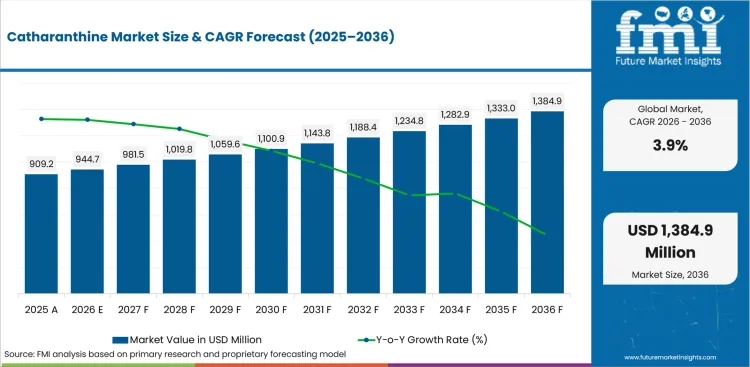
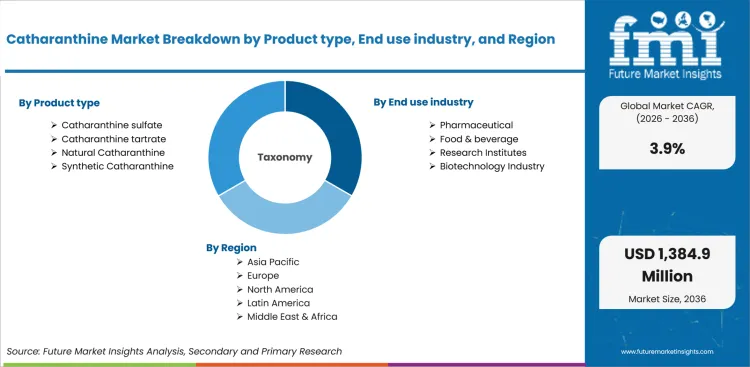
USD 944.7 million in 2026, reaching USD 1,384.9 million by 2036 at a 3.9% CAGR
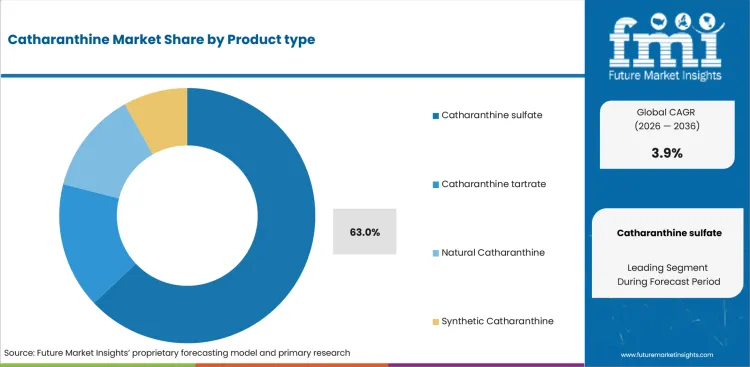
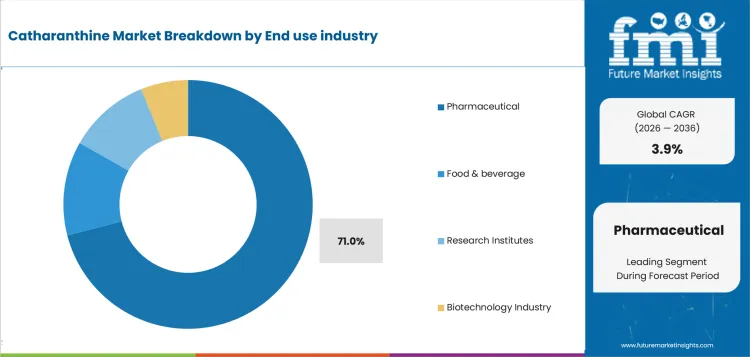
The catharanthine market is estimated at USD 944.7 million in 2026 and is forecast to reach USD 1,384.9 million by 2036 at a 3.9% CAGR. Catharanthine sulfate accounts for 63.0% of product type revenue in 2026, while Pharmaceutical leads end use industry at 71.0%. Demand is shaped by buyers consolidating purchases around the catharanthine sulfate category to control cost and qualification effort.
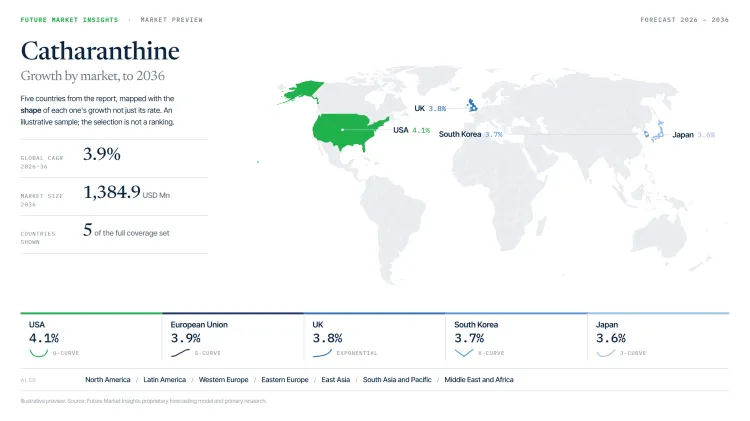
Expansion is paced by healthcare buyers refreshing installed product type on planned cycles, not by sudden surges. Adoption is increasing due to procurement teams favoring suppliers that reduce switching cost and shorten qualification. The fastest expansion sits in USA at 4.1% CAGR, followed by European Union at 3.9%, where buying centers prioritize FDA clearance pathways and CMS reimbursement codes.
Key Takeaways for the Catharanthine Market
- Demand for catharanthine is driven by pharmaceutical-manufacturing requirements, with procurement teams prioritizing specification consistency and dependable material availability.
- Pharmaceutical is anticipated to garner 71.0% share of end use industry in 2026, supported by concentrated demand from medicine manufacturers.
- Catharanthine sulfate is forecast to lead product type with 63.0% share in 2026, reflecting established use across pharmaceutical synthesis and research programs.
- Supplier qualification and supply-continuity requirements represent primary barriers limiting sourcing changes.
- Competition centers on AK Scientific, Cayman Chemical Company, Stanford Chemicals, BioVision Inc., and Enzo Biochem, with suppliers differentiating based on product quality and technical support.
Analyst Perspective
“Commercial adoption depends on suppliers demonstrating specification consistency and dependable quality across pharmaceutical production conditions. Sourcing teams favor vendors combining documented material performance with responsive support and reliable delivery. Each catharanthine product needs to satisfy manufacturing requirements without increasing qualification complexity or supply risk.”
- Nikhil Kaitwade, Principal Consultant at Future Market Insights
How is the Catharanthine Market segmented?
The catharanthine market is segmented by product type, end use industry, application, and distribution channel.
Why does Catharanthine sulfate lead the Catharanthine Market?
Catharanthine Market Analysis By Product Type
Catharanthine sulfate offers a stable and familiar form for pharmaceutical processing and laboratory work. Companies assess purity, batch consistency, storage conditions, and supporting technical documents before approving the material. Established handling procedures also reduce the work required when production moves from small laboratory quantities to larger commercial volumes. Its use across regulated processes strengthens demand for reliable supply and consistent quality.
- Catharanthine sulfate is expected to hold 63.0% of product type revenue in 2026, reflecting its established use and familiar processing profile. Pharmaceutical companies often retain approved material forms to avoid repeated validation and additional qualification work.
- Consistent specifications help manufacturers control downstream synthesis and quality testing across different production batches. Reliable documentation and traceability also support its use in regulated pharmaceutical operations.
How big is the Pharmaceutical segment in the Catharanthine Market?
Catharanthine Market Analysis By End Use Industry
The pharmaceutical industry uses catharanthine as an intermediate in the development and production of important alkaloid-based medicines. Procurement decisions depend on purity levels, manufacturing controls, analytical records, and the ability to maintain consistent supply. Companies also review storage stability and impurity profiles before introducing the material into validated processes. These requirements give established pharmaceutical users a larger position than smaller research-focused organizations.
- Pharmaceutical is forecast to hold 71.0% of end use industry revenue in 2026, making it the leading category. Its share reflects the concentration of commercial demand within regulated drug manufacturing and development programs.
- Pharmaceutical companies purchase catharanthine for controlled synthesis processes that require strict quality checks and complete batch records. Long approval cycles also favor established material sources once performance has been confirmed.
What drives and restrains the Catharanthine Market?
Driven by catharanthine sulfate replacement demand; restrained by qualification and cost barriers
Recurring product type procurement supports expansion, while upfront cost and certification effort limit faster adoption among smaller buyers.
- Driver: Pharmaceutical sustain catharanthine sulfate demand through replacement and capacity additions, keeping procurement recurring across the forecast period.
- Restraint: Certification and requalification effort for new product type specifications slows substitution, particularly for smaller buyers with limited engineering capacity.
- Opportunity: Suppliers offering pharmaceutical configurations that drop into existing workflows can widen adoption without full replacement.
Demand is shaped by buyers protecting continuity of supply, which rewards incumbents with broad product type portfolios.
Which factors support expansion in the Catharanthine Market?
Replacement demand, standardization and service coverage support market value
- Market value is supported by catharanthine sulfate replacement purchases before aftermarket and service revenue accrues.
- Supplier pricing reflects product type performance and availability before service coverage affects renewal demand.
- Buyers compare qualification time and support response before committing to multi-site standardization on pharmaceutical.
Which countries are growing fastest in the Catharanthine Market?
| Country / Region | CAGR |
|---|---|
| USA | 4.1% |
| European Union | 3.9% |
| UK | 3.8% |
| South Korea | 3.7% |
| Japan | 3.6% |
Source: FMI's proprietary forecasting model and primary research
How do country-level CAGRs compare in the Catharanthine Market?
The country comparison spans 0.5 percentage points and reveals a tightly grouped growth pattern across the Catharanthine Market. The USA and European Union form the upper range, with only 0.2 percentage points separating their forecasts. The UK, South Korea and Japan create a closely aligned lower group within a 0.2-point band. The narrow spread indicates that regulatory access, reimbursement routes and pharmaceutical procurement systems influence growth more than sharp differences in underlying demand. Markets with clearer approval pathways and broader purchasing networks generally demonstrate slightly stronger momentum.
- The USA leads the comparison as FDA requirements, reimbursement access and pricing pressure across integrated healthcare providers shape pharmaceutical procurement.
- The European Union remains only 0.2 percentage points below the USA, supported by coordinated conformity requirements and cross-border purchasing structures.
- The UK remains 0.1 percentage point below the European Union as NHS framework agreements and NICE assessments guide purchasing decisions.
- South Korea remains only 0.1 percentage point below the UK, reflecting MFDS approval, HIRA reimbursement and demand concentrated around major hospital centers.
- Japan remains 0.1 percentage point below South Korea as PMDA timelines, conformity requirements and long qualification cycles affect new commitments.
Comparable CAGRs can still produce different market-entry conditions. Differences in regulatory review, reimbursement access, procurement frameworks, hospital concentration and qualification timelines influence pharmaceutical ordering and account expansion. The full report provides country-level CAGR analysis across North America, Latin America, Europe, East Asia, South Asia, Oceania and the Middle East and Africa.
Country-wise Analysis
- United States pharmaceutical procurement operates through regulated approval pathways, reimbursement systems and integrated healthcare networks. The USA Catharanthine Market is projected to grow at 4.1% CAGR through 2036, placing it at the top of the comparison. FDA requirements and CMS reimbursement codes shape purchasing decisions across major pharmaceutical accounts. Pricing pressure under the IRA also encourages providers to review cost and treatment access more closely. These conditions widen the potential customer base beyond the largest organizations. Companies require clear regulatory documentation and dependable supply before expanding across hospital and pharmaceutical purchasing networks.
- European Union demand is shaped by coordinated conformity rules and cross-border procurement across member states. The European Union Catharanthine Market is projected to expand at 3.9% CAGR through 2036, supported by harmonized purchasing structures. EU regulatory assessment influences which products qualify for wider pharmaceutical use. Cross-border procurement also gives companies access to several national markets through shared frameworks. However, implementation and purchasing schedules may still differ between member states. Market entry therefore depends on complete technical files, regional distribution and consistent supply across multiple healthcare systems.
- United Kingdom pharmaceutical purchasing combines NHS framework agreements with NICE assessment requirements. The UK Catharanthine Market is projected to record 3.8% CAGR through 2036, supported by structured public procurement. NHS Supply Chain agreements provide multi-year purchasing visibility instead of relying on individual short-term orders. NICE thresholds also influence whether products gain broader use across public healthcare settings. Centralized purchasing offers scale but can extend review and tender timelines. Companies need strong evidence, competitive pricing and reliable service before gaining wider access across NHS-linked accounts.
- South Korea combines national approval and reimbursement systems with demand concentrated in major hospital regions. The South Korea Catharanthine Market is projected to grow at 3.7% CAGR through 2036. MFDS approval and HIRA reimbursement listing determine the pace of new pharmaceutical commitments. Purchasing activity remains concentrated across the Seoul Capital Area and the Busan corridor, where tertiary hospitals and specialist care centers are more established. This concentration supports focused commercial entry but limits immediate reach beyond major cities. Companies require local regulatory support and dependable distribution across leading hospital networks.
- Japan follows controlled approval and qualification processes across pharmaceutical and hospital purchasing. The Japan Catharanthine Market is projected to advance at 3.6% CAGR through 2036, placing it at the lower end of the comparison. PMDA review timelines and conformity requirements guide the timing of new commitments. Long qualification cycles within closely connected hospital and business groups also favor established commercial relationships. These conditions protect continuity but slow product switching. New entrants require Japanese documentation, local technical support and patience through extended approval and procurement reviews.
Who are the leading companies in the Catharanthine Market?
AK Scientific, Cayman Chemical Company, Stanford Chemicals, BioVision Inc. and Enzo Biochem
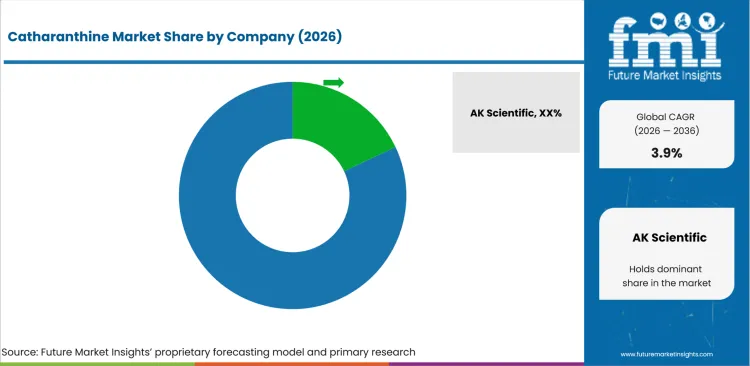
AK Scientific and Cayman Chemical Company compete through supply depth and qualification support across healthcare buyers. Stanford Chemicals maintains position through portfolio breadth, while service coverage and lead-time reliability are further competitive levers.
Who are the key players in the Catharanthine Market?
Key global companies leading the market include:
- AK Scientific, Cayman Chemical Company, Stanford Chemicals, BioVision Inc. and Enzo Biochem maintain leading positions through established manufacturing, portfolio breadth and direct procurement relationships.
- Hainan Yueyang Biotech, Abcam and ChemFaces compete through specialized configurations, competitive pricing and localized distribution in high-growth markets.
- Merck KGaA, Santa Cruz Biotechnology and Tocris Bioscience target underserved applications and regional markets to establish initial procurement positions.
How do top Catharanthine Market companies compare?
AK Scientific and Cayman Chemical Company lead on scale; Stanford Chemicals also has a global footprint, while BioVision Inc. and Enzo Biochem are more regionally concentrated.
| Company | Portfolio Breadth | Qualification Depth | Supply Scale | Geographic Footprint |
|---|---|---|---|---|
| AK Scientific | High | High | Strong | Global |
| Cayman Chemical Company | High | High | Strong | Global |
| Stanford Chemicals | Medium | Medium | Moderate | Global |
| BioVision Inc. | High | Medium | Moderate | Regional |
| Enzo Biochem | Medium | Medium | Moderate | Regional |
Source: Future Market Insights competitive analysis, 2026.
Key Players in the Catharanthine Market
- AK Scientific
- BioVision Inc.
- Abcam
- Merck KGaA
Catharanthine Market - Scope & Definition
| Attribute | Detail |
|---|---|
| Market Definition | Products and solutions within the catharanthine market spanning Product type, End use industry and Application categories |
| Key Segments Covered | Catharanthine sulfate, Pharmaceutical and Pharmaceutical Manufacturing and related healthcare applications |
| Applications Covered | Pharmaceutical Manufacturing, Research and Development and Biotechnology Applications |
| End-Use Industries | Pharmaceutical, Research Institutes and Biotechnology Industry |
| Inclusions | Commercially sold product type, end use industry and associated configurations |
| Exclusions | Custom one-off systems, standalone services and raw inputs outside the catharanthine market boundary |
Catharanthine Market - Research Methodology
| Method | Description |
|---|---|
| Primary Research | FMI analyst interviews with healthcare suppliers, distributors and procurement teams across major markets |
| Desk Research | Review of official activity data, regulatory releases, company disclosures and production statistics |
| Market Sizing & Forecasting | Bottom-up sizing using segment revenue, adoption rates, replacement demand and country-level activity |
| Data Validation | Cross-verification against public evidence, supplier portfolios and official indicators |
What does the Catharanthine Market report cover?
2021 to 2025 history and 2026 to 2036 forecasts across all segments and 30+ countries
| Parameter | Details |
|---|---|
| Forecast period | 2026 to 2036 |
| Historical period | 2021 to 2025 |
| Quantitative unit | Revenue in USD million |
| By Product type | Catharanthine sulfate, Catharanthine tartrate, Natural Catharanthine and Synthetic Catharanthine |
| By End use industry | Pharmaceutical, Research Institutes and Biotechnology Industry |
| By Application | Pharmaceutical Manufacturing, Research and Development and Biotechnology Applications |
| By Distribution Channel | Direct Sales, Distributor Sales and Online Sales |
| Regions covered | North America, Latin America, Western Europe, Eastern Europe, East Asia, South Asia and Pacific, Middle East and Africa |
| Countries covered | USA, European Union (Western and Eastern Europe), UK, South Korea, Japan |
| Key companies profiled | AK Scientific, Cayman Chemical Company, Stanford Chemicals, BioVision Inc. and Enzo Biochem |
| Approach | Bottom-up segment-boundary approach using adoption, replacement demand and supplier disclosures |
Market Segmentation Analysis
Catharanthine Market Segmented by Product type:
- Catharanthine sulfate
- Catharanthine tartrate
- Natural Catharanthine
- Plant Extracted Catharanthine
- Periwinkle Plant Extraction
- Alkaloid Isolation Methods
- Purified Natural Catharanthine
- High Purity Extracts
- Pharmaceutical Grade Extracts
- Plant Extracted Catharanthine
- Synthetic Catharanthine
- Chemically Synthesized Catharanthine
- Laboratory Synthesized Compounds
- Industrial Synthesis
- Modified Catharanthine
- Derivative Compounds
- Enhanced Stability Forms
- Chemically Synthesized Catharanthine
Catharanthine Market Segmented by End use industry:
- Pharmaceutical
- Drug Manufacturers
- Oncology Drug Producers
- Generic Drug Companies
- Biopharmaceutical Companies
- Biologic Drug Development
- Advanced Therapies
- Drug Manufacturers
- Research Institutes
- Academic Institutions
- Universities
- Medical Colleges
- Private Research Organizations
- Contract Research Labs
- Independent Labs
- Academic Institutions
- Biotechnology Industry
- Biotech Firms
- Life Science Companies
Catharanthine Market Segmented by Application:
- Pharmaceutical Manufacturing
- Anti Cancer Drug Production
- Vincristine Production
- Vinblastine Production
- Alkaloid Synthesis
- Semi Synthetic Derivatives
- Active Compound Production
- Anti Cancer Drug Production
- Research and Development
- Drug Discovery
- New Compound Screening
- Pharmacological Studies
- Biochemical Research
- Cellular Studies
- Molecular Research
- Drug Discovery
- Biotechnology Applications
- Plant Tissue Culture
- Metabolic Engineering
Catharanthine Market Segmented by Distribution Channel:
- Direct Sales
- Pharmaceutical Supply Contracts
- Long Term Agreements
- Bulk Supply Deals
- Research Supply
- Institutional Supply
- Custom Orders
- Pharmaceutical Supply Contracts
- Distributor Sales
- Chemical Distributors
- Global Distributors
- Regional Distributors
- Specialty Suppliers
- Life Science Suppliers
- Research Chemical Vendors
- Chemical Distributors
- Online Sales
- E Commerce Platforms
- Company Websites
Catharanthine Market by Region:
- North America
- USA
- Canada
- Mexico
- Latin America
- Brazil
- Chile
- Rest of Latin America
- Western Europe
- Germany
- UK
- Italy
- Spain
- France
- Nordic
- BENELUX
- Rest of Western Europe
- Eastern Europe
- Russia
- Poland
- Hungary
- Balkan & Baltic
- Rest of Eastern Europe
- East Asia
- China
- Japan
- South Korea
- South Asia and Pacific
- India
- ASEAN
- Australia & New Zealand
- Rest of South Asia and Pacific
- Middle East & Africa
- Kingdom of Saudi Arabia
- Other GCC Countries
- Türkiye
- South Africa
- Other African Union
- Rest of Middle East & Africa
Research Sources and Bibliography
- World Bank. (2026, March). World development indicators database.
- International Trade Centre. (2025, November). Trade statistics for international business development.
- OECD. (2026, February). Economic outlook and industry statistics.
- World Health Organization. (2025, December). Global health observatory data repository.
- USA Food and Drug Administration. (2026, January). Medical device databases.
This bibliography is provided for reader reference and is not exhaustive.
This Report Answers
- Market size estimates for 2026 and forecasts through 2036 for the catharanthine market.
- Segment demand across product type and end use industry with leading sub-segment shares.
- Country-level growth analysis covering USA, European Union, UK, South Korea and other markets.
- Company positioning across AK Scientific, Cayman Chemical Company and Stanford Chemicals and regional players.
- Assessment of drivers and restraints with procurement patterns across end-use buyers.
Frequently Asked Questions
What limits return on investment for purchasing teams?
Return on investment weakens when catharanthine performance, documentation or channel acceptance is not proven before rollout. Certification and requalification effort for new product type specifications slows substitution, particularly for smaller buyers with limited engineering capacity. Requalification, rework and substitution costs can erase the planned margin gain.
What should sourcing leaders check before approving a supplier?
Procurement leaders should evaluate specification evidence, second-source availability, service response, price discipline and fit with product type requirements across pharmaceutical, food & beverage, research institutes and biotechnology industry.
What is behind demand growth in the Catharanthine Market?
Growth is supported by demand that recurs rather than repeats once. Pharmaceutical sustains catharanthine sulfate demand through replacement and capacity additions, keeping procurement recurring across the forecast period. Buyers are consolidating around Catharanthine sulfate to control cost and qualification effort.
Who supplies the catharanthine market?
Key companies include AK Scientific, BioVision Inc., Abcam, Merck KGaA, Cayman Chemical Company, Enzo Biochem, ChemFaces and Stanford Chemicals. Competition is focused on qualification time, second-source availability, portfolio breadth and support response.
What does the Catharanthine Market cover?
Products and solutions within the catharanthine market spanning Product type, End use industry and Application categories. Included: commercially sold product type, end use industry and associated configurations. Applications span pharmaceutical manufacturing, research and development and biotechnology applications.
Preview the report firsthand - request a free sample
Get SampleGet the brochure for pricing and purchase details.
Get PDFTable of Content
- Key Takeaways
- Market Size and CAGR
- Top Growth Driver
- Fastest Growing Segment
- Leading Region
- Key Companies
- Emerging Opportunities
- Executive Summary
- Global Market Outlook
- Demand-side Trends
- Supply-side Trends
- Technology Roadmap Analysis
- Analysis and Recommendations
- Analyst Perspective (What is happening? Why now? What should investors know?)
- Key Questions Answered
- How large is the market?
- What is the CAGR?
- What are key trends?
- Which region dominates?
- Who are the leaders?
- Market Overview
- Market Coverage / Taxonomy
- Market Definition / Scope / Limitations
- Research Methodology
- Chapter Orientation
- Analytical Lens and Working Hypotheses
- Market Structure, Signals, and Trend Drivers
- Benchmarking and Cross-market Comparability
- Market Sizing, Forecasting, and Opportunity Mapping
- Research Design and Evidence Framework
- Desk Research Programme (Secondary Evidence)
- Expert Input and Fieldwork (Primary Evidence)
- Tooling, Models, and Reference Databases
- Data Engineering and Model Build
- Quality Assurance and Audit Trail
- Market Background
- Market Dynamics (Drivers, Restraints, Opportunity, Trends)
- Scenario Forecast (Optimistic, Likely, Conservative)
- Impact Analysis
- AI Impact
- Sustainability Impact
- Regulatory Impact
- Technology Impact
- Consumer / Buyer Analysis
- Purchase Drivers
- Adoption Barriers
- Buyer Journey
- Opportunity Map Analysis
- Product Life Cycle Analysis
- Supply Chain Analysis
- Investment Feasibility Matrix
- Value Chain Analysis
- PESTLE and Porter's Analysis
- Regulatory Landscape
- Regional Parent Market Outlook
- Production and Consumption Statistics
- Import and Export Statistics
- Global Market Analysis and Forecast, 2021 to 2036
- Historical Market Size Value (USD Million) Analysis, 2021 to 2025
- Current and Future Market Size Value (USD Million) Projections, 2026 to 2036
- Y-o-Y Growth Trend Analysis
- Absolute $ Opportunity Analysis
- Global Market Pricing Analysis, 2021 to 2036
- Global Market Analysis and Forecast, By Product type, 2021 to 2036
- Introduction / Key Findings
- Historical Market Size Value (USD Million) Analysis By Product type, 2021 to 2025
- Current and Future Market Size Value (USD Million) Analysis and Forecast By Product type, 2026 to 2036
- Catharanthine sulfate
- Catharanthine tartrate
- Natural Catharanthine
- Plant Extracted Catharanthine
- Purified Natural Catharanthine
- Synthetic Catharanthine
- Chemically Synthesized Catharanthine
- Modified Catharanthine
- Catharanthine sulfate
- Y-o-Y Growth Trend Analysis By Product type, 2021 to 2025
- Absolute $ Opportunity Analysis By Product type, 2026 to 2036
- Global Market Analysis and Forecast, By End use industry, 2021 to 2036
- Introduction / Key Findings
- Historical Market Size Value (USD Million) Analysis By End use industry, 2021 to 2025
- Current and Future Market Size Value (USD Million) Analysis and Forecast By End use industry, 2026 to 2036
- Pharmaceutical
- Drug Manufacturers
- Biopharmaceutical Companies
- Research Institutes
- Academic Institutions
- Private Research Organizations
- Biotechnology Industry
- Biotech Firms
- Life Science Companies
- Pharmaceutical
- Y-o-Y Growth Trend Analysis By End use industry, 2021 to 2025
- Absolute $ Opportunity Analysis By End use industry, 2026 to 2036
- Global Market Analysis and Forecast, By Application, 2021 to 2036
- Introduction / Key Findings
- Historical Market Size Value (USD Million) Analysis By Application, 2021 to 2025
- Current and Future Market Size Value (USD Million) Analysis and Forecast By Application, 2026 to 2036
- Pharmaceutical Manufacturing
- Anti Cancer Drug Production
- Alkaloid Synthesis
- Research and Development
- Drug Discovery
- Biochemical Research
- Biotechnology Applications
- Plant Tissue Culture
- Metabolic Engineering
- Pharmaceutical Manufacturing
- Y-o-Y Growth Trend Analysis By Application, 2021 to 2025
- Absolute $ Opportunity Analysis By Application, 2026 to 2036
- Global Market Analysis and Forecast, By Distribution Channel, 2021 to 2036
- Introduction / Key Findings
- Historical Market Size Value (USD Million) Analysis By Distribution Channel, 2021 to 2025
- Current and Future Market Size Value (USD Million) Analysis and Forecast By Distribution Channel, 2026 to 2036
- Direct Sales
- Pharmaceutical Supply Contracts
- Research Supply
- Distributor Sales
- Chemical Distributors
- Specialty Suppliers
- Online Sales
- E Commerce Platforms
- Company Websites
- Direct Sales
- Y-o-Y Growth Trend Analysis By Distribution Channel, 2021 to 2025
- Absolute $ Opportunity Analysis By Distribution Channel, 2026 to 2036
- Global Market Analysis and Forecast, By Region, 2021 to 2036
- Introduction
- Historical Market Size Value (USD Million) Analysis By Region, 2021 to 2025
- Current Market Size Value (USD Million) Analysis and Forecast By Region, 2026 to 2036
- North America
- Latin America
- Western Europe
- Eastern Europe
- East Asia
- South Asia and Pacific
- Middle East and Africa
- Market Attractiveness Analysis By Region
- North America Market Analysis and Forecast, By Country, 2021 to 2036
- Historical Market Size Value (USD Million) Trend Analysis By Market Taxonomy, 2021 to 2025
- Market Size Value (USD Million) Forecast By Market Taxonomy, 2026 to 2036
- By Country
- USA
- Canada
- By Product type
- By End use industry
- By Application
- By Distribution Channel
- By Country
- Market Attractiveness Analysis
- By Country
- By Product type
- By End use industry
- By Application
- By Distribution Channel
- Key Takeaways
- Latin America Market Analysis and Forecast, By Country
- Historical Market Size Value (USD Million) Trend Analysis By Market Taxonomy, 2021 to 2025
- Market Size Value (USD Million) Forecast By Market Taxonomy, 2026 to 2036
- By Country
- Brazil
- Mexico
- Chile
- Rest of Latin America
- By Product type
- By End use industry
- By Application
- By Distribution Channel
- By Country
- Market Attractiveness Analysis
- By Country
- By Product type
- By End use industry
- By Application
- By Distribution Channel
- Key Takeaways
- Western Europe Market Analysis and Forecast, By Country
- Historical Market Size Value (USD Million) Trend Analysis By Market Taxonomy, 2021 to 2025
- Market Size Value (USD Million) Forecast By Market Taxonomy, 2026 to 2036
- By Country
- Germany
- UK
- Italy
- Spain
- France
- Nordic
- BENELUX
- Rest of Western Europe
- By Product type
- By End use industry
- By Application
- By Distribution Channel
- By Country
- Market Attractiveness Analysis
- By Country
- By Product type
- By End use industry
- By Application
- By Distribution Channel
- Key Takeaways
- Eastern Europe Market Analysis and Forecast, By Country
- Historical Market Size Value (USD Million) Trend Analysis By Market Taxonomy, 2021 to 2025
- Market Size Value (USD Million) Forecast By Market Taxonomy, 2026 to 2036
- By Country
- Russia
- Poland
- Hungary
- Balkan & Baltic
- Rest of Eastern Europe
- By Product type
- By End use industry
- By Application
- By Distribution Channel
- By Country
- Market Attractiveness Analysis
- By Country
- By Product type
- By End use industry
- By Application
- By Distribution Channel
- Key Takeaways
- East Asia Market Analysis and Forecast, By Country
- Historical Market Size Value (USD Million) Trend Analysis By Market Taxonomy, 2021 to 2025
- Market Size Value (USD Million) Forecast By Market Taxonomy, 2026 to 2036
- By Country
- China
- Japan
- South Korea
- By Product type
- By End use industry
- By Application
- By Distribution Channel
- By Country
- Market Attractiveness Analysis
- By Country
- By Product type
- By End use industry
- By Application
- By Distribution Channel
- Key Takeaways
- South Asia and Pacific Market Analysis and Forecast, By Country
- Historical Market Size Value (USD Million) Trend Analysis By Market Taxonomy, 2021 to 2025
- Market Size Value (USD Million) Forecast By Market Taxonomy, 2026 to 2036
- By Country
- India
- ASEAN
- Australia & New Zealand
- Rest of South Asia and Pacific
- By Product type
- By End use industry
- By Application
- By Distribution Channel
- By Country
- Market Attractiveness Analysis
- By Country
- By Product type
- By End use industry
- By Application
- By Distribution Channel
- Key Takeaways
- Middle East and Africa Market Analysis and Forecast, By Country
- Historical Market Size Value (USD Million) Trend Analysis By Market Taxonomy, 2021 to 2025
- Market Size Value (USD Million) Forecast By Market Taxonomy, 2026 to 2036
- By Country
- Kingdom of Saudi Arabia
- Other GCC Countries
- Türkiye
- South Africa
- Other African Union
- Rest of Middle East and Africa
- By Product type
- By End use industry
- By Application
- By Distribution Channel
- By Country
- Market Attractiveness Analysis
- By Country
- By Product type
- By End use industry
- By Application
- By Distribution Channel
- Key Takeaways
- Key Countries Market Analysis
- USA
- Pricing Analysis
- Market Share Analysis, 2025
- By Product type
- By End use industry
- By Application
- By Distribution Channel
- Canada
- Pricing Analysis
- Market Share Analysis, 2025
- By Product type
- By End use industry
- By Application
- By Distribution Channel
- Mexico
- Pricing Analysis
- Market Share Analysis, 2025
- By Product type
- By End use industry
- By Application
- By Distribution Channel
- Brazil
- Pricing Analysis
- Market Share Analysis, 2025
- By Product type
- By End use industry
- By Application
- By Distribution Channel
- Chile
- Pricing Analysis
- Market Share Analysis, 2025
- By Product type
- By End use industry
- By Application
- By Distribution Channel
- Germany
- Pricing Analysis
- Market Share Analysis, 2025
- By Product type
- By End use industry
- By Application
- By Distribution Channel
- UK
- Pricing Analysis
- Market Share Analysis, 2025
- By Product type
- By End use industry
- By Application
- By Distribution Channel
- Italy
- Pricing Analysis
- Market Share Analysis, 2025
- By Product type
- By End use industry
- By Application
- By Distribution Channel
- Spain
- Pricing Analysis
- Market Share Analysis, 2025
- By Product type
- By End use industry
- By Application
- By Distribution Channel
- France
- Pricing Analysis
- Market Share Analysis, 2025
- By Product type
- By End use industry
- By Application
- By Distribution Channel
- India
- Pricing Analysis
- Market Share Analysis, 2025
- By Product type
- By End use industry
- By Application
- By Distribution Channel
- ASEAN
- Pricing Analysis
- Market Share Analysis, 2025
- By Product type
- By End use industry
- By Application
- By Distribution Channel
- Australia & New Zealand
- Pricing Analysis
- Market Share Analysis, 2025
- By Product type
- By End use industry
- By Application
- By Distribution Channel
- China
- Pricing Analysis
- Market Share Analysis, 2025
- By Product type
- By End use industry
- By Application
- By Distribution Channel
- Japan
- Pricing Analysis
- Market Share Analysis, 2025
- By Product type
- By End use industry
- By Application
- By Distribution Channel
- South Korea
- Pricing Analysis
- Market Share Analysis, 2025
- By Product type
- By End use industry
- By Application
- By Distribution Channel
- Russia
- Pricing Analysis
- Market Share Analysis, 2025
- By Product type
- By End use industry
- By Application
- By Distribution Channel
- Poland
- Pricing Analysis
- Market Share Analysis, 2025
- By Product type
- By End use industry
- By Application
- By Distribution Channel
- Hungary
- Pricing Analysis
- Market Share Analysis, 2025
- By Product type
- By End use industry
- By Application
- By Distribution Channel
- Kingdom of Saudi Arabia
- Pricing Analysis
- Market Share Analysis, 2025
- By Product type
- By End use industry
- By Application
- By Distribution Channel
- Türkiye
- Pricing Analysis
- Market Share Analysis, 2025
- By Product type
- By End use industry
- By Application
- By Distribution Channel
- South Africa
- Pricing Analysis
- Market Share Analysis, 2025
- By Product type
- By End use industry
- By Application
- By Distribution Channel
- USA
- Market Structure Analysis
- Competition Dashboard
- Competition Benchmarking
- Market Share Analysis of Top Players
- By Regional
- By Product type
- By End use industry
- By Application
- By Distribution Channel
- Emerging Startups
- Innovation Benchmarking
- Competition Analysis
- Competition Deep Dive
- AK Scientific
- BioVision Inc.
- Abcam
- Merck KGaA
- Case Studies
- Success Stories
- Recent Developments
- Competition Deep Dive
- Assumptions & Acronyms Used


