

- Market Size (2026)
- USD 760.6 Mn
- Forecast (2036)
- USD 1192.5 Mn
- CAGR (2026 to 2036)
- 4.6%
How big is Hydrocarbon Flotation Collectors Market in 2026?
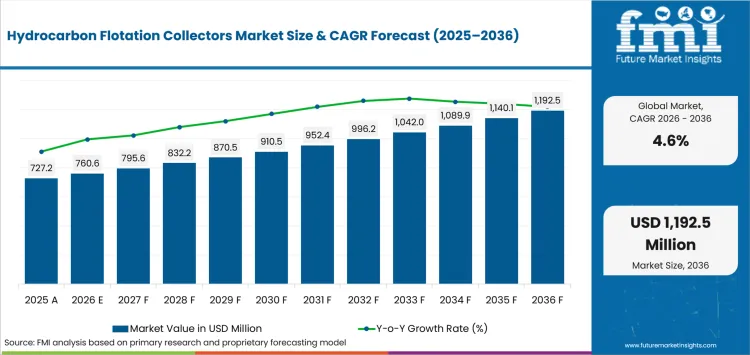
USD 760.6 million in 2026 and USD 1,192.5 million by 2036 at a 4.6% CAGR.
Demand for hydrocarbon flotation collectors is projected to expand at a 4.6% CAGR between 2026 and 2036 from USD 760.6 million in 2026 to USD 1,192.5 million by 2036. Coal plants and selected concentrators consume nonpolar oils as operating reagents. In April 2026 the IEA reported that global coal demand rose 0.4% in 2025. A replacement formulation must improve recovery or effective dosage in site trials before approval.
USA graphite demand depends on imported feed and new projects because the country has no producing mine. The USA Geological Survey estimated 71,000 tons of natural graphite consumption in 2025 and reported no domestic mine production. Canada and Brazil already have operating or advancing supply that can generate collector testwork. This puts early trials closer to producing or commissioning concentrators.
Key Takeaways
- Hydrocarbon collector demand follows treated tonnage because flotation plants consume the chemistry during operation rather than installing it as capital equipment.
- Fuel oil collectors are projected to account for 31.0% of collector type demand in 2026 due to familiar nonpolar collection behavior in coal and graphite circuits.
- By mineral, coal is forecast to represent 36.0% in 2026 driven by the direct fit between hydrocarbon oils and fine-coal flotation.
- The bulk liquid segment is projected to hold 47.0% share in 2026 owing to steady dosing from tanks at larger plants.
- Switching slows where a new oil changes storage rules or fails to repeat its laboratory benefit under plant conditions.
- Some of the key players in this market include Orica Limited, Syensqo SA/NV, Clariant AG, Nouryon, Chevron Phillips Chemical Company LLC, Axis House Group (Pty) Ltd, BASF SE, AECI Mining Chemicals, Sasol Chemicals, and Arkema-ArrMaz.
Analyst Perspective
"Plant metallurgists should compare a hydrocarbon collector on recovered product and effective dose before comparing unit price. A cheaper oil loses its advantage if plant dispersion changes or the supplier cannot repeat the trial result at commercial scale."
- Nikhil Kaitwade, Principal Consultant, Future Market Insights
How is the hydrocarbon flotation collectors market segmented?
The hydrocarbon flotation collectors market is segmented by collector type, mineral, form, end use and sales channel.
Collector type covers fuel oil collectors, kerosene collectors, diesel-based collectors, specialty hydrocarbon blends and low-aromatic collectors. Mineral covers coal, graphite, molybdenum, talc and sulfur minerals. Form covers bulk liquid, drum packaging, IBC packaging and emulsified blends. End use and sales channel separate plant type from the route used to supply reagents.
Why does coal lead demand within the mineral category?
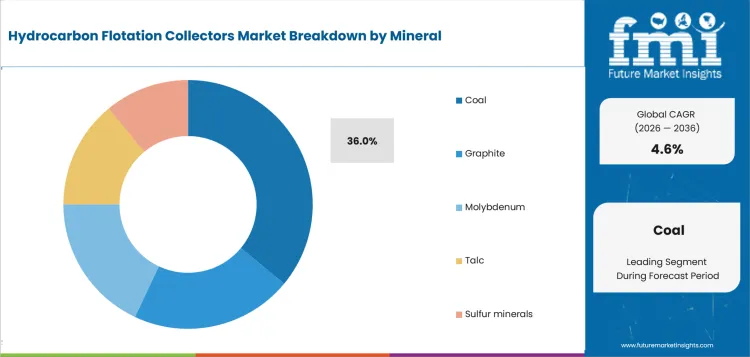
Nonpolar oils have a direct role in fine-coal recovery and ash control. EIA recorded 131.9 million short tons of USA coal production in the first quarter of 2026. Active preparation circuits therefore keep flotation reagents in operating budgets as mine output changes.
- Coal is set to lead the mineral category with 36.0% share in 2026 due to repeated collector use in fine-coal recovery and ash control.
- Plants judge collectors against combustible recovery and product ash. Graphite often uses similar chemistry with tighter concentrate specifications.
Why do fuel oil collectors lead demand within the collector type category?
Metallurgists know fuel oil's dosing behavior in coal and graphite circuits from established plant practice. A December 2025 SEC-filed Titan Mining report described eight graphite flotation tests using fuel oil or diesel as collector. The use case keeps hydrocarbon chemistry relevant as wider mining collectors move toward ore-specific formulations. Specialty blends must beat familiar oil during trials.
- By collector type, the fuel oil collectors segment is estimated to hold 31.0% in 2026 owing to familiar handling and nonpolar surface collection.
- Plant trials compare recovered product and effective dose against alternative oils. Poor dispersion can erase a lower purchase price through higher consumption.
Why does bulk liquid lead demand within the form category?
Bulk liquid fits continuous dosing at mines with tanks and metered pumps. A March 2025 Southern Copper report filed with the SEC listed collector and diesel among major flotation consumables. It also stated that most reagents arrive in bulk containers for tank storage. That handling model favors bulk mining flotation chemicals at large concentrators.
- In 2026, the bulk liquid segment is expected to account for 47.0% of the form category because steady plant consumption supports tank and scheduled-load economics.
- Bulk becomes practical once storage compatibility and shipment frequency justify the change.
Why do coal preparation plants lead demand within the end use category?
Coal preparation plants can adjust collector dosage without replacing circuit hardware. EIA reported 100.5 million short tons of USA coal distribution in the first quarter of 2026. Operating plants therefore keep collectors and polyglycol flotation frothers in repeated use as feed quality changes.
- Coal preparation plants are projected to represent 41.0% of end use in 2026 driven by continuous collector dosing in fine-coal circuits.
- Base-metal and graphite concentrators can accept higher chemical cost per tonne. Ore-specific test programs make qualification narrower than many coal applications.
Why does direct plant supply lead demand within the sales channel category?
Direct plant supply keeps reagent companies close to metallurgists who approve trials. A February 2025 USA Gold Corp. report filed with the SEC specifies collectors arriving in solution totes and being pumped directly to circuit addition points. The same route lets beneficiation reagents move from delivered package to controlled plant dosing.
- Direct plant supply is anticipated to hold 42.0% of the sales channel category in 2026 attributable to site qualification and scheduled replenishment.
- Direct accounts are stronger during dosage changes that need immediate testwork or formulation support.
What are the drivers, restraints and opportunities in the Hydrocarbon Flotation Collectors Market?
Active flotation circuits support repeat collector dosing. Liquid handling and plant trials slow switching. New graphite projects offer early qualification work for better-dispersed hydrocarbon formulations.
- Driver: Fine coal and naturally hydrophobic mineral circuits consume nonpolar collectors whenever feed conditions weaken recovery.
- Restraint: Combustible-liquid handling and site testing can delay a change even for alternatives that promise lower dosage.
- Opportunity: New graphite concentrators can specify collector chemistry during testwork ahead of steady commercial throughput.
Active Coal Circuits Sustain Repeat Collector Dosing
Collector revenue depends on flotation circuits that keep treating ore. The IEA's July 2025 Coal Mid-Year Update projected global coal demand near 8.78 billion tonnes in 2026. That plateau preserves a large operating base for repeat collector dosing. Mineral processing equipment run time and feed quality determine actual reagent use.
Liquid Handling and Plant Trials Slow Switching
A hydrocarbon blend can improve laboratory recovery yet fail a plant changeover because handling rules change. PHMSA confirmed in February 2026 that a flammable liquid with flash point at or above 38°C can be reclassified as combustible under stated ground-transport conditions. A different classification can alter site procedures. Similar discipline applies to flotation sulfidizing agents and other process reagents.
Graphite Projects Offer Early Qualification Work
Graphite projects let collector companies qualify chemistry while routine contracts are still open. Canada's Major Projects Office recorded a seven-year agreement for 30,000 tonnes per year of Matawinie flake graphite concentrate in May 2026. Early testwork can determine whether nonpolar oils or flotation activators belong in the circuit.
Which country CAGRs are profiled in the Hydrocarbon Flotation Collectors Market?
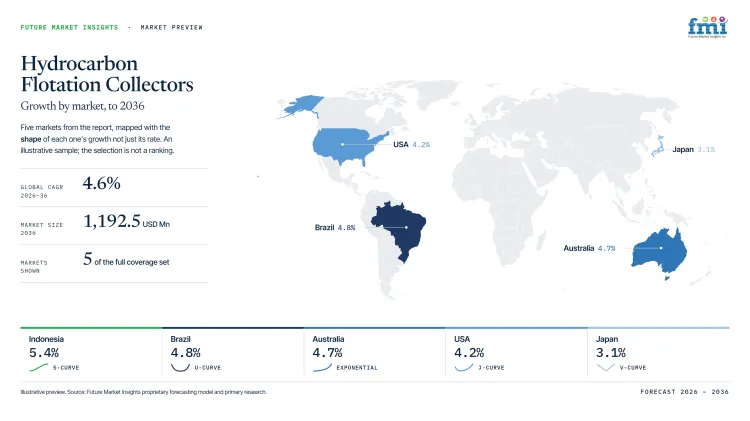
| Country | CAGR |
|---|---|
| Indonesia | 5.4% |
| Brazil | 4.8% |
| Australia | 4.7% |
| South Africa | 4.6% |
| Canada | 4.3% |
| USA | 4.2% |
| Japan | 3.1% |
How do country-level CAGRs compare in the Hydrocarbon Flotation Collectors Market?
The forecasts form a 4.2%-4.8% middle band with Indonesia above at 5.4% and Japan below at 3.1%. Brazil and Australia sit at the upper edge because both process mineral streams that regularly use hydrocarbon collectors. South Africa and North America remain near the middle where project timing and mature operating practice slow reagent changes.
- Indonesia leads because broad coal beneficiation creates recurring collector demand.
- Brazil reflects higher-value graphite concentrate economics that justify more specialized reagents.
- Australia pairs metallurgical coal output with established site-service requirements for major export operations.
- South Africa draws demand from a wider mineral-beneficiation base than regional peers.
- Canada's graphite projects expand collector demand without Australia's coal-processing scale.
- The USA trails South Africa because more producing mines do not require flotation circuits.
- Japan has fewer domestic flotation circuits and therefore a smaller collector base.
Comparable CAGRs still mask different addressable volumes. The full report provides country-level CAGR analysis across North America, Latin America, Western Europe, Eastern Europe, East Asia, South Asia and Pacific, and Middle East and Africa.
Country-wise Analysis
- Annual work plans can reset approved coal output before Indonesian preparation plants lock reagent call-offs. In January 2026 the Ministry of Energy and Mineral Resources stated that 2025 coal output reached 790 million tonnes and set a 2026 target near 600 million tonnes. Hydrocarbon flotation collector demand in Indonesia is projected to grow at 5.4% CAGR during the assessment period driven by the country's large coal-processing base. Lower approved output makes contracted volumes less predictable even when individual mines keep flotation circuits running. Reagent companies therefore need flexible delivery schedules and plant-level dosage trials that protect recovery without assuming nameplate mine capacity becomes chemical consumption.
- Graphite beneficiation in Brazil is concentrated in Minas Gerais and a small number of plants carry unusual weight in collector qualification. Hydrocarbon flotation collector sales in Brazil are forecast to expand at 4.8% CAGR by 2036 supported by current graphite processing. The National Mining Agency's 2025 Mineral Summary recorded 52.2 thousand tonnes of beneficiated natural graphite output in 2024. Concentration shortens service routes but losing one qualified account can materially reduce addressable volume. The same trial discipline also supports the microfined graphite powder market where particle-size control affects concentrate handling and final product consistency during final plant qualification.
- Australian mines often operate far from chemical depots and long inbound routes make delivered consistency part of reagent performance. The June 2026 Resources and Energy Quarterly forecast metallurgical coal export volumes to rise 1.1% per year to 2030-31. Thermal coal exports are expected to decline over the same period. Adoption of hydrocarbon flotation collectors in Australia is forecast to grow at 4.7% CAGR through 2036 supported by metallurgical coal processing and mine-site service. Remote sites need buffer stock and batch consistency to prevent delivery delays from interrupting dosing after a formulation passes plant trials at the operating site.
- South African coal and mineral plants are spread through mining districts that can sit far from chemical warehouses. Statistics South Africa reported in February 2026 that coal production fell 3.6% quarter on quarter in Q4 2025. The South African hydrocarbon flotation collectors sector is projected to record 4.6% CAGR during the assessment period owing to active beneficiation. Variable throughput complicates inventory planning and increases the value of regional stock during feed-rate or mineralogy changes. The same service model can support CMC flotation depressants used beside collector programs without forcing sites to hold excessive inventory during short-term production swings.
- Canadian graphite projects are moving from study work toward construction and reagent programs can be specified during early design. Demand for hydrocarbon flotation collectors in Canada is predicted to advance at 4.3% CAGR through 2036 driven by critical-mineral processing and concentrator qualification. Canada Economic Development stated in August 2025 that Lac-des-Îles in Quebec was North America's only operational graphite mine. The operating site gives metallurgists a live circuit for reagent comparison while the project pipeline generates trial work before commissioning. Project approvals and construction milestones do not create steady chemical consumption, so shipment sizes still need to follow actual throughput.
- USA coal preparation relies on a mature installed base with tanks and site procedures designed for accepted reagent chemistry. EIA reported in November 2025 that USA coal production totaled 512.5 million short tons in 2024 from 524 producing mines. The mine count supports broad service coverage and existing infrastructure favors formulations that fit current storage and dosing practice. Hydrocarbon flotation collector demand in the USA is forecast to rise at 4.2% CAGR over the forecast period attributable to continuing coal preparation. New entrants need to prove better recovery or lower effective dose without adding handling work that cancels the economic saving.
- Japan has fewer domestic flotation sites than the other profiled countries and depends more heavily on imported mineral supply chains. METI published its manufacturing-base report in April 2026 following a review of critical-mineral supply vulnerabilities. The country is anticipated to record 3.1% CAGR over the forecast period supported by selective mineral processing and supply-security work. Policy attention can encourage domestic processing evaluation but it does not create bulk collector consumption without operating concentrators. Smaller account sizes favor technical distributors with application-specific inventory and place more weight on laboratory support than warehouse scale for specialty-mineral programs at each qualified account.
Who are the notable companies in the Hydrocarbon Flotation Collectors Market?
Orica Limited, Syensqo SA/NV, Clariant AG, Nouryon, Chevron Phillips Chemical Company LLC, Axis House Group (Pty) Ltd, BASF SE, AECI Mining Chemicals, Sasol Chemicals, and Arkema-ArrMaz are the notable companies profiled in this market.
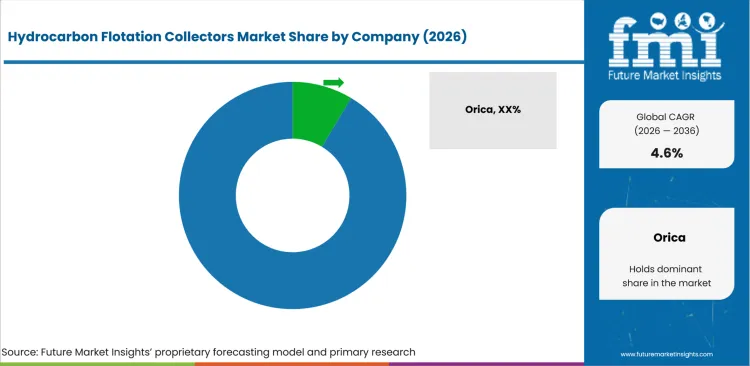
Competition spans broad flotation platforms and direct hydrocarbon suppliers. Entry depends on ore-specific proof plus technical service and reliable local supply.
- Orica Limited and Syensqo SA/NV provide broad flotation platforms alongside Clariant AG with Nouryon and BASF SE.
- Chevron Phillips Chemical Company LLC and Sasol Chemicals supply direct hydrocarbon routes beside Arkema-ArrMaz's specialty collector platform.
- Axis House Group (Pty) Ltd and AECI Mining Chemicals concentrate on regional formulation and mine service.
Competitive Benchmarking: Hydrocarbon Flotation Collectors Market
| Company | Collector Portfolio Breadth | Application Testing & Support | Regional Mine Supply | Geographic Reach |
|---|---|---|---|---|
| Orica Limited | High | High | High | Global mining jurisdictions |
| Syensqo SA/NV | High | High | High | Global |
| Clariant AG | High | High | High | Global |
| Nouryon | High | Medium | High | Global |
| Chevron Phillips Chemical Company LLC | High | Medium | High | North America and international orders |
| Axis House Group (Pty) Ltd | High | High | Medium | Africa and Australia |
| BASF SE | Medium | High | High | Global |
| AECI Mining Chemicals | High | High | Medium | Southern Africa and international markets |
| Sasol Chemicals | Medium | Medium | High | Global platform with Sub-Saharan collector supply |
| Arkema-ArrMaz | High | High | High | Global mining regions |
Scoring basis: High collector breadth requires several documented families or a direct hydrocarbon route. Medium identifies a narrower set. High testing support requires dedicated laboratories or ore-specific programs. Medium reflects application support. High regional supply requires multi-region delivery. Medium reflects a concentrated base. Low identifies a documented narrow role.
Key Developments in the Hydrocarbon Flotation Collectors Market
- In May 2026, Syensqo SA/NV initiated a strategic review of its Performance & Care segment. Technology Solutions within that segment includes specialty mining reagents.
- In April 2026, Orica Limited acquired the Danafloat collector range from FMC Corporation with formulation intellectual property and customer relationships. The deal expanded its sulfide-ore flotation chemistry.
- In August 2025, BASF SE opened a Mining Solutions R&D and Technical Service Laboratory in Almaty with Al-Farabi Kazakh National University. The facility tests flotation under local ore conditions.
Key Players in the Hydrocarbon Flotation Collectors Market
Global Flotation Chemistry Platforms
- Orica Limited
- Syensqo SA/NV
- Clariant AG
- Nouryon
- BASF SE
Hydrocarbon and Specialty Collector Providers
- Chevron Phillips Chemical Company LLC
- Sasol Chemicals
- Arkema-ArrMaz
Regional Mining-Reagent Specialists
- Axis House Group (Pty) Ltd
- AECI Mining Chemicals
Hydrocarbon Flotation Collectors Market - Report Scope
| Coverage field | Report scope |
|---|---|
| Market breakdown | By collector type, mineral, form, end use, sales channel and region. |
| Quantitative Units | USD million. |
| Market Definition | Revenue from hydrocarbon flotation collectors sold for mineral flotation. Frothers, depressants, ionic collectors and generic fuels are excluded. |
| Regions Covered | North America, Latin America, Western Europe, Eastern Europe, East Asia, South Asia and Pacific, and Middle East and Africa. |
| Countries Covered | Indonesia, Brazil, Australia, South Africa, Canada, USA, Japan, and 30+ countries covered in the full report. |
| Key Companies Profiled | Orica Limited, Syensqo SA/NV, Clariant AG, Nouryon, Chevron Phillips Chemical Company LLC, Axis House Group (Pty) Ltd, BASF SE, AECI Mining Chemicals, Sasol Chemicals, and Arkema-ArrMaz. |
| Forecast Period | 2026 to 2036. |
| Approach | Primary and secondary research with market triangulation. |
Hydrocarbon Flotation Collectors Market - Research Methodology
| Method | Approach |
|---|---|
| Primary Research | FMI analysts gathered input from manufacturers, service providers, technology developers, distributors, end users, procurement teams, and subject-matter experts. Interviews examined purchasing decisions, product or service evaluation, adoption barriers, approval requirements, pricing considerations, and expectations for technical or commercial support. Respondents were also asked what evidence is required before a trial, pilot, or initial order develops into regular purchasing. |
| Desk Research | Desk research covered government statistics, regulatory publications, trade data, industry associations, technical literature, standards, company filings, product information, and official corporate announcements. Sources were reviewed for relevance, publication date, geographic coverage, and consistency with the defined market scope. Claims relating to performance, applications, approvals, capacity, investment, and commercial activity were retained only when supported by credible public evidence. |
| Market Sizing and Forecasting | The market model combined the baseline value with historical performance, segment structure, pricing and volume indicators, adoption levels, company participation, and country-level demand conditions. Forecast assumptions considered economic activity, investment trends, regulatory developments, technology adoption, purchasing cycles, supply availability, and barriers to wider market use. Segment and regional estimates were reconciled before the final market total was calculated. |
| Data Validation | Estimates were checked against multiple independent indicators, including public data, company activity, trade patterns, industry developments, and findings from primary interviews. Validation also tested whether products, services, applications, and company revenues fell within the defined market boundaries. Adjacent categories, unsupported claims, overlapping revenues, and activities without direct market relevance were excluded to reduce double counting and maintain consistency across segments and countries. |
Hydrocarbon Flotation Collectors Market by Segments
Hydrocarbon Flotation Collectors Market segmented by Collector Type:
- Fuel oil collectors
- Kerosene collectors
- Diesel-based collectors
- Specialty hydrocarbon blends
- Low-aromatic collectors
Hydrocarbon Flotation Collectors Market segmented by Mineral:
- Coal
- Graphite
- Molybdenum
- Talc
- Sulfur minerals
Hydrocarbon Flotation Collectors Market segmented by Form:
- Bulk liquid
- Drum packaging
- IBC packaging
- Emulsified blends
Hydrocarbon Flotation Collectors Market segmented by End Use:
- Coal preparation plants
- Graphite concentrators
- Base metal concentrators
- Industrial minerals
Hydrocarbon Flotation Collectors Market segmented by Sales Channel:
- Direct plant supply
- Fuel/chemical distributors
- Mining reagent suppliers
- Regional blending plants
Hydrocarbon Flotation Collectors Market by Region:
- North America
- United States
- Canada
- Latin America
- Brazil
- Mexico
- Argentina
- Chile
- Western Europe
- Germany
- France
- United Kingdom
- Italy
- Spain
- Benelux
- Nordics
- Eastern Europe
- Poland
- Czech Republic
- Romania
- Hungary
- East Asia
- China
- Japan
- South Korea
- South Asia and Pacific
- India
- ASEAN
- Australia and New Zealand
- Middle East and Africa
- GCC Countries
- South Africa
- Türkiye
Research Sources and Bibliography
- International Energy Agency. (2026, April 20). Coal - Global Energy Review 2026.
- USA Geological Survey. (2026, February 6). Mineral Commodity Summaries 2026.
- Titan Mining Corporation. (2025, December 15). Empire State Mines 2025 NI 43-101 Technical Report.
- USA Energy Information Administration. (2026, July 1). Quarterly Coal Report.
- Southern Copper Corporation. (2025, March 3). Cuajone Operations, Moquegua Region, Peru: S-K 1300 Technical Report Summary.
- USA Energy Information Administration. (2026, July 1). Quarterly Coal Distribution Report.
- USA Gold Corp. (2025, February 14). CK Gold Project Technical Report Summary.
- International Energy Agency. (2025, July 24). Coal Mid-Year Update 2025.
- Pipeline and Hazardous Materials Safety Administration. (2026, February 26). Interpretation 25-0093.
- Government of Canada, Major Projects Office. (2026, May 29). Nouveau Monde Graphite's Matawinie Mine.
- Ministry of Energy and Mineral Resources, Republic of Indonesia. (2026, January 8). Perbaiki Harga Batubara, Pemerintah Bakal Revisi RKAB Tahun 2026.
- Agência Nacional de Mineração. (2025). Sumário Mineral 2025.
- Australian Government Department of Industry, Science and Resources. (2026, June). Resources and Energy Quarterly: June 2026.
- Statistics South Africa. (2026, February 12). Mining: Production and sales, December 2025.
- Canada Economic Development for Quebec Regions. (2025, August 26). Government of Canada strengthens the critical minerals sector by investing in Northern Graphite Corporation.
- USA Energy Information Administration. (2025, November 19). Annual Coal Report.
- Ministry of Economy, Trade and Industry, Japan. (2026, April 15). Report on Strengthening the Manufacturing Base.
- Syensqo SA/NV. (2026, May 21). Syensqo launches strategic review of its Performance & Care segment.
- Orica Limited. (2026, April 17). Orica expands portfolio into copper chemistry with Danafloat acquisition.
- BASF SE. (2025, August 28). BASF opens Mining Solutions Laboratory in conjunction with Al-Farabi Kazakh National University in Kazakhstan.
- BASF SE. (2025, May 20). BASF mining solutions strengthens commitment to copper hydrometallurgy and flotation research and development.
- Orica Limited. (2025, November 13). Highest earnings in 13 years.
- BASF SE. (2025, June 18). BASF mining solutions and FUCHS announce cooperation to serve the Australian mining industry.
- Nouryon. (2025, November 10). Nouryon opens new innovation center in Shanghai to accelerate localized innovation and customer collaboration in China.
- Clariant AG. (2025, February 23). SME Minexchange 2025.
- Clariant AG. (2026, July 7). Procemin 2026.
- Syensqo SA/NV. Mining Solutions. Retrieved September 8, 2026.
- Chevron Phillips Chemical Company LLC. Specialty Chemicals. Retrieved September 8, 2026.
- Axis House Group (Pty) Ltd. Axis House Group | Mining Reagents & Metallurgical Solutions. Retrieved September 8, 2026.
- AECI Limited. Mining Chemicals. Retrieved September 8, 2026.
- Sasol Chemicals. (2026, June 3). Mining, Oil & Gas.
This bibliography is provided for reader reference and is not exhaustive. The full report contains the complete reference list and detailed citations
This Report Answers
- What is the hydrocarbon flotation collectors market worth in 2026 and 2036?
- Why does treated tonnage sustain collector demand?
- Why do fuel oil collectors lead by collector type?
- Why does coal lead by mineral?
- Why does bulk liquid lead by form?
- Why do profiled country growth rates differ?
- Which companies supply hydrocarbon flotation collectors?
- What slows switching between collector chemistries?
Frequently Asked Questions
How big is the Hydrocarbon Flotation Collectors Market in 2026?
The hydrocarbon flotation collectors market is valued at USD 760.6 million in 2026 and is projected to reach USD 1,192.5 million by 2036. Repeat dosing in coal and hydrophobic mineral circuits supports growth.
What is the CAGR of the Hydrocarbon Flotation Collectors Market from 2026 to 2036?
The hydrocarbon flotation collectors market is projected to grow at a CAGR of 4.6% between 2026 and 2036. Reagent consumption rises with treated tonnes and recovery work.
Which collector type leads the Hydrocarbon Flotation Collectors Market?
The fuel oil collectors segment is expected to hold 31.0% of the hydrocarbon flotation collectors market in 2026, driven by familiar nonpolar collection behavior. Plant trials compare dose and dispersion against specialty blends.
Which mineral leads the Hydrocarbon Flotation Collectors Market?
The coal segment is expected to hold 36.0% of the hydrocarbon flotation collectors market in 2026, attributable to nonpolar-oil use in fine-coal flotation. Plants compare recovery with product ash.
Which countries are projected to record the highest growth in the Hydrocarbon Flotation Collectors Market?
Indonesia is projected to grow at 5.4% CAGR, followed by Brazil at 4.8% and Australia at 4.7% through 2036. Coal throughput and graphite processing produce different qualification conditions.
Which companies are active in the Hydrocarbon Flotation Collectors Market?
Key companies operating in the hydrocarbon flotation collectors market include Orica Limited, Syensqo SA/NV, Clariant AG, Nouryon, Chevron Phillips Chemical Company LLC, Axis House Group (Pty) Ltd, BASF SE, AECI Mining Chemicals, Sasol Chemicals, and Arkema-ArrMaz. They differ in reagent breadth and technical support.
Preview the report firsthand - request a free sample
Get SampleGet the brochure for pricing and purchase details.
Get PDFTable of Content
- Key Takeaways
- Market Size and CAGR
- Top Growth Driver
- Fastest Growing Segment
- Leading Region
- Key Companies
- Emerging Opportunities
- Executive Summary
- Global Market Outlook
- Demand-side Trends
- Supply-side Trends
- Technology Roadmap Analysis
- Analysis and Recommendations
- Analyst Perspective (What is happening? Why now? What should investors know?)
- Key Questions Answered
- How large is the market?
- What is the CAGR?
- What are key trends?
- Which region dominates?
- Who are the leaders?
- Market Overview
- Market Coverage / Taxonomy
- Market Definition / Scope / Limitations
- Research Methodology
- Chapter Orientation
- Analytical Lens and Working Hypotheses
- Market Structure, Signals, and Trend Drivers
- Benchmarking and Cross-market Comparability
- Market Sizing, Forecasting, and Opportunity Mapping
- Research Design and Evidence Framework
- Desk Research Programme (Secondary Evidence)
- Expert Input and Fieldwork (Primary Evidence)
- Tooling, Models, and Reference Databases
- Data Engineering and Model Build
- Quality Assurance and Audit Trail
- Market Background
- Market Dynamics (Drivers, Restraints, Opportunity, Trends)
- Scenario Forecast (Optimistic, Likely, Conservative)
- Impact Analysis
- AI Impact
- Sustainability Impact
- Regulatory Impact
- Technology Impact
- Consumer / Buyer Analysis
- Purchase Drivers
- Adoption Barriers
- Buyer Journey
- Opportunity Map Analysis
- Product Life Cycle Analysis
- Supply Chain Analysis
- Investment Feasibility Matrix
- Value Chain Analysis
- PESTLE and Porter's Analysis
- Regulatory Landscape
- Regional Parent Market Outlook
- Production and Consumption Statistics
- Import and Export Statistics
- Global Market Analysis and Forecast, 2021 to 2036
- Historical Market Size Value (USD Million) Analysis, 2021 to 2025
- Current and Future Market Size Value (USD Million) Projections, 2026 to 2036
- Y-o-Y Growth Trend Analysis
- Absolute $ Opportunity Analysis
- Global Market Pricing Analysis, 2021 to 2036
- Global Market Analysis and Forecast, By Collector Type, 2021 to 2036
- Introduction / Key Findings
- Historical Market Size Value (USD Million) Analysis By Collector Type, 2021 to 2025
- Current and Future Market Size Value (USD Million) Analysis and Forecast By Collector Type, 2026 to 2036
- Fuel oil collectors
- Kerosene collectors
- Diesel-based collectors
- Specialty hydrocarbon blends
- Low-aromatic collectors
- Fuel oil collectors
- Y-o-Y Growth Trend Analysis By Collector Type, 2021 to 2025
- Absolute $ Opportunity Analysis By Collector Type, 2026 to 2036
- Global Market Analysis and Forecast, By Mineral, 2021 to 2036
- Introduction / Key Findings
- Historical Market Size Value (USD Million) Analysis By Mineral, 2021 to 2025
- Current and Future Market Size Value (USD Million) Analysis and Forecast By Mineral, 2026 to 2036
- Coal
- Graphite
- Molybdenum
- Talc
- Sulfur minerals
- Coal
- Y-o-Y Growth Trend Analysis By Mineral, 2021 to 2025
- Absolute $ Opportunity Analysis By Mineral, 2026 to 2036
- Global Market Analysis and Forecast, By Form, 2021 to 2036
- Introduction / Key Findings
- Historical Market Size Value (USD Million) Analysis By Form, 2021 to 2025
- Current and Future Market Size Value (USD Million) Analysis and Forecast By Form, 2026 to 2036
- Bulk liquid
- Drum packaging
- IBC packaging
- Emulsified blends
- Bulk liquid
- Y-o-Y Growth Trend Analysis By Form, 2021 to 2025
- Absolute $ Opportunity Analysis By Form, 2026 to 2036
- Global Market Analysis and Forecast, By End Use, 2021 to 2036
- Introduction / Key Findings
- Historical Market Size Value (USD Million) Analysis By End Use, 2021 to 2025
- Current and Future Market Size Value (USD Million) Analysis and Forecast By End Use, 2026 to 2036
- Coal preparation plants
- Graphite concentrators
- Base metal concentrators
- Industrial minerals
- Coal preparation plants
- Y-o-Y Growth Trend Analysis By End Use, 2021 to 2025
- Absolute $ Opportunity Analysis By End Use, 2026 to 2036
- Global Market Analysis and Forecast, By Sales Channel, 2021 to 2036
- Introduction / Key Findings
- Historical Market Size Value (USD Million) Analysis By Sales Channel, 2021 to 2025
- Current and Future Market Size Value (USD Million) Analysis and Forecast By Sales Channel, 2026 to 2036
- Direct plant supply
- Fuel/chemical distributors
- Mining reagent suppliers
- Regional blending plants
- Direct plant supply
- Y-o-Y Growth Trend Analysis By Sales Channel, 2021 to 2025
- Absolute $ Opportunity Analysis By Sales Channel, 2026 to 2036
- Global Market Analysis and Forecast, By Region, 2021 to 2036
- Introduction
- Historical Market Size Value (USD Million) Analysis By Region, 2021 to 2025
- Current Market Size Value (USD Million) Analysis and Forecast By Region, 2026 to 2036
- North America
- Latin America
- Western Europe
- Eastern Europe
- East Asia
- South Asia and Pacific
- Middle East & Africa
- Market Attractiveness Analysis By Region
- North America Market Analysis and Forecast, By Country, 2021 to 2036
- Historical Market Size Value (USD Million) Trend Analysis By Market Taxonomy, 2021 to 2025
- Market Size Value (USD Million) Forecast By Market Taxonomy, 2026 to 2036
- By Country
- USA
- Canada
- By Collector Type
- By Mineral
- By Form
- By End Use
- By Sales Channel
- By Country
- Market Attractiveness Analysis
- By Country
- By Collector Type
- By Mineral
- By Form
- By End Use
- By Sales Channel
- Key Takeaways
- Latin America Market Analysis and Forecast, By Country
- Historical Market Size Value (USD Million) Trend Analysis By Market Taxonomy, 2021 to 2025
- Market Size Value (USD Million) Forecast By Market Taxonomy, 2026 to 2036
- By Country
- Brazil
- Mexico
- Chile
- Rest of Latin America
- By Collector Type
- By Mineral
- By Form
- By End Use
- By Sales Channel
- By Country
- Market Attractiveness Analysis
- By Country
- By Collector Type
- By Mineral
- By Form
- By End Use
- By Sales Channel
- Key Takeaways
- Western Europe Market Analysis and Forecast, By Country
- Historical Market Size Value (USD Million) Trend Analysis By Market Taxonomy, 2021 to 2025
- Market Size Value (USD Million) Forecast By Market Taxonomy, 2026 to 2036
- By Country
- Germany
- UK
- Italy
- Spain
- France
- Nordic
- BENELUX
- Rest of Western Europe
- By Collector Type
- By Mineral
- By Form
- By End Use
- By Sales Channel
- By Country
- Market Attractiveness Analysis
- By Country
- By Collector Type
- By Mineral
- By Form
- By End Use
- By Sales Channel
- Key Takeaways
- Eastern Europe Market Analysis and Forecast, By Country
- Historical Market Size Value (USD Million) Trend Analysis By Market Taxonomy, 2021 to 2025
- Market Size Value (USD Million) Forecast By Market Taxonomy, 2026 to 2036
- By Country
- Russia
- Poland
- Hungary
- Balkan & Baltic
- Rest of Eastern Europe
- By Collector Type
- By Mineral
- By Form
- By End Use
- By Sales Channel
- By Country
- Market Attractiveness Analysis
- By Country
- By Collector Type
- By Mineral
- By Form
- By End Use
- By Sales Channel
- Key Takeaways
- East Asia Market Analysis and Forecast, By Country
- Historical Market Size Value (USD Million) Trend Analysis By Market Taxonomy, 2021 to 2025
- Market Size Value (USD Million) Forecast By Market Taxonomy, 2026 to 2036
- By Country
- China
- Japan
- South Korea
- By Collector Type
- By Mineral
- By Form
- By End Use
- By Sales Channel
- By Country
- Market Attractiveness Analysis
- By Country
- By Collector Type
- By Mineral
- By Form
- By End Use
- By Sales Channel
- Key Takeaways
- South Asia and Pacific Market Analysis and Forecast, By Country
- Historical Market Size Value (USD Million) Trend Analysis By Market Taxonomy, 2021 to 2025
- Market Size Value (USD Million) Forecast By Market Taxonomy, 2026 to 2036
- By Country
- India
- ASEAN
- Australia & New Zealand
- Rest of South Asia and Pacific
- By Collector Type
- By Mineral
- By Form
- By End Use
- By Sales Channel
- By Country
- Market Attractiveness Analysis
- By Country
- By Collector Type
- By Mineral
- By Form
- By End Use
- By Sales Channel
- Key Takeaways
- Middle East & Africa Market Analysis and Forecast, By Country
- Historical Market Size Value (USD Million) Trend Analysis By Market Taxonomy, 2021 to 2025
- Market Size Value (USD Million) Forecast By Market Taxonomy, 2026 to 2036
- By Country
- Kingdom of Saudi Arabia
- Other GCC Countries
- Türkiye
- South Africa
- Other African Union
- Rest of Middle East & Africa
- By Collector Type
- By Mineral
- By Form
- By End Use
- By Sales Channel
- By Country
- Market Attractiveness Analysis
- By Country
- By Collector Type
- By Mineral
- By Form
- By End Use
- By Sales Channel
- Key Takeaways
- Key Countries Market Analysis
- USA
- Pricing Analysis
- Market Share Analysis, 2025
- By Collector Type
- By Mineral
- By Form
- By End Use
- By Sales Channel
- Canada
- Pricing Analysis
- Market Share Analysis, 2025
- By Collector Type
- By Mineral
- By Form
- By End Use
- By Sales Channel
- Mexico
- Pricing Analysis
- Market Share Analysis, 2025
- By Collector Type
- By Mineral
- By Form
- By End Use
- By Sales Channel
- Brazil
- Pricing Analysis
- Market Share Analysis, 2025
- By Collector Type
- By Mineral
- By Form
- By End Use
- By Sales Channel
- Chile
- Pricing Analysis
- Market Share Analysis, 2025
- By Collector Type
- By Mineral
- By Form
- By End Use
- By Sales Channel
- Germany
- Pricing Analysis
- Market Share Analysis, 2025
- By Collector Type
- By Mineral
- By Form
- By End Use
- By Sales Channel
- UK
- Pricing Analysis
- Market Share Analysis, 2025
- By Collector Type
- By Mineral
- By Form
- By End Use
- By Sales Channel
- Italy
- Pricing Analysis
- Market Share Analysis, 2025
- By Collector Type
- By Mineral
- By Form
- By End Use
- By Sales Channel
- Spain
- Pricing Analysis
- Market Share Analysis, 2025
- By Collector Type
- By Mineral
- By Form
- By End Use
- By Sales Channel
- France
- Pricing Analysis
- Market Share Analysis, 2025
- By Collector Type
- By Mineral
- By Form
- By End Use
- By Sales Channel
- India
- Pricing Analysis
- Market Share Analysis, 2025
- By Collector Type
- By Mineral
- By Form
- By End Use
- By Sales Channel
- ASEAN
- Pricing Analysis
- Market Share Analysis, 2025
- By Collector Type
- By Mineral
- By Form
- By End Use
- By Sales Channel
- Australia & New Zealand
- Pricing Analysis
- Market Share Analysis, 2025
- By Collector Type
- By Mineral
- By Form
- By End Use
- By Sales Channel
- China
- Pricing Analysis
- Market Share Analysis, 2025
- By Collector Type
- By Mineral
- By Form
- By End Use
- By Sales Channel
- Japan
- Pricing Analysis
- Market Share Analysis, 2025
- By Collector Type
- By Mineral
- By Form
- By End Use
- By Sales Channel
- South Korea
- Pricing Analysis
- Market Share Analysis, 2025
- By Collector Type
- By Mineral
- By Form
- By End Use
- By Sales Channel
- Russia
- Pricing Analysis
- Market Share Analysis, 2025
- By Collector Type
- By Mineral
- By Form
- By End Use
- By Sales Channel
- Poland
- Pricing Analysis
- Market Share Analysis, 2025
- By Collector Type
- By Mineral
- By Form
- By End Use
- By Sales Channel
- Hungary
- Pricing Analysis
- Market Share Analysis, 2025
- By Collector Type
- By Mineral
- By Form
- By End Use
- By Sales Channel
- Kingdom of Saudi Arabia
- Pricing Analysis
- Market Share Analysis, 2025
- By Collector Type
- By Mineral
- By Form
- By End Use
- By Sales Channel
- Türkiye
- Pricing Analysis
- Market Share Analysis, 2025
- By Collector Type
- By Mineral
- By Form
- By End Use
- By Sales Channel
- South Africa
- Pricing Analysis
- Market Share Analysis, 2025
- By Collector Type
- By Mineral
- By Form
- By End Use
- By Sales Channel
- USA
- Market Structure Analysis
- Competition Dashboard
- Competition Benchmarking
- Market Share Analysis of Top Players
- By Regional
- By Collector Type
- By Mineral
- By Form
- By End Use
- By Sales Channel
- Emerging Startups
- Innovation Benchmarking
- Competition Analysis
- Competition Deep Dive
- Orica
- Overview
- Product Portfolio
- Profitability by Market Segments
- Sales Footprint
- Strategy Overview
- Marketing Strategy
- Product Strategy
- Channel Strategy
- Solvay
- Clariant
- Nouryon
- Chevron Phillips Chemical
- Shell Chemicals
- ExxonMobil Chemical
- Axis House
- Coogee Chemicals
- Quadra Chemicals
- Orica
- Case Studies
- Success Stories
- Recent Developments
- Competition Deep Dive
- Assumptions & Acronyms Used


