

- Market Size (2026)
- USD 620.7 Mn
- Forecast (2036)
- USD 1001.5 Mn
- CAGR (2026 to 2036)
- 4.9%
How big is Flotation Sulfidizing Agents Market in 2026?
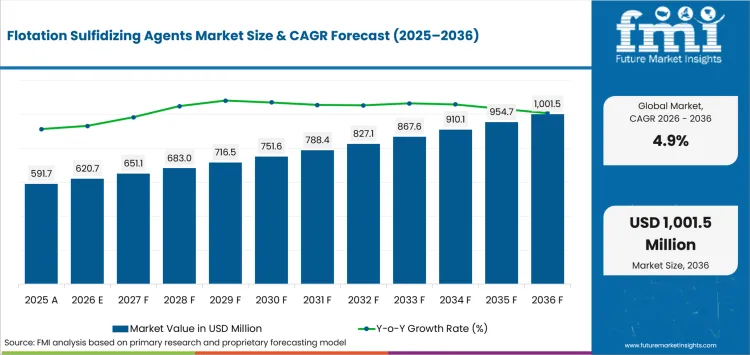
USD 620.7 million in 2026 and USD 1,001.5 million by 2036 at a 4.9% CAGR.
The flotation sulfidizing agents market is projected to rise from USD 620.7 million in 2026 to USD 1,001.5 million by 2036 at 4.9% CAGR. Oxidized feed weakens collector response, increasing the value of chemistry that recovers more payable metal from installed flotation capacity. The IEA’s May 2025 outlook projects a potential 30% copper supply shortfall by 2035 as ore grades decline and project lead times stay long. That pressure increases the commercial value of recovery chemistry within the wider flotation reagents market.
Country demand diverges from copper output because processing route determines the addressable reagent pool. Freeport-McMoRan’s February 2026 Form 10-K states that Morenci operates two concentrators with 132,000 metric tons per day of milling capacity beside separate leach and SX-EW circuits. Sulfidizer demand therefore follows the flotation share of mixed or oxidized feed instead of mine output alone.
Key Takeaways
- Oxidized and mixed ore feeds increase sulfidizer use once surface treatment restores collector response ahead of flotation.
- Based on agent type, sodium sulfide is projected to account for 36.0% in 2026 due to familiar dosing practice and broad oxide-flotation use.
- The oxidized copper ores segment is likely to capture 37.0% share in 2026 attributable to weak collector affinity on untreated oxide surfaces.
- Conditioning is projected to hold 34.0% share in 2026 owing to the need to set sulfidization conditions before collector addition.
- Dose sensitivity, acid-contact H2S release and bulk dangerous-goods handling can lengthen reagent qualification and narrow acceptable operating windows.
- Some of the key players in this market include Genesis Energy, L.P., Nouryon, Tessenderlo Kerley, Inc., Quadra Chemicals Ltd., Hydrite Chemical Co., BASF SE, Orica Limited, and AECI Limited.
Analyst Perspective
"A flotation sulfidizer earns its place after the plant proves the dose window against the ore feeding the circuit. The stronger offer pairs that recovery proof with safe NaHS handling and supply that does not interrupt conditioning."
- Nikhil Kaitwade, Principal Consultant, Future Market Insights
How is the flotation sulfidizing agents market segmented?
The flotation sulfidizing agents market covers agent type, ore type, application stage, end use and sales channel.
Agent type covers sodium sulfide, sodium hydrosulfide, ammonium sulfide, polysulfide blends and specialty sulfidization packages. Ore type covers oxidized copper, lead-zinc oxide, mixed oxide-sulfide, cobalt/nickel oxide and gold-associated ores. Application stage covers conditioning, rougher, scavenger and cleaner flotation. End use covers copper concentrators, polymetallic plants, hydrometallurgy preparation circuits and reagent distributors. Sales channel covers direct mine contracts, mining reagent distributors, regional chemical producers and technical-service supply.
How does conditioning lead the application stage category?
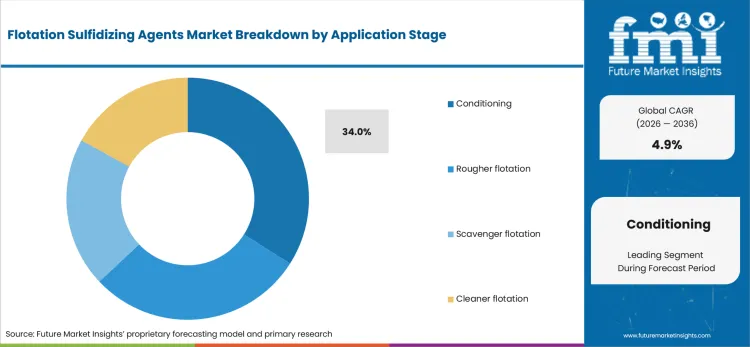
Conditioning sets slurry chemistry, redox potential and reagent contact ahead of collector-driven flotation. A July 2026 SEC-filed Carangas technical report records NaHS use in rougher testing and links dosage to oxidation-reduction potential control. That test route makes conditioning the point at which metallurgists decide whether sulfidization is strong enough to improve recovery without overdosing the circuit.
- By application stage, conditioning is forecast to represent 34.0% in 2026 driven by the need to establish sulfidization control before collector addition.
- Metallurgical teams tune dose and potential ahead of rougher flotation so under- or over-sulfidization does not carry into the full separation circuit.
Why do copper concentrators lead the end use category?
Copper concentrators generate repeat demand once a sulfidizer becomes part of a plant recipe. Southern Copper’s March 2025 SEC filing records 30,850,490 tonnes processed at Cuajone during 2024 and identifies NaSH among major flotation consumables. A circuit of that scale turns a qualified dosing recipe into repeat chemical demand, and ore changes preserve the need for testwork.
- Copper concentrators are set to lead the end use category with 52.0% share in 2026 due to continuous consumption in large flotation circuits.
- Bulk deliveries become repeat contracts after plant trials prove recovery, and changing ore mineralogy preserves the need for metallurgical support during operation.
Why does sodium sulfide lead the agent type category?
Sodium sulfide gives metallurgists a direct sulfide-ion source that fits familiar oxide-flotation dosing practice. Plants using solution handling may prefer NaHS because it can be metered without dissolving solid reagent first. A June 2026 SEC-filed KCM report documents controlled-potential sulfidization with NaHS, showing that plant choice depends on handling design and recovery response.
- By agent type, sodium sulfide is estimated to hold 36.0% in 2026 owing to familiar preparation and flexible dosing in oxide-flotation circuits.
- NaHS use in current controlled-potential sulfidization circuits means sodium sulfide has to compete on preparation cost, storage design and mine-specific recovery performance rather than assumed chemical interchangeability.
Why do oxidized copper ores lead the ore type category?
Oxidized copper surfaces often respond poorly to thiol collectors until a sulfide-like layer is formed. Metalla Royalty & Streaming’s March 2025 SEC-filed annual information form records NaHS sulfidization in the proposed Taca Taca flow sheet for oxidized or tarnished surfaces, with the affected material estimated near 22% of ore feed. That share makes sulfidization material to recovery testing.
- In 2026, oxidized copper ores are expected to lead ore type with 37.0% share because sulfidization improves collector response on oxide surfaces.
- Plant adoption depends on proving that the sulfidization stage raises payable copper recovery without excessive reagent consumption or selectivity loss against mixed sulfide minerals.
What are the drivers, restraints and opportunities in the Flotation Sulfidizing Agents Market?
Recovery pressure on oxidized feed supports reagent demand. Dose control and H2S handling limit adoption. Better testwork, local inventory and process-control support can raise contract value.
- Driver: Declining grade and changing ore mineralogy raise the value of recovering copper already entering flotation circuits.
- Restraint: Sulfidization has a narrow operating window and sodium hydrosulfide requires disciplined H2S controls during storage and handling.
- Opportunity: Reagent producers can raise contract value by pairing mine-specific qualification with local inventory and redox-control support.
Copper lost to tailings becomes more expensive as ore grades decline and mine expansions take longer to deliver new metal. Cochilco’s January 2026 projection expects Chilean output to rise near term until natural depletion and grade pressure weigh later in the period. Concentrators facing that profile have a stronger economic reason to test sulfidization on oxidized feed already entering installed flotation capacity.
Plant adoption slows if a recovery gain cannot be reproduced inside the site’s safety envelope. The USA EPA’s April 2025 Consolidated List of Lists assigns sodium hydrosulfide a 5,000-pound CERCLA hazardous-substance reportable quantity. Storage design, acid segregation and emergency response therefore become part of reagent qualification. Those controls can lengthen chemistry-switch decisions at mature copper concentrators with established HSE systems.
Mine-specific testwork gains commercial value once sulfidization is treated as a control problem instead of a commodity purchase. In November 2025, Nouryon opened an expanded Shanghai innovation center whose Natural Resources laboratory supports mining applications. Regional testing can shorten troubleshooting during ore or water changes. Nearby technical support also improves the chance that a successful trial becomes a repeat supply contract.
Which country CAGRs are profiled in the Flotation Sulfidizing Agents Market?
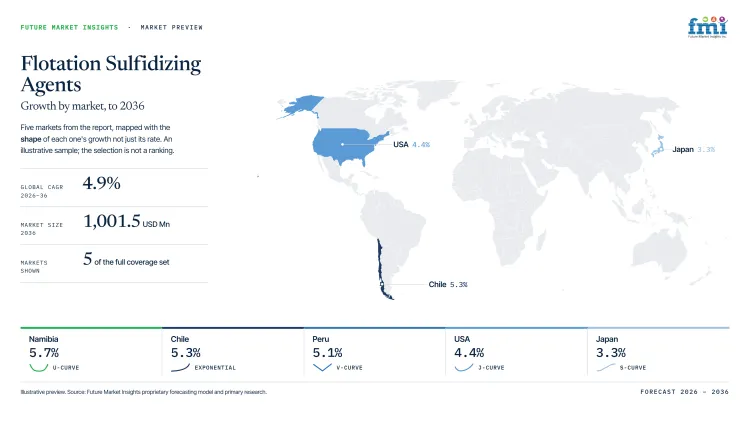
| Country | CAGR |
|---|---|
| Namibia | 5.7% |
| Chile | 5.3% |
| Peru | 5.1% |
| South Africa | 5.0% |
| Australia | 4.9% |
| USA | 4.4% |
| Japan | 3.3% |
How do country-level CAGRs compare in the Flotation Sulfidizing Agents Market?
The seven profiled rates span 2.4 percentage points from Namibia at 5.7% to Japan at 3.3%. Chile, Peru, South Africa and Australia form a middle band between 4.9% and 5.3%, while the USA is at 4.4%. The narrow spread makes operating conditions more useful than small forecast differences during account planning.
- Namibia: Import dependence favors regional safety stock.
- Chile: Local laboratories shorten plant-trial turnaround.
- Peru: Brownfield concentrators keep test pipelines active.
- South Africa: Technical depth supports regional mine service.
- Australia: Dangerous-goods carriers reduce remote delivery friction.
- USA: Large copper sites maintain reagent trial infrastructure.
- Japan: Trading groups link specialists with overseas copper projects.
CAGR ranks forecast expansion, whereas current sales depend on flotation throughput and oxide-feed exposure. The full report profiles country conditions within North America, Latin America, Western Europe, Eastern Europe, East Asia, South Asia and Pacific, and Middle East and Africa.
Country-wise Analysis
- Namibia’s reagent base is small enough that one concentrator restart can materially change national purchasing. New Horizon Copper began construction at Kombat in February 2026 following the December 2025 ownership transaction, with operations targeted to restart later in 2026. Namibia is set to post 5.7% CAGR by 2036, propelled by renewed concentrator activity. Kombat gives distributors a defined qualification target, although imported chemicals still face long replenishment routes. Trial schedules can be tied to commissioning milestones instead of broad national demand assumptions. Regional inventory and early metallurgical work will decide whether restarted throughput becomes repeat sulfidizer demand instead of irregular project orders.
- Chile’s concentrators expose any dosing change to high throughput and variable oxide content, so trial results must hold at plant scale. Flotation sulfidizing agents demand in Chile is forecast to rise at 5.3% CAGR over the forecast period, aided by the country’s concentrate-heavy processing base. Cochilco recorded 4,247.6 thousand tonnes of copper content in concentrates during 2025 versus 1,140.6 thousand tonnes from SX-EW cathodes. That mix gives bulk flotation chemistry a large addressable base. Water constraints, power costs and oxide-leach alternatives narrow the economic case for sulfidization on some ores. Local metallurgical support must prove incremental recovery for large sites to change established dosing recipes.
- Peru’s copper plants often treat polymetallic feed at altitude, which raises both selectivity and delivery requirements. MINEM documented 2,769,794 metric tons of fine copper production in 2025, 1.2% above 2024. Zinc and lead also recorded year-over-year gains, so reagent trials must account for polymetallic recovery trade-offs. Peru is likely to register 5.1% CAGR over the assessment period, tied to concentrator scale and continuing mine investment. The installed plant base gives reagent companies repeated opportunities for local site trials. High-altitude logistics and changing copper-lead-zinc mineralogy make one standard dose strategy unreliable. Companies keeping local inventory and metallurgists close to mines have the stronger route to repeat orders.
- South Africa gives mining-chemical companies a manufacturing and service base for domestic sites and nearby Copperbelt customers. The country’s flotation sulfidizing agents sector is positioned to record 5.0% CAGR during the assessment period, supported by regional mine demand and beneficiation policy. In May 2025, the Department of Mineral and Petroleum Resources classified copper and cobalt as moderately critical and called for stronger beneficiation, research and local value chains. Local production can shorten supply routes for qualified chemistry. Domestic copper throughput is uneven and project schedules can slip, limiting immediate sulfidizer volumes. Regional service coverage is a stronger commercial route than relying on South African mine demand alone.
- Australian mines often operate far from major ports and chemical hubs, turning reagent availability into a production-risk issue. The June 2026 Resources and Energy Quarterly expects Australian concentrate and refined-copper exports to increase despite delays affecting new global mine supply. Adoption of flotation sulfidizing agents in Australia is estimated to expand at 4.9% CAGR through 2036, attributable to mine investment and local technical capacity. Dangerous-goods logistics and experienced metallurgical service make remote qualification easier. Some oxide feeds are better suited to hydrometallurgical processing, which limits the addressable flotation pool. Sulfidizer companies must prove site economics to justify carrying extra hazardous-chemical inventory.
- USA copper mines usually put reagent changes through metallurgical trials, HSE review and purchasing approval ahead of routine use. In its 2026 Mineral Commodity Summaries, USGS documented 2025 output losses from concentrator shutdowns and lower ore grades at several mines, alongside new production from an Arizona mine. In the USA, flotation sulfidizing agents demand is on track to deliver 4.4% CAGR through 2036, driven by domestic copper investment and mature chemical logistics. The same governance slows chemistry switching because NaHS requires additional storage and emergency-response controls. Multiple delivery modes and technical stewardship carry an advantage at sites that value supply continuity over a small difference in reagent price.
- Japan has little domestic copper-mine volume, so reagent demand is more closely tied to metals groups, laboratories and overseas-resource partnerships. Japan’s flotation sulfidizing agents outlook may progress at 3.3% CAGR over the assessment period, given technical collaboration rather than mine throughput at home. JOGMEC signed a cooperation agreement with CODELCO in December 2025 to advance flotation technology for separating arsenic-bearing copper minerals. Advanced laboratories and trading networks give specialist formulators a route into technical programs. Long validation cycles limit near-term domestic volumes. The stronger commercial position lies in joint development and support for overseas concentrators instead of broad sales to Japanese mines.
Who are the notable companies in the Flotation Sulfidizing Agents Market?
Genesis Energy, L.P., Nouryon, Tessenderlo Kerley, Inc., Quadra Chemicals Ltd., Hydrite Chemical Co., BASF SE, Orica Limited, and AECI Limited
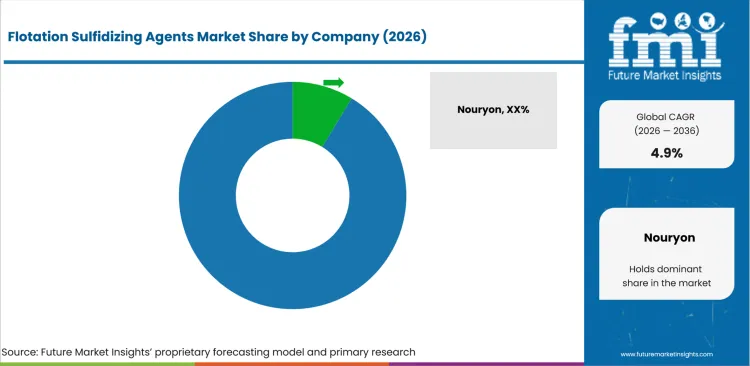
Competition separates direct NaHS production from distribution-led supply and broader flotation chemistry. Genesis Energy, Nouryon and Tessenderlo Kerley document direct sulfur-chemical positions. Quadra and Hydrite extend regional chemical supply. BASF, Orica and AECI compete on flotation support and adjacent processing chemistry.
- Direct sulfidizer supply: Genesis Energy, L.P., Nouryon and Tessenderlo Kerley, Inc. document NaHS production or branded high-purity NaHS supply.
- Distribution and regional supply: Quadra Chemicals Ltd. and Hydrite Chemical Co. provide mine-focused chemical logistics, warehousing and technical service.
- Flotation service and adjacent chemistry: BASF SE, Orica Limited and AECI Limited provide flotation reagents, laboratory support or broader beneficiation chemistry.
Competitive Benchmarking: Flotation Sulfidizing Agents Market
| Company | Direct Sulfidizer Supply | Ore-Specific Technical Support | Bulk & Regional Supply | Geographic Reach |
|---|---|---|---|---|
| Genesis Energy, L.P. | High | Medium | High | North America and South America |
| Nouryon | High | High | High | Global industrial and natural-resources network |
| Tessenderlo Kerley, Inc. | High | Medium | High | North America with international sulfur-chemical supply |
| Quadra Chemicals Ltd. | Low | High | High | Canada and United States |
| Hydrite Chemical Co. | Low | Medium | High | North America |
| BASF SE | Low | High | Medium | Global mining jurisdictions |
| Orica Limited | Low | High | High | Global mining jurisdictions |
| AECI Limited | Low | High | High | Africa, Australia and Latin America |
Scoring basis: High direct supply requires documented sulfidizer production for mining use. Medium requires verified distribution of the chemistry, and Low identifies adjacent flotation activity without direct production evidence. High technical support requires mine-focused laboratory or field service. High regional supply requires documented warehousing, manufacturing or multiple delivery routes.
Key Developments in the Flotation Sulfidizing Agents Market
- In April 2026, Orica Limited acquired the Danafloat product range from FMC Corporation, extending its specialty mining chemicals portfolio into copper flotation collectors and ore-specific technical service.
- In July 2025, Tessenderlo Kerley, Inc. introduced the ekoSURE brand for its high-purity sodium hydrosulfide solution, giving mining accounts a named NaHS grade within its sulfur-chemicals business.
- In June 2025, BASF SE and FUCHS signed an Australian cooperation agreement covering BASF flotation and dewatering solutions, expanding on-ground technical access for mine sites.
Key Players in the Flotation Sulfidizing Agents Market
Direct Sulfidizer Producers
- Genesis Energy, L.P.
- Nouryon
- Tessenderlo Kerley, Inc.
Regional Distribution and Mine-Chemical Supply
- Quadra Chemicals Ltd.
- Hydrite Chemical Co.
Flotation and Beneficiation Specialists
- BASF SE
- Orica Limited
- AECI Limited
Flotation Sulfidizing Agents Market - Report Scope
| Coverage field | Report scope |
|---|---|
| Market breakdown | By agent type, ore type, application stage, end use, sales channel and region. |
| Quantitative Units | USD million. |
| Market Definition | Revenue includes sodium sulfide, sodium hydrosulfide, ammonium sulfide, polysulfide blends and specialty sulfidization packages sold for flotation within the stated segmentation universe. |
| Regions Covered | North America, Latin America, Western Europe, Eastern Europe, East Asia, South Asia and Pacific, and Middle East and Africa. |
| Countries Covered | Namibia, Chile, Peru, South Africa, Australia, USA, Japan, and 20+ countries included in the full report. |
| Key Companies Profiled | Genesis Energy, L.P., Nouryon, Tessenderlo Kerley, Inc., Quadra Chemicals Ltd., Hydrite Chemical Co., BASF SE, Orica Limited, AECI Limited. |
| Forecast Period | 2026 to 2036. |
| Approach | Primary and secondary research with market triangulation. |
Flotation Sulfidizing Agents Market - Research Methodology
| Method | Approach |
|---|---|
| Primary Research | FMI analysts gathered input from manufacturers, service providers, technology developers, distributors, end users, procurement teams, and subject-matter experts. Interviews examined purchasing decisions, product or service evaluation, adoption barriers, approval requirements, pricing considerations, and expectations for technical or commercial support. Respondents were also asked what evidence is required before a trial, pilot, or initial order develops into regular purchasing. |
| Desk Research | Desk research covered government statistics, regulatory publications, trade data, industry associations, technical literature, standards, company filings, product information, and official corporate announcements. Sources were reviewed for relevance, publication date, geographic coverage, and consistency with the defined market scope. Claims relating to performance, applications, approvals, capacity, investment, and commercial activity were retained only when supported by credible public evidence. |
| Market Sizing and Forecasting | The market model combined the baseline value with historical performance, segment structure, pricing and volume indicators, adoption levels, company participation, and country-level demand conditions. Forecast assumptions considered economic activity, investment trends, regulatory developments, technology adoption, purchasing cycles, supply availability, and barriers to wider market use. Segment and regional estimates were reconciled before the final market total was calculated. |
| Data Validation | Estimates were checked against multiple independent indicators, including public data, company activity, trade patterns, industry developments, and findings from primary interviews. Validation also tested whether products, services, applications, and company revenues fell within the defined market boundaries. Adjacent categories, unsupported claims, overlapping revenues, and activities without direct market relevance were excluded to reduce double counting and maintain consistency across segments and countries. |
Flotation Sulfidizing Agents Market by Segments
Flotation Sulfidizing Agents Market segmented by Agent Type:
- Sodium sulfide
- Sodium hydrosulfide
- Ammonium sulfide
- Polysulfide blends
- Specialty sulfidization packages
Flotation Sulfidizing Agents Market segmented by Ore Type:
- Oxidized copper ores
- Lead-zinc oxide ores
- Mixed oxide-sulfide ores
- Cobalt/nickel oxide ores
- Gold-associated oxides
Flotation Sulfidizing Agents Market segmented by Application Stage:
- Conditioning
- Rougher flotation
- Scavenger flotation
- Cleaner flotation
Flotation Sulfidizing Agents Market segmented by End Use:
- Copper concentrators
- Polymetallic plants
- Hydrometallurgy prep circuits
- Reagent distributors
Flotation Sulfidizing Agents Market segmented by Sales Channel:
- Direct mine contracts
- Mining reagent distributors
- Regional chemical producers
- Technical service supply
Flotation Sulfidizing Agents Market by Region:
- North America
- United States
- Canada
- Latin America
- Brazil
- Mexico
- Chile
- Rest of Latin America
- Western Europe
- Germany
- United Kingdom
- Italy
- Spain
- France
- Nordics
- Benelux
- Rest of Western Europe
- Eastern Europe
- Russia
- Poland
- Hungary
- Balkan and Baltic States
- Rest of Eastern Europe
- East Asia
- China
- Japan
- South Korea
- South Asia and Pacific
- India
- ASEAN
- Australia and New Zealand
- Rest of South Asia and Pacific
- Middle East and Africa
- Kingdom of Saudi Arabia
- Other GCC Countries
- Türkiye
- South Africa
- Other African Union Countries
- Rest of Middle East and Africa
Research Sources and Bibliography
- International Energy Agency. (2025, May 21). Global Critical Minerals Outlook 2025.
- Freeport-McMoRan Inc. (2026, February 13). Annual report on Form 10-K for the year ended December 31, 2025.
- AMC Consultants (UK) Limited. (2026, June 2). S-K 1300 Technical Report Summary: KCM Integrated Operations (Preliminary Feasibility Study).
- Metalla Royalty & Streaming Ltd. (2025, March 27). Annual information form for the financial year ended December 31, 2024.
- New Pacific Metals Corp. (2026, July 16). Carangas Project NI 43-101 Technical Report and Preliminary Economic Assessment.
- Southern Copper Corporation. (2025, March 3). Cuajone Operations, Moquegua Region, Peru: S-K 1300 Technical Report Summary.
- Comisión Chilena del Cobre. (2026, January 19). Informe Proyección de la producción de cobre en Chile. Periodo 2025-2034.
- USA Environmental Protection Agency. (2025, April). Consolidated List of Lists.
- Nouryon. (2025, November 10). Nouryon opens new innovation center in Shanghai to accelerate localized innovation and customer collaboration in China.
- Chamber of Mines of Namibia. (2026, February 10). NEW HORIZONs for Namibian Copper.
- Comisión Chilena del Cobre. (2026, March). Producción chilena de cobre por productos - anual y mensual.
- Ministerio de Energía y Minas del Perú. (2026, March 11). MINEM: Producción minera mostró resultados positivos en varios metales claves al cierre de 2025.
- Department of Mineral and Petroleum Resources, South Africa. (2025, May 20). Statement on Cabinet approval of the Critical Minerals and Metals Strategy for South Africa.
- Australian Government Department of Industry, Science and Resources. (2026, June). Resources and energy quarterly: June 2026.
- USA Geological Survey. (2026). Mineral Commodity Summaries 2026.
- Japan Organization for Metals and Energy Security. (2025, December 8). Agreement on Cooperation for Technology to Reduce Impurities in Copper Raw Materials with CODELCO.
- Orica Limited. (2026, April 17). Orica expands portfolio into copper chemistry with Danafloat acquisition.
- Tessenderlo Kerley, Inc. (2025, July 1). moleko Unveils New Brand Names for Trusted Chemical Solutions: ekoFEND, ekoFITE, and ekoSURE.
- BASF SE. (2025, June 18). BASF mining solutions and FUCHS announce cooperation to serve the Australian mining industry.
- Genesis Energy, L.P. (2026, February 18). Form 10-K for the year ended December 31, 2025.
- Quadra Chemicals Ltd. (2025, April 1). Quadra Announces Acquisition of Bell Chem, Accelerating Growth and Strengthening Market Position.
- Hydrite Chemical Co. (n.d.). Mining Solutions. Retrieved September 1, 2026.
- Quadra Chemicals Ltd. (n.d.). Mining. Retrieved September 1, 2026.
- AECI Limited. (2026, May 28). Mining chemicals.
- Hydrite Chemical Co. (2025, September 3). Hydrite Announces the Acquisition of Enterprise Specialty Products, Inc. and Expansion to the US Southeast Region.
- Brenntag. (2025, December 17). Exclusive distribution agreement with Henan Yongchang in Australia and New Zealand.
- Genesis Energy, L.P. (2026, May). Form 10-Q for the quarter ended March 31, 2026.
- Albemarle Corporation. (2026, February 11). Annual report on Form 10-K for the year ended December 31, 2025.
- AECI Limited. (2026, August 11). AECI reports improved first-half 2026 performance with strong earnings growth and solid returns.
- Nouryon Chemicals LLC. (2025, October 16). RC 14001:2023 Americas Regional Certificate.
- Tessenderlo Group. (2026, April 1). Annual Report 2025.
- Hydrite Chemical Co. (2026, February 10). Hydrite Announces the Expansion of South Carolina Operations.
- BASF SE. (2025, May 20). BASF mining solutions strengthens commitment to copper hydrometallurgy and flotation research and development.
- Orica Limited. (2025, January 22). Orica Specialty Mining Chemicals and Century Lithium sign MOU for sodium hydroxide from Angel Island.
- AECI Limited. (2025, February 26). AECI reports 2024 results: Strategic execution drives transformation.
- Nouryon Chemicals LLC. (2026, May 8). ISO 9001:2015 Americas Regional Certificate.
This bibliography is provided for reader reference and is not exhaustive. The full report contains the complete reference list and detailed citations.
This Report Answers
- How large is the flotation sulfidizing agents market in 2026 and 2036?
- Why do oxidized and mixed ores increase the need for sulfidizing chemistry?
- Why does sodium sulfide hold the leading position within agent type?
- Why does conditioning represent the leading application stage?
- How do growth rates differ among the seven profiled countries?
- Which companies supply sulfidizers, distribution and ore-specific technical support?
- How do dose sensitivity and hydrogen sulfide handling affect reagent qualification?
- What should mine operators compare before changing a sulfidizer recipe?
Frequently Asked Questions
How big is the flotation sulfidizing agents market in 2026?
The flotation sulfidizing agents market is valued at USD 620.7 million in 2026 and is projected to reach USD 1,001.5 million by 2036. Growth follows pressure to recover more payable metal from oxidized and transition ores.
What is the CAGR of the flotation sulfidizing agents market from 2026 to 2036?
The flotation sulfidizing agents market is projected to grow at a CAGR of 4.9% between 2026 and 2036. Expansion follows copper-recovery pressure and repeat reagent use after plant qualification.
Which agent type leads the flotation sulfidizing agents market?
The sodium sulfide segment is expected to hold 36.0% of the flotation sulfidizing agents market in 2026, attributable to familiar preparation and flexible dosing. Site economics still depend on ore response.
Which ore type leads the flotation sulfidizing agents market?
The oxidized copper ores segment is expected to hold 37.0% of the flotation sulfidizing agents market in 2026, driven by weak collector response on untreated oxide surfaces. Plant trials must prove incremental payable-metal recovery.
How much value will the flotation sulfidizing agents market add between 2026 and 2036?
The flotation sulfidizing agents market is expected to add USD 380.8 million in value between 2026 and 2036. The increase follows recovery pressure in oxide and transition ores.
Which countries are projected to record the highest growth in the flotation sulfidizing agents market?
Namibia is projected to grow at 5.7% CAGR, followed by Chile at 5.3% and Peru at 5.1% through 2036. Mine restarts and concentrator investment explain the leading forecasts.
Which companies are active in the flotation sulfidizing agents market?
Key companies operating in the market include Genesis Energy, L.P., Nouryon, Tessenderlo Kerley, Inc., Quadra Chemicals Ltd., Hydrite Chemical Co., BASF SE, Orica Limited, and AECI Limited. They differ in NaHS supply, distribution and flotation support.
Preview the report firsthand - request a free sample
Get SampleGet the brochure for pricing and purchase details.
Get PDFTable of Content
- Key Takeaways
- Market Size and CAGR
- Top Growth Driver
- Fastest Growing Segment
- Leading Region
- Key Companies
- Emerging Opportunities
- Executive Summary
- Global Market Outlook
- Demand-side Trends
- Supply-side Trends
- Technology Roadmap Analysis
- Analysis and Recommendations
- Analyst Perspective (What is happening? Why now? What should investors know?)
- Key Questions Answered
- How large is the market?
- What is the CAGR?
- What are key trends?
- Which region dominates?
- Who are the leaders?
- Market Overview
- Market Coverage / Taxonomy
- Market Definition / Scope / Limitations
- Research Methodology
- Chapter Orientation
- Analytical Lens and Working Hypotheses
- Market Structure, Signals, and Trend Drivers
- Benchmarking and Cross-market Comparability
- Market Sizing, Forecasting, and Opportunity Mapping
- Research Design and Evidence Framework
- Desk Research Programme (Secondary Evidence)
- Expert Input and Fieldwork (Primary Evidence)
- Tooling, Models, and Reference Databases
- Data Engineering and Model Build
- Quality Assurance and Audit Trail
- Market Background
- Market Dynamics (Drivers, Restraints, Opportunity, Trends)
- Scenario Forecast (Optimistic, Likely, Conservative)
- Impact Analysis
- AI Impact
- Sustainability Impact
- Regulatory Impact
- Technology Impact
- Consumer / Buyer Analysis
- Purchase Drivers
- Adoption Barriers
- Buyer Journey
- Opportunity Map Analysis
- Product Life Cycle Analysis
- Supply Chain Analysis
- Investment Feasibility Matrix
- Value Chain Analysis
- PESTLE and Porter's Analysis
- Regulatory Landscape
- Regional Parent Market Outlook
- Production and Consumption Statistics
- Import and Export Statistics
- Global Market Analysis and Forecast, 2021 to 2036
- Historical Market Size Value (USD Million) Analysis, 2021 to 2025
- Current and Future Market Size Value (USD Million) Projections, 2026 to 2036
- Y-o-Y Growth Trend Analysis
- Absolute $ Opportunity Analysis
- Global Market Pricing Analysis, 2021 to 2036
- Global Market Analysis and Forecast, By Agent Type, 2021 to 2036
- Introduction / Key Findings
- Historical Market Size Value (USD Million) Analysis By Agent Type, 2021 to 2025
- Current and Future Market Size Value (USD Million) Analysis and Forecast By Agent Type, 2026 to 2036
- Sodium sulfide
- Sodium hydrosulfide
- Ammonium sulfide
- Polysulfide blends
- Specialty sulfidization packages
- Sodium sulfide
- Y-o-Y Growth Trend Analysis By Agent Type, 2021 to 2025
- Absolute $ Opportunity Analysis By Agent Type, 2026 to 2036
- Global Market Analysis and Forecast, By Ore Type, 2021 to 2036
- Introduction / Key Findings
- Historical Market Size Value (USD Million) Analysis By Ore Type, 2021 to 2025
- Current and Future Market Size Value (USD Million) Analysis and Forecast By Ore Type, 2026 to 2036
- Oxidized copper ores
- Lead-zinc oxide ores
- Mixed oxide-sulfide ores
- Cobalt/nickel oxide ores
- Gold-associated oxides
- Oxidized copper ores
- Y-o-Y Growth Trend Analysis By Ore Type, 2021 to 2025
- Absolute $ Opportunity Analysis By Ore Type, 2026 to 2036
- Global Market Analysis and Forecast, By Application Stage, 2021 to 2036
- Introduction / Key Findings
- Historical Market Size Value (USD Million) Analysis By Application Stage, 2021 to 2025
- Current and Future Market Size Value (USD Million) Analysis and Forecast By Application Stage, 2026 to 2036
- Conditioning
- Rougher flotation
- Scavenger flotation
- Cleaner flotation
- Conditioning
- Y-o-Y Growth Trend Analysis By Application Stage, 2021 to 2025
- Absolute $ Opportunity Analysis By Application Stage, 2026 to 2036
- Global Market Analysis and Forecast, By End Use, 2021 to 2036
- Introduction / Key Findings
- Historical Market Size Value (USD Million) Analysis By End Use, 2021 to 2025
- Current and Future Market Size Value (USD Million) Analysis and Forecast By End Use, 2026 to 2036
- Copper concentrators
- Polymetallic plants
- Hydrometallurgy prep circuits
- Reagent distributors
- Copper concentrators
- Y-o-Y Growth Trend Analysis By End Use, 2021 to 2025
- Absolute $ Opportunity Analysis By End Use, 2026 to 2036
- Global Market Analysis and Forecast, By Sales Channel, 2021 to 2036
- Introduction / Key Findings
- Historical Market Size Value (USD Million) Analysis By Sales Channel, 2021 to 2025
- Current and Future Market Size Value (USD Million) Analysis and Forecast By Sales Channel, 2026 to 2036
- Direct mine contracts
- Mining reagent distributors
- Regional chemical producers
- Technical service supply
- Direct mine contracts
- Y-o-Y Growth Trend Analysis By Sales Channel, 2021 to 2025
- Absolute $ Opportunity Analysis By Sales Channel, 2026 to 2036
- Global Market Analysis and Forecast, By Region, 2021 to 2036
- Introduction
- Historical Market Size Value (USD Million) Analysis By Region, 2021 to 2025
- Current Market Size Value (USD Million) Analysis and Forecast By Region, 2026 to 2036
- North America
- Latin America
- Western Europe
- Eastern Europe
- East Asia
- South Asia and Pacific
- Middle East & Africa
- Market Attractiveness Analysis By Region
- North America Market Analysis and Forecast, By Country, 2021 to 2036
- Historical Market Size Value (USD Million) Trend Analysis By Market Taxonomy, 2021 to 2025
- Market Size Value (USD Million) Forecast By Market Taxonomy, 2026 to 2036
- By Country
- USA
- Canada
- By Agent Type
- By Ore Type
- By Application Stage
- By End Use
- By Sales Channel
- By Country
- Market Attractiveness Analysis
- By Country
- By Agent Type
- By Ore Type
- By Application Stage
- By End Use
- By Sales Channel
- Key Takeaways
- Latin America Market Analysis and Forecast, By Country
- Historical Market Size Value (USD Million) Trend Analysis By Market Taxonomy, 2021 to 2025
- Market Size Value (USD Million) Forecast By Market Taxonomy, 2026 to 2036
- By Country
- Brazil
- Mexico
- Chile
- Rest of Latin America
- By Agent Type
- By Ore Type
- By Application Stage
- By End Use
- By Sales Channel
- By Country
- Market Attractiveness Analysis
- By Country
- By Agent Type
- By Ore Type
- By Application Stage
- By End Use
- By Sales Channel
- Key Takeaways
- Western Europe Market Analysis and Forecast, By Country
- Historical Market Size Value (USD Million) Trend Analysis By Market Taxonomy, 2021 to 2025
- Market Size Value (USD Million) Forecast By Market Taxonomy, 2026 to 2036
- By Country
- Germany
- UK
- Italy
- Spain
- France
- Nordic
- BENELUX
- Rest of Western Europe
- By Agent Type
- By Ore Type
- By Application Stage
- By End Use
- By Sales Channel
- By Country
- Market Attractiveness Analysis
- By Country
- By Agent Type
- By Ore Type
- By Application Stage
- By End Use
- By Sales Channel
- Key Takeaways
- Eastern Europe Market Analysis and Forecast, By Country
- Historical Market Size Value (USD Million) Trend Analysis By Market Taxonomy, 2021 to 2025
- Market Size Value (USD Million) Forecast By Market Taxonomy, 2026 to 2036
- By Country
- Russia
- Poland
- Hungary
- Balkan & Baltic
- Rest of Eastern Europe
- By Agent Type
- By Ore Type
- By Application Stage
- By End Use
- By Sales Channel
- By Country
- Market Attractiveness Analysis
- By Country
- By Agent Type
- By Ore Type
- By Application Stage
- By End Use
- By Sales Channel
- Key Takeaways
- East Asia Market Analysis and Forecast, By Country
- Historical Market Size Value (USD Million) Trend Analysis By Market Taxonomy, 2021 to 2025
- Market Size Value (USD Million) Forecast By Market Taxonomy, 2026 to 2036
- By Country
- China
- Japan
- South Korea
- By Agent Type
- By Ore Type
- By Application Stage
- By End Use
- By Sales Channel
- By Country
- Market Attractiveness Analysis
- By Country
- By Agent Type
- By Ore Type
- By Application Stage
- By End Use
- By Sales Channel
- Key Takeaways
- South Asia and Pacific Market Analysis and Forecast, By Country
- Historical Market Size Value (USD Million) Trend Analysis By Market Taxonomy, 2021 to 2025
- Market Size Value (USD Million) Forecast By Market Taxonomy, 2026 to 2036
- By Country
- India
- ASEAN
- Australia & New Zealand
- Rest of South Asia and Pacific
- By Agent Type
- By Ore Type
- By Application Stage
- By End Use
- By Sales Channel
- By Country
- Market Attractiveness Analysis
- By Country
- By Agent Type
- By Ore Type
- By Application Stage
- By End Use
- By Sales Channel
- Key Takeaways
- Middle East & Africa Market Analysis and Forecast, By Country
- Historical Market Size Value (USD Million) Trend Analysis By Market Taxonomy, 2021 to 2025
- Market Size Value (USD Million) Forecast By Market Taxonomy, 2026 to 2036
- By Country
- Kingdom of Saudi Arabia
- Other GCC Countries
- Türkiye
- South Africa
- Other African Union
- Rest of Middle East & Africa
- By Agent Type
- By Ore Type
- By Application Stage
- By End Use
- By Sales Channel
- By Country
- Market Attractiveness Analysis
- By Country
- By Agent Type
- By Ore Type
- By Application Stage
- By End Use
- By Sales Channel
- Key Takeaways
- Key Countries Market Analysis
- USA
- Pricing Analysis
- Market Share Analysis, 2025
- By Agent Type
- By Ore Type
- By Application Stage
- By End Use
- By Sales Channel
- Canada
- Pricing Analysis
- Market Share Analysis, 2025
- By Agent Type
- By Ore Type
- By Application Stage
- By End Use
- By Sales Channel
- Mexico
- Pricing Analysis
- Market Share Analysis, 2025
- By Agent Type
- By Ore Type
- By Application Stage
- By End Use
- By Sales Channel
- Brazil
- Pricing Analysis
- Market Share Analysis, 2025
- By Agent Type
- By Ore Type
- By Application Stage
- By End Use
- By Sales Channel
- Chile
- Pricing Analysis
- Market Share Analysis, 2025
- By Agent Type
- By Ore Type
- By Application Stage
- By End Use
- By Sales Channel
- Germany
- Pricing Analysis
- Market Share Analysis, 2025
- By Agent Type
- By Ore Type
- By Application Stage
- By End Use
- By Sales Channel
- UK
- Pricing Analysis
- Market Share Analysis, 2025
- By Agent Type
- By Ore Type
- By Application Stage
- By End Use
- By Sales Channel
- Italy
- Pricing Analysis
- Market Share Analysis, 2025
- By Agent Type
- By Ore Type
- By Application Stage
- By End Use
- By Sales Channel
- Spain
- Pricing Analysis
- Market Share Analysis, 2025
- By Agent Type
- By Ore Type
- By Application Stage
- By End Use
- By Sales Channel
- France
- Pricing Analysis
- Market Share Analysis, 2025
- By Agent Type
- By Ore Type
- By Application Stage
- By End Use
- By Sales Channel
- India
- Pricing Analysis
- Market Share Analysis, 2025
- By Agent Type
- By Ore Type
- By Application Stage
- By End Use
- By Sales Channel
- ASEAN
- Pricing Analysis
- Market Share Analysis, 2025
- By Agent Type
- By Ore Type
- By Application Stage
- By End Use
- By Sales Channel
- Australia & New Zealand
- Pricing Analysis
- Market Share Analysis, 2025
- By Agent Type
- By Ore Type
- By Application Stage
- By End Use
- By Sales Channel
- China
- Pricing Analysis
- Market Share Analysis, 2025
- By Agent Type
- By Ore Type
- By Application Stage
- By End Use
- By Sales Channel
- Japan
- Pricing Analysis
- Market Share Analysis, 2025
- By Agent Type
- By Ore Type
- By Application Stage
- By End Use
- By Sales Channel
- South Korea
- Pricing Analysis
- Market Share Analysis, 2025
- By Agent Type
- By Ore Type
- By Application Stage
- By End Use
- By Sales Channel
- Russia
- Pricing Analysis
- Market Share Analysis, 2025
- By Agent Type
- By Ore Type
- By Application Stage
- By End Use
- By Sales Channel
- Poland
- Pricing Analysis
- Market Share Analysis, 2025
- By Agent Type
- By Ore Type
- By Application Stage
- By End Use
- By Sales Channel
- Hungary
- Pricing Analysis
- Market Share Analysis, 2025
- By Agent Type
- By Ore Type
- By Application Stage
- By End Use
- By Sales Channel
- Kingdom of Saudi Arabia
- Pricing Analysis
- Market Share Analysis, 2025
- By Agent Type
- By Ore Type
- By Application Stage
- By End Use
- By Sales Channel
- Türkiye
- Pricing Analysis
- Market Share Analysis, 2025
- By Agent Type
- By Ore Type
- By Application Stage
- By End Use
- By Sales Channel
- South Africa
- Pricing Analysis
- Market Share Analysis, 2025
- By Agent Type
- By Ore Type
- By Application Stage
- By End Use
- By Sales Channel
- USA
- Market Structure Analysis
- Competition Dashboard
- Competition Benchmarking
- Market Share Analysis of Top Players
- By Regional
- By Agent Type
- By Ore Type
- By Application Stage
- By End Use
- By Sales Channel
- Emerging Startups
- Innovation Benchmarking
- Competition Analysis
- Competition Deep Dive
- Nouryon
- Overview
- Product Portfolio
- Profitability by Market Segments
- Sales Footprint
- Strategy Overview
- Marketing Strategy
- Product Strategy
- Channel Strategy
- Solvay
- Clariant
- Orica
- Axis House
- Senmin
- Nasaco
- Coogee Chemicals
- Quadra Chemicals
- Kemcore
- Nouryon
- Case Studies
- Success Stories
- Recent Developments
- Competition Deep Dive
- Assumptions & Acronyms Used


