

- Market Size (2026)
- USD 760.7 Mn
- Forecast (2036)
- USD 1215.7 Mn
- CAGR (2026 to 2036)
- 4.8%
How big is Dithiophosphate Flotation Collectors Market in 2026?
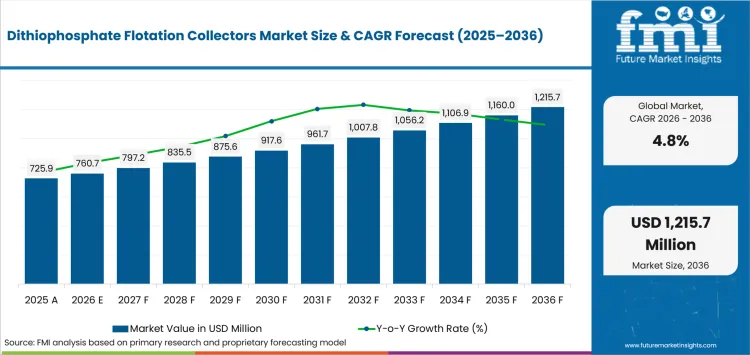
USD 760.7 million in 2026 and USD 1215.7 million by 2036 at a 4.8% CAGR.
Demand for dithiophosphate flotation collectors is projected to expand at 4.8% CAGR between 2026 and 2036, increasing valuation from USD 760.7 million to USD 1215.7 million. Flotation performance becomes more important as mining operations process more challenging ore bodies and seek to maintain metal recovery rates. USA Geological Survey data for 2024 documented lower ore grades and reduced copper recovery at several domestic operations. That operating pressure raises the value of mining flotation chemicals that improve sulfide recovery without destabilizing concentrate quality.
Country-level demand depends on where new circuits and brownfield upgrades reopen reagent qualification. Peru listed 66 mining investment projects in its June 2026 portfolio, which keeps laboratory and plant testing active before new reagent specifications are accepted. That pipeline gives flotation reagent systems a clearer commercial route where technical service and local delivery are available.
Key Takeaways
- Changing sulfide mineralogy raises the value of collector programs that protect payable-metal recovery without allowing gangue or penalty elements to rise.
- By collector type, dialkyl dithiophosphates are estimated to hold 28.0% in 2026 owing to their broad use in tunable sulfide-collector formulations.
- Copper ores are projected to account for 32.0% of ore type demand in 2026 because large concentrators repeatedly retest chemistry as feed mineralogy changes.
- In 2026, strong sulfide collectors are expected to lead selectivity with 34.0% share as rougher and scavenger circuits prioritize valuable-mineral capture before cleaning.
- Mine-site qualification slows switching because dosage, process water, pH and competing reagents can change recovery-grade performance after a laboratory result looks promising.
- Some of the key players in this market include BASF SE, Clariant AG, Syensqo SA/NV, Orica Limited, AECI Limited, Nouryon, Nasaco International Ltd., and Quadra Chemicals Ltd.
Analyst Perspective
"Plant metallurgists should judge a dithiophosphate program on the recovery-grade balance achieved on the site's actual ore and process water. Commercial value is earned after the formulation survives plant trials and the supplier can repeat that performance with dependable replenishment."
- Nikhil Kaitwade, Principal Consultant, Future Market Insights
How is the Dithiophosphate Flotation Collectors Market segmented?
The market is segmented by collector type, ore type, selectivity, end use and sales channel.
Collector type covers dialkyl dithiophosphates, aryl dithiophosphates, dithiophosphate blends, modified phosphorodithioates and water-soluble DTP collectors. Ore type covers copper, lead-zinc, gold, nickel and complex sulfide ores. Selectivity separates strong sulfide, precious-metal, zinc-activated and cleaner-stage duties. End use covers base-metal concentrators, precious-metal concentrators, reagent distributors and pilot plants. Sales channels include direct mine contracts, mining reagent distributors, technical-service packages and regional blending.
What makes Dialkyl Dithiophosphates central to the Collector type category?
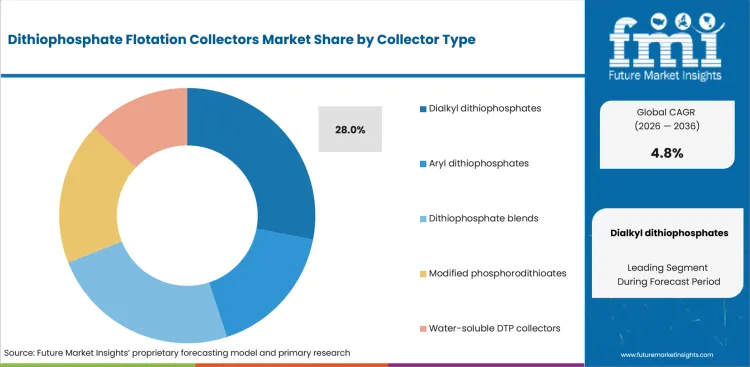
Plant metallurgists use dialkyl dithiophosphates where collector strength needs adjustment without replacing the wider reagent suite. Orica acquired the Danafloat product range in April 2026, adding high-performance dithiophosphate reagents and an existing technical-service base for sulfide ores. The transaction also strengthens competition within beneficiation reagents used for base-metal flotation.
- By collector type, dialkyl dithiophosphates are estimated to hold 28.0% in 2026 due to controllable sulfide affinity and compatibility with mixed collector programs.
- Repeat mine supply matters only after a collector has moved from laboratory adjustment into plant qualification. Orica stated that Danafloat serves copper, zinc and lead recovery with dithiophosphate reagents for qualified mines.
Why do Copper ores lead the Ore type category?
Copper concentrators provide a broad operating base because collectors must balance chalcopyrite recovery with pyrite rejection and impurity control. Chile reported in December 2025 that copper represented 89.8% of its 2025-2034 mining investment portfolio, including new concentrator projects. Those projects give copper processing reagents new qualification points before commissioning.
- Copper ores are projected to hold 32.0% of ore type demand in 2026, supported by high reagent throughput and frequent chemistry adjustment at large sulfide concentrators.
- New concentrator lines and brownfield expansions require collector trials against the project ore before operators lock dosage, recovery targets and concentrate specifications.
How does Strong sulfide collection shape the Selectivity category?
Rougher and scavenger stages accept stronger collection when valuable-mineral losses would otherwise rise under leaner or more variable feed. BASF announced in May 2025 that it was intensifying flotation research and formulation work within its mining solutions program. That work broadens the safer reagent alternatives available for sulfide circuits that need recovery without uncontrolled gangue pull.
- In 2026, strong sulfide collectors are expected to lead selectivity with 34.0% share owing to recovery priorities in rougher and scavenger duties.
- The commercial test is not nominal collecting strength alone. Mines compare grade loss, froth behavior and downstream cleaning burden before a stronger formulation enters routine use.
What supports base Metal concentrators within the End use category?
Base-metal concentrators consume collector with processed ore, so revenue follows throughput after a formulation clears metallurgical approval. Natural Resources Canada reported in 2026 that Canadian mines produced 514,582 tonnes of copper in concentrate during 2024. That installed processing base sustains repeat orders for qualified reagent chemistries that retain site approval under local plant conditions.
- By end use, base metal concentrators are forecast to represent 56.0% in 2026 driven by continuous reagent consumption in copper, lead-zinc and nickel flotation circuits.
- Large concentrators keep procurement behind metallurgical approval because a lower reagent price loses value if dosage rises or concentrate specifications become harder to hold.
What are the drivers, restraints and opportunities in the Dithiophosphate Flotation Collectors Market?
Lower ore grades increase recovery pressure, site-specific qualification slows switching, and service-led formulation programs provide the clearest route to new mine contracts.
- Driver: Declining grades and changing sulfide associations increase the cost of losing payable metal during flotation.
- Restraint: Water chemistry and ore variability force laboratory and plant trials before a new collector program receives routine approval.
- Opportunity: Reagent companies can pair site-specific formulation work with local inventory and technical service to shorten conversion from trial to contract.
The main driver is the cost of recovery loss as feed quality changes. USA Geological Survey reporting for 2024 recorded lower ore grades or recovery at several USA copper operations. Mines facing that pressure test reagent changes against recovery, grade and circuit monitoring systems before approving higher routine dosage. Successful trials then convert a metallurgical improvement into repeat collector consumption tied directly to processed ore.
The restraint is qualification risk under the site's actual process water and reagent suite. In December 2025, JOGMEC and CODELCO agreed to develop flotation technology for reducing arsenic impurities in copper raw materials. Their program includes reagent selection because sustainable mining solutions do not remove the recovery-grade trade-off that a new collector must survive. Mines therefore keep laboratory screening and plant trials ahead of routine procurement.
The strongest commercial opening is a formulation program paired with regional technical service and dependable supply. BASF and FUCHS entered an Australian cooperation agreement in June 2025 covering flotation and dewatering solutions. The arrangement gives surface mining operations local customer contact while BASF retains chemistry expertise behind the program. Reagent companies that shorten test response and replenishment time can move qualified formulations into routine contracts faster.
Which country CAGRs are profiled in the Dithiophosphate Flotation Collectors Market?
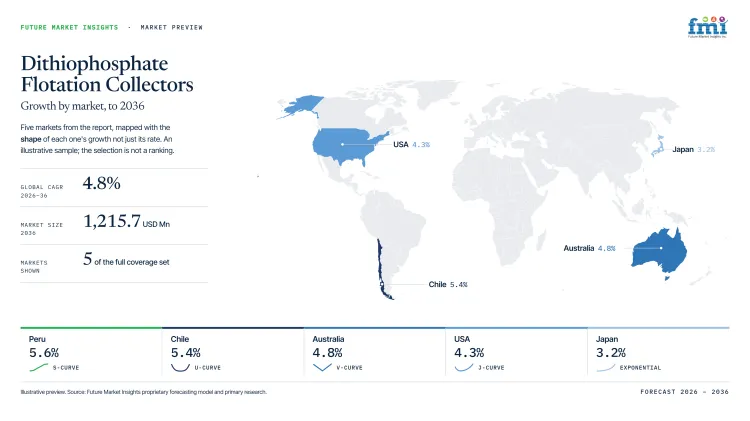
| Country | CAGR |
|---|---|
| Peru | 5.6% |
| Chile | 5.4% |
| Australia | 4.8% |
| USA | 4.3% |
| Japan | 3.2% |
How do country-level CAGRs compare in the Dithiophosphate Flotation Collectors Market?
The profiled range spans 2.4 percentage points from Peru at 5.6% to Japan at 3.2%. Peru and Chile form the upper group because project pipelines reopen reagent specifications more often. Australia and the USA occupy a middle band, where demand depends on concentrators, service depth and ore-specific switching decisions. Japan represents a mature market where standards can slow supplier changes.
- Peru gains more pre-commissioning trials from its large operating copper project pipeline.
- Chile's brownfield mix favors incumbents unless challengers prove plant-level recovery gains.
- Australia places more weight on regional stock because mine sites are remote.
- USA depends on concentrators where incumbent standards often slow switching.
- Japan requires technical validation before plants adopt suppliers.
Similar CAGRs therefore mask different trial timing and service requirements for reagent companies. The full report provides country-level CAGR analysis across North America, Latin America, Europe, East Asia, South Asia, Oceania and the Middle East and Africa.
Country-wise Analysis
- Peruvian concentrators face an active copper and polymetallic project pipeline that repeatedly reopens reagent specifications during engineering, detailed design and brownfield expansion programs. MINEM listed 67 mining investment projects in 19 regions in April 2025, giving local laboratories more opportunities to enter collector trials before commissioning and final reagent specification. Peru is projected to record 5.6% CAGR during the assessment period, attributable to project cadence and experienced metallurgical service near major copper districts. Project schedules remain the commercial friction because laboratory acceptance does not produce routine orders until construction, commissioning and plant-scale recovery targets are settled for each new circuit.
- Chilean copper operations often qualify flotation chemistry inside brownfield programs where incumbent reagents already have years of plant data and operator familiarity. In December 2025, the Ministry of Mining documented that 81% of the 2025-2034 investment portfolio was brownfield, which increases the number of expansion projects without removing switching risk. Existing service networks make plant trials easier to organize at major copper sites, but new formulations must produce measurable recovery or selectivity gains against established practice. Dithiophosphate collector sales in Chile are forecast to expand at 5.4% CAGR by 2036, tied to expansions that reopen specifications before new lines reach steady operation.
- Australian mines run long campaigns at sites far from major chemical production hubs, so inventory coverage influences whether a new reagent program reaches plant scale. The resources minister stated in July 2026 that capital expenditure in the resources and energy sector continued rising, keeping new and expanded metal projects active. Adoption of dithiophosphate flotation collectors in Australia is estimated to expand at 4.8% CAGR through 2036, aided by continuing investment and regional metallurgical expertise near producing districts. Regional warehousing lowers replenishment risk during trials, yet ore-specific qualification remains necessary before an alternative collector can displace a formulation already approved for continuous production.
- U.S. concentrators rely on established copper and base-metal operations where reagent selection depends on plant performance, technical service and ore-specific qualification. Mature processing infrastructure supports repeat collector consumption, while established plant standards can slow formulation changes. Regional application teams and reliable inventory help suppliers troubleshoot recovery performance and validate formulations before broader adoption. U.S. dithiophosphate collector demand is forecast to rise at 4.3% CAGR over the forecast period, supported by recurring consumption from operating concentrators and ongoing optimization of flotation circuits.
- Japanese demand is concentrated in mature mineral-processing operations, where reagent selection emphasizes consistency, technical validation and process reliability. Established plant standards and stringent qualification requirements can extend adoption timelines for alternative formulations. Suppliers with strong technical support can demonstrate performance through controlled plant testing before wider implementation. Japan is estimated to post 3.2% CAGR over the forecast period, reflecting mature infrastructure, limited new mine development and steady reagent consumption from existing processing operations. Demand remains supported by circuit optimization and the need for reliable flotation performance.
Who are the notable companies in the Dithiophosphate Flotation Collectors Market?
BASF SE, Clariant AG, Syensqo SA/NV, Orica Limited, AECI Limited, Nouryon, Nasaco International Ltd., and Quadra Chemicals Ltd. are the notable companies profiled in this market.
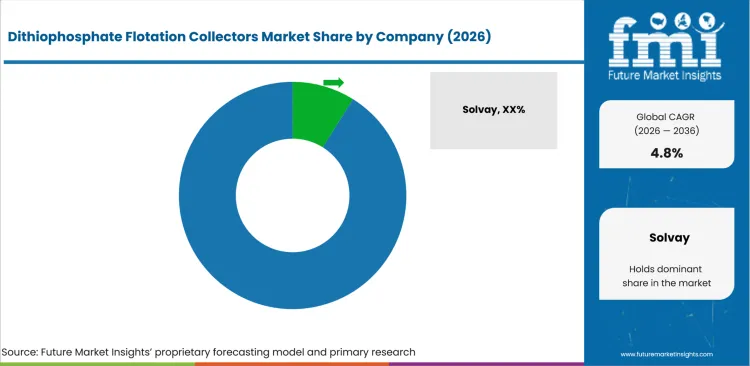
The competitive field separates into direct dithiophosphate positions, broader flotation platforms and regional mine-service models. Orica gained a direct DTP position through Danafloat, and Clariant and Syensqo retain documented sulfide-flotation chemistry. BASF and AECI compete with broader mineral-processing support. Nouryon brings collector research depth, and Nasaco and Quadra strengthen regional access beside copper recycling routes that affect long-run primary metal requirements without replacing mine-site reagent demand.
- Direct dithiophosphate and sulfide-collector platforms: Orica Limited, Clariant AG and Syensqo SA/NV compete through documented collector chemistry and application support.
- Broad mining-chemistry platforms: BASF SE, AECI Limited and Nouryon bring formulation research, mine-site support and wider mineral-processing portfolios.
- Regional supply specialists: Nasaco International Ltd. and Quadra Chemicals Ltd. compete through local inventory, blending access and technical distribution in mining regions.
Competitive Benchmarking: Dithiophosphate Flotation Collectors Market
| Company | Dithiophosphate Portfolio Depth | Sulfide Flotation Application Support | Mine-Site Supply and Formulation Reach | Geographic Reach |
|---|---|---|---|---|
| BASF SE | Medium | High | High | Global |
| Clariant AG | High | High | High | Global |
| Syensqo SA/NV | High | High | High | Global |
| Orica Limited | High | High | High | Global mining regions |
| AECI Limited | Medium | High | High | Africa, Australia, Asia, Europe and South America |
| Nouryon | Medium | Medium | High | Global specialty chemicals footprint |
| Nasaco International Ltd. | High | High | High | Africa, Latin America, Europe and Australia |
| Quadra Chemicals Ltd. | High | Medium | High | North America |
Scoring basis: High portfolio depth requires direct documented dithiophosphate or closely related sulfide-collector breadth. Medium identifies a narrower or adjacent collector position. High application support requires mine-facing flotation testing or optimization evidence and Medium reflects narrower public support. High supply reach requires documented regional service, inventory or formulation access. Low is reserved for a verified limitation rather than missing evidence.
Key Developments in the Dithiophosphate Flotation Collectors Market
- In April 2026, Orica Limited acquired the Danafloat product range from FMC Corporation, giving its Specialty Mining Chemicals business a direct portfolio of dithiophosphate reagents for copper, zinc and lead flotation.
- In June 2025, BASF SE entered a cooperation agreement with FUCHS in Australia, placing BASF flotation and dewatering solutions behind FUCHS customer relationships and local technical service.
- In March 2025, Clariant International Ltd. received European patent EP4399029B1 for collector compositions used in phosphate and lithium flotation, extending its protected collector-chemistry base within mineral processing.
Key Players in the Dithiophosphate Flotation Collectors Market
Direct Dithiophosphate and Sulfide Collector Platforms
- Clariant AG
- Syensqo SA/NV
- Orica Limited
Broad Mining Chemistry Platforms
- BASF SE
- AECI Limited
- Nouryon
Regional Supply and Distribution Specialists
- Nasaco International Ltd.
- Quadra Chemicals Ltd.
Dithiophosphate Flotation Collectors Market - Report Scope
| Coverage field | Report scope |
|---|---|
| Market breakdown | By collector type, ore type, selectivity, end use, sales channel and region. |
| Quantitative Units | USD Million. |
| Market Definition | Commercial dithiophosphate-based flotation collectors and DTP-containing formulations used to recover sulfide minerals within the stated ore, selectivity, end-use and sales-channel boundaries. |
| Regions Covered | North America, Latin America, Europe, East Asia, South Asia and Pacific, and Middle East and Africa. |
| Countries Covered | Peru, Chile, Australia, USA, Japan, and 20+ countries included in the full report. |
| Key Companies Profiled | BASF SE, Clariant AG, Syensqo SA/NV, Orica Limited, AECI Limited, Nouryon, Nasaco International Ltd., and Quadra Chemicals Ltd.. |
| Forecast Period | 2026 to 2036. |
| Approach | Primary and secondary research with market triangulation. |
Dithiophosphate Flotation Collectors Market - Research Methodology
| Method | Approach |
|---|---|
| Primary Research | FMI analysts gathered input from manufacturers, service providers, technology developers, distributors, end users, procurement teams, and subject-matter experts. Interviews examined purchasing decisions, product or service evaluation, adoption barriers, approval requirements, pricing considerations, and expectations for technical or commercial support. Respondents were also asked what evidence is required before a trial, pilot, or initial order develops into regular purchasing. |
| Desk Research | Desk research covered government statistics, regulatory publications, trade data, industry associations, technical literature, standards, company filings, product information, and official corporate announcements. Sources were reviewed for relevance, publication date, geographic coverage, and consistency with the defined market scope. Claims relating to performance, applications, approvals, capacity, investment, and commercial activity were retained only when supported by credible public evidence. |
| Market Sizing and Forecasting | The market model combined the baseline value with historical performance, segment structure, pricing and volume indicators, adoption levels, company participation, and country-level demand conditions. Forecast assumptions considered economic activity, investment trends, regulatory developments, technology adoption, purchasing cycles, supply availability, and barriers to wider market use. Segment and regional estimates were reconciled before the final market total was calculated. |
| Data Validation | Estimates were checked against multiple independent indicators, including public data, company activity, trade patterns, industry developments, and findings from primary interviews. Validation also tested whether products, services, applications, and company revenues fell within the defined market boundaries. Adjacent categories, unsupported claims, overlapping revenues, and activities without direct market relevance were excluded to reduce double counting and maintain consistency across segments and countries. |
Dithiophosphate Flotation Collectors Market by Segments
Dithiophosphate Flotation Collectors Market segmented by Collector Type:
- Dialkyl dithiophosphates
- Aryl dithiophosphates
- Dithiophosphate blends
- Modified phosphorodithioates
- Water-soluble DTP collectors
Dithiophosphate Flotation Collectors Market segmented by Ore Type:
- Copper ores
- Lead-zinc ores
- Gold ores
- Nickel ores
- Complex sulfide ores
Dithiophosphate Flotation Collectors Market segmented by Selectivity:
- Strong sulfide collector
- Selective precious metal collector
- Zinc-activated circuits
- Cleaner-stage collector
Dithiophosphate Flotation Collectors Market segmented by End Use:
- Base metal concentrators
- Precious metal concentrators
- Reagent distributors
- Pilot plants
Dithiophosphate Flotation Collectors Market segmented by Sales Channel:
- Direct mine contracts
- Mining reagent distributors
- Technical service packages
- Regional blending
Dithiophosphate Flotation Collectors Market by Region:
- North America
- United States
- Canada
- Latin America
- Brazil
- Mexico
- Argentina
- Chile
- Western Europe
- Germany
- France
- United Kingdom
- Italy
- Spain
- Benelux
- Nordics
- Eastern Europe
- Poland
- Czech Republic
- Romania
- Hungary
- East Asia
- China
- Japan
- South Korea
- South Asia and Pacific
- India
- ASEAN
- Australia and New Zealand
- Middle East and Africa
- GCC Countries
- South Africa
- Türkiye
- Israel
Research Sources and Bibliography
- USA Geological Survey. (2025, January 31). Mineral commodity summaries 2025.
- Ministerio de Energía y Minas, Peru. (2026, June 17). Cartera de Proyectos de Inversión Minera 2026.
- Orica Limited. (2026, April 17). Orica expands portfolio into copper chemistry with Danafloat acquisition.
- Ministerio de Minería, Chile. (2025, December 11). Cochilco presenta mayor cartera de proyectos mineros en una década por más de US$104.500 millones.
- BASF SE. (2025, May 20). BASF mining solutions strengthens commitment to copper hydrometallurgy and flotation research and development.
- Natural Resources Canada. (2026). Copper facts.
- Japan Organization for Metals and Energy Security. (2025, December 8). Agreement on Cooperation for Technology to Reduce Impurities in Copper Raw Materials with CODELCO.
- BASF SE. (2025, June 18). BASF mining solutions and FUCHS announce cooperation to serve the Australian mining industry.
- Ministerio de Energía y Minas, Peru. (2025, April 28). MINEM: Cartera de Proyectos de Inversión Minera 2025 está compuesta por 67 proyectos.
- Minister for Resources and Northern Australia. (2026, July 3). Australia's resources and energy exports remain strong.
- Statistics South Africa. (2026, February 12). Mining: Production and sales, December 2025.
- Clariant International Ltd. (2025, March 26). EP4399029B1: Composition and method for use of 1-alkyl-5-oxopyrrolidine-3-carboxylic acids as collectors for phosphate and lithium flotation.
- Nouryon Chemicals International B.V. (2025, July 22). US12364990B2: MySx/ZSH mixture as sulfidizing agent.
- Syensqo. (2025, February 18). CN115397802B: Novel foaming agents for mineral recovery and methods of making and using the same.
- AECI Limited. (2025). Our strategy.
- Clariant International Ltd. (2025, September 30). SE547457C2: Novel cationic collectors for improving a process for froth flotation of silicates.
- Molycop. (2025, November 3). Molycop launches OreVia: AI-powered insights for smarter mineral processing.
- Orica Limited. (2025, November 13). Highest earnings in 13 years.
This bibliography is provided for reader reference and is not exhaustive. The full report contains the complete reference list and detailed citations
This Report Answers
- What is the dithiophosphate flotation collectors market size in 2026 and what value is forecast for 2036?
- Which ore-quality and concentrator conditions are raising demand for dithiophosphate flotation collectors?
- Why do dialkyl dithiophosphates hold the leading position within collector type?
- How does copper-ore processing shape collector qualification and repeat purchasing?
- Why do strong sulfide collectors hold the leading selectivity position?
- How do country growth rates differ among Peru, Chile, Australia, South Africa and Canada?
- Which companies provide direct collector chemistry, application support and regional mine-service coverage?
- How does circuit-specific qualification slow switching between collector programs?
- What should plant metallurgists compare before approving a new dithiophosphate flotation collector?
Frequently Asked Questions
How big is the dithiophosphate flotation collectors market in 2026?
The dithiophosphate flotation collectors market is valued at USD 760.7 million in 2026 and is projected to reach USD 1,215.7 million by 2036. Growth follows repeated collector qualification as sulfide concentrators manage lower grades and changing mineral associations.
What is the CAGR of the dithiophosphate flotation collectors market from 2026 to 2036?
The dithiophosphate flotation collectors market is projected to grow at a CAGR of 4.8% between 2026 and 2036. Expansion is supported by copper and polymetallic processing programs that repeatedly test recovery, selectivity and reagent compatibility.
Which collector type leads the dithiophosphate flotation collectors market?
The dialkyl dithiophosphates segment is expected to hold 28.0% of the dithiophosphate flotation collectors market in 2026, attributable to tunable sulfide affinity and compatibility with mixed collector programs. Metallurgists can adjust dosage or blend design without rebuilding the entire reagent suite.
Which end use leads the dithiophosphate flotation collectors market?
The base metal concentrators segment is forecast to represent 56.0% of the dithiophosphate flotation collectors market in 2026, driven by continuous collector consumption at operating plants. Copper, lead-zinc and nickel circuits also provide repeated points for chemistry adjustment as ore conditions change.
Which companies are active in the dithiophosphate flotation collectors market?
Key companies operating in the market include BASF SE, Clariant AG, Syensqo SA/NV, Orica Limited, AECI Limited, Nouryon, Nasaco International Ltd., and Quadra Chemicals Ltd. These companies compete on collector chemistry, flotation testing, regional technical support and mine-site supply coverage.
Preview the report firsthand - request a free sample
Get SampleGet the brochure for pricing and purchase details.
Get PDFTable of Content
- Key Takeaways
- Market Size and CAGR
- Top Growth Driver
- Fastest Growing Segment
- Leading Region
- Key Companies
- Emerging Opportunities
- Executive Summary
- Global Market Outlook
- Demand-side Trends
- Supply-side Trends
- Technology Roadmap Analysis
- Analysis and Recommendations
- Analyst Perspective (What is happening? Why now? What should investors know?)
- Key Questions Answered
- How large is the market?
- What is the CAGR?
- What are key trends?
- Which region dominates?
- Who are the leaders?
- Market Overview
- Market Coverage / Taxonomy
- Market Definition / Scope / Limitations
- Research Methodology
- Chapter Orientation
- Analytical Lens and Working Hypotheses
- Market Structure, Signals, and Trend Drivers
- Benchmarking and Cross-market Comparability
- Market Sizing, Forecasting, and Opportunity Mapping
- Research Design and Evidence Framework
- Desk Research Programme (Secondary Evidence)
- Expert Input and Fieldwork (Primary Evidence)
- Tooling, Models, and Reference Databases
- Data Engineering and Model Build
- Quality Assurance and Audit Trail
- Market Background
- Market Dynamics (Drivers, Restraints, Opportunity, Trends)
- Scenario Forecast (Optimistic, Likely, Conservative)
- Impact Analysis
- AI Impact
- Sustainability Impact
- Regulatory Impact
- Technology Impact
- Consumer / Buyer Analysis
- Purchase Drivers
- Adoption Barriers
- Buyer Journey
- Opportunity Map Analysis
- Product Life Cycle Analysis
- Supply Chain Analysis
- Investment Feasibility Matrix
- Value Chain Analysis
- PESTLE and Porter's Analysis
- Regulatory Landscape
- Regional Parent Market Outlook
- Production and Consumption Statistics
- Import and Export Statistics
- Global Market Analysis and Forecast, 2021 to 2036
- Historical Market Size Value (USD Million) Analysis, 2021 to 2025
- Current and Future Market Size Value (USD Million) Projections, 2026 to 2036
- Y-o-Y Growth Trend Analysis
- Absolute $ Opportunity Analysis
- Global Market Pricing Analysis, 2021 to 2036
- Global Market Analysis and Forecast, By Collector Type, 2021 to 2036
- Introduction / Key Findings
- Historical Market Size Value (USD Million) Analysis By Collector Type, 2021 to 2025
- Current and Future Market Size Value (USD Million) Analysis and Forecast By Collector Type, 2026 to 2036
- Dialkyl dithiophosphates
- Aryl dithiophosphates
- Dithiophosphate blends
- Modified phosphorodithioates
- Water-soluble DTP collectors
- Dialkyl dithiophosphates
- Y-o-Y Growth Trend Analysis By Collector Type, 2021 to 2025
- Absolute $ Opportunity Analysis By Collector Type, 2026 to 2036
- Global Market Analysis and Forecast, By Ore Type, 2021 to 2036
- Introduction / Key Findings
- Historical Market Size Value (USD Million) Analysis By Ore Type, 2021 to 2025
- Current and Future Market Size Value (USD Million) Analysis and Forecast By Ore Type, 2026 to 2036
- Copper ores
- Lead-zinc ores
- Gold ores
- Nickel ores
- Complex sulfide ores
- Copper ores
- Y-o-Y Growth Trend Analysis By Ore Type, 2021 to 2025
- Absolute $ Opportunity Analysis By Ore Type, 2026 to 2036
- Global Market Analysis and Forecast, By Selectivity, 2021 to 2036
- Introduction / Key Findings
- Historical Market Size Value (USD Million) Analysis By Selectivity, 2021 to 2025
- Current and Future Market Size Value (USD Million) Analysis and Forecast By Selectivity, 2026 to 2036
- Strong sulfide collector
- Selective precious metal collector
- Zinc-activated circuits
- Cleaner-stage collector
- Strong sulfide collector
- Y-o-Y Growth Trend Analysis By Selectivity, 2021 to 2025
- Absolute $ Opportunity Analysis By Selectivity, 2026 to 2036
- Global Market Analysis and Forecast, By End Use, 2021 to 2036
- Introduction / Key Findings
- Historical Market Size Value (USD Million) Analysis By End Use, 2021 to 2025
- Current and Future Market Size Value (USD Million) Analysis and Forecast By End Use, 2026 to 2036
- Base metal concentrators
- Precious metal concentrators
- Reagent distributors
- Pilot plants
- Base metal concentrators
- Y-o-Y Growth Trend Analysis By End Use, 2021 to 2025
- Absolute $ Opportunity Analysis By End Use, 2026 to 2036
- Global Market Analysis and Forecast, By Sales Channel, 2021 to 2036
- Introduction / Key Findings
- Historical Market Size Value (USD Million) Analysis By Sales Channel, 2021 to 2025
- Current and Future Market Size Value (USD Million) Analysis and Forecast By Sales Channel, 2026 to 2036
- Direct mine contracts
- Mining reagent distributors
- Technical service packages
- Regional blending
- Direct mine contracts
- Y-o-Y Growth Trend Analysis By Sales Channel, 2021 to 2025
- Absolute $ Opportunity Analysis By Sales Channel, 2026 to 2036
- Global Market Analysis and Forecast, By Region, 2021 to 2036
- Introduction
- Historical Market Size Value (USD Million) Analysis By Region, 2021 to 2025
- Current Market Size Value (USD Million) Analysis and Forecast By Region, 2026 to 2036
- North America
- Latin America
- Western Europe
- Eastern Europe
- East Asia
- South Asia and Pacific
- Middle East & Africa
- Market Attractiveness Analysis By Region
- North America Market Analysis and Forecast, By Country, 2021 to 2036
- Historical Market Size Value (USD Million) Trend Analysis By Market Taxonomy, 2021 to 2025
- Market Size Value (USD Million) Forecast By Market Taxonomy, 2026 to 2036
- By Country
- USA
- Canada
- By Collector Type
- By Ore Type
- By Selectivity
- By End Use
- By Sales Channel
- By Country
- Market Attractiveness Analysis
- By Country
- By Collector Type
- By Ore Type
- By Selectivity
- By End Use
- By Sales Channel
- Key Takeaways
- Latin America Market Analysis and Forecast, By Country
- Historical Market Size Value (USD Million) Trend Analysis By Market Taxonomy, 2021 to 2025
- Market Size Value (USD Million) Forecast By Market Taxonomy, 2026 to 2036
- By Country
- Brazil
- Mexico
- Chile
- Rest of Latin America
- By Collector Type
- By Ore Type
- By Selectivity
- By End Use
- By Sales Channel
- By Country
- Market Attractiveness Analysis
- By Country
- By Collector Type
- By Ore Type
- By Selectivity
- By End Use
- By Sales Channel
- Key Takeaways
- Western Europe Market Analysis and Forecast, By Country
- Historical Market Size Value (USD Million) Trend Analysis By Market Taxonomy, 2021 to 2025
- Market Size Value (USD Million) Forecast By Market Taxonomy, 2026 to 2036
- By Country
- Germany
- UK
- Italy
- Spain
- France
- Nordic
- BENELUX
- Rest of Western Europe
- By Collector Type
- By Ore Type
- By Selectivity
- By End Use
- By Sales Channel
- By Country
- Market Attractiveness Analysis
- By Country
- By Collector Type
- By Ore Type
- By Selectivity
- By End Use
- By Sales Channel
- Key Takeaways
- Eastern Europe Market Analysis and Forecast, By Country
- Historical Market Size Value (USD Million) Trend Analysis By Market Taxonomy, 2021 to 2025
- Market Size Value (USD Million) Forecast By Market Taxonomy, 2026 to 2036
- By Country
- Russia
- Poland
- Hungary
- Balkan & Baltic
- Rest of Eastern Europe
- By Collector Type
- By Ore Type
- By Selectivity
- By End Use
- By Sales Channel
- By Country
- Market Attractiveness Analysis
- By Country
- By Collector Type
- By Ore Type
- By Selectivity
- By End Use
- By Sales Channel
- Key Takeaways
- East Asia Market Analysis and Forecast, By Country
- Historical Market Size Value (USD Million) Trend Analysis By Market Taxonomy, 2021 to 2025
- Market Size Value (USD Million) Forecast By Market Taxonomy, 2026 to 2036
- By Country
- China
- Japan
- South Korea
- By Collector Type
- By Ore Type
- By Selectivity
- By End Use
- By Sales Channel
- By Country
- Market Attractiveness Analysis
- By Country
- By Collector Type
- By Ore Type
- By Selectivity
- By End Use
- By Sales Channel
- Key Takeaways
- South Asia and Pacific Market Analysis and Forecast, By Country
- Historical Market Size Value (USD Million) Trend Analysis By Market Taxonomy, 2021 to 2025
- Market Size Value (USD Million) Forecast By Market Taxonomy, 2026 to 2036
- By Country
- India
- ASEAN
- Australia & New Zealand
- Rest of South Asia and Pacific
- By Collector Type
- By Ore Type
- By Selectivity
- By End Use
- By Sales Channel
- By Country
- Market Attractiveness Analysis
- By Country
- By Collector Type
- By Ore Type
- By Selectivity
- By End Use
- By Sales Channel
- Key Takeaways
- Middle East & Africa Market Analysis and Forecast, By Country
- Historical Market Size Value (USD Million) Trend Analysis By Market Taxonomy, 2021 to 2025
- Market Size Value (USD Million) Forecast By Market Taxonomy, 2026 to 2036
- By Country
- Kingdom of Saudi Arabia
- Other GCC Countries
- Türkiye
- South Africa
- Other African Union
- Rest of Middle East & Africa
- By Collector Type
- By Ore Type
- By Selectivity
- By End Use
- By Sales Channel
- By Country
- Market Attractiveness Analysis
- By Country
- By Collector Type
- By Ore Type
- By Selectivity
- By End Use
- By Sales Channel
- Key Takeaways
- Key Countries Market Analysis
- USA
- Pricing Analysis
- Market Share Analysis, 2025
- By Collector Type
- By Ore Type
- By Selectivity
- By End Use
- By Sales Channel
- Canada
- Pricing Analysis
- Market Share Analysis, 2025
- By Collector Type
- By Ore Type
- By Selectivity
- By End Use
- By Sales Channel
- Mexico
- Pricing Analysis
- Market Share Analysis, 2025
- By Collector Type
- By Ore Type
- By Selectivity
- By End Use
- By Sales Channel
- Brazil
- Pricing Analysis
- Market Share Analysis, 2025
- By Collector Type
- By Ore Type
- By Selectivity
- By End Use
- By Sales Channel
- Chile
- Pricing Analysis
- Market Share Analysis, 2025
- By Collector Type
- By Ore Type
- By Selectivity
- By End Use
- By Sales Channel
- Germany
- Pricing Analysis
- Market Share Analysis, 2025
- By Collector Type
- By Ore Type
- By Selectivity
- By End Use
- By Sales Channel
- UK
- Pricing Analysis
- Market Share Analysis, 2025
- By Collector Type
- By Ore Type
- By Selectivity
- By End Use
- By Sales Channel
- Italy
- Pricing Analysis
- Market Share Analysis, 2025
- By Collector Type
- By Ore Type
- By Selectivity
- By End Use
- By Sales Channel
- Spain
- Pricing Analysis
- Market Share Analysis, 2025
- By Collector Type
- By Ore Type
- By Selectivity
- By End Use
- By Sales Channel
- France
- Pricing Analysis
- Market Share Analysis, 2025
- By Collector Type
- By Ore Type
- By Selectivity
- By End Use
- By Sales Channel
- India
- Pricing Analysis
- Market Share Analysis, 2025
- By Collector Type
- By Ore Type
- By Selectivity
- By End Use
- By Sales Channel
- ASEAN
- Pricing Analysis
- Market Share Analysis, 2025
- By Collector Type
- By Ore Type
- By Selectivity
- By End Use
- By Sales Channel
- Australia & New Zealand
- Pricing Analysis
- Market Share Analysis, 2025
- By Collector Type
- By Ore Type
- By Selectivity
- By End Use
- By Sales Channel
- China
- Pricing Analysis
- Market Share Analysis, 2025
- By Collector Type
- By Ore Type
- By Selectivity
- By End Use
- By Sales Channel
- Japan
- Pricing Analysis
- Market Share Analysis, 2025
- By Collector Type
- By Ore Type
- By Selectivity
- By End Use
- By Sales Channel
- South Korea
- Pricing Analysis
- Market Share Analysis, 2025
- By Collector Type
- By Ore Type
- By Selectivity
- By End Use
- By Sales Channel
- Russia
- Pricing Analysis
- Market Share Analysis, 2025
- By Collector Type
- By Ore Type
- By Selectivity
- By End Use
- By Sales Channel
- Poland
- Pricing Analysis
- Market Share Analysis, 2025
- By Collector Type
- By Ore Type
- By Selectivity
- By End Use
- By Sales Channel
- Hungary
- Pricing Analysis
- Market Share Analysis, 2025
- By Collector Type
- By Ore Type
- By Selectivity
- By End Use
- By Sales Channel
- Kingdom of Saudi Arabia
- Pricing Analysis
- Market Share Analysis, 2025
- By Collector Type
- By Ore Type
- By Selectivity
- By End Use
- By Sales Channel
- Türkiye
- Pricing Analysis
- Market Share Analysis, 2025
- By Collector Type
- By Ore Type
- By Selectivity
- By End Use
- By Sales Channel
- South Africa
- Pricing Analysis
- Market Share Analysis, 2025
- By Collector Type
- By Ore Type
- By Selectivity
- By End Use
- By Sales Channel
- USA
- Market Structure Analysis
- Competition Dashboard
- Competition Benchmarking
- Market Share Analysis of Top Players
- By Regional
- By Collector Type
- By Ore Type
- By Selectivity
- By End Use
- By Sales Channel
- Emerging Startups
- Innovation Benchmarking
- Competition Analysis
- Competition Deep Dive
- Solvay
- Overview
- Product Portfolio
- Profitability by Market Segments
- Sales Footprint
- Strategy Overview
- Marketing Strategy
- Product Strategy
- Channel Strategy
- Nouryon
- Orica
- Clariant
- Senmin
- Axis House
- Nasaco
- Coogee Chemicals
- Quadra Chemicals
- Kemcore
- Solvay
- Case Studies
- Success Stories
- Recent Developments
- Competition Deep Dive
- Assumptions & Acronyms Used


