

- Market Size (2026)
- USD 760.6 Mn
- Forecast (2036)
- USD 1227.2 Mn
- CAGR (2026 to 2036)
- 4.9%
How big is CMC Flotation Depressants Market in 2026?
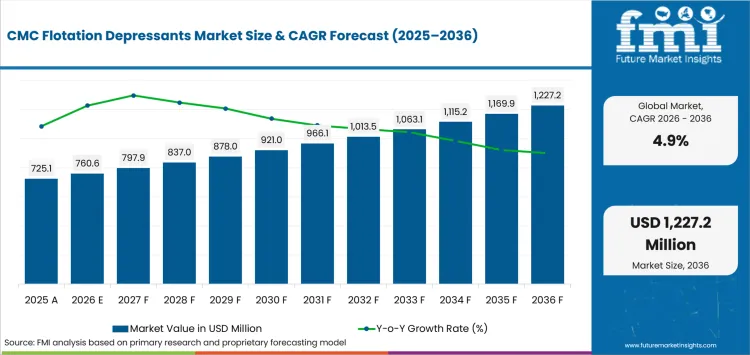
USD 760.6 million in 2026 and USD 1,227.2 million by 2036 at a 4.9% CAGR.
Sales in the CMC flotation depressants market is projected to rise from USD 760.6 million in 2026 to USD 1,227.2 million by 2036 at a 4.9% CAGR. Demand is attributable to mineral-processing operations that must maintain separation efficiency as ore characteristics become more challenging. The IEA stated in July 2026 that copper has the largest critical-mineral volume increase with about 7 million tonnes added through 2040. Lower-grade feed raises gangue tonnage per unit of saleable metal which gives concentrators stronger reasons to protect recovery during flotation.
Country demand varies with mine density because each operating circuit represents a separate qualification opportunity for depressant grades. Geoscience Australia's December 2025 tables listed 24 operating copper mines for 2024, giving reagent companies a broad domestic base for plant trials. Ore mineralogy and service distance still determine whether a successful trial develops into a repeat purchase under routine operating conditions.
Key Takeaways
- Copper and nickel concentrators purchase CMC depressants to protect recovery and concentrate grade as lower ore grades increase the amount of gangue handled during flotation.
- By CMC grade, technical CMC is estimated to hold 31.0% in 2026 owing to its cost-performance fit for repeated concentrator dosing and qualification work.
- In 2026, copper-nickel ores are expected to lead ore type with 25.0% share because sulfide circuits repeatedly require talc and silicate control during concentrate upgrading.
- Gangue depression is set to lead the function category with 32.0% share in 2026 due to its direct role in limiting unwanted minerals entering saleable concentrate.
- Ore-specific adsorption and process-water chemistry delay grade changes since a cheaper CMC loses its economic advantage if valuable-mineral recovery falls during qualification.
- Some of the key players in this market include Nouryon, Lamberti, Química Amtex, Zibo Hondo Chemical, SINOCMC, Landoil Chemical Group, Ashland, and Nippon Paper Industries.
Analyst Perspective
"CMC depressant qualification starts with the gangue species and process-water chemistry that limit concentrate grade under normal plant conditions. The stronger offer holds copper or nickel recovery through repeat plant runs and controls dosage, dissolution time and replenishment risk."
- Nikhil Kaitwade, Principal Consultant, Future Market Insights
How is the CMC flotation depressants market segmented?
The CMC flotation depressants market is segmented by CMC grade, ore type, function, end use, sales channel and region.
CMC grades include technical, high-viscosity, low-viscosity, high-purity and modified CMC blends. Ore type covers copper-nickel, potash, phosphate, talc-bearing and graphite ores. Functions are gangue depression, talc depression, slime control, selectivity improvement and froth stabilization support. End use covers mining concentrators, industrial mineral plants, reagent distributors and research/pilot plants. Sales channels cover direct mine supply, specialty cellulose suppliers, mining chemical distributors and regional formulators.
Why does direct mine supply lead the sales channel category?
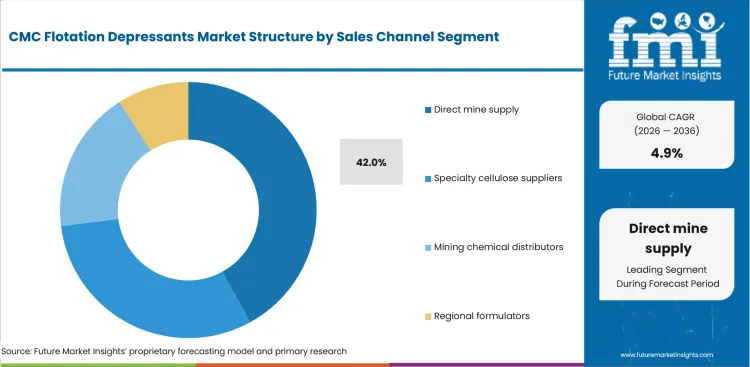
Mine operators rarely treat flotation depressants as interchangeable catalogue chemicals because every circuit exposes different recovery and dosage trade-offs. Direct supply keeps troubleshooting and replenishment tied to the site that approved a specific grade during routine plant optimization programs.
- Direct mine supply is forecast to account for 42.0% of sales channel demand in 2026 because routine purchasing follows site-specific plant qualification.
- Kemira mapped mine operators to direct sales in its April 2025 investor presentation alongside distributor and service-company routes. The structure shows why technically qualified chemicals often stay close to the supplier after operating-scale approval.
Why do mining concentrators lead demand within the end use category?
Mining concentrators consume depressants repeatedly and maintain laboratories that compare dosage against recovery ahead of full-scale approval. Natural Resources Canada reported in January 2026 that domestic mine copper production rose 6.2% during 2024, keeping an operating base available for plant qualification. Daily balances from mineral processing equipment expose reagent inconsistency faster than occasional end-product testing.
- In 2026, mining concentrators are expected to lead end use with 61.0% share because full-scale flotation generates repeat reagent demand and maintains on-site test capacity continuously.
- Full-scale trials reveal dissolution or recovery problems that bench tests can miss, so on-site metallurgical teams control final grade approval before routine purchasing begins.
Why does technical CMC lead demand within the CMC grade category?
Technical CMC gives mine metallurgists a workable cost and viscosity range for routine reagent preparation under site water chemistry. Current carboxymethyl cellulose demand depends on repeatable dissolution and adsorption, so higher purity earns a premium only when flotation tests justify it.
- Based on CMC grade, technical CMC is projected to account for 31.0% in 2026 due to its cost-performance fit for repeated concentrator dosing and qualification work.
- Lamberti Hydrocolloids received ISO 9001 certification in May 2025, giving cellulose ether derivatives customers quality-system evidence for consistency. Separate flotation trials remain necessary because certification does not establish ore-specific selectivity under a concentrator's actual process conditions.
Why do copper-nickel ores lead demand within the ore type category?
Copper-nickel sulfide circuits often contain talc or related silicates that float with valuable minerals and reduce concentrate grade. The IEA projected copper demand at 34.1 million tonnes in 2040 from 26.7 million tonnes in 2024, keeping recovery protection important for nickel mining as mines process feed.
- By ore type, copper-nickel ores are forecast to represent 25.0% in 2026 driven by repeated selective-depression work in complex sulfide flotation circuits routinely.
- Plant metallurgists compare mining flotation chemicals after ore testing confirms that gangue can be suppressed without materially reducing copper or nickel recovery. The test result then determines dosage and purchasing approval under the operating reagent scheme.
Why does gangue depression lead demand within the function category?
Gangue depression targets floatable silicates and entrained fines that lower concentrate quality ahead of downstream treatment. CMC adsorbs on selected unwanted mineral surfaces, allowing flotation reagents to preserve valuable-mineral response under the selected reagent scheme.
- The gangue depression segment is likely to capture 32.0% share in 2026 attributable to its direct role in stopping unwanted mineral recovery before concentrate treatment.
- The IEA documented in March 2026 that average global copper mine grades had fallen 40% since 1991. Lower grades increase the mass of gangue handled by beneficiation reagents and raise the commercial penalty for poor selectivity.
What are the drivers, restraints and opportunities in the CMC Flotation Depressants Market?
Lower ore grades increase the value of selective gangue control, but site-specific qualification slows switching and mine-focused technical service provides the clearest route to repeat orders.
- Driver: Lower ore grades increase the economic value of CMC grades that reject gangue without sacrificing recovery of saleable minerals.
- Restraint: Polymer properties and plant water chemistry alter adsorption behavior, so each grade must prove selectivity before a mine accepts a grade change.
- Opportunity: Companies with formulation laboratories can match viscosity and substitution characteristics to ore conditions before supporting controlled plant-scale qualification.
Lower ore grades raise the value of selective depression
Lower ore grades put more gangue through each concentrator and raise the cost of poor selectivity ahead of downstream treatment. In May 2025, the IEA projected a 30% copper mine-supply shortfall for 2035 from the announced project pipeline. Existing concentrators therefore have stronger reasons to protect recovery from processed ore instead of assuming new mine supply will satisfy future demand.
Qualification work slows low-cost supplier switching
CMC performance changes between flotation circuits because molecular weight and substitution affect adsorption under each reagent scheme. A grade change therefore needs controlled plant trials because higher project costs make recovery losses more expensive. The IEA documented in March 2026 that brownfield copper-project capital intensity had increased 65% since 2020, reinforcing the penalty attached to poorly controlled changes.
Mine-specific testing converts technical need into repeat orders
Application laboratories let cellulose producers screen specialty chemicals against customer ore ahead of routine deliveries. The IEA noted in July 2026 that investment by copper-focused companies increased 8% during 2025. Mine spending does not guarantee CMC adoption because each circuit requires technical qualification. Faster testing becomes more valuable during project evaluation of supported grades against commodity offers.
Which country CAGRs are profiled in the CMC Flotation Depressants Market?
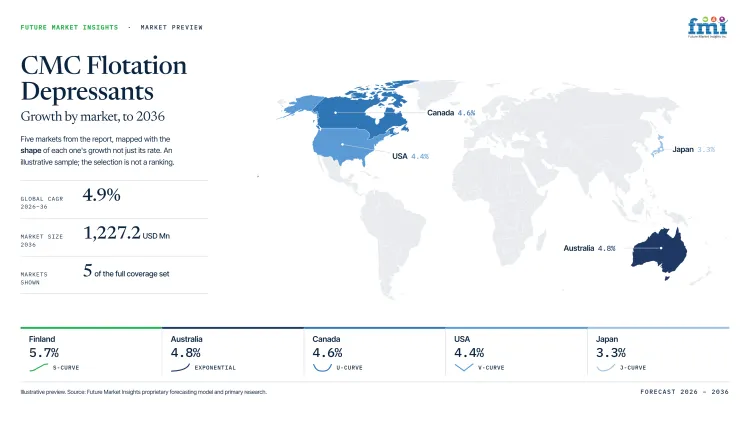
| Country | CAGR |
|---|---|
| Finland | 5.7% |
| Brazil | 5.0% |
| Australia | 4.8% |
| South Africa | 4.7% |
| Canada | 4.6% |
| USA | 4.4% |
| Japan | 3.3% |
How do country-level CAGRs compare in the CMC Flotation Depressants Market?
The forecasts span 2.4 percentage points from Finland at 5.7% CAGR to Japan at 3.3% through 2036. Finland and Brazil lead because active mine networks create repeated qualification opportunities under operating concentrator programs. Australia and South Africa form the next group while Canada and USA remain close behind under different service conditions. Japan grows more slowly because local demand depends more on reagent development and overseas project qualification than domestic mine density.
- Finland's compact mine base shortens field travel between concentrators and lowers the service burden during repeated reagent qualification.
- Brazil's long mineral corridors increase the value of regional inventory once qualified depressant grades enter routine mine purchasing.
- Australian concentrators monetize small recovery changes quickly which weakens reagent price as the only qualification criterion during trials.
- South African base-metal circuits create plant-trial opportunities but regional stock remains important after successful reagent qualification.
- Canada's dispersed copper and nickel operations require regional technical coverage before laboratory results become routine site orders.
- USA distribution depth gives concentrators more sourcing routes while broad geography still raises specialized field-support costs.
- Japan contributes reagent-development expertise even though limited domestic mine density keeps local volume below other profiled countries.
Forecast gaps still conceal different order frequency and field-service economics between operating mine networks and reagent-development centers. The full report provides country-level CAGR analysis across North America, Latin America, Europe, East Asia, South Asia, Oceania and the Middle East and Africa.
Country-wise Analysis
- Kevitsa and Siilinjärvi operate within a compact Finnish mine network that lets technical teams reach several concentrators without continent-scale travel. Finland's cmc flotation depressants outlook is anticipated to advance at 5.7% CAGR over the assessment period, supported by copper-nickel and phosphate operations requiring selective gangue control. The Finnish Government documented 22 companies extracting at 44 mines in March 2025, confirming a dense domestic operating base. Short service distances lower trial costs, yet rigorous approval cycles still require reproducible recovery data before a grade change. Companies with local laboratories can use Finland's industrial phosphates activity to extend application support without treating one mineral system as interchangeable with another.
- Brazilian concentrators operate along long mineral corridors, making local inventory valuable once a depressant trial enters routine use. Local formulators can shorten replenishment near major copper districts, but ore and process-water differences prevent one grade from transferring cleanly between sites. By 2036, Brazil is projected to grow at 5.0% CAGR, given its broad mineral-processing footprint and need for regional reagent coverage. In January 2026, the National Mining Agency stated that copper's share of mining royalties increased from 5.5% to 7.8% during 2025. Market entry works best with stock near mining districts plus laboratory evidence that dosage protects recovery under each site's water chemistry.
- Australian concentrators face long service distances, so a reagent saving can disappear if remote sites wait for troubleshooting or replacement inventory. Geoscience Australia's December 2025 tables recorded 24 operating copper mines for 2024, giving technical teams many potential trial locations. Regional application support lowers downtime during trial adjustments, although travel and inventory costs remain material outside established service hubs. Adoption of cmc flotation depressants in Australia is estimated to expand at 4.8% CAGR through 2036, reflecting the size of its domestic processing base. The same service constraint affects graphite circuits because pilot work still requires local technical follow-up before a new grade enters routine use.
- South African concentrators process several mineral systems that require reagent programs to be validated against changing ore composition and plant water. South Africa is projected to expand at 4.7% CAGR through 2036 because active base-metal circuits provide repeated plant-trial opportunities for flotation polymers. Statistics South Africa reported in February 2026 that copper mineral sales were 52.1% higher year on year during December 2025. Nickel mineral sales moved 7.5% lower over the same period which shows how operating conditions can diverge between adjacent base-metal circuits. That divergence keeps dosage and selectivity testing close to each operating circuit before routine purchasing develops at commercial scale.
- British Columbia supplied 48.3% of Canada's copper output in 2024 according to Natural Resources Canada data published in January 2026. The concentration gives reagent companies a clear western service base, but other provinces still require separate inventory and technical coverage. The Canada CMC flotation depressants sector is projected to record 4.6% CAGR during the assessment period, tied to an active base-metal processing network. Winter logistics and long interprovincial distances can extend field support after laboratory screening for copper and nickel concentrators. Stock near major mining districts lets a company respond faster than one centralized team trying to cover every province from a single location.
- Porphyry copper circuits in Arizona process large tonnage under water constraints that enter reagent preparation and flotation testing directly. CMC flotation depressant sales in the USA are forecast to expand at 4.4% CAGR by 2036, aided by broad beneficiation capacity and continuing mine investment. Water availability is a local friction because polymer performance must be checked under the process water used during routine flotation. The USA Geological Survey documented in April 2026 that Arizona accounted for more than 70% of domestic copper output during 2024. Southwest mine concentration gives technical teams a clear service cluster, and drought keeps water management central during depressant qualification.
- Japan has limited domestic mine density but retains technical relevance through copper-processing research linked to overseas resource supply. CMC flotation depressant demand in Japan is forecast to grow at 3.3% CAGR through 2036 because reagent expertise still supports impurity-control development and specialty formulation. JOGMEC announced a December 2025 cooperation agreement with CODELCO covering technology that reduces impurities in copper raw materials. The cooperation includes flotation technology built around reagent selection which keeps specialty chemical expertise relevant to impurity-control development programs. Repeat orders therefore depend more on overseas project qualification and technical collaboration than on Japan's comparatively limited domestic concentrator count.
Who are the notable companies in the CMC Flotation Depressants Market?
Nouryon, Lamberti, Química Amtex, Zibo Hondo Chemical, SINOCMC, Landoil Chemical Group, Ashland and Nippon Paper Industries are the notable companies serving this market.
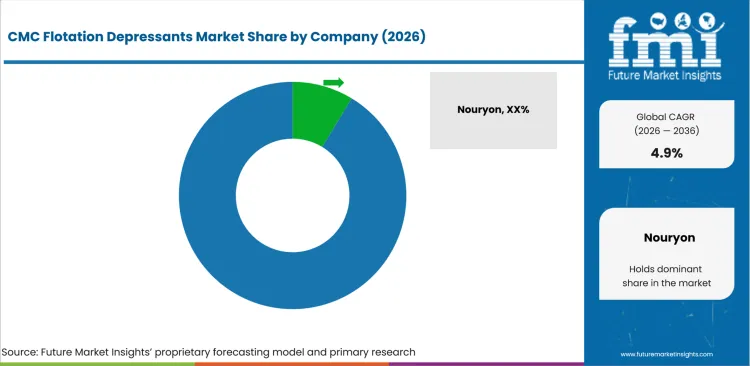
Competition is split between mine-focused cellulose specialists and broader CMC manufacturers whose public flotation evidence varies widely. Entry requires reproducible grade chemistry plus access to concentrator trials because product breadth alone does not establish mine-site performance. Remote mines also favor companies that can replenish qualified material and troubleshoot applications without long service delays.
- Nouryon and Lamberti have the strongest mine-focused positions based on flotation-specific cellulose programs plus laboratory and application resources.
- Química Amtex, Zibo Hondo Chemical and SINOCMC manufacture mining-grade CMC with documented mineral-processing applications and international sales coverage.
- Landoil Chemical Group supplies mining-grade cellulose internationally, while Ashland and Nippon Paper Industries operate broader CMC businesses with adjacent industrial relevance.
Competitive Benchmarking: CMC Flotation Depressants Market
| Company | Mining CMC Specificity | CMC Grade Breadth | Application Support Depth | Geographic Reach |
|---|---|---|---|---|
| Nouryon | High | High | High | Global |
| Lamberti | High | High | High | Global |
| Química Amtex | Medium | High | Medium | Americas, Asia and selected European markets |
| Zibo Hondo Chemical | High | Medium | Medium | International |
| SINOCMC | High | High | Medium | Asia, Americas, Middle East and Africa |
| Landoil Chemical Group | Medium | High | Medium | International |
| Ashland | Low | High | Medium | Global |
| Nippon Paper Industries | Low | High | Medium | Asia and Europe |
Scoring basis: High mining CMC specificity requires official flotation-depressant evidence naming an ore or gangue system. Medium covers documented mineral-processing use, and Low identifies a broader industrial CMC position with only adjacent mining evidence. High grade breadth requires three documented CMC routes, Medium requires two routes and Low requires one route. High application support requires mine-laboratory or customer-ore testing, Medium requires documented technical assistance and Low identifies standard commercial support.
Key Developments in the CMC Flotation Depressants Market
- In November 2025, Nouryon opened a Shanghai innovation center with a Natural Resources laboratory that explicitly supports mining applications.
- In November 2025, Ashland reported completion of its fiscal 2025 Portfolio Optimization program, which included CMC and methylcellulose product-line rationalizations.
- In May 2025, Nippon Paper Industries completed a new Hungary factory for its SUNROSE carboxymethyl cellulose platform.
Key Players in the CMC Flotation Depressants Market
Mine-Focused CMC and Depressant Platforms
- Nouryon
- Lamberti
Mining-Grade CMC Manufacturers
- Química Amtex
- Zibo Hondo Chemical
- SINOCMC
Broader CMC and Regional Cellulose Platforms
- Landoil Chemical Group
- Ashland
- Nippon Paper Industries
CMC Flotation Depressants Market - Report Scope
| Coverage field | Report scope |
|---|---|
| Market breakdown | By CMC grade, ore type, function, end use, sales channel and region. |
| Quantitative Units | USD million. |
| Market Definition | Revenue from carboxymethyl cellulose sold specifically for use as flotation depressants within the stated segmentation universe. The scope excludes non-flotation CMC uses, non-CMC depressants, collectors, frothers and downstream mineral value. |
| Regions Covered | North America, Latin America, Western Europe, Eastern Europe, East Asia, South Asia and Pacific and Middle East and Africa. |
| Countries Covered | Finland, Brazil, Australia, South Africa, Canada, USA, Japan, and 20+ countries included in the full report. |
| Key Companies Profiled | Nouryon, Lamberti, Química Amtex, Zibo Hondo Chemical, SINOCMC, Landoil Chemical Group, Ashland, Nippon Paper Industries. |
| Forecast Period | 2026 to 2036. |
| Approach | Primary and secondary research with market triangulation. |
CMC Flotation Depressants Market - Research Methodology
| Method | Approach |
|---|---|
| Primary Research | FMI analysts gathered input from manufacturers, service providers, technology developers, distributors, end users, procurement teams, and subject-matter experts. Interviews examined purchasing decisions, product or service evaluation, adoption barriers, approval requirements, pricing considerations, and expectations for technical or commercial support. Respondents were also asked what evidence is required before a trial, pilot, or initial order develops into regular purchasing. |
| Desk Research | Desk research covered government statistics, regulatory publications, trade data, industry associations, technical literature, standards, company filings, product information, and official corporate announcements. Sources were reviewed for relevance, publication date, geographic coverage, and consistency with the defined market scope. Claims relating to performance, applications, approvals, capacity, investment, and commercial activity were retained only when supported by credible public evidence. |
| Market Sizing and Forecasting | The market model combined the baseline value with historical performance, segment structure, pricing and volume indicators, adoption levels, company participation, and country-level demand conditions. Forecast assumptions considered economic activity, investment trends, regulatory developments, technology adoption, purchasing cycles, supply availability, and barriers to wider market use. Segment and regional estimates were reconciled before the final market total was calculated. |
| Data Validation | Estimates were checked against multiple independent indicators, including public data, company activity, trade patterns, industry developments, and findings from primary interviews. Validation also tested whether products, services, applications, and company revenues fell within the defined market boundaries. Adjacent categories, unsupported claims, overlapping revenues, and activities without direct market relevance were excluded to reduce double counting and maintain consistency across segments and countries. |
CMC Flotation Depressants Market by Segments
CMC Flotation Depressants Market segmented by CMC Grade:
- Technical CMC
- High-viscosity CMC
- Low-viscosity CMC
- High-purity CMC
- Modified CMC blends
CMC Flotation Depressants Market segmented by Ore Type:
- Copper-nickel ores
- Potash ores
- Phosphate ores
- Talc-bearing ores
- Graphite ores
CMC Flotation Depressants Market segmented by Function:
- Gangue depression
- Talc depression
- Slime control
- Selectivity improvement
- Froth stabilization support
CMC Flotation Depressants Market segmented by End Use:
- Mining concentrators
- Industrial mineral plants
- Reagent distributors
- Research/pilot plants
CMC Flotation Depressants Market segmented by Sales Channel:
- Direct mine supply
- Specialty cellulose suppliers
- Mining chemical distributors
- Regional formulators
CMC Flotation Depressants Market by Region:
- North America
- United States
- Canada
- Latin America
- Brazil
- Mexico
- Argentina
- Chile
- Western Europe
- Germany
- France
- United Kingdom
- Italy
- Spain
- Benelux
- Nordics
- Eastern Europe
- Poland
- Czech Republic
- Romania
- Hungary
- East Asia
- China
- Japan
- South Korea
- South Asia and Pacific
- India
- ASEAN
- Australia and New Zealand
- Middle East and Africa
- GCC Countries
- South Africa
- Türkiye
- Israel
Research Sources and Bibliography
- International Energy Agency. (2026, July 16). Global Critical Minerals Outlook 2026.
- Geoscience Australia. (2025, December 10). 2025 Preliminary Tables.
- Lamberti Group. (2025, May 8). Downloads | Surfactants - Lamberti Group.
- International Energy Agency. (2025, May 21). Copper.
- International Energy Agency. (2026, March 2). Copper prices have hit record highs, but smelters face mounting strategic pressures.
- Natural Resources Canada. (2026, January). Copper facts.
- International Energy Agency. (2025, May 21). Overview of outlook for key minerals.
- International Energy Agency. (2026, July 16). Market overview.
- Finnish Government. (2025, March 28). Mineral exploration decreased, mining investments increased.
- Agência Nacional de Mineração. (2026, January 20). Quase R$ 8 bilhões arrecadados com royalties da mineração em 2025.
- USA Geological Survey. (2026, April 16). Copper mining, critical minerals, and long-term drought in the Southwest United States.
- Nouryon. (2025, November 10). Nouryon opens new innovation center in Shanghai.
- Nippon Paper Industries Co., Ltd. (2025, May 19). Ceremony Held in Hungary to Mark the Completion of New LiB CMC Factory.
- Lamberti Group. Mining & Bentonite: Depressants for Froth Flotation. Retrieved August 28, 2026.
- Lamberti Group. (2025, July 7). ISO 50001: More Than a Certificate.
- Química Amtex. Certifications and Standards. Retrieved August 28, 2026.
- Química Amtex. Our Company. Retrieved August 28, 2026.
- Zibo Hondo Chemical. (2026, March 11). CMC For Mining: Applications in Flotation And Mineral Processing.
- SINOCMC. (2026, June 12). Application of CMC in Mining Flotation Industry.
- Landoil Chemical Group. PAC & CMC | Cellulose Ether Manufacturer | About Landoil. Retrieved August 28, 2026.
- Ashland Inc. (2025, November 4). Ashland reports fourth quarter fiscal 2025 results and issues outlook for full-year 2026.
- Ashland Inc. (2025, July 8). Ashland advances strategic $60MM network optimization.
- Nouryon. (2026, February 2). Nouryon launches industry's first 100% biobased, biodegradable carboxymethylcellulose for laundry detergents.
- Daicel Corporation. (2026, January 16). Announcement of ISCC PLUS Certification.
- Kemira. (2025, April 25). Q1 2025 investor presentation.
- Statistics South Africa. (2026, February). Mining: Production and sales, December 2025.
- Japan Organization for Metals and Energy Security. (2025, December 8). Agreement on cooperation for technology to reduce impurities in copper raw materials with CODELCO.
This bibliography is provided for reader reference and is not exhaustive. The full report contains the complete reference list and detailed citations.
This Report Answers
- What is the CMC flotation depressants market size in 2026 and 2036?
- What operating conditions increase demand for CMC depressants in flotation circuits?
- Why does technical CMC lead the CMC grade category?
- Why do copper-nickel ores lead the ore type category?
- Why does gangue depression lead the function category in 2026?
- What slows supplier switching after a CMC depressant passes laboratory testing?
- How do the seven profiled countries differ in forecast growth and buying conditions?
- Which companies have the strongest documented mining or flotation positions?
- What evidence should concentrators compare before approving a new CMC depressant grade?
Frequently Asked Questions
How big is the CMC flotation depressants market in 2026?
The CMC flotation depressants market is valued at USD 760.6 million in 2026 and is projected to reach USD 1,227.2 million by 2036. Growth follows concentrator demand for selective gangue control that protects valuable-mineral recovery as ore quality declines.
What is the CAGR of the CMC flotation depressants market from 2026 to 2036?
The CMC flotation depressants market is projected to grow at a CAGR of 4.9% between 2026 and 2036. Expansion follows continuing mineral-processing demand and tighter recovery economics as average copper ore grades decline.
Which CMC grade leads the CMC flotation depressants market?
The technical CMC segment is expected to hold 31.0% of the CMC flotation depressants market in 2026, driven by workable viscosity and cost for routine dosing. Consistent batch performance supports repeat purchasing after the grade passes mine-site qualification under actual plant water chemistry.
Which ore type holds another leading share in the CMC flotation depressants market?
The copper-nickel ores segment is expected to hold 25.0% of the CMC flotation depressants market in 2026, supported by repeated talc and silicate control in sulfide flotation. Selective depression protects concentrate grade without sacrificing saleable copper or nickel recovery.
Which companies are active in the CMC flotation depressants market?
Key companies operating in the CMC flotation depressants market include Nouryon, Lamberti, Química Amtex, Zibo Hondo Chemical, SINOCMC, Landoil Chemical Group, Ashland, and Nippon Paper Industries. Their positions span mine-focused application support, CMC manufacturing and broader cellulose supply.
Preview the report firsthand - request a free sample
Get SampleGet the brochure for pricing and purchase details.
Get PDFTable of Content
- Key Takeaways
- Market Size and CAGR
- Top Growth Driver
- Fastest Growing Segment
- Leading Region
- Key Companies
- Emerging Opportunities
- Executive Summary
- Global Market Outlook
- Demand-side Trends
- Supply-side Trends
- Technology Roadmap Analysis
- Analysis and Recommendations
- Analyst Perspective (What is happening? Why now? What should investors know?)
- Key Questions Answered
- How large is the market?
- What is the CAGR?
- What are key trends?
- Which region dominates?
- Who are the leaders?
- Market Overview
- Market Coverage / Taxonomy
- Market Definition / Scope / Limitations
- Research Methodology
- Chapter Orientation
- Analytical Lens and Working Hypotheses
- Market Structure, Signals, and Trend Drivers
- Benchmarking and Cross-market Comparability
- Market Sizing, Forecasting, and Opportunity Mapping
- Research Design and Evidence Framework
- Desk Research Programme (Secondary Evidence)
- Expert Input and Fieldwork (Primary Evidence)
- Tooling, Models, and Reference Databases
- Data Engineering and Model Build
- Quality Assurance and Audit Trail
- Market Background
- Market Dynamics (Drivers, Restraints, Opportunity, Trends)
- Scenario Forecast (Optimistic, Likely, Conservative)
- Impact Analysis
- AI Impact
- Sustainability Impact
- Regulatory Impact
- Technology Impact
- Consumer / Buyer Analysis
- Purchase Drivers
- Adoption Barriers
- Buyer Journey
- Opportunity Map Analysis
- Product Life Cycle Analysis
- Supply Chain Analysis
- Investment Feasibility Matrix
- Value Chain Analysis
- PESTLE and Porter's Analysis
- Regulatory Landscape
- Regional Parent Market Outlook
- Production and Consumption Statistics
- Import and Export Statistics
- Global Market Analysis and Forecast, 2021 to 2036
- Historical Market Size Value (USD Million) Analysis, 2021 to 2025
- Current and Future Market Size Value (USD Million) Projections, 2026 to 2036
- Y-o-Y Growth Trend Analysis
- Absolute $ Opportunity Analysis
- Global Market Pricing Analysis, 2021 to 2036
- Global Market Analysis and Forecast, By CMC Grade, 2021 to 2036
- Introduction / Key Findings
- Historical Market Size Value (USD Million) Analysis By CMC Grade, 2021 to 2025
- Current and Future Market Size Value (USD Million) Analysis and Forecast By CMC Grade, 2026 to 2036
- Technical CMC
- High-viscosity CMC
- Low-viscosity CMC
- High-purity CMC
- Modified CMC blends
- Technical CMC
- Y-o-Y Growth Trend Analysis By CMC Grade, 2021 to 2025
- Absolute $ Opportunity Analysis By CMC Grade, 2026 to 2036
- Global Market Analysis and Forecast, By Ore Type, 2021 to 2036
- Introduction / Key Findings
- Historical Market Size Value (USD Million) Analysis By Ore Type, 2021 to 2025
- Current and Future Market Size Value (USD Million) Analysis and Forecast By Ore Type, 2026 to 2036
- Copper-nickel ores
- Potash ores
- Phosphate ores
- Talc-bearing ores
- Graphite ores
- Copper-nickel ores
- Y-o-Y Growth Trend Analysis By Ore Type, 2021 to 2025
- Absolute $ Opportunity Analysis By Ore Type, 2026 to 2036
- Global Market Analysis and Forecast, By Function, 2021 to 2036
- Introduction / Key Findings
- Historical Market Size Value (USD Million) Analysis By Function, 2021 to 2025
- Current and Future Market Size Value (USD Million) Analysis and Forecast By Function, 2026 to 2036
- Gangue depression
- Talc depression
- Slime control
- Selectivity improvement
- Froth stabilization support
- Gangue depression
- Y-o-Y Growth Trend Analysis By Function, 2021 to 2025
- Absolute $ Opportunity Analysis By Function, 2026 to 2036
- Global Market Analysis and Forecast, By End Use, 2021 to 2036
- Introduction / Key Findings
- Historical Market Size Value (USD Million) Analysis By End Use, 2021 to 2025
- Current and Future Market Size Value (USD Million) Analysis and Forecast By End Use, 2026 to 2036
- Mining concentrators
- Industrial mineral plants
- Reagent distributors
- Research/pilot plants
- Mining concentrators
- Y-o-Y Growth Trend Analysis By End Use, 2021 to 2025
- Absolute $ Opportunity Analysis By End Use, 2026 to 2036
- Global Market Analysis and Forecast, By Sales Channel, 2021 to 2036
- Introduction / Key Findings
- Historical Market Size Value (USD Million) Analysis By Sales Channel, 2021 to 2025
- Current and Future Market Size Value (USD Million) Analysis and Forecast By Sales Channel, 2026 to 2036
- Direct mine supply
- Specialty cellulose suppliers
- Mining chemical distributors
- Regional formulators
- Direct mine supply
- Y-o-Y Growth Trend Analysis By Sales Channel, 2021 to 2025
- Absolute $ Opportunity Analysis By Sales Channel, 2026 to 2036
- Global Market Analysis and Forecast, By Region, 2021 to 2036
- Introduction
- Historical Market Size Value (USD Million) Analysis By Region, 2021 to 2025
- Current Market Size Value (USD Million) Analysis and Forecast By Region, 2026 to 2036
- North America
- Latin America
- Western Europe
- Eastern Europe
- East Asia
- South Asia and Pacific
- Middle East & Africa
- Market Attractiveness Analysis By Region
- North America Market Analysis and Forecast, By Country, 2021 to 2036
- Historical Market Size Value (USD Million) Trend Analysis By Market Taxonomy, 2021 to 2025
- Market Size Value (USD Million) Forecast By Market Taxonomy, 2026 to 2036
- By Country
- USA
- Canada
- By CMC Grade
- By Ore Type
- By Function
- By End Use
- By Sales Channel
- By Country
- Market Attractiveness Analysis
- By Country
- By CMC Grade
- By Ore Type
- By Function
- By End Use
- By Sales Channel
- Key Takeaways
- Latin America Market Analysis and Forecast, By Country
- Historical Market Size Value (USD Million) Trend Analysis By Market Taxonomy, 2021 to 2025
- Market Size Value (USD Million) Forecast By Market Taxonomy, 2026 to 2036
- By Country
- Brazil
- Mexico
- Chile
- Rest of Latin America
- By CMC Grade
- By Ore Type
- By Function
- By End Use
- By Sales Channel
- By Country
- Market Attractiveness Analysis
- By Country
- By CMC Grade
- By Ore Type
- By Function
- By End Use
- By Sales Channel
- Key Takeaways
- Western Europe Market Analysis and Forecast, By Country
- Historical Market Size Value (USD Million) Trend Analysis By Market Taxonomy, 2021 to 2025
- Market Size Value (USD Million) Forecast By Market Taxonomy, 2026 to 2036
- By Country
- Germany
- UK
- Italy
- Spain
- France
- Nordic
- BENELUX
- Rest of Western Europe
- By CMC Grade
- By Ore Type
- By Function
- By End Use
- By Sales Channel
- By Country
- Market Attractiveness Analysis
- By Country
- By CMC Grade
- By Ore Type
- By Function
- By End Use
- By Sales Channel
- Key Takeaways
- Eastern Europe Market Analysis and Forecast, By Country
- Historical Market Size Value (USD Million) Trend Analysis By Market Taxonomy, 2021 to 2025
- Market Size Value (USD Million) Forecast By Market Taxonomy, 2026 to 2036
- By Country
- Russia
- Poland
- Hungary
- Balkan & Baltic
- Rest of Eastern Europe
- By CMC Grade
- By Ore Type
- By Function
- By End Use
- By Sales Channel
- By Country
- Market Attractiveness Analysis
- By Country
- By CMC Grade
- By Ore Type
- By Function
- By End Use
- By Sales Channel
- Key Takeaways
- East Asia Market Analysis and Forecast, By Country
- Historical Market Size Value (USD Million) Trend Analysis By Market Taxonomy, 2021 to 2025
- Market Size Value (USD Million) Forecast By Market Taxonomy, 2026 to 2036
- By Country
- China
- Japan
- South Korea
- By CMC Grade
- By Ore Type
- By Function
- By End Use
- By Sales Channel
- By Country
- Market Attractiveness Analysis
- By Country
- By CMC Grade
- By Ore Type
- By Function
- By End Use
- By Sales Channel
- Key Takeaways
- South Asia and Pacific Market Analysis and Forecast, By Country
- Historical Market Size Value (USD Million) Trend Analysis By Market Taxonomy, 2021 to 2025
- Market Size Value (USD Million) Forecast By Market Taxonomy, 2026 to 2036
- By Country
- India
- ASEAN
- Australia & New Zealand
- Rest of South Asia and Pacific
- By CMC Grade
- By Ore Type
- By Function
- By End Use
- By Sales Channel
- By Country
- Market Attractiveness Analysis
- By Country
- By CMC Grade
- By Ore Type
- By Function
- By End Use
- By Sales Channel
- Key Takeaways
- Middle East & Africa Market Analysis and Forecast, By Country
- Historical Market Size Value (USD Million) Trend Analysis By Market Taxonomy, 2021 to 2025
- Market Size Value (USD Million) Forecast By Market Taxonomy, 2026 to 2036
- By Country
- Kingdom of Saudi Arabia
- Other GCC Countries
- Türkiye
- South Africa
- Other African Union
- Rest of Middle East & Africa
- By CMC Grade
- By Ore Type
- By Function
- By End Use
- By Sales Channel
- By Country
- Market Attractiveness Analysis
- By Country
- By CMC Grade
- By Ore Type
- By Function
- By End Use
- By Sales Channel
- Key Takeaways
- Key Countries Market Analysis
- USA
- Pricing Analysis
- Market Share Analysis, 2025
- By CMC Grade
- By Ore Type
- By Function
- By End Use
- By Sales Channel
- Canada
- Pricing Analysis
- Market Share Analysis, 2025
- By CMC Grade
- By Ore Type
- By Function
- By End Use
- By Sales Channel
- Mexico
- Pricing Analysis
- Market Share Analysis, 2025
- By CMC Grade
- By Ore Type
- By Function
- By End Use
- By Sales Channel
- Brazil
- Pricing Analysis
- Market Share Analysis, 2025
- By CMC Grade
- By Ore Type
- By Function
- By End Use
- By Sales Channel
- Chile
- Pricing Analysis
- Market Share Analysis, 2025
- By CMC Grade
- By Ore Type
- By Function
- By End Use
- By Sales Channel
- Germany
- Pricing Analysis
- Market Share Analysis, 2025
- By CMC Grade
- By Ore Type
- By Function
- By End Use
- By Sales Channel
- UK
- Pricing Analysis
- Market Share Analysis, 2025
- By CMC Grade
- By Ore Type
- By Function
- By End Use
- By Sales Channel
- Italy
- Pricing Analysis
- Market Share Analysis, 2025
- By CMC Grade
- By Ore Type
- By Function
- By End Use
- By Sales Channel
- Spain
- Pricing Analysis
- Market Share Analysis, 2025
- By CMC Grade
- By Ore Type
- By Function
- By End Use
- By Sales Channel
- France
- Pricing Analysis
- Market Share Analysis, 2025
- By CMC Grade
- By Ore Type
- By Function
- By End Use
- By Sales Channel
- India
- Pricing Analysis
- Market Share Analysis, 2025
- By CMC Grade
- By Ore Type
- By Function
- By End Use
- By Sales Channel
- ASEAN
- Pricing Analysis
- Market Share Analysis, 2025
- By CMC Grade
- By Ore Type
- By Function
- By End Use
- By Sales Channel
- Australia & New Zealand
- Pricing Analysis
- Market Share Analysis, 2025
- By CMC Grade
- By Ore Type
- By Function
- By End Use
- By Sales Channel
- China
- Pricing Analysis
- Market Share Analysis, 2025
- By CMC Grade
- By Ore Type
- By Function
- By End Use
- By Sales Channel
- Japan
- Pricing Analysis
- Market Share Analysis, 2025
- By CMC Grade
- By Ore Type
- By Function
- By End Use
- By Sales Channel
- South Korea
- Pricing Analysis
- Market Share Analysis, 2025
- By CMC Grade
- By Ore Type
- By Function
- By End Use
- By Sales Channel
- Russia
- Pricing Analysis
- Market Share Analysis, 2025
- By CMC Grade
- By Ore Type
- By Function
- By End Use
- By Sales Channel
- Poland
- Pricing Analysis
- Market Share Analysis, 2025
- By CMC Grade
- By Ore Type
- By Function
- By End Use
- By Sales Channel
- Hungary
- Pricing Analysis
- Market Share Analysis, 2025
- By CMC Grade
- By Ore Type
- By Function
- By End Use
- By Sales Channel
- Kingdom of Saudi Arabia
- Pricing Analysis
- Market Share Analysis, 2025
- By CMC Grade
- By Ore Type
- By Function
- By End Use
- By Sales Channel
- Türkiye
- Pricing Analysis
- Market Share Analysis, 2025
- By CMC Grade
- By Ore Type
- By Function
- By End Use
- By Sales Channel
- South Africa
- Pricing Analysis
- Market Share Analysis, 2025
- By CMC Grade
- By Ore Type
- By Function
- By End Use
- By Sales Channel
- USA
- Market Structure Analysis
- Competition Dashboard
- Competition Benchmarking
- Market Share Analysis of Top Players
- By Regional
- By CMC Grade
- By Ore Type
- By Function
- By End Use
- By Sales Channel
- Emerging Startups
- Innovation Benchmarking
- Competition Analysis
- Competition Deep Dive
- Nouryon
- Overview
- Product Portfolio
- Profitability by Market Segments
- Sales Footprint
- Strategy Overview
- Marketing Strategy
- Product Strategy
- Channel Strategy
- Ashland
- Dow
- CP Kelco
- Lamberti
- Daicel
- Nippon Paper Industries
- AkzoNobel Specialty Chemicals
- Quadra Chemicals
- Kemira
- Nouryon
- Case Studies
- Success Stories
- Recent Developments
- Competition Deep Dive
- Assumptions & Acronyms Used


