

- Market Size (2026)
- USD 920.7 Mn
- Forecast (2036)
- USD 1499.7 Mn
- CAGR (2026 to 2036)
- 5.0%
How big is Polyglycol Flotation Frothers Market in 2026?
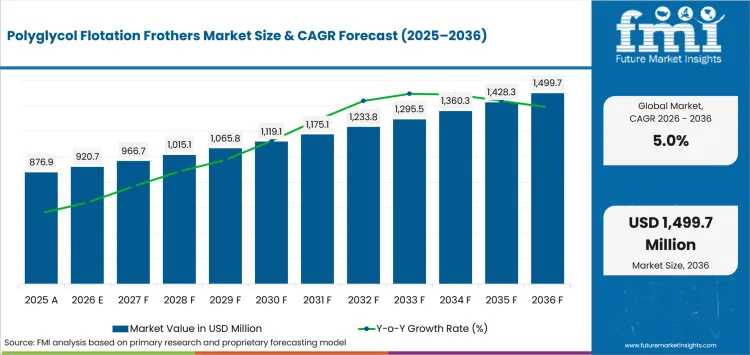
USD 920.7 million in 2026 and USD 1499.7 million by 2036 at a 5.0% CAGR.
Demand for polyglycol flotation frothers is projected to expand at 5.0% CAGR between 2026 and 2036, increasing valuation from USD 920.7 million in 2026 to USD 1499.7 million by 2036. Lower ore grades raise the value of stable froth control because concentrators must protect recovery without carrying excess water into cleaner stages. In February 2026, the USA Geological Survey documented lower ore grades and concentrator shutdowns affecting USA copper production during 2025, keeping reagent tuning tied to operating conditions in the mining flotation chemicals market.
Country growth depends on commissioning pace and the distance between mine sites and technical service. Peru's Ministry of Energy and Mines listed 66 investment projects in 19 departments in June 2026, widening the future pool of circuits that will require reagent qualification. Project announcements do not become frother revenue until concentrators start processing ore and plant trials confirm repeatable recovery, drainage and dosage performance.
Key Takeaways
- Lower ore grades, changing water chemistry and higher throughput increase the value of frothers that keep recovery and drainage within proven operating limits.
- By chemistry, polypropylene glycol frothers are estimated to hold 34.0% in 2026 owing to adjustable molecular weight and controllable froth persistence.
- In 2026, copper ores are expected to lead ore type with 33.0% share because large sulfide concentrators dose frothers during long operating campaigns.
- Fine bubble frothers are projected to hold 31.0% share in 2026 owing to the need for controlled bubble dispersion in finely liberated feeds.
- Plant qualification slows switching because a formulation can improve rougher recovery yet weaken cleaner drainage or downstream foam control.
- Some of the key players in this market include Dow, BASF, Syensqo, Clariant, Nouryon, Orica, Axis House Group, and AECI Mining Chemicals.
Analyst Perspective
"Frother economics are decided in the circuit, not on the reagent invoice. Mine operators gain more from formulations that hold grade and recovery after water chemistry or particle size changes because those formulations reduce repeat test work and emergency chemistry changes."
- Nikhil Kaitwade, Principal Consultant, Future Market Insights
How is the polyglycol flotation frothers market segmented?
The market is segmented by chemistry, ore type, froth profile, end use and sales channel.
Chemistry covers polypropylene glycol frothers, polyethylene glycol frothers, mixed polyglycol ethers, high-molecular-weight glycol frothers and low-foam specialty blends. Ore type includes copper, molybdenum, potash, phosphate and polymetallic ores. Froth profile includes fine bubble, persistent, fast-breaking and selective modifier grades. End use covers base metal concentrators, industrial minerals, precious metal circuits and pilot plants. Sales channels include direct mine contracts, mining reagent distributors, technical service packages and regional blending.
Why do polypropylene glycol frothers lead the chemistry category?
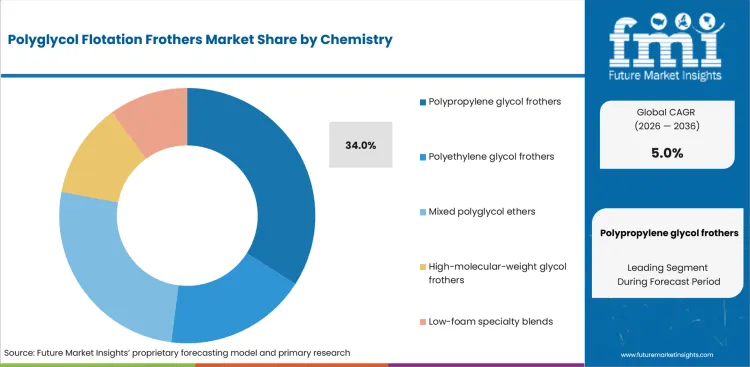
Plant metallurgists use polypropylene glycol chemistry to adjust froth persistence without changing the collector program. BASF announced in May 2025 that it was intensifying copper-flotation research on its Luprofroth portfolio, placing formulation work closer to ore-specific recovery and drainage problems.
- By chemistry, polypropylene glycol frothers are estimated to hold 34.0% in 2026 owing to adjustable molecular weight and controllable froth persistence.
- Bench testing establishes the dosage range before plant trials expose the formulation to recycled water and changing ore texture. Routine orders follow once the same formulation holds recovery and drainage within the concentrator's operating limits.
Why do copper ores lead the ore type category?
Copper concentrators dose frothers through rougher, scavenger and cleaner banks, so chemistry changes can alter recovery and concentrate drainage during the same shift. COCHILCO stated in October 2025 that concentrates represented 60% of Chilean copper output in 2024, confirming the scale of sulfide processing that sustains flotation-reagent use.
- In 2026, copper ores are expected to lead ore type with 33.0% share because large sulfide circuits consume frothers continuously during mineral separation.
- Long contracts follow plant trials that hold recovery and grade under changing mineralogy. A new frother loses the account if improved rougher performance raises entrainment or weakens cleaner-stage drainage.
Why do fine bubble frothers lead the froth profile category?
Finely liberated particles have fewer effective collisions with bubbles, making dispersion and drainage central to reagent selection. AusIMM published September 2025 research that found poor collision efficiency below 30 micrometres and faster flotation after spodumene aggregates exceeded 50 micrometres, giving plant teams a reason to test bubble-control chemistry against particle size.
- Fine bubble frothers are projected to hold 31.0% share in 2026 owing to controlled dispersion that raises capture probability without excessive froth persistence.
- Plant trials compare recovery against mass pull and concentrate grade before approval. The formulation earns repeat orders only if smaller bubbles improve capture without carrying excessive water or gangue into concentrate.
Why do base metal concentrators lead the end use category?
Base metal concentrators run long campaigns that expose frothers to changing mineralogy, recycled water and collector dosage. Geoscience Australia's 2025 commodity summary identified 24 operating copper mines and 0.75 million tonnes of copper production, an installed processing base that repeatedly tests reagent performance.
- Based on end use, base metal concentrators are projected to account for 56.0% in 2026 due to high throughput that magnifies small changes in recovery.
- Mine approvals also cover adjacent beneficiation reagents used in the same circuit. Local technical coverage becomes commercially important once the first trial succeeds because ore and process-water conditions change during long production campaigns.
Why do direct mine contracts lead the sales channel category?
Large concentrators prefer direct accountability because one frother change can alter recovery, grade and downstream foam. AECI's 2025 interim results said Mining Chemicals improved and linked future performance to technical execution plus four awarded mining contracts, showing why field access and supply routes influence qualification.
- Direct mine contracts are set to lead the sales channel with 46.0% share in 2026 due to site qualification, bulk planning and continuing technical service.
- Distributors serve smaller or irregular volumes. Major concentrators usually keep reformulation support and replenishment responsibility inside one commercial relationship because a stockout can reverse a qualified chemistry change.
What are the drivers, restraints and opportunities in the Polyglycol Flotation Frothers Market?
Ore complexity increases demand for controlled froth behavior, plant qualification slows chemistry changes, and saline-water formulations provide the clearest technical opening.
- Driver: New and expanded concentrators require frother programs that protect recovery as ore texture and operating conditions change.
- Restraint: Mine trials slow switching because recovery gains must survive cleaner drainage, concentrate-grade and downstream foam checks.
- Opportunity: Saline-water formulations can earn deeper technical-service value once plant trials prove stable recovery and drainage.
New concentrator projects enlarge the pool of circuits that must qualify frothers before routine dosing begins. Peru's October 2025 portfolio contained 67 projects, split between 33 greenfield and 34 brownfield developments. Greenfield projects need initial reagent selection while brownfield expansions reopen dosage choices, and repeat orders start only after commissioning plus plant-scale verification under sustained operating conditions.
Switching is slow because a new frother must protect recovery without worsening drainage or entrainment elsewhere in the circuit. In December 2025, JOGMEC and CODELCO agreed to advance reagent-based separation of arsenic-bearing copper minerals following independent testing. Complex mineralogy extends the proof burden, so incumbent formulations retain an advantage within broader flotation reagents programs until site trials isolate recovery gains without weakening downstream separation.
Saline water gives formulators a performance difference that concentrators can measure during qualification. COCHILCO projected in March 2026 that seawater would supply 67.6% of Chilean copper-mining water by 2034, up from 40.7% in 2024. Higher salinity changes bubble coalescence and froth persistence, so formulations that preserve grade and recovery can justify site-specific dosage work and deeper field support.
Which country CAGRs are profiled in the Polyglycol Flotation Frothers Market?
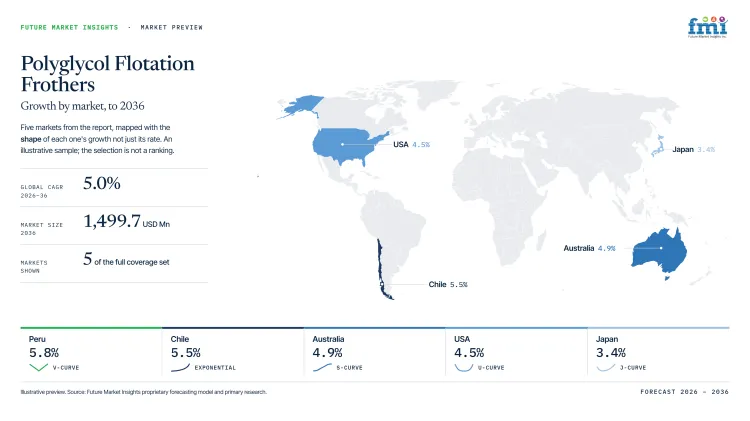
| Country | CAGR |
|---|---|
| Peru | 5.8% |
| Chile | 5.5% |
| Mexico | 5.0% |
| Australia | 4.9% |
| Canada | 4.7% |
| USA | 4.5% |
| Japan | 3.4% |
How do country-level CAGRs compare in the Polyglycol Flotation Frothers Market?
The profiled CAGRs span 2.4 percentage points, but the distribution separates into three operating groups. Peru and Chile lead because mine development and copper concentration generate more qualification events. Mexico, Australia and Canada cluster near the global rate. USA and Japan progress more slowly as mature or smaller domestic processing bases limit new circuit starts.
- Peru: Brownfield expansions reopen frother selection in operating concentrators.
- Chile: Concentrate output sustains routine frother dosing in copper circuits.
- Mexico: Water constraints increase the value of selective froth control.
- Australia: High-throughput accounts make individual supplier wins commercially material.
- Canada: Potash circuits create non-copper frother demand alongside base metals.
- USA: Mature circuits shift competition toward replacement economics and documented plant gains.
- Japan: Pilot work and overseas-resource programs offset limited domestic mine volume.
Similar growth rates produce different sales cycles because commissioning frequency and service intensity vary. The full report covers North America, Latin America, Western Europe, Eastern Europe, East Asia, South Asia and Pacific, and Middle East and Africa.
Country-wise Analysis
- Peruvian copper and polymetallic concentrators rely on direct metallurgical support because plant trials judge reagent changes against recovery, grade and water rejection. Polyglycol flotation frother demand in Peru is projected to expand at 5.8% CAGR through 2036, given an exploration pipeline that can extend existing mines. In August 2025, the Ministry of Energy and Mines listed 84 metallic exploration projects in 17 departments. Permitting and project timing delay reagent volume, so entrants need Spanish-language metallurgical staff and local inventory that can support repeated trials without extending plant schedules. Local blending also reduces reformulation cost if recycled-water conditions change between operating campaigns.
- Desalinated seawater enters northern concentrators as a process variable because ionic conditions alter frother dosage in rougher and cleaner banks. COCHILCO projected in April 2026 that copper-mining electricity use would rise 20.2% by 2034, with concentration taking 55% of sector electricity. Electricity-intensive concentration makes stable recovery more valuable because throughput losses carry a larger operating penalty. The Chilean polyglycol flotation frothers sector is projected to record 5.5% CAGR during the assessment period, attributable to large copper circuits and high processing intensity. Long northern supply routes raise qualification costs, so formulations need saline-water performance and local dosage support to survive extended plant trials.
- In Mexico's copper and polymetallic districts, local stock shortens response times while incumbent formulations keep switching economics demanding. Mexico is forecast to post 5.0% CAGR over the forecast period, aided by existing flotation infrastructure and recovery work inside operating concentrators. INEGI recorded 43,957 tonnes of copper output in April 2026, 7.9% above the same month a year earlier. Challengers gain trial opportunities from that processing base, though contracts still depend on cost per recovered metal and controlled entrainment. Regional blending reduces resupply risk during trials and gives mine metallurgists faster access to reformulation support following a dosage change.
- Distance between Australian concentrators and chemical production centers makes reagent inventory part of qualification, especially for high-throughput sites with limited service access. The South Australian Government reported in 2025 that BHP's Carrapateena HydroFloat work raised throughput from 4.25 million tonnes yearly to 7 million while maintaining or improving recovery. Failed trials or missed replenishment can therefore disrupt production for several days. Adoption in Australia is estimated to expand at 4.9% CAGR by 2036, driven by circuit upgrades that reward regional inventory and metallurgical support close to remote mines. Regional laboratories shorten the time between failed test work and a revised dosage plan.
- A wider Canadian ore mix forces technical teams to qualify more than one froth profile in copper, nickel, zinc, potash and industrial-mineral circuits. Natural Resources Canada documented 514,582 tonnes of copper-in-concentrate output in 2024, up 6.2% from 2023. Canada's outlook is expected to register 4.7% CAGR through 2036, given continuing test work in mature circuits and varied mineral systems. Long travel distances and provincial operating differences weaken thin service models, making chemistry breadth and regional laboratory access more useful than a single low-price grade. Potash and industrial-mineral circuits also broaden demand beyond the copper-heavy pattern seen in Latin America.
- Formal change control gives incumbent frother chemistry a high switching barrier in USA concentrators that already meet recovery and concentrate-grade targets. Polyglycol flotation frother sales in USA are forecast to expand at 4.5% CAGR by 2036, tied to replacement demand and domestic processing security. In November 2025, the USA Department of the Interior added copper to the final federal critical-minerals list. Policy attention raises scrutiny of domestic processing, but challengers need plant data showing recovery or grade gains without destabilizing cleaner stages or increasing downstream foam. Domestic inventory improves continuity, yet qualification evidence remains the harder barrier for new entrants.
- Limited domestic mine throughput concentrates Japanese frother demand in specialist processing work and overseas copper relationships instead of routine high-volume consumption. JOGMEC transferred an option covering 40% of future Josemaria copper concentrate to Mitsui in March 2026, reinforcing Japan's reliance on overseas resource partnerships. Small domestic mine volumes cap large reagent contracts, so collaborative test programs and selective formulations carry more commercial weight. In Japan, polyglycol flotation frother demand is predicted to advance at 3.4% CAGR through 2036, reflecting that specialist route and resource-security focus. Technical partnerships can carry more commercial weight than warehouse depth for a company entering Japan.
Who are the notable companies in the Polyglycol Flotation Frothers Market?
Dow, BASF, Syensqo, Clariant, Nouryon, Orica, Axis House Group, and AECI Mining Chemicals are the notable companies serving this market.
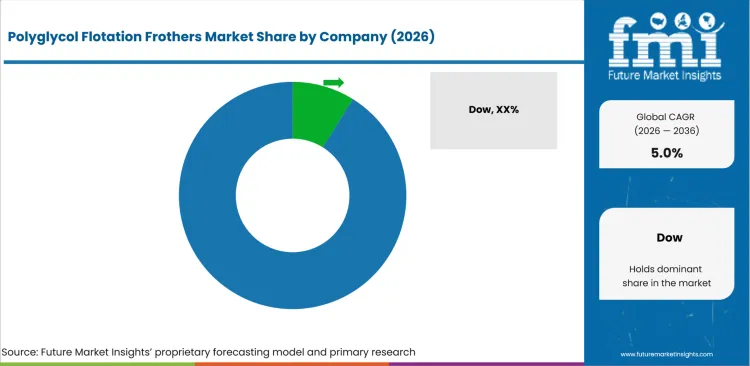
Competition separates dedicated glycol-frother platforms from broader mineral-processing chemistry and mine-focused formulation businesses. Entry depends on verified frother depth, ore-specific test work and mine-site service coverage.
- Dedicated frother platforms: Dow, BASF, Syensqo, Clariant, Axis House Group and AECI Mining Chemicals document glycol or flotation families with technical support.
- Adjacent mineral-processing platforms: Nouryon serves selected flotation uses while Orica reaches copper concentrators through adjacent collectors and specialty mining chemicals.
- Service coverage differs by region, so mine operators should confirm local inventory and laboratory access before treating global reach as mine-site support.
Competitive Benchmarking: Polyglycol Flotation Frothers Market
| Company | Polyglycol Frother Depth | Ore-Specific Formulation Support | Flotation-Reagent Integration | Geographic Reach |
|---|---|---|---|---|
| Dow | High | Medium | Medium | Americas, Europe and Asia-Pacific |
| BASF | High | High | High | Global mining regions |
| Syensqo | High | High | High | Global |
| Clariant | High | High | High | Global |
| Nouryon | Medium | Medium | High | Global |
| Orica | Low | High | Medium | Australia, Americas, EMEA and Asia |
| Axis House Group | Medium | High | High | Africa and international mining markets |
| AECI Mining Chemicals | High | High | High | Africa with expansion into other mining regions |
Scoring basis: High frother depth requires several documented glycol or polyglycol grades. Medium requires one dedicated frother family while Low marks adjacent-only chemistry portfolios. High formulation support requires ore-specific testing in several mineral systems, with Medium covering narrower work and Low general guidance. High reagent integration covers frothers plus two adjacent classes, with Medium covering one and Low frother-only.
Key Developments in the Polyglycol Flotation Frothers Market
- In April 2026, Orica acquired the Danafloat copper-flotation reagent business from FMC Corporation with formulation intellectual property and customer relationships. The deal gives Orica direct access to copper concentrators evaluating specialty reagents, although Danafloat is a collector range rather than a dedicated polyglycol frother family.
- In June 2025, BASF and FUCHS entered an Australian cooperation covering flotation and dewatering solutions, with FUCHS acting as the customer interface for Luprofroth chemistry. The arrangement shortens the service route during qualification while BASF retains formulation development.
- In June 2025, Clariant completed participation in the Designed Collectors for Selective Flotation of Sulfide Minerals project with Boliden and Luleå University of Technology. The program tested ore-specific collector chemistry against copper-bearing tailings, keeping reagent development tied to measurable separation performance.
Key Players in the Polyglycol Flotation Frothers Market
Global Frother and Flotation-Chemistry Platforms
- Dow
- BASF
- Syensqo
- Clariant
Integrated Mineral-Processing Chemical Providers
- Nouryon
- Orica
Mining-Focused Formulation and Service Specialists
- Axis House Group
- AECI Mining Chemicals
Polyglycol Flotation Frothers Market - Report Scope
| Coverage field | Report scope |
|---|---|
| Market breakdown | By chemistry, ore type, froth profile, end use, sales channel and region. |
| Quantitative Units | USD million. |
| Market Definition | Revenue from polyglycol-based flotation frothers sold for mineral flotation. The scope excludes alcohol-only frothers, collectors and depressants sold separately, flotation equipment, downstream metal value and standalone engineering services not attributable to frother supply. |
| Regions Covered | North America, Latin America, Western Europe, Eastern Europe, East Asia, South Asia and Pacific, and Middle East and Africa. |
| Countries Covered | Peru, Chile, Mexico, Australia, Canada, USA, Japan, and 20+ countries included in the full report. |
| Key Companies Profiled | Dow, BASF, Syensqo, Clariant, Nouryon, Orica, Axis House Group, and AECI Mining Chemicals. |
| Forecast Period | 2026 to 2036. |
| Approach | Primary and secondary research with market triangulation. |
Polyglycol Flotation Frothers Market - Research Methodology
| Method | Approach |
|---|---|
| Primary Research | FMI analysts gathered input from manufacturers, service providers, technology developers, distributors, end users, procurement teams, and subject-matter experts. Interviews examined purchasing decisions, product or service evaluation, adoption barriers, approval requirements, pricing considerations, and expectations for technical or commercial support. Respondents were also asked what evidence is required before a trial, pilot, or initial order develops into regular purchasing. |
| Desk Research | Desk research covered government statistics, regulatory publications, trade data, industry associations, technical literature, standards, company filings, product information, and official corporate announcements. Sources were reviewed for relevance, publication date, geographic coverage, and consistency with the defined market scope. Claims relating to performance, applications, approvals, capacity, investment, and commercial activity were retained only when supported by credible public evidence. |
| Market Sizing and Forecasting | The market model combined the baseline value with historical performance, segment structure, pricing and volume indicators, adoption levels, company participation, and country-level demand conditions. Forecast assumptions considered economic activity, investment trends, regulatory developments, technology adoption, purchasing cycles, supply availability, and barriers to wider market use. Segment and regional estimates were reconciled before the final market total was calculated. |
| Data Validation | Estimates were checked against multiple independent indicators, including public data, company activity, trade patterns, industry developments, and findings from primary interviews. Validation also tested whether products, services, applications, and company revenues fell within the defined market boundaries. Adjacent categories, unsupported claims, overlapping revenues, and activities without direct market relevance were excluded to reduce double counting and maintain consistency across segments and countries. |
Polyglycol Flotation Frothers Market by Segments
Polyglycol Flotation Frothers Market segmented by Chemistry:
- Polypropylene glycol frothers
- Polyethylene glycol frothers
- Mixed polyglycol ethers
- High-molecular-weight glycol frothers
- Low-foam specialty blends
Polyglycol Flotation Frothers Market segmented by Ore Type:
- Copper ores
- Molybdenum ores
- Potash ores
- Phosphate ores
- Polymetallic ores
Polyglycol Flotation Frothers Market segmented by Froth Profile:
- Fine bubble frothers
- Persistent frothers
- Fast-breaking frothers
- Selective froth modifiers
Polyglycol Flotation Frothers Market segmented by End Use:
- Base metal concentrators
- Industrial minerals
- Precious metal circuits
- Pilot plants
Polyglycol Flotation Frothers Market segmented by Sales Channel:
- Direct mine contracts
- Mining reagent distributors
- Technical service packages
- Regional blending
Polyglycol Flotation Frothers Market by Region:
- North America
- United States
- Canada
- Mexico
- Latin America
- Brazil
- Argentina
- Chile
- Peru
- Western Europe
- Germany
- France
- United Kingdom
- Italy
- Spain
- Benelux
- Nordics
- Eastern Europe
- Poland
- Czech Republic
- Romania
- Hungary
- East Asia
- Japan
- South Korea
- South Asia and Pacific
- ASEAN
- Australia and New Zealand
- Middle East and Africa
- GCC Countries
- South Africa
- Türkiye
- Israel
Research Sources and Bibliography
- USA Geological Survey. (2026, February 6). Mineral commodity summaries 2026.
- Ministry of Energy and Mines, Peru. (2026, June 17). Cartera de Proyectos de Inversión Minera 2026.
- BASF. (2025, May 20). BASF mining solutions strengthens commitment to copper hydrometallurgy and flotation research and development.
- Comisión Chilena del Cobre. (2025, October 23). Nuevo estudio: “Mercado de concentrados e industria de fundiciones”.
- Luo, D., Ng, W. S., & Franks, G. V. (2025, September 2). Selective flotation of fine spodumene with anionic polyacrylamide flocculant and calcium activator.
- Geoscience Australia. (2026). Commodity summaries: Copper.
- AECI Limited. (2025). Interim results 2025.
- Ministry of Energy and Mines, Peru. (2025, October 26). Cartera de Proyectos de Inversión Minera 2025.
- Japan Organization for Metals and Energy Security. (2025, December 8). Agreement on cooperation for technology to reduce impurities in copper raw materials with CODELCO.
- Comisión Chilena del Cobre. (2026, March 18). Informe Proyección de la Demanda de Agua en la Minería del Cobre en Chile. Periodo 2025-2034.
- Ministry of Energy and Mines, Peru. (2025, August 30). Cartera de Proyectos de Exploración Minera 2025.
- Comisión Chilena del Cobre. (2026, April 15). Informe Proyección del Consumo de Energía Eléctrica en la Minería del Cobre. Periodo 2025-2034.
- Instituto Nacional de Estadística y Geografía. (2026, June). Estadística de la Industria Minerometalúrgica, April 2026.
- Government of South Australia, Department for Energy and Mining. (2025). South Australian Resources Industry Awards: 2025 award winners.
- Natural Resources Canada. (2025). Copper facts.
- USA Department of the Interior. (2025, November 7). Interior Department releases final 2025 List of Critical Minerals.
- Japan Organization for Metals and Energy Security. (2026, March 11). Transfer of copper concentrate offtake option rights.
- Dow. (n.d.). Optimize grinding efficiencies: Oil, gas & mining. Retrieved September 3, 2026.
- Syensqo. (n.d.). Mineral processing solutions. Retrieved September 3, 2026.
- Clariant. (2026). Integrated Report 2025.
- Nouryon. (n.d.). Mining chemistry for efficiency and stability. Retrieved September 3, 2026.
- Orica. (2026, April 17). Orica expands portfolio into copper chemistry with Danafloat acquisition.
- Axis House Group. (n.d.). Metallurgical services & process optimisation. Retrieved September 3, 2026.
- AECI Limited. (n.d.). Investor overview. Retrieved September 3, 2026.
- BASF. (2025, June 18). BASF mining solutions and FUCHS announce cooperation to serve the Australian mining industry.
- Vinnova. (2025, September 26). Designed Collectors for Selective Flotation of Sulfide Minerals.
- Syensqo. (2025, May 13). Syensqo announces revised segment reporting.
- AECI Limited. (2025, February 26). AECI reports 2024 results: Strategic execution drives transformation.
- AECI Limited. (2026, August 11). AECI reports improved first-half 2026 performance with strong earnings growth and solid returns.
- Syensqo. (2026, May 21). Syensqo launches strategic review of its Performance & Care segment.
- Dow Inc. (2026, February 3). Annual report on Form 10-K for the year ended December 31, 2025.
- BASF SE. (2026, February 27). BASF Report 2025.
- Nouryon. (2025, March 18). First Nordic supplier to launch low-carbon footprint hydrogen peroxide.
- Orica. (2025, November 13). Highest earnings in 13 years.
- Syensqo. (2026, March 31). Syensqo releases its 2025 Annual Integrated Report.
- Clariant. (2025, September 4). FLOTAC 2025.
This bibliography is provided for reader reference and is not exhaustive. The full report contains the complete reference list and detailed citations.
This Report Answers
- What is the polyglycol flotation frothers market size in 2026 and what value is forecast for 2036?
- Which operating conditions increase demand for controlled froth behavior in mineral concentrators?
- Why do polypropylene glycol frothers lead the chemistry category in 2026?
- Why do copper ores account for the largest profiled ore-type share?
- How does plant qualification slow replacement of an established frother?
- How do growth rates differ among Peru, Chile, Mexico, Australia, Canada, USA and Japan?
- Which companies supply dedicated frothers or adjacent flotation chemistry?
- What should mine operators compare beyond unit reagent price during selection?
Frequently Asked Questions
How big is the polyglycol flotation frothers market in 2026?
The polyglycol flotation frothers market is valued at USD 920.7 million in 2026 and is projected to reach USD 1,499.7 million by 2036. Growth follows repeated frother dosing as concentrators manage lower ore grades and changing water chemistry.
What is the CAGR of the polyglycol flotation frothers market from 2026 to 2036?
The polyglycol flotation frothers market is projected to grow at a CAGR of 5.0% between 2026 and 2036. Expansion depends on routine dosing, concentrator commissioning and successful plant qualification under changing ore and water conditions.
Which chemistry leads the polyglycol flotation frothers market?
The polypropylene glycol frothers segment is expected to hold 34.0% of the polyglycol flotation frothers market in 2026, driven by adjustable molecular weight and controllable persistence. Plants can tune froth behavior without replacing the wider collector program.
Which ore type leads the polyglycol flotation frothers market?
The copper ores segment is expected to hold 33.0% of the polyglycol flotation frothers market in 2026, attributable to continuous dosing in large sulfide concentrators. Qualification must preserve recovery and concentrate drainage as mineralogy changes.
Which companies are active in the polyglycol flotation frothers market?
Key companies operating in the market include Dow, BASF, Syensqo, Clariant, Nouryon, Orica, Axis House Group and AECI Mining Chemicals. They differ in frother depth, ore-specific test work, reagent breadth, regional supply and mine-site technical support.
Preview the report firsthand - request a free sample
Get SampleGet the brochure for pricing and purchase details.
Get PDFTable of Content
- Key Takeaways
- Market Size and CAGR
- Top Growth Driver
- Fastest Growing Segment
- Leading Region
- Key Companies
- Emerging Opportunities
- Executive Summary
- Global Market Outlook
- Demand-side Trends
- Supply-side Trends
- Technology Roadmap Analysis
- Analysis and Recommendations
- Analyst Perspective (What is happening? Why now? What should investors know?)
- Key Questions Answered
- How large is the market?
- What is the CAGR?
- What are key trends?
- Which region dominates?
- Who are the leaders?
- Market Overview
- Market Coverage / Taxonomy
- Market Definition / Scope / Limitations
- Research Methodology
- Chapter Orientation
- Analytical Lens and Working Hypotheses
- Market Structure, Signals, and Trend Drivers
- Benchmarking and Cross-market Comparability
- Market Sizing, Forecasting, and Opportunity Mapping
- Research Design and Evidence Framework
- Desk Research Programme (Secondary Evidence)
- Expert Input and Fieldwork (Primary Evidence)
- Tooling, Models, and Reference Databases
- Data Engineering and Model Build
- Quality Assurance and Audit Trail
- Market Background
- Market Dynamics (Drivers, Restraints, Opportunity, Trends)
- Scenario Forecast (Optimistic, Likely, Conservative)
- Impact Analysis
- AI Impact
- Sustainability Impact
- Regulatory Impact
- Technology Impact
- Consumer / Buyer Analysis
- Purchase Drivers
- Adoption Barriers
- Buyer Journey
- Opportunity Map Analysis
- Product Life Cycle Analysis
- Supply Chain Analysis
- Investment Feasibility Matrix
- Value Chain Analysis
- PESTLE and Porter's Analysis
- Regulatory Landscape
- Regional Parent Market Outlook
- Production and Consumption Statistics
- Import and Export Statistics
- Global Market Analysis and Forecast, 2021 to 2036
- Historical Market Size Value (USD Million) Analysis, 2021 to 2025
- Current and Future Market Size Value (USD Million) Projections, 2026 to 2036
- Y-o-Y Growth Trend Analysis
- Absolute $ Opportunity Analysis
- Global Market Pricing Analysis, 2021 to 2036
- Global Market Analysis and Forecast, By Chemistry, 2021 to 2036
- Introduction / Key Findings
- Historical Market Size Value (USD Million) Analysis By Chemistry, 2021 to 2025
- Current and Future Market Size Value (USD Million) Analysis and Forecast By Chemistry, 2026 to 2036
- Polypropylene glycol frothers
- Polyethylene glycol frothers
- Mixed polyglycol ethers
- High-molecular-weight glycol frothers
- Low-foam specialty blends
- Polypropylene glycol frothers
- Y-o-Y Growth Trend Analysis By Chemistry, 2021 to 2025
- Absolute $ Opportunity Analysis By Chemistry, 2026 to 2036
- Global Market Analysis and Forecast, By Ore Type, 2021 to 2036
- Introduction / Key Findings
- Historical Market Size Value (USD Million) Analysis By Ore Type, 2021 to 2025
- Current and Future Market Size Value (USD Million) Analysis and Forecast By Ore Type, 2026 to 2036
- Copper ores
- Molybdenum ores
- Potash ores
- Phosphate ores
- Polymetallic ores
- Copper ores
- Y-o-Y Growth Trend Analysis By Ore Type, 2021 to 2025
- Absolute $ Opportunity Analysis By Ore Type, 2026 to 2036
- Global Market Analysis and Forecast, By Froth Profile, 2021 to 2036
- Introduction / Key Findings
- Historical Market Size Value (USD Million) Analysis By Froth Profile, 2021 to 2025
- Current and Future Market Size Value (USD Million) Analysis and Forecast By Froth Profile, 2026 to 2036
- Fine bubble frothers
- Persistent frothers
- Fast-breaking frothers
- Selective froth modifiers
- Fine bubble frothers
- Y-o-Y Growth Trend Analysis By Froth Profile, 2021 to 2025
- Absolute $ Opportunity Analysis By Froth Profile, 2026 to 2036
- Global Market Analysis and Forecast, By End Use, 2021 to 2036
- Introduction / Key Findings
- Historical Market Size Value (USD Million) Analysis By End Use, 2021 to 2025
- Current and Future Market Size Value (USD Million) Analysis and Forecast By End Use, 2026 to 2036
- Base metal concentrators
- Industrial minerals
- Precious metal circuits
- Pilot plants
- Base metal concentrators
- Y-o-Y Growth Trend Analysis By End Use, 2021 to 2025
- Absolute $ Opportunity Analysis By End Use, 2026 to 2036
- Global Market Analysis and Forecast, By Sales Channel, 2021 to 2036
- Introduction / Key Findings
- Historical Market Size Value (USD Million) Analysis By Sales Channel, 2021 to 2025
- Current and Future Market Size Value (USD Million) Analysis and Forecast By Sales Channel, 2026 to 2036
- Direct mine contracts
- Mining reagent distributors
- Technical service packages
- Regional blending
- Direct mine contracts
- Y-o-Y Growth Trend Analysis By Sales Channel, 2021 to 2025
- Absolute $ Opportunity Analysis By Sales Channel, 2026 to 2036
- Global Market Analysis and Forecast, By Region, 2021 to 2036
- Introduction
- Historical Market Size Value (USD Million) Analysis By Region, 2021 to 2025
- Current Market Size Value (USD Million) Analysis and Forecast By Region, 2026 to 2036
- North America
- Latin America
- Western Europe
- Eastern Europe
- East Asia
- South Asia and Pacific
- Middle East & Africa
- Market Attractiveness Analysis By Region
- North America Market Analysis and Forecast, By Country, 2021 to 2036
- Historical Market Size Value (USD Million) Trend Analysis By Market Taxonomy, 2021 to 2025
- Market Size Value (USD Million) Forecast By Market Taxonomy, 2026 to 2036
- By Country
- USA
- Canada
- By Chemistry
- By Ore Type
- By Froth Profile
- By End Use
- By Sales Channel
- By Country
- Market Attractiveness Analysis
- By Country
- By Chemistry
- By Ore Type
- By Froth Profile
- By End Use
- By Sales Channel
- Key Takeaways
- Latin America Market Analysis and Forecast, By Country
- Historical Market Size Value (USD Million) Trend Analysis By Market Taxonomy, 2021 to 2025
- Market Size Value (USD Million) Forecast By Market Taxonomy, 2026 to 2036
- By Country
- Brazil
- Mexico
- Chile
- Rest of Latin America
- By Chemistry
- By Ore Type
- By Froth Profile
- By End Use
- By Sales Channel
- By Country
- Market Attractiveness Analysis
- By Country
- By Chemistry
- By Ore Type
- By Froth Profile
- By End Use
- By Sales Channel
- Key Takeaways
- Western Europe Market Analysis and Forecast, By Country
- Historical Market Size Value (USD Million) Trend Analysis By Market Taxonomy, 2021 to 2025
- Market Size Value (USD Million) Forecast By Market Taxonomy, 2026 to 2036
- By Country
- Germany
- UK
- Italy
- Spain
- France
- Nordic
- BENELUX
- Rest of Western Europe
- By Chemistry
- By Ore Type
- By Froth Profile
- By End Use
- By Sales Channel
- By Country
- Market Attractiveness Analysis
- By Country
- By Chemistry
- By Ore Type
- By Froth Profile
- By End Use
- By Sales Channel
- Key Takeaways
- Eastern Europe Market Analysis and Forecast, By Country
- Historical Market Size Value (USD Million) Trend Analysis By Market Taxonomy, 2021 to 2025
- Market Size Value (USD Million) Forecast By Market Taxonomy, 2026 to 2036
- By Country
- Russia
- Poland
- Hungary
- Balkan & Baltic
- Rest of Eastern Europe
- By Chemistry
- By Ore Type
- By Froth Profile
- By End Use
- By Sales Channel
- By Country
- Market Attractiveness Analysis
- By Country
- By Chemistry
- By Ore Type
- By Froth Profile
- By End Use
- By Sales Channel
- Key Takeaways
- East Asia Market Analysis and Forecast, By Country
- Historical Market Size Value (USD Million) Trend Analysis By Market Taxonomy, 2021 to 2025
- Market Size Value (USD Million) Forecast By Market Taxonomy, 2026 to 2036
- By Country
- China
- Japan
- South Korea
- By Chemistry
- By Ore Type
- By Froth Profile
- By End Use
- By Sales Channel
- By Country
- Market Attractiveness Analysis
- By Country
- By Chemistry
- By Ore Type
- By Froth Profile
- By End Use
- By Sales Channel
- Key Takeaways
- South Asia and Pacific Market Analysis and Forecast, By Country
- Historical Market Size Value (USD Million) Trend Analysis By Market Taxonomy, 2021 to 2025
- Market Size Value (USD Million) Forecast By Market Taxonomy, 2026 to 2036
- By Country
- India
- ASEAN
- Australia & New Zealand
- Rest of South Asia and Pacific
- By Chemistry
- By Ore Type
- By Froth Profile
- By End Use
- By Sales Channel
- By Country
- Market Attractiveness Analysis
- By Country
- By Chemistry
- By Ore Type
- By Froth Profile
- By End Use
- By Sales Channel
- Key Takeaways
- Middle East & Africa Market Analysis and Forecast, By Country
- Historical Market Size Value (USD Million) Trend Analysis By Market Taxonomy, 2021 to 2025
- Market Size Value (USD Million) Forecast By Market Taxonomy, 2026 to 2036
- By Country
- Kingdom of Saudi Arabia
- Other GCC Countries
- Türkiye
- South Africa
- Other African Union
- Rest of Middle East & Africa
- By Chemistry
- By Ore Type
- By Froth Profile
- By End Use
- By Sales Channel
- By Country
- Market Attractiveness Analysis
- By Country
- By Chemistry
- By Ore Type
- By Froth Profile
- By End Use
- By Sales Channel
- Key Takeaways
- Key Countries Market Analysis
- USA
- Pricing Analysis
- Market Share Analysis, 2025
- By Chemistry
- By Ore Type
- By Froth Profile
- By End Use
- By Sales Channel
- Canada
- Pricing Analysis
- Market Share Analysis, 2025
- By Chemistry
- By Ore Type
- By Froth Profile
- By End Use
- By Sales Channel
- Mexico
- Pricing Analysis
- Market Share Analysis, 2025
- By Chemistry
- By Ore Type
- By Froth Profile
- By End Use
- By Sales Channel
- Brazil
- Pricing Analysis
- Market Share Analysis, 2025
- By Chemistry
- By Ore Type
- By Froth Profile
- By End Use
- By Sales Channel
- Chile
- Pricing Analysis
- Market Share Analysis, 2025
- By Chemistry
- By Ore Type
- By Froth Profile
- By End Use
- By Sales Channel
- Germany
- Pricing Analysis
- Market Share Analysis, 2025
- By Chemistry
- By Ore Type
- By Froth Profile
- By End Use
- By Sales Channel
- UK
- Pricing Analysis
- Market Share Analysis, 2025
- By Chemistry
- By Ore Type
- By Froth Profile
- By End Use
- By Sales Channel
- Italy
- Pricing Analysis
- Market Share Analysis, 2025
- By Chemistry
- By Ore Type
- By Froth Profile
- By End Use
- By Sales Channel
- Spain
- Pricing Analysis
- Market Share Analysis, 2025
- By Chemistry
- By Ore Type
- By Froth Profile
- By End Use
- By Sales Channel
- France
- Pricing Analysis
- Market Share Analysis, 2025
- By Chemistry
- By Ore Type
- By Froth Profile
- By End Use
- By Sales Channel
- India
- Pricing Analysis
- Market Share Analysis, 2025
- By Chemistry
- By Ore Type
- By Froth Profile
- By End Use
- By Sales Channel
- ASEAN
- Pricing Analysis
- Market Share Analysis, 2025
- By Chemistry
- By Ore Type
- By Froth Profile
- By End Use
- By Sales Channel
- Australia & New Zealand
- Pricing Analysis
- Market Share Analysis, 2025
- By Chemistry
- By Ore Type
- By Froth Profile
- By End Use
- By Sales Channel
- China
- Pricing Analysis
- Market Share Analysis, 2025
- By Chemistry
- By Ore Type
- By Froth Profile
- By End Use
- By Sales Channel
- Japan
- Pricing Analysis
- Market Share Analysis, 2025
- By Chemistry
- By Ore Type
- By Froth Profile
- By End Use
- By Sales Channel
- South Korea
- Pricing Analysis
- Market Share Analysis, 2025
- By Chemistry
- By Ore Type
- By Froth Profile
- By End Use
- By Sales Channel
- Russia
- Pricing Analysis
- Market Share Analysis, 2025
- By Chemistry
- By Ore Type
- By Froth Profile
- By End Use
- By Sales Channel
- Poland
- Pricing Analysis
- Market Share Analysis, 2025
- By Chemistry
- By Ore Type
- By Froth Profile
- By End Use
- By Sales Channel
- Hungary
- Pricing Analysis
- Market Share Analysis, 2025
- By Chemistry
- By Ore Type
- By Froth Profile
- By End Use
- By Sales Channel
- Kingdom of Saudi Arabia
- Pricing Analysis
- Market Share Analysis, 2025
- By Chemistry
- By Ore Type
- By Froth Profile
- By End Use
- By Sales Channel
- Türkiye
- Pricing Analysis
- Market Share Analysis, 2025
- By Chemistry
- By Ore Type
- By Froth Profile
- By End Use
- By Sales Channel
- South Africa
- Pricing Analysis
- Market Share Analysis, 2025
- By Chemistry
- By Ore Type
- By Froth Profile
- By End Use
- By Sales Channel
- USA
- Market Structure Analysis
- Competition Dashboard
- Competition Benchmarking
- Market Share Analysis of Top Players
- By Regional
- By Chemistry
- By Ore Type
- By Froth Profile
- By End Use
- By Sales Channel
- Emerging Startups
- Innovation Benchmarking
- Competition Analysis
- Competition Deep Dive
- Dow
- Overview
- Product Portfolio
- Profitability by Market Segments
- Sales Footprint
- Strategy Overview
- Marketing Strategy
- Product Strategy
- Channel Strategy
- BASF
- Solvay
- Clariant
- Nouryon
- Orica
- Huntsman
- SNF
- Axis House
- Senmin
- Dow
- Case Studies
- Success Stories
- Recent Developments
- Competition Deep Dive
- Assumptions & Acronyms Used


