

- Market Size (2026)
- USD 290.5 Mn
- Forecast (2036)
- USD 530.1 Mn
- CAGR (2026 to 2036)
- 6.2%
How big is Cellulose Produce Netting Market in 2026?
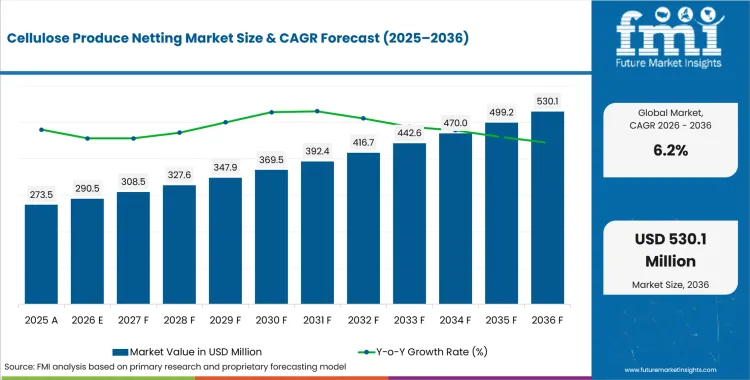
USD 290.5 million in 2026 and USD 530.1 million by 2036 at a 6.2% CAGR.
Demand for cellulose produce netting is projected to expand at 6.2% CAGR between 2026 and 2036, increasing valuation from USD 290.5 million in 2026 to USD 530.1 million by 2036. Packaging selection depends on both operational performance and end-of-life compliance. European Commission packaging rules applied from August 12, 2026 make composition and recyclability part of design qualification. Packers still test airflow, tensile strength and line speed before conversion.
Export packs carry a second qualification layer because one net must satisfy destination rules without forcing line changes. In October 2025, the Foundation for Food & Agriculture Research opened a specialty-crop packaging program covering the EU, UK, Canada and Japan. Cellulose formats still need destination-specific disposal evidence before clipping compatibility converts into repeat orders.
Key Takeaways
- Packaging rules and export requirements are increasing reviews of fiber netting that can replace selected plastic formats without slowing packhouses.
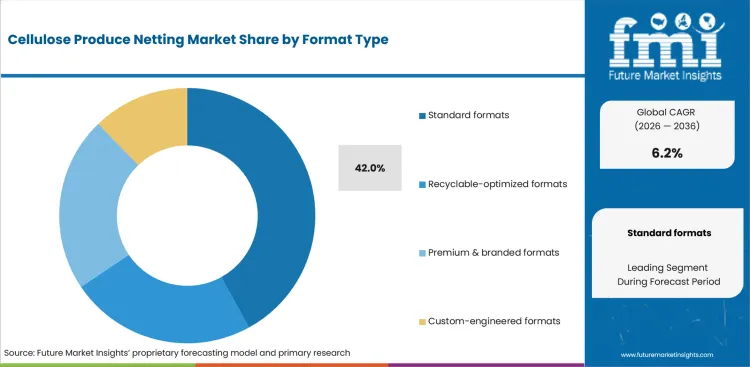
- By format type, standard formats are estimated to hold 42.0% in 2026 owing to familiar diameters and clip points that reduce changeover work.
- In 2026, recycled fiber is expected to lead material with 33.0% share because paper-recovery routes make secondary-content claims easier to document.
- Standard retail formats are projected to hold 39.0% of format size in 2026 owing to common pack weights that preserve shelf handling.
- Moisture exposure, tensile failure and equipment mismatch can erase the expected waste benefit through labor, breakage and pack-out losses.
- Some of the key players in this market include Giró Group, Sorma Group, Packnatur GmbH, The Royal NNZ Group, Badalona Pac, M.T. RETI, TVU Garnvertrieb GmbH, BiCOPACK, GALLOPLASTIK S.r.l., and KUKU International Packaging.
Analyst Perspective
"Cellulose produce netting earns repeat volume after wet-produce and clipping trials reproduce normal packhouse speed. Strong offers pair fiber evidence with a machine route that avoids rebuilding the packing line."
- Nandini Roy Choudhury, Principal Consultant, Future Market Insights
How is the cellulose produce netting market segmented?
The market is segmented by format type, material, format size, end use and sales channel.
Format type includes standard, recyclable-optimized, premium and branded, and custom-engineered formats. Material covers recycled fiber, virgin kraft and SBS, molded pulp, and barrier-coated fiber. Format size includes standard retail, small unit packs, and bulk and transit formats. End use covers food and foodservice, beverage, e-commerce and retail, personal care and pharma, and industrial applications. Sales channels comprise direct brand contracts, packaging distributors, and online B2B orders.
What makes standard formats central to the format type category?
Packers can test cellulose netting against existing tube diameter and clip position before changing the wider line. Familiar geometry narrows qualification to strength, airflow, pack-out loss and a smaller set of machine failure points.
- Based on format type, standard formats are projected to account for 42.0% in 2026 due to lower changeover work on familiar filling and clipping stations.
- Sorma Group launched SormaClipless in February 2026 for standard packaging machines. The non-cellulose format still shows why preserving machine interfaces reduces qualification work during packaging changes.
Why does recycled fiber lead the material category?
Recycled fiber gives produce-pack programs secondary content without leaving familiar paper-recovery routes. Cellulose yarn and moisture treatment must still survive filling, cooling and transport before plants can retain recycled-content claims.
- The recycled fiber segment is likely to capture 33.0% share in 2026 attributable to documented recovery routes that make secondary-content claims easier to assess.
- The American Forest & Paper Association stated in August 2026 that 61% to 65% of available USA paper was recycled in 2025. That recovery base gives fiber packaging a familiar end-of-life reference.
How does standard retail hold the format size lead?
Standard retail packs face airflow, shelf handling and disposal scrutiny because the complete pack reaches the shopper at the point of sale. Material changes must preserve merchandising behavior as well as containment.
- Standard retail is set to lead format size with 39.0% share in 2026 due to common pack weights that reduce handling changes during material substitution.
- France’s Conseil d’État confirmed in November 2025 that most labels placed directly on fruit or vegetables must be home-compostable and partly bio-based. Component rules keep small produce packs under material review.
What supports food and foodservice as the leading end use?
Food and foodservice applications use open packaging because irregular produce needs airflow and visual inspection during distribution. Cellulose nets also contact damp products, chilled rooms and repeated handling that quickly expose weak yarn or closures.
- By end use, food and foodservice is estimated to hold 37.0% in 2026 owing to ventilation needs for potatoes, onions, citrus and similar produce.
- In January 2025, the USA FDA ended authorization for 35 PFAS-related food-contact notifications covering grease-proof paper and paperboard uses. Food-packaging reviews therefore extend beyond pack strength to material chemistry.
What drives direct brand contracts in the sales channel category?
Direct contracts keep brand specifications and pack-line trials under one commercial relationship. Produce brands can set dimensions, graphics and fiber requirements while one technical team diagnoses failed runs and returns changes to the next test.
- By sales channel, direct brand contracts are forecast to represent 50.0% in 2026 driven by technical approval work that benefits from fewer commercial handoffs.
- Giró and Serfruit introduced an integrated produce-warehouse offer in June 2026 spanning inspection, weighing, packaging and palletizing controls. Their joint route carries a pack specification into line acceptance.
What are the drivers, restraints and opportunities in the Cellulose Produce Netting Market?
Packaging rules raise substitution reviews, material and line qualification constrain approvals, and integrated fiber-plus-equipment programs offer the clearest route to repeat volume.
- Driver: Producer-responsibility rules make packaging composition and recyclability part of the commercial specification for fresh produce packs.
- Restraint: Cellulose netting must retain tensile strength and equipment fit under moisture, cooling and transport conditions before packers approve repeat use.
- Opportunity: Companies can win direct programs by supplying validated net formats with material documentation and a defined route onto existing packing equipment.
Recyclability and Packaging Costs
Packaging costs depend on recyclability performance as producers prepare for EPR obligations. PackUK confirmed 2025 EPR base fees in June 2025 and linked future charges to recyclability ratings. The framework gives producers a financial reason to document recovery routes before selecting packaging formats. Cellulose netting therefore competes on both packing-line performance and expected compliance costs.
Component Qualification
Packaging approval depends on the recyclability performance of the complete pack rather than the net alone. PackUK's September 2025 recycling assessment method evaluates collection, sortation, reprocessing and end-use application. Labels, clips and coatings can affect the final recyclability outcome even when the base net material performs well. Cellulose netting suppliers therefore need component-level evidence before conversion projects move forward.
Packaging Validation
Repeat orders typically follow successful performance trials on commercial packing equipment. In November 2025, USDA NIFA funded 16 food-manufacturing projects that included packaging research. The activity reflects the importance of testing packaging under real operating conditions. Cellulose-net suppliers can strengthen adoption by demonstrating tension control, clipping compatibility and production throughput on installed lines before pursuing larger volumes.
Which country CAGRs are profiled in the Cellulose Produce Netting Market?
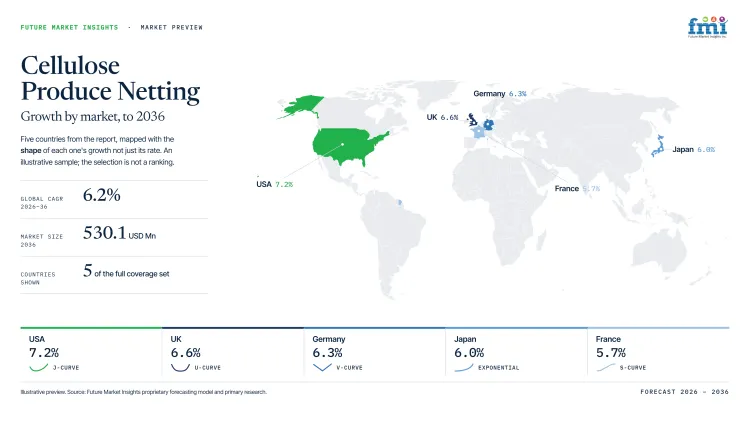
| Country | CAGR |
|---|---|
| UAE | 7.8% |
| Saudi Arabia | 7.5% |
| USA | 7.2% |
| South Korea | 6.9% |
| UK | 6.6% |
| Germany | 6.3% |
| Japan | 6.0% |
| France | 5.7% |
How do country-level CAGRs compare in the Cellulose Produce Netting Market?
The displayed CAGRs form three groups. UAE and Saudi Arabia lead above 7.5%, with USA and South Korea next. UK, Germany and Japan sit within 0.6 percentage points, while France is lower at 5.7%. The spacing points to different policy timing and packhouse qualification conditions instead of current market size.
- UAE rules shorten retailer specification cycles.
- Saudi heat raises pack-strength thresholds.
- USA state rules fragment pack specifications.
- South Korean targets favor material trials.
- UK fee modulation prices recyclability.
- German methods shift design screening upstream.
- Japanese packhouses favor controlled substitutions.
- French rules keep component scrutiny separate.
Entry conditions differ despite similar growth rates. The full report provides country-level CAGR analysis across North America, Latin America, Western Europe, Eastern Europe, East Asia, South Asia and Pacific, and the Middle East and Africa.
Country-wise Analysis
- UAE retailers entered 2026 under a broader ban on selected single-use items, so pack specifications now require category-level legal checks. The Ministry of Climate Change and Environment announced in December 2025 that phase two would take effect on January 1, 2026 for additional consumer products and bags. Cellulose produce netting sales in the UAE are forecast to expand at 7.8% CAGR by 2036, tied to retailer substitution programs. The ban does not automatically classify every cellulose net as compliant. Commercial orders still require line trials and evidence that the finished pack follows the intended local rule and retailer system.
- Riyadh distributors handle long summer routes, making wet strength and bag integrity central to cellulose-net trials. Riyadh Municipality’s May 2025 data placed paper and cardboard at 12.2% of municipal waste and plastic at 13.3%. Because waste-reduction programs keep fiber alternatives under review, Saudi Arabia is estimated to post 7.5% CAGR over the forecast period. The waste profile gives local teams a clear reference for material-reduction programs. Sorting capacity remains uneven during summer distribution, so market entry depends on heat-tested pack performance and disposal guidance that matches the collection route used by each municipal or retail account consistently.
- Produce brands in the USA often qualify one pack against retailer rules, state requirements and export specifications at the same time. The USA cellulose produce netting sector is projected to record 7.2% CAGR during the assessment period, propelled by producer-responsibility programs and export redesign work. CalRecycle confirmed that permanent SB 54 regulations became effective on May 1, 2026. California gives fiber substitutions a strong reason for engineering review without settling requirements elsewhere. National programs can reduce duplicated trials through a common technical specification, but material documentation still needs clear state and export mapping before repeat orders are placed.
- South Korean food brands are working under a national plan that reduces virgin-plastic dependence and directs packaging trials toward alternative materials. The Ministry of Climate, Energy and Environment set a 30% reduction target in April 2026 against projected virgin-material use by 2030. That target gives packaging teams a defined reason to test fiber formats, but design-for-recycling evidence still controls local recovery fit. In South Korea, cellulose produce netting demand is predicted to advance at 6.9% CAGR through 2036, attributable to formal plastic-reduction targets. New entrants therefore need local disposal evidence and repeatable pack-line behavior before a material switch becomes a national program.
- UK packaging programs now separate recyclability evidence by reporting year, making version control part of material qualification. PackUK published RAM 2027 in July 2026 and confirmed that 2026 reporting still uses version 1.1. The UK cellulose produce netting outlook is anticipated to advance at 6.6% CAGR over the assessment period, given continuing redesign work under EPR fee modulation. Early visibility lets brands screen 2027 specifications before the reporting year begins. The friction is evidence continuity: a fiber net has to retain acceptable collection, sortation and reprocessing treatment as the method changes, not merely pass one internal sustainability review.
- German packers can screen a cellulose format against a detailed national recyclability method before committing retailer volume. Adoption of cellulose produce netting in Germany is estimated to expand at 6.3% CAGR through 2036, reflecting early PPWR preparation. The Central Agency Packaging Register published the 2025 minimum standard in August 2025 and stated that packaging should reach at least 70% recyclability by 2030. The standard gives engineering teams an early design reference, while coatings and mixed components can alter classification. Companies that document separability before line trials can avoid late changes and preserve the intended recovery route as retailer specifications move toward PPWR rules.
- Japanese produce packers usually change packaging in controlled steps because dimensions, presentation and line consistency are tested together before rollout. The Ministry of the Environment opened its advanced social-implementation program in April 2026 for source reduction, recycling and wider biomass-plastic use. Public programs give manufacturers a place to test material changes under operating conditions. Japan is forecast to grow at 6.0% CAGR by 2036, helped by national funding for practical plastic-circulation models. Packhouse approval remains the limiting step, so new cellulose formats need repeatable dimensions and clear disposal instructions before retailers can separate the material decision from the equipment decision.
- French produce programs now face a separate producer-responsibility route for professional packaging, expanding compliance beyond consumer-facing pack components. Decree No. 2025-1081 was issued in November 2025 and applied from January 1, 2026 to professional packaging under extended producer responsibility. The rule gives commercial pack programs a clearer recovery obligation while leaving product-specific design choices to the operator. France is expected to register 5.7% CAGR during the forecast period, supported by plastic-reduction policy with slower complete-pack conversion. Entry is easier for modular cellulose formats whose net, label and closure can be documented separately instead of forcing one material claim onto every component.
Who are the notable companies in the Cellulose Produce Netting Market?
Giró Group, Sorma Group, Packnatur GmbH, The Royal NNZ Group, Badalona Pac, M.T. RETI, TVU Garnvertrieb GmbH, BiCOPACK, GALLOPLASTIK S.r.l., and KUKU International Packaging are notable companies serving the cellulose produce netting market.
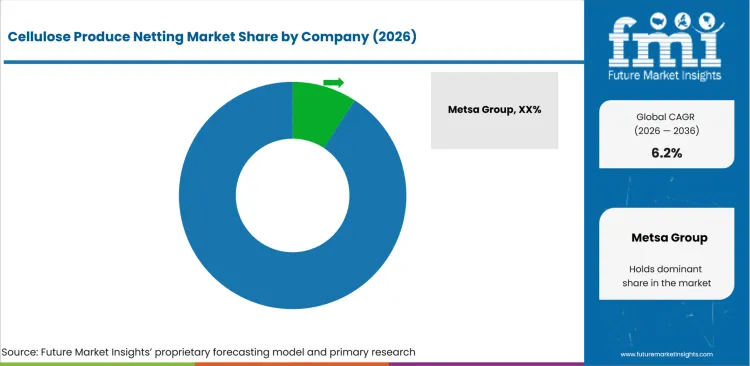
Competition divides between cellulose-net specialists, produce-packaging integrators and machinery-led groups. Entry depends on verified netting, food-contact evidence and pack-line compatibility more than company scale.
- Produce-packaging and machinery groups: Giró Group, Sorma Group, The Royal NNZ Group, and KUKU International Packaging.
- Cellulose-net specialists: Packnatur GmbH, Badalona Pac, M.T. RETI, TVU Garnvertrieb GmbH, BiCOPACK, and GALLOPLASTIK S.r.l.
Competitive Benchmarking: Cellulose Produce Netting Market
| Company | Cellulose Net Product Depth | Produce Pack Integration | Line Compatibility | Geographic Reach |
|---|---|---|---|---|
| Giró Group | High | High | High | Global |
| Sorma Group | Medium | High | High | Europe and international markets |
| Packnatur GmbH | Medium | Medium | Medium | Europe and selected international markets |
| The Royal NNZ Group | Low | High | Medium | Europe, North America and international network |
| Badalona Pac | High | Medium | Medium | More than 35 countries |
| M.T. RETI | Low | Medium | Low | Italy and European export markets |
| TVU Garnvertrieb GmbH | Medium | Medium | Low | Europe and more than 20 countries |
| BiCOPACK | Medium | Medium | Medium | Europe and international export markets |
| GALLOPLASTIK S.r.l. | Low | High | Medium | Italy and European markets |
| KUKU International Packaging | High | High | High | Italy and export markets |
Scoring basis: High product depth requires three cellulose-net configurations, Medium two and Low one. High produce integration requires netting plus two related pack elements, Medium one and Low none. High line compatibility requires owned packing machinery or several automated routes, Medium one conventional route and Low limited machine evidence.
Key Developments in the Cellulose Produce Netting Market
- In August 2026, KUKU International Packaging had EP4788611A1 published for a biodegradable or natural-fiber net layer fixed to a tray card strip. The filing extends its plastic-free produce-packaging route.
- In July 2026, The Royal NNZ Group announced Foreman Capital as a new shareholder while the Boot family stayed involved. The transaction changes ownership without removing family participation from NNZ’s produce-packaging network.
- In February 2026, Sorma Group documented advanced sorting technology in a loose-tomato line. The deployment links upstream grading with packaging equipment used later in produce handling.
Key Players in the Cellulose Produce Netting Market
Integrated Produce-Packaging and Machinery Platforms
- Giró Group
- Sorma Group
- The Royal NNZ Group
- KUKU International Packaging
Cellulose Net Specialists
- Packnatur GmbH
- M.T. RETI
- TVU Garnvertrieb GmbH
- BiCOPACK
- GALLOPLASTIK S.r.l.
Cellulose Mesh Manufacturing Specialist
- Badalona Pac
Cellulose Produce Netting Market - Report Scope
| Coverage field | Report scope |
|---|---|
| Market breakdown | By format type, material, format size, end use, sales channel and region. |
| Quantitative Units | USD million. |
| Market Definition | Commercial cellulose-derived netting, mesh sleeves and integrated cellulose-net produce packaging sold within the stated segmentation categories. |
| Regions Covered | North America, Latin America, Western Europe, Eastern Europe, East Asia, South Asia and Pacific, and Middle East and Africa. |
| Countries Covered | UAE, Saudi Arabia, USA, South Korea, UK, Germany, Japan, France, and 20+ countries included in the full report. |
| Key Companies Profiled | Giró Group, Sorma Group, Packnatur GmbH, The Royal NNZ Group, Badalona Pac, M.T. RETI, TVU Garnvertrieb GmbH, BiCOPACK, GALLOPLASTIK S.r.l., and KUKU International Packaging. |
| Forecast Period | 2026 to 2036. |
| Approach | Primary and secondary research with market triangulation. |
Cellulose Produce Netting Market - Research Methodology
| Method | Approach |
|---|---|
| Primary Research | FMI analysts gathered input from manufacturers, service providers, technology developers, distributors, end users, procurement teams, and subject-matter experts. Interviews examined purchasing decisions, product or service evaluation, adoption barriers, approval requirements, pricing considerations, and expectations for technical or commercial support. Respondents were also asked what evidence is required before a trial, pilot, or initial order develops into regular purchasing. |
| Desk Research | Desk research covered government statistics, regulatory publications, trade data, industry associations, technical literature, standards, company filings, product information, and official corporate announcements. Sources were reviewed for relevance, publication date, geographic coverage, and consistency with the defined market scope. Claims relating to performance, applications, approvals, capacity, investment, and commercial activity were retained only when supported by credible public evidence. |
| Market Sizing and Forecasting | The market model combined the baseline value with historical performance, segment structure, pricing and volume indicators, adoption levels, company participation, and country-level demand conditions. Forecast assumptions considered economic activity, investment trends, regulatory developments, technology adoption, purchasing cycles, supply availability, and barriers to wider market use. Segment and regional estimates were reconciled before the final market total was calculated. |
| Data Validation | Estimates were checked against multiple independent indicators, including public data, company activity, trade patterns, industry developments, and findings from primary interviews. Validation also tested whether products, services, applications, and company revenues fell within the defined market boundaries. Adjacent categories, unsupported claims, overlapping revenues, and activities without direct market relevance were excluded to reduce double counting and maintain consistency across segments and countries. |
Cellulose Produce Netting Market by Segments
Cellulose Produce Netting Market segmented by Format Type:
- Standard formats
- Recyclable-optimized formats
- Premium & branded formats
- Custom-engineered formats
Cellulose Produce Netting Market segmented by Material:
- Recycled fiber
- Virgin kraft & SBS
- Molded pulp
- Barrier-coated fiber
Cellulose Produce Netting Market segmented by Format Size:
- Standard retail
- Small unit packs
- Bulk & transit
Cellulose Produce Netting Market segmented by End Use:
- Food & foodservice
- Beverage
- E-commerce & retail
- Personal care & pharma
- Industrial
Cellulose Produce Netting Market segmented by Sales Channel:
- Direct brand contracts
- Packaging distributors
- Online B2B
Cellulose Produce Netting Market by Region:
- North America
- United States
- Canada
- Latin America
- Brazil
- Mexico
- Argentina
- Chile
- Western Europe
- Germany
- France
- United Kingdom
- Italy
- Spain
- Benelux
- Nordics
- Eastern Europe
- Poland
- Czech Republic
- Romania
- Hungary
- East Asia
- China
- Japan
- South Korea
- South Asia and Pacific
- India
- ASEAN
- Australia and New Zealand
- Middle East and Africa
- GCC Countries
- South Africa
- Türkiye
- Israel
Research Sources and Bibliography
- European Commission. (2026, August 12). New packaging rules for less waste and easier recycling.
- Foundation for Food & Agriculture Research. (2025, October 15). Funding Opportunity Drives Packaging Innovation for US Growers.
- Sorma Group. (2026, February 24). SAY GOODBYE TO CLIP - SORMACLIPLESS.
- American Forest & Paper Association. (2026, August 28). Paper Industry Announces 2025 USA Paper Recycling Rates.
- Conseil d’État. (2025, November 10). Décision n° 466929.
- USA Food and Drug Administration. (2025, January 3). FDA Determines Authorization for 35 Food Contact Notifications Related to PFAS Are No Longer Effective.
- Giró Group. (2026, June). GIRÓ AND SERFRUIT: Integrated automation and packaging for the produce warehouse of the future.
- Department for Environment, Food & Rural Affairs. (2025, June 27). Extended Producer Responsibility for Packaging: 2025 base fees.
- Department for Environment, Food & Rural Affairs. (2025, September 4). Recyclability assessment methodology: materials and outputs.
- USA Department of Agriculture, National Institute of Food and Agriculture. (2025, November 19). NIFA Invests $6.8M to Support Novel Foods and Innovative Manufacturing Projects.
- Emirates News Agency. (2025, December 16). Second phase of nationwide ban on import, trade of single-use consumer plastic products, bags begins.
- Riyadh Municipality. (2025, May 22). Environmental Protection in KSA.
- California Department of Resources Recycling and Recovery. (2026, May 1). SB 54 Plastic Pollution Prevention and Packaging Producer Responsibility Act Permanent Regulations.
- Ministry of Climate, Energy and Environment, Republic of Korea. (2026, April 28). Breaking Free from Oil Imports: Toward a Sustainable, Plastic-Free Circular Economy.
- PackUK. (2026, July 1). PackUK Publishes Recyclability Assessment Methodology (RAM) 2027.
- Zentrale Stelle Verpackungsregister. (2025, August 29). 2025 minimum standard published - initial touchstone for companies preparing for the PPWR.
- Ministry of the Environment, Government of Japan. (2026, April 14). Call for applications for the advanced social implementation model project on plastic resource circulation.
- French Republic. (2025, November 17). Décret n° 2025-1081 du 17 novembre 2025 relatif aux emballages ainsi qu’aux déchets d’emballages et instituant la filière de responsabilité élargie des producteurs d’emballages consommés ou utilisés par les professionnels.
- Spanish Patent and Trademark Office. (2026, August 12). EP4788611A1: Tray cover made of natural material and tray thereby covered.
- The Royal NNZ Group. (2026, July 22). Boot family welcomes Foreman Capital as new shareholder of the Royal NNZ Group.
- Sorma Group. (2026, February 16). Advanced sorting technology crowns loose tomato production line.
- Giró Group. (2025, July). Giró opens a new factory in Valencia.
- Giró Group. (n.d.). Net packaging. Retrieved September 3, 2026.
- Packnatur GmbH. (n.d.). Packnatur. Retrieved September 3, 2026.
- The Royal NNZ Group. (n.d.). Media center and fresh-produce packaging resources. Retrieved September 3, 2026.
- Badalona Pac S.L. (n.d.). About us. Retrieved September 3, 2026.
- M.T. RETI s.a.s. (n.d.). Cellulose packaging for citrus and fruit and vegetables. Retrieved September 3, 2026.
- TVU Garnvertrieb GmbH. (n.d.). CompoPac compostable natural fibre nettings. Retrieved September 3, 2026.
- BiCOPACK. (n.d.). Biodegradable and compostable natural-fibre meshes. Retrieved September 3, 2026.
- GALLOPLASTIK S.r.l. (n.d.). Verti-Paper. Retrieved September 3, 2026.
- KUKU International Packaging. (n.d.). KUKUZEROPLASTIC. Retrieved September 3, 2026.
- BiCOPACK. (2026, June 16). Bicopack strengthens its global presence at Go Global 2026.
- Giró Group. (2025, October). FRUIT ATTRACTION 2025.
- The Royal NNZ Group. (2025, September 3). NNZ at Potato Europe.
This bibliography is provided for reader reference and is not exhaustive. The full report contains the complete reference list and detailed citations.
This Report Answers
- What are the 2026 and 2036 cellulose produce netting values?
- Which rules are increasing cellulose-netting review?
- Why do standard formats lead by format type?
- Why does recycled fiber lead by material?
- Why does standard retail lead by format size?
- How do profiled country growth rates differ?
- Which companies supply cellulose netting and integrated produce packs?
- What delays replacement of plastic netting?
Frequently Asked Questions
How big is the cellulose produce netting market in 2026?
The cellulose produce netting market is valued at USD 290.5 million in 2026 and is projected to reach USD 530.1 million by 2036. Growth depends on fiber formats preserving packhouse performance.
What is the CAGR of the cellulose produce netting market from 2026 to 2036?
The cellulose produce netting market is projected to grow at a CAGR of 6.2% between 2026 and 2036. Expansion follows after moisture, tensile and equipment checks support repeat orders.
Which format type leads the cellulose produce netting market?
The standard formats segment is expected to hold 42.0% of the cellulose produce netting market in 2026, attributable to familiar diameters and clip positions. Existing line geometry reduces qualification work.
Which material leads the cellulose produce netting market?
The recycled fiber segment is expected to hold 33.0% of the cellulose produce netting market in 2026, driven by familiar paper-recovery routes. Wet strength and coatings still determine pack qualification.
Which countries are projected to record the highest growth in the cellulose produce netting market?
The UAE is projected to grow at 7.8% CAGR, followed by Saudi Arabia at 7.5% and the USA at 7.2% through 2036. Each market applies different packaging and recovery requirements.
Which companies are active in the cellulose produce netting market?
Key companies operating in the market include Giró Group, Sorma Group, Packnatur GmbH, The Royal NNZ Group, Badalona Pac, M.T. RETI, TVU Garnvertrieb GmbH, BiCOPACK, GALLOPLASTIK S.r.l., and KUKU International Packaging. They differ in cellulose-net depth, produce integration and machine support.
Preview the report firsthand - request a free sample
Get SampleGet the brochure for pricing and purchase details.
Get PDFTable of Content
- Key Takeaways
- Market Size and CAGR
- Top Growth Driver
- Fastest Growing Segment
- Leading Region
- Key Companies
- Emerging Opportunities
- Executive Summary
- Global Market Outlook
- Demand-side Trends
- Supply-side Trends
- Technology Roadmap Analysis
- Analysis and Recommendations
- Analyst Perspective (What is happening? Why now? What should investors know?)
- Key Questions Answered
- How large is the market?
- What is the CAGR?
- What are key trends?
- Which region dominates?
- Who are the leaders?
- Market Overview
- Market Coverage / Taxonomy
- Market Definition / Scope / Limitations
- Research Methodology
- Chapter Orientation
- Analytical Lens and Working Hypotheses
- Market Structure, Signals, and Trend Drivers
- Benchmarking and Cross-market Comparability
- Market Sizing, Forecasting, and Opportunity Mapping
- Research Design and Evidence Framework
- Desk Research Programme (Secondary Evidence)
- Expert Input and Fieldwork (Primary Evidence)
- Tooling, Models, and Reference Databases
- Data Engineering and Model Build
- Quality Assurance and Audit Trail
- Market Background
- Market Dynamics (Drivers, Restraints, Opportunity, Trends)
- Scenario Forecast (Optimistic, Likely, Conservative)
- Impact Analysis
- AI Impact
- Sustainability Impact
- Regulatory Impact
- Technology Impact
- Consumer / Buyer Analysis
- Purchase Drivers
- Adoption Barriers
- Buyer Journey
- Opportunity Map Analysis
- Product Life Cycle Analysis
- Supply Chain Analysis
- Investment Feasibility Matrix
- Value Chain Analysis
- PESTLE and Porter's Analysis
- Regulatory Landscape
- Regional Parent Market Outlook
- Production and Consumption Statistics
- Import and Export Statistics
- Global Market Analysis and Forecast, 2021 to 2036
- Historical Market Size Value (USD Million) Analysis, 2021 to 2025
- Current and Future Market Size Value (USD Million) Projections, 2026 to 2036
- Y-o-Y Growth Trend Analysis
- Absolute $ Opportunity Analysis
- Global Market Pricing Analysis, 2021 to 2036
- Global Market Analysis and Forecast, By Format Type, 2021 to 2036
- Introduction / Key Findings
- Historical Market Size Value (USD Million) Analysis By Format Type, 2021 to 2025
- Current and Future Market Size Value (USD Million) Analysis and Forecast By Format Type, 2026 to 2036
- Standard formats
- Recyclable-optimized formats
- Premium & branded formats
- Custom-engineered formats
- Standard formats
- Y-o-Y Growth Trend Analysis By Format Type, 2021 to 2025
- Absolute $ Opportunity Analysis By Format Type, 2026 to 2036
- Global Market Analysis and Forecast, By Material, 2021 to 2036
- Introduction / Key Findings
- Historical Market Size Value (USD Million) Analysis By Material, 2021 to 2025
- Current and Future Market Size Value (USD Million) Analysis and Forecast By Material, 2026 to 2036
- Recycled fiber
- Virgin kraft & SBS
- Molded pulp
- Barrier-coated fiber
- Recycled fiber
- Y-o-Y Growth Trend Analysis By Material, 2021 to 2025
- Absolute $ Opportunity Analysis By Material, 2026 to 2036
- Global Market Analysis and Forecast, By Format Size, 2021 to 2036
- Introduction / Key Findings
- Historical Market Size Value (USD Million) Analysis By Format Size, 2021 to 2025
- Current and Future Market Size Value (USD Million) Analysis and Forecast By Format Size, 2026 to 2036
- Standard retail
- Small unit packs
- Bulk & transit
- Standard retail
- Y-o-Y Growth Trend Analysis By Format Size, 2021 to 2025
- Absolute $ Opportunity Analysis By Format Size, 2026 to 2036
- Global Market Analysis and Forecast, By End Use, 2021 to 2036
- Introduction / Key Findings
- Historical Market Size Value (USD Million) Analysis By End Use, 2021 to 2025
- Current and Future Market Size Value (USD Million) Analysis and Forecast By End Use, 2026 to 2036
- Food & foodservice
- Beverage
- E-commerce & retail
- Personal care & pharma
- Industrial
- Food & foodservice
- Y-o-Y Growth Trend Analysis By End Use, 2021 to 2025
- Absolute $ Opportunity Analysis By End Use, 2026 to 2036
- Global Market Analysis and Forecast, By Sales Channel, 2021 to 2036
- Introduction / Key Findings
- Historical Market Size Value (USD Million) Analysis By Sales Channel, 2021 to 2025
- Current and Future Market Size Value (USD Million) Analysis and Forecast By Sales Channel, 2026 to 2036
- Direct brand contracts
- Packaging distributors
- Online B2B
- Direct brand contracts
- Y-o-Y Growth Trend Analysis By Sales Channel, 2021 to 2025
- Absolute $ Opportunity Analysis By Sales Channel, 2026 to 2036
- Global Market Analysis and Forecast, By Region, 2021 to 2036
- Introduction
- Historical Market Size Value (USD Million) Analysis By Region, 2021 to 2025
- Current Market Size Value (USD Million) Analysis and Forecast By Region, 2026 to 2036
- North America
- Latin America
- Western Europe
- Eastern Europe
- East Asia
- South Asia and Pacific
- Middle East & Africa
- Market Attractiveness Analysis By Region
- North America Market Analysis and Forecast, By Country, 2021 to 2036
- Historical Market Size Value (USD Million) Trend Analysis By Market Taxonomy, 2021 to 2025
- Market Size Value (USD Million) Forecast By Market Taxonomy, 2026 to 2036
- By Country
- USA
- Canada
- By Format Type
- By Material
- By Format Size
- By End Use
- By Sales Channel
- By Country
- Market Attractiveness Analysis
- By Country
- By Format Type
- By Material
- By Format Size
- By End Use
- By Sales Channel
- Key Takeaways
- Latin America Market Analysis and Forecast, By Country
- Historical Market Size Value (USD Million) Trend Analysis By Market Taxonomy, 2021 to 2025
- Market Size Value (USD Million) Forecast By Market Taxonomy, 2026 to 2036
- By Country
- Brazil
- Mexico
- Chile
- Rest of Latin America
- By Format Type
- By Material
- By Format Size
- By End Use
- By Sales Channel
- By Country
- Market Attractiveness Analysis
- By Country
- By Format Type
- By Material
- By Format Size
- By End Use
- By Sales Channel
- Key Takeaways
- Western Europe Market Analysis and Forecast, By Country
- Historical Market Size Value (USD Million) Trend Analysis By Market Taxonomy, 2021 to 2025
- Market Size Value (USD Million) Forecast By Market Taxonomy, 2026 to 2036
- By Country
- Germany
- UK
- Italy
- Spain
- France
- Nordic
- BENELUX
- Rest of Western Europe
- By Format Type
- By Material
- By Format Size
- By End Use
- By Sales Channel
- By Country
- Market Attractiveness Analysis
- By Country
- By Format Type
- By Material
- By Format Size
- By End Use
- By Sales Channel
- Key Takeaways
- Eastern Europe Market Analysis and Forecast, By Country
- Historical Market Size Value (USD Million) Trend Analysis By Market Taxonomy, 2021 to 2025
- Market Size Value (USD Million) Forecast By Market Taxonomy, 2026 to 2036
- By Country
- Russia
- Poland
- Hungary
- Balkan & Baltic
- Rest of Eastern Europe
- By Format Type
- By Material
- By Format Size
- By End Use
- By Sales Channel
- By Country
- Market Attractiveness Analysis
- By Country
- By Format Type
- By Material
- By Format Size
- By End Use
- By Sales Channel
- Key Takeaways
- East Asia Market Analysis and Forecast, By Country
- Historical Market Size Value (USD Million) Trend Analysis By Market Taxonomy, 2021 to 2025
- Market Size Value (USD Million) Forecast By Market Taxonomy, 2026 to 2036
- By Country
- China
- Japan
- South Korea
- By Format Type
- By Material
- By Format Size
- By End Use
- By Sales Channel
- By Country
- Market Attractiveness Analysis
- By Country
- By Format Type
- By Material
- By Format Size
- By End Use
- By Sales Channel
- Key Takeaways
- South Asia and Pacific Market Analysis and Forecast, By Country
- Historical Market Size Value (USD Million) Trend Analysis By Market Taxonomy, 2021 to 2025
- Market Size Value (USD Million) Forecast By Market Taxonomy, 2026 to 2036
- By Country
- India
- ASEAN
- Australia & New Zealand
- Rest of South Asia and Pacific
- By Format Type
- By Material
- By Format Size
- By End Use
- By Sales Channel
- By Country
- Market Attractiveness Analysis
- By Country
- By Format Type
- By Material
- By Format Size
- By End Use
- By Sales Channel
- Key Takeaways
- Middle East & Africa Market Analysis and Forecast, By Country
- Historical Market Size Value (USD Million) Trend Analysis By Market Taxonomy, 2021 to 2025
- Market Size Value (USD Million) Forecast By Market Taxonomy, 2026 to 2036
- By Country
- Kingdom of Saudi Arabia
- Other GCC Countries
- Türkiye
- South Africa
- Other African Union
- Rest of Middle East & Africa
- By Format Type
- By Material
- By Format Size
- By End Use
- By Sales Channel
- By Country
- Market Attractiveness Analysis
- By Country
- By Format Type
- By Material
- By Format Size
- By End Use
- By Sales Channel
- Key Takeaways
- Key Countries Market Analysis
- USA
- Pricing Analysis
- Market Share Analysis, 2025
- By Format Type
- By Material
- By Format Size
- By End Use
- By Sales Channel
- Canada
- Pricing Analysis
- Market Share Analysis, 2025
- By Format Type
- By Material
- By Format Size
- By End Use
- By Sales Channel
- Mexico
- Pricing Analysis
- Market Share Analysis, 2025
- By Format Type
- By Material
- By Format Size
- By End Use
- By Sales Channel
- Brazil
- Pricing Analysis
- Market Share Analysis, 2025
- By Format Type
- By Material
- By Format Size
- By End Use
- By Sales Channel
- Chile
- Pricing Analysis
- Market Share Analysis, 2025
- By Format Type
- By Material
- By Format Size
- By End Use
- By Sales Channel
- Germany
- Pricing Analysis
- Market Share Analysis, 2025
- By Format Type
- By Material
- By Format Size
- By End Use
- By Sales Channel
- UK
- Pricing Analysis
- Market Share Analysis, 2025
- By Format Type
- By Material
- By Format Size
- By End Use
- By Sales Channel
- Italy
- Pricing Analysis
- Market Share Analysis, 2025
- By Format Type
- By Material
- By Format Size
- By End Use
- By Sales Channel
- Spain
- Pricing Analysis
- Market Share Analysis, 2025
- By Format Type
- By Material
- By Format Size
- By End Use
- By Sales Channel
- France
- Pricing Analysis
- Market Share Analysis, 2025
- By Format Type
- By Material
- By Format Size
- By End Use
- By Sales Channel
- India
- Pricing Analysis
- Market Share Analysis, 2025
- By Format Type
- By Material
- By Format Size
- By End Use
- By Sales Channel
- ASEAN
- Pricing Analysis
- Market Share Analysis, 2025
- By Format Type
- By Material
- By Format Size
- By End Use
- By Sales Channel
- Australia & New Zealand
- Pricing Analysis
- Market Share Analysis, 2025
- By Format Type
- By Material
- By Format Size
- By End Use
- By Sales Channel
- China
- Pricing Analysis
- Market Share Analysis, 2025
- By Format Type
- By Material
- By Format Size
- By End Use
- By Sales Channel
- Japan
- Pricing Analysis
- Market Share Analysis, 2025
- By Format Type
- By Material
- By Format Size
- By End Use
- By Sales Channel
- South Korea
- Pricing Analysis
- Market Share Analysis, 2025
- By Format Type
- By Material
- By Format Size
- By End Use
- By Sales Channel
- Russia
- Pricing Analysis
- Market Share Analysis, 2025
- By Format Type
- By Material
- By Format Size
- By End Use
- By Sales Channel
- Poland
- Pricing Analysis
- Market Share Analysis, 2025
- By Format Type
- By Material
- By Format Size
- By End Use
- By Sales Channel
- Hungary
- Pricing Analysis
- Market Share Analysis, 2025
- By Format Type
- By Material
- By Format Size
- By End Use
- By Sales Channel
- Kingdom of Saudi Arabia
- Pricing Analysis
- Market Share Analysis, 2025
- By Format Type
- By Material
- By Format Size
- By End Use
- By Sales Channel
- Türkiye
- Pricing Analysis
- Market Share Analysis, 2025
- By Format Type
- By Material
- By Format Size
- By End Use
- By Sales Channel
- South Africa
- Pricing Analysis
- Market Share Analysis, 2025
- By Format Type
- By Material
- By Format Size
- By End Use
- By Sales Channel
- USA
- Market Structure Analysis
- Competition Dashboard
- Competition Benchmarking
- Market Share Analysis of Top Players
- By Regional
- By Format Type
- By Material
- By Format Size
- By End Use
- By Sales Channel
- Emerging Startups
- Innovation Benchmarking
- Competition Analysis
- Competition Deep Dive
- Metsa Group
- Overview
- Product Portfolio
- Profitability by Market Segments
- Sales Footprint
- Strategy Overview
- Marketing Strategy
- Product Strategy
- Channel Strategy
- Sonoco
- Mayr-Melnhof
- Ranpak
- Huhtamaki
- Graphic Packaging
- Mondi Group
- International Paper
- Smurfit Westrock
- Stora Enso
- Metsa Group
- Case Studies
- Success Stories
- Recent Developments
- Competition Deep Dive
- Assumptions & Acronyms Used


