

- Market Size (2026)
- USD 220.0 Mn
- Forecast (2036)
- USD 436.8 Mn
- CAGR (2026 to 2036)
- 7.1%
Chia Protein Powder Market Size, Market Forecast and Outlook By FMI
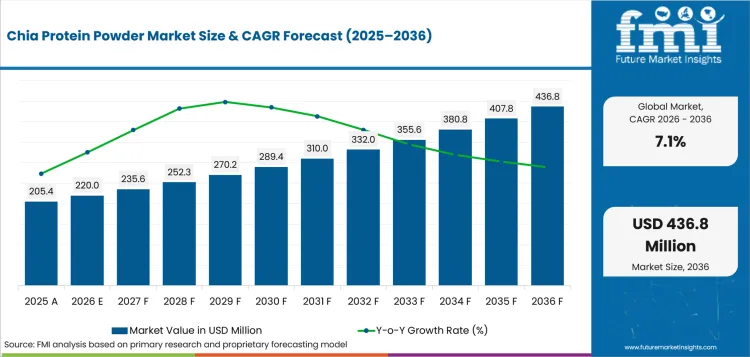
The chia protein powder market value is estimated to rise from USD 205.4 million in 2025 to USD 436.8 million by 2036 at 7.1% CAGR due to chia ingredient usage in supplements and premium plant protein positioning. The 40 to 49% protein segment is projected to capture 46.2% share in 2026, reflecting seed‑based powder preferences, while conventional certifications are expected to dominate with 57.8% share due to price sensitivity around organic formats.
Key Takeaways, Market Size, and Forecast
- 2026 Market Size: USD 220.0 million
- 2036 Market Size: USD 436.8 million
- Forecast CAGR: 7.1% from 2026 to 2036
- Leading Product Type: Chia Protein Concentrate
- Chia Protein Concentrate Share in 2026: 51.6%
- Leading End Use: Dietary Supplements
- Dietary Supplements Share in 2026: 42.8%
- Fastest-growing Country: Saudi Arabia
- Saudi Arabia CAGR: 8.0% through 2036
Summary of the Chia Protein Powder Market
- Demand and Growth Drivers
- Supplement brands are adding chia protein where plant-forward powder formulas need fiber, amino acid balance, and seed-origin label clarity.
- Bakery and snack manufacturers use chia powder blends to improve nutrition panels without moving into highly processed protein isolates.
- Retail powder brands position chia as a secondary protein source that complements pea, soy, rice, and seed blends.
- Organic and non-GMO claims support premium pricing when the product also meets protein and fiber label requirements.
- Ingredient buyers value traceable seed sourcing since chia production is concentrated in a limited group of Latin American suppliers.
- Product and Segment View
- Chia protein concentrate is expected to hold 51.6% share in 2026 due to cleaner blending and higher protein density.
- The 40 to 49% protein band is forecast to represent 46.2% share in 2026 as this level fits seed-based powder positioning.
- Conventional certified products are estimated to account for 57.8% share in 2026 while organic formats remain price-sensitive.
- Dietary supplements are projected to secure 42.8% share in 2026 with ready-to-mix powders forming the main use case.
- Geography and Competitive Outlook
- United States is expected to expand at 7.5% CAGR through 2036 due to wellness retail scale and protein powder use.
- Japan is projected to rise at 7.4% CAGR through 2036 as plant-based protein drinks and functional food formats gain wider testing.
- Functional Products S.A., Glanbia plc, and ADM focus on seed protein formats, plant protein portfolios, and formulation support.
- Supplement contract manufacturers help smaller brands enter the category through custom powder blends and certification handling.
- Analyst Opinion
- Nandini Roy Choudhury, Principal Consultant for Food and Beverage at Future Market Insights, observes, "Chia protein powder is not sold mainly on volume like pea or soy. The product works when buyers want a seed-based protein that also carries fiber and omega-3 associations. Suppliers that document protein level and origin have a clearer path to premium powder programs."
- Chia Protein Powder Market Value Analysis
- Market value is supported by finished protein powder brands and B2B ingredient sales into supplements and bakery mixes. Bars and drink powders add smaller revenue pools.
- Ingredient pricing reflects chia seed availability, milling yield, protein concentration and certification costs.
- Revenue improves when suppliers move from whole seed powder into concentrated formats used by supplement brands and food manufacturers.
- Gross margin depends on protein level, flavor neutrality and the ability to document origin for North American, European and Gulf buyers.
Chia protein powder has moved beyond whole-seed wellness shelves into formulated powders and plant-based food applications. Buyers now compare protein concentration and supply traceability before shortlisting ingredient partners. Product specification is becoming a clear separator in this market. In March 2025, Benexia stated that chia protein delivers a PDCAAS score of 0.95 and contains all essential amino acids. The company also identified XIA Powder 125W LM as a 42% protein concentrate suited for breads, cookies, bars, baking mixes, ready meals, and protein powder applications. FDA’s January 2025 draft guidance adds demand context as U.S. retail plant-based food dollar sales rose from USD 5.5 billion in 2019 to USD 8.1 billion in 2023. This supports the case for chia protein suppliers serving plant-forward formulations where buyers need protein quality and clear plant-source labeling.
Chia Protein Powder Market Definition
The chia protein powder market covers powdered ingredients and finished powder blends made from chia seeds and sold for human nutrition. Scope includes chia protein concentrate, milled chia powder blends, sprouted chia powder, defatted chia flour, and chia fiber-protein blends used in supplements, bakery, snacks, beverage mixes, and weight management nutrition. Revenue includes finished branded products, private label powders, and B2B ingredient sales where chia is positioned as a protein source or protein-supporting seed ingredient. The market excludes raw whole chia seed sold only as a topping, chia oil, animal feed, and non-food industrial uses.
Chia Protein Powder Market Inclusions
Market scope covers commercially sold chia protein concentrate and chia powder blends by product type. Protein concentration coverage includes 30 to 39% protein, 40 to 49% protein, above 50% protein, low protein blends, and custom blends. Certification analysis includes conventional, organic, non-GMO, gluten-free, halal, and kosher formats. End-use coverage includes dietary supplements, sports nutrition, bakery snacks, beverage mixes, weight management, and medical nutrition support where applicable. Sales channel coverage includes B2B ingredients, supplement CMOs, online retail, natural retail, and specialty distributors. Buyer type coverage includes supplement brands, food manufacturers, ingredient distributors, private label firms, and specialty retailers.
Chia Protein Powder Market Exclusions
Scope excludes whole chia seed sold without protein positioning, chia oil, chia beverages without powder revenue, pet nutrition, feed-grade chia meal, and commodity seed trading. Standard plant protein powders are excluded unless chia protein or chia powder is a named ingredient in the product boundary. This also excludes commercial market research figures from third-party publishers. Values were built from product boundary logic, supplier specification checks, official nutrition and trade sources, and channel-level triangulation.
Chia Protein Powder Market Research Methodology
- Primary Research: Future Market Insights analysts reviewed chia ingredient portfolios, supplement powder listings, private label powder programs, and distributor availability across priority markets.
- Desk Research: Public data from national food agencies, government nutrition surveys, trade agencies, peer-reviewed sources, and official company pages were checked against chia protein powder use cases.
- Market Sizing and Forecasting: The market size has been estimated using a bottom-up product-boundary approach. Each category has been defined by eligible chia protein SKUs, B2B ingredient revenue pools, supplement powder availability, foodservice and retail channel presence, product positioning, and country-level adoption patterns. Raw whole chia seeds were excluded unless they were sold as milled protein powder, chia protein concentrate, or powder blends with protein positioning.
- Data Validation: Forecast checks compared chia seed supply, plant protein powder benchmarks, supplement claim rules, retail channel pricing, and active supplier portfolios. Values were reconciled against parent plant protein categories and specialty seed ingredient pricing.
Why is the Chia Protein Powder Market Growing?
- Protein powder brands are widening seed-based formulas where consumers want plant protein without relying only on soy-based or pea-based formulas.
- Food manufacturers use chia protein in bakery and drink powder systems where fiber content supports added nutrition cues.
- Ingredient suppliers are improving specification language so buyers can compare protein level, fiber level, microbial safety, and origin before purchase.
Plant-Based Protein Formulation Is Creating Space for Seed Proteins
Chia protein powder is gaining traction as brands diversify plant protein systems beyond soy and pea. FDA’s January 2025 draft guidance reported that U.S. retail plant-based food dollar sales increased from USD 5.5 billion in 2019 to USD 8.1 billion in 2023. This demand base supports secondary seed proteins that can add protein and plant-source label value in one ingredient.
Microbial Safety Risk Raises Supplier Qualification Pressure
Food safety remains a restraint because chia-based inputs move through seed handling, milling, and powder processing stages. FDA’s January 2026 recall notice for Navitas Organics organic chia seeds listed eight affected lot codes due to possible Salmonella contamination. This shows why buyers may require tighter supplier audits, microbial testing, lot traceability, and certificate documentation before using chia protein powder in finished foods.
Faster Nutrient Testing Can Strengthen Buyer Confidence
Ingredient suppliers can create opportunity by improving specification proof around fiber and protein quality. USDA ARS reported in June 2025 that an FT-MIR testing method was approximately 90% as accurate as conventional laboratory methods for dietary fiber measurement in pulse flour. Similar rapid-testing approaches can help plant-protein ingredient suppliers reduce documentation gaps and give food manufacturers stronger data for nutrition-led formulation decisions.
Market Segmentation Analysis
- Chia protein concentrate is projected to secure 51.6% share in 2026 through more precise dosing and more predictable protein delivery.
- The 40 to 49% protein band is expected to hold 46.2% share in 2026 as seed-based concentrates commonly sit in this range.
- Conventional certification is anticipated to represent 57.8% share in 2026 since organic supply carries a pricing premium.
- Dietary supplements are forecast to account for 42.8% share in 2026 with ready-to-mix powders and capsules using chia ingredients.
- B2B ingredients are projected to hold 55.1% share in 2026 as most chia protein moves through ingredient suppliers and CMOs.
- Supplement brands are expected to represent 38.9% share in 2026 where powders need repeatable taste and pack instructions.
Insights into Chia Protein Powder Market by Product Type
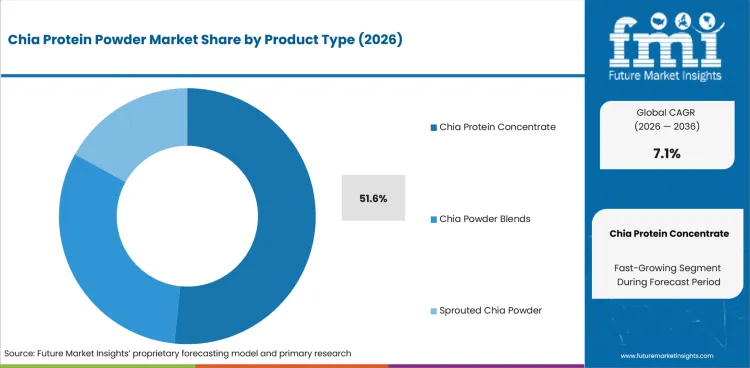
- Chia protein concentrate accounts for 51.6% share in 2026 as buyers prefer defined protein levels over whole-seed powder variability.
- Chia powder blends gain use in bars and bakery mixes where fiber and texture are part of the formulation target.
Insights into Chia Protein Powder Market by Protein Concentration
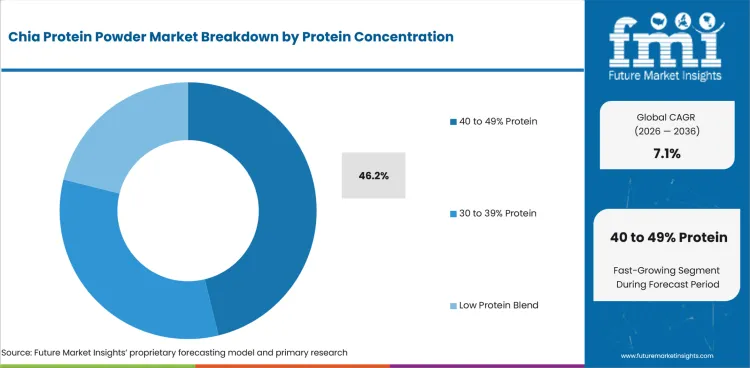
- The 40 to 49% protein segment is forecast to hold 46.2% share in 2026 since this band aligns with currently documented chia concentrate specifications.
- Above 50% protein formats remain smaller because higher concentration can increase processing cost and reduce the natural seed identity buyers want.
Insights into Chia Protein Powder Market by Certification Type
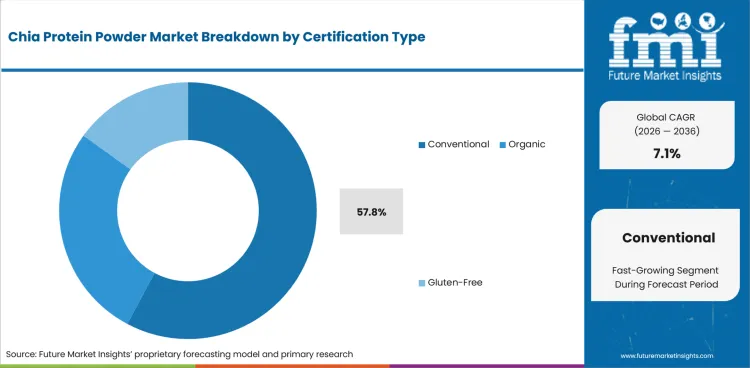
- Conventional products are estimated to account for 57.8% share in 2026 as price and availability remain practical selection filters.
- Organic chia protein keeps a premium role where natural retail brands need a clearer claim stack and origin documentation. Certification pressure overlaps with United States superfood powder retail logic where buyers compare seed origin, label claims, and pack trust before paying a premium.
Insights into Chia Protein Powder Market by End Use
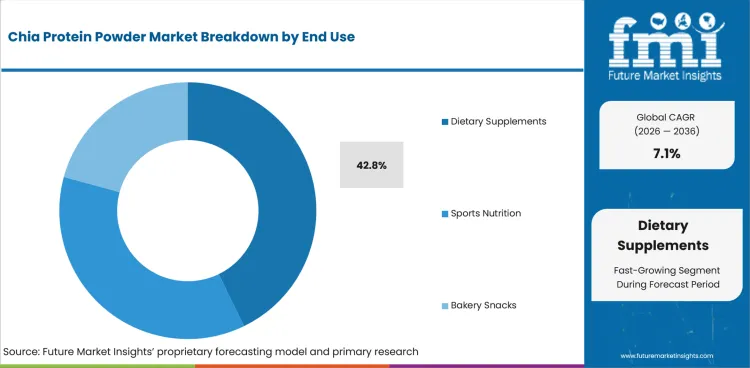
- Dietary supplements are projected to account for 42.8% share in 2026 through ready-to-mix powders and capsule-compatible milled formats.
- Bakery snacks use chia protein where brands want better nutrition panels without heavy isolate processing or allergen pressure. Agriculture and Agri-Food Canada reported in 2025 that plant-based or high-added protein claims in Canadian bakery products increased 140.0% between second quarter 2023 and second quarter 2024. That supports bakery as a credible secondary route for chia protein powder beyond supplements.
Insights into Chia Protein Powder Market by Sales Channel
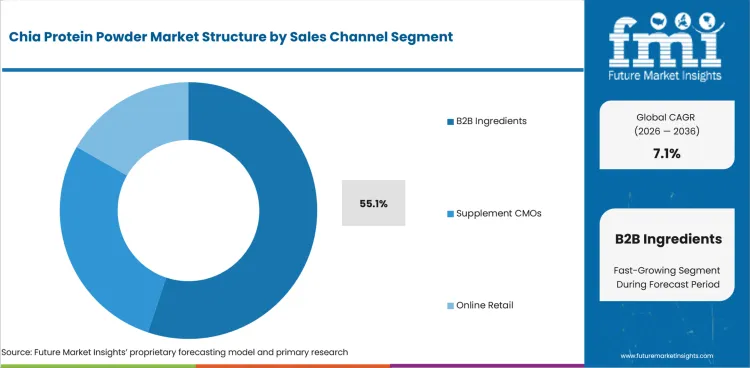
- B2B ingredients are forecast to hold 55.1% share in 2026 as supplement brands buy chia protein through ingredient suppliers and distributors.
- Online retail grows from a smaller base as natural product shoppers compare chia protein powders by origin, protein grams, and certification badges.
Channel structure favors suppliers with specification sheets and application guidance. Supplement CMOs also matter because they translate seed ingredients into repeatable powder blends for smaller brands.
Insights into Chia Protein Powder Market by Buyer Type
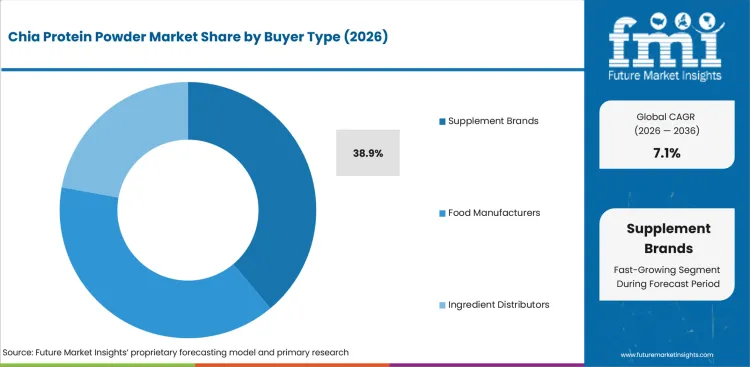
- Supplement brands are expected to hold 38.9% share in 2026 since they can communicate protein, fiber, and omega-3 associations on one label panel.
- Food manufacturers expand use when chia powder improves texture and nutrition without forcing a move into allergen-heavy protein sources.
Chia Protein Powder Market Drivers, Restraints, and Opportunities
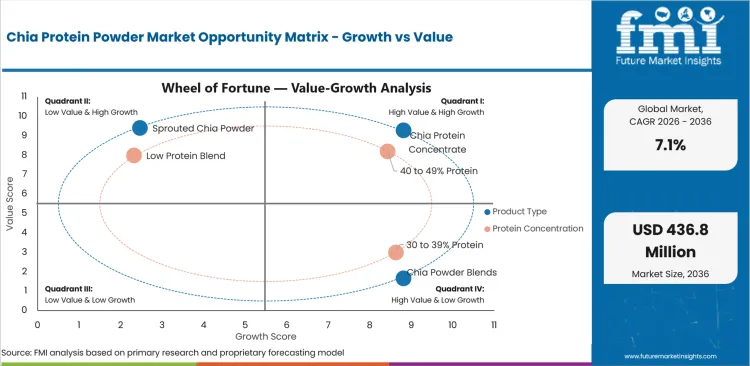
- Driver: Protein and fiber are both valued by consumers, which gives chia protein powder a dual claim route in supplement and food applications.
- Restraint: Chia protein remains more expensive than pea or soy protein when buyers only need grams of protein per dollar.
- Opportunity: Seed protein blends can use chia as a differentiating input while bulk protein comes from lower-cost sources.
The World Health Organization reported in January 2026 that protein intake at 10 to 15% of daily energy is generally sufficient for adults. This keeps excessive protein claims under review and makes balanced product communication important. Chia protein powder fits best when brands explain protein as part of a wider nutrition profile rather than as a high-dose isolate. Ingredient selection is also shaped by adjacent protein ingredients where suppliers compete on claim support, solubility, taste, and pricing. Chia has a clearer role when a powder also needs fiber and seed identity. Drink powder projects can draw from plant-based protein beverages formulation lessons because dispersion and mouthfeel remain buyer concerns. Chia protein suppliers that provide beverage and bakery application data have a better route to repeat orders.
Consumer Segmentation and Purchase Behavior Analysis
Consumers buying chia protein powder are typically health-oriented adults, plant-forward shoppers, sports nutrition users, and people seeking convenient fiber plus protein products. Purchase behavior is led by protein grams, ingredient simplicity, flavor compatibility, certification, and price per serving. The International Food Information Council reported in October 2025 that 38.0% of Americans selected good source of protein as a criterion for healthy food. Chia protein powder can use this behavior only when the pack presents protein content clearly and avoids vague wellness language.
Voice of Customer and Decision-driver Analysis
Brand owners check three practical points before adding chia protein powder. They review whether protein level is stable, whether the powder disperses without gritty texture, and whether label claims can pass the target country review.The Canadian Food Inspection Agency stated in June 2025 that complete protein is an implied nutrient content claim and must meet the required source of protein conditions. This matters for chia protein suppliers since complete amino acid messaging needs a regulatory check before pack launch.
Analysis of Chia Protein Powder Market by Key Countries
.webp "Top Country Growth Comparison Chia Protein Powder Market Cagr (2026 2036)")
| Country | CAGR |
|---|---|
| United States | 7.5% |
| Canada | 7.0% |
| Germany | 6.7% |
| United Kingdom | 6.6% |
| Japan | 7.4% |
| Australia | 6.4% |
| Saudi Arabia | 8.0% |
Source: Future Market Insights analysis, 2026.
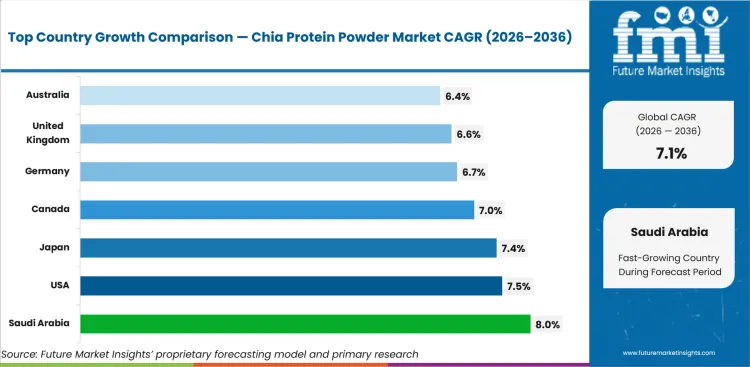
Chia Protein Powder Market CAGR Analysis by Country
- The United States is projected to record a 7.5% CAGR through 2036 as protein powder use and natural retail availability support chia blend testing.
- Canada is expected to expand at 7.0% CAGR through 2036 since protein claim activity in bakery and beverages supports ingredient trial.
- Germany is forecast to grow at 6.7% CAGR through 2036 with plant protein policy interest and cautious ingredient claim review.
- The United Kingdom is expected to advance at 6.6% CAGR through 2036 as plant-based nutrition stays visible in grocery and online channels.
- Japan is projected to rise at 7.4% CAGR through 2036 with functional food positioning and plant protein ingredient use in beverages.
- Australia is forecast at 6.4% CAGR through 2036 as supplement use is broad but price limits premium seed protein frequency.
- Saudi Arabia is expected to post 8.0% CAGR through 2036 as premium wellness retail and imported supplement rules support registered powder formats.
Sales Outlook for Chia Protein Powder Market in the United States
Protein powder retail scale and natural product shelves center, 2026 to 2036
Country Market Snapshot Table
| Parameter | Value |
|---|---|
| Market Size in 2025 (Value) | USD 54.2 million |
| Market Size in 2026 (Value) | USD 58.3 million |
| Market Forecast in 2036 (Value) | USD 120.3 million |
| CAGR (2026 to 2036) | 7.5% |
| Years Considered | 2021 to 2036 |
| Base Year | 2025 |
| Forecast Period | 2026 to 2036 |
| Units Considered | Value (USD million) |
| Leading Sub-Region | Pacific and Mountain wellness retail corridors |
United States Chia Protein Powder Market Outlook
United States chia protein powder demand is shaped by a large protein powder base and active natural product retail shelves. Buyers compare chia protein with pea, soy, rice, hemp and flax before selecting seed blends for finished powders.
The United States is projected to record a 7.5% CAGR through 2036 as protein powder use and plant-forward supplement programs support trial. Suppliers with verified protein levels and allergen documentation gain better access to national wellness retail.
Key Growth Drivers
- Protein-first shopping gives chia powder a clear message when brands state grams per serving. International Food Information Council reported in October 2025 that 38.0% of Americans define healthy food by good protein source cues.
- Fiber interest supports chia blends as one ingredient can carry protein and fiber. International Food Information Council reported in October 2025 that 64.0% of Americans try to consume fiber.
- Sports nutrition brands can use chia protein as a secondary seed protein where pea and rice still carry the main protein load.
- Natural product retailers can test smaller chia protein packs before wider listing since shelf education is easier around known chia ingredients.
Key Restraints
- Plant protein powders face testing scrutiny when buyers worry about contaminants and source quality in seed-based formulas.
- High ingredient cost can reduce repeat use when brands compare chia protein against lower-priced pea or soy protein.
- Claim wording needs regulatory care since complete protein and nutrient content claims require evidence before pack launch.
What makes United States unique
The United States is different due to large protein powder shelves and retailer scrutiny on supplement claims.
Key Companies
- Glanbia Nutritionals
- ADM
- Cargill Incorporated
- NOW Foods
- Nutiva, Inc.
- Navitas Organics
- Makers Nutrition LLC
Sales & Marketing Channels
- Natural product retail
- Online supplement stores
- Specialty distributors
- Supplement CMOs
- Gym and wellness retail
- Mass retail wellness aisles
Country Segment Breakdown Table
| Segment | Sub-Segments |
|---|---|
| By Product Type | Chia Protein Concentrate, Chia Powder Blends, Sprouted Chia Powder, Defatted Chia Flour, Chia Fiber Blend |
| By Protein Concentration | 30 to 39% Protein, 40 to 49% Protein, Above 50% Protein, Low Protein Blend, Custom Blend |
| By Certification Type | Conventional, Organic, Non-GMO, Gluten-Free, Halal, Kosher |
| By End Use | Dietary Supplements, Sports Nutrition, Bakery Snacks, Beverage Mixes, Weight Management, Medical Nutrition |
| By Sales Channel | B2B Ingredients, Supplement CMOs, Online Retail, Natural Retail, Specialty Distributors |
| By Buyer Type | Supplement Brands, Food Manufacturers, Ingredient Distributors, Private Label Firms, Specialty Retailers |
| Key Sub-Regions Covered, Nutrition Retail Corridors | California, Colorado, Texas, Florida, New York, Pacific Northwest. |
Frequently Asked Questions
How fast is United States chia protein powder market growing?
Demand in the United States is expected to expand at 7.5% CAGR from 2026 to 2036.
Who leads United States chia protein powder market?
Glanbia Nutritionals, ADM, Cargill, NOW Foods, Nutiva, and Navitas Organics are relevant suppliers or channel brands.
What is driving adoption in United States chia protein powder market?
Protein interest, fiber positioning, and natural retail availability support chia protein powder trial.
Opportunity Analysis for Chia Protein Powder Market in Canada
Protein claim growth and natural product retail center, 2026 to 2036
Country Market Snapshot Table
| Parameter | Value |
|---|---|
| Market Size in 2025 (Value) | USD 12.3 million |
| Market Size in 2026 (Value) | USD 13.2 million |
| Market Forecast in 2036 (Value) | USD 26.0 million |
| CAGR (2026 to 2036) | 7.0% |
| Years Considered | 2021 to 2036 |
| Base Year | 2025 |
| Forecast Period | 2026 to 2036 |
| Units Considered | Value (USD million) |
| Leading Sub-Region | Ontario and British Columbia natural product corridors |
Canada Chia Protein Powder Market Outlook
Canadian buyers treat chia protein powder as a premium seed ingredient rather than a bulk protein source. Natural product retailers and bakery brands compare certification, source origin, and protein claim wording before listing.
Canada is expected to expand at 7.0% CAGR through 2036 since protein claims in bakery and beverages create a practical entry route.This gives chia suppliers a route into bakery powder and snack systems.
Key Growth Drivers
- Bakery reformulation supports chia protein where brands need seed ingredients with fiber carryover. Agriculture and Agri-Food Canada reported a 140.0% rise in bakery protein claims between second quarter 2023 and second quarter 2024.
- Beverage concepts also support trial since Agriculture and Agri-Food Canada reported 5.0% growth in nutritional drinks with plant-based or high-added protein claims in the same period.
- Natural product retailers can use organic and non-GMO cues to justify higher-priced chia protein powder.
- Canadian supplement brands value suppliers that can provide bilingual label support and claim review.
Key Restraints
- Protein claim rules can slow pack approval when a supplier cannot document protein quality and serving basis.
- Imported chia inputs create exposure to freight costs and currency movements for smaller Canadian brands.
- Shelf placement remains selective because retailers often prefer familiar pea and soy protein powders for daily-use price points.
What makes Canada unique
Canada is different through formal protein claim discipline and strong natural product retail links with bakery and beverage development.
Key Companies
- SunOpta Inc.
- Manitoba Harvest
- Natures Crops International
- GFR Ingredients Inc.
- Healthy Planet Canada
Sales & Marketing Channels
- Natural Health Stores
- Online Wellness Retail
- Ingredient Distributors
- Bakery Ingredient Suppliers
- Supplement CMOs
- Grocery Wellness Aisles
Country Segment Breakdown Table
| Segment | Sub-Segments |
|---|---|
| By Product Type | Chia Protein Concentrate, Chia Powder Blends, Sprouted Chia Powder, Defatted Chia Flour, Chia Fiber Blend |
| By Protein Concentration | 30 to 39% Protein, 40 to 49% Protein, Above 50% Protein, Low Protein Blend, Custom Blend |
| By Certification Type | Conventional, Organic, Non-GMO, Gluten-Free, Halal, Kosher |
| By End Use | Dietary Supplements, Sports Nutrition, Bakery Snacks, Beverage Mixes, Weight Management, Medical Nutrition |
| By Sales Channel | B2B Ingredients, Supplement CMOs, Online Retail, Natural Retail, Specialty Distributors |
| By Buyer Type | Supplement Brands, Food Manufacturers, Ingredient Distributors, Private Label Firms, Specialty Retailers |
| Key Sub-Regions Covered, Nutrition Retail Corridors | Ontario, Quebec, British Columbia, Alberta, Manitoba, Saskatchewan. |
Frequently Asked Questions
How fast is Canada chia protein powder market growing?
Canada is projected to grow at 7.0% CAGR from 2026 to 2036.
Who leads Canada chia protein powder market?
Glanbia Canada, ADM Canada, SunOpta, Manitoba Harvest, and Natures Crops International support the broader seed and plant protein channel.
What is driving adoption in Canada chia protein powder market?
Protein claim growth in bakery and nutritional drinks supports chia protein use.
Growth Outlook for Chia Protein Powder Market in Germany
Plant protein policy interest and certification-led buying center, 2026 to 2036
Country Market Snapshot Table
| Parameter | Value |
|---|---|
| Market Size in 2025 (Value) | USD 19.2 million |
| Market Size in 2026 (Value) | USD 20.5 million |
| Market Forecast in 2036 (Value) | USD 39.2 million |
| CAGR (2026 to 2036) | 6.7% |
| Years Considered | 2021 to 2036 |
| Base Year | 2025 |
| Forecast Period | 2026 to 2036 |
| Units Considered | Value (USD million) |
| Leading Sub-Region | Bavaria, North Rhine-Westphalia and Berlin |
Germany Chia Protein Powder Market Outlook
Germany’s chia protein powder market is shaped by ingredient caution and certification-led purchasing. Buyers evaluate organic status and taste performance before accepting seed protein blends.
Germany is forecast to grow at 6.7% CAGR through 2036 with plant protein policy interest supporting alternative ingredient evaluation. Suppliers that make claim review and origin documents easy can reduce listing friction.
Key Growth Drivers
- Plant protein ingredient tracking creates a clearer benchmark for chia powder buyers. Agriculture and Agri-Food Canada published Germany plant-based protein ingredient demand by product category in July 2025.
- Organic retail depth supports premium seed protein powders when brands can show source and processing controls.
- Bakery and snack manufacturers can use chia powder where fiber and texture give a reason beyond protein grams.
- Ingredient distributors can place chia protein as a specialty seed input beside pea, rice, and fava protein lines.
Key Restraints
- Price sensitivity limits daily-use protein powder purchases when chia protein is compared with pea or soy.
- Taste adjustment can add formulation cost for beverage powders that need smoother texture and neutral flavor.
- Claim review remains strict since protein and health wording must align with European food information rules.
What makes Germany unique
Germany is different through certification-sensitive buyers, specialty ingredient distributors, and careful protein claim review.
Key Companies
- Roquette Deutschland GmbH
- ADM Hamburg AG
- Glanbia Nutritionals Deutschland GmbH
- Müller’s Mühle GmbH
- Govinda Natur GmbH
- Raab Vitalfood GmbH
- KoRo Handels GmbH
Sales & Marketing Channels
- Organic Retail
- Drugstore Wellness Aisles
- Ingredient Distributors
- Online Wellness Stores
- Bakery Suppliers
- Private Label Powder Firms
Country Segment Breakdown Table
| Segment | Sub-Segments |
|---|---|
| By Product Type | Chia Protein Concentrate, Chia Powder Blends, Sprouted Chia Powder, Defatted Chia Flour, Chia Fiber Blend |
| By Protein Concentration | 30 to 39% Protein, 40 to 49% Protein, Above 50% Protein, Low Protein Blend, Custom Blend |
| By Certification Type | Conventional, Organic, Non-GMO, Gluten-Free, Halal, Kosher |
| By End Use | Dietary Supplements, Sports Nutrition, Bakery Snacks, Beverage Mixes, Weight Management, Medical Nutrition |
| By Sales Channel | B2B Ingredients, Supplement CMOs, Online Retail, Natural Retail, Specialty Distributors |
| By Buyer Type | Supplement Brands, Food Manufacturers, Ingredient Distributors, Private Label Firms, Specialty Retailers |
| Key Sub-Regions Covered, Nutrition Retail Corridors | North Rhine-Westphalia, Bavaria, Baden-Württemberg, Berlin, Hamburg, Hesse. |
Frequently Asked Questions
How fast is Germany chia protein powder market growing?
Germany is forecast to grow at 6.7% CAGR from 2026 to 2036.
Who leads Germany chia protein powder market?
Roquette, ADM, Glanbia, Müller’s Mühle, Govinda, and Raab Vitalfood are relevant to plant protein or natural powder supply.
What is driving adoption in Germany chia protein powder market?
Certification-led buying and bakery use support cautious chia protein powder trial.
Demand Outlook for Chia Protein Powder Market in the United Kingdom
Grocery wellness and online supplement retail center, 2026 to 2036
Country Market Snapshot Table
| Parameter | Value |
|---|---|
| Market Size in 2025 (Value) | USD 14.4 million |
| Market Size in 2026 (Value) | USD 15.4 million |
| Market Forecast in 2036 (Value) | USD 29.2 million |
| CAGR (2026 to 2036) | 6.6% |
| Years Considered | 2021 to 2036 |
| Base Year | 2025 |
| Forecast Period | 2026 to 2036 |
| Units Considered | Value (USD million) |
| Leading Sub-Region | London, South East and Manchester retail corridors |
United Kingdom Chia Protein Powder Market Outlook
United Kingdom chia protein powder buyers are influenced by grocery wellness, online supplement retail, and plant-based nutrition discussion. Brands need simple pack language because shoppers compare protein, sugar, fiber, and ingredient count quickly.
The United Kingdom is expected to advance at 6.6% CAGR through 2036 as plant-based powders remain visible in online and retail wellness. The Scientific Advisory Committee on Nutrition and the Committee on Toxicity reported in July 2025 that many plant-based drinks have no minimum nutritional composition requirement. This creates space for powder brands that document protein and fiber contribution clearly.
Key Growth Drivers
- Nutritional clarity creates a role for chia protein powder where brands state protein grams and avoid unclear plant-based drink claims.
- Online supplement retail supports specialty seed protein discovery before mainstream grocery acceptance.
- Bakery and snack brands can test chia protein in smaller batches through local ingredient distributors.
- Plant-forward shoppers give brands a route to combine chia with pea, rice or hemp protein blends.
Key Restraints
- Price pressure is high since UK shoppers can compare many protein powders online before purchase.
- Texture limits repeat purchase when chia powder creates grit or thickness in ready-to-mix drinks.
- Regulatory review can restrict loose nutrition wording after the July 2025 plant-based drinks assessment highlighted composition concerns.
What makes United Kingdom unique
The United Kingdom is different through online comparison behavior and stricter attention to nutrition clarity in plant-based formats.
Key Companies
- Glanbia Performance Nutrition UK Limited
- Bulk Powders Limited
- Myprotein Limited
- ADM UK Limited
- Naturya Limited
- Planet Organic Limited
- The Protein Works
Sales & Marketing Channels
- Online Supplement Retail
- Health Food Stores
- Grocery Wellness Aisles
- Ingredient Distributors
- Private Label Powder Firms
- Gym Retail
Country Segment Breakdown Table
| Segment | Sub-Segments |
|---|---|
| By Product Type | Chia Protein Concentrate, Chia Powder Blends, Sprouted Chia Powder, Defatted Chia Flour, Chia Fiber Blend |
| By Protein Concentration | 30 to 39% Protein, 40 to 49% Protein, Above 50% Protein, Low Protein Blend, Custom Blend |
| By Certification Type | Conventional, Organic, Non-GMO, Gluten-Free, Halal, Kosher |
| By End Use | Dietary Supplements, Sports Nutrition, Bakery Snacks, Beverage Mixes, Weight Management, Medical Nutrition |
| By Sales Channel | B2B Ingredients, Supplement CMOs, Online Retail, Natural Retail, Specialty Distributors |
| By Buyer Type | Supplement Brands, Food Manufacturers, Ingredient Distributors, Private Label Firms, Specialty Retailers |
| Key Sub-Regions Covered, Nutrition Retail Corridors | London, South East England, Manchester, Birmingham, Scotland, Wales. |
Frequently Asked Questions
How fast is United Kingdom chia protein powder market growing?
The United Kingdom is expected to advance at 6.6% CAGR from 2026 to 2036.
Who leads United Kingdom chia protein powder market?
Bulk, Myprotein, Naturya, Glanbia, and The Protein Works help shape powder retail and formulation behavior.
What is driving adoption in United Kingdom chia protein powder market?
Online comparison and plant-based nutrition interest support chia powder trial.
Future Outlook for Chia Protein Powder Market in Japan
Functional food retail and plant protein beverage testing center, 2026 to 2036
Country Market Snapshot Table
| Parameter | Value |
|---|---|
| Market Size in 2025 (Value) | USD 17.4 million |
| Market Size in 2026 (Value) | USD 18.7 million |
| Market Forecast in 2036 (Value) | USD 38.2 million |
| CAGR (2026 to 2036) | 7.4% |
| Years Considered | 2021 to 2036 |
| Base Year | 2025 |
| Forecast Period | 2026 to 2036 |
| Units Considered | Value (USD million) |
| Leading Sub-Region | Kanto, Kansai and Chubu health food corridors |
Japan Chia Protein Powder Market Outlook
Japan’s market is shaped by functional food retail and controlled product claims. Buyers favor ingredients with clear nutrition data and stable sensory behavior in small-format powders, drinks, and snacks.
Japan is projected to rise at 7.4% CAGR through 2036 with functional food positioning and plant protein ingredient use in beverages.Seed protein suppliers that localize taste and pack size can win more repeat testing.
Key Growth Drivers
- Plant protein ingredient volume gives chia powder a credible entry point. Agriculture and Agri-Food Canada reported Japan non-animal derived protein ingredient sales of 46.3 thousand tonnes in 2023.
- Functional food channels can test chia protein where fiber and omega-3 cues fit small packs.
- Convenience-led retail favors single-serve drink powder or bar formats that use chia as a secondary protein input.
- Japanese buyers value fine milling and stable dispersion since texture is a repeat-purchase filter.
Key Restraints
- Soy protein has deep familiarity and lower cost, which can slow chia protein placement.
- Imported chia supply can create price exposure for small powder brands.
- Taste localization is needed since earthy notes can reduce repeat use in drink powders.
What makes Japan unique
Japan is different through functional food discipline, small-pack retail logic and higher sensitivity to texture in powder drinks.
Key Companies
- Nisshin OilliO Group, Ltd.
- Otsuka Pharmaceutical Co., Ltd.
- Ajinomoto Co., Inc.
- Mitsubishi Corporation Life Sciences Limited
- Morinaga & Co., Ltd.
- Asahi Group Foods, Ltd.
- Natural House Co., Ltd.
Sales & Marketing Channels
- Drugstores
- Convenience Retail
- Online Wellness Stores
- Functional Food Retailers
- Ingredient Distributors
- Sports Nutrition Stores
Country Segment Breakdown Table
| Segment | Sub-Segments |
|---|---|
| By Product Type | Chia Protein Concentrate, Chia Powder Blends, Sprouted Chia Powder, Defatted Chia Flour, Chia Fiber Blend |
| By Protein Concentration | 30 to 39% Protein, 40 to 49% Protein, Above 50% Protein, Low Protein Blend, Custom Blend |
| By Certification Type | Conventional, Organic, Non-GMO, Gluten-Free, Halal, Kosher |
| By End Use | Dietary Supplements, Sports Nutrition, Bakery Snacks, Beverage Mixes, Weight Management, Medical Nutrition |
| By Sales Channel | B2B Ingredients, Supplement CMOs, Online Retail, Natural Retail, Specialty Distributors |
| By Buyer Type | Supplement Brands, Food Manufacturers, Ingredient Distributors, Private Label Firms, Specialty Retailers |
| Key Sub-Regions Covered, Nutrition Retail Corridors | Kanto, Kansai, Chubu, Kyushu, Hokkaido, Tohoku. |
Frequently Asked Questions
How fast is Japan chia protein powder market growing?
Japan is projected to rise at 7.4% CAGR from 2026 to 2036.
Who leads Japan chia protein powder market?
Nisshin OilliO, Ajinomoto, Otsuka, Asahi Group Foods, and Mitsubishi Corporation Life Sciences are relevant to nutrition and ingredient channels.
What is driving adoption in Japan chia protein powder market?
Functional foods and small-pack powder formats support chia protein testing.
Sales Analysis for Chia Protein Powder Market in Australia
Supplement use and seed ingredient familiarity center, 2026 to 2036
Country Market Snapshot Table
| Parameter | Value |
|---|---|
| Market Size in 2025 (Value) | USD 11.4 million |
| Market Size in 2026 (Value) | USD 12.1 million |
| Market Forecast in 2036 (Value) | USD 22.5 million |
| CAGR (2026 to 2036) | 6.4% |
| Years Considered | 2021 to 2036 |
| Base Year | 2025 |
| Forecast Period | 2026 to 2036 |
| Units Considered | Value (USD million) |
| Leading Sub-Region | New South Wales, Victoria and Queensland |
Australia Chia Protein Powder Market Outlook
Australia’s chia protein powder market benefits from seed ingredient familiarity and broad supplement use. Buyers still compare chia protein against cheaper whey, pea, and rice powders for daily nutrition.
Australia is forecast at 6.4% CAGR through 2036 as supplement habits support trial but price limits repeat purchase frequency. The Australian Bureau of Statistics reported in September 2025 that average daily protein intake reached 88 grams in 2023. Chia protein suppliers need a clearer value message than protein grams alone.
Key Growth Drivers
- Dietary supplement use gives powder brands a larger wellness base. Australian Bureau of Statistics reported in September 2025 that 33.6% of people used a dietary supplement in 2023.
- Average protein intake keeps protein language familiar since the Australian Bureau of Statistics reported 88 grams per day in 2023.
- Natural product stores can position chia protein alongside hemp, flax, and seed powders.
- Sports nutrition brands can use chia in plant blends where fiber and omega-3 associations matter.
Key Restraints
- Premium seed protein price limits trial when buyers compare price per serving.
- Long-distance chia sourcing can create freight and inventory risk for smaller brands.
- High protein intake reduces urgency for pure protein messaging, so chia brands need fiber and seed-origin differentiation.
What makes Australia unique
Australia is different through broad supplement use and strict price comparison in sports nutrition retail.
Key Companies
- The Chia Co Pty Ltd
- Honest to Goodness Products Pty Ltd
- Morlife Pty Ltd
- Healthy Life Australia Pty Ltd
- Aussie Health Products Pty Ltd
- Glanbia Nutritionals Australia Pty Ltd
- Bulk Nutrients Pty Ltd
Sales & Marketing Channels
- Health Food Stores
- Online Supplement Retail
- Sports Nutrition Stores
- Grocery Wellness Aisles
- Ingredient Distributors
- Private Label Powder Firms
Country Segment Breakdown Table
| Segment | Sub-Segments |
|---|---|
| By Product Type | Chia Protein Concentrate, Chia Powder Blends, Sprouted Chia Powder, Defatted Chia Flour, Chia Fiber Blend |
| By Protein Concentration | 30 to 39% Protein, 40 to 49% Protein, Above 50% Protein, Low Protein Blend, Custom Blend |
| By Certification Type | Conventional, Organic, Non-GMO, Gluten-Free, Halal, Kosher |
| By End Use | Dietary Supplements, Sports Nutrition, Bakery Snacks, Beverage Mixes, Weight Management, Medical Nutrition |
| By Sales Channel | B2B Ingredients, Supplement CMOs, Online Retail, Natural Retail, Specialty Distributors |
| By Buyer Type | Supplement Brands, Food Manufacturers, Ingredient Distributors, Private Label Firms, Specialty Retailers |
| Key Sub-Regions Covered, Nutrition Retail Corridors | New South Wales, Victoria, Queensland, Western Australia, South Australia, Tasmania. |
Frequently Asked Questions
How fast is Australia chia protein powder market growing?
Australia is forecast at 6.4% CAGR from 2026 to 2036.
Who leads Australia chia protein powder market?
The Chia Co, Honest to Goodness, Morlife, Healthy Life, and Bulk Nutrients are relevant local brands or channels.
What is driving adoption in Australia chia protein powder market?
Supplement use and seed ingredient familiarity support chia protein powder trial.
Opportunity Analysis for Chia Protein Powder Market in Saudi Arabia
Premium wellness retail and imported supplement registration center, 2026 to 2036
Country Market Snapshot Table
| Parameter | Value |
|---|---|
| Market Size in 2025 (Value) | USD 8.1 million |
| Market Size in 2026 (Value) | USD 8.8 million |
| Market Forecast in 2036 (Value) | USD 19.0 million |
| CAGR (2026 to 2036) | 8.0% |
| Years Considered | 2021 to 2036 |
| Base Year | 2025 |
| Forecast Period | 2026 to 2036 |
| Units Considered | Value (USD million) |
| Leading Sub-Region | Riyadh, Jeddah and Dammam premium wellness retail |
Saudi Arabia Chia Protein Powder Market Outlook
Saudi Arabia’s chia protein powder market is shaped by imported supplement registration and premium wellness retail. Buyers evaluate halal documentation, ingredient classification, pack language, and distributor reliability before adding specialty plant proteins.
Saudi Arabia is expected to post 8.0% CAGR through 2036 as premium wellness retail expands from a smaller 2026 base. The Saudi Food and Drug Authority stated in February 2024 that food supplements may include amino acids and dietary fibers. This provides a defined regulatory route for chia protein powder when documentation is complete. Saudi Arabia powder projects also overlap with adjacent protein supplements applications where flavor and shelf stability guide product design.
Key Growth Drivers
- Regulatory classification supports chia protein powders when they fit food supplement rules. The Saudi Food and Drug Authority stated in February 2024 that food supplements can include amino acids and dietary fibers.
- Halal certification supports buyer confidence for imported seed protein powders.
- Premium wellness stores can test smaller powder formats before wider grocery listing.
- Gym and active nutrition channels create a route for plant protein blends with chia as a secondary ingredient.
Key Restraints
- Imported supply raises landed cost and can limit repeat purchase for price-sensitive users.
- Registration paperwork slows SKU entry when ingredient documents or label translations are incomplete.
- Limited local chia processing keeps the market dependent on foreign ingredient suppliers.
What makes Saudi Arabia unique
Saudi Arabia is different through halal documentation and premium wellness retail expansion from a smaller base.
Key Companies
- Nahdi Medical Company
- Al-Dawaa Medical Services Company
- Jamjoom Pharma
- Health Water Bottling Company Limited
- Glanbia Nutritionals Middle East
- ADM Middle East
- Dr. Nutrition Center LLC
Sales & Marketing Channels
- Pharmacy Retail
- Premium Wellness Stores
- Online Supplement Retail
- Gyms and Fitness Centers
- Ingredient Importers
- Specialty Grocery Stores
Country Segment Breakdown Table
| Segment | Sub-Segments |
|---|---|
| By Product Type | Chia Protein Concentrate, Chia Powder Blends, Sprouted Chia Powder, Defatted Chia Flour, Chia Fiber Blend |
| By Protein Concentration | 30 to 39% Protein, 40 to 49% Protein, Above 50% Protein, Low Protein Blend, Custom Blend |
| By Certification Type | Conventional, Organic, Non-GMO, Gluten-Free, Halal, Kosher |
| By End Use | Dietary Supplements, Sports Nutrition, Bakery Snacks, Beverage Mixes, Weight Management, Medical Nutrition |
| By Sales Channel | B2B Ingredients, Supplement CMOs, Online Retail, Natural Retail, Specialty Distributors |
| By Buyer Type | Supplement Brands, Food Manufacturers, Ingredient Distributors, Private Label Firms, Specialty Retailers |
| Key Sub-Regions Covered, Nutrition Retail Corridors | Riyadh, Jeddah, Dammam, Khobar, Mecca, Medina. |
Frequently Asked Questions
How fast is Saudi Arabia chia protein powder market growing?
Saudi Arabia is expected to post 8.0% CAGR from 2026 to 2036.
Who leads Saudi Arabia chia protein powder market?
Nahdi, Al-Dawaa, Dr. Nutrition, Glanbia Nutritionals Middle East, and ADM Middle East support wellness retail or ingredient access.
What is driving adoption in Saudi Arabia chia protein powder market?
Halal documentation and supplement registration support premium chia protein powder entry.
Competitive Landscape and Strategic Positioning
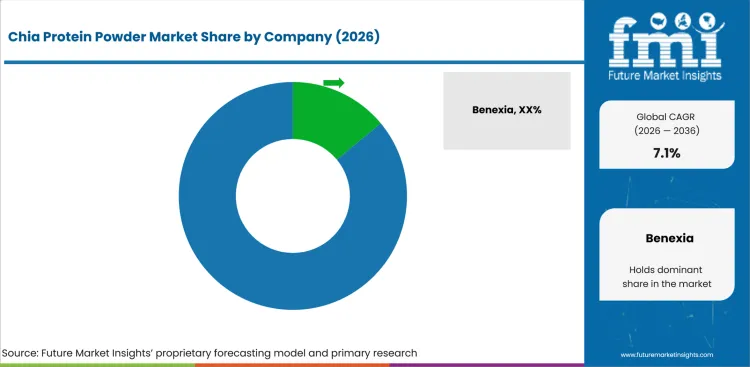
- Seed ingredient specialists hold an advantage when they document protein level, origin, microbial treatment, and application fit.
- Large ingredient groups compete through formulation support and plant protein portfolios that help brands blend chia with pea, soy, rice or flax.
- Supplement CMOs gain value when they can convert chia protein into stable powders with clean label flavor systems.
- Retail brands compete by serving size clarity and lower texture friction in ready-to-mix products.
Companies such as Functional Products S.A. focus on Benexia chia ingredients and direct technical documentation. Its March 2025 chia protein page states a Protein Digestibility Corrected Amino Acid Score of 0.95 and a 42% protein specification for XIA Powder 125W LM. This gives buyers a named benchmark for chia protein quality.
Large ingredient groups compete around broader plant-derived proteins and formulation service. Glanbia plc lists chia within plant protein solutions and states that BevChia Protein has more than 38% protein in a milled chia powder format. ADM and Cargill offer adjacent plant protein systems that set buyer expectations for taste and repeatable supply. Smaller and regional players can win when they focus on clean specifications and faster formulation support. They lose larger contracts when they cannot provide allergen statements or stable supply documentation.
Key Companies in the Chia Protein Powder Market
Competition differs across chia ingredient specialists, broad plant protein suppliers, supplement powder manufacturers and retail wellness brands. Buyers usually select a supplier only after checking protein content, certification, taste, and documentary support.
- Chia Ingredient Specialists: Functional Products S.A. under Benexia and The Chia Co compete through chia sourcing, milling, and seed ingredient knowledge.
- Plant Protein Ingredient Groups: Glanbia plc, ADM, Cargill Incorporated, and Roquette Frères compete through application support and broader protein portfolios.
- Retail and Private Label Brands: Nutiva, Navitas Organics, NOW Foods, Bulk, and Myprotein compete through online reach and consumer-facing powder packs.
- Supplement CMOs: Makers Nutrition LLC, NutraScience Labs, and similar powder manufacturers support smaller brand entry through formulation and pack execution.
Competitive Benchmarking: Chia Protein Powder Market
| Company | Relevance to Title | Chia or Seed Protein Fit | Powder Formulation Support | Certification Depth | Geographic Footprint |
|---|---|---|---|---|---|
| Functional Products S.A. (Benexia) | Very High | Very Strong | Strong | Very Strong | Americas and export markets |
| Glanbia plc | Very High | Strong | Very Strong | Strong | Global |
| ADM | High | Moderate | Very Strong | Strong | Global |
| Cargill Incorporated | High | Moderate | Very Strong | Strong | Global |
| Roquette Frères | Moderate to High | Moderate | Very Strong | Strong | Europe and North America |
| Nutiva, Inc. | High | Strong | Moderate | Strong | United States and online |
| The Chia Co Pty Ltd | High | Very Strong | Moderate | Strong | Australia and export markets |
| Navitas Organics | Moderate to High | Strong | Moderate | Strong | United States and online |
| Makers Nutrition LLC | Moderate | Low | Strong | Moderate | United States |
| Kerry Group plc | Moderate | Low | Very Strong | Strong | Global |
Source: Future Market Insights competitive analysis, 2026.
Key Developments in Chia Protein Powder Market
- In March 2025, Functional Products S.A. under Benexia described chia protein as a complete protein and stated a Protein Digestibility Corrected Amino Acid Score of 0.95. The update also described XIA Powder 125W LM as a chia protein concentrate with 42% protein for modern nutrition applications.
- In February 2026, Functional Products S.A. under Benexia discussed XIA Powder 435 as a chia fiber source for blood sugar management and described hydration, viscosity, sensory integration, and traceability features relevant to supplement formulation.
- In October 2025, Glanbia plc described plant-based proteins including pea, chia, and flaxseed proteins for bars, cereals, snacks, yogurts, ready-to-drink beverages, and powder drink mixes. This places chia inside broader powder and food formulation work.
- In February 2026, Roquette Frères launched NUTRALYS Pea 850F and stated that the NUTRALYS range includes pea, wheat, and fava proteins for plant-based and high-protein foods and beverages. This widens comparison pressure for seed proteins.
Chia Protein Powder Market - Report Scope and Coverage
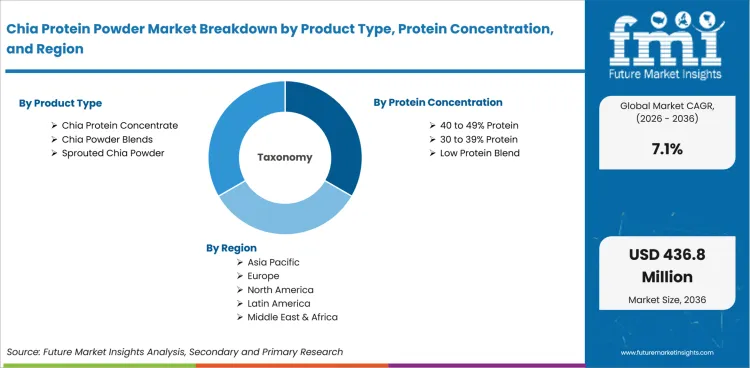
| Parameter | Details |
|---|---|
| Forecast Period | 2026 to 2036 |
| Base Year | 2025 |
| Historical Years | 2021 to 2024 |
| Quantitative Units | USD million |
| 2025 Market Size | USD 205.4 million |
| 2026 Market Size | USD 220.0 million |
| 2036 Market Size | USD 436.8 million |
| Forecast CAGR | 7.1% from 2026 to 2036 |
| Product Type | Chia Protein Concentrate, Chia Powder Blends, Sprouted Chia Powder, Defatted Chia Flour, Chia Fiber Blend |
| Protein Concentration | 30 to 39% Protein, 40 to 49% Protein, Above 50% Protein, Low Protein Blend, Custom Blend |
| Certification Type | Conventional, Organic, Non-GMO, Gluten-Free, Halal, Kosher |
| End Use | Dietary Supplements, Sports Nutrition, Bakery Snacks, Beverage Mixes, Weight Management, Medical Nutrition |
| Sales Channel | B2B Ingredients, Supplement CMOs, Online Retail, Natural Retail, Specialty Distributors |
| Buyer Type | Supplement Brands, Food Manufacturers, Ingredient Distributors, Private Label Firms, Specialty Retailers |
| Regions Covered | North America, Latin America, Europe, East Asia, South Asia Pacific, Middle East and Africa |
| Countries Covered | United States, Canada, Germany, United Kingdom, Japan, Australia, Saudi Arabia |
| Market Definition | Chia seed–derived protein powders and blends used in supplements, foods, and beverage applications |
| Methodology | Bottom-up product-boundary approach using eligible SKUs, protein concentration bands, certification status, channel presence, pricing benchmarks, and country-level adoption |
Chia Protein Powder Market by Segments
By Product Type:
- Chia Protein Concentrate
- Chia Powder Blends
- Sprouted Chia Powder
- Defatted Chia Flour
- Chia Fiber Blend
By Protein Concentration:
- 30 to 39% Protein
- 40 to 49% Protein
- Above 50% Protein
- Low Protein Blend
- Custom Blend
By Certification Type:
- Conventional
- Organic
- Non-GMO
- Gluten-Free
- Halal covers
- Kosher
By End Use:
- Dietary Supplements
- Sports Nutrition
- Bakery Snacks
- Beverage Mixes
- Weight Management
- Medical Nutrition
By Sales Channel:
- B2B Ingredients
- Supplement CMOs
- Online Retail
- Natural Retail covers
- Specialty Distributors
By Buyer Type:
- Supplement Brands
- Food Manufacturers
- Ingredient Distributors
- Private Label Firms
- Specialty Retailers
By Region:
- North America
- Latin America
- Europe
- East Asia
- South Asia Pacific
- Middle East and Africa
Research Sources and Bibliography
- [1] Agriculture and Agri-Food Canada. (2025, July 2). Sector trend analysis: Plant-based protein food and drink trends in Japan.
- [2] Agriculture and Agri-Food Canada. (2025). Sector trend analysis: Plant-based protein food and drink trends in Canada.
- [3] Agriculture and Agri-Food Canada. (2025). Sector trend analysis: Plant-based protein food and drink trends in Germany.
- [4] Archer-Daniels-Midland Company. (2024, October). GLP-1 user support products.
- [5] Archer-Daniels-Midland Company. (2025). Soy protein isolate product specifications.
- [6] Australian Bureau of Statistics. (2025, September 5). Food and nutrients, 2023.
- [7] Australian Bureau of Statistics. (2025, September 5). Dietary supplements, 2023.
- [8] Canadian Food Inspection Agency. (2025, June). Specific nutrient content claim requirements.
- [9] Cargill Incorporated. (2025). Plant protein for health and sports nutrition.
- [10] Cargill Incorporated. (2025). Plant protein for bakery, bars, and snacks.
- [11] Functional Products S.A. (2024, May 2). XIA Powder 435 W LM for dietary supplement applications.
- [12] Functional Products S.A. (2024, May 1). XIA Powder 435 W LM for high-protein and nutritional baking.
- [13] Functional Products S.A. (2025, March 20). Chia protein: A complete protein for modern nutrition.
- [14] Functional Products S.A. (2025, May). CHIAMUCIL chia-based fiber supplement concept.
- [16] Glanbia plc. (2024, March 13). The personalized protein powder space.
- [17] Glanbia plc. (2024, April 4). Athletic and sports performance.
- [18] Glanbia plc. (2025, October 7). Top diet trends for 2026: Insights for food companies.
- [19] International Food Information Council. (2025, October). 2025 Food and Health Survey.
- [20] Kerry Group plc. (2025, March 24). Emerging protein beverage trends in Latin America.
- [21] Kerry Group plc. (2025, April). Taste Charts for supplements.
- [22] Roquette Frères. (2024, May 28). Launch of a new fava bean protein isolate.
- [23] Roquette Frères. (2026, February 23). Launch of clean-tasting pea protein isolate.
- [24] Saudi Food and Drug Authority. (2024, February). Saudi FDA products classification guidance, version 7.
- [25] Scientific Advisory Committee on Nutrition and Committee on Toxicity. (2025, July 16). Assessing the health benefits and risks of consuming plant-based drinks.
- [26] United Kingdom Department of Health and Social Care. (2025, June 11). National Diet and Nutrition Survey 2019 to 2023.
This Report Answers
- What is the estimated value of the chia protein powder market in 2026?
- How much revenue is projected by 2036?
- Which product type leads the market in 2026?
- Which end use creates the largest revenue pool for chia protein powder?
- Which countries offer the clearest commercial route for chia protein powder suppliers?
- Which companies are relevant to chia protein powder supply and formulation?
- What restraints limit wider use of chia protein powder in beverages and daily-use supplements?
- How should buyers evaluate chia protein powder suppliers before purchase?
Frequently Asked Questions
What is the value of the chia protein powder market in 2026?
The market is estimated at USD 220.0 million in 2026 based on chia protein ingredient sales and finished powder revenue.
How large is the market projected to be by 2036?
The market is projected to reach USD 436.8 million by 2036 at 7.1% CAGR.
Which product type leads the market?
Chia protein concentrate leads the product type segment with 51.6% share in 2026.
Which end use leads the market?
Dietary supplements lead with 42.8% share in 2026 since ready-to-mix powders and capsules use chia ingredients.
Which country grows fastest?
Saudi Arabia is expected to post 8.0% CAGR through 2036 from a smaller base linked to premium wellness retail.
Why do buyers use chia protein powder?
Buyers use chia protein powder when they need seed-origin protein, fiber carryover, omega-3 associations, and clean label formulation support.
What limits market expansion?
Expansion is constrained by higher cost versus pea or soy protein, limited supply scale, and sensory issues in drink powders.
How was the market sized?
The market was sized with a bottom-up product-boundary method using eligible SKUs, B2B ingredient pools, retail availability, and country adoption patterns.
Preview the report firsthand - request a free sample
Get SampleGet the brochure for pricing and purchase details.
Get PDFTable of Content
- Executive Summary
- Global Market Outlook
- Demand to side Trends
- Supply to side Trends
- Technology Roadmap Analysis
- Analysis and Recommendations
- Market Overview
- Market Coverage / Taxonomy
- Market Definition / Scope / Limitations
- Research Methodology
- Chapter Orientation
- Analytical Lens and Working Hypotheses
- Market Structure, Signals, and Trend Drivers
- Benchmarking and Cross-market Comparability
- Market Sizing, Forecasting, and Opportunity Mapping
- Research Design and Evidence Framework
- Desk Research Programme (Secondary Evidence)
- Company Annual and Sustainability Reports
- Peer-reviewed Journals and Academic Literature
- Corporate Websites, Product Literature, and Technical Notes
- Earnings Decks and Investor Briefings
- Statutory Filings and Regulatory Disclosures
- Technical White Papers and Standards Notes
- Trade Journals, Industry Magazines, and Analyst Briefs
- Conference Proceedings, Webinars, and Seminar Materials
- Government Statistics Portals and Public Data Releases
- Press Releases and Reputable Media Coverage
- Specialist Newsletters and Curated Briefings
- Sector Databases and Reference Repositories
- FMI Internal Proprietary Databases and Historical Market Datasets
- Subscription Datasets and Paid Sources
- Social Channels, Communities, and Digital Listening Inputs
- Additional Desk Sources
- Expert Input and Fieldwork (Primary Evidence)
- Primary Modes
- Qualitative Interviews and Expert Elicitation
- Quantitative Surveys and Structured Data Capture
- Blended Approach
- Why Primary Evidence is Used
- Field Techniques
- Interviews
- Surveys
- Focus Groups
- Observational and In-context Research
- Social and Community Interactions
- Stakeholder Universe Engaged
- C-suite Leaders
- Board Members
- Presidents and Vice Presidents
- R&D and Innovation Heads
- Technical Specialists
- Domain Subject-matter Experts
- Scientists
- Physicians and Other Healthcare Professionals
- Governance, Ethics, and Data Stewardship
- Research Ethics
- Data Integrity and Handling
- Primary Modes
- Tooling, Models, and Reference Databases
- Desk Research Programme (Secondary Evidence)
- Data Engineering and Model Build
- Data Acquisition and Ingestion
- Cleaning, Normalisation, and Verification
- Synthesis, Triangulation, and Analysis
- Quality Assurance and Audit Trail
- Market Background
- Market Dynamics
- Drivers
- Restraints
- Opportunity
- Trends
- Scenario Forecast
- Demand in Optimistic Scenario
- Demand in Likely Scenario
- Demand in Conservative Scenario
- Opportunity Map Analysis
- Product Life Cycle Analysis
- Supply Chain Analysis
- Investment Feasibility Matrix
- Value Chain Analysis
- PESTLE and Porter’s Analysis
- Regulatory Landscape
- Regional Parent Market Outlook
- Production and Consumption Statistics
- Import and Export Statistics
- Market Dynamics
- Global Market Analysis 2021 to 2025 and Forecast, 2026 to 2036
- Historical Market Size Value (USD Million) Analysis, 2021 to 2025
- Current and Future Market Size Value (USD Million) Projections, 2026 to 2036
- Y to o to Y Growth Trend Analysis
- Absolute $ Opportunity Analysis
- Global Market Pricing Analysis 2021 to 2025 and Forecast 2026 to 2036
- Global Market Analysis 2021 to 2025 and Forecast 2026 to 2036, By Product Type
- Introduction / Key Findings
- Historical Market Size Value (USD Million) Analysis By Product Type , 2021 to 2025
- Current and Future Market Size Value (USD Million) Analysis and Forecast By Product Type , 2026 to 2036
- Chia Protein Concentrate
- Chia Powder Blends
- Sprouted Chia Powder
- Chia Protein Concentrate
- Y to o to Y Growth Trend Analysis By Product Type , 2021 to 2025
- Absolute $ Opportunity Analysis By Product Type , 2026 to 2036
- Global Market Analysis 2021 to 2025 and Forecast 2026 to 2036, By Protein Concentration
- Introduction / Key Findings
- Historical Market Size Value (USD Million) Analysis By Protein Concentration, 2021 to 2025
- Current and Future Market Size Value (USD Million) Analysis and Forecast By Protein Concentration, 2026 to 2036
- 40 to 49% Protein
- 30 to 39% Protein
- Low Protein Blend
- 40 to 49% Protein
- Y to o to Y Growth Trend Analysis By Protein Concentration, 2021 to 2025
- Absolute $ Opportunity Analysis By Protein Concentration, 2026 to 2036
- Global Market Analysis 2021 to 2025 and Forecast 2026 to 2036, By Certification Type
- Introduction / Key Findings
- Historical Market Size Value (USD Million) Analysis By Certification Type, 2021 to 2025
- Current and Future Market Size Value (USD Million) Analysis and Forecast By Certification Type, 2026 to 2036
- Conventional
- Organic
- Gluten-Free
- Conventional
- Y to o to Y Growth Trend Analysis By Certification Type, 2021 to 2025
- Absolute $ Opportunity Analysis By Certification Type, 2026 to 2036
- Global Market Analysis 2021 to 2025 and Forecast 2026 to 2036, By End Use
- Introduction / Key Findings
- Historical Market Size Value (USD Million) Analysis By End Use, 2021 to 2025
- Current and Future Market Size Value (USD Million) Analysis and Forecast By End Use, 2026 to 2036
- Dietary Supplements
- Sports Nutrition
- Bakery Snacks
- Dietary Supplements
- Y to o to Y Growth Trend Analysis By End Use, 2021 to 2025
- Absolute $ Opportunity Analysis By End Use, 2026 to 2036
- Global Market Analysis 2021 to 2025 and Forecast 2026 to 2036, By Sales Channel
- Introduction / Key Findings
- Historical Market Size Value (USD Million) Analysis By Sales Channel, 2021 to 2025
- Current and Future Market Size Value (USD Million) Analysis and Forecast By Sales Channel, 2026 to 2036
- B2B Ingredients
- Supplement CMOs
- Online Retail
- B2B Ingredients
- Y to o to Y Growth Trend Analysis By Sales Channel, 2021 to 2025
- Absolute $ Opportunity Analysis By Sales Channel, 2026 to 2036
- Global Market Analysis 2021 to 2025 and Forecast 2026 to 2036, By Buyer Type
- Introduction / Key Findings
- Historical Market Size Value (USD Million) Analysis By Buyer Type, 2021 to 2025
- Current and Future Market Size Value (USD Million) Analysis and Forecast By Buyer Type, 2026 to 2036
- Supplement Brands
- Food Manufacturers
- Ingredient Distributors
- Supplement Brands
- Y to o to Y Growth Trend Analysis By Buyer Type, 2021 to 2025
- Absolute $ Opportunity Analysis By Buyer Type, 2026 to 2036
- Global Market Analysis 2021 to 2025 and Forecast 2026 to 2036, By Region
- Introduction
- Historical Market Size Value (USD Million) Analysis By Region, 2021 to 2025
- Current Market Size Value (USD Million) Analysis and Forecast By Region, 2026 to 2036
- North America
- Latin America
- Western Europe
- Eastern Europe
- East Asia
- South Asia and Pacific
- Middle East & Africa
- Market Attractiveness Analysis By Region
- North America Market Analysis 2021 to 2025 and Forecast 2026 to 2036, By Country
- Historical Market Size Value (USD Million) Trend Analysis By Market Taxonomy, 2021 to 2025
- Market Size Value (USD Million) Forecast By Market Taxonomy, 2026 to 2036
- By Country
- USA
- Canada
- Mexico
- By Product Type
- By Protein Concentration
- By Certification Type
- By End Use
- By Sales Channel
- By Buyer Type
- By Country
- Market Attractiveness Analysis
- By Country
- By Product Type
- By Protein Concentration
- By Certification Type
- By End Use
- By Sales Channel
- By Buyer Type
- Key Takeaways
- Latin America Market Analysis 2021 to 2025 and Forecast 2026 to 2036, By Country
- Historical Market Size Value (USD Million) Trend Analysis By Market Taxonomy, 2021 to 2025
- Market Size Value (USD Million) Forecast By Market Taxonomy, 2026 to 2036
- By Country
- Brazil
- Chile
- Rest of Latin America
- By Product Type
- By Protein Concentration
- By Certification Type
- By End Use
- By Sales Channel
- By Buyer Type
- By Country
- Market Attractiveness Analysis
- By Country
- By Product Type
- By Protein Concentration
- By Certification Type
- By End Use
- By Sales Channel
- By Buyer Type
- Key Takeaways
- Western Europe Market Analysis 2021 to 2025 and Forecast 2026 to 2036, By Country
- Historical Market Size Value (USD Million) Trend Analysis By Market Taxonomy, 2021 to 2025
- Market Size Value (USD Million) Forecast By Market Taxonomy, 2026 to 2036
- By Country
- Germany
- UK
- Italy
- Spain
- France
- Nordic
- BENELUX
- Rest of Western Europe
- By Product Type
- By Protein Concentration
- By Certification Type
- By End Use
- By Sales Channel
- By Buyer Type
- By Country
- Market Attractiveness Analysis
- By Country
- By Product Type
- By Protein Concentration
- By Certification Type
- By End Use
- By Sales Channel
- By Buyer Type
- Key Takeaways
- Eastern Europe Market Analysis 2021 to 2025 and Forecast 2026 to 2036, By Country
- Historical Market Size Value (USD Million) Trend Analysis By Market Taxonomy, 2021 to 2025
- Market Size Value (USD Million) Forecast By Market Taxonomy, 2026 to 2036
- By Country
- Russia
- Poland
- Hungary
- Balkan & Baltic
- Rest of Eastern Europe
- By Product Type
- By Protein Concentration
- By Certification Type
- By End Use
- By Sales Channel
- By Buyer Type
- By Country
- Market Attractiveness Analysis
- By Country
- By Product Type
- By Protein Concentration
- By Certification Type
- By End Use
- By Sales Channel
- By Buyer Type
- Key Takeaways
- East Asia Market Analysis 2021 to 2025 and Forecast 2026 to 2036, By Country
- Historical Market Size Value (USD Million) Trend Analysis By Market Taxonomy, 2021 to 2025
- Market Size Value (USD Million) Forecast By Market Taxonomy, 2026 to 2036
- By Country
- China
- Japan
- South Korea
- By Product Type
- By Protein Concentration
- By Certification Type
- By End Use
- By Sales Channel
- By Buyer Type
- By Country
- Market Attractiveness Analysis
- By Country
- By Product Type
- By Protein Concentration
- By Certification Type
- By End Use
- By Sales Channel
- By Buyer Type
- Key Takeaways
- South Asia and Pacific Market Analysis 2021 to 2025 and Forecast 2026 to 2036, By Country
- Historical Market Size Value (USD Million) Trend Analysis By Market Taxonomy, 2021 to 2025
- Market Size Value (USD Million) Forecast By Market Taxonomy, 2026 to 2036
- By Country
- India
- ASEAN
- Australia & New Zealand
- Rest of South Asia and Pacific
- By Product Type
- By Protein Concentration
- By Certification Type
- By End Use
- By Sales Channel
- By Buyer Type
- By Country
- Market Attractiveness Analysis
- By Country
- By Product Type
- By Protein Concentration
- By Certification Type
- By End Use
- By Sales Channel
- By Buyer Type
- Key Takeaways
- Middle East & Africa Market Analysis 2021 to 2025 and Forecast 2026 to 2036, By Country
- Historical Market Size Value (USD Million) Trend Analysis By Market Taxonomy, 2021 to 2025
- Market Size Value (USD Million) Forecast By Market Taxonomy, 2026 to 2036
- By Country
- Kingdom of Saudi Arabia
- Other GCC Countries
- Turkiye
- South Africa
- Other African Union
- Rest of Middle East & Africa
- By Product Type
- By Protein Concentration
- By Certification Type
- By End Use
- By Sales Channel
- By Buyer Type
- By Country
- Market Attractiveness Analysis
- By Country
- By Product Type
- By Protein Concentration
- By Certification Type
- By End Use
- By Sales Channel
- By Buyer Type
- Key Takeaways
- Key Countries Market Analysis
- USA
- Pricing Analysis
- Market Share Analysis, 2025
- By Product Type
- By Protein Concentration
- By Certification Type
- By End Use
- By Sales Channel
- By Buyer Type
- Canada
- Pricing Analysis
- Market Share Analysis, 2025
- By Product Type
- By Protein Concentration
- By Certification Type
- By End Use
- By Sales Channel
- By Buyer Type
- Mexico
- Pricing Analysis
- Market Share Analysis, 2025
- By Product Type
- By Protein Concentration
- By Certification Type
- By End Use
- By Sales Channel
- By Buyer Type
- Brazil
- Pricing Analysis
- Market Share Analysis, 2025
- By Product Type
- By Protein Concentration
- By Certification Type
- By End Use
- By Sales Channel
- By Buyer Type
- Chile
- Pricing Analysis
- Market Share Analysis, 2025
- By Product Type
- By Protein Concentration
- By Certification Type
- By End Use
- By Sales Channel
- By Buyer Type
- Germany
- Pricing Analysis
- Market Share Analysis, 2025
- By Product Type
- By Protein Concentration
- By Certification Type
- By End Use
- By Sales Channel
- By Buyer Type
- UK
- Pricing Analysis
- Market Share Analysis, 2025
- By Product Type
- By Protein Concentration
- By Certification Type
- By End Use
- By Sales Channel
- By Buyer Type
- Italy
- Pricing Analysis
- Market Share Analysis, 2025
- By Product Type
- By Protein Concentration
- By Certification Type
- By End Use
- By Sales Channel
- By Buyer Type
- Spain
- Pricing Analysis
- Market Share Analysis, 2025
- By Product Type
- By Protein Concentration
- By Certification Type
- By End Use
- By Sales Channel
- By Buyer Type
- France
- Pricing Analysis
- Market Share Analysis, 2025
- By Product Type
- By Protein Concentration
- By Certification Type
- By End Use
- By Sales Channel
- By Buyer Type
- India
- Pricing Analysis
- Market Share Analysis, 2025
- By Product Type
- By Protein Concentration
- By Certification Type
- By End Use
- By Sales Channel
- By Buyer Type
- ASEAN
- Pricing Analysis
- Market Share Analysis, 2025
- By Product Type
- By Protein Concentration
- By Certification Type
- By End Use
- By Sales Channel
- By Buyer Type
- Australia & New Zealand
- Pricing Analysis
- Market Share Analysis, 2025
- By Product Type
- By Protein Concentration
- By Certification Type
- By End Use
- By Sales Channel
- By Buyer Type
- China
- Pricing Analysis
- Market Share Analysis, 2025
- By Product Type
- By Protein Concentration
- By Certification Type
- By End Use
- By Sales Channel
- By Buyer Type
- Japan
- Pricing Analysis
- Market Share Analysis, 2025
- By Product Type
- By Protein Concentration
- By Certification Type
- By End Use
- By Sales Channel
- By Buyer Type
- South Korea
- Pricing Analysis
- Market Share Analysis, 2025
- By Product Type
- By Protein Concentration
- By Certification Type
- By End Use
- By Sales Channel
- By Buyer Type
- Russia
- Pricing Analysis
- Market Share Analysis, 2025
- By Product Type
- By Protein Concentration
- By Certification Type
- By End Use
- By Sales Channel
- By Buyer Type
- Poland
- Pricing Analysis
- Market Share Analysis, 2025
- By Product Type
- By Protein Concentration
- By Certification Type
- By End Use
- By Sales Channel
- By Buyer Type
- Hungary
- Pricing Analysis
- Market Share Analysis, 2025
- By Product Type
- By Protein Concentration
- By Certification Type
- By End Use
- By Sales Channel
- By Buyer Type
- Kingdom of Saudi Arabia
- Pricing Analysis
- Market Share Analysis, 2025
- By Product Type
- By Protein Concentration
- By Certification Type
- By End Use
- By Sales Channel
- By Buyer Type
- Turkiye
- Pricing Analysis
- Market Share Analysis, 2025
- By Product Type
- By Protein Concentration
- By Certification Type
- By End Use
- By Sales Channel
- By Buyer Type
- South Africa
- Pricing Analysis
- Market Share Analysis, 2025
- By Product Type
- By Protein Concentration
- By Certification Type
- By End Use
- By Sales Channel
- By Buyer Type
- USA
- Market Structure Analysis
- Competition Dashboard
- Competition Benchmarking
- Market Share Analysis of Top Players
- By Regional
- By Product Type
- By Protein Concentration
- By Certification Type
- By End Use
- By Sales Channel
- By Buyer Type
- Competition Analysis
- Competition Deep Dive
- Benexia
- Overview
- Product Portfolio
- Profitability by Market Segments (Product/Age /Sales Channel/Region)
- Sales Footprint
- Strategy Overview
- Marketing Strategy
- Product Strategy
- Channel Strategy
- Al-Dawaa Medical Services Company
- Jamjoom Pharma
- Health Water Bottling Company Limited
- Glanbia Nutritionals Middle East
- Benexia
- Competition Deep Dive
- Assumptions & Acronyms Used


