

- Industry Size (2025)
- USD 1.5 Bn
- Forecast (2035)
- USD 3.7 Bn
- CAGR (2025 to 2035)
- 9.3%
Chromatin Immunoprecipitation Sequencing Market Size and Share Forecast Outlook 2025 to 2035
The Chromatin Immunoprecipitation Sequencing Market is estimated to be valued at USD 1.5 billion in 2025 and is projected to reach USD 3.7 billion by 2035, registering a compound annual growth rate (CAGR) of 9.3% over the forecast period.
Quick Stats for Chromatin Immunoprecipitation Sequencing Market
- Chromatin Immunoprecipitation Sequencing Market Value (2025): USD 1.5 billion
- Chromatin Immunoprecipitation Sequencing Market Forecast Value (2035): USD 3.7 billion
- Chromatin Immunoprecipitation Sequencing Market Forecast CAGR: 9.3%
- Leading Segment in Chromatin Immunoprecipitation Sequencing Market in 2025: Chromatin Immunoprecipitation Sequencing Kits (60.0%)
- Key Growth Regions in Chromatin Immunoprecipitation Sequencing Market: North America, Asia-Pacific, Europe
- Top Key Players in Chromatin Immunoprecipitation Sequencing Market: Thermo Fisher Scientific, Creative Diagnostics, Profacgen, Merck, Bio-Techne, Abcam, Bio-Rad, Cell Signaling Technology, BioLegend, Active Motif
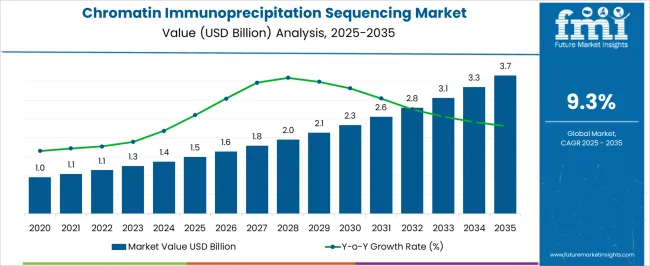
Chromatin Immunoprecipitation Sequencing Market Key Takeaways
| Metric | Value |
|---|---|
| Chromatin Immunoprecipitation Sequencing Market Estimated Value in (2025 E) | USD 1.5 billion |
| Chromatin Immunoprecipitation Sequencing Market Forecast Value in (2035 F) | USD 3.7 billion |
| Forecast CAGR (2025 to 2035) | 9.3% |
Why is the Chromatin Immunoprecipitation Sequencing Market Growing?
The Chromatin Immunoprecipitation Sequencing market is experiencing robust growth as a result of increasing adoption of advanced genomic tools for epigenetic research and precision medicine. The current market scenario reflects growing demand for high-throughput sequencing technologies that provide detailed insights into DNA-protein interactions and chromatin modifications. Expansion in cancer research, coupled with rising investments in life sciences infrastructure and genomics, has fueled market development.
Advancements in bioinformatics and sequencing workflows are enabling faster and more accurate analysis, reducing experimental turnaround times. As research institutes, pharmaceutical companies, and biotechnology organizations increasingly focus on epigenetic regulation and targeted therapies, the market is benefiting from rising utilization of chromatin immunoprecipitation sequencing in functional genomics studies.
Furthermore, ongoing efforts to improve reagent efficiency, data reproducibility, and integration with multi-omics approaches are creating new growth avenues The market outlook remains positive as demand for precise, reliable, and scalable sequencing solutions continues to expand across research, diagnostic, and therapeutic development domains.
Segmental Analysis
The chromatin immunoprecipitation sequencing market is segmented by product type, applications, end use, and geographic regions. By product type, chromatin immunoprecipitation sequencing market is divided into Chromatin Immunoprecipitation Sequencing Kits and Chromatin Immunoprecipitation Sequencing Array. In terms of applications, chromatin immunoprecipitation sequencing market is classified into Cancer, Cardiovascular Diseases, Central Nervous Disorders, and Others. Based on end use, chromatin immunoprecipitation sequencing market is segmented into Research Institutes, Hospitals, Diagnostic Centers, and Others. Regionally, the chromatin immunoprecipitation sequencing industry is classified into North America, Latin America, Western Europe, Eastern Europe, Balkan & Baltic Countries, Russia & Belarus, Central Asia, East Asia, South Asia & Pacific, and the Middle East & Africa.
Insights into the Chromatin Immunoprecipitation Sequencing Kits Segment
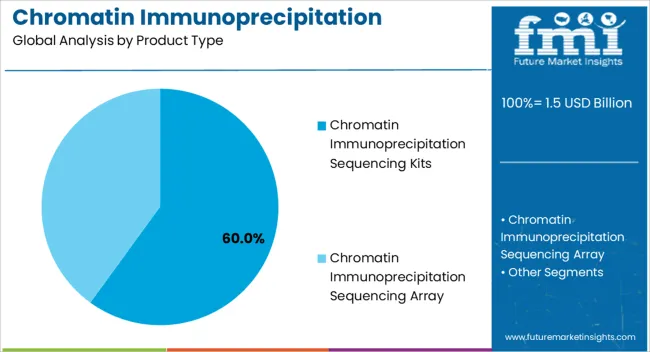
The Chromatin Immunoprecipitation Sequencing Kits product type is projected to account for 60.00% of the overall market revenue in 2025, establishing it as the leading product segment. This dominance is being driven by the convenience and comprehensiveness offered by pre-packaged kits, which streamline workflow and reduce experimental variability. The adoption of kits has been reinforced by the increasing requirement for reproducible, high-quality data in complex genomic studies.
Kits provide researchers with standardized reagents, optimized protocols, and validated controls, which significantly reduce the risk of technical errors and accelerate project timelines. The ability to integrate kits with various sequencing platforms and bioinformatics pipelines has further enhanced their appeal.
Demand has been particularly strong among academic and industrial research organizations seeking reliable, ready-to-use solutions for epigenetic profiling Additionally, continuous innovation in kit formulations, enabling higher sensitivity and specificity, is contributing to sustained growth and reinforcing their position as the preferred product type in the market.
Insights into the Cancer Applications Segment
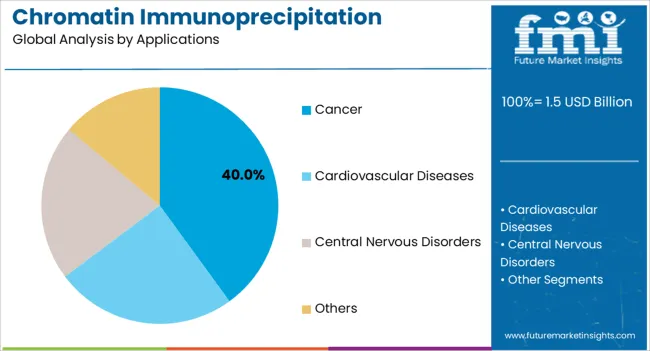
The Cancer application segment is expected to hold 40.00% of the Chromatin Immunoprecipitation Sequencing market revenue in 2025, making it the leading application. This prevalence is being attributed to the critical role of chromatin immunoprecipitation sequencing in understanding tumor epigenetics, identifying potential biomarkers, and developing targeted therapies. The increasing incidence of various cancers worldwide has accelerated research into the mechanisms of gene regulation and chromatin modifications in oncogenesis.
Research efforts are focused on uncovering epigenetic changes that drive cancer progression, which has heightened demand for precise sequencing tools. Chromatin immunoprecipitation sequencing provides insights into transcription factor binding, histone modifications, and regulatory networks, which are invaluable in both basic and translational oncology research.
The integration of these findings into drug discovery and clinical development pipelines has further strengthened the segment Continuous advancements in sequencing technology and analytical software are enhancing data quality and throughput, ensuring that the Cancer application segment remains a primary driver of market growth.
Insights into the Research Institutes End-Use Segment
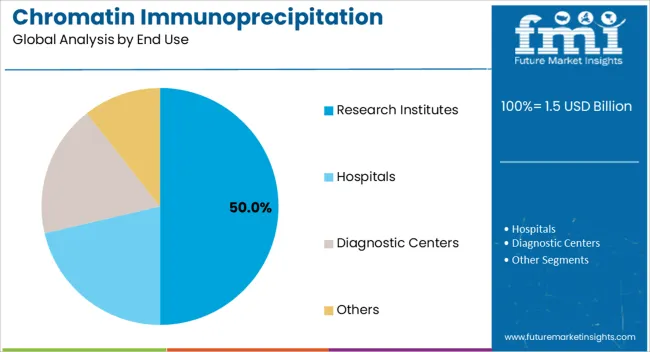
The Research Institutes end-use segment is anticipated to capture 50.00% of the Chromatin Immunoprecipitation Sequencing market revenue in 2025, establishing it as the leading end-use category. This leadership is being supported by the extensive adoption of sequencing technologies in academic and public research institutions focused on functional genomics, epigenetics, and molecular biology. Research institutes often require high-throughput and high-precision solutions to conduct large-scale studies, including investigations into gene regulation, chromatin dynamics, and disease mechanisms.
The flexibility and scalability of chromatin immunoprecipitation sequencing kits allow these organizations to implement complex experimental designs while maintaining reproducibility and data quality. Growing funding for genomics and cancer research has increased the acquisition of advanced sequencing equipment and consumables in such institutions.
Moreover, the emphasis on generating publishable, high-quality datasets has reinforced the preference for standardized kits and validated protocols The continued expansion of research initiatives and the growing focus on integrative multi-omics studies are expected to sustain the segment’s dominant position and drive long-term market growth.
Market Overview
Chromatin Immunoprecipitation Sequencing Market Overview
Chromatin Immunoprecipitation Sequencing or ChIP-seq is a method which is used to detect the interaction between DNA and Protein using next generation sequencing. It combines the chromatin immunoprecipitation with DNA sequencing for the identification of the binding sites of DNA-associated proteins.
It is a type of tool that helps in determining the location of the DNA binding sites on the genome for a protein of interest.
Chromatin Immunoprecipitation sequencing helps the researcher for the screening and identification of the protein binding sites on the complete chromosomal scale with high and improved accuracy and efficiency.
Analysis of Chromatin Immunoprecipitation Sequencing Market By Key Countries
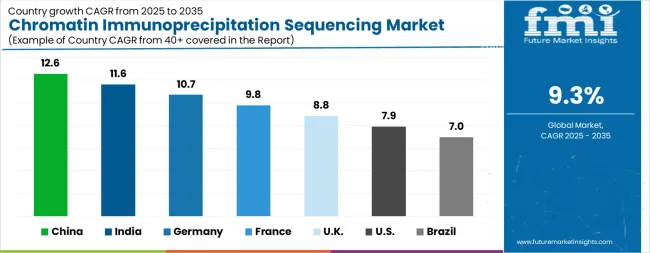
| Country | CAGR |
|---|---|
| China | 12.6% |
| India | 11.6% |
| Germany | 10.7% |
| France | 9.8% |
| UK | 8.8% |
| USA | 7.9% |
| Brazil | 7.0% |
Country-wise Analysis
The Chromatin Immunoprecipitation Sequencing Market is expected to register a CAGR of 9.3% during the forecast period, exhibiting varied country level momentum. China leads with the highest CAGR of 12.6%, followed by India at 11.6%. Developed markets such as Germany, France, and the UK continue to expand steadily, while the USA is likely to grow at consistent rates. Brazil posts the lowest CAGR at 7.0%, yet still underscores a broadly positive trajectory for the global Chromatin Immunoprecipitation Sequencing Market. In 2024, Germany held a dominant revenue in the Western Europe market and is expected to grow with a CAGR of 10.7%. The USA Chromatin Immunoprecipitation Sequencing Market is estimated to be valued at USD 557.3 million in 2025 and is anticipated to reach a valuation of USD 1.2 billion by 2035. Sales are projected to rise at a CAGR of 7.9% over the forecast period between 2025 and 2035. While Japan and South Korea markets are estimated to be valued at USD 70.5 million and USD 40.7 million respectively in 2025.
Key Players in the Chromatin Immunoprecipitation Sequencing Market
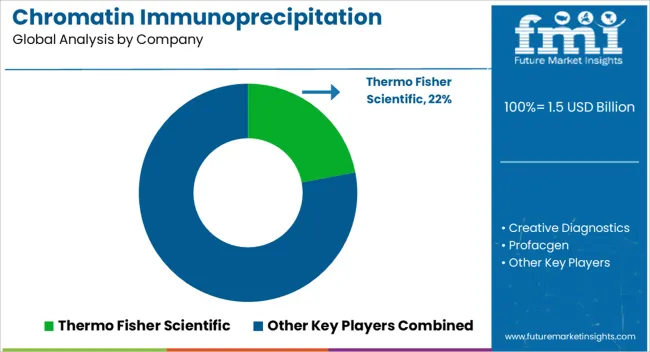
- Thermo Fisher Scientific
- Creative Diagnostics
- Profacgen
- Merck
- Bio-Techne
- Abcam
- Bio-Rad
- Cell Signaling Technology
- BioLegend
- Active Motif
Scope of the Report
| Item | Value |
|---|---|
| Quantitative Units | USD 1.5 Billion |
| Product Type | Chromatin Immunoprecipitation Sequencing Kits and Chromatin Immunoprecipitation Sequencing Array |
| Applications | Cancer, Cardiovascular Diseases, Central Nervous Disorders, and Others |
| End Use | Research Institutes, Hospitals, Diagnostic Centers, and Others |
| Regions Covered | North America, Europe, Asia-Pacific, Latin America, Middle East & Africa |
| Country Covered | United States, Canada, Germany, France, United Kingdom, China, Japan, India, Brazil, South Africa |
| Key Companies Profiled | Thermo Fisher Scientific, Creative Diagnostics, Profacgen, Merck, Bio-Techne, Abcam, Bio-Rad, Cell Signaling Technology, BioLegend, and Active Motif |
Chromatin Immunoprecipitation Sequencing Market by Segments
Product Type:
- Chromatin Immunoprecipitation Sequencing Kits
- Chromatin Immunoprecipitation Sequencing Array
Applications:
- Cancer
- Cardiovascular Diseases
- Central Nervous Disorders
- Others
End Use:
- Research Institutes
- Hospitals
- Diagnostic Centers
- Others
Region:
- North America
- USA
- Canada
- Mexico
- Latin America
- Brazil
- Chile
- Rest of Latin America
- Western Europe
- Germany
- UK
- Italy
- Spain
- France
- Nordic
- BENELUX
- Rest of Western Europe
- Eastern Europe
- Russia
- Poland
- Hungary
- Balkan & Baltic
- Rest of Eastern Europe
- East Asia
- China
- Japan
- South Korea
- South Asia and Pacific
- India
- ASEAN
- Australia & New Zealand
- Rest of South Asia and Pacific
- Middle East & Africa
- Kingdom of Saudi Arabia
- Other GCC Countries
- Turkiye
- South Africa
- Other African Union
- Rest of Middle East & Africa
Frequently Asked Questions
How big is the chromatin immunoprecipitation sequencing market in 2025?
The global chromatin immunoprecipitation sequencing market is estimated to be valued at USD 1.5 billion in 2025.
What will be the size of chromatin immunoprecipitation sequencing market in 2035?
The market size for the chromatin immunoprecipitation sequencing market is projected to reach USD 3.7 billion by 2035.
How much will be the chromatin immunoprecipitation sequencing market growth between 2025 and 2035?
The chromatin immunoprecipitation sequencing market is expected to grow at a 9.3% CAGR between 2025 and 2035.
What are the key product types in the chromatin immunoprecipitation sequencing market?
The key product types in chromatin immunoprecipitation sequencing market are chromatin immunoprecipitation sequencing kits and chromatin immunoprecipitation sequencing array.
Which applications segment to contribute significant share in the chromatin immunoprecipitation sequencing market in 2025?
In terms of applications, cancer segment to command 40.0% share in the chromatin immunoprecipitation sequencing market in 2025.
Preview the report firsthand - request a free sample
Get SampleGet the brochure for pricing and purchase details.
Get PDFTable of Content
- Executive Summary
- Global Market Outlook
- Demand-side Trends
- Supply-side Trends
- Technology Roadmap Analysis
- Analysis and Recommendations
- Market Overview
- Market Coverage / Taxonomy
- Market Definition / Scope / Limitations
- Market Background
- Market Dynamics
- Drivers
- Restraints
- Opportunity
- Trends
- Scenario Forecast
- Demand in Optimistic Scenario
- Demand in Likely Scenario
- Demand in Conservative Scenario
- Opportunity Map Analysis
- Product Life Cycle Analysis
- Supply Chain Analysis
- Investment Feasibility Matrix
- Value Chain Analysis
- PESTLE and Porter’s Analysis
- Regulatory Landscape
- Regional Parent Market Outlook
- Production and Consumption Statistics
- Import and Export Statistics
- Market Dynamics
- Global Market Analysis 2020 to 2024 and Forecast, 2025 to 2035
- Historical Market Size Value (USD Million) Analysis, 2020 to 2024
- Current and Future Market Size Value (USD Million) Projections, 2025 to 2035
- Y-o-Y Growth Trend Analysis
- Absolute $ Opportunity Analysis
- Global Market Pricing Analysis 2020 to 2024 and Forecast 2025 to 2035
- Global Market Analysis 2020 to 2024 and Forecast 2025 to 2035, By Product Type
- Introduction / Key Findings
- Historical Market Size Value (USD Million) Analysis By Product Type , 2020 to 2024
- Current and Future Market Size Value (USD Million) Analysis and Forecast By Product Type , 2025 to 2035
- Kits
- Array
- Y-o-Y Growth Trend Analysis By Product Type , 2020 to 2024
- Absolute $ Opportunity Analysis By Product Type , 2025 to 2035
- Global Market Analysis 2020 to 2024 and Forecast 2025 to 2035, By Applications
- Introduction / Key Findings
- Historical Market Size Value (USD Million) Analysis By Applications, 2020 to 2024
- Current and Future Market Size Value (USD Million) Analysis and Forecast By Applications, 2025 to 2035
- Cancer
- Cardiovascular Diseases
- Central Nervous Disorders
- Others
- Y-o-Y Growth Trend Analysis By Applications, 2020 to 2024
- Absolute $ Opportunity Analysis By Applications, 2025 to 2035
- Global Market Analysis 2020 to 2024 and Forecast 2025 to 2035, By End Use
- Introduction / Key Findings
- Historical Market Size Value (USD Million) Analysis By End Use, 2020 to 2024
- Current and Future Market Size Value (USD Million) Analysis and Forecast By End Use, 2025 to 2035
- Research Institutes
- Hospitals
- Diagnostic Centers
- Others
- Y-o-Y Growth Trend Analysis By End Use, 2020 to 2024
- Absolute $ Opportunity Analysis By End Use, 2025 to 2035
- Global Market Analysis 2020 to 2024 and Forecast 2025 to 2035, By Region
- Introduction
- Historical Market Size Value (USD Million) Analysis By Region, 2020 to 2024
- Current Market Size Value (USD Million) Analysis and Forecast By Region, 2025 to 2035
- North America
- Latin America
- Western Europe
- Eastern Europe
- East Asia
- South Asia and Pacific
- Middle East & Africa
- Market Attractiveness Analysis By Region
- North America Market Analysis 2020 to 2024 and Forecast 2025 to 2035, By Country
- Historical Market Size Value (USD Million) Trend Analysis By Market Taxonomy, 2020 to 2024
- Market Size Value (USD Million) Forecast By Market Taxonomy, 2025 to 2035
- By Country
- USA
- Canada
- Mexico
- By Product Type
- By Applications
- By End Use
- By Country
- Market Attractiveness Analysis
- By Country
- By Product Type
- By Applications
- By End Use
- Key Takeaways
- Latin America Market Analysis 2020 to 2024 and Forecast 2025 to 2035, By Country
- Historical Market Size Value (USD Million) Trend Analysis By Market Taxonomy, 2020 to 2024
- Market Size Value (USD Million) Forecast By Market Taxonomy, 2025 to 2035
- By Country
- Brazil
- Chile
- Rest of Latin America
- By Product Type
- By Applications
- By End Use
- By Country
- Market Attractiveness Analysis
- By Country
- By Product Type
- By Applications
- By End Use
- Key Takeaways
- Western Europe Market Analysis 2020 to 2024 and Forecast 2025 to 2035, By Country
- Historical Market Size Value (USD Million) Trend Analysis By Market Taxonomy, 2020 to 2024
- Market Size Value (USD Million) Forecast By Market Taxonomy, 2025 to 2035
- By Country
- Germany
- UK
- Italy
- Spain
- France
- Nordic
- BENELUX
- Rest of Western Europe
- By Product Type
- By Applications
- By End Use
- By Country
- Market Attractiveness Analysis
- By Country
- By Product Type
- By Applications
- By End Use
- Key Takeaways
- Eastern Europe Market Analysis 2020 to 2024 and Forecast 2025 to 2035, By Country
- Historical Market Size Value (USD Million) Trend Analysis By Market Taxonomy, 2020 to 2024
- Market Size Value (USD Million) Forecast By Market Taxonomy, 2025 to 2035
- By Country
- Russia
- Poland
- Hungary
- Balkan & Baltic
- Rest of Eastern Europe
- By Product Type
- By Applications
- By End Use
- By Country
- Market Attractiveness Analysis
- By Country
- By Product Type
- By Applications
- By End Use
- Key Takeaways
- East Asia Market Analysis 2020 to 2024 and Forecast 2025 to 2035, By Country
- Historical Market Size Value (USD Million) Trend Analysis By Market Taxonomy, 2020 to 2024
- Market Size Value (USD Million) Forecast By Market Taxonomy, 2025 to 2035
- By Country
- China
- Japan
- South Korea
- By Product Type
- By Applications
- By End Use
- By Country
- Market Attractiveness Analysis
- By Country
- By Product Type
- By Applications
- By End Use
- Key Takeaways
- South Asia and Pacific Market Analysis 2020 to 2024 and Forecast 2025 to 2035, By Country
- Historical Market Size Value (USD Million) Trend Analysis By Market Taxonomy, 2020 to 2024
- Market Size Value (USD Million) Forecast By Market Taxonomy, 2025 to 2035
- By Country
- India
- ASEAN
- Australia & New Zealand
- Rest of South Asia and Pacific
- By Product Type
- By Applications
- By End Use
- By Country
- Market Attractiveness Analysis
- By Country
- By Product Type
- By Applications
- By End Use
- Key Takeaways
- Middle East & Africa Market Analysis 2020 to 2024 and Forecast 2025 to 2035, By Country
- Historical Market Size Value (USD Million) Trend Analysis By Market Taxonomy, 2020 to 2024
- Market Size Value (USD Million) Forecast By Market Taxonomy, 2025 to 2035
- By Country
- Kingdom of Saudi Arabia
- Other GCC Countries
- Turkiye
- South Africa
- Other African Union
- Rest of Middle East & Africa
- By Product Type
- By Applications
- By End Use
- By Country
- Market Attractiveness Analysis
- By Country
- By Product Type
- By Applications
- By End Use
- Key Takeaways
- Key Countries Market Analysis
- USA
- Pricing Analysis
- Market Share Analysis, 2024
- By Product Type
- By Applications
- By End Use
- Canada
- Pricing Analysis
- Market Share Analysis, 2024
- By Product Type
- By Applications
- By End Use
- Mexico
- Pricing Analysis
- Market Share Analysis, 2024
- By Product Type
- By Applications
- By End Use
- Brazil
- Pricing Analysis
- Market Share Analysis, 2024
- By Product Type
- By Applications
- By End Use
- Chile
- Pricing Analysis
- Market Share Analysis, 2024
- By Product Type
- By Applications
- By End Use
- Germany
- Pricing Analysis
- Market Share Analysis, 2024
- By Product Type
- By Applications
- By End Use
- UK
- Pricing Analysis
- Market Share Analysis, 2024
- By Product Type
- By Applications
- By End Use
- Italy
- Pricing Analysis
- Market Share Analysis, 2024
- By Product Type
- By Applications
- By End Use
- Spain
- Pricing Analysis
- Market Share Analysis, 2024
- By Product Type
- By Applications
- By End Use
- France
- Pricing Analysis
- Market Share Analysis, 2024
- By Product Type
- By Applications
- By End Use
- India
- Pricing Analysis
- Market Share Analysis, 2024
- By Product Type
- By Applications
- By End Use
- ASEAN
- Pricing Analysis
- Market Share Analysis, 2024
- By Product Type
- By Applications
- By End Use
- Australia & New Zealand
- Pricing Analysis
- Market Share Analysis, 2024
- By Product Type
- By Applications
- By End Use
- China
- Pricing Analysis
- Market Share Analysis, 2024
- By Product Type
- By Applications
- By End Use
- Japan
- Pricing Analysis
- Market Share Analysis, 2024
- By Product Type
- By Applications
- By End Use
- South Korea
- Pricing Analysis
- Market Share Analysis, 2024
- By Product Type
- By Applications
- By End Use
- Russia
- Pricing Analysis
- Market Share Analysis, 2024
- By Product Type
- By Applications
- By End Use
- Poland
- Pricing Analysis
- Market Share Analysis, 2024
- By Product Type
- By Applications
- By End Use
- Hungary
- Pricing Analysis
- Market Share Analysis, 2024
- By Product Type
- By Applications
- By End Use
- Kingdom of Saudi Arabia
- Pricing Analysis
- Market Share Analysis, 2024
- By Product Type
- By Applications
- By End Use
- Turkiye
- Pricing Analysis
- Market Share Analysis, 2024
- By Product Type
- By Applications
- By End Use
- South Africa
- Pricing Analysis
- Market Share Analysis, 2024
- By Product Type
- By Applications
- By End Use
- USA
- Market Structure Analysis
- Competition Dashboard
- Competition Benchmarking
- Market Share Analysis of Top Players
- By Regional
- By Product Type
- By Applications
- By End Use
- Competition Analysis
- Competition Deep Dive
- Thermo Fisher Scientific
- Overview
- Product Portfolio
- Profitability by Market Segments (Product/Age /Sales Channel/Region)
- Sales Footprint
- Strategy Overview
- Marketing Strategy
- Product Strategy
- Channel Strategy
- Creative Diagnostics
- Profacgen
- Merck
- Bio-Techne
- Abcam
- Bio-Rad
- Cell Signaling Technology
- BioLegend
- Active Motif
- Thermo Fisher Scientific
- Competition Deep Dive
- Assumptions & Acronyms Used
- Research Methodology


