

- Market Size (2026)
- USD 35.0 Mn
- Forecast (2036)
- USD 75.0 Mn
- CAGR (2026 to 2036)
- 7.9%
How big is Clean-Label Bakery Flavor Systems Market size?
USD 35.0 million in 2026 and USD 75.0 million by 2036 at a 7.9% CAGR.
Sales of clean-label bakery flavor systems are estimated to rise at 7.9% CAGR through 2036, increasing valuation from USD 35.0 million in 2026 to USD 75.0 million by 2036. A July 2025 analysis by Kerry revealed by claiming 7 in 10 consumers prefer clean-label bakery products. Such preference for familiar everyday ingredients is driving commercial bakers to update and reformulate their recipes for breads and sweet baked goods. Flavor suppliers provide specialized heat-stable flavor profiles along with helpful guidance on proper dosages to assist with such recipe trials.
International bakery producers and buyers evaluate clean-label flavor systems based on distinct regional priorities. Buyers in the United States and Germany prioritize documented ingredient identity and a reliable stable output. Manufacturers in India and Japan emphasize local taste adaptation and easy access to technical support. Paying close attention to packaging is extremely common among shoppers reflected by the International Food Information Council having recorded a 90% rate of package-information use among surveyed Americans, in August 2025. This frequent reading of product packaging reinforces the strong commercial demand for clear ingredient descriptions and trustworthy defensible claims.
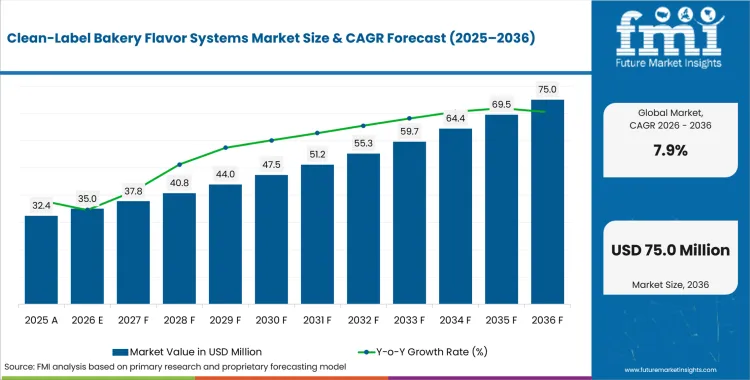
Key Takeaways for Clean-Label Bakery Flavor Systems Market
- Demand reflects reformulation programs seeking familiar ingredients and dependable sensory performance.
- Bakery is forecast to garner 29.0% share of application in 2026, driven by frequent recipe renewal across breads and pastries.
- Plant is estimated to lead source with 17.0% share in 2026, backed by familiar origin statements and versatile taste profiles.
- Raw-material variation and national labeling rules limit sensory consistency during multisite product approval.
- Competition includes IFF. Symrise AG and Kerry Group plc adding global flavor coverage. ADM and Puratos strengthen bakery application support. Sensient Technologies Corporation and Lallemand Inc. extend specialist coverage.
Analyst Perspective
“Clean-label bakery flavor systems have influence beyond taste selection. Effective systems connect ingredient transparency with process tolerance and shelf-life control. Suppliers earn lasting confidence led by translating sensory design into repeatable plant performance.”
- Nandini Roy Choudhury, Principal Analyst for Food and Beverage at Future Market Insights
How is Clean-Label Bakery Flavor Systems Market segmented?
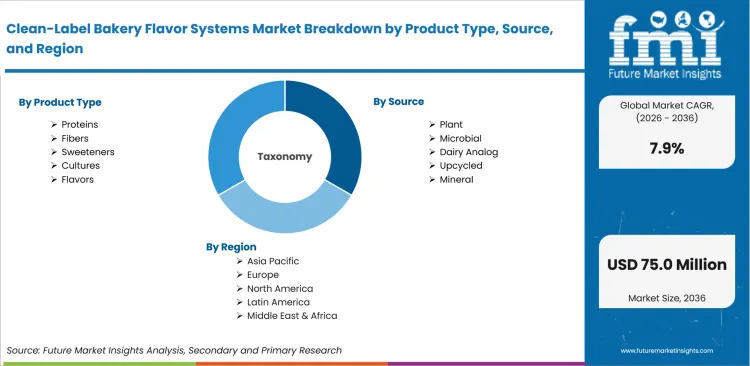
The clean-label bakery flavor systems industry is segmented by product type, source, application, end user, and region.
The clean-label bakery flavor systems sector is segmented by product type, source, application, end user, and region. Product type covers proteins, fibers, sweeteners, cultures, and flavors. Source covers plant, microbial, dairy analog, upcycled, and mineral. Application includes bakery, beverages, snacks, infant nutrition, and ready meals. End user spans food manufacturers, beverage manufacturers, foodservice operators, contract manufacturers, and retail brands. Regional coverage includes North America, Europe, East Asia, South Asia and Pacific, Latin America, and Middle East and Africa.
Why do proteins hold the prominent share of product type?
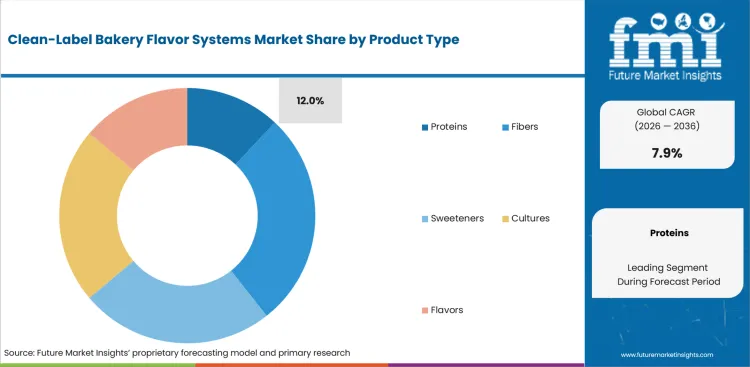
Puratos found 63% of consumers willing to switch to protein-enriched bread in December 2025. Such interest supports balanced profiles proven through pilot baking and commercial production. Protein enrichment alters bitterness and crumb structure across breads and snack bars. Flavor systems soften off-notes and restore sweetness during early recipe trials.
- Proteins are expected to account for 12.0% of product type in 2026, driven by frequent masking work in fortified bakery recipes. Technical teams review bitterness control and crumb recovery during pilot trials.
- Fibers and sweeteners address nutrition goals without changing the core flavor brief. Cultures and flavors refine aroma during fermentation and final scale-up.
Why does plant remain central to source?
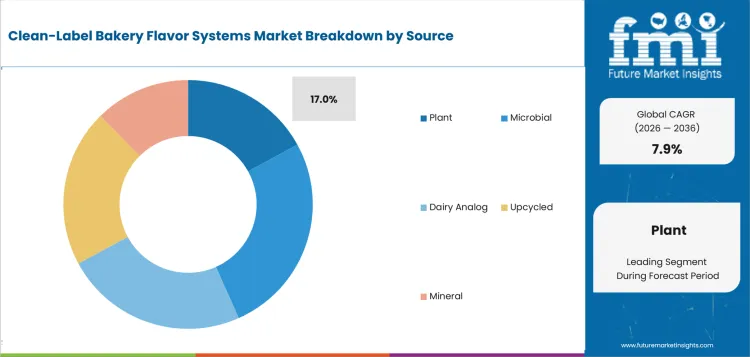
Plant-derived inputs support familiar source statements across sweet and savory bakery recipes. Seasonal crop differences require dosage checks during each formulation stage. Ingredion recorded 56% consumer willingness to pay more for recognizable ingredients in October 2025. Clean-label ingredients research supports source selection across starch and protein systems.
- Based on source, plant is projected to represent 17.0% share in 2026 since being backed by familiar origin statements on bakery labels. Developers compare crop consistency and heat response during commercial approval.
- Microbial and dairy analog sources create cultured or creamy profiles for specialized recipes. Upcycled and mineral options serve texture correction or process stability needs.
Why does bakery dominate application demand?
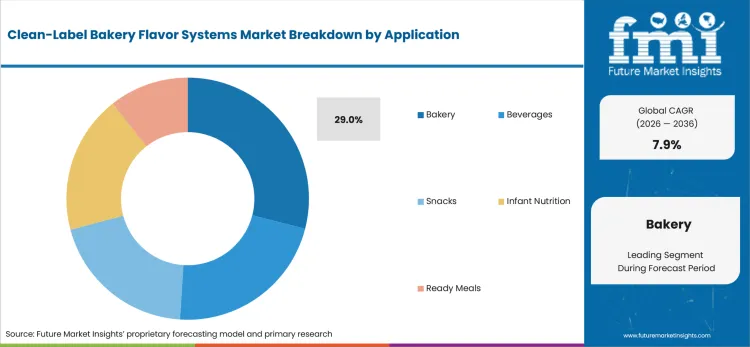
Puratos recorded 45% consumer willingness to pay more for perceived freshness in February 2025. Food flavors research supports profile selection during shelf-life review. Bakery production exposes flavor systems to mixing and fermentation. Baking heat tests aroma retention across doughs and fillings.
- In 2026, bakery is anticipated to account for 29.0% share as it reflects repeated reformulation in bread and pastry lines. Producers test aroma retention during baking and packaged storage.
- Beverages and snacks require flavor delivery suited to liquid or dry systems. Infant nutrition and ready meals need milder profiles with stricter suitability checks.
Why do food manufacturers lead end user?
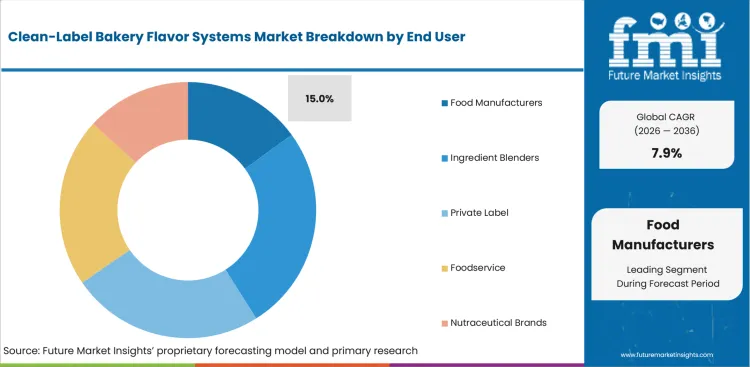
Food manufacturers control recipe approval and commercial plant settings. Production teams compare label wording with sensory results during scale-up. Puratos found 72% of consumers interested in exploring new textures during August 2025. Such interest links flavor selection with crumb design and finished-product mouthfeel.
- By end user, food manufacturers are expected to hold 15.0% share in 2026 owing to direct control over recipes and plant specifications. Internal teams assess suppliers during line transfer and product renovation.
- Beverage manufacturers and foodservice operators focus on batch consistency during variable service conditions. Contract manufacturers and retail brands emphasize client specifications and rapid technical response.
What are drivers, restraints, and opportunities in Clean-Label Bakery Flavor Systems Market?
Consumer preference drives reformulation and national rules slow approval. Sustainable inputs create expansion potential across clean-label bakery programs.
- Driver: Familiar ingredient statements encourage packaged bakery producers to renew recipes without changing established consumer expectations. Clearer label language also supports retailer approval by reducing questions about unfamiliar additives during product review.
- Restraint: National composition rules increase documentation work for suppliers serving several bakery product lines. Separate approval requirements are likely to delay product release as technical teams revise specifications for each country.
- Opportunity: Upcycled inputs support distinctive texture claims and help producers reduce reliance on newly sourced materials. Careful formulation converts by-products into stable ingredients suited to cleaner labels and credible sustainability narratives.
Natural color replacement changes flavor perception and visual acceptance across bakery products. USA Food and Drug Administration approved 3 natural-source color petitions in May 2025. Added choices support reformulation across frostings and coated bakery products. Recipe teams test appearance and taste together during commercial validation.
National composition requirements add control points across flour-based recipes. Department for Environment, Food and Rural Affairs and Food Standards Agency published guidance covering 5 nutrients in April 2025. Updated levels apply from December 2026 across non-whole meal common wheat flour. Manufacturers need accurate ingredient lists for product approval and label review.
Upcycled inputs connect functional performance with environmental claims across bakery development. Puratos recorded sustainability interest among 8 in 10 consumers during May 2025. Such interest supports flavor development using recovered plant materials. Commercial use requires stable sensory output and traceable source records.
How are country CAGRs aligned in Clean-Label Bakery Flavor Systems Market?
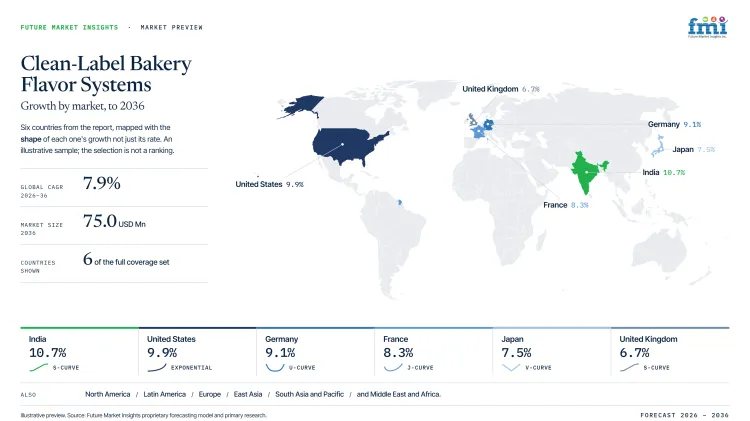
| Country or Market | CAGR |
|---|---|
| India | 10.7% |
| United States | 9.9% |
| Germany | 9.1% |
| France | 8.3% |
| Japan | 7.5% |
| United Kingdom | 6.7% |
Source: Future Market Insights analysis, 2026.
How do country-level CAGRs compare in Clean-Label Bakery Flavor Systems Market?
Country comparison shows a measured step-down across profiled markets. India occupies first position followed by United States and Germany. France and Japan form subsequent bands. United Kingdom completes disclosed comparison. A 4.0 percentage-point spread separates India from United Kingdom. National rates reflect recipe activity and regulation. Technical service coverage adds another difference.
- India leads disclosed comparison depending on local reformulation activity and formal product testing.
- United States follows through established bakery production and extensive supplier service networks.
- Germany occupies third position as documentation-heavy ingredient review shapes adoption.
- France and Japan form subsequent bands based on local taste preferences and retail renovation.
- United Kingdom completes comparison as composition rules extend supplier evaluation.
National approval systems create different entry conditions among markets carrying similar CAGRs. Full coverage includes North America, Latin America, Europe, and East Asia. South Asia and Pacific joins Middle East and Africa.
Country-wise Analysis
- Bakery flavor-system demand in India is projected to expand at 10.7% CAGR during the forecast period, driven by reformulation activity and formal product testing. Food Safety and Standards Authority of India listed 20 referral food laboratories in December 2025, strengthening ingredient verification capacity. Laboratory access helps manufacturers document recipe changes during approval. Suppliers offering local trials and clear specifications gain stronger adoption prospects.
- USA Department of Agriculture Economic Research Service reported per capita wheat flour use of 126.6 pounds for 2025 in April 2026, confirming a substantial consumption base. High flour use sustains frequent flavor work in breads and sweet goods. Manufacturers value technical support during cost-led ingredient changes. Adoption in the United States is forecast to rise at 9.9% CAGR from 2026 to 2036, reflecting extensive packaged-bakery production and recurring recipe renewal.
- Sector in Germany is expected to record 9.1% CAGR during the study period, guided by reformulation responding to ingredient-cost pressure. German Federal Statistical Office reported a 14.7% increase in bakery-related wholesale prices during 2025 in January 2026, highlighting stronger pressure on recipe economics. Cost changes prompt dosage reviews and taste-preservation work. Suppliers with proven performance in commercial recipes receive greater consideration.
- National Institute of Statistics and Economic Studies reported around 2% expansion in food-store sales during 2025 in June 2026, supporting continued product rotation. Retail activity encourages new flavors and limited-edition launches. Local application support helps manufacturers preserve familiar taste during scale-up. Industry in France is projected to progress at 8.3% CAGR between 2026 and 2036, aided by active retail turnover and seasonal bakery renewal.
- The market in Japan is anticipated to rise at 7.5% CAGR during the assessment period, backed by localized sensory expectations and cost-sensitive reformulation. Statistics Bureau of Japan reported a 6.8% food-price increase during 2025 in January 2026, increasing pressure on ingredient selection. Manufacturers adjust recipes without weakening familiar taste profiles. Suppliers gain attention through precise dosage guidance and local application testing.
- Office for National Statistics reported a 6.0% annual inflation rate for other bakery products during 2025 in April 2026, reinforcing cost pressure on recipe decisions. Manufacturers examine substitutions with careful label review. Clear records and stable sensory results support supplier approval. Sales in the United Kingdom are forecast to expand at 6.7% CAGR by 2036, influenced by detailed composition rules and established retail specifications.
Who are notable companies in Clean-Label Bakery Flavor Systems Market?
Givaudan and IFF lead flavor-system competition. Symrise AG and Kerry Group plc add global taste capabilities. ADM and Puratos provide bakery application depth. Sensient Technologies Corporation and Lallemand Inc. contribute color or fermentation expertise.
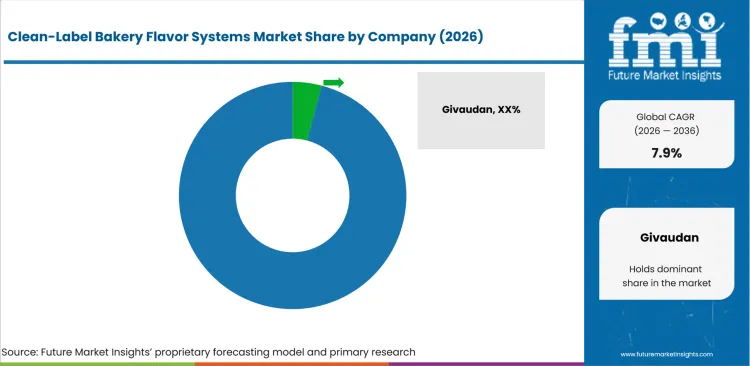
Competition centers on flavor authenticity and bakery application knowledge. Global groups combine creation libraries with regional laboratories. Bakery specialists emphasize dough behavior and freshness control. Fermentation providers offer cultured notes and clean-label preservation. Buyer review favors suppliers linking sensory evidence with responsive support across commercial production programs.
- Givaudan and IFF compete depending on flavor creation and bakery application support. Customer assessment examines taste replication and heat stability in commercial recipes.
- Symrise AG and Kerry Group plc combine sensory insight with regional service. Bakery teams assess reformulation speed and taste protection during ingredient changes.
- ADM and Puratos connect flavor systems with texture and processing knowledge. Purchase evaluation considers technical access and proof from plant trials.
- Sensient Technologies Corporation and Lallemand Inc. add color or fermentation expertise. Selection reflects portfolio match and compatibility with targeted ingredient statements.
Competitive Benchmarking: Clean-Label Bakery Flavor Systems Market
| Company | Flavor and Bakery Depth | Technical Service | Account Reach | Geographic Reach |
|---|---|---|---|---|
| Givaudan | High | High | High | Global |
| IFF | High | High | High | Global |
| Symrise AG | High | Medium | High | Global |
| Kerry Group plc | High | High | High | Global |
| ADM | High | High | High | Global |
| Puratos | High | High | High | Global |
| Sensient Technologies Corporation | High | Medium | High | Global |
| Lallemand Inc. | Medium | High | Medium | Global |
Source: Future Market Insights competitive analysis, 2026.
Key Developments in Clean-Label Bakery Flavor Systems Market
- In February 2025, Givaudan agreed with Dole Asia Holdings to distribute Green Banana Powder. Company information connected the upcycled ingredient with softness and moisture control across industrial baked goods.
- In August 2025, IFF launched POWERFRESH ACE 2000 for industrial bread applications. Launch details linked the enzyme solution with lasting softness and improved resilience across shelf life.
- In September 2025, Kerry launched Smart Taste for food reformulation programs. Kerry's announcement connected the portfolio with taste protection during nutrition and ingredient changes.
Key Players in Clean-Label Bakery Flavor Systems Market
Flavor and Taste System Specialists
- Givaudan
- IFF
- Symrise AG
- Kerry Group plc
Ingredient and Bakery Application Providers
- ADM
- Puratos
Color and Fermentation Specialists
- Sensient Technologies Corporation
- Lallemand Inc.
Clean-Label Bakery Flavor Systems Market Report Scope
| Coverage field | Report scope |
|---|---|
| Market breakdown | Clean-label bakery flavor systems market breakdown by product type, source, application, end user, and region. |
| Quantitative Units | USD million in 2026 to USD million by 2036 at CAGR in %. |
| Market Definition | Commercial demand for flavor systems supporting familiar declarations, taste design, masking, texture coordination, freshness cues, and reformulation assistance. |
| Regions Covered | North America, Latin America, Europe, East Asia, South Asia and Pacific, and Middle East and Africa. |
| Countries Covered | United States, Germany, United Kingdom, France, Japan, India, and 30+ countries. |
| Key Companies Profiled | Givaudan, IFF, Symrise AG, Kerry Group plc, ADM, Puratos, Sensient Technologies Corporation, and Lallemand Inc. |
| Forecast Period | 2026 to 2036 |
| Approach | Hybrid bottom-up and top-down sizing supported by primary interviews, segment shares, country CAGRs, and official desk research. |
Source: Future Market Insights report-scope analysis, 2026.
Clean-Label Bakery Flavor Systems Market - Research Methodology
| Method | Approach |
|---|---|
| Primary Research | FMI analysts gathered input from manufacturers, service providers, technology developers, distributors, end users, procurement teams, and subject-matter experts. Interviews examined purchasing decisions, product or service evaluation, adoption barriers, approval requirements, pricing considerations, and expectations for technical or commercial support. Respondents were also asked what evidence is required before a trial, pilot, or initial order develops into regular purchasing. |
| Desk Research | Desk research covered government statistics, regulatory publications, trade data, industry associations, technical literature, standards, company filings, product information, and official corporate announcements. Sources were reviewed for relevance, publication date, geographic coverage, and consistency with the defined market scope. Claims relating to performance, applications, approvals, capacity, investment, and commercial activity were retained only when supported by credible public evidence. |
| Market Sizing and Forecasting | The market model combined the baseline value with historical performance, segment structure, pricing and volume indicators, adoption levels, company participation, and country-level demand conditions. Forecast assumptions considered economic activity, investment trends, regulatory developments, technology adoption, purchasing cycles, supply availability, and barriers to wider market use. Segment and regional estimates were reconciled before the final market total was calculated. |
| Data Validation | Estimates were checked against multiple independent indicators, including public data, company activity, trade patterns, industry developments, and findings from primary interviews. Validation also tested whether products, services, applications, and company revenues fell within the defined market boundaries. Adjacent categories, unsupported claims, overlapping revenues, and activities without direct market relevance were excluded to reduce double counting and maintain consistency across segments and countries. |
Source: Future Market Insights research framework, 2026.
Clean-Label Bakery Flavor Systems Market by Segments
Clean-Label Bakery Flavor Systems Market segmented by Product Type:
- Proteins
- Fibers
- Sweeteners
- Cultures
- Flavors
Clean-Label Bakery Flavor Systems Market segmented by Source:
- Plant
- Microbial
- Dairy Analog
- Upcycled
- Mineral
Clean-Label Bakery Flavor Systems Market segmented by Application:
- Bakery
- Beverages
- Snacks
- Infant Nutrition
- Ready Meals
Clean-Label Bakery Flavor Systems Market segmented by End User:
- Food Manufacturers
- Beverage Manufacturers
- Foodservice Operators
- Contract Manufacturers
- Retail Brands
Clean-Label Bakery Flavor Systems Market segmented by Region:
- North America
- Europe
- East Asia
- South Asia and Pacific
- Latin America
- Middle East and Africa
Research Sources and Bibliography
- Kerry. (2025, July 11). Fresh thinking: How to improve bakery shelf life and reduce waste.
- International Food Information Council. (2025, August 5). Americans grade themselves better than average for diet healthfulness.
- Puratos. (2025, December 8). Why protein is the next big bakery opportunity.
- Ingredion. (2025, October 15). Clean label ingredients: From buzzword to business driver.
- Puratos. (2025, February 19). Elevate every bite: The sensory power of different cake textures.
- Puratos. (2025, August 11). How to perfect your donut's texture: Soft, moist & fluffy.
- USA Food and Drug Administration. (2025, May 9). FDA approves three food colors from natural sources.
- Department for Environment, Food & Rural Affairs, & Food Standards Agency. (2025, April 23). Bread and flour: Labelling and composition.
- Puratos. (2025, May 13). Bakery solutions for a sustainable future: Reduce carbon emissions by up to 40% with Puratos.
- Food Safety and Standards Authority of India. (2025, December 5). Referral food laboratories.
- USA Department of Agriculture Economic Research Service. (2026, April 8). Wheat sector at a glance.
- German Federal Statistical Office. (2026, January 15). Wholesale prices in December 2025: +1.2% on December 2024.
- Gallot, P., Bonfils, J., Finot, J., Gamrasni, A., & Lépine, N. (2026, June 18). The economic situation of trade in 2025 and early 2026.
- Statistics Bureau of Japan. (2026, January 23). Japan 2025: Consumer price index.
- Office for National Statistics. (2026, April 22). CPI annual rate 01.1.1.4 other bakery products 2015=100.
- Givaudan. (2025, February 11). Givaudan collaborates with Dole Asia Holdings to upcycle green, unripe bananas into a natural texturising food ingredient.
- IFF. (2025, August 13). IFF launches POWERFRESH ACE 2000, a bread fresh-keeping solution that “aces” the shelf-life test.
- Kerry. (2025, September 30). Kerry launches Smart Taste to help customers navigate market complexities without compromising on taste.
This bibliography is provided for reader reference and is not exhaustive. The full report contains the complete reference list and detailed citations.
This Report Answers
- How do product type options influence taste and texture design?
- How does source affect ingredient identity and sensory output?
- How does application change heat exposure and flavor delivery?
- How do end user groups compare supplier proof and service access?
- Why do country CAGRs differ across profiled national markets?
- How do company capabilities compare across flavor design and bakery support?
- How do composition rules influence recipe approval across countries?
- How are forecasts validated through bottom-up and top-down analysis?
- How does technical support influence recurring supplier selection?
- What risks reduce confidence during commercial bakery reformulation?
Frequently Asked Questions
What supports demand in clean-label bakery flavor systems market?
Demand is likely to receive support from bakery producers renewing recipes with familiar ingredient statements. Buyers are expected to favor systems preserving taste performance during processing and shelf-life testing.
Who are key players in clean-label bakery flavor systems market?
Key companies are anticipated to include Givaudan, IFF, Symrise, Kerry, ADM, and Puratos. Competition is likely to reflect flavor expertise and bakery application support during customer formulation programs.
What restraint affects clean-label bakery flavor systems market?
National composition rules restrain adoption by increasing documentation work for multisite product launches. Commercial approval weakens if ingredient records or finished-product claims lack clear supporting evidence.
Why do executives track clean-label bakery flavor systems market?
Executives are expected to track flavor-system demand as recipe renewal influences product competitiveness and development workload. Supplier selection creates additional responsibilities involving ingredient verification and production consistency.
What business problem does clean-label bakery flavor systems market address?
Clean-label bakery flavor systems connect familiar ingredient declarations with targeted taste and texture outcomes. Formulation assistance helps development teams preserve sensory quality during ingredient replacement and process adjustment.
What do bakery teams evaluate prior to selecting companies?
Bakery teams are likely to evaluate source identity and heat stability during supplier review. Shelf-life performance and plant-trial assistance are expected to influence final company approval.
What limits return on investment for purchasing teams?
Return weakens with extensive recipe testing failing to deliver stable sensory performance during production. Limited technical support also increases reformulation effort during scale-up and product-release review.
How do companies build long-term customer confidence?
Companies build confidence through repeatable flavor performance and dependable technical assistance during product development. Maintained ingredient records and successful plant trials support recurring use in approved bakery recipes.
Preview the report firsthand - request a free sample
Get SampleGet the brochure for pricing and purchase details.
Get PDFTable of Content
- Key Takeaways
- Market Size and CAGR
- Top Growth Driver
- Fastest Growing Segment
- Leading Region
- Key Companies
- Emerging Opportunities
- Executive Summary
- Global Market Outlook
- Demand-side Trends
- Supply-side Trends
- Technology Roadmap Analysis
- Analysis and Recommendations
- Analyst Perspective (What is happening? Why now? What should investors know?)
- Key Questions Answered
- How large is the market?
- What is the CAGR?
- What are key trends?
- Which region dominates?
- Who are the leaders?
- Market Overview
- Market Coverage / Taxonomy
- Market Definition / Scope / Limitations
- Research Methodology
- Chapter Orientation
- Analytical Lens and Working Hypotheses
- Market Structure, Signals, and Trend Drivers
- Benchmarking and Cross-market Comparability
- Market Sizing, Forecasting, and Opportunity Mapping
- Research Design and Evidence Framework
- Desk Research Programme (Secondary Evidence)
- Expert Input and Fieldwork (Primary Evidence)
- Tooling, Models, and Reference Databases
- Data Engineering and Model Build
- Quality Assurance and Audit Trail
- Market Background
- Market Dynamics (Drivers, Restraints, Opportunity, Trends)
- Scenario Forecast (Optimistic, Likely, Conservative)
- Impact Analysis
- AI Impact
- Sustainability Impact
- Regulatory Impact
- Technology Impact
- Consumer / Buyer Analysis
- Purchase Drivers
- Adoption Barriers
- Buyer Journey
- Opportunity Map Analysis
- Product Life Cycle Analysis
- Supply Chain Analysis
- Investment Feasibility Matrix
- Value Chain Analysis
- PESTLE and Porter's Analysis
- Regulatory Landscape
- Regional Parent Market Outlook
- Production and Consumption Statistics
- Import and Export Statistics
- Global Market Analysis and Forecast, 2021 to 2036
- Historical Market Size Value (USD Million) Analysis, 2021 to 2025
- Current and Future Market Size Value (USD Million) Projections, 2026 to 2036
- Y-o-Y Growth Trend Analysis
- Absolute $ Opportunity Analysis
- Global Market Pricing Analysis, 2021 to 2036
- Global Market Analysis and Forecast, By Product Type, 2021 to 2036
- Introduction / Key Findings
- Historical Market Size Value (USD Million) Analysis By Product Type, 2021 to 2025
- Current and Future Market Size Value (USD Million) Analysis and Forecast By Product Type, 2026 to 2036
- Proteins
- Fibers
- Sweeteners
- Cultures
- Flavors
- Proteins
- Y-o-Y Growth Trend Analysis By Product Type, 2021 to 2025
- Absolute $ Opportunity Analysis By Product Type, 2026 to 2036
- Global Market Analysis and Forecast, By Source, 2021 to 2036
- Introduction / Key Findings
- Historical Market Size Value (USD Million) Analysis By Source, 2021 to 2025
- Current and Future Market Size Value (USD Million) Analysis and Forecast By Source, 2026 to 2036
- Plant
- Microbial
- Dairy Analog
- Upcycled
- Mineral
- Plant
- Y-o-Y Growth Trend Analysis By Source, 2021 to 2025
- Absolute $ Opportunity Analysis By Source, 2026 to 2036
- Global Market Analysis and Forecast, By Application, 2021 to 2036
- Introduction / Key Findings
- Historical Market Size Value (USD Million) Analysis By Application, 2021 to 2025
- Current and Future Market Size Value (USD Million) Analysis and Forecast By Application, 2026 to 2036
- Bakery
- Beverages
- Snacks
- Infant Nutrition
- Ready Meals
- Bakery
- Y-o-Y Growth Trend Analysis By Application, 2021 to 2025
- Absolute $ Opportunity Analysis By Application, 2026 to 2036
- Global Market Analysis and Forecast, By End User, 2021 to 2036
- Introduction / Key Findings
- Historical Market Size Value (USD Million) Analysis By End User, 2021 to 2025
- Current and Future Market Size Value (USD Million) Analysis and Forecast By End User, 2026 to 2036
- Food Manufacturers
- Ingredient Blenders
- Private Label
- Foodservice
- Nutraceutical Brands
- Food Manufacturers
- Y-o-Y Growth Trend Analysis By End User, 2021 to 2025
- Absolute $ Opportunity Analysis By End User, 2026 to 2036
- Global Market Analysis and Forecast, By Region, 2021 to 2036
- Introduction
- Historical Market Size Value (USD Million) Analysis By Region, 2021 to 2025
- Current Market Size Value (USD Million) Analysis and Forecast By Region, 2026 to 2036
- North America
- Latin America
- Western Europe
- Eastern Europe
- East Asia
- South Asia and Pacific
- Middle East & Africa
- Market Attractiveness Analysis By Region
- North America Market Analysis and Forecast, By Country, 2021 to 2036
- Historical Market Size Value (USD Million) Trend Analysis By Market Taxonomy, 2021 to 2025
- Market Size Value (USD Million) Forecast By Market Taxonomy, 2026 to 2036
- By Country
- USA
- Canada
- By Product Type
- By Source
- By Application
- By End User
- By Country
- Market Attractiveness Analysis
- By Country
- By Product Type
- By Source
- By Application
- By End User
- Key Takeaways
- Latin America Market Analysis and Forecast, By Country
- Historical Market Size Value (USD Million) Trend Analysis By Market Taxonomy, 2021 to 2025
- Market Size Value (USD Million) Forecast By Market Taxonomy, 2026 to 2036
- By Country
- Brazil
- Mexico
- Chile
- Rest of Latin America
- By Product Type
- By Source
- By Application
- By End User
- By Country
- Market Attractiveness Analysis
- By Country
- By Product Type
- By Source
- By Application
- By End User
- Key Takeaways
- Western Europe Market Analysis and Forecast, By Country
- Historical Market Size Value (USD Million) Trend Analysis By Market Taxonomy, 2021 to 2025
- Market Size Value (USD Million) Forecast By Market Taxonomy, 2026 to 2036
- By Country
- Germany
- UK
- Italy
- Spain
- France
- Nordic
- BENELUX
- Rest of Western Europe
- By Product Type
- By Source
- By Application
- By End User
- By Country
- Market Attractiveness Analysis
- By Country
- By Product Type
- By Source
- By Application
- By End User
- Key Takeaways
- Eastern Europe Market Analysis and Forecast, By Country
- Historical Market Size Value (USD Million) Trend Analysis By Market Taxonomy, 2021 to 2025
- Market Size Value (USD Million) Forecast By Market Taxonomy, 2026 to 2036
- By Country
- Russia
- Poland
- Hungary
- Balkan & Baltic
- Rest of Eastern Europe
- By Product Type
- By Source
- By Application
- By End User
- By Country
- Market Attractiveness Analysis
- By Country
- By Product Type
- By Source
- By Application
- By End User
- Key Takeaways
- East Asia Market Analysis and Forecast, By Country
- Historical Market Size Value (USD Million) Trend Analysis By Market Taxonomy, 2021 to 2025
- Market Size Value (USD Million) Forecast By Market Taxonomy, 2026 to 2036
- By Country
- China
- Japan
- South Korea
- By Product Type
- By Source
- By Application
- By End User
- By Country
- Market Attractiveness Analysis
- By Country
- By Product Type
- By Source
- By Application
- By End User
- Key Takeaways
- South Asia and Pacific Market Analysis and Forecast, By Country
- Historical Market Size Value (USD Million) Trend Analysis By Market Taxonomy, 2021 to 2025
- Market Size Value (USD Million) Forecast By Market Taxonomy, 2026 to 2036
- By Country
- India
- ASEAN
- Australia & New Zealand
- Rest of South Asia and Pacific
- By Product Type
- By Source
- By Application
- By End User
- By Country
- Market Attractiveness Analysis
- By Country
- By Product Type
- By Source
- By Application
- By End User
- Key Takeaways
- Middle East & Africa Market Analysis and Forecast, By Country
- Historical Market Size Value (USD Million) Trend Analysis By Market Taxonomy, 2021 to 2025
- Market Size Value (USD Million) Forecast By Market Taxonomy, 2026 to 2036
- By Country
- Kingdom of Saudi Arabia
- Other GCC Countries
- Türkiye
- South Africa
- Other African Union
- Rest of Middle East & Africa
- By Product Type
- By Source
- By Application
- By End User
- By Country
- Market Attractiveness Analysis
- By Country
- By Product Type
- By Source
- By Application
- By End User
- Key Takeaways
- Key Countries Market Analysis
- USA
- Pricing Analysis
- Market Share Analysis, 2025
- By Product Type
- By Source
- By Application
- By End User
- Canada
- Pricing Analysis
- Market Share Analysis, 2025
- By Product Type
- By Source
- By Application
- By End User
- Mexico
- Pricing Analysis
- Market Share Analysis, 2025
- By Product Type
- By Source
- By Application
- By End User
- Brazil
- Pricing Analysis
- Market Share Analysis, 2025
- By Product Type
- By Source
- By Application
- By End User
- Chile
- Pricing Analysis
- Market Share Analysis, 2025
- By Product Type
- By Source
- By Application
- By End User
- Germany
- Pricing Analysis
- Market Share Analysis, 2025
- By Product Type
- By Source
- By Application
- By End User
- UK
- Pricing Analysis
- Market Share Analysis, 2025
- By Product Type
- By Source
- By Application
- By End User
- Italy
- Pricing Analysis
- Market Share Analysis, 2025
- By Product Type
- By Source
- By Application
- By End User
- Spain
- Pricing Analysis
- Market Share Analysis, 2025
- By Product Type
- By Source
- By Application
- By End User
- France
- Pricing Analysis
- Market Share Analysis, 2025
- By Product Type
- By Source
- By Application
- By End User
- India
- Pricing Analysis
- Market Share Analysis, 2025
- By Product Type
- By Source
- By Application
- By End User
- ASEAN
- Pricing Analysis
- Market Share Analysis, 2025
- By Product Type
- By Source
- By Application
- By End User
- Australia & New Zealand
- Pricing Analysis
- Market Share Analysis, 2025
- By Product Type
- By Source
- By Application
- By End User
- China
- Pricing Analysis
- Market Share Analysis, 2025
- By Product Type
- By Source
- By Application
- By End User
- Japan
- Pricing Analysis
- Market Share Analysis, 2025
- By Product Type
- By Source
- By Application
- By End User
- South Korea
- Pricing Analysis
- Market Share Analysis, 2025
- By Product Type
- By Source
- By Application
- By End User
- Russia
- Pricing Analysis
- Market Share Analysis, 2025
- By Product Type
- By Source
- By Application
- By End User
- Poland
- Pricing Analysis
- Market Share Analysis, 2025
- By Product Type
- By Source
- By Application
- By End User
- Hungary
- Pricing Analysis
- Market Share Analysis, 2025
- By Product Type
- By Source
- By Application
- By End User
- Kingdom of Saudi Arabia
- Pricing Analysis
- Market Share Analysis, 2025
- By Product Type
- By Source
- By Application
- By End User
- Türkiye
- Pricing Analysis
- Market Share Analysis, 2025
- By Product Type
- By Source
- By Application
- By End User
- South Africa
- Pricing Analysis
- Market Share Analysis, 2025
- By Product Type
- By Source
- By Application
- By End User
- USA
- Market Structure Analysis
- Competition Dashboard
- Competition Benchmarking
- Market Share Analysis of Top Players
- By Regional
- By Product Type
- By Source
- By Application
- By End User
- Emerging Startups
- Innovation Benchmarking
- Competition Analysis
- Competition Deep Dive
- Givaudan
- Overview
- Product Portfolio
- Profitability by Market Segments
- Sales Footprint
- Strategy Overview
- Marketing Strategy
- Product Strategy
- Channel Strategy
- IFF
- Symrise
- Kerry
- ADM
- Puratos
- Sensient Technologies
- Lallemand
- Givaudan
- Case Studies
- Success Stories
- Recent Developments
- Competition Deep Dive
- Assumptions & Acronyms Used


