

- Market Size (2026)
- USD 720.0 Mn
- Forecast (2036)
- USD 1301.6 Mn
- CAGR (2026 to 2036)
- 6.1%
Clean Label Bakery Enzymes Market Size, Market Forecast and Outlook By FMI
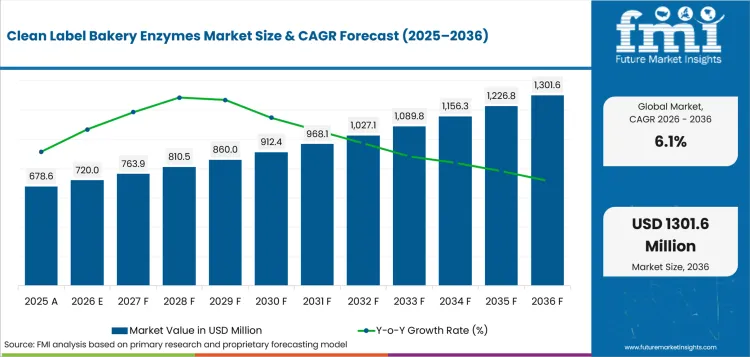
The clean label bakery enzymes market value is estimated at USD 678.6 million in 2025 and projected to reach USD 1,301.6 million by 2036 at 6.1% CAGR. The 2026 value is estimated at USD 720.0 million and uses the provided market anchor for clean label enzyme inputs.
Key Takeaways, Market Size, and Forecast
- 2026 Market Size: USD 720.0 million
- 2036 Market Size: USD 1,301.6 million
- Forecast CAGR: 6.1% from 2026 to 2036
- Leading Enzyme Type: Maltogenic Amylase
- Maltogenic Amylase Share in 2026: 32.5%
- Leading Bakery Application: Bread
- Bread Share in 2026: 46.0%
- Leading Buyer Type: Industrial Bakeries
- Industrial Bakeries Share in 2026: 58.0%
- Fastest-growing Country: South Korea
- South Korea CAGR: 6.8% by 2036
Summary of Clean Label Bakery Enzymes Market
- Demand and Growth Drivers
- Industrial bakeries are reformulating bread and buns to reduce additive-heavy labels without changing shelf-life expectations.
- Retailers are using cleaner ingredient panels as a buyer filter for private label bakery programs.
- Frozen and par-baked bakery formats need enzyme systems that protect texture after thawing and reheating.
- Product and Segment View
- Maltogenic amylase is estimated to hold 32.5% share in 2026 through anti-staling use in packaged bread.
- Anti-staling functions are projected to secure 39.0% share in 2026 as softness retention controls repeat purchases.
- Powder blends are expected to account for 49.5% share in 2026 because premix dosing fits industrial bakery handling.
- Geography and Competitive Outlook
- The United States is projected to record 5.9% CAGR through 2036 with national bakery scale and retailer label pressure.
- Saudi Arabia is expected to expand at 6.4% CAGR through 2036 as packaged baked goods volumes rise in modern retail.
- Novonesis and International Flavors & Fragrances compete through application proof. Kerry and AB Enzymes also use bakery trials to support approvals. Amano Enzyme adds further specialist support.
- Analyst Opinion
- Nandini Roy Choudhury, Principal Analyst at Future Market Insights, observes, “Clean label bakery enzymes are now bought as formulation insurance tools. I expect suppliers to win repeat contracts when one trial proves loaf softness and dough tolerance. The same trial also needs to show label cleanup. Smaller bakeries still need simpler dosing guidance before they can move from emulsifier replacement trials into routine production.”
- Clean Label Bakery Enzymes Market Value Analysis
- Market value is driven by clean label bakery enzyme input revenue before finished bakery sales add separate retail income.
- Supplier pricing reflects enzyme type, formulation support, allergen documentation, and bakery trial requirements.
- Revenue improves as bakeries convert emulsifier replacement trials into routine bread and bun production programs.
- Buyer trust rises as suppliers prove softness retention and shelf-life performance during plant trials.
Maltogenic amylase is expected to hold 32.5% share in 2026 since industrial bakeries use it to retain softness while reducing additive-heavy formulation work. Bread is anticipated to secure 46.0% share in 2026 as packaged bread and buns need texture stability during retail distribution.
The clean label bakery enzymes market is gaining value as industrial bakeries replace emulsifier-heavy and preservative-heavy systems with enzyme blends that protect softness, dough tolerance and shelf life. USDA ERS estimated United States per capita wheat flour use at 126.6 pounds in 2025. This gives enzyme suppliers a large bread and bakery base where small formulation changes can affect repeat production quality. In June 2025, Novonesis launched Optiva LS Prime to help bakers cut added sugar by up to 50% while maintaining sweetness and texture. The development fits clean label bakery demand because buyers want shorter ingredient panels, lower added sugar exposure and stable processing without major equipment changes.
Clean Label Bakery Enzymes Market Definition
The clean label bakery enzymes market covers enzyme systems used in bakery products where the buyer seeks shorter ingredient lists or additive replacement. Scope includes amylases and xylanases used in bakery production. It also includes lipases and proteases for clean label formulation. Glucose oxidase and cellulase are covered where they support bakery texture. Enzyme blends are counted when used for softness or shelf life. Volume and dough tolerance are covered when linked to clean label work. Crumb quality is also included when clean label value is clear. Revenue includes ingredient sales into industrial bakeries and foodservice bakeries. Retail bakery chains and private label manufacturers are also included. Bakery premix suppliers are counted when enzymes are sold through blend systems.
Clean Label Bakery Enzymes Market Inclusions
Market scope includes enzyme preparations used in bread and buns. Tortillas and cakes are included when enzymes support clean label reformulation. Pastries and biscuits are also covered. Frozen dough and par-baked products are included when enzymes support clean label work. Gluten-free formats are also covered. Clean label positioning includes additive replacement and emulsifier reduction. Preservative reduction and non-GMO positioning are also covered. Vegan suitability and organic-compatible formulation are included when buyers require them. Allergen-managed documentation is also covered. Revenue scope covers enzyme concentrates and powder blends. Liquid enzymes and granulated enzymes are also included. Custom premix systems are covered from 2026 to 2036.
Clean Label Bakery Enzymes Market Exclusions
Scope excludes conventional bakery enzymes when the supplier or buyer does not link the enzyme to clean label formulation work. It also excludes baking powders and chemical preservatives. Emulsifiers and flavors are outside the market boundary. Colors and yeast cultures are excluded. Flour improvers without enzyme content and generic bakery premixes are also excluded. Retail finished bakery revenue is not counted unless the value can be traced back to enzyme input revenue.
Clean Label Bakery Enzymes Market Research Methodology
- Primary Research: Future Market Insights analysts reviewed supplier portfolios and bakery trial patterns across industrial bread and sweet bakery applications.
- Desk Research: Public data from Agriculture and Agri-Food Canada was reviewed. European Food Safety Authority and International Food Information Council were also checked. National food agencies added country context.
- Market Sizing and Forecasting: The market size has been estimated using a bottom-up product-boundary approach. Each category has been defined by eligible enzyme SKUs and industrial bakery revenue pools. Foodservice bakery revenue pools were checked against channel availability and country-level use patterns. Conventional bakery enzymes were excluded unless they supported clean label claims such as emulsifier replacement or preservative reduction.
- Data Validation: Forecast checks compared bakery retail values and country bakery growth. Supplier launches and enzyme safety reviews were also checked. Active ingredient portfolios added supplier validation.
Why is the Clean Label Bakery Enzymes Market Growing?
- Bakeries are reducing additive-heavy formulas while keeping softness and volume targets that shoppers already expect.
- Industrial lines need repeatable enzyme dosing because clean label reformulation fails when dough tolerance varies between flour lots.
- Retail and foodservice buyers are asking suppliers to prove shelf-life claims before replacing familiar emulsifier systems.
Growth is supported by the overlap between bakery enzymes and cleaner ingredient programs. Enzymes help bakers protect crumb softness while lowering dependence on mono and diglycerides or other additive systems. The wider clean-label ingredients space also supports this shift as consumers connect shorter labels with simple processing. International Food Information Council reported in July 2025 that 25% of United States consumers used limited or no artificial ingredients and preservatives as a healthy food cue.
Supplier activity shows why enzymes are entering buyer trials beyond basic loaf volume. AB Enzymes launched VERON POLARUM in October 2024 for butter-rich bakery applications and positioned the product around handling challenges in laminated and enriched recipes. International Flavors & Fragrances presented enzyme blends for 50% egg-reduced cupcakes and 30% cocoa-reduced brownies in September 2025. Those examples indicate that clean label enzyme work is now connected with cost control as well as ingredient list cleanup.
Market Segmentation Analysis
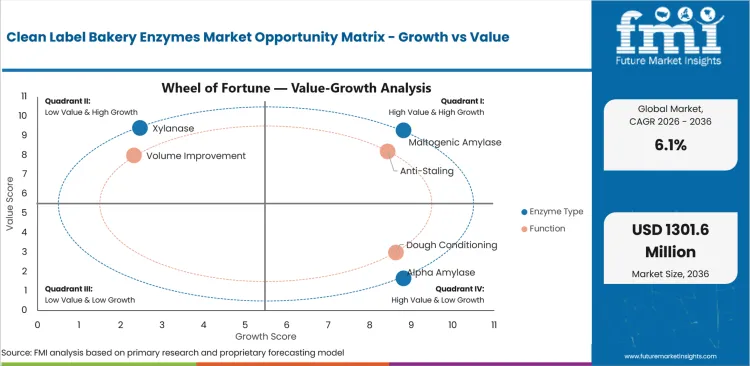
- Maltogenic amylase is projected to account for 32.5% share in 2026 because anti-staling remains the main clean label enzyme function.
- Anti-staling functions are expected to hold 39.0% share in 2026 as packaged bread needs softness retention during retail storage.
- Bread is forecast to secure 46.0% share in 2026 because high-volume bakeries validate enzyme systems through repeated production cycles.
- Additive replacement is estimated to represent 36.0% share in 2026 as bakeries reduce emulsifier-heavy labels in core SKUs.
- Industrial bakeries are anticipated to account for 58.0% share in 2026 since larger plants have better testing discipline.
- Powder blends are expected to hold 49.5% share in 2026 as premix handling lowers dosing errors in plant environments.
The market is segmented by enzyme type and function. Coverage also includes bakery application and label positioning. Product use connects with bread improvers where bakeries want dough strength and softness without adding more label complexity. Sweet bakery applications create a separate route for cake enzyme systems because moisture retention and egg reduction need different proof points than bread softness.
Insights into Clean Label Bakery Enzymes Market by Enzyme Type
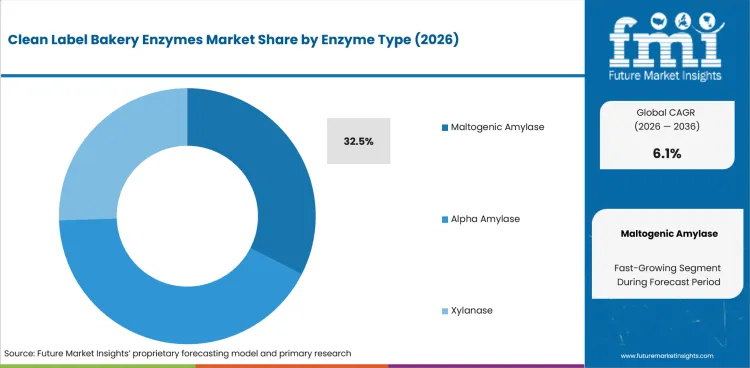
- Maltogenic amylase is projected to account for 32.5% share in 2026 through softness retention in packaged bread.
- Xylanase gains use where flour variation affects dough handling and line tolerance during high-volume production.
- Supplier portfolios inside food enzymes show that carbohydrate-active enzymes remain central to bakery texture work. European Food Safety Authority published a March 2026 evaluation for an endo-1,4-beta-xylanase intended for cereals and baked products.
Insights into Clean Label Bakery Enzymes Market by Function
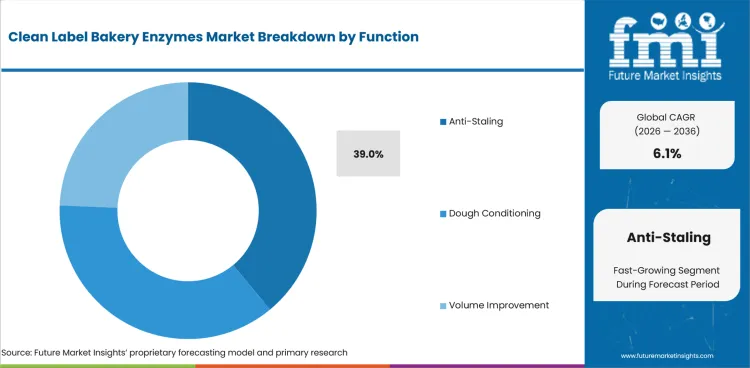
- Anti-staling is anticipated to secure 39.0% share in 2026 because softness loss is the first defect shoppers notice.
- Dough conditioning functions help bakers control machinability when flour protein and water absorption shift between lots.
- Emulsifier replacement functions remain linked to clean label work since bakers need texture recovery after additive removal. The function split also connects with alpha-amylase baking enzyme use because starch modification affects softness and bite.
Insights into Clean Label Bakery Enzymes Market by Bakery Application
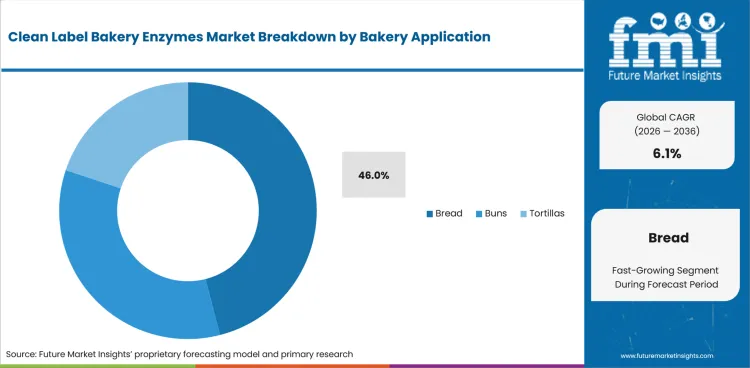
- Bread is forecast to hold 46.0% share in 2026 since packaged loaves face the strictest shelf-life expectations. Buns and rolls gain clean label enzyme use as foodservice operators need softness after warm holding and delivery.
- Gluten-free bakery needs enzyme support because texture gaps become visible faster when wheat gluten is absent. Application planning also touches clean label flour because bakers often adjust flour blends and enzyme systems together during reformulation.
Insights into Clean Label Bakery Enzymes Market by Label Positioning
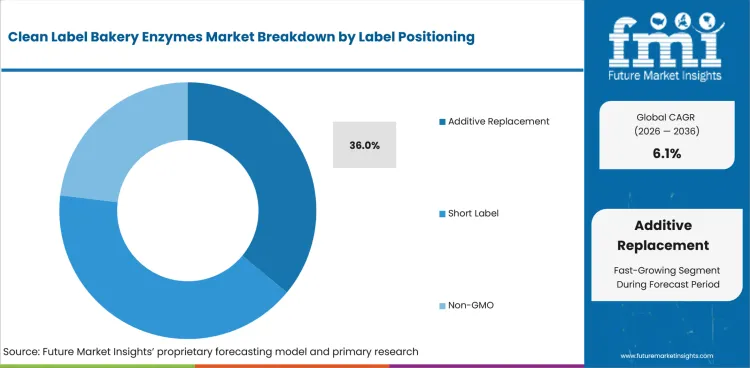
- Additive replacement is estimated to account for 36.0% share in 2026 through emulsifier and preservative reduction projects.
- Short label positioning is used when bakeries want fewer declared ingredients without changing familiar product names. Non-GMO and vegan suitability claims require supplier documentation because enzyme origin can affect buyer approval.
Insights into Clean Label Bakery Enzymes Market by Buyer Type
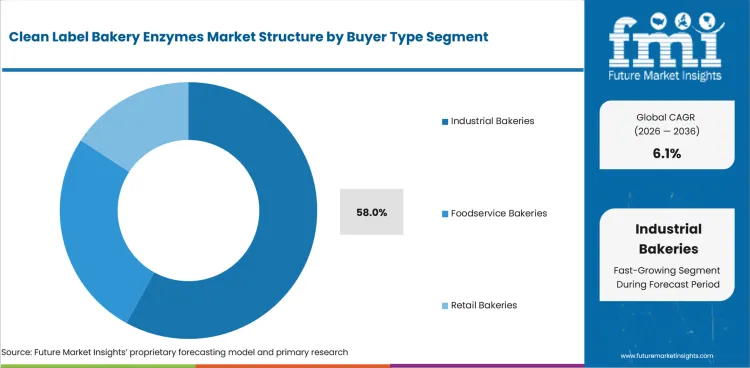
- Industrial bakeries are expected to represent 58.0% share in 2026 because plant trials can quantify dosing and texture changes.
- Foodservice bakeries use enzyme blends when centralized dough supply must survive storage and transport before final bake. Private label buyers favor suppliers that can prove label cleanup and shelf-life performance during retailer review.
Insights into Clean Label Bakery Enzymes Market by Format
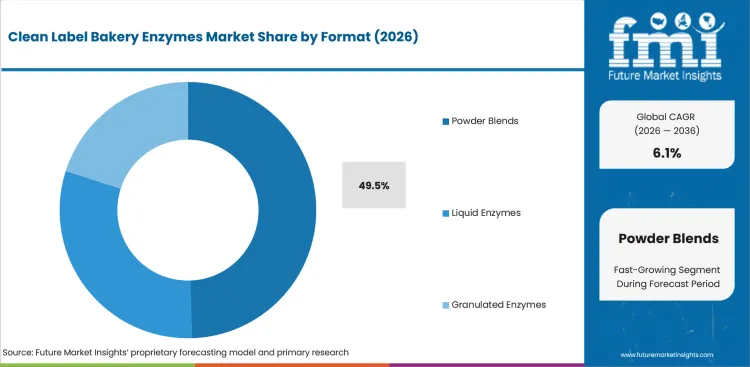
Powder blends are expected to hold 49.5% share in 2026 because premix handling fits flour batching systems. Format decisions overlap with bread emulsifier replacement work because enzyme blends often need to recover softness and volume after emulsifier reduction.
- Liquid enzymes remain relevant where bakeries use automated dosing and require fast dispersion in dough systems. Custom blends gain value when suppliers combine amylase and xylanase. Lipase can be added when one clean label bakery target requires more texture support.
Clean Label Bakery Enzymes Market Drivers, Restraints, and Opportunities
- Clean label reformulation is driven by retailer ingredient scrutiny and consumer preference for less artificial wording on packs. Shelf-life work is supported by bakery waste control because stale bread and buns can reduce retail sell-through.
- Adoption is constrained by uneven clean label definitions because retailers do not always treat enzyme preparations the same way.
- Gluten-free bakery creates a targeted growth route because texture gaps are visible and consumers expect cleaner labels in specialty foods.
Sugar and Additive Scrutiny Is Moving Bakers Toward Enzyme Reformulation
Clean label bakery enzymes are gaining relevance as bakeries look for texture and shelf-life support while reducing dependence on emulsifiers, conditioners and high-sugar positioning. FDA’s updated healthy claim rule became effective in February 2025 and introduced limits for added sugars, saturated fat and sodium. This raises pressure on bakery brands to review cakes, muffins and snack bakery labels before using nutrition-led claims. Enzyme suppliers benefit when they help bakers maintain softness and bite after recipe simplification.
Enzyme Systems Need More Technical Proof Across Flour and Process Conditions
Clean label conversion is difficult because enzymes can react differently across flour lots, water absorption levels and production speeds. Puratos stated in February 2026 that enzymes are a core clean-label tool but require precise flour analysis because their performance changes with flour composition. EFSA’s 2026 food enzyme application guidance also confirms that food enzymes require safety evaluation before they can be placed on the EU market. This adds technical and regulatory documentation work before bakeries approve a new enzyme supplier.
Shelf-Life and Waste Reduction Claims Can Support Premium Bakery Accounts
Bakery enzyme suppliers have an opportunity to win packaged, par-baked and frozen bakery accounts by proving shelf-life performance with shorter label declarations. Kerry stated in July 2025 that its Biobake enzyme range delivers anti-staling performance, volume support and cost-saving benefits across fresh, par-baked, chilled and frozen yeast-raised baked goods. UK advertising restrictions for less healthy food and drink come into force on January 5 2026. This creates a stronger case for enzyme-led reformulation when bakeries need products that stay soft, support cleaner labels and meet tougher campaign review requirements.
Analysis of Clean Label Bakery Enzymes Market by Key Countries
.webp "Top Country Growth Comparison Clean Label Bakery Enzymes Market Cagr (2026 2036)")
| Country | CAGR |
|---|---|
| South Korea | 6.8% |
| Saudi Arabia | 6.4% |
| United States | 5.9% |
| Germany | 5.7% |
| Canada | 5.4% |
| United Kingdom | 5.2% |
| Japan | 4.7% |
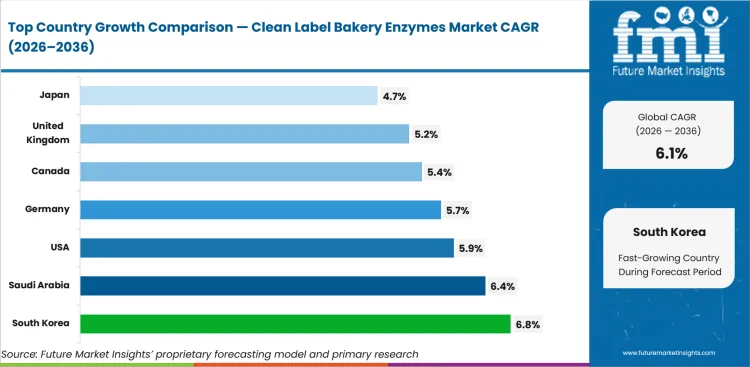
South Korea and Saudi Arabia are above the global CAGR because packaged bakery expansion is paired with faster modern retail development. Japan and the United Kingdom are below the global rate because bakery channels are more established and reformulation depends on slower product renovation cycles.
Clean Label Bakery Enzymes Market CAGR Analysis by Country
- South Korea is expected to post 6.8% CAGR through 2036 as frozen bakery and pastry formats add texture-control requirements.
- Saudi Arabia is projected to rise at 6.4% CAGR through 2036 as packaged baked goods expand in modern grocery channels.
- The United States is projected to record a 5.9% CAGR through 2036 with industrial bakery scale and retailer label checks.
- Germany is forecast to grow at 5.7% CAGR through 2036 as organic packaged bakery strengthens clean label positioning.
- Canada is expected to expand at 5.4% CAGR through 2036 as health-positioned baked goods outpace the wider bakery shelf.
- The United Kingdom is expected to advance at 5.2% CAGR through 2036 as retailer specifications keep reformulation measured.
- Japan is forecast at 4.7% CAGR through 2036 since established bakery habits limit faster enzyme switching.
Demand Outlook for Clean Label Bakery Enzymes Market in United States
Industrial bread scale and retailer label review center · 2026 to 2036
Country Market Snapshot Table
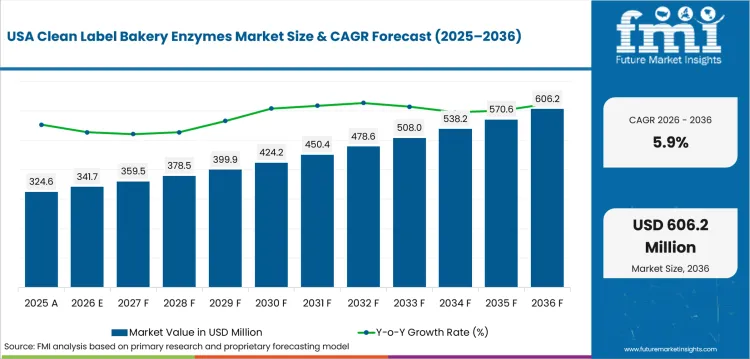
| Parameter | Value |
|---|---|
| Market Size in 2025 (Value) | USD 168.1 million |
| Market Size in 2026 (Value) | USD 178.0 million |
| Market Forecast in 2036 (Value) | USD 315.8 million |
| CAGR (2026 to 2036) | 5.9% |
| Years Considered | 2021 to 2036 |
| Base Year | 2025 |
| Forecast Period | 2026 to 2036 |
| Units Considered | Value (USD million) |
| Leading Sub-Region | South Atlantic and Midwest bakery corridors |
United States Clean Label Bakery Enzymes Market Outlook
United States buyers compare clean label enzyme systems against bakery line stability and retailer pack claims. The United States is projected to record a 5.9% CAGR through 2036 as large bakeries combine additive reduction with national distribution needs.
Agriculture and Agri-Food Canada reported in July 2025 that United States baked goods retail sales were expected to reach USD 97.7 billion in 2026. That scale gives enzyme suppliers a large testing base for bread and buns. Tortillas and sweet bakery formats add further trial routes.
Key Growth Drivers
- National bakery scale supports clean label enzyme trials because industrial plants can measure softness and volume. Waste is also tracked across repeated production cycles.
- Retailer private label programs create a clearer reason to replace emulsifiers when cleaner ingredient panels are part of shelf approval.
- The United States Department of Agriculture Economic Research Service reported in May 2026 that farm-level wheat prices are predicted to rise 10.1% in 2026, which keeps input cost control visible during reformulation.
Key Restraints
- Clean label enzyme switching can slow when bakery plants do not allocate enough trial time across flour lots and seasonal humidity changes.
- Suppliers must document enzyme origin and carrier materials before national accounts approve formulas for multiple store banners.
- Price pressure remains visible when bakeries compare enzyme blends with lower-cost improver systems already built into procurement contracts.
What makes United States unique
The United States combines national bakery scale and retailer specification power. Large industrial plants can also validate enzyme systems quickly.
Key Companies
- International Flavors & Fragrances Inc.
- Kerry Group plc
- Novonesis A/S
- AB Enzymes GmbH
- Amano Enzyme Inc.
- Lesaffre et Compagnie SA
- Corbion N.V.
Sales & Marketing Channels
- Industrial bakery direct sales
- Ingredient distributors
- Private label manufacturer channels
- Bakery premix suppliers
- Foodservice bakery networks
- Technical application centers
Country Segment Breakdown Table
| Segment | Sub-Segments |
|---|---|
| By Enzyme Type | Maltogenic Amylase · Alpha Amylase · Xylanase · Lipase · Protease · Glucose Oxidase · Cellulase |
| By Function | Anti-Staling · Dough Conditioning · Volume Improvement · Emulsifier Replacement · Sugar Reduction · Shelf Extension |
| By Bakery Application | Bread · Buns · Tortillas · Cakes · Pastries · Biscuits · Gluten-Free |
| By Label Positioning | Additive Replacement · Short Label · Non-GMO · Vegan · Organic-Compatible · Allergen Managed |
| By Buyer Type | Industrial Bakeries · Foodservice Bakeries · Retail Bakeries · Private Label · Ingredient Blenders |
| By Format | Powder Blends · Liquid Enzymes · Granulated Enzymes · Premix Systems · Custom Blends |
| Key Sub-Regions Covered, Bakery Production and Retail Corridors | South Atlantic · Midwest · California · Texas · Northeast · Pacific Northwest |
Frequently Asked Questions
How fast is United States clean label bakery enzymes market growing?
The United States market is projected to record 5.9% CAGR from 2026 to 2036 through industrial bakery reformulation.
Who leads United States clean label bakery enzymes supply?
International Flavors & Fragrances and Kerry compete through bakery application support. Novonesis and AB Enzymes also support buyer trials. Amano Enzyme adds specialist enzyme support.
What is driving clean label enzyme use in the United States?
Retailer label review and national bakery scale are moving enzyme trials into routine reformulation programs.
Opportunity Analysis for Clean Label Bakery Enzymes Market in Canada
Health-positioned bakery and private label center · 2026 to 2036
Country Market Snapshot Table
| Parameter | Value |
|---|---|
| Market Size in 2025 (Value) | USD 33.2 million |
| Market Size in 2026 (Value) | USD 35.0 million |
| Market Forecast in 2036 (Value) | USD 59.2 million |
| CAGR (2026 to 2036) | 5.4% |
| Years Considered | 2021 to 2036 |
| Base Year | 2025 |
| Forecast Period | 2026 to 2036 |
| Units Considered | Value (USD million) |
| Leading Sub-Region | Ontario and Quebec bakery corridors |
Canada Clean Label Bakery Enzymes Market Outlook
Canadian bakery buyers often compare clean label enzyme systems with health-positioned bakery claims and shorter ingredient lists. Canada is expected to expand at 5.4% CAGR through 2036 as clean label work stays tied to packaged bread and baked snack renovation.
Agriculture and Agri-Food Canada reported in March 2026 that Canadian baked goods retail sales reached Can$11.8 billion in 2024. The same source forecast health-positioned baked goods to reach Can$1.4 billion by 2029 at 8.9% CAGR.
Key Growth Drivers
- Health-positioned bakery growth supports enzyme trials when brands need softness retention without adding more label complexity.
- Private label programs can use clean label enzymes when retailers require shorter ingredient lists for bread and snack lines.
- E-commerce bakery sales in Canada grew at 40.6% annual pace in the cited Agriculture and Agri-Food Canada outlook, which raised packaging and freshness needs.
Key Restraints
- Canada’s smaller population limits total volume compared with the United States and keeps supplier coverage more selective.
- Foodservice bakers may delay enzyme switching when clean label claims are less visible than price and delivery reliability.
- Cold-chain bakery programs require formulation testing after thawing before suppliers can claim texture stability.
What makes Canada unique
Canada is differentiated by health-positioned bakery growth with concentrated bakery corridors in Ontario and Quebec.
Key Companies
- Kerry Group plc
- Novonesis A/S
- International Flavors & Fragrances Inc.
- AB Enzymes GmbH
- Lallemand Inc.
- Puratos Canada Inc.
- Dawn Food Products Canada Ltd.
Sales & Marketing Channels
- National ingredient distributors
- Industrial bakery accounts
- Grocery private label teams
- Foodservice bakery channels
- Frozen bakery suppliers
- Technical bakery labs
Country Segment Breakdown Table
| Segment | Sub-Segments |
|---|---|
| By Enzyme Type | Maltogenic Amylase · Alpha Amylase · Xylanase · Lipase · Protease · Glucose Oxidase · Cellulase |
| By Function | Anti-Staling · Dough Conditioning · Volume Improvement · Emulsifier Replacement · Sugar Reduction · Shelf Extension |
| By Bakery Application | Bread · Buns · Tortillas · Cakes · Pastries · Biscuits · Gluten-Free |
| By Label Positioning | Additive Replacement · Short Label · Non-GMO · Vegan · Organic-Compatible · Allergen Managed |
| By Buyer Type | Industrial Bakeries · Foodservice Bakeries · Retail Bakeries · Private Label · Ingredient Blenders |
| By Format | Powder Blends · Liquid Enzymes · Granulated Enzymes · Premix Systems · Custom Blends |
| Key Sub-Regions Covered, Bakery Production and Retail Corridors | Ontario · Quebec · British Columbia · Alberta · Manitoba · Atlantic Canada |
Frequently Asked Questions
How fast is Canada clean label bakery enzymes market growing?
Canada demand is expected to expand at 5.4% CAGR from 2026 to 2036 through health-positioned bakery reformulation.
Which segment leads Canada clean label bakery enzymes?
Industrial bakeries lead buyer demand because packaged bread programs need repeated softness checks before approval.
What limits faster enzyme use in Canada?
Market size and concentrated bakery production limit supplier scale even when health-positioned bakery sales improve.
Sales Outlook for Clean Label Bakery Enzymes Market in Germany
Organic packaged bakery and additive scrutiny center · 2026 to 2036
Country Market Snapshot Table
| Parameter | Value |
|---|---|
| Market Size in 2025 (Value) | USD 60.1 million |
| Market Size in 2026 (Value) | USD 63.5 million |
| Market Forecast in 2036 (Value) | USD 110.5 million |
| CAGR (2026 to 2036) | 5.7% |
| Years Considered | 2021 to 2036 |
| Base Year | 2025 |
| Forecast Period | 2026 to 2036 |
| Units Considered | Value (USD million) |
| Leading Sub-Region | North Rhine-Westphalia and Bavaria |
Germany Clean Label Bakery Enzymes Market Outlook
German bakery buyers place high value on documented ingredients and organic-compatible formulation support. Germany is forecast to grow at 5.7% CAGR through 2036 as clean label enzymes gain use in packaged bread and organic bakery formats.
Agriculture and Agri-Food Canada reported in April 2026 that organic baked goods in Germany reached USD 522.4 million in 2024. That figure shows why clean label enzyme suppliers need proof for organic-facing and additive-light bakery concepts.
Key Growth Drivers
- Organic bakery sales create a route for enzyme systems that support texture while protecting shorter ingredient declarations.
- German industrial bakeries require high documentation standards before approving enzyme origin and carrier systems. Allergen statements also need detailed review.
- Bread culture supports repeated bakery trials because consumers expect consistent crumb quality across packaged and fresh formats.
Key Restraints
- Regulatory and retailer caution can slow the use of enzyme systems when clean label definitions differ between brands.
- Application trials can become costly when bakers must test multiple bread styles and flour sources before switching.
- Organic positioning narrows the approved input pool and can limit faster movement from pilot batches into national programs.
What makes Germany unique
Germany differs through bread consumption depth with strict buyer review. Additive checks and organic cues shape approvals. Supplier documentation adds another review layer.
Key Companies
- AB Enzymes GmbH
- Novonesis A/S
- Kerry Group plc
- International Flavors & Fragrances Inc.
- Puratos Germany GmbH
- SternEnzym GmbH & Co. KG
- Mühlenchemie GmbH & Co. KG
Sales & Marketing Channels
- Direct industrial bakery sales
- Bakery ingredient distributors
- Organic bakery networks
- Premix manufacturers
- Technical service centers
- Retailer specification teams
Country Segment Breakdown Table
| Segment | Sub-Segments |
|---|---|
| By Enzyme Type | Maltogenic Amylase · Alpha Amylase · Xylanase · Lipase · Protease · Glucose Oxidase · Cellulase |
| By Function | Anti-Staling · Dough Conditioning · Volume Improvement · Emulsifier Replacement · Sugar Reduction · Shelf Extension |
| By Bakery Application | Bread · Buns · Tortillas · Cakes · Pastries · Biscuits · Gluten-Free |
| By Label Positioning | Additive Replacement · Short Label · Non-GMO · Vegan · Organic-Compatible · Allergen Managed |
| By Buyer Type | Industrial Bakeries · Foodservice Bakeries · Retail Bakeries · Private Label · Ingredient Blenders |
| By Format | Powder Blends · Liquid Enzymes · Granulated Enzymes · Premix Systems · Custom Blends |
| Key Sub-Regions Covered, Bakery Production and Retail Corridors | North Rhine-Westphalia · Bavaria · Baden-Wurttemberg · Lower Saxony · Hesse · Hamburg |
Frequently Asked Questions
How fast is Germany clean label bakery enzymes market growing?
Germany is forecast to grow at 5.7% CAGR from 2026 to 2036 with organic bakery and additive review support.
Who supplies clean label bakery enzymes in Germany?
AB Enzymes and Novonesis compete through documented bakery application work. Kerry and International Flavors & Fragrances also support trials. SternEnzym adds local application support.
What makes German buyer approval difficult?
Retailer review and organic-facing rules require detailed enzyme origin files before wider commercial bakery use.
Growth Outlook for Clean Label Bakery Enzymes Market in United Kingdom
Retailer specification and sandwich bakery center · 2026 to 2036
Country Market Snapshot Table
| Parameter | Value |
|---|---|
| Market Size in 2025 (Value) | USD 45.6 million |
| Market Size in 2026 (Value) | USD 48.0 million |
| Market Forecast in 2036 (Value) | USD 79.7 million |
| CAGR (2026 to 2036) | 5.2% |
| Years Considered | 2021 to 2036 |
| Base Year | 2025 |
| Forecast Period | 2026 to 2036 |
| Units Considered | Value (USD million) |
| Leading Sub-Region | England retail bakery clusters |
United Kingdom Clean Label Bakery Enzymes Market Outlook
United Kingdom buyers treat clean label enzyme systems as part of retail bakery specification control. The United Kingdom is expected to advance at 5.2% CAGR through 2036 as retailers renew bread and bun recipes. Sandwich carrier recipes add another reformulation route.
Supermarket bakery programs create stable demand for enzyme systems that protect softness after packed distribution. The rate remains lower than South Korea and Saudi Arabia because the bakery channel is already established.
Key Growth Drivers
- Retailer specifications create repeat demand for enzyme blends when private label bread and buns need shorter ingredient panels.
- Sandwich and foodservice bakery use supports softness retention because carriers must stay flexible during chilled storage.
- Health-oriented product renovation supports cleaner formulation work when brands reduce additive-heavy ingredient declarations.
Key Restraints
- Supplier switching can be slow because national retailers require documented trials before a formula reaches all stores.
- Lower population growth limits volume expansion compared with faster packaged food markets in Asia and the Gulf.
- Bakers may keep conventional improvers when clean label reformulation increases unit cost without visible shelf benefit.
What makes United Kingdom unique
The United Kingdom is defined by retailer-led bakery specifications and high use of packed sandwich carriers.
Key Companies
- Kerry Group plc
- Novonesis A/S
- International Flavors & Fragrances Inc.
- AB Enzymes GmbH
- Puratos United Kingdom Ltd.
- Bakels Ltd.
- Lesaffre United Kingdom and Ireland Ltd.
Sales & Marketing Channels
- Retailer technical teams
- Industrial bakery accounts
- Ingredient distributors
- Foodservice bakery suppliers
- Sandwich manufacturers
- Private label manufacturers
Country Segment Breakdown Table
| Segment | Sub-Segments |
|---|---|
| By Enzyme Type | Maltogenic Amylase · Alpha Amylase · Xylanase · Lipase · Protease · Glucose Oxidase · Cellulase |
| By Function | Anti-Staling · Dough Conditioning · Volume Improvement · Emulsifier Replacement · Sugar Reduction · Shelf Extension |
| By Bakery Application | Bread · Buns · Tortillas · Cakes · Pastries · Biscuits · Gluten-Free |
| By Label Positioning | Additive Replacement · Short Label · Non-GMO · Vegan · Organic-Compatible · Allergen Managed |
| By Buyer Type | Industrial Bakeries · Foodservice Bakeries · Retail Bakeries · Private Label · Ingredient Blenders |
| By Format | Powder Blends · Liquid Enzymes · Granulated Enzymes · Premix Systems · Custom Blends |
| Key Sub-Regions Covered, Bakery Production and Retail Corridors | England · Scotland · Wales · Northern Ireland · London · North West England |
Frequently Asked Questions
How fast is United Kingdom clean label bakery enzymes market growing?
The United Kingdom is expected to advance at 5.2% CAGR from 2026 to 2036 through retailer specification work.
Which applications matter most in the United Kingdom?
Bread and buns matter most because softness affects packed meal quality. Wraps and sandwich carriers add foldability requirements.
What constrains supplier entry in the United Kingdom?
Retailer approval cycles and trial documentation can slow supplier replacement even when clean label targets are clear.
Demand Outlook for Clean Label Bakery Enzymes Market in Saudi Arabia
Modern grocery bakery and packaged food center · 2026 to 2036
Country Market Snapshot Table
| Parameter | Value |
|---|---|
| Market Size in 2025 (Value) | USD 23.0 million |
| Market Size in 2026 (Value) | USD 24.5 million |
| Market Forecast in 2036 (Value) | USD 45.6 million |
| CAGR (2026 to 2036) | 6.4% |
| Years Considered | 2021 to 2036 |
| Base Year | 2025 |
| Forecast Period | 2026 to 2036 |
| Units Considered | Value (USD million) |
| Leading Sub-Region | Riyadh and Jeddah bakery channels |
Saudi Arabia Clean Label Bakery Enzymes Market Outlook
Saudi Arabia bakery demand is shaped by modern grocery growth and rising packaged food availability. Saudi Arabia is projected to rise at 6.4% CAGR through 2036 as packaged bread and sweet bakery volumes scale through urban retail.
Agriculture and Agri-Food Canada reported in July 2025 that baked goods in Saudi Arabia reached USD 6.7 billion in 2024. The same source stated that baked goods represented 27.1% of packaged food value that year.
Key Growth Drivers
- Modern grocery channels support clean label enzyme use when packaged bread needs softness after longer distribution routes.
- Urban bakery expansion creates demand for premix-compatible enzyme systems that simplify dosing in larger bakery plants.
- Healthier packaged food interest supports natural and high-fiber bakery positioning in the cited Saudi Arabia market overview.
Key Restraints
- Heat and distribution conditions require more validation before enzymes can protect texture across the full retail cycle.
- Clean label definitions can vary between imported brands and domestic bakeries, which complicates buyer approval documents.
- Supplier education remains needed because smaller bakeries may not separate enzyme performance from conventional improver blends.
What makes Saudi Arabia unique
Saudi Arabia differs through high packaged baked goods value and longer distribution needs across hot urban retail routes.
Key Companies
- Puratos Saudi Arabia
- Kerry Group plc
- Novonesis A/S
- International Flavors & Fragrances Inc.
- AB Enzymes GmbH
- Bakels Saudi Arabia
- IFFCO Group
Sales & Marketing Channels
- Industrial bakery direct sales
- Grocery bakery suppliers
- Ingredient importers
- Foodservice distributors
- Premix suppliers
- Modern retail channels
Country Segment Breakdown Table
| Segment | Sub-Segments |
|---|---|
| By Enzyme Type | Maltogenic Amylase · Alpha Amylase · Xylanase · Lipase · Protease · Glucose Oxidase · Cellulase |
| By Function | Anti-Staling · Dough Conditioning · Volume Improvement · Emulsifier Replacement · Sugar Reduction · Shelf Extension |
| By Bakery Application | Bread · Buns · Tortillas · Cakes · Pastries · Biscuits · Gluten-Free |
| By Label Positioning | Additive Replacement · Short Label · Non-GMO · Vegan · Organic-Compatible · Allergen Managed |
| By Buyer Type | Industrial Bakeries · Foodservice Bakeries · Retail Bakeries · Private Label · Ingredient Blenders |
| By Format | Powder Blends · Liquid Enzymes · Granulated Enzymes · Premix Systems · Custom Blends |
| Key Sub-Regions Covered, Bakery Production and Retail Corridors | Riyadh · Jeddah · Dammam · Makkah · Madinah · Eastern Province |
Frequently Asked Questions
How fast is Saudi Arabia clean label bakery enzymes market growing?
Saudi Arabia is projected to rise at 6.4% CAGR from 2026 to 2036 through packaged bakery expansion.
What supports clean label enzyme use in Saudi Arabia?
Modern grocery and longer retail distribution make softness retention more important for packaged bread suppliers.
What limits faster use in Saudi Arabia?
Heat exposure and mixed clean label definitions require more application testing before wider bakery use.
Opportunity Analysis for Clean Label Bakery Enzymes Market in South Korea
Frozen bakery and cafe bakery center · 2026 to 2036
Country Market Snapshot Table
| Parameter | Value |
|---|---|
| Market Size in 2025 (Value) | USD 26.7 million |
| Market Size in 2026 (Value) | USD 28.5 million |
| Market Forecast in 2036 (Value) | USD 55.0 million |
| CAGR (2026 to 2036) | 6.8% |
| Years Considered | 2021 to 2036 |
| Base Year | 2025 |
| Forecast Period | 2026 to 2036 |
| Units Considered | Value (USD million) |
| Leading Sub-Region | Seoul Capital Area and Busan |
South Korea Clean Label Bakery Enzymes Market Outlook
South Korea bakeries are adding more frozen and premium pastry formats through cafe and retail channels. South Korea is expected to post 6.8% CAGR through 2036 as texture control becomes more important after freezing and reheating.
Agriculture and Agri-Food Canada reported in April 2025 that South Korea frozen baked goods grew at 32.4% CAGR from 2018 to 2023 and reached USD 56.1 million. That product shift gives enzyme suppliers a faster route into clean label texture systems.
Key Growth Drivers
- Frozen bakery expansion supports enzyme use because softness and crumb recovery must survive thawing and reheating steps.
- Cafe bakery formats support premium bread and pastry renovation where clean label wording can support brand differentiation.
- Packaged pastries reached USD 394.6 million in 2023 in the cited South Korea bakery outlook, which widened the base for softness-focused enzyme systems.
Key Restraints
- Smaller bakery chains may delay enzyme switching when recipe familiarity matters more than documented clean label positioning.
- Imported enzyme suppliers must provide local technical support before plant trials can move into routine production.
- Frozen bakery formulas require repeated freeze-thaw tests, which raises trial cost for smaller producers.
What makes South Korea unique
South Korea stands out for fast frozen bakery expansion and cafe-led bakery renovation that rewards texture recovery.
Key Companies
- Novonesis Korea Ltd.
- Kerry Ingredients Korea Ltd.
- International Flavors & Fragrances Korea Ltd.
- Puratos Korea Co. Ltd.
- AB Enzymes GmbH
- Amano Enzyme Inc.
- CJ CheilJedang Corporation
Sales & Marketing Channels
- Cafe bakery chains
- Frozen bakery producers
- Ingredient distributors
- Industrial bakery plants
- Online grocery bakery suppliers
- Technical bakery centers
Country Segment Breakdown Table
| Segment | Sub-Segments |
|---|---|
| By Enzyme Type | Maltogenic Amylase · Alpha Amylase · Xylanase · Lipase · Protease · Glucose Oxidase · Cellulase |
| By Function | Anti-Staling · Dough Conditioning · Volume Improvement · Emulsifier Replacement · Sugar Reduction · Shelf Extension |
| By Bakery Application | Bread · Buns · Tortillas · Cakes · Pastries · Biscuits · Gluten-Free |
| By Label Positioning | Additive Replacement · Short Label · Non-GMO · Vegan · Organic-Compatible · Allergen Managed |
| By Buyer Type | Industrial Bakeries · Foodservice Bakeries · Retail Bakeries · Private Label · Ingredient Blenders |
| By Format | Powder Blends · Liquid Enzymes · Granulated Enzymes · Premix Systems · Custom Blends |
| Key Sub-Regions Covered, Bakery Production and Retail Corridors | Seoul Capital Area · Busan · Daegu · Incheon · Daejeon · Gwangju |
Frequently Asked Questions
How fast is South Korea clean label bakery enzymes market growing?
South Korea is expected to post 6.8% CAGR from 2026 to 2036 through frozen bakery and pastry expansion.
Which bakery formats support South Korea demand?
Frozen baked goods and pastries support enzyme trials in South Korea. Cafe breads and packaged bakery snacks add further demand routes.
What makes South Korea different for suppliers?
Fast frozen bakery growth creates a stronger need for enzyme systems tested after thawing and reheating.
Sales Outlook for Clean Label Bakery Enzymes Market in Japan
Convenience bakery and texture consistency center · 2026 to 2036
Country Market Snapshot Table
| Parameter | Value |
|---|---|
| Market Size in 2025 (Value) | USD 47.8 million |
| Market Size in 2026 (Value) | USD 50.0 million |
| Market Forecast in 2036 (Value) | USD 79.1 million |
| CAGR (2026 to 2036) | 4.7% |
| Years Considered | 2021 to 2036 |
| Base Year | 2025 |
| Forecast Period | 2026 to 2036 |
| Units Considered | Value (USD million) |
| Leading Sub-Region | Kanto and Kansai retail corridors |
Japan Clean Label Bakery Enzymes Market Outlook
Japan buyers value texture consistency and smaller pack formats across convenience bakery channels. Japan is forecast at 4.7% CAGR through 2036 since bakery habits are established but quality expectations keep enzyme use relevant.
Agriculture and Agri-Food Canada reported in January 2025 that Japan’s baked goods retail market reached USD 24.7 billion in 2023. The same source forecast the market to reach USD 27.0 billion by 2028.
Key Growth Drivers
- Convenience bakery channels support clean label enzymes when packed breads must keep softness during short retail cycles.
- Premium bakery formats need texture precision because Japanese consumers compare softness and mouthfeel closely across brands.
- Frozen baked goods in Japan grew 9.3% from 2018 to 2023 in the cited outlook, which supports clean label enzyme trials for thawed products.
Key Restraints
- Overall bakery growth is modest and limits faster value expansion for clean label enzyme suppliers.
- Established quality systems make bakeries cautious about switching enzyme blends without repeated sensory trials.
- Ingredient declaration expectations differ by category and can make clean label positioning less direct than in North America.
What makes Japan unique
Japan differs through convenience bakery discipline and high texture expectations. Bread and cakes create separate trial needs. Pastries and frozen bakery add more texture requirements.
Key Companies
- Amano Enzyme Inc.
- Novonesis Japan Ltd.
- International Flavors & Fragrances Japan K.K.
- Kerry Japan K.K.
- Puratos Japan Co. Ltd.
- Nitto Fuji Flour Milling Co. Ltd.
- Oriental Yeast Co. Ltd.
Sales & Marketing Channels
- Convenience bakery suppliers
- Industrial bakeries
- Ingredient trading houses
- Premix manufacturers
- Frozen bakery producers
- Technical application labs
Country Segment Breakdown Table
| Segment | Sub-Segments |
|---|---|
| By Enzyme Type | Maltogenic Amylase · Alpha Amylase · Xylanase · Lipase · Protease · Glucose Oxidase · Cellulase |
| By Function | Anti-Staling · Dough Conditioning · Volume Improvement · Emulsifier Replacement · Sugar Reduction · Shelf Extension |
| By Bakery Application | Bread · Buns · Tortillas · Cakes · Pastries · Biscuits · Gluten-Free |
| By Label Positioning | Additive Replacement · Short Label · Non-GMO · Vegan · Organic-Compatible · Allergen Managed |
| By Buyer Type | Industrial Bakeries · Foodservice Bakeries · Retail Bakeries · Private Label · Ingredient Blenders |
| By Format | Powder Blends · Liquid Enzymes · Granulated Enzymes · Premix Systems · Custom Blends |
| Key Sub-Regions Covered, Bakery Production and Retail Corridors | Kanto · Kansai · Chubu · Kyushu · Hokkaido · Tohoku |
Frequently Asked Questions
How fast is Japan clean label bakery enzymes market growing?
Japan is forecast at 4.7% CAGR from 2026 to 2036 through convenience bakery and frozen bakery use.
Which suppliers are relevant in Japan?
Amano Enzyme and Novonesis Japan serve enzyme-related bakery needs. International Flavors & Fragrances Japan and Kerry Japan also support bakery accounts.
What restrains faster growth in Japan?
Established bakery quality systems and modest retail growth slow formula switching even when texture benefits are clear.
Competitive Landscape and Strategic Positioning
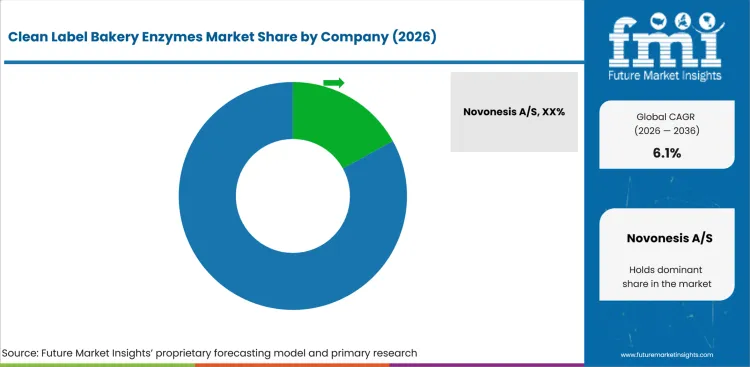
Competition is shaped by bakery trial capability rather than enzyme catalog size alone. Large suppliers compete on application centers and allergen files. Non-GMO documentation and commercial line evidence also affect buyer approval. Smaller ingredient houses can win regional accounts when they package enzymes inside easy-to-dose premix systems.
Novonesis is estimated to hold 24.0% share in 2026 due to its enzyme depth and bakery application coverage. International Flavors & Fragrances and Kerry compete through formulation systems that combine enzymes with taste. Texture and shelf-life support extend their buyer relevance. AB Enzymes and Amano Enzyme compete through focused enzyme portfolios and technical bakery guidance.
Buyer criteria differ by application. Industrial bread buyers look first at softness retention and machinability. Cake and sweet bakery buyers look at moisture retention and ingredient reduction. Gluten-free buyers place more weight on crumb structure and tolerance after storage.
Suppliers best positioned through 2036 can link enzyme blends with cleaner labels and plant trials. Documented country compliance adds another buyer filter. This means evidence quality is expected to matter as much as dose price when large bakeries shortlist partners.
Key Companies in Clean Label Bakery Enzymes Market
- Novonesis A/S
- International Flavors & Fragrances Inc.
- Kerry Group plc
- AB Enzymes GmbH
- Amano Enzyme Inc.
- Puratos Group
- Lallemand Inc.
Competitive Benchmarking
| Company | Market Position | Bakery Enzyme Capability | Clean Label Proof Point | Impact |
|---|---|---|---|---|
| Novonesis A/S | Estimated 24.0% share | Enzyme breadth | Bread freshness proof | High |
| International Flavors & Fragrances Inc. | Large application base | Blend systems | Egg and cocoa reduction trials | High |
| Kerry Group plc | Shelf-life portfolio | Bakery freshness systems | Waste reduction messaging | High |
| AB Enzymes GmbH | Focused enzyme house | Butter-rich recipe support | European production base | Medium |
| Amano Enzyme Inc. | Specialist enzyme supplier | Industrial bread enzymes | Japan technical base | Medium |
| Puratos Group | Bakery ingredient house | Sourdough and freshness tools | Customer innovation centers | Medium |
| Lallemand Inc. | Fermentation specialist | Bakery ingredient route | Global production footprint | Medium |
Key Developments in Clean Label Bakery Enzymes Market
- In September 2025, International Flavors & Fragrances presented enzyme blends for 50% egg-reduced cupcakes and 30% cocoa-reduced brownies at IBIE 2025.
- In July 2025, Kerry described bakery shelf-life solutions that use enzymes and fermentation-derived ingredients to retain softness and reduce waste.
- In October 2025, Amano Enzyme outlined food enzyme use in baking where proteases modify gluten strength and improve dough handling.
Key Players
- Novonesis A/S.
- International Flavors & Fragrances Inc.
- Kerry Group plc
- AB Enzymes GmbH
- Amano Enzyme Inc.
- Puratos Group
- Lallemand Inc.
Clean Label Bakery Enzymes Market - Report Scope
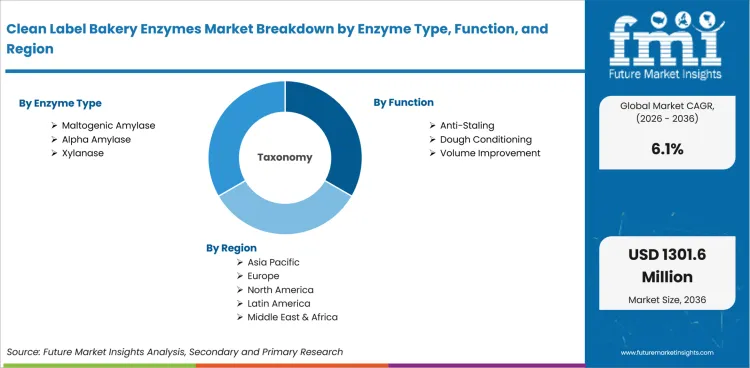
| Parameter | Details |
|---|---|
| Market size by 2036 | USD 1,301.6 million |
| Growth rate | 6.1% CAGR from 2026 to 2036 |
| Forecast period | 2026 to 2036 |
| Base year value (2025) | USD 678.6 million |
| By enzyme type | Maltogenic amylase, alpha amylase, xylanase, lipase, protease, glucose oxidase, cellulase |
| By function | Anti-staling, dough conditioning, volume improvement, emulsifier replacement, sugar reduction, shelf extension |
| By bakery application | Bread, buns, tortillas, cakes, pastries, biscuits, gluten-free bakery |
| By label positioning | Additive replacement, short label, non-GMO, vegan, organic-compatible, allergen managed |
| By buyer type | Industrial bakeries, foodservice bakeries, retail bakeries, private label, ingredient blenders |
| By format | Powder blends, liquid enzymes, granulated enzymes, premix systems, custom blends |
| Regions covered | North America, Europe, East Asia, GCC, Oceania, Rest of World |
| Countries covered | United States, Canada, Germany, United Kingdom, Saudi Arabia, South Korea, Japan |
| Key companies profiled | Novonesis, DSM-Firmenich, IFF, AB Enzymes, Amano Enzyme, Kerry Group, Puratos Group, Lesaffre, Corbion |
| Approach | Bottom-up product-boundary approach using eligible bakery enzyme revenue, enzyme function, bakery application depth, clean label positioning, additive replacement use, supplier portfolio checks, formulation support, and country-level bakery adoption |
Clean Label Bakery Enzymes Market by Segments
By Enzyme Type:
- Maltogenic Amylase
- Alpha Amylase
- Xylanase
- Lipase
- Protease
- Glucose Oxidase
- Cellulase
By Function:
- Anti-Staling
- Dough Conditioning
- Volume Improvement
- Emulsifier Replacement
- Sugar Reduction
- Shelf Extension
By Bakery Application:
- Bread
- Buns
- Tortillas
- Cakes
- Pastries
- Biscuits
- Gluten-Free Bakery
By Label Positioning:
- Additive Replacement
- Short Label
- Non-GMO
- Vegan
- Organic-Compatible
- Allergen Managed
By Buyer Type:
- Industrial Bakeries
- Foodservice Bakeries
- Retail Bakeries
- Private Label
- Ingredient Blenders
By Format:
- Powder Blends
- Liquid Enzymes
- Granulated Enzymes
- Premix Systems
- Custom Blends
Research Sources and Bibliography
- Agriculture and Agri-Food Canada. (2025, July 2). Sector Trend Analysis - Bakery products in the United States.
- Agriculture and Agri-Food Canada. (2026, March 4). Sector Trend Analysis - Bakery trends in Canada.
- Agriculture and Agri-Food Canada. (2026, April 29). Health and Wellness Series - Organic packaged food trends in Germany.
- Agriculture and Agri-Food Canada. (2025, July 2). Market Overview - Saudi Arabia.
- Agriculture and Agri-Food Canada. (2025, April 16). Sector Trend Analysis - Bakery trends in South Korea.
- Agriculture and Agri-Food Canada. (2025, January 29). Sector Trend Analysis - Bakery products in Japan.
- Agriculture and Agri-Food Canada. (2025, July 9). Sector Trend Analysis - Packaged food trends in Australia.
- International Food Information Council. (2025, July). 2025 IFIC Food and Health Survey.
- European Food Safety Authority. (2026, March 31). Safety evaluation of the food enzyme endo-1,4-beta-xylanase from the genetically modified Trichoderma reesei strain DP-Nzd66.
- European Food Safety Authority. (2026, February 26). Safety evaluation of a food enzyme containing xylanase and glucanase from Aspergillus tubingensis strain CBS 138353.
- AB Enzymes GmbH. (2024, October 9). AB Enzymes unlocks opportunities for butter-rich recipes with VERON POLARUM.
- International Flavors & Fragrances Inc. (2025, September 2). IFF tackles top challenges in baking at IBIE 2025.
- Kerry Group plc. (2025, July 11). How to improve bakery shelf life and reduce waste.
- Puratos Group. (2024, June 3). Puratos champions power of sourdough with opening of new Sourdough Institute.
- Amano Enzyme Inc. (2025, October). Food enzymes: Enhancing quality and efficiency in production.
- BASF SE. (2024, June 3). BASF sells bioenergy enzymes business to Lallemand.
- United States Department of Agriculture Economic Research Service. (2026, May 22). Food price outlook: Summary findings.
This Report Answers
- What is the estimated size of the clean label bakery enzymes market in 2026 and 2036?
- Which enzyme type accounts for the largest share in clean label bakery applications?
- Why do industrial bakeries account for the largest buyer share in 2026?
- Which countries show faster CAGR and what market conditions explain the difference?
- How do supplier developments after 2024 support clean label bakery enzyme demand?
- Which restraints can slow clean label enzyme switching in bakery production?
- Which companies are most relevant to clean label bakery enzyme supply and application support?
Frequently Asked Questions
What is the clean label bakery enzymes market size in 2026?
The clean label bakery enzymes market is estimated at USD 720.0 million in 2026 using the provided market anchor.
What is the clean label bakery enzymes market forecast for 2036?
The market is projected to reach USD 1,301.6 million by 2036 at 6.1% CAGR from 2026.
Which enzyme type leads the market?
Maltogenic amylase leads the market with 32.5% share in 2026 due to its anti-staling use in packaged bread.
Which bakery application leads demand?
Bread leads application demand with 46.0% share in 2026 since it needs repeated softness and shelf-life control.
Which country grows fastest through 2036?
South Korea grows fastest at 6.8% CAGR through 2036 as frozen bakery and pastry formats expand.
Who are the key companies in this market?
Novonesis and International Flavors & Fragrances are key suppliers. Kerry and AB Enzymes are also relevant. Amano Enzyme and Puratos add further supplier options. Lallemand adds fermentation-linked bakery reach.
What limits faster clean label bakery enzyme use?
Uneven clean label definitions and plant trial costs limit faster switching from conventional improver systems.
Preview the report firsthand - request a free sample
Get SampleGet the brochure for pricing and purchase details.
Get PDFTable of Content
- Executive Summary
- Global Market Outlook
- Demand to side Trends
- Supply to side Trends
- Technology Roadmap Analysis
- Analysis and Recommendations
- Market Overview
- Market Coverage / Taxonomy
- Market Definition / Scope / Limitations
- Research Methodology
- Chapter Orientation
- Analytical Lens and Working Hypotheses
- Market Structure, Signals, and Trend Drivers
- Benchmarking and Cross-market Comparability
- Market Sizing, Forecasting, and Opportunity Mapping
- Research Design and Evidence Framework
- Desk Research Programme (Secondary Evidence)
- Company Annual and Sustainability Reports
- Peer-reviewed Journals and Academic Literature
- Corporate Websites, Product Literature, and Technical Notes
- Earnings Decks and Investor Briefings
- Statutory Filings and Regulatory Disclosures
- Technical White Papers and Standards Notes
- Trade Journals, Industry Magazines, and Analyst Briefs
- Conference Proceedings, Webinars, and Seminar Materials
- Government Statistics Portals and Public Data Releases
- Press Releases and Reputable Media Coverage
- Specialist Newsletters and Curated Briefings
- Sector Databases and Reference Repositories
- FMI Internal Proprietary Databases and Historical Market Datasets
- Subscription Datasets and Paid Sources
- Social Channels, Communities, and Digital Listening Inputs
- Additional Desk Sources
- Expert Input and Fieldwork (Primary Evidence)
- Primary Modes
- Qualitative Interviews and Expert Elicitation
- Quantitative Surveys and Structured Data Capture
- Blended Approach
- Why Primary Evidence is Used
- Field Techniques
- Interviews
- Surveys
- Focus Groups
- Observational and In-context Research
- Social and Community Interactions
- Stakeholder Universe Engaged
- C-suite Leaders
- Board Members
- Presidents and Vice Presidents
- R&D and Innovation Heads
- Technical Specialists
- Domain Subject-matter Experts
- Scientists
- Physicians and Other Healthcare Professionals
- Governance, Ethics, and Data Stewardship
- Research Ethics
- Data Integrity and Handling
- Primary Modes
- Tooling, Models, and Reference Databases
- Desk Research Programme (Secondary Evidence)
- Data Engineering and Model Build
- Data Acquisition and Ingestion
- Cleaning, Normalisation, and Verification
- Synthesis, Triangulation, and Analysis
- Quality Assurance and Audit Trail
- Market Background
- Market Dynamics
- Drivers
- Restraints
- Opportunity
- Trends
- Scenario Forecast
- Demand in Optimistic Scenario
- Demand in Likely Scenario
- Demand in Conservative Scenario
- Opportunity Map Analysis
- Product Life Cycle Analysis
- Supply Chain Analysis
- Investment Feasibility Matrix
- Value Chain Analysis
- PESTLE and Porter’s Analysis
- Regulatory Landscape
- Regional Parent Market Outlook
- Production and Consumption Statistics
- Import and Export Statistics
- Market Dynamics
- Global Market Analysis 2021 to 2025 and Forecast, 2026 to 2036
- Historical Market Size Value (USD Million) Analysis, 2021 to 2025
- Current and Future Market Size Value (USD Million) Projections, 2026 to 2036
- Y to o to Y Growth Trend Analysis
- Absolute $ Opportunity Analysis
- Global Market Pricing Analysis 2021 to 2025 and Forecast 2026 to 2036
- Global Market Analysis 2021 to 2025 and Forecast 2026 to 2036, By Enzyme Type
- Introduction / Key Findings
- Historical Market Size Value (USD Million) Analysis By Enzyme Type , 2021 to 2025
- Current and Future Market Size Value (USD Million) Analysis and Forecast By Enzyme Type , 2026 to 2036
- Maltogenic Amylase
- Alpha Amylase
- Xylanase
- Maltogenic Amylase
- Y to o to Y Growth Trend Analysis By Enzyme Type , 2021 to 2025
- Absolute $ Opportunity Analysis By Enzyme Type , 2026 to 2036
- Global Market Analysis 2021 to 2025 and Forecast 2026 to 2036, By Function
- Introduction / Key Findings
- Historical Market Size Value (USD Million) Analysis By Function, 2021 to 2025
- Current and Future Market Size Value (USD Million) Analysis and Forecast By Function, 2026 to 2036
- Anti-Staling
- Dough Conditioning
- Volume Improvement
- Anti-Staling
- Y to o to Y Growth Trend Analysis By Function, 2021 to 2025
- Absolute $ Opportunity Analysis By Function, 2026 to 2036
- Global Market Analysis 2021 to 2025 and Forecast 2026 to 2036, By Bakery Application
- Introduction / Key Findings
- Historical Market Size Value (USD Million) Analysis By Bakery Application, 2021 to 2025
- Current and Future Market Size Value (USD Million) Analysis and Forecast By Bakery Application, 2026 to 2036
- Bread
- Buns
- Tortillas
- Bread
- Y to o to Y Growth Trend Analysis By Bakery Application, 2021 to 2025
- Absolute $ Opportunity Analysis By Bakery Application, 2026 to 2036
- Global Market Analysis 2021 to 2025 and Forecast 2026 to 2036, By Label Positioning
- Introduction / Key Findings
- Historical Market Size Value (USD Million) Analysis By Label Positioning, 2021 to 2025
- Current and Future Market Size Value (USD Million) Analysis and Forecast By Label Positioning, 2026 to 2036
- Additive Replacement
- Short Label
- Non-GMO
- Additive Replacement
- Y to o to Y Growth Trend Analysis By Label Positioning, 2021 to 2025
- Absolute $ Opportunity Analysis By Label Positioning, 2026 to 2036
- Global Market Analysis 2021 to 2025 and Forecast 2026 to 2036, By Buyer Type
- Introduction / Key Findings
- Historical Market Size Value (USD Million) Analysis By Buyer Type, 2021 to 2025
- Current and Future Market Size Value (USD Million) Analysis and Forecast By Buyer Type, 2026 to 2036
- Industrial Bakeries
- Foodservice Bakeries
- Retail Bakeries
- Industrial Bakeries
- Y to o to Y Growth Trend Analysis By Buyer Type, 2021 to 2025
- Absolute $ Opportunity Analysis By Buyer Type, 2026 to 2036
- Global Market Analysis 2021 to 2025 and Forecast 2026 to 2036, By Format
- Introduction / Key Findings
- Historical Market Size Value (USD Million) Analysis By Format, 2021 to 2025
- Current and Future Market Size Value (USD Million) Analysis and Forecast By Format, 2026 to 2036
- Powder Blends
- Liquid Enzymes
- Granulated Enzymes
- Powder Blends
- Y to o to Y Growth Trend Analysis By Format, 2021 to 2025
- Absolute $ Opportunity Analysis By Format, 2026 to 2036
- Global Market Analysis 2021 to 2025 and Forecast 2026 to 2036, By Region
- Introduction
- Historical Market Size Value (USD Million) Analysis By Region, 2021 to 2025
- Current Market Size Value (USD Million) Analysis and Forecast By Region, 2026 to 2036
- North America
- Latin America
- Western Europe
- Eastern Europe
- East Asia
- South Asia and Pacific
- Middle East & Africa
- Market Attractiveness Analysis By Region
- North America Market Analysis 2021 to 2025 and Forecast 2026 to 2036, By Country
- Historical Market Size Value (USD Million) Trend Analysis By Market Taxonomy, 2021 to 2025
- Market Size Value (USD Million) Forecast By Market Taxonomy, 2026 to 2036
- By Country
- USA
- Canada
- Mexico
- By Enzyme Type
- By Function
- By Bakery Application
- By Label Positioning
- By Buyer Type
- By Format
- By Country
- Market Attractiveness Analysis
- By Country
- By Enzyme Type
- By Function
- By Bakery Application
- By Label Positioning
- By Buyer Type
- By Format
- Key Takeaways
- Latin America Market Analysis 2021 to 2025 and Forecast 2026 to 2036, By Country
- Historical Market Size Value (USD Million) Trend Analysis By Market Taxonomy, 2021 to 2025
- Market Size Value (USD Million) Forecast By Market Taxonomy, 2026 to 2036
- By Country
- Brazil
- Chile
- Rest of Latin America
- By Enzyme Type
- By Function
- By Bakery Application
- By Label Positioning
- By Buyer Type
- By Format
- By Country
- Market Attractiveness Analysis
- By Country
- By Enzyme Type
- By Function
- By Bakery Application
- By Label Positioning
- By Buyer Type
- By Format
- Key Takeaways
- Western Europe Market Analysis 2021 to 2025 and Forecast 2026 to 2036, By Country
- Historical Market Size Value (USD Million) Trend Analysis By Market Taxonomy, 2021 to 2025
- Market Size Value (USD Million) Forecast By Market Taxonomy, 2026 to 2036
- By Country
- Germany
- UK
- Italy
- Spain
- France
- Nordic
- BENELUX
- Rest of Western Europe
- By Enzyme Type
- By Function
- By Bakery Application
- By Label Positioning
- By Buyer Type
- By Format
- By Country
- Market Attractiveness Analysis
- By Country
- By Enzyme Type
- By Function
- By Bakery Application
- By Label Positioning
- By Buyer Type
- By Format
- Key Takeaways
- Eastern Europe Market Analysis 2021 to 2025 and Forecast 2026 to 2036, By Country
- Historical Market Size Value (USD Million) Trend Analysis By Market Taxonomy, 2021 to 2025
- Market Size Value (USD Million) Forecast By Market Taxonomy, 2026 to 2036
- By Country
- Russia
- Poland
- Hungary
- Balkan & Baltic
- Rest of Eastern Europe
- By Enzyme Type
- By Function
- By Bakery Application
- By Label Positioning
- By Buyer Type
- By Format
- By Country
- Market Attractiveness Analysis
- By Country
- By Enzyme Type
- By Function
- By Bakery Application
- By Label Positioning
- By Buyer Type
- By Format
- Key Takeaways
- East Asia Market Analysis 2021 to 2025 and Forecast 2026 to 2036, By Country
- Historical Market Size Value (USD Million) Trend Analysis By Market Taxonomy, 2021 to 2025
- Market Size Value (USD Million) Forecast By Market Taxonomy, 2026 to 2036
- By Country
- China
- Japan
- South Korea
- By Enzyme Type
- By Function
- By Bakery Application
- By Label Positioning
- By Buyer Type
- By Format
- By Country
- Market Attractiveness Analysis
- By Country
- By Enzyme Type
- By Function
- By Bakery Application
- By Label Positioning
- By Buyer Type
- By Format
- Key Takeaways
- South Asia and Pacific Market Analysis 2021 to 2025 and Forecast 2026 to 2036, By Country
- Historical Market Size Value (USD Million) Trend Analysis By Market Taxonomy, 2021 to 2025
- Market Size Value (USD Million) Forecast By Market Taxonomy, 2026 to 2036
- By Country
- India
- ASEAN
- Australia & New Zealand
- Rest of South Asia and Pacific
- By Enzyme Type
- By Function
- By Bakery Application
- By Label Positioning
- By Buyer Type
- By Format
- By Country
- Market Attractiveness Analysis
- By Country
- By Enzyme Type
- By Function
- By Bakery Application
- By Label Positioning
- By Buyer Type
- By Format
- Key Takeaways
- Middle East & Africa Market Analysis 2021 to 2025 and Forecast 2026 to 2036, By Country
- Historical Market Size Value (USD Million) Trend Analysis By Market Taxonomy, 2021 to 2025
- Market Size Value (USD Million) Forecast By Market Taxonomy, 2026 to 2036
- By Country
- Kingdom of Saudi Arabia
- Other GCC Countries
- Turkiye
- South Africa
- Other African Union
- Rest of Middle East & Africa
- By Enzyme Type
- By Function
- By Bakery Application
- By Label Positioning
- By Buyer Type
- By Format
- By Country
- Market Attractiveness Analysis
- By Country
- By Enzyme Type
- By Function
- By Bakery Application
- By Label Positioning
- By Buyer Type
- By Format
- Key Takeaways
- Key Countries Market Analysis
- USA
- Pricing Analysis
- Market Share Analysis, 2025
- By Enzyme Type
- By Function
- By Bakery Application
- By Label Positioning
- By Buyer Type
- By Format
- Canada
- Pricing Analysis
- Market Share Analysis, 2025
- By Enzyme Type
- By Function
- By Bakery Application
- By Label Positioning
- By Buyer Type
- By Format
- Mexico
- Pricing Analysis
- Market Share Analysis, 2025
- By Enzyme Type
- By Function
- By Bakery Application
- By Label Positioning
- By Buyer Type
- By Format
- Brazil
- Pricing Analysis
- Market Share Analysis, 2025
- By Enzyme Type
- By Function
- By Bakery Application
- By Label Positioning
- By Buyer Type
- By Format
- Chile
- Pricing Analysis
- Market Share Analysis, 2025
- By Enzyme Type
- By Function
- By Bakery Application
- By Label Positioning
- By Buyer Type
- By Format
- Germany
- Pricing Analysis
- Market Share Analysis, 2025
- By Enzyme Type
- By Function
- By Bakery Application
- By Label Positioning
- By Buyer Type
- By Format
- UK
- Pricing Analysis
- Market Share Analysis, 2025
- By Enzyme Type
- By Function
- By Bakery Application
- By Label Positioning
- By Buyer Type
- By Format
- Italy
- Pricing Analysis
- Market Share Analysis, 2025
- By Enzyme Type
- By Function
- By Bakery Application
- By Label Positioning
- By Buyer Type
- By Format
- Spain
- Pricing Analysis
- Market Share Analysis, 2025
- By Enzyme Type
- By Function
- By Bakery Application
- By Label Positioning
- By Buyer Type
- By Format
- France
- Pricing Analysis
- Market Share Analysis, 2025
- By Enzyme Type
- By Function
- By Bakery Application
- By Label Positioning
- By Buyer Type
- By Format
- India
- Pricing Analysis
- Market Share Analysis, 2025
- By Enzyme Type
- By Function
- By Bakery Application
- By Label Positioning
- By Buyer Type
- By Format
- ASEAN
- Pricing Analysis
- Market Share Analysis, 2025
- By Enzyme Type
- By Function
- By Bakery Application
- By Label Positioning
- By Buyer Type
- By Format
- Australia & New Zealand
- Pricing Analysis
- Market Share Analysis, 2025
- By Enzyme Type
- By Function
- By Bakery Application
- By Label Positioning
- By Buyer Type
- By Format
- China
- Pricing Analysis
- Market Share Analysis, 2025
- By Enzyme Type
- By Function
- By Bakery Application
- By Label Positioning
- By Buyer Type
- By Format
- Japan
- Pricing Analysis
- Market Share Analysis, 2025
- By Enzyme Type
- By Function
- By Bakery Application
- By Label Positioning
- By Buyer Type
- By Format
- South Korea
- Pricing Analysis
- Market Share Analysis, 2025
- By Enzyme Type
- By Function
- By Bakery Application
- By Label Positioning
- By Buyer Type
- By Format
- Russia
- Pricing Analysis
- Market Share Analysis, 2025
- By Enzyme Type
- By Function
- By Bakery Application
- By Label Positioning
- By Buyer Type
- By Format
- Poland
- Pricing Analysis
- Market Share Analysis, 2025
- By Enzyme Type
- By Function
- By Bakery Application
- By Label Positioning
- By Buyer Type
- By Format
- Hungary
- Pricing Analysis
- Market Share Analysis, 2025
- By Enzyme Type
- By Function
- By Bakery Application
- By Label Positioning
- By Buyer Type
- By Format
- Kingdom of Saudi Arabia
- Pricing Analysis
- Market Share Analysis, 2025
- By Enzyme Type
- By Function
- By Bakery Application
- By Label Positioning
- By Buyer Type
- By Format
- Turkiye
- Pricing Analysis
- Market Share Analysis, 2025
- By Enzyme Type
- By Function
- By Bakery Application
- By Label Positioning
- By Buyer Type
- By Format
- South Africa
- Pricing Analysis
- Market Share Analysis, 2025
- By Enzyme Type
- By Function
- By Bakery Application
- By Label Positioning
- By Buyer Type
- By Format
- USA
- Market Structure Analysis
- Competition Dashboard
- Competition Benchmarking
- Market Share Analysis of Top Players
- By Regional
- By Enzyme Type
- By Function
- By Bakery Application
- By Label Positioning
- By Buyer Type
- By Format
- Competition Analysis
- Competition Deep Dive
- Novonesis A/S
- Overview
- Product Portfolio
- Profitability by Market Segments (Product/Age /Sales Channel/Region)
- Sales Footprint
- Strategy Overview
- Marketing Strategy
- Product Strategy
- Channel Strategy
- International Flavors & Fragrances Inc.
- Kerry Group plc
- AB Enzymes GmbH
- Amano Enzyme Inc.
- Puratos Group
- Lallemand Inc.
- Novonesis A/S
- Competition Deep Dive
- Assumptions & Acronyms Used


