
- Market Size (2026)
- USD 449.5 Mn
- Forecast (2036)
- USD 746.3 Mn
- CAGR (2026 to 2036)
- 5.2%
How big is Cake Enzyme Market in 2026?
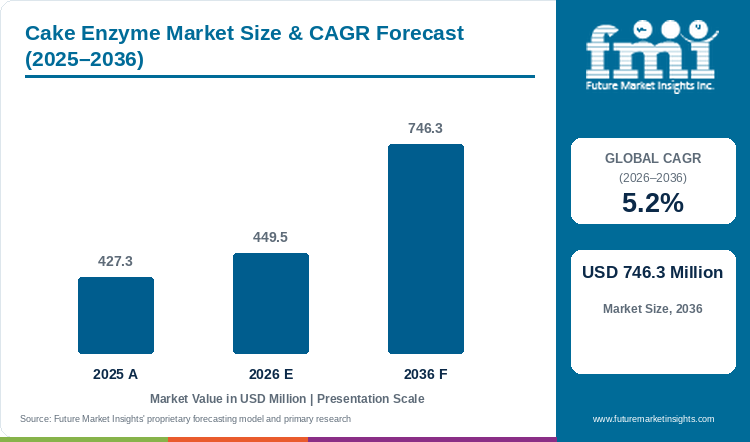
From USD 427.3 million in 2025, the cake enzyme market is expected to reach USD 449.5 million in 2026 and is slated to hit USD 746.3 million by 2036, growing at a 5.2% CAGR.
Supermarket and convenience-store shoppers increasingly buy pre-packed sponge cakes and Swiss rolls that must stay soft on ambient shelves for weeks rather than drying out after a few days. In June 2026, Puratos Group NV reported in its industrial patisserie trend analysis that packaged long-shelf-life items represent 41% of global cake and pastry consumption as more than 25% of households purchase them weekly, while 72% of shoppers switch brands when crumb texture disappoints. Because Maltogenic Alpha-Amylases keep high-sugar cake crumb moist without turning it gummy, they claim a projected 55.3% share within 2026 enzyme class valuation when blended with bakery xylanase biocatalysts. This retail shift lifts global cake enzyme sector valuation above its USD 427.3 million 2025 baseline to USD 449.5 million during 2026 and toward an expected market size of USD 746.3 million by 2036, compounding at a 5.2% CAGR that yields USD 296.8 million in ten-year valuation growth whilst mid-sized bakeries still need precise micro-dosing feeders.
Key Market Trends & Insights
- By enzyme class: Maltogenic Alpha-Amylases stand at a projected 55.3% of 2026 enzyme class market value because selective starch trimming keeps crumb springy across 30-to-45-day retail distribution.
- By source: Microbial fermentation reaches an estimated 69.3% within 2026 source valuation as bacterial and fungal strains stay active inside 82-degree high-sugar cake batters.
- By cake application: Industrial Packaged Sponge & Layer Cakes collect an expected 57.1% across 2026 cake application market size as national supermarket chains work to cut stale cake returns.
- By functional benefit: Crumb Softness & 30-Day Shelf-Life Extension draws a forecast 58.9% benefit valuation share during 2026 by replacing chemical mono- and diglyceride softeners.
- By physical form: Dust-Free Granulated Micro-Pellets command an anticipated 74.3% portion of 2026 form market value under strict flour-mill and bakery dust safety rules.
Regional Highlights
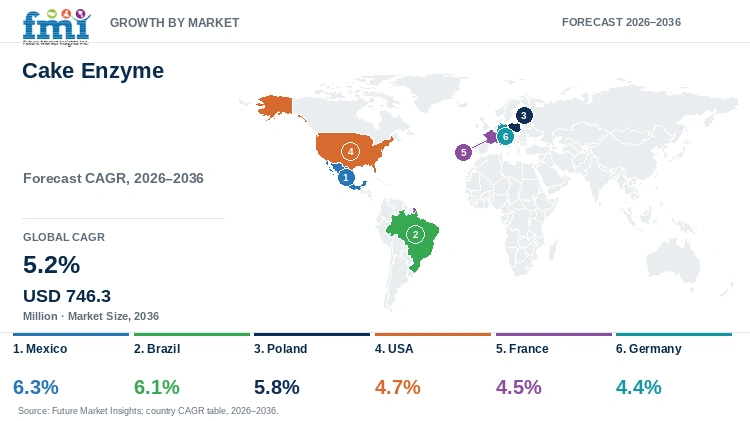
- Fastest national expansion: Mexican snack-cake bakeries head the six evaluated countries with a projected 6.3% compound annual pace to 2036 on cross-border export volume.
- Broader national rates: Brazilian bolo plants record an expected 6.1% annual gain and Polish contract bakers post a forecast 5.8% clip, outpacing U.S. demand (4.7%) as well as French patisseries (4.5%) and German bakeries (4.4%).
Market Size & Forecast
Table 1: Market Size and Forecast for the Cake Enzyme Market (USD million and CAGR percentage), 2025 to 2036
| Metric | Value |
|---|---|
| 2025 Market Value | USD 427.3 million |
| Estimated Market Size in 2026 | USD 449.5 million |
| Projected Industry Valuation by 2036 | USD 746.3 million |
| CAGR, 2026 to 2036 | 5.2% |
| Added Annual Market Value, 2026 to 2036 | USD 296.8 million |
Packaged sweet-goods bakeries are removing synthetic E471 mono- and diglycerides and E472e DATEM as well as E481 sodium stearoyl lactylate from ingredient labels while also trimming liquid egg and wheat gluten budgets. In June 2026, the UK Food Standards Agency updated its official registry of approved food additives and E numbers, reinforcing European supermarket clean-label programs that replace chemical emulsifiers with processing-aid enzymes. When cake plants dose microbial phospholipases with egg replacement ingredients, the enzymes convert natural flour and yolk lipids into strong emulsifiers directly inside the mixer.
Granulated Biocatalyst Tonnage and Treated Cake Batter Volume
Table 2: Commercial Enzyme Tonnage and Treated Cake Batter Indicators for the Cake Enzyme Market (USD million, thousand tonnes, and USD per kilogram), 2025 to 2036
| Metric | 2025 | 2026 | 2036 |
|---|---|---|---|
| Global market value (USD million) | 427.3 | 449.5 | 746.3 |
| Commercial cake enzyme volume (thousand tonnes) | 15.8 to 17.1 | 16.5 to 17.9 | 25.8 to 28.0 |
| Industrial cake batter treated (million tonnes) | 42.0 to 46.5 | 44.0 to 48.8 | 68.5 to 76.0 |
| Average realized enzyme valuation (USD per kilogram) | 25.0 to 27.0 | 25.1 to 27.2 | 26.6 to 28.9 |
Operational note: Treated cake batter tonnage reflects typical commercial enzyme inclusion rates of 50 to 500 ppm (0.005% to 0.05% on flour weight) across packaged sponge and muffin lines as well as snack cakes.
Per Capita & Commercial Bakery Line Valuation Benchmarks
When ambient cake softness lasts 30 to 45 days instead of 10 days, centralized bakeries can ship packaged Swiss rolls and layer cakes across regional grocery chains without refrigerated trucks. Bakery chemists pair maltogenic amylases with phospholipase enzyme preparations to keep cake slices springy and reduce stale store buy-backs.
Table 3: Per Capita and Industrial Bakery Line Valuation Indicators for the Cake Enzyme Market (USD and milligram metrics), 2025 to 2036
| Metric | 2025 | 2026 | 2036 |
|---|---|---|---|
| World population (billion) | 8.23 | 8.30 | 8.95 |
| Market value per 1,000 people (USD) | 51.92 | 54.16 | 83.39 |
| Per capita cake enzyme usage (grams) | 1.92 to 2.08 | 1.99 to 2.16 | 2.88 to 3.13 |
| Annual valuation per industrial cake plant (USD thousand) | 48.5 to 54.0 | 51.0 to 56.8 | 84.8 to 94.5 |
Table 4: Enzyme Class and Application Valuation Benchmarks for the Cake Enzyme Market (USD and percentages), 2025 to 2026
| Benchmark Indicator | Reported / Modeled Value | Institutional Reference Basis |
|---|---|---|
| Estimated market size, 2026 | USD 449.5 million | FMI primary & secondary triangulation |
| Maltogenic alpha-amylase valuation, 2026 | USD 248.6 million | 55.3% enzyme class share |
| Industrial packaged sponge & layer cake valuation, 2026 | USD 256.7 million | 57.1% cake application share |
| Dust-free granulated micro-pellet valuation, 2026 | USD 334.0 million | 74.3% physical form share |
Analyst Perspective
"Cake enzymes now serve as both shelf-life extenders and recipe cost savers for wholesale bakeries. Fermentation suppliers that pair sugar-tolerant amylases with egg-saving phospholipases help cake plants cut liquid egg and emulsifier budgets while keeping packaged cakes soft for a full month."
- Nandini Roy Choudhury, Principal Consultant, Future Market Insights.
How is the cake enzyme market segmented?
The cake enzyme market is segmented by enzyme class, source, cake application, functional benefit, physical form, and region. In 2026, Maltogenic Alpha-Amylases is projected at 55.3%, Microbial at 69.3%, Industrial Packaged Sponge & Layer Cakes at 57.1%, Crumb Softness & 30-Day Shelf-Life Extension at 58.9%, and Dust-Free Granulated Micro-Pellets at 74.3%.
By enzyme class: Maltogenic Alpha-Amylases (55.3%), Phospholipases (26.4%), and Xylanases & Proteases (18.3%).
By source: Microbial (69.3%) and Plant Malt Extracts (30.7%).
By cake application: Industrial Packaged Sponge & Layer Cakes (57.1%), Muffins & Cupcakes (24.8%), and Swiss Rolls & Snack Cakes (18.1%).
By functional benefit: Crumb Softness & 30-Day Shelf-Life Extension (58.9%), Batter Viscosity & Volume Lift (23.6%), and Egg & Emulsifier Cost-Reduction (17.5%).
By physical form: Dust-Free Granulated Micro-Pellets (74.3%) and Stabilized Liquid Dosing Solutions (25.7%).
Why Do Maltogenic Alpha-Amylases Lead Enzyme Class Valuation?
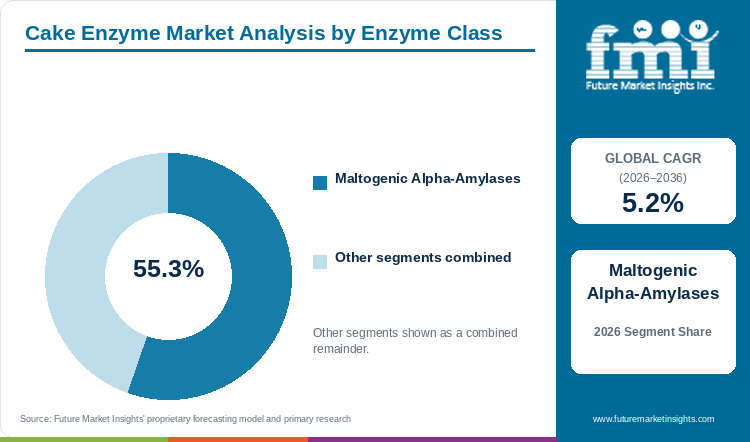
Starch anti-staling performance keeps Maltogenic Alpha-Amylases at a projected 55.3% share within 2026 enzyme class valuation.
Table 5: Enzyme Class Share for the Cake Enzyme Market (percentage share), 2026
| Enzyme Class Segment | Share (2026) |
|---|---|
| Maltogenic Alpha-Amylases | 55.3% |
| Phospholipases | 26.4% |
| Xylanases & Proteases | 18.3% |
| Total | 100.0% |
*Note: Remaining enzyme classes bring total 2026 cake biocatalyst market value to 100.0%.
Table 6: Enzyme Class Leadership and Market Growth for the Cake Enzyme Market (segment and CAGR percentage), 2026 to 2036
| Metric | Value |
|---|---|
| Global CAGR (2026 to 2036) | 5.2% |
| Leading Segment (2026) | Maltogenic Alpha-Amylases (55.3%) |
Standard fungal amylases lose activity around 65 degrees Celsius before high-sugar cake starch swells in the oven, whereas older bacterial amylases break down too much starch and leave the cake sticky. Heat-tolerant maltogenic alpha-amylases stay active up to 85 degrees Celsius and trim only the outer starch branches when formulated with commercial food enzymes. That targeted trimming stops starch from hardening during storage while keeping the cake structure intact.
- Elastic cake crumb without sticky dextrin buildup puts Maltogenic Alpha-Amylases at a projected 55.3% of 2026 enzyme class market value.
- Novonesis reported 9% organic growth in its Food & Health Biosolutions division with a 37.7% adjusted EBITDA margin for first-half 2026 in August 2026, supported by its Novamyl Cake and Novamyl 3D freshness platforms.
How Does Microbial Fermentation Capture Over Two-Thirds of Source Valuation?
Thermostable Bacillus and Aspergillus strains lift Microbial fermentation to an estimated 69.3% share within 2026 source valuation.
Submerged fermentation using selected Bacillus and Trichoderma as well as Fusarium strains delivers consistent enzyme strength in every batch regardless of grain weather. Plant malt flours vary from harvest to harvest and lose activity inside 40%-sugar pound cake batters. Bakery improver houses blend microbial enzymes with chemical bread emulsifiers or clean-label carriers so multi-plant bakeries get identical oven rise every day.
- Submerged bioreactor consistency gives Microbial sources an estimated 69.3% share within 2026 source market size.
- In October 2026, the European Commission's EU Agri-Food Platform highlighted that EFSA's Panel on Food Enzymes completed positive safety evaluations under Regulation (EC) No 1332/2008 for a non-GM Fusarium commune phospholipase A1 used in baked goods (with a margin of exposure of at least 2,601) and a Trichoderma reesei sugar-processing enzyme.
What Makes Industrial Packaged Sponge & Layer Cakes the Primary Cake Application?
Extended-shelf-life retail distribution gives Industrial Packaged Sponge & Layer Cakes an expected 57.1% cake application valuation share in 2026.
Flow-wrapped sponge cakes and celebration layer cakes together with cream-filled snack cakes travel through national grocery warehouses that require 30 to 90 days of soft bite. Without anti-staling enzymes, moisture moves out of the sponge layer into the cream filling within a week and leaves the cake dry. Bakers combine maltogenic amylases with food-grade emulsifier blends so sponge sheets bend cleanly without cracking when rolled or sliced.
- Multi-week warehouse distribution requirements keep Industrial Packaged Sponge & Layer Cakes at an expected 57.1% share across 2026 cake application market value.
- International Flavors & Fragrances Inc. debuted its POWERFRESH ACE 2000 fresh-keeping enzyme at IBIE in September 2025, extending packaged sweet-goods softness and resilience as well as slice cohesiveness up to 34 days.
Why Does Crumb Softness & 30-Day Shelf-Life Extension Lead Functional Benefits?
Retail anti-waste programs lift Crumb Softness & 30-Day Shelf-Life Extension to a forecast 58.9% benefit valuation share in 2026.
Supermarket chains charge wholesale bakeries for unsold stale returns and ask for at least 30 days of ambient shelf life on packaged sweet goods without artificial preservatives. Dual amylase and xylanase blends hold bound water inside the cake crumb and keep slices soft over weeks on the shelf. Bakeries also pair freshness enzymes with bakery ingredient systems so cakes keep a moist bite even when sugar or fat is reduced by 15%.
- Lower retail stale buy-backs give Crumb Softness & 30-Day Shelf-Life Extension a forecast 58.9% slice of 2026 functional benefit market value.
- Novonesis noted in its 2026 baking freshness biosolutions report that 70% of consumers prioritize freshness and 37% seek softer textures (rising to 50% in China), driving adoption of Novamyl 3D and Sensea granulates in packaged celebratory cakes.
How Do Dust-Free Granulated Micro-Pellets Secure Nearly Three-Quarters of Physical Form Share?
Bakery respiratory exposure limits place Dust-Free Granulated Micro-Pellets at an anticipated 74.3% share within 2026 physical form valuation.
Unfined enzyme powders can trigger breathing allergies among flour-mill and bakery workers, which is why European and North American safety rules cap airborne enzyme dust below 60 nanograms per cubic meter. Fluid-bed granulation coats the active enzyme core inside a water-soluble salt and cellulose shell to create 150-to-400-micron pellets that produce no airborne dust. Premix blenders mix these coated micro-granules with soy and sunflower lecithins and dry whey powders without settling inside 1,000-kilogram tote bins.
- Worker dust-safety compliance keeps Dust-Free Granulated Micro-Pellets at an anticipated 74.3% portion of 2026 physical form market size.
- dsm-firmenich detailed in its 2026 BakeZyme technical portfolio how dust-free granulated BakeZyme Fresh XL and BakeZyme Master maltogenic amylases improve crumb softness and moistness as well as foldability in sweet buns and packaged baked goods.
What are the drivers, restraints, and opportunities in the cake enzyme market?
Whole-egg cost reduction via phospholipases and clean-label removal of E471/E472e emulsifiers are expected to propel cake enzyme valuation expansion up to 2036, while sucrose-shifted thermal inactivation and FDA GRAS notification reforms create technical hurdles and sugar-reduced cake enzymes open premium opportunities.
- Driver: High liquid-egg and wheat prices together with supermarket E-number removal push cake plants to adopt phospholipase and maltogenic alpha-amylase blends.
- Restraint: Narrow ppm dosing windows in high-sugar batters and proposed mandatory FDA GRAS filing rules lengthen qualification timelines for new microbial enzymes.
- Opportunity: Sweetness-boosting glucoamylases and transglucosidases that cut added cake sugar by 20% to 30% without losing crust browning open health-focused bakery tenders.
Growth Analysis and Future Potential: Qualitative Demand Catalysts
High wheat flour and liquid egg prices are pushing commercial sweet-goods bakeries to get more functional performance out of the native starches and lipids already in their batters. September 2026 Food Price Outlook data from USDA economists shows that farm-level wheat prices jumped 35.1% over the prior year in August 2026 after multi-year egg inflation. Cake plants that dose phospholipase A1 and A2 preparations with egg wash substitutes reduce liquid egg needs by 20% to 30% and remove synthetic polyglycerol esters from their labels.
Risk Assessment of the Cake Enzyme Market: Operational and Regulatory Friction
New genetically modified enzyme strains entering North American and European baking channels face closer regulatory review as well as strict heat-inactivation checks in finished cakes. In August 2026, federal regulators at the U.S. Food and Drug Administration issued a proposed rule (Docket FDA-2025-N-3262) requiring formal GRAS notice submissions for food substances and ending self-affirmed GRAS pathways for new microbial enzyme preparations. In addition to this, an overdose of bacterial amylase by even 15 ppm over modified wheat starch batters can over-thin the starch gel and make the cake sink in the pan as it cools.
Commercial Opportunity Analysis: Formulation Differentiation and Value-Add Formats
Fermentation suppliers are winning high-margin bakery accounts by combining anti-staling amylases with sugar-reduction enzymes and in-batter emulsifier generation. In June 2026, International Flavors & Fragrances Inc. showed how its POWERFRESH cake amylases and ENOVERA phospholipases modify native flour lipids during mixing to replace chemical E-number emulsifiers across clean-label sweet goods. When bakeries pair these enzymes with dairy whey protein blends, they can sell reduced-sugar and egg-reduced cakes that stay soft for 35 days.
Cake Enzyme Market by Country (2026 to 2036)
Mexican snack-cake producers head the six evaluated cake enzyme markets with a projected 6.3% compound annual pace to 2036, ahead of Brazilian bolo bakeries (6.1%) and Polish export cake plants (5.8%), outpacing U.S. demand (4.7%) as well as French patisseries (4.5%) and German bakeries (4.4%). Country differences follow cross-border packaged snack-cake exports, front-of-pack sugar warning labels, and supermarket E-number removal.
Table 7: Country CAGR and Primary Growth Levers for the Cake Enzyme Market (CAGR percentage and operational drivers), 2026 to 2036
| Country | CAGR (2026 to 2036) | Primary Growth Lever |
|---|---|---|
| Mexico | 6.3% | High per-capita pastelito snack-cake output, cross-border bakery exports, and NOM-051 sugar/calorie reduction |
| Brazil | 6.1% | Long-distance tropical distribution of packaged bolo and panettone requiring 30-to-45-day anti-staling amylases |
| Poland | 5.8% | Central European contract cake and muffin manufacturing for Western European supermarket private labels |
| USA | 4.7% | 34-day coast-to-coast packaged cake distribution and phospholipase 25%-30% liquid egg cost reduction |
| France | 4.5% | Industrial madeleine and brioche clean-label E471 emulsifier removal and butter/egg cost optimization |
| Germany | 4.4% | Strict E-number-free retail Kuchen standards and dust-free micro-granule safety compliance in premix mills |
Source: Future Market Insights analysis
Mexico Cake Enzyme Market Outlook (2026 to 2036)
High daily consumption of single-serve packaged snack cakes (pastelitos) and large export bakeries in Monterrey and Mexico City make Mexico the fastest-growing evaluated market for cake enzymes. In March 2026, the USDA Foreign Agricultural Service reported that U.S. bakery goods and cereal trade with Mexico totaled USD 596 million during 2025 as American food-preparation exports to Mexican processors reached USD 1,225 million. Mexican cake enzyme market value expands with a projected 6.3% compound annual pace to 2036 as multinational and domestic snack-cake bakeries reformulate recipes under NOM-051 octagon warning labels. Bakeries use glucoamylases and maltogenic amylases to cut added sugar while keeping 35-day shelf softness.
Key takeaway: In Mexico, expanding snack-cake export bakeries and NOM-051 sugar-reduction reformulations generate a projected 6.3% compound annual pace to 2036.
Brazil Cake Enzyme Market Outlook (2026 to 2036)
Long highway shipping routes across warm tropical regions push Brazilian wholesale bakeries to rely on anti-staling and moisture-retention enzymes in packaged bolo and panettone lines. Without heat-stable maltogenic alpha-amylases, packaged sponge cakes shipped from Sao Paulo and Parana baking plants to Northeast grocery chains dry out and harden within two weeks. In February 2026, Novonesis reported that its Food & Health Biosolutions division delivered 8% organic growth in 2025 with 33 new product launches across Latin American and global baking markets, including Optiva LS Prime for sweet goods. Brazilian cake enzyme market valuation climbs by recording an expected 6.1% annual gain to 2036 across automated regional sponge bakeries.
Key takeaway: In Brazil, long-haul tropical distribution of packaged bolo and panettone secures an expected 6.1% annual cake enzyme valuation gain.
Poland Cake Enzyme Market Outlook (2026 to 2036)
Steady investment in automated private-label sponge cake and Swiss roll lines together with muffin plants supplying German and British discount supermarkets makes Poland Eastern Europe's primary growth hub for baking enzymes. Polish contract bakeries compete on 45-day ambient shelf life and tight unit production costs, which speeds up the switch from liquid whole eggs and chemical mono-diglycerides to concentrated enzyme premixes. In February 2026, DSM-Firmenich AG posted EUR 3,146 million in division-wide 2025 Taste, Texture & Health revenue with 4% organic growth supported by European BakeZyme cake and bakery enzyme demand. Polish cake enzyme market size advances by posting a forecast 5.8% yearly clip to 2036 across regional flour improver blenders.
Key takeaway: In Poland, export-oriented private-label cake manufacturing for European discounters powers a forecast 5.8% yearly enzyme market clip.
USA Cake Enzyme Market Outlook (2026 to 2036)
Centralized U.S. wholesale bakeries shipping packaged cupcakes and snack cakes together with thaw-and-sell layer cakes across coast-to-coast grocery chains rely on multi-enzyme blends to delay staling and cut egg costs. September 2026 poultry and egg market assessments from USDA economists confirm that recurring bird flu outbreaks and state cage-free laws keep U.S. industrial egg prices structurally high. United States cake enzyme market value progresses by achieving an anticipated 4.7% annual rate to 2036 as commercial bakeries pair sugar-tolerant maltogenic amylases with phospholipases that trim liquid egg inputs by one-quarter to one-half. Clean-label grocery standards across national supermarket chains also speed up synthetic E471 mono-diglyceride emulsifier removal in packaged sweet goods.
Key takeaway: In the USA, coast-to-coast 34-day shelf-life requirements and phospholipase egg savings sustain an anticipated 4.7% annual valuation rate.
France Cake Enzyme Market Outlook (2026 to 2036)
Industrial patisserie plants baking packaged madeleines and butter brioches together with pound cakes in Western France face strong supermarket pressure to remove E-number emulsifiers while managing high butter and egg costs. French grocery chains enforce strict clean-label charters that ban mono- and diglycerides of fatty acids (E471) and stearoyl lactylates (E481) from pre-packed family cakes. In April 2026, Lallemand Inc. highlighted from its European baking application centers how tailored LallZyme and Nutrilife phospholipase and amylase systems preserve brioche and cake crumb softness while cutting egg and fat inputs. French cake enzyme industry valuation grows by registering a slated 4.5% yearly advance to 2036 across regional patisserie plants.
Key takeaway: In France, supermarket E471-free patisserie charters and butter-and-egg cost savings anchor a slated 4.5% yearly enzyme advance.
Germany Cake Enzyme Market Outlook (2026 to 2036)
Strict worker dust-safety rules in German flour mills and baking premix plants together with steady packaged Kuchen demand shape enzyme purchasing across Germany. Because enzymes work as processing aids that bake out in the oven and do not need E-number listing under Regulation (EC) No 1332/2008, German sweet-goods bakeries combine amylase and phospholipase with xylanase blends to keep marble cakes soft across 28-day discount store cycles. In November 2025, Associated British Foods plc reported solid fiscal 2025 results in its AB Enzymes GmbH division supported by specialty baking enzymes and expanded fermentation capacity. German cake enzyme market growth rises by booking a predicted 4.4% annual pace to 2036 across industrial baking premix houses.
Key takeaway: In Germany, clean-label processing-aid rules under Regulation (EC) 1332/2008 and dust-free micro-granule standards yield a predicted 4.4% annual pace.
Full report country CAGRs cover: North America; Latin America; Western Europe; Eastern Europe; East Asia; South Asia and Pacific; Middle East and Africa.
Who are the notable companies in the cake enzyme market?
Novonesis, International Flavors & Fragrances Inc., DSM-Firmenich AG, AB Enzymes GmbH, Amano Enzyme Inc., Lallemand Inc., Kerry Group plc, and Puratos Group NV are the notable companies in the cake enzyme market.
FMI analysis indicates that the cake enzyme value chain connects upstream microbial fermentation bioscience corporations with specialized biocatalyst producers and downstream bakery improver formulators. Upstream bioscience leaders own patented bacterial and fungal strain libraries and submerged fermentation tanks. Integrated bakery application houses blend raw enzyme concentrates with gums and flour carriers into ready-to-use cake and muffin improvers.
- Global Microbial Fermentation & Bioscience Leaders: Novonesis and International Flavors & Fragrances Inc. together with DSM-Firmenich AG develop heat-stable maltogenic alpha-amylases and phospholipases.
- Specialized Baking Enzyme & Biocatalyst Producers: AB Enzymes GmbH and Amano Enzyme Inc. as well as Lallemand Inc. produce targeted xylanases and lipases together with non-GMO fungal or bacterial enzymes for sweet goods.
- Integrated Bakery Application & Cake Improver Houses: Kerry Group plc and Puratos Group NV formulate drop-in enzymatic cake freshness and egg-reduction blends for commercial bakeries.
Competitive Benchmarking: Cake Enzyme Market
Table 8: Competitive Benchmarking for the Cake Enzyme Market (qualitative capability ratings), 2026
| Company | High-Sucrose Thermostability | Phospholipase Egg-Reduction Tech | Dust-Free Granulation & Regulatory Dossiers | Global Bakery Application Centers |
|---|---|---|---|---|
| Novonesis | High | High | High | High |
| International Flavors & Fragrances Inc. | High | High | High | High |
| DSM-Firmenich AG | High | High | High | High |
| AB Enzymes GmbH | High | Medium | High | High |
| Amano Enzyme Inc. | Medium | High | High | Medium |
| Lallemand Inc. | Medium | Medium | High | High |
| Kerry Group plc | High | High | High | High |
| Puratos Group NV | High | High | High | High |
Evaluation criteria: Ratings reflect documented microbial strain patents and anti-staling performance in >35%-sugar cake batters over 30-day storage together with phospholipase whole-egg reduction ratios and regional baking pilot plant networks.
Key Developments in the Cake Enzyme Market
- Amano Enzyme Inc. received the Commissioner of the Japan Patent Office Award in April 2026 under the FY2026 Intellectual Property Achievement Awards for its patented specialty food and bakery enzyme innovations.
- Amano Enzyme USA announced in February 2026 the expansion of its non-GMO food and bakery enzyme portfolio for IFT FIRST 2026, targeting clean-label texture and protein modification.
- In December 2025, Puratos Group NV introduced its Intens Fresh 3-30 Premium enzymatic freshness technology across the United States for sweet goods containing over 5% sugar together with Acti Egg Reduction.
Key Players in the Cake Enzyme Market
Global Microbial Fermentation & Bioscience Leaders
- Novonesis
- International Flavors & Fragrances Inc.
- DSM-Firmenich AG
Specialized Baking Enzyme & Biocatalyst Producers
- AB Enzymes GmbH
- Amano Enzyme Inc.
- Lallemand Inc.
Integrated Bakery Application & Cake Improver Houses
- Kerry Group plc
- Puratos Group NV
Cake Enzyme Market - Report Scope
Table 9: Report Scope for the Cake Enzyme Market (coverage fields and definitions), 2026 to 2036
| Coverage field | Report scope |
|---|---|
| Market breakdown | Enzyme Class; Source; Cake Application; Functional Benefit; Physical Form; Region |
| Quantitative Units | USD Million |
| Market Definition | Covers B2B commercial market value of food-grade biocatalyst preparations (sucrose-tolerant maltogenic alpha-amylases, phospholipases A1/A2, endo-xylanases, proteases, and glucoamylases/transglucosidases) formulated specifically for industrial packaged sponge cakes, layer cakes, muffins, cupcakes, Swiss rolls, and sweet snack cakes. Category Scope Note: Excludes commodity pan-bread dough conditioning enzymes, brewing/distilling amylases, starch-syrup liquefaction enzymes, chemical E-number emulsifiers (E471/E472e/E481), and retail consumer baking powders. |
| Regions Covered | North America; Latin America; Western Europe; Eastern Europe; East Asia; South Asia and Pacific; Middle East and Africa |
| Countries Covered | Mexico, Brazil, Poland, USA, France, Germany, and additional countries in the full report |
| Key Companies Covered | Novonesis, International Flavors & Fragrances Inc., DSM-Firmenich AG, AB Enzymes GmbH, Amano Enzyme Inc., Lallemand Inc., Kerry Group plc, Puratos Group NV |
| Forecast Period | 2026 to 2036 |
| Approach | Primary and secondary research with rigorous market triangulation. |
Cake Enzyme Market - Research Methodology
Table 10: Research Methodology for the Cake Enzyme Market (research methods and approach), 2026 edition
| Method | Approach |
|---|---|
| Primary Research | Primary interviews were conducted with microbial fermentation enzymologists, industrial cake R&D directors, flour premix blenders, regulatory affairs specialists, and bakery procurement leads across Europe, North America, Latin America, and Asia. |
| Secondary Research | Secondary research incorporated U.S. FDA GRAS notices, UK Food Standards Agency and EFSA food enzyme registries, USDA ERS wheat and egg outlook data, Puratos and Novonesis baking sensory studies, and audited annual reports of bioscience leaders. |
| Market Sizing and Forecasting | Market sizing and 2026 to 2036 projections reconcile commercial cake enzyme tonnage, 50-to-500 ppm batter inclusion rates across industrial sweet-goods output, and realized per-kilogram enzyme valuations. |
| Data Triangulation and Validation | Market value estimates were cross-checked against industrial packaged cake and muffin production volumes, fermentation bioreactor capacities, and corporate food biosolutions segment disclosures. |
| Country Forecasting Model | National CAGRs are calibrated against the 5.2% global baseline using cross-border packaged snack-cake exports, NOM-051 and European sugar/E-number reformulation mandates, and wholesale bakery automation rates. |
| Operational Benchmark Traceability | Operational benchmarks (commercial cake enzyme volume, treated cake batter tonnage, and per-plant valuation) are modeled from industrial sweet-goods flour consumption and standard 0.005% to 0.05% enzyme dosing protocols. |
Cake Enzyme Market by Segments
Cake Enzyme Market segmented by Enzyme Class:
- Maltogenic Alpha-Amylases
- Phospholipases
- Xylanases & Proteases
Cake Enzyme Market segmented by Source:
- Microbial
- Plant Malt Extracts
Cake Enzyme Market segmented by Cake Application:
- Industrial Packaged Sponge & Layer Cakes
- Muffins & Cupcakes
- Swiss Rolls & Snack Cakes
Cake Enzyme Market segmented by Functional Benefit:
- Crumb Softness & 30-Day Shelf-Life Extension
- Batter Viscosity & Volume Lift
- Egg & Emulsifier Cost-Reduction
Cake Enzyme Market segmented by Physical Form:
- Dust-Free Granulated Micro-Pellets
- Stabilized Liquid Dosing Solutions
Cake Enzyme Market by Region
- North America
- United States
- Canada
- Latin America
- Mexico
- Brazil
- Argentina
- Chile
- Western Europe
- Germany
- France
- United Kingdom
- Italy
- Spain
- Benelux
- Nordics
- Eastern Europe
- Poland
- Czech Republic
- Romania
- Hungary
- East Asia
- China
- Japan
- South Korea
- South Asia and Pacific
- India
- ASEAN
- Australia and New Zealand
- Middle East and Africa
- GCC Countries
- South Africa
- Türkiye
- Israel
Research Sources and Bibliography
- [1] Puratos Group NV. (2026, June 15). The future of industrial patisserie: strategic trends shaping what's next. Puratos Inspiration Corner & Bakery Insights.
- [2] Food Standards Agency (GOV.UK). (2026, June 25). Approved additives and E numbers. GOV.UK Food Standards Agency Guidance.
- [3] Novonesis. (2026, August 19). H1 2026: Novonesis delivered strong 8% organic sales growth and increases full-year outlook. Novonesis Investor Announcements.
- [4] European Commission EU Agri-Food Platform / EFSA. (2026, October 14). EFSA completes safety evaluations of three food enzymes used in baking, sugar and fruit processing. European Commission Directorate-General for Internal Market, Industry, Entrepreneurship and SMEs.
- [5] International Flavors & Fragrances Inc. (IFF). (2025, September 02). IFF tackles top challenges in baking at IBIE 2025. IFF Press Releases.
- [6] Novonesis. (2026, January 15). Fresher for longer with biosolutions. Novonesis Food & Beverages Baking Biosolutions.
- [7] dsm-firmenich. (2026, March 10). BakeZyme | dsm-firmenich Taste, Texture & Health. dsm-firmenich Bakery, Bars & Confectionery Portfolio.
- [8] USDA Economic Research Service. (2026, September 25). Food Price Outlook - Summary Findings. U.S. Department of Agriculture Economic Research Service.
- [9] U.S. Food and Drug Administration (FDA). (2026, August 10). Generally Recognized as Safe (GRAS). U.S. Food and Drug Administration Food Ingredients & Packaging.
- [10] International Flavors & Fragrances Inc. (IFF). (2026, June 04). Label-Friendly by Design: How Enzymes Are Changing the Future of Baking. IFF Food Biosciences Insights.
- [11] USDA Foreign Agricultural Service. (2026, March 15). Bakery Goods, Cereals, and Pasta 2025 Export Highlights. U.S. Department of Agriculture Foreign Agricultural Service.
- [12] Novonesis. (2026, February 25). Novonesis delivered strong organic sales growth of 7% in 2025. Novonesis Annual Financial Releases.
- [13] DSM-Firmenich AG. (2026, February 12). dsm-firmenich reports full year 2025 results. DSM-Firmenich Investor Relations.
- [14] USDA Economic Research Service. (2026, September 18). Poultry & Eggs - Market Outlook. U.S. Department of Agriculture Economic Research Service.
- [15] Lallemand Inc. (2026, April 20). Baking Enzymes: Smart Science for Better Baking. Lallemand Baking Technical Bulletins.
- [16] Associated British Foods plc (AB Enzymes GmbH). (2025, November 04). Associated British Foods plc Annual Results Announcement for the 52 Weeks Ended 13 September 2025: Ingredients & AB Enzymes. Associated British Foods Investor Relations.
- [17] Amano Enzyme Inc. (2026, April 21). Announcement of Receiving an Award from the Commissioner of the Japan Patent Office under the FY2026 Intellectual Property Achievement Awards. Amano Enzyme Newsroom.
- [18] Amano Enzyme Inc. (2026, February 07). Amano Enzyme USA to Showcase Food, Beverage, and Diagnostic Enzyme Solutions at IFT FIRST and ADLM 2026. Amano Enzyme Newsroom.
- [19] Puratos Group NV. (2025, December 03). Puratos U.S. Launches New Cost Reduction Solutions to Support Bakers Amid Economic Pressures. Puratos USA Newsroom.
- [20] Kerry Group plc. (2026, March 16). How Enzymes Are Reshaping Bakery Performance. Kerry Group Bakery Insights.
This bibliography is provided for reader reference and is not exhaustive. The full report contains the complete reference list and detailed citations.
This Report Answers
- How large is the cake enzyme market in 2026 and what is forecast for 2036?
- Which shelf-life and egg-cost pressures support demand for cake enzymes?
- Why do Maltogenic Alpha-Amylases lead the enzyme class category?
- Why does Microbial fermentation lead the source category globally?
- How do growth rates differ across Mexico, Brazil, Poland, the USA, France, and Germany?
- Which leading companies ferment and formulate cake enzymes today?
- What limits enzyme dosing or strain approval in the cake enzyme market?
- What should industrial cake bakeries evaluate before selecting a cake enzyme system?
Table of Content
- Key Takeaways
- Market Size and CAGR
- Top Growth Driver
- Fastest Growing Segment
- Leading Region
- Key Companies
- Emerging Opportunities
- Executive Summary
- Global Market Outlook
- Demand-side Trends
- Supply-side Trends
- Technology Roadmap Analysis
- Analysis and Recommendations
- Analyst Perspective (What is happening? Why now? What should investors know?)
- Key Questions Answered
- How large is the market?
- What is the CAGR?
- What are key trends?
- Which region dominates?
- Who are the leaders?
Read More...
- Market Overview
- Market Coverage / Taxonomy
- Market Definition / Scope / Limitations
- Research Methodology
- Chapter Orientation
- Analytical Lens and Working Hypotheses
- Market Structure, Signals, and Trend Drivers
- Benchmarking and Cross-market Comparability
- Market Sizing, Forecasting, and Opportunity Mapping
- Research Design and Evidence Framework
- Desk Research Programme (Secondary Evidence)
- Expert Input and Fieldwork (Primary Evidence)
- Tooling, Models, and Reference Databases
- Data Engineering and Model Build
- Quality Assurance and Audit Trail
- Market Background
- Market Dynamics (Drivers, Restraints, Opportunity, Trends)
- Scenario Forecast (Optimistic, Likely, Conservative)
- Impact Analysis
- AI Impact
- Sustainability Impact
- Regulatory Impact
- Technology Impact
- Consumer / Buyer Analysis
- Purchase Drivers
- Adoption Barriers
- Buyer Journey
- Opportunity Map Analysis
- Product Life Cycle Analysis
- Supply Chain Analysis
- Investment Feasibility Matrix
- Value Chain Analysis
- PESTLE and Porter's Analysis
- Regulatory Landscape
- Regional Parent Market Outlook
- Production and Consumption Statistics
- Import and Export Statistics
- Global Market Analysis and Forecast, 2021 to 2036
- Historical Market Size Value (USD Million) Analysis, 2021 to 2025
- Current and Future Market Size Value (USD Million) Projections, 2026 to 2036
- Y-o-Y Growth Trend Analysis
- Absolute $ Opportunity Analysis
- Global Market Pricing Analysis, 2021 to 2036
- Global Market Analysis and Forecast, By Enzyme Class, 2021 to 2036
- Introduction / Key Findings
- Historical Market Size Value (USD Million) Analysis By Enzyme Class, 2021 to 2025
- Current and Future Market Size Value (USD Million) Analysis and Forecast By Enzyme Class, 2026 to 2036
- Maltogenic Alpha-Amylases
- Phospholipases
- Xylanases & Proteases
- Y-o-Y Growth Trend Analysis By Enzyme Class, 2021 to 2025
- Absolute $ Opportunity Analysis By Enzyme Class, 2026 to 2036
- Global Market Analysis and Forecast, By Source, 2021 to 2036
- Introduction / Key Findings
- Historical Market Size Value (USD Million) Analysis By Source, 2021 to 2025
- Current and Future Market Size Value (USD Million) Analysis and Forecast By Source, 2026 to 2036
- Microbial
- Plant Malt Extracts
- Y-o-Y Growth Trend Analysis By Source, 2021 to 2025
- Absolute $ Opportunity Analysis By Source, 2026 to 2036
- Global Market Analysis and Forecast, By Cake Application, 2021 to 2036
- Introduction / Key Findings
- Historical Market Size Value (USD Million) Analysis By Cake Application, 2021 to 2025
- Current and Future Market Size Value (USD Million) Analysis and Forecast By Cake Application, 2026 to 2036
- Industrial Packaged Sponge & Layer Cakes
- Muffins & Cupcakes
- Swiss Rolls & Snack Cakes
- Y-o-Y Growth Trend Analysis By Cake Application, 2021 to 2025
- Absolute $ Opportunity Analysis By Cake Application, 2026 to 2036
- Global Market Analysis and Forecast, By Functional Benefit, 2021 to 2036
- Introduction / Key Findings
- Historical Market Size Value (USD Million) Analysis By Functional Benefit, 2021 to 2025
- Current and Future Market Size Value (USD Million) Analysis and Forecast By Functional Benefit, 2026 to 2036
- Crumb Softness & 30-Day Shelf-Life Extension
- Batter Viscosity & Volume Lift
- Egg & Emulsifier Cost-Reduction
- Y-o-Y Growth Trend Analysis By Functional Benefit, 2021 to 2025
- Absolute $ Opportunity Analysis By Functional Benefit, 2026 to 2036
- Global Market Analysis and Forecast, By Physical Form, 2021 to 2036
- Introduction / Key Findings
- Historical Market Size Value (USD Million) Analysis By Physical Form, 2021 to 2025
- Current and Future Market Size Value (USD Million) Analysis and Forecast By Physical Form, 2026 to 2036
- Dust-Free Granulated Micro-Pellets
- Stabilized Liquid Dosing Solutions
- Y-o-Y Growth Trend Analysis By Physical Form, 2021 to 2025
- Absolute $ Opportunity Analysis By Physical Form, 2026 to 2036
- Global Market Analysis and Forecast, By Region, 2021 to 2036
- Introduction
- Historical Market Size Value (USD Million) Analysis By Region, 2021 to 2025
- Current Market Size Value (USD Million) Analysis and Forecast By Region, 2026 to 2036
- North America
- Latin America
- Western Europe
- Eastern Europe
- East Asia
- South Asia and Pacific
- Middle East and Africa
- Market Attractiveness Analysis By Region
- North America Market Analysis and Forecast, By Country, 2021 to 2036
- Historical Market Size Value (USD Million) Trend Analysis By Market Taxonomy, 2021 to 2025
- Market Size Value (USD Million) Forecast By Market Taxonomy, 2026 to 2036
- By Country
- United States
- Canada
- By Enzyme Class
- By Source
- By Cake Application
- By Functional Benefit
- By Physical Form
- By Country
- Market Attractiveness Analysis
- By Country
- By Enzyme Class
- By Source
- By Cake Application
- By Functional Benefit
- By Physical Form
- Key Takeaways
- Latin America Market Analysis and Forecast, By Country
- Historical Market Size Value (USD Million) Trend Analysis By Market Taxonomy, 2021 to 2025
- Market Size Value (USD Million) Forecast By Market Taxonomy, 2026 to 2036
- By Country
- Mexico
- Brazil
- Argentina
- Chile
- By Enzyme Class
- By Source
- By Cake Application
- By Functional Benefit
- By Physical Form
- By Country
- Market Attractiveness Analysis
- By Country
- By Enzyme Class
- By Source
- By Cake Application
- By Functional Benefit
- By Physical Form
- Key Takeaways
- Western Europe Market Analysis and Forecast, By Country
- Historical Market Size Value (USD Million) Trend Analysis By Market Taxonomy, 2021 to 2025
- Market Size Value (USD Million) Forecast By Market Taxonomy, 2026 to 2036
- By Country
- Germany
- France
- United Kingdom
- Italy
- Spain
- Benelux
- Nordics
- By Enzyme Class
- By Source
- By Cake Application
- By Functional Benefit
- By Physical Form
- By Country
- Market Attractiveness Analysis
- By Country
- By Enzyme Class
- By Source
- By Cake Application
- By Functional Benefit
- By Physical Form
- Key Takeaways
- Eastern Europe Market Analysis and Forecast, By Country
- Historical Market Size Value (USD Million) Trend Analysis By Market Taxonomy, 2021 to 2025
- Market Size Value (USD Million) Forecast By Market Taxonomy, 2026 to 2036
- By Country
- Poland
- Czech Republic
- Romania
- Hungary
- By Enzyme Class
- By Source
- By Cake Application
- By Functional Benefit
- By Physical Form
- By Country
- Market Attractiveness Analysis
- By Country
- By Enzyme Class
- By Source
- By Cake Application
- By Functional Benefit
- By Physical Form
- Key Takeaways
- East Asia Market Analysis and Forecast, By Country
- Historical Market Size Value (USD Million) Trend Analysis By Market Taxonomy, 2021 to 2025
- Market Size Value (USD Million) Forecast By Market Taxonomy, 2026 to 2036
- By Country
- China
- Japan
- South Korea
- By Enzyme Class
- By Source
- By Cake Application
- By Functional Benefit
- By Physical Form
- By Country
- Market Attractiveness Analysis
- By Country
- By Enzyme Class
- By Source
- By Cake Application
- By Functional Benefit
- By Physical Form
- Key Takeaways
- South Asia and Pacific Market Analysis and Forecast, By Country
- Historical Market Size Value (USD Million) Trend Analysis By Market Taxonomy, 2021 to 2025
- Market Size Value (USD Million) Forecast By Market Taxonomy, 2026 to 2036
- By Country
- India
- ASEAN
- Australia and New Zealand
- By Enzyme Class
- By Source
- By Cake Application
- By Functional Benefit
- By Physical Form
- By Country
- Market Attractiveness Analysis
- By Country
- By Enzyme Class
- By Source
- By Cake Application
- By Functional Benefit
- By Physical Form
- Key Takeaways
- Middle East and Africa Market Analysis and Forecast, By Country
- Historical Market Size Value (USD Million) Trend Analysis By Market Taxonomy, 2021 to 2025
- Market Size Value (USD Million) Forecast By Market Taxonomy, 2026 to 2036
- By Country
- GCC Countries
- South Africa
- Türkiye
- Israel
- By Enzyme Class
- By Source
- By Cake Application
- By Functional Benefit
- By Physical Form
- By Country
- Market Attractiveness Analysis
- By Country
- By Enzyme Class
- By Source
- By Cake Application
- By Functional Benefit
- By Physical Form
- Key Takeaways
- Key Countries Market Analysis
- United States
- Pricing Analysis
- Market Share Analysis, 2025
- By Enzyme Class
- By Source
- By Cake Application
- By Functional Benefit
- By Physical Form
- Canada
- Pricing Analysis
- Market Share Analysis, 2025
- By Enzyme Class
- By Source
- By Cake Application
- By Functional Benefit
- By Physical Form
- Mexico
- Pricing Analysis
- Market Share Analysis, 2025
- By Enzyme Class
- By Source
- By Cake Application
- By Functional Benefit
- By Physical Form
- Brazil
- Pricing Analysis
- Market Share Analysis, 2025
- By Enzyme Class
- By Source
- By Cake Application
- By Functional Benefit
- By Physical Form
- Chile
- Pricing Analysis
- Market Share Analysis, 2025
- By Enzyme Class
- By Source
- By Cake Application
- By Functional Benefit
- By Physical Form
- Germany
- Pricing Analysis
- Market Share Analysis, 2025
- By Enzyme Class
- By Source
- By Cake Application
- By Functional Benefit
- By Physical Form
- United Kingdom
- Pricing Analysis
- Market Share Analysis, 2025
- By Enzyme Class
- By Source
- By Cake Application
- By Functional Benefit
- By Physical Form
- Italy
- Pricing Analysis
- Market Share Analysis, 2025
- By Enzyme Class
- By Source
- By Cake Application
- By Functional Benefit
- By Physical Form
- Spain
- Pricing Analysis
- Market Share Analysis, 2025
- By Enzyme Class
- By Source
- By Cake Application
- By Functional Benefit
- By Physical Form
- France
- Pricing Analysis
- Market Share Analysis, 2025
- By Enzyme Class
- By Source
- By Cake Application
- By Functional Benefit
- By Physical Form
- India
- Pricing Analysis
- Market Share Analysis, 2025
- By Enzyme Class
- By Source
- By Cake Application
- By Functional Benefit
- By Physical Form
- ASEAN
- Pricing Analysis
- Market Share Analysis, 2025
- By Enzyme Class
- By Source
- By Cake Application
- By Functional Benefit
- By Physical Form
- Australia and New Zealand
- Pricing Analysis
- Market Share Analysis, 2025
- By Enzyme Class
- By Source
- By Cake Application
- By Functional Benefit
- By Physical Form
- China
- Pricing Analysis
- Market Share Analysis, 2025
- By Enzyme Class
- By Source
- By Cake Application
- By Functional Benefit
- By Physical Form
- Japan
- Pricing Analysis
- Market Share Analysis, 2025
- By Enzyme Class
- By Source
- By Cake Application
- By Functional Benefit
- By Physical Form
- South Korea
- Pricing Analysis
- Market Share Analysis, 2025
- By Enzyme Class
- By Source
- By Cake Application
- By Functional Benefit
- By Physical Form
- Poland
- Pricing Analysis
- Market Share Analysis, 2025
- By Enzyme Class
- By Source
- By Cake Application
- By Functional Benefit
- By Physical Form
- Hungary
- Pricing Analysis
- Market Share Analysis, 2025
- By Enzyme Class
- By Source
- By Cake Application
- By Functional Benefit
- By Physical Form
- Türkiye
- Pricing Analysis
- Market Share Analysis, 2025
- By Enzyme Class
- By Source
- By Cake Application
- By Functional Benefit
- By Physical Form
- South Africa
- Pricing Analysis
- Market Share Analysis, 2025
- By Enzyme Class
- By Source
- By Cake Application
- By Functional Benefit
- By Physical Form
- United States
- Market Structure Analysis
- Competition Dashboard
- Competition Benchmarking
- Market Share Analysis of Top Players
- By Regional
- By Enzyme Class
- By Source
- By Cake Application
- By Functional Benefit
- By Physical Form
- Emerging Startups
- Innovation Benchmarking
- Competition Analysis
- Competition Deep Dive
- Novonesis
- Overview
- Product Portfolio
- Profitability by Market Segments
- Sales Footprint
- Strategy Overview
- Marketing Strategy
- Product Strategy
- Channel Strategy
- International Flavors & Fragrances Inc.
- DSM-Firmenich AG
- AB Enzymes GmbH
- Amano Enzyme Inc.
- Lallemand Inc.
- Kerry Group plc
- Puratos Group NV
- Novonesis
- Case Studies
- Success Stories
- Recent Developments
- Competition Deep Dive
- Assumptions & Acronyms Used
List of Tables
- Table 1: Global Market Value (USD Million) Forecast by Region, 2021 to 2036
- Table 2: Global Market Value (USD Million) Forecast by Enzyme Class, 2021 to 2036
- Table 3: Global Market Value (USD Million) Forecast by Source, 2021 to 2036
- Table 4: Global Market Value (USD Million) Forecast by Cake Application, 2021 to 2036
- Table 5: Global Market Value (USD Million) Forecast by Functional Benefit, 2021 to 2036
- Table 6: Global Market Value (USD Million) Forecast by Physical Form, 2021 to 2036
- Table 7: North America Market Value (USD Million) Forecast by Country, 2021 to 2036
- Table 8: North America Market Value (USD Million) Forecast by Enzyme Class, 2021 to 2036
- Table 9: North America Market Value (USD Million) Forecast by Source, 2021 to 2036
- Table 10: North America Market Value (USD Million) Forecast by Cake Application, 2021 to 2036
- Table 11: North America Market Value (USD Million) Forecast by Functional Benefit, 2021 to 2036
- Table 12: North America Market Value (USD Million) Forecast by Physical Form, 2021 to 2036
- Table 13: Latin America Market Value (USD Million) Forecast by Country, 2021 to 2036
- Table 14: Latin America Market Value (USD Million) Forecast by Enzyme Class, 2021 to 2036
- Table 15: Latin America Market Value (USD Million) Forecast by Source, 2021 to 2036
- Table 16: Latin America Market Value (USD Million) Forecast by Cake Application, 2021 to 2036
- Table 17: Latin America Market Value (USD Million) Forecast by Functional Benefit, 2021 to 2036
- Table 18: Latin America Market Value (USD Million) Forecast by Physical Form, 2021 to 2036
- Table 19: Western Europe Market Value (USD Million) Forecast by Country, 2021 to 2036
- Table 20: Western Europe Market Value (USD Million) Forecast by Enzyme Class, 2021 to 2036
- Table 21: Western Europe Market Value (USD Million) Forecast by Source, 2021 to 2036
- Table 22: Western Europe Market Value (USD Million) Forecast by Cake Application, 2021 to 2036
- Table 23: Western Europe Market Value (USD Million) Forecast by Functional Benefit, 2021 to 2036
- Table 24: Western Europe Market Value (USD Million) Forecast by Physical Form, 2021 to 2036
- Table 25: Eastern Europe Market Value (USD Million) Forecast by Country, 2021 to 2036
- Table 26: Eastern Europe Market Value (USD Million) Forecast by Enzyme Class, 2021 to 2036
- Table 27: Eastern Europe Market Value (USD Million) Forecast by Source, 2021 to 2036
- Table 28: Eastern Europe Market Value (USD Million) Forecast by Cake Application, 2021 to 2036
- Table 29: Eastern Europe Market Value (USD Million) Forecast by Functional Benefit, 2021 to 2036
- Table 30: Eastern Europe Market Value (USD Million) Forecast by Physical Form, 2021 to 2036
- Table 31: East Asia Market Value (USD Million) Forecast by Country, 2021 to 2036
- Table 32: East Asia Market Value (USD Million) Forecast by Enzyme Class, 2021 to 2036
- Table 33: East Asia Market Value (USD Million) Forecast by Source, 2021 to 2036
- Table 34: East Asia Market Value (USD Million) Forecast by Cake Application, 2021 to 2036
- Table 35: East Asia Market Value (USD Million) Forecast by Functional Benefit, 2021 to 2036
- Table 36: East Asia Market Value (USD Million) Forecast by Physical Form, 2021 to 2036
- Table 37: South Asia and Pacific Market Value (USD Million) Forecast by Country, 2021 to 2036
- Table 38: South Asia and Pacific Market Value (USD Million) Forecast by Enzyme Class, 2021 to 2036
- Table 39: South Asia and Pacific Market Value (USD Million) Forecast by Source, 2021 to 2036
- Table 40: South Asia and Pacific Market Value (USD Million) Forecast by Cake Application, 2021 to 2036
- Table 41: South Asia and Pacific Market Value (USD Million) Forecast by Functional Benefit, 2021 to 2036
- Table 42: South Asia and Pacific Market Value (USD Million) Forecast by Physical Form, 2021 to 2036
- Table 43: Middle East and Africa Market Value (USD Million) Forecast by Country, 2021 to 2036
- Table 44: Middle East and Africa Market Value (USD Million) Forecast by Enzyme Class, 2021 to 2036
- Table 45: Middle East and Africa Market Value (USD Million) Forecast by Source, 2021 to 2036
- Table 46: Middle East and Africa Market Value (USD Million) Forecast by Cake Application, 2021 to 2036
- Table 47: Middle East and Africa Market Value (USD Million) Forecast by Functional Benefit, 2021 to 2036
- Table 48: Middle East and Africa Market Value (USD Million) Forecast by Physical Form, 2021 to 2036
List of Figures
- Figure 1: Global Market Pricing Analysis
- Figure 2: Global Market Value (USD Million) Forecast 2021-2036
- Figure 3: Global Market Value Share and BPS Analysis by Enzyme Class, 2026 and 2036
- Figure 4: Global Market Y-o-Y Growth Comparison by Enzyme Class, 2026-2036
- Figure 5: Global Market Attractiveness Analysis by Enzyme Class
- Figure 6: Global Market Value Share and BPS Analysis by Source, 2026 and 2036
- Figure 7: Global Market Y-o-Y Growth Comparison by Source, 2026-2036
- Figure 8: Global Market Attractiveness Analysis by Source
- Figure 9: Global Market Value Share and BPS Analysis by Cake Application, 2026 and 2036
- Figure 10: Global Market Y-o-Y Growth Comparison by Cake Application, 2026-2036
- Figure 11: Global Market Attractiveness Analysis by Cake Application
- Figure 12: Global Market Value Share and BPS Analysis by Functional Benefit, 2026 and 2036
- Figure 13: Global Market Y-o-Y Growth Comparison by Functional Benefit, 2026-2036
- Figure 14: Global Market Attractiveness Analysis by Functional Benefit
- Figure 15: Global Market Value Share and BPS Analysis by Physical Form, 2026 and 2036
- Figure 16: Global Market Y-o-Y Growth Comparison by Physical Form, 2026-2036
- Figure 17: Global Market Attractiveness Analysis by Physical Form
- Figure 18: Global Market Value (USD Million) Share and BPS Analysis by Region, 2026 and 2036
- Figure 19: Global Market Y-o-Y Growth Comparison by Region, 2026-2036
- Figure 20: Global Market Attractiveness Analysis by Region
- Figure 21: North America Market Incremental Dollar Opportunity, 2026-2036
- Figure 22: Latin America Market Incremental Dollar Opportunity, 2026-2036
- Figure 23: Western Europe Market Incremental Dollar Opportunity, 2026-2036
- Figure 24: Eastern Europe Market Incremental Dollar Opportunity, 2026-2036
- Figure 25: East Asia Market Incremental Dollar Opportunity, 2026-2036
- Figure 26: South Asia and Pacific Market Incremental Dollar Opportunity, 2026-2036
- Figure 27: Middle East and Africa Market Incremental Dollar Opportunity, 2026-2036
- Figure 28: North America Market Value Share and BPS Analysis by Country, 2026 and 2036
- Figure 29: North America Market Value Share and BPS Analysis by Enzyme Class, 2026 and 2036
- Figure 30: North America Market Y-o-Y Growth Comparison by Enzyme Class, 2026-2036
- Figure 31: North America Market Attractiveness Analysis by Enzyme Class
- Figure 32: North America Market Value Share and BPS Analysis by Source, 2026 and 2036
- Figure 33: North America Market Y-o-Y Growth Comparison by Source, 2026-2036
- Figure 34: North America Market Attractiveness Analysis by Source
- Figure 35: North America Market Value Share and BPS Analysis by Cake Application, 2026 and 2036
- Figure 36: North America Market Y-o-Y Growth Comparison by Cake Application, 2026-2036
- Figure 37: North America Market Attractiveness Analysis by Cake Application
- Figure 38: North America Market Value Share and BPS Analysis by Functional Benefit, 2026 and 2036
- Figure 39: North America Market Y-o-Y Growth Comparison by Functional Benefit, 2026-2036
- Figure 40: North America Market Attractiveness Analysis by Functional Benefit
- Figure 41: North America Market Value Share and BPS Analysis by Physical Form, 2026 and 2036
- Figure 42: North America Market Y-o-Y Growth Comparison by Physical Form, 2026-2036
- Figure 43: North America Market Attractiveness Analysis by Physical Form
- Figure 44: Latin America Market Value Share and BPS Analysis by Country, 2026 and 2036
- Figure 45: Latin America Market Value Share and BPS Analysis by Enzyme Class, 2026 and 2036
- Figure 46: Latin America Market Y-o-Y Growth Comparison by Enzyme Class, 2026-2036
- Figure 47: Latin America Market Attractiveness Analysis by Enzyme Class
- Figure 48: Latin America Market Value Share and BPS Analysis by Source, 2026 and 2036
- Figure 49: Latin America Market Y-o-Y Growth Comparison by Source, 2026-2036
- Figure 50: Latin America Market Attractiveness Analysis by Source
- Figure 51: Latin America Market Value Share and BPS Analysis by Cake Application, 2026 and 2036
- Figure 52: Latin America Market Y-o-Y Growth Comparison by Cake Application, 2026-2036
- Figure 53: Latin America Market Attractiveness Analysis by Cake Application
- Figure 54: Latin America Market Value Share and BPS Analysis by Functional Benefit, 2026 and 2036
- Figure 55: Latin America Market Y-o-Y Growth Comparison by Functional Benefit, 2026-2036
- Figure 56: Latin America Market Attractiveness Analysis by Functional Benefit
- Figure 57: Latin America Market Value Share and BPS Analysis by Physical Form, 2026 and 2036
- Figure 58: Latin America Market Y-o-Y Growth Comparison by Physical Form, 2026-2036
- Figure 59: Latin America Market Attractiveness Analysis by Physical Form
- Figure 60: Western Europe Market Value Share and BPS Analysis by Country, 2026 and 2036
- Figure 61: Western Europe Market Value Share and BPS Analysis by Enzyme Class, 2026 and 2036
- Figure 62: Western Europe Market Y-o-Y Growth Comparison by Enzyme Class, 2026-2036
- Figure 63: Western Europe Market Attractiveness Analysis by Enzyme Class
- Figure 64: Western Europe Market Value Share and BPS Analysis by Source, 2026 and 2036
- Figure 65: Western Europe Market Y-o-Y Growth Comparison by Source, 2026-2036
- Figure 66: Western Europe Market Attractiveness Analysis by Source
- Figure 67: Western Europe Market Value Share and BPS Analysis by Cake Application, 2026 and 2036
- Figure 68: Western Europe Market Y-o-Y Growth Comparison by Cake Application, 2026-2036
- Figure 69: Western Europe Market Attractiveness Analysis by Cake Application
- Figure 70: Western Europe Market Value Share and BPS Analysis by Functional Benefit, 2026 and 2036
- Figure 71: Western Europe Market Y-o-Y Growth Comparison by Functional Benefit, 2026-2036
- Figure 72: Western Europe Market Attractiveness Analysis by Functional Benefit
- Figure 73: Western Europe Market Value Share and BPS Analysis by Physical Form, 2026 and 2036
- Figure 74: Western Europe Market Y-o-Y Growth Comparison by Physical Form, 2026-2036
- Figure 75: Western Europe Market Attractiveness Analysis by Physical Form
- Figure 76: Eastern Europe Market Value Share and BPS Analysis by Country, 2026 and 2036
- Figure 77: Eastern Europe Market Value Share and BPS Analysis by Enzyme Class, 2026 and 2036
- Figure 78: Eastern Europe Market Y-o-Y Growth Comparison by Enzyme Class, 2026-2036
- Figure 79: Eastern Europe Market Attractiveness Analysis by Enzyme Class
- Figure 80: Eastern Europe Market Value Share and BPS Analysis by Source, 2026 and 2036
- Figure 81: Eastern Europe Market Y-o-Y Growth Comparison by Source, 2026-2036
- Figure 82: Eastern Europe Market Attractiveness Analysis by Source
- Figure 83: Eastern Europe Market Value Share and BPS Analysis by Cake Application, 2026 and 2036
- Figure 84: Eastern Europe Market Y-o-Y Growth Comparison by Cake Application, 2026-2036
- Figure 85: Eastern Europe Market Attractiveness Analysis by Cake Application
- Figure 86: Eastern Europe Market Value Share and BPS Analysis by Functional Benefit, 2026 and 2036
- Figure 87: Eastern Europe Market Y-o-Y Growth Comparison by Functional Benefit, 2026-2036
- Figure 88: Eastern Europe Market Attractiveness Analysis by Functional Benefit
- Figure 89: Eastern Europe Market Value Share and BPS Analysis by Physical Form, 2026 and 2036
- Figure 90: Eastern Europe Market Y-o-Y Growth Comparison by Physical Form, 2026-2036
- Figure 91: Eastern Europe Market Attractiveness Analysis by Physical Form
- Figure 92: East Asia Market Value Share and BPS Analysis by Country, 2026 and 2036
- Figure 93: East Asia Market Value Share and BPS Analysis by Enzyme Class, 2026 and 2036
- Figure 94: East Asia Market Y-o-Y Growth Comparison by Enzyme Class, 2026-2036
- Figure 95: East Asia Market Attractiveness Analysis by Enzyme Class
- Figure 96: East Asia Market Value Share and BPS Analysis by Source, 2026 and 2036
- Figure 97: East Asia Market Y-o-Y Growth Comparison by Source, 2026-2036
- Figure 98: East Asia Market Attractiveness Analysis by Source
- Figure 99: East Asia Market Value Share and BPS Analysis by Cake Application, 2026 and 2036
- Figure 100: East Asia Market Y-o-Y Growth Comparison by Cake Application, 2026-2036
- Figure 101: East Asia Market Attractiveness Analysis by Cake Application
- Figure 102: East Asia Market Value Share and BPS Analysis by Functional Benefit, 2026 and 2036
- Figure 103: East Asia Market Y-o-Y Growth Comparison by Functional Benefit, 2026-2036
- Figure 104: East Asia Market Attractiveness Analysis by Functional Benefit
- Figure 105: East Asia Market Value Share and BPS Analysis by Physical Form, 2026 and 2036
- Figure 106: East Asia Market Y-o-Y Growth Comparison by Physical Form, 2026-2036
- Figure 107: East Asia Market Attractiveness Analysis by Physical Form
- Figure 108: South Asia and Pacific Market Value Share and BPS Analysis by Country, 2026 and 2036
- Figure 109: South Asia and Pacific Market Value Share and BPS Analysis by Enzyme Class, 2026 and 2036
- Figure 110: South Asia and Pacific Market Y-o-Y Growth Comparison by Enzyme Class, 2026-2036
- Figure 111: South Asia and Pacific Market Attractiveness Analysis by Enzyme Class
- Figure 112: South Asia and Pacific Market Value Share and BPS Analysis by Source, 2026 and 2036
- Figure 113: South Asia and Pacific Market Y-o-Y Growth Comparison by Source, 2026-2036
- Figure 114: South Asia and Pacific Market Attractiveness Analysis by Source
- Figure 115: South Asia and Pacific Market Value Share and BPS Analysis by Cake Application, 2026 and 2036
- Figure 116: South Asia and Pacific Market Y-o-Y Growth Comparison by Cake Application, 2026-2036
- Figure 117: South Asia and Pacific Market Attractiveness Analysis by Cake Application
- Figure 118: South Asia and Pacific Market Value Share and BPS Analysis by Functional Benefit, 2026 and 2036
- Figure 119: South Asia and Pacific Market Y-o-Y Growth Comparison by Functional Benefit, 2026-2036
- Figure 120: South Asia and Pacific Market Attractiveness Analysis by Functional Benefit
- Figure 121: South Asia and Pacific Market Value Share and BPS Analysis by Physical Form, 2026 and 2036
- Figure 122: South Asia and Pacific Market Y-o-Y Growth Comparison by Physical Form, 2026-2036
- Figure 123: South Asia and Pacific Market Attractiveness Analysis by Physical Form
- Figure 124: Middle East and Africa Market Value Share and BPS Analysis by Country, 2026 and 2036
- Figure 125: Middle East and Africa Market Value Share and BPS Analysis by Enzyme Class, 2026 and 2036
- Figure 126: Middle East and Africa Market Y-o-Y Growth Comparison by Enzyme Class, 2026-2036
- Figure 127: Middle East and Africa Market Attractiveness Analysis by Enzyme Class
- Figure 128: Middle East and Africa Market Value Share and BPS Analysis by Source, 2026 and 2036
- Figure 129: Middle East and Africa Market Y-o-Y Growth Comparison by Source, 2026-2036
- Figure 130: Middle East and Africa Market Attractiveness Analysis by Source
- Figure 131: Middle East and Africa Market Value Share and BPS Analysis by Cake Application, 2026 and 2036
- Figure 132: Middle East and Africa Market Y-o-Y Growth Comparison by Cake Application, 2026-2036
- Figure 133: Middle East and Africa Market Attractiveness Analysis by Cake Application
- Figure 134: Middle East and Africa Market Value Share and BPS Analysis by Functional Benefit, 2026 and 2036
- Figure 135: Middle East and Africa Market Y-o-Y Growth Comparison by Functional Benefit, 2026-2036
- Figure 136: Middle East and Africa Market Attractiveness Analysis by Functional Benefit
- Figure 137: Middle East and Africa Market Value Share and BPS Analysis by Physical Form, 2026 and 2036
- Figure 138: Middle East and Africa Market Y-o-Y Growth Comparison by Physical Form, 2026-2036
- Figure 139: Middle East and Africa Market Attractiveness Analysis by Physical Form
- Figure 140: Global Market - Tier Structure Analysis
- Figure 141: Global Market - Company Share Analysis
Frequently Asked Questions
How big is the cake enzyme market in 2026, and what is forecast for 2036?
FMI estimates place the global cake enzyme market size at USD 449.5 million in 2026 versus a USD 427.3 million valuation in 2025, with industry valuation slated to reach USD 746.3 million by 2036 as packaged cake bakeries extend ambient crumb softness beyond 30 days.
What is the CAGR for the cake enzyme market from 2026 to 2036?
Over the 2026 to 2036 window, cake enzyme market value is anticipated to progress at a 5.2% CAGR, delivering a USD 296.8 million net increase in annual market valuation across commercial sweet-goods applications.
Which enzyme class segment leads the cake enzyme market?
Maltogenic Alpha-Amylases stand at a projected 55.3% of 2026 enzyme class market value because outer starch branch trimming stops staling in high-sugar batters without creating sticky dextrins.
Which physical form segment leads the cake enzyme market?
Dust-Free Granulated Micro-Pellets command an anticipated 74.3% portion of 2026 physical form valuation to meet strict mill and bakery airborne dust limits below 60 ng/m3.
Which country has a notable growth outlook during the assessment period?
Mexico heads the six evaluated countries with a projected 6.3% compound annual pace to 2036, supported by cross-border packaged snack-cake exports and NOM-051 sugar-reduction reformulation.
Who are the key players in the market?
Active suppliers include Novonesis, International Flavors & Fragrances Inc., DSM-Firmenich AG, AB Enzymes GmbH, Amano Enzyme Inc., Lallemand Inc., Kerry Group plc, and Puratos Group NV across microbial strain engineering and cake improver supply.
Preview the report firsthand - request a free sample
Get SampleGet the brochure for pricing and purchase details.
Get PDF
