

- Industry Size (2026)
- USD 4.00 Bn
- Forecast (2036)
- USD 11.79 Bn
- CAGR (2026 to 2036)
- 11.4%
Aerating Cake Emulsifier Market size, market forecast and outlook by FMI
The market for aerating cake emulsifiers was worth USD 3.59 billion in 2025 and is expected to grow to USD 4.00 billion in 2026. By 2036, it is expected to be worth USD 11.79 billion, with a compound annual growth rate (CAGR) of 11.4%. According to Future Market Insights, the market is expected to gain an extra opportunity worth USD 7.78 billion over the forecast period. FMI says that the demand for cake is changing because of industrial bakery automation, the use of organic emulsifiers, and the rise in cake consumption in emerging markets.
Summary of Aerating Cake Emulsifier Market
- By 2036, the market is expected to be worth USD 11.79 billion.
- From 2026 to 2036, the market is expected to grow at a rate of 11.4% per year.
- In 2025, the market was thought to be worth USD 3.59 billion.
- The forecast period gives you an extra chance to make $7.78 billion.
- Liquid makes up 42.0% of the physical form segment and is best for automated industrial bakery incorporation.
- 58% of source type leads are organic, which shows a demand for clean-label and organic certification.
- Industrial use is the most common, making up 64.0% of the total. This is because of the needs of large-scale commercial bakeries.
Aerating Cake Emulsifier Market key Takeaways
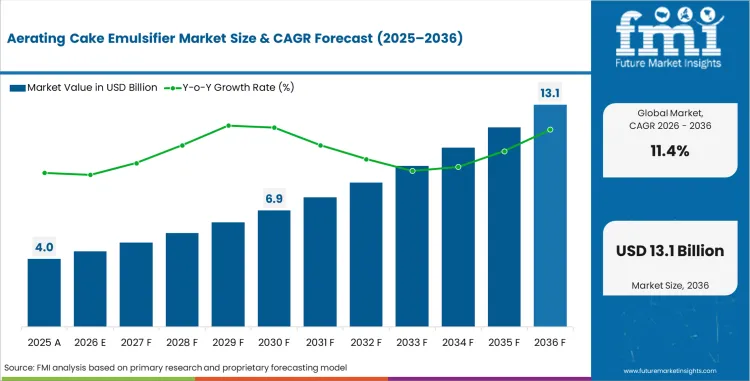
| Parameter | Details |
|---|---|
| Market value (2026) | USD 4.00 billion |
| Forecast value (2036) | USD 11.79 billion |
| CAGR (2026 to 2036) | 11.4% |
| Estimated market value (2025) | USD 3.59 billion |
| Incremental opportunity | USD 7.78 billion |
| Leading physical form | Liquid (42.0%) |
| Leading source type | Organic (58.0%) |
| Leading application type | Industrial (64.0%) |
| Key players | Cargill Incorporated, Palsgaard S/A, Beldem, BASF SE, Danisco A/S |
Source: Future Market Insights, 2026
There are three things that are driving the aerating cake emulsifier market to grow by double digits. First, the automation of industrial bakeries in developing countries is creating a huge need for consistent aeration performance at the speed of production. Second, the fact that 58.0% of sources use organic emulsifiers shows that people want bakery goods with clean labels. Third, the growth of cake consumption in China (15.4%) and India (14.2%) is making the market bigger.
China is the fastest-growing country among those tracked, with a CAGR of 15.4%. India comes in second with 14.2%. Next is Germany with 13.1%. Next is Brazil, which has 12.0%. The USA comes next with 10.8%. The UK comes next at 9.7%.
Aerating Cake Emulsifier Market Definition
The aerating cake emulsifier market includes emulsifier compounds that are made to mix and stabilize air in cake batters. This makes the finished cake products bigger, with a better crumb texture and a lighter feel. Products include liquid, powder, and gel emulsifiers from both organic and non-organic sources for use in industrial, artisan, and retail bakeries.
Aerating Cake Emulsifier Market Inclusions
The market scope includes all aerating cake emulsifiers that are sold on the market, divided by physical form, source type, application type, functionality, and end user. The revenue size ranges from 2026 to 2036.
Aerating Cake Emulsifier Market Exclusions
Does not include general-purpose food emulsifiers, bread improvers, or whipping agents that are not made specifically for cake aeration.
Aerating Cake Emulsifier Market Research Methodology
- Primary Research: FMI analysts did primary research by talking to bakery ingredient makers, industrial bakery engineers, and emulsifier technology experts in North America, Europe, and Asia-Pacific.
- Desk Research: The data collection included statistics on the bakery industry, trade data on food additives, and reports from emulsifier manufacturers.
- Market Sizing and Forecasting: We get baseline values by adding up the volumes of aerating cake emulsifiers sold in industrial, artisan, and retail channels, and then adjusting for growth in each region.
- Data validation and update cycle: Every three months, projections are checked against global bakery production data and disclosures from emulsifier manufacturers.
Why is the Aerating Cake Emulsifier Market Growing?
- In emerging markets, industrial bakery automation is driving up demand for aerating emulsifiers that work well at production speed. China (15.4%) and India (14.2%) are the two countries with the fastest growth.
- 58.0% of organic sourcing shows that people want clean-label, organic-certified bakery goods, which is pushing for better emulsifier specifications.
- 64.0% of industrial applications shows that commercial-scale bakeries are the main users of emulsifiers, which means they buy them in large quantities.
The aerating cake emulsifier market is growing quickly, with double-digit growth rates. This is due to the industrialization of bakeries in emerging markets, the use of organic ingredients, and the rise in cake consumption around the world. Aerating emulsifiers are important functional ingredients that mix and hold air bubbles in cake batters. They directly affect the volume, lightness, and crumb structure of the finished product.
The main driver of growth is industrialization in emerging markets. China and India are quickly building up their modern bakery infrastructure. New industrial production lines need high-performance emulsifiers that keep aeration steady at commercial throughput rates.
Demand for organic and clean-label products adds a new level of premium growth. Consumers in developed markets are more and more expecting baked goods made with well-known, natural ingredients. This means that manufacturers have to find organic-certified emulsifiers that meet clean-label standards while still working well.
Segmental Analysis
- Liquid at 42.0% is the best physical form for automated use in industrial bakery production and for keeping a precise volume-to-batter ratio.
- Organic at 58.0% is the most common source type. This is because people want organic-certified baked goods and clean-label ingredients.
- Industrial at 64.0% shows that large commercial bakeries are the main source of demand.
Divided into groups based on physical form (liquid, powder, gel), source type (organic, conventional), application type (industrial, artisan, retail), functionality, and end user.
Insights into the Liquid Physical Form Segment
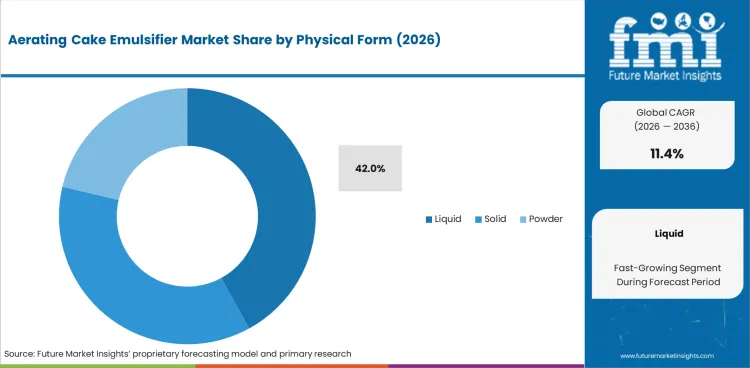
Liquid leads with a 42.0% share, which is best for automating industrial bakeries because liquid emulsifiers allow for precise metering and consistent batter incorporation at production speed.
Powder and gel forms are used in artisan and retail bakeries where manual handling and storage at room temperature are important.
Insights into the Industrial Application Type Segment
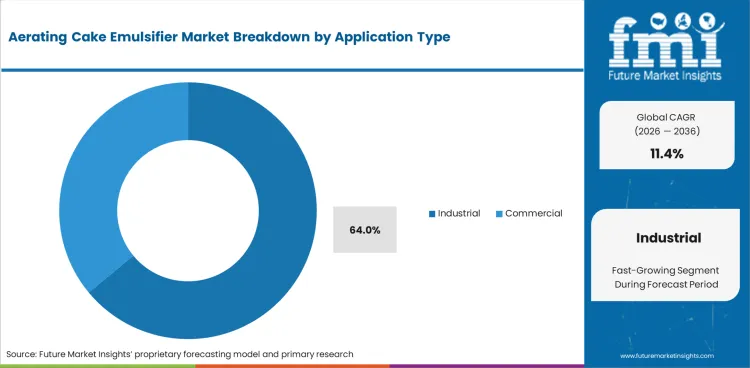
Industrial accounts for 64.0% of applications, with extensive commercial bakery operations being the main source of demand for aerating emulsifiers that work consistently and in large quantities.
Artisan and retail bakery applications are a growing high-end market where specialty emulsifier formulations are in high demand because they set products apart.
What are the Drivers, Restraints, and Key Trends of the Aerating Cake Emulsifier Market?
- The main driver of growth is the industrialization of bakeries in emerging markets at rates of 10% or more. China and India are the leaders in new production capacity investment.
- The need for sustainable palm oil and the changing costs of raw materials make it hard to buy things and put pressure on margins.
- New organic emulsifiers are making high-end product tiers that are good for clean-label bakery makers.
The market for aerating cake emulsifiers is growing quickly because of industrialization in emerging markets and organic demand. Even though there are problems with getting raw materials, there are a lot of chances for growth in industrial automation, organic certification, and expanding into new markets.
Emerging Market Bakery Industrialization
China's 15.4% and India's 14.2% CAGR show that the industrial bakery business is growing quickly. New automated production lines need high-performance aerating emulsifiers to keep commercial output steady.
Raw Material Cost and Sustainability
The price of palm oil derivatives and the RSPO's requirements for sustainability certification make it hard to buy palm oil. Manufacturers have to find a balance between keeping costs down and making sure they get their materials from sources that are good for the environment.
Organic Emulsifier Innovation
58.0% of the ingredients come from organic sources, which shows that there is more demand for organic-certified emulsifiers. Creating plant-based, non-palm organic alternatives allows for premium positioning in clean-label bakery segments.
Industrial Automation Integration
Modern industrial bakery lines need emulsifiers that work with systems for automated dosing, mixing, and aeration. For production to run smoothly, liquid emulsifier formats must have a consistent viscosity and dispersion.
Analysis of Aerating Cake Emulsifier Market By Key Countries
.webp "Top Country Growth Comparison — Aerating Cake Emulsifier Market CAGR (2026–2036)")
| Country | CAGR |
|---|---|
| China | 15.4% |
| India | 14.2% |
| Germany | 13.1% |
| Brazil | 12.0% |
| USA | 10.8% |
| UK | 9.7% |
| Japan | 8.6% |
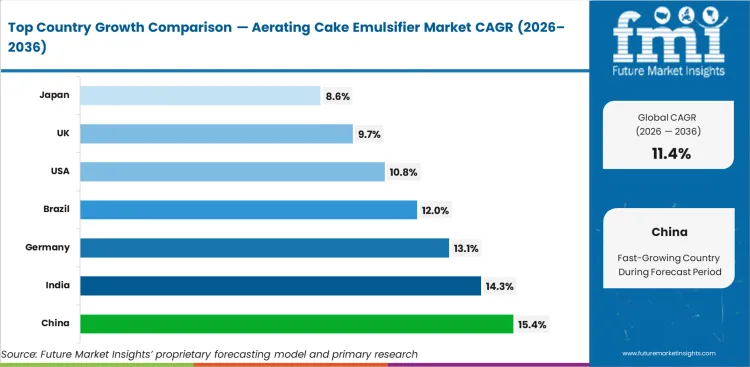
- China is in the lead with a 15.4% CAGR, thanks to the fast growth of industrial bakeries and the rising demand for Western-style cakes among city dwellers.
- India's 14.2% growth rate shows that the bakery industry is becoming more industrialized, that demand for packaged cakes is rising, and that modern retail distribution is growing.
- Germany's growth continues at 13.1% thanks to a well-established bakery industry and a steady demand for organic emulsifiers within EU rules.
- The US (10.8%) and UK (9.7%) are both mature markets where growth is driven by clean-label reformulation and new premium cakes.
The global market for aerating cake emulsifiers is expected to grow at a CAGR of 11.4% from 2026 to 2036. The study looks at more than 30 countries, and the main markets are listed below.
Demand Outlook for Aerating Cake Emulsifier Market in the United States
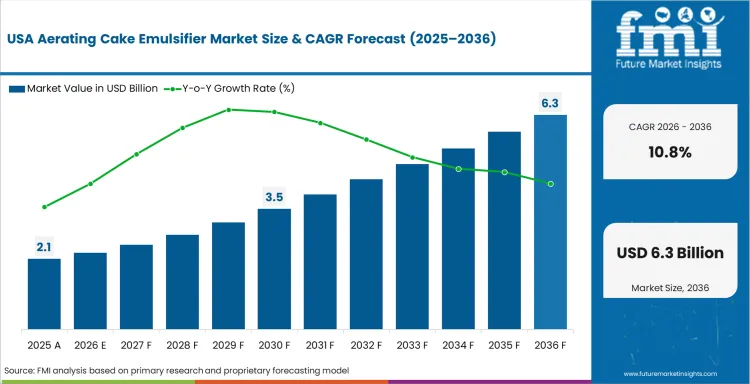
The United States is expected to grow at a CAGR of 10.8% through 2036. This is because of established industrial bakery infrastructure, clean-label consumer demand, and new ideas in the premium cake market that are pushing for better emulsifier specifications.
- The infrastructure of industrial bakeries keeps up with demand.
- The need for clean labels is what makes organic emulsifiers popular.
- Innovation in high-end cakes supports products with higher specifications.
Future Outlook for Aerating Cake Emulsifier Market in the United Kingdom
The UK is expected to grow at a CAGR of 9.7% through 2036, thanks to the demand for clean-label reformulation, supermarket private-label cakes, and industrial bakery production.
- Industrial bakery production keeps demand high.
- Private-label cake is what makes people buy more.
- The specification is shaped by clean-label reformulation.
Opportunity Analysis of Aerating Cake Emulsifier Market in Germany
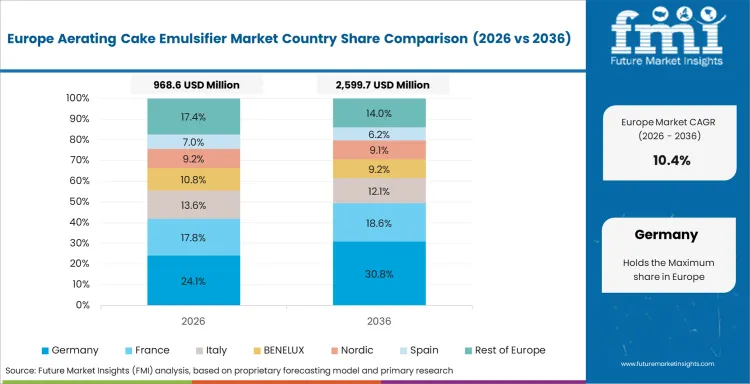
Germany's growth rate of 13.1% through 2036 is a sign of the bakery industry's size, the demand for organic certification, and the EU's rules for food additives that govern emulsifier specifications.
- The size of the bakery industry sets the level of demand.
- Organic demand fuels the search for high-quality emulsifiers.
- EU rules and regulations shape specifications.
In-depth Analysis of Aerating Cake Emulsifier Market in Japan
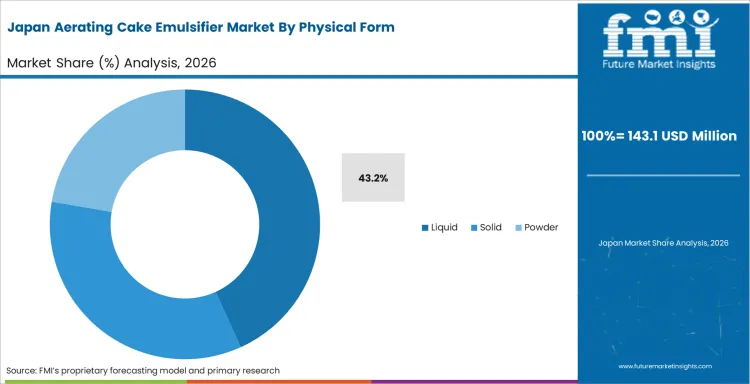
Japan's economy will keep growing until 2036. This is because of the country's love of high-quality baked goods, the fact that convenience stores sell cakes, and the fact that customers expect high-quality products.
- The culture of high-end bakeries drives specification.
- Convenience distribution gives you volume.
- Expectations of quality keep demand strong.
Sales Analysis of Aerating Cake Emulsifier Market in China
Demand for aerating cake emulsifiers in China is projected to grow at 15.4% per year through 2036, driven by industrial bakery expansion, rising popularity of Western-style cakes, and investment in modern retail distribution infrastructure.
- The growth of industrial bakeries drives demand for volume.
- Urban people are eating more Western-style cakes.
- Modern retail distribution gives people access to the market.
In-depth Analysis of Aerating Cake Emulsifier Market in India
India is growing quickly, at a rate of 14.2% through 2036. This is due to the industrialization of bakeries, the rise in packaged cake consumption, and the growth of organized retail distribution.
- Bakery industrialization makes people want to buy things.
- As cities grow, more people eat packaged cakes.
- Organized retail makes it easier to get things.
Competitive Landscape of Aerating Cake Emulsifier Market
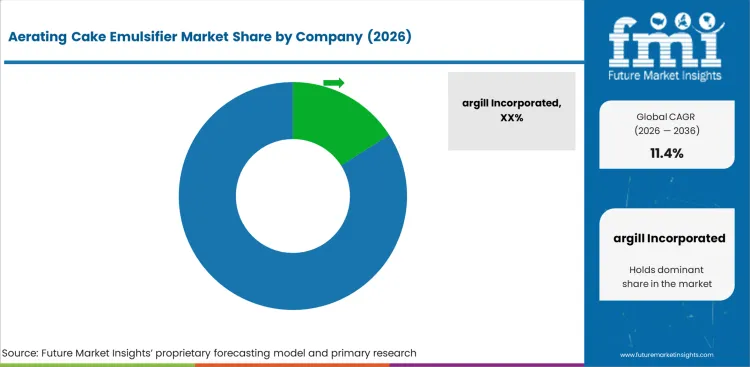
- CCargill Incorporated and Palsgaard S/A are the leaders in making emulsifiers and setting up supply chains for industrial bakeries.
- BASF SE and Danisco A/S offer a wide range of food additives, including aerating emulsifier systems.
- New companies that make organic and plant-based emulsifiers are going after the high-end bakery market with clean labels.
CCargill Incorporated is the leader in the global food ingredient manufacturing industry and has strong relationships with bakeries. Palsgaard S/A has a lot of experience with bakery emulsifiers and does a lot of research and development on aeration.
Beldem is an expert in bakery emulsifier systems. BASF SE and Danisco A/S both sell aerating emulsifiers as well as a wide range of other food additives. The Bakers Group sells to bakeries in the area.
Barriers include knowledge of emulsification technology, certification in food safety, and established relationships with industrial bakeries for buying goods. Developing organic emulsifiers, expanding into the Asian market, and coming up with new formulations that work with automation are all strategic priorities.
Major Industry Players
Key global companies leading the aerating cake emulsifier market include:
- CCargill Incorporated (USA), Palsgaard S/A (Denmark), Beldem (Belgium), and BASF SE (Germany) were named as some of the top companies in the global aerating cake emulsifier market. They have strong emulsifier manufacturing infrastructure, established relationships with industrial bakeries, and a wide range of products, including liquid, powder, and gel aerating emulsifier systems.
- Danisco A/S (Denmark) and The Bakers Group have built strong positions by knowing a lot about regional markets and distributing specialized bakery ingredients.
- Emerging organic and plant-based emulsifier manufacturers have set themselves apart from other startups and small and medium-sized businesses by establishing strong positions in clean-label and sustainably sourced aerating emulsifier formulations. This shows that they have the potential to become market leaders.
Competitive Benchmarking: Aerating Cake Emulsifier Market
| Company | Emulsifier Portfolio | Aeration Technology | Industrial Bakery Access | Geographic Footprint |
|---|---|---|---|---|
| CCargill Incorporated | High | High | Strong | Global |
| Palsgaard S/A | High | High | Strong | Global |
| Beldem | High | High | Moderate | Europe |
| BASF SE | High | Medium | Strong | Global |
| Danisco A/S | High | Medium | Strong | Global |
| The Bakers Group | Medium | Medium | Moderate | Regional |
Source: Future Market Insights competitive analysis, 2026. Ratings reflect relative positioning based on emulsifier portfolio, aeration technology, industrial bakery access, and distribution scope.
Key Developments in Aerating Cake Emulsifier Market
- In 2026, Palsgaard S/A did not introduce a new organic-certified liquid aerating emulsifier system. The company expanded production of its existing plant-based, lean-label Emulpals® powdered cake emulsifiers to Brazil to meet growing demand for clean-label cake premixes with high aeration
- In 2026, Cargill Incorporated did not increase capacity specifically for aerating emulsifiers in Asia-Pacific. The company expanded specialty fats production in Malaysia and other facilities to serve bakery and confectionery demand in the region, including China and India.
Key Players in the Aerating Cake Emulsifier Market:
Major Global Players:
- CCargill Incorporated
- Palsgaard S/A
- Beldem
- BASF SE
- Danisco A/S
- The Bakers Group
Emerging Players/Startups
- Emerging organic emulsifier producers
- Plant-based emulsifier innovators
Scope of the report
| Parameter | Details |
|---|---|
| Quantitative Units | USD 4.00 billion to USD 11.79 billion, at a CAGR of 11.4% |
| Market Definition | The aerating cake emulsifier market encompasses emulsifier compounds designed to incorporate and stabilize air in cake batters for improved volume, crumb texture, and lightness in industrial, artisan, and retail bakery applications. |
| Regions Covered | North America, Latin America, Europe, East Asia, South Asia and Pacific, Middle East and Africa |
| Countries Covered | China, India, Germany, Brazil, USA, UK, Japan, 30 plus countries |
| Key Companies Profiled | Cargill Incorporated, Palsgaard S/A, Beldem, BASF SE, Danisco A/S, The Bakers Group, Croda International Plc, DSM Nutritional Products, Tate & Lyle Plc |
| Forecast Period | 2026 to 2036 |
| Approach | Hybrid bottom-up and top-down methodology starting with verified transaction data, projecting adoption velocity across segments and regions. |
Aerating Cake Emulsifier Market by Segments
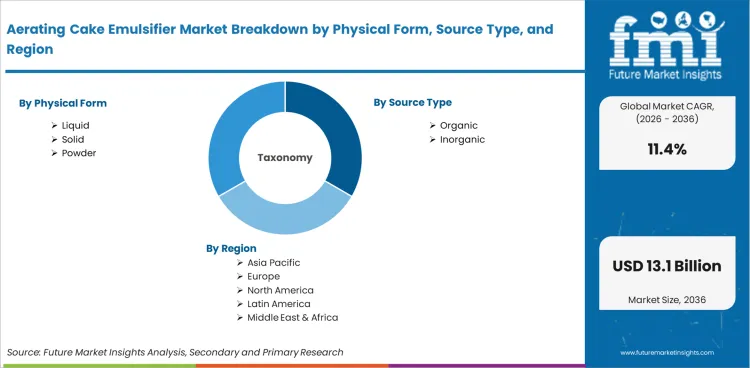
Aerating Cake Emulsifier Market Market Segmented by Physical Form:
- Liquid
- Solid
- Powder
Aerating Cake Emulsifier Market Market Segmented by Source Type:
- Organic
- Inorganic
Aerating Cake Emulsifier Market Market Segmented by Application Type:
- Industrial
- Commercial
Aerating Cake Emulsifier Market Market by Region:
- North America
- USA
- Canada
- Mexico
- Latin America
- Brazil
- Chile
- Rest of Latin America
- Western Europe
- Germany
- UK
- Italy
- Spain
- France
- Nordic
- BENELUX
- Rest of Western Europe
- Eastern Europe
- Russia
- Poland
- Hungary
- Balkan & Baltic
- Rest of Eastern Europe
- East Asia
- China
- Japan
- South Korea
- South Asia and Pacific
- India
- ASEAN
- Australia & New Zealand
- Rest of South Asia and Pacific
- Middle East & Africa
- Kingdom of Saudi Arabia
- Other GCC Countries
- Turkiye
- South Africa
- Other African Union
- Rest of Middle East & Africa
Bibliography
- 1. International Association of Plant Bakers. (2025). IAPB Global Bakery Industry Report. IAPB.
- 2. European Commission. (2024). EU Food Additive Regulation: Emulsifier Standards. EC.
- 3. U.S. Food and Drug Administration. (2024). FDA GRAS: Food-Grade Emulsifiers. FDA.
- 4. Codex Alimentarius Commission. (2024). General Standard for Food Additives: Emulsifier Specifications. FAO/WHO.
- 5. European Food Emulsifiers Manufacturers Association. (2025). EFEMA Bakery Emulsifier Market Report. EFEMA.
This bibliography is provided for reader reference. The full FMI report contains the complete reference list with primary research documentation.
Frequently Asked Questions
What will the global market for Aerating Cake Emulsifiers look like in 2026?
The global market for aerating cake emulsifiers is expected to be worth $4.00 billion by 2026.
How big will the market for Aerating Cake Emulsifiers be in 2036?
By 2036, the market for aerating cake emulsifiers is expected to be worth $11.79 billion.
How much more will people want Aerating Cake Emulsifiers between 2026 and 2036?
Between 2026 and 2036, the demand for aerating cake emulsifiers is expected to grow by 11.4% per year.
Which Physical Form is likely to be the best seller in the world by 2026?
Liquid will make up 42.0% of the market in 2026. This shows that people prefer automated industrial bakery incorporation and precise control over the volume-to-batter ratio.
How is the use of Aerating Cake Emulsifier in industry driving its use?
Industrial makes up 64.0% of the application segment because large-scale commercial bakeries are the main customers for high-volume, consistent-performance aerating emulsifiers.
What is making people want things in China?
China's economy will grow at a rate of 15.4% per year until 2036. This is due to the rapid growth of industrial bakeries, the rise in popularity of Western-style cakes, and investments in modern retail distribution infrastructure.
What does this report mean by "Aerating Cake Emulsifier Market definition"?
The aerating cake emulsifier market includes emulsifier compounds that are made to mix air into cake batters and keep it stable. This makes the cake bigger, gives it a better crumb texture, and makes it lighter in bakery settings.
How does FMI make the Aerating Cake Emulsifier forecast and check it?
Forecasting models use a mix of bottom-up and top-down methods, starting with verified emulsifier transaction data and checking it against global bakery production statistics and food additive manufacturer disclosures.
Preview the report firsthand - request a free sample
Get SampleGet the brochure for pricing and purchase details.
Get PDFTable of Content
- Executive Summary
- Global Market Outlook
- Demand-side Trends
- Supply-side Trends
- Technology Roadmap Analysis
- Analysis and Recommendations
- Market Overview
- Market Coverage / Taxonomy
- Market Definition / Scope / Limitations
- Research Methodology
- Chapter Orientation
- Analytical Lens and Working Hypotheses
- Market Structure, Signals, and Trend Drivers
- Benchmarking and Cross-market Comparability
- Market Sizing, Forecasting, and Opportunity Mapping
- Research Design and Evidence Framework
- Desk Research Programme (Secondary Evidence)
- Company Annual and Sustainability Reports
- Peer-reviewed Journals and Academic Literature
- Corporate Websites, Product Literature, and Technical Notes
- Earnings Decks and Investor Briefings
- Statutory Filings and Regulatory Disclosures
- Technical White Papers and Standards Notes
- Trade Journals, Industry Magazines, and Analyst Briefs
- Conference Proceedings, Webinars, and Seminar Materials
- Government Statistics Portals and Public Data Releases
- Press Releases and Reputable Media Coverage
- FMI Internal Proprietary Databases and Historical Market Datasets
- Subscription Datasets and Paid Sources
- Social Channels, Communities, and Digital Listening Inputs
- Additional Desk Sources
- Expert Input and Fieldwork (Primary Evidence)
- Primary Modes
- Qualitative Interviews and Expert Elicitation
- Quantitative Surveys and Structured Data Capture
- Blended Approach
- Why Primary Evidence is Used
- Field Techniques
- Interviews
- Surveys
- Focus Groups
- Observational and In-context Research
- Social and Community Interactions
- Stakeholder Universe Engaged
- C-suite Leaders
- Board Members
- Presidents and Vice Presidents
- R&D and Innovation Heads
- Technical Specialists
- Domain Subject-matter Experts
- Scientists
- Physicians and Other Healthcare Professionals
- Governance, Ethics, and Data Stewardship
- Research Ethics
- Data Integrity and Handling
- Primary Modes
- Tooling, Models, and Reference Databases
- Desk Research Programme (Secondary Evidence)
- Data Engineering and Model Build
- Data Acquisition and Ingestion
- Cleaning, Normalisation, and Verification
- Synthesis, Triangulation, and Analysis
- Quality Assurance and Audit Trail
- Market Background
- Market Dynamics
- Drivers
- Restraints
- Opportunity
- Trends
- Scenario Forecast
- Demand in Optimistic Scenario
- Demand in Likely Scenario
- Demand in Conservative Scenario
- Opportunity Map Analysis
- Product Life Cycle Analysis
- Supply Chain Analysis
- Investment Feasibility Matrix
- Value Chain Analysis
- PESTLE and Porter’s Analysis
- Regulatory Landscape
- Regional Parent Market Outlook
- Production and Consumption Statistics
- Import and Export Statistics
- Market Dynamics
- Global Market Analysis 2021 to 2025 and Forecast, 2026 to 2036
- Historical Market Size Value (USD Million) Analysis, 2021 to 2025
- Current and Future Market Size Value (USD Million) Projections, 2026 to 2036
- Y-o-Y Growth Trend Analysis
- Absolute $ Opportunity Analysis
- Global Market Pricing Analysis 2021 to 2025 and Forecast 2026 to 2036
- Global Market Analysis 2021 to 2025 and Forecast 2026 to 2036, By Physical Form
- Introduction / Key Findings
- Historical Market Size Value (USD Million) Analysis By Physical Form , 2021 to 2025
- Current and Future Market Size Value (USD Million) Analysis and Forecast By Physical Form , 2026 to 2036
- Liquid
- Solid
- Powder
- Liquid
- Y-o-Y Growth Trend Analysis By Physical Form , 2021 to 2025
- Absolute $ Opportunity Analysis By Physical Form , 2026 to 2036
- Global Market Analysis 2021 to 2025 and Forecast 2026 to 2036, By Source Type
- Introduction / Key Findings
- Historical Market Size Value (USD Million) Analysis By Source Type, 2021 to 2025
- Current and Future Market Size Value (USD Million) Analysis and Forecast By Source Type, 2026 to 2036
- Organic
- Inorganic
- Organic
- Y-o-Y Growth Trend Analysis By Source Type, 2021 to 2025
- Absolute $ Opportunity Analysis By Source Type, 2026 to 2036
- Global Market Analysis 2021 to 2025 and Forecast 2026 to 2036, By Application Type
- Introduction / Key Findings
- Historical Market Size Value (USD Million) Analysis By Application Type, 2021 to 2025
- Current and Future Market Size Value (USD Million) Analysis and Forecast By Application Type, 2026 to 2036
- Industrial
- Commercial
- Industrial
- Y-o-Y Growth Trend Analysis By Application Type, 2021 to 2025
- Absolute $ Opportunity Analysis By Application Type, 2026 to 2036
- Global Market Analysis 2021 to 2025 and Forecast 2026 to 2036, By Region
- Introduction
- Historical Market Size Value (USD Million) Analysis By Region, 2021 to 2025
- Current Market Size Value (USD Million) Analysis and Forecast By Region, 2026 to 2036
- North America
- Latin America
- Western Europe
- Eastern Europe
- East Asia
- South Asia and Pacific
- Middle East & Africa
- Market Attractiveness Analysis By Region
- North America Market Analysis 2021 to 2025 and Forecast 2026 to 2036, By Country
- Historical Market Size Value (USD Million) Trend Analysis By Market Taxonomy, 2021 to 2025
- Market Size Value (USD Million) Forecast By Market Taxonomy, 2026 to 2036
- By Country
- USA
- Canada
- Mexico
- By Physical Form
- By Source Type
- By Application Type
- By Country
- Market Attractiveness Analysis
- By Country
- By Physical Form
- By Source Type
- By Application Type
- Key Takeaways
- Latin America Market Analysis 2021 to 2025 and Forecast 2026 to 2036, By Country
- Historical Market Size Value (USD Million) Trend Analysis By Market Taxonomy, 2021 to 2025
- Market Size Value (USD Million) Forecast By Market Taxonomy, 2026 to 2036
- By Country
- Brazil
- Chile
- Rest of Latin America
- By Physical Form
- By Source Type
- By Application Type
- By Country
- Market Attractiveness Analysis
- By Country
- By Physical Form
- By Source Type
- By Application Type
- Key Takeaways
- Western Europe Market Analysis 2021 to 2025 and Forecast 2026 to 2036, By Country
- Historical Market Size Value (USD Million) Trend Analysis By Market Taxonomy, 2021 to 2025
- Market Size Value (USD Million) Forecast By Market Taxonomy, 2026 to 2036
- By Country
- Germany
- UK
- Italy
- Spain
- France
- Nordic
- BENELUX
- Rest of Western Europe
- By Physical Form
- By Source Type
- By Application Type
- By Country
- Market Attractiveness Analysis
- By Country
- By Physical Form
- By Source Type
- By Application Type
- Key Takeaways
- Eastern Europe Market Analysis 2021 to 2025 and Forecast 2026 to 2036, By Country
- Historical Market Size Value (USD Million) Trend Analysis By Market Taxonomy, 2021 to 2025
- Market Size Value (USD Million) Forecast By Market Taxonomy, 2026 to 2036
- By Country
- Russia
- Poland
- Hungary
- Balkan & Baltic
- Rest of Eastern Europe
- By Physical Form
- By Source Type
- By Application Type
- By Country
- Market Attractiveness Analysis
- By Country
- By Physical Form
- By Source Type
- By Application Type
- Key Takeaways
- East Asia Market Analysis 2021 to 2025 and Forecast 2026 to 2036, By Country
- Historical Market Size Value (USD Million) Trend Analysis By Market Taxonomy, 2021 to 2025
- Market Size Value (USD Million) Forecast By Market Taxonomy, 2026 to 2036
- By Country
- China
- Japan
- South Korea
- By Physical Form
- By Source Type
- By Application Type
- By Country
- Market Attractiveness Analysis
- By Country
- By Physical Form
- By Source Type
- By Application Type
- Key Takeaways
- South Asia and Pacific Market Analysis 2021 to 2025 and Forecast 2026 to 2036, By Country
- Historical Market Size Value (USD Million) Trend Analysis By Market Taxonomy, 2021 to 2025
- Market Size Value (USD Million) Forecast By Market Taxonomy, 2026 to 2036
- By Country
- India
- ASEAN
- Australia & New Zealand
- Rest of South Asia and Pacific
- By Physical Form
- By Source Type
- By Application Type
- By Country
- Market Attractiveness Analysis
- By Country
- By Physical Form
- By Source Type
- By Application Type
- Key Takeaways
- Middle East & Africa Market Analysis 2021 to 2025 and Forecast 2026 to 2036, By Country
- Historical Market Size Value (USD Million) Trend Analysis By Market Taxonomy, 2021 to 2025
- Market Size Value (USD Million) Forecast By Market Taxonomy, 2026 to 2036
- By Country
- Kingdom of Saudi Arabia
- Other GCC Countries
- Turkiye
- South Africa
- Other African Union
- Rest of Middle East & Africa
- By Physical Form
- By Source Type
- By Application Type
- By Country
- Market Attractiveness Analysis
- By Country
- By Physical Form
- By Source Type
- By Application Type
- Key Takeaways
- Key Countries Market Analysis
- USA
- Pricing Analysis
- Market Share Analysis, 2025
- By Physical Form
- By Source Type
- By Application Type
- Canada
- Pricing Analysis
- Market Share Analysis, 2025
- By Physical Form
- By Source Type
- By Application Type
- Mexico
- Pricing Analysis
- Market Share Analysis, 2025
- By Physical Form
- By Source Type
- By Application Type
- Brazil
- Pricing Analysis
- Market Share Analysis, 2025
- By Physical Form
- By Source Type
- By Application Type
- Chile
- Pricing Analysis
- Market Share Analysis, 2025
- By Physical Form
- By Source Type
- By Application Type
- Germany
- Pricing Analysis
- Market Share Analysis, 2025
- By Physical Form
- By Source Type
- By Application Type
- UK
- Pricing Analysis
- Market Share Analysis, 2025
- By Physical Form
- By Source Type
- By Application Type
- Italy
- Pricing Analysis
- Market Share Analysis, 2025
- By Physical Form
- By Source Type
- By Application Type
- Spain
- Pricing Analysis
- Market Share Analysis, 2025
- By Physical Form
- By Source Type
- By Application Type
- France
- Pricing Analysis
- Market Share Analysis, 2025
- By Physical Form
- By Source Type
- By Application Type
- India
- Pricing Analysis
- Market Share Analysis, 2025
- By Physical Form
- By Source Type
- By Application Type
- ASEAN
- Pricing Analysis
- Market Share Analysis, 2025
- By Physical Form
- By Source Type
- By Application Type
- Australia & New Zealand
- Pricing Analysis
- Market Share Analysis, 2025
- By Physical Form
- By Source Type
- By Application Type
- China
- Pricing Analysis
- Market Share Analysis, 2025
- By Physical Form
- By Source Type
- By Application Type
- Japan
- Pricing Analysis
- Market Share Analysis, 2025
- By Physical Form
- By Source Type
- By Application Type
- South Korea
- Pricing Analysis
- Market Share Analysis, 2025
- By Physical Form
- By Source Type
- By Application Type
- Russia
- Pricing Analysis
- Market Share Analysis, 2025
- By Physical Form
- By Source Type
- By Application Type
- Poland
- Pricing Analysis
- Market Share Analysis, 2025
- By Physical Form
- By Source Type
- By Application Type
- Hungary
- Pricing Analysis
- Market Share Analysis, 2025
- By Physical Form
- By Source Type
- By Application Type
- Kingdom of Saudi Arabia
- Pricing Analysis
- Market Share Analysis, 2025
- By Physical Form
- By Source Type
- By Application Type
- Turkiye
- Pricing Analysis
- Market Share Analysis, 2025
- By Physical Form
- By Source Type
- By Application Type
- South Africa
- Pricing Analysis
- Market Share Analysis, 2025
- By Physical Form
- By Source Type
- By Application Type
- USA
- Market Structure Analysis
- Competition Dashboard
- Competition Benchmarking
- Market Share Analysis of Top Players
- By Regional
- By Physical Form
- By Source Type
- By Application Type
- Competition Analysis
- Competition Deep Dive
- argill Incorporated
- Overview
- Product Portfolio
- Profitability by Market Segments (Product/Age /Sales Channel/Region)
- Sales Footprint
- Strategy Overview
- Marketing Strategy
- Product Strategy
- Channel Strategy
- Palsgaard SA
- Beldem
- BASF SE
- Danisco A/S
- The Bakers Group
- Corning Corporation
- Dow DuPont
- Croda International Plc
- DSM Nutritional Products
- Tate & Lyle Plc
- argill Incorporated
- Competition Deep Dive
- Assumptions & Acronyms Used


