

- Market Size (2026)
- USD 1.5 Bn
- Forecast (2036)
- USD 2.8 Bn
- CAGR (2026 to 2036)
- 6.4%
Private Label Bakery Mix Market Size, Market Forecast and Outlook By FMI
The private label bakery mix industry value is forecast to grow from USD 1.4 billion in 2025 to USD 2.8 billion by 2036 at 6.4% CAGR as retailers expand own-brand baking ranges and B2B buyers use pre-blended mixes to control recipe results. The market is estimated at USD 1.5 billion in 2026. Powder mixes are forecast to account for 68.0% share in 2026 because dry formats simplify storage and national distribution. Retailer programs are expected to secure 55.0% share in 2026, led by grocery chains that use own-brand mixes to protect price tiers.
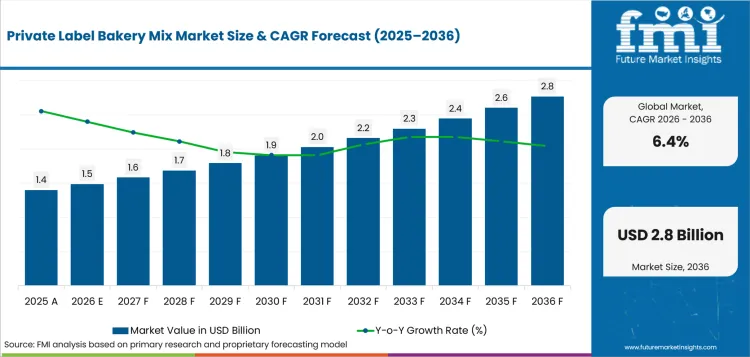
Key Takeaways, Market Size, and Forecast
- 2026 Market Size: USD 1.5 billion
- 2036 Market Size: USD 2.8 billion
- Forecast CAGR: 6.4% from 2026 to 2036
- Leading Format: Powder Mixes
- Powder Mixes Share in 2026: 68.0%
- Leading Buyer Type: Retailer Programs
- Retailer Programs Share in 2026: 55.0%
- Fastest-growing Country: Saudi Arabia
- Saudi Arabia CAGR: 7.4% by 2036
Summary of Private Label Bakery Mix Market
- Demand and Growth Drivers
- Retailers are widening own-brand baking ranges to defend household basket value and price choice.
- Foodservice buyers are using B2B private-label mixes to keep portion quality steady across outlets.
- Contract packers are gaining orders when they support allergen files and retailer audits.
- Modern grocery chains in Saudi Arabia and South Korea are adding bakery mixes as shelf-stable value products.
- Product and Segment View
- Powder mixes are forecast to represent 68.0% share in 2026, supported by lower storage risk and longer shelf life.
- Retailer programs are projected to hold 55.0% share in 2026, led by grocery chain control over shelf space.
- Supermarkets are expected to account for 42.0% share in 2026, shaped by direct comparison with branded mixes.
- Clean label programs are anticipated to capture 37.0% share in 2026, driven by shorter retailer ingredient briefs.
- Cake mixes are projected to secure 31.5% share in 2026, supported by repeat dessert use and seasonal promotions.
- Geography and Competitive Outlook
- Saudi Arabia is projected to record 7.4% CAGR by 2036, backed by modern grocery expansion and import-reliant food supply.
- South Korea is expected to expand at 6.8% CAGR by 2036 through convenience retail and cafe bakery channels.
- The United States is forecast to grow at 6.7% CAGR by 2036 as retailer brand scale supports national programs.
- Dawn Foods and Puratos compete through formulation support and bakery application centers.
- CSM Ingredients, AB Mauri, and Bakels compete through mix systems, bakery ingredients, and technical service.
- Analyst Opinion
- Nandini Roy Choudhury, Principal Consultant for Food and Beverage at FMI, observes, " Private-label bakery mix growth is not solely a pricing story for retailers. The strongest gains occur where suppliers help reduce recipe risk. Buyers expect consistency in sponge and color across locations and seasons. This expectation increases pressure on suppliers to clearly document flour performance and batch repeatability."
- Private Label Bakery Mix Market Value Analysis
- Market value is supported by retailer-owned bakery mix SKUs and B2B contract packs before branded consumer mixes are counted elsewhere.
- Value expansion reflects sustained demand linked to flour input costs and functional ingredient usage, with additional value capture coming from packaging requirements and retailer compliance standards.
- Revenue growth is driven by increasing retailer adoption of year-round private-label bakery programs, as seasonal baking products are converted into consistent, repeat-demand offerings.
- Market outlook visibility remains moderate, as value estimates are influenced by partial reliance on trade-association demand data, while underlying bakery input demand is benchmarked against official production indicators.
The private label bakery mix market is becoming more procurement led as retailers ask suppliers for stable formulas and stronger flour security. BLS reported in May 2026 that bakery product prices increased 2.6% over the previous 12 months. The same release showed cakes, cupcakes and cookies increased 4.0% over that period.
This pricing pressure supports owned-label cake mixes and cookie mixes because retailers can protect value positioning while maintaining shelf variety. In October 2025, Mennel reported that its Bakery Mix & Foodservice facility in Martel received the company’s FY25 Plant of the Year award after new production system adoption, first-pass quality gains and improved output. This recognition followed the adoption of new production systems and increased production output.
Why is the Private Label Bakery Mix Market Growing?
- Retailers are adding own-brand baking options because consumers compare price gaps more closely during grocery trips.
- Industrial bakeries are buying pre-blended dry systems to reduce batch variation and speed line changeovers.
- Contract manufacturers are using certification files and allergen controls to win retailer programs with lower onboarding risk.
Private-label programs are moving from basic cake and pancake SKUs toward richer formulation work. The wider flour mixes category gives this submarket its commercial base because retailers can borrow proven formats before building own-brand lines. Supplier economics also depend on flour, leavening, fats, and inclusions because these inputs shape gross margin. The broader bakery ingredients pool therefore gives suppliers a reference point for formulation cost. United States Department of Agriculture National Agricultural Statistics Service reported 907.0 million bushels of wheat ground for flour in 2025. That milling base helps private-label mix suppliers secure steady inputs for national retail programs.
Private-label bakery mixes also gain from a clearer split between retail and B2B uses. Retail formats serve pantry baking and seasonal promotions. B2B packs serve in-store bakery, foodservice kitchens, and industrial dessert lines. This split helps suppliers sell the same formulation logic through different pack sizes. Suppliers that build one formula for retail cartons and another for foodservice bags can defend margin across both channels.
Market Segmentation Analysis
- Powder mixes are projected to secure 68.0% share in 2026, led by shelf-stable handling and lower warehouse risk.
- Retailer programs are expected to hold 55.0% share in 2026 since grocery groups control shelf space and brand architecture.
- Supermarkets are anticipated to represent 42.0% share in 2026 because shoppers compare private-label and branded mixes in the same aisle.
- Clean-label programs are forecast to account for 37.0% share in 2026 as retailers request shorter ingredient panels.
- Cake mixes are projected to capture 31.5% share in 2026 due to familiar pantry use and dessert promotion value.
Product choice is widening around health and diet claims where retailer brands copy branded cues without full brand spending. Adjacent gluten-free bakery premix activity shows why private-label suppliers need claim-ready production. Retailers also ask suppliers to document flour identity and claim wording before a range is approved. Clean ingredient briefs link bakery mix work to clean label flour because flour identity shapes pack claims. The private label bakery mix industry is segmented by product type, buyer type, format, claim position, sales channel, and region. Product type includes cake mixes, bread mixes, muffin mixes, cookie mixes, pancake mixes, and brownie mixes. Buyer type includes retailer programs, B2B bakery users, foodservice distributors, club stores, and export programs. Format includes powder mixes, wet mixes, frozen mixes, concentrates, and sachet packs.
Insights into Private Label Bakery Mix Market by Product Type
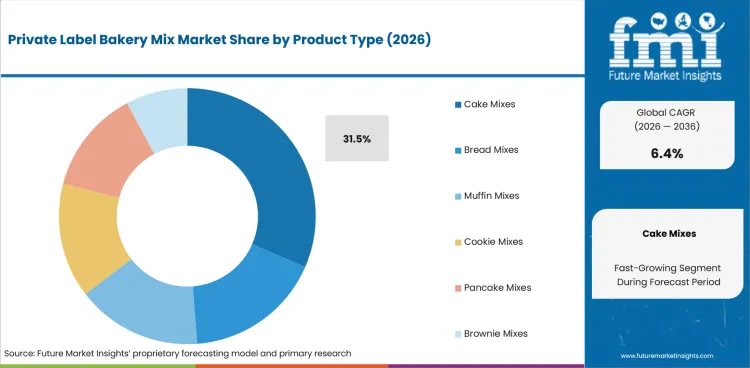
- Cake mixes are projected to account for 31.5% share in 2026, influenced by repeat pantry use and broad dessert appeal.
- Bread mixes gain value as in-store bakeries seek consistent dough quality across high-volume production.
Insights into Private Label Bakery Mix Market by Buyer Type
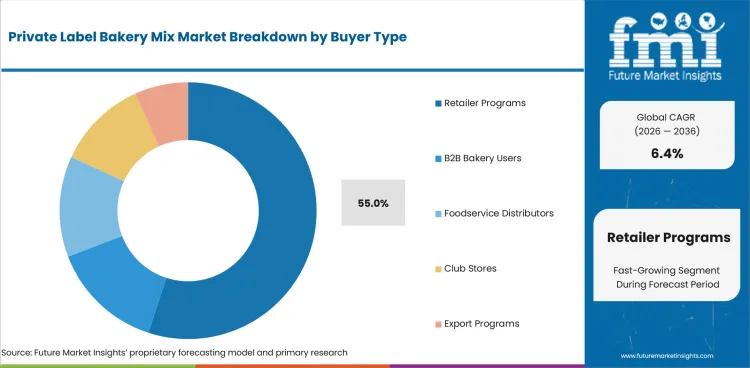
- Retailer programs are anticipated to hold 55.0% share in 2026 through grocery chain control over shelf space.
- B2B bakery users add volume when private-label packs support foodservice and commissary production.
Insights into Private Label Bakery Mix Market by Format
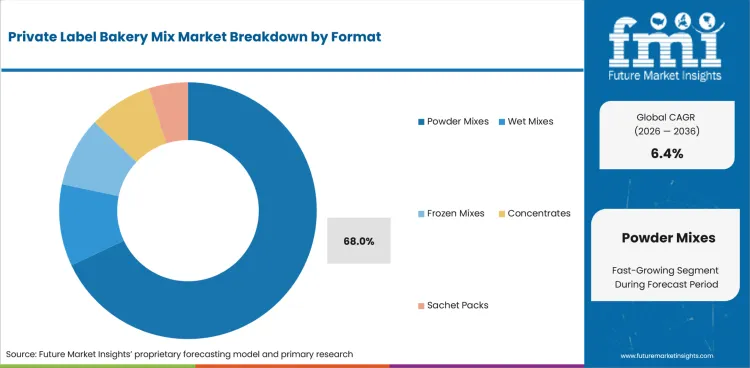
- Powder mixes are forecast to secure 68.0% share in 2026 because shelf-stable dry systems simplify storage.
- Wet concentrates are used where industrial lines need faster dispersion and fewer dry handling steps.
Insights into Private Label Bakery Mix Market by Claim Position
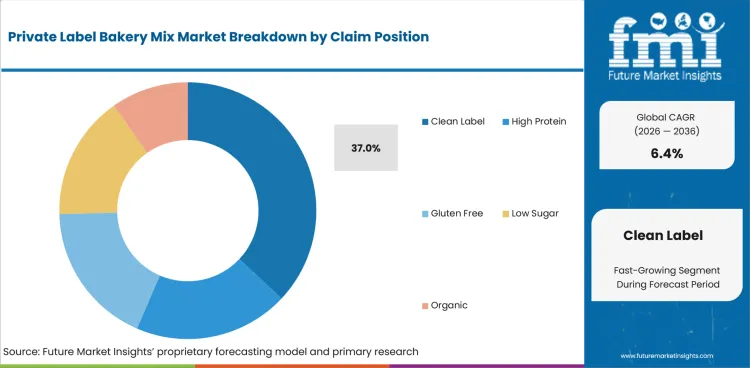
- Clean-label programs are expected to represent 37.0% share in 2026, reflected by retailer requests for shorter labels.
- High-protein programs gain use where breakfast mixes and snack mixes carry nutrition-led shelf cues.
Insights into Private Label Bakery Mix Market by Sales Channel
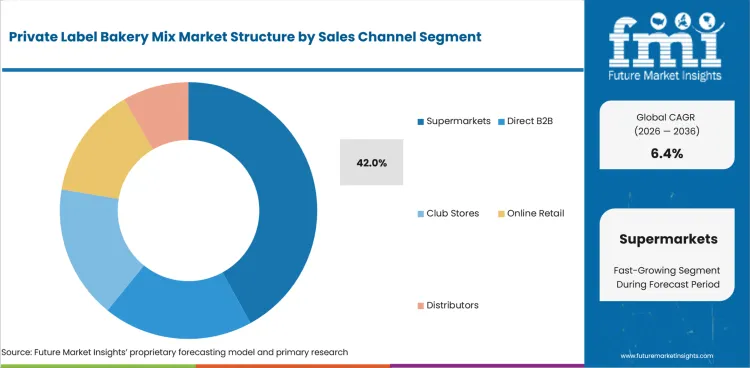
- Supermarkets are projected to account for 42.0% share in 2026 through shelf comparison with branded mixes.
- Direct B2B contracts support larger packs when commissaries and industrial bakeries buy repeat formulations.
Private Label Bakery Mix Market Drivers, Restraints, and Opportunities
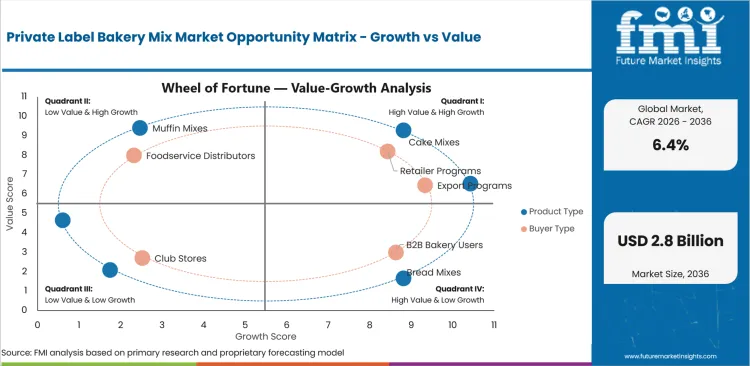
- Driver: Retailer brand expansion is shifting bakery mix work toward contract programs with clear pack cost targets.
- Restraint: Flour and sugar price shifts can reduce retailer margin when contracts do not include price review clauses.
- Opportunity: B2B packs can expand faster where bakeries need repeatable cake and muffin output.
Retailers Are Using Own-Brand Baking Ranges to Protect Shopper Traffic
Retailers are using own-brand baking ranges to hold shopper traffic when household budgets remain tight. This supports private-label programs that can move across retailers with limited formula changes and tailored packaging. Claim work is also shaping supplier selection because clean-label ingredients are now part of private-label bakery briefs. Agriculture and Agri-Food Canada reported in March 2026 that Canadian health-positioned baked goods are forecast to reach Can$1.4 billion by 2029. B2B buyers also compare contract mixes with food premix suppliers when they need multi-ingredient systems and fewer formulation steps. Suppliers must connect price value with documented ingredient claims to win repeat retail programs.
Contract Discipline Becomes Harder When Input Costs Move
The main restraint is contract discipline. Retailers often expect price protection while flour and sugar costs keep moving. USDA ERS reported in May 2026 that food-at-home prices increased 2.3% in 2025. Flour costs can shift alongside sugar and packaging costs during long supply agreements. This can squeeze smaller co-packers when review clauses are weak. Suppliers that align price windows with raw material movement can protect service levels without cutting formulation quality.
Private Label Mix Suppliers Can Win Through Flexible Reformulation Support
The strongest opportunity sits with suppliers that can support recipe conversion across cake mixes and muffin mixes. It also applies to cookie bases and pancake mixes. PLMA reported in January 2026 that the U.S. private label industry reached USD 282.8 billion in sales in 2025. This shows that retailers still have room to expand owned-brand food ranges when suppliers provide reliable production support. Bakery mix manufacturers can win accounts by offering smaller batch changes and retailer-specific flavor systems. They also gain when they provide claim documents and packaging-ready specifications before commercial rollout.
Analysis of Private Label Bakery Mix Market by Key Countries
.webp "Top Country Growth Comparison Private Label Bakery Mix Market Cagr (2026 2036)")
| Country | CAGR |
|---|---|
| United States | 6.7% |
| Canada | 5.9% |
| Germany | 5.8% |
| United Kingdom | 5.6% |
| Saudi Arabia | 7.4% |
| South Korea | 6.8% |
| Australia | 5.4% |
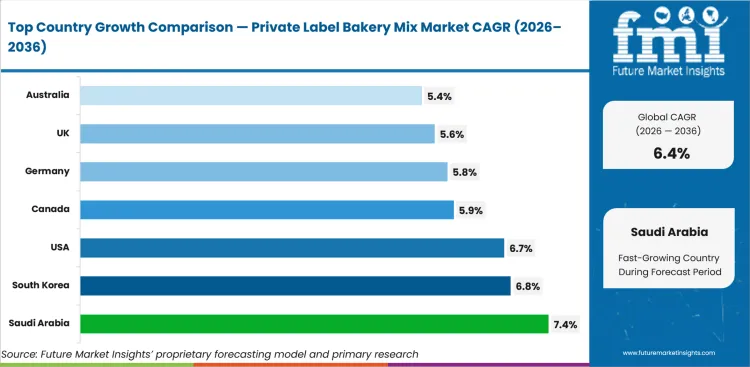
Source: Future Market Insights, 2026.
Private Label Bakery Mix Market CAGR Analysis by Country
- Saudi Arabia is projected to record 7.4% CAGR by 2036 as modern grocery and foodservice expansion widen private-label mix demand.
- South Korea is expected to expand at 6.8% CAGR from 2026 to 2036 due to convenience retail and cafe bakery use.
- The United States is forecast to grow at 6.7% CAGR by 2036 through retailer brand scale and domestic milling depth.
- Canada is expected to advance at 5.9% CAGR over the forecast period with bilingual grocery programs and baked goods retail value.
- Germany is projected to rise at 5.8% CAGR by 2036 due to discounter systems and export-linked bakery supply.
- The United Kingdom is forecast at 5.6% CAGR by 2036 as value grocery programs support own-brand baking mixes.
- Australia is expected to post 5.4% CAGR by 2036 as supermarket concentration speeds private-label range testing.
Sales Outlook for Private Label Bakery Mix Market in the United States
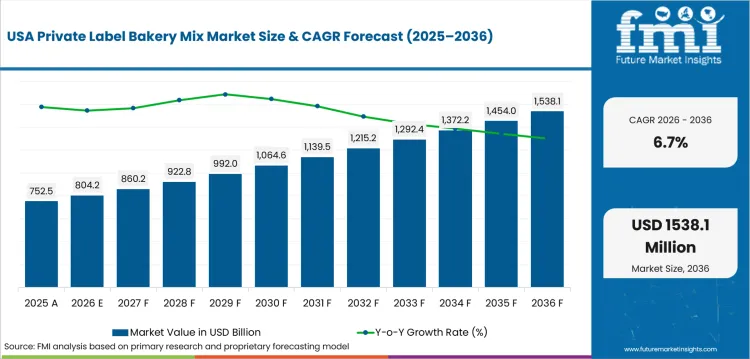
Retailer brand scale and flour milling base center · 2026 to 2036
Country Market Snapshot Table
| Parameter | Value |
|---|---|
| Market Size in 2025 (Value) | USD 431.1 million |
| Market Size in 2026 (Value) | USD 460.0 million |
| Market Forecast in 2036 (Value) | USD 879.8 million |
| CAGR (2026 to 2036) | 6.7% |
| Years Considered | 2021 to 2036 |
| Base Year | 2025 |
| Forecast Period | 2026 to 2036 |
| Units Considered | Value (USD million) |
| Leading Sub-Region | Midwest and national grocery networks |
United States Private Label Bakery Mix Market Outlook
United States private-label bakery mix demand is shaped by national retailer scale and a deep flour milling base. Large grocery chains compare bakery mixes by shelf price, pack consistency, and repeat promotion value.
The United States is projected to record a 6.7% CAGR by 2036, supported by retailer brand programs and B2B in-store bakery demand. United States Department of Agriculture National Agricultural Statistics Service reported in May 2026 that all wheat ground for flour reached 907.0 million bushels in 2025. Suppliers with plant audit records and multi-pack capability are better placed for national bids.
Key Growth Drivers
- Retailer private-brand scale gives cake and pancake mixes a broad shelf route. United States Department of Agriculture Economic Research Service reported in April 2026 that total food spending reached USD 2.51 trillion in 2025.
- Flour milling depth supports dry blend supply. United States Department of Agriculture National Agricultural Statistics Service reported 907.0 million bushels of wheat ground for flour in 2025.
- Club stores support larger breakfast and dessert mix packs for household stock-up trips.
- Foodservice distributors use private-label mix bags to keep cake and muffin output stable across kitchens.
Key Restraints
- Input price changes can weaken fixed-price retail contracts. United States Department of Agriculture Economic Research Service reported in May 2026 that food-at-home prices increased 2.3% in 2025.
- Retailer audits can lengthen supplier onboarding when allergen files and plant documents are incomplete.
- National branded mix promotions can pressure private-label shelf price gaps during holiday baking periods.
What makes United States unique
United States is unique because retailer brand scale and flour milling capacity allow private-label bakery mixes to move from regional pilots into national grocery programs.
Key Companies
- Dawn Foods Products Inc.
- BakeMark USA LLC
- C.H. Guenther & Son LLC
- Chelsea Milling Company
- Continental Mills Inc.
- Grain Craft
- General Mills Foodservice
Sales & Marketing Channels
- Grocery chains
- Club stores
- Mass retail
- Direct B2B contracts
- Foodservice distributors
- Online grocery
Country Segment Breakdown Table
| Segment | Sub-Segments |
|---|---|
| By Product Type | Cake Mixes · Bread Mixes · Muffin Mixes · Cookie Mixes · Pancake Mixes · Brownie Mixes |
| By Buyer Type | Retailer Programs · B2B Bakery Users · Foodservice Distributors · Club Stores · Export Programs |
| By Format | Powder Mixes · Wet Mixes · Frozen Mixes · Concentrates · Sachet Packs |
| By Claim Position | Clean Label · High Protein · Gluten Free · Low Sugar · Organic |
| By Sales Channel | Supermarkets · Direct B2B · Club Stores · Online Retail · Distributors |
| Key Sub-Regions Covered, Retail and Bakery Supply Corridors | Midwest · South Atlantic · Texas · California · Northeast · Pacific Northwest |
Market Taxonomy and Sub-Regions Covered
Frequently Asked Questions
How fast is United States private label bakery mix market growing?
The United States is projected to expand at 6.7% CAGR from 2026 to 2036 through retailer brand scale.
Who leads United States private label bakery mix market?
Dawn Foods, BakeMark, C.H. Guenther, and Chelsea Milling compete through mix production and national retail access.
What is driving adoption in United States private label bakery mix market?
Retailer brand scale and Midwest flour supply are moving more bakery mixes into own-brand programs.
Demand Outlook for Private Label Bakery Mix Market in Canada
Grocery private label and bilingual pack control center · 2026 to 2036
Country Market Snapshot Table
| Parameter | Value |
|---|---|
| Market Size in 2025 (Value) | USD 94.4 million |
| Market Size in 2026 (Value) | USD 100.0 million |
| Market Forecast in 2036 (Value) | USD 177.4 million |
| CAGR (2026 to 2036) | 5.9% |
| Years Considered | 2021 to 2036 |
| Base Year | 2025 |
| Forecast Period | 2026 to 2036 |
| Units Considered | Value (USD million) |
| Leading Sub-Region | Ontario and Quebec grocery corridors |
Canada Private Label Bakery Mix Market Outlook
Canadian buyers compare private-label bakery mixes against branded pantry staples and in-store bakery alternatives. Ontario and Quebec retailers have enough scale to test cake mixes and pancake mixes before wider national rollout.
Canada is expected to expand at 5.9% CAGR by 2036, attributable to grocery private-label range building and flour-backed domestic supply. Agriculture and Agri-Food Canada reported in March 2026 that Canadian baked goods retail sales reached Can$11.8 billion in 2024. Suppliers that support bilingual packs and retailer audits can move faster through national listings.
Key Growth Drivers
- Grocery baking demand gives retailers room to extend own-brand lines. Agriculture and Agri-Food Canada reported Can$11.8 billion in baked goods retail sales in 2024.
- Health-positioned bakery creates more mix briefs. Agriculture and Agri-Food Canada forecast health-positioned baked goods to reach Can$1.4 billion by 2029.
- Ontario club stores support larger pancake and muffin pack formats for household stock-up trips.
- Quebec retailers need bilingual packaging files, which favors suppliers with stronger label review systems.
Key Restraints
- Channel shifts require smaller pack planning. Agriculture and Agri-Food Canada stated in March 2026 that baked goods e-commerce increased at 40.6% annually.
- Long-distance freight into western provinces can weaken margin for low-price private-label baking mixes.
- Smaller co-packers can lose national bids when they cannot print bilingual cartons and foodservice bags together.
What makes Canada unique
Canada is unique because national retailers need bilingual packs and reliable flour-backed supply across long distances.
Key Companies
- Dawn Foods Canada Ltd.
- Canada Bread Company Limited
- Grain Process Enterprises Ltd.
- Lallemand Baking Solutions
- Anita’s Organic Mill
- P&H Milling Group
- Snowcap Enterprises Ltd.
Sales & Marketing Channels
- Supermarkets
- Club stores
- Direct B2B contracts
- Foodservice distributors
- Online grocery
- Bakery distributors
Country Segment Breakdown Table
| Segment | Sub-Segments |
|---|---|
| By Product Type | Cake Mixes · Bread Mixes · Muffin Mixes · Cookie Mixes · Pancake Mixes · Brownie Mixes |
| By Buyer Type | Retailer Programs · B2B Bakery Users · Foodservice Distributors · Club Stores · Export Programs |
| By Format | Powder Mixes · Wet Mixes · Frozen Mixes · Concentrates · Sachet Packs |
| By Claim Position | Clean Label · High Protein · Gluten Free · Low Sugar · Organic |
| By Sales Channel | Supermarkets · Direct B2B · Club Stores · Online Retail · Distributors |
| Key Sub-Regions Covered, Retail and Bakery Supply Corridors | Ontario · Quebec · British Columbia · Alberta · Manitoba · Atlantic Canada |
Market Taxonomy and Sub-Regions Covered
Frequently Asked Questions
How fast is Canada private label bakery mix market growing?
Canada demand is expected to rise at 5.9% CAGR from 2026 to 2036 with grocery private-label expansion.
Who leads Canada private label bakery mix market?
Dawn Foods Canada, Lallemand, Grain Process Enterprises, and P&H Milling Group compete through local supply and bakery formulation support.
What is driving adoption in Canada private label bakery mix market?
Bilingual grocery programs and domestic flour supply support wider retailer-owned bakery mix ranges.
Growth Outlook for Private Label Bakery Mix Market in Germany
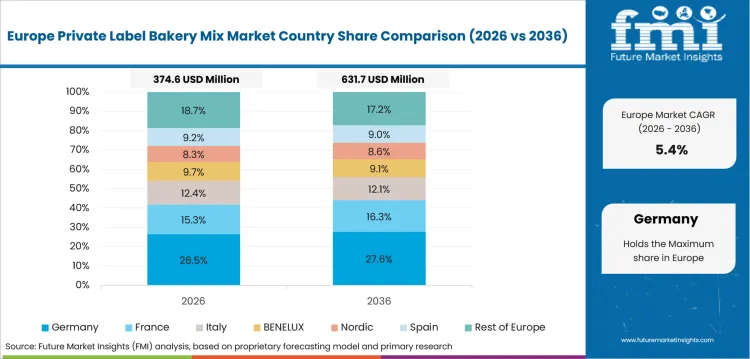
Discounter systems and bakery export base center · 2026 to 2036
Country Market Snapshot Table
| Parameter | Value |
|---|---|
| Market Size in 2025 (Value) | USD 151.2 million |
| Market Size in 2026 (Value) | USD 160.0 million |
| Market Forecast in 2036 (Value) | USD 281.2 million |
| CAGR (2026 to 2036) | 5.8% |
| Years Considered | 2021 to 2036 |
| Base Year | 2025 |
| Forecast Period | 2026 to 2036 |
| Units Considered | Value (USD million) |
| Leading Sub-Region | North Rhine-Westphalia and Bavaria retail corridors |
Germany Private Label Bakery Mix Market Outlook
Germany supplies a large bakery export base and a dense discount retail network. Private-label bakery mixes fit this structure because discounters test price tiers and rotate seasonal baking ranges.
Germany is forecast to grow at 5.8% CAGR by 2036, supported by discounter discipline and B2B bakery supply. Private Label Manufacturers Association International stated that private label reached 40.0% collective share in Europe’s three largest markets. Suppliers with retailer audit files and plant-scale blending can win beyond household cake mixes.
Key Growth Drivers
- Discounter strength gives own-brand mixes a direct shelf route. Private Label Manufacturers Association International reported 40.0% collective private-label share in Europe’s three largest markets.
- Bakery export strength supports ingredient and mix capacity. Food processing trade evidence placed German baked goods exports above USD 5.0 billion in 2024.
- Bavarian bakery groups use dry blend systems to keep bread and cake quality steady across store networks.
- North Rhine-Westphalia food processors can serve both retailer cartons and industrial bakery bags from nearby logistics hubs.
Key Restraints
- Retail price pressure limits formula upgrades. Eurostat reported in November 2025 that European Union food retail volume rose only 0.5% in September 2025.
- German ingredient declarations are closely reviewed by discounters, which slows the launch of claim-heavy baking mixes.
- Energy and labor cost pressure can make smaller blenders less able to serve national discount chains.
What makes Germany unique
Germany is unique due to discounter private-label discipline and export-linked bakery production capacity.
Key Companies
- GoodMills Innovation GmbH
- Stern-Wywiol Gruppe GmbH & Co. KG
- IREKS GmbH
- Ulmer Spatz GmbH
- Martin Braun KG
- Dr. Oetker Professional
- Diamant Zucker GmbH
Sales & Marketing Channels
- Discount retail
- Supermarkets
- Bakery wholesalers
- Direct B2B contracts
- Foodservice distributors
- Export distributors
Country Segment Breakdown Table
| Segment | Sub-Segments |
|---|---|
| By Product Type | Cake Mixes · Bread Mixes · Muffin Mixes · Cookie Mixes · Pancake Mixes · Brownie Mixes |
| By Buyer Type | Retailer Programs · B2B Bakery Users · Foodservice Distributors · Club Stores · Export Programs |
| By Format | Powder Mixes · Wet Mixes · Frozen Mixes · Concentrates · Sachet Packs |
| By Claim Position | Clean Label · High Protein · Gluten Free · Low Sugar · Organic |
| By Sales Channel | Supermarkets · Direct B2B · Club Stores · Online Retail · Distributors |
| Key Sub-Regions Covered, Retail and Bakery Supply Corridors | North Rhine-Westphalia · Bavaria · Baden-Wurttemberg · Lower Saxony · Hesse · Hamburg |
Market Taxonomy and Sub-Regions Covered
Frequently Asked Questions
How fast is Germany private label bakery mix market growing?
Germany is projected to grow at 5.8% CAGR from 2026 to 2036 with discounter and export-linked demand.
Who leads Germany private label bakery mix market?
GoodMills Innovation, IREKS, Martin Braun, and Stern-Wywiol compete through bakery ingredient depth.
What is driving adoption in Germany private label bakery mix market?
Discounter shelf systems and bakery export scale support own-brand and B2B mix programs.
Opportunity Analysis for Private Label Bakery Mix Market in the United Kingdom
Discounter retail and home baking value center · 2026 to 2036
Country Market Snapshot Table
| Parameter | Value |
|---|---|
| Market Size in 2025 (Value) | USD 123.1 million |
| Market Size in 2026 (Value) | USD 130.0 million |
| Market Forecast in 2036 (Value) | USD 224.2 million |
| CAGR (2026 to 2036) | 5.6% |
| Years Considered | 2021 to 2036 |
| Base Year | 2025 |
| Forecast Period | 2026 to 2036 |
| Units Considered | Value (USD million) |
| Leading Sub-Region | London and national discount grocery networks |
United Kingdom Private Label Bakery Mix Market Outlook
United Kingdom is expected to advance at 5.6% CAGR by 2036, attributable to discounter expansion and value-led grocery buying. Office for National Statistics reported in July 2025 that Great Britain retail sales volumes rose 0.9% in June 2025 after a May fall. Suppliers with smaller carton runs and retailer label support are better placed for supermarket own-brand briefs.
Key Growth Drivers
- Food store recovery helps retailers test baking ranges. Office for National Statistics reported that retail sales volumes rose 0.9% in June 2025.
- Flour supply supports bakery ingredient resilience. United Kingdom Flour Millers reported in 2025 that the sector had 93.0% national household access through food products using flour.
- Retailers use private-label cake and pancake mixes to protect value tiers against branded promotions.
- Foodservice distributors use B2B mix bags for school catering, hotel desserts, and bakery counters.
Key Restraints
- Food inflation makes price reviews more frequent. Office for National Statistics reported food and non-alcoholic beverage inflation remained above 4.0% in parts of 2025.
- Retailer own-label codes require strict allergen and ingredient review before new SKUs reach shelf.
- Low-margin baking mixes face promotion pressure from branded cake and pancake products during seasonal peaks.
What makes United Kingdom unique
United Kingdom is unique due to high private-label grocery penetration and retailer control over category architecture.
Key Companies
- British Bakels Ltd.
- Macphie Ltd.
- Edme Ltd.
- Carrs Flour Mills Ltd.
- Premier Foods Group Limited
- Eurostar Commodities Ltd.
- Fleming Howden Ltd.
Sales & Marketing Channels
- Discount retail
- Supermarkets
- Online grocery
- Foodservice distributors
- Bakery wholesalers
- Club stores
Country Segment Breakdown Table
| Segment | Sub-Segments |
|---|---|
| By Product Type | Cake Mixes · Bread Mixes · Muffin Mixes · Cookie Mixes · Pancake Mixes · Brownie Mixes |
| By Buyer Type | Retailer Programs · B2B Bakery Users · Foodservice Distributors · Club Stores · Export Programs |
| By Format | Powder Mixes · Wet Mixes · Frozen Mixes · Concentrates · Sachet Packs |
| By Claim Position | Clean Label · High Protein · Gluten Free · Low Sugar · Organic |
| By Sales Channel | Supermarkets · Direct B2B · Club Stores · Online Retail · Distributors |
| Key Sub-Regions Covered, Grocery and Foodservice Corridors | London · Midlands · North West England · Scotland · Wales · Yorkshire |
Market Taxonomy and Sub-Regions Covered
Frequently Asked Questions
How fast is United Kingdom private label bakery mix market growing?
United Kingdom demand is forecast to grow at 5.6% CAGR from 2026 to 2036 with value grocery programs.
Who leads United Kingdom private label bakery mix market?
British Bakels, Macphie, Edme, and Carrs Flour Mills compete through bakery ingredient supply and foodservice reach.
What is driving adoption in United Kingdom private label bakery mix market?
Discounter retail and own-brand grocery planning are supporting private-label bakery mix programs.
Demand Analysis for Private Label Bakery Mix Market in Saudi Arabia
Modern grocery and import-reliant food supply center · 2026 to 2036
Country Market Snapshot Table
| Parameter | Value |
|---|---|
| Market Size in 2025 (Value) | USD 69.8 million |
| Market Size in 2026 (Value) | USD 75.0 million |
| Market Forecast in 2036 (Value) | USD 153.1 million |
| CAGR (2026 to 2036) | 7.4% |
| Years Considered | 2021 to 2036 |
| Base Year | 2025 |
| Forecast Period | 2026 to 2036 |
| Units Considered | Value (USD million) |
| Leading Sub-Region | Riyadh and Jeddah modern grocery corridors |
Saudi Arabia Private Label Bakery Mix Market Outlook
Saudi Arabia is projected to rise at 7.4% CAGR by 2036, supported by food retail expansion and import-reliant ingredient supply. Saudi Arabia demand is tied to modern grocery chains and hotel-linked foodservice. Retailers need shelf-stable bakery mixes that travel well through hot logistics conditions and support Arabic-English pack files.
Key Growth Drivers
- Modern grocery expansion supports own-brand baking. United States Department of Agriculture Foreign Agricultural Service reported Saudi food retail sales above USD 50.0 billion in 2024.
- Food import reliance supports packaged dry mix sourcing. The same United States Department of Agriculture report stated that imports meet about 70.0% of Saudi food demand.
- Hotel and cafe chains use bakery mixes to hold dessert quality across new outlets.
- Arabic-English pack control favors suppliers with halal files and retailer-ready label systems.
Key Restraints
- Retailer margin can tighten when freight and wheat-linked inputs move. United States Department of Agriculture Foreign Agricultural Service expected Saudi food retail sales to grow about 5.0% in 2025.
- Temperature-sensitive inclusions can limit richer cake and muffin mixes during summer logistics.
- Smaller importers can lose bids when they cannot support halal certificates and Arabic pack reviews together.
What makes Saudi Arabia unique
Saudi Arabia is unique because modern grocery expansion and import reliance create fast demand for shelf-stable private-label baking mixes.
Key Companies
- Modern Mills Company
- First Milling Company
- Arabian Mills for Food Products
- Fourth Milling Company
- Almarai Company
- Halwani Brothers Company
- Al Raya Foodstuff Company
Sales & Marketing Channels
- Modern grocery chains
- Hypermarkets
- Hotel suppliers
- Foodservice distributors
- Online grocery
- Wholesale importers
Country Segment Breakdown Table
| Segment | Sub-Segments |
|---|---|
| By Product Type | Cake Mixes · Bread Mixes · Muffin Mixes · Cookie Mixes · Pancake Mixes · Brownie Mixes |
| By Buyer Type | Retailer Programs · B2B Bakery Users · Foodservice Distributors · Club Stores · Export Programs |
| By Format | Powder Mixes · Wet Mixes · Frozen Mixes · Concentrates · Sachet Packs |
| By Claim Position | Clean Label · High Protein · Gluten Free · Low Sugar · Organic |
| By Sales Channel | Supermarkets · Direct B2B · Club Stores · Online Retail · Distributors |
| Key Sub-Regions Covered, Modern Grocery and Foodservice Corridors | Riyadh · Jeddah · Dammam · Makkah · Madinah · Al Khobar |
Market Taxonomy and Sub-Regions Covered
Frequently Asked Questions
How fast is Saudi Arabia private label bakery mix market growing?
Saudi Arabia is expected to post 7.4% CAGR from 2026 to 2036 through modern grocery and foodservice expansion.
Who leads Saudi Arabia private label bakery mix market?
Modern Mills, First Milling Company, Arabian Mills, and Almarai compete through milling depth and food distribution.
What is driving adoption in Saudi Arabia private label bakery mix market?
Import reliance and modern grocery growth are moving bakery mixes into retailer-owned and B2B programs.
Sales Analysis for Private Label Bakery Mix Market in South Korea
Convenience retail and cafe bakery center · 2026 to 2036
Country Market Snapshot Table
| Parameter | Value |
|---|---|
| Market Size in 2025 (Value) | USD 60.9 million |
| Market Size in 2026 (Value) | USD 65.0 million |
| Market Forecast in 2036 (Value) | USD 125.5 million |
| CAGR (2026 to 2036) | 6.8% |
| Years Considered | 2021 to 2036 |
| Base Year | 2025 |
| Forecast Period | 2026 to 2036 |
| Units Considered | Value (USD million) |
| Leading Sub-Region | Seoul Capital Area and convenience retail networks |
South Korea Private Label Bakery Mix Market Outlook
South Korea is forecast to expand at 6.8% CAGR by 2036, led by convenience retail and frozen baked goods exposure. Industry is rising due to convenience retail and cafe bakery formats. Retailers use smaller packs and dessert-oriented mixes to serve households that want quick baking and snack preparation. Suppliers with smaller packs and dessert applications can win more shelf tests.
Key Growth Drivers
- Bakery retail value gives mix suppliers a clear shelf base. Agriculture and Agri-Food Canada reported South Korea baked goods sales of USD 3.8 billion in 2023.
- Frozen baked goods show faster format change. Agriculture and Agri-Food Canada reported 32.4% CAGR for frozen baked goods in South Korea through 2023.
- Convenience stores support single-household baking packs and dessert mixes with quick preparation cues.
- Cafe chains use private-label and commissary mixes to keep pancakes, muffins, and dessert bases consistent.
Key Restraints
- Small kitchens limit large retail pack sizes. Statistics Korea household data show one-person homes account for more than 35.0% of households in recent reporting.
- Domestic brands can crowd shelf space and slow entry for imported private-label mix suppliers.
- Dessert mixes need stronger flavor localization because Korean buyers compare texture and sweetness closely.
What makes South Korea unique
South Korea is unique because convenience retail and cafe bakery culture favor smaller dessert mix packs and foodservice-ready formulations.
Key Companies
- CJ CheilJedang Corporation
- Samyang Corporation
- SPC Samlip Co. Ltd.
- Ottogi Corporation
- Daehan Flour Mills Co. Ltd.
- Sajo Daerim Corporation
- Lotte Wellfood Co. Ltd.
Sales & Marketing Channels
- Convenience stores
- Supermarkets
- Cafe chains
- Online grocery
- Foodservice distributors
- Club stores
Country Segment Breakdown Table
| Segment | Sub-Segments |
|---|---|
| By Product Type | Cake Mixes · Bread Mixes · Muffin Mixes · Cookie Mixes · Pancake Mixes · Brownie Mixes |
| By Buyer Type | Retailer Programs · B2B Bakery Users · Foodservice Distributors · Club Stores · Export Programs |
| By Format | Powder Mixes · Wet Mixes · Frozen Mixes · Concentrates · Sachet Packs |
| By Claim Position | Clean Label · High Protein · Gluten Free · Low Sugar · Organic |
| By Sales Channel | Supermarkets · Direct B2B · Club Stores · Online Retail · Distributors |
| Key Sub-Regions Covered, Convenience Retail and Cafe Corridors | Seoul · Gyeonggi · Incheon · Busan · Daegu · Daejeon |
Market Taxonomy and Sub-Regions Covered
Frequently Asked Questions
How fast is South Korea private label bakery mix market growing?
South Korea is expected to rise at 6.8% CAGR from 2026 to 2036 through convenience retail and cafe bakery programs.
Who leads South Korea private label bakery mix market?
CJ CheilJedang, Samyang, SPC Samlip, and Ottogi compete through local food manufacturing and retail access.
What is driving adoption in South Korea private label bakery mix market?
Convenience retail and cafe bakery formats are supporting smaller private-label dessert and pancake mix packs.
Opportunity Analysis for Private Label Bakery Mix Market in Australia
Supermarket concentration and domestic flour supply center · 2026 to 2036
Country Market Snapshot Table
| Parameter | Value |
|---|---|
| Market Size in 2025 (Value) | USD 85.4 million |
| Market Size in 2026 (Value) | USD 90.0 million |
| Market Forecast in 2036 (Value) | USD 152.2 million |
| CAGR (2026 to 2036) | 5.4% |
| Years Considered | 2021 to 2036 |
| Base Year | 2025 |
| Forecast Period | 2026 to 2036 |
| Units Considered | Value (USD million) |
| Leading Sub-Region | New South Wales and Victoria grocery corridors |
Australia Private Label Bakery Mix Market Outlook
Australia private-label bakery mix demand is shaped by supermarket concentration and domestic flour supply. Australia is expected to post 5.4% CAGR by 2036, driven by supermarket grocery programs and B2B bakery use. Suppliers that combine local flour sourcing with retailer label support are better placed for repeat listings.
Key Growth Drivers
- Supermarket turnover supports own-brand baking ranges. Australian Bureau of Statistics reported supermarket and grocery store turnover increased 1.2% in June 2025.
- Broader food retailing also improved. Australian Bureau of Statistics reported food retailing rose 0.9% in June 2025.
- Domestic flour and bakery ingredient suppliers support shorter lead times for private-label mix tenders.
- Foodservice distributors use cake and muffin mixes to reduce kitchen preparation work across cafes and hospitality venues.
Key Restraints
- Specialty food retail was softer in the same month. Australian Bureau of Statistics reported other specialised food retailing fell 0.1% in June 2025.
- Long logistics routes can raise delivered costs for low-price private-label bakery mixes outside eastern states.
- Supermarket concentration gives retailers high bargaining power over pack price and promotion funding.
What makes Australia unique
Australia is unique because supermarket concentration lets a few national retailers shape private-label bakery mix range decisions quickly.
Key Companies
- Allied Pinnacle Pty Ltd.
- Mauri ANZ Pty Ltd.
- Manildra Group
- Laucke Flour Mills Pty Ltd.
- Bakels Australia Pty Ltd.
- George Weston Foods Limited
- Pinnacle Bakery and Integrated Ingredients
Sales & Marketing Channels
- Supermarkets
- Club stores
- Online grocery
- Foodservice distributors
- Bakery wholesalers
- Hospitality suppliers
Country Segment Breakdown Table
| Segment | Sub-Segments |
|---|---|
| By Product Type | Cake Mixes · Bread Mixes · Muffin Mixes · Cookie Mixes · Pancake Mixes · Brownie Mixes |
| By Buyer Type | Retailer Programs · B2B Bakery Users · Foodservice Distributors · Club Stores · Export Programs |
| By Format | Powder Mixes · Wet Mixes · Frozen Mixes · Concentrates · Sachet Packs |
| By Claim Position | Clean Label · High Protein · Gluten Free · Low Sugar · Organic |
| By Sales Channel | Supermarkets · Direct B2B · Club Stores · Online Retail · Distributors |
| Key Sub-Regions Covered, Grocery and Bakery Supply Corridors | New South Wales · Victoria · Queensland · Western Australia · South Australia · Tasmania |
Market Taxonomy and Sub-Regions Covered
Frequently Asked Questions
How fast is Australia private label bakery mix market growing?
Australia is forecast to grow at 5.4% CAGR from 2026 to 2036 with supermarket-led own-brand range building.
Who leads Australia private label bakery mix market?
Allied Pinnacle, Mauri ANZ, Manildra Group, and Bakels Australia compete through local flour and bakery ingredient supply.
What is driving adoption in Australia private label bakery mix market?
Supermarket concentration and domestic flour supply support faster private-label bakery mix testing.
Competitive Landscape and Strategic Positioning
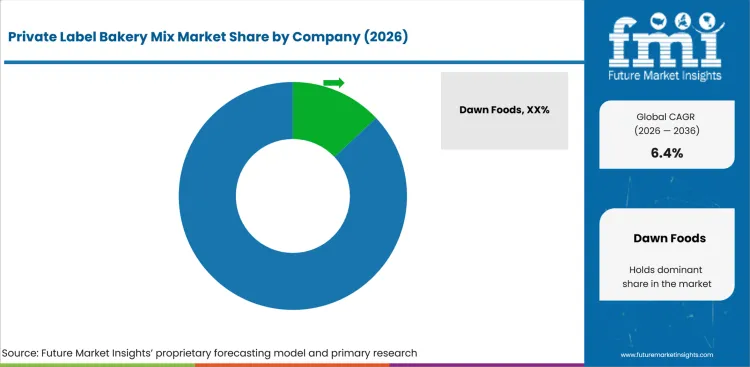
- Established bakery ingredient suppliers hold an advantage through application labs and retailer audit support.
- Private-label specialists gain shelf access when they combine carton design, allergen files, and low minimum order quantities.
- Milling-linked suppliers can protect flour quality better than pure packers during wheat supply shifts.
- Foodservice distributors gain value when they convert bakery mix programs into repeat kitchen contracts.
Bakery ingredient groups in the market compete by combining formulation service with retailer program management. Dawn Foods strengthened bakery ingredient depth after acquiring Royal Steensma in February 2024. Puratos used iba 2025 to present bakery solutions linked to convenience and fiber-rich formats. These moves show why suppliers must connect product development with retailer launch support. Buyers assess whether a supplier can deliver repeat texture and manage label documentation before giving shelf space.
Manufacturing scale is important, although it does not decide awards alone. Contract bakery mix buyers need dry blending capacity, allergen segregation, shelf-life testing, and pack change flexibility. Suppliers serving frozen bakery customers also bring process knowledge from thawing and reheating formats. Australia shows a related path because Australian bakery mixes benefit from concentrated supermarket range decisions. Smaller suppliers can still win local tenders if they shorten label cycles and support retailer audits.
Regional players can compete through local flavor knowledge and faster pack changes. Saudi Arabia needs halal documentation and Arabic-English labels. South Korea needs smaller dessert formats and convenience-store readiness. The United Kingdom needs value-tier packs that fit discounter shelves. Germany rewards suppliers that understand discounter documentation and bakery export flows. Companies with local QA teams and practical pack flexibility should gain better repeat listings.
Key Companies in the Private Label Bakery Mix Market
Competition differs across global bakery ingredient groups, regional millers, and private-label contract manufacturers. Local distributors add channel depth in grocery and foodservice accounts.
- Global Bakery Ingredient Groups: Dawn Foods and Puratos compete through formulation depth and bakery application centers. AB Mauri, Bakels, and Zeelandia add ingredient systems and technical service.
- Regional Millers and Mix Producers: GoodMills Innovation, IREKS, Allied Pinnacle, Modern Mills, and CJ CheilJedang compete through flour supply and bakery product development.
- Private-label and Foodservice Suppliers: BakeMark, Macphie, C.H. Guenther, and Lallemand Baking Solutions compete through foodservice access and contract pack capability.
Competitive Benchmarking: Private Label Bakery Mix Market
| Company | Relevance to Market Title | Private-label Program Depth | Bakery Application Support | Label and Audit Support | Channel Reach | Geographic Footprint |
|---|---|---|---|---|---|---|
| Dawn Foods | Very High | Very Strong | Very Strong | Strong | Very Strong | Global |
| Puratos Group | Very High | Strong | Very Strong | Strong | Very Strong | Global |
| CSM Ingredients | High | Strong | Strong | Strong | Strong | Europe and Americas |
| AB Mauri | High | Strong | Very Strong | Moderate | Strong | Global |
| Bakels Group | High | Moderate | Strong | Moderate | Strong | Global |
| Zeelandia International | High | Moderate | Strong | Strong | Strong | Europe and Asia |
| GoodMills Innovation | Moderate to High | Strong | Strong | Strong | Moderate | Europe |
| IREKS GmbH | Moderate to High | Moderate | Strong | Strong | Moderate | Europe |
| BakeMark USA | Moderate to High | Strong | Moderate | Moderate | Strong | United States |
| Modern Mills Company | Moderate | Moderate | Moderate | Strong | Moderate | Saudi Arabia |
Source: Future Market Insights competitive analysis, 2026.
Key Developments in Private Label Bakery Mix Market
- In April 2025, Dawn Foods introduced a seasonal cake program with three new cake mixes and two icings. The launch indicated continued supplier attention to cake mix systems and seasonal bakery merchandising.
- In November 2025, Associated British Foods reported AB Mauri’s bakery health and wellness work through its 2025 Annual Report. The cited product benefits included 25.0% sodium reduction, no preservatives or artificial colours and high fiber content.
- In May 2025, Puratos presented Cubease at iba as a concentrated bakery improver with one cube treating 10.0 kg of flour. The launch supports supplier focus on dosing ease and operational control for commercial bakeries.
Key Players in the Private Label Bakery Mix Market
- Dawn Foods
- Puratos Group
- CSM Ingredients
- AB Mauri
- Bakels Group
- Zeelandia International
- GoodMills Innovation
- IREKS GmbH
- BakeMark USA
- Modern Mills Company
Private Label Bakery Mix Market - Report Scope
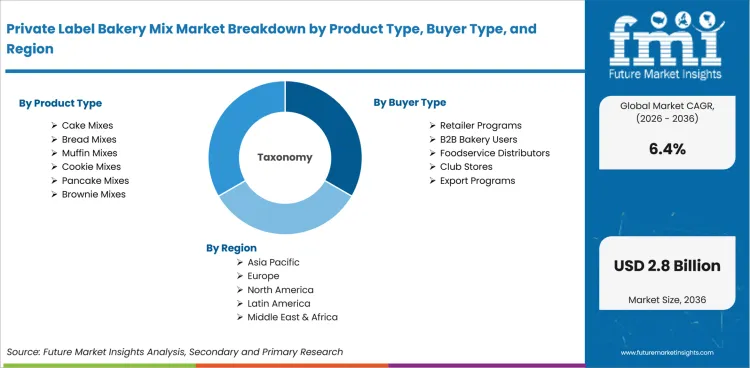
| Item | Value |
|---|---|
| Market size by 2036 | USD 2.8 billion |
| Growth rate | 6.4% CAGR from 2026 to 2036 |
| Forecast period | 2026 to 2036 |
| Base year value (2025) | USD 1.4 billion |
| By product type | Cake mixes, bread mixes, muffin mixes, cookie mixes, pancake mixes, brownie mixes |
| By buyer type | Retailer programs, B2B bakery users, foodservice distributors, club stores, export programs |
| By format | Powder mixes, wet mixes, frozen mixes, concentrates, sachet packs |
| By claim position | Clean label, high protein, gluten free, low sugar, organic |
| By sales channel | Supermarkets, direct B2B, club stores, online retail, distributors |
| Regions covered | North America, Europe, East Asia, South Asia and Pacific, Middle East and Africa, Australia |
| Countries covered | United States, Canada, Germany, United Kingdom, Saudi Arabia, South Korea, Australia |
| Key companies profiled | Dawn Foods, Puratos, CSM Ingredients, AB Mauri, Bakels, Zeelandia, GoodMills Innovation, IREKS |
| Approach | Bottom-up product-boundary approach using eligible SKU revenue, B2B pack supply, retailer brand programs, country channel share, and private-label adoption patterns |
Source: Future Market Insights, 2026.
Private Label Bakery Mix Market Breakdown by Product Type, Buyer Type, Format, Claim Position, Sales Channel, and Region
Private Label Bakery Mix Market Segmented by Product Type
- Cake Mixes
- Bread Mixes
- Muffin Mixes
- Cookie Mixes
- Pancake Mixes
- Brownie Mixes
Private Label Bakery Mix Market Segmented by Buyer Type
- Retailer Programs
- B2B Bakery Users
- Foodservice Distributors
- Club Stores
- Export Programs
Private Label Bakery Mix Market Segmented by Format
- Powder Mixes
- Wet Mixes
- Frozen Mixes
- Concentrates
- Sachet Packs
Private Label Bakery Mix Market Segmented by Claim Position
- Clean Label
- High Protein
- Gluten Free
- Low Sugar
- Organic
Private Label Bakery Mix Market Segmented by Sales Channel
- Supermarkets
- Direct B2B
- Club Stores
- Online Retail
- Distributors
Private Label Bakery Mix Market by Region
- North America
- Europe
- East Asia
- South Asia and Pacific
- Middle East and Africa
- Australia
Research Sources and Bibliography
- Agriculture and Agri-Food Canada. (2026, March 4). Sector trend analysis: Bakery trends in Canada.
- Agriculture and Agri-Food Canada. (2025). Sector trend analysis: Bakery trends in South Korea.
- Associated British Foods plc. (2025). AB Mauri: Championing health and wellness in bakery.
- Australian Bureau of Statistics. (2025, July 31). Retail trade, Australia, June 2025.
- Bakels Group. (2025, July 8). Bakels worldwide review: Edition 176.
- Dawn Foods. (2024, February 6). Dawn Foods acquires Royal Steensma.
- Dawn Foods. (2025, April 4). Dawn Foods unveils new products to meet seasonal flavor needs.
- Eurostat. (2025, November). Retail trade volume index, September 2025.
- Future Market Insights. (2026). Bakery mixes market size, share, and forecast to 2036.
- Future Market Insights. (2026). Bakery ingredients market trends 2026 to 2036.
- Future Market Insights. (2026). Dough based premixes market outlook to 2036.
- Future Market Insights. (2026). Flour mixes market outlook to 2036.
- Office for National Statistics. (2025, July 25). Retail sales, Great Britain: June 2025.
- Private Label Manufacturers Association International. (2026). European private label sales rose to 355 billion euro last year.
- Puratos Group. (2025). Puratos brings a trio of baking solutions to iba 2025.
- United Kingdom Flour Millers. (2025). Nourishing the nation: UK flour milling economic impact report 2025.
- United States Department of Agriculture Economic Research Service. (2026, April 30). Charting the essentials: Food prices and spending.
- United States Department of Agriculture Economic Research Service. (2026, May 22). Food price outlook: Summary findings.
- United States Department of Agriculture Foreign Agricultural Service. (2025, September 24). Retail foods annual: Saudi Arabia.
- United States Department of Agriculture Foreign Agricultural Service. (2026, January 29). 2025 trends in South Korea food sector.
- United States Department of Agriculture National Agricultural Statistics Service. (2026, May 1). Flour milling products 2025 summary.
This bibliography is provided for reader reference and is not exhaustive. The full report contains the complete reference list and detailed citations.
This Report Answers
- What is the 2026 value and 2036 forecast for private label bakery mix market?
- What format is projected to hold the leading share during the forecast period?
- What buyer type is expected to account for the leading 2026 share?
- How do retailer brand programs affect bakery mix procurement?
- What companies compete in private-label bakery mixes?
Frequently Asked Questions
What is the private label bakery mix market size in 2026?
The private label bakery mix market size is anticipated to cross USD 1.5 billion in 2026.
What is the private label bakery mix market forecast for 2036?
The private label bakery mix industry revenue is predicted to reach USD 2.8 billion by 2036 as retailer programs and B2B bakery use expand.
What is the private label bakery mix market CAGR?
The private label bakery mix sector is projected to expand at 6.4% CAGR from 2026 to 2036.
What segment leads the private label bakery mix market?
Powder mixes are likely to capture 68.0% share in 2026 due to shelf-stable storage and easier distribution.
What country grows fastest in the private label bakery mix market?
Saudi Arabia is set to record 7.4% CAGR by 2036, driven by modern grocery and foodservice expansion.
Preview the report firsthand - request a free sample
Get SampleGet the brochure for pricing and purchase details.
Get PDFTable of Content
- Executive Summary
- Global Market Outlook
- Demand to side Trends
- Supply to side Trends
- Technology Roadmap Analysis
- Analysis and Recommendations
- Market Overview
- Market Coverage / Taxonomy
- Market Definition / Scope / Limitations
- Research Methodology
- Chapter Orientation
- Analytical Lens and Working Hypotheses
- Market Structure, Signals, and Trend Drivers
- Benchmarking and Cross-market Comparability
- Market Sizing, Forecasting, and Opportunity Mapping
- Research Design and Evidence Framework
- Desk Research Programme (Secondary Evidence)
- Company Annual and Sustainability Reports
- Peer-reviewed Journals and Academic Literature
- Corporate Websites, Product Literature, and Technical Notes
- Earnings Decks and Investor Briefings
- Statutory Filings and Regulatory Disclosures
- Technical White Papers and Standards Notes
- Trade Journals, Industry Magazines, and Analyst Briefs
- Conference Proceedings, Webinars, and Seminar Materials
- Government Statistics Portals and Public Data Releases
- Press Releases and Reputable Media Coverage
- Specialist Newsletters and Curated Briefings
- Sector Databases and Reference Repositories
- FMI Internal Proprietary Databases and Historical Market Datasets
- Subscription Datasets and Paid Sources
- Social Channels, Communities, and Digital Listening Inputs
- Additional Desk Sources
- Expert Input and Fieldwork (Primary Evidence)
- Primary Modes
- Qualitative Interviews and Expert Elicitation
- Quantitative Surveys and Structured Data Capture
- Blended Approach
- Why Primary Evidence is Used
- Field Techniques
- Interviews
- Surveys
- Focus Groups
- Observational and In-context Research
- Social and Community Interactions
- Stakeholder Universe Engaged
- C-suite Leaders
- Board Members
- Presidents and Vice Presidents
- R&D and Innovation Heads
- Technical Specialists
- Domain Subject-matter Experts
- Scientists
- Physicians and Other Healthcare Professionals
- Governance, Ethics, and Data Stewardship
- Research Ethics
- Data Integrity and Handling
- Primary Modes
- Tooling, Models, and Reference Databases
- Desk Research Programme (Secondary Evidence)
- Data Engineering and Model Build
- Data Acquisition and Ingestion
- Cleaning, Normalisation, and Verification
- Synthesis, Triangulation, and Analysis
- Quality Assurance and Audit Trail
- Market Background
- Market Dynamics
- Drivers
- Restraints
- Opportunity
- Trends
- Scenario Forecast
- Demand in Optimistic Scenario
- Demand in Likely Scenario
- Demand in Conservative Scenario
- Opportunity Map Analysis
- Product Life Cycle Analysis
- Supply Chain Analysis
- Investment Feasibility Matrix
- Value Chain Analysis
- PESTLE and Porter’s Analysis
- Regulatory Landscape
- Regional Parent Market Outlook
- Production and Consumption Statistics
- Import and Export Statistics
- Market Dynamics
- Global Market Analysis 2021 to 2025 and Forecast, 2026 to 2036
- Historical Market Size Value (USD Million) Analysis, 2021 to 2025
- Current and Future Market Size Value (USD Million) Projections, 2026 to 2036
- Y to o to Y Growth Trend Analysis
- Absolute $ Opportunity Analysis
- Global Market Pricing Analysis 2021 to 2025 and Forecast 2026 to 2036
- Global Market Analysis 2021 to 2025 and Forecast 2026 to 2036, By Label Owner
- Introduction / Key Findings
- Historical Market Size Value (USD Million) Analysis By Label Owner , 2021 to 2025
- Current and Future Market Size Value (USD Million) Analysis and Forecast By Label Owner , 2026 to 2036
- Retailer Brands
- Importer Brands
- Distributor Brands
- Foodservice Brands
- Co-packed Brands
- Retailer Brands
- Y to o to Y Growth Trend Analysis By Label Owner , 2021 to 2025
- Absolute $ Opportunity Analysis By Label Owner , 2026 to 2036
- Global Market Analysis 2021 to 2025 and Forecast 2026 to 2036, By Product Format
- Introduction / Key Findings
- Historical Market Size Value (USD Million) Analysis By Product Format, 2021 to 2025
- Current and Future Market Size Value (USD Million) Analysis and Forecast By Product Format, 2026 to 2036
- Canned
- Carton
- Pouch
- Aseptic Bottle
- Bulk Pack
- Canned
- Y to o to Y Growth Trend Analysis By Product Format, 2021 to 2025
- Absolute $ Opportunity Analysis By Product Format, 2026 to 2036
- Global Market Analysis 2021 to 2025 and Forecast 2026 to 2036, By Nature
- Introduction / Key Findings
- Historical Market Size Value (USD Million) Analysis By Nature, 2021 to 2025
- Current and Future Market Size Value (USD Million) Analysis and Forecast By Nature, 2026 to 2036
- Conventional
- Organic
- Clean Label
- Fortified
- Low Fat
- Conventional
- Y to o to Y Growth Trend Analysis By Nature, 2021 to 2025
- Absolute $ Opportunity Analysis By Nature, 2026 to 2036
- Global Market Analysis 2021 to 2025 and Forecast 2026 to 2036, By Packaging Type
- Introduction / Key Findings
- Historical Market Size Value (USD Million) Analysis By Packaging Type, 2021 to 2025
- Current and Future Market Size Value (USD Million) Analysis and Forecast By Packaging Type, 2026 to 2036
- Metal Can
- Aseptic Carton
- Flexible Pouch
- Glass Bottle
- Bag-in-Box
- Metal Can
- Y to o to Y Growth Trend Analysis By Packaging Type, 2021 to 2025
- Absolute $ Opportunity Analysis By Packaging Type, 2026 to 2036
- Global Market Analysis 2021 to 2025 and Forecast 2026 to 2036, By End Use
- Introduction / Key Findings
- Historical Market Size Value (USD Million) Analysis By End Use, 2021 to 2025
- Current and Future Market Size Value (USD Million) Analysis and Forecast By End Use, 2026 to 2036
- Cooking
- Beverages
- Bakery
- Desserts
- Foodservice
- Cooking
- Y to o to Y Growth Trend Analysis By End Use, 2021 to 2025
- Absolute $ Opportunity Analysis By End Use, 2026 to 2036
- Global Market Analysis 2021 to 2025 and Forecast 2026 to 2036, By Sales Channel
- Introduction / Key Findings
- Historical Market Size Value (USD Million) Analysis By Sales Channel, 2021 to 2025
- Current and Future Market Size Value (USD Million) Analysis and Forecast By Sales Channel, 2026 to 2036
- Supermarkets
- Club Stores
- Online Grocery
- Specialty Stores
- Cash-and-Carry
- Supermarkets
- Y to o to Y Growth Trend Analysis By Sales Channel, 2021 to 2025
- Absolute $ Opportunity Analysis By Sales Channel, 2026 to 2036
- Global Market Analysis 2021 to 2025 and Forecast 2026 to 2036, By Region
- Introduction
- Historical Market Size Value (USD Million) Analysis By Region, 2021 to 2025
- Current Market Size Value (USD Million) Analysis and Forecast By Region, 2026 to 2036
- North America
- Latin America
- Western Europe
- Eastern Europe
- East Asia
- South Asia and Pacific
- Middle East & Africa
- Market Attractiveness Analysis By Region
- North America Market Analysis 2021 to 2025 and Forecast 2026 to 2036, By Country
- Historical Market Size Value (USD Million) Trend Analysis By Market Taxonomy, 2021 to 2025
- Market Size Value (USD Million) Forecast By Market Taxonomy, 2026 to 2036
- By Country
- USA
- Canada
- Mexico
- By Label Owner
- By Product Format
- By Nature
- By Packaging Type
- By End Use
- By Sales Channel
- By Country
- Market Attractiveness Analysis
- By Country
- By Label Owner
- By Product Format
- By Nature
- By Packaging Type
- By End Use
- By Sales Channel
- Key Takeaways
- Latin America Market Analysis 2021 to 2025 and Forecast 2026 to 2036, By Country
- Historical Market Size Value (USD Million) Trend Analysis By Market Taxonomy, 2021 to 2025
- Market Size Value (USD Million) Forecast By Market Taxonomy, 2026 to 2036
- By Country
- Brazil
- Chile
- Rest of Latin America
- By Label Owner
- By Product Format
- By Nature
- By Packaging Type
- By End Use
- By Sales Channel
- By Country
- Market Attractiveness Analysis
- By Country
- By Label Owner
- By Product Format
- By Nature
- By Packaging Type
- By End Use
- By Sales Channel
- Key Takeaways
- Western Europe Market Analysis 2021 to 2025 and Forecast 2026 to 2036, By Country
- Historical Market Size Value (USD Million) Trend Analysis By Market Taxonomy, 2021 to 2025
- Market Size Value (USD Million) Forecast By Market Taxonomy, 2026 to 2036
- By Country
- Germany
- UK
- Italy
- Spain
- France
- Nordic
- BENELUX
- Rest of Western Europe
- By Label Owner
- By Product Format
- By Nature
- By Packaging Type
- By End Use
- By Sales Channel
- By Country
- Market Attractiveness Analysis
- By Country
- By Label Owner
- By Product Format
- By Nature
- By Packaging Type
- By End Use
- By Sales Channel
- Key Takeaways
- Eastern Europe Market Analysis 2021 to 2025 and Forecast 2026 to 2036, By Country
- Historical Market Size Value (USD Million) Trend Analysis By Market Taxonomy, 2021 to 2025
- Market Size Value (USD Million) Forecast By Market Taxonomy, 2026 to 2036
- By Country
- Russia
- Poland
- Hungary
- Balkan & Baltic
- Rest of Eastern Europe
- By Label Owner
- By Product Format
- By Nature
- By Packaging Type
- By End Use
- By Sales Channel
- By Country
- Market Attractiveness Analysis
- By Country
- By Label Owner
- By Product Format
- By Nature
- By Packaging Type
- By End Use
- By Sales Channel
- Key Takeaways
- East Asia Market Analysis 2021 to 2025 and Forecast 2026 to 2036, By Country
- Historical Market Size Value (USD Million) Trend Analysis By Market Taxonomy, 2021 to 2025
- Market Size Value (USD Million) Forecast By Market Taxonomy, 2026 to 2036
- By Country
- China
- Japan
- South Korea
- By Label Owner
- By Product Format
- By Nature
- By Packaging Type
- By End Use
- By Sales Channel
- By Country
- Market Attractiveness Analysis
- By Country
- By Label Owner
- By Product Format
- By Nature
- By Packaging Type
- By End Use
- By Sales Channel
- Key Takeaways
- South Asia and Pacific Market Analysis 2021 to 2025 and Forecast 2026 to 2036, By Country
- Historical Market Size Value (USD Million) Trend Analysis By Market Taxonomy, 2021 to 2025
- Market Size Value (USD Million) Forecast By Market Taxonomy, 2026 to 2036
- By Country
- India
- ASEAN
- Australia & New Zealand
- Rest of South Asia and Pacific
- By Label Owner
- By Product Format
- By Nature
- By Packaging Type
- By End Use
- By Sales Channel
- By Country
- Market Attractiveness Analysis
- By Country
- By Label Owner
- By Product Format
- By Nature
- By Packaging Type
- By End Use
- By Sales Channel
- Key Takeaways
- Middle East & Africa Market Analysis 2021 to 2025 and Forecast 2026 to 2036, By Country
- Historical Market Size Value (USD Million) Trend Analysis By Market Taxonomy, 2021 to 2025
- Market Size Value (USD Million) Forecast By Market Taxonomy, 2026 to 2036
- By Country
- Kingdom of Saudi Arabia
- Other GCC Countries
- Turkiye
- South Africa
- Other African Union
- Rest of Middle East & Africa
- By Label Owner
- By Product Format
- By Nature
- By Packaging Type
- By End Use
- By Sales Channel
- By Country
- Market Attractiveness Analysis
- By Country
- By Label Owner
- By Product Format
- By Nature
- By Packaging Type
- By End Use
- By Sales Channel
- Key Takeaways
- Key Countries Market Analysis
- USA
- Pricing Analysis
- Market Share Analysis, 2025
- By Label Owner
- By Product Format
- By Nature
- By Packaging Type
- By End Use
- By Sales Channel
- Canada
- Pricing Analysis
- Market Share Analysis, 2025
- By Label Owner
- By Product Format
- By Nature
- By Packaging Type
- By End Use
- By Sales Channel
- Mexico
- Pricing Analysis
- Market Share Analysis, 2025
- By Label Owner
- By Product Format
- By Nature
- By Packaging Type
- By End Use
- By Sales Channel
- Brazil
- Pricing Analysis
- Market Share Analysis, 2025
- By Label Owner
- By Product Format
- By Nature
- By Packaging Type
- By End Use
- By Sales Channel
- Chile
- Pricing Analysis
- Market Share Analysis, 2025
- By Label Owner
- By Product Format
- By Nature
- By Packaging Type
- By End Use
- By Sales Channel
- Germany
- Pricing Analysis
- Market Share Analysis, 2025
- By Label Owner
- By Product Format
- By Nature
- By Packaging Type
- By End Use
- By Sales Channel
- UK
- Pricing Analysis
- Market Share Analysis, 2025
- By Label Owner
- By Product Format
- By Nature
- By Packaging Type
- By End Use
- By Sales Channel
- Italy
- Pricing Analysis
- Market Share Analysis, 2025
- By Label Owner
- By Product Format
- By Nature
- By Packaging Type
- By End Use
- By Sales Channel
- Spain
- Pricing Analysis
- Market Share Analysis, 2025
- By Label Owner
- By Product Format
- By Nature
- By Packaging Type
- By End Use
- By Sales Channel
- France
- Pricing Analysis
- Market Share Analysis, 2025
- By Label Owner
- By Product Format
- By Nature
- By Packaging Type
- By End Use
- By Sales Channel
- India
- Pricing Analysis
- Market Share Analysis, 2025
- By Label Owner
- By Product Format
- By Nature
- By Packaging Type
- By End Use
- By Sales Channel
- ASEAN
- Pricing Analysis
- Market Share Analysis, 2025
- By Label Owner
- By Product Format
- By Nature
- By Packaging Type
- By End Use
- By Sales Channel
- Australia & New Zealand
- Pricing Analysis
- Market Share Analysis, 2025
- By Label Owner
- By Product Format
- By Nature
- By Packaging Type
- By End Use
- By Sales Channel
- China
- Pricing Analysis
- Market Share Analysis, 2025
- By Label Owner
- By Product Format
- By Nature
- By Packaging Type
- By End Use
- By Sales Channel
- Japan
- Pricing Analysis
- Market Share Analysis, 2025
- By Label Owner
- By Product Format
- By Nature
- By Packaging Type
- By End Use
- By Sales Channel
- South Korea
- Pricing Analysis
- Market Share Analysis, 2025
- By Label Owner
- By Product Format
- By Nature
- By Packaging Type
- By End Use
- By Sales Channel
- Russia
- Pricing Analysis
- Market Share Analysis, 2025
- By Label Owner
- By Product Format
- By Nature
- By Packaging Type
- By End Use
- By Sales Channel
- Poland
- Pricing Analysis
- Market Share Analysis, 2025
- By Label Owner
- By Product Format
- By Nature
- By Packaging Type
- By End Use
- By Sales Channel
- Hungary
- Pricing Analysis
- Market Share Analysis, 2025
- By Label Owner
- By Product Format
- By Nature
- By Packaging Type
- By End Use
- By Sales Channel
- Kingdom of Saudi Arabia
- Pricing Analysis
- Market Share Analysis, 2025
- By Label Owner
- By Product Format
- By Nature
- By Packaging Type
- By End Use
- By Sales Channel
- Turkiye
- Pricing Analysis
- Market Share Analysis, 2025
- By Label Owner
- By Product Format
- By Nature
- By Packaging Type
- By End Use
- By Sales Channel
- South Africa
- Pricing Analysis
- Market Share Analysis, 2025
- By Label Owner
- By Product Format
- By Nature
- By Packaging Type
- By End Use
- By Sales Channel
- USA
- Market Structure Analysis
- Competition Dashboard
- Competition Benchmarking
- Market Share Analysis of Top Players
- By Regional
- By Label Owner
- By Product Format
- By Nature
- By Packaging Type
- By End Use
- By Sales Channel
- Competition Analysis
- Competition Deep Dive
- Thai Coconut Public Company Limited
- Overview
- Product Portfolio
- Profitability by Market Segments (Product/Age /Sales Channel/Region)
- Sales Footprint
- Strategy Overview
- Marketing Strategy
- Product Strategy
- Channel Strategy
- Erawan Food Public Company Limited
- Thai Agri Foods Public Company Limited
- Theppadungporn Coconut Co., Ltd.
- Sambu Group
- Celebes Coconut Corporation
- Primex Coco Products, Inc.
- Thai Coconut Public Company Limited
- Competition Deep Dive
- Assumptions & Acronyms Used


