

- Market Size (2026)
- USD 715.0 Mn
- Forecast (2036)
- USD 1888.5 Mn
- CAGR (2026 to 2036)
- 10.2%
How big is Clean Label Bread Market in 2026?
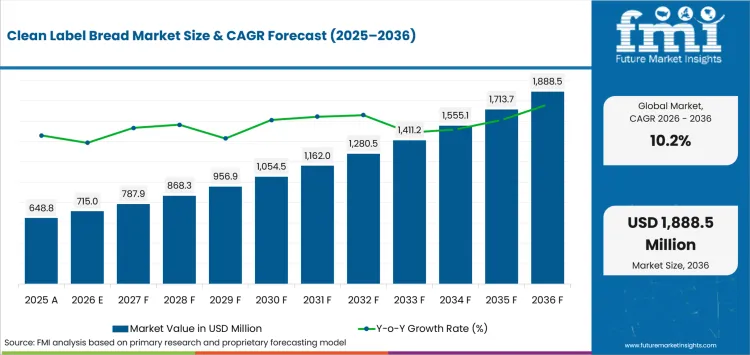
USD 715.0 million in 2026 and USD 1888.5 million by 2036 at a 10.2% CAGR.
The clean label bread market is projected to expand from USD 715.0 million in 2026 to USD 1888.5 million by 2036 at a 10.2% CAGR. Commercial growth depends on bakers removing selected additives without losing softness or line consistency during normal production. In May 2025, dsm-firmenich opened its Princeton Baking Innovation Center to test breads and rolls with bakery technology and sensory tools. That investment makes formulation support part of the purchase decision for bakery ingredients and related clean-label systems.
Country rules change which cleaner recipes can scale through mainstream retail without weakening nutrition claims or shelf communication. The FDA's updated healthy-claim criteria became usable in April 2025 and specifically removed fortified white bread from qualifying examples. USA manufacturers therefore need ingredient simplification to work beside nutrient thresholds while other countries impose different label and nutrition tests. That divergence also increases demand for natural food preservatives that preserve distribution performance without complicating the ingredient statement.
Key Takeaways
- Demand is concentrated around bread recipes that simplify ingredient statements without sacrificing softness or commercial shelf life during normal retail distribution.
- Based on product type, classic - original is projected to account for 37.0% in 2026 due to familiar loaves reducing trial risk during recipe changes.
- By claim - nature, conventional is estimated to hold 57.0% in 2026 owing to mainstream recipes simplifying ingredients without certification premiums.
- In 2026, fresh is expected to lead format with 35.0% share because sensory quality supports repeat purchase despite tighter replenishment windows.
- Reduced preservatives and functional additives can shorten sellable life unless bakers qualify replacement systems against mold control and texture requirements.
- Some of the key players in this market include Dr. Schär, Flowers Foods, Grupo Bimbo, Hovis Limited, Warburtons, Lantmännen Unibake, ARYZTA AG, and La Lorraine Bakery Group.
Analyst Perspective
"Clean label bread earns repeat orders after a simpler formula survives plant handling and the full retail shelf-life window. Manufacturers should compare ingredient declarations with waste exposure and repeat-purchase performance because a cheaper reformulation can become expensive through returns."
- Nandini Roy Choudhury, Principal Consultant, Future Market Insights
How is the Clean Label Bread Market segmented?
The clean label bread market is segmented by product type, claim - nature, format, packaging format, sales channel and region.
Product type includes classic - original, whole grain & seeded, flavored & filled, mini & snacking formats and premium / artisan. Claim - nature covers conventional, clean label, organic, gluten-free and high-protein / fortified. Format includes fresh, frozen, ambient packaged, chilled and par-baked / thaw-and-serve. Packaging format includes multipack, single-serve, family / loaf pack and bulk foodservice. Sales channel covers supermarkets & hypermarkets, artisan & specialty bakeries, convenience & forecourt, online & DTC and foodservice distributors.
Why does Conventional lead demand within the Claim - Nature category?
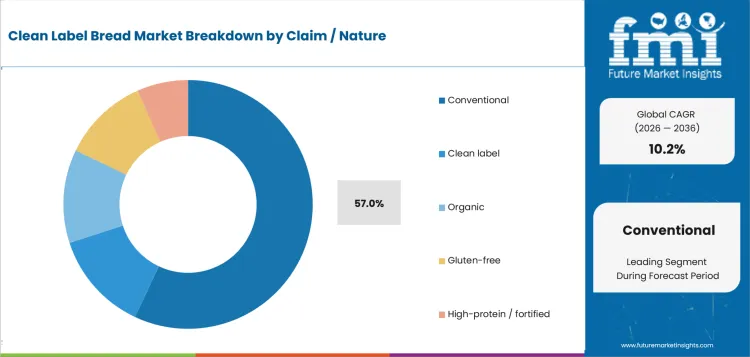
Conventional bread gives manufacturers wider formulation and pricing room because recipe simplification does not require organic certification or specialist free-from sourcing.
- In 2026, conventional is expected to lead claim - nature with 57.0% share because mainstream recipes retain broad price and channel coverage during ingredient simplification.
- Large bakery groups can phase ingredient changes through existing brands without rebuilding every claim architecture. Grupo Bimbo stated in July 2025 that its daily-consumption portfolio included breads and buns without artificial colors while 99% contained no artificial flavors. Clean-label bakery enzymes remain useful where simpler declarations must preserve dough tolerance during high-volume production.
Why does Classic - Original lead demand within the Product Type category?
Classic loaves carry the lowest behavior-change burden because shoppers already know the expected slice size and eating quality. Hovis reinforced that route in June 2025 by launching White n' Fibre and Signature White loaves beside a wholemeal farmhouse variant for mainstream grocery shelves.
- By product type, classic - original is estimated to hold 37.0% in 2026 owing to familiar loaf architecture that reduces trial risk during recipe reformulation.
- Familiar loaf expectations shift qualification toward texture and freshness instead of flavor education during reformulation trials. Bakers can use bread improvers selectively while keeping the visible recipe easier to understand commercially.
How does Fresh maintain its position within the Format category?
Fresh bread gives shoppers a direct sensory test because crust condition and softness are visible during the purchase decision. La Lorraine Bakery Group opened a new artisan bread line in Türkiye in May 2026 to expand locally produced bake-off capacity for regional customers.
- The fresh segment is likely to capture 35.0% share in 2026 attributable to near-store baking and shorter handling cycles that reinforce perceived bakery quality.
- Shorter retail windows leave less room for forecasting error after preservatives are reduced from fresh bread recipes. Sourdough products can differentiate the loaf while operators control production cadence and local retail sell-through.
Why do Supermarkets & Hypermarkets lead demand within the Sales Channel category?
Large grocery stores place mainstream and specialty loaves in the same comparison set where ingredient statements compete beside price and freshness.
- Based on sales channel, supermarkets & hypermarkets are projected to account for 39.0% in 2026 due to routine grocery traffic and direct shelf comparison.
- Retail waste and repeat-purchase data expose reformulation failures quickly after a loaf enters high-volume grocery distribution. Flowers Foods expanded several Nature's Own and Dave's Killer Bread lines in April 2025 with nationwide launches and additional small-loaf formats. Brands therefore need flour improvers and process controls that hold texture during frequent national replenishment cycles.
What are the drivers, restraints and opportunities in the Clean Label Bread Market?
Ingredient scrutiny increases reformulation demand while shelf-life risk limits additive removal and functional recipes expand higher-value bread propositions.
- Driver: Front-of-pack nutrition scrutiny increases pressure for cleaner bread recipes that also meet sodium and added-sugar expectations.
- Restraint: Preservative reduction can narrow mold-control margins and increase waste before a replacement system proves equivalent shelf performance.
- Opportunity: Protein-rich and fermented loaves give bakers a clearer value proposition if ingredient simplification remains visible to shoppers.
Packaged bread manufacturers need nutrition and recipe changes to work together at the point of retail comparison. In January 2025, the FDA proposed a front-of-package Nutrition Info box that would classify saturated fat plus sodium and added sugars as Low / Med / High. The proposal raises the commercial value of baking enzymes and reformulation work that improves nutrient composition without sacrificing loaf texture or normal production performance.
A preservative change becomes costly if mold appears earlier or crumb quality falls inside the stated sell-by window. Corbion launched Verdad Essence WH100 in April 2025 for natural mold inhibition in breads and buns without sacrificing taste or texture. The launch explains why food preservatives and full-route trials remain central to cleaner labels that must protect shelf life through warehouse handling and routine retail distribution.
Functional nutrition gives cleaner bread a reason to earn a premium beyond a shorter ingredient list in crowded grocery aisles. Flowers Foods launched a higher-protein Nature's Own loaf and an organic Dave's Killer Bread sourdough in October 2025. Flowers Foods' launch gives manufacturers a practical route into protein and fermentation claims while bread dough improvers protect familiar eating quality during larger commercial production runs.
Which country CAGRs are profiled in the Clean Label Bread Market?
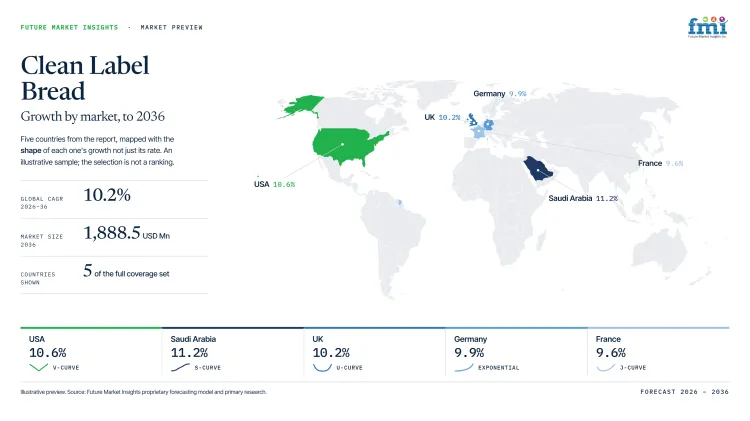
| Country | CAGR |
|---|---|
| Saudi Arabia | 11.2% |
| USA | 10.6% |
| UK | 10.2% |
| Germany | 9.9% |
| France | 9.6% |
How do country-level CAGRs compare in the Clean Label Bread Market?
The five profiled markets span 1.6 percentage points, from Saudi Arabia at 11.2% to France at 9.6%. Gulf markets lead the range, supported by nutrition-focused foodservice requirements and evolving bakery demand. The USA and UK follow, while Germany and France represent more mature bakery markets with comparatively moderate growth.
- Saudi Arabia sees nutrition and menu rules increase focus on sodium and nutritional information across bakery and foodservice channels.
- The USA maintains strong wheat and sesame controls through allergen rules covering bakery reformulation and labeling.
- The UK applies bread composition rules that influence recipe development and product claims across grocery bakery products.
- Germany enforces strict labeling standards that require detailed ingredient documentation for bakery products.
- France applies food-information rules that support compliant recipes and greater ingredient transparency.
Those CAGRs translate into different compliance costs and route-to-shelf requirements for bread manufacturers. The full report provides country-level CAGR analysis across North America, Latin America, Europe, East Asia, South Asia, Oceania and the Middle East and Africa.
Country-wise Analysis
- Saudi Arabia’s bread market is shaped by frequent staple consumption and tighter nutrition requirements across foodservice. The SFDA announced in June 2025 that high-sodium menu labels would become mandatory from July 1. Clean label bread demand is projected to grow at 11.2% CAGR through 2036, supported by routine bread demand and expanding modern food channels. Manufacturers therefore need sodium control that maintains familiar taste without creating a sharp price premium.
- The USA has a large grocery market where allergen declarations, ingredient lists, and nutrition claims influence bakery launches. The FDA’s January 2025 allergen-labeling guidance keeps wheat and sesame controls important during clean-recipe development. Clean label bread demand is forecast to grow at 10.6% CAGR through 2036, supported by broad retail distribution. Manufacturers must therefore align simpler recipes with allergen controls, plant segregation, and packaging requirements.
- The UK has mature grocery channels where mainstream and free-from breads compete for limited shelf space. April 2025 guidance from Defra and the Food Standards Agency covered bread composition, fortified flour, and nutrition claims. Clean label bread demand is estimated to grow at 10.2% CAGR through 2036, supported by strong grocery coverage. Manufacturers therefore need clear nutritional or sensory benefits beyond basic ingredient reduction.
- Germany’s established bakery industry provides a strong base for clean label bread, while strict food-information requirements increase the importance of accurate ingredient and nutrition documentation. Clean label bread demand is projected to grow at 9.9% CAGR through 2036, supported by established retail networks and consumer interest in transparent formulations. Manufacturers must balance cleaner recipes with familiar taste, texture, and regulatory compliance.
- France’s mature bakery market combines strong bread consumption with established product standards and detailed food-information requirements. Clean label bread demand is forecast to grow at 9.6% CAGR through 2036, supported by premium bakery positioning and established grocery distribution. Manufacturers therefore need to demonstrate clear ingredient, nutritional, or sensory value while preserving the quality expected from traditional bread products.
Who are the notable companies in the Clean Label Bread Market?
Dr. Schär, Flowers Foods, Grupo Bimbo, Hovis Limited, Warburtons, Lantmännen Unibake, ARYZTA AG, and La Lorraine Bakery Group are the notable companies serving this market.
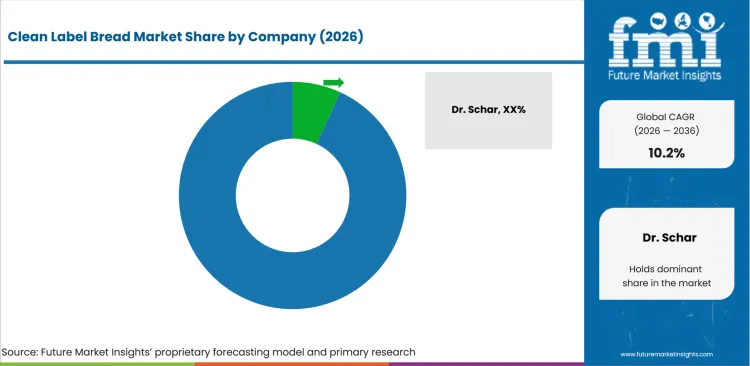
Competition is concentrated among packaged-bread groups with owned bakery networks and specialists that document recipe control in multiple formats. Retailers compare bakery improvers with plant consistency because high-frequency bread lines cannot tolerate repeated texture or replenishment failures.
- Global packaged-bread operators: Flowers Foods and Grupo Bimbo pair broad branded portfolios with national or international production and retail distribution.
- UK bread specialists: Hovis Limited and Warburtons compete through grocery relationships, wide loaf ranges and frequent domestic replenishment.
- International bakery manufacturers: Dr. Schär and Lantmännen Unibake serve free-from or bake-off routes alongside ARYZTA AG and La Lorraine Bakery Group in multiple regions.
Competitive Benchmarking: Clean Label Bread Market
| Company | Bread Portfolio Depth | Production Network Scale | Channel Breadth | Geographic Reach |
|---|---|---|---|---|
| Dr. Schär | High | High | Medium | Europe, North America and international markets |
| Flowers Foods | High | High | High | United States |
| Grupo Bimbo | High | High | High | Global |
| Hovis Limited | High | Medium | Medium | United Kingdom and Ireland |
| Warburtons | High | High | Medium | United Kingdom |
| Lantmännen Unibake | High | High | High | Europe and international markets |
| ARYZTA AG | Medium | High | High | Europe, Asia, Australia and New Zealand |
| La Lorraine Bakery Group | High | High | High | Europe, North America and Middle East |
Scoring basis: High bread portfolio depth requires three documented bread formats while Medium requires two and Low one. High production network scale requires multiple bakery sites or major capacity lines while Medium reflects one principal base and Low one specialty line. High channel breadth requires commercial routes in more than one geography while Medium reflects two routes in one main geography and Low one. Geographic reach follows current official company evidence listed in the bibliography.
Key Developments in the Clean Label Bread Market
- In October 2025, Hovis Limited launched its first sourdough cobs for Tesco and Morrisons after more than a year of product development.
- In June 2025, Lantmännen Unibake announced a 13,000-square-meter bread facility in Örebro to expand hotdog and burger bun production capacity.
- In February 2025, Dr. Schär reported that it had centralized USA operations in Swedesboro and enhanced a facility dedicated to gluten-free bread and rolls.
Key Players in the Clean Label Bread Market
Global and Specialty Bread Platforms
- Dr. Schär
- Flowers Foods
- Grupo Bimbo
UK Bread Specialists
- Hovis Limited
- Warburtons
International Bakery Manufacturers
- Lantmännen Unibake
- ARYZTA AG
- La Lorraine Bakery Group
Clean Label Bread Market - Report Scope
| Coverage field | Report scope |
|---|---|
| Market breakdown | By product type, claim - nature, format, packaging format, sales channel and region. |
| Quantitative Units | USD Million. |
| Market Definition | Commercial bread products positioned around simpler or more recognizable ingredient systems within the defined product, claim, format, packaging and sales-channel scope. |
| Regions Covered | North America, Latin America, Europe, East Asia, South Asia and Pacific, and Middle East and Africa. |
| Countries Covered | UAE, Saudi Arabia, South Korea, USA, UK, and 20+ countries included in the full report. |
| Key Companies Profiled | Dr. Schär, Flowers Foods, Grupo Bimbo, Hovis Limited, Warburtons, Lantmännen Unibake, ARYZTA AG, and La Lorraine Bakery Group. |
| Forecast Period | 2026 to 2036. |
| Approach | Primary and secondary research with market triangulation. |
Clean Label Bread Market - Research Methodology
| Method | Approach |
|---|---|
| Primary Research | FMI analysts gathered input from manufacturers, service providers, technology developers, distributors, end users, procurement teams, and subject-matter experts. Interviews examined purchasing decisions, product or service evaluation, adoption barriers, approval requirements, pricing considerations, and expectations for technical or commercial support. Respondents were also asked what evidence is required before a trial, pilot, or initial order develops into regular purchasing. |
| Desk Research | Desk research covered government statistics, regulatory publications, trade data, industry associations, technical literature, standards, company filings, product information, and official corporate announcements. Sources were reviewed for relevance, publication date, geographic coverage, and consistency with the defined market scope. Claims relating to performance, applications, approvals, capacity, investment, and commercial activity were retained only when supported by credible public evidence. |
| Market Sizing and Forecasting | The market model combined the baseline value with historical performance, segment structure, pricing and volume indicators, adoption levels, company participation, and country-level demand conditions. Forecast assumptions considered economic activity, investment trends, regulatory developments, technology adoption, purchasing cycles, supply availability, and barriers to wider market use. Segment and regional estimates were reconciled before the final market total was calculated. |
| Data Validation | Estimates were checked against multiple independent indicators, including public data, company activity, trade patterns, industry developments, and findings from primary interviews. Validation also tested whether products, services, applications, and company revenues fell within the defined market boundaries. Adjacent categories, unsupported claims, overlapping revenues, and activities without direct market relevance were excluded to reduce double counting and maintain consistency across segments and countries. |
Clean Label Bread Market by Segments
Clean Label Bread Market segmented by Product Type:
- Classic - original
- Whole grain & seeded
- Flavored & filled
- Mini & snacking formats
- Premium / artisan
Clean Label Bread Market segmented by Claim - nature:
- Conventional
- Clean label
- Organic
- Gluten-free
- High-protein / fortified
Clean Label Bread Market segmented by Format:
- Fresh
- Frozen
- Ambient packaged
- Chilled
- Par-baked / thaw-and-serve
Clean Label Bread Market segmented by Packaging Format:
- Multipack
- Single-serve
- Family / loaf pack
- Bulk foodservice
Clean Label Bread Market segmented by Sales Channel:
- Supermarkets & hypermarkets
- Artisan & specialty bakeries
- Convenience & forecourt
- Online & DTC
- Foodservice distributors
Clean Label Bread Market by Region:
- North America
- United States
- Canada
- Latin America
- Brazil
- Mexico
- Chile
- Rest of Latin America
- Western Europe
- Germany
- United Kingdom
- Italy
- Spain
- France
- Nordics
- Benelux
- Rest of Western Europe
- Eastern Europe
- Russia
- Poland
- Hungary
- Balkan and Baltic States
- Rest of Eastern Europe
- East Asia
- China
- Japan
- South Korea
- South Asia and Pacific
- India
- ASEAN
- Australia and New Zealand
- Rest of South Asia and Pacific
- Middle East and Africa
- Kingdom of Saudi Arabia
- Other GCC Countries
- Türkiye
- South Africa
- Other African Union Countries
- Rest of Middle East and Africa
Research Sources and Bibliography
- dsm-firmenich. (2025, May 20). On the rise: dsm-firmenich opens state-of-the-art Princeton Baking Innovation Center in Princeton, NJ.
- USA Food and Drug Administration. (2025). A Fresh Take on What "Healthy" Means on Food Packages.
- Hovis Limited. (2025, June). Hovis Bakes up a Buzz with Series of New Innovation.
- Grupo Bimbo. (2025, July 29). We are committed to removing artificial colorants from all our products by the end of 2026.
- La Lorraine Bakery Group. (2026, May 5). Investment Move in Türkiye from La Lorraine Türkiye in Its 10th Year.
- Flowers Foods. (2025, April 16). Flowers Foods Launches New Products and Line Expansions to Meet Consumer Needs.
- USA Food and Drug Administration. (2025, January 14). FDA Proposes Requiring At-a-Glance Nutrition Information on the Front of Packaged Foods.
- Corbion. (2025, April 21). Corbion Unveils Verdad® Essence WH100: Redefining Natural Mold Inhibition for Bakers.
- Flowers Foods. (2025, October 27). Flowers Foods Taps Into Higher-Protein and Sourdough Trends with New Products.
- Department of Health - Abu Dhabi. (2025, October). Policy for Regulating Advertising of Unhealthy Food and Beverages on Out-of-Home Media Assets.
- Saudi Food and Drug Authority. (2025, June 18). SFDA to Implement New Food Rules for Transparency and Consumer Health.
- Ministry of Food and Drug Safety, Republic of Korea. (2025, April 21). 「식품등의 표시기준」 고시 전문(고시 제2025-27호, '25.4.21.).
- USA Food and Drug Administration. (2025, January). Guidance for Industry: Questions and Answers Regarding Food Allergen Labeling (Edition 5).
- Department for Environment, Food & Rural Affairs & Food Standards Agency. (2025, April 23). Bread and flour: labelling and composition.
- Hovis Limited. (2025, October 12). Hovis Targets Sourdough Market for the First Time with New Cob Range.
- Lantmännen Unibake. (2025, June 3). Lantmännen makes strategic and long-term investment in new production facility for bread.
- Dr. Schär. (2025, February 19). A record-breaking 2024 for Dr. Schär.
- Dr. Schär. (2026, February 25). Our 2025: growing with vision, investing in the future.
- Flowers Foods. (2026). Annual Report 2025.
- Grupo Bimbo. (2026). Annual Report 2025.
- Hovis Limited. (2026). Slavery and Human Trafficking Statement.
- Warburtons. (Retrieved August 20, 2026). Fast Facts.
- Lantmännen Unibake. (Retrieved August 20, 2026). Quick facts about Lantmännen Unibake.
- ARYZTA AG. (2026, March 2). ARYZTA AG 2025 annual results.
- La Lorraine Bakery Group. (Retrieved August 20, 2026). How LLBG is organised.
- Dr. Schär. (2026, July 22). In Trieste (Italy), a new plant to shape the future of nutrition.
- Flowers Foods. (2026, May 21). Flowers Foods - First Quarter 2026 Earnings (Prepared Remarks).
- Grupo Bimbo. (2026, March 26). Inauguramos NOVABES y reforzamos nuestra apuesta por la inversión y desarrollo en El Salvador.
- Warburtons. (2026, March). Packaging Redesign Unveiled.
- Lantmännen Unibake. (2025, November 3). Lantmännen Unibake Denmark Frozen reformulates recipes to add more wholegrain.
- ARYZTA AG. (2026, January 22). Full year 2025 targets achieved; Revenue growth & improved performance expected in 2026; New €40m bun bakery in Portugal.
- La Lorraine Bakery Group. (2026, April 27). Solid financial performance for La Lorraine Bakery Group in 2025, further strengthening its foundations for future growth.
- Puratos. (2025, September 12). Puratos and Guelph Announced Strategic Joint Venture to Ignite a New Chapter for Asia Pacific Bakery Industry.
- ARYZTA AG. (2026, June 23). ARYZTA acquires French distribution business.
This bibliography is provided for reader reference and is not exhaustive. The full report contains the complete reference list and detailed citations.
This Report Answers
- What value is forecast for the clean label bread market in 2026 and 2036?
- Which formulation and nutrition pressures increase demand for cleaner bread recipes?
- Why does classic - original lead the product type category?
- Why does conventional lead the claim - nature category?
- How does fresh retain leadership despite shelf-life pressure?
- How do growth conditions differ among the five profiled countries?
- Which companies combine bread depth with manufacturing and channel coverage?
- What limits clean-label reformulation during commercial distribution?
Frequently Asked Questions
How big is the clean label bread market in 2026?
The clean label bread market is valued at USD 715.0 million in 2026 and is projected to reach USD 1,888.5 million by 2036. Growth depends on simpler recipes preserving texture and commercial shelf life.
What is the CAGR of the clean label bread market from 2026 to 2036?
The clean label bread market is projected to grow at a CAGR of 10.2% between 2026 and 2036. Expansion is tied to ingredient scrutiny and nutrition reformulation in mainstream bread.
Which product type leads the clean label bread market?
The classic - original segment is expected to hold 37.0% of the clean label bread market in 2026, attributable to familiar eating quality and routine household use. Reformulation can focus on ingredients without changing the core usage occasion.
Which countries are projected to record the highest growth in the clean label bread market?
The UAE is projected to grow at 11.5% CAGR, followed by Saudi Arabia at 11.2% and South Korea at 10.9% through 2036. Modern retail expansion and visible nutrition requirements shape these higher-growth markets.
Which companies are active in the clean label bread market?
Key companies operating in the clean label bread market include Dr. Schär, Flowers Foods, Grupo Bimbo, Hovis Limited, Warburtons, Lantmännen Unibake, ARYZTA AG, and La Lorraine Bakery Group. Their positions rely on bread portfolios, bakery capacity and commercial distribution.
Preview the report firsthand - request a free sample
Get SampleGet the brochure for pricing and purchase details.
Get PDFTable of Content
- Key Takeaways
- Market Size and CAGR
- Top Growth Driver
- Fastest Growing Segment
- Leading Region
- Key Companies
- Emerging Opportunities
- Executive Summary
- Global Market Outlook
- Demand-side Trends
- Supply-side Trends
- Technology Roadmap Analysis
- Analysis and Recommendations
- Analyst Perspective (What is happening? Why now? What should investors know?)
- Key Questions Answered
- How large is the market?
- What is the CAGR?
- What are key trends?
- Which region dominates?
- Who are the leaders?
- Market Overview
- Market Coverage / Taxonomy
- Market Definition / Scope / Limitations
- Research Methodology
- Chapter Orientation
- Analytical Lens and Working Hypotheses
- Market Structure, Signals, and Trend Drivers
- Benchmarking and Cross-market Comparability
- Market Sizing, Forecasting, and Opportunity Mapping
- Research Design and Evidence Framework
- Desk Research Programme (Secondary Evidence)
- Expert Input and Fieldwork (Primary Evidence)
- Tooling, Models, and Reference Databases
- Data Engineering and Model Build
- Quality Assurance and Audit Trail
- Market Background
- Market Dynamics (Drivers, Restraints, Opportunity, Trends)
- Scenario Forecast (Optimistic, Likely, Conservative)
- Impact Analysis
- AI Impact
- Sustainability Impact
- Regulatory Impact
- Technology Impact
- Consumer / Buyer Analysis
- Purchase Drivers
- Adoption Barriers
- Buyer Journey
- Opportunity Map Analysis
- Product Life Cycle Analysis
- Supply Chain Analysis
- Investment Feasibility Matrix
- Value Chain Analysis
- PESTLE and Porter's Analysis
- Regulatory Landscape
- Regional Parent Market Outlook
- Production and Consumption Statistics
- Import and Export Statistics
- Global Market Analysis and Forecast, 2021 to 2036
- Historical Market Size Value (USD Million) Analysis, 2021 to 2025
- Current and Future Market Size Value (USD Million) Projections, 2026 to 2036
- Y-o-Y Growth Trend Analysis
- Absolute $ Opportunity Analysis
- Global Market Pricing Analysis, 2021 to 2036
- Global Market Analysis and Forecast, By Product Type, 2021 to 2036
- Introduction / Key Findings
- Historical Market Size Value (USD Million) Analysis By Product Type, 2021 to 2025
- Current and Future Market Size Value (USD Million) Analysis and Forecast By Product Type, 2026 to 2036
- Classic / original
- Whole grain & seeded
- Flavored & filled
- Mini & snacking formats
- Premium / artisan
- Classic / original
- Y-o-Y Growth Trend Analysis By Product Type, 2021 to 2025
- Absolute $ Opportunity Analysis By Product Type, 2026 to 2036
- Global Market Analysis and Forecast, By Claim / Nature, 2021 to 2036
- Introduction / Key Findings
- Historical Market Size Value (USD Million) Analysis By Claim / Nature, 2021 to 2025
- Current and Future Market Size Value (USD Million) Analysis and Forecast By Claim / Nature, 2026 to 2036
- Conventional
- Clean label
- Organic
- Gluten-free
- High-protein / fortified
- Conventional
- Y-o-Y Growth Trend Analysis By Claim / Nature, 2021 to 2025
- Absolute $ Opportunity Analysis By Claim / Nature, 2026 to 2036
- Global Market Analysis and Forecast, By Format, 2021 to 2036
- Introduction / Key Findings
- Historical Market Size Value (USD Million) Analysis By Format, 2021 to 2025
- Current and Future Market Size Value (USD Million) Analysis and Forecast By Format, 2026 to 2036
- Fresh
- Frozen
- Ambient packaged
- Chilled
- Par-baked / thaw-and-serve
- Fresh
- Y-o-Y Growth Trend Analysis By Format, 2021 to 2025
- Absolute $ Opportunity Analysis By Format, 2026 to 2036
- Global Market Analysis and Forecast, By Packaging Format, 2021 to 2036
- Introduction / Key Findings
- Historical Market Size Value (USD Million) Analysis By Packaging Format, 2021 to 2025
- Current and Future Market Size Value (USD Million) Analysis and Forecast By Packaging Format, 2026 to 2036
- Multipack
- Single-serve
- Family / loaf pack
- Bulk foodservice
- Multipack
- Y-o-Y Growth Trend Analysis By Packaging Format, 2021 to 2025
- Absolute $ Opportunity Analysis By Packaging Format, 2026 to 2036
- Global Market Analysis and Forecast, By Sales Channel, 2021 to 2036
- Introduction / Key Findings
- Historical Market Size Value (USD Million) Analysis By Sales Channel, 2021 to 2025
- Current and Future Market Size Value (USD Million) Analysis and Forecast By Sales Channel, 2026 to 2036
- Supermarkets & hypermarkets
- Artisan & specialty bakeries
- Convenience & forecourt
- Online & DTC
- Foodservice distributors
- Supermarkets & hypermarkets
- Y-o-Y Growth Trend Analysis By Sales Channel, 2021 to 2025
- Absolute $ Opportunity Analysis By Sales Channel, 2026 to 2036
- Global Market Analysis and Forecast, By Region, 2021 to 2036
- Introduction
- Historical Market Size Value (USD Million) Analysis By Region, 2021 to 2025
- Current Market Size Value (USD Million) Analysis and Forecast By Region, 2026 to 2036
- North America
- Latin America
- Western Europe
- Eastern Europe
- East Asia
- South Asia and Pacific
- Middle East & Africa
- Market Attractiveness Analysis By Region
- North America Market Analysis and Forecast, By Country, 2021 to 2036
- Historical Market Size Value (USD Million) Trend Analysis By Market Taxonomy, 2021 to 2025
- Market Size Value (USD Million) Forecast By Market Taxonomy, 2026 to 2036
- By Country
- USA
- Canada
- By Product Type
- By Claim / Nature
- By Format
- By Packaging Format
- By Sales Channel
- By Country
- Market Attractiveness Analysis
- By Country
- By Product Type
- By Claim / Nature
- By Format
- By Packaging Format
- By Sales Channel
- Key Takeaways
- Latin America Market Analysis and Forecast, By Country
- Historical Market Size Value (USD Million) Trend Analysis By Market Taxonomy, 2021 to 2025
- Market Size Value (USD Million) Forecast By Market Taxonomy, 2026 to 2036
- By Country
- Brazil
- Mexico
- Chile
- Rest of Latin America
- By Product Type
- By Claim / Nature
- By Format
- By Packaging Format
- By Sales Channel
- By Country
- Market Attractiveness Analysis
- By Country
- By Product Type
- By Claim / Nature
- By Format
- By Packaging Format
- By Sales Channel
- Key Takeaways
- Western Europe Market Analysis and Forecast, By Country
- Historical Market Size Value (USD Million) Trend Analysis By Market Taxonomy, 2021 to 2025
- Market Size Value (USD Million) Forecast By Market Taxonomy, 2026 to 2036
- By Country
- Germany
- UK
- Italy
- Spain
- France
- Nordic
- BENELUX
- Rest of Western Europe
- By Product Type
- By Claim / Nature
- By Format
- By Packaging Format
- By Sales Channel
- By Country
- Market Attractiveness Analysis
- By Country
- By Product Type
- By Claim / Nature
- By Format
- By Packaging Format
- By Sales Channel
- Key Takeaways
- Eastern Europe Market Analysis and Forecast, By Country
- Historical Market Size Value (USD Million) Trend Analysis By Market Taxonomy, 2021 to 2025
- Market Size Value (USD Million) Forecast By Market Taxonomy, 2026 to 2036
- By Country
- Russia
- Poland
- Hungary
- Balkan & Baltic
- Rest of Eastern Europe
- By Product Type
- By Claim / Nature
- By Format
- By Packaging Format
- By Sales Channel
- By Country
- Market Attractiveness Analysis
- By Country
- By Product Type
- By Claim / Nature
- By Format
- By Packaging Format
- By Sales Channel
- Key Takeaways
- East Asia Market Analysis and Forecast, By Country
- Historical Market Size Value (USD Million) Trend Analysis By Market Taxonomy, 2021 to 2025
- Market Size Value (USD Million) Forecast By Market Taxonomy, 2026 to 2036
- By Country
- China
- Japan
- South Korea
- By Product Type
- By Claim / Nature
- By Format
- By Packaging Format
- By Sales Channel
- By Country
- Market Attractiveness Analysis
- By Country
- By Product Type
- By Claim / Nature
- By Format
- By Packaging Format
- By Sales Channel
- Key Takeaways
- South Asia and Pacific Market Analysis and Forecast, By Country
- Historical Market Size Value (USD Million) Trend Analysis By Market Taxonomy, 2021 to 2025
- Market Size Value (USD Million) Forecast By Market Taxonomy, 2026 to 2036
- By Country
- India
- ASEAN
- Australia & New Zealand
- Rest of South Asia and Pacific
- By Product Type
- By Claim / Nature
- By Format
- By Packaging Format
- By Sales Channel
- By Country
- Market Attractiveness Analysis
- By Country
- By Product Type
- By Claim / Nature
- By Format
- By Packaging Format
- By Sales Channel
- Key Takeaways
- Middle East & Africa Market Analysis and Forecast, By Country
- Historical Market Size Value (USD Million) Trend Analysis By Market Taxonomy, 2021 to 2025
- Market Size Value (USD Million) Forecast By Market Taxonomy, 2026 to 2036
- By Country
- Kingdom of Saudi Arabia
- Other GCC Countries
- Türkiye
- South Africa
- Other African Union
- Rest of Middle East & Africa
- By Product Type
- By Claim / Nature
- By Format
- By Packaging Format
- By Sales Channel
- By Country
- Market Attractiveness Analysis
- By Country
- By Product Type
- By Claim / Nature
- By Format
- By Packaging Format
- By Sales Channel
- Key Takeaways
- Key Countries Market Analysis
- USA
- Pricing Analysis
- Market Share Analysis, 2025
- By Product Type
- By Claim / Nature
- By Format
- By Packaging Format
- By Sales Channel
- Canada
- Pricing Analysis
- Market Share Analysis, 2025
- By Product Type
- By Claim / Nature
- By Format
- By Packaging Format
- By Sales Channel
- Mexico
- Pricing Analysis
- Market Share Analysis, 2025
- By Product Type
- By Claim / Nature
- By Format
- By Packaging Format
- By Sales Channel
- Brazil
- Pricing Analysis
- Market Share Analysis, 2025
- By Product Type
- By Claim / Nature
- By Format
- By Packaging Format
- By Sales Channel
- Chile
- Pricing Analysis
- Market Share Analysis, 2025
- By Product Type
- By Claim / Nature
- By Format
- By Packaging Format
- By Sales Channel
- Germany
- Pricing Analysis
- Market Share Analysis, 2025
- By Product Type
- By Claim / Nature
- By Format
- By Packaging Format
- By Sales Channel
- UK
- Pricing Analysis
- Market Share Analysis, 2025
- By Product Type
- By Claim / Nature
- By Format
- By Packaging Format
- By Sales Channel
- Italy
- Pricing Analysis
- Market Share Analysis, 2025
- By Product Type
- By Claim / Nature
- By Format
- By Packaging Format
- By Sales Channel
- Spain
- Pricing Analysis
- Market Share Analysis, 2025
- By Product Type
- By Claim / Nature
- By Format
- By Packaging Format
- By Sales Channel
- France
- Pricing Analysis
- Market Share Analysis, 2025
- By Product Type
- By Claim / Nature
- By Format
- By Packaging Format
- By Sales Channel
- India
- Pricing Analysis
- Market Share Analysis, 2025
- By Product Type
- By Claim / Nature
- By Format
- By Packaging Format
- By Sales Channel
- ASEAN
- Pricing Analysis
- Market Share Analysis, 2025
- By Product Type
- By Claim / Nature
- By Format
- By Packaging Format
- By Sales Channel
- Australia & New Zealand
- Pricing Analysis
- Market Share Analysis, 2025
- By Product Type
- By Claim / Nature
- By Format
- By Packaging Format
- By Sales Channel
- China
- Pricing Analysis
- Market Share Analysis, 2025
- By Product Type
- By Claim / Nature
- By Format
- By Packaging Format
- By Sales Channel
- Japan
- Pricing Analysis
- Market Share Analysis, 2025
- By Product Type
- By Claim / Nature
- By Format
- By Packaging Format
- By Sales Channel
- South Korea
- Pricing Analysis
- Market Share Analysis, 2025
- By Product Type
- By Claim / Nature
- By Format
- By Packaging Format
- By Sales Channel
- Russia
- Pricing Analysis
- Market Share Analysis, 2025
- By Product Type
- By Claim / Nature
- By Format
- By Packaging Format
- By Sales Channel
- Poland
- Pricing Analysis
- Market Share Analysis, 2025
- By Product Type
- By Claim / Nature
- By Format
- By Packaging Format
- By Sales Channel
- Hungary
- Pricing Analysis
- Market Share Analysis, 2025
- By Product Type
- By Claim / Nature
- By Format
- By Packaging Format
- By Sales Channel
- Kingdom of Saudi Arabia
- Pricing Analysis
- Market Share Analysis, 2025
- By Product Type
- By Claim / Nature
- By Format
- By Packaging Format
- By Sales Channel
- Türkiye
- Pricing Analysis
- Market Share Analysis, 2025
- By Product Type
- By Claim / Nature
- By Format
- By Packaging Format
- By Sales Channel
- South Africa
- Pricing Analysis
- Market Share Analysis, 2025
- By Product Type
- By Claim / Nature
- By Format
- By Packaging Format
- By Sales Channel
- USA
- Market Structure Analysis
- Competition Dashboard
- Competition Benchmarking
- Market Share Analysis of Top Players
- By Regional
- By Product Type
- By Claim / Nature
- By Format
- By Packaging Format
- By Sales Channel
- Emerging Startups
- Innovation Benchmarking
- Competition Analysis
- Competition Deep Dive
- Dr. Schar
- Overview
- Product Portfolio
- Profitability by Market Segments
- Sales Footprint
- Strategy Overview
- Marketing Strategy
- Product Strategy
- Channel Strategy
- Flowers Foods
- BFree Foods
- Katz Gluten Free
- Base Culture
- Hero Group
- Genius Foods
- Warburtons
- Simple Mills
- Siete Foods
- Dr. Schar
- Case Studies
- Success Stories
- Recent Developments
- Competition Deep Dive
- Assumptions & Acronyms Used


