

- Market Size (2026)
- USD 39.9 Bn
- Forecast (2036)
- USD 70.8 Bn
- CAGR (2026 to 2036)
- 5.9%
How big is Clean Label & Transparency Ingredient Solutions Market in 2026?
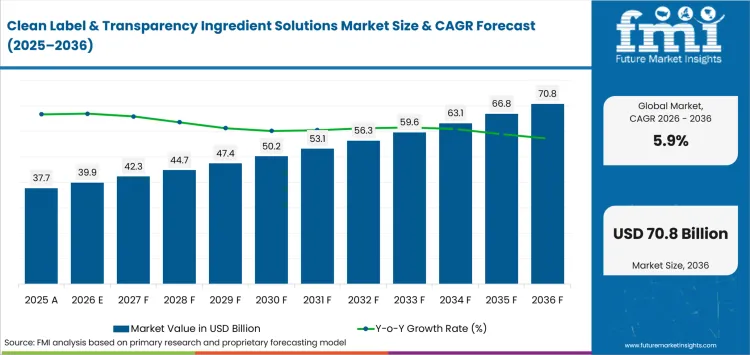
USD 39.9 billion in 2026 and USD 70.8 billion by 2036 at a 5.9% CAGR.
Demand for clean label & transparency ingredient solutions is projected to expand at 5.9% CAGR between 2026 and 2036, increasing valuation from USD 39.9 billion in 2026 to USD 70.8 billion by 2036. Food manufacturers spend on clean-label ingredients when simpler declarations must preserve texture and shelf life under existing plant conditions. The FDA quantified that reformulation route in January 2025 at a primary annualized cost estimate of USD 227 million under its proposal. Reformulation was not required, so the estimate represents a possible manufacturer response to package-level nutrition information.
Canada entered 2026 with a fixed front-of-package compliance date unlike the comparable USA federal action that remained proposed. Health Canada stated on January 5, 2026 that covered foods high in saturated fat or sugars or sodium require the symbol. Manufacturers using clean-label food additives therefore face scheduled packaging work, but ingredient substitutions still need sensory and plant validation for routine orders to scale.
Key Takeaways of Clean Label & Transparency Ingredient Solutions Market
- Food manufacturers fund reformulation as package transparency must coexist with texture and shelf-life performance under existing plant conditions.
- Based on solution, label-friendly starches are projected to account for 49.3% in 2026 due to broad texture and stability needs across food applications.
- The bakery segment is likely to capture 41.8% share in 2026 attributable to combined freshness and crumb-quality requirements in reformulation projects.
- Qualification risk slows switching because a simpler declaration does not guarantee equivalent performance during processing or the intended distribution period.
- Ingredion, Kerry, Cargill, ADM, Tate & Lyle, Corbion, Novonesis and IFF compete across texture, preservation and broader formulation capabilities.
Analyst Perspective
"Clean-label ingredients earn a place in a formula after they reproduce the texture or shelf life the existing system already delivers. The strongest offer reduces plant trials and keeps cost-in-use within the brand's margin target, making formulation support more valuable than a shorter ingredient list alone."
- Nandini Roy Choudhury, Principal Consultant, Future Market Insights
How is the Clean Label & Transparency Ingredient Solutions Market segmented?
The clean label & transparency ingredient solutions market is segmented by solution, application and region.
The clean label & transparency ingredient solutions market is segmented by solution, application and region. Solution includes label-friendly starches, natural preservation and clean emulsifiers. Application covers bakery, dairy, beverages and meat. Region covers North America, Latin America, Western Europe, Eastern Europe, East Asia, South Asia and Pacific, and Middle East and Africa.
Why does bakery lead the application category?
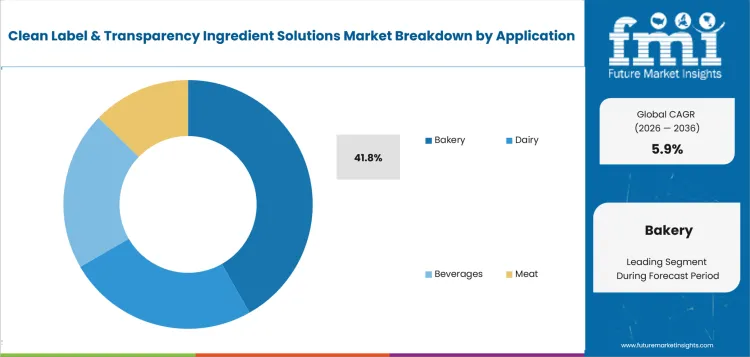
Bakery formulations tie crumb softness to mold control and line tolerance across the retail distribution window. Replacing conventional bakery ingredients can disturb those functions, forcing another plant trial even if the label becomes simpler.
- In 2026, bakery is expected to lead the application category with 41.8% share due to simultaneous texture and shelf-life requirements.
- Bakery formulators need preservation evidence that connects cleaner declarations with mold control across the distribution window. Corbion launched Verdad Essence WH100 in April 2025 for natural mold inhibition in breads and bakery formats. The cultured-wheat option broadens label-friendly preservation choices, but each formula still needs shelf-life validation for commercial conversion.
What makes label-friendly starches central to the solution category?
Label-friendly starches preserve viscosity and process stability without a modified starch declaration during commercial reformulation. Ingredion reported on July 20, 2026 that its IFT FIRST program paired clean-label reformulation with texture work in food prototypes. Food developers compare replacements with food starch performance under plant heat and shear plus the expected storage period.
- By solution, label-friendly starches are estimated to hold 49.3% in 2026 owing to broad use across texture-sensitive food formulations.
- Food formulators qualify label-friendly starches by checking texture and process tolerance at commercial scale. Routine purchasing starts once the selected starch maintains mouthfeel and stability across the customer's recipe and production conditions.
What are the drivers, restraints and opportunities in the Clean Label & Transparency Ingredient Solutions Market?
Package-level transparency increases reformulation work, validation burden slows ingredient switching and application support shortens the path from trial to commercial use.
- Driver: Package-level nutrition rules prompt recipe reviews as food manufacturers assess declared ingredients alongside nutrient targets and sensory performance.
- Restraint: Natural preservation and label-friendly texture substitutions require plant or shelf-life validation to secure recurring production orders.
- Opportunity: Regional application teams can reduce trial cycles by testing multifunctional ingredient systems under the food manufacturer's actual processing conditions.
Package Transparency Sustains Reformulation Activity
Food manufacturers revisit ingredients when nutrition rules change the commercial value of a recipe. In March 2026 the UK Department of Health and Social Care said its restrictions incentivise reformulation, with location rules linked to two million fewer in-scope products sold each day. The same review can bring clean-label emulsifiers into consideration if the replacement preserves sensory performance under the intended process.
Qualification Burden Slows Ingredient Switching
Preservation changes take longer to qualify because the finished food must remain microbiologically safe across its distribution period. In December 2025 the European Commission issued new Listeria shelf-life study guidance for ready-to-eat foods under microbiological criteria rules. Food manufacturers assessing food preservatives therefore need formula-specific challenge data to approve recurring orders for the intended selling period.
Application Support Shortens Commercial Conversion
Regional application laboratories shorten qualification by reproducing the processing conditions that can break a reformulated recipe at scale. Cargill announced in November 2024 that it was transforming its Singapore Innovation Center, with enhancements to serve foodservice and indulgent-product customers across Asia expected to complete in early 2025. Ingredient developers selling clean-label preservatives can resolve recipe problems earlier by testing close to customer production conditions ahead of commercial release.
Which country CAGRs are profiled in the Clean Label & Transparency Ingredient Solutions Market?
| Country | CAGR |
|---|---|
| Canada | 8.0% |
| USA | 7.6% |
| UK | 7.2% |
| France | 6.8% |
| Germany | 6.4% |
How do country-level CAGRs compare in the Clean Label & Transparency Ingredient Solutions Market?
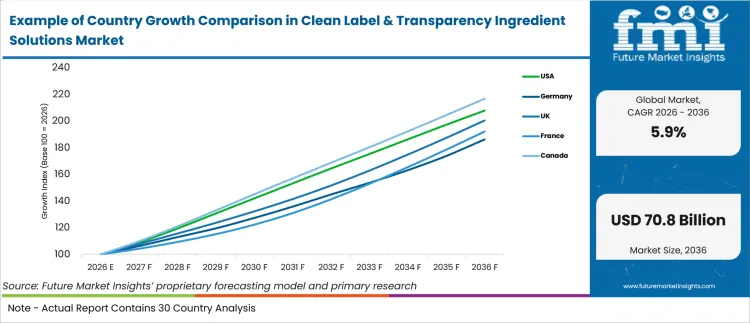
The country comparison spans 1.6 percentage points, with Canada and the USA forming the fastest-growing group. The UK and France sit in the middle with a 0.4-point difference, while Germany records the lowest CAGR. Despite the narrow spread, regulatory timelines and reformulation priorities create different commercial conditions across these markets.
- Canada leads at an 8.0% CAGR through 2036, as front-of-package labeling requirements encourage manufacturers to adjust formulations alongside bilingual packaging and scheduled production runs.
- The USA reaches a 7.6% CAGR, 0.4 percentage points below Canada. Proposed front-of-package labeling gives manufacturers greater flexibility to coordinate ingredient changes with packaging updates and product reformulation cycles.
- The UK records a 7.2% CAGR, with advertising restrictions influencing how brands connect ingredient composition, nutritional positioning and eligibility for television and paid-online promotions.
- France advances at a 6.8% CAGR, 0.4 percentage points below the UK. Nutri-Score transition periods give manufacturers scope to synchronize recipe modifications with planned packaging renewals.
- Germany posts a 6.4% CAGR, the lowest among the profiled countries. Its revised Nutri-Score transition framework shapes formulation and labeling decisions for participating food products.
Similar CAGRs therefore mask different qualification and packaging schedules across the five markets.
The full report provides country-level CAGR analysis across North America, Latin America, Europe, East Asia, South Asia, Oceania and the Middle East and Africa.
Country-wise Analysis
- Mandatory front-of-package nutrition labeling and bilingual packaging regulations reshaped packaging priorities for Canadian packaged food manufacturers in 2026, prompting portfolio-wide label updates and integration of compliance initiatives into annual product-renovation programs. Clean label & transparency ingredient solutions sales in Canada are forecast to expand at 8.0% CAGR by 2036, supported by fixed compliance timing that concentrates recipe review around scheduled national packaging cycles. The Canadian Food Inspection Agency stated in November 2025 that the transition ended December 31 with no further enforcement discretion planned, so ingredient companies must pair faster formulation work with documented texture and shelf-life performance for compliant recipes to convert into recurring orders.
- United States ready-to-eat meat processors assess preservation substitutions against federal sampling programs that test microbial control under established production and distribution conditions across national retail channels. Adoption of clean label & transparency ingredient solutions in the USA is estimated to expand at 7.6% CAGR through 2036, aided by extensive formulation capacity across bakery and meat applications where shelf life matters. The Food Safety and Inspection Service stated in January 2025 that eligible establishments are sampled at least twice yearly under revised ready-to-eat programs, so natural-preservation systems need documented microbial performance for simpler declarations to convert into recurring purchases across validated product lines.
- UK food brands in covered categories now review recipe composition beside promotion eligibility under less-healthy-food restrictions covering television and paid online media during national campaign planning cycles and retailer reviews. Clean label & transparency ingredient solutions demand in the UK is forecast to rise at 7.2% CAGR over the forecast period, reinforced by advertising rules that give manufacturers a defined trigger for portfolio renovation. The Department of Health and Social Care confirmed in January 2026 that those restrictions had taken effect, so ingredient companies must preserve sensory quality and cost-in-use as reformulated recipes progress into recurring purchasing across branded and private-label retail channels.
- French manufacturers using Nutri-Score can phase packaging and formula changes across a two-year transition that aligns updates with scheduled renovation and label-refresh cycles across branded and private-label portfolios. France's clean label & transparency ingredient solutions outlook is anticipated to advance at 6.8% CAGR over the assessment period, supported by continued recipe review under the revised scoring method during planned reformulation cycles. Santé publique France stated in March 2025 that the new algorithm applied from March 16 with two years for packaging updates, leaving ingredient companies to preserve sensory performance as food brands adjust nutrition profiles and declaration choices across national retail ranges.
- German manufacturers using Nutri-Score entered 2026 with the revised calculation method fully in force for participating packaged-food portfolios after the voluntary system's 24-month transition and planned annual renovations. Germany is estimated to post 6.4% CAGR over the forecast period, shaped by a settled scoring basis that gives product developers a predictable schedule for recipe and packaging changes. The federal food ministry stated in January 2025 that the revised algorithm had applied since 2024 and the transition ended on January 1 2026, leaving ingredient companies to meet separate nutrition and process targets for recurring orders to expand across national branded and private-label portfolios.
Who are the notable companies in the Clean Label & Transparency Ingredient Solutions Market?
Ingredion, Kerry, Cargill, ADM, Tate & Lyle, Corbion, Novonesis and IFF are the notable companies profiled in this market.
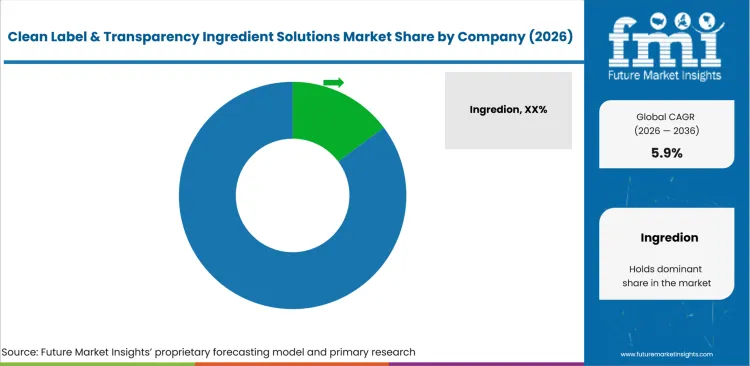
Competition is fragmented across texture specialists and preservation companies plus broader formulation groups that solve different clean-label problems. Food emulsifiers and preservation systems must survive commercial processing and shelf-life testing in each customer's formula, which raises entry barriers. Regional application support becomes decisive when labeling expectations and qualification steps differ across food categories and jurisdictions.
- Label-friendly starch and texture platforms: Ingredion and Tate & Lyle compete on clean-label texturizers with documented use across several food applications.
- Natural preservation platforms: Kerry and Corbion focus on shelf-life control with fermentates and cultured ingredients across selected clean-label bakery applications.
- Cross-functional reformulation platforms: Cargill and ADM cover wider ingredient systems, and Novonesis and IFF add food enzymes that reduce conventional functional additives in bakery recipes.
Competitive Benchmarking: Clean Label & Transparency Ingredient Solutions Market
| Company | Label-Friendly Texture Capability | Natural Preservation Capability | Recipe Simplification Capability | Geographic Reach |
|---|---|---|---|---|
| Ingredion | High | Unscored | Unscored | Global |
| Kerry | Unscored | Medium | Medium | Global |
| Cargill | Unscored | Medium | Medium | North America and Asia |
| ADM | Unscored | Unscored | Unscored | Global |
| Tate & Lyle | High | Unscored | Unscored | Global |
| Corbion | Unscored | Medium | Medium | Global |
| Novonesis | Unscored | Unscored | Medium | Global |
| IFF | Unscored | Unscored | Medium | Global |
Key Developments in the Clean Label & Transparency Ingredient Solutions Market
- In August 2025, Corbion announced a collaboration with BRAIN Biotech AG to develop novel biobased antimicrobial compounds, accelerating Corbion's natural preservation capabilities for food manufacturers.
- In September 2025, Kerry inaugurated its Biotechnology Centre in Leipzig to expand enzyme and fermentation development across food and beverage applications.
- In May 2025, Cargill reported that its natural-antioxidant flavor system had preserved more than 1.5 million pounds of ground beef with planned expansion into patties and whole-muscle cuts.
Key Players in the Clean Label & Transparency Ingredient Solutions Market
Label-Friendly Starch and Texture Platforms
- Ingredion
- Tate & Lyle
Natural Preservation Platforms
- Kerry
- Corbion
Cross-Functional Reformulation Platforms
- Cargill
- ADM
- Novonesis
- IFF
Clean Label & Transparency Ingredient Solutions Market - Report Scope
| Coverage field | Report scope |
|---|---|
| Market breakdown | By solution, application and region. |
| Quantitative Units | Revenue in USD billion and CAGR in %. |
| Market Definition | Revenue includes label-friendly starches, natural preservation systems and clean emulsifiers sold for bakery, dairy, beverages and meat applications. Finished-food revenue and adjacent or substitute ingredient categories are excluded. |
| Regions Covered | North America, Latin America, Europe, East Asia, South Asia and Pacific, and Middle East and Africa. |
| Countries Covered | Canada, USA, UK, France, Germany, and 20+ countries included in the full report. |
| Key Companies Profiled | Ingredion, Kerry, Cargill, ADM, Tate & Lyle, Corbion, Novonesis, IFF. |
| Forecast Period | 2026 to 2036. |
| Approach | Primary and secondary research with market triangulation. |
Clean Label & Transparency Ingredient Solutions Market - Research Methodology
| Method | Approach |
|---|---|
| Primary Research | FMI analysts gathered input from manufacturers, service providers, technology developers, distributors, end users, procurement teams, and subject-matter experts. Interviews examined purchasing decisions, product or service evaluation, adoption barriers, approval requirements, pricing considerations, and expectations for technical or commercial support. Respondents were also asked what evidence is required before a trial, pilot, or initial order develops into regular purchasing. |
| Desk Research | Desk research covered government statistics, regulatory publications, trade data, industry associations, technical literature, standards, company filings, product information, and official corporate announcements. Sources were reviewed for relevance, publication date, geographic coverage, and consistency with the defined market scope. Claims relating to performance, applications, approvals, capacity, investment, and commercial activity were retained only when supported by credible public evidence. |
| Market Sizing and Forecasting | The market model combined the baseline value with historical performance, segment structure, pricing and volume indicators, adoption levels, company participation, and country-level demand conditions. Forecast assumptions considered economic activity, investment trends, regulatory developments, technology adoption, purchasing cycles, supply availability, and barriers to wider market use. Segment and regional estimates were reconciled before the final market total was calculated. |
| Data Validation | Estimates were checked against multiple independent indicators, including public data, company activity, trade patterns, industry developments, and findings from primary interviews. Validation also tested whether products, services, applications, and company revenues fell within the defined market boundaries. Adjacent categories, unsupported claims, overlapping revenues, and activities without direct market relevance were excluded to reduce double counting and maintain consistency across segments and countries. |
Clean Label & Transparency Ingredient Solutions Market by Segments
Clean Label & Transparency Ingredient Solutions Market segmented by Solution:
- Label-friendly Starches
- Natural Preservation
- Clean Emulsifiers
Clean Label & Transparency Ingredient Solutions Market segmented by Application:
- Bakery
- Dairy
- Beverages
- Meat
Clean Label & Transparency Ingredient Solutions Market by Region:
- North America
- United States
- Canada
- Latin America
- Brazil
- Mexico
- Chile
- Rest of Latin America
- Western Europe
- Germany
- United Kingdom
- Italy
- Spain
- France
- Nordics
- Benelux
- Rest of Western Europe
- Eastern Europe
- Russia
- Poland
- Hungary
- Balkan and Baltic States
- Rest of Eastern Europe
- East Asia
- China
- Japan
- South Korea
- South Asia and Pacific
- India
- ASEAN
- Australia and New Zealand
- Rest of South Asia and Pacific
- Middle East and Africa
- Kingdom of Saudi Arabia
- Other GCC Countries
- Türkiye
- South Africa
- Other African Union Countries
- Rest of Middle East and Africa
Research Sources and Bibliography
- USA Food and Drug Administration. (2025, January 16). Food Labeling: Front-of-Package Nutrition Information (Proposed Rule).
- Health Canada. (2026, January 5). Nutrition labelling: Front-of-package nutrition symbol.
- Ingredion. (2026, July 20). Ingredion at IFT FIRST 2026: Bold ideas, real-world impact.
- Corbion. (2025, April 21). Corbion Unveils Verdad® Essence WH100: Redefining Natural Mold Inhibition for Bakers.
- Department of Health and Social Care. (2026, March 25). Applying the new NPM to advertising and promotions restrictions.
- European Commission. (2025, December 18). Guidance Document on Listeria monocytogenes shelf-life studies for ready-to-eat foods, under Regulation (EC) No 2073/2005 of 15 November 2005 on microbiological criteria for foodstuffs.
- Cargill. (2025, April 10). Cargill unveils transformed Innovation Center in Singapore to advance food innovation, for Asia from Asia.
- Canadian Food Inspection Agency. (2025, November 17). Notice to industry - Compliance and enforcement approach for front-of-package nutrition labelling effective January 1, 2026.
- USA Department of Agriculture, Food Safety and Inspection Service. (2025, January 17). FSIS Ready-To-Eat Sampling Programs - Revision 1.
- Department of Health and Social Care. (2026, January 5). Landmark junk food ad ban to protect kids' health.
- Santé publique France. (2025, March 17). Signature de l’arrêté Nutri-Score : un pas de plus vers une meilleure information nutritionnelle des consommateurs.
- Bundesministerium für Ernährung und Landwirtschaft. (2025, January 29). Internationale Zusammenarbeit beim Nutri-Score.
- Ingredion. (2025, October 15). Clean label ingredients: From buzzword to business driver.
- Tate & Lyle. (2025, July 7). Tate & Lyle debuts expanded portfolio and mouthfeel leadership at IFT FIRST 2025.
- Kerry. (2025, July 11). Fresh Thinking: How to Improve Bakery Shelf Life and Reduce Waste.
- Cargill. (2025, March 4). Cargill Showcases Full Range of Innovative Food Solutions at AAHAR 2025.
- Archer-Daniels-Midland Company. (2026, January 15). ADM’s $26M Investment in Erlanger Facility Strengthens Capabilities for Growing Reformulation Demand.
- Novonesis. (2025, June 11). Novonesis launches Optiva® LS Prime, helping bakers cut up to 50% added sugar and create more cost-effective baked goods.
- IFF. (2026, June 4). Label-Friendly by Design: How Enzymes Are Changing the Future of Baking.
- Cargill. (2025, May 20). Cargill is reducing food waste, one innovation at a time.
- Corbion. (2026, June 15). Corbion launches LUMI™ Set to help bakers reformulate away from titanium dioxide without sacrificing visual appeal.
- Kerry. (2025, September 24). Kerry Establishes New Biotechnology Centre in Leipzig.
This bibliography is provided for reader reference and is not exhaustive. The full report contains the complete reference list and detailed citations
This Report Answers
- How large is the clean label & transparency ingredient solutions market in 2026 and by 2036?
- Which reformulation conditions convert package transparency into ingredient demand?
- Why do label-friendly starches account for 49.3% of solution demand in 2026?
- Why does bakery account for 41.8% of application demand in 2026?
- Which validation requirements slow switching from conventional functional ingredients?
- How do growth conditions differ across Canada, the USA, the UK, France and Germany?
- Which ingredient capabilities matter most during clean-label formulation qualification?
- How do notable companies differ across texture, preservation and recipe simplification?
Frequently Asked Questions
How big is the Clean Label & Transparency Ingredient Solutions Market in 2026?
The clean label & transparency ingredient solutions market is expected to be valued at USD 39.9 billion in 2026. Food manufacturers fund reformulation when simpler declarations must preserve texture and shelf life in commercial production.
What is the CAGR of the Clean Label & Transparency Ingredient Solutions Market from 2026 to 2036?
The clean label & transparency ingredient solutions market is projected to grow at 5.9% CAGR from 2026 to 2036. Package transparency keeps reformulation active because ingredient changes must preserve product performance as recipes and labels change.
Which solution is projected to account for 49.3% of the Clean Label & Transparency Ingredient Solutions Market?
The clean label & transparency ingredient solutions market is expected to see label-friendly starches account for 49.3% of solution demand in 2026. Their position rests on broad texture and stability needs across bakery and other food formulations.
Which application is projected to account for 41.8% of the Clean Label & Transparency Ingredient Solutions Market?
The clean label & transparency ingredient solutions market is expected to see bakery account for 41.8% of application demand in 2026. Bakery concentrates freshness and texture requirements in the same reformulation project, making qualification especially sensitive to shelf-life and line performance.
Which companies are active in the Clean Label & Transparency Ingredient Solutions Market?
The clean label & transparency ingredient solutions market includes Ingredion, Kerry, Cargill, ADM, Tate & Lyle, Corbion, Novonesis and IFF among the profiled companies. Their roles span clean-label texture, natural preservation and recipe simplification across food applications.
Preview the report firsthand - request a free sample
Get SampleGet the brochure for pricing and purchase details.
Get PDFTable of Content
- Key Takeaways
- Market Size and CAGR
- Top Growth Driver
- Fastest Growing Segment
- Leading Region
- Key Companies
- Emerging Opportunities
- Executive Summary
- Global Market Outlook
- Demand-side Trends
- Supply-side Trends
- Technology Roadmap Analysis
- Analysis and Recommendations
- Analyst Perspective (What is happening? Why now? What should investors know?)
- Key Questions Answered
- How large is the market?
- What is the CAGR?
- What are key trends?
- Which region dominates?
- Who are the leaders?
- Market Overview
- Market Coverage / Taxonomy
- Market Definition / Scope / Limitations
- Research Methodology
- Chapter Orientation
- Analytical Lens and Working Hypotheses
- Market Structure, Signals, and Trend Drivers
- Benchmarking and Cross-market Comparability
- Market Sizing, Forecasting, and Opportunity Mapping
- Research Design and Evidence Framework
- Desk Research Programme (Secondary Evidence)
- Expert Input and Fieldwork (Primary Evidence)
- Tooling, Models, and Reference Databases
- Data Engineering and Model Build
- Quality Assurance and Audit Trail
- Market Background
- Market Dynamics (Drivers, Restraints, Opportunity, Trends)
- Scenario Forecast (Optimistic, Likely, Conservative)
- Impact Analysis
- AI Impact
- Sustainability Impact
- Regulatory Impact
- Technology Impact
- Consumer / Buyer Analysis
- Purchase Drivers
- Adoption Barriers
- Buyer Journey
- Opportunity Map Analysis
- Product Life Cycle Analysis
- Supply Chain Analysis
- Investment Feasibility Matrix
- Value Chain Analysis
- PESTLE and Porter's Analysis
- Regulatory Landscape
- Regional Parent Market Outlook
- Production and Consumption Statistics
- Import and Export Statistics
- Global Market Analysis and Forecast, 2021 to 2036
- Historical Market Size Value (USD Billion) Analysis, 2021 to 2025
- Current and Future Market Size Value (USD Billion) Projections, 2026 to 2036
- Y-o-Y Growth Trend Analysis
- Absolute $ Opportunity Analysis
- Global Market Pricing Analysis, 2021 to 2036
- Global Market Analysis and Forecast, By Solution, 2021 to 2036
- Introduction / Key Findings
- Historical Market Size Value (USD Billion) Analysis By Solution, 2021 to 2025
- Current and Future Market Size Value (USD Billion) Analysis and Forecast By Solution, 2026 to 2036
- Label-friendly Starches
- Natural Preservation
- Clean Emulsifiers
- Label-friendly Starches
- Y-o-Y Growth Trend Analysis By Solution, 2021 to 2025
- Absolute $ Opportunity Analysis By Solution, 2026 to 2036
- Global Market Analysis and Forecast, By Application, 2021 to 2036
- Introduction / Key Findings
- Historical Market Size Value (USD Billion) Analysis By Application, 2021 to 2025
- Current and Future Market Size Value (USD Billion) Analysis and Forecast By Application, 2026 to 2036
- Bakery
- Dairy
- Beverages
- Meat
- Bakery
- Y-o-Y Growth Trend Analysis By Application, 2021 to 2025
- Absolute $ Opportunity Analysis By Application, 2026 to 2036
- Global Market Analysis and Forecast, By Region, 2021 to 2036
- Introduction
- Historical Market Size Value (USD Billion) Analysis By Region, 2021 to 2025
- Current Market Size Value (USD Billion) Analysis and Forecast By Region, 2026 to 2036
- North America
- Latin America
- Western Europe
- Eastern Europe
- East Asia
- South Asia and Pacific
- Middle East & Africa
- Market Attractiveness Analysis By Region
- North America Market Analysis and Forecast, By Country, 2021 to 2036
- Historical Market Size Value (USD Billion) Trend Analysis By Market Taxonomy, 2021 to 2025
- Market Size Value (USD Billion) Forecast By Market Taxonomy, 2026 to 2036
- By Country
- USA
- Canada
- By Solution
- By Application
- By Country
- Market Attractiveness Analysis
- By Country
- By Solution
- By Application
- Key Takeaways
- Latin America Market Analysis and Forecast, By Country
- Historical Market Size Value (USD Billion) Trend Analysis By Market Taxonomy, 2021 to 2025
- Market Size Value (USD Billion) Forecast By Market Taxonomy, 2026 to 2036
- By Country
- Brazil
- Mexico
- Chile
- Rest of Latin America
- By Solution
- By Application
- By Country
- Market Attractiveness Analysis
- By Country
- By Solution
- By Application
- Key Takeaways
- Western Europe Market Analysis and Forecast, By Country
- Historical Market Size Value (USD Billion) Trend Analysis By Market Taxonomy, 2021 to 2025
- Market Size Value (USD Billion) Forecast By Market Taxonomy, 2026 to 2036
- By Country
- Germany
- UK
- Italy
- Spain
- France
- Nordic
- BENELUX
- Rest of Western Europe
- By Solution
- By Application
- By Country
- Market Attractiveness Analysis
- By Country
- By Solution
- By Application
- Key Takeaways
- Eastern Europe Market Analysis and Forecast, By Country
- Historical Market Size Value (USD Billion) Trend Analysis By Market Taxonomy, 2021 to 2025
- Market Size Value (USD Billion) Forecast By Market Taxonomy, 2026 to 2036
- By Country
- Russia
- Poland
- Hungary
- Balkan & Baltic
- Rest of Eastern Europe
- By Solution
- By Application
- By Country
- Market Attractiveness Analysis
- By Country
- By Solution
- By Application
- Key Takeaways
- East Asia Market Analysis and Forecast, By Country
- Historical Market Size Value (USD Billion) Trend Analysis By Market Taxonomy, 2021 to 2025
- Market Size Value (USD Billion) Forecast By Market Taxonomy, 2026 to 2036
- By Country
- China
- Japan
- South Korea
- By Solution
- By Application
- By Country
- Market Attractiveness Analysis
- By Country
- By Solution
- By Application
- Key Takeaways
- South Asia and Pacific Market Analysis and Forecast, By Country
- Historical Market Size Value (USD Billion) Trend Analysis By Market Taxonomy, 2021 to 2025
- Market Size Value (USD Billion) Forecast By Market Taxonomy, 2026 to 2036
- By Country
- India
- ASEAN
- Australia & New Zealand
- Rest of South Asia and Pacific
- By Solution
- By Application
- By Country
- Market Attractiveness Analysis
- By Country
- By Solution
- By Application
- Key Takeaways
- Middle East & Africa Market Analysis and Forecast, By Country
- Historical Market Size Value (USD Billion) Trend Analysis By Market Taxonomy, 2021 to 2025
- Market Size Value (USD Billion) Forecast By Market Taxonomy, 2026 to 2036
- By Country
- Kingdom of Saudi Arabia
- Other GCC Countries
- Türkiye
- South Africa
- Other African Union
- Rest of Middle East & Africa
- By Solution
- By Application
- By Country
- Market Attractiveness Analysis
- By Country
- By Solution
- By Application
- Key Takeaways
- Key Countries Market Analysis
- USA
- Pricing Analysis
- Market Share Analysis, 2025
- By Solution
- By Application
- Canada
- Pricing Analysis
- Market Share Analysis, 2025
- By Solution
- By Application
- Mexico
- Pricing Analysis
- Market Share Analysis, 2025
- By Solution
- By Application
- Brazil
- Pricing Analysis
- Market Share Analysis, 2025
- By Solution
- By Application
- Chile
- Pricing Analysis
- Market Share Analysis, 2025
- By Solution
- By Application
- Germany
- Pricing Analysis
- Market Share Analysis, 2025
- By Solution
- By Application
- UK
- Pricing Analysis
- Market Share Analysis, 2025
- By Solution
- By Application
- Italy
- Pricing Analysis
- Market Share Analysis, 2025
- By Solution
- By Application
- Spain
- Pricing Analysis
- Market Share Analysis, 2025
- By Solution
- By Application
- France
- Pricing Analysis
- Market Share Analysis, 2025
- By Solution
- By Application
- India
- Pricing Analysis
- Market Share Analysis, 2025
- By Solution
- By Application
- ASEAN
- Pricing Analysis
- Market Share Analysis, 2025
- By Solution
- By Application
- Australia & New Zealand
- Pricing Analysis
- Market Share Analysis, 2025
- By Solution
- By Application
- China
- Pricing Analysis
- Market Share Analysis, 2025
- By Solution
- By Application
- Japan
- Pricing Analysis
- Market Share Analysis, 2025
- By Solution
- By Application
- South Korea
- Pricing Analysis
- Market Share Analysis, 2025
- By Solution
- By Application
- Russia
- Pricing Analysis
- Market Share Analysis, 2025
- By Solution
- By Application
- Poland
- Pricing Analysis
- Market Share Analysis, 2025
- By Solution
- By Application
- Hungary
- Pricing Analysis
- Market Share Analysis, 2025
- By Solution
- By Application
- Kingdom of Saudi Arabia
- Pricing Analysis
- Market Share Analysis, 2025
- By Solution
- By Application
- Türkiye
- Pricing Analysis
- Market Share Analysis, 2025
- By Solution
- By Application
- South Africa
- Pricing Analysis
- Market Share Analysis, 2025
- By Solution
- By Application
- USA
- Market Structure Analysis
- Competition Dashboard
- Competition Benchmarking
- Market Share Analysis of Top Players
- By Regional
- By Solution
- By Application
- Emerging Startups
- Innovation Benchmarking
- Competition Analysis
- Competition Deep Dive
- Ingredion
- Overview
- Product Portfolio
- Profitability by Market Segments
- Sales Footprint
- Strategy Overview
- Marketing Strategy
- Product Strategy
- Channel Strategy
- Kerry
- Cargill
- ADM
- Tate & Lyle
- Corbion
- Novonesis
- Ingredion
- Case Studies
- Success Stories
- Recent Developments
- Competition Deep Dive
- Assumptions & Acronyms Used


