

- Market Size (2026)
- USD 2.3 Bn
- Forecast (2036)
- USD 4.5 Bn
- CAGR (2026 to 2036)
- 6.9%
How big is Clean-Label Syrups & Natural Sweetener Syrups Market in 2026?
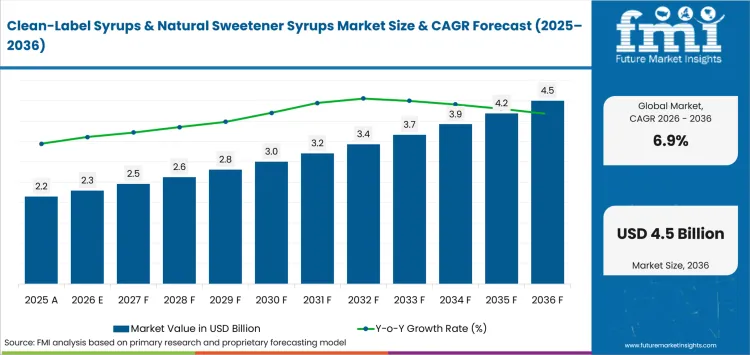
USD 2.3 billion in 2026 and USD 4.5 billion by 2036 at a 6.9% CAGR.
Sales of clean-label syrups and natural sweetener syrups are projected to expand at a 6.9% CAGR from 2026 to 2036. Market value is forecast to increase from USD 2.3 billion in 2026 to USD 4.5 billion by 2036. In January 2025 the FDA proposed a front-of-package box that would classify added sugars as low, medium or high. The proposal increases recipe-review pressure for clean-label ingredients that preserve texture without weakening sweetness control. Packaged food manufacturers compare naturally derived sweeteners through taste consistency and simple ingredient declarations during commercial approval.
Starch conversion and filtration control color and solids consistency across repeated syrup batches and storage periods. United States formulation teams calculate added sugars and confirm nutrition-panel effects during package approval for each finished recipe. United Kingdom teams also assess whether sweetener formulations alter advertising exposure for packaged foods classified as less healthy. Department of Health and Social Care guidance updated in June 2025 confirmed that online and television restrictions would begin on January 5, 2026. The United States and United Kingdom require different documentation sequences despite testing similar syrup characteristics under commercial processing conditions. Concentration and storage decisions influence viscosity during transport and final bakery use across multiple facilities. Food manufacturers compare liquid sugar systems through processing performance and the finished product’s commercial labeling route.
Key Takeaways of Clean-Label Syrups & Natural Sweetener Syrups Market
- Demand for clean-label syrups is driven by manufacturers needing predictable sweetness and viscosity without adding unfamiliar ingredient names to the final label, with commercial approval hinging on one syrup specification supporting texture and labeling targets across repeated factory runs.
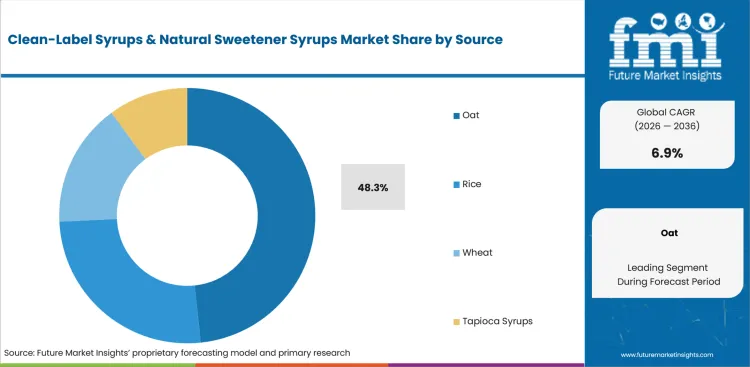
- By source, oat holds the leading share at 48.3% in 2026, due to its mild flavor and useful binding performance in cereal-based snacks.
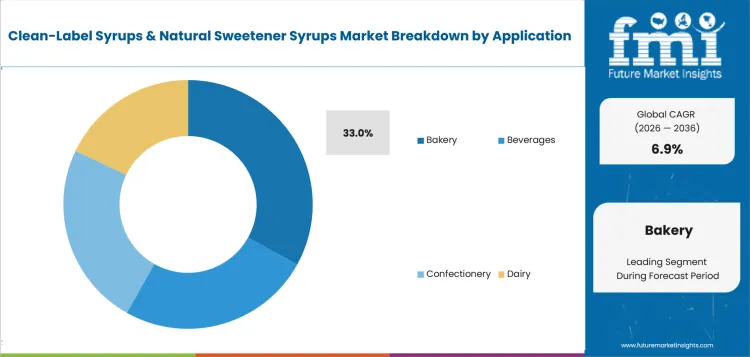
- Bakery is the dominant application segment, holding 33.0% share in 2026, owing to the combined sweetness and binding performance required across high-volume formats.
- Rice offers a neutral flavor profile, while wheat and tapioca address different viscosity or sourcing requirements across formulation needs.
- Regional labeling rules determine the calculations and package revisions required ahead of commercial launch, with stable color and solids content reducing production corrections across facilities using different equipment.
- The UK, USA, and Belgium record CAGRs of 8.4%, 8.0%, and 7.6% respectively through 2036, shaped by advertising restrictions, added-sugar disclosure requirements, and multilingual steviol-glycoside labeling rules.
- Competition centers on Meurens Natural, Grain Millers, Ingredion, Tate & Lyle, ADM, and Cargill, with vendors differentiating through direct cereal-syrup portfolios, sugar-reduction formulation laboratories, and manufacturing scale with international distribution reach.
Analyst Perspective
Commercial decisions in clean-label syrups should separate a simple ingredient label from measurable performance under normal production conditions, since a source claim carries limited value unless texture and color remain stable through the intended shelf life. Development teams should compare sweetness curves and solids content across several full production runs and storage periods, while contracts need clear color and viscosity tolerances for each commercial destination. Expansion should follow stable results across repeat batches rather than early formulation success alone.
- Nandini Roy Choudhury, Principal Analyst at Future Market Insights
Source: FMI's proprietary forecasting model and primary research
How is the Clean-Label Syrups & Natural Sweetener Syrups Market segmented?
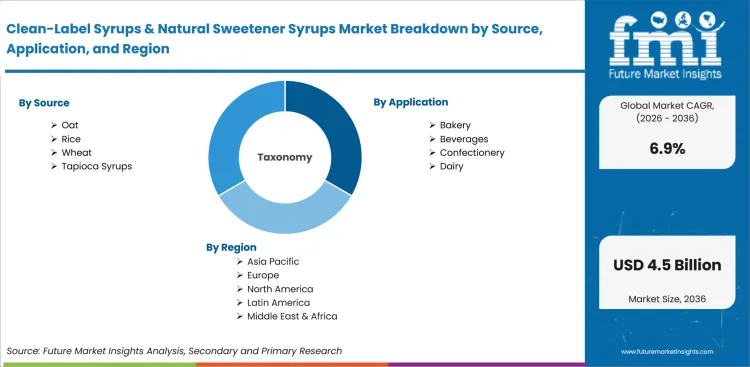
The clean-label syrups and natural sweetener syrups industry is segmented by source, application, and region.
The segmentation framework separates cereal source from the application that converts syrup properties into finished-product value. Source analysis covers oat and rice alongside wheat and tapioca alternatives with different sweetness and viscosity profiles. Application analysis covers bakery and beverage use together with confectionery and dairy formulations under distinct processing conditions. Bakery trials test binding and moisture control through heating and packaged storage under normal production conditions.
Beverage trials examine solubility and flavor balance across acidic recipes and extended refrigerated distribution periods. Confectionery applications focus on crystallization and texture during storage; dairy formulations require consistent mouthfeel without unwanted color development. Regional analysis then compares labeling routes and available commercial support for integrated food ingredients across each national market.
Why is oat central to the source category?
Oat syrup combines mild sweetness with viscosity that supports bars and baked snacks without overpowering cereal flavors. The USDA reported in September 2025 that oat production reached 69.6 million bushels and increased 2% from 2024. The larger crop supports ingredient planning but does not guarantee consistent syrup color or solids performance. Manufacturers must control dextrose equivalent and color across repeated batches under normal commercial storage conditions. Commercial trials should test binding and moisture retention under the finished product’s actual heating conditions.
- The source category is forecast to be led by oat at 48.3% share in 2026 due to its mild flavor and useful binding performance in cereal-based snacks. Oat syrup fits cereal bars and baked snacks that need controlled moisture without intense sweetness during storage. Commercial specifications for starch derivatives should define solids and color ranges for every approved production grade.
- Bakery and snack manufacturers adopt oat syrup to simplify ingredient declarations and preserve softness across the intended shelf life. Production trials should compare dough handling with baked color under routine equipment settings and storage periods. Repeatable results across several batches reduce reformulation work and support later commercial approval across multiple production sites.
How does bakery shape demand within the application category?
Bakery applications expose syrup performance through mixing and baking followed by cooling and packaged storage. Syrups must deliver sweetness and binding without repeated recipe correction across routine mixing and baking operations. Destatis reported in January 2026 that wholesale prices for sugar, confectionery and bakery products rose 14.7% during 2025. Higher input costs make formulation efficiency more valuable for bakery ingredients during qualification and commercial scale-up. Trials should measure spread and browning together with moisture retention throughout the intended shelf life.
- Bakery is projected to hold 33.0% share in 2026 owing to the combined sweetness and binding performance required across high-volume formats. Humectancy supports texture control in bars and soft baked products during storage and reduces recipe corrections across routine mixing schedules. Stable performance also improves commercial confidence during shelf-life approval for high-volume bakery formats across several facilities.
- Bakery manufacturers adopt natural sweetener syrups through staged trials that compare texture and color against existing recipes. The evaluation should include food coating ingredients and inclusions that change surface drying or perceived sweetness. Commercial approval becomes easier through shelf-life tests that confirm stable handling across several production batches and packaging formats.
What are the drivers, restraints, and opportunities in the Clean-Label Syrups & Natural Sweetener Syrups Market?
Label scrutiny supports reformulation demand; relabeling costs slow adoption and newer sweetener combinations create targeted bakery and beverage opportunities.
- Driver: Packaged food reformulation increases demand for syrups that reduce declared sugars and preserve texture throughout the intended shelf life.
- Restraint: Relabeling and reformulation costs can delay conversion from successful trials to routine commercial purchasing across branded portfolios.
- Opportunity: New sweetener combinations can pair cereal syrup functionality with improved sweetness profiles for defined bakery and beverage applications.
Revised front-label scoring gives packaged food companies a direct reason to reconsider complete sweetness systems. Santé publique France confirmed in March 2025 that the revised Nutri-Score method had entered force for participating brands. The method rates sugary products more strictly and changes how complete recipes are compared during reformulation. Natural syrup producers can support reformulation through reliable texture and color data for the finished product. Recipe-level calculations remain essential because an ingredient claim does not establish the final nutrition score.
Implementation costs materially slow reformulation across brands that manage numerous package formats and product recipes. The FDA estimated in January 2025 that annualized relabeling and reformulation costs could reach USD 333 million under the proposed rule. Smaller brands distribute technical expenses across fewer sales volumes and therefore face longer payback periods. Syrup manufacturers can reduce delays through application data that limits repeated recipe and artwork changes. Incomplete documentation can postpone regular commercial purchasing despite acceptable performance during controlled factory trials at commercial scale.
Structured dairy reformulation creates an opportunity to pair syrup functionality with measured commercial mouthfeel targets. Tate & Lyle launched its Sensation formulation tool in Asia-Pacific during September 2025 for yogurt development. The tool translates consumer texture language into formulation choices and shortens trial design for yogurt applications. Natural syrup producers can define compatible solids levels and heat limits within these structured trials. Commercial value depends on repeated sweetness and mouthfeel results across full factory batches and intended storage periods.
Which country CAGRs are profiled in the Clean-Label Syrups & Natural Sweetener Syrups Market?

| Country | CAGR |
|---|---|
| USA | 8.0% |
| Belgium | 7.6% |
| Germany | 6.8% |
| UK | 8.4% |
| France | 7.2% |
How do country-level CAGRs compare in the Clean-Label Syrups & Natural Sweetener Syrups Market?
The country outlook occupies a narrow 1.6-point range between the UK and Germany across the five markets. USA and Belgium remain within 0.8 points of the UK and form the central growth band. France stays closer to Germany through a smaller 0.4-point gap between their forecast rates. The spacing indicates similar category momentum across mature food markets that apply different label and promotion systems. Forecast rates help sequence commercial attention but cannot replace national recipe and packaging analysis for each market. Syrup manufacturers should compare local application costs with the size and concentration of each addressable customer base.
- The UK exceeds USA by 0.4 points and pairs greater forecast momentum with advertising rules that increase recipe review for major campaigns.
- USA remains close to the UK but national brands must coordinate added-sugar calculations across numerous package formats and retail channels.
- Belgium trails USA by 0.4 points and adds a separate Nutri-Score license and product-notification route for participating brands.
- France remains 0.4 points below Belgium and requires portfolio-wide packaging transitions under the revised Nutri-Score method.
- Germany follows France by 0.4 points and combines measured growth with stronger sensitivity to ingredient and bakery input costs.
Commercial sequencing should reflect local approval effort and application support rather than forecast rates alone. The full report provides country-level CAGR analysis across North America, Latin America, Europe, East Asia, South Asia, Oceania and the Middle East and Africa.
Country-wise Analysis
- United States food manufacturers calculate added-sugar content for each recipe and serving size during nutrition-label preparation. The USA clean-label syrup sector is projected to record 8.0% CAGR during the assessment period, supported by national nutrition-panel requirements. The FDA confirmed in February 2025 that the updated healthy claim sets limits for added sugars and becomes effective in April 2025. The rule creates another recipe test for bakery and snack products that use voluntary health positioning. Large bakery and snack manufacturers can run multi-site trials across common product formats and national retail channels. The main friction comes from coordinating recipe calculations and package changes across national retail calendars. Stable specification data can reduce approval delays during commercial production across several separate manufacturing locations.
- Belgian food companies must separate natural syrup claims from mandatory ingredient naming for added steviol glycosides. Belgium’s central location supports bakery and confectionery trials for neighboring markets through established cross-border distribution networks. Adoption of clean-label syrups in Belgium is estimated to expand at 7.6% CAGR through 2036, shaped by cereal-processing expertise and cross-border food manufacturing. In April 2025 the Federal Public Service Health issued guidance requiring ingredient lists to identify the specific steviol glycoside type used in food. The guidance directly affects syrup systems blended with stevia for reduced-sugar recipes and complete label declarations. Local friction involves keeping each claim clear across several languages and distinct national retail systems. Complete process descriptions can reduce repeated legal review during multi-market portfolio launches and packaging updates.
- German packaged food companies balance Nutri-Score goals with bakery cost and performance targets during recipe planning. In Germany clean-label syrup demand is predicted to advance at 6.8% CAGR through 2036, reinforced by established cereal processing and industrial bakery capacity. The Federal Ministry of Food and Agriculture stated in June 2025 that about 960 companies with 1,420 brands were registered as of April 9, 2025. The registration base creates a practical route for recipe comparison across participating brands and packaged food categories. Local friction involves preserving texture and browning across different flour systems and commercial equipment settings. Local application trials can connect syrup specifications with complete product scores and reliable factory performance during commercial scale-up.
- United Kingdom manufacturers plan recipes around advertising and promotion rules for less-healthy packaged foods during product development. Private-label channels support structured trials across grocery and foodservice products with compressed commercial launch schedules. Clean-label syrup demand in the UK is forecast to rise at 8.4% CAGR over the forecast period, influenced by reformulation programs across bakery and beverage categories. Department of Health and Social Care guidance updated in October 2025 confirmed restrictions on volume promotions and prominent placement for specified products. The rules make nutrient calculations part of commercial campaign planning rather than a separate labeling task. Local friction involves maintaining taste and texture within compressed retailer development calendars and promotional windows. Rapid application tests can align syrup choices with planned campaigns and final package decisions across product ranges.
- French packaged food manufacturers use the revised Nutri-Score method during commercial recipe and package development. By 2036 clean-label syrup sales in France are projected to grow at 7.2% CAGR, underpinned by active reformulation across branded bakery and confectionery portfolios. Santé publique France reported in March 2026 that 30% to 40% of products could change scores under the updated method. Participating companies receive two full years to update affected packaging across each registered product portfolio. France’s bakery expertise supports application testing across indulgent formats with different browning and moisture targets. Local friction centers on balancing lower sweetness with browning and texture across familiar regional recipes. Recipe-level score checks should accompany sensory trials and production tests ahead of wider portfolio conversion.
Who are the notable companies in the Clean-Label Syrups & Natural Sweetener Syrups Market?
Meurens Natural, Tate & Lyle, Cargill, Ingredion, ADM, and Grain Millers are the notable companies shaping this market.
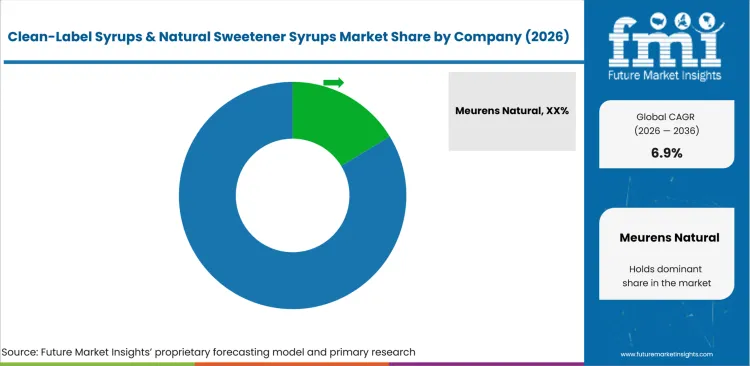
Competition combines cereal syrup specialists with global ingredient groups that offer broader formulation and supply capabilities. Meurens Natural and Grain Millers focus on cereal extracts for bakery and snack applications across commercial production settings. Tate & Lyle and Ingredion add application laboratories; ADM and Cargill provide wider manufacturing coverage across regions. ADM reported in February 2026 that full-year Starches and Sweeteners operating profit declined 21% amid softer demand and higher corn costs. Margin pressure increases the value of precise specifications and disciplined application support across large portfolios. Clean-label preservatives affect syrup selection in moist bakery products through shared water-activity and shelf-life requirements. Beverage ingredients require syrup systems that remain stable during acidic processing and refrigerated distribution across regional product lines.
- Meurens Natural and Grain Millers compete through direct cereal-syrup knowledge aligned with oat and bakery applications. Their commercial value depends on stable specifications and practical technical support that carries recipes from pilot work into repeat production. Focused portfolios also support detailed discussions about cereal flavor and viscosity across individual customer recipes.
- Tate & Lyle and Ingredion compete through formulation laboratories and sweetener systems that address taste and sugar reduction. Their advantage increases in projects requiring coordinated texture and label changes through commercial scale-up and regional launch review. Broader ingredient toolkits also support recipe adjustments that combine bulk syrups with several high-intensity sweeteners.
- ADM and Cargill compete through manufacturing scale and broad sweetener portfolios across established regional facilities. Their reach supports multi-site launches that require common specifications together with dependable supply and technical support under different labeling expectations. Large networks also reduce transition risk for food companies managing related recipes across several countries.
Competitive Benchmarking: Clean-Label Syrups & Natural Sweetener Syrups Market
| Company | Cereal Syrup Portfolio | Bakery Formulation Support | Certification Readiness | Geographic Reach |
|---|---|---|---|---|
| Meurens Natural | High | High | High | Europe |
| Tate & Lyle | Medium | High | High | Global |
| Cargill | High | High | High | Global |
| Ingredion | High | High | Medium | Global |
| ADM | High | High | Medium | Global |
| Grain Millers | Medium | Medium | High | North America |
Key Developments in the Clean-Label Syrups & Natural Sweetener Syrups Market
- In February 2026, Tate & Lyle and Manus launched Yume™ M Stevia at Manus’s large-scale Augusta BioFacility in Georgia. The launch adds regional commercial capacity for food manufacturers that blend bulk syrups with high-intensity sweeteners. Cereal syrup producers can respond through compatibility data that explains solids balance and processing behavior across combined sweetener systems during full production runs.
- In May 2026, Tate & Lyle and BioHarvest Sciences expanded their collaboration to develop several plant-based sweetener molecules for category-specific food and beverage formulations. The program broadens sweetness profiles available for blended systems and creates more options for balancing taste with syrup functionality. Natural syrup producers need commercial compatibility data that explains how cereal solids and newer molecules interact during processing and storage.
- In April 2025, Ingredion reported that PureCircle achieved Farm Sustainability Assessment Silver performance across its contracted stevia supply. Independent external audits covered the contracted grower network and strengthened traceability records for commercial ingredient sourcing. The milestone improves documentation for food companies that combine natural syrups with stevia in reduced-sugar recipes. Comparable cereal syrup programs need source records that remain consistent across commercial grades and customer documentation reviews.
- In June 2026, Ingredion and Tate & Lyle announced a recommended cash acquisition through a scheme of arrangement requiring shareholder and court approval. Ingredion filed the scheme document in July and scheduled shareholder meetings for later that month under the formal transaction process. The transaction remained pending at the publication cutoff; benchmarking therefore retains both companies separately until legal completion changes the combined portfolio.
Key Players in the Clean-Label Syrups & Natural Sweetener Syrups Market
Cereal Syrup Specialists
- Meurens Natural
- Grain Millers
Global Sweetener and Formulation Groups
- Tate & Lyle
- Ingredion
Scaled Ingredient and Supply Groups
- Cargill
- ADM
Clean-Label Syrups & Natural Sweetener Syrups Market - Report Scope
| Coverage field | Report scope |
|---|---|
| Market breakdown | Source, application, and region. |
| Quantitative Units | Revenue in USD Million, CAGR in %. |
| Market Definition | Revenue includes natural cereal syrups and related clean-label sweetener syrups sold directly into food and beverage formulations. The scope covers oat and rice alongside wheat and tapioca syrup categories across the defined applications. |
| Regions Covered | North America, Latin America, Europe, East Asia, South Asia, Oceania, and Middle East and Africa. |
| Countries Covered | USA, Belgium, Germany, UK, and France, plus more than twenty-five additional countries across the covered regions. |
| Key Companies Profiled | Meurens Natural, Tate & Lyle, Cargill, Ingredion, ADM, and Grain Millers |
| Forecast Period | 2026 to 2036. |
| Approach | Hybrid bottom-up and top-down market sizing supported by primary interviews and official desk research sources. |
Clean-Label Syrups & Natural Sweetener Syrups Market - Research Methodology
| Method | Approach |
|---|---|
| Primary Research | FMI analysts gathered input from manufacturers, service providers, technology developers, distributors, end users, sourcing teams, and subject-matter experts. Interviews examined purchasing decisions, product or service evaluation, adoption barriers, approval requirements, pricing considerations, and expectations for technical or commercial support. Respondents were also asked what evidence is required before a trial, pilot, or initial order develops into regular purchasing. |
| Desk Research | Desk research covered government statistics, regulatory publications, trade data, industry associations, technical literature, standards, company filings, product information, and official corporate announcements. Sources were reviewed for relevance, publication date, geographic coverage, and consistency with the defined market scope. Claims relating to performance, applications, approvals, capacity, investment, and commercial activity were retained only when supported by credible public evidence. |
| Market Sizing and Forecasting | The market model combined the baseline value with historical performance, segment structure, pricing and volume indicators, adoption levels, company participation, and country-level demand conditions. Forecast assumptions considered economic activity, investment trends, regulatory developments, technology adoption, purchasing cycles, supply availability, and barriers to wider market use. Segment and regional estimates were reconciled before the final market total was calculated. |
| Data Validation | Estimates were checked against multiple independent indicators, including public data, company activity, trade patterns, industry developments, and findings from primary interviews. Validation also tested whether products, services, applications, and company revenues fell within the defined market boundaries. Adjacent categories, unsupported claims, overlapping revenues, and activities without direct market relevance were excluded to reduce double counting and maintain consistency across segments and countries. |
Clean-Label Syrups & Natural Sweetener Syrups Market by Segments
Clean-Label Syrups & Natural Sweetener Syrups Market segmented by Source:
- Oat
- Rice
- Wheat
- Tapioca Syrups
Clean-Label Syrups & Natural Sweetener Syrups Market segmented by Application:
- Bakery
- Beverages
- Confectionery
- Dairy
Clean-Label Syrups & Natural Sweetener Syrups Market by Region:
- North America
- United States
- Canada
- Latin America
- Brazil
- Mexico
- Argentina
- Chile
- Western Europe
- Germany
- France
- United Kingdom
- Italy
- Spain
- Benelux
- Nordics
- Eastern Europe
- Poland
- Czech Republic
- Romania
- Hungary
- East Asia
- China
- Japan
- South Korea
- South Asia and Pacific
- India
- ASEAN
- Australia and New Zealand
- Middle East and Africa
- GCC Countries
- South Africa
- Türkiye
- Israel
Research Sources and Bibliography
- USA Food and Drug Administration. (2025, January 14). FDA Proposes Requiring At-a-Glance Nutrition Information on the Front of Packaged Foods.
- USA Department of Agriculture, National Agricultural Statistics Service. (2025, September 30). Small Grains 2025 Summary.
- USA Food and Drug Administration. (2025, January 16). Food Labeling: Front-of-Package Nutrition Information (Proposed Rule).
- Department of Health and Social Care. (2025, June 4). Restricting advertising of less healthy food or drink on TV and online: products in scope.
- Department of Health and Social Care. (2025, October 1). Restricting promotions of products high in fat, sugar and salt by location and by price: government response to public consultation.
- Santé publique France. (2025, March 17). Signature de l’arrêté Nutri-Score : un pas de plus vers une meilleure information nutritionnelle des consommateurs.
- Santé publique France. (2026, March 19). Evaluation of the Nutri-Score 2025 Campaign.
- USA Food and Drug Administration. (2025, February 24). FDA Finalizes Updated “Healthy” Nutrient Content Claim.
- Federal Public Service Health, Food Chain Safety and Environment. (2025, April 7). Steviolglycosiden.
- German Federal Statistical Office. (2026, January 15). Wholesale prices in December 2025: +1.2% on December 2024.
- Federal Ministry of Food and Agriculture. (2025, June 4). Hilfestellung für Unternehmen - Verwendung des Nutri-Score.
- Grain Millers, Inc. (n.d.). CereSweet® | Healthy Oat Syrup | Guar Gum & Xantham Gum Alternative.
- Tate & Lyle PLC. (n.d.). STAR-DRI® Maltodextrins and Corn Syrup Solids.
- ADM. (n.d.). Specialty Syrups Innovation.
- ADM. (n.d.). World-Class Bakery Ingredients.
- ADM. (n.d.). ADM Locations Around the World.
- ADM. (n.d.). Quality & Food Safety.
- Tate & Lyle PLC. (2026, May 18). Tate & lyle expands collaboration with BioHarvest to accelerate next-generation sweetener innovation.
- Tate & Lyle PLC. (2025, September 4). Tate & Lyle launches breakthrough formulation tool In Asia-Pacific to unlock full potential of mouthfeel.
- Tate & Lyle PLC. (2026, February 23). Introducing Yume™: A new standard for sweetness.
- Ingredion Incorporated. (2025, April 29). PureCircle™ by Ingredion Achieves Farm Sustainability Assessment Silver Performance Level for 100% of Stevia Supply.
- Ingredion Incorporated. (2026, June 8). Ingredion Announces Recommended All-Cash Acquisition of Tate & Lyle.
- Ingredion Incorporated. (2026, July 3). Form 8-K: Current Report.
- ADM. (2026, February 3). ADM Reports Fourth Quarter and Full-year 2025 Results; Provides 2026 Guidance.
This bibliography is provided for reader reference and is not exhaustive. The full report contains the complete reference list and detailed citations.
This Report Answers
- How large is the clean-label syrups and natural sweetener syrups market in 2026 and 2036?
- Which formulation pressures support demand for natural cereal syrup systems?
- Why is oat estimated to hold the leading source share in 2026?
- How does bakery influence syrup performance and qualification requirements?
- How do country growth rates compare across USA, Belgium, Germany, UK, and France?
- Which companies compete through cereal syrups or broader sweetener formulation capabilities?
- What labeling and reformulation costs can limit commercial adoption?
- Which recent company developments influence sweetener innovation and sourcing documentation?
- How should food manufacturers evaluate syrup performance across full production and shelf-life trials?
Frequently Asked Questions
How big is the Clean-Label Syrups & Natural Sweetener Syrups Market in 2026?
The clean-label syrups and natural sweetener syrups market is valued at USD 2.3 billion in 2026 and is forecast to reach USD 4.5 billion by 2036. Growth reflects packaged food manufacturers comparing naturally derived sweeteners through taste consistency and simple ingredient declarations during commercial recipe approval.
What is the CAGR of the Clean-Label Syrups & Natural Sweetener Syrups Market from 2026 to 2036?
The clean-label syrups and natural sweetener syrups market grows at a CAGR of 6.9% between 2026 and 2036, supported by packaged food reformulation that increases demand for syrups reducing declared sugars while preserving texture throughout the intended shelf life.
Which source leads the Clean-Label Syrups & Natural Sweetener Syrups Market?
Oat accounts for 48.3% of the clean-label syrups and natural sweetener syrups market by source in 2026, driven by its mild flavor and useful binding performance that fits cereal bars and baked snacks needing controlled moisture without intense sweetness.
How much will the Clean-Label Syrups & Natural Sweetener Syrups Market add between 2026 and 2036?
The clean-label syrups and natural sweetener syrups market is set to add USD 2.2 billion between 2026 and 2036, growing from USD 2.3 billion to USD 4.5 billion as reformulation demand extends across a widening base of bakery, beverage, and confectionery applications.
Who are the leading companies in the Clean-Label Syrups & Natural Sweetener Syrups Market?
Five companies lead the clean-label syrups and natural sweetener syrups market, including Meurens Natural, Grain Millers, Ingredion, Tate & Lyle, and ADM, competing through direct cereal-syrup portfolios, sugar-reduction formulation laboratories, and manufacturing scale with international distribution reach.
Preview the report firsthand - request a free sample
Get SampleGet the brochure for pricing and purchase details.
Get PDFTable of Content
- Key Takeaways
- Market Size and CAGR
- Top Growth Driver
- Fastest Growing Segment
- Leading Region
- Key Companies
- Emerging Opportunities
- Executive Summary
- Global Market Outlook
- Demand-side Trends
- Supply-side Trends
- Technology Roadmap Analysis
- Analysis and Recommendations
- Analyst Perspective (What is happening? Why now? What should investors know?)
- Key Questions Answered
- How large is the market?
- What is the CAGR?
- What are key trends?
- Which region dominates?
- Who are the leaders?
- Market Overview
- Market Coverage / Taxonomy
- Market Definition / Scope / Limitations
- Research Methodology
- Chapter Orientation
- Analytical Lens and Working Hypotheses
- Market Structure, Signals, and Trend Drivers
- Benchmarking and Cross-market Comparability
- Market Sizing, Forecasting, and Opportunity Mapping
- Research Design and Evidence Framework
- Desk Research Programme (Secondary Evidence)
- Expert Input and Fieldwork (Primary Evidence)
- Tooling, Models, and Reference Databases
- Data Engineering and Model Build
- Quality Assurance and Audit Trail
- Market Background
- Market Dynamics (Drivers, Restraints, Opportunity, Trends)
- Scenario Forecast (Optimistic, Likely, Conservative)
- Impact Analysis
- AI Impact
- Sustainability Impact
- Regulatory Impact
- Technology Impact
- Consumer / Buyer Analysis
- Purchase Drivers
- Adoption Barriers
- Buyer Journey
- Opportunity Map Analysis
- Product Life Cycle Analysis
- Supply Chain Analysis
- Investment Feasibility Matrix
- Value Chain Analysis
- PESTLE and Porter's Analysis
- Regulatory Landscape
- Regional Parent Market Outlook
- Production and Consumption Statistics
- Import and Export Statistics
- Global Market Analysis and Forecast, 2021 to 2036
- Historical Market Size Value (USD Billion) Analysis, 2021 to 2025
- Current and Future Market Size Value (USD Billion) Projections, 2026 to 2036
- Y-o-Y Growth Trend Analysis
- Absolute $ Opportunity Analysis
- Global Market Pricing Analysis, 2021 to 2036
- Global Market Analysis and Forecast, By Source, 2021 to 2036
- Introduction / Key Findings
- Historical Market Size Value (USD Billion) Analysis By Source, 2021 to 2025
- Current and Future Market Size Value (USD Billion) Analysis and Forecast By Source, 2026 to 2036
- Oat
- Rice
- Wheat
- Tapioca Syrups
- Oat
- Y-o-Y Growth Trend Analysis By Source, 2021 to 2025
- Absolute $ Opportunity Analysis By Source, 2026 to 2036
- Global Market Analysis and Forecast, By Application, 2021 to 2036
- Introduction / Key Findings
- Historical Market Size Value (USD Billion) Analysis By Application, 2021 to 2025
- Current and Future Market Size Value (USD Billion) Analysis and Forecast By Application, 2026 to 2036
- Bakery
- Beverages
- Confectionery
- Dairy
- Bakery
- Y-o-Y Growth Trend Analysis By Application, 2021 to 2025
- Absolute $ Opportunity Analysis By Application, 2026 to 2036
- Global Market Analysis and Forecast, By Region, 2021 to 2036
- Introduction
- Historical Market Size Value (USD Billion) Analysis By Region, 2021 to 2025
- Current Market Size Value (USD Billion) Analysis and Forecast By Region, 2026 to 2036
- North America
- Latin America
- Western Europe
- Eastern Europe
- East Asia
- South Asia and Pacific
- Middle East & Africa
- Market Attractiveness Analysis By Region
- North America Market Analysis and Forecast, By Country, 2021 to 2036
- Historical Market Size Value (USD Billion) Trend Analysis By Market Taxonomy, 2021 to 2025
- Market Size Value (USD Billion) Forecast By Market Taxonomy, 2026 to 2036
- By Country
- USA
- Canada
- By Source
- By Application
- By Country
- Market Attractiveness Analysis
- By Country
- By Source
- By Application
- Key Takeaways
- Latin America Market Analysis and Forecast, By Country
- Historical Market Size Value (USD Billion) Trend Analysis By Market Taxonomy, 2021 to 2025
- Market Size Value (USD Billion) Forecast By Market Taxonomy, 2026 to 2036
- By Country
- Brazil
- Mexico
- Chile
- Rest of Latin America
- By Source
- By Application
- By Country
- Market Attractiveness Analysis
- By Country
- By Source
- By Application
- Key Takeaways
- Western Europe Market Analysis and Forecast, By Country
- Historical Market Size Value (USD Billion) Trend Analysis By Market Taxonomy, 2021 to 2025
- Market Size Value (USD Billion) Forecast By Market Taxonomy, 2026 to 2036
- By Country
- Germany
- UK
- Italy
- Spain
- France
- Nordic
- BENELUX
- Rest of Western Europe
- By Source
- By Application
- By Country
- Market Attractiveness Analysis
- By Country
- By Source
- By Application
- Key Takeaways
- Eastern Europe Market Analysis and Forecast, By Country
- Historical Market Size Value (USD Billion) Trend Analysis By Market Taxonomy, 2021 to 2025
- Market Size Value (USD Billion) Forecast By Market Taxonomy, 2026 to 2036
- By Country
- Russia
- Poland
- Hungary
- Balkan & Baltic
- Rest of Eastern Europe
- By Source
- By Application
- By Country
- Market Attractiveness Analysis
- By Country
- By Source
- By Application
- Key Takeaways
- East Asia Market Analysis and Forecast, By Country
- Historical Market Size Value (USD Billion) Trend Analysis By Market Taxonomy, 2021 to 2025
- Market Size Value (USD Billion) Forecast By Market Taxonomy, 2026 to 2036
- By Country
- China
- Japan
- South Korea
- By Source
- By Application
- By Country
- Market Attractiveness Analysis
- By Country
- By Source
- By Application
- Key Takeaways
- South Asia and Pacific Market Analysis and Forecast, By Country
- Historical Market Size Value (USD Billion) Trend Analysis By Market Taxonomy, 2021 to 2025
- Market Size Value (USD Billion) Forecast By Market Taxonomy, 2026 to 2036
- By Country
- India
- ASEAN
- Australia & New Zealand
- Rest of South Asia and Pacific
- By Source
- By Application
- By Country
- Market Attractiveness Analysis
- By Country
- By Source
- By Application
- Key Takeaways
- Middle East & Africa Market Analysis and Forecast, By Country
- Historical Market Size Value (USD Billion) Trend Analysis By Market Taxonomy, 2021 to 2025
- Market Size Value (USD Billion) Forecast By Market Taxonomy, 2026 to 2036
- By Country
- Kingdom of Saudi Arabia
- Other GCC Countries
- Türkiye
- South Africa
- Other African Union
- Rest of Middle East & Africa
- By Source
- By Application
- By Country
- Market Attractiveness Analysis
- By Country
- By Source
- By Application
- Key Takeaways
- Key Countries Market Analysis
- USA
- Pricing Analysis
- Market Share Analysis, 2025
- By Source
- By Application
- Canada
- Pricing Analysis
- Market Share Analysis, 2025
- By Source
- By Application
- Mexico
- Pricing Analysis
- Market Share Analysis, 2025
- By Source
- By Application
- Brazil
- Pricing Analysis
- Market Share Analysis, 2025
- By Source
- By Application
- Chile
- Pricing Analysis
- Market Share Analysis, 2025
- By Source
- By Application
- Germany
- Pricing Analysis
- Market Share Analysis, 2025
- By Source
- By Application
- UK
- Pricing Analysis
- Market Share Analysis, 2025
- By Source
- By Application
- Italy
- Pricing Analysis
- Market Share Analysis, 2025
- By Source
- By Application
- Spain
- Pricing Analysis
- Market Share Analysis, 2025
- By Source
- By Application
- France
- Pricing Analysis
- Market Share Analysis, 2025
- By Source
- By Application
- India
- Pricing Analysis
- Market Share Analysis, 2025
- By Source
- By Application
- ASEAN
- Pricing Analysis
- Market Share Analysis, 2025
- By Source
- By Application
- Australia & New Zealand
- Pricing Analysis
- Market Share Analysis, 2025
- By Source
- By Application
- China
- Pricing Analysis
- Market Share Analysis, 2025
- By Source
- By Application
- Japan
- Pricing Analysis
- Market Share Analysis, 2025
- By Source
- By Application
- South Korea
- Pricing Analysis
- Market Share Analysis, 2025
- By Source
- By Application
- Russia
- Pricing Analysis
- Market Share Analysis, 2025
- By Source
- By Application
- Poland
- Pricing Analysis
- Market Share Analysis, 2025
- By Source
- By Application
- Hungary
- Pricing Analysis
- Market Share Analysis, 2025
- By Source
- By Application
- Kingdom of Saudi Arabia
- Pricing Analysis
- Market Share Analysis, 2025
- By Source
- By Application
- Türkiye
- Pricing Analysis
- Market Share Analysis, 2025
- By Source
- By Application
- South Africa
- Pricing Analysis
- Market Share Analysis, 2025
- By Source
- By Application
- USA
- Market Structure Analysis
- Competition Dashboard
- Competition Benchmarking
- Market Share Analysis of Top Players
- By Regional
- By Source
- By Application
- Emerging Startups
- Innovation Benchmarking
- Competition Analysis
- Competition Deep Dive
- Meurens Natural
- Overview
- Product Portfolio
- Profitability by Market Segments
- Sales Footprint
- Strategy Overview
- Marketing Strategy
- Product Strategy
- Channel Strategy
- Tate & Lyle
- Cargill
- Ingredion
- ADM
- Grain Millers
- Meurens Natural
- Case Studies
- Success Stories
- Recent Developments
- Competition Deep Dive
- Assumptions & Acronyms Used


