

- Market Size (2026)
- USD 14.6 Bn
- Forecast (2036)
- USD 27.4 Bn
- CAGR (2026 to 2036)
- 6.5%
How big is Clean-Label Functional Starches Market size in 2026?
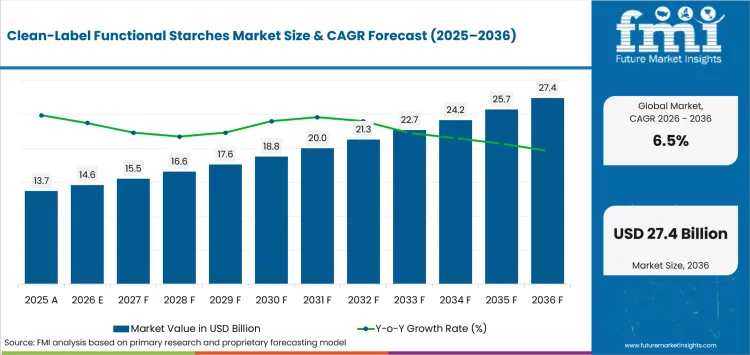
USD 14.6 billion in 2026 and USD 27.4 billion by 2036 at a 6.5% CAGR.
Sales of clean-label functional starches are estimated to rise at 6.5% CAGR through 2036, increasing valuation from USD 14.6 billion in 2026 to USD 27.4 billion by 2036. Food scientists are actively developing natural ingredients to replace synthetic additives like xanthan gum. In January 2025, Park and Kim reported for combining ultrasound-treated rice and potato starch in an optimal 25:75 ratio created a highly effective natural substitute. Their mathematical model for predicting thickness achieved an accuracy score of R² = 0.988. Such strong scientific evidence directly supports food manufacturers who are conducting recipe trials to use physically processed food starch instead of artificial thickeners.
International food producers evaluate these clean-label starches based on distinct regional priorities. Buyers in the United States and Germany favor clear ingredient declarations and repeatable viscosity. Manufacturers in China and Thailand focus primarily on local crop availability and faster testing approvals. Earlier research also demonstrates how simple physical treatments can enhance ingredient performance. In April 2024, Park and colleagues reported claiming mildly heating a 40% by weight starch suspension in aqueous ethanol significantly improved both gel strength and freeze-thaw stability. Such findings encourage food plants to carefully test and validate local potato and corn formulations before granting final factory approval since different starch sources react differently.
Key Takeaways of Clean-Label Functional Starches Market
- Demand for clean-label functional starches is driven by food manufacturers replacing additive-style declarations without losing texture or shelf stability, with product approvals relying on application trials and repeatable processing results.
- By type, soluble starch holds the leading share at 44.3% in 2026, due to efficient dispersion across powdered and liquid formulations.
- Pea is the dominant source segment, holding 46.4% share in 2026, backed by plant-based formulations and distinct texturizing performance.
- Bakery accounts for 36.8% application share in 2026, guided by moisture management across fillings and baked products.
- Potato and maize provide alternative viscosity profiles across dairy and bakery systems, while native and functional native starches support applications requiring familiar source declarations with stronger process tolerance.
- Thailand, China, and the United States record CAGRs of 7.2%, 6.8%, and 6.4% respectively through 2036, shaped by cassava processing depth, corn output scale, and established reformulation programs.
- Competition centers on Roquette, Ingredion, Cargill, ADM, Emsland Group, Royal Avebe, and Tereos, with vendors differentiating through native and soluble starch development, multi-source portfolios, and potato/pea functionality application support.
Analyst Perspective
The clean-label claim on a functional starch is only as strong as its dosage data, since gel strength and dispersion behavior shift measurably with formulation levels rather than staying fixed by source alone. Formulation teams should validate candidate starches under the intended heat, shear, and freeze-thaw conditions of the target recipe, not just against a generic specification sheet. Quality agreements should lock in viscosity, moisture, and sensory tolerances before scale-up, since a starch that performs in trial batches can still fail once production volume and equipment variability enter the picture.
-Nandini Roy Choudhury, Principal Consultant for Food and Beverages at Future Market Insights
Source: Future Market Insights analysis, 2026.
How is Clean-Label Functional Starches Market segmented?
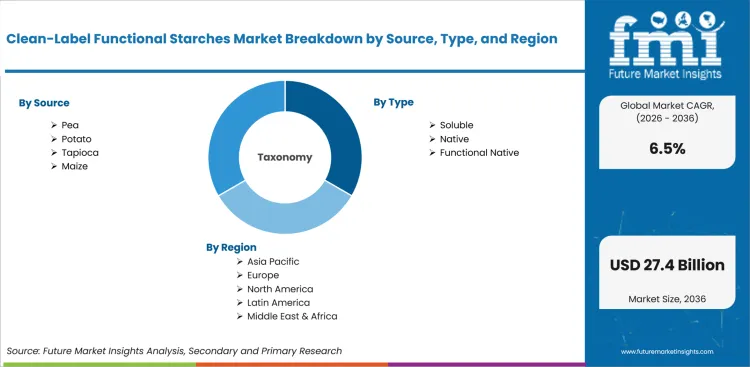
The clean-label functional starches industry is segmented by source, type, application, and region.
The clean-label functional starches sector is segmented by type, source, application, and region. Type coverage includes soluble starches and native starches. Functional native starches complete type analysis. Source coverage includes pea and potato. Tapioca and maize complete source analysis. Application coverage includes bakery and soups. Dairy and meat complete application analysis. Regional coverage spans North America and Latin America. Western Europe and Eastern Europe form European coverage. East Asia joins South Asia and Pacific. Middle East and Africa complete geographic analysis.
Why does pea shape source selection?
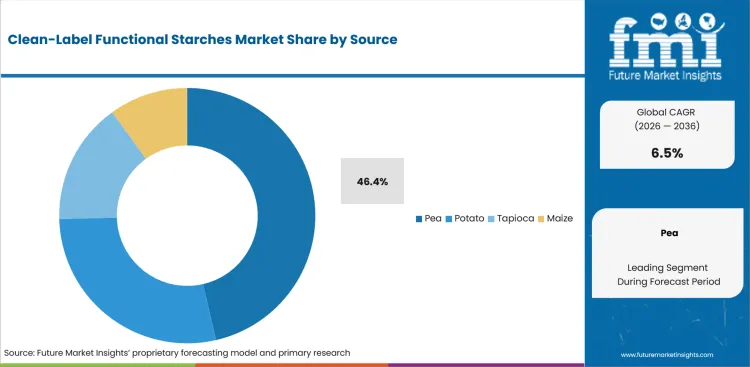
Pea starch combines plant-based source appeal with gelling and binding functionality. Pea-derived film forming starches integrate coating and moisture-control trials across selected foods. Kuang and colleagues reported in January 2025 a 38.2% decline in pea-starch gel strength at 12% pea protein isolate, reinforcing recipe-specific dosage checks. Neutral sensory properties influence savory and bakery product development. Powdered formats add another use case. Supply decisions examine source traceability and moisture control across processing sites.
- Pea is anticipated to represent 46.4% share of source in 2026, backed by plant-based formulations and distinct texturizing performance. Buyers compare gelatinization behavior and gel strength across recipes requiring pea starch declarations.
- Potato and maize provide alternative viscosity profiles across dairy and bakery systems. Selection teams assess local availability and process tolerance prior to assigning each source across product families.
Why does soluble shape type selection?
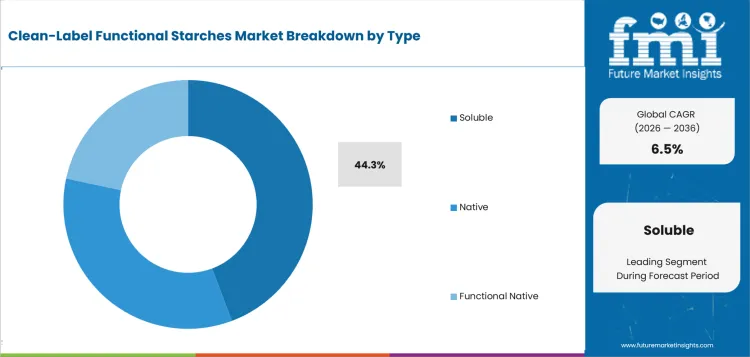
Soluble starch supports formulations requiring quick dispersion without lengthy cooking steps. Powdered beverages and soup mixes benefit from controlled hydration during preparation. Dry seasoning systems require comparable dosing control. He and colleagues reported in February 2024 cold-water solubility above 70% for extrusion-treated kudzu starch, compared with 0.11% for native material. Dry-mix developers compare roll-dried starch against other soluble formats across dosing and viscosity trials. Commercial review examines dust control and hydration consistency across intended applications.
- Based on type, soluble is projected to hold 44.3% share in 2026 due to efficient dispersion across powdered and liquid formulations. Production teams evaluate hydration speed and viscosity consistency across repeated batches prior to full portfolio approval.
- Native and functional native starches support applications requiring familiar source declarations with stronger process tolerance. Formulators compare heat resistance and freeze-thaw behavior against native starch specifications during product trials.
Why does bakery shape application demand?
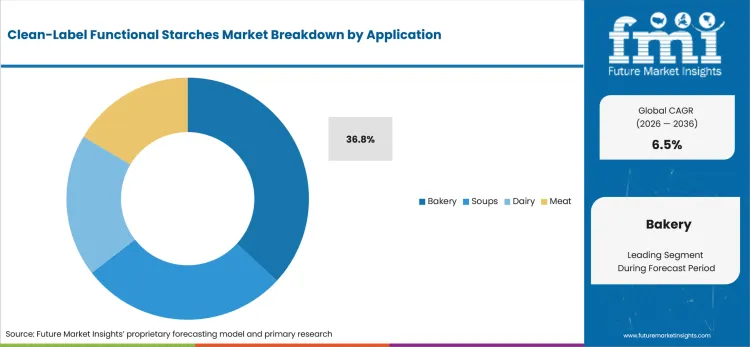
Bakery formulations use functional starches to manage moisture migration and filling stability. Crumb texture and storage quality shape final dosage. Devi and colleagues reported in January 2024 improved bread texture with barley starch substitution up to 10%, highlighting dosage-led bakery qualification. Clean declarations gain commercial value only if processing performance matches established formulation standards. Product developers test starch behavior during mixing and baking. Cooling or freezing trials extend assessment into distribution.
- By application, bakery is estimated to secure 36.8% share in 2026 as it is guided by moisture management across fillings and baked products. Technical teams compare bake stability and storage texture against existing stabilized starch systems.
- Soups and meat applications require distinct thickening and syneresis-control profiles. Application laboratories adjust dosage and process conditions to preserve sensory quality across commercial batches.
What Are Drivers, Restraints, and Opportunities in Clean-Label Functional Starches Market?
Familiar ingredient declarations support reformulation activity across packaged food portfolios. Technical conversion remains complex as label simplicity offers limited value without dependable processing results.
- Driver: Food brands seek recognizable starch declarations without sacrificing texture, stability, or sensory quality. Functional native and soluble options support reformulation across dairy, bakery, savory, and prepared-food products.
- Restraint: Physical modification may require precise moisture, temperature, and treatment control across industrial equipment. Small processing deviations may alter viscosity, gel strength, or storage performance across finished products.
- Opportunity: Multi-functional starches may replace several formulation inputs within one recipe. Lower ingredient complexity may reduce formulation steps and improve label clarity across value-sensitive food products.
Brand teams gain a clearer commercialization path as familiar declarations reduce label-review resistance across reformulated products. Ingredion’s February 2024 release recorded 79% of surveyed global consumers seeking recognizable product ingredients. Such preference supports reformulation trials using clean-label ingredients, provided sensory performance survives factory-scale production.
A January 2024 study by Cheng and colleagues applied heat-moisture treatment for 6 hours under tested conditions. Extended treatment periods increase validation work across throughput and batch reproducibility prior to commercial scale. Longer treatment cycles may restrict factory adoption across plants operating under tight production schedules.
Dairy formulators gain room to simplify stabilizer systems across products requiring dependable texture and familiar ingredient labeling. A March 2024 study by Lee and Kang identified 1.0% heat-moisture-treated rice starch as an optimal nonfat-yogurt stabilizer. Comparable viscosity against pectin expands formulation options for dairy products seeking clean-label starch declarations.
How Are Country CAGRs Aligned in Clean-Label Functional Starches Market?
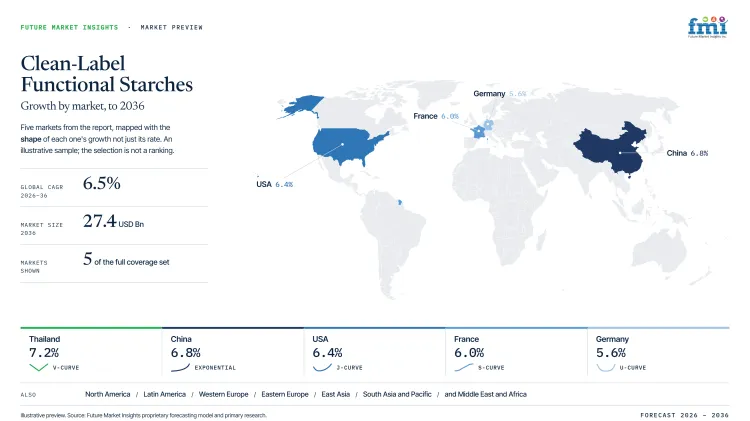
| Country | CAGR |
|---|---|
| Thailand | 7.2% |
| China | 6.8% |
| USA | 6.4% |
| France | 6.0% |
| Germany | 5.6% |
Source: Future Market Insights analysis, 2026.
How Do Country-Level CAGRs Compare in Clean-Label Functional Starches Market?
Country comparison shows a gradual step-down in growth across the profiled locations. Thailand and China occupy the upper end of the range, followed by the United States in the middle position. France and Germany complete the comparison with moderately lower rates. The 1.6-percentage-point spread indicates a shared positive outlook with different commercialization speeds across national markets.
- Thailand and China lead the comparison and establish Asia as the principal development cluster across the locations shown.
- United States follows at a limited distance, indicating sustained reformulation activity across established food manufacturing networks.
- France and Germany form the next growth band and maintain a narrow separation from the middle position.
- Germany records the lowest rate among profiled locations, although its forecast reflects continued demand across structured ingredient qualification programs.
- The pattern forms a measured downward slope instead of a sharp division between quicker-expanding and slower-expanding locations.
Markets carrying similar CAGRs may present different entry conditions through crop availability and technical-service access. Full report coverage extends across North America, Latin America, Western Europe, Eastern Europe, East Asia, South Asia and Pacific, and Middle East and Africa.
Country-wise Analysis
- Demand in Thailand is likely to scale at 7.2% CAGR during the forecast period, influenced by cassava processing expertise and export-oriented ingredient supply. Local conversion capacity links root availability with starch processing for domestic food production and overseas customers. National Statistical Office reported 28,624,312 tonnes of cassava production during 2024, providing a deep feedstock base for tapioca-based functionality.
- Manufacturers in China combine extensive crop availability with large packaged-food production networks. Sales in China are projected to rise at 6.8% CAGR from 2026 to 2036, guided by formulation investment and regional supply development. National Bureau of Statistics of China recorded 301.24 million tons of corn output in 2025, supporting maize-based starch processing across numerous applications.
- United States buyers emphasize process tolerance and dependable technical service across national product portfolios. USA Department of Agriculture’s National Agricultural Statistics Service reported 14.9 billion bushels of corn production during 2024, sustaining domestic feedstock availability for corn-based starch manufacturing. Market in the United States is estimated to grow at 6.4% CAGR during the assessment period, driven by established reformulation expertise and large application laboratories.
- Sector in France is anticipated to progress at 6.0% CAGR during the study period, aided by food manufacturing depth and established texture-development programs. Crop availability influences source choices across potato and pulse-based starch formulations. Insee reported a 3.9% increase in crop production volume during 2025, improving raw-material conditions for ingredient processors and food manufacturers.
- Food producers in Germany apply structured specification controls across ingredient qualification and routine production. Demand is predicted to expand at 5.6% CAGR between 2026 and 2036, helped by application testing and regional starch processing knowledge. German Federal Statistical Office estimated 139,100 hectares of field peas for 2025 harvest, strengthening domestic pulse availability for pea-derived ingredients.
Who Are Notable Companies in Clean-Label Functional Starches Market?
Notable companies include Roquette and Ingredion. Cargill and Emsland Group add multi-source or specialist capabilities. Royal Avebe and Tereos add further capabilities. ADM completes profiled group.
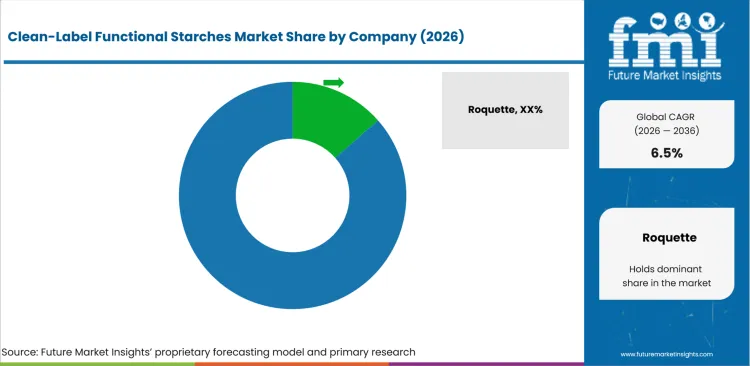
Competition focuses on raw-material coverage and physical processing knowledge. Formulation laboratories support customer trials. Regulatory guidance and supply continuity influence final selection. Buyers are expected to compare supplier evidence through processing trials and final-product performance. Companies offering several botanical sources may address diverse texture requirements across global portfolios. Specialists using potato or pea inputs may gain review attention across applications seeking familiar declarations and distinct sensory results.
- Roquette supports pea and multi-source starch development across savory and powdered formulations. Application support is anticipated to strengthen evaluation across products requiring soluble or low-moisture functionality.
- Ingredion supplies functional native starch systems across dairy and prepared-food uses. Formulation teams are projected to compare process tolerance against existing modified starch standards.
- Cargill participates based on native and specialty starch portfolios across several botanical sources. Customer review is likely to emphasize viscosity retention and shelf stability across demanding production conditions.
- Emsland Group develops potato and pea-based ingredients for clean declarations across confectionery and meat applications. Technical support is likely to reduce trial cycles across recipes requiring plant-based texture systems.
- Royal Avebe concentrates on potato-derived starch functionality across cheese and meat products. Buyers are expected to assess creaminess and gelling behavior under intended process settings.
- Tereos combines starch processing capacity with food formulation support depending on texturizing and fibre applications. Regional manufacturing presence may support continuity across European customer programs.
- ADM offers modified and resistant starch options led by corn and tapioca sources. Portfolio range may support reformulation driven by products requiring organic starch or simple-label positioning.
Competitive Benchmarking: Clean-Label Functional Starches Market
| Company | Source Breadth | Functional Processing | Application Support | Commercial Position |
|---|---|---|---|---|
| Roquette | High | High | High | Plant-based starch specialist |
| Ingredion | High | High | High | Global formulation supplier |
| Cargill | High | High | High | Multi-source ingredient group |
| Emsland Group | Moderate | High | High | Potato and pea specialist |
| Royal Avebe | Focused | High | High | Potato starch cooperative |
| Tereos | Moderate | Moderate | Moderate | European starch processor |
| ADM | High | High | High | Global ingredient supplier |
Source: Future Market Insights competitive analysis, 2026.
Key Developments in Clean-Label Functional Starches Market
- In October 2025, Roquette introduced AMYSTA L 123 thermally soluble pea starch through a patented enzyme-free and chemical-free process. Launch expanded soluble pea options for powdered beverages and condiments requiring familiar label declarations.
- In December 2025, Royal Avebe presented ETENIA as a clean-label potato starch supporting creaminess and cost control across dairy formulations. Company application work extended potato starch use across yogurt and fresh-cheese products requiring texture retention.
- In January 2026, Emsland Group introduced Emjel LC 15 functional starch for vegan and vegetarian jellies and gums. Atmospheric cooking capability reduced reliance on pressure or vacuum systems and expanded plant-based confectionery processing options.
Key Companies in Clean-Label Functional Starches Market
Functional Native and Soluble Starch Developers
- Roquette
- Ingredion
- Cargill
Potato and Pea Starch Specialists
- Emsland Group
- Royal Avebe
Scaled Starch and Ingredient Suppliers
- Tereos
- ADM
Clean-Label Functional Starches Market Report Scope
| Coverage Field | Report Scope |
|---|---|
| Market Breakdown | Clean-label functional starches breakdown by source, type, application, and region |
| Quantitative Units | Revenue in USD Million, CAGR in %. |
| Market Definition | Clean-label functional starches include native, physically processed, enzymatically processed, soluble, and functional native starch ingredients used for texture, stability, binding, moisture control, or sensory performance under familiar label declarations. |
| Regions Covered | North America, Latin America, Western Europe, Eastern Europe, East Asia, South Asia and Pacific, and Middle East and Africa |
| Countries Covered | Thailand, China, USA, France, and Germany with additional countries across profiled regions |
| Key Companies Profiled | Roquette, Ingredion, Cargill, Emsland Group, Royal Avebe, Tereos, and ADM |
| Forecast Period | 2026 to 2036 |
| Approach | Hybrid bottom-up and top-down methodology using source shares, type shares, application shares, country CAGRs, crop availability, company participation, technical evidence, and formulation activity |
Source: Future Market Insights analysis, 2026.
Clean-Label Functional Starches Market - Research Methodology
| Method | Approach |
|---|---|
| Primary Research | FMI analysts gathered input from manufacturers, service providers, technology developers, distributors, end users, sourcing teams, and subject-matter experts. Interviews examined purchasing decisions, product or service evaluation, adoption barriers, approval requirements, pricing considerations, and expectations for technical or commercial support. Respondents were also asked what evidence is required before a trial, pilot, or initial order develops into regular purchasing. |
| Desk Research | Desk research covered government statistics, regulatory publications, trade data, industry associations, technical literature, standards, company filings, product information, and official corporate announcements. Sources were reviewed for relevance, publication date, geographic coverage, and consistency with the defined market scope. Claims relating to performance, applications, approvals, capacity, investment, and commercial activity were retained only when supported by credible public evidence. |
| Market Sizing and Forecasting | The market model combined the baseline value with historical performance, segment structure, pricing and volume indicators, adoption levels, company participation, and country-level demand conditions. Forecast assumptions considered economic activity, investment trends, regulatory developments, technology adoption, purchasing cycles, supply availability, and barriers to wider market use. Segment and regional estimates were reconciled before the final market total was calculated. |
| Data Validation | Estimates were checked against multiple independent indicators, including public data, company activity, trade patterns, industry developments, and findings from primary interviews. Validation also tested whether products, services, applications, and company revenues fell within the defined market boundaries. Adjacent categories, unsupported claims, overlapping revenues, and activities without direct market relevance were excluded to reduce double counting and maintain consistency across segments and countries. |
Source: Future Market Insights analysis, 2026.
Clean-Label Functional Starches Market by Segments
Clean-Label Functional Starches Market Segmented by Source
- Pea
- Potato
- Tapioca
- Maize
Clean-Label Functional Starches Market Segmented by Type
- Soluble
- Native
- Functional Native
Clean-Label Functional Starches Market Segmented by Application
- Bakery
- Soups
- Dairy
- Meat
Clean-Label Functional Starches Market Segmented by Region
- North America
- United States
- Canada
- Latin America
- Brazil
- Mexico
- Argentina
- Chile
- Western Europe
- Germany
- France
- United Kingdom
- Italy
- Spain
- Benelux
- Nordics
- Eastern Europe
- Poland
- Czech Republic
- Romania
- Hungary
- East Asia
- China
- Japan
- South Korea
- South Asia and Pacific
- India
- ASEAN
- Australia and New Zealand
- Middle East and Africa
- GCC Countries
- South Africa
- Türkiye
- Israel
Research Sources and Bibliography
- Park, S., & Kim, Y.-R. (2025). Production of clean-label starch using physically treated starch blending and its application as a xanthan gum substitute. Food Science and Biotechnology, 34, 1949-1956.
- Park, H.-J., Cho, D.-H., Chung, H.-J., & Lim, S.-T. (2024). Enhanced gelling property and freeze-thaw stability of potato, tapioca and corn starches modified by mild heating in aqueous ethanol solution. Journal of the Science of Food and Agriculture, 104(12), 7228-7237.
- Cheng, F., Ren, Y., Warkentin, T. D., & Ai, Y. (2024). Heat-moisture treatment to modify structure and functionality and reduce digestibility of wrinkled and round pea starches. Carbohydrate Polymers, 324, 121506.
- Devi, R., Singh, A., Dutta, D., & Sit, N. (2024). Physicochemical properties of barley starch and effect of substitution of wheat flour with barley starch on texture and sensory properties of bread. eFood, 5(1), e132.
- Emsland Group. (2025, July 3). Clean Label, Clear Benefits.
- Emsland Group. (2026, January 21). Emjel® LC 15 Sets a New Standard for Vegan & Vegetarian Jellies & Gums.
- German Federal Statistical Office. (2025, May 19). Field crops and grassland: Field crops.
- Ingredion Incorporated. (2024, February 6). Ingredion launches first functional native, clean label starch with gelling and improved mouthfeel capabilities.
- Insee. (2026, July 7). Second estimates for the 2025 agricultural accounts: Prices and volumes rebounded after the decline in 2024.
- He, R., Li, M., Huang, B., Zou, X., Li, S., Sang, X., & Yang, L. (2024). Comparative analysis of multi-angle structural alterations and cold-water solubility of kudzu starch modifications using different methods. International Journal of Biological Macromolecules, 264, 130522.
- Lee, I., & Kang, T. (2024). Heat-moisture-treated rice starches with different amylose and moisture contents as stabilizers for nonfat yogurt. Food Chemistry, 436, 137746.
- Kuang, J., Zhang, W., Yang, X., & Ma, P. (2025). Controlling pea starch gelatinization behavior and rheological properties by modulating granule structure change with pea protein isolate. Food Chemistry: X, 25, 102218.
- National Bureau of Statistics of China. (2026, February 28). Statistical communiqué of the People’s Republic of China on the 2025 national economic and social development.
- National Statistical Office. (2025). Statistical Yearbook Thailand 2025.
- Roquette. (2025, October 31). AMYSTA™ L 123, the New Label-Friendly Soluble Pea Starch.
- Royal Avebe. (2025, December 23). Creamy, clean-label, and cost-effective: How to solve dairy’s toughest challenges with potato starch.
- USA Department of Agriculture, National Agricultural Statistics Service. (2025, January 10). Corn production down, soybean production up in 2024, USDA reports; corn stocks down, soybean stocks up from year earlier, winter wheat seedings up for 2025.
This bibliography is provided for reader reference and is not exhaustive. The full report contains the complete reference list and detailed citations.
This Report Answers
- What segments influence demand across source, type, application, and region?
- How do food manufacturers evaluate clean-label functional starches prior to routine production use?
- How do country CAGRs differ across key countries for the market?
- What companies compete through source breadth and supply continuity?
- How are forecasts validated through hybrid bottom-up and top-down analysis using independent indicators?
- What evidence do formulation teams examine prior to multi-site ingredient approval?
- How do viscosity and sensory performance influence ingredient selection?
- What limits return on investment across clean-label reformulation programs?
- How do specification records and technical guidance influence supplier approval?
- What company capabilities improve long-term formulation confidence and repeat purchasing?
Frequently Asked Questions
How big is the Clean-Label Functional Starches Market in 2026?
The clean-label functional starches market is valued at USD 14.6 billion in 2026 and is forecast to reach USD 27.4 billion by 2036. Growth reflects food scientists developing natural ingredients that replace synthetic additives while preserving texture and processing performance across commercial food formulations.
What is the CAGR of the Clean-Label Functional Starches Market from 2026 to 2036?
The clean-label functional starches market grows at a CAGR of 6.5% between 2026 and 2036, supported by food brands seeking recognizable starch declarations that preserve texture, stability, and sensory quality across dairy, bakery, savory, and prepared-food product portfolios.
Which source leads the Clean-Label Functional Starches Market?
Pea accounts for 46.4% of the clean-label functional starches market by source in 2026, backed by plant-based positioning and distinct texturizing performance that food buyers compare through gelatinization behavior and gel strength across recipes requiring pea starch declarations.
How much will the Clean-Label Functional Starches Market add between 2026 and 2036?
The clean-label functional starches market is set to add USD 12.8 billion between 2026 and 2036, growing from USD 14.6 billion to USD 27.4 billion as clean-label reformulation extends across a widening base of bakery, dairy, and savory food applications.
Who are the leading companies in the Clean-Label Functional Starches Market?
Five companies lead the clean-label functional starches market, including Roquette, Ingredion, Cargill, Emsland Group, and Royal Avebe, competing through source breadth, functional processing capability, and application support across bakery, dairy, savory, and confectionery formulation programs worldwide.
Preview the report firsthand - request a free sample
Get SampleGet the brochure for pricing and purchase details.
Get PDFTable of Content
- Key Takeaways
- Market Size and CAGR
- Top Growth Driver
- Fastest Growing Segment
- Leading Region
- Key Companies
- Emerging Opportunities
- Executive Summary
- Global Market Outlook
- Demand-side Trends
- Supply-side Trends
- Technology Roadmap Analysis
- Analysis and Recommendations
- Analyst Perspective (What is happening? Why now? What should investors know?)
- Key Questions Answered
- How large is the market?
- What is the CAGR?
- What are key trends?
- Which region dominates?
- Who are the leaders?
- Market Overview
- Market Coverage / Taxonomy
- Market Definition / Scope / Limitations
- Research Methodology
- Chapter Orientation
- Analytical Lens and Working Hypotheses
- Market Structure, Signals, and Trend Drivers
- Benchmarking and Cross-market Comparability
- Market Sizing, Forecasting, and Opportunity Mapping
- Research Design and Evidence Framework
- Desk Research Programme (Secondary Evidence)
- Expert Input and Fieldwork (Primary Evidence)
- Tooling, Models, and Reference Databases
- Data Engineering and Model Build
- Quality Assurance and Audit Trail
- Market Background
- Market Dynamics (Drivers, Restraints, Opportunity, Trends)
- Scenario Forecast (Optimistic, Likely, Conservative)
- Impact Analysis
- AI Impact
- Sustainability Impact
- Regulatory Impact
- Technology Impact
- Consumer / Buyer Analysis
- Purchase Drivers
- Adoption Barriers
- Buyer Journey
- Opportunity Map Analysis
- Product Life Cycle Analysis
- Supply Chain Analysis
- Investment Feasibility Matrix
- Value Chain Analysis
- PESTLE and Porter's Analysis
- Regulatory Landscape
- Regional Parent Market Outlook
- Production and Consumption Statistics
- Import and Export Statistics
- Global Market Analysis and Forecast, 2021 to 2036
- Historical Market Size Value (USD Billion) Analysis, 2021 to 2025
- Current and Future Market Size Value (USD Billion) Projections, 2026 to 2036
- Y-o-Y Growth Trend Analysis
- Absolute $ Opportunity Analysis
- Global Market Pricing Analysis, 2021 to 2036
- Global Market Analysis and Forecast, By Source, 2021 to 2036
- Introduction / Key Findings
- Historical Market Size Value (USD Billion) Analysis By Source, 2021 to 2025
- Current and Future Market Size Value (USD Billion) Analysis and Forecast By Source, 2026 to 2036
- Pea
- Potato
- Tapioca
- Maize
- Pea
- Y-o-Y Growth Trend Analysis By Source, 2021 to 2025
- Absolute $ Opportunity Analysis By Source, 2026 to 2036
- Global Market Analysis and Forecast, By Type, 2021 to 2036
- Introduction / Key Findings
- Historical Market Size Value (USD Billion) Analysis By Type, 2021 to 2025
- Current and Future Market Size Value (USD Billion) Analysis and Forecast By Type, 2026 to 2036
- Soluble
- Native
- Functional Native
- Soluble
- Y-o-Y Growth Trend Analysis By Type, 2021 to 2025
- Absolute $ Opportunity Analysis By Type, 2026 to 2036
- Global Market Analysis and Forecast, By Application, 2021 to 2036
- Introduction / Key Findings
- Historical Market Size Value (USD Billion) Analysis By Application, 2021 to 2025
- Current and Future Market Size Value (USD Billion) Analysis and Forecast By Application, 2026 to 2036
- Bakery
- Soups
- Dairy
- Meat
- Bakery
- Y-o-Y Growth Trend Analysis By Application, 2021 to 2025
- Absolute $ Opportunity Analysis By Application, 2026 to 2036
- Global Market Analysis and Forecast, By Region, 2021 to 2036
- Introduction
- Historical Market Size Value (USD Billion) Analysis By Region, 2021 to 2025
- Current Market Size Value (USD Billion) Analysis and Forecast By Region, 2026 to 2036
- North America
- Latin America
- Western Europe
- Eastern Europe
- East Asia
- South Asia and Pacific
- Middle East & Africa
- Market Attractiveness Analysis By Region
- North America Market Analysis and Forecast, By Country, 2021 to 2036
- Historical Market Size Value (USD Billion) Trend Analysis By Market Taxonomy, 2021 to 2025
- Market Size Value (USD Billion) Forecast By Market Taxonomy, 2026 to 2036
- By Country
- USA
- Canada
- By Source
- By Type
- By Application
- By Country
- Market Attractiveness Analysis
- By Country
- By Source
- By Type
- By Application
- Key Takeaways
- Latin America Market Analysis and Forecast, By Country
- Historical Market Size Value (USD Billion) Trend Analysis By Market Taxonomy, 2021 to 2025
- Market Size Value (USD Billion) Forecast By Market Taxonomy, 2026 to 2036
- By Country
- Brazil
- Mexico
- Chile
- Rest of Latin America
- By Source
- By Type
- By Application
- By Country
- Market Attractiveness Analysis
- By Country
- By Source
- By Type
- By Application
- Key Takeaways
- Western Europe Market Analysis and Forecast, By Country
- Historical Market Size Value (USD Billion) Trend Analysis By Market Taxonomy, 2021 to 2025
- Market Size Value (USD Billion) Forecast By Market Taxonomy, 2026 to 2036
- By Country
- Germany
- UK
- Italy
- Spain
- France
- Nordic
- BENELUX
- Rest of Western Europe
- By Source
- By Type
- By Application
- By Country
- Market Attractiveness Analysis
- By Country
- By Source
- By Type
- By Application
- Key Takeaways
- Eastern Europe Market Analysis and Forecast, By Country
- Historical Market Size Value (USD Billion) Trend Analysis By Market Taxonomy, 2021 to 2025
- Market Size Value (USD Billion) Forecast By Market Taxonomy, 2026 to 2036
- By Country
- Russia
- Poland
- Hungary
- Balkan & Baltic
- Rest of Eastern Europe
- By Source
- By Type
- By Application
- By Country
- Market Attractiveness Analysis
- By Country
- By Source
- By Type
- By Application
- Key Takeaways
- East Asia Market Analysis and Forecast, By Country
- Historical Market Size Value (USD Billion) Trend Analysis By Market Taxonomy, 2021 to 2025
- Market Size Value (USD Billion) Forecast By Market Taxonomy, 2026 to 2036
- By Country
- China
- Japan
- South Korea
- By Source
- By Type
- By Application
- By Country
- Market Attractiveness Analysis
- By Country
- By Source
- By Type
- By Application
- Key Takeaways
- South Asia and Pacific Market Analysis and Forecast, By Country
- Historical Market Size Value (USD Billion) Trend Analysis By Market Taxonomy, 2021 to 2025
- Market Size Value (USD Billion) Forecast By Market Taxonomy, 2026 to 2036
- By Country
- India
- ASEAN
- Australia & New Zealand
- Rest of South Asia and Pacific
- By Source
- By Type
- By Application
- By Country
- Market Attractiveness Analysis
- By Country
- By Source
- By Type
- By Application
- Key Takeaways
- Middle East & Africa Market Analysis and Forecast, By Country
- Historical Market Size Value (USD Billion) Trend Analysis By Market Taxonomy, 2021 to 2025
- Market Size Value (USD Billion) Forecast By Market Taxonomy, 2026 to 2036
- By Country
- Kingdom of Saudi Arabia
- Other GCC Countries
- Türkiye
- South Africa
- Other African Union
- Rest of Middle East & Africa
- By Source
- By Type
- By Application
- By Country
- Market Attractiveness Analysis
- By Country
- By Source
- By Type
- By Application
- Key Takeaways
- Key Countries Market Analysis
- USA
- Pricing Analysis
- Market Share Analysis, 2025
- By Source
- By Type
- By Application
- Canada
- Pricing Analysis
- Market Share Analysis, 2025
- By Source
- By Type
- By Application
- Mexico
- Pricing Analysis
- Market Share Analysis, 2025
- By Source
- By Type
- By Application
- Brazil
- Pricing Analysis
- Market Share Analysis, 2025
- By Source
- By Type
- By Application
- Chile
- Pricing Analysis
- Market Share Analysis, 2025
- By Source
- By Type
- By Application
- Germany
- Pricing Analysis
- Market Share Analysis, 2025
- By Source
- By Type
- By Application
- UK
- Pricing Analysis
- Market Share Analysis, 2025
- By Source
- By Type
- By Application
- Italy
- Pricing Analysis
- Market Share Analysis, 2025
- By Source
- By Type
- By Application
- Spain
- Pricing Analysis
- Market Share Analysis, 2025
- By Source
- By Type
- By Application
- France
- Pricing Analysis
- Market Share Analysis, 2025
- By Source
- By Type
- By Application
- India
- Pricing Analysis
- Market Share Analysis, 2025
- By Source
- By Type
- By Application
- ASEAN
- Pricing Analysis
- Market Share Analysis, 2025
- By Source
- By Type
- By Application
- Australia & New Zealand
- Pricing Analysis
- Market Share Analysis, 2025
- By Source
- By Type
- By Application
- China
- Pricing Analysis
- Market Share Analysis, 2025
- By Source
- By Type
- By Application
- Japan
- Pricing Analysis
- Market Share Analysis, 2025
- By Source
- By Type
- By Application
- South Korea
- Pricing Analysis
- Market Share Analysis, 2025
- By Source
- By Type
- By Application
- Russia
- Pricing Analysis
- Market Share Analysis, 2025
- By Source
- By Type
- By Application
- Poland
- Pricing Analysis
- Market Share Analysis, 2025
- By Source
- By Type
- By Application
- Hungary
- Pricing Analysis
- Market Share Analysis, 2025
- By Source
- By Type
- By Application
- Kingdom of Saudi Arabia
- Pricing Analysis
- Market Share Analysis, 2025
- By Source
- By Type
- By Application
- Türkiye
- Pricing Analysis
- Market Share Analysis, 2025
- By Source
- By Type
- By Application
- South Africa
- Pricing Analysis
- Market Share Analysis, 2025
- By Source
- By Type
- By Application
- USA
- Market Structure Analysis
- Competition Dashboard
- Competition Benchmarking
- Market Share Analysis of Top Players
- By Regional
- By Source
- By Type
- By Application
- Emerging Startups
- Innovation Benchmarking
- Competition Analysis
- Competition Deep Dive
- Roquette
- Overview
- Product Portfolio
- Profitability by Market Segments
- Sales Footprint
- Strategy Overview
- Marketing Strategy
- Product Strategy
- Channel Strategy
- Ingredion
- Cargill
- Emsland
- Avebe
- Tereos
- ADM
- Roquette
- Case Studies
- Success Stories
- Recent Developments
- Competition Deep Dive
- Assumptions & Acronyms Used


