

- Market Size (2026)
- USD 182.2 Mn
- Forecast (2036)
- USD 464.1 Mn
- CAGR (2026 to 2036)
- 9.8%
How big is the bakery flavor pastes market in 2026?
The market was valued at USD 165.9 million in 2025 and is expected to reach USD 182.2 million in 2026. It is projected to reach USD 464.1 million by 2036 at a CAGR of 9.8% from 2026 to 2036.
The bakery flavor pastes market was valued at USD 165.9 million in 2025 and is estimated at USD 182.2 million in 2026, with revenue projected to reach USD 464.1 million by 2036 at a CAGR of 9.8%. Liquid flavors account for 37.0% of product type demand in 2026, while adoption depends on whether a preparation delivers the intended flavor after fermentation and baking. In the UK, real output from bakery and farinaceous manufacturing grew 2.7% in 2025, according to the Office for National Statistics.[6] Prepared pastes can gain use even when overall bakery output grows more slowly, as producers replace in-house fruit and nut preparations with ingredients that simplify dosing, storage and quality control. Those advantages matter most when an approved recipe runs often enough to support regular replenishment. For suppliers, a trial is commercially meaningful when flavor, texture and shelf life hold across full production runs and repeated deliveries, rather than in a single test batch.
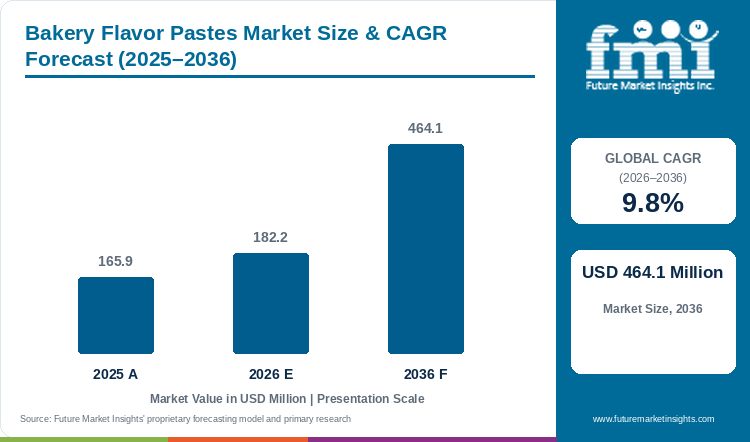
Key Market Trends & Insights
- By product type: Liquid Flavors represented 37.0% of 2026 product type demand. Manufacturers choose liquids when they need exact measurements and a perfectly even mix. It’s the most reliable way to guarantee the taste is identical from the first batch to the last.
- By form: Dry Powders accounted for 45.0% of 2026 form demand. Powders hold the largest share because they are simply more practical for dry manufacturing. They don't clump in storage and blend seamlessly into other dry ingredients like flour or spice mixes.
- By application: Bread & Rolls held 34.0% of 2026 application demand. This is the top application, but it’s also the toughest test. A bakery flavor is only useful if it can survive yeast fermentation and high oven temperatures without baking out.
Regional Highlights
- The UAE has the strongest country forecast for bakery flavor pastes, at 11.2% CAGR through 2036, where repeatable flavor after baking remains the practical test for new formulations.
- Saudi Arabia's 10.8% and South Korea's 10.5% forecasts sit ahead of the USA at 10.2%, while Japan's 8.9% outlook points to a more measured pace of recipe conversion.
Market Size & Forecast
Table 1: Bakery Flavor Pastes Market Size and Forecast (USD million), 2025 to 2036
| Market size and forecast | Value |
|---|---|
| 2025 Value (actual) | USD 165.9 million |
| Estimated market size in 2026 | USD 182.2 million |
| Projected market size by 2036 | USD 464.1 million |
| CAGR (2026-2036) | 9.8% |
The practical opportunity depends on formulation performance. Research published by the University of Illinois in 2024 demonstrated that baking at 160°C caused greater losses of certain flavor compounds than baking at 130°C, while vanillin showed comparatively greater stability.[7] A separate study of avocado fruit puree in pound cakes reported differences in finished cake properties.[8] These findings indicate that flavor concentration alone cannot establish suitability for industrial baking. Water activity also requires attention because it influences microbial stability and product shelf life. Consequently, actual demand will depend on whether purchased pastes deliver consistent results in finished products while offering sufficient economic advantages over existing preparation methods.
The market is segmented by Product Type, Form, Application, Claim, Sales Channel and Region. The forecast period runs from 2026 to 2036.
For bakeries, the choice between a flavour paste and a prepared filling comes down to how much of the recipe they want to make themselves. Dawn’s fruit-based compounds allow manufacturers to add concentrated flavour to their existing creams or batters without preparing the fruit component separately. CSM Ingredients took a different approach with Creami, launched in May 2026, offering finished fillings for bakery and confectionery applications. Both formats can serve similar products, but their economics differ. A concentrate leaves more preparation with the bakery, while a finished filling reduces the work required before assembly. The decision depends on ingredient dosage, labour costs and how well each option performs in the finished product.
Nut pastes present a further challenge when production volumes increase. Puratos acquired US-based Vör Foods in January 2026, adding a manufacturing facility producing pistachio, hazelnut and other nut preparations. The company also announced plans to expand equipment capacity. Such investment matters when a flavour developed for a small product launch moves into regular commercial production. Larger orders require reliable supply, but consistency remains equally important. Research on pistachio spreads published in 2025 found that formulation and storage temperature influenced oil separation and texture. A bakery therefore needs assurance that a paste will retain its handling properties as production scales. Additional manufacturing capacity has commercial value when the supplier can maintain that consistency.
Demand also varies considerably by geography. Givaudan reported 7.1% like-for-like growth in its Taste & Wellbeing business in Asia Pacific during the first nine months of 2026, compared with a 3.3% decline in North America. These figures cover a much broader ingredient portfolio and cannot be treated as bakery flavor paste growth rates. Established bakery formulations face another consideration in regulated markets. The European Commission distinguishes between flavouring substances and preparations under EU food law, making ingredient classification relevant when manufacturers reformulate products. A replacement ingredient may require changes to existing specifications or a review of label declarations. Even where an alternative delivers a comparable flavour, these requirements can discourage switching. Sustained demand for bakery flavor pastes will depend on whether manufacturers can reduce preparation costs without compromising product consistency or disrupting established production processes.
Table 2: Supporting Industry Indicators for the Bakery Flavor Pastes Market, 2025 to 2026 and current product specifications
| Indicator | Data point | Why it matters | Source |
|---|---|---|---|
| Wider flavour sales | Givaudan Taste & Wellbeing grew 1.5% like-for-like in January–September 2026. | Recent sales at a diversified flavour supplier provide context for the narrower bakery-paste forecast. | [5] |
| Regional supplier variation | Taste & Wellbeing grew 7.1% in Asia Pacific and declined 3.3% in North America. | Customer and regional demand can diverge within the same supplier portfolio. | [5] |
| Local nut-paste supply | Puratos acquired Vör Foods in January 2026. | The transaction adds a US nut-paste and filling manufacturing operation. | [3] |
| Concentrate format | Dawn offers compounds based on concentrated fruit ingredients. | The customer retains control of the receiving base and addition rate. | [2] |
| Adjacent filling offer | CSM launched Creami prepared fillings in May 2026. | A more complete preparation competes for the customer’s formulation work. | [4] |
| Ingredient identity | EU rules distinguish several categories of flavourings. | Supplier specifications must support the customer’s intended declaration. | [1] |
Demand Intensity Analysis
The bakery flavor pastes market is forecast to generate an additional USD 281.9 million in annual revenue between 2026 and 2036. Some of this growth can come from bakeries purchasing ingredients they previously prepared themselves. A manufacturer may replace in-house fruit processing with a ready-to-use paste without producing more cakes or pastries. The same preparation can also be used across several product lines, although that does not guarantee substantial sales. A flavour developed for a limited-edition dessert may generate only a few orders, whereas one adopted in a regularly manufactured product can create demand throughout the year. Suppliers therefore need to convert successful formulation trials into repeat purchases.
The choice of ingredient format influences how much spending suppliers can capture. A concentrated paste allows bakeries to prepare their own cream or filling base while avoiding some of the work involved in processing flavour ingredients. A complete filling removes more preparation work but may give the manufacturer less flexibility over the final recipe. These distinctions matter when assessing the market's projected 9.8% CAGR. Givaudan reported just 1.5% like-for-like growth in its wider Taste & Wellbeing business during the first nine months of 2026. While the figures represent different markets and periods, they suggest that the bakery flavor pastes forecast requires gains beyond general flavour-industry expansion. Greater use of purchased preparations offers one possible route, particularly where manufacturers can demonstrate savings over existing production methods.
Liquid flavors generate USD 67.4 million in 2026, while Powder / dry products account for USD 82.0 million under a separate Form classification. Ingredient concentration affects purchasing economics because a relatively small quantity may be sufficient for a large production batch. The relevant cost is therefore the amount used in each recipe, rather than the price of the ingredient container. Highly concentrated preparations introduce practical challenges, however. Small additions must be measured accurately and distributed evenly through the mixture to avoid differences between batches. This becomes especially relevant when a bakery moves from development trials to routine production, where the same flavour must perform consistently at larger volumes.
Direct supply to industrial bakeries represents USD 85.6 million in 2026. A preparation approved by a large manufacturer may eventually be used across multiple production facilities, increasing the volume purchased from a single supplier. Such accounts can also be difficult to retain when ingredient performance changes. Adjustments to an established paste may require new production trials and revisions to technical specifications. Manufacturers consequently have reasons to favour suppliers that can maintain the agreed formulation and provide reliable replenishment. Long-term sales are ultimately determined by how much finished product the bakery manufactures, how frequently it runs each recipe and the quantity of paste required per batch.
Table 3: Demand Intensity Metrics for the Bakery Flavor Pastes Market, 2026 to 2036 with relevant industry comparisons
| Demand intensity metric | Value | Basis |
|---|---|---|
| Bakery flavour pastes value CAGR | 9.8% | Global value forecast, 2026 to 2036. |
| Wider flavour-business growth | 1.5% | Givaudan Taste & Wellbeing, nine months of 2026; like-for-like sales.[5] |
| Liquid flavors revenue, 2026 | USD 67.4 million | Product Type category; 37.0% market share. |
| Powder / dry revenue, 2026 | USD 82.0 million | Separate Form category; 45.0% market share. |
| Bread & rolls revenue, 2026 | USD 61.9 million | Application category; 34.0% market share. |
| Direct industrial-bakery revenue, 2026 | USD 85.6 million | Sales Channel category; recurring industrial supply. |
| Added revenue through 2036 | USD 281.9 million | Change in forecast market value between 2026 and 2036. |
Analyst Perspective
Concentrated pastes earn a lasting place when they remove preparation work without disrupting the customer’s base recipe. Suppliers that preserve that balance can extend an accepted ingredient across products, while an unstable dose or texture limits repeat use.
- Nandini Roy Choudhury, Principal Analyst at Future Market Insights
How is the bakery flavor pastes market segmented?
The bakery flavor pastes market is segmented by Product Type (Liquid flavors, Pastes & emulco, Powders, Natural extracts), Form (Powder / dry, Liquid, Paste / semi-solid, Granules / pieces), Application (Bread & rolls, Cakes & muffins, Biscuits & cookies, Viennoiserie & pastry, Other bakery & snacks), Claim (Conventional, Clean label, Organic, Non-GMO / identity preserved), and Sales Channel (Direct to industrial bakeries, Ingredient distributors, Foodservice & artisan supply, Online B2B). Regionally, the market is segmented into North America, Latin America, Western Europe, Eastern Europe, East Asia, South Asia and Pacific, and Middle East and Africa.
Why do Liquid flavors lead the Product Type category?
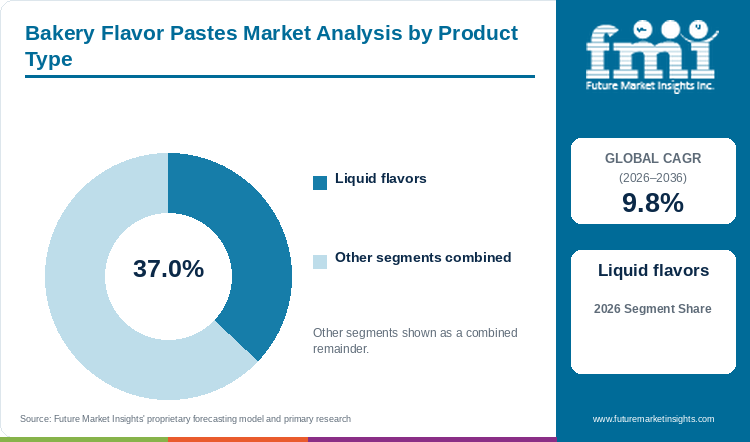
Liquid flavors lead with 37.0% of Product Type demand in 2026.
Their commercial reach depends on even dispersion at a dose the bakery can measure consistently. Dawn’s compounds use extracts, concentrates and purées, illustrating the range of compositions available.[2] Different carriers and strengths can change the volume required for the same finished recipe, so revenue and physical consumption need not move together.
- Liquid flavors hold 37.0% of Product Type demand in 2026.
- The chosen dose must remain measurable and disperse evenly at the smallest intended batch size.
What sustains Powder / dry as the leading Form?
Powder / dry accounts for 45.0% of Form revenue in 2026.
Dry preparations can enter flour-room weighing routines and be combined with other measured ingredients. Moisture exposure and incomplete incorporation can still undermine that convenience. A format that fits storage and mixing routines can remain in repeated use without introducing an extra preparation stage.
- Powder / dry accounts for 45.0% of Form revenue in 2026.
- Stored flow and incorporation into the recipe need to be checked together.
Why do bread and roll applications support repeat purchasing?
Bread & rolls represent 34.0% of Application revenue in 2026. A flavour added before fermentation and baking must leave the required character in the finished product. Incorporation into a bakery mix gives a concentrate another route to repeated use, although it also connects the flavour supplier to the mix manufacturer’s specification. Changes in strength or carrier can then affect several downstream recipes.
- Bread & rolls represent 34.0% of Application revenue in 2026.
- The finished bake establishes whether the selected dose retains its intended character.
What are the drivers, restraints and opportunities in the bakery flavor pastes market?
Concentrated ingredients make product variation easier to manage
A common cream or batter base can support several finished products when measured concentrates supply the flavour variation. Dawn’s compound range illustrates this model.[2] It transfers part of fruit preparation to the supplier and can reduce the number of specialist ingredients held at the bakery. The commercial opportunity grows when those variants remain in regular production, giving the concentrate a recurring place in replenishment.
Recipe compatibility sets a higher threshold than flavour intensity
Texture can prevent an attractive flavour sample from becoming a production ingredient. Added water, oil or acidity can affect a cream or filling, leaving the bakery with reformulation work beyond the concentrate itself. European flavouring categories also affect the description of the ingredient.[1] A replacement consequently has to repay the cost of recipe and label changes before a lower purchase price becomes a saving.
Local production and targeted flavour support can win repeat accounts
Puratos’ acquisition of Vör Foods in January 2026 brought US nut-paste manufacturing into its wider bakery offer.[3] That creates a basis for coordinating product development with supply as a customer’s requirements expand. Nut concentrates compete with other almond ingredients and preparations according to the work retained in the customer’s recipe. The opportunity is strongest when the supplier can carry a successful trial into larger, continuing orders.
Which country CAGRs are profiled in the bakery flavor pastes market?
Table 4: Country growth outlook for the bakery flavor pastes market
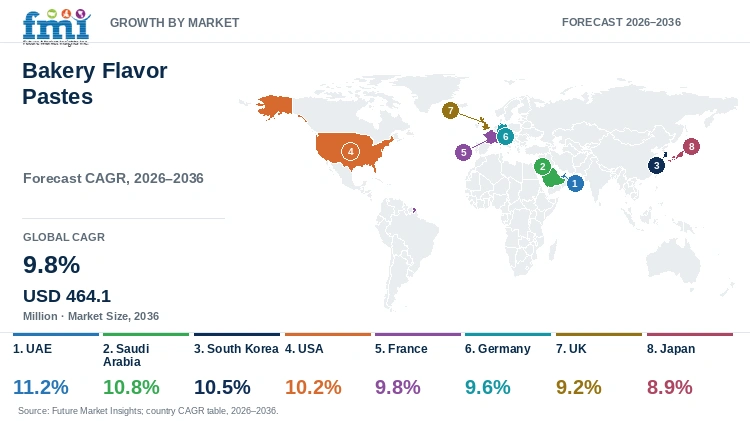
| Country | CAGR, 2026 to 2036 |
|---|---|
| UAE | 11.2% |
| Saudi Arabia | 10.8% |
| South Korea | 10.5% |
| USA | 10.2% |
| France | 9.8% |
| Germany | 9.6% |
| UK | 9.2% |
| Japan | 8.9% |
UAE
The UAE is forecast to record the highest growth among the profiled countries, at 11.2% CAGR between 2026 and 2036. Dubai welcomed 19.59 million international overnight visitors in 2025, an increase of 5.0%, providing a growing customer base for hotel bakeries and foodservice operators. Concentrated fruit and nut preparations can help these businesses offer different pastry flavours without preparing each component from raw ingredients. However, demand linked to tourist seasons and short promotional menus can result in irregular purchasing. Suppliers must also consider whether small orders justify the cost of imported ingredients and local distribution. Growth in flavor paste consumption will depend on how many products become permanent menu items and the frequency with which hospitality operators replenish them.
Saudi Arabia
Saudi Arabia's projected CAGR of 10.8% reflects opportunities associated with expanding domestic hospitality activity. Government statistics show that domestic tourism increased by 8.3% in 2025, while inbound visitor numbers declined by 1.6%. This distinction matters for suppliers serving bakery chains and hotel kitchens, where consistent local demand can support repeat purchases. A concentrated date, chocolate or nut preparation can be incorporated into several desserts while allowing operators to retain their existing cream or dough recipes. The limitation is that formulations developed for one production kitchen may behave differently when transferred to another facility. Demand growth will therefore depend on how widely approved preparations are adopted across operating locations and the volume of finished products sold.
South Korea
South Korea is projected to expand at 10.5% CAGR, although recent franchise data suggest that bakery ingredient growth cannot rely entirely on expansion in store sales. Official figures show that average sales per bakery franchise outlet increased by only 0.7% in 2024. Flavor pastes offer another source of growth through greater ingredient use in existing outlets. Concentrated fruit preparations can be incorporated into creams and pastry fillings, allowing bakeries to introduce additional flavours without developing a separate base recipe for every product. Short product cycles remain a limitation because newly introduced flavours may be discontinued before generating significant repeat orders. Sustained demand depends on how many formulations move beyond promotional launches and become regularly produced bakery items.
USA
The USA is forecast to grow at 10.2% CAGR, slightly above the global average. The country's established foodservice industry offers a large potential customer base, with USDA reporting that food consumed away from home accounted for 56.3% of total US food expenditure in 2025. Supplier investment is also relevant. Puratos acquired Pennsylvania-based Vör Foods in January 2026, adding local production capabilities for nut pastes and fillings. These ingredients can be used in industrial cakes or pastries where manufacturers require controlled inclusion rates and consistent finished-product characteristics. Nut oil separation and changes in texture during storage can complicate large-scale use. Commercial growth will depend on whether suppliers can secure approval for recurring formulations and maintain consistent ingredient quality across production facilities.
France
France is projected to grow at 9.8% CAGR, matching the global forecast. INSEE reported that household consumption of bread and cereal products increased by 2.0% in volume during 2025, indicating that the stronger flavor paste outlook requires additional ingredient adoption beyond underlying consumption growth. Opportunities exist in pastry production, where concentrated fruit or nut preparations can be added to creams and fillings without replacing the entire recipe. However, traditional formulations may require adjustments when a new paste changes moisture content or finished texture. EU flavouring rules can also require manufacturers to review ingredient descriptions and product declarations. Demand will be determined by the number of established recipes converted to purchased preparations and whether their use remains economical over repeated production runs.
Germany
Germany's forecast CAGR of 9.6% is slightly below the global average. Growth is constrained by uneven demand across bakery categories, particularly seasonal products. Federal statistics show that German gingerbread production declined by 10.0% in 2025, illustrating how established seasonal products can experience falling volumes. Concentrated flavour preparations can support fruit-filled pastries and other bakery products by reducing the need to process individual ingredients. Yet a paste must tolerate the intended baking or storage conditions without affecting texture or flavour intensity. Seasonal products also create inventory risks when suppliers commit to volumes that customers do not ultimately require. The more dependable source of demand is adoption in year-round production, where stable recipes generate regular ingredient purchases.
UK
The UK bakery flavor pastes market is projected to expand at 9.2% CAGR, below the global average. Government household food statistics show that purchases of cakes, buns and pastries declined by 3.6% in the financial year ending 2025. Growth in flavor pastes therefore cannot be attributed simply to higher consumption of these products. Concentrated preparations may appeal to manufacturers seeking to reduce the labour involved in preparing fruit components for fillings or bakery mixes. However, changing suppliers can require production testing and revisions to ingredient declarations. UK allergen labelling requirements add particular importance when formulations contain nuts or other regulated allergens. Demand will depend on whether the savings from purchased preparations are sufficient to justify reformulation and support repeated orders.
Japan
Japan has the lowest forecast CAGR among the profiled countries at 8.9%. The Ministry of Agriculture, Forestry and Fisheries reported a 0.8% decline in real household food expenditure in 2025, indicating limited support from broader consumption growth. Opportunities for flavor pastes are more closely associated with changes in product formulations and the use of prepared ingredients. Bakeries producing filled buns or packaged pastries can incorporate concentrated flavours into established bases while controlling the amount added to each batch. Small production runs may make accurate dosing difficult, while longer storage periods can expose weaknesses in flavour stability or filling texture. Suppliers will generate sustained demand when their preparations are adopted in products manufactured frequently enough to justify consistent procurement, even if overall bakery consumption grows slowly.
Who are the notable companies in the bakery flavor pastes market?
Dawn Foods; Fabbri 1905; Dreidoppel; Puratos; IRCA Group
Dawn Foods, Fabbri 1905 and Dreidoppel offer concentrated preparations for bakery recipes. Puratos adds nut-paste manufacturing to its bakery portfolio, while IRCA Group supplies flavouring preparations through Joypaste. Their offers differ in concentration, composition and intended use, leaving customers with different amounts of preparation work.
Competition with complete fillings gives paste suppliers a clear commercial challenge. They have to preserve the customer’s freedom to formulate while making flavour preparation easier. The strongest account relationships extend an accepted preparation across recipes without repeatedly changing its dose, texture or declaration.
Competitive Benchmarking: Bakery Flavor Pastes Market
Table 5: Company capabilities in the bakery flavor pastes market
| Company | Relevant offer | Commercial capability |
|---|---|---|
| Dawn Foods | Fruit and flavouring compounds | Concentrated preparations for creams and batters |
| Fabbri 1905 | Delipaste flavouring pastes | Fruit and cream flavour formats for pastry |
| Dreidoppel | Pastry pastes and baking flavours | Application-focused flavour preparations |
| Puratos | Nut pastes and nut-based fillings | Bakery ingredient development and U.S. nut processing |
| IRCA Group | Joypaste flavouring preparations | Pastry and gelato flavour systems |
Key Developments in the Bakery Flavor Pastes Market
- Vör Foods in Pennsylvania joined Puratos in January 2026. The acquisition added US manufacturing for nut pastes and nut fillings, extending the group's local offer to bakery customers. [3]
- CSM Ingredients introduced Creami in May 2026 for bakery, pastry and confectionery applications. The filling range adds prepared flavour-bearing options where customers are comparing a concentrated flavour preparation with a more fully formulated filling. [4]
Key Players in the Bakery Flavor Pastes Market
- Dawn Foods
- Fabbri 1905
- Dreidoppel
- Puratos
- IRCA Group
Bakery Flavor Pastes Market - Report Scope
Table 6: Report scope for the bakery flavor pastes market
| Coverage field | Report scope |
|---|---|
| Market breakdown | Product Type; Form; Application; Claim; Sales Channel; Region |
| Quantitative Units | USD Million |
| Market Definition | Revenue from flavouring preparations sold for use in bakery formulations within the five specified segment classifications. Includes discrete liquid, paste, dry and extract preparations with a flavouring function. Excludes downstream finished bakery products, unallocated mixed bakery-ingredient bundles, commodity inputs without a defined flavouring preparation, and toppings or fillings sold solely for other functions. |
| Regions Covered | North America; Latin America; Western Europe; Eastern Europe; East Asia; South Asia and Pacific; Middle East and Africa |
| Countries Covered | UAE; Saudi Arabia; South Korea; USA; France; Germany; UK; Japan |
| Key Companies Profiled | Dawn Foods; Fabbri 1905; Dreidoppel; Puratos; IRCA Group |
| Forecast Period | 2026 to 2036 |
| Approach | Market assessment supported by official technical and regulatory publications, company product information and country operating conditions. |
Bakery Flavor Pastes Market - Research Methodology
Table 7: Research approach for the bakery flavor pastes market
| Method | Approach |
|---|---|
| Market coverage | Coverage follows discrete bakery flavouring preparations and distinguishes concentrates from finished bakery products and complete fillings sold for other functions. |
| Secondary evidence | Government and technical publications are considered alongside first-party product information and dated corporate announcements. |
| Commercial analysis | Purchasing requirements, operating constraints, service needs and country-specific routes to market inform the interpretation of demand. |
| Forecast presentation | Global values, leading segment shares and country growth rates are stated for the 2026 to 2036 forecast period. |
Bakery Flavor Pastes Market by Segments
Product Type
- Liquid flavors
- Pastes & emulco
- Powders
- Natural extracts
Form
- Powder / dry
- Liquid
- Paste / semi-solid
- Granules / pieces
Application
- Bread & rolls
- Cakes & muffins
- Biscuits & cookies
- Viennoiserie & pastry
- Other bakery & snacks
Claim
- Conventional
- Clean label
- Organic
- Non-GMO / identity preserved
Sales Channel
- Direct to industrial bakeries
- Ingredient distributors
- Foodservice & artisan supply
- Online B2B
Bakery Flavor Pastes Market by Region
- North America
- United States
- Canada
- Latin America
- Brazil
- Mexico
- Argentina
- Chile
- Western Europe
- Germany
- France
- United Kingdom
- Italy
- Spain
- Benelux
- Nordics
- Eastern Europe
- Poland
- Czech Republic
- Romania
- Hungary
- East Asia
- China
- Japan
- South Korea
- South Asia and Pacific
- India
- ASEAN
- Australia and New Zealand
- Middle East and Africa
- GCC Countries
- South Africa
- Türkiye
- Israel
Research Sources and Bibliography
- [1] European Commission. (n.d.). Flavourings.
- [2] Dawn Foods. (n.d.). Compounds.
- [3] Puratos. (2026, January 21). Puratos acquires Vör Foods, accelerating U.S. nut-based innovation.
- [4] CSM Ingredients. (2026, May 12). CSM Ingredients launches Creami, a comprehensive range of indulgent fillings.
- [5] Givaudan. (2026). 2026 nine month sales.
- [6] Office for National Statistics. (2026). Manufacture of Bakery and Farinaceous Products: CVM annual and monthly growth.
- [7] Abedi, F. M., Hwisa, N., Cadwallader, K. R., & Takhar, P. S. (2024). Influence of baking conditions and initial flavour load on the evolution of flavours in cookies.
- [8] Pokatong, W. D. R., & Nathalie, T. (2021). Partial substitution of margarine with avocado fruit puree for healthy pound cake preparation using various flour types and baking methods.
This Report Answers
- How large is the Bakery Flavor Pastes Market in 2026, and what value is forecast for 2036?
- Which production and operating pressures motivate bakeries to purchase concentrated flavour systems?
- Why do Liquid flavors hold the largest Product Type share in 2026?
- Why does Powder / dry lead the Form category?
- How do projected growth rates differ across the eight profiled countries?
- Which profiled companies supply bakery flavouring preparations or relevant ingredient capabilities?
Frequently Asked Questions
How big is the Bakery Flavor Pastes Market in 2026, and what is expected by 2036?
The market is valued at USD 182.2 Million in 2026 and forecast at USD 464.1 Million by 2036.
What is the Bakery Flavor Pastes Market CAGR from 2026 to 2036?
The overall forecast CAGR is 9.8% from 2026 to 2036.
Which Product Type leads the Bakery Flavor Pastes Market in 2026?
Liquid flavors lead Product Type with a 37.0% share in 2026. Their dosing characteristics make them suitable for many mixing and batter applications.
Which Form has the leading Bakery Flavor Pastes Market share in 2026?
Powder / dry leads Form with a 45.0% share in 2026. These preparations fit dry storage and weighing routines, subject to complete incorporation in the receiving recipe.
Which profiled countries have the highest Bakery Flavor Pastes Market growth rates?
The UAE leads with an 11.2% CAGR and Saudi Arabia follows at 10.8% from 2026 to 2036.
Which companies participate in the bakery flavor pastes market?
Relevant participants include Dawn Foods, Fabbri 1905, Dreidoppel, Puratos and IRCA Group. Key Players
Preview the report firsthand - request a free sample
Get SampleGet the brochure for pricing and purchase details.
Get PDFTable of Content
- Key Takeaways
- Market Size and CAGR
- Top Growth Driver
- Fastest Growing Segment
- Leading Region
- Key Companies
- Emerging Opportunities
- Executive Summary
- Global Market Outlook
- Demand-side Trends
- Supply-side Trends
- Technology Roadmap Analysis
- Analysis and Recommendations
- Analyst Perspective (What is happening? Why now? What should investors know?)
- Key Questions Answered
- How large is the market?
- What is the CAGR?
- What are key trends?
- Which region dominates?
- Who are the leaders?
- Market Overview
- Market Coverage / Taxonomy
- Market Definition / Scope / Limitations
- Research Methodology
- Chapter Orientation
- Analytical Lens and Working Hypotheses
- Market Structure, Signals, and Trend Drivers
- Benchmarking and Cross-market Comparability
- Market Sizing, Forecasting, and Opportunity Mapping
- Research Design and Evidence Framework
- Desk Research Programme (Secondary Evidence)
- Expert Input and Fieldwork (Primary Evidence)
- Tooling, Models, and Reference Databases
- Data Engineering and Model Build
- Quality Assurance and Audit Trail
- Market Background
- Market Dynamics (Drivers, Restraints, Opportunity, Trends)
- Scenario Forecast (Optimistic, Likely, Conservative)
- Impact Analysis
- AI Impact
- Sustainability Impact
- Regulatory Impact
- Technology Impact
- Consumer / Buyer Analysis
- Purchase Drivers
- Adoption Barriers
- Buyer Journey
- Opportunity Map Analysis
- Product Life Cycle Analysis
- Supply Chain Analysis
- Investment Feasibility Matrix
- Value Chain Analysis
- PESTLE and Porter's Analysis
- Regulatory Landscape
- Regional Parent Market Outlook
- Production and Consumption Statistics
- Import and Export Statistics
- Global Market Analysis and Forecast, 2021 to 2036
- Historical Market Size Value (USD Million) Analysis, 2021 to 2025
- Current and Future Market Size Value (USD Million) Projections, 2026 to 2036
- Y-o-Y Growth Trend Analysis
- Absolute $ Opportunity Analysis
- Global Market Pricing Analysis, 2021 to 2036
- Global Market Analysis and Forecast, By Product Type, 2021 to 2036
- Introduction / Key Findings
- Historical Market Size Value (USD Million) Analysis By Product Type, 2021 to 2025
- Current and Future Market Size Value (USD Million) Analysis and Forecast By Product Type, 2026 to 2036
- Liquid flavors
- Pastes & emulco
- Powders
- Natural extracts
- Y-o-Y Growth Trend Analysis By Product Type, 2021 to 2025
- Absolute $ Opportunity Analysis By Product Type, 2026 to 2036
- Global Market Analysis and Forecast, By Form, 2021 to 2036
- Introduction / Key Findings
- Historical Market Size Value (USD Million) Analysis By Form, 2021 to 2025
- Current and Future Market Size Value (USD Million) Analysis and Forecast By Form, 2026 to 2036
- Powder / dry
- Liquid
- Paste / semi-solid
- Granules / pieces
- Y-o-Y Growth Trend Analysis By Form, 2021 to 2025
- Absolute $ Opportunity Analysis By Form, 2026 to 2036
- Global Market Analysis and Forecast, By Application, 2021 to 2036
- Introduction / Key Findings
- Historical Market Size Value (USD Million) Analysis By Application, 2021 to 2025
- Current and Future Market Size Value (USD Million) Analysis and Forecast By Application, 2026 to 2036
- Bread & rolls
- Cakes & muffins
- Biscuits & cookies
- Viennoiserie & pastry
- Other bakery & snacks
- Y-o-Y Growth Trend Analysis By Application, 2021 to 2025
- Absolute $ Opportunity Analysis By Application, 2026 to 2036
- Global Market Analysis and Forecast, By Claim, 2021 to 2036
- Introduction / Key Findings
- Historical Market Size Value (USD Million) Analysis By Claim, 2021 to 2025
- Current and Future Market Size Value (USD Million) Analysis and Forecast By Claim, 2026 to 2036
- Conventional
- Clean label
- Organic
- Non-GMO / identity preserved
- Y-o-Y Growth Trend Analysis By Claim, 2021 to 2025
- Absolute $ Opportunity Analysis By Claim, 2026 to 2036
- Global Market Analysis and Forecast, By Sales Channel, 2021 to 2036
- Introduction / Key Findings
- Historical Market Size Value (USD Million) Analysis By Sales Channel, 2021 to 2025
- Current and Future Market Size Value (USD Million) Analysis and Forecast By Sales Channel, 2026 to 2036
- Direct to industrial bakeries
- Ingredient distributors
- Foodservice & artisan supply
- Online B2B
- Y-o-Y Growth Trend Analysis By Sales Channel, 2021 to 2025
- Absolute $ Opportunity Analysis By Sales Channel, 2026 to 2036
- Global Market Analysis and Forecast, By Region, 2021 to 2036
- Introduction
- Historical Market Size Value (USD Million) Analysis By Region, 2021 to 2025
- Current Market Size Value (USD Million) Analysis and Forecast By Region, 2026 to 2036
- North America
- Latin America
- Western Europe
- Eastern Europe
- East Asia
- South Asia and Pacific
- Middle East and Africa
- Market Attractiveness Analysis By Region
- North America Market Analysis and Forecast, By Country, 2021 to 2036
- Historical Market Size Value (USD Million) Trend Analysis By Market Taxonomy, 2021 to 2025
- Market Size Value (USD Million) Forecast By Market Taxonomy, 2026 to 2036
- By Country
- United States
- Canada
- By Product Type
- By Form
- By Application
- By Claim
- By Sales Channel
- By Country
- Market Attractiveness Analysis
- By Country
- By Product Type
- By Form
- By Application
- By Claim
- By Sales Channel
- Key Takeaways
- Latin America Market Analysis and Forecast, By Country
- Historical Market Size Value (USD Million) Trend Analysis By Market Taxonomy, 2021 to 2025
- Market Size Value (USD Million) Forecast By Market Taxonomy, 2026 to 2036
- By Country
- Brazil
- Mexico
- Argentina
- Chile
- By Product Type
- By Form
- By Application
- By Claim
- By Sales Channel
- By Country
- Market Attractiveness Analysis
- By Country
- By Product Type
- By Form
- By Application
- By Claim
- By Sales Channel
- Key Takeaways
- Western Europe Market Analysis and Forecast, By Country
- Historical Market Size Value (USD Million) Trend Analysis By Market Taxonomy, 2021 to 2025
- Market Size Value (USD Million) Forecast By Market Taxonomy, 2026 to 2036
- By Country
- Germany
- France
- United Kingdom
- Italy
- Spain
- Benelux
- Nordics
- By Product Type
- By Form
- By Application
- By Claim
- By Sales Channel
- By Country
- Market Attractiveness Analysis
- By Country
- By Product Type
- By Form
- By Application
- By Claim
- By Sales Channel
- Key Takeaways
- Eastern Europe Market Analysis and Forecast, By Country
- Historical Market Size Value (USD Million) Trend Analysis By Market Taxonomy, 2021 to 2025
- Market Size Value (USD Million) Forecast By Market Taxonomy, 2026 to 2036
- By Country
- Poland
- Czech Republic
- Romania
- Hungary
- By Product Type
- By Form
- By Application
- By Claim
- By Sales Channel
- By Country
- Market Attractiveness Analysis
- By Country
- By Product Type
- By Form
- By Application
- By Claim
- By Sales Channel
- Key Takeaways
- East Asia Market Analysis and Forecast, By Country
- Historical Market Size Value (USD Million) Trend Analysis By Market Taxonomy, 2021 to 2025
- Market Size Value (USD Million) Forecast By Market Taxonomy, 2026 to 2036
- By Country
- China
- Japan
- South Korea
- By Product Type
- By Form
- By Application
- By Claim
- By Sales Channel
- By Country
- Market Attractiveness Analysis
- By Country
- By Product Type
- By Form
- By Application
- By Claim
- By Sales Channel
- Key Takeaways
- South Asia and Pacific Market Analysis and Forecast, By Country
- Historical Market Size Value (USD Million) Trend Analysis By Market Taxonomy, 2021 to 2025
- Market Size Value (USD Million) Forecast By Market Taxonomy, 2026 to 2036
- By Country
- India
- ASEAN
- Australia and New Zealand
- By Product Type
- By Form
- By Application
- By Claim
- By Sales Channel
- By Country
- Market Attractiveness Analysis
- By Country
- By Product Type
- By Form
- By Application
- By Claim
- By Sales Channel
- Key Takeaways
- Middle East and Africa Market Analysis and Forecast, By Country
- Historical Market Size Value (USD Million) Trend Analysis By Market Taxonomy, 2021 to 2025
- Market Size Value (USD Million) Forecast By Market Taxonomy, 2026 to 2036
- By Country
- GCC Countries
- South Africa
- Türkiye
- Israel
- By Product Type
- By Form
- By Application
- By Claim
- By Sales Channel
- By Country
- Market Attractiveness Analysis
- By Country
- By Product Type
- By Form
- By Application
- By Claim
- By Sales Channel
- Key Takeaways
- Key Countries Market Analysis
- United States
- Pricing Analysis
- Market Share Analysis, 2025
- By Product Type
- By Form
- By Application
- By Claim
- By Sales Channel
- Canada
- Pricing Analysis
- Market Share Analysis, 2025
- By Product Type
- By Form
- By Application
- By Claim
- By Sales Channel
- Mexico
- Pricing Analysis
- Market Share Analysis, 2025
- By Product Type
- By Form
- By Application
- By Claim
- By Sales Channel
- Brazil
- Pricing Analysis
- Market Share Analysis, 2025
- By Product Type
- By Form
- By Application
- By Claim
- By Sales Channel
- Chile
- Pricing Analysis
- Market Share Analysis, 2025
- By Product Type
- By Form
- By Application
- By Claim
- By Sales Channel
- Germany
- Pricing Analysis
- Market Share Analysis, 2025
- By Product Type
- By Form
- By Application
- By Claim
- By Sales Channel
- United Kingdom
- Pricing Analysis
- Market Share Analysis, 2025
- By Product Type
- By Form
- By Application
- By Claim
- By Sales Channel
- Italy
- Pricing Analysis
- Market Share Analysis, 2025
- By Product Type
- By Form
- By Application
- By Claim
- By Sales Channel
- Spain
- Pricing Analysis
- Market Share Analysis, 2025
- By Product Type
- By Form
- By Application
- By Claim
- By Sales Channel
- France
- Pricing Analysis
- Market Share Analysis, 2025
- By Product Type
- By Form
- By Application
- By Claim
- By Sales Channel
- India
- Pricing Analysis
- Market Share Analysis, 2025
- By Product Type
- By Form
- By Application
- By Claim
- By Sales Channel
- ASEAN
- Pricing Analysis
- Market Share Analysis, 2025
- By Product Type
- By Form
- By Application
- By Claim
- By Sales Channel
- Australia and New Zealand
- Pricing Analysis
- Market Share Analysis, 2025
- By Product Type
- By Form
- By Application
- By Claim
- By Sales Channel
- China
- Pricing Analysis
- Market Share Analysis, 2025
- By Product Type
- By Form
- By Application
- By Claim
- By Sales Channel
- Japan
- Pricing Analysis
- Market Share Analysis, 2025
- By Product Type
- By Form
- By Application
- By Claim
- By Sales Channel
- South Korea
- Pricing Analysis
- Market Share Analysis, 2025
- By Product Type
- By Form
- By Application
- By Claim
- By Sales Channel
- Poland
- Pricing Analysis
- Market Share Analysis, 2025
- By Product Type
- By Form
- By Application
- By Claim
- By Sales Channel
- Hungary
- Pricing Analysis
- Market Share Analysis, 2025
- By Product Type
- By Form
- By Application
- By Claim
- By Sales Channel
- Türkiye
- Pricing Analysis
- Market Share Analysis, 2025
- By Product Type
- By Form
- By Application
- By Claim
- By Sales Channel
- South Africa
- Pricing Analysis
- Market Share Analysis, 2025
- By Product Type
- By Form
- By Application
- By Claim
- By Sales Channel
- UAE
- Pricing Analysis
- Market Share Analysis, 2025
- By Product Type
- By Form
- By Application
- By Claim
- By Sales Channel
- Saudi Arabia
- Pricing Analysis
- Market Share Analysis, 2025
- By Product Type
- By Form
- By Application
- By Claim
- By Sales Channel
- United States
- Market Structure Analysis
- Competition Dashboard
- Competition Benchmarking
- Market Share Analysis of Top Players
- By Regional
- By Product Type
- By Form
- By Application
- By Claim
- By Sales Channel
- Emerging Startups
- Innovation Benchmarking
- Competition Analysis
- Competition Deep Dive
- Dawn Foods
- Overview
- Product Portfolio
- Profitability by Market Segments
- Sales Footprint
- Strategy Overview
- Marketing Strategy
- Product Strategy
- Channel Strategy
- Fabbri 1905
- Dreidoppel
- Puratos
- IRCA Group
- Dawn Foods
- Case Studies
- Success Stories
- Recent Developments
- Competition Deep Dive
- Assumptions & Acronyms Used


