

- Market Size (2026)
- USD 863.0 Mn
- Forecast (2036)
- USD 3491.0 Mn
- CAGR (2026 to 2036)
- 15.0%
How big is Clinic-Based Rehab Therapy Robots Market in 2026?
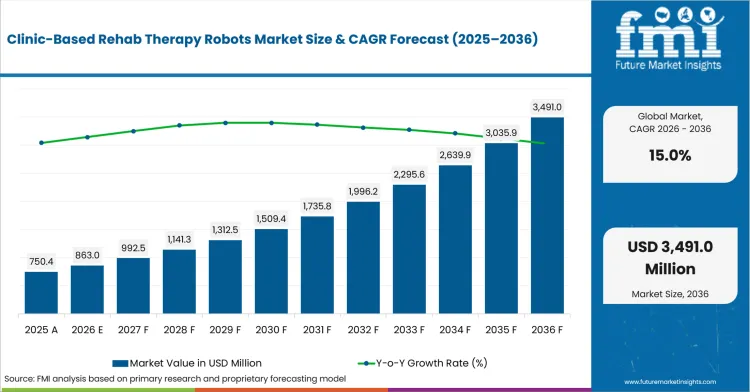
USD 863.0 million in 2026 and USD 3,491.0 million by 2036 at a 15.0% CAGR.
Demand for clinic-based rehab therapy robots is projected to increase from USD 863.0 million in 2026 to USD 3,491.0 million by 2036 at a 15.0% CAGR. This growth is underpinned by the scale and persistence of unmet rehabilitation needs. For instance, the World Health Organization reported in April 2024 that 2.4 billion people live with conditions that may benefit from rehabilitation. That scale of functional need supports investment in repeatable therapy systems that document progress and extend therapist capacity across scheduled sessions. This demand-side validation shapes the medical rehabilitation robotics outlook as clinics assess equipment budgets during annual planning cycles.
Adoption conditions differ between the United States and China through separate funding systems and care delivery models. USA facilities often connect equipment purchases to inpatient budgets and measurable gains in therapist productivity. China medical centers face an ageing population and policy pressure to expand rehabilitation capacity across more facilities. The Centers for Medicare and Medicaid Services reported in July 2024 that its fiscal 2025 inpatient rehabilitation update increased payments by an estimated USD 280 million. That payment increase gives established rehabilitation hospitals more room to consider capital equipment within annual budget reviews. Clinic managers compare transfer steps with setup time during selection of a device for routine use. This operating test makes physiotherapy equipment economics concrete by showing whether added sessions can cover financing and service costs.
Key Takeaways of Clinic-Based Rehab Therapy Robots Market
- Demand for clinic-based rehab therapy robots is driven by the need for structured, repeatable rehabilitation programs, though high equipment costs remain a key constraint on wider adoption.
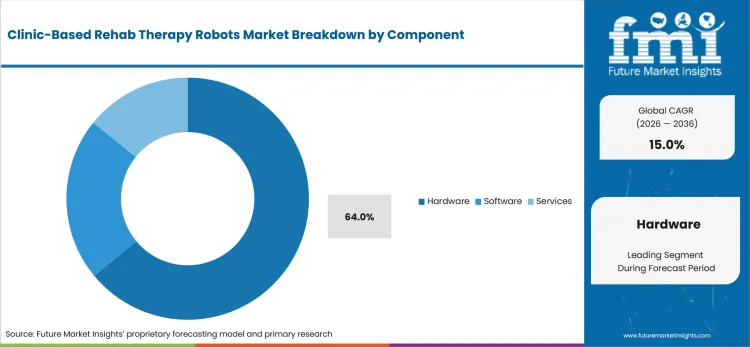
- By component, hardware is expected to lead with 64.0% share in 2026, reflecting the cost of robotic frames and powered assistive systems within each installed unit.
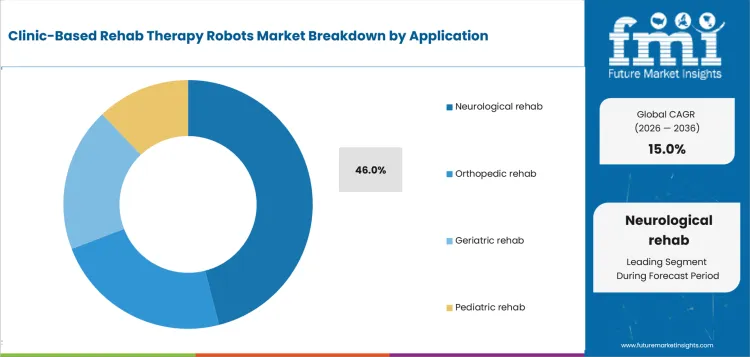
- Neurological rehabilitation is the dominant application segment, projected to hold 46.0% share in 2026, driven by structured therapy needs across stroke and related recovery programs.
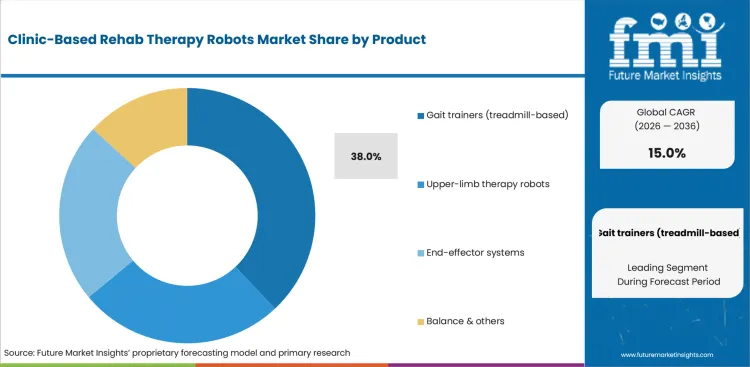
- Gait trainers (treadmill-based) are estimated to lead the product category with 38.0% share in 2026, supported by their established role in walking-recovery protocols.
- Structured rehabilitation programs remain central to clinic adoption, favoring systems that support measurable, repeatable treatment sessions over standalone demonstrations.
- Competition centers on Hocoma, Tyromotion, Fourier Intelligence, ChronoScale, CYBERDYNE, and CUREXO, with vendors differentiating across multi-device rehabilitation platforms, wearable and gait-focused robotics, and end-effector gait rehabilitation systems.
Analyst Perspective
"Clinic-based rehabilitation robotics is becoming a capacity management decision as therapy providers work to improve treatment consistency while serving a growing patient population. The commercial value of these systems depends on how effectively they fit routine rehabilitation workflows, support therapists across different stages of recovery, and sustain high equipment utilization throughout the day. Providers that simplify clinical implementation, strengthen therapist training, and generate measurable patient outcome data will be better placed to expand adoption across rehabilitation centers, specialty clinics, and outpatient therapy networks."
- Anurag Sharma, Principal Analyst at Future Market Insights
Source: FMI's proprietary forecasting model and primary research
How is the Clinic-Based Rehab Therapy Robots Market segmented?
The industry is segmented by product, application, component, end user, business model, and region.
The report separates six dimensions that shape clinical use and purchasing decisions across hospitals and outpatient rehabilitation centers. Product categories distinguish treadmill gait trainers from upper-limb robots and end-effector systems designed for different movement goals. Application analysis covers neurological and orthopedic rehabilitation together with geriatric and pediatric programs that require different treatment routines. Component and end-user analysis connects hardware plus software costs with the schedules and budgets of several care settings. Business model and regional comparisons show how direct purchases or recurring plans interact with approval conditions and local funding. This structure helps readers compare defined therapy needs with robotic rehabilitation tools across different clinic settings.
What supports demand for treadmill-based gait trainers within the product category?
Treadmill-based gait trainers serve clinics that need guided stepping with body-weight support across different impairment levels. In July 2025, DIH appointed Rehazentrum Valens as a Center of Excellence for integrated robotic rehabilitation. The official announcement confirmed that the Swiss center uses LokomatPro within a broader gait program. This example shows how established clinical pathways strengthen the value of equipment performance during capital review. Facilities can use rehabilitation robot testing requirements to compare staff training with patient transfer needs during decisions about floor space and capital.
- By product, treadmill-based gait trainers are projected to represent 38.0% of demand in 2026 due to established use in neurological programs. Their share reflects the value of body-weight support and guided stepping across repeated treatment plans. Clinics must compare transfer steps with available floor space so the system can support a dependable daily schedule.
- Rehabilitation hospitals are expected to favor gait platforms that adjust assistance and record progress across several impairment levels. One system can support broader patient selection if staff can change settings without delaying each session. The commercial case weakens if training or setup prevents the equipment from reaching the session volume required for payback.
How does neurological rehabilitation shape application demand?
Neurological rehabilitation relies on repeated task practice to rebuild movement following stroke and other nervous system injuries. The Centers for Disease Control and Prevention reported in May 2024 that self-reported stroke prevalence across the United States increased 7.8% between 2011-2013 and 2020-2022. This increase expands the population entering structured therapy pathways across both hospital and outpatient clinic settings. Medical robot adoption depends on systems that adjust assistance without removing therapist judgment from treatment progression.
- In 2026, neurological rehabilitation is estimated to hold 46.0% of application demand due to repeated gait and upper-limb practice used in stroke care. The share connects clinical need with treatment intensity rather than relying on diagnosis counts alone for commercial planning. Robotic sessions add value by extending structured practice under therapist supervision across several stages of recovery.
- Stroke programs are expected to purchase systems that record changes across repeated sessions and support graded assistance. Consistent records help therapists decide whether a patient needs more active movement or greater mechanical support. This evidence can direct each platform toward patients whose goals match the device design and improve use across the clinic schedule.
How is hardware positioned within the component category?
Hardware creates the initial cost base for clinic robotics through motors and sensors designed for repeated patient contact. Tyromotion reported in December 2025 that Lexo and Omego received Class IIa certification under the EU Medical Device Regulation. The same certification covered Diego and Amadeo together with the tyroS software used across its device family. That certification supports physical therapy equipment portfolios by reducing uncertainty for clinics during European tender review.
- By component, hardware is forecast to represent 64.0% in 2026 due to the cost of frames and powered movement systems. Clinics fund the physical platform through capital budgets, and software plus service agreements create recurring expense during ownership. Expected use deserves close review due to depreciation that continues without a matching therapy benefit.
- Software demand is anticipated to rise in multi-device programs that need shared exercise libraries and patient records. Updates to shared software can widen the tasks delivered on installed systems without replacing the mechanical platform during normal ownership cycles. Companies gain a retention advantage if software supports treatment planning across several devices and remains simple enough for therapists to use during normal sessions.
What are the drivers, restraints, and opportunities in the Clinic-Based Rehab Therapy Robots Market?
Neurological caseloads support adoption. Capital and regulatory costs limit smaller clinics. Recurring access plans widen the provider base.
- Driver: Repeated gait and upper-limb therapy is expected to increase demand for systems that preserve therapist control and standardize movement intensity across scheduled sessions.
- Restraint: Hardware expense and medical device obligations are anticipated to extend payback periods for clinics operating uneven patient volumes.
- Opportunity: Lease and subscription structures are projected to lower initial cash requirements for outpatient providers that cannot justify direct purchase.
Clinical need supports equipment purchases once clinics can deliver repeatable sessions around clear treatment goals and dependable patient selection. Hocoma reported in January 2025 that the newly opened Theraneurum center in Münster installed LokomatNanos and C-Mill VR+ alongside ArmeoSpring for upper-limb therapy. The installation shows how clinics combine gait and arm systems within one treatment site to serve varied neurological needs. Companies that support staff training and coordinated workflows can lower adoption friction and turn clinical interest into regular use across scheduled programs.
Medical device obligations add cost at the company level before a clinic receives equipment or continuing support. The Food and Drug Administration listed an annual establishment registration fee of USD 11,423 for fiscal 2026 in September 2025. Manufacturers and importers carry this expense alongside other compliance costs required throughout commercial operation and distribution. These obligations can influence pricing and the number of companies able to maintain local service. Medical exoskeleton regulation shows why clinics should examine service continuity and documentation rather than compare purchase prices alone.
Recurring payment models can separate clinic access from the full capital cost of direct equipment ownership. Outpatient centers gain a clearer route to adoption through monthly payments that include service and training. This structure gives companies a reason to design compact systems with remote diagnostics and standard setup methods. Wearable robot business models become more relevant as clinics pay for ongoing support rather than one equipment sale. The opportunity depends on transparent total cost due to the risk that long contracts exceed outright ownership costs for busy clinics.
Which country CAGRs are profiled in the Clinic-Based Rehab Therapy Robots Market?
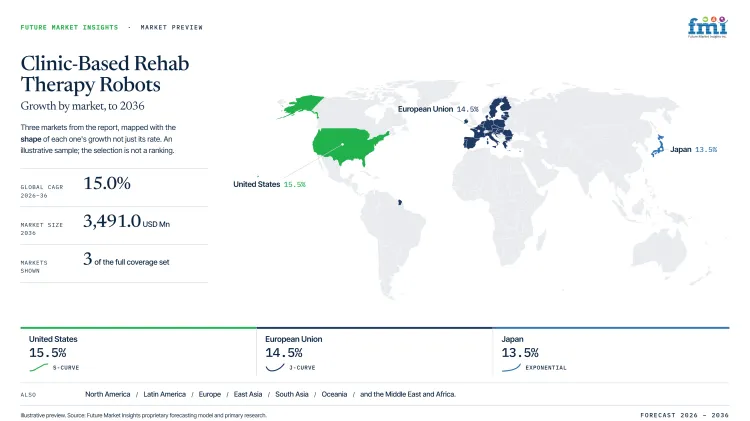
| Country | CAGR |
|---|---|
| United States | 15.5% |
| European Union | 14.5% |
| Japan | 13.5% |
Source: FMI's proprietary forecasting model and primary research
How do country-level CAGRs compare in the Clinic-Based Rehab Therapy Robots Market?
The comparison spans 2.0 percentage points and indicates a closely aligned growth outlook across the clinic-based rehab therapy robots market. The United States leads with a CAGR of 15.5%, followed by the European Union at 14.5% and Japan at 13.5%. The limited variation suggests that rehabilitation providers across all three markets are steadily expanding the use of robotic therapy systems, although healthcare infrastructure, reimbursement models and clinical adoption pathways differ.
- The United States leads the comparison with a CAGR of 15.5%. Rehabilitation hospitals and outpatient therapy centers are increasingly incorporating robotic rehabilitation systems to improve therapy consistency, increase treatment capacity and support recovery programs for patients with neurological and musculoskeletal conditions.
- The European Union follows at 14.5%, only 1.0 percentage point behind the United States. Clinics across the region are integrating robotic therapy platforms into rehabilitation programs that focus on gait training, upper-limb recovery and post-stroke rehabilitation. Adoption differs among member states because healthcare funding, clinical resources and technology investment priorities are not uniform.
- Japan records a CAGR of 13.5%, standing 1.0 percentage point below the European Union. Rehabilitation providers continue evaluating robotic therapy equipment to enhance patient mobility training, support longer rehabilitation sessions and improve treatment efficiency in response to increasing demand for rehabilitation services.
Comparable CAGRs do not necessarily translate into identical commercial opportunities. Differences in rehabilitation infrastructure, therapist workflows, reimbursement policies and capital investment strategies influence purchasing decisions and long-term market expansion. The full report provides country-level CAGR analysis across North America, Latin America, Europe, East Asia, South Asia, Oceania and the Middle East and Africa.
Country-wise Analysis
Country growth reflects differences in rehabilitation capacity and medical device funding across care networks that use separate approval systems. Ageing creates a common demand base, but providers respond through separate purchasing routes and clinical review procedures. The United States can evaluate expensive equipment through established inpatient networks and established funding routes. European systems apply formal evidence standards, and Japan faces concentrated ageing demand across established care networks with limited treatment space.
- The United States has a defined inpatient rehabilitation network that can evaluate clinic robots within established payment and clinical governance systems. Demand is forecast to expand at 15.5% CAGR from 2026 to 2036 through investment in repeatable therapy capacity. The Centers for Medicare and Medicaid Services reported in April 2026 that proposed rate-setting data covered 1,175 inpatient rehabilitation facilities. That footprint gives manufacturers a visible group of sites with formal capital review and clinical evaluation processes. Hospital committees compare setup time with service response and staff training during product selection within each facility. Companies need dependable field support to convert demonstrations into regular use across several therapy programs. Evidence from comparable facilities can shorten approval discussions without replacing each hospital's local workflow review.
- European Union providers evaluate clinic robots within health systems that face ageing demand and formal medical device controls. Adoption is estimated to expand at 14.5% CAGR through 2036 as clinics invest in treatment capacity that preserves evidence standards. Eurostat reported in February 2026 that the EU population reached 450.6 million on 1 January 2025 and residents aged 65 or older represented 22.0%. This demographic profile supports neurological and geriatric rehabilitation demand across many national health systems throughout the region. Purchasing remains divided across Europe as hospitals and public systems apply separate national tender rules. Companies need multilingual clinical support and consistent documentation to compete without treating Europe as one uniform purchasing environment. The ability to maintain evidence quality across several health systems is expected to shape company selection.
- Japan combines a concentrated older population with clinics that give close attention to safe setup and careful use of limited treatment space. Sales are forecast to expand at 13.5% CAGR by 2036 due to demand for repeatable therapy across age-related neurological and mobility conditions. The Cabinet Office reported in June 2025 that 36.24 million residents were aged 65 or older and represented 29.3% of the population. Compact equipment and clear patient transfer methods therefore carry practical value for clinic operations throughout daily schedules. Capital committees compare expected service life with local maintenance and therapist training requirements during budget review. Companies that protect daily schedules through quick support can improve product acceptance across space-constrained facilities. Product fit may matter more than feature count in this operating environment due to the cost of slow setup in crowded rooms.
Who are the notable companies in the Clinic-Based Rehab Therapy Robots Market?
Hocoma, Tyromotion, Fourier Intelligence, Ekso Bionics, CYBERDYNE, and CUREXO are verified participants serving clinic rehabilitation robotics.
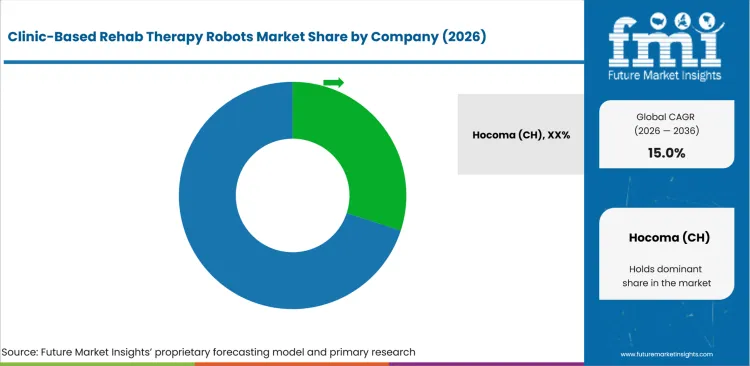
Competition reflects distinct therapy designs rather than one robot format that can address every patient and movement goal. Hocoma and Tyromotion offer device families that cover gait plus upper-limb therapy within connected clinical programs. Fourier Intelligence combines several robot categories with shared software that supports coordinated planning across connected devices. Ekso Bionics and CYBERDYNE focus on wearable systems that require defined fitting methods and careful patient selection. CUREXO uses an end-effector gait platform that reduces direct attachment across the patient's legs during preparation. Clinics can use medical robot company profiles to compare these approaches against manual therapy resources already available. Commercial advantage depends on treatment fit and service support that maintains regular use of installed equipment.
- Portfolio breadth separates Hocoma and Tyromotion from companies focused on one device type within clinic programs. Both support gait and upper-limb programs through related hardware plus shared clinical services for therapists. A clinic should test whether this breadth simplifies staff learning or creates dependence on one company for software updates and maintenance.
- Fourier Intelligence combines gait and upper-limb robots with RehabHub software across a coordinated multi-device rehabilitation program. This model suits centers seeking several therapy systems through one coordinated training and service relationship. The commercial risk rises if local technical support cannot maintain several connected devices during normal clinic schedules.
- Ekso Bionics and CYBERDYNE concentrate on wearable lower-limb systems for defined neurological use cases in clinic settings. Their products require careful patient selection and structured fitting by trained clinical staff during each session. Commercial performance depends on integrating preparation time into clinic schedules without reducing the number of useful sessions.
- CUREXO competes through MorningWalk and a footplate-based gait method that reduces direct attachment to the patient's legs. The company must support this design with relevant clinical evidence and dependable local service for routine use. Those resources help clinics identify suitable patients and judge whether quicker setup produces a useful capacity gain.
Competitive Benchmarking: Clinic-Based Rehab Therapy Robots Market
| Company | Gait Robotics | Upper-Limb Robotics | Clinic Integration | Geographic Reach |
|---|---|---|---|---|
| Hocoma | High | High | High | International partner network |
| Tyromotion | High | High | High | Europe and North America with distributor network |
| Fourier Intelligence | High | High | High | China and Singapore with international distribution |
| Ekso Bionics | High | Low | High | United States clinical market |
| CYBERDYNE | High | Medium | Medium | Japan and Malaysia with selected overseas programs |
| CUREXO | High | Low | Medium | South Korea with selected overseas programs |
Scoring basis: High indicates verified depth across the stated capability. Medium reflects narrower activity that remains relevant to clinic use. Low identifies limited verified coverage compared with the other assessed companies.
Source: Future Market Insights competitive analysis, 2026. Ratings reflect relative portfolio relevance and clinic workflow fit. Service capability and geographic reach shape the remaining comparison.
Key Developments in the Clinic-Based Rehab Therapy Robots Market
- In December 2025, Tyromotion launched a 3D room planning tool that includes its rehabilitation devices with dimensions and recommended movement zones. Clinics can place equipment within a virtual room to review the proposed layout during internal approval. The service addresses a practical purchasing risk since floor space and patient flow determine whether a multi-device plan works during daily treatment. It gives clinical and facilities staff one shared view of the proposed installation during capital review.
- In April 2025, Fourier Intelligence introduced the Embodied AI for Rehabilitation Technology Development Initiative during its GReAT 2025 event. The program joined rehabilitation robotics with artificial intelligence research across several connected therapy categories and device types. Fourier's announcement shows that sensing and software are becoming more central to product design as clinics seek systems that adjust assistance and support clearer treatment decisions across connected devices.
- In December 2025, Ekso Bionics announced an agreement to become the exclusive United States distributor for MediTouch and its BalanceTutor system. The arrangement expanded the clinic offer beyond wearable exoskeletons into balance rehabilitation equipment for inpatient and outpatient facilities. This distribution agreement gives Ekso Bionics another product to offer rehabilitation facilities across the United States. It lets providers compare gait and balance technologies through one commercial relationship and service channel.
- In June 2026, CYBERDYNE announced the opening of Malaysia's PERKESO National Neuro-Robotics and Cybernics Rehabilitation Centre with 65 HAL units across 50 sets. The facility can serve up to 700 patients at one time and about 3,000 patients each year. This installation shows how a national rehabilitation program can support high-volume robotic treatment through concentrated infrastructure and public funding across one national center.
Key Players in the Clinic-Based Rehab Therapy Robots Market
Multi-device rehabilitation platform providers
- Hocoma
- Tyromotion
- Fourier Intelligence
Wearable and gait-focused robotics providers
- Ekso Bionics
- CYBERDYNE
End-effector gait rehabilitation providers
- CUREXO
Clinic-Based Rehab Therapy Robots Market - Report Scope
| Coverage field | Report scope |
|---|---|
| Market breakdown | Product, application, component, end user, business model, and region. |
| Quantitative Units | Revenue in USD Million, CAGR in %. |
| Market Definition | Clinic-based robotic systems used for supervised gait, upper-limb, balance, and mobility rehabilitation within healthcare facilities. |
| Regions Covered | North America, Latin America, Europe, East Asia, South Asia, Oceania, and the Middle East and Africa. |
| Countries Covered | United States, Canada, Brazil, Mexico, Germany, United Kingdom, France, China, Japan, South Korea, India, Australia, and selected regional economies. |
| Key Companies Profiled | Hocoma, Tyromotion, Fourier Intelligence, Ekso Bionics, CYBERDYNE, and CUREXO. |
| Forecast Period | 2026 to 2036. |
| Approach | Market size estimation based on a hybrid bottom-up and top-down methodology, integrating primary interviews, company portfolio assessment, and segment-wise reconciliation. |
Source: Future Market Insights analysis driven by proprietary forecasting models and primary research
Clinic-Based Rehab Therapy Robots Market - Research Methodology
| Method | Approach |
|---|---|
| Primary Research | FMI analysts gathered input from manufacturers, service providers, technology developers, distributors, end users, sourcing teams, and subject-matter experts. Interviews examined purchasing decisions, product or service evaluation, adoption barriers, approval requirements, pricing considerations, and expectations for technical or commercial support. Respondents were also asked what evidence is required before a trial, pilot, or initial order develops into regular purchasing. |
| Desk Research | Desk research covered government statistics, regulatory publications, trade data, industry associations, technical literature, standards, company filings, product information, and official corporate announcements. Sources were reviewed for relevance, publication date, geographic coverage, and consistency with the defined market scope. Claims relating to performance, applications, approvals, capacity, investment, and commercial activity were retained only when supported by credible public evidence. |
| Market Sizing and Forecasting | The market model combined the baseline value with historical performance, segment structure, pricing and volume indicators, adoption levels, company participation, and country-level demand conditions. Forecast assumptions considered economic activity, investment trends, regulatory developments, technology adoption, purchasing cycles, supply availability, and barriers to wider market use. Segment and regional estimates were reconciled before the final market total was calculated. |
| Data Validation | Estimates were checked against multiple independent indicators, including public data, company activity, trade patterns, industry developments, and findings from primary interviews. Validation also tested whether products, services, applications, and company revenues fell within the defined market boundaries. Adjacent categories, unsupported claims, overlapping revenues, and activities without direct market relevance were excluded to reduce double counting and maintain consistency across segments and countries. |
Source: Future Market Insights (FMI) analysis, based on proprietary forecasting model and primary research
Clinic-Based Rehab Therapy Robots Market by Segments
Clinic-Based Rehab Therapy Robots Market segmented by Product:
- Gait trainers (treadmill-based)
- Upper-limb therapy robots
- End-effector gait systems
- Balance and mobility systems
Clinic-Based Rehab Therapy Robots Market segmented by Application:
- Neurological rehabilitation
- Orthopedic rehabilitation
- Geriatric rehabilitation
- Pediatric rehabilitation
Clinic-Based Rehab Therapy Robots Market segmented by Component:
- Hardware
- Software
- Services
Clinic-Based Rehab Therapy Robots Market segmented by End User:
- Rehabilitation hospitals
- Outpatient clinics
- Long-term care facilities
- Research institutes
Clinic-Based Rehab Therapy Robots Market segmented by Business Model:
- Capital purchase
- Lease
- Subscription
- Grant-funded acquisition
Clinic-Based Rehab Therapy Robots Market by Region:
- North America
- United States
- Canada
- Latin America
- Brazil
- Mexico
- Argentina
- Europe
- Germany
- United Kingdom
- France
- Italy
- Spain
- East Asia
- China
- Japan
- South Korea
- South Asia
- India
- Thailand
- Indonesia
- Oceania
- Australia
- New Zealand
- Middle East and Africa
- GCC countries
- South Africa
- Türkiye
Research Sources and Bibliography
- Centers for Disease Control and Prevention. (2024, May 23). Prevalence of stroke: Behavioral Risk Factor Surveillance System, United States, 2011-2022.
- Centers for Medicare and Medicaid Services. (2024, July 31). Fiscal year 2025 inpatient rehabilitation facility prospective payment system final rule.
- Centers for Medicare and Medicaid Services. (2026, April 6). CMS-1845-P inpatient rehabilitation facility rate-setting data.
- CYBERDYNE, Inc. (2026, June 17). Malaysia's PERKESO National Neuro-Robotics and Cybernics Rehabilitation Centre officially opens.
- DIH Holding US, Inc. (2025, July 1). DIH appoints Rehazentrum Valens as a DIH Center of Excellence.
- Ekso Bionics Holdings, Inc. (2025, December 4). Ekso Bionics inks agreement to become the exclusive USA distributor for MediTouch.
- Eurostat. (2026, February 2). Population structure and ageing.
- Fourier Intelligence. (2025, April). GReAT 2025 and the Embodied AI for Rehabilitation Technology Development Initiative.
- Fourier Intelligence. (n.d.). Fourier rehabilitation products and RehabHub. Retrieved July 16, 2026,
- Government of India, Press Information Bureau. (2025, December 2). India's commitment to disability rights.
- Hocoma. (2025, January 17). From mechanical engineer to successful therapy centre owner: The story of Mike Robers.
- Japan Cabinet Office. (2025, June 5). Annual report on the ageing society FY2025.
- National Health Commission of the People's Republic of China. (2025, October 28). China aims to raise average life expectancy to around 80 years in five years.
- Tyromotion GmbH. (2025, December 3). MDR certificate: Commitment to safety, stability, and long-term partnership.
- Tyromotion GmbH. (2025, December 18). New Tyromotion planning tool for modern therapy spaces.
- USA Food and Drug Administration. (2025, September 30). Medical Device User Fee Amendments fees for fiscal year 2026.
- World Health Organization. (2024, April 22). Rehabilitation.
This bibliography is provided for reader reference and uses primary government, standards-body, official trade body, and company sources.
This Report Answers
- What is the estimated value of the clinic-based rehab therapy robots market in 2026 and 2036?
- Which product and application segments account for the stated 2026 shares?
- How do hardware and recurring software services shape clinic purchasing decisions?
- Which clinical and operating conditions support investment in rehabilitation robots?
- How do country growth rates differ across the United States, China, Europe, Japan, and India?
- Which verified companies serve gait, upper-limb, wearable, and end-effector rehabilitation needs?
- What financing and service factors influence return on clinic robotics investment?
- Which evidence sources support the country and company analysis?
- What should equipment committees compare across setup time, service coverage, and software support?
Frequently Asked Questions
What is driving growth in the clinic-based rehab therapy robots market?
Neurological caseloads and limited therapist capacity support demand for repeatable robotic sessions across clinic schedules. Growth depends on devices fitting treatment goals without adding slow setup or complex staff routines.
Who are the key players in the clinic-based rehab therapy robots market?
Verified participants include Hocoma and Tyromotion alongside Fourier Intelligence across several multi-device rehabilitation programs in clinics. Ekso Bionics and CYBERDYNE join CUREXO through wearable or end-effector therapy designs for clinic use.
What is a notable restraint in the clinic-based rehab therapy robots market?
High hardware cost extends payback for clinics that operate uneven patient volumes across the year. Service contracts and staff training add continuing expense that can weaken returns throughout the ownership period.
Why should executives track the clinic-based rehab therapy robots market?
The sector connects ageing and neurological demand with major capital equipment decisions inside rehabilitation facilities. Its growth shows how clinics balance therapist capacity against measurable treatment output and service cost.
What business problem does the clinic-based rehab therapy robots market address?
Robotic systems standardize repetitive movement practice under direct therapist control over patient progression decisions within clinics. They can increase useful session capacity without asking staff to repeat the same physical assistance throughout treatment.
What should equipment committees evaluate in clinic rehabilitation robots?
Equipment committees should compare patient fit and setup time with staff training plus local service coverage. Software support and maintenance response determine whether the device remains available across normal clinic schedules.
What limits return on investment in clinic rehabilitation robots?
Low session volume and prolonged setup can leave expensive equipment underused across the ownership period. Weak service support extends downtime and reduces the productivity gain expected from the original purchase.
What supports long-term commercial confidence in clinic rehabilitation robots?
Commercial confidence improves through clinical evidence and dependable local service across the installed device base. Systems gain value as software extends treatment options without requiring frequent replacement of the mechanical platform.
Preview the report firsthand - request a free sample
Get SampleGet the brochure for pricing and purchase details.
Get PDFTable of Content
- Key Takeaways
- Market Size and CAGR
- Top Growth Driver
- Fastest Growing Segment
- Leading Region
- Key Companies
- Emerging Opportunities
- Executive Summary
- Global Market Outlook
- Demand-side Trends
- Supply-side Trends
- Technology Roadmap Analysis
- Analysis and Recommendations
- Analyst Perspective (What is happening? Why now? What should investors know?)
- Key Questions Answered
- How large is the market?
- What is the CAGR?
- What are key trends?
- Which region dominates?
- Who are the leaders?
- Market Overview
- Market Coverage / Taxonomy
- Market Definition / Scope / Limitations
- Research Methodology
- Chapter Orientation
- Analytical Lens and Working Hypotheses
- Market Structure, Signals, and Trend Drivers
- Benchmarking and Cross-market Comparability
- Market Sizing, Forecasting, and Opportunity Mapping
- Research Design and Evidence Framework
- Desk Research Programme (Secondary Evidence)
- Expert Input and Fieldwork (Primary Evidence)
- Tooling, Models, and Reference Databases
- Data Engineering and Model Build
- Quality Assurance and Audit Trail
- Market Background
- Market Dynamics (Drivers, Restraints, Opportunity, Trends)
- Scenario Forecast (Optimistic, Likely, Conservative)
- Impact Analysis
- AI Impact
- Sustainability Impact
- Regulatory Impact
- Technology Impact
- Consumer / Buyer Analysis
- Purchase Drivers
- Adoption Barriers
- Buyer Journey
- Opportunity Map Analysis
- Product Life Cycle Analysis
- Supply Chain Analysis
- Investment Feasibility Matrix
- Value Chain Analysis
- PESTLE and Porter's Analysis
- Regulatory Landscape
- Regional Parent Market Outlook
- Production and Consumption Statistics
- Import and Export Statistics
- Global Market Analysis and Forecast, 2021 to 2036
- Historical Market Size Value (USD Mn) Analysis, 2021 to 2025
- Current and Future Market Size Value (USD Mn) Projections, 2026 to 2036
- Y-o-Y Growth Trend Analysis
- Absolute $ Opportunity Analysis
- Global Market Pricing Analysis, 2021 to 2036
- Global Market Analysis and Forecast, By Product, 2021 to 2036
- Introduction / Key Findings
- Historical Market Size Value (USD Mn) Analysis By Product, 2021 to 2025
- Current and Future Market Size Value (USD Mn) Analysis and Forecast By Product, 2026 to 2036
- Gait trainers (treadmill-based)
- Upper-limb therapy robots
- End-effector systems
- Balance & others
- Gait trainers (treadmill-based)
- Y-o-Y Growth Trend Analysis By Product, 2021 to 2025
- Absolute $ Opportunity Analysis By Product, 2026 to 2036
- Global Market Analysis and Forecast, By Application, 2021 to 2036
- Introduction / Key Findings
- Historical Market Size Value (USD Mn) Analysis By Application, 2021 to 2025
- Current and Future Market Size Value (USD Mn) Analysis and Forecast By Application, 2026 to 2036
- Neurological rehab
- Orthopedic rehab
- Geriatric rehab
- Pediatric rehab
- Neurological rehab
- Y-o-Y Growth Trend Analysis By Application, 2021 to 2025
- Absolute $ Opportunity Analysis By Application, 2026 to 2036
- Global Market Analysis and Forecast, By Component, 2021 to 2036
- Introduction / Key Findings
- Historical Market Size Value (USD Mn) Analysis By Component, 2021 to 2025
- Current and Future Market Size Value (USD Mn) Analysis and Forecast By Component, 2026 to 2036
- Hardware
- Software
- Services
- Hardware
- Y-o-Y Growth Trend Analysis By Component, 2021 to 2025
- Absolute $ Opportunity Analysis By Component, 2026 to 2036
- Global Market Analysis and Forecast, By End User, 2021 to 2036
- Introduction / Key Findings
- Historical Market Size Value (USD Mn) Analysis By End User, 2021 to 2025
- Current and Future Market Size Value (USD Mn) Analysis and Forecast By End User, 2026 to 2036
- Rehab hospitals
- Outpatient clinics
- Long-term care
- Research institutes
- Rehab hospitals
- Y-o-Y Growth Trend Analysis By End User, 2021 to 2025
- Absolute $ Opportunity Analysis By End User, 2026 to 2036
- Global Market Analysis and Forecast, By Business Model, 2021 to 2036
- Introduction / Key Findings
- Historical Market Size Value (USD Mn) Analysis By Business Model, 2021 to 2025
- Current and Future Market Size Value (USD Mn) Analysis and Forecast By Business Model, 2026 to 2036
- Capital purchase
- Lease
- Subscription
- Grant-funded
- Capital purchase
- Y-o-Y Growth Trend Analysis By Business Model, 2021 to 2025
- Absolute $ Opportunity Analysis By Business Model, 2026 to 2036
- Global Market Analysis and Forecast, By Region, 2021 to 2036
- Introduction
- Historical Market Size Value (USD Mn) Analysis By Region, 2021 to 2025
- Current Market Size Value (USD Mn) Analysis and Forecast By Region, 2026 to 2036
- North America
- Latin America
- Western Europe
- Eastern Europe
- East Asia
- South Asia and Pacific
- Middle East & Africa
- Market Attractiveness Analysis By Region
- North America Market Analysis and Forecast, By Country, 2021 to 2036
- Historical Market Size Value (USD Mn) Trend Analysis By Market Taxonomy, 2021 to 2025
- Market Size Value (USD Mn) Forecast By Market Taxonomy, 2026 to 2036
- By Country
- USA
- Canada
- By Product
- By Application
- By Component
- By End User
- By Business Model
- By Country
- Market Attractiveness Analysis
- By Country
- By Product
- By Application
- By Component
- By End User
- By Business Model
- Key Takeaways
- Latin America Market Analysis and Forecast, By Country
- Historical Market Size Value (USD Mn) Trend Analysis By Market Taxonomy, 2021 to 2025
- Market Size Value (USD Mn) Forecast By Market Taxonomy, 2026 to 2036
- By Country
- Brazil
- Mexico
- Chile
- Rest of Latin America
- By Product
- By Application
- By Component
- By End User
- By Business Model
- By Country
- Market Attractiveness Analysis
- By Country
- By Product
- By Application
- By Component
- By End User
- By Business Model
- Key Takeaways
- Western Europe Market Analysis and Forecast, By Country
- Historical Market Size Value (USD Mn) Trend Analysis By Market Taxonomy, 2021 to 2025
- Market Size Value (USD Mn) Forecast By Market Taxonomy, 2026 to 2036
- By Country
- Germany
- UK
- Italy
- Spain
- France
- Nordic
- BENELUX
- Rest of Western Europe
- By Product
- By Application
- By Component
- By End User
- By Business Model
- By Country
- Market Attractiveness Analysis
- By Country
- By Product
- By Application
- By Component
- By End User
- By Business Model
- Key Takeaways
- Eastern Europe Market Analysis and Forecast, By Country
- Historical Market Size Value (USD Mn) Trend Analysis By Market Taxonomy, 2021 to 2025
- Market Size Value (USD Mn) Forecast By Market Taxonomy, 2026 to 2036
- By Country
- Russia
- Poland
- Hungary
- Balkan & Baltic
- Rest of Eastern Europe
- By Product
- By Application
- By Component
- By End User
- By Business Model
- By Country
- Market Attractiveness Analysis
- By Country
- By Product
- By Application
- By Component
- By End User
- By Business Model
- Key Takeaways
- East Asia Market Analysis and Forecast, By Country
- Historical Market Size Value (USD Mn) Trend Analysis By Market Taxonomy, 2021 to 2025
- Market Size Value (USD Mn) Forecast By Market Taxonomy, 2026 to 2036
- By Country
- China
- Japan
- South Korea
- By Product
- By Application
- By Component
- By End User
- By Business Model
- By Country
- Market Attractiveness Analysis
- By Country
- By Product
- By Application
- By Component
- By End User
- By Business Model
- Key Takeaways
- South Asia and Pacific Market Analysis and Forecast, By Country
- Historical Market Size Value (USD Mn) Trend Analysis By Market Taxonomy, 2021 to 2025
- Market Size Value (USD Mn) Forecast By Market Taxonomy, 2026 to 2036
- By Country
- India
- ASEAN
- Australia & New Zealand
- Rest of South Asia and Pacific
- By Product
- By Application
- By Component
- By End User
- By Business Model
- By Country
- Market Attractiveness Analysis
- By Country
- By Product
- By Application
- By Component
- By End User
- By Business Model
- Key Takeaways
- Middle East & Africa Market Analysis and Forecast, By Country
- Historical Market Size Value (USD Mn) Trend Analysis By Market Taxonomy, 2021 to 2025
- Market Size Value (USD Mn) Forecast By Market Taxonomy, 2026 to 2036
- By Country
- Kingdom of Saudi Arabia
- Other GCC Countries
- Türkiye
- South Africa
- Other African Union
- Rest of Middle East & Africa
- By Product
- By Application
- By Component
- By End User
- By Business Model
- By Country
- Market Attractiveness Analysis
- By Country
- By Product
- By Application
- By Component
- By End User
- By Business Model
- Key Takeaways
- Key Countries Market Analysis
- USA
- Pricing Analysis
- Market Share Analysis, 2025
- By Product
- By Application
- By Component
- By End User
- By Business Model
- Canada
- Pricing Analysis
- Market Share Analysis, 2025
- By Product
- By Application
- By Component
- By End User
- By Business Model
- Mexico
- Pricing Analysis
- Market Share Analysis, 2025
- By Product
- By Application
- By Component
- By End User
- By Business Model
- Brazil
- Pricing Analysis
- Market Share Analysis, 2025
- By Product
- By Application
- By Component
- By End User
- By Business Model
- Chile
- Pricing Analysis
- Market Share Analysis, 2025
- By Product
- By Application
- By Component
- By End User
- By Business Model
- Germany
- Pricing Analysis
- Market Share Analysis, 2025
- By Product
- By Application
- By Component
- By End User
- By Business Model
- UK
- Pricing Analysis
- Market Share Analysis, 2025
- By Product
- By Application
- By Component
- By End User
- By Business Model
- Italy
- Pricing Analysis
- Market Share Analysis, 2025
- By Product
- By Application
- By Component
- By End User
- By Business Model
- Spain
- Pricing Analysis
- Market Share Analysis, 2025
- By Product
- By Application
- By Component
- By End User
- By Business Model
- France
- Pricing Analysis
- Market Share Analysis, 2025
- By Product
- By Application
- By Component
- By End User
- By Business Model
- India
- Pricing Analysis
- Market Share Analysis, 2025
- By Product
- By Application
- By Component
- By End User
- By Business Model
- ASEAN
- Pricing Analysis
- Market Share Analysis, 2025
- By Product
- By Application
- By Component
- By End User
- By Business Model
- Australia & New Zealand
- Pricing Analysis
- Market Share Analysis, 2025
- By Product
- By Application
- By Component
- By End User
- By Business Model
- China
- Pricing Analysis
- Market Share Analysis, 2025
- By Product
- By Application
- By Component
- By End User
- By Business Model
- Japan
- Pricing Analysis
- Market Share Analysis, 2025
- By Product
- By Application
- By Component
- By End User
- By Business Model
- South Korea
- Pricing Analysis
- Market Share Analysis, 2025
- By Product
- By Application
- By Component
- By End User
- By Business Model
- Russia
- Pricing Analysis
- Market Share Analysis, 2025
- By Product
- By Application
- By Component
- By End User
- By Business Model
- Poland
- Pricing Analysis
- Market Share Analysis, 2025
- By Product
- By Application
- By Component
- By End User
- By Business Model
- Hungary
- Pricing Analysis
- Market Share Analysis, 2025
- By Product
- By Application
- By Component
- By End User
- By Business Model
- Kingdom of Saudi Arabia
- Pricing Analysis
- Market Share Analysis, 2025
- By Product
- By Application
- By Component
- By End User
- By Business Model
- Türkiye
- Pricing Analysis
- Market Share Analysis, 2025
- By Product
- By Application
- By Component
- By End User
- By Business Model
- South Africa
- Pricing Analysis
- Market Share Analysis, 2025
- By Product
- By Application
- By Component
- By End User
- By Business Model
- USA
- Market Structure Analysis
- Competition Dashboard
- Competition Benchmarking
- Market Share Analysis of Top Players
- By Regional
- By Product
- By Application
- By Component
- By End User
- By Business Model
- Emerging Startups
- Innovation Benchmarking
- Competition Analysis
- Competition Deep Dive
- Hocoma (CH)
- Overview
- Product Portfolio
- Profitability by Market Segments
- Sales Footprint
- Strategy Overview
- Marketing Strategy
- Product Strategy
- Channel Strategy
- Tyromotion (AT)
- Harmonic Bionics (US)
- Hocoma (CH)
- Case Studies
- Success Stories
- Recent Developments
- Competition Deep Dive
- Assumptions & Acronyms Used


