

- Market Size (2026)
- USD 1.7 Bn
- Forecast (2036)
- USD 3.0 Bn
- CAGR (2026 to 2036)
- 5.9%
How big is Cold Plastic Marking Market in 2026?
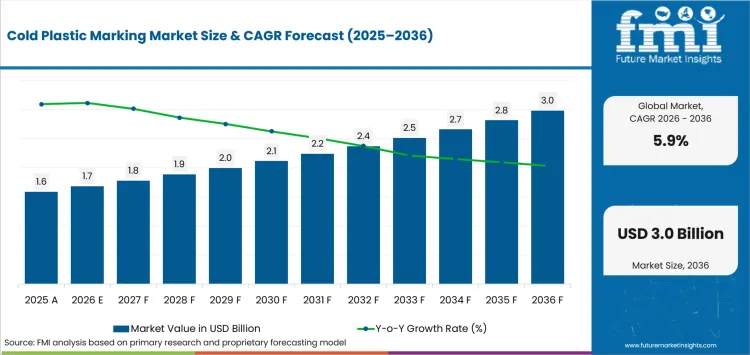
USD 1.7 billion in 2026 and USD 3.0 billion by 2036 at a 5.9% CAGR.
Demand for cold plastic marking is projected to expand at 5.9% CAGR between 2026 and 2036, increasing valuation from USD 1.7 billion in 2026 to USD 3.0 billion by 2036. Revenue depends on local approval of complete marking systems and repeatable field performance under traffic.
Road agencies evaluate cold plastic where frequent remarking raises lane-closure cost and crew exposure. The Federal Highway Administration keeps maintained pavement-marking retroreflectivity in view on applicable USA roads, while Devon County Council reported in June 2025 that selected work was moving from thermoplastic to cold-applied MMA to extend service intervals and reduce return visits.
Key Takeaways of Cold Plastic Marking Market
- By resin chemistry, MMA cold plastic leads with a 34.0% share in 2026, favored for its reactive two-component cure system enabling durable, high-build road markings without the heating step required by thermoplastics; by marking type, line markings account for 37.0% of demand in 2026, reflecting their recurring renewal requirements across highway and urban road networks.
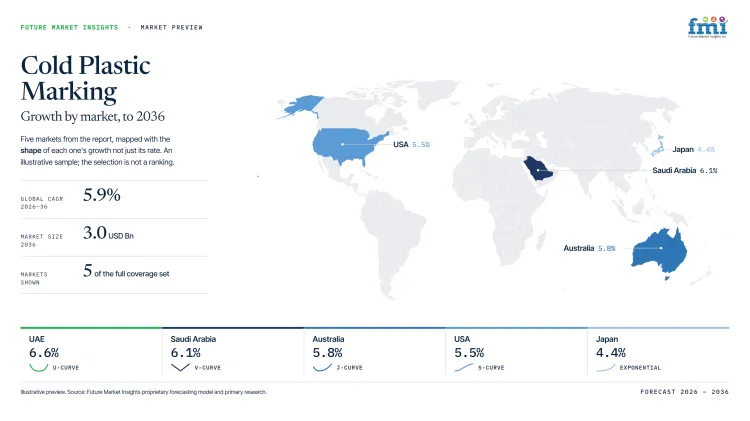
- Among the key countries covered, the UAE leads with the highest CAGR of 6.6%, followed by Saudi Arabia at 6.1%, Australia at 5.8%, the USA at 5.5%, the UK at 5.2%, Germany at 4.9%, and Japan at 4.4% through 2036.
- By application method, extrusion holds a 31.0% share of demand in 2026, supported by its ability to deliver consistent high-build placement for durable markings, with controlled film build and integrated bead placement as key performance factors.
- By end use, highways account for the largest share at 36.0% in 2026, as persistent traffic loading amplifies the value of extended service life and reduced maintenance closures; by sales channel, road marking contractors lead with a 42.0% share, given their critical role in ensuring field application discipline translates material qualification into actual road performance.
- Notable companies operating in the cold plastic marking market include SWARCO, Geveko Markings, PPG, Kataline Limited, 3M, Sherwin-Williams, Asian Paints PPG, SealMaster, Hempel, and Crown Technology, LLC, competing across reactive cold-plastic chemistry, application breadth, visibility system integration, and regional market coverage.
Analyst Perspective
"Cold plastic earns a premium when an authority can verify the installed system across material qualification and field application. Resin choice matters, but jobsite control decides whether the expected service interval appears on the road. Suppliers should pair approval evidence with contractor training before asking buyers to replace an established marking specification."
- Nikhil Kaitwade, Principal Consultant, Future Market Insights
How is the Cold Plastic Marking Market segmented?
The cold plastic marking market is segmented by resin chemistry, marking type, application method, end use, sales channel and region.
Resin chemistry separates reactive MMA systems from other cold-applied formats, while marking type reflects how the material is used on the pavement. Application method captures placement workflow, end use reflects traffic exposure, and sales channel shows who controls specification and jobsite execution. Cold plastic sits inside the wider road marking paint field, but this market excludes conventional waterborne paint and hot-applied thermoplastic.
Why does extrusion lead the application method category?
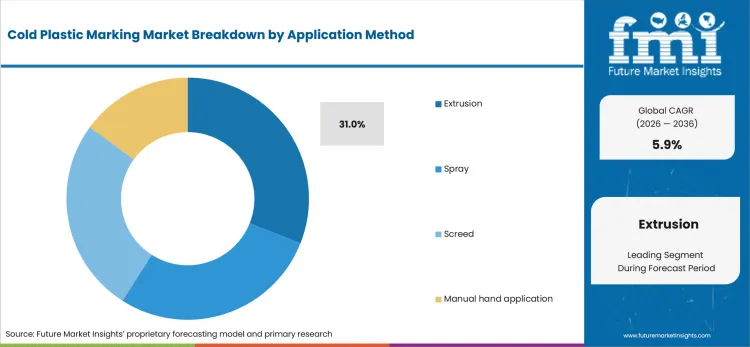
Extrusion supports controlled film build for reactive material and suits high-build profiles that need repeatable placement. Application equipment has to meter material consistently and coordinate surface preparation with bead placement. That process link makes road marking equipment selection part of installed performance rather than a separate purchasing decision.
- Extrusion is projected to account for 31.0% of application method demand in 2026 because it supports consistent high-build placement for durable markings.
- The City of Sydney specification issued in July 2025 requires two-part cold-applied plastic to comply with Transport for NSW specification 3360 and links application rates to the relevant pavement-marking requirements.
Why does MMA cold plastic lead the resin chemistry category?
MMA cold plastic cures through a reactive two-component system and can support high-build or structured markings without the heating step used for thermoplastic. This gives agencies a route to durable markings where lane closure frequency matters. The chemistry also sits within the broader road marking coatings category, but qualification is usually tied to a complete system rather than resin chemistry alone.
- Based on resin chemistry, MMA cold plastic is projected to account for 34.0% in 2026 because the cure system supports durable, high-build road markings.
- In 2026, SWARCO reported BASt endurance testing of an MMA cold-plastic system after more than 12 million simulated wheel passes, with retained retroreflective performance documented for the tested system.
Why do line markings lead the marking type category?
Line markings create a recurring maintenance footprint across center lines, edge lines and lane separation. They face continuous wheel exposure over long distances and are directly tied to nighttime guidance on applicable roads. Federal rules in the USA therefore make maintained pavement-marking visibility a practical procurement consideration for many agencies.
- Line markings are expected to account for 37.0% of marking type demand in 2026 because longitudinal markings require recurring renewal across highway and urban road networks.
- The Federal Highway Administration confirmed in February 2024 that the 11th Edition MUTCD retains minimum maintained pavement-marking retroreflectivity requirements for applicable roads.
Why do highways lead the end-use category?
Highways create a clear lifecycle test for premium markings because traffic loading is persistent and work-zone exposure can be costly. A material that stays serviceable for longer can reduce remarking frequency when laboratory qualification is matched by field execution. This economics becomes more visible on routes where traffic management forms a material share of maintenance effort.
- Highways are forecast to account for 36.0% of end-use demand in 2026 because traffic loading increases the value of service life and fewer maintenance closures.
- In June 2025, Devon County Council said it was using cold-applied MMA road markings on selected work and linked the change to longer service life and fewer return visits.
Why do road marking contractors lead the sales channel category?
Road marking contractors control the point where material qualification becomes road performance. Crews manage surface preparation, component proportioning and line geometry before reopening a route to traffic. Optical media also has to be applied at the intended rate. Supplier documentation can define the system, but contractor discipline determines whether the installed marking matches that specification.
- Road marking contractors are expected to account for 42.0% of sales channel demand in 2026 because application discipline is part of the delivered performance.
- 3M updated its Connected Roads All Weather Elements application guidance in June 2025 with binder-compatibility and calibration requirements that include MMA and other two-component marking systems.
What are the drivers, restraints and opportunities in the Cold Plastic Marking Market?
Durability and visibility requirements support adoption, while qualification and field-application discipline slow switching as structured and high-visibility markings widen premium use cases.
- Driver: Road authorities value durable visible markings when frequent restriping would add traffic disruption and lifecycle cost.
- Restraint: Qualification rules and field-application sensitivity increase switching effort versus established paint or thermoplastic specifications.
- Opportunity: Wet-night optics and structured formats can extend cold plastic into safety-led applications, while symbols and colored surfaces add urban use cases.
The central demand driver is the need to keep markings visible while controlling maintenance disruption. FHWA requirements focus on maintained retroreflectivity for applicable markings rather than prescribing one chemistry. Cold plastic therefore competes on evidence that a qualified installed system can hold visibility for an acceptable service interval under local traffic.
Qualification is the main restraint because road agencies buy performance systems, not resin in isolation. Germany uses BASt testing for road-marking systems, while Australia has an explicit specification for two-part cold-applied material. These controls reduce performance risk for agencies but increase the cost of switching for suppliers and contractors that still need local approvals.
Opportunity concentrates where markings must remain conspicuous in difficult viewing conditions or carry added road-user information. Structured profiles can support wet-night guidance, and cold-applied material can serve symbols or colored areas where the specification permits it. Wider use therefore depends on matching the material format to an approved road-safety function instead of selling durability as a stand-alone claim.
Which country CAGRs are included in the Cold Plastic Marking Market?
| Country | CAGR |
|---|---|
| UAE | 6.6% |
| USA | 5.5% |
| Japan | 4.4% |
| Saudi Arabia | 6.1% |
| Australia | 5.8% |
| UK | 5.2% |
| Germany | 4.9% |
How do country-level CAGRs compare in the Cold Plastic Marking Market?
The seven country CAGRs span 2.2 percentage points across road programs with different approval systems and incumbent marking materials. The spread indicates expected expansion, while actual entry conditions still depend on specification openness and qualified contractor capacity.
- UAE is set to expand at 6.6% CAGR as road-marking renewal creates recurring opportunities, although heat and dust performance remain practical qualification gates.
- Saudi Arabia is projected to grow at 6.1% CAGR as digital road-condition assessment strengthens the link between measured asset quality and maintenance planning.
- Australia is anticipated to advance at 5.8% CAGR, supported by an established two-part cold-applied specification pathway that keeps compliance requirements visible to suppliers.
- USA is expected to expand at 5.5% CAGR as federal visibility requirements operate alongside state-level material qualification and project specifications.
- UK is forecast to grow at 5.2% CAGR as local authorities evaluate longer-life MMA against conventional road-marking maintenance cycles.
- Germany is likely to advance at 4.9% CAGR, with BASt system testing keeping technical validation central to market entry.
- Japan is projected to expand at 4.4% CAGR as cold plastic competes with established public-works specifications that continue to include hot-applied marking systems.
Comparable CAGRs can produce different market entry conditions. The full report provides country-level CAGR analysis across North America, Latin America, Western Europe, Eastern Europe, East Asia, South Asia and Pacific, and the Middle East and Africa.
Country-wise Analysis
- Road agencies in the UAE purchase pavement marking through maintenance programs that place weight on rapid execution and performance under heat, dust and dense traffic. Demand for cold plastic marking in the UAE is forecast to expand at 6.6% CAGR from 2026 to 2036. Dubai RTA said in May 2025 that road-marking renewal had begun across 89 locations, covering more than 30,000 linear metres and showing the continuing scale of planned marking work.
- USA procurement is decentralized because state and local agencies maintain qualified-product processes within the federal traffic-control framework. Demand for cold plastic marking in the USA is projected to expand at 5.5% CAGR through 2036. FHWA maintains minimum retroreflectivity provisions for applicable markings, while Michigan DOT publishes construction requirements for overlay cold-plastic pavement markings.
- Japanese public works remain specification-led, and incumbent marking formats can slow material substitution. Demand for cold plastic marking in Japan is expected to advance at 4.4% CAGR through 2036. A 2025 Kinki Regional Development Bureau maintenance design for National Route 171 includes melt-type road marking work, illustrating the qualification hurdle facing alternative cold-applied systems in some public projects.
- Saudi Arabia is connecting road maintenance with digital condition assessment and code-based performance control. Demand for cold plastic marking in Saudi Arabia is anticipated to expand at 6.1% CAGR through 2036. The Roads General Authority has deployed mobile road-survey technologies that capture marking condition, creating a more measurable basis for maintenance planning and contractor performance.
- Australia provides suppliers with a defined compliance route for two-part cold-applied material. Demand for cold plastic marking in Australia is set to grow at 5.8% CAGR through 2036. City of Sydney specifications require two-part cold-applied plastic to comply with Transport for NSW 3360, which makes technical approval and application control visible at tender stage.
- UK demand is shaped by local authority maintenance economics and the cost of repeat traffic management. Cold plastic marking demand in the UK is forecast to expand at 5.2% CAGR through 2036. Devon County Council said in June 2025 that it was using cold-applied MMA on selected road-marking work as part of a move intended to extend service life and reduce return visits.
- Germany uses system-level road-marking qualification that raises the evidence threshold for market entry. Demand for cold plastic marking in Germany is projected to expand at 4.9% CAGR through 2036. BASt certificates document rotary traffic simulator testing for road-marking systems, keeping retained retroreflectivity and wear performance central to supplier qualification.
Who are the notable companies in the Cold Plastic Marking Market?
SWARCO, Geveko Markings, 3M, PPG, Kataline Limited, Sherwin-Williams, Asian Paints PPG, SealMaster, Hempel and Crown Technology, LLC are notable companies serving the cold plastic marking market.
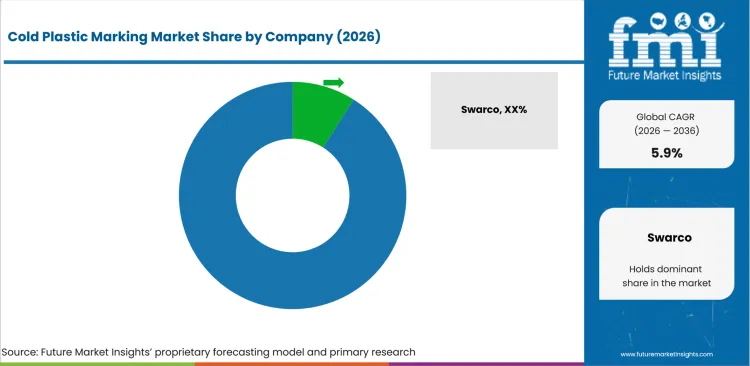
Competition combines suppliers with direct cold-plastic systems and broader road-marking portfolios. Buyers assess whether a company can support local qualification and the contractor at application stage, because equivalent chemistry can perform differently when film build or optical media placement changes in the field.
- SWARCO, Geveko Markings, PPG and Kataline Limited offer cold-applied or two-component road-marking systems with direct relevance to reactive marking work.
- 3M, Sherwin-Williams and Hempel participate through visibility materials or adjacent coating platforms that can support specified road-marking systems.
- Asian Paints PPG, SealMaster and Crown Technology, LLC extend regional supply or contractor-facing access across traffic-marking applications.
Competitive Benchmarking: Cold Plastic Marking Market
| Company | Reactive cold-plastic chemistry | Cold-plastic application breadth | Visibility system integration | Geographic Reach |
|---|---|---|---|---|
| SWARCO | High | High | High | Europe, North America, Asia Pacific and Middle East |
| Geveko Markings | High | High | Medium | Europe, North America, Australia and New Zealand |
| 3M | Unscored | Unscored | High | Global road-safety distribution |
| PPG | High | High | Medium | North America and selected international markets |
| Kataline Limited | High | High | Medium | India and selected export markets |
| Sherwin-Williams | Unscored | Unscored | Unscored | North America and selected international markets |
| Asian Paints PPG | Unscored | Unscored | Unscored | India and selected Asian markets |
| SealMaster | Unscored | Unscored | Unscored | North America and selected international markets |
| Hempel | Unscored | Unscored | Medium | Europe, Middle East and Asia Pacific |
| Crown Technology, LLC | Unscored | Unscored | Medium | North America |
Key Developments in the Cold Plastic Marking Market
- In April 2026, PPG completed its acquisition of Ozark Materials, adding pavement-marking production and customer reach in the USA and Canada to its Traffic Solutions business.
- In February 2026, SWARCO reported BASt rotary traffic simulator results for its SWARCOPLAST G601 MMA cold-plastic system after more than 12 million simulated wheel passes.
- In February 2025, Geveko Markings acquired Farby Maestria Polska, adding manufacturing and distribution capacity for road-marking materials in Poland.
Key Players in the Cold Plastic Marking Market
Cold-Plastic and Road-Marking Systems
- SWARCO
- Geveko Markings
- PPG
- Kataline Limited
Visibility and Coating Platforms
- 3M
- Sherwin-Williams
- Hempel
Regional and Contractor-Facing Suppliers
- Asian Paints PPG
- SealMaster
- Crown Technology, LLC
Cold Plastic Marking Market - Report Scope
| Coverage field | Report scope |
|---|---|
| Market breakdown | By resin chemistry, marking type, application method, end use, sales channel and region. |
| Quantitative Units | Revenue in USD billion and CAGR in %. |
| Market Definition | Revenue from cold-applied reactive road-marking materials and system products used for line, symbol, profile and specialty pavement markings. Conventional waterborne traffic paint and hot-applied thermoplastic are excluded. |
| Regions Covered | North America, Latin America, Western Europe, Eastern Europe, East Asia, South Asia and Pacific, and Middle East and Africa. |
| Countries Covered | UAE, USA, Japan, Saudi Arabia, Australia, UK, Germany, and 20+ countries included in the full report. |
| Key Companies | SWARCO, Geveko Markings, 3M, PPG, Kataline Limited, Sherwin-Williams, Asian Paints PPG, SealMaster, Hempel and Crown Technology, LLC. |
| Forecast Period | 2026 to 2036. |
| Approach | Primary and secondary research with market triangulation. |
Cold Plastic Marking Market - Research Methodology
| Method | Approach |
|---|---|
| Primary Research | FMI analysts gathered input from road-marking material suppliers, applicators, distributors, procurement teams and technical specialists. Interviews examined specification choices, approval requirements, material substitution, application constraints and purchasing criteria. Respondents were asked what evidence is needed before a trial progresses to repeat procurement. |
| Desk Research | Desk research covered road-agency specifications, transport standards, government maintenance releases, technical qualification records and company publications. Sources were reviewed for date, geography and direct relevance to cold-applied road marking. Product and development claims were retained only when current public evidence supported them. |
| Market Sizing and Forecasting | The market model combined the 2026 baseline with segment structure, material pricing, adoption patterns and country demand conditions. Forecast assumptions considered road-maintenance activity, qualification cycles, contractor capacity and substitution against paint or thermoplastic. Segment and regional estimates were reconciled to the global total. |
| Data Validation | Estimates were checked against independent indicators such as road-agency activity, product qualification, company participation and public project specifications. Validation also tested whether revenue fell within the defined material boundary. Installation services and adjacent marking categories were excluded where they would create overlap. |
Cold Plastic Marking Market by Segments
Cold Plastic Marking Market segmented by Resin Chemistry:
- MMA cold plastic
- Two-component cold plastic
- Spray plastic
- Profiled cold plastic
- Preformed cold plastic
Cold Plastic Marking Market segmented by Marking Type:
- Line markings
- Crosswalk / symbols
- Audible / tactile markings
- Bike lane markings
- Airport / industrial markings
Cold Plastic Marking Market segmented by Application Method:
- Extrusion
- Spray
- Screed
- Manual hand application
Cold Plastic Marking Market segmented by End Use:
- Highways
- Urban roads
- Airports
- Parking facilities
- Industrial sites
Cold Plastic Marking Market segmented by Sales Channel:
- Road marking contractors
- Direct material supply
- Distributors
- Government-approved vendors
Cold Plastic Marking Market by Region:
- North America
- United States
- Canada
- Latin America
- Brazil
- Mexico
- Argentina
- Chile
- Western Europe
- Germany
- France
- United Kingdom
- Italy
- Spain
- Benelux
- Nordics
- Eastern Europe
- Poland
- Czech Republic
- Romania
- Hungary
- East Asia
- China
- Japan
- South Korea
- South Asia and Pacific
- India
- ASEAN
- Australia and New Zealand
- Middle East and Africa
- GCC Countries
- South Africa
- Türkiye
- Israel
Research Sources and Bibliography
- Federal Highway Administration. (2024, February 15). Pavement Markings Regulations / Standards.
- Federal Highway Administration. (2023). Manual on Uniform Traffic Control Devices, 11th Edition.
- Dubai Roads and Transport Authority. (2025, May 8). Commencing the Renewal of Road Markings in 89 Main Locations.
- Saudi Press Agency. (2025, February 16). Roads General Authority Adopts Advanced Digital Mobile Mapping System.
- Saudi Press Agency. (2023, December 3). Roads General Authority Makes Use of Device to Assess Road Markings.
- Devon County Council. (2025, June 25). Council to trial pothole repair blitz as part of road maintenance programme.
- City of Sydney. (2025, July). B9 Road Pavement Marking and Road Signage Construction, Sydney Streets Technical Specifications Revision 7.
- Transport for NSW. IC-QA-3360 - Two Part Cold Applied Road Marking Material.
- Federal Highway Research Institute (BASt). (2025). Certificate 2025 1DK 06.03: Road-marking system test on rotary traffic simulator.
- Ministry of Land, Infrastructure, Transport and Tourism, Kinki Regional Development Bureau. (2025). National Route 171 road-maintenance design documentation.
- Michigan Department of Transportation. Pavement Marking Material Verification Checklist, Form 1585.
- Michigan Department of Transportation. Construction Requirements for Overlay Cold Plastic Pavement Markings, 20SP-811H.
- SWARCO. (2026). Performance, Well Beyond 12 Million Wheel Passes.
- PPG. (2026, April 15). PPG acquires pavement markings manufacturer Ozark Materials.
- Geveko Markings. (2025). Acquisition of Farby Maestria Polska.
- 3M. (2025, June). Connected Roads All Weather Elements Application Guidelines, Revision A.
- PPG Traffic Solutions. Ennis-Flint by PPG Methyl Methacrylate pavement marking systems.
- Kataline Limited. Two-component cold plastic road-marking systems.
This bibliography is provided for reader reference and is not exhaustive. The full report contains the complete reference list and detailed citations
This Report Answers
- How large is the Cold Plastic Marking Market at the beginning and end of the forecast period?
- Which operating conditions support recurring demand for cold-applied road markings?
- Which resin chemistry leads adoption across durable marking systems?
- How does marking type shape repeat road-maintenance demand?
- Which application method supports controlled high-build placement?
- How do road-agency qualification rules affect supplier entry?
- How do country growth rates change commercial entry conditions?
- Which companies serve cold-plastic and adjacent road-marking applications?
Frequently Asked Questions
How big is the Cold Plastic Marking Market in 2026?
USD 1.7 billion represents the cold plastic marking market value in 2026. Demand is expected to reach USD 3.0 billion by 2036 as road agencies weigh longer service intervals against qualification cost and contractor execution requirements.
What is the CAGR of the Cold Plastic Marking Market from 2026 to 2036?
A 5.9% CAGR is projected for the cold plastic marking market between 2026 and 2036. Growth depends on road-maintenance renewal, visibility requirements and the ability of suppliers to qualify complete systems within local specifications.
Which resin chemistry segment is projected to account for 34.0% of the Cold Plastic Marking Market?
MMA cold plastic is projected to account for 34.0% of resin chemistry demand in 2026. Reactive cure supports durable high-build formats, although material qualification and field application remain necessary to translate chemistry into road performance.
How much will the Cold Plastic Marking Market add between 2026 and 2036?
USD 1.3 billion is expected to be added to the cold plastic marking market between 2026 and 2036. The increase reflects wider use in durable road-maintenance applications where service life can offset higher qualification and application requirements.
Which companies are active in the Cold Plastic Marking Market?
Companies active in the cold plastic marking market include SWARCO, Geveko Markings, 3M, PPG, Kataline Limited, Sherwin-Williams, Asian Paints PPG, SealMaster, Hempel and Crown Technology, LLC. Their roles range from direct cold-applied systems to visibility materials and adjacent traffic-marking portfolios.
Preview the report firsthand - request a free sample
Get SampleGet the brochure for pricing and purchase details.
Get PDFTable of Content
- Key Takeaways
- Market Size and CAGR
- Top Growth Driver
- Fastest Growing Segment
- Leading Region
- Key Companies
- Emerging Opportunities
- Executive Summary
- Global Market Outlook
- Demand-side Trends
- Supply-side Trends
- Technology Roadmap Analysis
- Analysis and Recommendations
- Analyst Perspective (What is happening? Why now? What should investors know?)
- Key Questions Answered
- How large is the market?
- What is the CAGR?
- What are key trends?
- Which region dominates?
- Who are the leaders?
- Market Overview
- Market Coverage / Taxonomy
- Market Definition / Scope / Limitations
- Research Methodology
- Chapter Orientation
- Analytical Lens and Working Hypotheses
- Market Structure, Signals, and Trend Drivers
- Benchmarking and Cross-market Comparability
- Market Sizing, Forecasting, and Opportunity Mapping
- Research Design and Evidence Framework
- Desk Research Programme (Secondary Evidence)
- Expert Input and Fieldwork (Primary Evidence)
- Tooling, Models, and Reference Databases
- Data Engineering and Model Build
- Quality Assurance and Audit Trail
- Market Background
- Market Dynamics (Drivers, Restraints, Opportunity, Trends)
- Scenario Forecast (Optimistic, Likely, Conservative)
- Impact Analysis
- AI Impact
- Sustainability Impact
- Regulatory Impact
- Technology Impact
- Consumer / Buyer Analysis
- Purchase Drivers
- Adoption Barriers
- Buyer Journey
- Opportunity Map Analysis
- Product Life Cycle Analysis
- Supply Chain Analysis
- Investment Feasibility Matrix
- Value Chain Analysis
- PESTLE and Porter's Analysis
- Regulatory Landscape
- Regional Parent Market Outlook
- Production and Consumption Statistics
- Import and Export Statistics
- Global Market Analysis and Forecast, 2021 to 2036
- Historical Market Size Value (USD Billion) Analysis, 2021 to 2025
- Current and Future Market Size Value (USD Billion) Projections, 2026 to 2036
- Y-o-Y Growth Trend Analysis
- Absolute $ Opportunity Analysis
- Global Market Pricing Analysis, 2021 to 2036
- Global Market Analysis and Forecast, By Resin Chemistry, 2021 to 2036
- Introduction / Key Findings
- Historical Market Size Value (USD Billion) Analysis By Resin Chemistry, 2021 to 2025
- Current and Future Market Size Value (USD Billion) Analysis and Forecast By Resin Chemistry, 2026 to 2036
- MMA cold plastic
- Two-component cold plastic
- Spray plastic
- Profiled cold plastic
- Preformed cold plastic
- MMA cold plastic
- Y-o-Y Growth Trend Analysis By Resin Chemistry, 2021 to 2025
- Absolute $ Opportunity Analysis By Resin Chemistry, 2026 to 2036
- Global Market Analysis and Forecast, By Marking Type, 2021 to 2036
- Introduction / Key Findings
- Historical Market Size Value (USD Billion) Analysis By Marking Type, 2021 to 2025
- Current and Future Market Size Value (USD Billion) Analysis and Forecast By Marking Type, 2026 to 2036
- Line markings
- Crosswalk / symbols
- Audible / tactile markings
- Bike lane markings
- Airport / industrial markings
- Line markings
- Y-o-Y Growth Trend Analysis By Marking Type, 2021 to 2025
- Absolute $ Opportunity Analysis By Marking Type, 2026 to 2036
- Global Market Analysis and Forecast, By Application Method, 2021 to 2036
- Introduction / Key Findings
- Historical Market Size Value (USD Billion) Analysis By Application Method, 2021 to 2025
- Current and Future Market Size Value (USD Billion) Analysis and Forecast By Application Method, 2026 to 2036
- Extrusion
- Spray
- Screed
- Manual hand application
- Extrusion
- Y-o-Y Growth Trend Analysis By Application Method, 2021 to 2025
- Absolute $ Opportunity Analysis By Application Method, 2026 to 2036
- Global Market Analysis and Forecast, By End Use, 2021 to 2036
- Introduction / Key Findings
- Historical Market Size Value (USD Billion) Analysis By End Use, 2021 to 2025
- Current and Future Market Size Value (USD Billion) Analysis and Forecast By End Use, 2026 to 2036
- Highways
- Urban roads
- Airports
- Parking facilities
- Industrial sites
- Highways
- Y-o-Y Growth Trend Analysis By End Use, 2021 to 2025
- Absolute $ Opportunity Analysis By End Use, 2026 to 2036
- Global Market Analysis and Forecast, By Sales Channel, 2021 to 2036
- Introduction / Key Findings
- Historical Market Size Value (USD Billion) Analysis By Sales Channel, 2021 to 2025
- Current and Future Market Size Value (USD Billion) Analysis and Forecast By Sales Channel, 2026 to 2036
- Road marking contractors
- Direct material supply
- Distributors
- Government-approved vendors
- Road marking contractors
- Y-o-Y Growth Trend Analysis By Sales Channel, 2021 to 2025
- Absolute $ Opportunity Analysis By Sales Channel, 2026 to 2036
- Global Market Analysis and Forecast, By Region, 2021 to 2036
- Introduction
- Historical Market Size Value (USD Billion) Analysis By Region, 2021 to 2025
- Current Market Size Value (USD Billion) Analysis and Forecast By Region, 2026 to 2036
- North America
- Latin America
- Western Europe
- Eastern Europe
- East Asia
- South Asia and Pacific
- Middle East & Africa
- Market Attractiveness Analysis By Region
- North America Market Analysis and Forecast, By Country, 2021 to 2036
- Historical Market Size Value (USD Billion) Trend Analysis By Market Taxonomy, 2021 to 2025
- Market Size Value (USD Billion) Forecast By Market Taxonomy, 2026 to 2036
- By Country
- USA
- Canada
- By Resin Chemistry
- By Marking Type
- By Application Method
- By End Use
- By Sales Channel
- By Country
- Market Attractiveness Analysis
- By Country
- By Resin Chemistry
- By Marking Type
- By Application Method
- By End Use
- By Sales Channel
- Key Takeaways
- Latin America Market Analysis and Forecast, By Country
- Historical Market Size Value (USD Billion) Trend Analysis By Market Taxonomy, 2021 to 2025
- Market Size Value (USD Billion) Forecast By Market Taxonomy, 2026 to 2036
- By Country
- Brazil
- Mexico
- Chile
- Rest of Latin America
- By Resin Chemistry
- By Marking Type
- By Application Method
- By End Use
- By Sales Channel
- By Country
- Market Attractiveness Analysis
- By Country
- By Resin Chemistry
- By Marking Type
- By Application Method
- By End Use
- By Sales Channel
- Key Takeaways
- Western Europe Market Analysis and Forecast, By Country
- Historical Market Size Value (USD Billion) Trend Analysis By Market Taxonomy, 2021 to 2025
- Market Size Value (USD Billion) Forecast By Market Taxonomy, 2026 to 2036
- By Country
- Germany
- UK
- Italy
- Spain
- France
- Nordic
- BENELUX
- Rest of Western Europe
- By Resin Chemistry
- By Marking Type
- By Application Method
- By End Use
- By Sales Channel
- By Country
- Market Attractiveness Analysis
- By Country
- By Resin Chemistry
- By Marking Type
- By Application Method
- By End Use
- By Sales Channel
- Key Takeaways
- Eastern Europe Market Analysis and Forecast, By Country
- Historical Market Size Value (USD Billion) Trend Analysis By Market Taxonomy, 2021 to 2025
- Market Size Value (USD Billion) Forecast By Market Taxonomy, 2026 to 2036
- By Country
- Russia
- Poland
- Hungary
- Balkan & Baltic
- Rest of Eastern Europe
- By Resin Chemistry
- By Marking Type
- By Application Method
- By End Use
- By Sales Channel
- By Country
- Market Attractiveness Analysis
- By Country
- By Resin Chemistry
- By Marking Type
- By Application Method
- By End Use
- By Sales Channel
- Key Takeaways
- East Asia Market Analysis and Forecast, By Country
- Historical Market Size Value (USD Billion) Trend Analysis By Market Taxonomy, 2021 to 2025
- Market Size Value (USD Billion) Forecast By Market Taxonomy, 2026 to 2036
- By Country
- China
- Japan
- South Korea
- By Resin Chemistry
- By Marking Type
- By Application Method
- By End Use
- By Sales Channel
- By Country
- Market Attractiveness Analysis
- By Country
- By Resin Chemistry
- By Marking Type
- By Application Method
- By End Use
- By Sales Channel
- Key Takeaways
- South Asia and Pacific Market Analysis and Forecast, By Country
- Historical Market Size Value (USD Billion) Trend Analysis By Market Taxonomy, 2021 to 2025
- Market Size Value (USD Billion) Forecast By Market Taxonomy, 2026 to 2036
- By Country
- India
- ASEAN
- Australia & New Zealand
- Rest of South Asia and Pacific
- By Resin Chemistry
- By Marking Type
- By Application Method
- By End Use
- By Sales Channel
- By Country
- Market Attractiveness Analysis
- By Country
- By Resin Chemistry
- By Marking Type
- By Application Method
- By End Use
- By Sales Channel
- Key Takeaways
- Middle East & Africa Market Analysis and Forecast, By Country
- Historical Market Size Value (USD Billion) Trend Analysis By Market Taxonomy, 2021 to 2025
- Market Size Value (USD Billion) Forecast By Market Taxonomy, 2026 to 2036
- By Country
- Kingdom of Saudi Arabia
- Other GCC Countries
- Türkiye
- South Africa
- Other African Union
- Rest of Middle East & Africa
- By Resin Chemistry
- By Marking Type
- By Application Method
- By End Use
- By Sales Channel
- By Country
- Market Attractiveness Analysis
- By Country
- By Resin Chemistry
- By Marking Type
- By Application Method
- By End Use
- By Sales Channel
- Key Takeaways
- Key Countries Market Analysis
- USA
- Pricing Analysis
- Market Share Analysis, 2025
- By Resin Chemistry
- By Marking Type
- By Application Method
- By End Use
- By Sales Channel
- Canada
- Pricing Analysis
- Market Share Analysis, 2025
- By Resin Chemistry
- By Marking Type
- By Application Method
- By End Use
- By Sales Channel
- Mexico
- Pricing Analysis
- Market Share Analysis, 2025
- By Resin Chemistry
- By Marking Type
- By Application Method
- By End Use
- By Sales Channel
- Brazil
- Pricing Analysis
- Market Share Analysis, 2025
- By Resin Chemistry
- By Marking Type
- By Application Method
- By End Use
- By Sales Channel
- Chile
- Pricing Analysis
- Market Share Analysis, 2025
- By Resin Chemistry
- By Marking Type
- By Application Method
- By End Use
- By Sales Channel
- Germany
- Pricing Analysis
- Market Share Analysis, 2025
- By Resin Chemistry
- By Marking Type
- By Application Method
- By End Use
- By Sales Channel
- UK
- Pricing Analysis
- Market Share Analysis, 2025
- By Resin Chemistry
- By Marking Type
- By Application Method
- By End Use
- By Sales Channel
- Italy
- Pricing Analysis
- Market Share Analysis, 2025
- By Resin Chemistry
- By Marking Type
- By Application Method
- By End Use
- By Sales Channel
- Spain
- Pricing Analysis
- Market Share Analysis, 2025
- By Resin Chemistry
- By Marking Type
- By Application Method
- By End Use
- By Sales Channel
- France
- Pricing Analysis
- Market Share Analysis, 2025
- By Resin Chemistry
- By Marking Type
- By Application Method
- By End Use
- By Sales Channel
- India
- Pricing Analysis
- Market Share Analysis, 2025
- By Resin Chemistry
- By Marking Type
- By Application Method
- By End Use
- By Sales Channel
- ASEAN
- Pricing Analysis
- Market Share Analysis, 2025
- By Resin Chemistry
- By Marking Type
- By Application Method
- By End Use
- By Sales Channel
- Australia & New Zealand
- Pricing Analysis
- Market Share Analysis, 2025
- By Resin Chemistry
- By Marking Type
- By Application Method
- By End Use
- By Sales Channel
- China
- Pricing Analysis
- Market Share Analysis, 2025
- By Resin Chemistry
- By Marking Type
- By Application Method
- By End Use
- By Sales Channel
- Japan
- Pricing Analysis
- Market Share Analysis, 2025
- By Resin Chemistry
- By Marking Type
- By Application Method
- By End Use
- By Sales Channel
- South Korea
- Pricing Analysis
- Market Share Analysis, 2025
- By Resin Chemistry
- By Marking Type
- By Application Method
- By End Use
- By Sales Channel
- Russia
- Pricing Analysis
- Market Share Analysis, 2025
- By Resin Chemistry
- By Marking Type
- By Application Method
- By End Use
- By Sales Channel
- Poland
- Pricing Analysis
- Market Share Analysis, 2025
- By Resin Chemistry
- By Marking Type
- By Application Method
- By End Use
- By Sales Channel
- Hungary
- Pricing Analysis
- Market Share Analysis, 2025
- By Resin Chemistry
- By Marking Type
- By Application Method
- By End Use
- By Sales Channel
- Kingdom of Saudi Arabia
- Pricing Analysis
- Market Share Analysis, 2025
- By Resin Chemistry
- By Marking Type
- By Application Method
- By End Use
- By Sales Channel
- Türkiye
- Pricing Analysis
- Market Share Analysis, 2025
- By Resin Chemistry
- By Marking Type
- By Application Method
- By End Use
- By Sales Channel
- South Africa
- Pricing Analysis
- Market Share Analysis, 2025
- By Resin Chemistry
- By Marking Type
- By Application Method
- By End Use
- By Sales Channel
- USA
- Market Structure Analysis
- Competition Dashboard
- Competition Benchmarking
- Market Share Analysis of Top Players
- By Regional
- By Resin Chemistry
- By Marking Type
- By Application Method
- By End Use
- By Sales Channel
- Emerging Startups
- Innovation Benchmarking
- Competition Analysis
- Competition Deep Dive
- Swarco
- Overview
- Product Portfolio
- Profitability by Market Segments
- Sales Footprint
- Strategy Overview
- Marketing Strategy
- Product Strategy
- Channel Strategy
- Geveko Markings
- 3M
- PPG
- Ennis-Flint / PPG
- Sherwin-Williams
- Asian Paints PPG
- SealMaster
- Hempel
- Crown Technology
- Swarco
- Case Studies
- Success Stories
- Recent Developments
- Competition Deep Dive
- Assumptions & Acronyms Used


