
- Market Size (2026)
- USD 13.2 Bn
- Forecast (2036)
- USD 24.8 Bn
- CAGR (2026 to 2036)
- 6.5%
How Big Is the Comic Book Market in 2026?
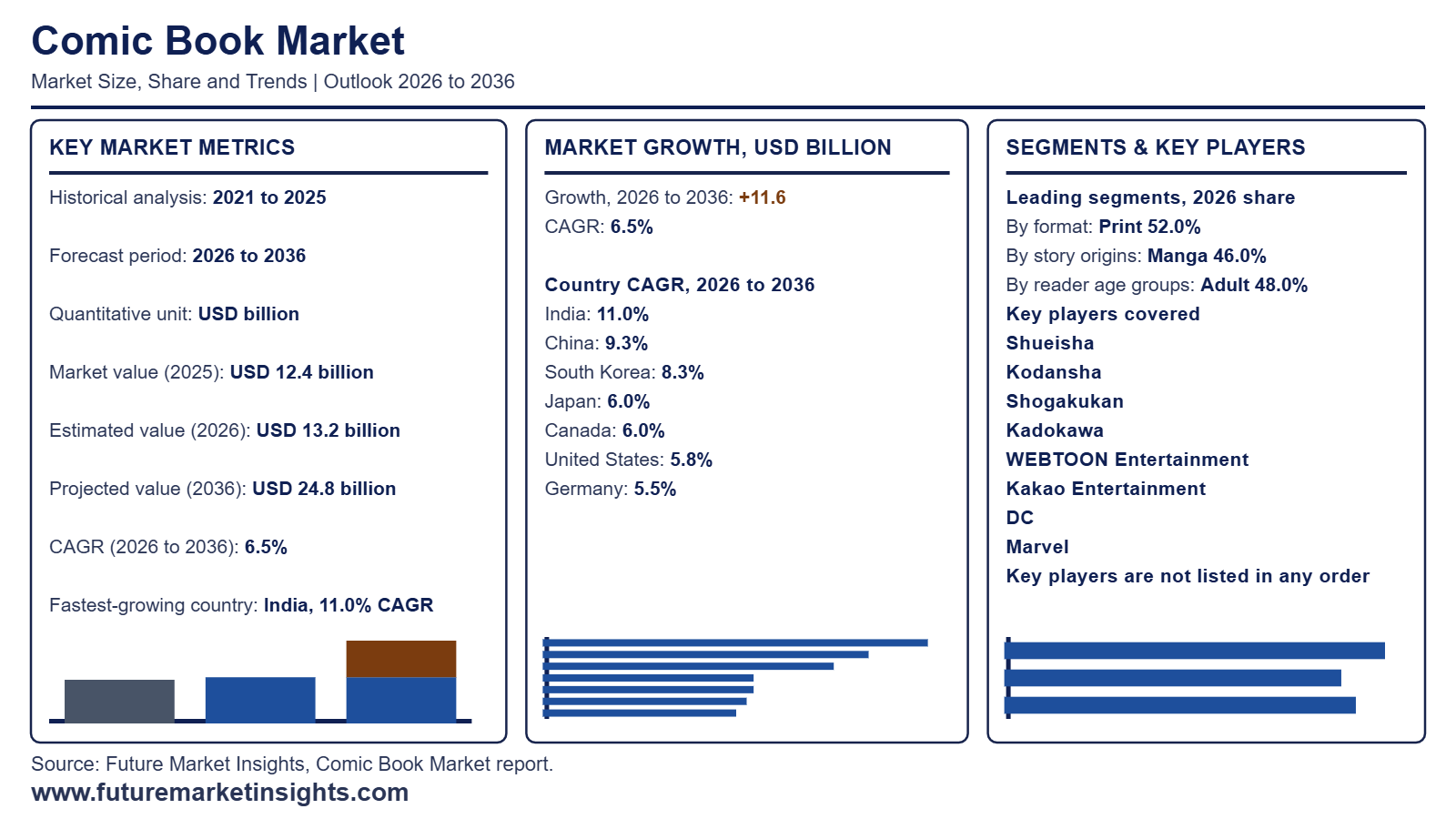
The global comic book market is valued at USD 13.2 billion in 2026, up from USD 12.4 billion in 2025, and is projected by Future Market Insights (FMI) to reach USD 24.8 billion by 2036, expanding at a 6.5% CAGR from 2026 to 2036 and generating USD 11.6 billion in incremental revenue over the 10-year forecast period.
| Market Metric | Valuation / Share / Forecast Benchmark |
|---|---|
| 2025 Market Size (Historical) | USD 12.4 billion |
| 2026 Market Size (Estimated) | USD 13.2 billion |
| 2036 Market Size (Projected) | USD 24.8 billion |
| Compound Annual Growth Rate (2026 to 2036) | 6.5% CAGR |
| Incremental Dollar Opportunity (2026 to 2036) | USD 11.6 billion |
| Dominant Format (2026 to 2036 Share) | Print (52.0% in 2026, 37.2% by 2036) | Digital fastest at 9.4% CAGR |
| Leading & Fastest-Growing Story Origins | Manga (46.0% share in 2026; 7.0% CAGR) | Webtoon (fastest, 9.5% CAGR) |
| Leading & Fastest-Growing Reader Age Groups | Adult (48.0% share in 2026; 6.0% CAGR) | Children (fastest, 7.2% CAGR) |
| Largest Country Markets (2026 Global Share) | Japan (36.0%), United States (20.0%), China (8.0%) |
| Fastest-Growing Country Markets (2026 to 2036) | India (11.0% CAGR), China (9.3% CAGR), South Korea (8.3% CAGR) |
| Leading Tier-1 Companies | Shueisha, Kodansha, Shogakukan, Kadokawa, WEBTOON Entertainment, Kakao Entertainment, DC, Marvel |
Source: Future Market Insights analysis of the comic book market, 2026.
Executive Market Overview
Adoption of mobile reading is moving comic book revenue from printed volumes to chapters read on phones. Mobile apps let readers buy single chapters for small amounts. As a result, readers who would not visit a bookshop are joining the market. Printed comics and graphic novels still hold about 52% of revenue in 2026. Digital comics, however, are growing at around 9.4% a year, more than three times faster than print. Digital is therefore set to reach about 63% of revenue by 2036. Manga holds about 46% of revenue and remains the largest story type worldwide.
Sales of printed comics in North America are recovering strongly even as reading moves to phones. For example, US and Canadian comic shop dollar sales rose 22% in January to August 2026, according to ICv2. Graphic novel sales in these shops rose 28%. Manga sales through bookshops, meanwhile, were up close to 40%. Film and television adaptations send new readers to the original books. Webtoons, read as vertical-scroll mobile chapters, are still the fastest-growing story type at about 9.5% a year.
Analyst Perspective
"Readers are moving to phones for new chapters, yet printed collections and comic shops in North America are having strong years. Digital comics will become the larger format before the end of the decade. Screen adaptations will continue to decide which series sell. Saturation in Japanese apps, however, shows digital growth will not be even across markets."
- Rahul Pandita, Principal Consultant, Future Market Insights (FMI)
Major Market Trends and Insights
- Readers Are Returning to Comic Shops: Sales at specialist comic shops in North America are growing again after years of slow sales. ICv2, for example, reported that comic shop sales rose nearly 30% in 2025 and kept rising in 2026. New superhero lines, manga and collectible editions helped this growth. Readers visit shops for events, variant covers and staff advice. Publishers, in turn, are working with several distributors after the sale of Diamond Comic Distributors in 2025.
- Readers Are Paying per Chapter on Phones: Purchases of single chapters through coins and free advertising-supported episodes are rising on webtoon and manga apps. This model suits readers who read during short breaks. For instance, WEBTOON Entertainment said advertising revenue grew strongly in 2026. Paid chapter sales, however, were weaker in some markets. Publishers are releasing digital chapters alongside printed editions in many countries, which reduces piracy.
- Publishers Are Turning Series Into Screen Projects: Demand for original comics rises sharply when screen versions of a series are released. Manga sales, for example, jump when a new anime season begins. Superhero films support sales of related graphic novels. Publishers and platforms are therefore investing more in adapting own stories for screen. Adaptation revenue, however, is uneven, since release dates vary from year to year.
What Are the Main Drivers, Restraints, and Opportunities?
Screen adaptations, easy mobile reading and wider young adult and child audiences are driving comic book sales. Piracy and rising print costs restrain growth, while digital chapters, webtoons and children's graphic novels offer the largest new revenue.
Driver: Adaptations, Mobile Reading and New Readers
Demand for comics is widening as screen adaptations bring in readers of all ages who then buy the original books. Mobile apps, in turn, make it easy to read a chapter in minutes and discover new series. More women, children and young adults read comics than in the past. As a result, the audience is wider than superhero fans alone. Digital comics are set to add about USD 9.2 billion of revenue by 2036, the largest gain by format.
Restraint: Piracy, Saturation and Print Costs
Revenue lost to piracy is a large restraint, since unofficial websites copy manga and webtoon chapters. Some mature markets are also showing saturation. For example, WEBTOON Entertainment reported that monthly users in Japan fell 12% in the third quarter of 2026. Rising paper, printing and shipping costs, meanwhile, raise the price of printed books. Print sales in some countries are falling as readers move to phones.
Opportunity: Digital Chapters, Webtoons and Children's Books
Webtoons offer the largest investment opportunity in comic books, growing at about 9.5% a year. This story type is set to add around USD 2.7 billion of revenue by 2036. Children's comics and graphic novels, in turn, are growing at around 7.2% a year. Schools and libraries are adding more comics to reading lists. India, at about 11.0% a year, is the fastest-growing profiled country as mobile reading spreads.
How Is the Comic Book Market Segmented?
The comic book market is segmented into format, story origin, reader age group and region, with values shown in USD billion.
| Segmentation Axis | Sub-Segments Covered | 2026 Leading Segment & Share | Main Growth Benchmark (2026 to 2036) |
|---|---|---|---|
| Format | Print, Digital | Print (52.0% revenue share) | Digital (9.4% CAGR) vs. Print (3.0% CAGR) |
| Story Origin | Manga, Western Comics, Webtoon, European Comics | Manga (46.0% revenue share) | Webtoon (9.5% CAGR) vs. Western Comics (4.2% CAGR) |
| Reader Age Group | Adult, Young Adult, Children | Adult (48.0% revenue share) | Children lead growth at a 7.2% CAGR vs. Adult at 6.0% |
| Region | East Asia, North America, Europe, South Asia & Pacific, Latin America, Middle East & Africa | East Asia (51.5% revenue share) | Middle East & Africa leads regional growth at a 13.6% CAGR; India leads national growth at an 11.0% CAGR |
Source: Future Market Insights analysis of the comic book market, 2026.
Why Does the Print Segment Lead by Format?
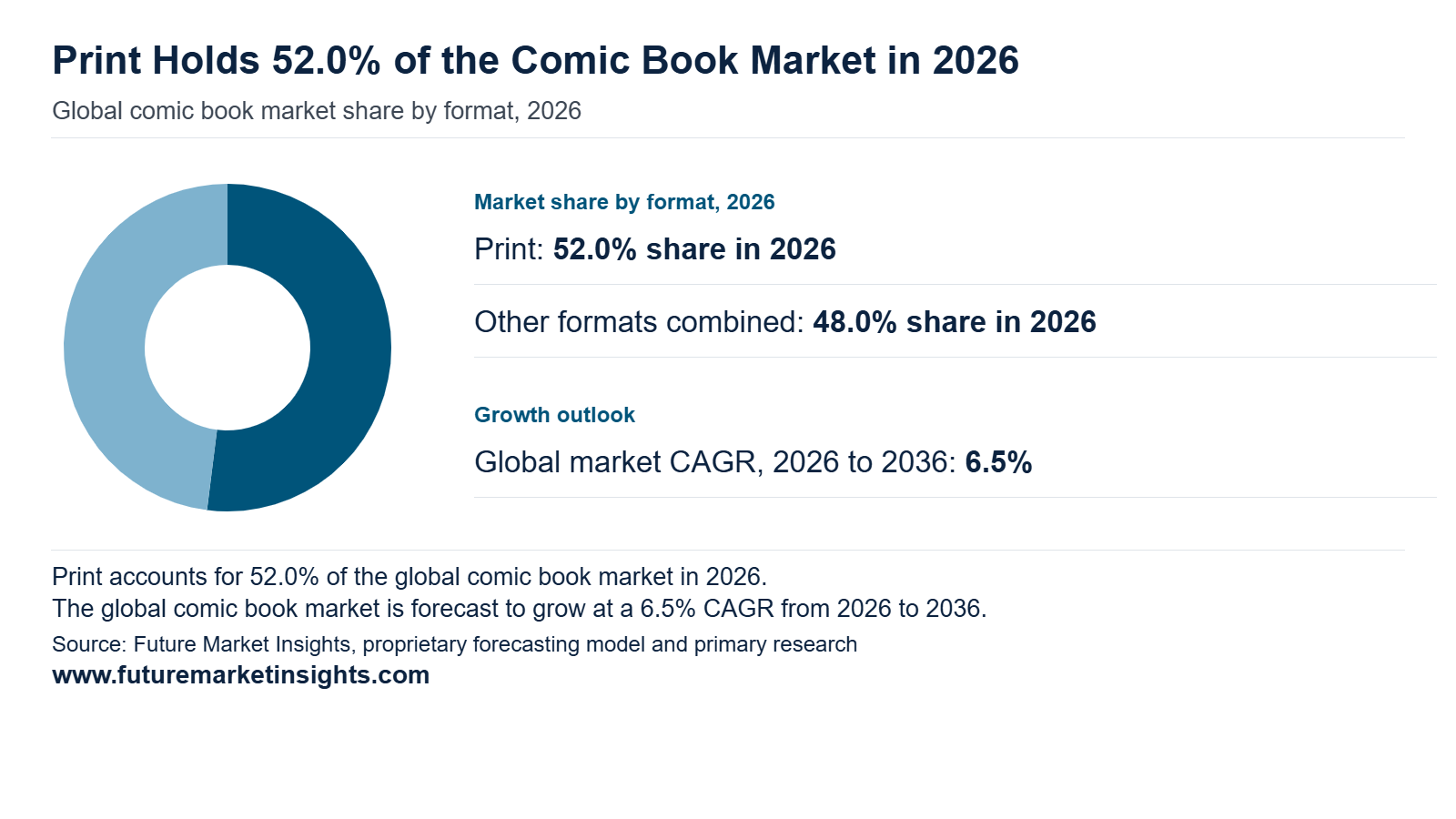
Print makes up about 52% of comic book revenue in 2026, worth USD 6.9 billion. Collectors, bookshop buyers and many manga readers still prefer printed volumes. Print sales, however, are growing at only about 3.0% a year. As a result, the print share is set to fall to about 37% by 2036. Digital comics, at about 48%, are growing at close to 9.4% a year and will overtake print within a few years. Mobile chapter sales and advertising-supported reading in East Asia and North America lead digital growth.
Why Does the Manga Segment Lead by Story Origin?
Sales of Japanese manga lead by story origin, supported by a very large catalogue of long-running series and strong anime links. Manga therefore holds about 46% of revenue in 2026, worth USD 6.1 billion, growing at about 7.0% a year. Webtoons, however, are growing fastest at close to 9.5%, from about 14% of revenue. Western comics, including superhero and independent titles, hold about 28% and are growing at around 4.2%. European comics, meanwhile, hold about 12% and are growing at around 5.4% a year.
Why Does the Adult Segment Lead by Reader Age Group?
Adult readers account for about 48% of comic book revenue in 2026, worth USD 6.3 billion. Adults have more money to spend on collections and long series. This group is growing at about 6.0% a year. Young adult readers, at about 32%, are growing at around 6.8%, supported by webtoons and romance and fantasy series. Children's comics, however, are growing fastest at close to 7.2% a year, from about 20% of revenue. Graphic novels used in schools and libraries support this growth.
Comic Book Market by Region and Country (2026 to 2036)
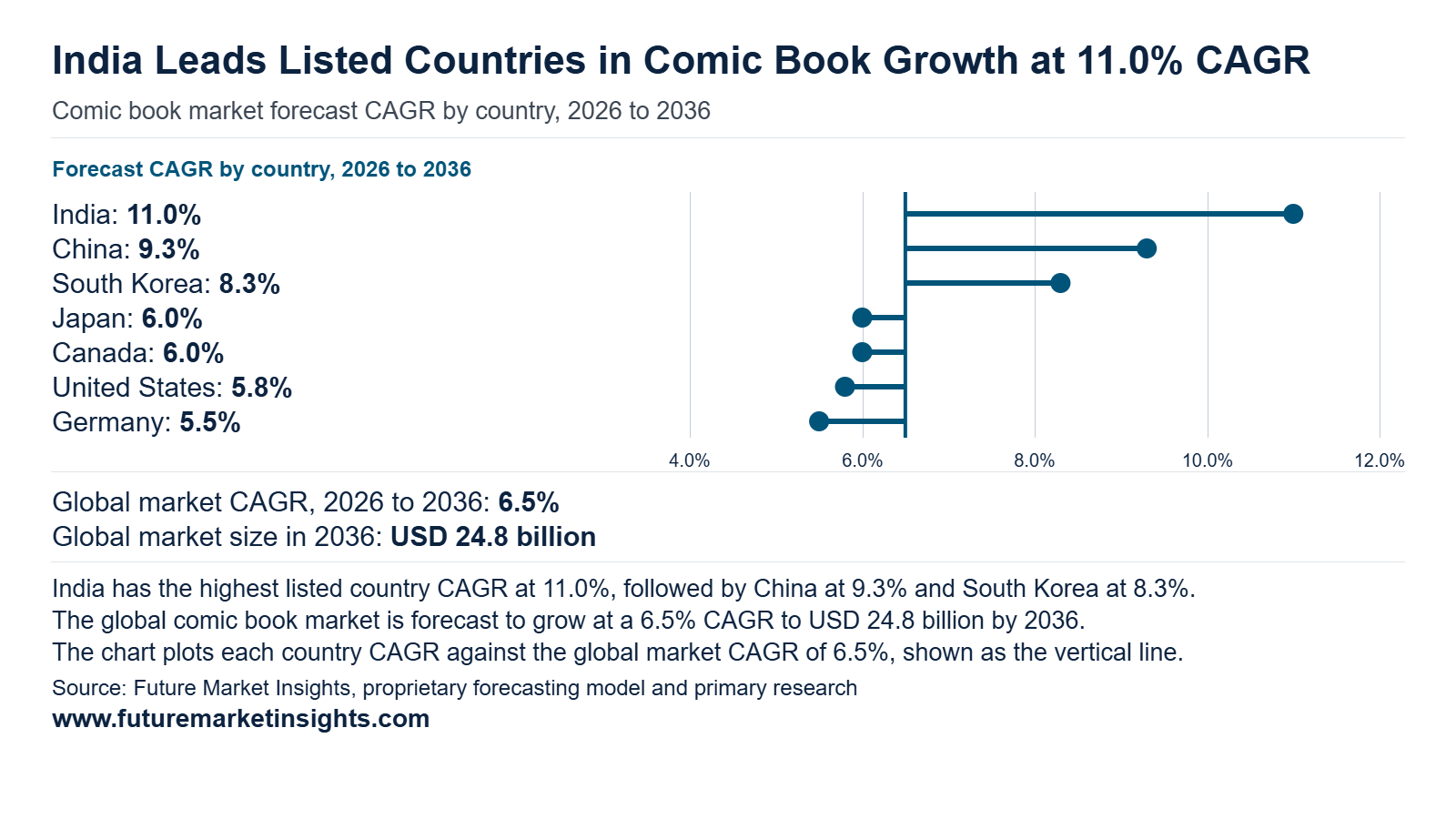
Sales of comic books are highest in East Asia, which holds more than half of global revenue. East Asia is likely to remain the highest market, accounting for about 51.5% of revenue in 2026. Growth there is about 7.0% a year, led by Japan, China and South Korea. North America holds about 22.5% and is growing at close to 5.8%. Europe, at roughly 20%, is the slowest region at around 5.0%. South Asia and Pacific is growing at about 8.5% a year, led by India. The Middle East and Africa, however, is growing fastest at about 13.6%, from a very small base. The ten profiled countries make up around 88% of global revenue.
| Country | 2026 Revenue | 2036 Revenue | 10-Year Addition | 2026 to 2036 CAGR | Global Share (2026 → 2036) |
|---|---|---|---|---|---|
| Japan | USD 4.75 billion | USD 8.51 billion | +USD 3.76 billion | 6.0% | 36.0% → 34.3% |
| United States | USD 2.64 billion | USD 4.64 billion | +USD 2.00 billion | 5.8% | 20.0% → 18.7% |
| China | USD 1.06 billion | USD 2.57 billion | +USD 1.51 billion | 9.3% | 8.0% → 10.4% |
| France | USD 0.92 billion | USD 1.44 billion | +USD 0.51 billion | 4.5% | 7.0% → 5.8% |
| South Korea | USD 0.79 billion | USD 1.76 billion | +USD 0.97 billion | 8.3% | 6.0% → 7.1% |
| Germany | USD 0.40 billion | USD 0.68 billion | +USD 0.28 billion | 5.5% | 3.0% → 2.7% |
| United Kingdom | USD 0.33 billion | USD 0.56 billion | +USD 0.23 billion | 5.4% | 2.5% → 2.3% |
| Italy | USD 0.33 billion | USD 0.51 billion | +USD 0.18 billion | 4.5% | 2.5% → 2.1% |
| Canada | USD 0.26 billion | USD 0.47 billion | +USD 0.21 billion | 6.0% | 2.0% → 1.9% |
| India | USD 0.20 billion | USD 0.56 billion | +USD 0.36 billion | 11.0% | 1.5% → 2.3% |
Source: Future Market Insights analysis of the comic book market, 2026.
Japan
The home of manga is projected to remain the largest comic book market through 2036. In 2026, the market in Japan is valued at USD 4.8 billion. Through 2036, it is likely to grow to USD 8.5 billion at a CAGR of 6.0%. Key trends to look for include the shift of manga sales to apps. Digital manga makes up most sales, read through publisher and platform apps. Printed volume sales, however, have fallen as readers move to phones. Shueisha, Kodansha, Shogakukan and Kadokawa publish most leading series through weekly and monthly magazines. Competition among apps is also strong. For example, WEBTOON Entertainment reported a 12% fall in Japanese monthly users in the third quarter of 2026. Collected editions of hit series, meanwhile, still sell millions of copies.
United States
Purchases by superhero, independent and manga readers support comic book sales in the United States, the second largest market. For example, ICv2 reported that comic shop sales rose 22% in January to August 2026. Manga sales in bookshops rose close to 40%. DC, Marvel, Image Comics, Viz Media and Scholastic's Graphix line are leading publishers. Libraries and schools, in turn, are large buyers of graphic novels. Children's graphic novel series sell millions of copies. Webtoon titles are also appearing on bookshop best-seller lists, which shows growing crossover between digital and print readers. Valued at USD 2.6 billion in 2026, the market in the US is set to reach USD 4.6 billion by 2036. Growth is at a CAGR of 5.8%.
China
Mobile reading by a very large audience supports comic book sales in China. Platforms such as Tencent Animation and Comics, Kuaikan Manhua and Bilibili Comics offer local manhua and licensed Japanese and Korean titles. Paid chapters, memberships and advertising fund most reading on phones. Popular fantasy and martial arts series are often adapted into animated series and live-action dramas. As a result, many new readers join each year, mostly through free chapters supported by advertising. Content rules, however, limit some story types, and titles need approval before release. Local manhua therefore makes up most new releases. In 2026, the market in China is valued at USD 1.1 billion. By 2036, it is projected to reach USD 2.6 billion at a CAGR of 9.3%.
France
Demand for both bande dessinée albums and manga keeps France one of the strongest comic markets in Europe. France is also the second largest manga market outside Japan. Publishers such as Média-Participations, Glénat, Delcourt and Pika publish both local and Japanese titles. The Angoulême International Comics Festival each January, in turn, is a major event for publishers and readers. A culture pass for young people has also supported manga sales. Young readers in Paris and other large cities are the main buyers of new series. Bookshops and large retailers such as Fnac are the main channels. The market in France stands at USD 0.92 billion in 2026 and is set to reach USD 1.4 billion by 2036. This represents a CAGR of 4.5%.
South Korea
Adaptations of webtoons into Korean dramas and films bring many new readers to platforms in South Korea each year. South Korea is the home of the webtoon format. Naver WEBTOON and Kakao Page are the two leading platforms. Creators earn money from paid chapters, advertising and adaptation rights. Platforms, meanwhile, run training programmes for new artists to keep new series coming. Korean platforms also export series to Japan, the United States and Southeast Asia. As a result, overseas readers are a growing source of revenue for Korean creators. Worth USD 0.79 billion in 2026, the market in South Korea is set to reach USD 1.8 billion by 2036. Growth is at a CAGR of 8.3%, the third fastest among the profiled countries.
Germany
Interest in manga among young readers is driving comic sales in Germany. Manga makes up a large share of comic sales in German bookshops. Carlsen, Egmont, Altraverse and Tokyopop are leading publishers. Events such as Comic-Con Germany and the Leipzig Book Fair, in turn, draw large numbers of manga and anime fans. Franco-Belgian albums and local graphic novels have a loyal adult audience. Libraries are adding more comics for young readers as well. Bookshops such as Thalia and online sellers are the main channels, and anime streaming is bringing new readers to manga. In 2026, the market in Germany is valued at USD 0.40 billion. Through 2036, it is likely to grow to USD 0.68 billion at a CAGR of 5.5%.
United Kingdom
Sales of manga and graphic novels are among the fastest-growing book categories in many UK shops. A long history of children's comics also supports demand. Large chains such as Waterstones and specialist shops such as Forbidden Planet sell a wide range of titles. Events such as MCM Comic Con in London, meanwhile, draw large crowds of manga and anime fans. British science fiction comics keep a loyal adult audience. Online sales are growing among younger readers. Libraries and schools, as a result, are adding more graphic novels for children and teenagers. The market in the UK is valued at USD 0.33 billion in 2026. By 2036, it is projected to reach USD 0.56 billion, growing at a CAGR of 5.4%.
Italy
Newsstands remain an important channel for monthly comics in Italy, though many have closed. Italy has a long tradition of comics, known as fumetti. Sergio Bonelli Editore publishes long-running Italian series, while Panini Comics publishes Marvel, DC-licensed and manga titles in Italian. The Lucca Comics and Games festival is one of the largest comic events in the world. Manga sales in bookshops, in turn, are rising among young readers. Italian artists also draw for French and US publishers. Online sales, meanwhile, are growing as newsstands close in smaller towns, suburbs and rural areas. Valued at USD 0.33 billion in 2026, the market in Italy is expected to reach USD 0.51 billion by 2036. Growth is at a CAGR of 4.5%.
Canada
Library lending and a bilingual reading market support comic sales in Canada. Canadian readers buy English-language comics from the United States and French-language bande dessinée, especially in Quebec. Publishers such as Drawn & Quarterly in Montreal are known for literary graphic novels. For example, ICv2 reported strong sales growth in US and Canadian comic shops in the first eight months of 2026. Manga sales, meanwhile, are growing quickly in bookshops such as Indigo. Public libraries lend large numbers of graphic novels, which brings new readers to bookshops. French-language readers in Quebec also buy European albums. In 2026, the market in Canada stands at USD 0.26 billion. Through 2036, it is likely to grow to USD 0.47 billion at a CAGR of 6.0%.
India
Mobile reading growth is making India the fastest-growing comic book market among the profiled countries. Amar Chitra Katha, Tinkle and Raj Comics have long histories with Indian readers. Local digital platforms, in turn, publish Indian webtoon-style series. Interest in manga and anime among young readers has grown quickly through streaming services. Comic Con India events in Delhi, Mumbai and Bengaluru draw large crowds. Low prices and free advertising-supported chapters help reach readers in smaller cities. Regional-language editions are also widening the audience beyond English-language readers in large cities and smaller towns alike. In 2026, the market in India is valued at USD 0.20 billion. By 2036, it is projected to reach USD 0.56 billion, growing at a CAGR of 11.0%.
Competitive Environment and Notable Companies
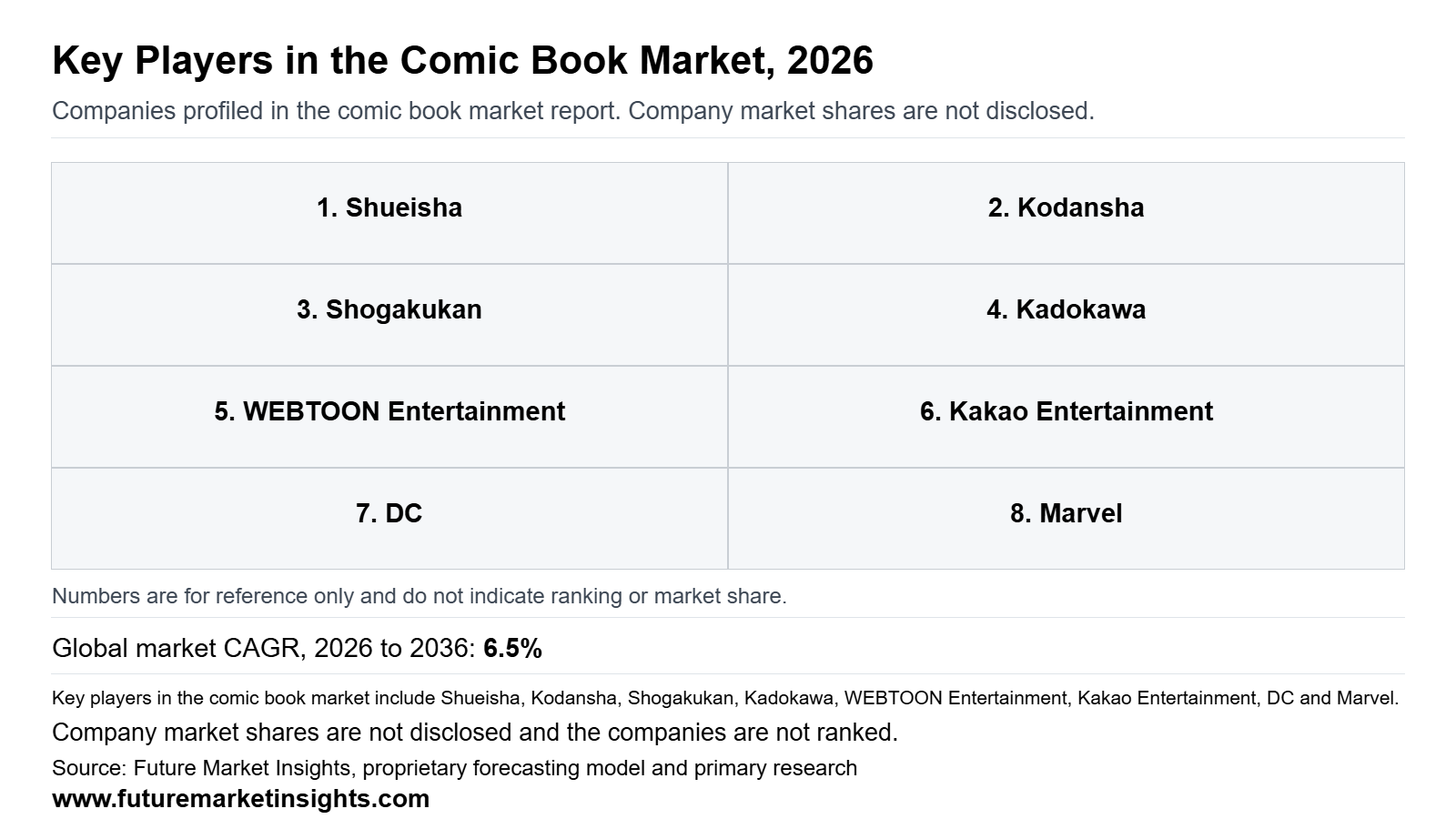
The comic book market is split between Japanese publishers, Korean platforms and US publishers. Notable companies include Shueisha, Kodansha, Shogakukan, Kadokawa and WEBTOON Entertainment. Kakao Entertainment, Tencent, DC, Marvel, Image Comics, Viz Media and Média-Participations are also active. Japanese publishers lead in manga, Korean platforms in webtoons and US publishers in superhero comics. Since screen adaptations drive book sales, partnerships with streaming and game companies are growing. As a result, competition is shifting toward popular series, creators, digital platforms and adaptation rights.
How Are Companies Positioned in the Comic Book Market?
Digital and adaptation businesses are expanding at platforms and publishers. For example, WEBTOON Entertainment reported lower third-quarter revenue in US dollars in November 2026 but stronger advertising sales. US comic shops, in turn, reported 22% sales growth for January to August 2026, according to ICv2. Publishers are releasing digital chapters alongside print. Screen adaptation deals, meanwhile, are bringing new readers to original series.
How Do Readers Choose Comics?
Readers compare comics first on story and artwork. The creator comes next, since many readers follow favourite artists. Price and format then shape the purchase. Links to anime, films or games also draw new readers. Many readers follow a series for years once started.
Which Capabilities Distinguish Publisher Offers?
Large libraries of popular series are the main point of difference between publishers. Strong mobile apps, in turn, help platforms reach new readers. Fast translation into many languages cuts piracy. Screen adaptation deals also raise sales of original books.
How Does Geographic Reach Affect Competition?
Local publishers lead in home markets, such as manga in Japan and webtoons in South Korea. Digital platforms and translated editions, however, let popular series reach readers worldwide within days. As a result, global audiences for Asian series are growing quickly. Content approval rules in some countries limit foreign titles.
| Verified Company Evidence (2026) | Commercial Effect | Buyer Action |
|---|---|---|
| 16 October 2026: ICv2 reported that US and Canadian comic shop dollar sales rose 22% in January-August 2026, graphic novel sales in comic shops rose 28%, and manga sales in the book channel rose almost 40% (ICv2, October 2026). | Shows strong recovery in printed comic and manga sales in North America. | Increase print orders for manga and popular graphic novel series. |
| 10 August 2026: WEBTOON Entertainment reported Q2 2026 revenue of USD 338.5 million, down 2.8%, mainly due to a weaker won and yen (Anime News Network, August 2026). | Currency swings affect reported revenue of digital comic platforms. | Compare digital platform results at constant exchange rates. |
| November 2026: WEBTOON Entertainment reported Q3 2026 revenue of USD 363 million, down 4% but up 0.2% at constant currency, with advertising up 26% and Japanese monthly users down 12% (Panabee, November 2026). | Advertising is becoming a larger source of digital comic revenue, while Japan is saturated. | Add advertising-supported reading options to digital comic plans. |
Source: Verified corporate disclosures and Future Market Insights analysis, 2026.
| Company | Core Positioning | Verified Activity & Source Attribution |
|---|---|---|
| WEBTOON Entertainment | Global webtoon and digital comics platform | Q3 2026 revenue USD 363 million, advertising up 26% (Panabee, November 2026). |
| Shueisha | Leading Japanese manga publisher | Company information. |
| Kodansha | Japanese manga publisher | Company information. |
| DC | US superhero comic publisher | Company information. |
Source: Verified corporate disclosures and Future Market Insights analysis, 2026.
Comic Book Market Report Scope and Research Methodology
Comic sales by country form the base of FMI's estimate. These sales are taken from publisher reports, bookshop and comic shop data and digital platform results. Sales are split by format, story origin and age group. Country totals are then added to give regional and global values. Forecasts are built on population, mobile use, adaptation releases and prices. Comic shop sales data from ICv2 for 2026 are used to check recent print demand. As a final step, FMI checks the results against the reported revenue of listed publishers and platforms. Any country where figures do not match is adjusted.
| Coverage Field | Report Scope |
|---|---|
| Market definition | Comic books, graphic novels, manga, webtoons and other illustrated stories sold in print or digital form. |
| Formats | Print and digital. |
| Story origins | Manga, Western comics, webtoons and European comics. |
| Reader age groups | Adult, young adult and children. |
| Sales channels | Bookshops, comic shops, newsstands, online retailers and digital platforms. |
| Customer types | Individual readers, collectors, libraries and schools. |
| Revenue basis | Consumer sales of comics plus digital chapter, subscription and advertising revenue. |
| Exclusions | Film, television and game revenue from adaptations, merchandise and collectible resale. |
| Quantitative units | USD billion for value. |
| Volume basis | Units and chapters sold, used to check value estimates. |
| Value basis | Revenue recognised in the country of the reader. |
| Regions covered | East Asia, North America, Europe, South Asia & Pacific, Latin America, and Middle East & Africa. |
| National coverage | Japan, United States, China, France, South Korea, Germany, United Kingdom, Italy, Canada, India. |
| Companies covered | Shueisha, Kodansha, Shogakukan, Kadokawa, WEBTOON Entertainment, Kakao Entertainment, Tencent, DC, Marvel, Image Comics, Viz Media and Média-Participations. |
Source: Future Market Insights analysis of the comic book market, 2026.
Research Sources and Bibliography
- ICv2. (2026, October 16). ICv2 white paper: Building growth.
- ICv2. (2026). Manga sales up in 2025, comic store growth leads.
- Panabee. (2026, November). Webtoon Q3 revenue slips 4% to $363 million amid Japan headwinds, but advertising surges 26%.
- Anime News Network. (2026, August 31). WEBTOON Ent. reports US$15.6 million operating loss in 2nd quarter of 2026.
- WEBTOON Entertainment Inc. (2026, May 11). WEBTOON Entertainment Inc. reports first quarter 2026 financial results.
Table of Content
- Key Takeaways
- Market Size and CAGR
- Top Growth Driver
- Fastest Growing Segment
- Leading Region
- Key Companies
- Emerging Opportunities
- Executive Summary
- Global Market Outlook
- Demand-side Trends
- Supply-side Trends
- Technology Roadmap Analysis
- Analysis and Recommendations
- Analyst Perspective (What is happening? Why now? What should investors know?)
- Key Questions Answered
- How large is the market?
- What is the CAGR?
- What are key trends?
- Which region dominates?
- Who are the leaders?
Read More...
- Market Overview
- Market Coverage / Taxonomy
- Market Definition / Scope / Limitations
- Research Methodology
- Chapter Orientation
- Analytical Lens and Working Hypotheses
- Market Structure, Signals, and Trend Drivers
- Benchmarking and Cross-market Comparability
- Market Sizing, Forecasting, and Opportunity Mapping
- Research Design and Evidence Framework
- Desk Research Programme (Secondary Evidence)
- Expert Input and Fieldwork (Primary Evidence)
- Tooling, Models, and Reference Databases
- Data Engineering and Model Build
- Quality Assurance and Audit Trail
- Market Background
- Market Dynamics (Drivers, Restraints, Opportunity, Trends)
- Scenario Forecast (Optimistic, Likely, Conservative)
- Impact Analysis
- AI Impact
- Sustainability Impact
- Regulatory Impact
- Technology Impact
- Consumer / Buyer Analysis
- Purchase Drivers
- Adoption Barriers
- Buyer Journey
- Opportunity Map Analysis
- Product Life Cycle Analysis
- Supply Chain Analysis
- Investment Feasibility Matrix
- Value Chain Analysis
- PESTLE and Porter's Analysis
- Regulatory Landscape
- Regional Parent Market Outlook
- Production and Consumption Statistics
- Import and Export Statistics
- Global Comic Book Market Analysis and Forecast, 2021 to 2036
- Historical Market Size Value (USD Billion) Analysis, 2021 to 2025
- Current and Future Market Size Value (USD Billion) Projections, 2026 to 2036
- Y-o-Y Growth Trend Analysis
- Absolute $ Opportunity Analysis
- Global Comic Book Market Pricing Analysis, 2021 to 2036
- Global Comic Book Market Analysis and Forecast, By Format, 2021 to 2036
- Introduction / Key Findings
- Historical Market Size Value (USD Billion) Analysis By Format, 2021 to 2025
- Current and Future Market Size Value (USD Billion) Analysis and Forecast By Format, 2026 to 2036
- Digital
- Y-o-Y Growth Trend Analysis By Format, 2021 to 2025
- Absolute $ Opportunity Analysis By Format, 2026 to 2036
- Global Comic Book Market Analysis and Forecast, By Story Origin, 2021 to 2036
- Introduction / Key Findings
- Historical Market Size Value (USD Billion) Analysis By Story Origin, 2021 to 2025
- Current and Future Market Size Value (USD Billion) Analysis and Forecast By Story Origin, 2026 to 2036
- Manga
- Western Comics
- Webtoon
- European Comics
- Y-o-Y Growth Trend Analysis By Story Origin, 2021 to 2025
- Absolute $ Opportunity Analysis By Story Origin, 2026 to 2036
- Global Comic Book Market Analysis and Forecast, By Reader Age Group, 2021 to 2036
- Introduction / Key Findings
- Historical Market Size Value (USD Billion) Analysis By Reader Age Group, 2021 to 2025
- Current and Future Market Size Value (USD Billion) Analysis and Forecast By Reader Age Group, 2026 to 2036
- Adult
- Young Adult
- Children
- Y-o-Y Growth Trend Analysis By Reader Age Group, 2021 to 2025
- Absolute $ Opportunity Analysis By Reader Age Group, 2026 to 2036
- Global Comic Book Market Analysis and Forecast, By Region, 2021 to 2036
- Introduction
- Historical Market Size Value (USD Billion) Analysis By Region, 2021 to 2025
- Current Market Size Value (USD Billion) Analysis and Forecast By Region, 2026 to 2036
- East Asia
- North America
- Europe
- South Asia & Pacific
- Latin America
- Middle East & Africa
- Market Attractiveness Analysis By Region
- East Asia Comic Book Market Analysis and Forecast, By Country, 2021 to 2036
- Historical Market Size Value (USD Billion) Trend Analysis By Market Taxonomy, 2021 to 2025
- Market Size Value (USD Billion) Forecast By Market Taxonomy, 2026 to 2036
- By Country
- Japan
- China
- South Korea
- Rest of East Asia
- By Format
- By Story Origin
- By Reader Age Group
- By Country
- Market Attractiveness Analysis
- By Country
- By Format
- By Story Origin
- By Reader Age Group
- Key Takeaways
- North America Comic Book Market Analysis and Forecast, By Country, 2021 to 2036
- Historical Market Size Value (USD Billion) Trend Analysis By Market Taxonomy, 2021 to 2025
- Market Size Value (USD Billion) Forecast By Market Taxonomy, 2026 to 2036
- By Country
- United States
- Canada
- Rest of North America
- By Format
- By Story Origin
- By Reader Age Group
- By Country
- Market Attractiveness Analysis
- By Country
- By Format
- By Story Origin
- By Reader Age Group
- Key Takeaways
- Europe Comic Book Market Analysis and Forecast, By Country, 2021 to 2036
- Historical Market Size Value (USD Billion) Trend Analysis By Market Taxonomy, 2021 to 2025
- Market Size Value (USD Billion) Forecast By Market Taxonomy, 2026 to 2036
- By Country
- France
- Germany
- United Kingdom
- Italy
- Rest of Europe
- By Format
- By Story Origin
- By Reader Age Group
- By Country
- Market Attractiveness Analysis
- By Country
- By Format
- By Story Origin
- By Reader Age Group
- Key Takeaways
- South Asia & Pacific Comic Book Market Analysis and Forecast, By Country, 2021 to 2036
- Historical Market Size Value (USD Billion) Trend Analysis By Market Taxonomy, 2021 to 2025
- Market Size Value (USD Billion) Forecast By Market Taxonomy, 2026 to 2036
- By Country
- India
- Rest of South Asia & Pacific
- By Format
- By Story Origin
- By Reader Age Group
- By Country
- Market Attractiveness Analysis
- By Country
- By Format
- By Story Origin
- By Reader Age Group
- Key Takeaways
- Latin America Comic Book Market Analysis and Forecast, By Country, 2021 to 2036
- Historical Market Size Value (USD Billion) Trend Analysis By Market Taxonomy, 2021 to 2025
- Market Size Value (USD Billion) Forecast By Market Taxonomy, 2026 to 2036
- By Country
- Rest of Latin America
- By Format
- By Story Origin
- By Reader Age Group
- By Country
- Market Attractiveness Analysis
- By Country
- By Format
- By Story Origin
- By Reader Age Group
- Key Takeaways
- Middle East & Africa Comic Book Market Analysis and Forecast, By Country, 2021 to 2036
- Historical Market Size Value (USD Billion) Trend Analysis By Market Taxonomy, 2021 to 2025
- Market Size Value (USD Billion) Forecast By Market Taxonomy, 2026 to 2036
- By Country
- Rest of Middle East & Africa
- By Format
- By Story Origin
- By Reader Age Group
- By Country
- Market Attractiveness Analysis
- By Country
- By Format
- By Story Origin
- By Reader Age Group
- Key Takeaways
- Key Countries Market Analysis
- Japan
- Pricing Analysis
- Market Share Analysis, 2025
- By Format
- By Story Origin
- By Reader Age Group
- United States
- Pricing Analysis
- Market Share Analysis, 2025
- By Format
- By Story Origin
- By Reader Age Group
- China
- Pricing Analysis
- Market Share Analysis, 2025
- By Format
- By Story Origin
- By Reader Age Group
- France
- Pricing Analysis
- Market Share Analysis, 2025
- By Format
- By Story Origin
- By Reader Age Group
- South Korea
- Pricing Analysis
- Market Share Analysis, 2025
- By Format
- By Story Origin
- By Reader Age Group
- Germany
- Pricing Analysis
- Market Share Analysis, 2025
- By Format
- By Story Origin
- By Reader Age Group
- United Kingdom
- Pricing Analysis
- Market Share Analysis, 2025
- By Format
- By Story Origin
- By Reader Age Group
- Italy
- Pricing Analysis
- Market Share Analysis, 2025
- By Format
- By Story Origin
- By Reader Age Group
- Canada
- Pricing Analysis
- Market Share Analysis, 2025
- By Format
- By Story Origin
- By Reader Age Group
- India
- Pricing Analysis
- Market Share Analysis, 2025
- By Format
- By Story Origin
- By Reader Age Group
- Japan
- Market Structure Analysis
- Competition Dashboard
- Competition Benchmarking
- Market Share Analysis of Top Players
- By Regional
- By Format
- By Story Origin
- By Reader Age Group
- Emerging Startups
- Innovation Benchmarking
- Competition Analysis
- Competition Deep Dive
- Shueisha
- Overview
- Product Portfolio
- Profitability by Market Segments
- Sales Footprint
- Strategy Overview
- Marketing Strategy
- Product Strategy
- Channel Strategy
- Kodansha
- Shogakukan
- Kadokawa
- WEBTOON Entertainment
- Kakao Entertainment
- Tencent
- DC
- Marvel
- Image Comics
- Viz Media
- Média-Participations
- Shueisha
- Case Studies
- Success Stories
- Recent Developments
- Competition Deep Dive
- Assumptions & Acronyms Used
List of Tables
- Table 1: Global Comic Book Market Value (USD Billion) Forecast by Region, 2021 to 2036
- Table 2: Global Comic Book Market Value (USD Billion) Forecast by Format, 2021 to 2036
- Table 3: Global Comic Book Market Value (USD Billion) Forecast by Story Origin, 2021 to 2036
- Table 4: Global Comic Book Market Value (USD Billion) Forecast by Reader Age Group, 2021 to 2036
- Table 5: East Asia Comic Book Market Value (USD Billion) Forecast by Country, 2021 to 2036
- Table 6: East Asia Comic Book Market Value (USD Billion) Forecast by Format, 2021 to 2036
- Table 7: East Asia Comic Book Market Value (USD Billion) Forecast by Story Origin, 2021 to 2036
- Table 8: East Asia Comic Book Market Value (USD Billion) Forecast by Reader Age Group, 2021 to 2036
- Table 9: North America Comic Book Market Value (USD Billion) Forecast by Country, 2021 to 2036
- Table 10: North America Comic Book Market Value (USD Billion) Forecast by Format, 2021 to 2036
- Table 11: North America Comic Book Market Value (USD Billion) Forecast by Story Origin, 2021 to 2036
- Table 12: North America Comic Book Market Value (USD Billion) Forecast by Reader Age Group, 2021 to 2036
- Table 13: Europe Comic Book Market Value (USD Billion) Forecast by Country, 2021 to 2036
- Table 14: Europe Comic Book Market Value (USD Billion) Forecast by Format, 2021 to 2036
- Table 15: Europe Comic Book Market Value (USD Billion) Forecast by Story Origin, 2021 to 2036
- Table 16: Europe Comic Book Market Value (USD Billion) Forecast by Reader Age Group, 2021 to 2036
- Table 17: South Asia & Pacific Comic Book Market Value (USD Billion) Forecast by Country, 2021 to 2036
- Table 18: South Asia & Pacific Comic Book Market Value (USD Billion) Forecast by Format, 2021 to 2036
- Table 19: South Asia & Pacific Comic Book Market Value (USD Billion) Forecast by Story Origin, 2021 to 2036
- Table 20: South Asia & Pacific Comic Book Market Value (USD Billion) Forecast by Reader Age Group, 2021 to 2036
- Table 21: Latin America Comic Book Market Value (USD Billion) Forecast by Country, 2021 to 2036
- Table 22: Latin America Comic Book Market Value (USD Billion) Forecast by Format, 2021 to 2036
- Table 23: Latin America Comic Book Market Value (USD Billion) Forecast by Story Origin, 2021 to 2036
- Table 24: Latin America Comic Book Market Value (USD Billion) Forecast by Reader Age Group, 2021 to 2036
- Table 25: Middle East & Africa Comic Book Market Value (USD Billion) Forecast by Country, 2021 to 2036
- Table 26: Middle East & Africa Comic Book Market Value (USD Billion) Forecast by Format, 2021 to 2036
- Table 27: Middle East & Africa Comic Book Market Value (USD Billion) Forecast by Story Origin, 2021 to 2036
- Table 28: Middle East & Africa Comic Book Market Value (USD Billion) Forecast by Reader Age Group, 2021 to 2036
List of Figures
- Figure 1: Global Comic Book Market Pricing Analysis
- Figure 2: Global Comic Book Market Value (USD Billion) Forecast 2021-2036
- Figure 3: Global Comic Book Market Value Share and BPS Analysis by Format, 2026 and 2036
- Figure 4: Global Comic Book Market Y-o-Y Growth Comparison by Format, 2026-2036
- Figure 5: Global Comic Book Market Attractiveness Analysis by Format
- Figure 6: Global Comic Book Market Value Share and BPS Analysis by Story Origin, 2026 and 2036
- Figure 7: Global Comic Book Market Y-o-Y Growth Comparison by Story Origin, 2026-2036
- Figure 8: Global Comic Book Market Attractiveness Analysis by Story Origin
- Figure 9: Global Comic Book Market Value Share and BPS Analysis by Reader Age Group, 2026 and 2036
- Figure 10: Global Comic Book Market Y-o-Y Growth Comparison by Reader Age Group, 2026-2036
- Figure 11: Global Comic Book Market Attractiveness Analysis by Reader Age Group
- Figure 12: Global Comic Book Market Value (USD Billion) Share and BPS Analysis by Region, 2026 and 2036
- Figure 13: Global Comic Book Market Y-o-Y Growth Comparison by Region, 2026-2036
- Figure 14: Global Comic Book Market Attractiveness Analysis by Region
- Figure 15: East Asia Comic Book Market Incremental Dollar Opportunity, 2026-2036
- Figure 16: North America Comic Book Market Incremental Dollar Opportunity, 2026-2036
- Figure 17: Europe Comic Book Market Incremental Dollar Opportunity, 2026-2036
- Figure 18: South Asia & Pacific Comic Book Market Incremental Dollar Opportunity, 2026-2036
- Figure 19: Latin America Comic Book Market Incremental Dollar Opportunity, 2026-2036
- Figure 20: Middle East & Africa Comic Book Market Incremental Dollar Opportunity, 2026-2036
- Figure 21: East Asia Comic Book Market Value Share and BPS Analysis by Country, 2026 and 2036
- Figure 22: East Asia Comic Book Market Value Share and BPS Analysis by Format, 2026 and 2036
- Figure 23: East Asia Comic Book Market Y-o-Y Growth Comparison by Format, 2026-2036
- Figure 24: East Asia Comic Book Market Attractiveness Analysis by Format
- Figure 25: East Asia Comic Book Market Value Share and BPS Analysis by Story Origin, 2026 and 2036
- Figure 26: East Asia Comic Book Market Y-o-Y Growth Comparison by Story Origin, 2026-2036
- Figure 27: East Asia Comic Book Market Attractiveness Analysis by Story Origin
- Figure 28: East Asia Comic Book Market Value Share and BPS Analysis by Reader Age Group, 2026 and 2036
- Figure 29: East Asia Comic Book Market Y-o-Y Growth Comparison by Reader Age Group, 2026-2036
- Figure 30: East Asia Comic Book Market Attractiveness Analysis by Reader Age Group
- Figure 31: North America Comic Book Market Value Share and BPS Analysis by Country, 2026 and 2036
- Figure 32: North America Comic Book Market Value Share and BPS Analysis by Format, 2026 and 2036
- Figure 33: North America Comic Book Market Y-o-Y Growth Comparison by Format, 2026-2036
- Figure 34: North America Comic Book Market Attractiveness Analysis by Format
- Figure 35: North America Comic Book Market Value Share and BPS Analysis by Story Origin, 2026 and 2036
- Figure 36: North America Comic Book Market Y-o-Y Growth Comparison by Story Origin, 2026-2036
- Figure 37: North America Comic Book Market Attractiveness Analysis by Story Origin
- Figure 38: North America Comic Book Market Value Share and BPS Analysis by Reader Age Group, 2026 and 2036
- Figure 39: North America Comic Book Market Y-o-Y Growth Comparison by Reader Age Group, 2026-2036
- Figure 40: North America Comic Book Market Attractiveness Analysis by Reader Age Group
- Figure 41: Europe Comic Book Market Value Share and BPS Analysis by Country, 2026 and 2036
- Figure 42: Europe Comic Book Market Value Share and BPS Analysis by Format, 2026 and 2036
- Figure 43: Europe Comic Book Market Y-o-Y Growth Comparison by Format, 2026-2036
- Figure 44: Europe Comic Book Market Attractiveness Analysis by Format
- Figure 45: Europe Comic Book Market Value Share and BPS Analysis by Story Origin, 2026 and 2036
- Figure 46: Europe Comic Book Market Y-o-Y Growth Comparison by Story Origin, 2026-2036
- Figure 47: Europe Comic Book Market Attractiveness Analysis by Story Origin
- Figure 48: Europe Comic Book Market Value Share and BPS Analysis by Reader Age Group, 2026 and 2036
- Figure 49: Europe Comic Book Market Y-o-Y Growth Comparison by Reader Age Group, 2026-2036
- Figure 50: Europe Comic Book Market Attractiveness Analysis by Reader Age Group
- Figure 51: South Asia & Pacific Comic Book Market Value Share and BPS Analysis by Country, 2026 and 2036
- Figure 52: South Asia & Pacific Comic Book Market Value Share and BPS Analysis by Format, 2026 and 2036
- Figure 53: South Asia & Pacific Comic Book Market Y-o-Y Growth Comparison by Format, 2026-2036
- Figure 54: South Asia & Pacific Comic Book Market Attractiveness Analysis by Format
- Figure 55: South Asia & Pacific Comic Book Market Value Share and BPS Analysis by Story Origin, 2026 and 2036
- Figure 56: South Asia & Pacific Comic Book Market Y-o-Y Growth Comparison by Story Origin, 2026-2036
- Figure 57: South Asia & Pacific Comic Book Market Attractiveness Analysis by Story Origin
- Figure 58: South Asia & Pacific Comic Book Market Value Share and BPS Analysis by Reader Age Group, 2026 and 2036
- Figure 59: South Asia & Pacific Comic Book Market Y-o-Y Growth Comparison by Reader Age Group, 2026-2036
- Figure 60: South Asia & Pacific Comic Book Market Attractiveness Analysis by Reader Age Group
- Figure 61: Latin America Comic Book Market Value Share and BPS Analysis by Country, 2026 and 2036
- Figure 62: Latin America Comic Book Market Value Share and BPS Analysis by Format, 2026 and 2036
- Figure 63: Latin America Comic Book Market Y-o-Y Growth Comparison by Format, 2026-2036
- Figure 64: Latin America Comic Book Market Attractiveness Analysis by Format
- Figure 65: Latin America Comic Book Market Value Share and BPS Analysis by Story Origin, 2026 and 2036
- Figure 66: Latin America Comic Book Market Y-o-Y Growth Comparison by Story Origin, 2026-2036
- Figure 67: Latin America Comic Book Market Attractiveness Analysis by Story Origin
- Figure 68: Latin America Comic Book Market Value Share and BPS Analysis by Reader Age Group, 2026 and 2036
- Figure 69: Latin America Comic Book Market Y-o-Y Growth Comparison by Reader Age Group, 2026-2036
- Figure 70: Latin America Comic Book Market Attractiveness Analysis by Reader Age Group
- Figure 71: Middle East & Africa Comic Book Market Value Share and BPS Analysis by Country, 2026 and 2036
- Figure 72: Middle East & Africa Comic Book Market Value Share and BPS Analysis by Format, 2026 and 2036
- Figure 73: Middle East & Africa Comic Book Market Y-o-Y Growth Comparison by Format, 2026-2036
- Figure 74: Middle East & Africa Comic Book Market Attractiveness Analysis by Format
- Figure 75: Middle East & Africa Comic Book Market Value Share and BPS Analysis by Story Origin, 2026 and 2036
- Figure 76: Middle East & Africa Comic Book Market Y-o-Y Growth Comparison by Story Origin, 2026-2036
- Figure 77: Middle East & Africa Comic Book Market Attractiveness Analysis by Story Origin
- Figure 78: Middle East & Africa Comic Book Market Value Share and BPS Analysis by Reader Age Group, 2026 and 2036
- Figure 79: Middle East & Africa Comic Book Market Y-o-Y Growth Comparison by Reader Age Group, 2026-2036
- Figure 80: Middle East & Africa Comic Book Market Attractiveness Analysis by Reader Age Group
- Figure 81: Global Comic Book Market - Tier Structure Analysis
- Figure 82: Global Comic Book Market - Company Share Analysis
Frequently Asked Questions
How big is the comic book market in 2026?
Future Market Insights estimates the global comic book market at USD 13.2 billion in 2026, up from USD 12.4 billion in 2025. Mobile reading and screen adaptations are driving this growth.
How fast is the comic book market expected to grow through 2036?
FMI projects a 6.5% CAGR from 2026 to 2036, taking the market to USD 24.8 billion by 2036. This adds USD 11.6 billion in revenue, led by digital comics and webtoons.
Which format leads the comic book market?
Print leads with 52.0% of 2026 revenue, as collectors and bookshop buyers prefer printed volumes. Digital comics are growing fastest, at about 9.4% a year, as reading moves to phones.
Which story origin leads the comic book market?
Manga holds 46.0% of 2026 revenue, backed by a large catalogue and anime links. Webtoons are growing fastest, at about 9.5% a year, as mobile chapter reading spreads.
Which reader age group leads the comic book market?
Adult readers account for 48.0% of 2026 revenue, as adults buy collections. Children's comics are growing fastest, at about 7.2% a year from 2026 to 2036, helped by schools and libraries.
Which country is the largest comic book market?
Japan is the largest comic book market, with 36.0% of global revenue in 2026, worth USD 4.8 billion. The United States follows at 20.0% and China at 8.0%.
Which countries are expected to grow fastest in the comic book market?
India is projected to grow fastest, at an 11.0% CAGR from 2026 to 2036, as mobile reading spreads. China follows at 9.3% and South Korea at 8.3%.
What drives demand for comic books?
Screen adaptations and easy mobile reading are the main drivers. A wider audience of young adults and children and growth in comic shops are also adding sales.
Preview the report firsthand - request a free sample
Get SampleGet the brochure for pricing and purchase details.
Get PDF
