
- Market Size (2026)
- USD 6.90 Bn
- Forecast (2036)
- USD 13.45 Bn
- CAGR (2026 to 2036)
- 6.9%
How Big Is the Constrained Peptide Drugs Market in 2026?
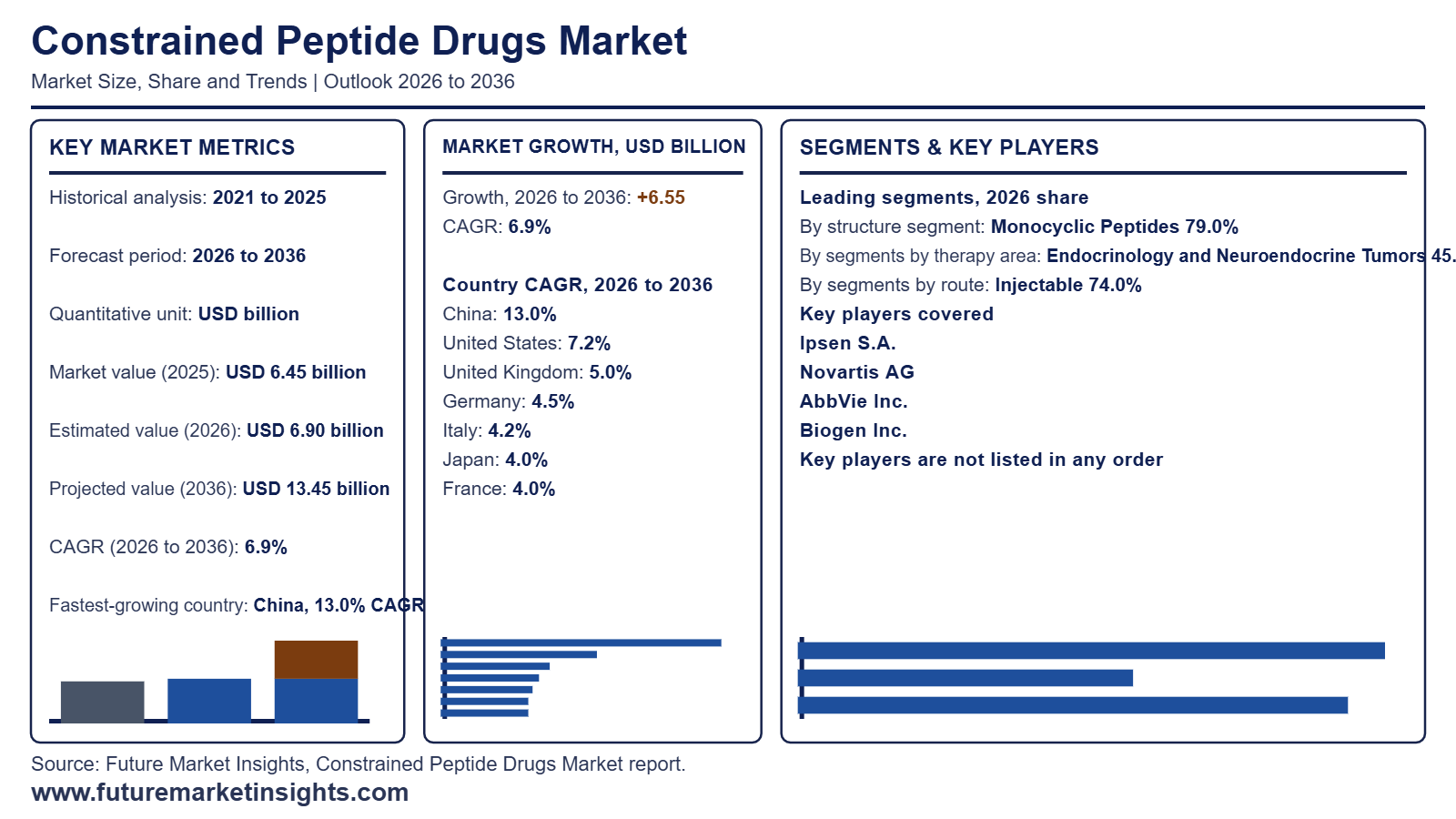
The market was valued at USD 6.45 billion in 2025. The global constrained peptide drugs market is valued at USD 6.90 billion in 2026, and is projected by Future Market Insights (FMI) to reach USD 13.45 billion by 2036, expanding at a 6.9% CAGR from 2026 to 2036 and generating USD 6.55 billion in incremental revenue over the 10-year forecast period.
| Market Metric | Valuation / Share / Forecast Benchmark |
|---|---|
| 2025 Market Size (Historical) | USD 6.45 billion |
| 2026 Market Size (Estimated) | USD 6.9 billion |
| 2036 Market Size (Projected) | USD 13.45 billion |
| Compound Annual Growth Rate (2026 to 2036) | 6.9% CAGR |
| Incremental Dollar Opportunity (2026 to 2036) | USD 6.55 billion |
| Dominant Structure Segment (2026 to 2036 Share) | Monocyclic Peptides (79.0% in 2026, easing to 72.0% by 2036) |
| Leading & Fastest-Growing Segments by Therapy Area | Endocrinology and Neuroendocrine Tumors (45.0% share in 2026, 5.1% CAGR) │ Metabolic and Rare Disease (11.7% CAGR) |
| Leading & Fastest-Growing Segments by Route | Injectable (74.0% share in 2026, 5.7% CAGR) │ Oral (9.8% CAGR) |
| Largest Country Markets (2026 Global Share) | United States (56.0%), Germany (5.6%), Japan (5.5%) |
| Fastest-Growing Country Markets (2026 to 2036) | China (13.0% CAGR), United States (7.2% CAGR), United Kingdom (5.0% CAGR) |
| Leading Tier-1 Companies | Ipsen S.A., Novartis AG, AbbVie Inc., Biogen Inc. |
Source: Future Market Insights analysis of the constrained peptide drugs market, 2026.
Executive Market Overview
Sales of constrained peptide drugs are expected to be driven by long-term somatostatin analog treatment of acromegaly and neuroendocrine tumors along with newer complement inhibitor launches as well as oral macrocycle approvals. Endocrinology and oncology clinics write the largest group of these prescriptions in FMI's assessment. Ipsen (February 2026) reported Somatuline sales of EUR 1,135.4 million for 2025, including EUR 591.1 million in North America. Newer products in the United States include tablets, and Merck (July 2026) announced FDA approval of Lipfendra, described in the release as a macrocyclic peptide.
Hospital and specialty pharmacies buy constrained peptide drugs for chronic conditions treated over many years. FMI finds that dosing interval and reimbursement status decide which product is dispensed. Brand owners are adding oral tablets and self-injected depots, and generic makers are entering older somatostatin analog lines. The Metabolic and Rare Disease segment is projected to expand at an 11.7% CAGR, the Bicyclic and Polycyclic Peptides segment at 10.6% and China at 13.0%, all faster than the 6.9% overall market CAGR. Market sizing covers prescription medicines built on designed monocyclic peptides and bicyclic or polycyclic peptides, along with stapled peptides, measured at manufacturer net sales. Natural-product antibiotics and ciclosporin are excluded, as are linear peptide hormones, along with radioligand conjugates and candidates still in clinical trials.
Analyst Perspective
"Patient numbers in acromegaly and neuroendocrine tumors rise slowly, so revenue in this drug class moves mostly with net price per patient and with the split between branded and generic injections. The clearest commercial risk is an inspection finding at a single contract plant, because one site can supply an entire generic lanreotide line."
- Anurag Sharma, Principal Consultant, Future Market Insights (FMI)
Major Market Trends and Insights
Oral macrocyclic peptides reach pharmacy shelves: Oral peptide approvals in the United States added new brand owners to this category in 2026. Johnson and Johnson (March 2026) announced approval of Icotyde, described in the release as a targeted oral peptide, for plaque psoriasis in patients aged 12 and older. Merck (July 2026) then announced approval of Lipfendra 20 mg tablets for adults with hypercholesterolemia. FMI expects tablets to enlarge the prescriber base beyond specialist injection clinics, which links this category more closely to the wider peptide therapeutics market.
Generic lanreotide supply is uneven: Business Standard (January 2026) reported that Pharmathen, the exclusive maker of the lanreotide sold by Cipla USA, paused production at a plant in Greece after an FDA inspection on 10 to 21 November 2025. Ipsen (February 2026) said Somatuline sales grew 4.3% at constant exchange rates in 2025 and linked that growth to generic lanreotide shortages in North America and Europe. In FMI's assessment, branded share in the acromegaly treatment market will move with generic plant availability as much as with list prices.
Complement peptides change owners and gain scale: Biogen (May 2026) completed the purchase of Apellis Pharmaceuticals and stated that Empaveli and Syfovre together recorded USD 689 million of net product sales in 2025. UCB (February 2026) reported Zilbrysq net sales of EUR 217 million for 2025, compared with EUR 72 million a year earlier. FMI sees larger owners committing more sales resources to these products within the complement inhibitors market.
What Are the Main Drivers, Restraints, and Opportunities?
Label expansions and oral approvals are enlarging the treated population at the same time as the oldest brands face negotiated prices and generic entry.
Driver: Label expansions add new patient groups
Rhythm Pharmaceuticals (March 2026) announced FDA approval of Imcivree for acquired hypothalamic obesity in patients aged 4 years and older and put the affected population at approximately 10,000 people in the United States. In the first quarter results, Rhythm Pharmaceuticals (May 2026) reported global Imcivree net product sales of USD 60.1 million, with 61% generated in the United States. European Commission authorization for the same indication was granted on 1 May 2026, according to Rhythm Pharmaceuticals (May 2026). FMI expects each added indication to lift sales of an existing peptide without a new launch cost base.
Restraint: Older brands face negotiated prices and generic entry
CMS (November 2025) announced negotiated Maximum Fair Prices for 15 drugs in the second cycle of the Medicare negotiation program. The CMS fact sheet (November 2025) lists Linzess among those drugs with a 75% discount to the 2024 list price for a 30-day supply. AbbVie (February 2026) reported 2025 net sales of USD 907 million for Linzess and Constella, down 4.9%, and Novartis (February 2026) reported Sandostatin sales of USD 1,213 million, down 5%. FMI regards lower net prices on these mature brands as the main drag on category growth before 2030.
Opportunity: Self-administered depots and bicyclic pipelines
Camurus (November 2025) launched Oczyesa, a once-monthly octreotide depot given with an autoinjector pen, in Germany after European Commission authorization on 30 June 2025. The same release from Camurus (November 2025) cites about 70,000 people living with acromegaly in the EU. Bicycle Therapeutics (July 2026) reported cash and cash equivalents of USD 510.1 million at 30 June 2026 and described the company's molecules as synthetic peptides formed into 2 loops. FMI sees patient-administered formats as the nearer commercial opening and bicyclic products as a later one.
How Is the Constrained Peptide Drugs Market Segmented?
The global constrained peptide drugs market is segmented by structure and therapy area, along with route and region.
| Segmentation Axis | Sub-Segments Covered | 2026 Leading Segment & Share | Main Growth Benchmark (2026 to 2036) |
|---|---|---|---|
| Structure | Monocyclic Peptides, Bicyclic and Polycyclic Peptides, Stapled Peptides | Monocyclic Peptides (79.0% share) | Bicyclic and Polycyclic Peptides leads growth at 10.6% CAGR, against 5.9% for Monocyclic Peptides |
| Therapy Area | Endocrinology and Neuroendocrine Tumors, Gastroenterology, Hematology and Complement Disorders, Metabolic and Rare Disease, Others | Endocrinology and Neuroendocrine Tumors (45.0% share) | Metabolic and Rare Disease leads growth at 11.7% CAGR, against 5.1% for Endocrinology and Neuroendocrine Tumors |
| Route | Injectable, Oral | Injectable (74.0% share) | Oral leads growth at 9.8% CAGR, against 5.7% for Injectable |
| Region | North America, Latin America, Western Europe, Eastern Europe, East Asia, South Asia and Pacific, Middle East and Africa | United States (56.0% global share) | China leads national growth at 13.0% CAGR |
Source: Future Market Insights analysis of the constrained peptide drugs market, 2026.
Why Does the Monocyclic Peptides Segment Lead by Structure?
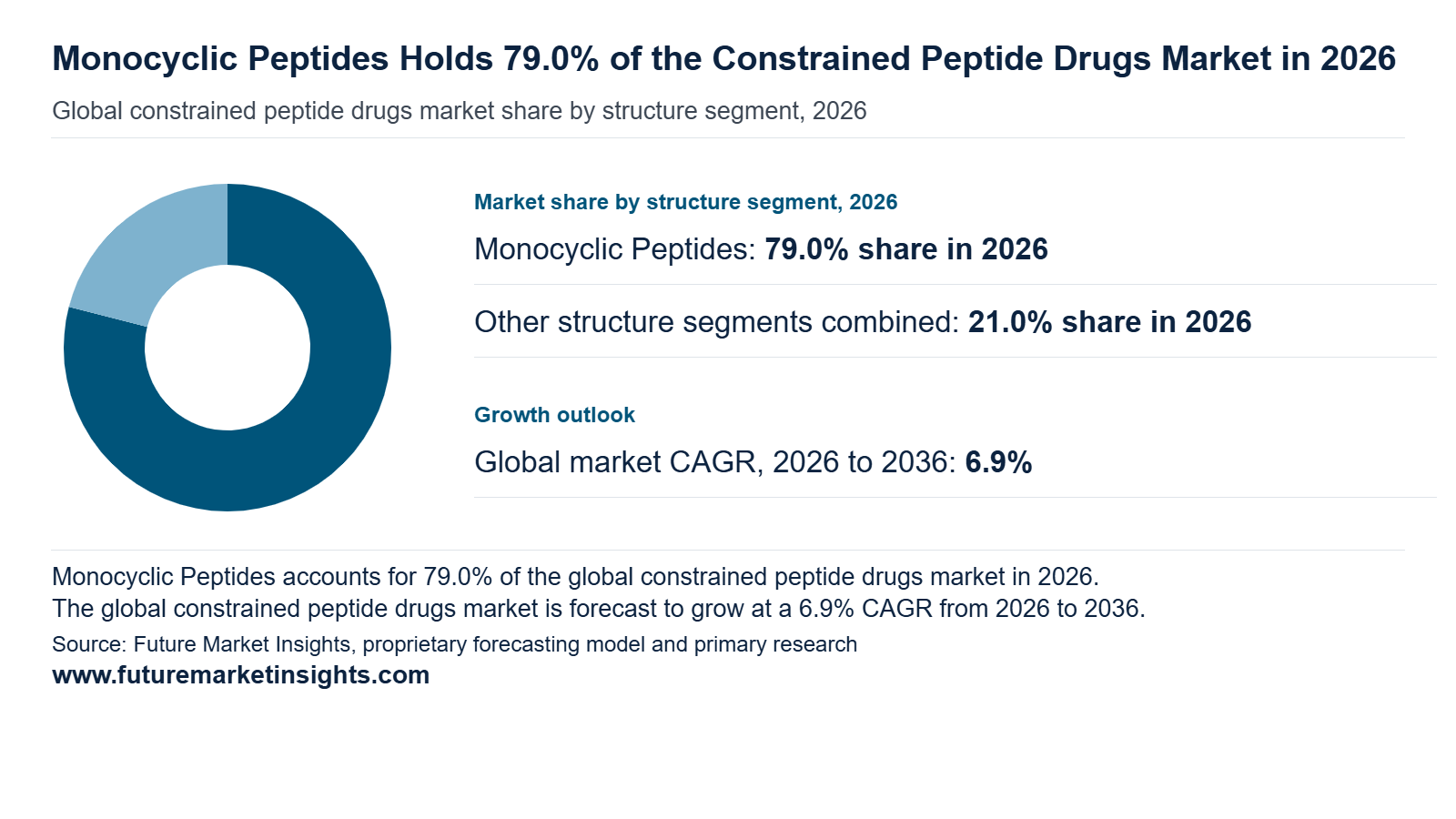
Monocyclic Peptides hold 79.0% of 2026 sales because the largest product lines are single-ring molecules in FMI's classification. Somatostatin analogs are the main examples. Novartis (February 2026) disclosed Sandostatin Group sales of USD 1,213 million in the 2025 results, and Ipsen (February 2026) gave EUR 1,135.4 million for Somatuline. FMI projects the monocyclic share to ease to 72.0% by 2036 as generic lanreotide and octreotide take volume at lower prices. Bicyclic and Polycyclic Peptides are projected to grow at 10.6% from a smaller base.
Why Does the Endocrinology and Neuroendocrine Tumors Segment Lead by Therapy Area?
Endocrinology and Neuroendocrine Tumors account for 45.0% of 2026 sales. Lanreotide and octreotide, along with pasireotide, have been prescribed for acromegaly and tumor symptom control for many years. Recordati (February 2026) reported endocrinology franchise net sales of EUR 394.1 million for 2025, up 22.5%, and named Signifor among the growing products. FMI projects this therapy area at 38.0% of sales in 2036, a lower share than today because generic entry is concentrated here. Demand overlaps with the neuroendocrine tumor treatment market, since the same analogs are sold in both.
Why Does the Injectable Segment Lead by Route?
Injectable products represent 74.0% of 2026 sales because depot somatostatin analogs and complement inhibitors are given by subcutaneous or intramuscular injection. UCB (February 2026) described Zilbrysq as a once-daily subcutaneous product that reached EUR 217 million of net sales in 2025. FMI projects the injectable share at 66.0% in 2036. Oral products are projected to expand at 9.8%, helped by the oral peptide approvals of 2026.
Constrained Peptide Drugs Market by Region and Country (2026 to 2036)
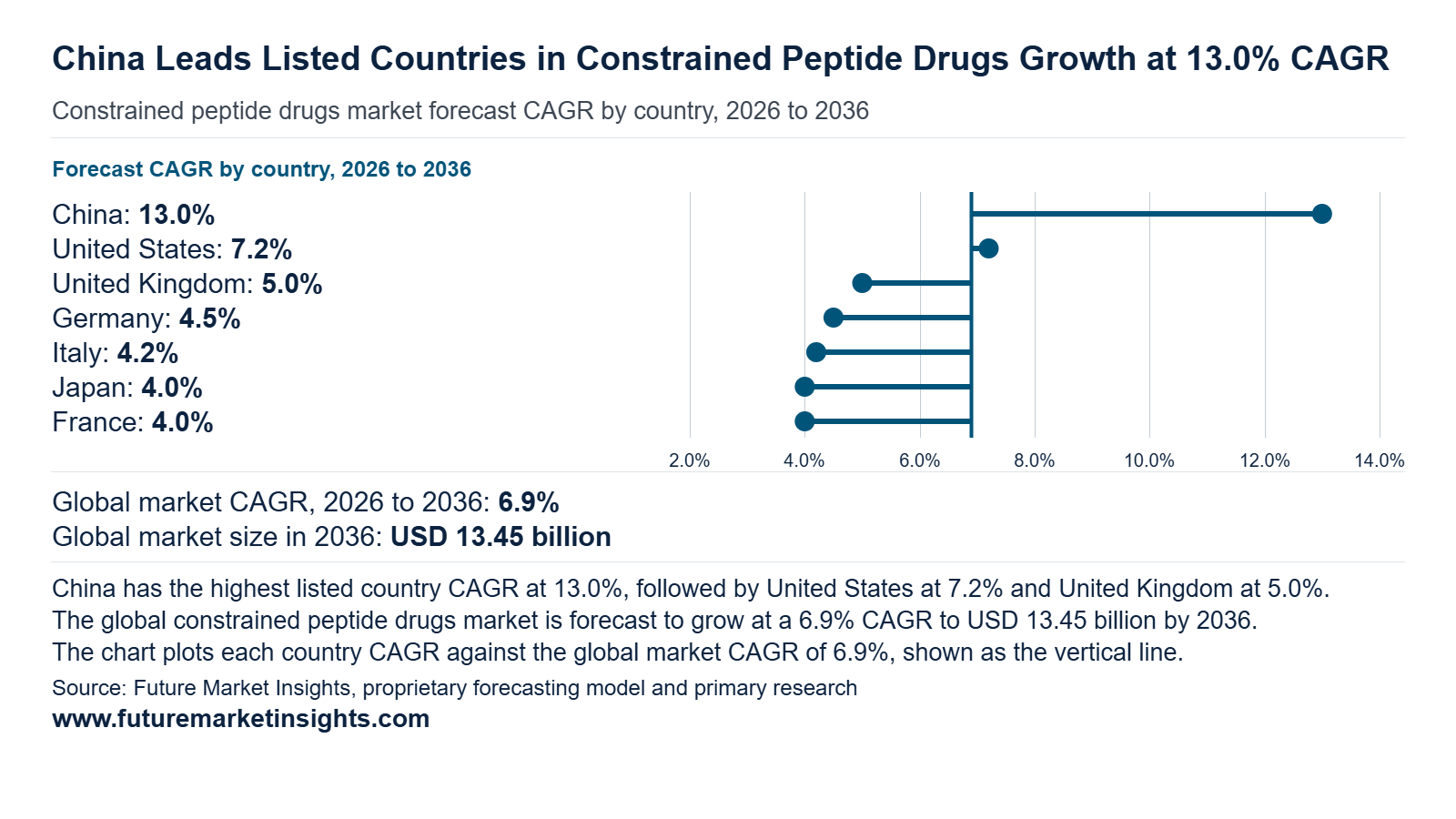
North America generates more than half of global sales, and the United States alone holds 56.0% of the 2026 total because net prices per patient are higher than in other countries. Europe is the second-largest region, with Germany at 5.6% and France at 4.1%. China is projected to grow fastest among the countries covered, at 13.0%, as recently approved products enter hospital formularies. Western European countries are projected to grow more slowly than the global rate because generic somatostatin analogs are widely available.
| Country | 2026 Revenue | 2036 Revenue | 10-Year Addition | 2026 to 2036 CAGR | Global Share (2026 → 2036) |
|---|---|---|---|---|---|
| China | USD 296.7 million | USD 1.01 billion | +USD 713.3 million | 13.0% | 4.3% → 7.5% |
| United States | USD 3.86 billion | USD 7.74 billion | +USD 3.88 billion | 7.2% | 56.0% → 57.6% |
| United Kingdom | USD 248.4 million | USD 404.6 million | +USD 156.2 million | 5.0% | 3.6% → 3.0% |
| Germany | USD 386.4 million | USD 600.1 million | +USD 213.7 million | 4.5% | 5.6% → 4.5% |
| Italy | USD 220.8 million | USD 333.2 million | +USD 112.4 million | 4.2% | 3.2% → 2.5% |
| Japan | USD 379.5 million | USD 561.8 million | +USD 182.3 million | 4.0% | 5.5% → 4.2% |
| France | USD 282.9 million | USD 418.8 million | +USD 135.9 million | 4.0% | 4.1% → 3.1% |
Source: Future Market Insights analysis of the constrained peptide drugs market, 2026.
United States
The United States is projected to move from USD 3.86 billion in 2026 to USD 7.74 billion in 2036, a CAGR of 7.2%. CMS (November 2025) published negotiated Medicare prices for 15 drugs, and the CMS fact sheet (November 2025) shows Linzess on that list. Rhythm Pharmaceuticals (May 2026) reported that 61% of first quarter Imcivree sales were made in the country. FMI expects new launches and label expansions to outweigh the negotiated price reduction on linaclotide.
Germany
Germany accounts for USD 386.4 million of 2026 sales, and FMI projects USD 600.1 million by 2036 at a CAGR of 4.5%. Camurus (November 2025) made Oczyesa, a once-monthly octreotide depot, available in Germany as the first EU country. In FMI's view, early availability of new formats supports value in Germany, and generic octreotide holds growth below the global rate.
Japan
Sales in Japan are estimated at USD 379.5 million for 2026 and projected at USD 561.8 million for 2036, which equals a 4.0% CAGR. UCB (February 2026) reported Japanese Zilbrysq net sales of EUR 24 million for 2025. Rhythm Pharmaceuticals (November 2026) said the Japanese health ministry approved Imcivree for acquired hypothalamic obesity on 24 August 2026. FMI expects scheduled national price revisions to hold growth below the global rate.
China
China is the fastest-growing country covered, and FMI sees USD 296.7 million of 2026 sales becoming USD 1.01 billion by 2036 at a 13.0% CAGR. Fineline Cube (October 2025) reported that the National Medical Products Administration had authorized zilucoplan for adults with generalized myasthenia gravis. FMI expects reimbursement listing of newer peptides to be the main condition for volume growth in Chinese hospitals.
France
For France, FMI projects growth from USD 282.9 million in 2026 to USD 418.8 million in 2036, or 4.0% a year. Ipsen (February 2026) reported European Somatuline sales of EUR 383.1 million for 2025, up 4.9% at constant exchange rates, helped by generic lanreotide shortages. The French transparency committee adopted an opinion on 28 May 2025 that favored reimbursement of Aspaveli (pegcetacoplan) for a restricted group of adults with paroxysmal nocturnal hemoglobinuria, according to HAS (May 2025). FMI expects French sales to slow once generic supply normalizes.
United Kingdom
FMI sizes the United Kingdom at USD 248.4 million in 2026 and USD 404.6 million in 2036, a CAGR of 5.0%. Bicycle Therapeutics (July 2026), a developer of bicyclic peptides headquartered in Cambridge in the United Kingdom, reported an expected cash runway into 2030. FMI regards the country as a research base for this drug class, with product sales held back by national cost-effectiveness reviews.
Italy
Italian sales are projected at USD 333.2 million in 2036, compared with USD 220.8 million in 2026, for a CAGR of 4.2%. Milan-based Recordati (February 2026) booked EUR 394.1 million from the endocrinology franchise across all countries in 2025. Il Sole 24 Ore (November 2026) reported that Respighi BidCo, a vehicle in which CVC and GBL hold stakes, reached 91.928% of Recordati share capital at the close of an extended takeover bid, based on provisional figures. FMI expects regional hospital purchasing of generic somatostatin analogs to keep Italian growth modest.
Competitive Environment and Notable Companies
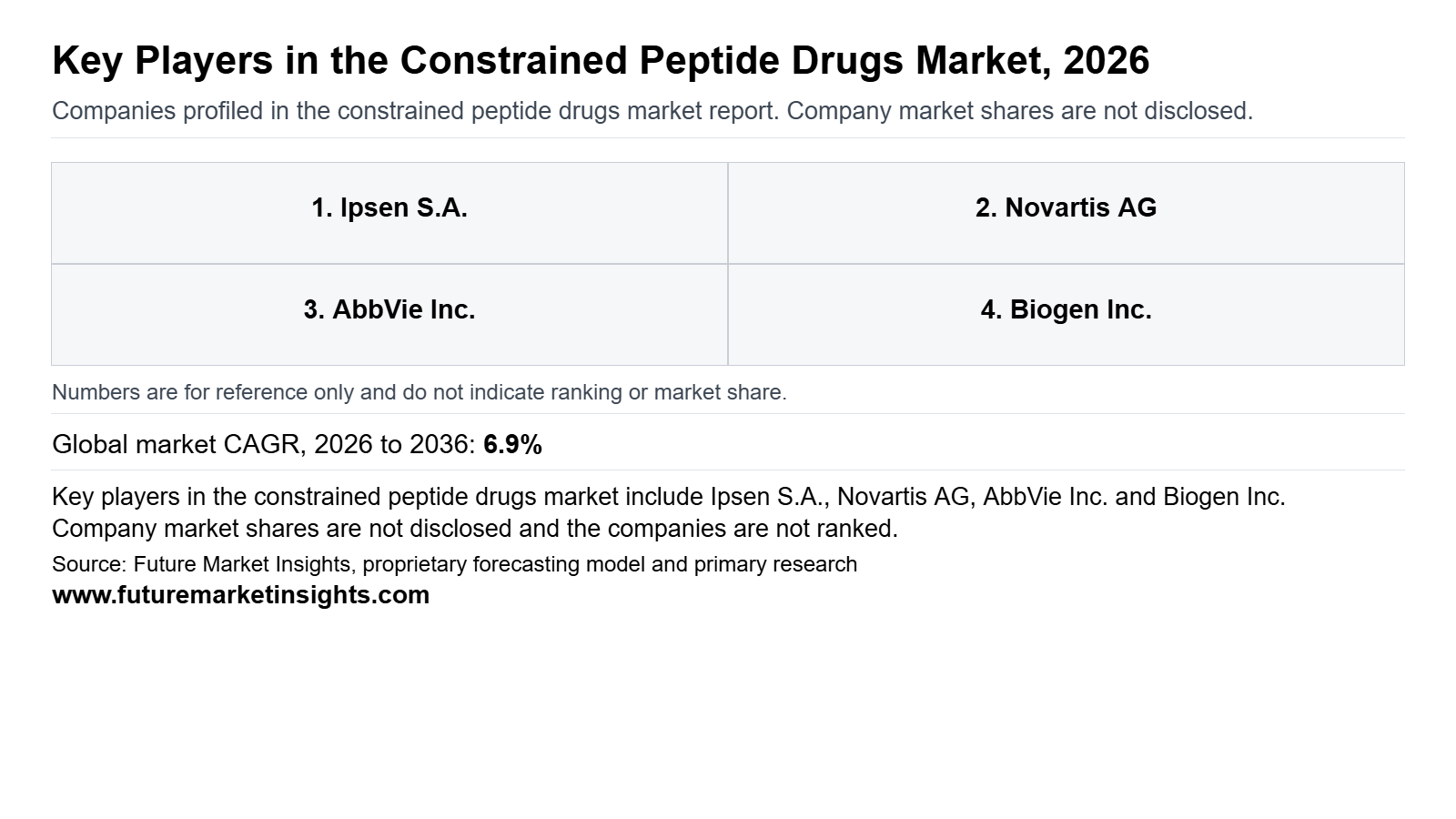
Sales are concentrated among a small group of brand owners. Ipsen S.A. and Novartis AG each sell an established somatostatin analog franchise, AbbVie Inc. sells linaclotide, and Biogen Inc. now sells pegcetacoplan as Empaveli and Syfovre after buying Apellis Pharmaceuticals. Recordati S.p.A. and UCB S.A., along with Rhythm Pharmaceuticals Inc., each hold one specialist product line, and Cipla Limited sells generic lanreotide in the United States.
How Are Companies Positioned in the Constrained Peptide Drugs Market?
Each large brand owner is identified with one molecule family. Ipsen and Novartis are defending mature depot injections against generics, and AbbVie is managing linaclotide ahead of a negotiated Medicare price. Biogen and UCB, along with Rhythm Pharmaceuticals, are building newer products in complement disorders and rare obesity.
What Matters When a Buyer Selects a Constrained Peptide Drugs Supplier?
Prescribers and payers look first at the approved indication and the reimbursement decision in each country. Dosing interval and the option of self-injection, along with continuity of supply, are the next points of comparison, especially for depot products with a generic alternative.
Which Capabilities Distinguish Product Offers?
Long-acting depot formulation and device design separate branded somatostatin analogs from generics. Oral dosing separates the 2026 entrants from injected peptides. Sterile peptide manufacturing capacity is a further difference in FMI's assessment, since generic lanreotide sold by Cipla USA relies on one exclusive maker.
How Does Geographic Reach Affect Competition?
Companies with sales teams in the United States capture most of the value because prices per patient are highest there. European and Japanese sales need separate reimbursement approvals in every country, so smaller owners often reach those patients through regional partners or after acquisition by a larger group.
| Verified Company Evidence (2026) | Commercial Effect | Buyer Action |
|---|---|---|
| 16 January 2026: Pharmathen, the exclusive maker of the lanreotide sold by Cipla USA, was reported to have paused production at the Rodopi plant in Greece after an FDA inspection (Business Standard, January 2026). | Cipla said at the time that generic lanreotide would remain in limited supply until regulatory clearances were obtained. | Specialty pharmacies may need to check lanreotide stock cover and alternative depot products. |
| 19 March 2026: Rhythm Pharmaceuticals announced FDA approval of Imcivree for acquired hypothalamic obesity in adults and children aged 4 years and older (Rhythm Pharmaceuticals, March 2026). | The approval adds a new patient group for an existing cyclic peptide. | Payers may need to set coverage criteria for the new indication. |
| 14 May 2026: Biogen completed the acquisition of Apellis Pharmaceuticals for USD 41 per share in cash plus a contingent value right (Biogen, May 2026). | Empaveli and Syfovre now belong to a larger company. | Hospital buyers may need to confirm contract and contact details for Empaveli and Syfovre. |
Source: Verified corporate disclosures and Future Market Insights analysis, 2026.
| Company | Core Positioning | Verified Activity & Source Attribution |
|---|---|---|
| Ipsen S.A. | Owner of Somatuline (lanreotide) depot for acromegaly and neuroendocrine tumors. | Reported 2025 Somatuline sales of EUR 1,135.4 million, up 4.3% at constant exchange rates (Ipsen, February 2026). |
| Novartis AG | Owner of the Sandostatin (octreotide) franchise. | Reported 2025 Sandostatin Group net sales of USD 1,213 million, down 5% (Novartis, February 2026). |
| AbbVie Inc. | Seller of linaclotide as Linzess and Constella in gastroenterology. | Reported 2025 Linzess and Constella net sales of USD 907 million, down 4.9% (AbbVie, February 2026). |
| Biogen Inc. | Owner of Empaveli and Syfovre (pegcetacoplan) through the Apellis purchase. | Completed the acquisition of Apellis Pharmaceuticals on 14 May 2026 (Biogen, May 2026). |
| Recordati S.p.A. | Owner of Signifor (pasireotide) within an endocrinology franchise. | Reported 2025 endocrinology franchise net sales of EUR 394.1 million, up 22.5%, and named Signifor among the growing products (Recordati, February 2026). |
| UCB S.A. | Owner of Zilbrysq (zilucoplan) for generalized myasthenia gravis. | Reported 2025 Zilbrysq net sales of EUR 217 million, including EUR 157 million in the United States (UCB, February 2026). |
| Rhythm Pharmaceuticals Inc. | Owner of Imcivree (setmelanotide) for rare forms of obesity. | Reported first quarter 2026 Imcivree net product sales of USD 60.1 million (Rhythm Pharmaceuticals, May 2026). |
| Cipla Limited | Seller of generic lanreotide injection in the United States. | Manufacturing partner Pharmathen paused lanreotide production after an FDA inspection on 10 to 21 November 2025, and Cipla expected limited supply (Business Standard, January 2026). |
Source: Verified corporate disclosures and Future Market Insights analysis, 2026.
Constrained Peptide Drugs Market Report Scope and Research Methodology
FMI measures the market as manufacturer net sales of approved constrained peptide medicines in each country. Product sales reported by brand owners are the starting point, and generic volumes are added at local net prices. Each product is assigned to a single structure class and therapy area, as well as one route, so the segments of every axis add up to the global total. Country figures are recorded in the place of sale to the pharmacy or hospital. Forecasts reflect patent expiry dates and announced price changes, along with approvals already granted.
| Coverage Field | Report Scope |
|---|---|
| Market definition | Prescription medicines whose active ingredient is a designed monocyclic, bicyclic, polycyclic or stapled peptide. |
| Structure | Monocyclic Peptides, Bicyclic and Polycyclic Peptides, Stapled Peptides |
| Therapy Area | Endocrinology and Neuroendocrine Tumors, Gastroenterology, Hematology and Complement Disorders, Metabolic and Rare Disease, Others |
| Route | Injectable, Oral |
| End users | Hospital and specialty pharmacies, along with retail pharmacies, dispensing to patients under specialist care. |
| Inclusions | Somatostatin analogs, guanylate cyclase agonists, complement inhibitor peptides, melanocortin receptor agonists and oral macrocyclic peptides, branded and generic. |
| Exclusions | Natural-product antibiotics, ciclosporin, linear peptide hormones, radioligand conjugates and candidates in clinical trials. |
| Quantitative units | USD million and USD billion, as shown. |
| Value basis | Manufacturer net sales in USD at constant 2026 exchange rates. |
| Base year and history | 2025 base year, with history from 2021 to 2025. |
| Forecast period | 2026 to 2036. |
| Regions covered | North America, Latin America, Western Europe, Eastern Europe, East Asia, South Asia and Pacific, Middle East and Africa. |
| National coverage | United States, Germany, Japan, China, France, United Kingdom, Italy. |
| Companies covered | Ipsen S.A., Novartis AG, AbbVie Inc., Biogen Inc., Recordati S.p.A., UCB S.A., Rhythm Pharmaceuticals Inc., Cipla Limited. |
Source: Future Market Insights analysis of the constrained peptide drugs market, 2026.
Research Sources and Bibliography
- AbbVie. (2026, February 4). AbbVie Reports Full-Year and Fourth-Quarter 2025 Financial Results.
- Bicycle Therapeutics. (2026, July 30). Bicycle Therapeutics Reports Recent Business Progress and Second Quarter 2026 Financial Results.
- Biogen. (2026, May 14). Biogen Completes Acquisition of Apellis Pharmaceuticals.
- Business Standard. (2026, January 16). FDA observation to hit Lanreotide supply; Cipla may face earnings risk.
- Camurus. (2025, November 3). Camurus launches long-acting Oczyesa for the treatment of acromegaly.
- Centers for Medicare and Medicaid Services. (2025, November). New Lower Drug Prices Under the Medicare Drug Price Negotiation Program: What You Need to Know. https://www.cms.gov/files/document/infographic-negotiated-prices-ipay-2027.pdf
- Centers for Medicare and Medicaid Services. (2025, November 25). CMS Delivers Savings for Seniors on 15 Major Drugs for Cancer and Chronic Disease. https://www.cms.gov/newsroom/press-releases/cms-delivers-savings-seniors-15-major-drugs-cancer-chronic-disease
- Fineline Cube. (2025, October 14). UCB Biosciences Receives NMPA Marketing Authorization for Zilucoplan (Zilbrysq) in Adult Generalized Myasthenia Gravis. https://flcube.com/?p=43264
- Haute Autorité de Santé. (2025, May 28). ASPAVELI 1 080 mg, solution pour perfusion (avis de la Commission de la Transparence, reevaluation). https://www.has-sante.fr/upload/docs/evamed/CT-21273_ASPAVELI_PIC_REEV_AvisDef_CT21273.pdf
- Il Sole 24 Ore. (2026, November 10). Recordati: Respighi's takeover bid closes at 91.93 per cent; delisting to go ahead. https://en.ilsole24ore.com/art/recordati-opa-respighi-closes-at-9193-per-cent-following-delisting-AJ5OrBBC
- Ipsen. (2026, February 12). Ipsen delivers strong results in 2025, driven by solid execution across all therapeutic areas, and provides 2026 guidance. https://www.ipsen.com/wp-content/uploads/2026/02/Ipsen-PR_FY-2025-Results-Announcement_12022026.pdf
- Johnson and Johnson. (2026, March 18). FDA approval of ICOTYDE (icotrokinra) ushers in new era for first-line systemic treatment of plaque psoriasis with a targeted oral peptide. https://www.jnj.com/media-center/press-releases/fda-approval-of-icotyde-icotrokinra-ushers-in-new-era-for-first-line-systemic-treatment-of-plaque-psoriasis-with-a-targeted-oral-peptide
- Merck & Co., Inc. (2026, July 16). Merck's LIPFENDRA (enlicitide) is the First and Only Once-Daily Oral PCSK9 Inhibitor Approved by the U.S. FDA to Reduce LDL-C in Adults with Hypercholesterolemia. https://www.merck.com/?p=3692897
- Novartis. (2026, February 4). Novartis delivered high single-digit sales growth, achieved 40% core margin and further advanced the pipeline in 2025. https://www.novartis.com/news/media-releases/novartis-delivered-high-single-digit-sales-growth-achieved-40-core-margin-and-further-advanced-pipeline-2025
- Recordati. (2026, February 17). Recordati Reports Strong Preliminary Full Year 2025 Results: Revenue +11.8%, EBITDA +14.5%, Adjusted Net Income +14.5%. https://www.globenewswire.com/fr/news-release/2026/02/17/3239593/0/en/RECORDATI-REPORTS-STRONG-PRELIMINARY-FULL-YEAR-2025-RESULTS-REVENUE-11-8-EBITDA-1-14-5-ADJUSTED-NET-INCOME-2-14-5.html
- Rhythm Pharmaceuticals. (2026, March 19). Rhythm Pharmaceuticals Announces FDA Approval of IMCIVREE (setmelanotide) for Patients with Acquired Hypothalamic Obesity. https://ir.rhythmtx.com/news-releases/news-release-details/rhythm-pharmaceuticals-announces-fda-approval-imcivreer-1
- Rhythm Pharmaceuticals. (2026, May 5). Rhythm Pharmaceuticals Reports First Quarter 2026 Financial Results and Business Update. https://www.sec.gov/Archives/edgar/data/0001649904/000162828026030136/q12026earningspr_draft.htm
- Rhythm Pharmaceuticals. (2026, November 3). Rhythm Pharmaceuticals Reports Third Quarter 2026 Financial Results and Business Update. https://www.sec.gov/Archives/edgar/data/0001649904/000162828026069106/q32026earningspr.htm
- UCB. (2026, February 26). Strong Execution Fueling Sustained Company Growth (UCB Full-Year Report 2025). https://www.ucb.com/sites/default/files/2026-02/UCB-PR-2025-FY-Results-ENG.pdf
Table of Content
- Key Takeaways
- Market Size and CAGR
- Top Growth Driver
- Fastest Growing Segment
- Leading Region
- Key Companies
- Emerging Opportunities
- Executive Summary
- Global Market Outlook
- Demand-side Trends
- Supply-side Trends
- Technology Roadmap Analysis
- Analysis and Recommendations
- Analyst Perspective (What is happening? Why now? What should investors know?)
Read More...
- Key Questions Answered
- How large is the market?
- What is the CAGR?
- What are key trends?
- Which region dominates?
- Who are the leaders?
- Market Overview
- Market Coverage / Taxonomy
- Market Definition / Scope / Limitations
- Research Methodology
- Chapter Orientation
- Analytical Lens and Working Hypotheses
- Market Structure, Signals, and Trend Drivers
- Benchmarking and Cross-market Comparability
- Market Sizing, Forecasting, and Opportunity Mapping
- Research Design and Evidence Framework
- Desk Research Program (Secondary Evidence)
- Expert Input and Fieldwork (Primary Evidence)
- Tooling, Models, and Reference Databases
- Data Engineering and Model Build
- Quality Assurance and Audit Trail
- Market Background
- Market Dynamics (Drivers, Restraints, Opportunity, Trends)
- Scenario Forecast (Optimistic, Likely, Conservative)
- Impact Analysis
- AI Impact
- Sustainability Impact
- Regulatory Impact
- Technology Impact
- Consumer / Buyer Analysis
- Purchase Drivers
- Adoption Barriers
- Buyer Journey
- Opportunity Map Analysis
- Product Life Cycle Analysis
- Supply Chain Analysis
- Investment Feasibility Matrix
- Value Chain Analysis
- PESTLE and Porter's Analysis
- Regulatory Landscape
- Regional Parent Market Outlook
- Production and Consumption Statistics
- Import and Export Statistics
- Global Market Analysis and Forecast, 2021 to 2036
- Historical Market Size Value (USD Million) Analysis, 2021 to 2025
- Current and Future Market Size Value (USD Million) Projections, 2026 to 2036
- Y-o-Y Growth Trend Analysis
- Absolute $ Opportunity Analysis
- Global Market Pricing Analysis, 2021 to 2036
- Global Market Analysis and Forecast, By Structure, 2021 to 2036
- Introduction / Key Findings
- Historical Market Size Value (USD Million) Analysis By Structure, 2021 to 2025
- Current and Future Market Size Value (USD Million) Analysis and Forecast By Structure, 2026 to 2036
- Monocyclic Peptides
- Bicyclic and Polycyclic Peptides
- Stapled Peptides
- Y-o-Y Growth Trend Analysis By Structure, 2021 to 2025
- Absolute $ Opportunity Analysis By Structure, 2026 to 2036
- Global Market Analysis and Forecast, By Therapy Area, 2021 to 2036
- Introduction / Key Findings
- Historical Market Size Value (USD Million) Analysis By Therapy Area, 2021 to 2025
- Current and Future Market Size Value (USD Million) Analysis and Forecast By Therapy Area, 2026 to 2036
- Endocrinology and Neuroendocrine Tumors
- Gastroenterology
- Hematology and Complement Disorders
- Metabolic and Rare Disease
- Others
- Y-o-Y Growth Trend Analysis By Therapy Area, 2021 to 2025
- Absolute $ Opportunity Analysis By Therapy Area, 2026 to 2036
- Global Market Analysis and Forecast, By Route, 2021 to 2036
- Introduction / Key Findings
- Historical Market Size Value (USD Million) Analysis By Route, 2021 to 2025
- Current and Future Market Size Value (USD Million) Analysis and Forecast By Route, 2026 to 2036
- Injectable
- Oral
- Y-o-Y Growth Trend Analysis By Route, 2021 to 2025
- Absolute $ Opportunity Analysis By Route, 2026 to 2036
- Global Market Analysis and Forecast, By Region, 2021 to 2036
- Introduction
- Historical Market Size Value (USD Million) Analysis By Region, 2021 to 2025
- Current Market Size Value (USD Million) Analysis and Forecast By Region, 2026 to 2036
- North America
- Western Europe
- East Asia
- Market Attractiveness Analysis By Region
- North America Market Analysis and Forecast, By Country, 2021 to 2036
- Historical Market Size Value (USD Million) Trend Analysis By Market Taxonomy, 2021 to 2025
- Market Size Value (USD Million) Forecast By Market Taxonomy, 2026 to 2036
- By Country
- United States
- Rest of North America
- By Structure
- By Therapy Area
- By Route
- By Country
- Market Attractiveness Analysis
- By Country
- By Structure
- By Therapy Area
- By Route
- Key Takeaways
- Western Europe Market Analysis and Forecast, By Country, 2021 to 2036
- Historical Market Size Value (USD Million) Trend Analysis By Market Taxonomy, 2021 to 2025
- Market Size Value (USD Million) Forecast By Market Taxonomy, 2026 to 2036
- By Country
- Germany
- France
- United Kingdom
- Italy
- Rest of Western Europe
- By Structure
- By Therapy Area
- By Route
- By Country
- Market Attractiveness Analysis
- By Country
- By Structure
- By Therapy Area
- By Route
- Key Takeaways
- East Asia Market Analysis and Forecast, By Country, 2021 to 2036
- Historical Market Size Value (USD Million) Trend Analysis By Market Taxonomy, 2021 to 2025
- Market Size Value (USD Million) Forecast By Market Taxonomy, 2026 to 2036
- By Country
- Japan
- China
- Rest of East Asia
- By Structure
- By Therapy Area
- By Route
- By Country
- Market Attractiveness Analysis
- By Country
- By Structure
- By Therapy Area
- By Route
- Key Takeaways
- Key Countries Market Analysis
- United States
- Pricing Analysis
- Market Share Analysis, 2025
- By Structure
- By Therapy Area
- By Route
- Germany
- Pricing Analysis
- Market Share Analysis, 2025
- By Structure
- By Therapy Area
- By Route
- Japan
- Pricing Analysis
- Market Share Analysis, 2025
- By Structure
- By Therapy Area
- By Route
- France
- Pricing Analysis
- Market Share Analysis, 2025
- By Structure
- By Therapy Area
- By Route
- China
- Pricing Analysis
- Market Share Analysis, 2025
- By Structure
- By Therapy Area
- By Route
- United Kingdom
- Pricing Analysis
- Market Share Analysis, 2025
- By Structure
- By Therapy Area
- By Route
- Italy
- Pricing Analysis
- Market Share Analysis, 2025
- By Structure
- By Therapy Area
- By Route
- United States
- Market Structure Analysis
- Competition Dashboard
- Competition Benchmarking
- Market Share Analysis of Top Players
- By Regional
- By Structure
- By Therapy Area
- By Route
- Emerging Startups
- Innovation Benchmarking
- Competition Analysis
- Competition Deep Dive
- Ipsen S.A.
- Overview
- Product Portfolio
- Profitability by Market Segments
- Sales Footprint
- Strategy Overview
- Marketing Strategy
- Product Strategy
- Channel Strategy
- Novartis AG
- AbbVie Inc.
- Biogen Inc.
- Recordati S.p.A.
- UCB S.A.
- Rhythm Pharmaceuticals Inc.
- Cipla Limited
- Ipsen S.A.
- Competition Deep Dive
- Case Studies
- Success Stories
- Recent Developments
- Assumptions & Acronyms Used
List of Tables
- Table 1: Global Market Value (USD Million) Forecast by Region, 2021 to 2036
- Table 2: Global Market Value (USD Million) Forecast by Structure, 2021 to 2036
- Table 3: Global Market Value (USD Million) Forecast by Therapy Area, 2021 to 2036
- Table 4: Global Market Value (USD Million) Forecast by Route, 2021 to 2036
- Table 5: North America Market Value (USD Million) Forecast by Country, 2021 to 2036
- Table 6: North America Market Value (USD Million) Forecast by Structure, 2021 to 2036
- Table 7: North America Market Value (USD Million) Forecast by Therapy Area, 2021 to 2036
- Table 8: North America Market Value (USD Million) Forecast by Route, 2021 to 2036
- Table 9: Western Europe Market Value (USD Million) Forecast by Country, 2021 to 2036
- Table 10: Western Europe Market Value (USD Million) Forecast by Structure, 2021 to 2036
- Table 11: Western Europe Market Value (USD Million) Forecast by Therapy Area, 2021 to 2036
- Table 12: Western Europe Market Value (USD Million) Forecast by Route, 2021 to 2036
- Table 13: East Asia Market Value (USD Million) Forecast by Country, 2021 to 2036
- Table 14: East Asia Market Value (USD Million) Forecast by Structure, 2021 to 2036
- Table 15: East Asia Market Value (USD Million) Forecast by Therapy Area, 2021 to 2036
- Table 16: East Asia Market Value (USD Million) Forecast by Route, 2021 to 2036
List of Figures
- Figure 1: Global Market Pricing Analysis
- Figure 2: Global Market Value (USD Million) Forecast 2021-2036
- Figure 3: Global Market Value Share and BPS Analysis by Structure, 2026 and 2036
- Figure 4: Global Market Y-o-Y Growth Comparison by Structure, 2026-2036
- Figure 5: Global Market Attractiveness Analysis by Structure
- Figure 6: Global Market Value Share and BPS Analysis by Therapy Area, 2026 and 2036
- Figure 7: Global Market Y-o-Y Growth Comparison by Therapy Area, 2026-2036
- Figure 8: Global Market Attractiveness Analysis by Therapy Area
- Figure 9: Global Market Value Share and BPS Analysis by Route, 2026 and 2036
- Figure 10: Global Market Y-o-Y Growth Comparison by Route, 2026-2036
- Figure 11: Global Market Attractiveness Analysis by Route
- Figure 12: Global Market Value (USD Million) Share and BPS Analysis by Region, 2026 and 2036
- Figure 13: Global Market Y-o-Y Growth Comparison by Region, 2026-2036
- Figure 14: Global Market Attractiveness Analysis by Region
- Figure 15: North America Market Incremental Dollar Opportunity, 2026-2036
- Figure 16: Western Europe Market Incremental Dollar Opportunity, 2026-2036
- Figure 17: East Asia Market Incremental Dollar Opportunity, 2026-2036
- Figure 18: North America Market Value Share and BPS Analysis by Country, 2026 and 2036
- Figure 19: North America Market Value Share and BPS Analysis by Structure, 2026 and 2036
- Figure 20: North America Market Y-o-Y Growth Comparison by Structure, 2026-2036
- Figure 21: North America Market Attractiveness Analysis by Structure
- Figure 22: North America Market Value Share and BPS Analysis by Therapy Area, 2026 and 2036
- Figure 23: North America Market Y-o-Y Growth Comparison by Therapy Area, 2026-2036
- Figure 24: North America Market Attractiveness Analysis by Therapy Area
- Figure 25: North America Market Value Share and BPS Analysis by Route, 2026 and 2036
- Figure 26: North America Market Y-o-Y Growth Comparison by Route, 2026-2036
- Figure 27: North America Market Attractiveness Analysis by Route
- Figure 28: Western Europe Market Value Share and BPS Analysis by Country, 2026 and 2036
- Figure 29: Western Europe Market Value Share and BPS Analysis by Structure, 2026 and 2036
- Figure 30: Western Europe Market Y-o-Y Growth Comparison by Structure, 2026-2036
- Figure 31: Western Europe Market Attractiveness Analysis by Structure
- Figure 32: Western Europe Market Value Share and BPS Analysis by Therapy Area, 2026 and 2036
- Figure 33: Western Europe Market Y-o-Y Growth Comparison by Therapy Area, 2026-2036
- Figure 34: Western Europe Market Attractiveness Analysis by Therapy Area
- Figure 35: Western Europe Market Value Share and BPS Analysis by Route, 2026 and 2036
- Figure 36: Western Europe Market Y-o-Y Growth Comparison by Route, 2026-2036
- Figure 37: Western Europe Market Attractiveness Analysis by Route
- Figure 38: East Asia Market Value Share and BPS Analysis by Country, 2026 and 2036
- Figure 39: East Asia Market Value Share and BPS Analysis by Structure, 2026 and 2036
- Figure 40: East Asia Market Y-o-Y Growth Comparison by Structure, 2026-2036
- Figure 41: East Asia Market Attractiveness Analysis by Structure
- Figure 42: East Asia Market Value Share and BPS Analysis by Therapy Area, 2026 and 2036
- Figure 43: East Asia Market Y-o-Y Growth Comparison by Therapy Area, 2026-2036
- Figure 44: East Asia Market Attractiveness Analysis by Therapy Area
- Figure 45: East Asia Market Value Share and BPS Analysis by Route, 2026 and 2036
- Figure 46: East Asia Market Y-o-Y Growth Comparison by Route, 2026-2036
- Figure 47: East Asia Market Attractiveness Analysis by Route
- Figure 48: Global Market - Tier Structure Analysis
- Figure 49: Global Market - Company Share Analysis
Frequently Asked Questions
How big is the constrained peptide drugs market in 2026?
Future Market Insights estimates the global constrained peptide drugs market at USD 6.90 billion in 2026, up from USD 6.45 billion in 2025.
How fast is the constrained peptide drugs market expected to grow through 2036?
FMI projects a 6.9% CAGR from 2026 to 2036, taking the global constrained peptide drugs market to USD 13.45 billion by 2036 and generating USD 6.55 billion in incremental revenue.
Which structure leads the constrained peptide drugs market?
The Monocyclic Peptides segment leads the constrained peptide drugs market by structure with 79.0% of 2026 revenue, and the Bicyclic and Polycyclic Peptides segment is projected to grow fastest at a 10.6% CAGR from 2026 to 2036.
Which therapy area leads the constrained peptide drugs market?
The Endocrinology and Neuroendocrine Tumors segment leads the constrained peptide drugs market by therapy area with 45.0% of 2026 revenue, and the Metabolic and Rare Disease segment is projected to grow fastest at an 11.7% CAGR from 2026 to 2036.
Which route leads the constrained peptide drugs market?
The Injectable segment leads the constrained peptide drugs market by route with 74.0% of 2026 revenue, and the Oral segment is projected to grow fastest at a 9.8% CAGR from 2026 to 2036.
Which country is the largest constrained peptide drugs market?
Among the countries covered, the United States is the largest constrained peptide drugs market with 56.0% of global revenue in 2026 (USD 3.86 billion), followed by Germany at 5.6% (USD 386.4 million) and Japan at 5.5% (USD 379.5 million).
Which countries are expected to grow fastest in the constrained peptide drugs market?
China is projected to grow fastest in the constrained peptide drugs market among the countries covered, at a 13.0% CAGR from 2026 to 2036, followed by the United States at 7.2% and the United Kingdom at 5.0%.
What drives demand for constrained peptide drugs?
Demand for constrained peptide drugs comes from long-term treatment of acromegaly and neuroendocrine tumors, with newer demand from complement disorders and rare obesity. Oral macrocyclic peptides approved in 2026 add patients treated outside specialist injection clinics.
Preview the report firsthand - request a free sample
Get SampleGet the brochure for pricing and purchase details.
Get PDF
