

- Market Size (2026)
- USD 18.8 Bn
- Forecast (2036)
- USD 37.0 Bn
- CAGR (2026 to 2036)
- 7.0%
How big is the Heart Failure Drugs Market in 2026?
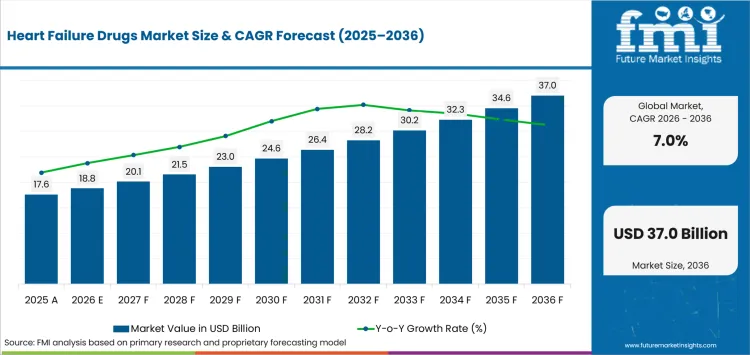
USD 18.8 billion in 2026 and USD 37.0 billion by 2036 at a 7.0% CAGR.
Demand for heart failure drugs is projected to expand at 7.0% CAGR between 2026 and 2036, increasing valuation from USD 18.8 billion to USD 37.0 billion. The March 2024 ACC treatment pathway recommends early initiation of four foundational therapy classes for patients with heart failure with reduced ejection fraction (HFrEF). Adoption of this treatment framework expands the use of combination drug regimens and supports recurring prescription volume across established heart failure therapies.
Country growth depends on treatment conversion rather than diagnosed population alone. HFSA reported in September 2025 that 6.7 million United States adults had heart failure, yet fewer than one in four eligible HFrEF patients received quadruple therapy. Japan's specialist-led pathway supports more centralized initiation, whereas fragmented United States coverage raises authorization work and demand for heart failure biomarkers during follow-up.
Key Takeaways of Heart Failure Drugs Market
- Guideline-directed care increases demand as cardiology teams initiate foundational medicines earlier and coordinate titration across hospital and community settings.
- SGLT2 inhibitors are projected to lead drug class demand with 31.0% share in 2026 owing to recommendations covering several ejection-fraction groups.
- HFrEF is estimated to account for 54.0% of indication demand in 2026 owing to established four-class treatment and titration pathways.
- Oral medicines are forecast to represent 82.0% of route demand in 2026 supported by chronic treatment continuing mainly outside infusion settings.
- Renal impairment plus low blood pressure and payer controls delay dose escalation or prevent eligible patients from completing recommended multidrug regimens.
- AstraZeneca PLC, Novartis AG, Boehringer Ingelheim International GmbH, Eli Lilly and Company, Bayer AG, Merck & Co., Inc., Lexicon Pharmaceuticals, Inc. and Otsuka Pharmaceutical Co., Ltd. are some notable players.
Analyst Perspective
“Commercial performance depends on whether hospitals can start an evidence-based regimen and transfer each monitoring responsibility without interruption. Companies earn durable prescription volume by supporting formulary access, dose adjustment and community continuation across several drug classes.”
- Anurag Sharma, Principal Consultant, Future Market Insights
How is the Heart Failure Drugs Market segmented?
The heart failure drugs market is segmented by drug class, indication, route of administration, distribution channel, end user and region.
Drug classes cover SGLT2 inhibitors, ARNI, beta blockers and other heart failure drugs. Indications include HFrEF, HFpEF and acute heart failure. Routes include oral, injectable and combination therapy. Distribution channels comprise hospital pharmacies, retail pharmacies and online pharmacies. End users include hospitals, specialty cardiac clinics and home healthcare.
Why do SGLT2 inhibitors lead demand within the drug class category?
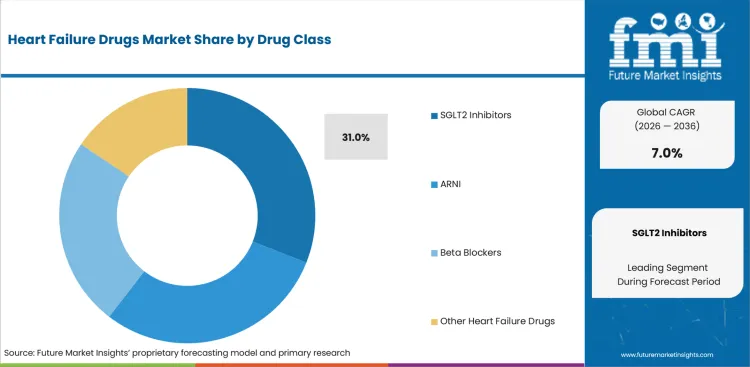
SGLT2 inhibitors connect heart failure care with established cardiometabolic drug portfolios among patients with overlapping diabetes and kidney disease. Once-daily tablets support continuation after discharge, although clinicians must match each medicine to its labeled indication and the patient's renal status.
- By drug class, SGLT2 inhibitors are estimated to hold 31.0% in 2026 owing to guideline placement across several ejection-fraction groups.
- Formulary position and prior authorization shape selection more than class familiarity alone. Manufacturers that support safe initiation and renal review can protect repeat use across hospital and community prescribing.
Why does HFrEF lead demand within the indication category?
HFrEF has the clearest four-class treatment sequence and the most established titration pathway across inpatient and outpatient care. Ejection-fraction measurement identifies eligible patients, while blood pressure and kidney function determine how quickly each class can be added across recurrent clinical reviews.
- In 2026, HFrEF is expected to lead indication demand with 54.0% share because established pathways support initiation and long-term maintenance.
- Structured heart failure testing guides product sequencing rather than merely confirming diagnosis. A documented discharge regimen gives community clinicians the dose plan and monitoring responsibility required for repeat prescriptions.
Why do oral medicines lead demand within the route of administration category?
Oral medicines carry most long-term treatment beyond specialist facilities and fit daily use across several foundational classes. The FDA approved first generic dapagliflozin tablets in April 2026 for specified Farxiga uses, expanding oral SGLT2 competition within approved indications.
- The route category is forecast to be led by oral medicines at 82.0% share in 2026 due to routine home administration across chronic regimens.
- Oral drug formulation must preserve dose flexibility during staged titration and combination therapy. Pharmacists also need clear substitution instructions that prevent dosing errors during product changes and refill transitions.
Why do hospital pharmacies lead demand within the distribution channel category?
Hospital pharmacies connect acute stabilization with the maintenance regimen carried into community care. Pharmacists confirm formulary status and discharge supply while cardiology teams assign laboratory monitoring during early titration.
- Based on distribution channel, hospital pharmacies are projected to account for 44.0% in 2026 due to specialist-led initiation and regimen changes during admission.
- The August 2024 ACC pathway emphasizes establishing foundational therapy during hospitalization and arranging follow-up after discharge. Pharmacy coordination reduces missed starts, although refill continuity later depends on community authorization and monitoring capacity.
What are the drivers, restraints and opportunities in the Heart Failure Drugs Market?
Guideline-led care expands treatment, but comorbidities and access controls slow regimen completion while coordinated discharge planning protects continued use.
- Driver: Updated guidance places disease-modifying classes earlier in care and broadens eligibility across major ejection-fraction groups.
- Restraint: Renal dysfunction and payer review delay initiation and prevent some eligible patients from completing recommended multidrug regimens.
- Opportunity: Discharge programs that combine therapy initiation with authorization support and scheduled monitoring improve refill continuity across community care.
Guidelines Move Disease-Modifying Therapy Earlier
Updated guidance broadens the treated population by assigning disease-modifying medicines across HFrEF plus HFmrEF and HFpEF pathways. NICE revised chronic heart failure guidance in September 2025 and set class-based combinations for each ejection-fraction group. Manufacturers gain addressable use as hospitals convert eligibility into documented starts and scheduled titration.
Comorbidities and Access Controls Slow Regimen Completion
Renal impairment and low blood pressure limit how rapidly clinicians add several medicines alongside hyperglycemia treatment. GLP-1 therapies and kidney disease complicate sequencing because dose changes require laboratory review across cardiology and primary care. Commercial uptake slows whenever prior authorization separates discharge supply from the monitoring needed for continued prescribing.
Discharge Coordination Protects Continued Use
Hospital discharge concentrates medication reconciliation and authorization work at a defined point in the treatment pathway. Programs that start appropriate therapy and assign follow-up responsibilities can reduce missed prescriptions during the transition to community care. Manufacturers can support durable use with formulary assistance plus patient education and practical monitoring tools.
Which country CAGRs are profiled in the Heart Failure Drugs Market?
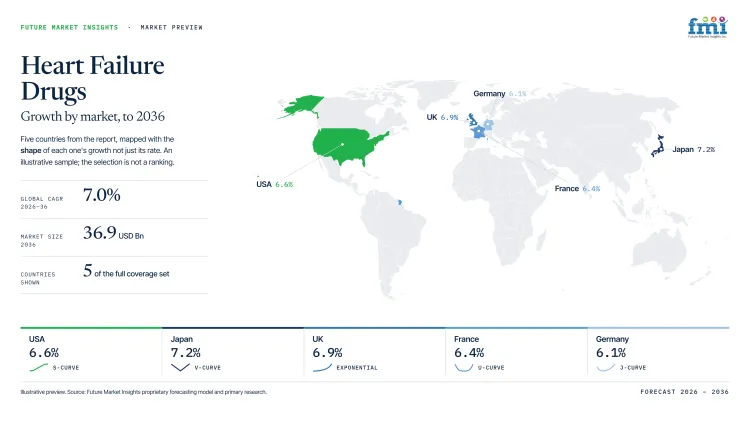
| Country | CAGR |
|---|---|
| Japan | 7.2% |
| United Kingdom | 6.9% |
| United States | 6.6% |
| France | 6.4% |
| Germany | 6.1% |
How do country-level CAGRs compare in the Heart Failure Drugs Market?
The 1.1 percentage-point range forms a narrow forecast band and does not measure current market size. Differences reflect reimbursement rules plus service capacity and treatment pathways that determine how quickly eligible patients begin multidrug therapy.
- Japan's rate reflects specialist pathways that centralize initiation and monitored dose adjustment within hospitals.
- The United Kingdom remains close because national guidance standardizes eligibility across integrated care systems with different service capacity.
- The United States reflects a large treated population alongside fragmented payer rules that delay complete regimen adoption.
- France combines national reimbursement with regional differences in hospitalization and outpatient treatment continuation.
- Germany reflects formal benefit assessment and price negotiation that lengthen access decisions for newly approved medicines.
Comparable CAGRs can produce different market entry conditions. The full report provides country-level CAGR analysis across North America, Latin America, Europe, East Asia, South Asia and Pacific, and the Middle East and Africa.
Country-wise Analysis
- Japanese cardiology services combine hospital initiation with national co-promotion support for Entresto across specialist referral networks that manage complex adult and pediatric cases. Otsuka and Novartis launched pediatric Entresto granules in May 2024, giving pharmacists two strengths that simplify weight-based dispensing and reduce manual tablet preparation. Adoption of heart failure drugs in Japan is estimated to expand at 7.2% CAGR through 2036, supported by local formulation access but constrained by specialist monitoring and prescription transfer into community care.
- United Kingdom prescribing follows national guidance that defines medicine combinations and monitoring duties across major ejection-fraction groups. Government cardiovascular profiles published in December 2025 recorded a 4.8-fold difference in heart failure admission rates between English local authorities, revealing uneven service pressure across integrated care systems. Heart failure drug demand in the United Kingdom is forecast to rise at 6.9% CAGR over the forecast period, supported by standardized eligibility but limited by local budget capacity and uneven follow-up resources.
- United States treatment spans four foundational classes across commercial plans and public insurance programs with different authorization rules. The American Heart Association reported in May 2025 that four-class use at discharge rose from 4.7% to 44.6% among more than 43,000 patients in a structured hospital initiative. The United States heart failure drugs sector is projected to record 6.6% CAGR during the assessment period, supported by a large treated population and constrained by payer fragmentation plus monitoring needs involving late-stage kidney therapeutics.
- French reimbursement gives hospital cardiology teams a defined route for continuing disease-modifying treatment across regional pharmacy and referral networks. Santé publique France reported in March 2025 that 1,376,692 adults had heart failure in 2022 and 181,178 adults were hospitalized, establishing a substantial pool for continuing treatment and cardiac rehabilitation services. Heart failure drug sales in France are forecast to expand at 6.4% CAGR by 2036, aided by national coverage but limited by regional hospitalization differences and incomplete outpatient regimen continuation.
- Germany routes new heart failure medicines through formal added-benefit assessment before national price negotiations within statutory insurance. The G-BA began its finerenone assessment in May 2026 for symptomatic chronic heart failure with LVEF of at least 40%, linking access to subgroup evidence and comparator selection. Germany is estimated to post 6.1% CAGR over the forecast period, supported by structured evaluation but limited by assessment timing and negotiated pricing before broader prescribing.
Who are the notable companies in the Heart Failure Drugs Market?
AstraZeneca PLC, Novartis AG, Boehringer Ingelheim International GmbH, Eli Lilly and Company, Bayer AG, Merck & Co., Inc., Lexicon Pharmaceuticals, Inc. and Otsuka Pharmaceutical Co., Ltd. are the notable companies serving this market.
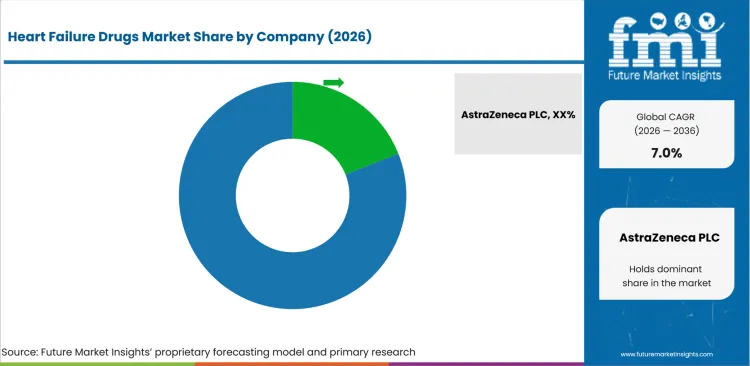
The competition is moderately concentrated around multinational franchises that hold broad labels and evidence across several heart failure populations. Smaller developers compete through a defined pathway or licensed territory, while entry depends on outcome data and formulary access. heart pump devices remain outside the drug boundary and become relevant only after medical management no longer provides adequate support.
- AstraZeneca PLC and the Boehringer Ingelheim-Eli Lilly alliance compete through broad SGLT2 evidence, while Lexicon Pharmaceuticals, Inc. adds dual SGLT1 and SGLT2 positioning.
- Novartis AG combines an established ARNI franchise with Otsuka Pharmaceutical Co., Ltd. for selected Japanese commercialization and formulation support.
- Bayer AG and Merck & Co., Inc. address defined populations through mineralocorticoid receptor and soluble guanylate cyclase pathways.
Competitive Benchmarking: Heart Failure Drugs Market
| Company | Direct Heart Failure Portfolio | Ejection-Fraction Evidence | Hospital and Outpatient Fit | Geographic Reach |
|---|---|---|---|---|
| AstraZeneca PLC | High | High | High | Global |
| Novartis AG | High | High | High | Global |
| Boehringer Ingelheim International GmbH | High | High | High | Global |
| Eli Lilly and Company | High | High | High | Global |
| Bayer AG | Medium | High | High | Global |
| Merck & Co., Inc. | Medium | High | Medium | Global |
| Lexicon Pharmaceuticals, Inc. | High | High | High | United States and licensed markets |
| Otsuka Pharmaceutical Co., Ltd. | Medium | Medium | Medium | Japan and selected Asian markets |
Key Developments in the Heart Failure Drugs Market
- In November 2025, Lexicon Pharmaceuticals, Inc. shipped the first commercial INPEFA order to Viatris for the United Arab Emirates following local approval. The shipment established the medicine's first commercial market outside the United States and activated a licensed regional distribution route for sotagliflozin.
- In August 2025, Merck & Co., Inc. reported completed Phase 3 VICTOR results in stable chronic HFrEF. The trial missed its primary endpoint, although the pooled VICTOR and VICTORIA analysis expanded the evidence considered for vericiguat across different disease severity.
- In July 2025, Bayer AG received FDA approval for finerenone in adults with heart failure and LVEF of at least 40%. The approval expanded direct treatment coverage across mildly reduced and preserved ejection-fraction populations under a new disease-modifying pathway.
Key Players in the Heart Failure Drugs Market
Broad Heart Failure Franchise Leaders
- AstraZeneca PLC
- Novartis AG
- Boehringer Ingelheim International GmbH
- Eli Lilly and Company
Defined-Pathway Heart Failure Specialists
- Bayer AG
- Merck & Co., Inc.
- Lexicon Pharmaceuticals, Inc.
Regional Heart Failure Commercial Platforms
- Otsuka Pharmaceutical Co., Ltd.
Heart Failure Drugs Market - Report Scope
| Coverage field | Report scope |
|---|---|
| Market breakdown | By drug class, indication, route of administration, distribution channel, end user and region. |
| Quantitative Units | Revenue in USD billion and CAGR in %. |
| Market Definition | Branded and generic prescription medicines used to treat heart failure or reduce heart failure events across approved drug classes, indications and care settings. |
| Regions Covered | North America, Latin America, Europe, East Asia, South Asia and Pacific, and Middle East and Africa. |
| Countries Covered | Japan, United Kingdom, United States, France, Germany, and 20+ countries included in the full report. |
| Key Companies Profiled | AstraZeneca PLC, Novartis AG, Boehringer Ingelheim International GmbH, Eli Lilly and Company, Bayer AG, Merck & Co., Inc., Lexicon Pharmaceuticals, Inc. and Otsuka Pharmaceutical Co., Ltd. |
| Forecast Period | 2026 to 2036. |
| Approach | Primary and secondary research with market triangulation. |
Heart Failure Drugs Market - Research Methodology
| Method | Approach |
|---|---|
| Primary Research | FMI analysts gathered input from manufacturers, service providers, technology developers, distributors, end users, procurement teams, and subject-matter experts. Interviews examined purchasing decisions, product or service evaluation, adoption barriers, approval requirements, pricing considerations, and expectations for technical or commercial support. Respondents were also asked what evidence is required before a trial, pilot, or initial order develops into regular purchasing. |
| Desk Research | Desk research covered government statistics, regulatory publications, trade data, industry associations, technical literature, standards, company filings, product information, and official corporate announcements. Sources were reviewed for relevance, publication date, geographic coverage, and consistency with the defined market scope. Claims relating to performance, applications, approvals, capacity, investment, and commercial activity were retained only when supported by credible public evidence. |
| Market Sizing and Forecasting | The market model combined the baseline value with historical performance, segment structure, pricing and volume indicators, adoption levels, company participation, and country-level demand conditions. Forecast assumptions considered economic activity, investment trends, regulatory developments, technology adoption, purchasing cycles, supply availability, and barriers to wider market use. Segment and regional estimates were reconciled before the final market total was calculated. |
| Data Validation | Estimates were checked against multiple independent indicators, including public data, company activity, trade patterns, industry developments, and findings from primary interviews. Validation also tested whether products, services, applications, and company revenues fell within the defined market boundaries. Adjacent categories, unsupported claims, overlapping revenues, and activities without direct market relevance were excluded to reduce double counting and maintain consistency across segments and countries. |
Heart Failure Drugs Market by Segments
Heart Failure Drugs Market segmented by Drug Class:
- SGLT2 Inhibitors
- Dapagliflozin
- Empagliflozin
- Sotagliflozin
- ARNI
- Angiotensin Receptor-Neprilysin Inhibitors
- Sacubitril-Valsartan
- Next-generation ARNI
- Beta Blockers
- Carvedilol
- Metoprolol Succinate
- Bisoprolol
- Other Heart Failure Drugs
- ACE Inhibitors
- Angiotensin Receptor Blockers
- Mineralocorticoid Receptor Antagonists
Heart Failure Drugs Market segmented by Indication:
- Heart Failure with Reduced Ejection Fraction
- Chronic HFrEF
- Acute Decompensated HFrEF
- Post-myocardial Infarction Heart Failure
- Heart Failure with Preserved Ejection Fraction
- Chronic HFpEF
- Elderly HFpEF Patients
- Hypertensive HFpEF
- Acute Heart Failure
- Hospitalized Patients
- Cardiogenic Shock
- Intensive Care Management
Heart Failure Drugs Market segmented by Route of Administration:
- Oral
- Tablets
- Capsules
- Extended-release Formulations
- Injectable
- Intravenous Infusion
- Subcutaneous Injection
- Hospital-administered Therapy
- Combination Therapy
- Fixed-dose Combinations
- Multi-drug Regimens
- Personalized Therapy
Heart Failure Drugs Market segmented by Distribution Channel:
- Hospital Pharmacies
- Inpatient Pharmacies
- Outpatient Hospital Pharmacies
- Cardiac Care Centers
- Retail Pharmacies
- Chain Pharmacies
- Independent Pharmacies
- Cardiology-focused Pharmacies
- Online Pharmacies
- E-prescription Platforms
- Home Delivery Services
- Digital Pharmacy Services
Heart Failure Drugs Market segmented by End User:
- Hospitals
- Cardiology Departments
- Tertiary Care Hospitals
- Academic Medical Centers
- Specialty Cardiac Clinics
- Heart Failure Clinics
- Cardiology Clinics
- Outpatient Cardiac Centers
- Home Healthcare
- Remote Patient Management
- Long-term Drug Therapy
- Elderly Care Services
Heart Failure Drugs Market by Region:
- North America
- United States
- Canada
- Mexico
- Latin America
- Brazil
- Chile
- Rest of Latin America
- Western Europe
- Germany
- United Kingdom
- Italy
- Spain
- France
- Nordics
- Benelux
- Rest of Western Europe
- Eastern Europe
- Russia
- Poland
- Hungary
- Balkan and Baltic States
- Rest of Eastern Europe
- East Asia
- China
- Japan
- South Korea
- South Asia and Pacific
- India
- ASEAN
- Australia and New Zealand
- Rest of South Asia and Pacific
- Middle East and Africa
- Kingdom of Saudi Arabia
- Other GCC Countries
- Türkiye
- South Africa
- Other African Union Countries
- Rest of Middle East and Africa
Research Sources and Bibliography
- American College of Cardiology. (2024, March 8). ACC Expert Consensus for Treatment of HFrEF: Key Points.
- Heart Failure Society of America. (2025, September 22). HF Stats 2025: Heart Failure Epidemiology and Outcomes Statistics.
- USA Food and Drug Administration. (2026, April 7). FDA Approves First Generic Dapagliflozin Tablets.
- American College of Cardiology. (2024, August 8). New Expert Consensus Decision Pathway Updates Guidance on HF Management, Treatment.
- National Institute for Health and Care Excellence. (2025, September 3). Chronic heart failure in adults: diagnosis and management.
- Otsuka Pharmaceutical Co., Ltd. (2024, May 22). Novartis launches Entresto® Granular Tablets for Pediatric Use, a formulation dedicated for pediatric patients.
- Office for Health Improvement and Disparities. (2025, December 2). Cardiovascular disease profiles: short statistical commentary.
- American Heart Association. (2025, May 2). Large-scale heart failure initiative boosts use of lifesaving medications.
- Santé publique France. (2025, March 4). Epidemiology of Heart Failure in France.
- Gemeinsamer Bundesausschuss. (2026, August 3). Nutzenbewertungsverfahren zum Wirkstoff Finerenon (Neues Anwendungsgebiet: Chronische Herzinsuffizienz mit linksventrikulärer Ejektionsfraktion LVEF > 40 %).
- AstraZeneca PLC. (2026, February 24). Annual Report and Form 20-F Information 2025.
- Eli Lilly and Company. (2024, April 6). Results announced from EMPACT-MI phase III trial investigating the effect of Jardiance® (empagliflozin) on risk of heart failure hospitalization and death in adults following a heart attack.
- Lexicon Pharmaceuticals, Inc. (2025, November 6). Lexicon Pharmaceuticals Reports Third Quarter 2025 Financial Results and Provides R&D Updates.
- Merck & Co., Inc. (2025, August 30). Merck Provides New Results for VERQUVO® (vericiguat) in Patients with Chronic Heart Failure and Reduced Ejection Fraction.
- Bayer AG. (2025, July 14). USA FDA Approves Finerenone for New Indication in Patients with Heart Failure with Left Ventricular Ejection Fraction of ≥ 40%.
This bibliography is provided for reader reference and is not exhaustive. The full report contains the complete reference list and detailed citations
This Report Answers
- How large is the Heart Failure Drugs Market in 2026 and 2036?
- How do guideline changes alter the treated population for heart failure drugs?
- Why do SGLT2 inhibitors hold the leading drug class share in 2026?
- How do oral medicines and hospital pharmacies shape treatment continuity?
- How do reimbursement rules change entry conditions across the profiled countries?
- Which clinical barriers slow complete guideline-directed regimen adoption?
- How do verified companies differ across portfolio breadth and care-setting fit?
- Where do generic entry and discharge support change commercial access?
Frequently Asked Questions
How big is the Heart Failure Drugs Market in 2026?
The heart failure drugs market is estimated at USD 18.8 billion in 2026. Growth is supported by increasing adoption of guideline-directed therapies and improved treatment access across hospital and outpatient settings.
What is the CAGR of the Heart Failure Drugs Market from 2026 to 2036?
The heart failure drugs market is projected to grow at a CAGR of 7.0% between 2026 and 2036. The market is expected to reach USD 37.0 billion by 2036, driven by broader use of disease-modifying therapies and better long-term patient management.
Which drug class is projected to account for 31.0% of the Heart Failure Drugs Market?
SGLT2 inhibitors are projected to account for 31.0% of the market in 2026. Their leading share reflects strong guideline recommendations and growing use across multiple heart failure patient populations.
Which indication is projected to account for 54.0% of the Heart Failure Drugs Market?
HFrEF is projected to account for 54.0% of the market by indication in 2026. Its dominance is supported by well-established treatment pathways and widespread adoption of combination drug therapies.
Which companies are active in the Heart Failure Drugs Market?
Companies such as AstraZeneca PLC, Novartis AG, Boehringer Ingelheim International GmbH, Eli Lilly and Company, Bayer AG, Merck & Co., Inc., Lexicon Pharmaceuticals, Inc. and Otsuka Pharmaceutical Co., Ltd. span broad franchises plus defined pathways and regional commercialization.
Preview the report firsthand - request a free sample
Get SampleGet the brochure for pricing and purchase details.
Get PDFTable of Content
- Key Takeaways
- Market Size and CAGR
- Top Growth Driver
- Fastest Growing Segment
- Leading Region
- Key Companies
- Emerging Opportunities
- Executive Summary
- Global Market Outlook
- Demand-side Trends
- Supply-side Trends
- Technology Roadmap Analysis
- Analysis and Recommendations
- Analyst Perspective (What is happening? Why now? What should investors know?)
- Key Questions Answered
- How large is the market?
- What is the CAGR?
- What are key trends?
- Which region dominates?
- Who are the leaders?
- Market Overview
- Market Coverage / Taxonomy
- Market Definition / Scope / Limitations
- Research Methodology
- Chapter Orientation
- Analytical Lens and Working Hypotheses
- Market Structure, Signals, and Trend Drivers
- Benchmarking and Cross-market Comparability
- Market Sizing, Forecasting, and Opportunity Mapping
- Research Design and Evidence Framework
- Desk Research Programme (Secondary Evidence)
- Expert Input and Fieldwork (Primary Evidence)
- Tooling, Models, and Reference Databases
- Data Engineering and Model Build
- Quality Assurance and Audit Trail
- Market Background
- Market Dynamics (Drivers, Restraints, Opportunity, Trends)
- Scenario Forecast (Optimistic, Likely, Conservative)
- Impact Analysis
- AI Impact
- Sustainability Impact
- Regulatory Impact
- Technology Impact
- Consumer / Buyer Analysis
- Purchase Drivers
- Adoption Barriers
- Buyer Journey
- Opportunity Map Analysis
- Product Life Cycle Analysis
- Supply Chain Analysis
- Investment Feasibility Matrix
- Value Chain Analysis
- PESTLE and Porter's Analysis
- Regulatory Landscape
- Regional Parent Market Outlook
- Production and Consumption Statistics
- Import and Export Statistics
- Global Market Analysis and Forecast, 2021 to 2036
- Historical Market Size Value (USD Billion) Analysis, 2021 to 2025
- Current and Future Market Size Value (USD Billion) Projections, 2026 to 2036
- Y-o-Y Growth Trend Analysis
- Absolute $ Opportunity Analysis
- Global Market Pricing Analysis, 2021 to 2036
- Global Market Analysis and Forecast, By Drug Class, 2021 to 2036
- Introduction / Key Findings
- Historical Market Size Value (USD Billion) Analysis By Drug Class, 2021 to 2025
- Current and Future Market Size Value (USD Billion) Analysis and Forecast By Drug Class, 2026 to 2036
- SGLT2 Inhibitors
- Dapagliflozin
- Empagliflozin
- Sotagliflozin
- ARNI
- Angiotensin Receptor-Neprilysin Inhibitors
- Sacubitril-Valsartan
- Next-generation ARNI
- Beta Blockers
- Carvedilol
- Metoprolol Succinate
- Bisoprolol
- Other Heart Failure Drugs
- ACE Inhibitors
- Angiotensin Receptor Blockers
- Mineralocorticoid Receptor Antagonists
- SGLT2 Inhibitors
- Y-o-Y Growth Trend Analysis By Drug Class, 2021 to 2025
- Absolute $ Opportunity Analysis By Drug Class, 2026 to 2036
- Global Market Analysis and Forecast, By Indication, 2021 to 2036
- Introduction / Key Findings
- Historical Market Size Value (USD Billion) Analysis By Indication, 2021 to 2025
- Current and Future Market Size Value (USD Billion) Analysis and Forecast By Indication, 2026 to 2036
- Heart Failure with Reduced Ejection Fraction
- Chronic HFrEF
- Acute Decompensated HFrEF
- Post-myocardial Infarction Heart Failure
- Heart Failure with Preserved Ejection Fraction
- Chronic HFpEF
- Elderly HFpEF Patients
- Hypertensive HFpEF
- Acute Heart Failure
- Hospitalized Patients
- Cardiogenic Shock
- Intensive Care Management
- Heart Failure with Reduced Ejection Fraction
- Y-o-Y Growth Trend Analysis By Indication, 2021 to 2025
- Absolute $ Opportunity Analysis By Indication, 2026 to 2036
- Global Market Analysis and Forecast, By Route of Administration, 2021 to 2036
- Introduction / Key Findings
- Historical Market Size Value (USD Billion) Analysis By Route of Administration, 2021 to 2025
- Current and Future Market Size Value (USD Billion) Analysis and Forecast By Route of Administration, 2026 to 2036
- Oral
- Tablets
- Capsules
- Extended-release Formulations
- Injectable
- Intravenous Infusion
- Subcutaneous Injection
- Hospital-administered Therapy
- Combination Therapy
- Fixed-dose Combinations
- Multi-drug Regimens
- Personalized Therapy
- Oral
- Y-o-Y Growth Trend Analysis By Route of Administration, 2021 to 2025
- Absolute $ Opportunity Analysis By Route of Administration, 2026 to 2036
- Global Market Analysis and Forecast, By Distribution Channel, 2021 to 2036
- Introduction / Key Findings
- Historical Market Size Value (USD Billion) Analysis By Distribution Channel, 2021 to 2025
- Current and Future Market Size Value (USD Billion) Analysis and Forecast By Distribution Channel, 2026 to 2036
- Hospital Pharmacies
- Inpatient Pharmacies
- Outpatient Hospital Pharmacies
- Cardiac Care Centers
- Retail Pharmacies
- Chain Pharmacies
- Independent Pharmacies
- Cardiology-focused Pharmacies
- Online Pharmacies
- E-prescription Platforms
- Home Delivery Services
- Digital Pharmacy Services
- Hospital Pharmacies
- Y-o-Y Growth Trend Analysis By Distribution Channel, 2021 to 2025
- Absolute $ Opportunity Analysis By Distribution Channel, 2026 to 2036
- Global Market Analysis and Forecast, By End User, 2021 to 2036
- Introduction / Key Findings
- Historical Market Size Value (USD Billion) Analysis By End User, 2021 to 2025
- Current and Future Market Size Value (USD Billion) Analysis and Forecast By End User, 2026 to 2036
- Hospitals
- Cardiology Departments
- Tertiary Care Hospitals
- Academic Medical Centers
- Specialty Cardiac Clinics
- Heart Failure Clinics
- Cardiology Clinics
- Outpatient Cardiac Centers
- Home Healthcare
- Remote Patient Management
- Long-term Drug Therapy
- Elderly Care Services
- Hospitals
- Y-o-Y Growth Trend Analysis By End User, 2021 to 2025
- Absolute $ Opportunity Analysis By End User, 2026 to 2036
- Global Market Analysis and Forecast, By Region, 2021 to 2036
- Introduction
- Historical Market Size Value (USD Billion) Analysis By Region, 2021 to 2025
- Current Market Size Value (USD Billion) Analysis and Forecast By Region, 2026 to 2036
- North America
- Latin America
- Western Europe
- Eastern Europe
- East Asia
- South Asia and Pacific
- Middle East & Africa
- Market Attractiveness Analysis By Region
- North America Market Analysis and Forecast, By Country, 2021 to 2036
- Historical Market Size Value (USD Billion) Trend Analysis By Market Taxonomy, 2021 to 2025
- Market Size Value (USD Billion) Forecast By Market Taxonomy, 2026 to 2036
- By Country
- USA
- Canada
- By Drug Class
- By Indication
- By Route of Administration
- By Distribution Channel
- By End User
- By Country
- Market Attractiveness Analysis
- By Country
- By Drug Class
- By Indication
- By Route of Administration
- By Distribution Channel
- By End User
- Key Takeaways
- Latin America Market Analysis and Forecast, By Country
- Historical Market Size Value (USD Billion) Trend Analysis By Market Taxonomy, 2021 to 2025
- Market Size Value (USD Billion) Forecast By Market Taxonomy, 2026 to 2036
- By Country
- Brazil
- Mexico
- Chile
- Rest of Latin America
- By Drug Class
- By Indication
- By Route of Administration
- By Distribution Channel
- By End User
- By Country
- Market Attractiveness Analysis
- By Country
- By Drug Class
- By Indication
- By Route of Administration
- By Distribution Channel
- By End User
- Key Takeaways
- Western Europe Market Analysis and Forecast, By Country
- Historical Market Size Value (USD Billion) Trend Analysis By Market Taxonomy, 2021 to 2025
- Market Size Value (USD Billion) Forecast By Market Taxonomy, 2026 to 2036
- By Country
- Germany
- UK
- Italy
- Spain
- France
- Nordic
- BENELUX
- Rest of Western Europe
- By Drug Class
- By Indication
- By Route of Administration
- By Distribution Channel
- By End User
- By Country
- Market Attractiveness Analysis
- By Country
- By Drug Class
- By Indication
- By Route of Administration
- By Distribution Channel
- By End User
- Key Takeaways
- Eastern Europe Market Analysis and Forecast, By Country
- Historical Market Size Value (USD Billion) Trend Analysis By Market Taxonomy, 2021 to 2025
- Market Size Value (USD Billion) Forecast By Market Taxonomy, 2026 to 2036
- By Country
- Russia
- Poland
- Hungary
- Balkan & Baltic
- Rest of Eastern Europe
- By Drug Class
- By Indication
- By Route of Administration
- By Distribution Channel
- By End User
- By Country
- Market Attractiveness Analysis
- By Country
- By Drug Class
- By Indication
- By Route of Administration
- By Distribution Channel
- By End User
- Key Takeaways
- East Asia Market Analysis and Forecast, By Country
- Historical Market Size Value (USD Billion) Trend Analysis By Market Taxonomy, 2021 to 2025
- Market Size Value (USD Billion) Forecast By Market Taxonomy, 2026 to 2036
- By Country
- China
- Japan
- South Korea
- By Drug Class
- By Indication
- By Route of Administration
- By Distribution Channel
- By End User
- By Country
- Market Attractiveness Analysis
- By Country
- By Drug Class
- By Indication
- By Route of Administration
- By Distribution Channel
- By End User
- Key Takeaways
- South Asia and Pacific Market Analysis and Forecast, By Country
- Historical Market Size Value (USD Billion) Trend Analysis By Market Taxonomy, 2021 to 2025
- Market Size Value (USD Billion) Forecast By Market Taxonomy, 2026 to 2036
- By Country
- India
- ASEAN
- Australia & New Zealand
- Rest of South Asia and Pacific
- By Drug Class
- By Indication
- By Route of Administration
- By Distribution Channel
- By End User
- By Country
- Market Attractiveness Analysis
- By Country
- By Drug Class
- By Indication
- By Route of Administration
- By Distribution Channel
- By End User
- Key Takeaways
- Middle East & Africa Market Analysis and Forecast, By Country
- Historical Market Size Value (USD Billion) Trend Analysis By Market Taxonomy, 2021 to 2025
- Market Size Value (USD Billion) Forecast By Market Taxonomy, 2026 to 2036
- By Country
- Kingdom of Saudi Arabia
- Other GCC Countries
- Türkiye
- South Africa
- Other African Union
- Rest of Middle East & Africa
- By Drug Class
- By Indication
- By Route of Administration
- By Distribution Channel
- By End User
- By Country
- Market Attractiveness Analysis
- By Country
- By Drug Class
- By Indication
- By Route of Administration
- By Distribution Channel
- By End User
- Key Takeaways
- Key Countries Market Analysis
- USA
- Pricing Analysis
- Market Share Analysis, 2025
- By Drug Class
- By Indication
- By Route of Administration
- By Distribution Channel
- By End User
- Canada
- Pricing Analysis
- Market Share Analysis, 2025
- By Drug Class
- By Indication
- By Route of Administration
- By Distribution Channel
- By End User
- Mexico
- Pricing Analysis
- Market Share Analysis, 2025
- By Drug Class
- By Indication
- By Route of Administration
- By Distribution Channel
- By End User
- Brazil
- Pricing Analysis
- Market Share Analysis, 2025
- By Drug Class
- By Indication
- By Route of Administration
- By Distribution Channel
- By End User
- Chile
- Pricing Analysis
- Market Share Analysis, 2025
- By Drug Class
- By Indication
- By Route of Administration
- By Distribution Channel
- By End User
- Germany
- Pricing Analysis
- Market Share Analysis, 2025
- By Drug Class
- By Indication
- By Route of Administration
- By Distribution Channel
- By End User
- UK
- Pricing Analysis
- Market Share Analysis, 2025
- By Drug Class
- By Indication
- By Route of Administration
- By Distribution Channel
- By End User
- Italy
- Pricing Analysis
- Market Share Analysis, 2025
- By Drug Class
- By Indication
- By Route of Administration
- By Distribution Channel
- By End User
- Spain
- Pricing Analysis
- Market Share Analysis, 2025
- By Drug Class
- By Indication
- By Route of Administration
- By Distribution Channel
- By End User
- France
- Pricing Analysis
- Market Share Analysis, 2025
- By Drug Class
- By Indication
- By Route of Administration
- By Distribution Channel
- By End User
- India
- Pricing Analysis
- Market Share Analysis, 2025
- By Drug Class
- By Indication
- By Route of Administration
- By Distribution Channel
- By End User
- ASEAN
- Pricing Analysis
- Market Share Analysis, 2025
- By Drug Class
- By Indication
- By Route of Administration
- By Distribution Channel
- By End User
- Australia & New Zealand
- Pricing Analysis
- Market Share Analysis, 2025
- By Drug Class
- By Indication
- By Route of Administration
- By Distribution Channel
- By End User
- China
- Pricing Analysis
- Market Share Analysis, 2025
- By Drug Class
- By Indication
- By Route of Administration
- By Distribution Channel
- By End User
- Japan
- Pricing Analysis
- Market Share Analysis, 2025
- By Drug Class
- By Indication
- By Route of Administration
- By Distribution Channel
- By End User
- South Korea
- Pricing Analysis
- Market Share Analysis, 2025
- By Drug Class
- By Indication
- By Route of Administration
- By Distribution Channel
- By End User
- Russia
- Pricing Analysis
- Market Share Analysis, 2025
- By Drug Class
- By Indication
- By Route of Administration
- By Distribution Channel
- By End User
- Poland
- Pricing Analysis
- Market Share Analysis, 2025
- By Drug Class
- By Indication
- By Route of Administration
- By Distribution Channel
- By End User
- Hungary
- Pricing Analysis
- Market Share Analysis, 2025
- By Drug Class
- By Indication
- By Route of Administration
- By Distribution Channel
- By End User
- Kingdom of Saudi Arabia
- Pricing Analysis
- Market Share Analysis, 2025
- By Drug Class
- By Indication
- By Route of Administration
- By Distribution Channel
- By End User
- Türkiye
- Pricing Analysis
- Market Share Analysis, 2025
- By Drug Class
- By Indication
- By Route of Administration
- By Distribution Channel
- By End User
- South Africa
- Pricing Analysis
- Market Share Analysis, 2025
- By Drug Class
- By Indication
- By Route of Administration
- By Distribution Channel
- By End User
- USA
- Market Structure Analysis
- Competition Dashboard
- Competition Benchmarking
- Market Share Analysis of Top Players
- By Regional
- By Drug Class
- By Indication
- By Route of Administration
- By Distribution Channel
- By End User
- Emerging Startups
- Innovation Benchmarking
- Competition Analysis
- Competition Deep Dive
- AstraZeneca PLC
- Overview
- Product Portfolio
- Profitability by Market Segments
- Sales Footprint
- Strategy Overview
- Marketing Strategy
- Product Strategy
- Channel Strategy
- Novartis AG
- Boehringer Ingelheim International GmbH
- Eli Lilly and Company
- Bayer AG
- Pfizer Inc.
- Merck & Co., Inc.
- Bristol Myers Squibb
- Johnson & Johnson
- Otsuka Pharmaceutical Co., Ltd.
- AstraZeneca PLC
- Case Studies
- Success Stories
- Recent Developments
- Competition Deep Dive
- Assumptions & Acronyms Used


