

- Industry Size (2026)
- USD 2400.0 Mn
- Forecast (2036)
- USD 5200.0 Mn
- CAGR (2026 to 2036)
- 8.0%
Heart Failure Biomarker Market Size, Market Forecast and Outlook By FMI
In 2026, the heart failure biomarker market was valued at USD 2,400.0 million. Based on Future Market Insights analysis, demand for heart failure biomarkers is estimated to grow to USD 5,200.0 million by 2036. FMI projects a CAGR of 8.0% during the forecast period.
Absolute dollar growth of USD 2,800.0 million over the decade signals structural expansion rather than a routine assay refresh. As per FMI, growth is expected to be supported by wider BNP/NT-proBNP use in emergency triage and inpatient management, while reimbursement controls and lab capacity constraints are expected to keep adoption paced across lower-resource settings. "We are extremely pleased that the FDA has granted Fast Track designation for VS-041, This designation reinforces the potential of VS-041 to address a serious unmet medical need with a novel mechanism of action that targets the underlying pathophysiology of HFpEF. It also supports the opportunity to establish a precision medicine paradigm in diagnosis and treatment of HFpEF by utilizing an emerging biomarker. We look forward to working closely with the FDA as we advance VS-041 through clinical development."[1]
Summary of Heart Failure Biomarker Market
- Heart Failure Biomarker Market Definition:
- This study covers in IVD biomarker tests used to support heart failure diagnosis, risk stratification, therapy monitoring, and prognosis workflows across central laboratories and point-of-care settings.
- Demand Drivers in the Market:
- Emergency and inpatient pathways are using biomarkers to rule-in or rule-out heart failure faster, reducing time to treatment decisions.
- Hospital systems are expanding risk stratification and monitoring to reduce avoidable readmissions, increasing repeat testing frequency.
- Routine adoption of cardiac panels in high-volume labs is sustaining steady reagent pull-through in central immunoassay workflows.
- Key Segments Analyzed in the FMI Report:
- By Biomarker Type: BNP/NT-proBNP leads at 46% share in 2026, followed by high-sensitivity troponin at 16% share.
- By Test Format: central lab immunoassay leads at 58% share in 2026, followed by point-of-care immunoassay at 24% share.
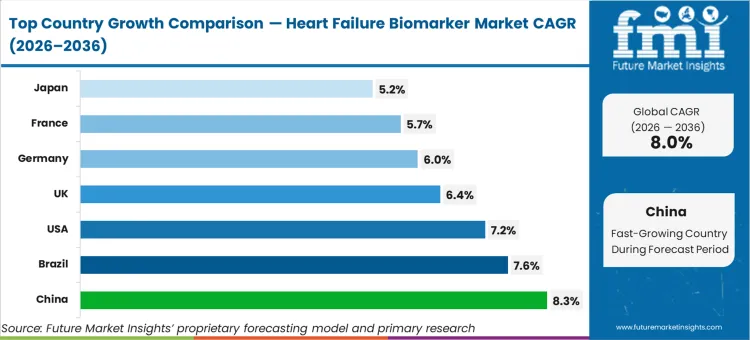
- Geography: China and Brazil show the fastest growth at 8.3% and 7.6% CAGR, supported by expanding diagnostic capacity and higher cardiovascular testing volumes.
- Analyst Opinion at FMI:
- Sabyasachi Ghosh, Principal Consultant at Future Market Insights, opines, ‘Preference is being shaped by assay standardization, turn-around reliability, and clinical pathway fit, since adoption depends on whether biomarker results can be acted on within ED and inpatient decision windows.’
- Strategic Implications and Executive Takeaways:
- Protect BNP/NT-proBNP leadership with consistent assay performance and broad analyzer compatibility to lock in hospital protocols.
- Strengthen central lab immunoassay positioning with throughput-driven automation and service coverage that protects turnaround time.
- Expand point-of-care placements in urgent care and clinics where faster triage improves patient routing and reduces downstream congestion.
- Methodology:
- As per FMI, a bottom-up approach as well as a Top-down methodology was calculated to do the market sizing and splits, which were triangulated using company revenue sales, product mapping, and target revenue sales.
- Segment shares were validated by linking clinical use cases to test format adoption and sample-type handling practices across settings.
- Sensitivity checks were run across biomarker mix and central lab versus point-of-care deployment to confirm revenue movement under realistic adoption shifts.
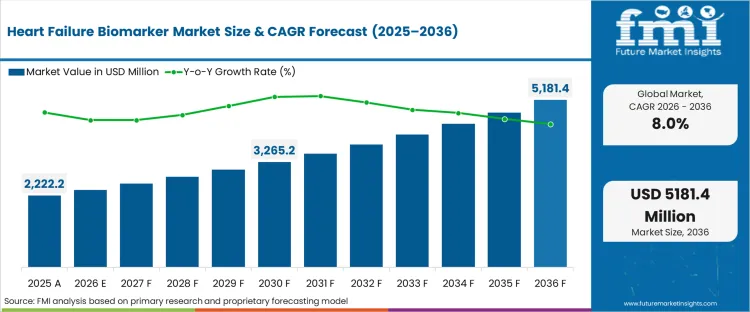
Governmental regulatory approvals and adherence to national laboratory standards are also shaping purchasing decisions, as buyers are focusing on assays that have fulfilled government-approved performance standards. Purchasing decisions are also being shaped by standardization of cardiology and emergency department algorithms, as buyers are focusing on the ability of assays to be comparable across platforms, consistent turnaround times, and reagent standardization to prevent disruptions in high-volume testing. Multi-year reagent contracts are being utilized to standardize per-test costs, while device location strategies are being aligned with central lab capacity and point-of-care needs.
China (8.3% CAGR, supported by rising cardiometabolic burden and expanded hospital testing) and Brazil (7.6% CAGR, driven by growth in emergency and hospital diagnostics) are expected to lead growth. The U.S. (7.2% CAGR) is expected to expand through protocolised testing and readmission management focus. Mature markets including the UK (6.4%), Germany (6.0%), France (5.7%), and Japan (5.2%) are expected to contribute more through replacement and guideline-driven utilisation, constrained by budget governance and platform verification workload.
Heart Failure Biomarker Market Definition
The market includes in vitro diagnostic tests for the detection and monitoring of biomarkers that support the diagnosis, triage, risk assessment, and monitoring of therapy in heart failure. The market includes BNP/NT-proBNP tests and other biomarkers such as high-sensitivity troponin, ST2, galectin-3, MR-proADM, and multi-biomarker panels, which are provided by immunoassay systems for central laboratory testing, point-of-care systems, and multiplex platforms. The tests are conducted using serum/plasma, whole blood, urine, and other types of samples in hospital, reference laboratory, and clinic settings, and selected home or remote monitoring settings. The market is driven by emergency triage requirements, pathway standardization, and the reduction of readmissions.
Heart Failure Biomarker Market Inclusions
The report includes global and regional market sizes and a 10-year forecast for 2026 to 2036. Segment-level sizing is provided by biomarker type, test format, clinical use, sample, and end user, with country-level CAGR comparisons across major markets. Coverage includes assessment of protocol adoption in emergency and cardiology pathways, procurement dynamics in central lab versus point-of-care placements, and competitive positioning of leading assay and platform suppliers, as per FMI analysis.
Heart Failure Biomarker Market Exclusions
The scope excludes imaging diagnostics such as echocardiography and cardiac MRI, as well as therapeutic drug products used to treat heart failure. It also omits hospital service revenue, procedure fees, and broader cardiometabolic lab testing not used for heart failure pathways. Consumer wellness monitoring devices and non-clinical screening tools are excluded. The focus remains on clinical biomarker assays and platforms aligned to the stated biomarker types, test formats, clinical uses, samples, and end users.
Heart Failure Biomarker Market Research Methodology
- Primary Research: Interviews were conducted with cardiology clinicians, emergency department stakeholders, laboratory directors, procurement teams, and diagnostic suppliers to validate pathway use, placement decisions, and assay selection criteria.
- Desk Research: Public information was reviewed from regulators, public health systems, professional societies, peer-reviewed literature, and company primary disclosures to benchmark guideline use and assay performance considerations.
- Market-Sizing and Forecasting: A hybrid model was applied using country-level testing volume logic by clinical use and end user, then reconciled using segment shares across biomarker type, format, and sample.
- Data Validation and Update Cycle: Outputs were checked through internal consistency screening across segment totals and country growth rates, with variance review applied prior to release.
Segmental Analysis
Heart Failure Biomarker Market Analysis by Biomarker Type
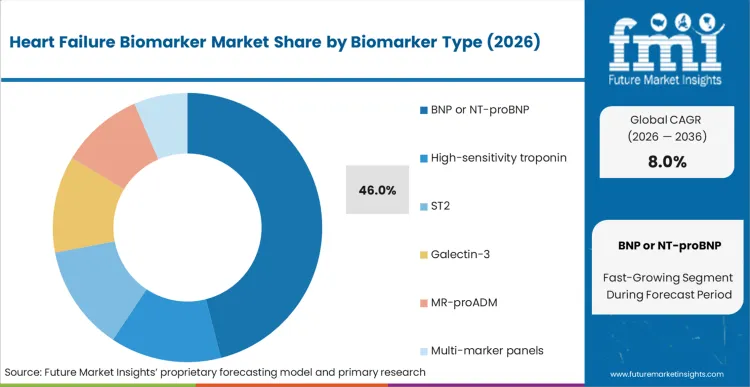
Based on FMI’s report, BNP/NT-proBNP is estimated to hold 46% share in 2026, followed by high-sensitivity troponin at 16% share. BNP/NT-proBNP leads because it is routinely embedded in diagnosis and triage pathways, with repeat use in monitoring and readmission management programs. High-sensitivity troponin follows due to overlap with acute care chest-pain pathways and broader cardiovascular workups, which sustains steady testing even when it is not exclusive to heart failure.
- Guideline-backed BNP/NT-proBNP dominance: BNP and NT-proBNP are described as the gold-standard HF biomarkers and are recommended by major guidelines to help rule out and diagnose HF using defined cut-offs, which drives routine ordering and keeps them the highest-volume biomarker tests in HF care.[2]
- NT-proBNP is a first-line biomarker for HF diagnosis and monitoring: NT-proBNP rises when the heart is under wall stress, so it is widely used to diagnose HF, distinguish cardiac vs non-cardiac breathlessness, and track prognosis/therapy response through repeat measurements in routine clinical lab workflows.[3]
- Broad clinical utility across settings keeps volumes high: BNP/NT-proBNP testing fits emergency triage, inpatient management, and outpatient follow-up, so the same assay is repeatedly used across the whole care pathway, sustaining the highest overall test demand versus narrower, event-specific biomarkers.
Heart Failure Biomarker Market Analysis by Test Format
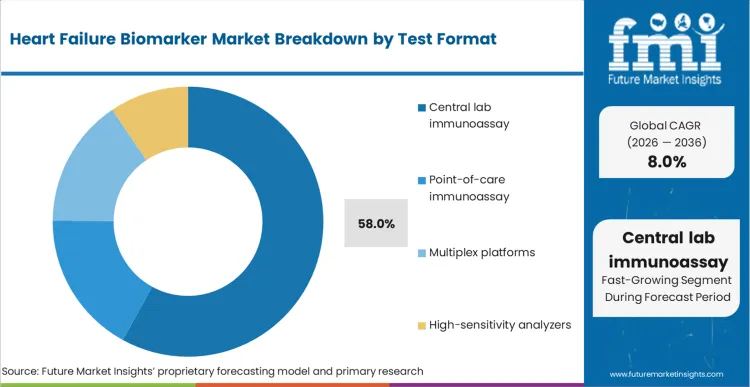
The market share of central lab immunoassay is 58% in 2026, followed by point-of-care immunoassay with 24% market share, according to the report by FMI. The dominance of central labs can be attributed to their higher volume, strict QC practices, and economies of scale, which are well-suited for hospital-wide ordering. Point-of-care immunoassay is driven by regions where rapid triage is emphasized, and results are required within short decision times.
- Scale efficiency and cost optimization: Central laboratory immunoassay platforms process large daily volumes on fully automated analyzers, which lowers cost per test and supports hospital-wide ordering of BNP/NT-proBNP and troponin assays more efficiently than decentralized formats.[4]
- Improved quality governance and standardization: Core labs have defined quality control processes, calibration, and accreditation requirements that promote analytical consistency and reproducibility, which are critical factors in maintaining large-volume heart failure biomarker testing in centralized facilities.
- Menu integration and clinical workflow optimization: Immunoassay analyzers in central labs enable the simultaneous testing of heart failure biomarkers (BNP/NT-proBNP, troponin) with other chemistry and immunoassay analytes on the same platform, facilitating integrated reporting and streamlined workflow integration with hospital diagnostic operations.
Heart Failure Biomarker Market Drivers, Restraints, And Opportunities
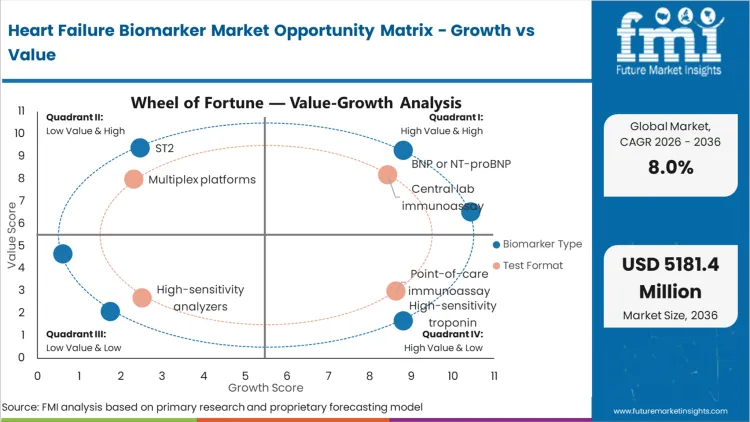
Future Market Insights analysis that historical patterns point at a protocol-driven diagnostics category where demand is anchored in emergency triage, inpatient decision-making, and chronic heart failure monitoring. Current demand is being shaped by hospital readmission reduction focus and the need to act on biomarker results within defined clinical decision windows, as per FMI.
While growth is being restrained by reimbursement discipline, assay standardization requirements, and variability in point-of-care deployment readiness, value expansion is being supported by rising test frequency in monitoring pathways and broader adoption of structured risk stratification programs. Based on FMI’s report, purchasing decisions are increasingly being filtered by analyzer compatibility, turnaround reliability, and supply continuity rather than by test price alone.
- Protocol-Led Adoption: Growth is being sustained where ED and inpatient pathways standardize biomarker ordering for faster diagnosis and triage.
- Implementation Pacing Restraint: POC scale-up is slowed by training needs, cartridge cost pressure, and connectivity requirements.
- Monitoring Expansion Mechanism: Repeat testing for therapy monitoring and readmission risk management is increasing volumes in hospital-led programs.
Regional Analysis
Based on the regional analysis, heart failure biomarker market is segmented into North America, Latin America, East Asia, South Asia & Pacific, Western Europe, Eastern Europe and Middle East & Africa across 40+ countries. Regional performance is interpreted through ED triage protocols, central lab immunoassay adoption, and penetration of BNP or NT-proBNP testing in hospitals and reference laboratories, as per FMI. The full report also offers market attractiveness analysis based on regional trends.
.webp "Top Country Growth Comparison Heart Failure Biomarker Market Cagr (2026 2036)")
| Country | CAGR |
|---|---|
| United States | 7.2% |
| Germany | 6.0% |
| United Kingdom | 6.4% |
| France | 5.7% |
| Japan | 5.2% |
| China | 8.3% |
| Brazil | 7.6% |
Source: Future Market Insights (FMI) analysis, based on proprietary forecasting model and primary research
North America Heart Failure Biomarker Market Analysis
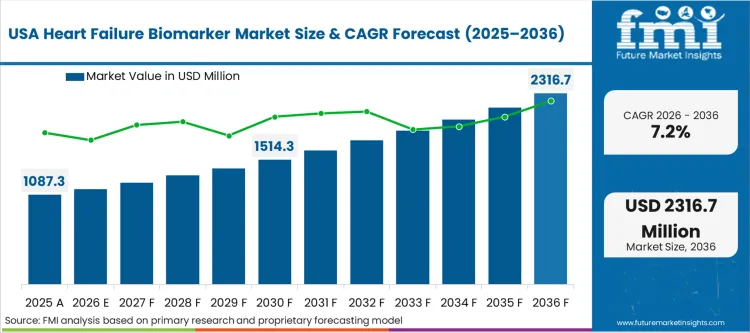
North America is shaped by ED driven diagnosis pathways and high central lab testing penetration, where BNP or NT-proBNP remains the default biomarker for diagnosis and triage, and where risk stratification demand supports repeat testing. Roche Diagnostics holds a strong position in central lab immunoassay workflows with broad hospital access. Abbott is widely adopted through integrated immunoassay platforms and emergency care channel reach. Siemens Healthineers competes through core lab presence and high-sensitivity assay ecosystems. FMI analysts note that hospitals remain the dominant end users, with reference labs supporting overflow and outpatient monitoring.
- United States.: In the USA, biomarker testing for heart failure is projected to grow at a CAGR of 7.2% from 2016 to 2036, driven by the steady volume of ED triage patients and the increasing adoption of biomarker-driven strategies for rapid rule-in and rule-out. Immunoassays in central labs form the cornerstone of routine testing, with increasing adoption of immunoassays in point-of-care settings in urgent care centers and smaller hospitals.
FMI’s report includes a detailed analysis of the growth in the North American region, along with a country-wise assessment that includes the USA, Canada and Mexico. Readers can also find regional trends, regulations, and market growth based on different segments and countries in the North America region.
Latin America Heart Failure Biomarker Market Analysis
Latin America is driven by expansion of hospital diagnostics capacity and higher adoption of standard cardiac biomarker panels, with growth shaped by public hospital budgets and private lab chain expansion. Roche Diagnostics and Abbott remain key participants through hospital and reference lab access, while Siemens Healthineers supports testing growth through immunoassay platform placements. FMI opines that uptake is accelerating in larger urban centres where ED load and cardiology workups are rising.
- Brazil: Brazil is projected at 7.6% CAGR through 2036, supported by rising use of BNP or NT-proBNP testing in hospital triage and greater adoption in private diagnostic chains. Central lab immunoassays remain the preferred format in large hospitals, while point-of-care formats gain traction in urgent settings where rapid decision-making is needed.
The report consists of a detailed analysis for the market in Brazil, Argentina and Rest of Latin America. Readers can find detailed information about several factors, such as the pricing analysis and regional trends, which are impacting growth in the Latin America region.
East Asia Heart Failure Biomarker Market Analysis
The East Asia market is driven by the growing number of cases of cardiovascular diseases and the increasing capacity of hospital diagnostics, which is supported by the increasing use of BNP or NT-proBNP testing. Roche Diagnostics and Abbott continue to be major players in the market through their core lab placements and assays. The regional platform suppliers also affect purchases, which are driven by cost and geographic coverage. According to FMI analysts, centralized lab testing is currently the leading method, with multiplex platforms attracting attention for broader cardiac panels.
- China: China has the highest growth rate of 8.3% CAGR from 2036 onwards, due to the increasing number of hospital admissions and the adoption of biomarker-driven pathways in emergency departments. Immunoassays in central labs are predominant due to their volume and efficiency, but point-of-care testing is rising when the volume of patients in the emergency department requires rapid triage.
- Japan: Japan is expected to grow at a CAGR of 5.2% from 2036 onwards, due to the established infrastructure of hospital testing and the consistent adoption of biomarkers for diagnosis and prognosis in the aging population. The adoption is tempered by established testing methodologies and conservative adoption cycles for novel biomarkers beyond BNP or NT-proBNP.
FMI’s report includes a detailed analysis of the growth in the East Asia region, along with a country-wise assessment that includes China, Japan and South Korea. Readers can also find regional trends, regulations, and market growth based on different segments and countries in the East Asia region.
Western Europe Heart Failure Biomarker Market Analysis
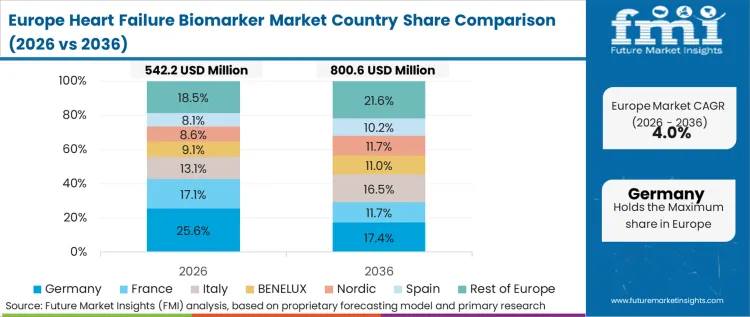
Western Europe is procurement-driven and guideline-driven, where adoption is influenced by ED pathways, national clinical guidelines, and central lab workflows. Roche Diagnostics maintains a strong base in core labs, Abbott competes through immunoassay platforms across hospitals, and Siemens Healthineers supports high-sensitivity analyzer ecosystems that interact with cardiac biomarker testing. According to FMI, the market is driven by the increasing use of risk stratification and the need for readmission reduction strategies in hospital settings.
- Germany: Germany grows at 6.0% CAGR through 2036, driven by excellent hospital diagnostic capabilities and widespread use of BNP or NT-proBNP testing in emergency and cardiology departments. Central lab immunoassays are the mainstay, with selective use of point-of-care testing.
- United Kingdom: The UK is expected to grow at 6.4% CAGR through 2036, driven by ED triage requirements and rising biomarker utilization for risk stratification and monitoring of therapy. Use is strongly centralized due to NHS purchasing and standardization, with selective use of point-of-care testing when turnaround times are essential.
- France: The French market is expected to register a CAGR of 5.7% until 2036, with steady volumes of hospital testing and the use of BNP or NT-proBNP testing for diagnosis and prognosis. Immunoassays in central labs are the primary approach, with the occasional use of multiplex analyzers in larger institutions.
FMI’s analysis of heart failure biomarker market in Western Europe consists of country-wise assessment that includes Germany, UK, France, Italy, Spain, BENELUX, Nordic Countries and Rest of Western Europe. Readers can know various regulations and latest trends in the regional market.
Competitive Aligners for Market Players
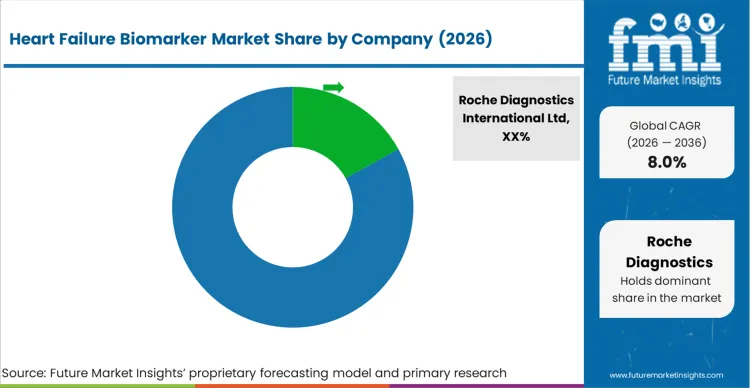
Market structure remains fragmented, yet practical competition is concentrated among a limited set of suppliers that can sustain assay quality consistency, maintain stable reagent supply, and support hospital and reference lab purchasing cycles with documented performance. Competition is shaped by clinical acceptance and repeat purchasing economics, since most volumes flow through central lab immunoassay workflows and are renewed through structured tenders. The primary competitive variable is confidence in result stability across lots and instruments, since the test is used in time-sensitive pathways such as emergency diagnosis support and inpatient risk management, as per FMI.
Companies with structural advantages tend to combine large installed bases in core lab immunoassay with broad assay menus and service coverage that keeps downtime low. Suppliers that can support both central lab systems and point-of-care formats are better positioned where hospitals want a single vendor across triage and routine monitoring. Control over calibrators, controls, and instrument specific assay tuning supports comparability across sites, which matters when networks standardise clinical protocols and quality dashboards. Firms with weaker service density or narrower menu coverage face higher exposure during rebids because hospitals tend to rationalise vendors when QC burden rises, based on FMI’s report.
Customer concentration reinforces buyer leverage. Hospitals and integrated systems commonly qualify more than one supplier, maintain approved alternates for high-volume markers, and use contract clauses tied to supply continuity and complaint closure timelines. Reference labs enforce similar discipline through volume tiers and performance scorecards, which keeps net pricing controlled in routine testing. Pricing power is therefore constrained for standard natriuretic peptide testing, while measured premiums are retained mainly where a platform offers workflow efficiency, rapid turnaround support, or integration that reduces revalidation effort across multi-site networks, Future Market Insights analysis.
Recent Developments:
The report includes full coverage of key trends from competitive benchmarking. Some of the recent developments covered in the reports:
- In January 2025, Abbott has received 510(k) clearance from the US Food and Drug Administration for its cardiac function test intended to help diagnose heart failure.
- In January 2025, The USA Food and Drug Administration (FDA) announced the clearance of a test from Abbott that assesses cardiac function in people with heart failure. Heart failure accounts for roughly one million emergency department visits in the USA each year.[5]
- In November 2025, Vasa Therapeutics, a private, clinical stage biotechnology company developing novel therapies for cardiovascular and metabolic aging, today announced that the USA Food and Drug Administration (FDA) has granted Fast Track designation to its lead investigational therapy, VS-041, a narrow spectrum small molecule inhibitor of matrix metalloproteinases (MMPs) for the treatment of heart failure with preserved ejection fraction (HFpEF).[1]
Key Players in Heart Failure Biomarker Market
- Roche Diagnostics International Ltd
- Abbott Laboratories
- Siemens Healthineers AG
- Beckman Coulter, Inc.
- bioMérieux SA
- QuidelOrtho Corporation
- Radiometer Medical ApS
- Randox Laboratories Ltd
- DiaSorin S.p.A.
- Thermo Fisher Scientific Inc.
Scope of the Report
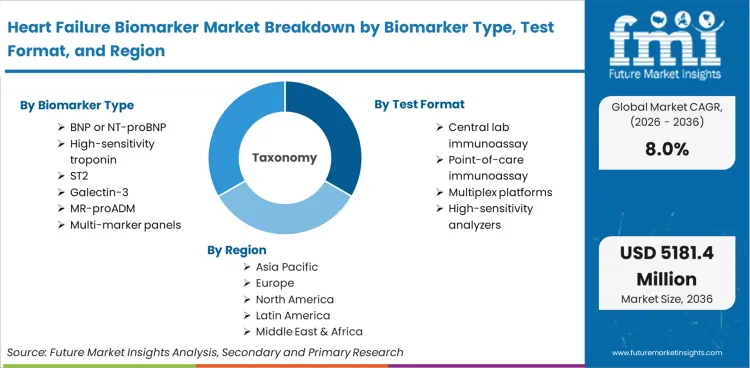
| Metric | Value |
|---|---|
| Quantitative Units | USD 2,400.0 Million (2026) to USD 5,200.0 Million (2036), at a CAGR of 8.0% |
| Market Definition | The heart failure biomarker market comprises global production and trade of in vitro diagnostic tests and related consumables used to support diagnosis, triage, risk stratification, therapy monitoring, and prognosis assessment in heart failure pathways, where adoption is shaped by emergency care throughput, laboratory turnaround time requirements, and guideline aligned use of natriuretic peptides and related marker panels. |
| Biomarker Type Segmentation | BNP or NT-proBNP, High-sensitivity troponin, ST2, Galectin-3, MR-proADM, Multi-marker panels |
| Test Format Segmentation | Central lab immunoassay, Point-of-care immunoassay, Multiplex platforms, High-sensitivity analyzers |
| Clinical Use Coverage | Diagnosis or triage, Risk stratification, Therapy monitoring, Prognosis or readmission |
| Sample Coverage | Serum or plasma, Whole blood, Urine, Other |
| End User Coverage | Hospitals, Reference Laboratories, Diagnostic Laboratories, Specialty Clinics and Ambulatory Surgical Centers |
| Regions Covered | North America, Latin America, East Asia, South Asia & Pacific, Western Europe, Eastern Europe, and Middle East & Africa. |
| Countries Covered | United States, Canada, Mexico, Brazil, Argentina, Germany, France, United Kingdom, Italy, Spain, China, India, Japan, South Korea, Indonesia, Australia and 40+ countries |
| Key Companies Profiled | Roche Diagnostics International Ltd, Abbott Laboratories, Siemens Healthineers AG, Beckman Coulter, Inc., bioMérieux SA, QuidelOrtho Corporation, Radiometer Medical ApS, Randox Laboratories Ltd, DiaSorin S.p.A., Thermo Fisher Scientific Inc. |
| Forecast period | 2026 to 2036 |
| Approach | Hybrid top down and bottom up market modeling validated through primary interviews with cardiology and emergency care stakeholders and diagnostics suppliers, supported by testing volume triangulation and platform placement benchmarking, as per FMI. |
Heart failure Biomarker Market Analysis by Segments
Biomarker Type:
- BNP or NT-proBNP
- High-sensitivity troponin
- ST2
- Galectin-3
- MR-proADM
- Multi-marker panels
Test Format:
- Central lab immunoassay
- Point-of-care immunoassay
- Multiplex platforms
- High-sensitivity analyzers
Clinical Use:
- Diagnosis or triage
- Risk stratification
- Therapy monitoring
- Prognosis or readmission
Sample:
- Serum or plasma
- Whole blood
- Urine
- Other
End User:
- Hospitals
- Reference Laboratories
- Diagnostic Laboratories
- Specialty Clinics
- Ambulatory Surgical Centers
Region:
- North America
- USA
- Canada
- Mexico
- Latin America
- Brazil
- Argentina
- Rest of Latin America
- East Asia
- China
- Japan
- South Korea
- South Asia & Pacific
- India
- ASEAN Countries
- Australia & New Zealand
- Rest of South Asia
- Western Europe
- Germany
- U.K.
- France
- Italy
- Spain
- BENELUX
- Nordic Countries
- Rest of Western Europe
- Eastern Europe
- Russia
- Hungary
- Poland
- Rest of Eastern Europe
- Middle East & Africa
- Saudi Arabia
- Türkiye
- South Africa
- Other African Union
- Rest of Middle East & Africa
Bibliography
- [1] Vasa Therapeutics (2025). Vasa Therapeutics Granted FDA Fast Track Designation for VS-041, a Novel Investigational Treatment of Heart Failure with Preserved Ejection Fraction (HFpEF).
- [2] Cardiac Failure Review (2024) Evaluating Biomarkers as Tools for Early Detection and Prognosis of Heart Failure: A Comprehensive Review.
- [3] J. Mitra & Co. Pvt. Ltd. (2025). Article on NT-pro BNP as a Biomarker: Diagnostic and Prognostic Applications in Heart Failure.
- [4] Europe PMC (2021). Synergy Between Point-of-Care Testing and Laboratory Consolidations.
- [5] Abbott’s (2025), FDA Clears Abbott Test for Heart Failure with NT-proBNP Biomarker.
This bibliography is provided for reader reference and is not exhaustive. The full report contains the complete reference list and detailed citations.
This Report Addresses
- Market intelligence to enable structured decision making across cardiac diagnostics planning and biomarker testing adoption pathways
- Market size estimation and 10-year revenue forecasts from 2026 to 2036 for heart failure biomarker testing demand
- Growth opportunity mapping across biomarker type, test format, clinical use, sample type, and end user pools
- Segment and regional revenue forecasts aligned to the stated taxonomy and covered geographies
- Competition strategy assessment including platform positioning, menu breadth, and care setting coverage benchmarking
- Product and compliance tracking focused on IVD quality requirements, laboratory accreditation needs, and documentation discipline
- Regulatory impact analysis covering IVD compliance expectations and clinical pathway alignment affecting testing uptake
- Market report delivery in PDF, Excel, PPT, and interactive dashboard formats for executive and operational use
Frequently Asked Questions
How large is the demand for Heart Failure Biomarkers in the global market in 2026?
Demand for Heart Failure Biomarkers in the global market is estimated to be valued at USD 2,400.0 Mn in 2026, as per FMI.
What will be the market size of Heart Failure Biomarkers in the global market by 2036?
Market size for Heart Failure Biomarkers is projected to reach USD 5,200.0 Mn by 2036.
What is the expected demand growth for Heart failure biomarkers in the global market between 2026 and 2036?
Demand for Heart Failure Biomarkers in the global market is expected to grow at a CAGR of 8.0% between 2026 and 2036.
Which biomarker type is poised to lead global demand by 2026?
BNP or NT-proBNP is expected to be the dominant biomarker type, capturing 46% share in 2026.
Which test format is expected to account for the largest share in 2026?
Central lab immunoassay is expected to hold the highest share at 58% in 2026.
How significant is the hospital end user segment in 2026?
Hospitals are projected to account for 60% share of end user demand in 2026.
Preview the report firsthand - request a free sample
Get SampleGet the brochure for pricing and purchase details.
Get PDFTable of Content
- Executive Summary
- Global Market Outlook
- Demand-side Trends
- Supply-side Trends
- Technology Roadmap Analysis
- Analysis and Recommendations
- Market Overview
- Market Coverage / Taxonomy
- Market Definition / Scope / Limitations
- Research Methodology
- Chapter Orientation
- Analytical Lens and Working Hypotheses
- Market Structure, Signals, and Trend Drivers
- Benchmarking and Cross-market Comparability
- Market Sizing, Forecasting, and Opportunity Mapping
- Research Design and Evidence Framework
- Desk Research Programme (Secondary Evidence)
- Company Annual and Sustainability Reports
- Peer-reviewed Journals and Academic Literature
- Corporate Websites, Product Literature, and Technical Notes
- Earnings Decks and Investor Briefings
- Statutory Filings and Regulatory Disclosures
- Technical White Papers and Standards Notes
- Trade Journals, Industry Magazines, and Analyst Briefs
- Conference Proceedings, Webinars, and Seminar Materials
- Government Statistics Portals and Public Data Releases
- Press Releases and Reputable Media Coverage
- Specialist Newsletters and Curated Briefings
- Sector Databases and Reference Repositories
- FMI Internal Proprietary Databases and Historical Market Datasets
- Subscription Datasets and Paid Sources
- Social Channels, Communities, and Digital Listening Inputs
- Additional Desk Sources
- Expert Input and Fieldwork (Primary Evidence)
- Primary Modes
- Qualitative Interviews and Expert Elicitation
- Quantitative Surveys and Structured Data Capture
- Blended Approach
- Why Primary Evidence is Used
- Field Techniques
- Interviews
- Surveys
- Focus Groups
- Observational and In-context Research
- Social and Community Interactions
- Stakeholder Universe Engaged
- C-suite Leaders
- Board Members
- Presidents and Vice Presidents
- R&D and Innovation Heads
- Technical Specialists
- Domain Subject-matter Experts
- Scientists
- Physicians and Other Healthcare Professionals
- Governance, Ethics, and Data Stewardship
- Research Ethics
- Data Integrity and Handling
- Primary Modes
- Tooling, Models, and Reference Databases
- Desk Research Programme (Secondary Evidence)
- Data Engineering and Model Build
- Data Acquisition and Ingestion
- Cleaning, Normalisation, and Verification
- Synthesis, Triangulation, and Analysis
- Quality Assurance and Audit Trail
- Market Background
- Market Dynamics
- Drivers
- Restraints
- Opportunity
- Trends
- Scenario Forecast
- Demand in Optimistic Scenario
- Demand in Likely Scenario
- Demand in Conservative Scenario
- Opportunity Map Analysis
- Product Life Cycle Analysis
- Supply Chain Analysis
- Investment Feasibility Matrix
- Value Chain Analysis
- PESTLE and Porter’s Analysis
- Regulatory Landscape
- Regional Parent Market Outlook
- Production and Consumption Statistics
- Import and Export Statistics
- Market Dynamics
- Global Market Analysis 2021 to 2025 and Forecast, 2026 to 2036
- Historical Market Size Value (USD Million) Analysis, 2021 to 2025
- Current and Future Market Size Value (USD Million) Projections, 2026 to 2036
- Y-o-Y Growth Trend Analysis
- Absolute $ Opportunity Analysis
- Global Market Pricing Analysis 2021 to 2025 and Forecast 2026 to 2036
- Global Market Analysis 2021 to 2025 and Forecast 2026 to 2036, By Biomarker Type
- Introduction / Key Findings
- Historical Market Size Value (USD Million) Analysis By Biomarker Type , 2021 to 2025
- Current and Future Market Size Value (USD Million) Analysis and Forecast By Biomarker Type , 2026 to 2036
- BNP or NT-proBNP
- High-sensitivity troponin
- ST2
- Galectin-3
- MR-proADM
- Multi-marker panels
- BNP or NT-proBNP
- Y-o-Y Growth Trend Analysis By Biomarker Type , 2021 to 2025
- Absolute $ Opportunity Analysis By Biomarker Type , 2026 to 2036
- Global Market Analysis 2021 to 2025 and Forecast 2026 to 2036, By Test Format
- Introduction / Key Findings
- Historical Market Size Value (USD Million) Analysis By Test Format, 2021 to 2025
- Current and Future Market Size Value (USD Million) Analysis and Forecast By Test Format, 2026 to 2036
- Central lab immunoassay
- Point-of-care immunoassay
- Multiplex platforms
- High-sensitivity analyzers
- Central lab immunoassay
- Y-o-Y Growth Trend Analysis By Test Format, 2021 to 2025
- Absolute $ Opportunity Analysis By Test Format, 2026 to 2036
- Global Market Analysis 2021 to 2025 and Forecast 2026 to 2036, By Region
- Introduction
- Historical Market Size Value (USD Million) Analysis By Region, 2021 to 2025
- Current Market Size Value (USD Million) Analysis and Forecast By Region, 2026 to 2036
- North America
- Latin America
- Western Europe
- Eastern Europe
- East Asia
- South Asia and Pacific
- Middle East & Africa
- Market Attractiveness Analysis By Region
- North America Market Analysis 2021 to 2025 and Forecast 2026 to 2036, By Country
- Historical Market Size Value (USD Million) Trend Analysis By Market Taxonomy, 2021 to 2025
- Market Size Value (USD Million) Forecast By Market Taxonomy, 2026 to 2036
- By Country
- USA
- Canada
- Mexico
- By Biomarker Type
- By Test Format
- By Country
- Market Attractiveness Analysis
- By Country
- By Biomarker Type
- By Test Format
- Key Takeaways
- Latin America Market Analysis 2021 to 2025 and Forecast 2026 to 2036, By Country
- Historical Market Size Value (USD Million) Trend Analysis By Market Taxonomy, 2021 to 2025
- Market Size Value (USD Million) Forecast By Market Taxonomy, 2026 to 2036
- By Country
- Brazil
- Chile
- Rest of Latin America
- By Biomarker Type
- By Test Format
- By Country
- Market Attractiveness Analysis
- By Country
- By Biomarker Type
- By Test Format
- Key Takeaways
- Western Europe Market Analysis 2021 to 2025 and Forecast 2026 to 2036, By Country
- Historical Market Size Value (USD Million) Trend Analysis By Market Taxonomy, 2021 to 2025
- Market Size Value (USD Million) Forecast By Market Taxonomy, 2026 to 2036
- By Country
- Germany
- UK
- Italy
- Spain
- France
- Nordic
- BENELUX
- Rest of Western Europe
- By Biomarker Type
- By Test Format
- By Country
- Market Attractiveness Analysis
- By Country
- By Biomarker Type
- By Test Format
- Key Takeaways
- Eastern Europe Market Analysis 2021 to 2025 and Forecast 2026 to 2036, By Country
- Historical Market Size Value (USD Million) Trend Analysis By Market Taxonomy, 2021 to 2025
- Market Size Value (USD Million) Forecast By Market Taxonomy, 2026 to 2036
- By Country
- Russia
- Poland
- Hungary
- Balkan & Baltic
- Rest of Eastern Europe
- By Biomarker Type
- By Test Format
- By Country
- Market Attractiveness Analysis
- By Country
- By Biomarker Type
- By Test Format
- Key Takeaways
- East Asia Market Analysis 2021 to 2025 and Forecast 2026 to 2036, By Country
- Historical Market Size Value (USD Million) Trend Analysis By Market Taxonomy, 2021 to 2025
- Market Size Value (USD Million) Forecast By Market Taxonomy, 2026 to 2036
- By Country
- China
- Japan
- South Korea
- By Biomarker Type
- By Test Format
- By Country
- Market Attractiveness Analysis
- By Country
- By Biomarker Type
- By Test Format
- Key Takeaways
- South Asia and Pacific Market Analysis 2021 to 2025 and Forecast 2026 to 2036, By Country
- Historical Market Size Value (USD Million) Trend Analysis By Market Taxonomy, 2021 to 2025
- Market Size Value (USD Million) Forecast By Market Taxonomy, 2026 to 2036
- By Country
- India
- ASEAN
- Australia & New Zealand
- Rest of South Asia and Pacific
- By Biomarker Type
- By Test Format
- By Country
- Market Attractiveness Analysis
- By Country
- By Biomarker Type
- By Test Format
- Key Takeaways
- Middle East & Africa Market Analysis 2021 to 2025 and Forecast 2026 to 2036, By Country
- Historical Market Size Value (USD Million) Trend Analysis By Market Taxonomy, 2021 to 2025
- Market Size Value (USD Million) Forecast By Market Taxonomy, 2026 to 2036
- By Country
- Kingdom of Saudi Arabia
- Other GCC Countries
- Turkiye
- South Africa
- Other African Union
- Rest of Middle East & Africa
- By Biomarker Type
- By Test Format
- By Country
- Market Attractiveness Analysis
- By Country
- By Biomarker Type
- By Test Format
- Key Takeaways
- Key Countries Market Analysis
- USA
- Pricing Analysis
- Market Share Analysis, 2025
- By Biomarker Type
- By Test Format
- Canada
- Pricing Analysis
- Market Share Analysis, 2025
- By Biomarker Type
- By Test Format
- Mexico
- Pricing Analysis
- Market Share Analysis, 2025
- By Biomarker Type
- By Test Format
- Brazil
- Pricing Analysis
- Market Share Analysis, 2025
- By Biomarker Type
- By Test Format
- Chile
- Pricing Analysis
- Market Share Analysis, 2025
- By Biomarker Type
- By Test Format
- Germany
- Pricing Analysis
- Market Share Analysis, 2025
- By Biomarker Type
- By Test Format
- UK
- Pricing Analysis
- Market Share Analysis, 2025
- By Biomarker Type
- By Test Format
- Italy
- Pricing Analysis
- Market Share Analysis, 2025
- By Biomarker Type
- By Test Format
- Spain
- Pricing Analysis
- Market Share Analysis, 2025
- By Biomarker Type
- By Test Format
- France
- Pricing Analysis
- Market Share Analysis, 2025
- By Biomarker Type
- By Test Format
- India
- Pricing Analysis
- Market Share Analysis, 2025
- By Biomarker Type
- By Test Format
- ASEAN
- Pricing Analysis
- Market Share Analysis, 2025
- By Biomarker Type
- By Test Format
- Australia & New Zealand
- Pricing Analysis
- Market Share Analysis, 2025
- By Biomarker Type
- By Test Format
- China
- Pricing Analysis
- Market Share Analysis, 2025
- By Biomarker Type
- By Test Format
- Japan
- Pricing Analysis
- Market Share Analysis, 2025
- By Biomarker Type
- By Test Format
- South Korea
- Pricing Analysis
- Market Share Analysis, 2025
- By Biomarker Type
- By Test Format
- Russia
- Pricing Analysis
- Market Share Analysis, 2025
- By Biomarker Type
- By Test Format
- Poland
- Pricing Analysis
- Market Share Analysis, 2025
- By Biomarker Type
- By Test Format
- Hungary
- Pricing Analysis
- Market Share Analysis, 2025
- By Biomarker Type
- By Test Format
- Kingdom of Saudi Arabia
- Pricing Analysis
- Market Share Analysis, 2025
- By Biomarker Type
- By Test Format
- Turkiye
- Pricing Analysis
- Market Share Analysis, 2025
- By Biomarker Type
- By Test Format
- South Africa
- Pricing Analysis
- Market Share Analysis, 2025
- By Biomarker Type
- By Test Format
- USA
- Market Structure Analysis
- Competition Dashboard
- Competition Benchmarking
- Market Share Analysis of Top Players
- By Regional
- By Biomarker Type
- By Test Format
- Competition Analysis
- Competition Deep Dive
- Roche Diagnostics International Ltd
- Overview
- Product Portfolio
- Profitability by Market Segments (Product/Age /Sales Channel/Region)
- Sales Footprint
- Strategy Overview
- Marketing Strategy
- Product Strategy
- Channel Strategy
- Abbott Laboratories
- Siemens Healthineers AG
- Beckman Coulter, Inc.
- bioMérieux SA
- QuidelOrtho Corporation
- Radiometer Medical ApS
- Randox Laboratories Ltd
- DiaSorin S.p.A.
- Thermo Fisher Scientific Inc.
- Roche Diagnostics International Ltd
- Competition Deep Dive
- Assumptions & Acronyms Used


