

- Market Size (2026)
- USD 140.9 Mn
- Forecast (2036)
- USD 304.3 Mn
- CAGR (2026 to 2036)
- 8.0%
How big is Critical-Care Omega-3 Nutrition Market in 2026?
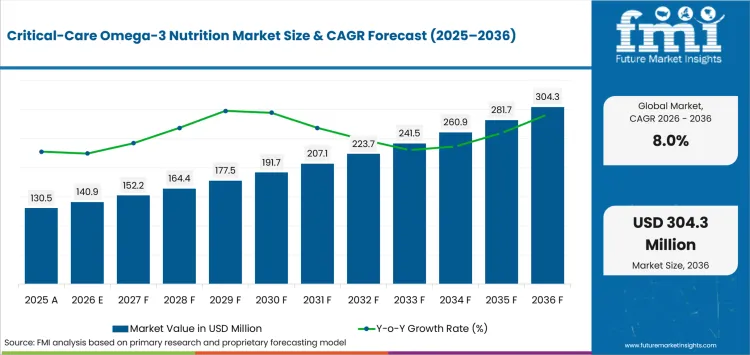
USD 140.9 million in 2026 and USD 304.3 million by 2036 at an 8.0% CAGR.
Demand for critical-care omega-3 nutrition is projected to expand at 8.0% CAGR between 2026 and 2036, increasing valuation from USD 140.9 million in 2026 to USD 304.3 million by 2036. A larger acute-care pool expands the cases in which clinical nutrition teams must decide route, dose and formulary eligibility for specialized feeding. AHRQ reported in March 2025 that USA sepsis inpatient stays rose from 1.8 million in 2016 to 2.5 million in 2021.
Country adoption depends on hospital capacity and the local route from clinical review to contracted supply. OECD's 2025 data recorded 12.6 hospital beds per 1,000 people in South Korea and 12.5 in Japan, against a 4.2 OECD average. High bed density enlarges the institutional review base, but medical nutrition orders still depend on local guidance, pharmacy controls and service terms.
Key Takeaways
- Earlier ICU feeding pathways increase the number of severe sepsis, respiratory failure and postoperative cases considered for controlled omega-3 nutrition.
- Based on product type, EPA / DHA-enriched enteral formulas are projected to account for 50.2% in 2026 due to one-product dosing and familiar tube-feeding administration.
- By indication, ARDS & respiratory failure is estimated to hold 40.8% in 2026 owing to prolonged ventilatory care and controlled nutrition delivery.
- In 2026, enteral feeds are expected to lead product form with 53.9% share because pump-based administration fits ICU feeding routines.
- Uneven outcome evidence and caution on routine high-dose use raise the proof threshold for formulary approval and repeated protocol use.
- Some of the key players in this market include Fresenius Kabi, Nestle Health Science, Abbott, Danone Nutricia, B. Braun, Baxter, dsm-firmenich, and JW Pharmaceutical.
Analyst Perspective
"Critical-care omega-3 products earn formulary access only after dose, route and patient selection fit a hospital protocol. Commercial value follows when the same product can be supplied reliably without adding preparation work or widening the clinical claim beyond available evidence."
- Nandini Roy Choudhury, Principal Consultant, Future Market Insights
How is the critical-care omega-3 nutrition market segmented?
The critical-care omega-3 nutrition market is segmented by product type, indication, product form, end user, sales channel and region.
Product type includes EPA / DHA-enriched enteral formulas, fish oil enteral modules, omega-forward immunonutrition blends and others. Indication includes ARDS & respiratory failure, sepsis & SIRS, major surgery in the ICU and others. Product form covers enteral feeds, liquid modules and others. End users include ICUs, step-down units and others. Sales channels comprise hospital pharmacy, retail pharmacy, online supply, institutional tender and others.
How do enteral feeds hold the product form lead?
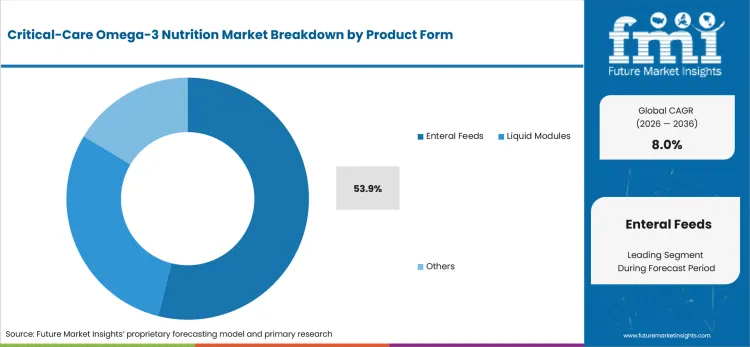
Enteral feeds use a gastrointestinal route already built into many ICU pathways. A complete tube feeding formula can provide energy, protein and omega-3 lipids with standard pumps, reducing the extra calculations, bedside handling and separate inventory required by modular dosing.
- In 2026, enteral feeds are expected to lead product form with 53.9% share because pump-compatible administration limits bedside preparation.
- Public Contracts Scotland published an enteral-feeding procurement in October 2025 that weighted service and delivery at 40% on several tube-feed lots. Contract access therefore depends on operational support, reliable deliveries and nursing service as well as formula specification.
What supports EPA / DHA-enriched enteral formulas within the product type category?
Complete enriched formulas place energy, protein and omega-3 lipids inside one enteral order. ICU teams can assess the intended dose without calculating a separate fish-oil module, which reduces bedside manipulation and keeps the product inside a familiar enteral nutrition workflow.
- By product type, EPA / DHA-enriched enteral formulas are estimated to hold 50.2% in 2026 owing to one-product dosing and familiar tube-feeding administration.
- The Japanese Critical Care Nutrition Guideline 2024, published in March 2025, gave omega-3-enriched enteral nutrition a weak recommendation under low-certainty evidence. Transparent dosing therefore carries more weight than a broad enrichment claim during hospital review.
Why does ARDS & respiratory failure lead the indication category?
Respiratory failure can keep patients dependent on controlled feeding as clinicians manage ventilation, fluid balance and metabolic tolerance. SCCM issued adult ARDS neuromuscular-blockade guidance in March 2026 that ties treatment choices to severity and institutional practice. Formula selection therefore needs an indication-specific rationale for a defined patient group.
- ARDS & respiratory failure is set to lead the indication category with 40.8% share in 2026 due to prolonged feeding periods during ventilatory care.
- ICU committees evaluate nutrition beside severity-specific treatment plans, so dose instructions and patient-selection evidence must be clear enough for protocol review. General inflammatory positioning does not meet that qualification need.
What supports ICUs as the leading end user?
ICUs concentrate the physicians, dietitians, pharmacists and nurses who decide route, dose, tolerance and monitoring for specialized feeding. NHS England counted 234,889 usable adult critical-care records in 2024-25, placing a large treatment volume under teams that initiate and monitor specialist nutrition.
- The ICUs segment is likely to capture 55.3% share in 2026 attributable to concentrated monitoring and protocol ownership during acute care.
- Step-down units usually inherit a regimen selected earlier, so enteral feeding devices and formula supply must remain compatible with the ICU order as patients move to lower-acuity care without restarting local qualification.
Why does hospital pharmacy lead the sales channel category?
Hospital pharmacy controls formulary access, storage and dispensing for specialist nutrition products. Pharmacists reconcile the ordered route with labeling, handling requirements and local stock rules before a formula reaches the ward, giving this channel direct influence over repeat availability.
- Hospital pharmacy is projected to hold 45.1% share in 2026 owing to close control of product qualification, dispensing records and stock continuity.
- A Scottish enteral-feeding award published in January 2026 drew nine tenders and included Abbott, Fresenius Kabi and Nutricia among successful operators. National contracting can narrow the commercial field before a hospital makes daily product choices.
What are the drivers, restraints and opportunities in the Critical-Care Omega-3 Nutrition Market?
Earlier protocolized feeding increases addressable use, uneven outcome evidence slows routine high-dose adoption, and standardized route options can reduce pharmacy preparation work.
- Driver: Earlier enteral feeding protocols place more critically ill patients inside a standing nutrition pathway before prolonged intake deficits develop.
- Restraint: Conflicting outcome evidence raises the clinical proof needed before routine high-dose omega-3 use enters a formulary or order set.
- Opportunity: Standardized enteral and parenteral formats can reduce preparation steps and give clinicians a defined omega-3 dose and route.
Early enteral protocols expand the qualifying patient pool
Critical-care nutrition demand strengthens once feeding begins inside a standing care pathway instead of an exceptional order. SCCM stated in March 2026 that adults with sepsis or septic shock should receive early enteral nutrition within 72 hours under very low-certainty evidence. Hospitals therefore need eligible formulas available before the next severe case arrives, making pathway readiness a repeat purchasing condition.
Uneven outcome evidence raises the formulary threshold
Clinical qualification slows if omega-3 outcomes do not justify routine high-dose use for a broad ICU population. The NIH Office of Dietary Supplements updated its professional fact sheet in March 2025 and retained the conclusion that critical-care evidence is conflicting. Hospital committees can narrow use by indication or dose, reducing conversion even where clinicians remain interested in omega-3 products and controlled lipid delivery.
Standardized parenteral formats reduce preparation burden
Route flexibility is commercially useful if enteral feeding is temporarily unsuitable or insufficient. ASPEN added a multi-chamber bag parenteral nutrition resource in January 2025 and places standardized commercial PN products inside its current care pathway alongside in-house or outsourced compounding. Hospitals can therefore reduce compounding steps and preparation variability. Adoption still depends on dose fit, compatibility review and local pharmacy approval.
Which country CAGRs are profiled in the Critical-Care Omega-3 Nutrition Market?
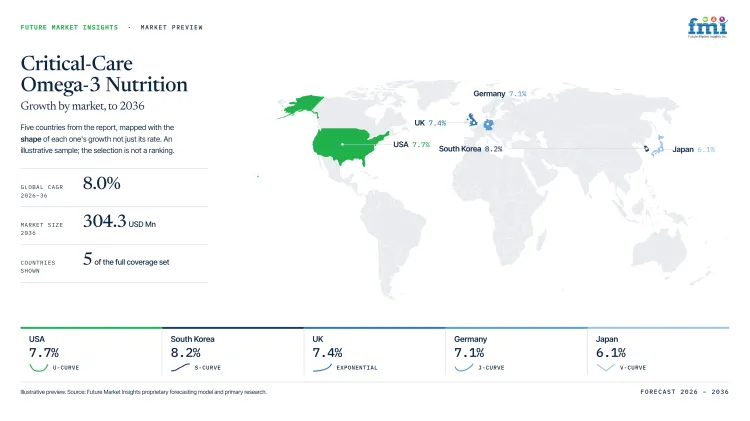
| Country | CAGR |
|---|---|
| South Korea | 8.2% |
| USA | 7.7% |
| UK | 7.4% |
| Germany | 7.1% |
| Japan | 6.1% |
How do country-level CAGRs compare in the Critical-Care Omega-3 Nutrition Market?
Only 2.1 percentage points separate South Korea at 8.2% from Japan at 6.1%, making the middle of the table more revealing. USA stays near the upper band, UK and Germany form a 0.3-point pair, and Japan follows alone. Hospital purchasing routes and patient-selection rules explain the spacing better than regional demand.
- South Korea uses dense tertiary capacity to spread approved protocols within large hospital accounts.
- USA networks can extend one accepted nutrition pathway to several aligned hospital formularies.
- UK framework economics make delivery service and call-off terms important after clinical acceptance.
- German pharmacy governance rewards clear composition records and local documentation during hospital qualification.
- Japanese guideline caution narrows routine high-dose positioning beyond defined patient groups.
Similar CAGRs produce different order patterns under different clinical and contracting filters. The full report uses North America, Latin America, Western Europe, Eastern Europe, East Asia, South Asia and Pacific, and Middle East and Africa.
Country-wise Analysis
- South Korean tertiary hospitals centralize nutrition review inside high-acuity teams, and national ICU assessment gives those teams a common quality frame for staffing, nursing intensity and care processes during severe ICU patient admissions. The critical-care omega-3 nutrition market in South Korea is projected to expand at 8.2% CAGR over the assessment period, supported by concentrated tertiary capacity and formal protocol review. HIRA announced in April 2025 that its fifth ICU appropriateness evaluation would assess July through December 2025 care at general hospitals and higher-level institutions, and specialist distribution outside Seoul and major regional centers still limits repeat institutional hospital ordering.
- USA hospitals commonly place specialist nutrition behind pharmacy, dietetics and ICU formulary review, so a formula must fit local order sets before broad network use begins. CDC data released in August 2026 covered 5,430 acute-care and critical-access hospitals, with 87% reporting tailored sepsis order sets and 93% standard screening, so approved products gain a large institutional route but face costly local evidence alignment. Demand in USA is forecast to rise at 7.7% CAGR through 2036, given broad sepsis-program adoption, and companies with USA-ready clinical documentation and dependable distribution can convert committee approval into regular hospital orders more consistently nationwide.
- In May 2026, NHS Ayrshire & Arran recorded Fresenius Kabi Limited as contractor for an adult enteral feeds and homecare call-off under NP51225, showing how framework awards narrow the commercial field before ward selection. UK hospital nutrition access then depends on local call-off performance, delivery continuity and clinical support that can carry a contracted formula into routine ward use without renegotiating the national framework. Critical-care omega-3 nutrition sales in the UK are forecast to expand at 7.4% CAGR over the forecast period, tied to structured tender access, but weak service performance or incomplete evidence can restrict volume after framework eligibility is secured.
- German hospitals evaluate specialist nutrition inside a large acute-care system where pharmacy governance and detailed documentation shape formulary entry, dose review and routine replenishment after initial formal hospital approval. The German critical-care omega-3 nutrition sector is expected to register 7.1% CAGR during the assessment period, helped by substantial treatment capacity and formal hospital review. Destatis reported in November 2025 that 1,841 hospitals operated 472,900 beds in 2024, including 26,000 intensive-care and 7,700 intermediate-care beds, giving specialized nutrition a broad institutional base while patient-selection caution keeps German-language evidence and pharmacy-ready documentation central to local hospital qualification and repeat use.
- Japanese hospitals apply domestic critical-care guidance closely, so low-certainty recommendations narrow the patients and doses that committees will accept for routine use. The Ministry of Health, Labour and Welfare reported in February 2026 that December 2025 hospital capacity fell by seven facilities and 645 beds from the prior month, so tighter capacity keeps efficiency and local evidence prominent during formulary review. Adoption of critical-care omega-3 nutrition in Japan is estimated to expand at 6.1% CAGR through 2036, because selective clinical positioning limits broader use, and lower-dose options with Japanese evidence offer a more credible entry route than global claims copied into local review.
Who are the notable companies in the Critical-Care Omega-3 Nutrition Market?
Fresenius Kabi, Nestle Health Science, Abbott, Danone Nutricia, B. Braun, Baxter, dsm-firmenich and JW Pharmaceutical are the notable companies serving this market.
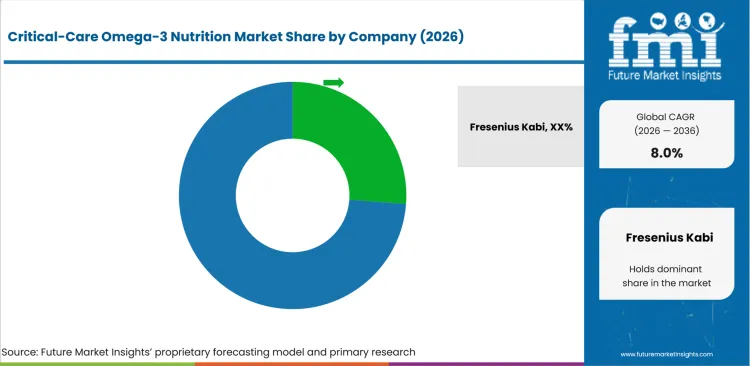
Competition separates into hospital nutrition platforms, enteral medical-nutrition portfolios, omega-3 ingredient specialists and parenteral nutrition developers. Fresenius Kabi, B. Braun and Baxter compete on hospital infusion and nutrition infrastructure. Nestle Health Science, Abbott and Danone Nutricia carry broader enteral portfolios. dsm-firmenich supplies EPA and DHA formulation inputs. JW Pharmaceutical concentrates on total parenteral nutrition with fish-oil lipids.
- Integrated hospital nutrition platforms: Fresenius Kabi, B. Braun and Baxter.
- Enteral medical-nutrition portfolios: Nestle Health Science, Abbott and Danone Nutricia.
- Omega-3 ingredient and parenteral specialists: dsm-firmenich and JW Pharmaceutical.
Competitive Benchmarking: Critical-Care Omega-3 Nutrition Market
| Company | Omega-3 Formulation Depth | Clinical Route Coverage | Hospital Nutrition Integration | Geographic Reach |
|---|---|---|---|---|
| Fresenius Kabi | High | High | High | Global |
| Nestle Health Science | Medium | High | High | Global |
| Abbott | Medium | High | High | Global |
| Danone Nutricia | Medium | High | High | Global |
| B. Braun | High | High | High | Global |
| Baxter | High | Medium | High | Global |
| dsm-firmenich | High | Low | Medium | Global B2B ingredient network |
| JW Pharmaceutical | High | Low | Medium | South Korea, Europe and selected Asian markets |
Scoring basis: High omega-3 formulation depth requires multiple documented fish-oil or EPA/DHA routes, Medium identifies one current qualifying route and Low a narrower adjacent contribution. High clinical route coverage requires enteral and parenteral or several clinical formats, Medium one route with several hospital formats and Low one route or an upstream ingredient role. High hospital nutrition integration requires direct institutional nutrition and service evidence, Medium a narrower medical-nutrition role and Low a documented limited hospital role.
Key Developments in the Critical-Care Omega-3 Nutrition Market
- In March 2026, Fresenius Kabi announced that China's NMPA approved a pediatric indication for Omegaven, its omega-3 fish-oil lipid emulsion used in parenteral nutrition-associated cholestasis. The approval broadens a regulated hospital route for fish-oil lipids. Its pediatric indication does not establish adult ICU use.
- In July 2025, Danone completed the acquisition of a majority stake in Kate Farms, extending its USA medical-nutrition channel alongside Nutricia and other specialized nutrition businesses. The transaction increases hospital and home access for specialized formulas, but it does not establish omega-3 leadership by itself.
- In May 2025, B. Braun announced an exclusive Kenya distribution partnership with Sky Healthcare Limited for its nutrition portfolio, effective from April 2025. The agreement expands a hospital supply route in Kenya. Product-level eligibility still depends on local registration and institutional qualification.
Key Players in the Critical-Care Omega-3 Nutrition Market
Integrated hospital nutrition platforms
- Fresenius Kabi
- B. Braun
- Baxter
Enteral medical-nutrition portfolios
- Nestle Health Science
- Abbott
- Danone Nutricia
Omega-3 ingredient and parenteral specialists
- dsm-firmenich
- JW Pharmaceutical
Critical-Care Omega-3 Nutrition Market - Report Scope
| Coverage field | Report scope |
|---|---|
| Market breakdown | By product type, indication, product form, end user, sales channel and region. |
| Quantitative Units | USD million. |
| Market Definition | Revenue from qualifying critical-care nutrition products intentionally formulated to deliver EPA, DHA or fish-oil-derived omega-3 within the defined segmentation universe. Revenue is recognized at the first commercial sale of the qualifying product. Routine supplements, standard feeds without purposeful omega-3 positioning, separately sold feeding equipment and adjacent service revenue are excluded. |
| Regions Covered | North America, Latin America, Western Europe, Eastern Europe, East Asia, South Asia and Pacific, and Middle East and Africa. |
| Countries Covered | South Korea, USA, UK, Germany, Japan, and 20+ countries included in the full report. |
| Key Companies Profiled | Fresenius Kabi, Nestle Health Science, Abbott, Danone Nutricia, B. Braun, Baxter, dsm-firmenich, and JW Pharmaceutical. |
| Forecast Period | 2026 to 2036. |
| Approach | Primary and secondary research with market triangulation. |
Critical-Care Omega-3 Nutrition Market - Research Methodology
| Method | Approach |
|---|---|
| Primary Research | FMI analysts gathered input from manufacturers, service providers, technology developers, distributors, end users, procurement teams, and subject-matter experts. Interviews examined purchasing decisions, product or service evaluation, adoption barriers, approval requirements, pricing considerations, and expectations for technical or commercial support. Respondents were also asked what evidence is required before a trial, pilot, or initial order develops into regular purchasing. |
| Desk Research | Desk research covered government statistics, regulatory publications, trade data, industry associations, technical literature, standards, company filings, product information, and official corporate announcements. Sources were reviewed for relevance, publication date, geographic coverage, and consistency with the defined market scope. Claims relating to performance, applications, approvals, capacity, investment, and commercial activity were retained only when supported by credible public evidence. |
| Market Sizing and Forecasting | The market model combined the baseline value with historical performance, segment structure, pricing and volume indicators, adoption levels, company participation, and country-level demand conditions. Forecast assumptions considered economic activity, investment trends, regulatory developments, technology adoption, purchasing cycles, supply availability, and barriers to wider market use. Segment and regional estimates were reconciled before the final market total was calculated. |
| Data Validation | Estimates were checked against multiple independent indicators, including public data, company activity, trade patterns, industry developments, and findings from primary interviews. Validation also tested whether products, services, applications, and company revenues fell within the defined market boundaries. Adjacent categories, unsupported claims, overlapping revenues, and activities without direct market relevance were excluded to reduce double counting and maintain consistency across segments and countries. |
Critical-Care Omega-3 Nutrition Market by Segments
Critical-Care Omega-3 Nutrition Market segmented by Product Type:
- EPA / DHA-Enriched Enteral Formulas
- Fish Oil Enteral Modules
- Immunonutrition Blends (Omega-Forward)
- Others
Critical-Care Omega-3 Nutrition Market segmented by Indication:
- ARDS & Respiratory Failure
- Sepsis & SIRS
- Major Surgery (ICU)
- Others
Critical-Care Omega-3 Nutrition Market segmented by Product Form:
- Enteral Feeds
- Liquid Modules
- Others
Critical-Care Omega-3 Nutrition Market segmented by End User:
- ICUs
- Step-Down Units
- Others
Critical-Care Omega-3 Nutrition Market segmented by Sales Channel:
- Hospital Pharmacy
- Retail Pharmacy
- Online
- Institutional Tender
- Others
Critical-Care Omega-3 Nutrition Market by Region:
- North America
- United States
- Canada
- Latin America
- Brazil
- Mexico
- Argentina
- Chile
- Western Europe
- Germany
- France
- United Kingdom
- Italy
- Spain
- Benelux
- Nordics
- Eastern Europe
- Poland
- Czech Republic
- Romania
- Hungary
- East Asia
- China
- Japan
- South Korea
- South Asia and Pacific
- India
- ASEAN
- Australia and New Zealand
- Middle East and Africa
- GCC Countries
- South Africa
- Türkiye
- Israel
Research Sources and Bibliography
- Agency for Healthcare Research and Quality. (2025, March). New Interactive Data Resource Illustrates Trends in Sepsis Hospital Care.
- Organisation for Economic Co-operation and Development. (2025). Hospital beds and occupancy: Health at a Glance 2025.
- Nakamura, K., et al. (2025, March 21). The Japanese Critical Care Nutrition Guideline 2024.
- Society of Critical Care Medicine. (2026, March 3). Guidelines for the Administration of Neuromuscular Blockade in Adults With ARDS.
- Public Contracts Scotland. (2025, October 15). Enteral Feeds, Reference NP51225.
- NHS England. (2025, September 25). Hospital Admitted Patient Care Activity, 2024-25.
- Public Contracts Scotland. (2026, January 14). Enteral Feeds.
- Society of Critical Care Medicine. (2026, March 23). Surviving Sepsis Campaign: International Guidelines for Management of Sepsis and Septic Shock 2026.
- National Institutes of Health, Office of Dietary Supplements. (2025, March 10). Dietary Supplements for Immune Function and Infectious Diseases: Fact Sheet for Health Professionals.
- American Society for Parenteral and Enteral Nutrition. (2025, January). Multi-Chamber Bag PN.
- Centers for Disease Control and Prevention. (2026, August 17). Hospital Sepsis Management and Practices: Findings from the 2025 NHSN Annual Survey.
- Public Contracts Scotland. (2026, May 11). AA-220-26-DA Adult Enteral Feeds and Homecare Using NP51225.
- Federal Statistical Office of Germany. (2025, November 6). 2,0 % mehr stationäre Krankenhausbehandlungen im Jahr 2024.
- Ministry of Health, Labour and Welfare, Japan. (2026, February 27). 医療施設動態調査(令和7(2025)年12月末概数).
- Health Insurance Review & Assessment Service. (2025, April 28). 2025년(5차) 중환자실 적정성 평가 세부시행계획 안내.
- Fresenius Kabi. (2026, March 3). 费森尤斯卡比宣布尤文®在中国获批新增儿科适应症.
- Danone. (2025, July 1). Danone completes the acquisition of Kate Farms, enhancing its USA specialized nutrition offerings.
- B. Braun Medical Kenya Ltd. (2025, May 20). B. Braun Kenya partners with Sky Healthcare Limited for exclusive distribution of Nutrition portfolio.
- Fresenius SE & Co. KGaA. (2026, March 25). Annual Report 2025.
- Nestlé. (2026, February 19). Publication of 2025 Annual Report.
- Abbott Laboratories. (2026, February 20). 2025 Form 10-K.
- Danone. (2026, March 4). Universal Registration Document 2025.
- B. Braun. (2026). Annual Report 2025.
- Baxter International Inc. (2026, February 12). 2025 Form 10-K.
- dsm-firmenich. (2026, February 20). Health, Nutrition & Care - Integrated Annual Report 2025.
- JW Pharmaceutical. (2026). 2025 Annual Report.
- Fresenius. (2026, June 2). Fresenius Opens Innovation Center for Medical Nutrition in Bad Homburg.
- Nestlé Health Science. (2025, October 15). Nestlé Health Science and University of California, Davis Innovation Institute for Food & Health Announce Strategic Partnership to Accelerate Innovation in Nutrition and Health Science.
- Nestlé Health Science. (2025, October 17). Nestlé Health Science and Tufts Strengthen Nutrition Innovation.
- dsm-firmenich. (2025, March 20). dsm-firmenich wins patent lawsuit protecting algal oil innovations.
- Fresenius. (2026, June 8). Fresenius announces European launch of Pedismof range.
This bibliography is provided for reader reference and is not exhaustive. The full report contains the complete reference list and detailed citations.
This Report Answers
- How large is the critical-care omega-3 nutrition market in 2026 and 2036?
- Which ICU operating conditions translate nutrition protocols into repeat omega-3 product orders?
- Why do EPA / DHA-enriched enteral formulas hold the leading product type position?
- How does ARDS & respiratory failure shape demand for controlled critical-care nutrition?
- Why do enteral feeds hold the leading product form position?
- How do country growth rates differ across South Korea, USA, UK, Germany and Japan?
- Which companies provide hospital nutrition platforms, enteral portfolios, omega-3 inputs or parenteral products?
- How does uneven high-dose evidence affect formulary review and routine protocol use?
- What should hospital nutrition and pharmacy teams evaluate before repeat purchasing?
Frequently Asked Questions
How big is the Critical-Care Omega-3 Nutrition Market in 2026?
The critical-care omega-3 nutrition market is valued at USD 140.9 million in 2026 and is projected to reach USD 304.3 million by 2036. Growth follows broader use of protocolized feeding in severe hospital care.
What is the CAGR of the Critical-Care Omega-3 Nutrition Market from 2026 to 2036?
The critical-care omega-3 nutrition market is projected to grow at a CAGR of 8.0% between 2026 and 2036. Expansion depends on controlled omega-3 delivery fitting established enteral and parenteral nutrition pathways.
Which product type leads the Critical-Care Omega-3 Nutrition Market?
The EPA / DHA-enriched enteral formulas segment is expected to hold 50.2% of the critical-care omega-3 nutrition market in 2026, driven by one-product dosing. Familiar tube-feeding administration also reduces bedside handling.
Which product form holds a leading position in the Critical-Care Omega-3 Nutrition Market?
The enteral feeds segment is expected to hold 53.9% of the critical-care omega-3 nutrition market in 2026, attributable to pump-compatible administration. Complete feeds also reduce separate preparation steps during ICU use.
How much value will the Critical-Care Omega-3 Nutrition Market add between 2026 and 2036?
The critical-care omega-3 nutrition market is expected to add USD 163.4 million in value between 2026 and 2036. The increase depends on broader protocol eligibility and higher-value formulas clearing hospital evidence and handling requirements.
Which countries are projected to record the highest growth in the Critical-Care Omega-3 Nutrition Market?
South Korea is projected to grow at 8.2% CAGR, followed by USA at 7.7% and UK at 7.4% through 2036. Growth is strongest where ICU capacity and institutional nutrition pathways give qualifying products a clear purchasing route.
Which companies are active in the Critical-Care Omega-3 Nutrition Market?
Key companies operating in the critical-care omega-3 nutrition market include Fresenius Kabi, Nestle Health Science, Abbott, Danone Nutricia, B. Braun, Baxter, dsm-firmenich, and JW Pharmaceutical. Their roles cover hospital platforms, enteral nutrition, omega-3 ingredients and parenteral formulations.
Preview the report firsthand - request a free sample
Get SampleGet the brochure for pricing and purchase details.
Get PDFTable of Content
- Key Takeaways
- Market Size and CAGR
- Top Growth Driver
- Fastest Growing Segment
- Leading Region
- Key Companies
- Emerging Opportunities
- Executive Summary
- Global Market Outlook
- Demand-side Trends
- Supply-side Trends
- Technology Roadmap Analysis
- Analysis and Recommendations
- Analyst Perspective (What is happening? Why now? What should investors know?)
- Key Questions Answered
- How large is the market?
- What is the CAGR?
- What are key trends?
- Which region dominates?
- Who are the leaders?
- Market Overview
- Market Coverage / Taxonomy
- Market Definition / Scope / Limitations
- Research Methodology
- Chapter Orientation
- Analytical Lens and Working Hypotheses
- Market Structure, Signals, and Trend Drivers
- Benchmarking and Cross-market Comparability
- Market Sizing, Forecasting, and Opportunity Mapping
- Research Design and Evidence Framework
- Desk Research Programme (Secondary Evidence)
- Expert Input and Fieldwork (Primary Evidence)
- Tooling, Models, and Reference Databases
- Data Engineering and Model Build
- Quality Assurance and Audit Trail
- Market Background
- Market Dynamics (Drivers, Restraints, Opportunity, Trends)
- Scenario Forecast (Optimistic, Likely, Conservative)
- Impact Analysis
- AI Impact
- Sustainability Impact
- Regulatory Impact
- Technology Impact
- Consumer / Buyer Analysis
- Purchase Drivers
- Adoption Barriers
- Buyer Journey
- Opportunity Map Analysis
- Product Life Cycle Analysis
- Supply Chain Analysis
- Investment Feasibility Matrix
- Value Chain Analysis
- PESTLE and Porter's Analysis
- Regulatory Landscape
- Regional Parent Market Outlook
- Production and Consumption Statistics
- Import and Export Statistics
- Global Market Analysis and Forecast, 2021 to 2036
- Historical Market Size Value (USD Million) Analysis, 2021 to 2025
- Current and Future Market Size Value (USD Million) Projections, 2026 to 2036
- Y-o-Y Growth Trend Analysis
- Absolute $ Opportunity Analysis
- Global Market Pricing Analysis, 2021 to 2036
- Global Market Analysis and Forecast, By Product Type, 2021 to 2036
- Introduction / Key Findings
- Historical Market Size Value (USD Million) Analysis By Product Type, 2021 to 2025
- Current and Future Market Size Value (USD Million) Analysis and Forecast By Product Type, 2026 to 2036
- EPA / DHA-Enriched Enteral Formulas
- Fish Oil Enteral Modules
- Immunonutrition Blends (Omega-Forward)
- Others
- EPA / DHA-Enriched Enteral Formulas
- Y-o-Y Growth Trend Analysis By Product Type, 2021 to 2025
- Absolute $ Opportunity Analysis By Product Type, 2026 to 2036
- Global Market Analysis and Forecast, By Indication, 2021 to 2036
- Introduction / Key Findings
- Historical Market Size Value (USD Million) Analysis By Indication, 2021 to 2025
- Current and Future Market Size Value (USD Million) Analysis and Forecast By Indication, 2026 to 2036
- ARDS & Respiratory Failure
- Sepsis & SIRS
- Major Surgery (ICU)
- Others
- ARDS & Respiratory Failure
- Y-o-Y Growth Trend Analysis By Indication, 2021 to 2025
- Absolute $ Opportunity Analysis By Indication, 2026 to 2036
- Global Market Analysis and Forecast, By Product Form, 2021 to 2036
- Introduction / Key Findings
- Historical Market Size Value (USD Million) Analysis By Product Form, 2021 to 2025
- Current and Future Market Size Value (USD Million) Analysis and Forecast By Product Form, 2026 to 2036
- Enteral Feeds
- Liquid Modules
- Others
- Enteral Feeds
- Y-o-Y Growth Trend Analysis By Product Form, 2021 to 2025
- Absolute $ Opportunity Analysis By Product Form, 2026 to 2036
- Global Market Analysis and Forecast, By End User, 2021 to 2036
- Introduction / Key Findings
- Historical Market Size Value (USD Million) Analysis By End User, 2021 to 2025
- Current and Future Market Size Value (USD Million) Analysis and Forecast By End User, 2026 to 2036
- ICUs
- Step-Down Units
- Others
- ICUs
- Y-o-Y Growth Trend Analysis By End User, 2021 to 2025
- Absolute $ Opportunity Analysis By End User, 2026 to 2036
- Global Market Analysis and Forecast, By Sales Channel, 2021 to 2036
- Introduction / Key Findings
- Historical Market Size Value (USD Million) Analysis By Sales Channel, 2021 to 2025
- Current and Future Market Size Value (USD Million) Analysis and Forecast By Sales Channel, 2026 to 2036
- Hospital Pharmacy
- Retail Pharmacy
- Online
- Institutional Tender
- Others
- Hospital Pharmacy
- Y-o-Y Growth Trend Analysis By Sales Channel, 2021 to 2025
- Absolute $ Opportunity Analysis By Sales Channel, 2026 to 2036
- Global Market Analysis and Forecast, By Region, 2021 to 2036
- Introduction
- Historical Market Size Value (USD Million) Analysis By Region, 2021 to 2025
- Current Market Size Value (USD Million) Analysis and Forecast By Region, 2026 to 2036
- North America
- Latin America
- Western Europe
- Eastern Europe
- East Asia
- South Asia and Pacific
- Middle East & Africa
- Market Attractiveness Analysis By Region
- North America Market Analysis and Forecast, By Country, 2021 to 2036
- Historical Market Size Value (USD Million) Trend Analysis By Market Taxonomy, 2021 to 2025
- Market Size Value (USD Million) Forecast By Market Taxonomy, 2026 to 2036
- By Country
- USA
- Canada
- By Product Type
- By Indication
- By Product Form
- By End User
- By Sales Channel
- By Country
- Market Attractiveness Analysis
- By Country
- By Product Type
- By Indication
- By Product Form
- By End User
- By Sales Channel
- Key Takeaways
- Latin America Market Analysis and Forecast, By Country
- Historical Market Size Value (USD Million) Trend Analysis By Market Taxonomy, 2021 to 2025
- Market Size Value (USD Million) Forecast By Market Taxonomy, 2026 to 2036
- By Country
- Brazil
- Mexico
- Chile
- Rest of Latin America
- By Product Type
- By Indication
- By Product Form
- By End User
- By Sales Channel
- By Country
- Market Attractiveness Analysis
- By Country
- By Product Type
- By Indication
- By Product Form
- By End User
- By Sales Channel
- Key Takeaways
- Western Europe Market Analysis and Forecast, By Country
- Historical Market Size Value (USD Million) Trend Analysis By Market Taxonomy, 2021 to 2025
- Market Size Value (USD Million) Forecast By Market Taxonomy, 2026 to 2036
- By Country
- Germany
- UK
- Italy
- Spain
- France
- Nordic
- BENELUX
- Rest of Western Europe
- By Product Type
- By Indication
- By Product Form
- By End User
- By Sales Channel
- By Country
- Market Attractiveness Analysis
- By Country
- By Product Type
- By Indication
- By Product Form
- By End User
- By Sales Channel
- Key Takeaways
- Eastern Europe Market Analysis and Forecast, By Country
- Historical Market Size Value (USD Million) Trend Analysis By Market Taxonomy, 2021 to 2025
- Market Size Value (USD Million) Forecast By Market Taxonomy, 2026 to 2036
- By Country
- Russia
- Poland
- Hungary
- Balkan & Baltic
- Rest of Eastern Europe
- By Product Type
- By Indication
- By Product Form
- By End User
- By Sales Channel
- By Country
- Market Attractiveness Analysis
- By Country
- By Product Type
- By Indication
- By Product Form
- By End User
- By Sales Channel
- Key Takeaways
- East Asia Market Analysis and Forecast, By Country
- Historical Market Size Value (USD Million) Trend Analysis By Market Taxonomy, 2021 to 2025
- Market Size Value (USD Million) Forecast By Market Taxonomy, 2026 to 2036
- By Country
- China
- Japan
- South Korea
- By Product Type
- By Indication
- By Product Form
- By End User
- By Sales Channel
- By Country
- Market Attractiveness Analysis
- By Country
- By Product Type
- By Indication
- By Product Form
- By End User
- By Sales Channel
- Key Takeaways
- South Asia and Pacific Market Analysis and Forecast, By Country
- Historical Market Size Value (USD Million) Trend Analysis By Market Taxonomy, 2021 to 2025
- Market Size Value (USD Million) Forecast By Market Taxonomy, 2026 to 2036
- By Country
- India
- ASEAN
- Australia & New Zealand
- Rest of South Asia and Pacific
- By Product Type
- By Indication
- By Product Form
- By End User
- By Sales Channel
- By Country
- Market Attractiveness Analysis
- By Country
- By Product Type
- By Indication
- By Product Form
- By End User
- By Sales Channel
- Key Takeaways
- Middle East & Africa Market Analysis and Forecast, By Country
- Historical Market Size Value (USD Million) Trend Analysis By Market Taxonomy, 2021 to 2025
- Market Size Value (USD Million) Forecast By Market Taxonomy, 2026 to 2036
- By Country
- Kingdom of Saudi Arabia
- Other GCC Countries
- Türkiye
- South Africa
- Other African Union
- Rest of Middle East & Africa
- By Product Type
- By Indication
- By Product Form
- By End User
- By Sales Channel
- By Country
- Market Attractiveness Analysis
- By Country
- By Product Type
- By Indication
- By Product Form
- By End User
- By Sales Channel
- Key Takeaways
- Key Countries Market Analysis
- USA
- Pricing Analysis
- Market Share Analysis, 2025
- By Product Type
- By Indication
- By Product Form
- By End User
- By Sales Channel
- Canada
- Pricing Analysis
- Market Share Analysis, 2025
- By Product Type
- By Indication
- By Product Form
- By End User
- By Sales Channel
- Mexico
- Pricing Analysis
- Market Share Analysis, 2025
- By Product Type
- By Indication
- By Product Form
- By End User
- By Sales Channel
- Brazil
- Pricing Analysis
- Market Share Analysis, 2025
- By Product Type
- By Indication
- By Product Form
- By End User
- By Sales Channel
- Chile
- Pricing Analysis
- Market Share Analysis, 2025
- By Product Type
- By Indication
- By Product Form
- By End User
- By Sales Channel
- Germany
- Pricing Analysis
- Market Share Analysis, 2025
- By Product Type
- By Indication
- By Product Form
- By End User
- By Sales Channel
- UK
- Pricing Analysis
- Market Share Analysis, 2025
- By Product Type
- By Indication
- By Product Form
- By End User
- By Sales Channel
- Italy
- Pricing Analysis
- Market Share Analysis, 2025
- By Product Type
- By Indication
- By Product Form
- By End User
- By Sales Channel
- Spain
- Pricing Analysis
- Market Share Analysis, 2025
- By Product Type
- By Indication
- By Product Form
- By End User
- By Sales Channel
- France
- Pricing Analysis
- Market Share Analysis, 2025
- By Product Type
- By Indication
- By Product Form
- By End User
- By Sales Channel
- India
- Pricing Analysis
- Market Share Analysis, 2025
- By Product Type
- By Indication
- By Product Form
- By End User
- By Sales Channel
- ASEAN
- Pricing Analysis
- Market Share Analysis, 2025
- By Product Type
- By Indication
- By Product Form
- By End User
- By Sales Channel
- Australia & New Zealand
- Pricing Analysis
- Market Share Analysis, 2025
- By Product Type
- By Indication
- By Product Form
- By End User
- By Sales Channel
- China
- Pricing Analysis
- Market Share Analysis, 2025
- By Product Type
- By Indication
- By Product Form
- By End User
- By Sales Channel
- Japan
- Pricing Analysis
- Market Share Analysis, 2025
- By Product Type
- By Indication
- By Product Form
- By End User
- By Sales Channel
- South Korea
- Pricing Analysis
- Market Share Analysis, 2025
- By Product Type
- By Indication
- By Product Form
- By End User
- By Sales Channel
- Russia
- Pricing Analysis
- Market Share Analysis, 2025
- By Product Type
- By Indication
- By Product Form
- By End User
- By Sales Channel
- Poland
- Pricing Analysis
- Market Share Analysis, 2025
- By Product Type
- By Indication
- By Product Form
- By End User
- By Sales Channel
- Hungary
- Pricing Analysis
- Market Share Analysis, 2025
- By Product Type
- By Indication
- By Product Form
- By End User
- By Sales Channel
- Kingdom of Saudi Arabia
- Pricing Analysis
- Market Share Analysis, 2025
- By Product Type
- By Indication
- By Product Form
- By End User
- By Sales Channel
- Türkiye
- Pricing Analysis
- Market Share Analysis, 2025
- By Product Type
- By Indication
- By Product Form
- By End User
- By Sales Channel
- South Africa
- Pricing Analysis
- Market Share Analysis, 2025
- By Product Type
- By Indication
- By Product Form
- By End User
- By Sales Channel
- USA
- Market Structure Analysis
- Competition Dashboard
- Competition Benchmarking
- Market Share Analysis of Top Players
- By Regional
- By Product Type
- By Indication
- By Product Form
- By End User
- By Sales Channel
- Emerging Startups
- Innovation Benchmarking
- Competition Analysis
- Competition Deep Dive
- Fresenius Kabi
- Overview
- Product Portfolio
- Profitability by Market Segments
- Sales Footprint
- Strategy Overview
- Marketing Strategy
- Product Strategy
- Channel Strategy
- Nestle Health Science
- Abbott
- Danone Nutricia
- B. Braun
- Baxter
- DSM-Firmenich
- Medtrition
- Fresenius Kabi
- Case Studies
- Success Stories
- Recent Developments
- Competition Deep Dive
- Assumptions & Acronyms Used


