

- Market Size (2026)
- USD 0.7 Bn
- Forecast (2036)
- USD 1.8 Bn
- CAGR (2026 to 2036)
- 9.9%
Omega-3 Fortified Foods Market Size, Market Forecast and Outlook By FMI
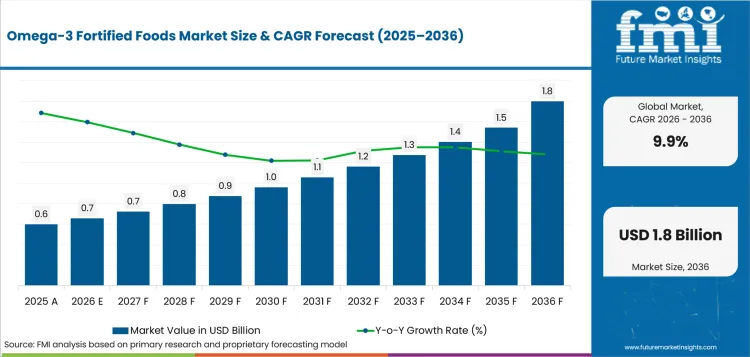
The omega-3 fortified foods industry value is anticipated to scale from USD 0.6 billion in 2025 to USD 1.8 billion by 2036 at 9.9% CAGR as food processors add EPA and ALA to dairy and family nutrition products. Microencapsulated Fish Oil is forecast to represent 46.8% share in 2026, led by dose control and cleaner sensory performance in food plants. Heart Health is expected to secure 44.2% share in 2026, reflected by adult nutrition familiarity and long-standing omega-3 communication.
Key Takeaways, Market Size, and Forecast
- 2026 Market Size: USD 0.7 billion
- 2036 Market Size: USD 1.8 billion
- Forecast CAGR: 9.9% from 2026 to 2036
- Leading Omega-3 Source: Microencapsulated Fish Oil
- Microencapsulated Fish Oil Share in 2026: 46.8%
- Leading Health Positioning: Heart Health
- Heart Health Share in 2026: 44.2%
- Fastest-growing Country: Saudi Arabia
- Saudi Arabia CAGR: 12.4% by 2036
Summary of Omega-3 Fortified Foods Market
- Demand and Growth Drivers
- Food processors are adding omega-3 to regular grocery products so households can obtain EPA or ALA through familiar eating occasions.
- Dairy and beverage brands are using encapsulated oils and algal lipids to reduce taste failure during commercial trials.
- Retailers are testing nutrition-led SKUs comparing clearly against standard milk and drink products.
- Product and Segment View
- Microencapsulated Fish Oil is forecast to represent 46.8% share in 2026, driven by dose control and reduced oxidation in food manufacturing.
- Heart Health is projected to hold 44.2% share in 2026, influenced by established consumer recognition of EPA and DHA.
- Supermarkets and Hypermarkets are expected to secure 42.9% share in 2026, reflected by shelf comparison beside standard dairy and breakfast products.
- Geography and Competitive Outlook
- Saudi Arabia is projected to record 12.4% CAGR by 2036, backed by premium grocery growth and imported nutrition product depth.
- South Korea is expected to expand at 11.8% CAGR by 2036 due to health functional food purchasing and online grocery strength.
- KD Pharma Group and dsm-firmenich compete based on omega-3 source depth and food-grade technical documentation.
- Epax, Croda, GC Rieber VivoMega, Polaris, Golden Omega, Louis Dreyfus Company, Algarithm Ingredients, and Nissui compete through marine and specialty lipid portfolios.
- Analyst Opinion
- Nandini Roy Choudhury, Principal Consultant for Food and Beverages at FMI says, "I see omega-3 fortified foods moving through a practical but narrow commercial path. Consumers know omega-3, but food makers still need products that taste clean and survive shelf life. Dairy and breakfast foods can carry a health message without asking shoppers to change routines. Clients should watch how plant-based dairy and children's nutrition brands use DHA."
- Omega-3 Fortified Foods Market Value Analysis
- Food-grade omega-3 inputs add value by converting standard dairy and bars into nutrition-positioned grocery products.
- Microencapsulation raises finished product value by reducing odor and dose variation during processing.
- Algal DHA and EPA expand the buyer base by giving plant-based and vegetarian brands a non-fish source for fortified products.
- Retail price realization improves as serving-level omega-3 content helps products justify premium placement against standard foods.
Omega-3 fortified foods need strong taste control and stable shelf life before buyers approve them. GOED’s August 2024 guidance notes that flavored EPA/DHA oils can create para-anisidine testing issues and sets a maximum TOTOX value of 26, making validated oxidation testing important for suppliers. Plant-based products also require cleaner ingredient choices. Cargill’s algal DHA oil contains at least 40% DHA or 400 mg/g and carries GRAS and Non-GMO Project verification, helping formulators add DHA to dairy alternatives and family beverages without fish-based positioning. Dairy products need more careful formulation as well. A January 2025 yogurt study found 71.75 ± 2.84% EPA+DHA retention after 21 days and 328.70 mg per 100 g serving, showing why emulsion design and flavor masking are important for product trials. Suppliers with clear dosage and strong documentation are better placed to support food brands.
Why is the Omega-3 Fortified Foods Market Growing?
- Food makers are moving omega-3 into dairy and family foods because regular eating occasions support repeat use.
- Ingredient selection is becoming more technical as brands look for cleaner taste and clear serving-level nutrition.
- Retail demand is shifting toward fortified foods making omega-3 intake easier without asking consumers to rely only on capsules or softgels.
Omega-3 fortified foods are gaining a stronger role as brands try to close the gap between nutrition awareness and daily intake. NIH Office of Dietary Supplements, updated in August 2025, states that DHA and EPA from foods contribute only about 90 mg per day in adults, which supports the case for adding omega-3 to familiar products such as milk and cereals. Finished foods also need clear dosage and better sensory control. Nissui’s 2024 Integrated Report states, its fish sausage contains 1,050 mg of EPA and DHA per portion, showing how measurable omega-3 content can be delivered through regular foods instead of supplement-only formats. Plant-based formulation adds another route. A 2025 Foods review explains that omega-3 fortification can improve the nutritional profile of plant-based beverages, although taste and ingredient sourcing remain formulation barriers across the plant-based beverages market and nutritional lipids market.
Market Segmentation Analysis
- Microencapsulated fish oil is projected to secure 46.8% share in 2026, led by food plants requiring measured EPA and DHA addition with better odor control during dairy and beverage processing.
- Heart health is anticipated to hold 44.2% share in 2026, since adult buyers already associate omega-3 with cardiovascular nutrition and compare claims on milk and drinks.
- Supermarkets and hypermarkets are forecast to account for 42.9% share in 2026, shaped by refrigerated shelf placement and repeat purchases in family grocery baskets.
- Dairy processors are expected to capture 39.5% share in 2026, influenced by milk and dairy-alternative lines that can carry lipid-based nutrients.
- Fortified dairy and dairy alternatives are projected to represent 37.6% share in 2026, reflected by routine consumption and compatibility with measured omega-3 serving claims.
- Adults and family nutrition are expected to hold 35.7% share in 2026, guided by household food formats serving parents and older adults together.
The omega-3 fortified foods industry is segmented by omega-3 source, health positioning, distribution channel, end-use processor, product form, buyer group, and region. Omega-3 Source covers microencapsulated fish oil, algal DHA and EPA oil, flaxseed and ALA oils, krill oil, and blended marine and plant sources. Health positioning covers heart health, cognitive and eye support, maternal and infant nutrition, active lifestyle, and daily nutrition. Distribution channel covers supermarkets and hypermarkets, online grocery, health food stores, pharmacies, and foodservice and institutional supply. End-use processor covers dairy processors, beverage manufacturers, bakery and cereal producers, snack and bar brands, and private label manufacturers. Product form covers fortified dairy and dairy alternatives, functional beverages, bakery and cereal foods, snacks and bars, and infant and family foods. Buyer group covers adults and family nutrition, children, pregnant and nursing consumers, older adults, and sports and active consumers.
Insights into Omega-3 Fortified Foods Market by Omega-3 Source
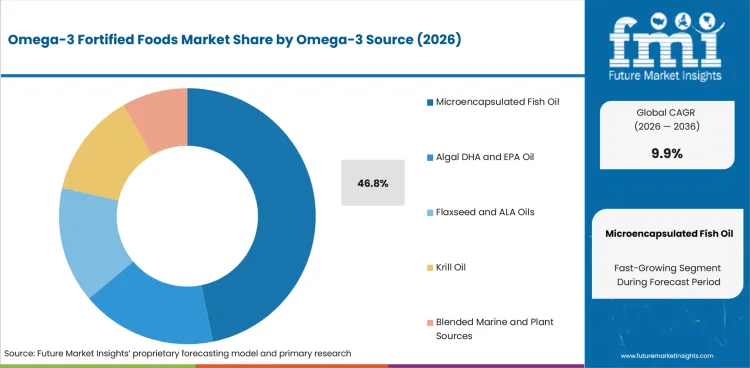
- Microencapsulated fish oil is projected to account for 46.8% share in 2026, influenced by dose accuracy and sensory protection during product shelf life.
- Algal DHA and EPA oil gains selective use in vegetarian dairy alternatives and family nutrition drinks requiring non-fish source claims.
Insights into Omega-3 Fortified Foods Market by Health Positioning
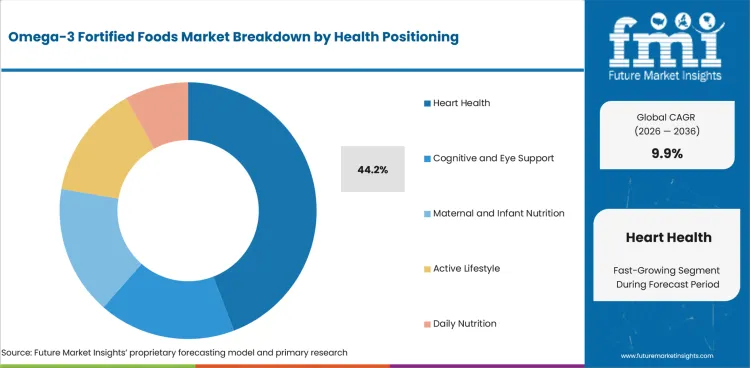
- Heart health is anticipated to hold 44.2% share in 2026 due to adult nutrition products carrying EPA and DHA communication.
- Cognitive and eye support gains value in children's products and older adult foods requiring DHA-linked nutrition messaging.
Insights into Omega-3 Fortified Foods Market by Distribution Channel
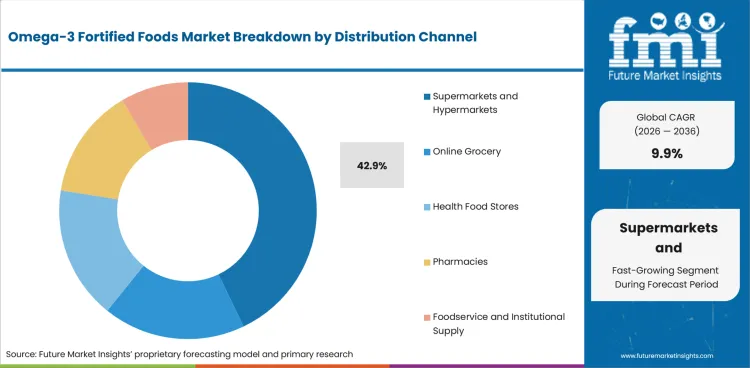
- Supermarkets and hypermarkets are forecast to secure 42.9% share in 2026, led by routine grocery comparison and chilled food placement.
- Online grocery gains use through subscription packs and repeat purchasing of fortified milk and family beverages.
Insights into Omega-3 Fortified Foods Market by End-use Processor
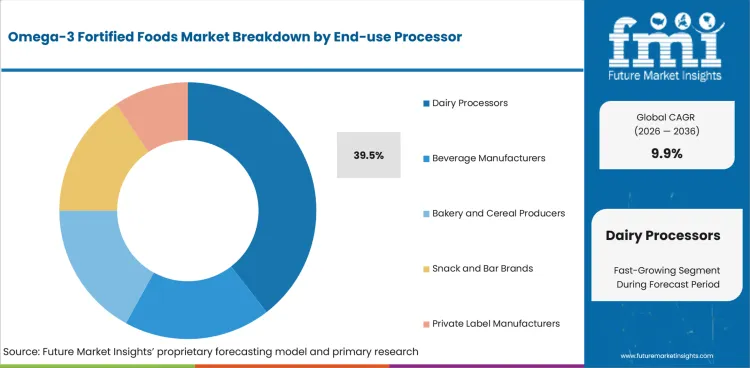
- Dairy processors are expected to capture 39.5% share in 2026, reflected by milk and plant-based dairy alternatives.
- Beverage manufacturers gain orders as refrigerated and shelf-stable drinks use emulsions and powdered omega-3 inputs.
Insights into Omega-3 Fortified Foods Market by Product Form
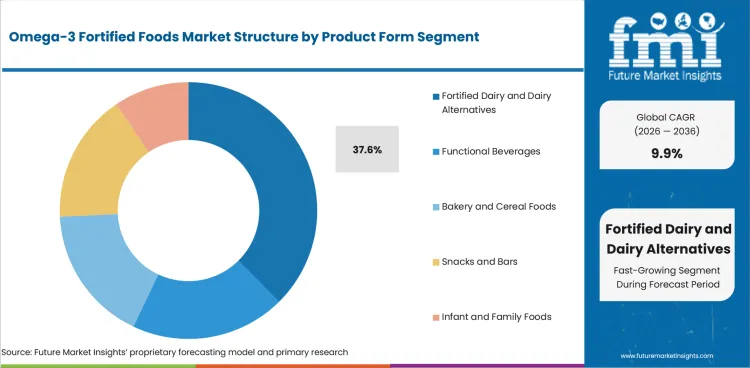
- Fortified dairy and dairy alternatives are projected to represent 37.6% share in 2026, guided by daily intake frequency and consumer familiarity with fortified milk.
- Bakery and cereal foods gain use in breakfast products carrying ALA or blended source claims.
Insights into Omega-3 Fortified Foods Market by Buyer Group
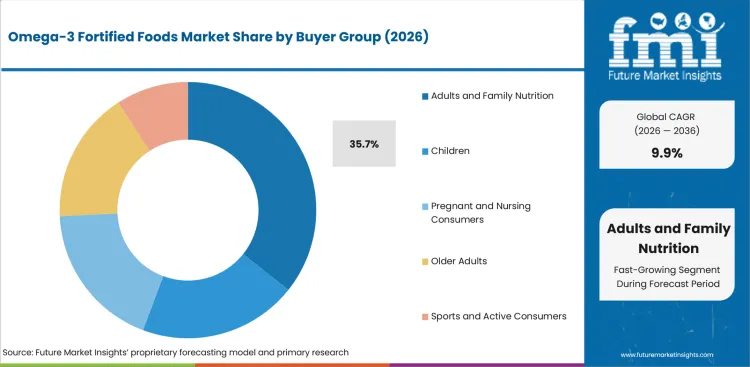
- Adults and family nutrition are expected to hold 35.7% share in 2026, supported by multiperson household use and shared grocery purchase decisions.
- Pregnant and nursing consumers add value through DHA-focused products, especially in maternal nutrition drinks and family food extensions.
Omega-3 Fortified Foods Market Drivers, Restraints and Opportunities
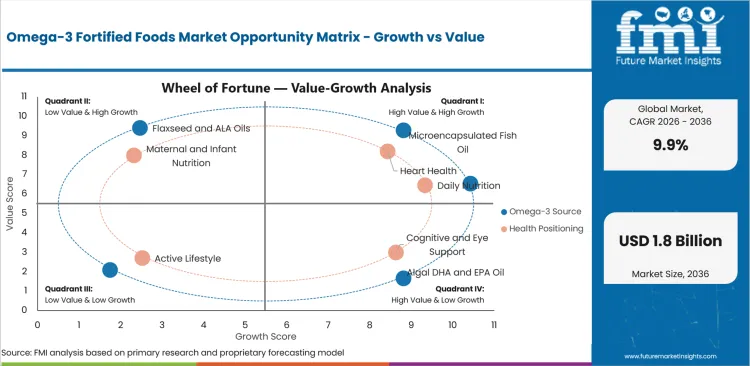
- Grocery-based nutrition is pushing omega-3 into dairy and family snacks.
- Sensory failure and ingredient cost can slow product rollout in value-priced foods.
- Algal and encapsulated inputs create room for vegetarian and plant-based fortified products.
Grocery-based Nutrition Supports Food Fortification
Consumer interest in food-led health benefits is creating room for omega-3 foods beyond supplements. IFIC’s 2025 Food & Health Survey of 3,000 U.S. adults found that 32% seek heart or cardiovascular benefits from foods and nutrients. It also found, 27% seek brain-function benefits. This gives omega-3 fortified milk and drinks a clearer retail role across the functional beverage market.
Processing Stability Limits Wider Rollout
Food processors need omega-3 ingredients that survive heat and storage before commercial scale-up. Frontiers in Nutrition stated in April 2026, moderate processing temperatures of 45°C to 70°C can accelerate DHA oxidation under oxygen and pro-oxidant conditions. This makes encapsulation and stability testing important for dairy and beverage trials across the food encapsulation market.
Algal Inputs Create Regulated Food Openings
Algal DHA is gaining relevance where brands need non-fish omega-3 sources for family nutrition and dairy-adjacent formats. FDA GRN No. 1217 states, HuveNutra intends to use algal oil with at least 40% DHA in infant formula at a maximum level of 0.5% of total fat as DHA. This supports regulated product development across the infant formula DHA algae oil market.
Analysis of Omega-3 Fortified Foods Market by Key Countries
.webp "Top Country Growth Comparison Omega 3 Fortified Foods Market Cagr (2026 2036)")
| Country | CAGR |
|---|---|
| Saudi Arabia | 12.4% |
| South Korea | 11.8% |
| United States | 10.2% |
| Canada | 9.6% |
| United Kingdom | 9.2% |
| Germany | 8.7% |
| Japan | 8.1% |
Source: Future Market Insights, 2026.
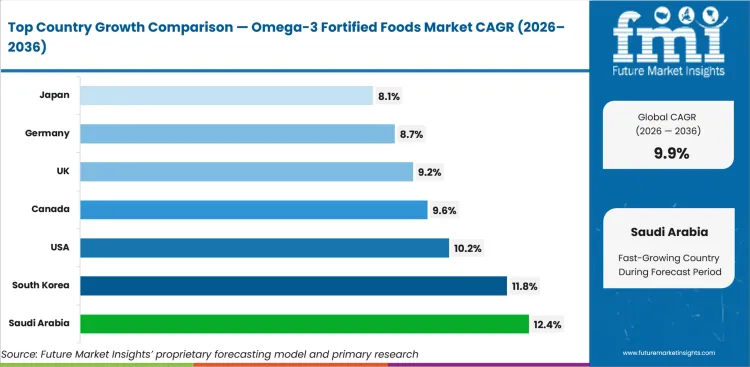
Omega-3 Fortified Foods Market CAGR Analysis by Country
- Saudi Arabia is anticipated to record 12.4% CAGR by 2036, driven by modern grocery expansion and imported premium nutrition products.
- South Korea is expected to expand at 11.8% CAGR from 2026 to 2036 due to health functional food familiarity and online retail depth.
- United States is projected to grow at 10.2% CAGR by 2036, reflected by grocery spending scale and updated claim rules.
- Canada is set to rise at 9.6% CAGR by 2036, since supermarket concentration and bilingual label discipline favor documented products.
- United Kingdom is likely to scale at 9.2% CAGR by 2036, influenced by food manufacturing scale and regulated nutrition claims.
- Germany is forecast at 8.7% CAGR by 2036 as ingredient scrutiny and dairy processing depth support measured fortification.
- Japan is expected to post 8.1% CAGR by 2036, led by older adult nutrition needs and function-claim food systems.
Industry Outlook for Omega-3 Fortified Foods Market in Saudi Arabia
Fastest-growing country market · 2026 to 2036
Country Market Snapshot Table
| Parameter | Value |
|---|---|
| Market Size in 2025 (Value) | USD 19.6 million |
| Market Size in 2026 (Value) | USD 22.0 million |
| Market Forecast in 2036 (Value) | USD 70.8 million |
| CAGR (2026 to 2036) | 12.4% |
| Years Considered | 2021 to 2036 |
| Base Year | 2025 |
| Forecast Period | 2026 to 2036 |
| Units Considered | Value (USD million) |
| Leading Sub-Region | Riyadh and Jeddah modern grocery corridors |
Saudi Arabia Omega-3 Fortified Foods Market Outlook
The market in Saudi Arabia is forecast to record 12.4% CAGR from 2026 to 2036, driven by modern grocery concentration and imported nutrition product depth. Saudi Arabia omega-3 fortified foods sector is shaped by imported food depth and established grocery corridors in Riyadh and Dammam. Modern retail chains make chilled dairy and children's foods practical formats for omega-3 trials.
Food brands can use fortified milk and functional beverages to reach urban households. Local processors and importers gain better shelf access with supplier files supporting Arabic labels and nutrient claim review.
Key Growth Drivers
- Riyadh and Jeddah retailers can support specialized omega-3 dairy and beverage launches, as USDA FAS reported in September 2025 that Saudi food retail sales exceeded USD 50.0 billion in 2024.
- Chain-led grocery concentration shortens the route from trial listing to national rollout, with USDA FAS stating in September 2025 that 5 leading chains represented more than 80.0% of retail revenues.
- Family nutrition shelves in Riyadh pharmacies and hypermarkets provide a practical path for DHA-linked children's foods and adult drinks.
- Domestic dairy processors can add encapsulated omega-3 to flavored milk and yogurt drinks without changing daily consumption routines.
Key Restraints
- Import-led supply can delay omega-3 food launches if Arabic label review or freight timing slows product release.
- Premium fortified products may face weaker repeat purchase outside higher-income grocery corridors in Riyadh and Jeddah.
- Shelf-price headroom remains controlled by household inflation pressure, as the General Authority for Statistics reported in October 2025 that Saudi CPI reached 2.2% year over year.
What makes Saudi Arabia unique
Saudi Arabia combines high imported food reliance with concentrated modern grocery chains, creating a faster test market for premium fortified foods.
Key Companies
- Almarai
- Nadec
- Saudia Dairy & Foodstuff Company
- Al Safi Danone
- Forsan Foods
- Tamimi Markets Private Label
Sales & Marketing Channels
- Hypermarket nutrition aisles
- Imported food distributors
- Dairy processor retail routes
- Pharmacy-adjacent nutrition shelves
- Online grocery platforms
- Family nutrition promotions
Country Segment Breakdown Table
| Segment | Sub-Segments |
|---|---|
| By Omega-3 Source | Microencapsulated Fish Oil · Algal DHA and EPA Oil · Flaxseed and ALA Oils · Krill Oil · Blended Marine and Plant Sources |
| By Health Positioning | Heart Health · Cognitive and Eye Support · Maternal and Infant Nutrition · Active Lifestyle · Daily Nutrition |
| By Distribution Channel | Supermarkets and Hypermarkets · Online Grocery · Health Food Stores · Pharmacies · Foodservice and Institutional Supply |
| By End-use Processor | Dairy Processors · Beverage Manufacturers · Bakery and Cereal Producers · Snack and Bar Brands · Private Label Manufacturers |
| By Product Form | Fortified Dairy and Dairy Alternatives · Functional Beverages · Bakery and Cereal Foods · Snacks and Bars · Infant and Family Foods |
| By Buyer Group | Adults and Family Nutrition · Children · Pregnant and Nursing Consumers · Older Adults · Sports and Active Consumers |
| Key Sub-Regions Covered, Grocery and Food Manufacturing Areas | Riyadh · Jeddah · Dammam · Makkah · Madinah · Eastern Province |
Frequently Asked Questions
How fast is Saudi Arabia omega-3 fortified foods market growing?
Saudi Arabia omega-3 fortified foods industry is forecast to record 12.4% CAGR from 2026 to 2036, led by modern grocery expansion and imported nutrition products.
Who leads Saudi Arabia omega-3 fortified foods market?
Almarai, Nadec, Saudia Dairy & Foodstuff Company, Al Safi Danone, Forsan Foods, and Tamimi Markets Private Label compete based on dairy and established grocery channels.
What is driving adoption in Saudi Arabia omega-3 fortified foods market?
Urban grocery chains and family nutrition products are supporting omega-3 fortified foods in dairy drinks and specialty beverages.
Demand Outlook for Omega-3 Fortified Foods Market in South Korea
Health functional food-led market · 2026 to 2036
Country Market Snapshot Table
| Parameter | Value |
|---|---|
| Market Size in 2025 (Value) | USD 45.6 million |
| Market Size in 2026 (Value) | USD 51.0 million |
| Market Forecast in 2036 (Value) | USD 155.6 million |
| CAGR (2026 to 2036) | 11.8% |
| Years Considered | 2021 to 2036 |
| Base Year | 2025 |
| Forecast Period | 2026 to 2036 |
| Units Considered | Value (USD million) |
| Leading Sub-Region | Seoul Capital Area and Busan retail corridors |
South Korea Omega-3 Fortified Foods Market Outlook
Industry in South Korea is expected to expand at 11.8% CAGR from 2026 to 2036, influenced by health functional food familiarity and convenience-led nutrition retail. South Korea demand is supported by buyers accustomed to health functional food labeling and MFDS-recognized ingredient systems. Food manufacturers use dairy drinks and convenience-store nutrition products to test omega-3 formats.
Online grocery and health-oriented retail support repeat purchase. Suppliers able to support Korean documentation and clean-taste trials are favored by dairy and beverage processors.
Key Growth Drivers
- Seoul processors can position omega-3 foods beside familiar health products, as USDA FAS reported in April 2026 that South Korea's health functional food market reached KRW 5.07 trillion in 2024.
- Consumer readiness strengthens fortified food trial potential, with KHFF stating in September 2025 that 83.2% of Korean consumers had purchased health functional foods in 2024.
- Convenience-store nutrition products give omega-3 beverages and dairy drinks a route beyond supplement stores.
- Seoul Capital Area online grocery channels help repeat purchasing for fortified family foods and breakfast products.
Key Restraints
- Softgels and capsules remain strong substitutes for consumers seeking measured EPA and DHA intake.
- Fast SKU turnover raises slotting risk for small food brands without established retail backing.
- Shelf crowding can dilute fortified food discovery, as the U.S. International Trade Administration stated in July 2025 that roughly 5,000.0 new health supplement products enter South Korea each year.
What makes South Korea unique
South Korea links health functional food familiarity with convenience retail and online grocery speed, giving fortified foods more trial routes than many Asian markets.
Key Companies
- Maeil Dairies
- Namyang Dairy Products
- hy
- Lotte Wellfood
- Pulmuone
- CJ CheilJedang
Sales & Marketing Channels
- Convenience-store nutrition shelves
- Online grocery subscriptions
- Supermarket dairy aisles
- Health functional food retailers
- Dairy processor channels
- Family nutrition bundles
Country Segment Breakdown Table
| Segment | Sub-Segments |
|---|---|
| By Omega-3 Source | Microencapsulated Fish Oil · Algal DHA and EPA Oil · Flaxseed and ALA Oils · Krill Oil · Blended Marine and Plant Sources |
| By Health Positioning | Heart Health · Cognitive and Eye Support · Maternal and Infant Nutrition · Active Lifestyle · Daily Nutrition |
| By Distribution Channel | Supermarkets and Hypermarkets · Online Grocery · Health Food Stores · Pharmacies · Foodservice and Institutional Supply |
| By End-use Processor | Dairy Processors · Beverage Manufacturers · Bakery and Cereal Producers · Snack and Bar Brands · Private Label Manufacturers |
| By Product Form | Fortified Dairy and Dairy Alternatives · Functional Beverages · Bakery and Cereal Foods · Snacks and Bars · Infant and Family Foods |
| By Buyer Group | Adults and Family Nutrition · Children · Pregnant and Nursing Consumers · Older Adults · Sports and Active Consumers |
| Key Sub-Regions Covered, Grocery and Food Manufacturing Areas | Seoul Capital Area · Busan · Daegu · Incheon · Daejeon · Gwangju |
Frequently Asked Questions
How fast is South Korea omega-3 fortified foods market growing?
South Korea omega-3 fortified foods industry is expected to expand at 11.8% CAGR from 2026 to 2036, influenced by health functional food familiarity.
Who leads South Korea omega-3 fortified foods market?
Maeil Dairies, Namyang Dairy Products, hy, Lotte Wellfood, Pulmuone, and CJ CheilJedang compete led by convenience nutrition and family food formats.
What is driving adoption in South Korea omega-3 fortified foods market?
Functional food familiarity and online grocery buying are moving omega-3 into drinks and children's products.
Sales Outlook for Omega-3 Fortified Foods Market in the United States
Largest value market · 2026 to 2036
Country Market Snapshot Table
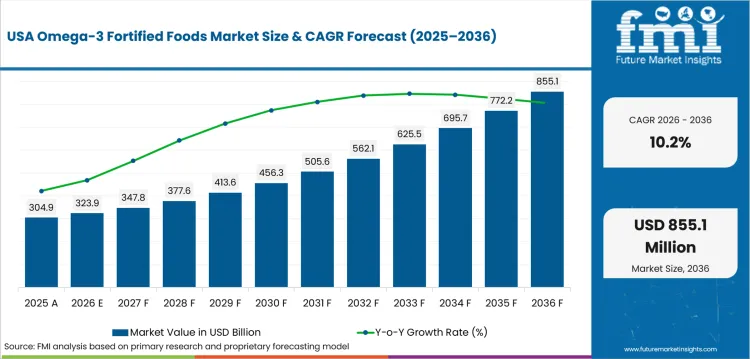
| Parameter | Value |
|---|---|
| Market Size in 2025 (Value) | USD 165.2 million |
| Market Size in 2026 (Value) | USD 182.0 million |
| Market Forecast in 2036 (Value) | USD 480.7 million |
| CAGR (2026 to 2036) | 10.2% |
| Years Considered | 2021 to 2036 |
| Base Year | 2025 |
| Forecast Period | 2026 to 2036 |
| Units Considered | Value (USD million) |
| Leading Sub-Region | National grocery and club-store channels |
United States Omega-3 Fortified Foods Market Outlook
The market in United States is projected to grow at 10.2% CAGR from 2026 to 2036, reflected by national grocery scale and updated nutrient claim criteria. United States omega-3 fortified foods sales are shaped by large food-at-home spending and broad national grocery reach. FDA's updated healthy claim rule gives brand owners a clearer compliance path for nutrient communication.
Club stores and online grocery channels can support multipack formats for milk and beverages. Suppliers with application support and serving-level nutrient files are better placed to win food manufacturer trials.
Key Growth Drivers
- National grocery scale gives omega-3 foods a large base for milk and beverage launches, as USDA ERS reported in June 2026 that food-at-home expenditures reached USD 1.10 trillion in 2025.
- Online grocery and direct ordering support repeat purchases, with the U.S. Census Bureau reporting in May 2026 that seasonally adjusted retail e-commerce sales reached USD 326.7 billion in Q1 2026.
- Club-store multipacks can move omega-3 milk and family beverages into household stock-up routines.
- Plant-based brands can use algal DHA and EPA to improve dairy-alternative nutrition within the dairy alternatives market.
Key Restraints
- Fish oil odor concerns can delay scale-up unless suppliers provide encapsulation and shelf-life data.
- Value milk and cereal brands may resist specialty fortification during grocery price pressure.
- Premium fortified foods face household cost scrutiny, as the U.S. Bureau of Labor Statistics reported in June 2026 that the food-at-home index rose 2.7% over the 12 months ending in May 2026.
What makes the United States unique
United States demand combines national retail scale and a large private-label base able to test omega-3 products quickly.
Key Companies
- Organic Valley
- Horizon Organic
- Eggland's Best
- General Mills
- Kellanova
- Ripple Foods
Sales & Marketing Channels
- Club-store multipacks
- National supermarket chains
- Online grocery subscriptions
- Natural food retailers
- Refrigerated dairy distributors
- Breakfast-food retail programs
Country Segment Breakdown Table
| Segment | Sub-Segments |
|---|---|
| By Omega-3 Source | Microencapsulated Fish Oil · Algal DHA and EPA Oil · Flaxseed and ALA Oils · Krill Oil · Blended Marine and Plant Sources |
| By Health Positioning | Heart Health · Cognitive and Eye Support · Maternal and Infant Nutrition · Active Lifestyle · Daily Nutrition |
| By Distribution Channel | Supermarkets and Hypermarkets · Online Grocery · Health Food Stores · Pharmacies · Foodservice and Institutional Supply |
| By End-use Processor | Dairy Processors · Beverage Manufacturers · Bakery and Cereal Producers · Snack and Bar Brands · Private Label Manufacturers |
| By Product Form | Fortified Dairy and Dairy Alternatives · Functional Beverages · Bakery and Cereal Foods · Snacks and Bars · Infant and Family Foods |
| By Buyer Group | Adults and Family Nutrition · Children · Pregnant and Nursing Consumers · Older Adults · Sports and Active Consumers |
| Key Sub-Regions Covered, Grocery and Food Manufacturing Areas | California · Texas · Florida · New York · Midwest dairy belt · Pacific Northwest |
Frequently Asked Questions
How fast is United States omega-3 fortified foods market growing?
United States omega-3 fortified foods industry is projected to grow at 10.2% CAGR from 2026 to 2036, guided by grocery scale and label-rule clarity.
Who leads United States omega-3 fortified foods market?
Organic Valley, Horizon Organic, Eggland's Best, General Mills, Kellanova, and Ripple Foods compete through dairy and plant-based beverages.
What is driving adoption in United States omega-3 fortified foods market?
Grocery spending scale and updated nutrient claim rules are supporting omega-3 foods in mainstream retail.
Growth Outlook for Omega-3 Fortified Foods Market in Canada
Premium grocery and bilingual label market · 2026 to 2036
Country Market Snapshot Table
| Parameter | Value |
|---|---|
| Market Size in 2025 (Value) | USD 28.3 million |
| Market Size in 2026 (Value) | USD 31.0 million |
| Market Forecast in 2036 (Value) | USD 77.5 million |
| CAGR (2026 to 2036) | 9.6% |
| Years Considered | 2021 to 2036 |
| Base Year | 2025 |
| Forecast Period | 2026 to 2036 |
| Units Considered | Value (USD million) |
| Leading Sub-Region | Ontario and Quebec grocery corridors |
Canada Omega-3 Fortified Foods Market Outlook
Sector in Canada is expected to advance at 9.6% CAGR from 2026 to 2036, aided by supermarket concentration and bilingual food label requirements. Canada omega-3 fortified foods demand is influenced by supermarket scale and cross-border ingredient supply. Ontario and Quebec support dairy and private-label development for nutrition-led grocery products.
Bilingual packaging and food label review raise the value of supplier documentation. Processors can move faster as ingredient partners provide English and French nutrient support along with stability data.
Key Growth Drivers
- Food retailers offer an improving placement base for fortified dairy and beverages, as Statistics Canada reported in May 2026 that food and beverage retailers increased 0.5% in March 2026.
- Supermarket traffic supports omega-3 products near standard milk and cereal shelves, with Statistics Canada reporting in May 2026 that supermarkets and other grocery retailers increased 0.8% in March 2026.
- Ontario dairy processors can test omega-3 milk and yogurt through regional retail routes.
- Private label teams can use documented omega-3 powders to build retailer-owned fortified food lines.
Key Restraints
- Smaller production runs can reduce priority for omega-3 foods compared with U.S. national SKUs.
- Cold-chain distance raises delivered cost for fortified dairy drinks in western and northern provinces.
- Online discovery remains limited for new fortified foods, as Statistics Canada reported in May 2026 that e-commerce accounted for 7.1% of total retail trade in March 2026.
What makes Canada unique
Canada combines established grocery demand with bilingual label requirements, making documentation quality more important than simple ingredient access.
Key Companies
- Saputo
- Lactalis Canada
- Earth's Own
- Nature's Path
- Loblaw Private Label
- Agropur
Sales & Marketing Channels
- Bilingual supermarket packaging
- Dairy processor retail routes
- Natural food chains
- Private label programs
- Online grocery repeat packs
- Regional refrigerated distributors
Country Segment Breakdown Table
| Segment | Sub-Segments |
|---|---|
| By Omega-3 Source | Microencapsulated Fish Oil · Algal DHA and EPA Oil · Flaxseed and ALA Oils · Krill Oil · Blended Marine and Plant Sources |
| By Health Positioning | Heart Health · Cognitive and Eye Support · Maternal and Infant Nutrition · Active Lifestyle · Daily Nutrition |
| By Distribution Channel | Supermarkets and Hypermarkets · Online Grocery · Health Food Stores · Pharmacies · Foodservice and Institutional Supply |
| By End-use Processor | Dairy Processors · Beverage Manufacturers · Bakery and Cereal Producers · Snack and Bar Brands · Private Label Manufacturers |
| By Product Form | Fortified Dairy and Dairy Alternatives · Functional Beverages · Bakery and Cereal Foods · Snacks and Bars · Infant and Family Foods |
| By Buyer Group | Adults and Family Nutrition · Children · Pregnant and Nursing Consumers · Older Adults · Sports and Active Consumers |
| Key Sub-Regions Covered, Grocery and Food Manufacturing Areas | Ontario · Quebec · British Columbia · Alberta · Manitoba · Atlantic Canada |
Frequently Asked Questions
How fast is Canada omega-3 fortified foods market growing?
Canada omega-3 fortified foods industry is expected to advance at 9.6% CAGR from 2026 to 2036, helped by grocery concentration and label discipline.
Who leads Canada omega-3 fortified foods market?
Saputo, Lactalis Canada, Earth's Own, Nature's Path, Loblaw Private Label, and Agropur compete depending on plant-based beverages and retailer-owned products.
What is driving adoption in Canada omega-3 fortified foods market?
Premium grocery shelves and bilingual claim documentation are guiding omega-3 fortified food launches.
Industry Outlook for Omega-3 Fortified Foods Market in the United Kingdom
Regulated nutrition claim market · 2026 to 2036
Country Market Snapshot Table
| Parameter | Value |
|---|---|
| Market Size in 2025 (Value) | USD 40.3 million |
| Market Size in 2026 (Value) | USD 44.0 million |
| Market Forecast in 2036 (Value) | USD 106.1 million |
| CAGR (2026 to 2036) | 9.2% |
| Years Considered | 2021 to 2036 |
| Base Year | 2025 |
| Forecast Period | 2026 to 2036 |
| Units Considered | Value (USD million) |
| Leading Sub-Region | Greater London and Midlands grocery corridors |
United Kingdom Omega-3 Fortified Foods Market Outlook
Demand in the United Kingdom is likely to rise at 9.2% CAGR from 2026 to 2036, backed by food manufacturing scale and regulated nutrition communication. United Kingdom omega-3 fortified foods are influenced by nutrition legislation and concentrated supermarket purchasing. Government nutrition guidance and food labeling rules make claim wording a central approval issue for brands.
Food and drink manufacturers can trial omega-3 in dairy drinks and chilled beverages. Retail private labels can scale products faster with formulation and claim files already prepared.
Key Growth Drivers
- Domestic manufacturing scale supports reformulation activity, as DEFRA reported in February 2026 that the agri-food chain contributed GBP 153.2 billion to UK GVA in 2023.
- Food and drink factories create a base for dairy and beverage trials, with DEFRA stating in February 2026 that food chain GVA excluding agriculture and fishing reached GBP 139.5 billion in 2023.
- Retail private label programs can test omega-3 dairy and breakfast products before national rollout.
- Nutrition legislation guidance increases demand for suppliers able to provide compliant claim wording and serving support.
Key Restraints
- Compliance review raises development cost for smaller brands seeking supermarket listings.
- Price-sensitive households may choose standard dairy and breakfast foods over premium fortified products.
- Retail softness can delay new shelf entries, as the Office for National Statistics reported in May 2026 that retail sales volumes fell 1.3% in April 2026.
What makes the United Kingdom unique
United Kingdom food brands operate in a claim-sensitive grocery system in which retailer approval often requires strong label and serving documentation.
Key Companies
- Arla Foods UK
- Müller UK & Ireland
- Yeo Valley
- Rude Health
- Hovis
- Tesco Private Label
Sales & Marketing Channels
- Supermarket private label programs
- Chilled dairy aisles
- Breakfast bakery shelves
- Online grocery subscriptions
- Health food retailers
- Contract food manufacturers
Country Segment Breakdown Table
| Segment | Sub-Segments |
|---|---|
| By Omega-3 Source | Microencapsulated Fish Oil · Algal DHA and EPA Oil · Flaxseed and ALA Oils · Krill Oil · Blended Marine and Plant Sources |
| By Health Positioning | Heart Health · Cognitive and Eye Support · Maternal and Infant Nutrition · Active Lifestyle · Daily Nutrition |
| By Distribution Channel | Supermarkets and Hypermarkets · Online Grocery · Health Food Stores · Pharmacies · Foodservice and Institutional Supply |
| By End-use Processor | Dairy Processors · Beverage Manufacturers · Bakery and Cereal Producers · Snack and Bar Brands · Private Label Manufacturers |
| By Product Form | Fortified Dairy and Dairy Alternatives · Functional Beverages · Bakery and Cereal Foods · Snacks and Bars · Infant and Family Foods |
| By Buyer Group | Adults and Family Nutrition · Children · Pregnant and Nursing Consumers · Older Adults · Sports and Active Consumers |
| Key Sub-Regions Covered, Grocery and Food Manufacturing Areas | Greater London · South East England · West Midlands · East Midlands · North West England · Yorkshire |
Frequently Asked Questions
How fast is United Kingdom omega-3 fortified foods market growing?
United Kingdom omega-3 fortified foods industry is projected to rise at 9.2% CAGR from 2026 to 2036, reflected by food manufacturing and regulated claims.
Who leads United Kingdom omega-3 fortified foods market?
Arla Foods UK, Müller UK & Ireland, Yeo Valley, Rude Health, Hovis, and Tesco Private Label compete through dairy and retailer-owned formats.
What is driving adoption in United Kingdom omega-3 fortified foods market?
Nutrition claim rules and supermarket private label programs are supporting omega-3 foods with clear serving-level documentation.
Demand Outlook for Omega-3 Fortified Foods Market in Germany
Ingredient scrutiny and dairy manufacturing market · 2026 to 2036
Country Market Snapshot Table
| Parameter | Value |
|---|---|
| Market Size in 2025 (Value) | USD 53.4 million |
| Market Size in 2026 (Value) | USD 58.0 million |
| Market Forecast in 2036 (Value) | USD 133.6 million |
| CAGR (2026 to 2036) | 8.7% |
| Years Considered | 2021 to 2036 |
| Base Year | 2025 |
| Forecast Period | 2026 to 2036 |
| Units Considered | Value (USD million) |
| Leading Sub-Region | North Rhine-Westphalia and Bavaria food manufacturing corridors |
Germany Omega-3 Fortified Foods Market Outlook
Sector in Germany is forecast to expand at 8.7% CAGR from 2026 to 2036, helped by ingredient scrutiny and dairy processing strength. Germany omega-3 fortified foods are guided by ingredient scrutiny and a technically demanding retail base. Public guidance on omega-3 supports consumer knowledge while reinforcing caution around dosage and supplements.
Dairy
and plant-based food manufacturers can use omega-3 inputs once source identity and sensory stability are well documented. Suppliers need EU claim support and clear food-grade files to enter processor trials.
Key Growth Drivers
- Grocery scale gives fortified dairy and cereal products a large shelf base, as USDA FAS reported in September 2025 that Germany's food retail sales reached USD 293.1 billion in 2024.
- Retail value growth supports premium nutrition tests, with USDA FAS reporting in September 2025 that German food retail sales increased 8.2% in 2024.
- Dairy and bakery manufacturers can add omega-3 powders to familiar foods without changing eating occasions.
- Drugstores and supermarkets give fortified foods a route to health-oriented shoppers outside supplement shelves.
Key Restraints
- German buyers scrutinize source claims and dosage before accepting premium food prices.
- Fish oil odor and oxidation concerns can lengthen dairy and bakery trials.
- Premium food launches face cautious shopper behavior, as Destatis reported in June 2026 that food prices were only 0.4% higher year over year in May 2026.
What makes Germany unique
Germany combines omega-3 consumer education with strict ingredient review, making technical documentation a decisive supplier advantage.
Key Companies
- DMK Deutsches Milchkontor
- Theo Müller
- Ehrmann
- Alnatura
- Rügenwalder Mühle
- Edeka Private Label
Sales & Marketing Channels
- Supermarket dairy shelves
- Drugstore nutrition aisles
- Organic food retailers
- Bakery ingredient distributors
- Plant-based food processors
- EU-compliant private label programs
Country Segment Breakdown Table
| Segment | Sub-Segments |
|---|---|
| By Omega-3 Source | Microencapsulated Fish Oil · Algal DHA and EPA Oil · Flaxseed and ALA Oils · Krill Oil · Blended Marine and Plant Sources |
| By Health Positioning | Heart Health · Cognitive and Eye Support · Maternal and Infant Nutrition · Active Lifestyle · Daily Nutrition |
| By Distribution Channel | Supermarkets and Hypermarkets · Online Grocery · Health Food Stores · Pharmacies · Foodservice and Institutional Supply |
| By End-use Processor | Dairy Processors · Beverage Manufacturers · Bakery and Cereal Producers · Snack and Bar Brands · Private Label Manufacturers |
| By Product Form | Fortified Dairy and Dairy Alternatives · Functional Beverages · Bakery and Cereal Foods · Snacks and Bars · Infant and Family Foods |
| By Buyer Group | Adults and Family Nutrition · Children · Pregnant and Nursing Consumers · Older Adults · Sports and Active Consumers |
| Key Sub-Regions Covered, Grocery and Food Manufacturing Areas | North Rhine-Westphalia · Bavaria · Baden-Wurttemberg · Lower Saxony · Hesse · Hamburg |
Frequently Asked Questions
How fast is Germany omega-3 fortified foods market growing?
Germany omega-3 fortified foods industry is forecast at 8.7% CAGR from 2026 to 2036, aided by ingredient scrutiny and dairy manufacturing depth.
Who leads Germany omega-3 fortified foods market?
DMK Deutsches Milchkontor, Theo Müller, Ehrmann, Alnatura, Rügenwalder Mühle, and Edeka Private Label compete due to organic food and retailer-owned channels.
What is driving adoption in Germany omega-3 fortified foods market?
Omega-3 education and dairy processing capability are supporting measured fortification in familiar foods.
Sales Outlook for Omega-3 Fortified Foods Market in Japan
Ageing nutrition and function-claim food market · 2026 to 2036
Country Market Snapshot Table
| Parameter | Value |
|---|---|
| Market Size in 2025 (Value) | USD 61.1 million |
| Market Size in 2026 (Value) | USD 66.0 million |
| Market Forecast in 2036 (Value) | USD 143.8 million |
| CAGR (2026 to 2036) | 8.1% |
| Years Considered | 2021 to 2036 |
| Base Year | 2025 |
| Forecast Period | 2026 to 2036 |
| Units Considered | Value (USD million) |
| Leading Sub-Region | Kanto and Kansai retail corridors |
Japan Omega-3 Fortified Foods Market Outlook
Industry in Japan is expected to post 8.1% CAGR from 2026 to 2036, led by older adult nutrition needs and function-claim food systems. Japan omega-3 fortified foods are influenced by older adult nutrition needs and a well-developed functional food system. Foods with Function Claims create a structured route for brands that can document ingredient purpose and consumer communication.
Dairy drinks and health beverages provide the clearest product routes. Suppliers with Japanese-language files and precise dosage support can gain processor trust in Kanto and Kansai.
Key Growth Drivers
- Older adult nutrition supports DHA and EPA food positioning, as Japan's Cabinet Office reported in June 2025 that people aged 65 and over represented 29.3% of the population in 2024.
- Health-oriented processed foods have a manufacturing base, as USDA FAS reported in April 2026 that Japan's food processing sector totaled USD 174.0 billion in 2025.
- Functional beverage and dairy brands can add DHA-led messaging for older adults and family nutrition.
- Seafood familiarity helps omega-3 claims connect with established eating patterns.
Key Restraints
- Compact serving sizes can limit deliverable EPA and DHA dose in drinks and dairy products.
- Imported algal and microencapsulated inputs can raise shelf prices for premium products.
- Reformulation budgets remain selective, as USDA FAS reported in April 2026 that Japan's food processing sector contracted 3.0% in 2025.
What makes Japan unique
Japan combines aged-population nutrition needs with a formal function-claim food route, giving documented omega-3 foods a clear retail pathway.
Key Companies
- Nissui Corporation
- Meiji Holdings
- Morinaga Milk Industry
- Megmilk Snow Brand
- Yakult Honsha
- Asahi Group Foods
Sales & Marketing Channels
- Supermarket health food shelves
- Convenience-store beverages
- Dairy drink channels
- Seafood processor routes
- Functional food retail programs
- Online senior nutrition stores
Country Segment Breakdown Table
| Segment | Sub-Segments |
|---|---|
| By Omega-3 Source | Microencapsulated Fish Oil · Algal DHA and EPA Oil · Flaxseed and ALA Oils · Krill Oil · Blended Marine and Plant Sources |
| By Health Positioning | Heart Health · Cognitive and Eye Support · Maternal and Infant Nutrition · Active Lifestyle · Daily Nutrition |
| By Distribution Channel | Supermarkets and Hypermarkets · Online Grocery · Health Food Stores · Pharmacies · Foodservice and Institutional Supply |
| By End-use Processor | Dairy Processors · Beverage Manufacturers · Bakery and Cereal Producers · Snack and Bar Brands · Private Label Manufacturers |
| By Product Form | Fortified Dairy and Dairy Alternatives · Functional Beverages · Bakery and Cereal Foods · Snacks and Bars · Infant and Family Foods |
| By Buyer Group | Adults and Family Nutrition · Children · Pregnant and Nursing Consumers · Older Adults · Sports and Active Consumers |
| Key Sub-Regions Covered, Grocery and Food Manufacturing Areas | Kanto · Kansai · Chubu · Kyushu · Hokkaido · Tohoku |
Frequently Asked Questions
How fast is Japan omega-3 fortified foods market growing?
Japan omega-3 fortified foods industry is expected to post 8.1% CAGR from 2026 to 2036, supported by aged-population nutrition and function-claim foods.
Who leads Japan omega-3 fortified foods market?
Nissui Corporation, Meiji Holdings, Morinaga Milk Industry, Megmilk Snow Brand, Yakult Honsha, and Asahi Group Foods compete led by seafood and functional food formats.
What is driving adoption in Japan omega-3 fortified foods market?
Older adult nutrition needs and function-claim food systems are supporting omega-3 fortified foods.
Competitive Landscape and Strategic Positioning
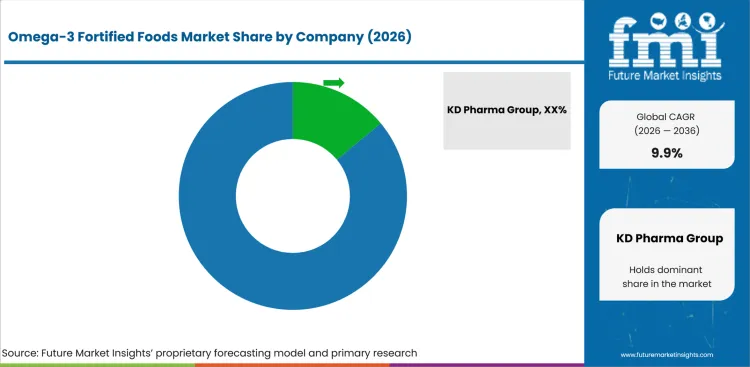
- Food-grade omega-3 suppliers hold an advantage through source traceability and application support.
- Algal oil developers gain attention from plant-based dairy and children's nutrition brands.
- Marine oil specialists compete by offering EPA and DHA concentration depth and food-grade production systems.
- Finished food companies influence adoption by translating ingredient claims into dairy and family food formats.
Competition in omega-3 fortified foods centers on ingredient suitability for real food processing. Buyers compare fish oil powders and blended sources before approving product trials. Supplier selection depends on clean taste and claim documentation.
Manufacturing depth separates food-ready ingredient firms from companies mainly serving capsules and bulk oils. KD Pharma Group gained MEG-3 marine lipid assets for food and beverage markets through its 2024 acquisition. dsm-firmenich competes with algal nutritional lipids, while Epax, Croda, GC Rieber VivoMega, Polaris, Golden Omega, Louis Dreyfus Company, Algarithm Ingredients, and Nissui add source control and regional food industry access.
Smaller regional food processors can profit by introducing omega-3 in familiar products. Larger ingredient firms are better placed to gain share when they combine technical files and food application support. Companies likely to profit are those able to reduce taste risk and support compliant claims before products reach retail shelves.
Key Companies in the Omega-3 Fortified Foods Market
Competition differs across marine oil suppliers, algal oil producers, nutritional lipid specialists, and food companies. Food processors favor partners supporting trial batches and retailer documentation.
- Marine and Food-grade Omega-3 Suppliers: KD Pharma Group, Epax, GC Rieber VivoMega, Golden Omega, and Nissui Corporation compete based on EPA and DHA source control and food-grade documentation.
- Algal and Vegetarian Source Providers: dsm-firmenich and Algarithm Ingredients compete depending on algal DHA and EPA supply for vegetarian and family nutrition products.
- Nutrition Ingredient Groups: Louis Dreyfus Company, Croda International, and Polaris compete through lipid technology and regional distribution for food and nutrition manufacturers.
Competitive Benchmarking: Omega-3 Fortified Foods Market
| Company | Match to Market Title | Omega-3 Portfolio Depth | Food Application Support | Regulatory Documentation | Channel Reach | Geographic Footprint |
|---|---|---|---|---|---|---|
| KD Pharma Group | Very High | Very Strong | Strong | Very Strong | Strong | Europe and North America |
| dsm-firmenich | Very High | Very Strong | Very Strong | Very Strong | Very Strong | Global |
| Epax | High | Very Strong | Strong | Very Strong | Moderate | Europe and export markets |
| Croda International | High | Strong | Strong | Strong | Strong | Global |
| GC Rieber VivoMega | High | Very Strong | Moderate | Strong | Moderate | Europe and export markets |
| Polaris | Moderate to High | Strong | Moderate | Strong | Moderate | Europe |
| Golden Omega | Moderate to High | Strong | Moderate | Strong | Moderate | Latin America and export markets |
| Louis Dreyfus Company | Moderate to High | Strong | Moderate | Strong | Very Strong | Global |
| Algarithm Ingredients | High | Strong | Strong | Strong | Moderate | North America and export markets |
| Nissui Corporation | High | Strong | Strong | Strong | Strong | Japan and export markets |
Source: Future Market Insights competitive analysis, 2026.
Key Developments in Omega-3 Fortified Foods Market
- In October 2024, KD Pharma Group completed the acquisition of dsm-firmenich's Marine Lipids business after customer and regulatory approvals.
- In October 2024, dsm-firmenich expanded its life's portfolio with life's DHA B54-0100.
- In April 2025, Epax launched EPAX Evolve 05 after confirming EU non-novel food status and U.S. GRAS self-affirmation.
Key Players in the Omega-3 Fortified Foods Market
- KD Pharma Group
- dsm-firmenich
- Epax
- Croda International
- GC Rieber VivoMega
- Polaris
- Golden Omega
- Louis Dreyfus Company
- Algarithm Ingredients
- Nissui Corporation
Omega-3 Fortified Foods Market - Report Scope
| Parameter | Details |
|---|---|
| Market size by 2036 | USD 1.8 billion |
| Growth rate | 9.9% CAGR from 2026 to 2036 |
| Forecast period | 2026 to 2036 |
| Base year value (2025) | USD 0.6 billion |
| By omega-3 source | Microencapsulated fish oil, algal DHA and EPA oil, flaxseed and ALA oils, krill oil, blended marine and plant sources |
| By health positioning | Heart health, cognitive and eye support, maternal and infant nutrition, active lifestyle, daily nutrition |
| By distribution channel | Supermarkets and hypermarkets, online grocery, health food stores, pharmacies, foodservice and institutional supply |
| By end-use processor | Dairy processors, beverage manufacturers, bakery and cereal producers, snack and bar brands, private label manufacturers |
| By product form | Fortified dairy and dairy alternatives, functional beverages, bakery and cereal foods, snacks and bars, infant and family foods |
| By buyer group | Adults and family nutrition, children, pregnant and nursing consumers, older adults, sports and active consumers |
| Regions covered | North America, Latin America, Europe, East Asia, South Asia and Pacific, Middle East and Africa |
| Countries covered | Saudi Arabia, South Korea, United States, Canada, United Kingdom, Germany, Japan |
| Key companies profiled | KD Pharma Group, dsm-firmenich, Epax, Croda International, GC Rieber VivoMega, Polaris, Golden Omega, Louis Dreyfus Company, Algarithm Ingredients, Nissui Corporation |
| Approach | Bottom-up product-boundary approach using eligible SKU revenue, channel presence, retail pricing, product positioning, and country-level adoption |
Source: Future Market Insights, 2026.
Omega-3 Fortified Foods Market Breakdown by Omega-3 Source, Health Positioning, Distribution Channel, End-use Processor, Product Form, Buyer Group, and Region
By Omega-3 Source:
- Microencapsulated Fish Oil
- Algal DHA and EPA Oil
- Flaxseed and ALA Oils
- Krill Oil
- Blended Marine and Plant Sources
By Health Positioning:
- Heart Health
- Cognitive and Eye Support
- Maternal and Infant Nutrition
- Active Lifestyle
- Daily Nutrition
By Distribution Channel:
- Supermarkets and Hypermarkets
- Online Grocery
- Health Food Stores
- Pharmacies
- Foodservice and Institutional Supply
By End-use Processor:
- Dairy Processors
- Beverage Manufacturers
- Bakery and Cereal Producers
- Snack and Bar Brands
- Private Label Manufacturers
By Product Form:
- Fortified Dairy and Dairy Alternatives
- Functional Beverages
- Bakery and Cereal Foods
- Snacks and Bars
- Infant and Family Foods
By Buyer Group:
- Adults and Family Nutrition
- Children
- Pregnant and Nursing Consumers
- Older Adults
- Sports and Active Consumers
By Region:
- North America
- Latin America
- Europe
- East Asia
- South Asia and Pacific
- Middle East and Africa
This Report Answers
- What is the 2026 value and 2036 forecast for omega-3 fortified foods market?
- Which omega-3 source is projected to hold the leading share during the forecast period?
- What health positioning is expected to account for the leading 2026 share?
- How do claim rules and ingredient stability affect omega-3 fortified food demand?
- What companies compete in omega-3 fortified foods?
Research Sources and Bibliography
- Bundesinstitut für Risikobewertung. (2026, April 30). Omega-3 fatty acids: Important but in moderation.
- Cargill, Incorporated. (2024). Algal DHA oil: An alternative source of omega-3 to support well-being.
- Chokshi, K. C., Ahmad, A., Ashraf, S. S., Banat, F., & Hachem, M. (2026). Development of functional foods with stable encapsulated docosahexaenoic acid. Frontiers in Nutrition, 13, Article 1754055.
- dsm-firmenich. (2024, October 23). dsm-firmenich expands its life’s portfolio with life’sDHA B54-0100, a naturally potent DHA algal oil with exceptional sensory appeal.
- Epax. (2025, April 2). Epax launches first commercially available VLC-PUFA product.
- Global Organization for EPA and DHA Omega-3s. (2024, August 21). GOED technical guidance documents.
- International Food Information Council. (2025). 2025 IFIC food & health survey: The full report.
- KD Pharma Group. (2024, October 1). KD Pharma Group completes acquisition of dsm-firmenich’s Marine Lipids business.
- Louis Dreyfus Company. (2025, September 30). BASF and Louis Dreyfus Company complete sale and purchase transaction for BASF’s Food and Health Performance Ingredients business.
- National Institutes of Health, Office of Dietary Supplements. (2025, August 22). Omega-3 fatty acids: Health professional fact sheet.
- Nissui Corporation. (2024). Nissui Group integrated report 2024.
- Pandey, A., Kamran, F., Choudhury, M., Li, L., Rahman, M. S., & Hussain, M. A. (2025). Omega-3 fatty acid fortification of plant-based beverages to enhance their nutritional profile. Foods, 14(9), Article 1602.
- Shanuke, D. S., Edirisinghe, E. M. R. K. B., Marapana, R. A. U. J., & Hettiarachchi, S. (2025). Development of omega-3 fortified stirred yoghurt with enhanced sensory and oxidative qualities through the addition of fish oil nanoemulsion and fruits. International Journal of Food Science & Technology, 60(1), Article vvae034.
- U.S. Food and Drug Administration. (2025, May 7). GRN No. 1217: Algal oil (≥40% docosahexaenoic acid) from Aurantiochytrium limacinum CCAP A1.
This bibliography is provided for reader reference and is not exhaustive. The full report contains the complete reference list and detailed citations.
Omega-3 Fortified Foods Market - Scope & Definition
| Attribute | Detail |
|---|---|
| Market Definition | Foods and beverages fortified with added omega-3 fatty acids through EPA, DHA, ALA, or blended sources. |
| Functions Covered | Nutrient fortification, heart health positioning, cognitive and eye support, maternal and infant nutrition, daily nutrition. |
| Applications Covered | Fortified milk, yogurt, dairy alternatives, juices, nutrition beverages, cereals, bakery products, snacks, bars, and family foods. |
| End-use Industries | Food and beverage processing, dairy processing, beverage manufacturing, bakery and cereal production, private label food manufacturing. |
| Grades Covered | Food-grade oils, encapsulated powders, emulsions, algal oils, marine oils, plant oils, and blended omega-3 inputs. |
| Inclusions | Omega-3 fortified foods sold through retail, online grocery, health food, pharmacy, foodservice, and institutional channels. |
| Exclusions | Dietary supplement capsules, softgels, gummies, pharmaceutical omega-3 products, pet foods, and omega-3 ingredients sold without food fortification use. |
Omega-3 Fortified Foods Market - Research Methodology
| Method | Description |
|---|---|
| Primary Research | FMI analysts reviewed input from omega-3 ingredient suppliers, food processors, dairy manufacturers, beverage developers, retailers, and nutrition product distributors across major markets. |
| Desk Research | Desk research reviewed regulatory updates, food retail data, official food spending statistics, company releases, ingredient documentation, and national food industry publications dated 2024 onward. |
| Market Sizing & Forecasting | Market size was estimated using a bottom-up product-boundary approach. Eligible SKU revenue, channel presence, retail pricing, product positioning, and country-level adoption were used to construct the 2026 market estimate. |
| Data Validation | Forecasts were checked against supplier activity, launch evidence, official statistics, and analyst review for product-boundary accuracy. Segment shares were reviewed against source type, product form availability, and end-use processing patterns before finalization. |
Frequently Asked Questions
What is the omega-3 fortified foods market size in 2026?
The omega-3 fortified foods market size is anticipated to cross USD 0.7 billion in 2026.
What is the omega-3 fortified foods market forecast for 2036?
Omega-3 fortified foods industry revenue is predicted to reach USD 1.8 billion by 2036 as food processors add EPA and ALA to dairy and family nutrition products.
What is the omega-3 fortified foods market CAGR?
Omega-3 fortified foods sector is projected to expand at 9.9% CAGR from 2026 to 2036.
What segment leads the omega-3 fortified foods market?
Microencapsulated Fish Oil is likely to capture 46.8% share in 2026, driven by dose control and lower sensory risk in food processing.
What health positioning leads the omega-3 fortified foods market?
Heart Health is anticipated to garner 44.2% share in 2026, guided by adult familiarity with EPA and DHA nutrition messaging.
What country grows fastest in the omega-3 fortified foods market?
Saudi Arabia is projected to record 12.4% CAGR by 2036, influenced by modern grocery expansion and imported nutrition product depth.
Which companies operate in omega-3 fortified foods market?
KD Pharma Group, dsm-firmenich, Epax, Croda International, GC Rieber VivoMega, Polaris, Golden Omega, Louis Dreyfus Company, Algarithm Ingredients, and Nissui Corporation operate across food-grade omega-3 supply and fortified food development.
How are omega-3 fortified foods different from omega-3 supplements?
Omega-3 fortified foods add EPA, DHA, or ALA to grocery products such as milk, yogurt, beverages, cereals, and bars. Omega-3 supplements are sold as capsules or pharmaceutical products outside the food product boundary.
Preview the report firsthand - request a free sample
Get SampleGet the brochure for pricing and purchase details.
Get PDFTable of Content
- Key Takeaways
- Market Size and CAGR
- Top Growth Driver
- Fastest Growing Segment
- Leading Region
- Key Companies
- Emerging Opportunities
- Executive Summary
- Global Market Outlook
- Demand-side Trends
- Supply-side Trends
- Technology Roadmap Analysis
- Analysis and Recommendations
- Analyst Perspective (What is happening? Why now? What should investors know?)
- Key Questions Answered
- How large is the market?
- What is the CAGR?
- What are key trends?
- Which region dominates?
- Who are the leaders?
- Market Overview
- Market Coverage / Taxonomy
- Market Definition / Scope / Limitations
- Research Methodology
- Chapter Orientation
- Analytical Lens and Working Hypotheses
- Market Structure, Signals, and Trend Drivers
- Benchmarking and Cross-market Comparability
- Market Sizing, Forecasting, and Opportunity Mapping
- Research Design and Evidence Framework
- Desk Research Programme (Secondary Evidence)
- Expert Input and Fieldwork (Primary Evidence)
- Tooling, Models, and Reference Databases
- Data Engineering and Model Build
- Quality Assurance and Audit Trail
- Market Background
- Market Dynamics (Drivers, Restraints, Opportunity, Trends)
- Scenario Forecast (Optimistic, Likely, Conservative)
- Impact Analysis
- AI Impact
- Sustainability Impact
- Regulatory Impact
- Technology Impact
- Consumer / Buyer Analysis
- Purchase Drivers
- Adoption Barriers
- Buyer Journey
- Opportunity Map Analysis
- Product Life Cycle Analysis
- Supply Chain Analysis
- Investment Feasibility Matrix
- Value Chain Analysis
- PESTLE and Porter's Analysis
- Regulatory Landscape
- Regional Parent Market Outlook
- Production and Consumption Statistics
- Import and Export Statistics
- Global Market Analysis and Forecast, 2021 to 2036
- Historical Market Size Value (USD Billion) & Volume (Unit) Analysis, 2021 to 2025
- Current and Future Market Size Value (USD Billion) & Volume (Unit) Projections, 2026 to 2036
- Y-o-Y Growth Trend Analysis
- Absolute $ Opportunity Analysis
- Global Market Pricing Analysis, 2021 to 2036
- Global Market Analysis and Forecast, By Omega-3 Source, 2021 to 2036
- Introduction / Key Findings
- Historical Market Size Value (USD Billion) & Volume (Unit) Analysis By Omega-3 Source, 2021 to 2025
- Current and Future Market Size Value (USD Billion) & Volume (Unit) Analysis and Forecast By Omega-3 Source, 2026 to 2036
- Microencapsulated Fish Oil
- Algal DHA and EPA Oil
- Flaxseed and ALA Oils
- Krill Oil
- Blended Marine and Plant Sources
- Microencapsulated Fish Oil
- Y-o-Y Growth Trend Analysis By Omega-3 Source, 2021 to 2025
- Absolute $ Opportunity Analysis By Omega-3 Source, 2026 to 2036
- Global Market Analysis and Forecast, By Health Positioning, 2021 to 2036
- Introduction / Key Findings
- Historical Market Size Value (USD Billion) & Volume (Unit) Analysis By Health Positioning, 2021 to 2025
- Current and Future Market Size Value (USD Billion) & Volume (Unit) Analysis and Forecast By Health Positioning, 2026 to 2036
- Heart Health
- Cognitive and Eye Support
- Maternal and Infant Nutrition
- Active Lifestyle
- Daily Nutrition
- Heart Health
- Y-o-Y Growth Trend Analysis By Health Positioning, 2021 to 2025
- Absolute $ Opportunity Analysis By Health Positioning, 2026 to 2036
- Global Market Analysis and Forecast, By Distribution Channel, 2021 to 2036
- Introduction / Key Findings
- Historical Market Size Value (USD Billion) & Volume (Unit) Analysis By Distribution Channel, 2021 to 2025
- Current and Future Market Size Value (USD Billion) & Volume (Unit) Analysis and Forecast By Distribution Channel, 2026 to 2036
- Supermarkets and Hypermarkets
- Online Grocery
- Health Food Stores
- Pharmacies
- Foodservice and Institutional Supply
- Supermarkets and Hypermarkets
- Y-o-Y Growth Trend Analysis By Distribution Channel, 2021 to 2025
- Absolute $ Opportunity Analysis By Distribution Channel, 2026 to 2036
- Global Market Analysis and Forecast, By End-use Processor, 2021 to 2036
- Introduction / Key Findings
- Historical Market Size Value (USD Billion) & Volume (Unit) Analysis By End-use Processor, 2021 to 2025
- Current and Future Market Size Value (USD Billion) & Volume (Unit) Analysis and Forecast By End-use Processor, 2026 to 2036
- Dairy Processors
- Beverage Manufacturers
- Bakery and Cereal Producers
- Snack and Bar Brands
- Private Label Manufacturers
- Dairy Processors
- Y-o-Y Growth Trend Analysis By End-use Processor, 2021 to 2025
- Absolute $ Opportunity Analysis By End-use Processor, 2026 to 2036
- Global Market Analysis and Forecast, By Product Form, 2021 to 2036
- Introduction / Key Findings
- Historical Market Size Value (USD Billion) & Volume (Unit) Analysis By Product Form, 2021 to 2025
- Current and Future Market Size Value (USD Billion) & Volume (Unit) Analysis and Forecast By Product Form, 2026 to 2036
- Fortified Dairy and Dairy Alternatives
- Functional Beverages
- Bakery and Cereal Foods
- Snacks and Bars
- Infant and Family Foods
- Fortified Dairy and Dairy Alternatives
- Y-o-Y Growth Trend Analysis By Product Form, 2021 to 2025
- Absolute $ Opportunity Analysis By Product Form, 2026 to 2036
- Global Market Analysis and Forecast, By Buyer Group
- Introduction / Key Findings
- Historical Market Size Value (USD Billion) & Volume (Unit) Analysis By Buyer Group, 2021 to 2025
- Current and Future Market Size Value (USD Billion) & Volume (Unit) Analysis and Forecast By Buyer Group, 2026 to 2036
- Adults and Family Nutrition
- Children
- Pregnant and Nursing Consumers
- Older Adults
- Sports and Active Consumers
- Adults and Family Nutrition
- Y-o-Y Growth Trend Analysis By Buyer Group, 2021 to 2025
- Absolute $ Opportunity Analysis By Buyer Group, 2026 to 2036
- Global Market Analysis and Forecast, By Region, 2021 to 2036
- Introduction
- Historical Market Size Value (USD Billion) & Volume (Unit) Analysis By Region, 2021 to 2025
- Current Market Size Value (USD Billion) & Volume (Unit) Analysis and Forecast By Region, 2026 to 2036
- North America
- Latin America
- Western Europe
- Eastern Europe
- East Asia
- South Asia and Pacific
- Middle East & Africa
- Market Attractiveness Analysis By Region
- North America Market Analysis and Forecast, By Country, 2021 to 2036
- Historical Market Size Value (USD Billion) & Volume (Unit) Trend Analysis By Market Taxonomy, 2021 to 2025
- Market Size Value (USD Billion) & Volume (Unit) Forecast By Market Taxonomy, 2026 to 2036
- By Country
- USA
- Canada
- Mexico
- By Omega-3 Source
- By Health Positioning
- By Distribution Channel
- By End-use Processor
- By Product Form
- By Buyer Group
- By Country
- Market Attractiveness Analysis
- By Country
- By Omega-3 Source
- By Health Positioning
- By Distribution Channel
- By End-use Processor
- By Product Form
- By Buyer Group
- Key Takeaways
- Latin America Market Analysis and Forecast, By Country
- Historical Market Size Value (USD Billion) & Volume (Unit) Trend Analysis By Market Taxonomy, 2021 to 2025
- Market Size Value (USD Billion) & Volume (Unit) Forecast By Market Taxonomy, 2026 to 2036
- By Country
- Brazil
- Chile
- Rest of Latin America
- By Omega-3 Source
- By Health Positioning
- By Distribution Channel
- By End-use Processor
- By Product Form
- By Buyer Group
- By Country
- Market Attractiveness Analysis
- By Country
- By Omega-3 Source
- By Health Positioning
- By Distribution Channel
- By End-use Processor
- By Product Form
- By Buyer Group
- Key Takeaways
- Western Europe Market Analysis and Forecast, By Country
- Historical Market Size Value (USD Billion) & Volume (Unit) Trend Analysis By Market Taxonomy, 2021 to 2025
- Market Size Value (USD Billion) & Volume (Unit) Forecast By Market Taxonomy, 2026 to 2036
- By Country
- Germany
- UK
- Italy
- Spain
- France
- Nordic
- BENELUX
- Rest of Western Europe
- By Omega-3 Source
- By Health Positioning
- By Distribution Channel
- By End-use Processor
- By Product Form
- By Buyer Group
- By Country
- Market Attractiveness Analysis
- By Country
- By Omega-3 Source
- By Health Positioning
- By Distribution Channel
- By End-use Processor
- By Product Form
- By Buyer Group
- Key Takeaways
- Eastern Europe Market Analysis and Forecast, By Country
- Historical Market Size Value (USD Billion) & Volume (Unit) Trend Analysis By Market Taxonomy, 2021 to 2025
- Market Size Value (USD Billion) & Volume (Unit) Forecast By Market Taxonomy, 2026 to 2036
- By Country
- Russia
- Poland
- Hungary
- Balkan & Baltic
- Rest of Eastern Europe
- By Omega-3 Source
- By Health Positioning
- By Distribution Channel
- By End-use Processor
- By Product Form
- By Buyer Group
- By Country
- Market Attractiveness Analysis
- By Country
- By Omega-3 Source
- By Health Positioning
- By Distribution Channel
- By End-use Processor
- By Product Form
- By Buyer Group
- Key Takeaways
- East Asia Market Analysis and Forecast, By Country
- Historical Market Size Value (USD Billion) & Volume (Unit) Trend Analysis By Market Taxonomy, 2021 to 2025
- Market Size Value (USD Billion) & Volume (Unit) Forecast By Market Taxonomy, 2026 to 2036
- By Country
- China
- Japan
- South Korea
- By Omega-3 Source
- By Health Positioning
- By Distribution Channel
- By End-use Processor
- By Product Form
- By Buyer Group
- By Country
- Market Attractiveness Analysis
- By Country
- By Omega-3 Source
- By Health Positioning
- By Distribution Channel
- By End-use Processor
- By Product Form
- By Buyer Group
- Key Takeaways
- South Asia and Pacific Market Analysis and Forecast, By Country
- Historical Market Size Value (USD Billion) & Volume (Unit) Trend Analysis By Market Taxonomy, 2021 to 2025
- Market Size Value (USD Billion) & Volume (Unit) Forecast By Market Taxonomy, 2026 to 2036
- By Country
- India
- ASEAN
- Australia & New Zealand
- Rest of South Asia and Pacific
- By Omega-3 Source
- By Health Positioning
- By Distribution Channel
- By End-use Processor
- By Product Form
- By Buyer Group
- By Country
- Market Attractiveness Analysis
- By Country
- By Omega-3 Source
- By Health Positioning
- By Distribution Channel
- By End-use Processor
- By Product Form
- By Buyer Group
- Key Takeaways
- Middle East & Africa Market Analysis and Forecast, By Country
- Historical Market Size Value (USD Billion) & Volume (Unit) Trend Analysis By Market Taxonomy, 2021 to 2025
- Market Size Value (USD Billion) & Volume (Unit) Forecast By Market Taxonomy, 2026 to 2036
- By Country
- Kingdom of Saudi Arabia
- Other GCC Countries
- Türkiye
- South Africa
- Other African Union
- Rest of Middle East & Africa
- By Omega-3 Source
- By Health Positioning
- By Distribution Channel
- By End-use Processor
- By Product Form
- By Buyer Group
- By Country
- Market Attractiveness Analysis
- By Country
- By Omega-3 Source
- By Health Positioning
- By Distribution Channel
- By End-use Processor
- By Product Form
- By Buyer Group
- Key Takeaways
- Key Countries Market Analysis
- USA
- Pricing Analysis
- Market Share Analysis, 2025
- By Omega-3 Source
- By Health Positioning
- By Distribution Channel
- By End-use Processor
- By Product Form
- By Buyer Group
- Canada
- Pricing Analysis
- Market Share Analysis, 2025
- By Omega-3 Source
- By Health Positioning
- By Distribution Channel
- By End-use Processor
- By Product Form
- By Buyer Group
- Mexico
- Pricing Analysis
- Market Share Analysis, 2025
- By Omega-3 Source
- By Health Positioning
- By Distribution Channel
- By End-use Processor
- By Product Form
- By Buyer Group
- Brazil
- Pricing Analysis
- Market Share Analysis, 2025
- By Omega-3 Source
- By Health Positioning
- By Distribution Channel
- By End-use Processor
- By Product Form
- By Buyer Group
- Chile
- Pricing Analysis
- Market Share Analysis, 2025
- By Omega-3 Source
- By Health Positioning
- By Distribution Channel
- By End-use Processor
- By Product Form
- By Buyer Group
- Germany
- Pricing Analysis
- Market Share Analysis, 2025
- By Omega-3 Source
- By Health Positioning
- By Distribution Channel
- By End-use Processor
- By Product Form
- By Buyer Group
- UK
- Pricing Analysis
- Market Share Analysis, 2025
- By Omega-3 Source
- By Health Positioning
- By Distribution Channel
- By End-use Processor
- By Product Form
- By Buyer Group
- Italy
- Pricing Analysis
- Market Share Analysis, 2025
- By Omega-3 Source
- By Health Positioning
- By Distribution Channel
- By End-use Processor
- By Product Form
- By Buyer Group
- Spain
- Pricing Analysis
- Market Share Analysis, 2025
- By Omega-3 Source
- By Health Positioning
- By Distribution Channel
- By End-use Processor
- By Product Form
- By Buyer Group
- France
- Pricing Analysis
- Market Share Analysis, 2025
- By Omega-3 Source
- By Health Positioning
- By Distribution Channel
- By End-use Processor
- By Product Form
- By Buyer Group
- India
- Pricing Analysis
- Market Share Analysis, 2025
- By Omega-3 Source
- By Health Positioning
- By Distribution Channel
- By End-use Processor
- By Product Form
- By Buyer Group
- ASEAN
- Pricing Analysis
- Market Share Analysis, 2025
- By Omega-3 Source
- By Health Positioning
- By Distribution Channel
- By End-use Processor
- By Product Form
- By Buyer Group
- Australia & New Zealand
- Pricing Analysis
- Market Share Analysis, 2025
- By Omega-3 Source
- By Health Positioning
- By Distribution Channel
- By End-use Processor
- By Product Form
- By Buyer Group
- China
- Pricing Analysis
- Market Share Analysis, 2025
- By Omega-3 Source
- By Health Positioning
- By Distribution Channel
- By End-use Processor
- By Product Form
- By Buyer Group
- Japan
- Pricing Analysis
- Market Share Analysis, 2025
- By Omega-3 Source
- By Health Positioning
- By Distribution Channel
- By End-use Processor
- By Product Form
- By Buyer Group
- South Korea
- Pricing Analysis
- Market Share Analysis, 2025
- By Omega-3 Source
- By Health Positioning
- By Distribution Channel
- By End-use Processor
- By Product Form
- By Buyer Group
- Russia
- Pricing Analysis
- Market Share Analysis, 2025
- By Omega-3 Source
- By Health Positioning
- By Distribution Channel
- By End-use Processor
- By Product Form
- By Buyer Group
- Poland
- Pricing Analysis
- Market Share Analysis, 2025
- By Omega-3 Source
- By Health Positioning
- By Distribution Channel
- By End-use Processor
- By Product Form
- By Buyer Group
- Hungary
- Pricing Analysis
- Market Share Analysis, 2025
- By Omega-3 Source
- By Health Positioning
- By Distribution Channel
- By End-use Processor
- By Product Form
- By Buyer Group
- Kingdom of Saudi Arabia
- Pricing Analysis
- Market Share Analysis, 2025
- By Omega-3 Source
- By Health Positioning
- By Distribution Channel
- By End-use Processor
- By Product Form
- By Buyer Group
- Türkiye
- Pricing Analysis
- Market Share Analysis, 2025
- By Omega-3 Source
- By Health Positioning
- By Distribution Channel
- By End-use Processor
- By Product Form
- By Buyer Group
- South Africa
- Pricing Analysis
- Market Share Analysis, 2025
- By Omega-3 Source
- By Health Positioning
- By Distribution Channel
- By End-use Processor
- By Product Form
- By Buyer Group
- USA
- Market Structure Analysis
- Competition Dashboard
- Competition Benchmarking
- Market Share Analysis of Top Players
- By Regional
- By Omega-3 Source
- By Health Positioning
- By Distribution Channel
- By End-use Processor
- By Product Form
- By Buyer Group
- Emerging Startups
- Innovation Benchmarking
- Competition Analysis
- Competition Deep Dive
- Saputo
- Overview
- Product Portfolio
- Profitability by Market Segments (Product/Region/Sales Channel)
- Sales Footprint
- Strategy Overview
- Marketing Strategy
- Product Strategy
- Channel Strategy
- Lactalis Canada
- Earth's Own
- Nature's Path
- Loblaw Private Label
- Agropur
- Saputo
- Case Studies
- Success Stories
- Recent Developments
- Competition Deep Dive
- Assumptions & Acronyms Used


