

- Industry Size (2026)
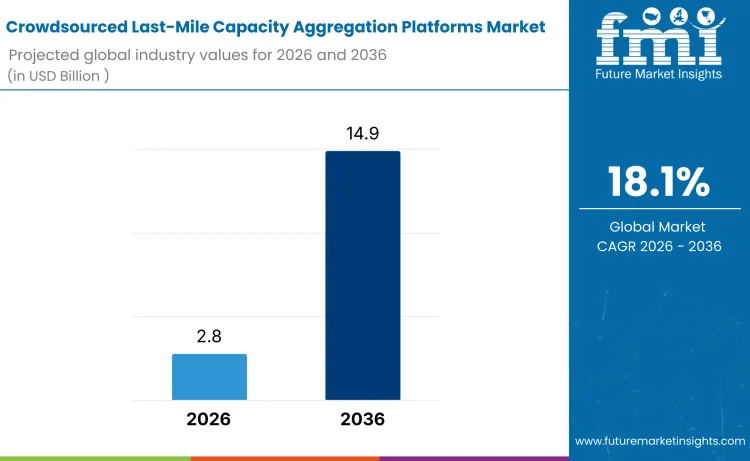
- USD 2.8 Bn
- Forecast (2036)
- USD 14.9 Bn
- CAGR (2026 to 2036)
- 18.1%
Crowdsourced Last-Mile Capacity Aggregation Platforms Market Forecast and Outlook 2026 to 2036
The crowdsourced last-mile capacity aggregation platforms market is valued at USD 2.8 billion in 2026 and is projected to reach USD 14.9 billion by 2036, representing a CAGR of 18.1%. Demand expands as retailers, carriers, and on-demand delivery platforms adopt flexible capacity models to manage volatile order volumes and reduce last-mile bottlenecks. Growth is reinforced by surging e-commerce activity and increased reliance on same-day and ultra-fast delivery commitments.
Real-time capacity aggregation leads model adoption because dynamic pooling of driver availability enables rapid matching of supply with hyperlocal demand. Platforms integrate multi-carrier networks, automate dispatch logic, and optimize routing based on live traffic, order density, and rider proximity. Data-driven orchestration improves utilization rates, shortens delivery timeframes, and stabilizes peak-period capacity.
China, India, USA, and Japan emerge as core growth regions due to dense delivery ecosystems and widespread adoption of gig-based logistics models. Uber Direct, DoorDash Drive, Roadie (UPS), Instacart Platform, and Lalamove anchor competitive activity through expanded independent-driver networks, API-driven merchant integration, and predictive capacity algorithms that support scalable, high-frequency last-mile delivery operations.
Quick Stats for Crowdsourced Last-Mile Capacity Aggregation Platforms Market
- Market Value (2026): USD 2.8 billion
- Market Forecast Value (2036): USD 14.9 billion
- Forecast CAGR (2026 to 2036): 18.1%
- Leading Aggregation Model in Global Demand: Real-Time Capacity Aggregation
- Key Growth Regions in Global Demand: China, India, USA, Japan
- Top Players in Global Demand: Uber Direct, DoorDash Drive, Roadie (UPS), Instacart Platform, Lalamove
Crowdsourced Last-Mile Capacity Aggregation Platforms Market Key Takeaways
| Metric | Value |
|---|---|
| Market Value (2026) | USD 2.8 billion |
| Market Forecast Value (2036) | USD 14.9 billion |
| Forecast CAGR (2026 to 2036) | 18.1% |
How Are the Segments Classified in the Crowdsourced Last-Mile Capacity Aggregation Platforms Market?
Demand for crowdsourced last-mile capacity aggregation platforms is shaped by fluctuating parcel volumes, delivery-speed expectations, and the need for flexible fleet capacity across urban and suburban zones. Buyers evaluate real-time visibility, workforce scalability, routing integration, and platform reliability. Adoption patterns reflect reliance on gig-based labor pools, demand surges driven by e-commerce, and operational goals involving rapid capacity matching across diverse delivery types.
Which Aggregation Model Accounts for the Largest Share of Global Demand?
Real-time capacity aggregation holds 44.6%, making it the leading aggregation-model segment globally. This model supports instant matching of available couriers with dynamic delivery volumes, enabling platforms to handle peak surges and short-notice requirements. Scheduled or planned capacity aggregation supports predictable delivery windows, recurring orders, and coordinated fleet allocation. Hybrid aggregation models blend real-time and scheduled workflows to balance cost efficiency and responsiveness. Distribution reflects operational needs driven by volatile parcel loads and dependency on flexible capacity.
Key Points:
- Real-time aggregation supports instant courier–task matching.
- Scheduled aggregation fits predictable and recurring workflows.
- Hybrid aggregation balances responsiveness with planning efficiency.
- Model selection aligns with volume volatility and service targets.
Which Delivery Type Represents the Largest Share of Global Demand?
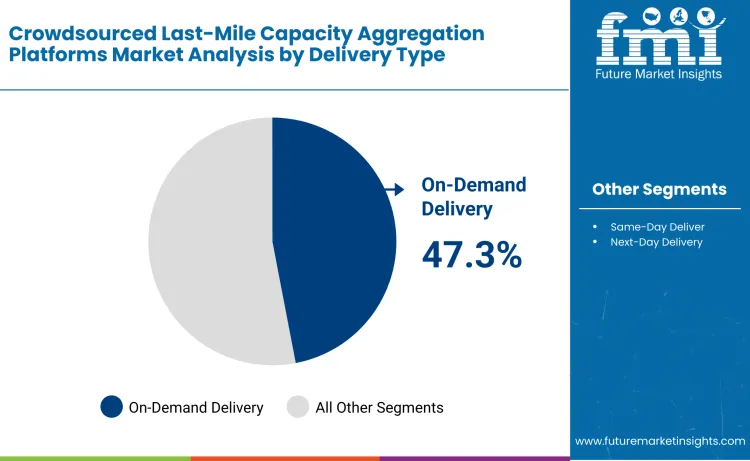
On-demand delivery holds 47.3%, making it the largest delivery-type segment globally. This category supports rapid service expectations across food delivery, urgent parcels, and quick-commerce transactions requiring immediate assignment. Same-day delivery supports predictable e-commerce cycles and retail fulfillment with defined windows. Next-day delivery supports cost-optimized routes and broader service coverage with lower urgency. Delivery-type distribution reflects customer expectations for speed, operational timing, and service differentiation across last-mile environments.
Key Points:
- On-demand delivery dominates due to speed-critical use cases.
- Same-day services support planned retail and e-commerce fulfillment.
- Next-day delivery emphasizes cost efficiency and route density.
- Delivery choice aligns with urgency, geography, and order patterns.
Which Workforce Type Accounts for the Largest Share of Global Demand?
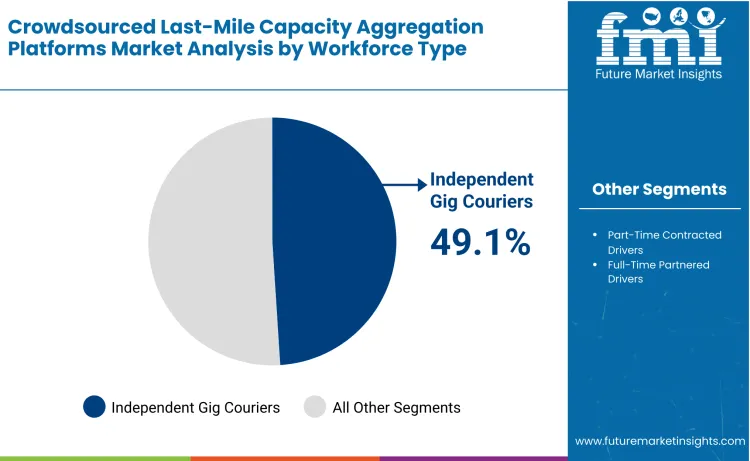
Independent gig couriers hold 49.1%, making them the leading workforce segment globally. These couriers provide scalable, flexible labor capacity that adjusts rapidly to demand fluctuations. Part-time contracted drivers support consistent availability with moderate scheduling control and predictable labor pools. Full-time partnered drivers support reliability, route familiarity, and structured operations for high-volume or enterprise clients. Workforce distribution reflects the dominance of gig-based flexibility and platform reliance on decentralized capacity sources.
Key Points:
- Gig couriers offer scalable, on-demand capacity.
- Part-time drivers support semi-structured availability.
- Full-time drivers ensure stable, predictable service.
- Workforce mix aligns with delivery volume variability and operational strategy.
What are the Key Dynamics in the Crowdsourced Last-Mile Capacity Aggregation Platforms Market?
Global demand rises as e-commerce operators, parcel carriers, and retailers adopt crowdsourced delivery capacity to manage peak order volatility, reduce fixed fleet commitments, and expand geographic reach. Platforms aggregate independent drivers, optimize route allocation, and adjust capacity in real time. Retailers use flexible capacity models to stabilize fulfilment during seasonal spikes. Urban and suburban regions adopt crowdsourced fleets to improve delivery coverage across diffuse neighborhood patterns.
How are variable delivery volumes and flexible fleet requirements shaping adoption of crowdsourced capacity platforms?
E-commerce growth produces irregular order patterns that increase need for adaptable capacity. Retailers rely on crowdsourced fleets during peak seasons when internal networks experience strain. Platforms match drivers with short radius delivery tasks that support rapid dispatch. Parcel carriers use aggregated capacity to manage overflow in suburban and low density zones. Independent couriers value flexible schedules and localized routing. Digital platforms incorporate performance scoring, geofencing, and real time tracking to stabilize service quality. Retailers integrate crowdsourced delivery with store based fulfilment models to extend delivery reach without maintaining additional vehicles across dispersed markets.
How do quality control requirements, regulatory uncertainty, and operational alignment challenges affect scalability?
Platforms manage service variation created by differing driver experience levels, which influences customer satisfaction. Insurance, liability, and worker classification rules vary across jurisdictions, creating planning complexity for operators. Retailers seek integration that aligns delivery timing, order handoff protocols, and customer notification systems. Driver availability fluctuates based on local labour supply and competing gig work opportunities. Training and onboarding processes require continuous refinement to maintain consistent service standards. Peak demand surges create allocation challenges when driver pools tighten. Regulatory oversight of gig economy operations introduces uncertainty for long term contract structures and platform expansion strategies.
How is Demand for Crowdsourced Last-Mile Capacity Aggregation Platforms Market Evolving Across Key Countries?
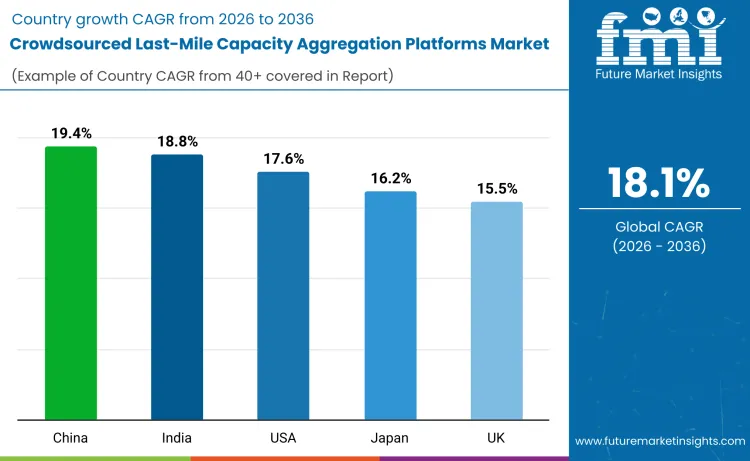
Demand for the crowdsourced last-mile capacity aggregation platforms market is rising due to increased parcel volumes, need for flexible delivery capacity, and strong adoption of dynamic routing technologies. China records a CAGR of 19.4% supported by dense delivery ecosystems and rapid platform scaling. India shows an 18.8% CAGR driven by expanding gig-based logistics participation and high urban delivery intensity. USA posts a 17.6% CAGR supported by strong on-demand delivery requirements. Japan holds a 16.2% CAGR linked with structured logistics optimization. UK records a 15.5% CAGR supported by urban freight strategies and widespread use of flexible delivery networks.
| Country | CAGR (%) |
|---|---|
| China | 19.4% |
| India | 18.8% |
| USA | 17.6% |
| Japan | 16.2% |
| UK | 15.5% |
How is China driving demand for Crowdsourced Last-Mile Capacity Aggregation Platforms?
China drives demand due to high parcel density, rapid e-commerce growth, and broad acceptance of platform-based delivery models. The country’s CAGR of 19.4% reflects strong use of crowdsourced fleets to manage peak-volume surges and short delivery windows. Logistics operators rely on aggregation platforms to combine independent couriers into scalable delivery capacity. Real-time routing and automated assignment tools improve speed and reduce operational gaps. Urban congestion patterns reinforce demand for flexible, quick-responding delivery networks. Retail and marketplace operators use these platforms to stabilize fulfilment performance during high-traffic periods.
- High parcel density supporting platform usage
- Broad courier participation enabling flexible capacity
- Real-time routing improving delivery consistency
- Strong marketplace integration driving operational scale
How is India driving demand for Crowdsourced Last-Mile Capacity Aggregation Platforms?
India supports rising demand due to rapid e-commerce expansion, dense last-mile environments, and increased participation in gig-based logistics. The country’s CAGR of 18.8% reflects widespread adoption of aggregation platforms for managing fluctuating order volumes across urban centers. Delivery providers rely on crowdsourced capacity to address congestion-related delays and maintain service levels. Retailers integrate platforms to support peak periods in metro regions. Digital logistics ecosystems strengthen adoption through mobile-first driver onboarding, real-time verification, and automated payment workflows. Strong hyperlocal delivery activity reinforces continuous platform usage.
- Rapid growth in urban e-commerce
- Increased gig-worker participation in delivery networks
- Mobile-first logistics tools supporting driver onboarding
- High hyperlocal delivery activity sustaining demand
How is the USA driving demand for Crowdsourced Last-Mile Capacity Aggregation Platforms?
USA drives demand through high on-demand delivery frequency, strong digital-platform adoption, and interest in flexible last-mile capacity. The country’s CAGR of 17.6% reflects steady integration of crowdsourced drivers into parcel, grocery, and meal-delivery workflows. Retailers use aggregation platforms to manage unpredictable order spikes and reduce delivery costs. Logistics firms deploy dynamic assignment tools to expand reach in dense and suburban areas. Real-time analytics support load balancing and route optimization across large service territories. Continued growth in rapid-delivery models strengthens platform utilization.
- High-frequency on-demand delivery patterns
- Retail and logistics integration supporting flexible capacity
- Strong use of real-time analytics and dynamic routing
- Broad application across parcel, grocery, and meal delivery
How is Japan driving demand for Crowdsourced Last-Mile Capacity Aggregation Platforms?
Japan drives demand due to structured logistics operations, compact urban layouts, and interest in flexible delivery augmentation. The country’s CAGR of 16.2% reflects controlled adoption of crowdsourced capacity to support peak delivery periods and localized distribution needs. Logistics operators use aggregation tools to supplement professional fleets without compromising reliability standards. Real-time routing enhances precision across narrow delivery zones. Retail and e-commerce providers rely on aggregated drivers to maintain timely fulfilment. Collaboration between logistics firms and municipalities supports regulated deployment of flexible delivery capacity.
- Compact cities requiring precise routing
- Supplemental capacity supporting punctual delivery
- Retail use for localized fulfilment requirements
- Regulated deployment aligned with municipal logistics goals
How is the UK driving demand for Crowdsourced Last-Mile Capacity Aggregation Platforms?
The UK supports demand through strong online-retail adoption, delivery-vehicle restrictions in urban centers, and interest in scalable last-mile networks. The country’s CAGR of 15.5% reflects steady integration of crowdsourced fleets into parcel and same-day delivery workflows. Retailers use aggregation platforms to expand peak-season capacity while reducing reliance on traditional vans. Urban freight strategies encourage use of flexible, low-impact delivery networks. Real-time routing and compliance tools facilitate efficient street-level operations. Growth in convenience delivery patterns reinforces platform-driven capacity aggregation.
- Strong online-retail activity requiring flexible capacity
- Urban freight restrictions encouraging lightweight delivery modes
- Use of dynamic routing and compliance tools
- Steady adoption across parcel and same-day delivery services
What is the competitive landscape of demand for crowdsourced last-mile capacity aggregation platforms globally?
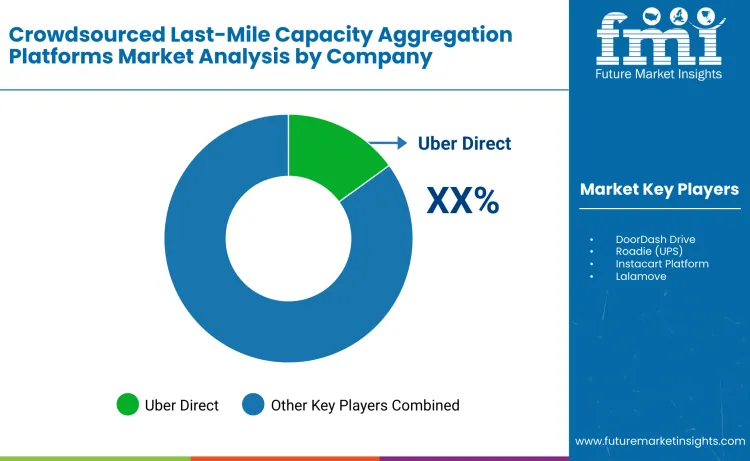
Demand for crowdsourced last-mile capacity aggregation platforms grows as retailers, parcel carriers, and food delivery operators seek flexible surge capacity and geographically distributed delivery resources. Requirements center on real-time capacity matching, route optimization, courier vetting, and performance tracking across diverse delivery segments. Buyers evaluate integration depth with ordering systems, payout management workflows, API compatibility, and rider availability across dense urban and suburban zones. Procurement teams prioritize platform reliability, delivery transparency, dispute resolution mechanisms, and data security supporting scalable peak-period operations. Trend in the global market reflects expanded gig-economy participation and rising interest in hybrid delivery models combining couriers, fleets, and crowdsourced resources.
Position strengthens through global courier access, established ride-hailing infrastructure, and integration with major retail, grocery, and restaurant platforms. DoorDash Drive participates with white-label delivery capacity supporting retailers and food operators requiring scalable on-demand logistics. Roadie, a UPS company, maintains visibility with nationwide same-day capacity aggregated from independent drivers handling parcels, retail goods, and regional shipments. Instacart Platform contributes through shopper-driven last-mile capacity linked to grocery and retail delivery networks. Lalamove supports demand across Asia, Latin America, and select global cities using broad crowdsourced fleets suited for varied parcel sizes. Competitive positioning globally reflects network density, delivery reliability, software integration capability, and geographic coverage supporting dynamic last-mile fulfillment.
Key Players in the Crowdsourced Last-Mile Capacity Aggregation Platforms Market
- Uber Direct
- DoorDash Drive
- Roadie (UPS)
- Instacart Platform
- Lalamove
Scope of the Report
| Items | Values |
|---|---|
| Quantitative Units | USD billion |
| Aggregation Model | Real-Time Capacity Aggregation, Scheduled / Planned Capacity Aggregation, Hybrid Aggregation Models |
| Delivery Type | On-Demand Delivery, Same-Day Delivery, Next-Day Delivery |
| Workforce Type | Independent Gig Couriers, Part-Time Contracted Drivers, Full-Time Partnered Drivers |
| End-User | E-commerce & Retail Platforms, Food & Grocery Delivery Companies, Courier & Parcel Service Providers, Enterprise / B2B Shippers |
| Regions Covered | Asia Pacific, Europe, North America, Latin America, Middle East & Africa |
| Countries Covered | India, China, USA, Germany, South Korea, Japan, Italy, and 40+ countries |
| Key Companies Profiled | Uber Direct, DoorDash Drive, Roadie (UPS), Instacart Platform, Lalamove |
| Additional Attributes | Dollar sales by aggregation model, delivery type, and workforce type; adoption trends driven by peak-capacity outsourcing, surge demand management, and flexible last-mile resource pooling; operational integration with routing, batching, telematics, and courier-matching algorithms; competitive landscape across platform-based logistics enablers; technology evolution in API-driven fulfillment orchestration, dynamic pricing, courier scoring, and fleet compliance tracking; enterprise use cases for retail, grocery, parcel, and B2B freight aggregation. |
Crowdsourced Last-Mile Capacity Aggregation Platforms Market by Segment
By Aggregation Model:
- Real-Time Capacity Aggregation
- Scheduled / Planned Capacity Aggregation
- Hybrid Aggregation Models
By Delivery Type:
- On-Demand Delivery
- Same-Day Delivery
- Next-Day Delivery
By Workforce Type:
- Independent Gig Couriers
- Part-Time Contracted Drivers
- Full-Time Partnered Drivers
By End-User:
- E-commerce & Retail Platforms
- Food & Grocery Delivery Companies
- Courier & Parcel Service Providers
- Enterprise / B2B Shippers
Region:
- Asia Pacific
- China
- Japan
- South Korea
- India
- Australia & New Zealand
- ASEAN
- Rest of Asia Pacific
- Europe
- Germany
- United Kingdom
- France
- Italy
- Spain
- Nordic
- BENELUX
- Rest of Europe
- North America
- United States
- Canada
- Mexico
- Latin America
- Brazil
- Chile
- Rest of Latin America
- Middle East & Africa
- Kingdom of Saudi Arabia
- Other GCC Countries
- Turkey
- South Africa
- Other African Union
- Rest of Middle East & Africa
Frequently Asked Questions
What is the size of the crowdsourced last-mile capacity aggregation platforms market in 2026?
The market is valued at USD 2.8 billion in 2026, driven by adoption of flexible delivery capacity in high-density urban areas.
What will be the industry size by 2036?
Industry value will reach USD 14.9 billion by 2036 as operators expand real-time courier aggregation and integrate route-optimization tools.
What is the CAGR for 2026 to 2036?
The crowdsourced last-mile capacity aggregation platforms market expands at an 18.1% CAGR during the forecast period.
Which aggregation-model segment leads in 2026?
Real-time capacity aggregation holds 44.6% share due to its ability to match fluctuating parcel loads with available courier supply.
Which delivery-type segment holds the highest share?
On-demand delivery leads with 47.3% share, reflecting demand for rapid, short-window delivery execution across consumer and retail channels.
Preview the report firsthand - request a free sample
Get SampleGet the brochure for pricing and purchase details.
Get PDFTable of Content
- Executive Summary
- Market Overview
- Global Market Value, 2020 to 2026
- Global Market Forecast, 2026 to 2036
- Market Dynamics
- Drivers
- Restraints
- Opportunities
- Regulatory & Standards Landscape
- Technology & Platform Innovation Outlook
- Market Segmentation Analysis
- By Aggregation Model
- Real-Time Capacity Aggregation
- Scheduled / Planned Capacity Aggregation
- Hybrid Aggregation Models
- By Delivery Type
- On-Demand Delivery
- Same-Day Delivery
- Next-Day Delivery
- By Workforce Type
- Independent Gig Couriers
- Part-Time Contracted Drivers
- Full-Time Partnered Drivers
- By End-User
- E-commerce & Retail Platforms
- Food & Grocery Delivery Companies
- Courier & Parcel Service Providers
- Enterprise / B2B Shippers
- By Aggregation Model
- Regional Outlook
- Asia Pacific
- Europe
- North America
- Latin America
- Middle East & Africa
- Country-Level Outlook
- China
- India
- USA
- Japan
- United Kingdom
- Germany
- South Korea
- Italy
- Australia & New Zealand
- ASEAN
- Brazil
- Chile
- Turkey
- South Africa
- Other GCC Countries
- Rest of Europe
- Rest of Latin America
- Rest of Middle East & Africa
- Competitive Landscape
- Market Structure Overview
- Company Positioning
- Strategic Initiatives
- Key Player Profiles
- Scope of the Report
- Research Methodology
- Assumptions & Acronyms


