

- Market Size (2026)
- USD 2.0 Bn
- Forecast (2036)
- USD 27.6 Bn
- CAGR (2026 to 2036)
- 30.0%
How big is the Defense Autonomy Software & Battle Networks Market size?
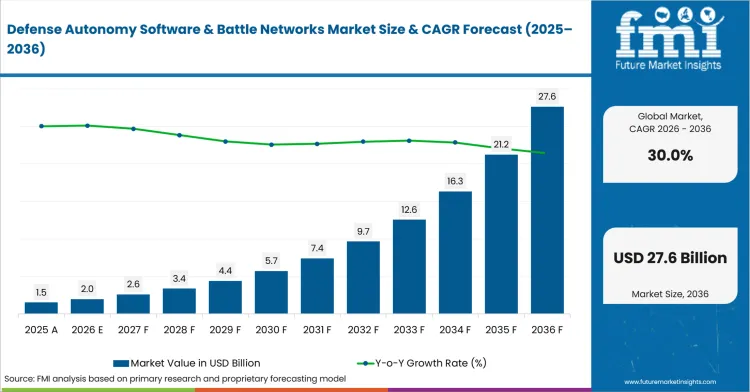
USD 2.0 billion in 2026 and USD 27.6 billion by 2036 at a 30.0% CAGR.
Demand for defense autonomy software & battle networks is projected to expand at 30.0% CAGR between 2026 and 2036, increasing valuation from USD 2.0 billion in 2026 to USD 27.6 billion by 2036. Connecting battlefield sensors directly to command posts helps military leaders make faster decisions during active missions. Real difficulty is blending separate data streams instantly so commanders can see the full picture. Highlighting this push, the Chief Digital and Artificial Intelligence Office reported in January 2025 stating its Open DAGIR initiative deployed 3 lines of effort to improve enterprise analytics and edge data services. Such projects make software being able to automatically combine mission data and link battle networks highly valuable.
National security goals dictate how different countries build their digital networks. Like, the United States programs focus heavily on blending operational data and speeding up software approvals. European Union buyers prefer self-reliant autonomy systems still cooperating smoothly with allies. The pressure to modernize is growing considerable, the Department of War reported in January 2024 stating its Replicator initiative aimed to deploy thousands of autonomous systems across multiple domains within 18 to 24 months. This fast rollout schedule makes acquiring reliable mission software and command network tools an immediate priority for defense ministries globally.
Key Takeaways of Defense Autonomy Software & Battle Networks Market
- Demand for defense autonomy software & battle networks is driven by armed forces connecting unmanned assets with command systems and sensor feeds, with account decisions reflecting accreditation evidence and mission-data integration proof.
- By buyer, defense ministries are expected to lead with 58.0% share in 2026, driven by classified program ownership.
- Software licenses are the dominant offering segment, projected to hold 56.0% share in 2026, as software rights guide recurring deployment.
- Mission autonomy software is estimated to lead the product category with 44.0% share in 2026, driven by decision-support and mission execution needs.
- Secure network integration and authorization files remain critical to supplier evaluation, as integrators seek vendors that reduce handoffs during classified network approvals.
- The United States and European Union are expected to form the higher-growth region tier, advancing at 31.0% and 29.0% CAGR respectively through 2036, supported by software-defined command priorities and sovereign AI planning.
- Competition centers on Anduril Industries, Helsing, Shield AI, Auterion, and prime/platform partners, with vendors differentiating through mission autonomy depth, AI-enabled defense software, and unmanned aircraft integration.
Analyst Perspective
"Modern defense programs are placing greater value on software that accelerates operational decision-making while maintaining security, interoperability, and command accountability across complex missions. Success in this market depends on the ability to integrate autonomous capabilities with existing defense networks, support mission-critical data exchange, and perform reliably under demanding operational conditions. Organizations that deliver trusted software architectures, seamless systems integration, and sustained program support will be well placed to secure long-term defense modernization initiatives."
- Sudip Saha, Principal Consultant for Technology at Future Market Insights
Source: Future Market Insights analysis, 2026.
How is defense Autonomy Software & Battle Networks Market segmented?
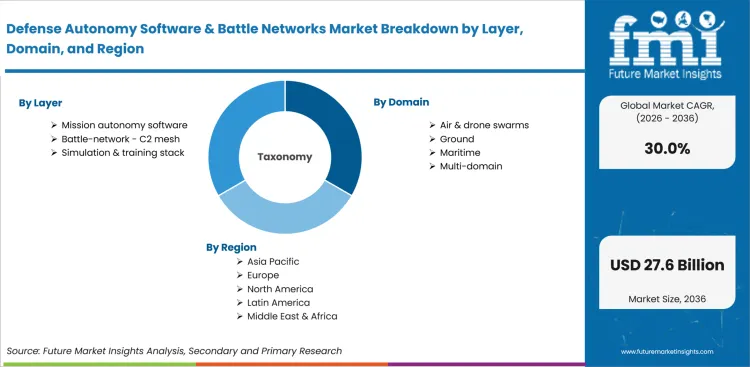
The defense autonomy software & battle networks industry is segmented by layer, domain, component, end user, business model and region.
Layer coverage includes mission autonomy software alongside battle-network C2 mesh and simulation and training stack. Domain coverage includes air and drone swarms, ground, maritime and multi-domain programs. Component coverage includes software licenses, integration services and support and updates. End user coverage includes defense ministries, primes and OEMs and allied agencies. Business model coverage includes programs of record, enterprise licenses and research contracts. Regional coverage includes North America and Latin America. Coverage also includes Europe, East Asia, South Asia, Oceania and Middle East and Africa.
How does mission autonomy software shape layer purchasing?
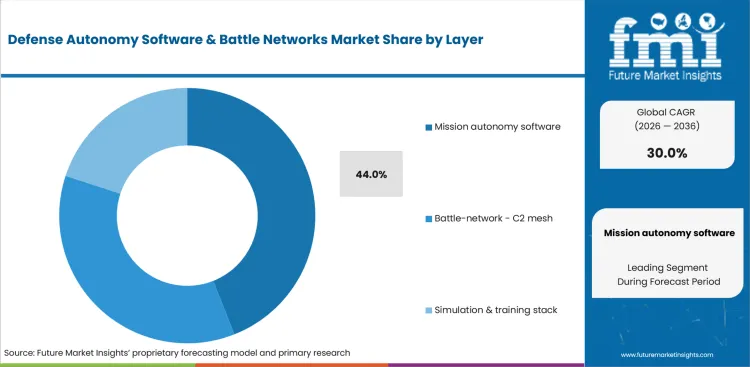
Mission autonomy software is estimated to lead layer purchasing as defense programs shift from manual information review toward AI-enabled decision support. Program teams value software supporting battle management and mission execution across classified operating environments. Department of War issued its Artificial Intelligence Strategy in January 2026 identifying 7 pace-setting projects, including Swarm Forge and Agent Network for AI-enabled warfighting and battle management. Such direction is expected to raise buyer review of mission autonomy stacks used across command and unmanned systems.
- Mission autonomy software is predicted to garner 44.0% share of layer in 2026, helped by direct decision-support value and mission execution needs. Buyers prefer autonomy stacks on integration evidence and operator-control rules being documented.
- Battle-network C2 mesh and simulation and training stack support command connectivity and mission rehearsal. Mission autonomy software retains selection strength driven by equipment programs requiring executable autonomy.
How do air & drone swarms influence domain demand?
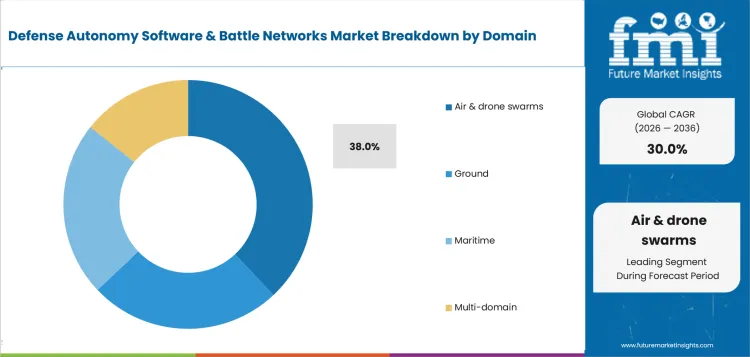
Shield AI reported in April 2025 announcing V-BAT upgrades with endurance beyond 13 hours and Hivemind readiness, affecting air-domain autonomy review for persistent ISR and targeting missions. This capability is expected to lift demand for software linked with autonomous aerial operations. Air and drone swarms are anticipated to support domain as autonomous aircraft need coordinated routing and operator-supervised mission execution. Defense teams assess autonomy readiness and C2 links before moving from demonstration to program adoption.
- Air and drone swarms are estimated to secure 38.0% share of domain in 2026, backed by unmanned aircraft programs and autonomous mission roles. Vendors acquire review strength as software proves a reliable operation across jammed or contested environments.
- Ground and multi-domain applications add steady demand for autonomy software. Air and drone swarms gain preference depending on buyers compare mission risk and coordination depth across unmanned programs.
How do software licenses support component demand?
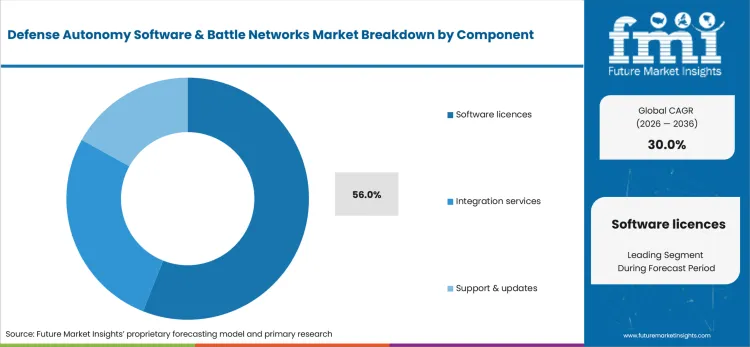
Software licenses are expected to support component demand as defense buyers need repeatable rights and controlled deployment across approved environments. Program offices compare license flexibility with integration burden before scaling autonomy software across units. Department of War CIO reported in March 2025 noting about 78 acquisition programs had adopted the Software Acquisition Pathway and 75% delivered software in less than 6 months. The delivery cadence influences license-led buying for mission applications requiring frequent updates.
- By component, software licenses are projected to account for 56.0% share in 2026 due to recurring rights and controlled software distribution. Program teams prefer license structures on release cycles and security responsibilities being clear.
- Integration services and support and updates remain important for classified deployment and sustainment. Software licenses achieve preference depending on defense teams needing scalable rights aligned with program milestones.
Why do defense ministries lead end user demand?
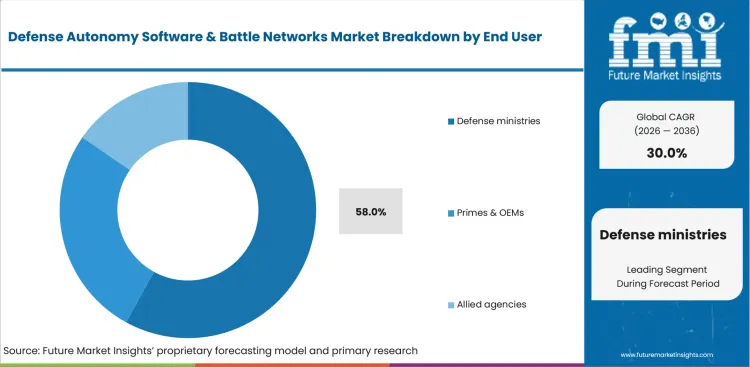
Chief Digital and AI Office reported in August 2025 stating the AI Partnership for Defense had reached its 11th meeting and involved 16 defense institutions, highlighting structured alliance-level attention to AI use cases and mission autonomy. Such collaboration is anticipated to support ministry-led buying and standards alignment. Buying teams evaluate operational risk and allied interoperability before committing to autonomy stacks. Defense ministries are projected to lead end user requirement as autonomy and battle-network programs require mission ownership and cross-service alignment.
- In 2026, defense ministries are expected to hold 58.0% share since it is guided by classified program authority and direct mission accountability. Vendors gain approval after security files and operational assurance evidence match ministry needs.
- Primes and allied agencies influence platform integration and coalition adoption. Defense ministries maintain demand control due to autonomy decisions affecting operating doctrine and mission approval chains.
How do programs of record guide business model demand?
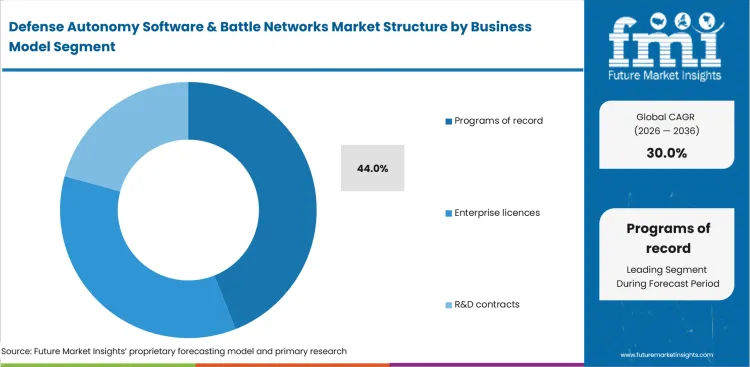
Programs of record are estimated to guide business model demand as defense organizations prefer structured buying paths for mission software tied to budget approval and sustainment rules. Account teams review upgrade timing, mission assurance and integration ownership before converting trials into recurring orders. Department of War Comptroller issued DARPA budget estimates in March 2024 listing USD 4.0 million for Rapid Experimental Missionized Autonomy in FY2025. Such funded testing for plug-in autonomy controllers and maritime behaviors favors program-backed models with stable development records.
- Based on business model, programs of record are anticipated to capture 44.0% share in 2026 as it is driven by formal acquisition paths and sustainment visibility. Buyers prefer program-backed models being led by mission risk and software update authority assigning.
- Enterprise licenses and research contracts promote early experimentation and wider access. Programs of record gain account preference guided by defense buyers moving autonomy software from pilots into funded mission deployments.
What are drivers, restraints, and opportunities in Defense Autonomy Software & Battle Networks Market?
Mission-data overload pushes buyers toward autonomy software, and assurance review slows approvals before program release.
- Driver: Armed forces are replacing manual sensor review with autonomy software designed to improve decision speed and reduce operator workload.
- Restraint: Adoption slows if cybersecurity evidence and human-control boundaries remain unclear during mission approval.
- Opportunity: Vendors offering secure integration support and mission-ready software updates improve approval chances across defense accounts.
Mission data pressure is creating adoption for software connecting sensors and command posts into unified mission views. Chief Digital and Artificial Intelligence Office launched the AI Rapid Capabilities Cell in December 2024 with 15 generative AI use cases covering warfighting and enterprise management. Wider use-case coverage directly promotes demand for battle-network software used across tactical and operational command environments.
Authorization risk restrains purchases after autonomy software enters edge computing or classified cloud environments. Department of War CIO released AI cybersecurity tailoring guidance in August 2025 stating DoD organizations are required to implement CNSSI 1253 Revision 5 controls for AI systems. Such assurance pressure is expected to lengthen approval reviews before mission autonomy software moves into operational use.
Experimentation channels are expected to create opportunities for technology providers aligning software with allied mission needs. European Defence Agency reported in April 2026 highlighting 87 ad hoc capability and research projects undertaken during 2025. This collaborative activity is projected to increase demand for test environments and battle-network integration support.
What country CAGRs are profiled in defense Autonomy Software & Battle Networks Market?
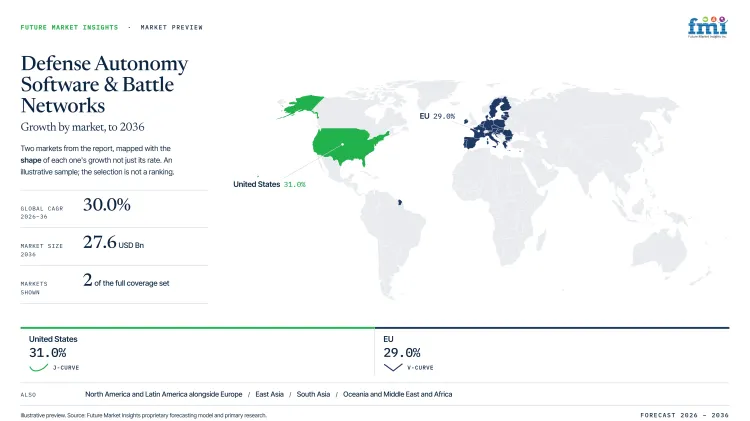
| Country | CAGR |
|---|---|
| United States | 31.0% |
| EU | 29.0% |
Source: Future Market Insights analysis, 2026.
How do country-level CAGRs compare in the Defense Autonomy Software & Battle Networks Market?
The comparison spans 2.0 percentage points, indicating a closely aligned growth outlook across the defense autonomy software & battle networks market. The United States leads with a CAGR of 31.0%, while the European Union follows at 29.0%. Both markets are prioritizing software-defined defense capabilities, although procurement priorities, force structures and multinational integration requirements create different adoption pathways.
-
The United States records the higher CAGR at 31.0%. Defense organizations are placing greater emphasis on autonomy software, AI-enabled mission planning and battle network architectures that improve coordination between crewed and uncrewed platforms while accelerating operational decision-making. Continued modernization of command-and-control systems and software-centric defense programs is expanding opportunities for autonomy platforms.
-
The European Union follows 2.0 percentage points behind the United States with a CAGR of 29.0%. Demand reflects increasing collaboration on interoperable defense networks, digital battlefield management and autonomous mission support capabilities across member states. Adoption progresses at different rates because national defense budgets, modernization programs and operational priorities vary throughout the region.
Comparable CAGRs do not necessarily translate into identical commercial opportunities. Differences in defense acquisition processes, software certification requirements, interoperability standards and military modernization priorities influence deployment timelines and long-term supplier positioning. The full report provides country-level CAGR analysis across North America, Latin America, Europe, East Asia, South Asia, Oceania and the Middle East and Africa.
Country-wise Analysis
Country demand in defense autonomy software & battle networks is expected to be guided by mission-data strategy and defense AI adoption depth. Software accreditation also promotes vendor selection. EU buyers are likely to connect demand with sovereign AI and allied interoperability planning. United States programs are anticipated to connect adoption with faster acquisition paths and autonomous system fielding.
-
Defense Innovation Unit reported in June 2024 stating roughly 25% of its budget would support new projects including cross-cutting software for complex autonomous systems, highlighting direct fielding pressure for autonomy software and battle-network integration. The market in United States is expected to post 31.0% CAGR by 2036, guided by mission autonomy buying and faster software acquisition pathways.
- Industry in the EU is projected to expand at 29.0% CAGR during the forecast period, backed by sovereign autonomy priorities and multinational interoperability reviews. European Defence Agency published Defence Data 2024-2025 stating 25 EU Member States increased defense expenditure in real terms during 2024, reinforcing capability modernization planning and software-defined defense readiness.
Who are notable companies in defense Autonomy Software & Battle Networks Market?
Anduril Industries Inc. and Helsing are expected to shape market direction. Shield AI and Auterion add autonomy software depth across unmanned aircraft and drone operating systems. Prime contractors and system integrators support platform integration and mission sustainment.
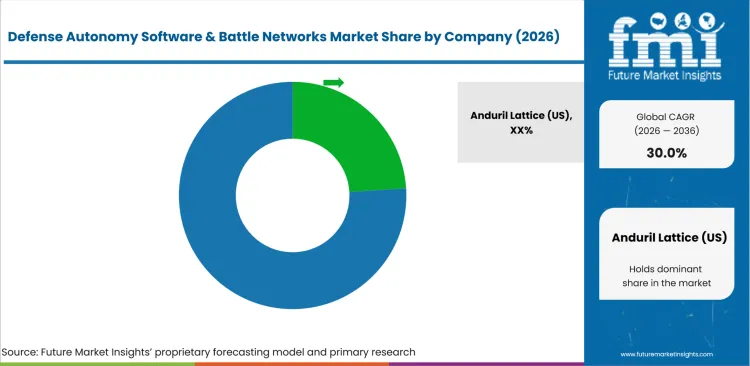
The defense autonomy software & battle networks market is anticipated to compete by focussing on mission autonomy depth and accredited network integration. Command system pairing and secure software update evidence guide final vendor review. Account teams are likely to compare companies based on proof files and deployment support for repeat programs after initial approval. Anduril Industries Inc. is expected to receive review attention due to Lattice and tactical C2 depth. Helsing is anticipated to add AI-enabled software and autonomous systems coverage. Shield AI is projected to compete led by Hivemind and V-BAT autonomy links. Auterion is estimated to compete based on drone operating systems and swarm software. Platform primes are forecast to influence demand driven by integration access and classified support.
- Anduril Industries Inc. and Helsing draw account attention through mission autonomy and AI-enabled defense software. Software depth supports programs needing battle-management functions and reusable mission data paths.
- Shield AI competes through Hivemind software and autonomous aircraft programs. V-BAT and mission autonomy integration strengthen review standing as defense buyers assess aerial autonomy.
- Auterion supports demand through AuterionOS, Skynode and Nemyx. Drone software experience helps buyers compare cross-platform swarm coordination and autonomous strike support.
- Prime contractors and system integrators gain review strength depending on platform access and classified program support. Vendor attention improves as ministries require proof across networks and mission assurance.
Competitive Benchmarking: Defense Autonomy Software & Battle Networks Market
| Company | Autonomy Software Depth | Battle-Network Match | Application Support | Service Reach |
|---|---|---|---|---|
| Anduril Industries Inc. | High | High | High | Global |
| Helsing | High | Medium | High | Regional/Global |
| Shield AI | High | Medium | High | Global |
| Auterion | High | Medium | Medium | Regional/Global |
| Palantir Technologies Inc. | Medium | High | High | Global |
| Booz Allen Hamilton Holding Corporation | Medium | High | High | Global |
| Lockheed Martin Corporation | Medium | High | High | Global |
| RTX Corporation | Medium | High | Medium | Global |
Source: Future Market Insights competitive analysis, 2026.
Key Developments in Defense Autonomy Software & Battle Networks Market
- In March 2025, Anduril Industries Inc. partnered with DSTA and the RSAF to explore mission autonomy for manned-unmanned teaming. Anduril stated in March 2025 the effort would use Lattice for Mission Autonomy to build collaborative autonomous behaviors, impacting buyer evaluation of AI-enabled aircraft coordination.
- In June 2025, Helsing completed Saab Gripen E test flights using Centaur autonomous air-combat AI. Helsing stated in June 2025 the flights occurred on May 2 and June 3, improving review confidence for software-defined air-combat autonomy.
- In September 2025, Auterion launched Nemyx for coordinated drone swarms. Auterion stated in September 2025 Nemyx coordinates drones from different manufacturers and enables multiple drones to act as a single coordinated unit, promoting cross-platform autonomy review for defense buyers.
Key Players in Defense Autonomy Software & Battle Networks Market
Mission autonomy and battle-network software companies
- Anduril Industries Inc.
- Helsing
- Shield AI
- Auterion
Defense AI and command software providers
- Palantir Technologies Inc.
- Booz Allen Hamilton Holding Corporation
- Lockheed Martin Corporation
- RTX Corporation
Integration and deployment support partners
- Northrop Grumman Corporation
- BAE Systems plc
- General Dynamics Corporation
- Leidos Holdings Inc.
Defense Autonomy Software & Battle Networks Market - Report Scope
| Coverage field | Report scope |
|---|---|
| Market breakdown | Defense Autonomy Software & Battle Networks Market breakdown by layer, domain, component, end user, business model and region |
| Market Definition | Defense autonomy software & battle networks are mission software, integration tools and support offerings used to automate decision support, connect platforms and coordinate sensors across defense operations. |
| Regions Covered | North America and Latin America alongside Europe, East Asia, South Asia, Oceania and Middle East and Africa |
| Countries Covered | United States and EU alongside Canada, Brazil, Mexico, Germany, United Kingdom, France, Italy, Spain, China, Japan, South Korea, India, Thailand, Indonesia, Australia, New Zealand, GCC countries, South Africa and Türkiye |
| Key Companies Profiled | Anduril Industries Inc. and Helsing alongside Shield AI, Auterion, Palantir Technologies Inc., Booz Allen Hamilton Holding Corporation, Lockheed Martin Corporation, RTX Corporation, Northrop Grumman Corporation, BAE Systems plc, General Dynamics Corporation and Leidos Holdings Inc. |
| Forecast Period | 2026 to 2036 |
| Approach | Hybrid bottom-up and top-down methodology using segment share, country CAGR, defense autonomy adoption, software authorization needs, command-network integration, vendor portfolio depth and deployment support exposure |
Source: Future Market Insights analysis, 2026.
Defense Autonomy Software & Battle Networks Market - Research Methodology
| Method | Approach |
|---|---|
| Primary Research | FMI analysts gathered input from manufacturers, service providers, technology developers, distributors, end users, procurement teams, and subject-matter experts. Interviews examined purchasing decisions, product or service evaluation, adoption barriers, approval requirements, pricing considerations, and expectations for technical or commercial support. Respondents were also asked what evidence is required before a trial, pilot, or initial order develops into regular purchasing. |
| Desk Research | Desk research covered government statistics, regulatory publications, trade data, industry associations, technical literature, standards, company filings, product information, and official corporate announcements. Sources were reviewed for relevance, publication date, geographic coverage, and consistency with the defined market scope. Claims relating to performance, applications, approvals, capacity, investment, and commercial activity were retained only when supported by credible public evidence. |
| Market Sizing and Forecasting | The market model combined the baseline value with historical performance, segment structure, pricing and volume indicators, adoption levels, company participation, and country-level demand conditions. Forecast assumptions considered economic activity, investment trends, regulatory developments, technology adoption, purchasing cycles, supply availability, and barriers to wider market use. Segment and regional estimates were reconciled before the final market total was calculated. |
| Data Validation | Estimates were checked against multiple independent indicators, including public data, company activity, trade patterns, industry developments, and findings from primary interviews. Validation also tested whether products, services, applications, and company revenues fell within the defined market boundaries. Adjacent categories, unsupported claims, overlapping revenues, and activities without direct market relevance were excluded to reduce double counting and maintain consistency across segments and countries. |
Source: Future Market Insights analysis, 2026.
Defense Autonomy Software & Battle Networks Market by Segments
Defense Autonomy Software & Battle Networks Market segmented by Layer:
- Mission Autonomy Software
- Battle-network C2 Mesh
- Simulation and Training Stack
Defense Autonomy Software & Battle Networks Market segmented by Domain:
- Air and Drone Swarms
- Ground
- Maritime
- Multi-domain
Defense Autonomy Software & Battle Networks Market segmented by Component:
- Software Licenses
- Integration Services
- Support and Updates
Defense Autonomy Software & Battle Networks Market segmented by End User:
- Defense Ministries
- Primes and OEMs
- Allied Agencies
Defense Autonomy Software & Battle Networks Market segmented by Business Model:
- Programs of Record
- Enterprise Licenses
- Research Contracts
Defense Autonomy Software & Battle Networks Market by Region:
- North America
- United States
- Canada
- Latin America
- Brazil
- Mexico
- Argentina
- Europe
- Germany
- United Kingdom
- France
- Italy
- Spain
- East Asia
- China
- Japan
- South Korea
- South Asia
- India
- Thailand
- Indonesia
- Oceania
- Australia
- New Zealand
- Middle East and Africa
- GCC countries
- South Africa
- Türkiye
Research Sources and Bibliography
- Anduril Industries Inc. (2025, March 19). DSTA and the RSAF partner with Anduril to explore mission autonomy for manned-unmanned teaming.
- Auterion. (2025, September 3). Auterion launches Nemyx, enabling fully coordinated drone swarms.
- Chief Digital and Artificial Intelligence Office. (2024, December 11). Artificial Intelligence Rapid Capabilities Cell.
- Chief Digital and Artificial Intelligence Office. (2025, January 10). CDAO highlights progress in scaling data and AI capabilities at six month mark of Open DAGIR.
- Chief Digital and Artificial Intelligence Office. (2025, August 13). DoD CDAO holds eleventh AI Partnership for Defense.
- Defense Innovation Unit. (2024, June 20). DIU announces strategic allocation of 2024 budget and plan to scale.
- Department of War. (2024, January 26). Defense innovation official says Replicator initiative remains on track.
- Department of War Comptroller. (2024, March). Defense Advanced Research Projects Agency budget estimates FY 2025.
- Department of War Chief Information Officer. (2025, August 7). DoD artificial intelligence cybersecurity risk management tailoring guide.
- European Defence Agency. (2025). Defence Data 2024-2025.
- European Defence Agency. (2026, April 15). EDA delivers value for Member States - Annual Report 2025.
- Helsing. (2025, June 11). Helsing AI agent successfully completes Saab Gripen E test flight.
- Office of the Secretary of Defense. (2026, January 9). Artificial intelligence strategy for the Department of War.
- Shield AI. (2025, April 7). Shield AI unveils V-BAT block upgrade powered by Hivemind: Advanced autonomy, SATCOM, and heavy-fuel engine among new features.
This bibliography is provided for reader reference and is not exhaustive. The full report contains the complete reference list and detailed citations.
This Report Answers
- What segments shape demand across layer, domain, component, end user and business model?
- How do defense buyers evaluate autonomy software before replacing established command workflows?
- How do country CAGRs differ across profiled markets?
- What companies compete through mission autonomy depth and battle-network service?
- How does FMI validate forecasts using a hybrid bottom-up and top-down approach?
- What factors do account teams address before wider account expansion?
- How do authorization files and mission assurance evidence affect vendor selection?
- What limits return on investment for teams adding autonomy software to defense programs?
- How do software update records and integration guidance influence account approval?
- What vendor capabilities improve long-term account confidence?
Frequently Asked Questions
What supports demand in defense autonomy software & battle networks market?
Demand is likely to be supported by defense buyers needing software connecting unmanned platforms and command posts during mission operations. Accounts are expected to prefer vendors combining autonomy proof and secure deployment support.
Who are key players in defense autonomy software & battle networks market?
Key companies are anticipated to include Anduril Industries Inc. and Helsing among others to support competition. Competition is likely to be based on mission autonomy evidence and deployment support coverage.
What restraint affects defense autonomy software & battle networks market?
A major restraint is the proof burden created during cybersecurity authorization and mission-control review across approval teams. Accounts slow adoption if software lacks assurance evidence or integration support needed for operational approval.
Why do executives track defense autonomy software & battle networks market?
Executives are expected to track defense autonomy software demand as mission software choices affect command speed and operator workload. Factors such as data fusion and secure software delivery shape buyer reviews.
What business problem does defense autonomy software & battle networks market address?
Defense autonomy software & battle networks market addresses the mission coordination gap created by sensors and command posts producing more information than teams process quickly. Defense ministries and primes need software supporting decision support and field-ready integration evidence.
What do account teams evaluate before selecting vendors?
Account teams are likely to evaluate autonomy depth and repeat deployment reliability before vendor approval. Cybersecurity evidence and mission integration documentation are expected to guide final vendor review.
What limits return on investment for purchasing teams?
Return on investment weakens if mission performance or account acceptance is not proven before operational release. Rework and delayed authorization reduce expected program gains.
How do vendors build long-term account confidence?
Vendors build account confidence by providing consistent software quality and evidence specific to defense autonomy software & battle networks. Installation records and responsive troubleshooting support are expected to influence repeat-order trust.
Preview the report firsthand - request a free sample
Get SampleGet the brochure for pricing and purchase details.
Get PDFTable of Content
- Key Takeaways
- Market Size and CAGR
- Top Growth Driver
- Fastest Growing Segment
- Leading Region
- Key Companies
- Emerging Opportunities
- Executive Summary
- Global Market Outlook
- Demand-side Trends
- Supply-side Trends
- Technology Roadmap Analysis
- Analysis and Recommendations
- Analyst Perspective (What is happening? Why now? What should investors know?)
- Key Questions Answered
- How large is the market?
- What is the CAGR?
- What are key trends?
- Which region dominates?
- Who are the leaders?
- Market Overview
- Market Coverage / Taxonomy
- Market Definition / Scope / Limitations
- Research Methodology
- Chapter Orientation
- Analytical Lens and Working Hypotheses
- Market Structure, Signals, and Trend Drivers
- Benchmarking and Cross-market Comparability
- Market Sizing, Forecasting, and Opportunity Mapping
- Research Design and Evidence Framework
- Desk Research Programme (Secondary Evidence)
- Expert Input and Fieldwork (Primary Evidence)
- Tooling, Models, and Reference Databases
- Data Engineering and Model Build
- Quality Assurance and Audit Trail
- Market Background
- Market Dynamics (Drivers, Restraints, Opportunity, Trends)
- Scenario Forecast (Optimistic, Likely, Conservative)
- Impact Analysis
- AI Impact
- Sustainability Impact
- Regulatory Impact
- Technology Impact
- Consumer / Buyer Analysis
- Purchase Drivers
- Adoption Barriers
- Buyer Journey
- Opportunity Map Analysis
- Product Life Cycle Analysis
- Supply Chain Analysis
- Investment Feasibility Matrix
- Value Chain Analysis
- PESTLE and Porter's Analysis
- Regulatory Landscape
- Regional Parent Market Outlook
- Production and Consumption Statistics
- Import and Export Statistics
- Global Market Analysis and Forecast, 2021 to 2036
- Historical Market Size Value (USD Billion) Analysis, 2021 to 2025
- Current and Future Market Size Value (USD Billion) Projections, 2026 to 2036
- Y-o-Y Growth Trend Analysis
- Absolute $ Opportunity Analysis
- Global Market Pricing Analysis, 2021 to 2036
- Global Market Analysis and Forecast, By Layer, 2021 to 2036
- Introduction / Key Findings
- Historical Market Size Value (USD Billion) Analysis By Layer, 2021 to 2025
- Current and Future Market Size Value (USD Billion) Analysis and Forecast By Layer, 2026 to 2036
- Mission autonomy software
- Battle-network - C2 mesh
- Simulation & training stack
- Mission autonomy software
- Y-o-Y Growth Trend Analysis By Layer, 2021 to 2025
- Absolute $ Opportunity Analysis By Layer, 2026 to 2036
- Global Market Analysis and Forecast, By Domain, 2021 to 2036
- Introduction / Key Findings
- Historical Market Size Value (USD Billion) Analysis By Domain, 2021 to 2025
- Current and Future Market Size Value (USD Billion) Analysis and Forecast By Domain, 2026 to 2036
- Air & drone swarms
- Ground
- Maritime
- Multi-domain
- Air & drone swarms
- Y-o-Y Growth Trend Analysis By Domain, 2021 to 2025
- Absolute $ Opportunity Analysis By Domain, 2026 to 2036
- Global Market Analysis and Forecast, By Component, 2021 to 2036
- Introduction / Key Findings
- Historical Market Size Value (USD Billion) Analysis By Component, 2021 to 2025
- Current and Future Market Size Value (USD Billion) Analysis and Forecast By Component, 2026 to 2036
- Software Licenses
- Integration services
- Support & updates
- Software Licenses
- Y-o-Y Growth Trend Analysis By Component, 2021 to 2025
- Absolute $ Opportunity Analysis By Component, 2026 to 2036
- Global Market Analysis and Forecast, By End User, 2021 to 2036
- Introduction / Key Findings
- Historical Market Size Value (USD Billion) Analysis By End User, 2021 to 2025
- Current and Future Market Size Value (USD Billion) Analysis and Forecast By End User, 2026 to 2036
- Defense ministries
- Primes & OEMs
- Allied agencies
- Defense ministries
- Y-o-Y Growth Trend Analysis By End User, 2021 to 2025
- Absolute $ Opportunity Analysis By End User, 2026 to 2036
- Global Market Analysis and Forecast, By Business Model, 2021 to 2036
- Introduction / Key Findings
- Historical Market Size Value (USD Billion) Analysis By Business Model, 2021 to 2025
- Current and Future Market Size Value (USD Billion) Analysis and Forecast By Business Model, 2026 to 2036
- Programs of record
- Enterprise Licenses
- R&D contracts
- Programs of record
- Y-o-Y Growth Trend Analysis By Business Model, 2021 to 2025
- Absolute $ Opportunity Analysis By Business Model, 2026 to 2036
- Global Market Analysis and Forecast, By Region, 2021 to 2036
- Introduction
- Historical Market Size Value (USD Billion) Analysis By Region, 2021 to 2025
- Current Market Size Value (USD Billion) Analysis and Forecast By Region, 2026 to 2036
- North America
- Latin America
- Western Europe
- Eastern Europe
- East Asia
- South Asia and Pacific
- Middle East & Africa
- Market Attractiveness Analysis By Region
- North America Market Analysis and Forecast, By Country, 2021 to 2036
- Historical Market Size Value (USD Billion) Trend Analysis By Market Taxonomy, 2021 to 2025
- Market Size Value (USD Billion) Forecast By Market Taxonomy, 2026 to 2036
- By Country
- USA
- Canada
- By Layer
- By Domain
- By Component
- By End User
- By Business Model
- By Country
- Market Attractiveness Analysis
- By Country
- By Layer
- By Domain
- By Component
- By End User
- By Business Model
- Key Takeaways
- Latin America Market Analysis and Forecast, By Country
- Historical Market Size Value (USD Billion) Trend Analysis By Market Taxonomy, 2021 to 2025
- Market Size Value (USD Billion) Forecast By Market Taxonomy, 2026 to 2036
- By Country
- Brazil
- Mexico
- Chile
- Rest of Latin America
- By Layer
- By Domain
- By Component
- By End User
- By Business Model
- By Country
- Market Attractiveness Analysis
- By Country
- By Layer
- By Domain
- By Component
- By End User
- By Business Model
- Key Takeaways
- Western Europe Market Analysis and Forecast, By Country
- Historical Market Size Value (USD Billion) Trend Analysis By Market Taxonomy, 2021 to 2025
- Market Size Value (USD Billion) Forecast By Market Taxonomy, 2026 to 2036
- By Country
- Germany
- UK
- Italy
- Spain
- France
- Nordic
- BENELUX
- Rest of Western Europe
- By Layer
- By Domain
- By Component
- By End User
- By Business Model
- By Country
- Market Attractiveness Analysis
- By Country
- By Layer
- By Domain
- By Component
- By End User
- By Business Model
- Key Takeaways
- Eastern Europe Market Analysis and Forecast, By Country
- Historical Market Size Value (USD Billion) Trend Analysis By Market Taxonomy, 2021 to 2025
- Market Size Value (USD Billion) Forecast By Market Taxonomy, 2026 to 2036
- By Country
- Russia
- Poland
- Hungary
- Balkan & Baltic
- Rest of Eastern Europe
- By Layer
- By Domain
- By Component
- By End User
- By Business Model
- By Country
- Market Attractiveness Analysis
- By Country
- By Layer
- By Domain
- By Component
- By End User
- By Business Model
- Key Takeaways
- East Asia Market Analysis and Forecast, By Country
- Historical Market Size Value (USD Billion) Trend Analysis By Market Taxonomy, 2021 to 2025
- Market Size Value (USD Billion) Forecast By Market Taxonomy, 2026 to 2036
- By Country
- China
- Japan
- South Korea
- By Layer
- By Domain
- By Component
- By End User
- By Business Model
- By Country
- Market Attractiveness Analysis
- By Country
- By Layer
- By Domain
- By Component
- By End User
- By Business Model
- Key Takeaways
- South Asia and Pacific Market Analysis and Forecast, By Country
- Historical Market Size Value (USD Billion) Trend Analysis By Market Taxonomy, 2021 to 2025
- Market Size Value (USD Billion) Forecast By Market Taxonomy, 2026 to 2036
- By Country
- India
- ASEAN
- Australia & New Zealand
- Rest of South Asia and Pacific
- By Layer
- By Domain
- By Component
- By End User
- By Business Model
- By Country
- Market Attractiveness Analysis
- By Country
- By Layer
- By Domain
- By Component
- By End User
- By Business Model
- Key Takeaways
- Middle East & Africa Market Analysis and Forecast, By Country
- Historical Market Size Value (USD Billion) Trend Analysis By Market Taxonomy, 2021 to 2025
- Market Size Value (USD Billion) Forecast By Market Taxonomy, 2026 to 2036
- By Country
- Kingdom of Saudi Arabia
- Other GCC Countries
- Türkiye
- South Africa
- Other African Union
- Rest of Middle East & Africa
- By Layer
- By Domain
- By Component
- By End User
- By Business Model
- By Country
- Market Attractiveness Analysis
- By Country
- By Layer
- By Domain
- By Component
- By End User
- By Business Model
- Key Takeaways
- Key Countries Market Analysis
- USA
- Pricing Analysis
- Market Share Analysis, 2025
- By Layer
- By Domain
- By Component
- By End User
- By Business Model
- Canada
- Pricing Analysis
- Market Share Analysis, 2025
- By Layer
- By Domain
- By Component
- By End User
- By Business Model
- Mexico
- Pricing Analysis
- Market Share Analysis, 2025
- By Layer
- By Domain
- By Component
- By End User
- By Business Model
- Brazil
- Pricing Analysis
- Market Share Analysis, 2025
- By Layer
- By Domain
- By Component
- By End User
- By Business Model
- Chile
- Pricing Analysis
- Market Share Analysis, 2025
- By Layer
- By Domain
- By Component
- By End User
- By Business Model
- Germany
- Pricing Analysis
- Market Share Analysis, 2025
- By Layer
- By Domain
- By Component
- By End User
- By Business Model
- UK
- Pricing Analysis
- Market Share Analysis, 2025
- By Layer
- By Domain
- By Component
- By End User
- By Business Model
- Italy
- Pricing Analysis
- Market Share Analysis, 2025
- By Layer
- By Domain
- By Component
- By End User
- By Business Model
- Spain
- Pricing Analysis
- Market Share Analysis, 2025
- By Layer
- By Domain
- By Component
- By End User
- By Business Model
- France
- Pricing Analysis
- Market Share Analysis, 2025
- By Layer
- By Domain
- By Component
- By End User
- By Business Model
- India
- Pricing Analysis
- Market Share Analysis, 2025
- By Layer
- By Domain
- By Component
- By End User
- By Business Model
- ASEAN
- Pricing Analysis
- Market Share Analysis, 2025
- By Layer
- By Domain
- By Component
- By End User
- By Business Model
- Australia & New Zealand
- Pricing Analysis
- Market Share Analysis, 2025
- By Layer
- By Domain
- By Component
- By End User
- By Business Model
- China
- Pricing Analysis
- Market Share Analysis, 2025
- By Layer
- By Domain
- By Component
- By End User
- By Business Model
- Japan
- Pricing Analysis
- Market Share Analysis, 2025
- By Layer
- By Domain
- By Component
- By End User
- By Business Model
- South Korea
- Pricing Analysis
- Market Share Analysis, 2025
- By Layer
- By Domain
- By Component
- By End User
- By Business Model
- Russia
- Pricing Analysis
- Market Share Analysis, 2025
- By Layer
- By Domain
- By Component
- By End User
- By Business Model
- Poland
- Pricing Analysis
- Market Share Analysis, 2025
- By Layer
- By Domain
- By Component
- By End User
- By Business Model
- Hungary
- Pricing Analysis
- Market Share Analysis, 2025
- By Layer
- By Domain
- By Component
- By End User
- By Business Model
- Kingdom of Saudi Arabia
- Pricing Analysis
- Market Share Analysis, 2025
- By Layer
- By Domain
- By Component
- By End User
- By Business Model
- Türkiye
- Pricing Analysis
- Market Share Analysis, 2025
- By Layer
- By Domain
- By Component
- By End User
- By Business Model
- South Africa
- Pricing Analysis
- Market Share Analysis, 2025
- By Layer
- By Domain
- By Component
- By End User
- By Business Model
- USA
- Market Structure Analysis
- Competition Dashboard
- Competition Benchmarking
- Market Share Analysis of Top Players
- By Regional
- By Layer
- By Domain
- By Component
- By End User
- By Business Model
- Emerging Startups
- Innovation Benchmarking
- Competition Analysis
- Competition Deep Dive
- Anduril Lattice (US)
- Overview
- Product Portfolio
- Profitability by Market Segments
- Sales Footprint
- Strategy Overview
- Marketing Strategy
- Product Strategy
- Channel Strategy
- Helsing (DE)
- Shield AI (US)
- Auterion (CH-US)
- Anduril Lattice (US)
- Case Studies
- Success Stories
- Recent Developments
- Competition Deep Dive
- Assumptions & Acronyms Used


