

- Industry Size (2026)
- USD 13.1 Mn
- Forecast (2036)
- USD 19.2 Mn
- CAGR (2026 to 2036)
- 3.9%
Demand for Trash Rack Cleaning Machine in South Korea Forecast and Outlook 2026 to 2036
The demand for trash rack cleaning machines in South Korea is projected to reach USD 13.1 million in 2026 and grow to USD 19.2 million by 2036, expanding at a 3.9% CAGR. The quality of demand in this sector is marked by stability, with purchases typically driven by ongoing infrastructure maintenance rather than one-off projects. These machines serve essential, repeat functions in water treatment facilities, power plants, and other industrial operations, ensuring sustained usage over time. Buyer commitment is typically high, as these machines represent long-term investments tied to operational efficiency and compliance with environmental standards. However, decision-making processes may be slower due to the capital intensity of the purchase and the need for justifying ongoing operational value. Given these factors, demand remains relatively predictable, driven by the continuous need for reliable and effective cleaning solutions in critical industrial systems. This steady demand profile is less susceptible to short-term market fluctuations.
Quick Stats for the Demand for Trash Rack Cleaning Machine in South Korea
- Trash Rack Cleaning Machine in South Korea Value (2026): USD 13.1 million
- Trash Rack Cleaning Machine in South Korea Forecast Value (2036): USD 19.2 million
- Trash Rack Cleaning Machine in South Korea Forecast CAGR (2026 to 2036): 3.9%
- Trash Rack Cleaning Machine in South Korea Leading Segment: Hydraulic Lifting (70%)
- Key Growth Regions of Trash Rack Cleaning Machine in South Korea: Jeju (leading CAGR ~4.7%)
- Top Players of Trash Rack Cleaning Machine in South Korea: Muhr GmbH, Bosch Rexroth AG, Evoqua Water Technologies LLC, FRIULAIR S.R.L., Jash Engineering Ltd.
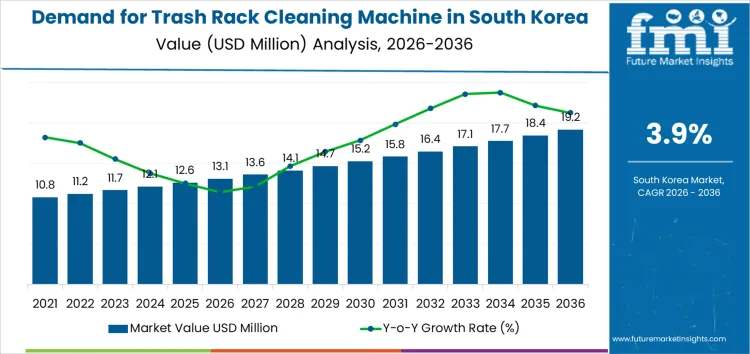
What is the Growth Forecast for the Demand for Trash Rack Cleaning Machine in South Korea through 2036?
The growth momentum for trash rack cleaning machines in South Korea shows steady progress over the forecast period, reflecting the ongoing demand for reliable, efficient equipment in water treatment and power generation facilities. The market is expected to grow from USD 13.1 million in 2026 to USD 19.2 million by 2036, with an overall growth rate of 3.9% CAGR. Early growth in the period (2026-2030) is driven by the ongoing need for equipment to ensure the smooth operation of water treatment plants and power stations, which have seen increased activity due to population growth and urbanization.
The growth momentum analysis indicates that demand will increase consistently throughout the forecast period. Over time, as existing machines are upgraded or replaced, growth will stabilize, but the market will continue to expand steadily due to continuous infrastructure development, particularly in coastal and industrial areas where debris accumulation poses a significant challenge. This ensures sustained demand for trash rack cleaning solutions, which are critical for maintaining uninterrupted operations in South Korea's water and power sectors.
Key Takeaways for Demand for Trash Rack Cleaning Machine in South Korea
| Metric | Value |
|---|---|
| Industry Sales Value (2026) | USD 13.1 million |
| Industry Forecast Value (2036) | USD 19.2 million |
| Industry Forecast CAGR (2026 to 2036) | 3.9% |
Why is the Demand for Trash Rack Cleaning Machines Growing in South Korea?
Demand for trash rack cleaning machines in South Korea is rising as water management authorities and infrastructure operators seek reliable solutions to maintain screens that intercept debris in canals, intake structures, and stormwater systems. Trash racks accumulate leaves, plastic waste, and other solids that can impede water flow and place strain on pumps and turbines. Manual cleaning of these screens is labor intensive and can expose workers to safety risks during periods of high flow or inclement weather. Mechanized cleaning equipment offers consistent removal of debris with predictable performance and reduced dependence on manual labour cycles.
Hydropower facilities, municipal water treatment plants, and flood control structures specify trash rack cleaning machines that fit existing channel dimensions and flow characteristics. Procurement decisions emphasize machine durability, ease of maintenance, and the ability to operate under variable flow conditions. These practical factors shape ongoing procurement by engineering and operations teams responsible for system uptime and infrastructure resilience.
Looking ahead, several structural factors are expected to support continued demand for trash rack cleaning machines in South Korea. Authorities are placing increasing emphasis on infrastructure reliability as urban and industrial water networks age and face more frequent extreme weather events that carry greater debris loads. Stormwater management programs reinforce the need to keep intake screens clear to prevent downstream flooding and maintain operational continuity in treatment facilities. Investments in smart water infrastructure may integrate automated cleaning equipment with monitoring systems that signal when rack cleaning is required, simplifying maintenance scheduling and reducing unplanned outages.
Construction of new hydropower and water conveyance projects includes design considerations that anticipate debris management challenges, creating opportunities for specifying cleaning machines early in project timelines. Technical improvements, such as enhanced drive systems that handle heavier debris and modular attachments that suit diverse rack geometries, broaden the applicability of machines across site types. These dynamics contribute to sustained interest in trash rack cleaning solutions across public and private sector water infrastructure programs in South Korea.
What Shapes the Demand for Trash Rack Cleaning Machines in South Korea?
The demand for trash rack cleaning machines in South Korea is driven by two primary factors: type and application. Hydraulic lifting machines lead the market with a 70% share, while hydro power plants represent the largest application segment at 65%. These two categories are crucial to the growth of the trash rack cleaning machine market, as both the energy and water management sectors rely on efficient, automated solutions to maintain the flow of water through intake systems and prevent clogging from debris.
Why Does Hydraulic Lifting Lead the Trash Rack Cleaning Machine Market?
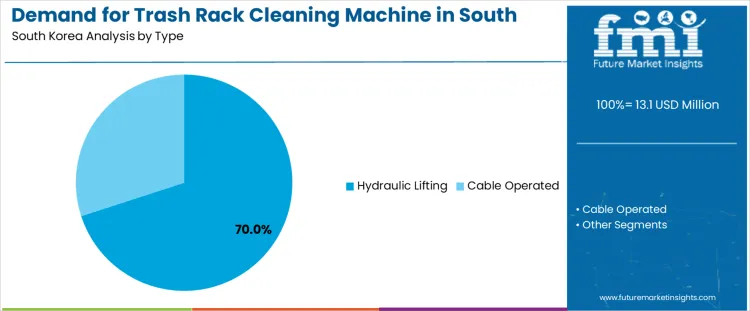
Hydraulic lifting machines dominate the trash rack cleaning machine market in South Korea, with a 70% market share due to their efficiency and high performance in handling debris removal. Hydraulic systems offer superior lifting capacity and are ideal for cleaning large trash racks in water intake systems, especially in applications where heavy debris such as logs, vegetation, and other large objects can accumulate. These machines provide reliable, automatic operation, reducing the need for manual labor and ensuring continuous, smooth water flow.
Hydraulic lifting machines are particularly preferred in power plants, water treatment plants, and other high-demand industrial environments, where downtime due to debris blockage must be minimized. Their strength, versatility, and adaptability to varying operational conditions make them a preferred choice for maintaining large-scale infrastructure. As South Korea continues to expand its renewable energy capacity, especially in hydro power, the demand for hydraulic lifting trash rack cleaning machines is expected to increase as part of ongoing efforts to improve efficiency and reduce maintenance costs.
Why Do Hydro Power Plants Lead the Application Demand?
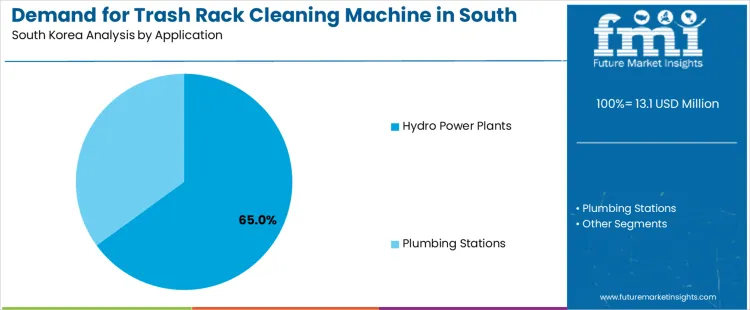
Hydro power plants account for 65% of the demand for trash rack cleaning machines in South Korea, driven by the need to keep intake systems clear of debris that could obstruct water flow and damage machinery. In hydroelectric plants, maintaining an uninterrupted supply of water through intake channels is critical for operational efficiency and power generation. Trash racks are designed to filter out large debris, but over time, they can become clogged, affecting water intake capacity and increasing the risk of damage to turbines and other sensitive equipment.
Trash rack cleaning machines, particularly those with hydraulic lifting mechanisms, offer an automated and efficient solution to remove debris, ensuring that hydro power plants can maintain consistent water flow and avoid costly downtime. The growth of South Korea’s renewable energy sector, with a focus on hydroelectric power, further boosts the demand for such machines as power plants seek to optimize their operational capabilities. As hydro power continues to play a significant role in South Korea’s energy mix, the need for reliable trash rack cleaning solutions is likely to remain a key priority.
What Is the Current Demand for Trash Rack Cleaning Machine in South Korea?
Demand for trash rack cleaning machines in South Korea is tied to the maintenance needs of water intake systems at dams, wastewater treatment plants, stormwater facilities, and industrial installations. These machines remove debris, leaves, plastics, and sediments from trash racks that protect pumps and screens. As infrastructure ages and focus on operational reliability increases, facility managers emphasize mechanized cleaning to reduce manual labor and prevent clogging. Procurement reflects investment in water management and flood control systems, with utilities and municipalities specifying automated solutions to uphold service continuity.
What Factors Are Driving Demand for Trash Rack Cleaning Machines in South Korea?
Several factors support demand for trash rack cleaning machines in South Korea. Rising emphasis on water resource management and flood mitigation has prompted upgrades to intake and screening infrastructure, making automated cleaning solutions more attractive. Municipal and industrial wastewater facilities require equipment that can operate reliably with minimal human intervention to maintain throughput and reduce safety risks. Regulations governing discharge quality and intake protection drive adoption of systems that maintain clear water flows and reduce downtime caused by manual cleaning. Urbanization and expansion of civil works increase the need for mechanized solutions that handle diverse debris loads efficiently, particularly during peak rainfall periods.
What Are the Constraints on Demand for Trash Rack Cleaning Machines in South Korea?
Despite ongoing requirements, some constraints influence the pace of demand for trash rack cleaning machines. Initial capital costs can be a deterrent for smaller municipalities or private facilities with limited budgets, leading them to continue with manual cleaning methods. Complex site conditions, such as confined spaces and variable water depths, may require customized equipment, extending lead times and elevating procurement costs. Competition from simpler or semi automated cleaning approaches remains in environments where debris loads are manageable without fully mechanized systems. Budgetary cycles in public water utilities and infrastructure programs also affect timing of purchases, as capital allocations fluctuate across fiscal periods.
What Trends Are Emerging in South Korea’s Trash Rack Cleaning Machine Sector?
Emerging trends in South Korea’s trash rack cleaning machine sector include a shift toward remote monitoring and control features that support operation from centralized control rooms, especially in critical infrastructure settings. Integration with condition monitoring sensors allows maintenance planning based on performance data rather than fixed schedules, improving uptime and reducing costs. There is increasing interest in machines with modular designs that can be adapted to varied rack widths and debris profiles. Sustainability goals influence specification of energy efficient drive systems and rugged components that extend service life. Collaboration between local engineering firms and international manufacturers is shaping product availability and after sales support networks.
What is the Regional Outlook for the Demand for Trash Rack Cleaning Machines in South Korea?
The demand for trash rack cleaning machines in South Korea is influenced by the country’s increasing infrastructure development, particularly in sectors related to water treatment, power generation, and industrial waste management. Jeju, South Gyeongsang, and South Jeolla show strong growth potential, while North Jeolla is projected to see more moderate demand. These machines are essential for maintaining the efficiency of water intake systems in power plants, water treatment facilities, and industrial sites, which are prevalent in South Korea's coastal and industrial regions. As the need for efficient waste management and environmental sustainability rises, the adoption of automated cleaning systems is set to increase, driving demand for these machines.
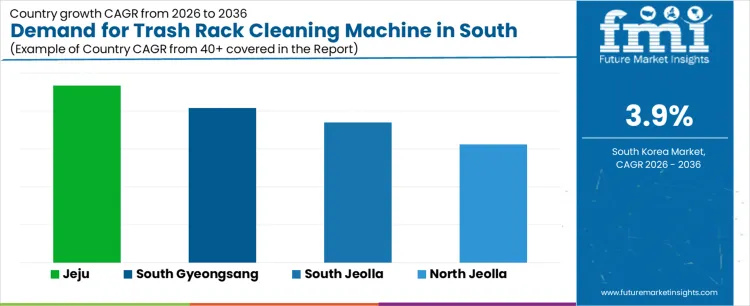
| Province | CAGR (2026–2036) |
|---|---|
| South Gyeongsang | 4.1% |
| North Jeolla | 3.1% |
| South Jeolla | 3.7% |
| Jeju | 4.7% |
What drives the demand for Trash Rack Cleaning Machines in South Gyeongsang?
South Gyeongsang is projected to experience a CAGR of 4.1% in demand for trash rack cleaning machines from 2026 to 2036. The region’s robust industrial and energy sectors are primary drivers of this demand. South Gyeongsang is home to numerous power plants, desalination facilities, and large-scale water treatment plants that require reliable waste management solutions, including automated trash rack cleaning. These machines are essential for removing debris and ensuring that water intake systems operate efficiently, preventing blockages and downtime. The region’s emphasis on improving environmental sustainability and operational efficiency in water management systems further supports the growing adoption of trash rack cleaning machines. As South Gyeongsang continues to expand its industrial base, particularly in energy generation and water management, demand for these machines is expected to remain strong.
What influences the growth of Trash Rack Cleaning Machine demand in North Jeolla?
North Jeolla is expected to see a steady CAGR of 3.1% in demand for trash rack cleaning machines over the 2026 to 2036 period. The region’s industrial activities, including power generation, water treatment, and agriculture, drive moderate demand for waste management equipment. North Jeolla’s focus on enhancing water treatment and managing waste from industrial processes supports the adoption of automated cleaning systems, especially in regions with significant water intake infrastructure. While North Jeolla’s industrial base is smaller than that of other regions, growing environmental concerns and stricter regulations on water quality are expected to increase the demand for efficient waste management solutions, including trash rack cleaning machines. This steady growth is supported by the region’s ongoing investments in infrastructure and environmental technology.
What drives the demand for Trash Rack Cleaning Machines in South Jeolla?
South Jeolla’s demand for trash rack cleaning machines is projected to grow at a CAGR of 3.7% from 2026 to 2036. The region’s substantial presence in the agriculture, food processing, and energy sectors contributes to the increasing need for these machines. Water intake systems in industrial plants and power stations in South Jeolla require frequent cleaning to maintain their efficiency, and trash rack cleaning machines provide a reliable solution. Additionally, the region’s focus on sustainable water management practices, particularly in agricultural and industrial settings, further boosts the demand for waste management solutions. South Jeolla’s ongoing investments in improving infrastructure and adopting environmentally friendly technologies, including waste management systems, contribute to the rising demand for trash rack cleaning machines in the coming years.
Why is Jeju projected to have the highest demand growth for Trash Rack Cleaning Machines?
Jeju is projected to experience the highest demand growth for trash rack cleaning machines, with a CAGR of 4.7% from 2026 to 2036. The region’s increasing focus on tourism infrastructure and water management drives the need for efficient waste management systems. Jeju’s growing number of water treatment facilities, alongside its expanding energy generation infrastructure, requires reliable and automated cleaning solutions for water intake systems. The island's commitment to environmental sustainability, particularly in maintaining the quality of water bodies and managing waste from tourism and agriculture, further accelerates the demand for trash rack cleaning machines. Jeju's rising focus on green technologies and waste reduction across industries makes it the fastest-growing region for this type of equipment. As the island’s infrastructure continues to expand, demand for these machines is expected to grow at an accelerated rate.
How are Competitors Differentiating in the Trash Rack Cleaning Machine Market in South Korea?
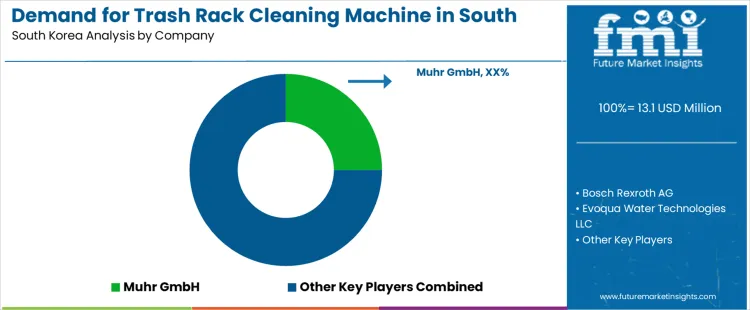
The demand for trash rack cleaning machines in South Korea is driven by the growing need for efficient water treatment systems, particularly in industrial and municipal applications where water intake systems need to be kept clear of debris. Muhr GmbH, the leading player, distinguishes itself with its high-performance cleaning machines designed for a wide range of environments, from hydroelectric plants to water treatment facilities. Their machines are known for robust construction, minimal maintenance requirements, and adaptable cleaning technology that ensures consistent, reliable operation in demanding conditions. Bosch Rexroth AG competes with its automated systems that integrate advanced sensors and controls, enhancing the cleaning process by allowing for precise operation and monitoring, which minimizes downtime and improves overall efficiency.
Evoqua Water Technologies LLC focuses on offering trash rack cleaning systems that prioritize environmental sustainability and energy efficiency. Their solutions are tailored for large-scale water intake systems and aim to reduce operational costs while ensuring compliance with environmental regulations. FRIULAIR S.R.L. positions itself by offering compact, cost-effective trash rack cleaning machines suitable for smaller-scale applications, ensuring ease of use and rapid deployment. Jash Engineering Ltd. caters to the industrial sector with a focus on durable machines that handle large volumes of debris, offering flexibility and high cleaning capacity for high-demand operations. These companies utilize product brochures to highlight key features such as machine reliability, energy efficiency, and ease of integration into existing infrastructure, helping South Korean clients make informed decisions about their water treatment needs.
Key Players of the Demand for Trash Rack Cleaning Machine in South Korea
- Muhr GmbH
- Bosch Rexroth AG
- Evoqua Water Technologies LLC
- FRIULAIR S.R.L.
- Jash Engineering Ltd.
Scope of the Report
| Items | Values |
|---|---|
| Quantitative Units (2026) | USD Million |
| Type | Hydraulic Lifting, Cable Operated |
| Application | Hydro Power Plants, Plumbing Stations |
| Companies | Muhr GmbH, Bosch Rexroth AG, Evoqua Water Technologies LLC, FRIULAIR S.R.L., Jash Engineering Ltd. |
| Region Covered | South Korea |
| Provinces Covered | South Gyeongsang, North Jeolla, South Jeolla, Jeju |
| Additional Attributes | Dollar sales by type and application. The demand for trash rack cleaning machines is driven by their crucial role in maintaining efficient operations in hydro power plants and plumbing stations. Hydraulic lifting systems dominate the market, with increasing adoption of cable operated models in specialized applications. |
Demand for Trash Rack Cleaning Machine in South Korea
Type
- Hydraulic Lifting
- Cable Operated
Application
- Hydro Power Plants
- Plumbing Stations
Provinces
- South Gyeongsang
- North Jeolla
- South Jeolla
- Jeju
Bibliography
- Ministry of Environment (Republic of Korea). (2024). Water infrastructure modernization and hydropower plant maintenance guidelines. Government of South Korea.
- Ministry of Trade, Industry and Energy (Republic of Korea). (2024). Industrial water treatment and energy-efficient equipment adoption roadmap. Government of South Korea.
- Korean Hydropower Association. (2025). Technological advancements in hydropower facility maintenance and trash rack cleaning automation. Korean Hydropower Association.
Frequently Asked Questions
How big is the demand for trash rack cleaning machine in south korea in 2026?
The demand for trash rack cleaning machine in south korea is estimated to be valued at USD 13.1 million in 2026.
What will be the size of trash rack cleaning machine in south korea in 2036?
The market size for the trash rack cleaning machine in south korea is projected to reach USD 19.2 million by 2036.
How much will be the demand for trash rack cleaning machine in south korea growth between 2026 and 2036?
The demand for trash rack cleaning machine in south korea is expected to grow at a 3.9% CAGR between 2026 and 2036.
What are the key product types in the trash rack cleaning machine in south korea?
The key product types in trash rack cleaning machine in south korea are hydraulic lifting and cable operated.
Which application segment is expected to contribute significant share in the trash rack cleaning machine in south korea in 2026?
In terms of application, hydro power plants segment is expected to command 65.0% share in the trash rack cleaning machine in south korea in 2026.
Preview the report firsthand - request a free sample
Get SampleGet the brochure for pricing and purchase details.
Get PDFTable of Content
- Executive Summary
- South Korea Market Outlook
- Demand-side Trends
- Supply-side Trends
- Technology Roadmap Analysis
- Analysis and Recommendations
- Market Overview
- Market Coverage / Taxonomy
- Market Definition / Scope / Limitations
- Market Background
- Market Dynamics
- Drivers
- Restraints
- Opportunity
- Trends
- Scenario Forecast
- Demand in Optimistic Scenario
- Demand in Likely Scenario
- Demand in Conservative Scenario
- Opportunity Map Analysis
- Product Life Cycle Analysis
- Supply Chain Analysis
- Investment Feasibility Matrix
- Value Chain Analysis
- PESTLE and Porter’s Analysis
- Regulatory Landscape
- Regional Parent Market Outlook
- Production and Consumption Statistics
- Import and Export Statistics
- Market Dynamics
- South Korea Market Analysis 2021 to 2025 and Forecast, 2026 to 2036
- Historical Market Size Value (USD Million) Analysis, 2021 to 2025
- Current and Future Market Size Value (USD Million) Projections, 2026 to 2036
- Y-o-Y Growth Trend Analysis
- Absolute $ Opportunity Analysis
- South Korea Market Pricing Analysis 2021 to 2025 and Forecast 2026 to 2036
- South Korea Market Analysis 2021 to 2025 and Forecast 2026 to 2036, By Type
- Introduction / Key Findings
- Historical Market Size Value (USD Million) Analysis By Type , 2021 to 2025
- Current and Future Market Size Value (USD Million) Analysis and Forecast By Type , 2026 to 2036
- Hydraulic Lifting
- Cable Operated
- Hydraulic Lifting
- Y-o-Y Growth Trend Analysis By Type , 2021 to 2025
- Absolute $ Opportunity Analysis By Type , 2026 to 2036
- South Korea Market Analysis 2021 to 2025 and Forecast 2026 to 2036, By Application
- Introduction / Key Findings
- Historical Market Size Value (USD Million) Analysis By Application, 2021 to 2025
- Current and Future Market Size Value (USD Million) Analysis and Forecast By Application, 2026 to 2036
- Hydro Power Plants
- Plumbing Stations
- Hydro Power Plants
- Y-o-Y Growth Trend Analysis By Application, 2021 to 2025
- Absolute $ Opportunity Analysis By Application, 2026 to 2036
- Market Structure Analysis
- Competition Dashboard
- Competition Benchmarking
- Market Share Analysis of Top Players
- By Regional
- By Type
- By Application
- Competition Analysis
- Competition Deep Dive
- Muhr GmbH
- Overview
- Product Portfolio
- Profitability by Market Segments (Product/Age /Sales Channel/Region)
- Sales Footprint
- Strategy Overview
- Marketing Strategy
- Product Strategy
- Channel Strategy
- Bosch Rexroth AG
- Evoqua Water Technologies LLC
- FRIULAIR S.R.L.
- Jash Engineering Ltd.
- Muhr GmbH
- Competition Deep Dive
- Assumptions & Acronyms Used
- Research Methodology


