

- Industry Size (2026)
- USD 14.2 Mn
- Forecast (2036)
- USD 18.3 Mn
- CAGR (2026 to 2036)
- 2.6%
Demand for Tire Marking Machine in South Korea Forecast and Outlook 2026 to 2036
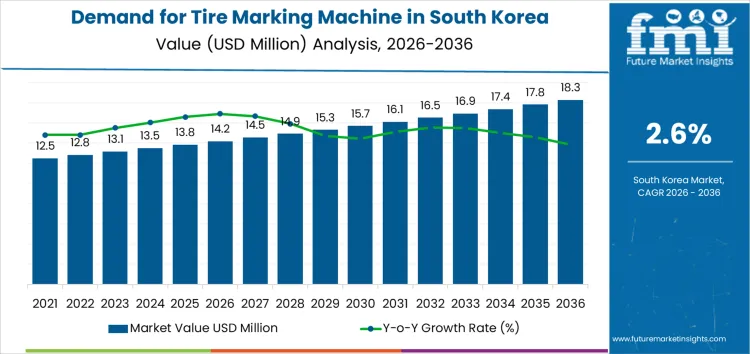
The demand for tire marking machines in South Korea is projected to reach USD 18.3 million by 2036, growing at a CAGR of 2.6% from USD 14.2 million in 2026. This category holds strategic importance within the broader automotive manufacturing and aftermarket sectors, as tire marking machines play a key role in ensuring product traceability and regulatory compliance. Control points in this market are centered around the accuracy, efficiency, and technology used in these machines, which can significantly impact manufacturing timelines and quality.
Dependency factors include the broader automotive industry's production cycles and regulatory changes, which often necessitate updates in marking systems. Strategic trade-offs are also evident, as companies must balance the adoption of new technologies with the costs of equipment upgrades. The ability to navigate these factors efficiently will determine competitive positioning, especially as global supply chain dynamics and industry standards continue to evolve.
Quick Stats for the Demand for Tire Marking Machine in South Korea
- Tire Marking Machine in South Korea Value (2026): USD 14.2 million
- Tire Marking Machine in South Korea Forecast Value (2036): USD 18.3 million
- Tire Marking Machine in South Korea Forecast CAGR (2026 to 2036): 2.6%
- Tire Marking Machine in South Korea Leading Segment: Permanent Marking (60%)
- Key Growth Regions of Tire Marking Machine in South Korea: Jeju (leading CAGR ~3.1%)
- Top Players of Tire Marking Machine in South Korea: Markem-Imaje (Dover Corporation), Videojet Technologies (Danaher Corporation), Rea Jet (Rea Elektronik GmbH), Koenig & Bauer Coding GmbH, Domino Printing Sciences (Brother Industries)
What is the Growth Forecast for the Tire Marking Machine Market in South Korea through 2036?
The tire marking machine market in South Korea is projected to experience slow but consistent growth from 2026 to 2036. The industry value will start at USD 14.2 million in 2026, with a slight increase to USD 14.5 million in 2027. By 2028, the industry is expected to reach USD 14.9 million, followed by USD 15.3 million in 2029. The growth will continue steadily, with the industry projected to reach USD 15.7 million in 2030 and USD 16.1 million in 2031.
In the coming years, the demand for tire marking machines will show consistent increases, with the industry expected to reach USD 16.5 million in 2032 and USD 16.9 million in 2033. By 2034, the industry will reach USD 17.4 million, and further growth will bring the value to USD 17.8 million in 2035. By 2036, the industry value is projected to reach USD 18.3 million. This steady growth reflects the ongoing expansion of South Korea’s tire manufacturing industry, driven by increased production and the need for high-efficiency marking systems. The industry's growth momentum will continue, driven by the automation of manufacturing processes and stricter industry regulations.
Key Takeaways for Demand for Tire Marking Machine in South Korea
| Metric | Value |
|---|---|
| Industry Sales Value (2026) | USD 14.2 million |
| Industry Forecast Value (2036) | USD 18.3 million |
| Industry Forecast CAGR (2026 to 2036) | 2.6% |
Why is the Demand for Tire Marking Machines Growing in South Korea?
Demand for tire marking machines in South Korea has increased as automotive production and tire manufacturing have sought improved traceability and quality control. Historically, South Korea’s automotive sector expanded rapidly, with local manufacturers scaling production of passenger vehicles and commercial fleets. Tire suppliers responded by adopting automated marking systems that imprint information such as batch numbers, size codes, and production dates directly onto tire surfaces. These systems helped manufacturers meet regulatory and customer requirements for traceability, reduce errors associated with manual marking, and speed up inspection processes on the production line.
Industrial automation strategies in South Korean manufacturing also pushed suppliers to incorporate machine based solutions that operate consistently under high throughput conditions. Enhanced marking precision supported compliance with standards for export markets where detailed tyre specification and origin data are mandatory. Tires destined for export to regions with stringent labeling rules required reliable marking to avoid shipment delays or non conformity penalties. OEMs and tier 1 automotive suppliers in South Korea adopted tire marking machines as part of broader investments in production line digitization and quality monitoring systems.
Looking ahead, demand for tire marking machines in South Korea is expected to expand as tire manufacturers and automotive assemblers pursue greater efficiency and data integration. Growth in electric vehicle (EV) production will increase demand for tyres tailored to specific performance criteria, prompting marking solutions capable of accommodating variable product specifications rapidly. Operators are likely to invest in marking systems that integrate with factory execution systems, providing real time production data that supports predictive maintenance and quality analytics.
Advanced marking technologies that offer multi axis printing and support for variable codes will attract interest from manufacturers seeking flexible production lines. Suppliers of tire marking equipment should consider local service capability, training, and customisation options to support Korean industrial clients. Improvements in machine durability and ease of integration into existing manufacturing execution systems will influence procurement decisions among tyre producers focused on uptime and return on investment.
What Are the Key Segments in Demand for Tire Marking Machines in South Korea?
The demand for tire marking machines in South Korea is driven by machine type and marking type. Inkjet marking machines lead the machine type segment, holding 35% of the industry, while laser marking machines also contribute to the demand. In terms of marking types, permanent marking dominates the industry with 60%, followed by temporary marking solutions. As tire manufacturers look for efficient, high-precision, and durable marking methods, the demand for both inkjet and laser marking machines continues to grow across various segments.
How Does Machine Type Influence Demand for Tire Marking Machines in South Korea?
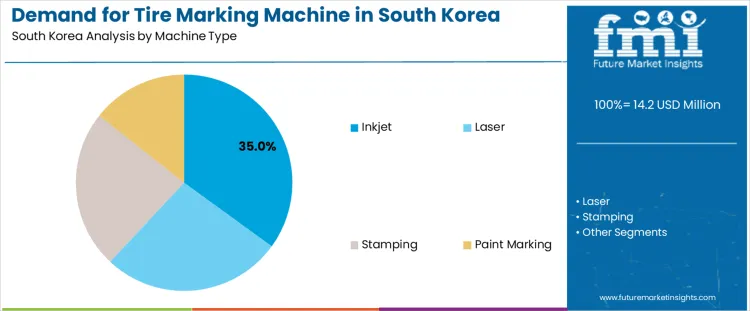
The demand for tire marking machines in South Korea is significantly impacted by the choice of machine type. Inkjet marking machines account for 35% of the industry, primarily because of their flexibility, cost-effectiveness, and speed in marking a wide range of tire products. Inkjet technology is valued for its ability to print high-quality, clear markings on tires with minimal setup time and is widely used in large-scale tire manufacturing operations. The ability to mark various tire surfaces, including rough and curved surfaces, makes inkjet machines a popular choice for tire makers. Laser marking machines, although a smaller segment compared to inkjet machines, are growing in demand due to their precision and permanence.
Laser machines are used in high-end applications where the highest quality and durability of markings are required. These machines are favored in the production of premium tires, where markings must withstand harsh conditions over time. Laser marking offers clear, permanent, and tamper-resistant markings, which makes them ideal for branding, traceability, and regulatory compliance. As tire manufacturers continue to prioritize long-lasting, high-quality markings that align with industry standards, the demand for laser marking machines is expected to rise, particularly in specialized and premium tire segments.
What Is the Demand for Different Marking Types in Tire Marking Machines in South Korea?
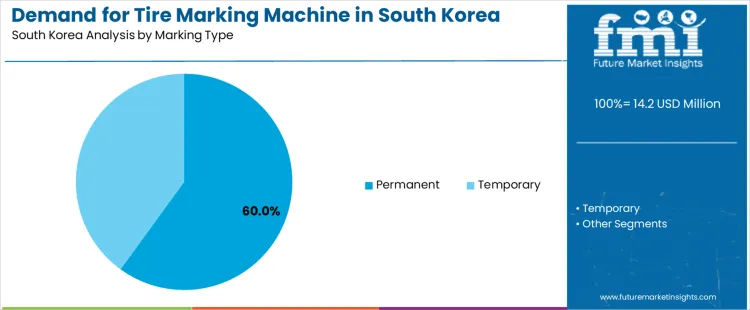
In South Korea, permanent marking is the leading marking type for tire marking machines, accounting for 60% of the industry. Permanent markings are essential for tire manufacturers that require long-lasting and durable identification on their products. These markings are used for tire traceability, brand identification, and compliance with regulatory standards, making them crucial for both domestic and export markets. Permanent markings, whether applied by inkjet, laser, or other technologies, ensure that the tire's information remains visible throughout its lifecycle, even under harsh environmental conditions. Temporary marking solutions, although a smaller segment, are used for tasks that require short-term identification or for marking during the production process.
These marks are typically removed or altered after the tire is finished, making them less permanent but cost-effective for specific applications. Other marking types, such as stamping and paint marking, also serve niche needs within tire manufacturing. Stamping is typically used for deep, indelible marks, while paint marking is applied for temporary or color-coded identification purposes during production. As tire manufacturers continue to focus on precision, traceability, and branding, the demand for permanent marking solutions will remain strong, while temporary and other types will cater to specific production needs.
What are the Key Dynamics in the Demand for Tire Marking Machines in South Korea?
Demand for tire marking machines in South Korea is linked to automotive production volumes, quality control requirements, and aftermarket service activities. These machines imprint identification codes, brand logos, and regulatory markings on tire sidewalls during manufacturing or retreading operations. South Korea’s automotive sector, which includes passenger cars, commercial vehicles, and two wheelers, generates recurring need for precise marking to support traceability and compliance with safety standards. Tire retreaders and service networks also require marking equipment to document processing history. Buyers prioritize systems that deliver consistent mark quality, integration with production lines, and reliable throughput.
What are the Drivers of Demand for Tire Marking Machines in South Korea?
The foremost drivers include strong automotive manufacturing and export orientation, where tire suppliers and assemblers adopt automated marking systems to meet traceability standards. Regulatory requirements for tire identification, batch codes, and safety compliance encourage integration of marking solutions. Growth in replacement tire sales and retread services supports aftermarket uptake of portable and shop floor marking equipment. Manufacturers seek marking machines that support high throughput while minimizing downtime and misprint rates. Demand is further influenced by quality assurance protocols that link tire IDs to production data, aiding recalls and warranty tracking. Industrial buyers value equipment that supports serialisation and integration with MES (Manufacturing Execution System) environments.
What are the Restraints on Demand for Tire Marking Machines in South Korea?
Restraints stem from cost pressures and adoption barriers faced by smaller tire manufacturers and retread shops. Advanced marking systems, particularly laser or ink jet based machines, require significant upfront investment, which can deter cost conscious buyers. Technical complexity and integration challenges with legacy production lines can extend commissioning timelines and increase implementation expenses. Variations in tire sizes and materials necessitate adaptable fixtures and programming, which can raise training and support costs for buyers with limited automation experience. Competitive pressures in the tire supply market also constrain capital expenditure on marking equipment in some segments.
What Key Trends Affect Demand for Tire Marking Machines in South Korea?
A key trend involves the uptake of laser marking technologies that deliver durable, high resolution marks without consumable inks. Integration of marking systems with Industry 4.0 frameworks and data capture platforms is expanding, enabling real time traceability and analytics across production lines. Portable marking units that support flexible use in service centres and retread facilities are gaining traction, especially where fixed installation is impractical. Demand is rising for systems that accommodate diverse tire profiles while maintaining mark consistency. Suppliers are also offering modular solutions that support phased automation investments, aligning with variable budget cycles among domestic manufacturers and aftermarket operators.
What is the Regional Demand Analysis for Tire Marking Machines in South Korea?
The demand for tire marking machines in South Korea is influenced by regional industrial activities, particularly in the automotive and manufacturing sectors. South Gyeongsang, with a CAGR of 2.7%, demonstrates steady demand driven by its strong automotive industry presence, which includes tire manufacturing. North Jeolla, with a growth rate of 2.1%, experiences moderate demand, driven by its automotive and machinery sectors. South Jeolla, with a projected CAGR of 2.4%, sees gradual demand growth, supported by its growing automotive and manufacturing base. Jeju, with the highest demand growth of 3.1%, stands out for its increasing demand, likely driven by emerging industrial activities and local tire manufacturers. The demand in all regions reflects the need for efficient, automated systems that ensure accurate and reliable tire marking in the automotive manufacturing process.
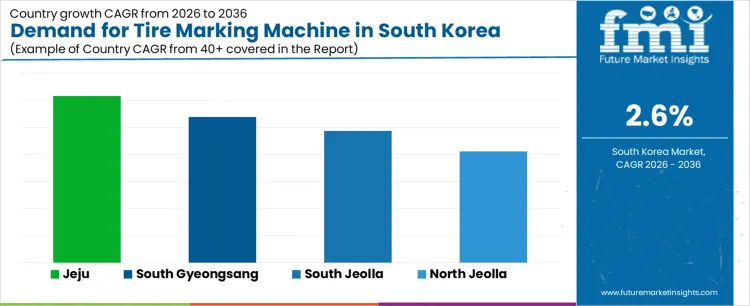
| Region | CAGR (2026 to 2036) |
|---|---|
| South Gyeongsang | 2.7% |
| North Jeolla | 2.1% |
| South Jeolla | 2.4% |
| Jeju | 3.1% |
How is Demand for Tire Marking Machines Evolving in South Gyeongsang?
South Gyeongsang, with a CAGR of 2.7%, shows steady demand for tire marking machines, reflecting its position as a key hub for South Korea’s automotive industry. The region is home to large tire manufacturing plants, and as these facilities expand their production capabilities, the need for efficient tire marking solutions grows. Manufacturers in South Gyeongsang require accurate and automated tire marking machines to ensure consistency and quality control in tire production. As local automotive companies continue to focus on enhancing manufacturing processes, demand for advanced tire marking technology is expected to rise steadily, driven by the growing need for precise, high-volume tire production.
What Drives Demand for Tire Marking Machines in North Jeolla?
North Jeolla, with a projected CAGR of 2.1%, experiences moderate demand for tire marking machines. The region's automotive and machinery sectors are expanding, but at a slower pace compared to more industrially concentrated areas like South Gyeongsang. As North Jeolla's automotive and tire manufacturing industries continue to grow, particularly with the rise of electric vehicle production, there will be a gradual increase in demand for tire marking machines. Manufacturers in this region will seek to improve production efficiency and accuracy, leading to moderate growth in demand for automated tire marking solutions over the next decade.
What is the Outlook for Tire Marking Machines in South Jeolla?
South Jeolla, with a projected CAGR of 2.4%, is seeing moderate demand for tire marking machines, primarily driven by its automotive manufacturing base. While the region is not as prominent as South Gyeongsang in terms of tire production, the increasing demand for tire marking machines is linked to growing local production and technological advancements in the automotive sector. Manufacturers in South Jeolla are adopting automated solutions to improve production efficiency, reduce human error, and meet quality standards. As demand for high-quality tires increases in South Jeolla, the need for advanced marking systems to meet industry requirements is expected to grow gradually, supporting the region’s automotive sector.
Why is Jeju Seeing Increased Demand for Tire Marking Machines?
Jeju, with the highest projected CAGR of 3.1%, is seeing a more pronounced growth in demand for tire marking machines. While Jeju’s automotive sector is smaller compared to other regions, its growing industrial activities and local tire manufacturing initiatives are driving this rise. The region’s emerging automotive sector, combined with increasing automation in manufacturing processes, is contributing to the growing demand for precise and reliable tire marking technology. Manufacturers in Jeju are seeking to enhance production capabilities and meet the rising demand for high-quality, durable tires. As Jeju’s industrial landscape continues to develop, the demand for tire marking machines is expected to grow more rapidly compared to other regions.
What is the Competitive Landscape for Tire Marking Machines in South Korea?
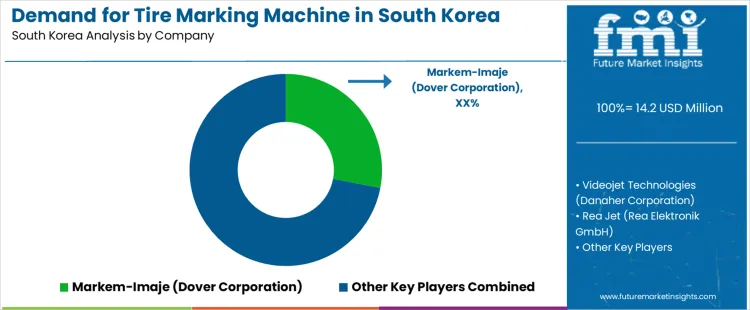
Demand for tire marking machines in South Korea is anchored in the automotive and tire manufacturing sectors where traceability and quality assurance are critical. Tire producers require marking solutions that deliver high resolution, durable codes for plant tracking, regulatory compliance, and end of life identification. Growth in domestic tire output, coupled with export oriented production by major Korean manufacturers, has supported steady uptake of advanced marking technologies. Specifications for tire marking systems increasingly emphasize speed, print clarity, and ability to mark on curved, textured rubber surfaces without affecting material integrity.
Procurement criteria in South Korea typically include machine uptime, ease of integration with existing production lines, and service support availability. Manufacturers of marking equipment also consider local service networks, spare parts supply, and technical training for operations staff when engaging with South Korean tire producers and contract manufacturers. Demand signals reflect a need for flexible, robust marking systems compatible with varied tire sizes and production speeds typical of modern assembly lines.
Competition among leading suppliers in the South Korean tire marking machine market is shaped by product performance, technical documentation, and channel support. Markem Imaje (Dover Corporation) is positioned as a leading provider, with product brochures detailing laser, inkjet, and contact marking options alongside throughput rates and code permanence data. Videojet Technologies (Danaher Corporation) literature focuses on modular marking systems, print resolution specifications, and integration guidelines for high volume environments. Rea Jet (Rea Elektronik GmbH) materials present industrial marking solutions with emphasis on rugged designs, operator interfaces, and maintenance intervals relevant to continuous manufacturing.
Koenig & Bauer Coding GmbH documentation outlines coding platforms with flexible configuration options, including recommended print parameters for rubber substrates. Domino Printing Sciences (Brother Industries) brochures describe a range of marking technologies with specification sheets on print speed, connectivity protocols, and serviceability features. These brochures typically include technical data such as marking range, resolution metrics, and environmental tolerances that assist South Korean manufacturers and equipment buyers in evaluating supplier offerings against operational requirements.
Key Players of the Demand for Tire Marking Machine in South Korea
- Markem-Imaje (Dover Corporation)
- Videojet Technologies (Danaher Corporation)
- Rea Jet (Rea Elektronik GmbH)
- Koenig & Bauer Coding GmbH
- Domino Printing Sciences (Brother Industries)
Scope of the Report
| Items | Values |
|---|---|
| Quantitative Units (2026) | USD Million |
| Machine Type | Inkjet, Laser, Stamping, Paint Marking |
| Marking Type | Permanent, Temporary |
| Companies | Markem-Imaje (Dover Corporation), Videojet Technologies (Danaher Corporation), Rea Jet (Rea Elektronik GmbH), Koenig & Bauer Coding GmbH, Domino Printing Sciences (Brother Industries) |
| Region Covered | South Korea |
| Provinces Covered | South Gyeongsang, North Jeolla, South Jeolla, Jeju |
| Additional Attributes | Dollar sales by machine type and marking type. Demand is driven by automation in tire manufacturing, traceability compliance, and shift toward durable high-precision marking systems such as laser and advanced inkjet units used across tire plants. |
Key Segments of Demand for Tire Marking Machine in South Korea
Machine Type
- Inkjet
- Laser
- Stamping
- Paint Marking
- Other
Marking Type
- Permanent
- Temporary
- Other
Provinces
- South Gyeongsang
- North Jeolla
- South Jeolla
- Jeju
Bibliography
- Ministry of Trade, Industry and Energy (Republic of Korea). (2024). Regulation on measuring and grading energy consumption efficiency and labeling for automotive tires.
- Ministry of Land, Infrastructure and Transport (Republic of Korea). (2024). Rules on automobile safety standards. National Law Information Center (Korea).
- United Nations Economic Commission for Europe. (2024). UN Regulation No. 30: Uniform provisions concerning the approval of pneumatic tyres for motor vehicles and their trailers (ECE/TRANS/505/Add.29, consolidated version). UNECE.
- United Nations. (2024). UN Regulation No. 117: Uniform provisions concerning the approval of tyres with regard to rolling sound emissions, wet grip, and rolling resistance (ECE/TRANS/505/Add.116, consolidated version). UN Digital Library.
- International Organization for Standardization. (2024). ISO/IEC 15426-2: Information technology — Automatic identification and data capture techniques — Bar code verifier conformance specification — Part 2: Two-dimensional symbols (latest edition). ISO.
Frequently Asked Questions
How big is the demand for tire marking machine in south korea in 2026?
The demand for tire marking machine in south korea is estimated to be valued at USD 14.2 million in 2026.
What will be the size of tire marking machine in south korea in 2036?
The market size for the tire marking machine in south korea is projected to reach USD 18.3 million by 2036.
How much will be the demand for tire marking machine in south korea growth between 2026 and 2036?
The demand for tire marking machine in south korea is expected to grow at a 2.6% CAGR between 2026 and 2036.
What are the key product types in the tire marking machine in south korea?
The key product types in tire marking machine in south korea are inkjet, laser, stamping and paint marking.
Which marking type segment is expected to contribute significant share in the tire marking machine in south korea in 2026?
In terms of marking type, permanent segment is expected to command 60.0% share in the tire marking machine in south korea in 2026.
Preview the report firsthand - request a free sample
Get SampleGet the brochure for pricing and purchase details.
Get PDFTable of Content
- Executive Summary
- South Korea Market Outlook
- Demand-side Trends
- Supply-side Trends
- Technology Roadmap Analysis
- Analysis and Recommendations
- Market Overview
- Market Coverage / Taxonomy
- Market Definition / Scope / Limitations
- Market Background
- Market Dynamics
- Drivers
- Restraints
- Opportunity
- Trends
- Scenario Forecast
- Demand in Optimistic Scenario
- Demand in Likely Scenario
- Demand in Conservative Scenario
- Opportunity Map Analysis
- Product Life Cycle Analysis
- Supply Chain Analysis
- Investment Feasibility Matrix
- Value Chain Analysis
- PESTLE and Porter’s Analysis
- Regulatory Landscape
- Regional Parent Market Outlook
- Production and Consumption Statistics
- Import and Export Statistics
- Market Dynamics
- South Korea Market Analysis 2021 to 2025 and Forecast, 2026 to 2036
- Historical Market Size Value (USD Million) Analysis, 2021 to 2025
- Current and Future Market Size Value (USD Million) Projections, 2026 to 2036
- Y-o-Y Growth Trend Analysis
- Absolute $ Opportunity Analysis
- South Korea Market Pricing Analysis 2021 to 2025 and Forecast 2026 to 2036
- South Korea Market Analysis 2021 to 2025 and Forecast 2026 to 2036, By Machine Type
- Introduction / Key Findings
- Historical Market Size Value (USD Million) Analysis By Machine Type, 2021 to 2025
- Current and Future Market Size Value (USD Million) Analysis and Forecast By Machine Type, 2026 to 2036
- Inkjet
- Laser
- Stamping
- Paint Marking
- Inkjet
- Y-o-Y Growth Trend Analysis By Machine Type, 2021 to 2025
- Absolute $ Opportunity Analysis By Machine Type, 2026 to 2036
- South Korea Market Analysis 2021 to 2025 and Forecast 2026 to 2036, By Marking Type
- Introduction / Key Findings
- Historical Market Size Value (USD Million) Analysis By Marking Type, 2021 to 2025
- Current and Future Market Size Value (USD Million) Analysis and Forecast By Marking Type, 2026 to 2036
- Permanent
- Temporary
- Permanent
- Y-o-Y Growth Trend Analysis By Marking Type, 2021 to 2025
- Absolute $ Opportunity Analysis By Marking Type, 2026 to 2036
- Market Structure Analysis
- Competition Dashboard
- Competition Benchmarking
- Market Share Analysis of Top Players
- By Regional
- By Machine Type
- By Marking Type
- Competition Analysis
- Competition Deep Dive
- Markem-Imaje (Dover Corporation)
- Overview
- Product Portfolio
- Profitability by Market Segments (Product/Age /Sales Channel/Region)
- Sales Footprint
- Strategy Overview
- Marketing Strategy
- Product Strategy
- Channel Strategy
- Videojet Technologies (Danaher Corporation)
- Rea Jet (Rea Elektronik GmbH)
- Koenig & Bauer Coding GmbH
- Domino Printing Sciences (Brother Industries)
- Markem-Imaje (Dover Corporation)
- Competition Deep Dive
- Assumptions & Acronyms Used
- Research Methodology


