

- Industry Size (2026)
- USD 45.7 Mn
- Forecast (2036)
- USD 60.5 Mn
- CAGR (2026 to 2036)
- 2.8%
Demand for Tire Marking Machine in United Kingdom Forecast and Outlook 2026 to 2036
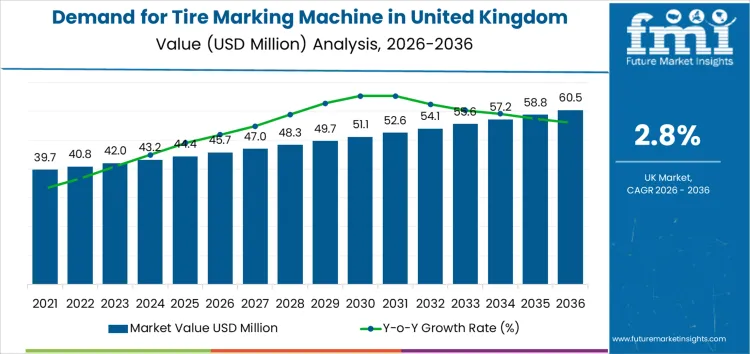
The tire marking machine market in the United Kingdom is projected to grow from USD 45.7 million in 2026 to USD 60.5 million by 2036, at a CAGR of 2.8%. The sector holds commercial relevance as tire manufacturers face increasing pressure to comply with regulatory standards and ensure product traceability.
Players in the sector are increasingly focused on ensuring that their production lines are equipped with reliable, efficient systems that can meet both performance and compliance demands. As such, purchasing decisions will center on balancing cost with the ability to meet evolving quality and safety requirements. Economic factors, such as fluctuating raw material costs and demand for high-quality tires, will influence buyer intent, pushing manufacturers to invest in cost-effective, long-lasting machinery. The decision-making process will also be influenced by the need for operational efficiency and minimal downtime, meaning that companies offering high-performing, low-maintenance machines will be positioned for success in this steady-growth market.
Quick Stats for the Demand for Tire Marking Machine in United Kingdom
- Tire Marking Machine in United Kingdom Value (2026): USD 45.7 million
- Tire Marking Machine in United Kingdom Forecast Value (2036): USD 60.5 million
- Tire Marking Machine in United Kingdom Forecast CAGR (2026 to 2036): 2.8%
- Tire Marking Machine in United Kingdom Leading Segment: Permanent Marking (65% share)
- Key Growth Regions of Tire Marking Machine in United Kingdom: England
- Top Players of Tire Marking Machine in United Kingdom: Markem-Imaje (Dover Corporation), Videojet Technologies (Danaher Corporation), Rea Jet (Rea Elektronik GmbH), Koenig & Bauer Coding GmbH, Domino Printing Sciences (Brother Industries)
What is the Growth Forecast for Tire Marking Machine in United Kingdom through 2036?
The demand for tire marking machines in the United Kingdom is expected to increase from USD 45.7 million in 2026 to USD 60.5 million by 2036, reflecting a compound annual growth rate (CAGR) of 2.8%. Between 2026 and 2031, the industry will experience steady growth, with values increasing from USD 45.7 million to USD 52.6 million. From 2031 to 2036, the demand will continue to rise, reaching USD 60.5 million by the end of the forecast period.
The growth momentum analysis indicates that the industry will follow a consistent upward trajectory throughout the forecast period, with gradual increases in demand for tire marking machines. While the growth rate is relatively modest, it reflects stable, continuous demand supported by steady advancements in manufacturing technologies and increasing automotive production requirements. The pace of growth may be influenced by external factors, such as changes in regulatory standards, the evolution of tire production technologies, and fluctuations in automotive manufacturing activity.
Key Takeaways for Demand for Tire Marking Machine in United Kingdom
| Metric | Value |
|---|---|
| Industry Sales Value (2026) | USD 45.7 million |
| Industry Forecast Value (2036) | USD 60.5 million |
| Industry Forecast CAGR (2026 to 2036) | 2.8% |
Why is Demand for Tire Marking Machine in United Kingdom Growing?
Demand for tire marking machines in the United Kingdom has risen as manufacturers, retreaders, and logistics operators prioritise traceability, quality control, and process efficiency. Historically, marking tires was a manual task, relying on hand applied ink or paint, which led to inconsistent results and limited data capture. UK tyre producers and retread facilities began adopting automated marking equipment that integrates with production lines and applies codes, batch information, and regulatory marks with precision. Automated systems reduce variability and improve legibility, which supports compliance with industry standards and safety regulations governing tyre identification. Quality assurance teams value machines that consistently apply unique identifiers, as this enhances post production tracking through distribution and service networks. Equipment that interfaces with enterprise systems also allows digital logging of marking events, aiding audit trails and reducing manual record keeping errors.
Looking ahead, demand for tire marking machines in the United Kingdom is expected to maintain momentum as data centric manufacturing and traceability requirements evolve. Original equipment manufacturers (OEMs) and tier 1 suppliers will assess marking systems based on speed, integration capability, and ability to handle varied tyre sizes and compositions. Retreading and remanufacturing operations, which require clear distinction between original and regenerated sections, will increasingly specify automated marking to support consistent quality output and reduce rework. Fleet operators and tyre service chains may influence demand by seeking tyres with machine readable codes that facilitate service history tracking and rotation planning. Suppliers that offer robust after sales support, including training and preventive maintenance, will attract engagement from UK buyers focused on uptime and total cost of ownership. Continued emphasis on regulatory compliance, digital traceability, and production reliability positions tire marking machines as essential investments for tyre manufacturing and service ecosystems in the UK.
What Are the Key Segments in the Demand for Tire Marking Machines in the United Kingdom?
Demand for tire marking machines in the United Kingdom is influenced by machine type and marking type. Inkjet machines lead the machine type segment with 45%, while permanent marking dominates the marking type segment at 65%. Other machine types, such as laser and stamping, and marking methods like temporary and paint marking, also contribute to the industry. These segments highlight the evolving requirements for precise, durable, and cost-effective tire marking solutions across the automotive and manufacturing sectors.
Which Machine Type Segment Leads the Demand for Tire Marking Machines in the United Kingdom?
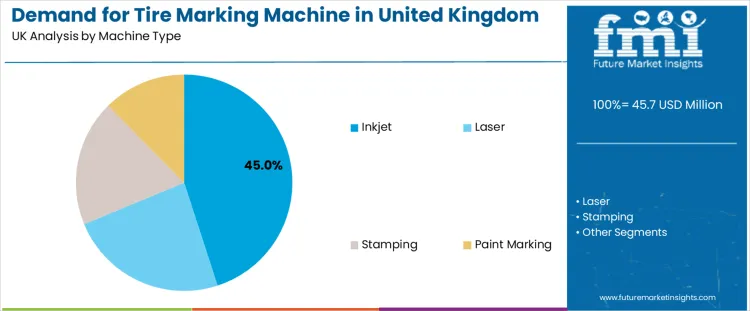
The machine type segment for tire marking machines in the United Kingdom is led by inkjet marking machines, which account for 45% of the industry share. Inkjet machines are favored for their ability to produce clear, high-quality markings on tires, making them ideal for high-volume production environments. They offer flexibility in marking designs, including logos, serial numbers, and barcodes, on a variety of tire surfaces. The inkjet technology is valued for its speed, precision, and the ability to handle complex marking tasks without compromising efficiency. As the demand for traceability and quality control in the automotive industry increases, inkjet tire marking machines continue to play a crucial role in ensuring that manufacturers meet industry standards for product identification.
Laser marking machines, although representing a smaller portion of the industry, offer distinct advantages in terms of precision and durability. Laser technology creates permanent marks by engraving or etching into the tire surface, ensuring that the markings remain visible throughout the tire's lifespan, even under harsh conditions. This makes laser machines ideal for industries where durability is paramount, such as in heavy-duty or off-road tire production. Stamping machines, which apply pressure to create indentations or impressions on tire surfaces, offer a cost-effective alternative for basic marking needs. Although stamping is less common for complex markings, it remains relevant for simpler applications or smaller-scale tire production.
Which Is the Dominant Marking Type Segment in Tire Marking Machines Industry in the United Kingdom?
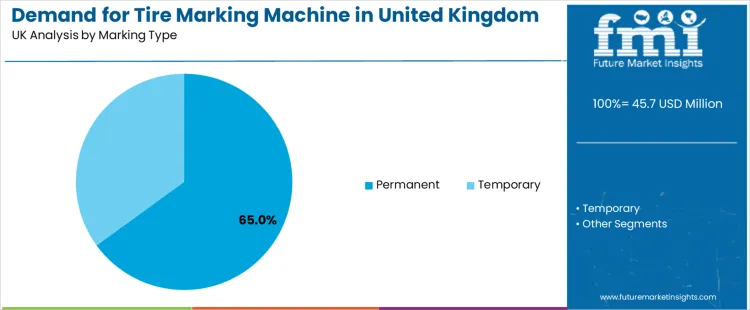
The marking type segment for tire marking machines in the United Kingdom is dominated by permanent marking, which accounts for 65% of the industry share. Permanent marking methods, such as laser etching or inkjet marking with durable ink, ensure that tire information such as identification numbers, batch codes, and other critical details remain legible throughout the tire's entire lifespan. Permanent markings are essential for tire manufacturers and suppliers who need to maintain traceability for safety, warranty, and regulatory compliance purposes. The long-lasting nature of permanent markings ensures that crucial information remains intact, even under exposure to environmental factors such as heat, friction, and moisture.
Temporary marking methods, although representing a smaller segment, are used for applications where short-term identification is required, such as during production, testing, or transport. Temporary markings are often applied using inkjet or paint marking techniques, allowing manufacturers to track tires through various stages of production or distribution. Once the tires reach their final destination or are sold, these temporary markings are often removed or replaced with permanent ones. Paint marking, while a niche segment, is sometimes used for temporary color coding or distinguishing tires by categories during the manufacturing process. The demand for both permanent and temporary marking methods is driven by the tire industry's need for clear identification and efficient production tracking, ensuring the safety and traceability of each product.
What are the Key Dynamics in the Demand for Tire Marking Machines in the United Kingdom?
Demand for tire marking machines in the United Kingdom stems from the need to automate identification, traceability, and branding processes within tyre manufacturing, retreading, and distribution operations. Tire marking machines apply characters, codes, logos, and other markings that support quality control, inventory management, regulatory compliance (e.g., DOT, ECE markings), and after sales service tracking. Procurement decisions are influenced by throughput requirements, print durability needs, integration with production lines, and data capture systems. Both original equipment manufacturers (OEMs) and aftermarket service providers drive adoption as they seek improvements in operational efficiency and product traceability.
What are the Key Drivers for Tire Marking Machine Demand in the United Kingdom?
Several factors are driving demand for tire marking machines in the United Kingdom. Growing production volumes in tyre manufacturing and retreading facilities require high speed, reliable marking solutions that keep pace with line speeds and minimise downtime. The need for precise traceability, including batch codes, production dates, and safety information, aligns with compliance requirements and quality assurance programmes. Integration with digital manufacturing environments and enterprise systems (ERP, MES, WMS) enhances data accuracy and product tracking across supply chains. Aftermarket suppliers and distributors also seek marking solutions that support inventory identification and differentiation of tyre grades, sizes, and performance categories.
What are the Restraints on Tire Marking Machine Demand in the United Kingdom?
Despite clear operational benefits, several restraints affect the demand for tire marking machines in the United Kingdom. Capital investment for specialised equipment, particularly systems designed for high speed or multi character marking, can be a barrier for smaller manufacturers and retreaders with constrained budgets. Variability in production runs and lot sizes may reduce utilisation rates for dedicated marking machines, making flexible or modular alternatives more attractive. Skills requirements for operating, maintaining, and integrating marking systems into existing automation infrastructure add overhead and may extend implementation timelines. Cost pressures in the tyre supply chain, including raw material price volatility, can prompt cautious capital planning.
What are the Key Trends in Tire Marking Machine Demand in the United Kingdom?
Key trends shaping tire marking machine demand in the United Kingdom include the adoption of advanced marking technologies such as laser etching, inkjet printing, and thermal transfer that deliver durable, high resolution marks suitable for harsh service environments. There is a shift toward marking systems that support variable data printing, enabling unique identifiers and QR codes for smart tracking and digital engagement with end customers. Integration of vision systems for real time quality inspection of marks enhances compliance and reduces rework. Suppliers are offering modular, upgradeable platforms that support phased investment and scalability to match evolving production requirements. Connectivity with factory automation networks and support for Industry 4.0 initiatives further positions marking equipment as part of broader digital transformation strategies.
What is the Country-Wise Demand for Tire Marking Machines in the United Kingdom?
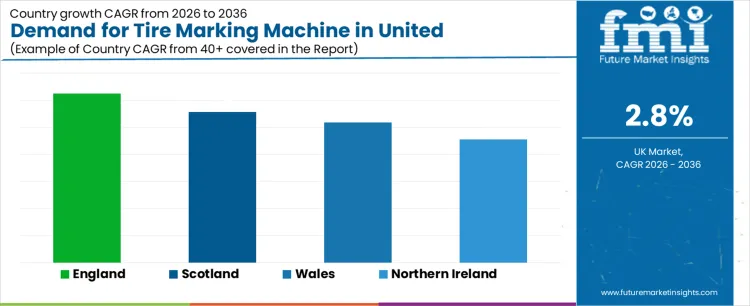
The demand for tire marking machines in the United Kingdom varies across regions, with England leading the industry. The demand is driven by England’s large automotive manufacturing sector, including tire production, where tire marking machines are essential for labeling and identifying tires during production. Scotland, Wales, and Northern Ireland follow with steady demand, supported by their respective automotive, manufacturing, and logistics industries. As regulations on tire traceability and product identification increase, the need for efficient marking solutions is expected to rise across all regions. While England remains the largest market, steady growth in the adoption of tire marking machines is anticipated across Scotland, Wales, and Northern Ireland due to expanding industrial and regulatory requirements.
| Country | CAGR (2026 to 2036) |
|---|---|
| England | 3.1% |
| Scotland | 2.8% |
| Wales | 2.6% |
| Northern Ireland | 2.3% |
What is Driving the Demand for Tire Marking Machines in England?
The demand for tire marking machines in England is projected to grow at a CAGR of 3.1% from 2026 to 2036. England’s dominant automotive and tire manufacturing industries are key drivers of this demand. Tire marking machines are essential for labeling products with critical information such as tire type, specifications, and traceability codes, helping manufacturers comply with safety and regulatory standards. As consumer demand for high-quality, compliant tires increases, especially with the rise of electric vehicles (EVs), the need for precise and efficient tire marking solutions is growing. England’s strong automotive infrastructure, along with its focus on innovation and automation, continues to drive the demand for tire marking systems. Additionally, the ongoing regulatory emphasis on product traceability and consumer safety ensures that tire manufacturers will rely on advanced marking technologies.
How is the Demand for Tire Marking Machines Performing in Scotland?
In Scotland, the demand for tire marking machines is expected to grow at a CAGR of 2.8% from 2026 to 2036. The key drivers of this demand are the growing automotive manufacturing sector and tire production in Scotland. As Scottish manufacturers increasingly focus on high-quality production and traceability, tire marking machines are becoming more essential for ensuring compliance with industry regulations. The rise in electric vehicle production and the growing demand for tires that meet stricter environmental and safety standards are further contributing to the demand for these machines. Scotland’s automotive sector continues to innovate, adopting more efficient production processes, which further supports the adoption of advanced tire marking technology. The continued expansion of manufacturing capabilities and the increasing emphasis on quality control are expected to drive steady growth in the tire marking machine market in Scotland.
What Are the Growth Drivers for Tire Marking Machines in Wales?
The demand for tire marking machines in Wales is projected to grow at a CAGR of 2.6% through 2036. The main drivers for this growth are the automotive and manufacturing sectors in Wales, where tire production is increasingly relying on automated marking systems to ensure precision and compliance with safety regulations. As the automotive sector in Wales continues to expand, particularly with an increased focus on electric vehicle manufacturing, the need for tire marking machines that can handle large-scale production efficiently is growing. The growing emphasis on traceability, safety, and environmental compliance in tire manufacturing is also contributing to this demand. Furthermore, Wales’ focus on innovation in manufacturing processes and its push for sustainability in production will continue to drive the need for advanced tire marking technologies.
What is the Outlook for Tire Marking Machines Demand in Northern Ireland?
Northern Ireland’s demand for tire marking machines is expected to grow at a CAGR of 2.3% from 2026 to 2036. Although Northern Ireland represents the smallest market for tire marking machines in the United Kingdom, steady growth is expected as the automotive and manufacturing sectors continue to expand. The increasing need for efficient tire production, coupled with tightening regulations on tire safety and traceability, is driving the adoption of tire marking machines. As Northern Ireland’s automotive industry grows and embraces more advanced manufacturing processes, the demand for automated and high-precision tire marking systems is expected to increase. Additionally, the push for higher quality standards and the rising trend toward electric vehicles will further contribute to the steady demand for tire marking technology in Northern Ireland.
What is the Competitive Landscape of Tire Marking Machines in the United Kingdom?
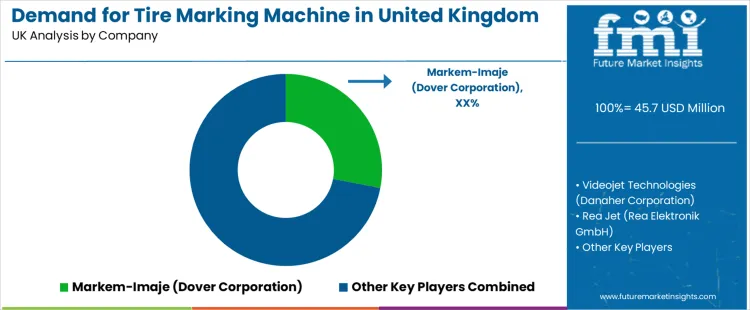
Demand for tire marking machines in the United Kingdom is shaped by quality control protocols, traceability requirements, and production throughput needs within tire manufacturing and retreading operations. Specification documents and product brochures supplied by equipment manufacturers are used to compare documented marking accuracy, supported marking speeds, and compatibility with tire materials. Markem Imaje (Dover Corporation) holds a leading position with systems documented for high resolution coding on curved surfaces and durable inks that resist abrasion. Technical literature outlines machine cycle times, supported interfaces with production line controls, and recommended maintenance intervals. These details assist production planners and purchasing teams when evaluating capital equipment against defined throughput targets and line automation frameworks. Videojet Technologies (Danaher Corporation) provides tire marking equipment documented for flexibility across tire sizes and for integration with existing vision systems. Specification sheets from Videojet list recorded marking speeds, supported communication protocols, and ink chemistries that meet wash resistance standards used in UK automotive manufacturing.
Rea Jet (Rea Elektronik GmbH) competes with marking systems that are accompanied by detailed documentation on drop on demand technology and laser coding options. Buyers refer to these brochures when matching machine performance to tire compound types and environmental operating conditions. Koenig & Bauer Coding GmbH supplies automated coding solutions with documented system parameters that cover print resolution, ribbon consumption rates, and service support metrics. Procurement professionals examine these documented performance metrics to ensure selected equipment aligns with production quality standards and service coverage plans. Domino Printing Sciences (Brother Industries) provides marking machines documented for modular deployment and ease of integration with line control systems. Brochures include documented reliability data, documented service response times, and documented consumable specifications. In the United Kingdom, procurement cycles involve side by side comparisons of documented performance values, documented life cycle cost projections, and documented spare parts availability. Buyers place emphasis on documented uptime records and documented maintenance support to reduce production bottlenecks. Production engineers review specification details to ensure that marking solutions will meet evolving product tracking requirements and regulatory compliance frameworks. Competitive activity in this market segment reflects a focus on measurable performance, documented technical support, and documented supply terms, enabling manufacturers and suppliers to align selections with operational targets.
Key Players of the Demand for Tire Marking Machine in United Kingdom
- Markem-Imaje (Dover Corporation)
- Videojet Technologies (Danaher Corporation)
- Rea Jet (Rea Elektronik GmbH)
- Koenig & Bauer Coding GmbH
- Domino Printing Sciences (Brother Industries)
Scope of the Report
| Items | Values |
|---|---|
| Quantitative Units (2026) | USD Million |
| Machine Type | Inkjet, Laser, Stamping, Paint Marking |
| Marking Type | Permanent, Temporary |
| Companies | Markem-Imaje (Dover Corporation), Videojet Technologies (Danaher Corporation), Rea Jet (Rea Elektronik GmbH), Koenig & Bauer Coding GmbH, Domino Printing Sciences (Brother Industries) |
| Regions Covered | United Kingdom |
| Countries Covered | England, Scotland, Wales, Northern Ireland |
| Additional Attributes | Dollar by sales by machine type, marking type, and region. Includes market trends towards efficiency, automation, and the role of tire marking machines in enhancing production processes across industries. |
Key Segments of Demand for Tire Marking Machine in United Kingdom
Machine Type:
- Inkjet
- Laser
- Stamping
- Paint Marking
Marking Type:
- Permanent
- Temporary
Countries:
- England
- Scotland
- Wales
- Northern Ireland
Bibliography
- Department for Business and Trade. (2024). Advanced manufacturing plan: Automotive production and automation. UK Government.
- Department for Transport. (2024). Vehicle type-approval, safety compliance, and component traceability. UK Government.
- International Organization for Standardization. (2024). ISO 9001: Quality management systems—Requirements. ISO.
- International Organization for Standardization. (2024). ISO 14001: Environmental management systems—Requirements. ISO.
- Organisation for Economic Co-operation and Development. (2024). Automation, traceability systems, and productivity in automotive manufacturing. OECD Publishing.
Frequently Asked Questions
How big is the demand for tire marking machine in united kingdom in 2026?
The demand for tire marking machine in united kingdom is estimated to be valued at USD 45.7 million in 2026.
What will be the size of tire marking machine in united kingdom in 2036?
The market size for the tire marking machine in united kingdom is projected to reach USD 60.5 million by 2036.
How much will be the demand for tire marking machine in united kingdom growth between 2026 and 2036?
The demand for tire marking machine in united kingdom is expected to grow at a 2.8% CAGR between 2026 and 2036.
What are the key product types in the tire marking machine in united kingdom?
The key product types in tire marking machine in united kingdom are inkjet, laser, stamping and paint marking.
Which marking type segment is expected to contribute significant share in the tire marking machine in united kingdom in 2026?
In terms of marking type, permanent segment is expected to command 65.0% share in the tire marking machine in united kingdom in 2026.
Preview the report firsthand - request a free sample
Get SampleGet the brochure for pricing and purchase details.
Get PDFTable of Content
- Executive Summary
- UK Market Outlook
- Demand-side Trends
- Supply-side Trends
- Technology Roadmap Analysis
- Analysis and Recommendations
- Market Overview
- Market Coverage / Taxonomy
- Market Definition / Scope / Limitations
- Market Background
- Market Dynamics
- Drivers
- Restraints
- Opportunity
- Trends
- Scenario Forecast
- Demand in Optimistic Scenario
- Demand in Likely Scenario
- Demand in Conservative Scenario
- Opportunity Map Analysis
- Product Life Cycle Analysis
- Supply Chain Analysis
- Investment Feasibility Matrix
- Value Chain Analysis
- PESTLE and Porter’s Analysis
- Regulatory Landscape
- Regional Parent Market Outlook
- Production and Consumption Statistics
- Import and Export Statistics
- Market Dynamics
- UK Market Analysis 2021 to 2025 and Forecast, 2026 to 2036
- Historical Market Size Value (USD Million) Analysis, 2021 to 2025
- Current and Future Market Size Value (USD Million) Projections, 2026 to 2036
- Y-o-Y Growth Trend Analysis
- Absolute $ Opportunity Analysis
- UK Market Pricing Analysis 2021 to 2025 and Forecast 2026 to 2036
- UK Market Analysis 2021 to 2025 and Forecast 2026 to 2036, By Machine Type
- Introduction / Key Findings
- Historical Market Size Value (USD Million) Analysis By Machine Type , 2021 to 2025
- Current and Future Market Size Value (USD Million) Analysis and Forecast By Machine Type , 2026 to 2036
- Inkjet
- Laser
- Stamping
- Paint Marking
- Inkjet
- Y-o-Y Growth Trend Analysis By Machine Type , 2021 to 2025
- Absolute $ Opportunity Analysis By Machine Type , 2026 to 2036
- UK Market Analysis 2021 to 2025 and Forecast 2026 to 2036, By Marking Type
- Introduction / Key Findings
- Historical Market Size Value (USD Million) Analysis By Marking Type, 2021 to 2025
- Current and Future Market Size Value (USD Million) Analysis and Forecast By Marking Type, 2026 to 2036
- Permanent
- Temporary
- Permanent
- Y-o-Y Growth Trend Analysis By Marking Type, 2021 to 2025
- Absolute $ Opportunity Analysis By Marking Type, 2026 to 2036
- Market Structure Analysis
- Competition Dashboard
- Competition Benchmarking
- Market Share Analysis of Top Players
- By Regional
- By Machine Type
- By Marking Type
- Competition Analysis
- Competition Deep Dive
- Markem-Imaje (Dover Corporation)
- Overview
- Product Portfolio
- Profitability by Market Segments (Product/Age /Sales Channel/Region)
- Sales Footprint
- Strategy Overview
- Marketing Strategy
- Product Strategy
- Channel Strategy
- Videojet Technologies (Danaher Corporation)
- Rea Jet (Rea Elektronik GmbH)
- Koenig & Bauer Coding GmbH
- Domino Printing Sciences (Brother Industries)
- Markem-Imaje (Dover Corporation)
- Competition Deep Dive
- Assumptions & Acronyms Used
- Research Methodology


