

- Market Size (2026)
- USD 5.61 Mn
- Forecast (2036)
- USD 6.28 Mn
- CAGR (2026 to 2036)
- 1.1%
How big is the Dextromethorphan Hydrobromide Market in 2026?
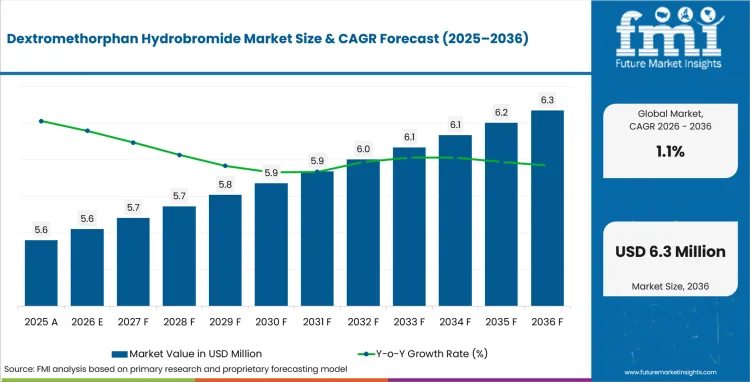
USD 5.61 million in 2026 and USD 6.28 million by 2036 at a 1.1% CAGR.
The dextromethorphan hydrobromide industry value is likely to expand from USD 5.56 million in 2025 to USD 6.28 million by 2036 at 1.1% CAGR due to cough-product manufacturers protecting qualified active ingredient supply. Finished-dose manufacturers are projected to secure 68.0% share in 2026, driven by batch records and pharmacopoeial supplier files. Cough Suppressant is expected to hold 64.0% share in 2026, influenced by established antitussive use.
API sourcing is moving toward regulated manufacturing geography and traceable channel selection. DailyMed updated a guaifenesin and dextromethorphan hydrobromide label in November 2025 showing 600 mg/30 mg and 1,200 mg/60 mg extended-release strengths. FDA stated in October 2025 that only 9% of API manufacturers were located in the United States, against 22% in China and 44% in India. Eurostat reported EU medicinal and pharmaceutical exports of EUR 366.2 billion and imports of EUR 145.7 billion in 2025, showing the scale of documented medicine trade.
| Metric | Value |
|---|---|
| 2026 Market Size | USD 5.61 million |
| 2036 Market Size | USD 6.28 million |
| Forecast CAGR (2026-2036) | 1.1% |
| Leading Buyer Type | Finished-Dose Manufacturers |
| Finished-Dose Manufacturers Share (2026) | 68.0% |
| Leading Application | Cough Suppressant |
| Cough Suppressant Share (2026) | 64.0% |
| Fastest-growing Country | China |
| China CAGR by 2036 | 1.35% |
Summary of the Dextromethorphan Hydrobromide Market
| Market Signal | Commercial Impact |
|---|---|
| Demand and Growth Drivers | Demand for dextromethorphan hydrobromide is expected to expand steadily through 2036, supported by continued production of cough medicines and increasing emphasis on documented API sourcing.
|
| Product and Segment View | Finished-dose manufacturers, cough suppressant applications, and powder formulations continue to lead their respective market segments.
|
| Geography and Growth Outlook | Asia continues to support market growth through pharmaceutical manufacturing capacity and regulated API supply.
|
| Competitive Landscape | Competition increasingly focuses on manufacturing quality, regulatory compliance, and documented pharmaceutical distribution.
|
| Analyst Perspective | Dextromethorphan hydrobromide remains a compliance-driven API market where documentation quality, pharmacopoeial alignment, and supply reliability outweigh price-based competition.
- Anurag Sharma, Principal Consultant for Healthcare at Future Market Insights |
Which factors support expansion in the Dextromethorphan Hydrobromide Market?
Finished-dose continuity and regulated API documentation support market value across cough suppressant supply chains.
- Cough-product producers need qualified API sources to protect finished-dose labels and avoid supplier-change delays.
- Powder grades support adoption as formulators can use one workable API format across tablets and combination products.
- Higher-purity grades influence buying as pharmacopoeial alignment lowers release-test friction across commercial files.
- Direct supply supports accounts needing certificates and destination-market paperwork.
Why is the Dextromethorphan Hydrobromide Market growing?
Repeat cough-product manufacturing increases API demand as seasonal respiratory-care activity sustains finished-dose production.
Dextromethorphan hydrobromide suppliers gain from repeat cough-product lines and current respiratory medicine use. CDC estimated 51 million flu-related illnesses, 23 million medical visits, 710,000 hospitalizations, and 45,000 deaths during the 2024 to 2025 United States flu season. Cough-product producers need qualified API supply to maintain finished-dose continuity during seasonal illness cycles.
How is the Dextromethorphan Hydrobromide Market segmented?
Dextromethorphan Hydrobromide Market is segmented by form, purity grade, application, sales channel, and buyer type.
- Powder is projected to account for 62.0% share in 2026, influenced by flexible formulation use across syrups and combination cold products.
- 99.5% and above is expected to hold 58.0% share in 2026, shaped by pharmacopoeial alignment and release-test confidence.
- Cough suppressant is anticipated to account for 64.0% share in 2026, led by established antitussive use across single-action cough products.
- Direct supply is projected to hold 45.0% share in 2026, guided by documentation needs and source qualification.
- Finished-dose manufacturers are expected to represent 68.0% share in 2026, supported by commercial batch continuity and supplier-file control.
Why does powder dominate the Dextromethorphan Hydrobromide Market by form?
- Powder is projected to account for 62.0% share in 2026, driven by formulation flexibility across tablets and combination cold products.
- Crystalline material gains demand in files requiring particle control and customer-specific processing evidence.
Which purity grade leads the Dextromethorphan Hydrobromide Market?
- 99.5% and above is expected to hold 58.0% share in 2026, shaped by buyer preference for clean assay records and pharmacopoeial alignment.
- 98.0% to 99.5% material remains active in controlled smaller orders and accepted customer-specific files.
Which application leads the Dextromethorphan Hydrobromide Market?
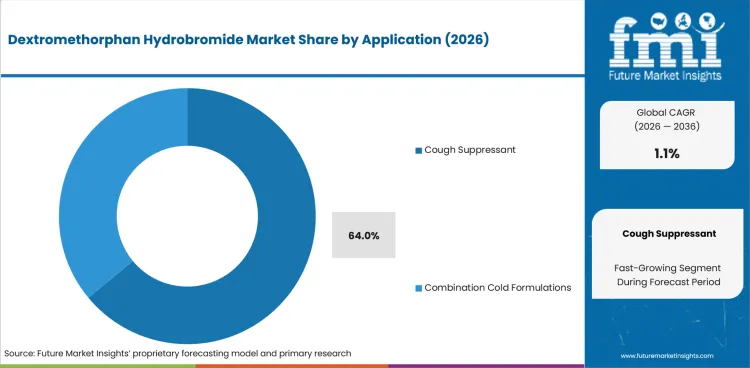
- Cough suppressant is anticipated to account for 64.0% share in 2026, led by single-action antitussive finished products and routine cough labels.
- Combination cold formulations create added demand as formulators pair dextromethorphan hydrobromide alongside expectorants or decongestants.
Which sales channel leads the Dextromethorphan Hydrobromide Market?
- Direct Supply is expected to represent 45.0% share in 2026, guided by buyer preference for source files and audit-ready documents.
- Distributors remain active across smaller orders and buyers needing faster documented access.
Which buyer type leads the Dextromethorphan Hydrobromide Market?
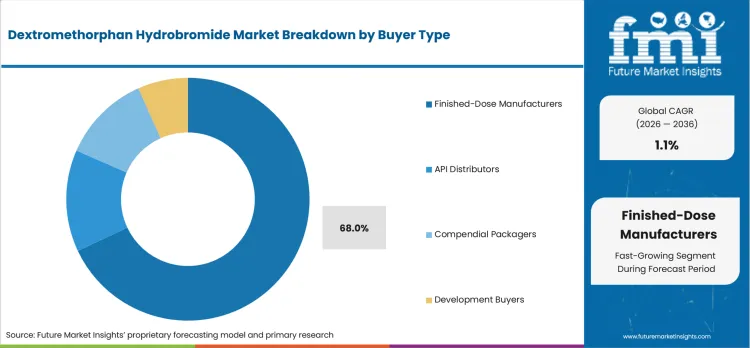
- Finished-dose manufacturers are projected to hold 68.0% share in 2026, supported by repeat production of cough suppressant and combination cold products.
- API distributors and compendial packagers retain value as smaller buyers need documented lots without full factory onboarding.
What are the drivers, restraints, and opportunities in the Dextromethorphan Hydrobromide Market?
Industrial API continuity and channel control are shaping dextromethorphan hydrobromide sourcing decisions.
- Driver: Finished-dose cough products require qualified API supply before routine line continuity can be protected.
- Restraint: Misuse monitoring can narrow open-channel access and reduce weak online marketplace activity.
- Opportunity: Documentation-ready suppliers can gain repeat accounts as buyers request pharmacopoeial files and traceable order paths.
Cough-Product Label Continuity Strengthens API Demand
Current cough labels create a clear reason for dextromethorphan hydrobromide sourcing. DailyMed updated a dextromethorphan HBr softgel label in September 2025 showing 15 mg active ingredient per softgel. Such label continuity supports API purchasing for single-action antitussive products.
Controlled-Sale Rules Limit Weak Channels
Misuse controls can reduce weaker ordering routes for dextromethorphan hydrobromide. Legitimate API demand stays active through verified buyers, reinforced by China’s 2024 control action requiring 2-year prescription retention and no sales to minors. Supplier qualification therefore shifts toward customer screening and compliant order records.
Export Documentation Creates Supplier Opportunity
Export-facing API documentation creates a stronger opening for qualified manufacturers. India’s pharmaceutical exports reached USD 30.5 billion in 2024-25, and exports went to 191 countries. Dextromethorphan hydrobromide suppliers can convert buyer interest into repeat orders through pharmacopoeial grades and written confirmations.
Which countries are growing in the Dextromethorphan Hydrobromide Market?
China 1.35% CAGR, India 1.28% CAGR, United States 1.05% CAGR, Germany 0.92% CAGR, France 0.85% CAGR, United Kingdom 0.78% CAGR, Japan 0.62% CAGR, and South Korea 0.58% CAGR through 2036.
| Country | CAGR |
|---|---|
| China | 1.35% |
| India | 1.28% |
| United States | 1.05% |
| Germany | 0.92% |
| France | 0.85% |
| United Kingdom | 0.78% |
| Japan | 0.62% |
| South Korea | 0.58% |
Source: Future Market Insights, 2026.
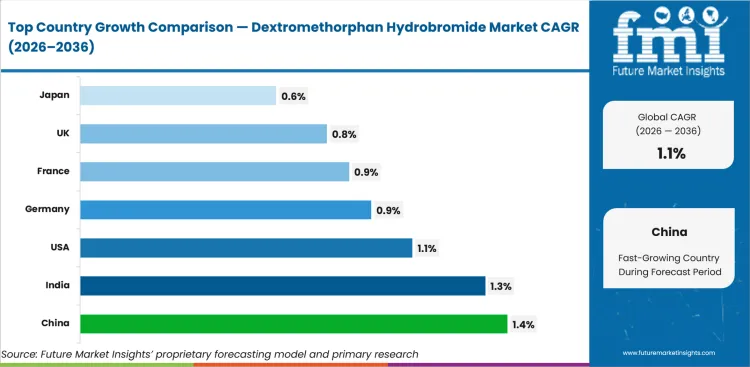
How do country-level CAGRs compare in the Dextromethorphan Hydrobromide Market?
China leads country expansion, and South Korea records the most cautious pace among profiled countries.
- China is forecast to record 1.35% CAGR by 2036 due to controlled-channel formalization and API manufacturing scale.
- India is expected to expand at 1.28% CAGR from 2026 to 2036, led by written confirmations and export-facing API documents.
- United States is estimated to rise at 1.05% CAGR by 2036, reflected by established cough labels and distributor depth.
- Germany is expected to advance at 0.92% CAGR over the forecast period as pharmacopoeial discipline supports documented buying.
- France is forecast to grow at 0.85% CAGR by 2036, backed by pharmacy-channel control and public medicine records.
- United Kingdom is projected to post 0.78% CAGR by 2036, guided by quality recall sensitivity and BP-grade sourcing.
- Japan is forecast to grow at 0.62% CAGR by 2036, supported by master-file discipline and strict quality expectations.
- South Korea is expected to record 0.58% CAGR by 2036, driven by post-approval change control and MFDS documentation needs.
How fast is the Dextromethorphan Hydrobromide Market growing in China?
A 1.35% CAGR through 2036 reflects controlled-channel formalization and API manufacturing scale.
Country Market Snapshot Table
| Parameter | Value |
|---|---|
| Market Size in 2025 (Value) | USD 0.77 million |
| Market Size in 2026 (Value) | USD 0.78 million |
| Market Forecast in 2036 (Value) | USD 0.89 million |
| CAGR (2026 to 2036) | 1.35% |
| Years Considered | 2021 to 2036 |
| Base Year | 2025 |
| Forecast Period | 2026 to 2036 |
| Units Considered | Value (USD million) |
| Leading Sub-Region | Jiangsu, Zhejiang, Shandong, and Guangdong pharmaceutical corridors |
China Dextromethorphan Hydrobromide Market Outlook
China dextromethorphan hydrobromide demand reflects controlled antitussive access and active API manufacturing networks. Finished-dose companies need suppliers able to verify product destination and compliant movement through prescription-led channels.
Qualified sellers are expected to gain preference through customer screening and stable quality files. Domestic API producers benefit from chemical manufacturing depth, and digital drug-channel supervision keeps weak online routes under tighter review.
Key Growth Drivers
- Controlled prescription handling supports legitimate API demand, reflected by the 2024 national action moving dextromethorphan into Category II psychotropic drug control.
- Chemical manufacturing depth supports API availability, with China’s 2025 raw chemical materials and chemical products value addition rising 7.8% year on year.
- Finished-dose producers need local supply relationships that can support customer verification and batch documentation.
- Domestic distributors gain scope as prescription-led product movement requires stronger traceability and account screening.
Key Restraints
- Psychotropic-drug classification can reduce casual demand as single-agent finished products face closer access control.
- Online drug sellers face strict recordkeeping, and third-party platforms must keep drug transaction records for at least 5 years.
- Smaller distributors can lose orders if customer screening and product-destination evidence remain incomplete.
What makes China unique
China combines controlled chemical manufacturing depth and national online-drug supervision in one sourcing base.
Key Companies
- CSPC Pharmaceutical Group
- Northeast Pharmaceutical Group
- Hubei Gedian Humanwell Pharmaceutical
- Sinopharm Chemical Reagent
- China National Pharmaceutical Foreign Trade
- Zhejiang Medicine
- Shanghai Pharma
- Zhejiang Huahai Pharmaceutical
Sales & Marketing Channels
- Direct API supply to qualified finished-dose firms
- Licensed pharmaceutical distributor networks
- Hospital and pharmacy prescription channels
- Online pharmacy platforms under controlled access rules
- Export distributor relationships
- Regulatory documentation-led sourcing programs
Country Segment Breakdown Table
| Segment | Sub-Segments |
|---|---|
| By Form | Powder · Crystalline |
| By Purity Grade | 99.5% and Above · 98.0% to 99.5% · Below 98% |
| By Application | Cough Suppressant · Combination Cold Formulations |
| By Sales Channel | Direct Supply · Distributors · Online/API Marketplaces |
| By Buyer Type | Finished-Dose Manufacturers · API Distributors · Compendial Packagers · Development Buyers |
| Key Sub-Regions Covered, Pharmaceutical Corridors | Jiangsu · Zhejiang · Shandong · Guangdong · Shanghai · Hubei |
Frequently Asked Questions
How fast is China Dextromethorphan Hydrobromide Market growing?
China is expected to record 1.35% CAGR as controlled prescription access gives qualified API suppliers a clearer channel role.
Who leads China Dextromethorphan Hydrobromide Market?
CSPC Pharmaceutical Group, Sinopharm Chemical Reagent, and Zhejiang Medicine hold local relevance across regulated supply channels.
What is driving adoption in China Dextromethorphan Hydrobromide Market?
Prescription-channel formalization is pushing buyers toward suppliers that can document destination and customer legitimacy.
What is the Dextromethorphan Hydrobromide Market outlook in India?
A 1.28% CAGR through 2036 reflects written confirmations and export-facing API documentation.
Country Market Snapshot Table
| Parameter | Value |
|---|---|
| Market Size in 2025 (Value) | USD 0.57 million |
| Market Size in 2026 (Value) | USD 0.58 million |
| Market Forecast in 2036 (Value) | USD 0.66 million |
| CAGR (2026 to 2036) | 1.28% |
| Years Considered | 2021 to 2036 |
| Base Year | 2025 |
| Forecast Period | 2026 to 2036 |
| Units Considered | Value (USD million) |
| Leading Sub-Region | Hyderabad, Gujarat, Chennai, and Maharashtra API corridors |
India Dextromethorphan Hydrobromide Market Outlook
India dextromethorphan hydrobromide demand benefits from API manufacturing evidence and export documentation. Finished-dose buyers assess Indian suppliers through pharmacopoeial grade coverage and packing controls.
Suppliers are expected to compete through audit readiness and destination-market paperwork. Indian manufacturers that support USP and JP expectations can protect repeat accounts among regulated buyers.
Key Growth Drivers
- Export-facing API systems support buyer confidence, led by pharmaceutical exports reaching ₹245,962 crore in FY2024-25.
- Global acceptance strengthens supplier qualification, influenced by Indian pharmaceutical exports reaching 191 countries in 2024-25.
- CDSCO written confirmations help API suppliers support European import expectations and buyer audits.
- Pharmacopoeial grade coverage helps local manufacturers serve USP and JP customer files.
Key Restraints
- Supplier qualification can take longer as buyers review impurity records and packing controls.
- International buyers may spread sourcing across countries to manage single-origin supply exposure.
- Import dependence remains a constraint after pharmaceutical imports reached ₹63,573 crore in FY2024-25.
What makes India unique
India’s value comes from export-facing API plants and multi-pharmacopoeial documentation strength.
Key Companies
- Malladi Drugs & Pharmaceuticals
- Supriya Lifescience
- Virupaksha Organics
- Exemed Pharmaceuticals
- Solara Active Pharma Sciences
- Aarti Drugs
- Tyche Industries
- Anmol Chemicals
Sales & Marketing Channels
- Direct manufacturer supply to formulation companies
- Export distributor networks
- Regulated-market documentation sales
- Compendial grade distributor partnerships
- Long-term API supply agreements
- Audit-supported buyer qualification programs
Country Segment Breakdown Table
| Segment | Sub-Segments |
|---|---|
| By Form | Powder · Crystalline |
| By Purity Grade | 99.5% and Above · 98.0% to 99.5% · Below 98% |
| By Application | Cough Suppressant · Combination Cold Formulations |
| By Sales Channel | Direct Supply · Distributors · Online/API Marketplaces |
| By Buyer Type | Finished-Dose Manufacturers · API Distributors · Compendial Packagers · Development Buyers |
| Key Sub-Regions Covered, Pharmaceutical Corridors | Hyderabad · Gujarat · Chennai · Mumbai · Pune · Visakhapatnam |
Frequently Asked Questions
How fast is India Dextromethorphan Hydrobromide Market growing?
India is likely to record 1.28% CAGR, driven by written-confirmation depth supports regulated API sourcing.
Who leads India Dextromethorphan Hydrobromide Market?
Malladi Drugs, Supriya Lifescience, Virupaksha Organics, and Exemed lead local API manufacturing relevance.
What is driving adoption in India Dextromethorphan Hydrobromide Market?
Regulated export channels are favoring suppliers that can present compendial evidence and packing records.
How is the Dextromethorphan Hydrobromide Market performing in the United States?
A 1.05% CAGR through 2036 reflects established cough labels and regulated distributor depth.
Country Market Snapshot Table
| Parameter | Value |
|---|---|
| Market Size in 2025 (Value) | USD 1.05 million |
| Market Size in 2026 (Value) | USD 1.06 million |
| Market Forecast in 2036 (Value) | USD 1.18 million |
| CAGR (2026 to 2036) | 1.05% |
| Years Considered | 2021 to 2036 |
| Base Year | 2025 |
| Forecast Period | 2026 to 2036 |
| Units Considered | Value (USD million) |
| Leading Sub-Region | New Jersey, Pennsylvania, New York, and California pharmaceutical corridors |
United States Dextromethorphan Hydrobromide Market Outlook
United States demand is supported by current cough labels, compendial packagers, and regulated distributor relationships. Finished-dose companies need API partners that can support FDA-facing records and controlled supplier changes.
Distributor access remains important for development lots and smaller documented orders. Commercial buyers assess suppliers through certificates, source transparency, impurity evidence, and customer support speed.
Key Growth Drivers
- Current product labels support API pull-through, showed by DailyMed listing 30 mg and 60 mg dextromethorphan hydrobromide strengths in extended-release tablets.
- Seasonal respiratory-care activity supports continuity, as CDC estimated 51 million flu illnesses during the 2024 to 2025 season.
- Compendial packagers serve buyers needing USP-grade material in documented smaller lots.
- FDA-facing cGMP expectations keep supplier qualification focused on release controls and finished-product quality.
Key Restraints
- Established cough-product channels limit major API volume additions as most demand follows product maintenance.
- Offshore API exposure raises sourcing risk since FDA stated only 9% of API manufacturers were located in the United States in 2025.
- Misuse sensitivity around single-agent dextromethorphan can constrain casual retail and online ordering.
What makes the United States unique
United States demand is distinguished by FDA-facing quality expectations and compendial distributor depth.
Key Companies
- LGM Pharma
- Rochem International
- Spectrum Chemical
- Pharm-RX Chemical
- Actylis
- Letco Medical
- PCCA
- Medisca
Sales & Marketing Channels
- Direct API supply to finished-dose firms
- Compendial pack distribution
- Qualified chemical distributor networks
- Contract manufacturing buyer channels
- Development-lot supply programs
- Regulatory documentation-led qualification
Country Segment Breakdown Table
| Segment | Sub-Segments |
|---|---|
| By Form | Powder · Crystalline |
| By Purity Grade | 99.5% and Above · 98.0% to 99.5% · Below 98% |
| By Application | Cough Suppressant · Combination Cold Formulations |
| By Sales Channel | Direct Supply · Distributors · Online/API Marketplaces |
| By Buyer Type | Finished-Dose Manufacturers · API Distributors · Compendial Packagers · Development Buyers |
| Key Sub-Regions Covered, Pharmaceutical Corridors | New Jersey · Pennsylvania · New York · California · North Carolina · Texas |
Frequently Asked Questions
How fast is United States Dextromethorphan Hydrobromide Market growing?
United States demand is estimated to rise at 1.05% CAGR, led by current cough labels sustain qualified API pull-through.
Who leads United States Dextromethorphan Hydrobromide Market?
LGM Pharma, Rochem International, Spectrum Chemical, and Actylis lead local access based on distributor and compendial channels.
What is driving adoption in United States Dextromethorphan Hydrobromide Market?
FDA-facing documentation needs are moving buyers toward suppliers that can support cGMP files and source transparency.
What is the Dextromethorphan Hydrobromide Market forecast for Germany?
A 0.92% CAGR through 2036 reflects pharmacopoeial discipline and documented buyer expectations.
Country Market Snapshot Table
| Parameter | Value |
|---|---|
| Market Size in 2025 (Value) | USD 0.41 million |
| Market Size in 2026 (Value) | USD 0.41 million |
| Market Forecast in 2036 (Value) | USD 0.45 million |
| CAGR (2026 to 2036) | 0.92% |
| Years Considered | 2021 to 2036 |
| Base Year | 2025 |
| Forecast Period | 2026 to 2036 |
| Units Considered | Value (USD million) |
| Leading Sub-Region | North Rhine-Westphalia, Hesse, Bavaria, and Baden-Wurttemberg pharmaceutical corridors |
Germany Dextromethorphan Hydrobromide Market Outlook
Germany demand is guided by pharmacopoeial discipline and strict medicine quality culture. Buyers assess dextromethorphan hydrobromide through impurity profiles and supplier-change risk.
Local compounding suppliers and pharmaceutical distributors support smaller documented lots. Finished-dose companies continue to favor reliable grade coverage and fast technical response.
Key Growth Drivers
- European regulatory activity supports documented medicine channels. EMA recommended 104 human medicines for marketing authorization in 2025.
- EU pharmaceutical trade supports distributor activity, reflected by EUR 366.2 billion in medicinal and pharmaceutical exports in 2025.
- German buyers value BP and USP evidence for destination-specific finished-dose files.
- Local specialty suppliers can support compendial access and smaller pack requirements.
Key Restraints
- High qualification standards can slow onboarding if impurity records or batch histories lack depth.
- Manufacturing budget caution can delay supplier changes and optional inventory expansion.
- Weak macro conditions can limit stock-building appetite after Germany’s GDP rose 0.2% in 2025.
What makes Germany unique
Germany’s sourcing profile reflects specialty distributor scrutiny and strict supplier-change control.
Key Companies
- Caesar & Loretz
- Fagron Germany
- Merck KGaA
- Caelo
- Euro OTC Pharma
- Aenova Group
- Wörwag Pharma
- Klinge Pharma
Sales & Marketing Channels
- Direct API supply to finished-dose manufacturers
- Pharmaceutical wholesale distribution
- Compounding and laboratory distributor access
- Regulated OTC manufacturer channels
- Technical documentation-based selling
- Qualified packager partnerships
Country Segment Breakdown Table
| Segment | Sub-Segments |
|---|---|
| By Form | Powder · Crystalline |
| By Purity Grade | 99.5% and Above · 98.0% to 99.5% · Below 98% |
| By Application | Cough Suppressant · Combination Cold Formulations |
| By Sales Channel | Direct Supply · Distributors · Online/API Marketplaces |
| By Buyer Type | Finished-Dose Manufacturers · API Distributors · Compendial Packagers · Development Buyers |
| Key Sub-Regions Covered, Pharmaceutical Corridors | North Rhine-Westphalia · Hesse · Bavaria · Baden-Wurttemberg · Hamburg · Berlin |
Frequently Asked Questions
How fast is Germany Dextromethorphan Hydrobromide Market growing?
Germany is set to expand at 0.92% CAGR since compendial discipline keeps supplier qualification selective.
Who leads Germany Dextromethorphan Hydrobromide Market?
Caesar & Loretz, Fagron Germany, Merck KGaA, and Caelo lead local access across documented supply channels.
What is driving adoption in Germany Dextromethorphan Hydrobromide Market?
Pharmacopoeial alignment is encouraging buyers to retain suppliers that can defend release testing and batch traceability.
What is driving Dextromethorphan Hydrobromide Market growth in France?
A 0.85% CAGR through 2036 reflects pharmacy-channel control and finished-product continuity.
Country Market Snapshot Table
| Parameter | Value |
|---|---|
| Market Size in 2025 (Value) | USD 0.32 million |
| Market Size in 2026 (Value) | USD 0.32 million |
| Market Forecast in 2036 (Value) | USD 0.35 million |
| CAGR (2026 to 2036) | 0.85% |
| Years Considered | 2021 to 2036 |
| Base Year | 2025 |
| Forecast Period | 2026 to 2036 |
| Units Considered | Value (USD million) |
| Leading Sub-Region | Ile-de-France, Auvergne-Rhone-Alpes, Normandy, and Centre-Val de Loire pharmaceutical corridors |
France Dextromethorphan Hydrobromide Market Outlook
France demand is led by regulated medicine access and pharmacy-channel discipline. API suppliers need traceable lots and evidence that supports finished-dose continuity.
Distributor and finished-dose relationships remain central to commercial access. Buyers favor compendial material that reduces release-test friction and supports clear product records.
Key Growth Drivers
- Healthcare and life-sciences activity supports medicine supply, demonstrated by France’s pharmaceutical revenue having reached EUR 73 billion in 2024.
- Export-facing capability supports finished-dose and API networks, as pharmaceutical exports were listed at EUR 41 billion in 2024.
- Pharmacy-led cough-product access favors documented sources and controlled distribution.
- Public medicine records support buyer confidence in maintained finished-product files.
Key Restraints
- Established cough-product use can limit incremental API volume additions across local channels.
- Product cost pressure can reduce inventory flexibility for smaller pharmaceutical buyers.
- Input-price pressure remains a risk, with France’s basic pharmaceutical products index reaching 122.7 in December 2025.
What makes France unique
France stands apart through public medicine records and local OTC brand supply relationships.
Key Companies
- Cooper Consumer Health
- UPSA
- Laboratoires Gilbert
- Gifrer
- Fagron France
- Delbert
- Sanofi Consumer Healthcare France
- Mayoly
Sales & Marketing Channels
- Pharmacy-led finished-product channels
- Direct supply to formulation companies
- Qualified pharmaceutical wholesalers
- Compendial distributor channels
- Contract manufacturing partnerships
- Regulated documentation-based qualification
Country Segment Breakdown Table
| Segment | Sub-Segments |
|---|---|
| By Form | Powder · Crystalline |
| By Purity Grade | 99.5% and Above · 98.0% to 99.5% · Below 98% |
| By Application | Cough Suppressant · Combination Cold Formulations |
| By Sales Channel | Direct Supply · Distributors · Online/API Marketplaces |
| By Buyer Type | Finished-Dose Manufacturers · API Distributors · Compendial Packagers · Development Buyers |
| Key Sub-Regions Covered, Pharmaceutical Corridors | Ile-de-France · Auvergne-Rhone-Alpes · Normandy · Centre-Val de Loire · Nouvelle-Aquitaine · Grand Est |
Frequently Asked Questions
How fast is France Dextromethorphan Hydrobromide Market growing?
France records 0.85% CAGR as pharmacy-channel control supports steady API purchasing.
Who leads France Dextromethorphan Hydrobromide Market?
Cooper Consumer Health, UPSA, Laboratoires Gilbert, and Fagron France lead local supplier and formulation relevance.
What is driving adoption in France Dextromethorphan Hydrobromide Market?
Finished-dose continuity and pharmacy distribution discipline are keeping buyers focused on traceable API supply.
How is the Dextromethorphan Hydrobromide Market performing in the United Kingdom?
A 0.78% CAGR through 2036 reflects quality recall sensitivity and BP-grade sourcing.
Country Market Snapshot Table
| Parameter | Value |
|---|---|
| Market Size in 2025 (Value) | USD 0.29 million |
| Market Size in 2026 (Value) | USD 0.29 million |
| Market Forecast in 2036 (Value) | USD 0.31 million |
| CAGR (2026 to 2036) | 0.78% |
| Years Considered | 2021 to 2036 |
| Base Year | 2025 |
| Forecast Period | 2026 to 2036 |
| Units Considered | Value (USD million) |
| Leading Sub-Region | North West, Midlands, London, and South East pharmaceutical corridors |
United Kingdom Dextromethorphan Hydrobromide Market Outlook
United Kingdom demand is tied to BP-grade expectations and quality recall awareness. Finished-dose buyers need source records that can support product accountability.
Supplier value depends on batch traceability and distributor reliability. Cough-product companies remain careful during source changes due to retail brand exposure.
Key Growth Drivers
- Pharmaceutical export activity supports regulated channels, led by UK pharmaceutical exports reaching GBP 24.7 billion in 2024.
- Life-sciences capability supports local medicine infrastructure, since the pharmaceutical industry contributed GBP 17.6 billion in direct GVA and 126,000 high-skilled jobs.
- BP-grade documentation supports supplier continuity for cough-product producers and pharmacy-brand packers.
- Local OTC brands need stable active ingredient files to protect shelf supply and retailer confidence.
Key Restraints
- Quality events can raise buyer caution after MHRA listed a Class 2 recall for dextromethorphan hydrobromide BP products in January 2025.
- Smaller local cough-product production can limit large API volume additions.
- Distributor qualification can take longer if source records and foreign-material controls lack detail.
What makes the United Kingdom unique
United Kingdom sourcing is marked by retail brand accountability and recall-sensitive quality checks.
Key Companies
- Bells Healthcare
- Thornton & Ross
- Rosemont Pharmaceuticals
- Martindale Pharma
- Galpharm Healthcare
- Aspire Pharma
- Ennogen Healthcare
- Alliance Healthcare UK
Sales & Marketing Channels
- Direct supply to OTC manufacturers
- Pharmacy brand manufacturer channels
- Qualified pharmaceutical wholesalers
- Compendial distributor channels
- Contract packer relationships
- Recall-response documentation programs
Country Segment Breakdown Table
| Segment | Sub-Segments |
|---|---|
| By Form | Powder · Crystalline |
| By Purity Grade | 99.5% and Above · 98.0% to 99.5% · Below 98% |
| By Application | Cough Suppressant · Combination Cold Formulations |
| By Sales Channel | Direct Supply · Distributors · Online/API Marketplaces |
| By Buyer Type | Finished-Dose Manufacturers · API Distributors · Compendial Packagers · Development Buyers |
| Key Sub-Regions Covered, Pharmaceutical Corridors | North West · Midlands · London · South East · Yorkshire · Scotland |
Frequently Asked Questions
How fast is United Kingdom Dextromethorphan Hydrobromide Market growing?
United Kingdom demand is predicted to rise at 0.78% CAGR through BP-grade sourcing and retail cough-product continuity.
Who leads United Kingdom Dextromethorphan Hydrobromide Market?
Bells Healthcare, Thornton & Ross, Rosemont Pharmaceuticals, and Galpharm Healthcare lead local product and channel relevance.
What is driving adoption in United Kingdom Dextromethorphan Hydrobromide Market?
Retail brand accountability is moving buyers toward suppliers that can support BP files and recall-ready records.
What is the Dextromethorphan Hydrobromide Market forecast for Japan?
A 0.62% CAGR through 2036 reflects master-file discipline and strict quality expectations.
Country Market Snapshot Table
| Parameter | Value |
|---|---|
| Market Size in 2025 (Value) | USD 0.27 million |
| Market Size in 2026 (Value) | USD 0.27 million |
| Market Forecast in 2036 (Value) | USD 0.29 million |
| CAGR (2026 to 2036) | 0.62% |
| Years Considered | 2021 to 2036 |
| Base Year | 2025 |
| Forecast Period | 2026 to 2036 |
| Units Considered | Value (USD million) |
| Leading Sub-Region | Tokyo, Osaka, Toyama, Shizuoka, and Aichi pharmaceutical corridors |
Japan Dextromethorphan Hydrobromide Market Outlook
Japan demand reflects conservative source qualification, and quality-first manufacturer behavior. Finished-dose producers need local partners that can defend manufacturing records and grade evidence.
API suppliers benefit from stable documentation and Japanese Pharmacopoeia expectations. Source changes remain selective as buyers protect approved product files and review timelines.
Key Growth Drivers
- Master-file review supports API transparency across Japan’s approved-product files. PMDA’s FY2024 GMP/GCTP Annual Report recorded 368 survey responses from personnel involved in GMP/GCTP operations and Master File holders, supporting stronger information disclosure for pharmaceutical quality review.
- Quality communication supports manufacturing discipline. PMDA reported 20 Orange Letters and 6 GMP Roundtable Meetings in its FY2024 annual report.
- Local pharmaceutical companies maintain cough and cold products through careful source qualification.
- Japanese buyers value local technical support for grade evidence and specification changes.
Key Restraints
- Conservative supplier-change behavior can slow new API source adoption across approved product files.
- International inspection scrutiny raises documentation pressure after a 5-day PIC/S on-site assessment was conducted at Japanese pharmaceutical manufacturing sites in March 2025.
- Premium documentation requirements can raise onboarding time for smaller foreign API suppliers.
What makes Japan unique
Japan relies on PMDA quality communication and careful source-change governance.
Key Companies
- ALPS Pharmaceutical
- Taisho Pharmaceutical
- Daiichi Sankyo Healthcare
- Shionogi Healthcare
- Kyorin Pharmaceutical
- Nichi-Iko Pharmaceutical
- Towa Pharmaceutical
- Sawai Pharmaceutical
Sales & Marketing Channels
- Direct supply to finished-dose firms
- Local API manufacturer relationships
- Master-file supported qualification
- Japanese pharmaceutical distributor channels
- Contract manufacturing partnerships
- Quality documentation-led sourcing
Country Segment Breakdown Table
| Segment | Sub-Segments |
|---|---|
| By Form | Powder · Crystalline |
| By Purity Grade | 99.5% and Above · 98.0% to 99.5% · Below 98% |
| By Application | Cough Suppressant · Combination Cold Formulations |
| By Sales Channel | Direct Supply · Distributors · Online/API Marketplaces |
| By Buyer Type | Finished-Dose Manufacturers · API Distributors · Compendial Packagers · Development Buyers |
| Key Sub-Regions Covered, Pharmaceutical Corridors | Tokyo · Osaka · Toyama · Shizuoka · Aichi · Saitama |
Frequently Asked Questions
How fast is Japan Dextromethorphan Hydrobromide Market growing?
Japan maintains 0.62% CAGR as master-file expectations keep source qualification careful and document-led.
Who leads Japan Dextromethorphan Hydrobromide Market?
ALPS Pharmaceutical, Taisho Pharmaceutical, Daiichi Sankyo Healthcare, and Shionogi Healthcare lead local relevance.
What is driving adoption in Japan Dextromethorphan Hydrobromide Market?
Master-file discipline is guiding buyers toward API sources that can protect approved product records.
What is the Dextromethorphan Hydrobromide Market outlook in South Korea?
A 0.58% CAGR through 2036 reflects post-approval change control and MFDS documentation needs.
Country Market Snapshot Table
| Parameter | Value |
|---|---|
| Market Size in 2025 (Value) | USD 0.20 million |
| Market Size in 2026 (Value) | USD 0.20 million |
| Market Forecast in 2036 (Value) | USD 0.21 million |
| CAGR (2026 to 2036) | 0.58% |
| Years Considered | 2021 to 2036 |
| Base Year | 2025 |
| Forecast Period | 2026 to 2036 |
| Units Considered | Value (USD million) |
| Leading Sub-Region | Seoul, Gyeonggi, Incheon, Daejeon, and Chungbuk pharmaceutical corridors |
South Korea Dextromethorphan Hydrobromide Market Outlook
Industry in South Korea reflects post-approval manufacturing controls and disciplined source maintenance. Local buyers assess dextromethorphan hydrobromide through approved files and process-change evidence.
Domestic pharmaceutical firms keep sourcing conservative for cough and cold products. API suppliers must support MFDS-facing records and timely documentation during post-approval changes.
Key Growth Drivers
- Approval-cycle reform supports product-file planning, justified by MFDS announcing a 240-day target for new drugs and innovative medical devices.
- Post-approval manufacturing control supports documentation demand, showed by MFDS’s English change-management guideline recording 9,031 hits.
- Domestic pharmaceutical firms maintain cough and cold products through controlled supply and quality files.
- Regulated distributors can support documented small-lot access for formulation and product-maintenance needs.
Key Restraints
- Strict post-approval change controls can delay supplier switching and finished-dose file updates.
- Limited incremental cough-product expansion keeps API order volumes restrained.
- MFDS requires drug-substance dossiers covering 8 data groups, increasing documentation work for source changes.
What makes South unique
South Korea’s sourcing profile centers on MFDS change control and dossier-level documentation discipline.
Key Companies
- Yuhan Corporation
- Hanmi Pharmaceutical
- Chong Kun Dang
- Dong Wha Pharm
- Samjin Pharmaceutical
- Kolmar Korea
- Daewoong Pharmaceutical
- GC Biopharma
Sales & Marketing Channels
- Direct finished-dose manufacturer supply
- Local pharmaceutical distributor channels
- Post-approval documentation programs
- Contract manufacturing partnerships
- Hospital and pharmacy supply relationships
- Regulated buyer qualification routes
Country Segment Breakdown Table
| Segment | Sub-Segments |
|---|---|
| By Form | Powder · Crystalline |
| By Purity Grade | 99.5% and Above · 98.0% to 99.5% · Below 98% |
| By Application | Cough Suppressant · Combination Cold Formulations |
| By Sales Channel | Direct Supply · Distributors · Online/API Marketplaces |
| By Buyer Type | Finished-Dose Manufacturers · API Distributors · Compendial Packagers · Development Buyers |
| Key Sub-Regions Covered, Pharmaceutical Corridors | Seoul · Gyeonggi · Incheon · Daejeon · Chungbuk · Busan |
Frequently Asked Questions
How fast is South Korea Dextromethorphan Hydrobromide Market growing?
South Korea is anticipated to grow at 0.58% CAGR due to post-approval change discipline controls source-switching pace.
Who leads South Korea Dextromethorphan Hydrobromide Market?
Yuhan Corporation, Hanmi Pharmaceutical, Chong Kun Dang, and Dong Wha Pharm lead local pharmaceutical relevance.
What is driving adoption in South Korea Dextromethorphan Hydrobromide Market?
MFDS documentation requirements are directing buyers toward sources that can support manufacturing-change reviews.
Who are the leading companies in the Dextromethorphan Hydrobromide Market?
Malladi Drugs, Supriya Lifescience, Virupaksha Organics, Exemed, and ALPS Pharmaceutical.
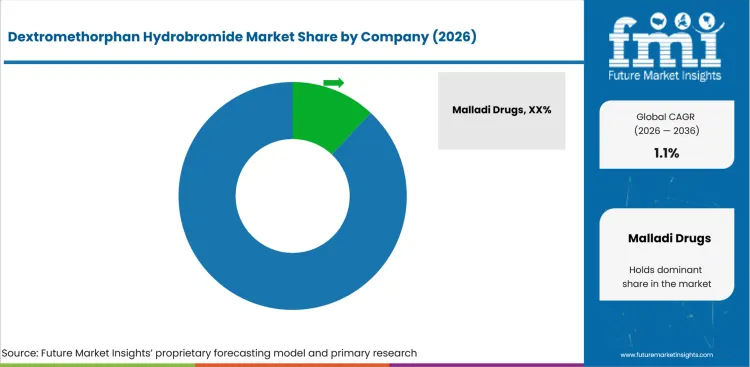
- Established API manufacturers hold an advantage led by written confirmations and pharmacopoeial product coverage.
- Distributor-led suppliers gain acceptance by combining documented access and smaller qualified lot availability.
- Compendial packagers support development buyers needing USP-grade material and traceable handling.
- Regional pharmaceutical companies influence country demand through cough-product maintenance and local buyer access.
API manufacturers compete by combining dextromethorphan hydrobromide production and documentation support. Malladi Drugs has a strong position through written confirmation evidence and export-facing manufacturing files. Supriya Lifescience, Virupaksha Organics, and Exemed compete based on API manufacturing evidence and multi-pharmacopoeial coverage.
Distribution strength has commercial value in smaller orders and controlled access channels. LGM Pharma, Rochem International, Pharm-RX Chemical, Spectrum Chemical, and Actylis compete depending on documented access and regulated buyer support. Buyers compare suppliers through assay consistency and audit response speed.
Country suppliers are expected to profit through local documentation support and product-file familiarity. India and China create API manufacturing depth. United States and Europe create distributor-led access and stricter documentation expectations. Japan and South Korea create slower qualification pathways guided by master-file and post-approval controls.
How do top Dextromethorphan Hydrobromide companies compare?
Malladi Drugs and Supriya Lifescience score on written confirmation depth, and LGM Pharma and Spectrum Chemical lead through regulated channel access.
| Company | Relevance to Market Title | DMF and Written Confirmation Depth | Pharmacopoeial Grade Coverage | Regulated Channel Reach | Geographic Footprint |
|---|---|---|---|---|---|
| Malladi Drugs | Very High | High | Strong | Strong | India and export markets |
| Supriya Lifescience | Very High | High | Strong | Strong | India and global exports |
| Virupaksha Organics | Very High | High | Strong | Moderate | India and export markets |
| Exemed | High | High | Strong | Moderate | India and export markets |
| ALPS Pharmaceutical | High | Medium | Strong | Moderate | Japan and Asia |
| LGM Pharma | High | Medium | Medium | Strong | United States and global |
| Rochem International | High | Medium | Medium | Strong | United States and global |
| Pharm-RX Chemical | Moderate | Low | Medium | Moderate | United States |
| Spectrum Chemical | High | Low | Strong | Moderate | United States |
| Actylis | High | Medium | Medium | Strong | Global |
Source: Future Market Insights competitive analysis, 2026.
Who are the key players in the Dextromethorphan Hydrobromide Market?
Malladi Drugs, Supriya Lifescience, and Virupaksha Organics are listed alongside Exemed and ALPS Pharmaceutical among other suppliers.
Key global companies leading the Dextromethorphan Hydrobromide Market include:
- Malladi Drugs
- Supriya Lifescience
- Virupaksha Organics
- Exemed
- ALPS Pharmaceutical
- LGM Pharma
- Rochem International
- Pharm-RX Chemical
- Spectrum Chemical
- Actylis
Key Developments in Dextromethorphan Hydrobromide Market
- In January 2025, MHRA listed a Class 2 recall involving Bells Healthcare dextromethorphan hydrobromide BP products after foreign material was detected in some bottles.
- In October 2025, CDSCO issued written confirmation material for Virupaksha Organics covering dextromethorphan hydrobromide manufacturing and packing evidence.
- In April 2026, CDSCO issued written confirmation for Malladi Drugs covering dextromethorphan hydrobromide BP/Ph.Eur. manufacturing and packing.
Key Players in the Dextromethorphan Hydrobromide Market
Primary API Manufacturers
- Malladi Drugs
- Supriya Lifescience
- Virupaksha Organics
- Exemed
- ALPS Pharmaceutical
Regulated API Distributors
- LGM Pharma
- Rochem International
- Pharm-RX Chemical
- Actylis
Compendial Packagers and Marketplace Suppliers
- Spectrum Chemical
- Medisca
- PCCA
- Letco Medical
Regional Pharmaceutical and OTC Companies
- Bells Healthcare
- Cooper Consumer Health
- Taisho Pharmaceutical
- Yuhan Corporation
Dextromethorphan Hydrobromide Market - Report Scope
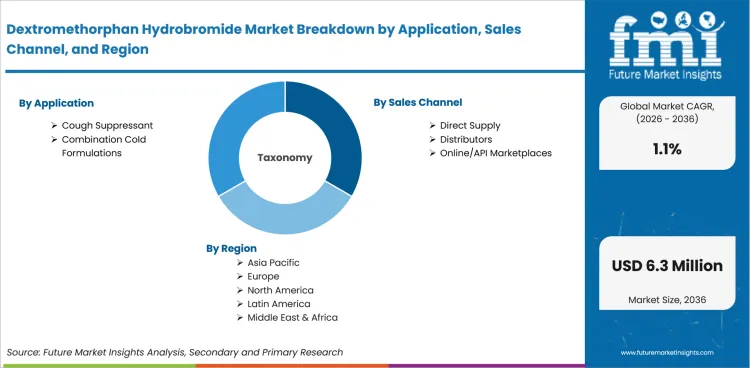
| Parameter | Details |
|---|---|
| Forecast period | 2026 to 2036 |
| Historical period | 2021 to 2025 |
| Quantitative unit | Revenue in USD million |
| By form | Powder, Crystalline |
| By purity grade | 99.5% and Above, 98.0% to 99.5%, Below 98% |
| By application | Cough Suppressant, Combination Cold Formulations |
| By sales channel | Direct Supply, Distributors, Online/API Marketplaces |
| By buyer type | Finished-Dose Manufacturers, API Distributors, Compendial Packagers, Development Buyers |
| Regions covered | North America, Latin America, Europe, East Asia, South Asia and Pacific, Middle East and Africa |
| Countries covered | China, India, United States, Germany, France, United Kingdom, Japan, South Korea |
| Key companies profiled | Malladi Drugs, Supriya Lifescience, Virupaksha Organics, Exemed, ALPS Pharmaceutical, LGM Pharma, Rochem International, Pharm-RX Chemical, Spectrum Chemical, Actylis |
| Approach | Bottom-up API revenue approach using product evidence, supplier documentation, country regulation, purity-grade demand, channel mix, and finished-dose buyer exposure |
Source: Future Market Insights competitive analysis, 2026.
Dextromethorphan Hydrobromide Market - Scope & Definition
| Attribute | Detail |
|---|---|
| Market Definition | Commercially supplied dextromethorphan hydrobromide active pharmaceutical ingredient used in antitussive finished-dose products |
| Functions Covered | Cough suppression API supply, active ingredient sourcing, compendial grade support, release-test documentation, and finished-dose batch continuity |
| Applications Covered | Cough suppressant products, combination cold formulations, oral liquids, tablets, capsules, softgels, and development-stage finished-dose products |
| End-Use Industries | Finished-dose pharmaceutical manufacturers, OTC medicine producers, API distributors, compendial packagers, and development buyers |
| Grades Covered | 99.5% and Above, 98.0% to 99.5%, Below 98%, USP, BP, Ph.Eur., and JP-aligned grades |
| Inclusions | All commercially traded dextromethorphan hydrobromide API across form, purity grade, application, sales channel, buyer type, and region |
| Exclusions | Finished cough medicines, retail syrups, lozenges, dextromethorphan polistirex finished-release systems, opioid antitussives, unrelated expectorant APIs, non-pharmaceutical research chemicals, and clinical treatment advice |
Dextromethorphan Hydrobromide Market - Research Methodology
| Method | Description |
|---|---|
| Primary Research | FMI analyst interviews with API manufacturers, finished-dose formulators, pharmaceutical distributors, regulatory consultants, and compendial packagers across selected markets |
| Desk Research | Review of official labels, regulator records, written confirmations, medicine recalls, product documentation, and country-level pharmaceutical statistics |
| Market Sizing & Forecasting | Bottom-up API revenue approach using finished-dose demand, form preference, purity-grade mix, country regulation, supplier qualification, and channel structure |
| Data Validation | Cross-verification using official labels, national regulator records, supplier documentation, company product listings, distributor checks, and country-level medicine evidence |
Dextromethorphan Hydrobromide Market Breakdown by Form, Purity Grade, Application, Sales Channel, Buyer Type, and Region
Dextromethorphan Hydrobromide Market Segmented by Form
- Powder
- Crystalline
Dextromethorphan Hydrobromide Market Segmented by Purity Grade
- 99.5% and Above
- 98.0% to 99.5%
- Below 98%
Dextromethorphan Hydrobromide Market Segmented by Application
- Cough Suppressant
- Combination Cold Formulations
Dextromethorphan Hydrobromide Market Segmented by Sales Channel
- Direct Supply
- Distributors
- Online/API Marketplaces
Dextromethorphan Hydrobromide Market Segmented by Buyer Type
- Finished-Dose Manufacturers
- API Distributors
- Compendial Packagers
- Development Buyers
Dextromethorphan Hydrobromide Market by Region
- North America
- Latin America
- Europe
- East Asia
- South Asia and Pacific
- Middle East and Africa
Research Sources and Bibliography
- Central Drugs Standard Control Organisation. (2025, October 1). Written confirmation for active substances imported into the European Union: Virupaksha Organics Ltd.
- Central Drugs Standard Control Organisation. (2026, April 10). Written confirmation for active substances imported into the European Union: Malladi Drugs & Pharmaceuticals Limited.
- Centers for Disease Control and Prevention. (2025). 2024-2025 influenza season summary: Severity, disease burden, and burden prevented by vaccination.
- Department for Business and Trade. (2026, March 23). Life sciences competitiveness indicators 2026: Summary.
- Department of Pharmaceuticals, Government of India. (2026). Annual report 2025-26.
- European Medicines Agency. (2026, June 11). EMA’s 2025 annual report shows strong approval numbers for human and veterinary medicines.
- Eurostat. (2026, April 13). Medicinal and pharmaceutical products: EUR 221 billion trade surplus.
- Federal Statistical Office of Germany. (2026, January 15). Gross domestic product up 0.2% in 2025.
- French National Institute of Statistics and Economic Studies. (2026, March 30). Producer price index in industrial production sold in France: Basic pharmaceutical products.
- International Trade Administration. (2025, November 20). Japan - Pharmaceuticals.
- International Trade Administration. (2026, May 22). France - Healthcare and life sciences.
- Medicines and Healthcare products Regulatory Agency. (2025, February 26). Letters and medicine recalls sent to healthcare professionals in January 2025.
- Ministry of Food and Drug Safety. (2024, December 23). Guideline on post approval change management of pharmaceutical manufacturing process.
- Ministry of Food and Drug Safety. (2026, May 28). MFDS opens a new era of innovation in medical product approval and review: Target 240-day approval.
- National Bureau of Statistics of China. (2026, February 28). Statistical communiqué of the People’s Republic of China on the 2025 national economic and social development.
- State Council of the People’s Republic of China. (2024, May 8). China tightens restrictions on controversial cough medicine.
- National Library of Medicine. (2025, November 30). Guaifenesin and dextromethorphan HBr tablet, extended release. DailyMed.
- National Medical Products Administration. (2022, December 29). Provisions for supervision and administration of online drug sales.
- Pharmaceuticals and Medical Devices Agency. (2025, September 5). GMP/GCTP annual report FY2024.
- Pharmaceuticals and Medical Devices Agency. (2025). Master File System.
- Press Information Bureau, Government of India. (2026, March 21). India’s pharmaceuticals in global healthcare.
- USA Food and Drug Administration. (2025, October 3). FDA announces new ANDA prioritization pilot to support USA generic drug manufacturing and testing.
This bibliography is provided for reader reference and is not exhaustive. The full report contains the complete reference list and detailed citations.
This Report Answers
- Market size estimates for 2026 and forecasts through 2036 for the Dextromethorphan Hydrobromide Market.
- Insights across regional and country-level regulated API supply markets.
- Analysis of demand drivers and finished-dose buyer behavior.
- Evaluation of form, purity grade, application, sales channel, and buyer type.
- Assessment of cough-product continuity and antitussive API sourcing requirements.
- Identification of opportunities across pharmacopoeial grades and documentation-ready suppliers.
- Evaluation of direct supply and online/API marketplaces.
- Country-level analysis covering China, India, United States, Germany, France, United Kingdom, Japan, and South Korea.
- Assessment of competition, including leading API manufacturers and compendial packagers.
- Analysis of supplier qualification criteria and regulatory documentation needs.
- Regional outlooks across North America, Europe, East Asia, South Asia and Pacific, Latin America, and Middle East and Africa.
- Delivery of market data, forecasts, and supporting analysis in report-ready format.
Frequently Asked Questions
What is the growth prospect for dextromethorphan hydrobromide?
Demand for dextromethorphan hydrobromide is expected to rise at a modest pace as cough-product manufacturers maintain qualified API sources.
Which companies are expected to shape the dextromethorphan hydrobromide market?
Malladi Drugs, Supriya Lifescience, Virupaksha Organics, Exemed, ALPS Pharmaceutical, LGM Pharma, Spectrum Chemical, and Actylis are expected to shape competition.
Why are API manufacturers investing in dextromethorphan hydrobromide documentation?
API manufacturers are investing in documentation to support pharmacopoeial alignment and destination-market source files.
Why are direct supply channels important in the dextromethorphan hydrobromide market?
Direct supply channels support installation of batch documentation and source-change control.
Which API formats are gaining attention in dextromethorphan hydrobromide?
Powder and high-purity grades are gaining attention as buyers seek flexible formulation use and release-test confidence.
How does cough-product continuity influence dextromethorphan hydrobromide demand?
Cough-product continuity influences demand through repeat manufacturing needs and stable active ingredient files.
Why is purity grade important for dextromethorphan hydrobromide?
Purity grade is important since regulated buyers need reliable assay and pharmacopoeial evidence.
What role does Direct Supply play in dextromethorphan hydrobromide adoption?
Direct supply supports adoption by combining API access and after-sales documentation support.
Preview the report firsthand - request a free sample
Get SampleGet the brochure for pricing and purchase details.
Get PDFTable of Content
- Key Takeaways
- Market Size and CAGR
- Top Growth Driver
- Fastest Growing Segment
- Leading Region
- Key Companies
- Emerging Opportunities
- Executive Summary
- Global Market Outlook
- Demand-side Trends
- Supply-side Trends
- Technology Roadmap Analysis
- Analysis and Recommendations
- Analyst Perspective (What is happening? Why now? What should investors know?)
- Key Questions Answered
- How large is the market?
- What is the CAGR?
- What are key trends?
- Which region dominates?
- Who are the leaders?
- Market Overview
- Market Coverage / Taxonomy
- Market Definition / Scope / Limitations
- Research Methodology
- Chapter Orientation
- Analytical Lens and Working Hypotheses
- Market Structure, Signals, and Trend Drivers
- Benchmarking and Cross-market Comparability
- Market Sizing, Forecasting, and Opportunity Mapping
- Research Design and Evidence Framework
- Desk Research Programme (Secondary Evidence)
- Expert Input and Fieldwork (Primary Evidence)
- Tooling, Models, and Reference Databases
- Data Engineering and Model Build
- Quality Assurance and Audit Trail
- Market Background
- Market Dynamics (Drivers, Restraints, Opportunity, Trends)
- Scenario Forecast (Optimistic, Likely, Conservative)
- Impact Analysis
- AI Impact
- Sustainability Impact
- Regulatory Impact
- Technology Impact
- Consumer / Buyer Analysis
- Purchase Drivers
- Adoption Barriers
- Buyer Journey
- Opportunity Map Analysis
- Product Life Cycle Analysis
- Supply Chain Analysis
- Investment Feasibility Matrix
- Value Chain Analysis
- PESTLE and Porter's Analysis
- Regulatory Landscape
- Regional Parent Market Outlook
- Production and Consumption Statistics
- Import and Export Statistics
- Global Market Analysis and Forecast, 2021 to 2036
- Historical Market Size Value (USD Million) & Volume (Unit) Analysis, 2021 to 2025
- Current and Future Market Size Value (USD Million) & Volume (Unit) Projections, 2026 to 2036
- Y-o-Y Growth Trend Analysis
- Absolute $ Opportunity Analysis
- Global Market Pricing Analysis, 2021 to 2036
- Global Market Analysis and Forecast, By Application, 2021 to 2036
- Introduction / Key Findings
- Historical Market Size Value (USD Million) & Volume (Unit) Analysis By Application, 2021 to 2025
- Current and Future Market Size Value (USD Million) & Volume (Unit) Analysis and Forecast By Application, 2026 to 2036
- Cough Suppressant
- Combination Cold Formulations
- Cough Suppressant
- Y-o-Y Growth Trend Analysis By Application, 2021 to 2025
- Absolute $ Opportunity Analysis By Application, 2026 to 2036
- Global Market Analysis and Forecast, By Sales Channel, 2021 to 2036
- Introduction / Key Findings
- Historical Market Size Value (USD Million) & Volume (Unit) Analysis By Sales Channel, 2021 to 2025
- Current and Future Market Size Value (USD Million) & Volume (Unit) Analysis and Forecast By Sales Channel, 2026 to 2036
- Direct Supply
- Distributors
- Online/API Marketplaces
- Direct Supply
- Y-o-Y Growth Trend Analysis By Sales Channel, 2021 to 2025
- Absolute $ Opportunity Analysis By Sales Channel, 2026 to 2036
- Global Market Analysis and Forecast, By Buyer Type, 2021 to 2036
- Introduction / Key Findings
- Historical Market Size Value (USD Million) & Volume (Unit) Analysis By Buyer Type, 2021 to 2025
- Current and Future Market Size Value (USD Million) & Volume (Unit) Analysis and Forecast By Buyer Type, 2026 to 2036
- Finished-Dose Manufacturers
- API Distributors
- Compendial Packagers
- Development Buyers
- Finished-Dose Manufacturers
- Y-o-Y Growth Trend Analysis By Buyer Type, 2021 to 2025
- Absolute $ Opportunity Analysis By Buyer Type, 2026 to 2036
- Global Market Analysis and Forecast, By Region, 2021 to 2036
- Introduction
- Historical Market Size Value (USD Million) & Volume (Unit) Analysis By Region, 2021 to 2025
- Current Market Size Value (USD Million) & Volume (Unit) Analysis and Forecast By Region, 2026 to 2036
- North America
- Latin America
- Western Europe
- Eastern Europe
- East Asia
- South Asia and Pacific
- Middle East & Africa
- Market Attractiveness Analysis By Region
- North America Market Analysis and Forecast, By Country, 2021 to 2036
- Historical Market Size Value (USD Million) & Volume (Unit) Trend Analysis By Market Taxonomy, 2021 to 2025
- Market Size Value (USD Million) & Volume (Unit) Forecast By Market Taxonomy, 2026 to 2036
- By Country
- USA
- Canada
- Mexico
- By Application
- By Sales Channel
- By Buyer Type
- By Country
- Market Attractiveness Analysis
- By Country
- By Application
- By Sales Channel
- By Buyer Type
- Key Takeaways
- Latin America Market Analysis and Forecast, By Country
- Historical Market Size Value (USD Million) & Volume (Unit) Trend Analysis By Market Taxonomy, 2021 to 2025
- Market Size Value (USD Million) & Volume (Unit) Forecast By Market Taxonomy, 2026 to 2036
- By Country
- Brazil
- Chile
- Rest of Latin America
- By Application
- By Sales Channel
- By Buyer Type
- By Country
- Market Attractiveness Analysis
- By Country
- By Application
- By Sales Channel
- By Buyer Type
- Key Takeaways
- Western Europe Market Analysis and Forecast, By Country
- Historical Market Size Value (USD Million) & Volume (Unit) Trend Analysis By Market Taxonomy, 2021 to 2025
- Market Size Value (USD Million) & Volume (Unit) Forecast By Market Taxonomy, 2026 to 2036
- By Country
- Germany
- UK
- Italy
- Spain
- France
- Nordic
- BENELUX
- Rest of Western Europe
- By Application
- By Sales Channel
- By Buyer Type
- By Country
- Market Attractiveness Analysis
- By Country
- By Application
- By Sales Channel
- By Buyer Type
- Key Takeaways
- Eastern Europe Market Analysis and Forecast, By Country
- Historical Market Size Value (USD Million) & Volume (Unit) Trend Analysis By Market Taxonomy, 2021 to 2025
- Market Size Value (USD Million) & Volume (Unit) Forecast By Market Taxonomy, 2026 to 2036
- By Country
- Russia
- Poland
- Hungary
- Balkan & Baltic
- Rest of Eastern Europe
- By Application
- By Sales Channel
- By Buyer Type
- By Country
- Market Attractiveness Analysis
- By Country
- By Application
- By Sales Channel
- By Buyer Type
- Key Takeaways
- East Asia Market Analysis and Forecast, By Country
- Historical Market Size Value (USD Million) & Volume (Unit) Trend Analysis By Market Taxonomy, 2021 to 2025
- Market Size Value (USD Million) & Volume (Unit) Forecast By Market Taxonomy, 2026 to 2036
- By Country
- China
- Japan
- South Korea
- By Application
- By Sales Channel
- By Buyer Type
- By Country
- Market Attractiveness Analysis
- By Country
- By Application
- By Sales Channel
- By Buyer Type
- Key Takeaways
- South Asia and Pacific Market Analysis and Forecast, By Country
- Historical Market Size Value (USD Million) & Volume (Unit) Trend Analysis By Market Taxonomy, 2021 to 2025
- Market Size Value (USD Million) & Volume (Unit) Forecast By Market Taxonomy, 2026 to 2036
- By Country
- India
- ASEAN
- Australia & New Zealand
- Rest of South Asia and Pacific
- By Application
- By Sales Channel
- By Buyer Type
- By Country
- Market Attractiveness Analysis
- By Country
- By Application
- By Sales Channel
- By Buyer Type
- Key Takeaways
- Middle East & Africa Market Analysis and Forecast, By Country
- Historical Market Size Value (USD Million) & Volume (Unit) Trend Analysis By Market Taxonomy, 2021 to 2025
- Market Size Value (USD Million) & Volume (Unit) Forecast By Market Taxonomy, 2026 to 2036
- By Country
- Kingdom of Saudi Arabia
- Other GCC Countries
- Türkiye
- South Africa
- Other African Union
- Rest of Middle East & Africa
- By Application
- By Sales Channel
- By Buyer Type
- By Country
- Market Attractiveness Analysis
- By Country
- By Application
- By Sales Channel
- By Buyer Type
- Key Takeaways
- Key Countries Market Analysis
- USA
- Pricing Analysis
- Market Share Analysis, 2025
- By Application
- By Sales Channel
- By Buyer Type
- Canada
- Pricing Analysis
- Market Share Analysis, 2025
- By Application
- By Sales Channel
- By Buyer Type
- Mexico
- Pricing Analysis
- Market Share Analysis, 2025
- By Application
- By Sales Channel
- By Buyer Type
- Brazil
- Pricing Analysis
- Market Share Analysis, 2025
- By Application
- By Sales Channel
- By Buyer Type
- Chile
- Pricing Analysis
- Market Share Analysis, 2025
- By Application
- By Sales Channel
- By Buyer Type
- Germany
- Pricing Analysis
- Market Share Analysis, 2025
- By Application
- By Sales Channel
- By Buyer Type
- UK
- Pricing Analysis
- Market Share Analysis, 2025
- By Application
- By Sales Channel
- By Buyer Type
- Italy
- Pricing Analysis
- Market Share Analysis, 2025
- By Application
- By Sales Channel
- By Buyer Type
- Spain
- Pricing Analysis
- Market Share Analysis, 2025
- By Application
- By Sales Channel
- By Buyer Type
- France
- Pricing Analysis
- Market Share Analysis, 2025
- By Application
- By Sales Channel
- By Buyer Type
- India
- Pricing Analysis
- Market Share Analysis, 2025
- By Application
- By Sales Channel
- By Buyer Type
- ASEAN
- Pricing Analysis
- Market Share Analysis, 2025
- By Application
- By Sales Channel
- By Buyer Type
- Australia & New Zealand
- Pricing Analysis
- Market Share Analysis, 2025
- By Application
- By Sales Channel
- By Buyer Type
- China
- Pricing Analysis
- Market Share Analysis, 2025
- By Application
- By Sales Channel
- By Buyer Type
- Japan
- Pricing Analysis
- Market Share Analysis, 2025
- By Application
- By Sales Channel
- By Buyer Type
- South Korea
- Pricing Analysis
- Market Share Analysis, 2025
- By Application
- By Sales Channel
- By Buyer Type
- Russia
- Pricing Analysis
- Market Share Analysis, 2025
- By Application
- By Sales Channel
- By Buyer Type
- Poland
- Pricing Analysis
- Market Share Analysis, 2025
- By Application
- By Sales Channel
- By Buyer Type
- Hungary
- Pricing Analysis
- Market Share Analysis, 2025
- By Application
- By Sales Channel
- By Buyer Type
- Kingdom of Saudi Arabia
- Pricing Analysis
- Market Share Analysis, 2025
- By Application
- By Sales Channel
- By Buyer Type
- Türkiye
- Pricing Analysis
- Market Share Analysis, 2025
- By Application
- By Sales Channel
- By Buyer Type
- South Africa
- Pricing Analysis
- Market Share Analysis, 2025
- By Application
- By Sales Channel
- By Buyer Type
- USA
- Market Structure Analysis
- Competition Dashboard
- Competition Benchmarking
- Market Share Analysis of Top Players
- By Regional
- By Application
- By Sales Channel
- By Buyer Type
- Emerging Startups
- Innovation Benchmarking
- Competition Analysis
- Competition Deep Dive
- Malladi Drugs
- Overview
- Product Portfolio
- Profitability by Market Segments (Product/Region/Sales Channel)
- Sales Footprint
- Strategy Overview
- Marketing Strategy
- Product Strategy
- Channel Strategy
- Supriya Lifescience
- Virupaksha Organics
- Exemed
- ALPS Pharmaceutical
- LGM Pharma
- Rochem International
- Pharm-RX Chemical
- Spectrum Chemical
- Actylis
- Malladi Drugs
- Case Studies
- Success Stories
- Recent Developments
- Competition Deep Dive
- Assumptions & Acronyms Used


