

- Industry Size (2025)
- USD 646.8 Mn
- Forecast (2035)
- USD 1097.4 Mn
- CAGR (2025 to 2035)
- 5.4%
Vaccine Cryoprotectants Market Forecast and Outlook 2025 to 2035
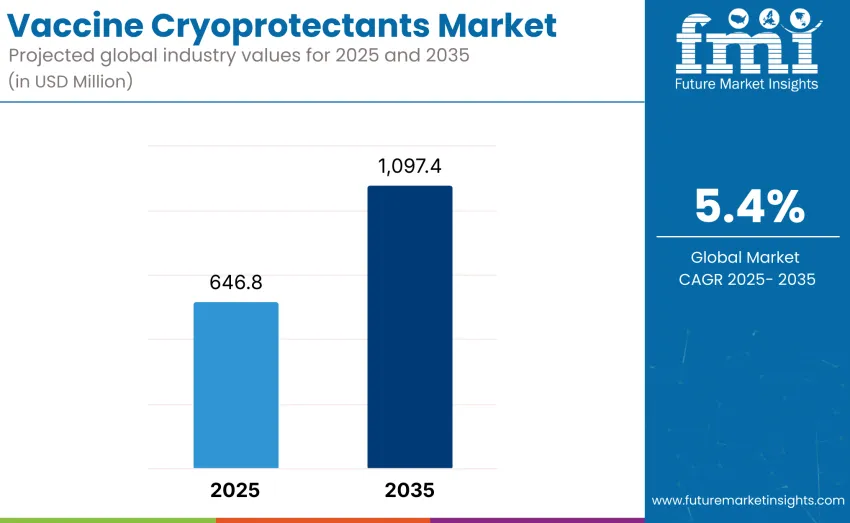
The global vaccine cryoprotectants market is expected to reach USD 1,097.4 million by 2035, recording an absolute increase of USD 450.6 million over the forecast period. This market is valued at USD 646.8 million in 2025 and is likely to grow at a CAGR of 5.4% over the assessment period. Growth is projected to record a compound annual growth rate of 5.4 percent, driven by increasing demand for advanced vaccine preservation solutions and rising investments in cold-chain infrastructure worldwide.
Expansion is expected to be supported by an increased focus on vaccine stability and extended shelf life, particularly for temperature-sensitive biologics. Adoption of cryoprotectants is being recognized as a critical strategy to maintain efficacy and potency of vaccines during storage and transportation. Innovations in cryoprotectant formulations, including development of polysaccharide-based and amino acid-based stabilizers, are projected to enhance growth by providing enhanced preservation of vaccine integrity under ultra-low temperature conditions.
Quick Stats for Vaccine Cryoprotectants Market
- Vaccine Cryoprotectants Market Value (2025): USD 646.8 million
- Vaccine Cryoprotectants Market Forecast Value (2035): USD 1,097.4 million
- Vaccine Cryoprotectants Market Forecast CAGR: 5.4%
- Leading Product Type in Vaccine Cryoprotectants Market: Sugars with 37.6% share
- Key Growth Regions in Vaccine Cryoprotectants Market: Asia Pacific, Europe, and North America
- Top Players in Vaccine Cryoprotectants Market: Merck MilliporeSigma, Thermo Fisher Scientific (Gibco), Roquette, Pfanstiehl, Hayashibara (Nagase), Avantor, DFE Pharma, SPI Pharma, Cytiva, Others
Technological advancements in cryopreservation techniques are projected to influence dynamics. Modern cryoprotectants are designed to minimize ice crystal formation, maintain protein structure, and reduce degradation of sensitive vaccine components, supporting production and distribution of high-quality immunization products. Integration of cryoprotectants into scalable vaccine manufacturing processes is expected to enhance operational efficiency and reduce product loss, strengthening demand.
Vaccine Cryoprotectants Market Year-over-Year Forecast (2025 to 2035)
Between 2025 and 2030, the vaccine cryoprotectants market is projected to expand from USD 646.8 million to USD 842.5 million, resulting in a value increase of USD 195.7 million, which represents 43.4% of total forecast growth for the decade. This phase of development will be shaped by rising demand for stable, long-term vaccine storage solutions and expanding global immunization programs, innovation in cryoprotectant formulations and stability enhancement technologies, as well as increasing integration with advanced cold-chain logistics and automated storage systems.
From 2030 to 2035, growth is forecast from USD 842.5 million to USD 1,097.4 million, adding USD 254.9 million, constituting 56.6% of overall ten-year expansion. This period is expected to be characterized by development of specialized cryoprotectant solutions for mRNA, viral vector, and protein-based vaccines, strategic collaborations between cryoprotectant manufacturers and vaccine developers, and enhanced focus on sustainable production practices and energy-efficient cold-chain integration. Growing focus on global vaccination programs, pandemic preparedness, and advanced vaccine preservation will drive demand.
Vaccine Cryoprotectants Market Key Takeaways
| Metric | Value |
|---|---|
| Market Value (2025) | USD 646.8 million |
| Market Forecast Value (2035) | USD 1,097.4 million |
| Forecast CAGR (2025 to 2035) | 5.4% |
Why Is the Vaccine Cryoprotectants Market Growing Worldwide?
The global vaccine cryoprotectants market is driven by increasing demand for advanced vaccine preservation solutions that enhance stability and extend shelf life during storage and transportation. Growth has been supported by rising scale of vaccine production and distribution, where cryoprotectants are applied to maintain potency under ultra-low temperature conditions. Adoption has been accelerated by improvements in cryoprotectant formulations, which allow vaccines to remain stable across diverse platforms, including mRNA, viral vector, and protein-based vaccines.
Technological innovation and formulation enhancements have allowed manufacturers to differentiate their offerings and meet growing demand from commercial vaccine producers, contract research organizations, and biobanking facilities. Increased investment in manufacturing capacity and cold-chain capabilities in emerging markets has facilitated deployment of cryoprotectants at global scale. These factors have driven worldwide expansion and are expected to sustain growth throughout the forecast period.
How Is the Vaccine Cryoprotectants Market Segmented by Product Type, Application, and Region?
The vaccine cryoprotectants market is segmented by product type, application, and region. By product type, division includes sugars, polyols, amino acids & proteins, polymers, and blends & buffer systems. Based on application, categorization covers mRNA & LNP vaccines, viral vector vaccines, protein subunit & inactivated vaccines, live-attenuated & oral vaccines, and thermostabilization & lyophilization programs. Regionally, segmentation spans Asia Pacific, Europe, North America, Latin America, and Middle East & Africa.
By Product Type, Sugars Account for Dominant Share
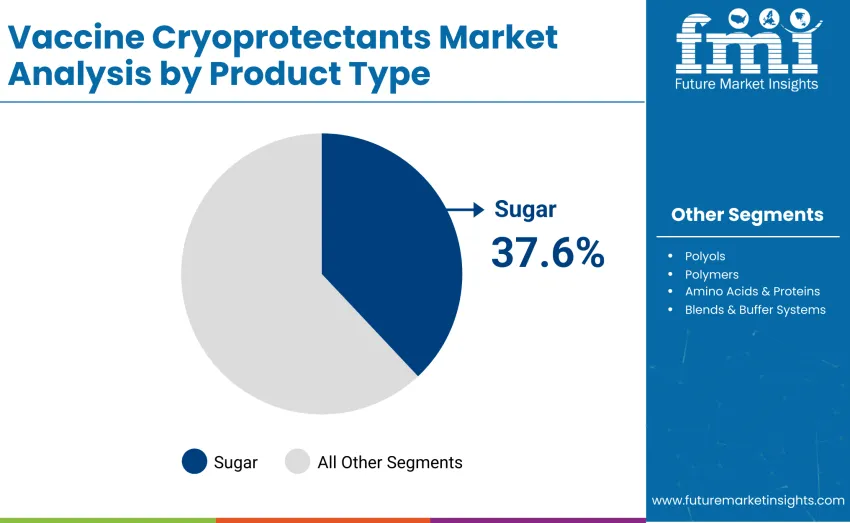
The sugars segment represents the dominant force, capturing a 37.6% share of total revenue in 2025. This category encompasses widely used cryoprotective agents such as sucrose and trehalose, which are applied to stabilize vaccine formulations during ultra-low temperature storage and freeze-drying processes. Leadership stems from critical role in maintaining vaccine potency, protecting protein structures, and preventing aggregation during cryopreservation, ensuring efficacy across diverse vaccine platforms.
The polyols segment maintains substantial share, serving applications where enhanced stabilization, glass formation, and moisture retention are required for mRNA, viral vector, and protein-based vaccines. Amino acids & proteins constitute another key segment, providing targeted stabilization of labile vaccine components, reducing structural degradation, and enhancing thermal tolerance. Polymers are employed in specialized formulations to improve viscosity, structural integrity, and long-term stability, while blends & buffer systems offer multifunctional protection by combining complementary cryoprotectants.
Key advantages driving the sugars segment include:
- High cryoprotective efficiency supporting structural integrity of sensitive vaccine components during freezing and lyophilization
- Compatibility with a wide range of vaccine platforms, including mRNA, viral vector, and protein-based formulations
- Facilitation of thermostabilization programs that extend shelf life under ultra-low temperature conditions
By Application, mRNA & LNP Vaccines Lead
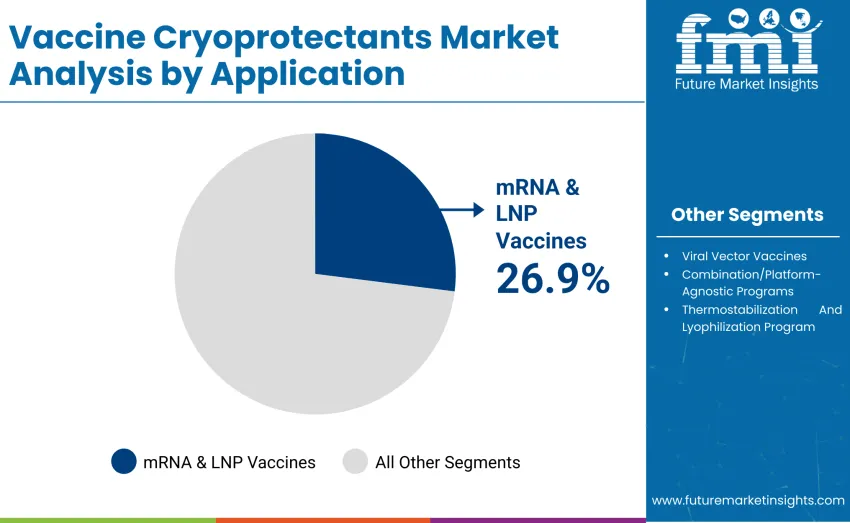
The mRNA & LNP vaccines segment dominates with a 26.9% share in 2025, reflecting rapid expansion of mRNA vaccine development and distribution worldwide. Leadership is reinforced by widespread adoption among commercial vaccine manufacturers, contract research organizations, and biopharmaceutical companies, where cryoprotectants are applied to preserve lipid nanoparticle integrity, enhance thermal stability, and maintain vaccine potency during ultra-low temperature storage and transport.
The viral vector vaccines segment holds substantial share through applications in adenovirus-based and other viral vector vaccines, where cryoprotectants support structural stability, reduce aggregation, and ensure consistent efficacy across production batches. Protein subunit & inactivated vaccines represent another key segment, utilizing cryoprotectants to protect labile proteins, prevent denaturation, and enable reliable freeze-drying processes. Live-attenuated & oral vaccines segment relies on cryoprotectants to maintain virus viability during long-term storage, distribution, and thermostabilization programs.
Key market dynamics supporting application preferences include:
- mRNA & LNP adoption driven by global immunization campaigns and rapid vaccine deployment requirements
- Viral vector and protein-based vaccines benefiting from cryoprotectant formulations that ensure structural and thermal stability
- Live-attenuated vaccine preservation enabling safe distribution and effective oral delivery in emerging markets
What Are the Major Drivers, Restraints, and Emerging Trends Influencing the Vaccine Cryoprotectants Market?
The global vaccine cryoprotectants market experiences sustained growth, underpinned by increasing scale of vaccine production, expanding global immunization programs, and rising demand for long-term preservation solutions. Technological progress in cryoprotectant formulation and improved cold-chain logistics has enabled maintenance of vaccine potency under ultra-low temperature conditions, facilitating broader adoption across commercial manufacturers, contract research organizations, and public health initiatives. Government policies promoting vaccine accessibility and regulatory support for advanced preservation technologies have reinforced expansion.
What Are the Major Restraints Affecting the Vaccine Cryoprotectants Market?
Expansion faces constraints from high production and formulation costs, particularly for advanced cryoprotectants tailored to sensitive vaccine platforms. Stringent regulatory requirements for efficacy validation across diverse vaccine types and complex freeze-drying compatibility issues pose challenges. Cold-chain dependency and limited ultra-low temperature storage capacity in emerging regions can restrict adoption, while technical complexities related to large-scale vaccine stabilization continue to hinder operational efficiency.
What Emerging Trends Are Shaping the Future of the Vaccine Cryoprotectants Market?
Emerging trends include development of platform-specific and multifunctional cryoprotectant formulations, with blends and buffer systems being optimized for structural integrity, pH maintenance, and thermal stress resistance. Thermostabilization programs are gaining prominence, reducing reliance on energy-intensive cold-chain infrastructure and enabling wider distribution in resource-constrained regions. Strategic collaborations between cryoprotectant manufacturers, vaccine developers, and logistics providers are increasingly pursued to co-develop integrated solutions.
How Are Leading Countries Driving Growth in the Vaccine Cryoprotectants Market?
| Country | CAGR (2025 to 2035) |
|---|---|
| United States | 5.1% |
| Brazil | 5.6% |
| China | 6.0% |
| India | 6.4% |
| Europe | 5.0% |
| Germany | 4.8% |
| United Kingdom | 4.9% |
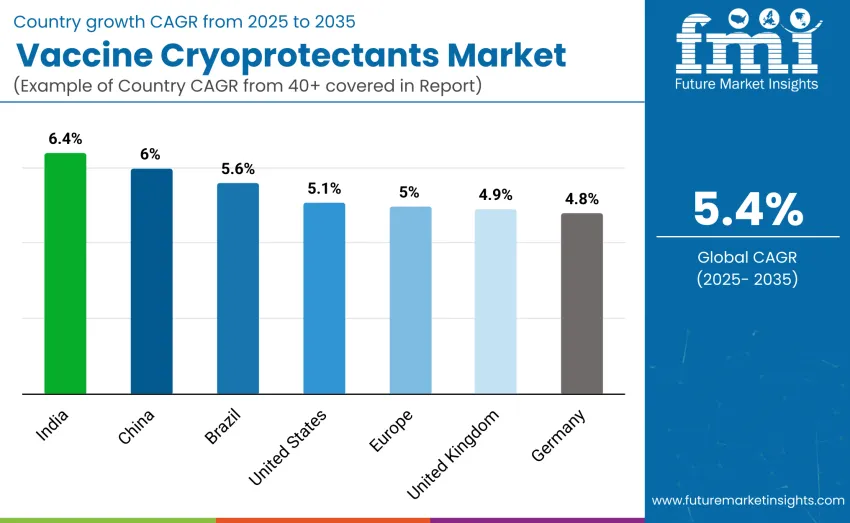
The vaccine cryoprotectants market is expanding globally, with India leading at a 6.4% CAGR due to strong immunization programs, biotechnology growth, and adoption of advanced cryoprotectants. China follows at 6.0%, driven by rapid vaccine manufacturing expansion and investment in cold-chain systems. Brazil records 5.6% growth supported by increased vaccine production and public health initiatives. The USA shows a 5.1% CAGR, reflecting its mature vaccine ecosystem and advanced cryoprotection technologies. Europe grows at 5.0%, with Germany at 4.8% and the UK at 4.9%, driven by research strength and regulatory-supported adoption.
The report covers an in-depth analysis of 40+ countries top-performing countries are highlighted below.
How Is Healthcare Modernization Driving Growth in China?
China demonstrates the strongest growth potential with a CAGR of 6.0% through 2035. Leadership is supported by government-led healthcare modernization programs, rapid expansion of biotechnology clusters, and industrial adoption of advanced cold-chain logistics for vaccine storage and transport. Growth concentrates in major metropolitan and industrial regions, including Beijing, Shanghai, Shenzhen, and Hangzhou, where research institutes, hospitals, and vaccine manufacturers are implementing state-of-the-art cryoprotectants to improve vaccine stability and shelf-life.
Strategic policy initiatives, including the Made in China 2025 program and targeted subsidies for cold-chain infrastructure, have accelerated adoption among domestic producers. Partnerships between public research institutions and private enterprises have enabled technology transfer, workforce development, and regulatory compliance. Extensive government programs have been implemented to modernize healthcare facilities and integrate advanced vaccine storage systems, ensuring that hospitals, research institutes, and distribution hubs are equipped with state-of-the-art cryoprotectant solutions.
Why Are Infrastructure Investments Enhancing Adoption in India?
In India, the vaccine cryoprotectants market is projected to grow at a CAGR of 6.4% through 2035. Expansion is supported by large-scale development of cold-chain infrastructure across hospitals, clinics, and rural health centers to improve vaccine accessibility. Government programs, such as the National Vaccine Development Program, provide financial incentives, grants, and low-interest loans to facilitate acquisition of advanced cryoprotectants. Local manufacturing capacity has been enhanced through public-private partnerships and technology transfer agreements.
Regional production hubs in Bangalore, Hyderabad, Mumbai, and Pune have strengthened logistics efficiency, ensuring temperature-stable vaccine delivery. Nationwide immunization campaigns and increased public awareness regarding vaccine importance have stimulated demand for cryoprotectants in both urban and semi-urban healthcare facilities. Significant investments have been made to establish temperature-controlled storage and transport networks in major cities and peripheral healthcare centers, improving vaccine accessibility and reliability across diverse populations.
How Does Research and Technology Adoption Sustain Leadership in Germany?
Germany's vaccine cryoprotectants market is expected to grow at a CAGR of 4.8% through 2035. Expansion is driven by advanced engineering practices in pharmaceutical manufacturing, compliance with strict EU regulatory standards, and sustainability initiatives in cold-chain management. Key biotechnology and research clusters in Berlin, Munich, Hamburg, and Frankfurt have facilitated integration of advanced cryoprotectants in vaccine storage and transport.
Collaborative research programs between universities, research institutes, and private companies have accelerated innovation, optimized logistics, and enhanced workforce expertise. Focus on energy-efficient cold-chain facilities and precision monitoring technologies has ensured product stability and operational efficiency, supporting adoption across professional healthcare and research settings. German pharmaceutical and biotechnology companies leverage advanced engineering practices to integrate cryoprotectants into vaccine production, storage, and logistics systems, enhancing operational efficiency and reliability.
Why Is Expanding Healthcare Access Driving Demand in Brazil?
Brazil's vaccine cryoprotectants market is projected to grow at a CAGR of 5.6% through 2035, supported by expansion of healthcare infrastructure and modernization of cold-chain systems. Urban centers such as São Paulo, Rio de Janeiro, Brasília, and Porto Alegre are focal points for implementing advanced storage solutions in hospitals and vaccination centers. Government subsidies and financial assistance programs have incentivized both public and private adoption of cryoprotectants.
Partnerships with international technology providers have improved temperature stability, storage efficiency, and compliance with quality standards. Nationwide vaccination campaigns and public awareness initiatives have increased demand for reliable cold-chain logistics and cryoprotectant solutions. Major metropolitan regions have seen significant infrastructure development to support temperature-controlled vaccine storage and distribution networks while public financial support and procurement schemes encourage both private and public healthcare providers to adopt advanced cryoprotectants.
How Are Advanced R&D and Logistics Driving Growth in the United States?
The United States vaccine cryoprotectants market is expected to grow at a CAGR of 5.1% through 2035. Growth is driven by advanced research capabilities in pharmaceutical and biotechnology sectors, coupled with automation and digitalization of cold-chain logistics. Key biotech clusters in California, Massachusetts, New Jersey, and Texas have enabled large-scale adoption of cryoprotectants in vaccine production, storage, and transport.
Collaboration between private manufacturers and academic research institutions has facilitated process optimization, regulatory compliance, and workforce skill development. Mature distribution networks and national immunization programs ensure reliable availability of cryoprotectants across urban and rural healthcare facilities, supporting sustained expansion. Leading pharmaceutical and biotech clusters have incorporated cryoprotectants into sophisticated vaccine development and production processes to enhance stability and efficacy while extensive adoption of automated monitoring and temperature-controlled storage systems ensures high operational efficiency.
How Are Research Hubs and Government Initiatives Supporting Growth in the United Kingdom?
The United Kingdom's vaccine cryoprotectants market is projected to grow at a CAGR of 4.9% through 2035. Expansion is driven by presence of leading biomedical research hubs in London, Cambridge, and Oxford, where cryoprotectants are integrated into vaccine research and cold-chain systems. Public health programs and government-funded initiatives have promoted adoption in hospitals, laboratories, and vaccination centers.
Partnerships between private biotech companies and research institutions have facilitated technology transfer, professional training, and workflow optimization. Established distribution infrastructure ensures consistent supply and delivery across regional healthcare networks, while national immunization campaigns sustain demand for temperature-stable vaccine storage solutions. Universities and research centers have implemented cryoprotectants in research pipelines and hospital storage systems, facilitating advanced vaccine handling and quality assurance across the expanding healthcare network.
How Are Creative Economy Investments Advancing Expansion Across Europe?
The vaccine cryoprotectants market in Europe is projected to grow from USD 169.5 million in 2025 to USD 273.3 million by 2035, registering a CAGR of 5.0% over the forecast period. Germany is expected to maintain leadership with a 28.5% share in 2025, declining slightly to 27.8% by 2035, driven by advanced pharmaceutical infrastructure, robust biotechnology clusters, and well-established cold-chain logistics in Berlin, Munich, and Hamburg.
France follows with a 22.3% share in 2025, increasing to 22.6% by 2035, supported by extensive vaccine production capabilities in Paris and Lyon, government immunization programs, and research investments in cryoprotectant integration. The United Kingdom holds a 19.5% share in 2025, rising to 19.8% by 2035, underpinned by national vaccination initiatives, modern biomedical research hubs, and strong collaboration between public health authorities and private biotech companies.
Italy maintains a 13.2% share across the period, enabled by regional healthcare networks, biotechnology partnerships, and focus on cold-chain efficiency. Spain accounts for 9.5% in 2025, reaching 9.7% by 2035, reflecting expansion of hospital storage systems and training programs for vaccine handling. The Netherlands maintains a 6.8% share, while the Rest of Europe grows from 7.0% to 7.2%, supported by enhanced cold-chain adoption in Nordic and Central & Eastern European countries.
How Competitive Is the Global Vaccine Cryoprotectants Market and What Defines Its Structure?
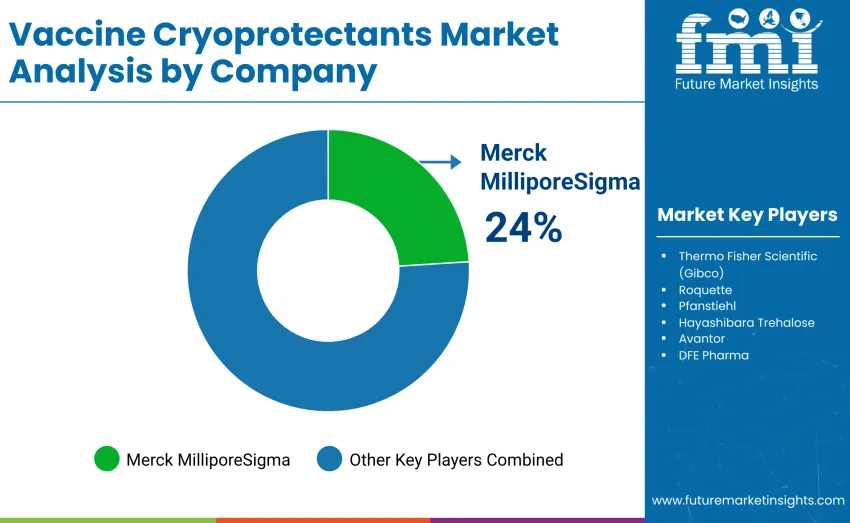
The global vaccine cryoprotectants market is moderately concentrated, with 12-15 players shaping competitive dynamics through formulation quality, cryogenic stability, regulatory compliance, and distribution strength rather than cost competitiveness alone. The top three companies hold over half the global share, led by Merck MilliporeSigma, which now accounts for 24% of the market. Its leadership is driven by advanced stabilizer technologies, including trehalose, polyol-based formulations, and deep technical expertise supporting vaccine preservation workflows. Thermo Fisher Scientific (Gibco), Roquette, and Pfanstiehl also maintain strong positions through high-purity cryoprotectant formulations, process integration capabilities, and robust regional distribution networks designed to support precise cold-chain management.
Mid-tier challengers such as Hayashibara and Avantor gain traction through specialized formulations and environmentally sustainable production practices tailored to niche applications. Meanwhile, emerging manufacturers across Asia increasingly intensify competition with rapid product development cycles, cost-effective cryoprotectants, and partnerships with local distributors, especially in price-sensitive regions such as India, Southeast Asia, and Latin America. Market dynamics increasingly favor companies that combine proven cryoprotectant performance with strong technical support, cold-chain integration services, and professional training programs, ensuring consistent adoption within hospitals, research laboratories, and large-scale vaccine manufacturing facilities.
Key Players in the Vaccine Cryoprotectants Market
- Merck MilliporeSigma
- Thermo Fisher Scientific (Gibco)
- Roquette (Polyols/Trehalose)
- Pfanstiehl (Trehalose/Mannitol)
- Hayashibara (Nagase) Trehalose
- Avantor
- DFE Pharma
- SPI Pharma
- Cytiva (Stabilizers/Process Solutions)
Scope of the Report
| Items | Values |
|---|---|
| Quantitative Units | USD 646.8 million |
| Product Type | Sugars, Polyols, Amino Acids & Proteins, Polymers, Blends & Buffer Systems |
| Application | mRNA & LNP Vaccines, Viral Vector Vaccines, Protein Subunit & Inactivated Vaccines, Live-Attenuated & Oral Vaccines, Thermostabilization & Lyophilization Programs |
| Regions Covered | Asia Pacific, Europe, North America, Latin America, Middle East & Africa |
| Country Covered | USA, Brazil, China, India, Europe, Germany, France, UK |
| Key Companies Profiled | Merck MilliporeSigma, Thermo Fisher Scientific ( Gibco ), Roquette, Pfanstiehl, Hayashibara (Nagase), Avantor, DFE Pharma, SPI Pharma, Cytiva, Others |
| Additional Attributes | Dollar sales by product type and application, regional trends across North America, Europe, Asia Pacific, and Latin America, competitive landscape of vaccine cryoprotectant manufacturers, technical specifications, cold-chain integration, automated handling compatibility, and innovations in formulation stability, thermal protection, and specialized solutions for enhanced vaccine preservation and transport reliability |
Vaccine Cryoprotectants Market by Segments
By Product Type:
- Sugars
- Polyols
- Amino Acids & Proteins
- Polymers
- Blends & Buffer Systems
By Application:
- mRNA & LNP Vaccines
- Viral Vector Vaccines
- Protein Subunit & Inactivated Vaccines
- Live-Attenuated & Oral Vaccines
- Thermostabilization & Lyophilization Programs
By Region:
- Asia Pacific
- China
- India
- Japan
- South Korea
- Vietnam
- Australia & New Zealand
- ASEAN
- Rest of Asia Pacific
- Europe
- Germany
- United Kingdom
- France
- Italy
- Spain
- Netherlands
- Nordic
- BENELUX
- Rest of Europe
- North America
- United States
- Canada
- Mexico
- Latin America
- Brazil
- Argentina
- Rest of Latin America
- Middle East & Africa
- Kingdom of Saudi Arabia
- Other GCC Countries
- Turkey
- South Africa
- Other African Union
- Rest of Middle East & Africa
Frequently Asked Questions
How big is the vaccine cryoprotectants market in 2025?
The global vaccine cryoprotectants market is valued at USD 646.8 million in 2025.
What will be the size of the vaccine cryoprotectants market in 2035?
The market is projected to reach USD 1,097.4 million by 2035.
How fast will the vaccine cryoprotectants market grow between 2025 and 2035?
The market will grow at a CAGR of 5.4% from 2025 to 2035.
Which product type leads the vaccine cryoprotectants market in 2025?
Sugars lead the market with a 37.6% share in 2025.
Who are the major players in the vaccine cryoprotectants market?
Key players include Merck MilliporeSigma, Thermo Fisher Scientific (Gibco), Roquette, Pfanstiehl, Hayashibara, Avantor, DFE Pharma, SPI Pharma, and Cytiva.
Preview the report firsthand - request a free sample
Get SampleGet the brochure for pricing and purchase details.
Get PDFTable of Content
- Executive Summary
- Regional Level Market Outlook
- Demand-side Trends
- Supply-side Trends
- Technology Roadmap Analysis
- Analysis and Recommendations
- Market Overview
- Market Coverage / Taxonomy
- Market Definition / Scope / Limitations
- Market Background
- Market Dynamics
- Drivers
- Restraints
- Opportunity
- Trends
- Scenario Forecast
- Demand in Optimistic Scenario
- Demand in Likely Scenario
- Demand in Conservative Scenario
- Opportunity Assessment
- Market Trade Assessment
- Products Market Assessment
- Strategic Divestments/ Investments
- Value Chain Analysis
- Participants and their Roles
- Profit Margin Analysis
- Operating Margins By Region
- PESTLE and Porter’s Analysis
- Regulatory Landscape
- By Key Regions
- By Key Countries
- Regional Parent Market Outlook
- Product Launches & Development
- Technological Innovation
- Market Dynamics
- Regional Level Market Analysis 2020 to 2024 and Forecast, 2025 to 2035
- Historical Market Size USD Million Analysis, 2020 to 2024
- Current and Future Market Size USD Million Projections, 2025 to 2035
- Y-o-Y Growth Trend Analysis
- Absolute $ Opportunity Analysis
- Regional Level Market Analysis 2020 to 2024 and Forecast 2025 to 2035, By Product Type
- Introduction / Key Findings
- Historical Market Size USD Million Analysis By Product Type, 2020 to 2024
- Current and Future Market Size USD Million Analysis and Forecast By Product Type, 2025 to 2035
- Sugars (Sucrose, Trehalose)
- Polyols (Mannitol, Sorbitol, Glycerol)
- Amino Acids & Proteins (Glycine, Albumin)
- Polymers (PEG, PVP)
- Blends & Buffer Systems (custom stabilizer mixes)
- Y-o-Y Growth Trend Analysis By Product Type, 2020 to 2024
- Absolute $ Opportunity Analysis By Product Type, 2025 to 2035
- Regional Level Market Analysis 2020 to 2024 and Forecast 2025 to 2035, By Application
- Introduction / Key Findings
- Historical Market Size USD Million Analysis By Application, 2020 to 2024
- Current and Future Market Size USD Million Analysis and Forecast By Application, 2025 to 2035
- mRNA & LNP Vaccines
- Viral Vector Vaccines
- Protein Subunit & Inactivated Vaccines
- Live-Attenuated & Oral Vaccines
- Thermostabilization & Lyophilization Programs
- Y-o-Y Growth Trend Analysis By Application, 2020 to 2024
- Absolute $ Opportunity Analysis By Application, 2025 to 2035
- Regional Level Market Analysis 2020 to 2024 and Forecast 2025 to 2035, By End User
- Introduction / Key Findings
- Historical Market Size USD Million Analysis By End User, 2020 to 2024
- Current and Future Market Size USD Million Analysis and Forecast By End User, 2025 to 2035
- Vaccine Manufacturers
- CDMOs & Fill-Finish Providers
- Public Sector Institutes (NIH, Serum-type)
- Academic & NGO Labs
- Y-o-Y Growth Trend Analysis By End User, 2020 to 2024
- Absolute $ Opportunity Analysis By End User, 2025 to 2035
- Regional Level Market Analysis 2020 to 2024 and Forecast 2025 to 2035, By Region
- Introduction
- Historical Market Size USD Million Analysis By Region, 2020 to 2024
- Current Market Size USD Million Analysis and Forecast By Region, 2025 to 2035
- North America
- Latin America
- East Asia
- South Asia
- Western Europe
- Eastern Europe
- Middle East & Africa
- Market Attractiveness Analysis By Region
- North America Market Analysis 2020 to 2024 and Forecast 2025 to 2035, By Country
- Historical Market Size USD Million Trend Analysis By Market Taxonomy, 2020 to 2024
- Market Size USD Million Forecast By Market Taxonomy, 2025 to 2035
- By Country
- USA
- Canada
- Mexico
- By Product Type
- By Application
- By End User
- By Country
- Market Attractiveness Analysis
- By Country
- By Product Type
- By Application
- By End User
- Key Takeaways
- Latin America Market Analysis 2020 to 2024 and Forecast 2025 to 2035, By Country
- Historical Market Size USD Million Trend Analysis By Market Taxonomy, 2020 to 2024
- Market Size USD Million Forecast By Market Taxonomy, 2025 to 2035
- By Country
- Brazil
- Argentina
- Rest of Latin America
- By Product Type
- By Application
- By End User
- By Country
- Market Attractiveness Analysis
- By Country
- By Product Type
- By Application
- By End User
- Key Takeaways
- East Asia Market Analysis 2020 to 2024 and Forecast 2025 to 2035, By Country
- Historical Market Size USD Million Trend Analysis By Market Taxonomy, 2020 to 2024
- Market Size USD Million Forecast By Market Taxonomy, 2025 to 2035
- By Country
- China
- Japan
- South Korea
- By Product Type
- By Application
- By End User
- By Country
- Market Attractiveness Analysis
- By Country
- By Product Type
- By Application
- By End User
- Key Takeaways
- South Asia Market Analysis 2020 to 2024 and Forecast 2025 to 2035, By Country
- Historical Market Size USD Million Trend Analysis By Market Taxonomy, 2020 to 2024
- Market Size USD Million Forecast By Market Taxonomy, 2025 to 2035
- By Country
- India
- ASEAN Countries
- Australia & New Zealand
- Rest of South Asia
- By Product Type
- By Application
- By End User
- By Country
- Market Attractiveness Analysis
- By Country
- By Product Type
- By Application
- By End User
- Key Takeaways
- Western Europe Market Analysis 2020 to 2024 and Forecast 2025 to 2035, By Country
- Historical Market Size USD Million Trend Analysis By Market Taxonomy, 2020 to 2024
- Market Size USD Million Forecast By Market Taxonomy, 2025 to 2035
- By Country
- Germany
- UK
- France
- Italy
- Spain
- BENELUX
- Nordic Countries
- Rest of Western Europe
- By Product Type
- By Application
- By End User
- By Country
- Market Attractiveness Analysis
- By Country
- By Product Type
- By Application
- By End User
- Key Takeaways
- Eastern Europe Market Analysis 2020 to 2024 and Forecast 2025 to 2035, By Country
- Historical Market Size USD Million Trend Analysis By Market Taxonomy, 2020 to 2024
- Market Size USD Million Forecast By Market Taxonomy, 2025 to 2035
- By Country
- Russia
- Hungary
- Poland
- Rest of Eastern Europe
- By Product Type
- By Application
- By End User
- By Country
- Market Attractiveness Analysis
- By Country
- By Product Type
- By Application
- By End User
- Key Takeaways
- Middle East & Africa Market Analysis 2020 to 2024 and Forecast 2025 to 2035, By Country
- Historical Market Size USD Million Trend Analysis By Market Taxonomy, 2020 to 2024
- Market Size USD Million Forecast By Market Taxonomy, 2025 to 2035
- By Country
- Saudi Arabia
- Other GCC Countries
- Türkiye
- South Africa
- Rest of MEA
- By Product Type
- By Application
- By End User
- By Country
- Market Attractiveness Analysis
- By Country
- By Product Type
- By Application
- By End User
- Key Takeaways
- Market Structure Analysis
- Competition Dashboard
- Competition Benchmarking
- Market Share Analysis of Top Players
- By Regional
- By Product Type
- By Application
- By End User
- Competition Analysis
- Competition Deep Dive
- Merck MilliporeSigma
- Overview
- Product Portfolio
- Key Financials
- Key Developments
- Global/Regional Footprint
- Strategy Overview
- Marketing Strategy
- SWOT
- Analyst Comment
- Thermo Fisher Scientific (Gibco)
- Overview
- Product Portfolio
- Key Financials
- Key Developments
- Global/Regional Footprint
- Strategy Overview
- Marketing Strategy
- SWOT
- Analyst Comment
- Roquette (Polyols/Trehalose)
- Overview
- Product Portfolio
- Key Financials
- Key Developments
- Global/Regional Footprint
- Strategy Overview
- Marketing Strategy
- SWOT
- Analyst Comment
- Pfanstiehl (Trehalose/Mannitol)
- Overview
- Product Portfolio
- Key Financials
- Key Developments
- Global/Regional Footprint
- Strategy Overview
- Marketing Strategy
- SWOT
- Analyst Comment
- Hayashibara (Nagase) Trehalose
- Overview
- Product Portfolio
- Key Financials
- Key Developments
- Global/Regional Footprint
- Strategy Overview
- Marketing Strategy
- SWOT
- Analyst Comment
- Avantor
- Overview
- Product Portfolio
- Key Financials
- Key Developments
- Global/Regional Footprint
- Strategy Overview
- Marketing Strategy
- SWOT
- Analyst Comment
- DFE Pharma
- Overview
- Product Portfolio
- Key Financials
- Key Developments
- Global/Regional Footprint
- Strategy Overview
- Marketing Strategy
- SWOT
- Analyst Comment
- SPI Pharma
- Overview
- Product Portfolio
- Key Financials
- Key Developments
- Global/Regional Footprint
- Strategy Overview
- Marketing Strategy
- SWOT
- Analyst Comment
- Cytiva (Stabilizers/Process Solutions)
- Overview
- Product Portfolio
- Key Financials
- Key Developments
- Global/Regional Footprint
- Strategy Overview
- Marketing Strategy
- SWOT
- Analyst Comment
- Merck MilliporeSigma
- Competition Deep Dive
- Assumptions & Acronyms Used
- Research Methodology


