

- Industry Size (2025)
- USD 972.6 Mn
- Forecast (2035)
- USD 1639.8 Mn
- CAGR (2025 to 2035)
- 5.4%
Vaccine Residual Process Reagents Market Forecast and Outlook 2025 to 2035
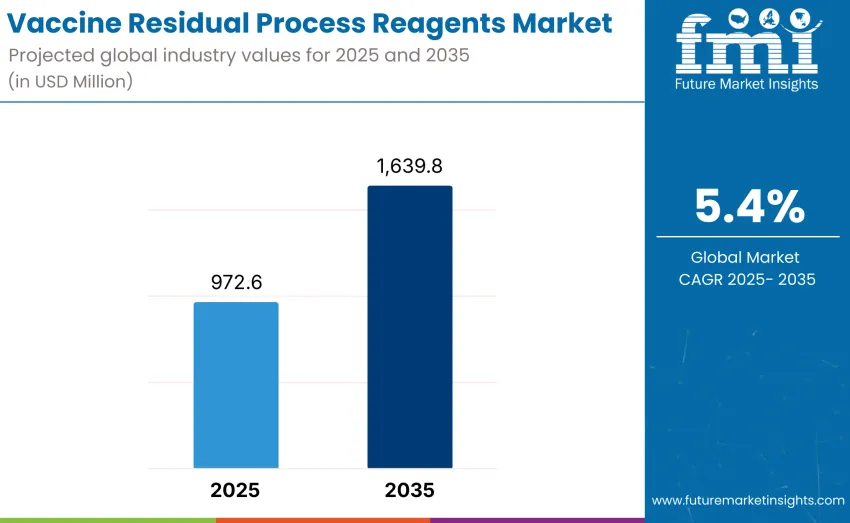
The global vaccine residual process reagents market is projected to reach USD 1,639.8 million by 2035, recording an absolute increase of USD 667.2 million over the forecast period. This market is valued at USD 972.6 million in 2025 and is set to rise at a CAGR of 5.4% during the assessment period. Overall size is expected to grow by nearly 1.5 times over the same period, supported by increasing demand for high-quality vaccines worldwide, driving adoption of advanced quality control solutions and growing investments in biopharmaceutical manufacturing infrastructure and process optimization initiatives globally.
Increasing complexity of vaccine platforms and rising global immunization targets create demand for high-precision reagents capable of detecting host cell proteins, nucleic acids, and endotoxins at trace levels. Technological advancements in assay design, reagent formulation, and automated detection platforms are reshaping the vaccine residual process reagents landscape. Modern systems integrate with ELISA, HPLC, PCR, and chromatography tools, enabling precise detection of residual contaminants and supporting streamlined quality control workflows. Innovations in reagent sensitivity, stability, and reproducibility allow manufacturers to maintain regulatory compliance while reducing batch release times.
Quick Stats for Vaccine Residual Process Reagents Market
- Vaccine Residual Process Reagents Market Value (2025): USD 972.6 million
- Vaccine Residual Process Reagents Market Value (2035): USD 1,639.8 million
- Vaccine Residual Process Reagents Market CAGR: 5.4%
- Leading Reagent Class in Vaccine Residual Process Reagents Market: Nucleases for Residual DNA Removal with 23.7% share
- Key Growth Regions in Vaccine Residual Process Reagents Market: Asia Pacific, Europe, and North America
- Top Players in Vaccine Residual Process Reagents Market: Merck MilliporeSigma (incl. Benzonase), Thermo Fisher Scientific, Cytiva, Sartorius, Croda Pharma (incl. Avanti), BASF (Kolliphor/solvents), Seppic (Air Liquide Group), NOF Corporation (PEG & lipids), ArcticZymes (SAN nucleases), Eastman (BPL/formulation solvents), Promega (nucleases & enzymes)
Government vaccination programs, global immunization campaigns, and public health initiatives accelerate growth. Biopharmaceutical companies and research institutions worldwide are investing in laboratory infrastructure and process optimization to ensure vaccine safety and efficacy. Industry adoption of large-scale automated production platforms drives sustained demand for high-performance reagents that support rapid vaccine development, efficient batch testing, and global distribution. Training programs for laboratory personnel and quality control teams enhance adoption of sophisticated reagents, enabling manufacturers to maintain consistent product quality across diverse vaccine pipelines.
Vaccine Residual Process Reagents Market Year-over-Year Forecast (2025 to 2035)
Between 2025 and 2030, the vaccine residual process reagents market is projected to expand from USD 972.6 million to USD 1,262.9 million, resulting in a value increase of USD 290.3 million, which represents 43.5% of total forecast growth for the decade. This growth phase will be driven by rising global demand for vaccines, increased production capacities, innovation in residual process reagents, and adoption of advanced purification and formulation technologies. Companies are strengthening positions through investment in high-quality reagents, enzyme technologies, process optimization, and strategic expansion in emerging and established markets.
From 2030 to 2035, growth is forecast from USD 1,262.9 million to USD 1,639.8 million, adding USD 376.9 million, constituting 56.5% of overall ten-year expansion. This period is expected to see increased adoption of specialized reagents for next-generation vaccines, collaborations between reagent suppliers and vaccine manufacturers, and focus on scalable, efficient, and sustainable manufacturing processes. Rising global vaccination programs, demand for higher purity reagents, and regulatory compliance will continue to drive growth, along with innovation in enzyme and solvent formulations tailored for advanced vaccine production processes.
Vaccine Residual Process Reagents Market Key Takeaways
| Metric | Value |
|---|---|
| Market Value (2025) | USD 972.6 million |
| Market Forecast Value (2035) | USD 1,639.8 million |
| Forecast CAGR (2025 to 2035) | 5.4% |
Why Is the Vaccine Residual Process Reagents Market Growing Worldwide?
The vaccine residual process reagents market grows by enabling biopharmaceutical manufacturers to achieve superior vaccine purity and safety while maintaining efficient production workflows for regulatory compliance. Vaccine producers face mounting pressure to deliver high-quality products within stringent regulatory timelines, with advanced residual process reagents providing significant improvement in contaminant detection and removal efficiency over conventional methods, making these technologies essential for modern vaccine manufacturing operations. Growing global vaccination programs create demand for professional-grade reagents that can deliver consistent quality across mRNA, viral vector, and protein subunit vaccine production requiring precise impurity control.
Government initiatives promoting vaccine development and manufacturing infrastructure drive adoption in biopharmaceutical facilities, contract manufacturing organizations, and research institutions, where high-quality reagents have direct impact on product safety and regulatory approval success. The global shift toward automated production platforms and quality control systems accelerates demand for reagents that enable rapid batch testing and release processes while maintaining compliance with international standards. Premium pricing of specialized reagents and complex integration requirements with sophisticated purification systems may limit adoption among smaller manufacturers.
How Is the Vaccine Residual Process Reagents Market Segmented by Reagent Class, Application, and Region?
The vaccine residual process reagents market is segmented by reagent class, application, and region. By reagent class, division includes nucleases for residual DNA removal, detergents & solubilizers, inactivation agents, precipitation polymers & flocculants, extraction solvents & phase-transfer aids, buffer additives & scavengers, and LNP/wash & auxiliary process reagents. Based on application, categorization covers mRNA & LNP vaccines, viral vector vaccines, protein subunit & inactivated vaccines, live-attenuated & oral vaccines, and combination/platform-agnostic programs. Regionally, segmentation spans Asia Pacific, Europe, North America, Latin America, and Middle East & Africa.
By Reagent Class, Nucleases for Residual DNA Removal Lead
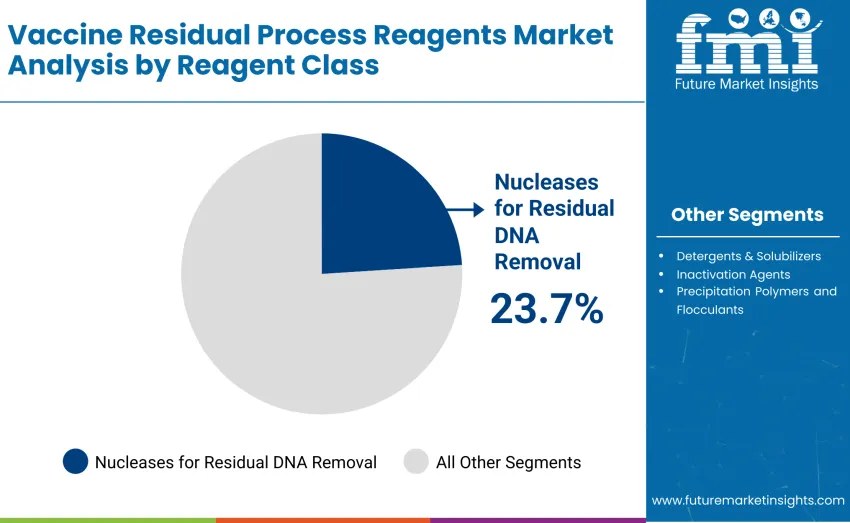
The nucleases for residual DNA removal segment represents the leading force, capturing approximately 23.7% of total revenue in 2025. This segment includes high-purity enzymatic reagents used to degrade residual host-cell DNA during vaccine production, ensuring regulatory compliance and product safety. Leadership stems from essential role in maintaining vaccine quality, reducing contaminants, and supporting high-volume manufacturing workflows where process consistency and regulatory adherence are critical for successful commercialization.
The detergents and solubilizers segment holds 19.6% of share, supporting protein extraction, solubilization, and formulation processes. Inactivation agents account for 16.4%, aiding viral inactivation and stabilization, while precipitation polymers and flocculants contribute 14.8%, helping remove impurities and clarify production streams. Extraction solvents and phase-transfer aids represent 9.7%, buffer additives and scavengers 8.9%, and LNP/wash & auxiliary process reagents 6.9%, providing support for lipid nanoparticle formulation and auxiliary purification steps across diverse vaccine manufacturing platforms.
Key advantages driving the nucleases segment include:
- High specificity in degrading residual DNA to meet regulatory thresholds
- Compatibility with multiple vaccine platforms, including mRNA, viral vector, and protein subunit vaccines
- Integration into automated purification workflows to improve consistency and throughput
By Application, Protein Subunit & Inactivated Vaccines Lead
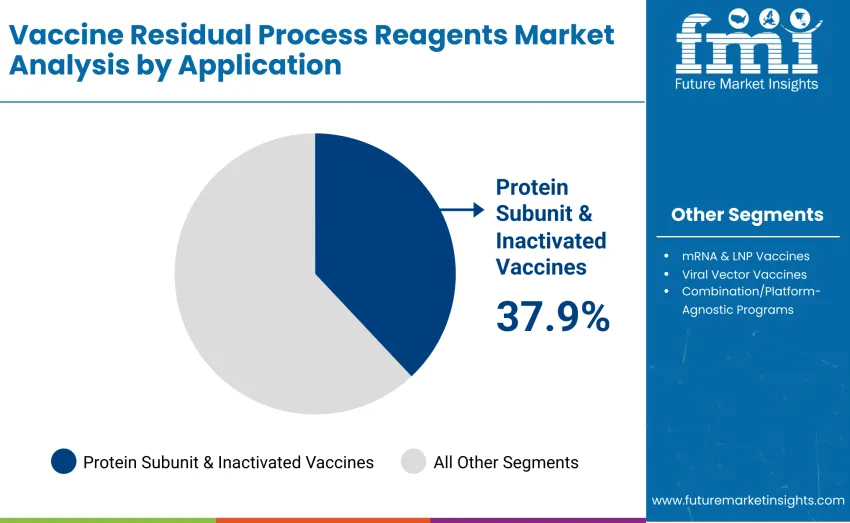
Protein subunit and inactivated vaccines dominate with 37.9% revenue share in 2025, reflecting their widespread adoption and stringent purification requirements these platforms demand. Viral vector vaccines account for 24.6%, and mRNA & LNP vaccines represent 22.8%. Live-attenuated and oral vaccines contribute 9.8%, while combination/platform-agnostic programs account for 4.9%, serving diverse therapeutic applications and research initiatives requiring specialized reagent solutions.
Key market dynamics supporting application preferences include:
- High global demand for protein subunit and inactivated vaccines, particularly in routine immunization programs
- Increasing adoption of viral vector and mRNA platforms requiring specialized reagents for residual DNA removal and process optimization
- Regulatory emphasis on residual impurity control, driving consistent use of high-quality reagents
What Are the Major Drivers, Restraints, and Emerging Trends Influencing the Vaccine Residual Process Reagents Market?
The vaccine residual process reagents market is driven by several key factors tied to growth of global vaccine production and increasing focus on product safety and regulatory compliance. Expansion of vaccination programs worldwide, including COVID-19, influenza, and other emerging infectious diseases, creates higher demand for high-quality reagents that ensure vaccine purity and efficacy. Scaling up of vaccine manufacturing capacities, including mRNA, viral vector, and protein subunit platforms, requires reliable residual process reagents to support automated workflows, high-throughput purification, and formulation processes across diverse production environments.
What Are the Major Restraints Affecting the Adoption of Vaccine Residual Process Reagents?
Stringent regulatory requirements from agencies such as the FDA, EMA, and WHO necessitate precise control over residual DNA, proteins, and other impurities, reinforcing the need for advanced enzymatic and chemical reagents in vaccine production. Restraints include high costs associated with premium reagents, which can pose adoption barriers for small-scale manufacturers or emerging regions. Technical complexity in integrating reagents into sophisticated purification and formulation workflows requires skilled personnel and strict adherence to protocols, which may limit efficiency if not properly managed.
What Emerging Trends Are Shaping the Vaccine Residual Process Reagents Market?
Key emerging trends in the reagent market include the increasing adoption of next-generation reagents designed for mRNA and lipid nanoparticle (LNP) vaccine platforms, which are crucial for the development of novel vaccines. There is also a focus on the creation of multi-functional reagent solutions that streamline the DNA removal, inactivation, and purification processes, enhancing overall efficiency. Additionally, there is growing investment in sustainable and scalable reagent manufacturing processes to meet the rising global demand, driven by the expansion of vaccine production and biotechnology research in response to global health challenges.
How Are Leading Countries Driving Growth in the Vaccine Residual Process Reagents Market?
| Country/Region | CAGR 2025 to 2035 (%) |
|---|---|
| United States | 5.1 |
| Brazil | 5.6 |
| China | 6.0 |
| India | 6.4 |
| Europe | 4.9 |
| Germany | 4.7 |
| United Kingdom | 4.8 |
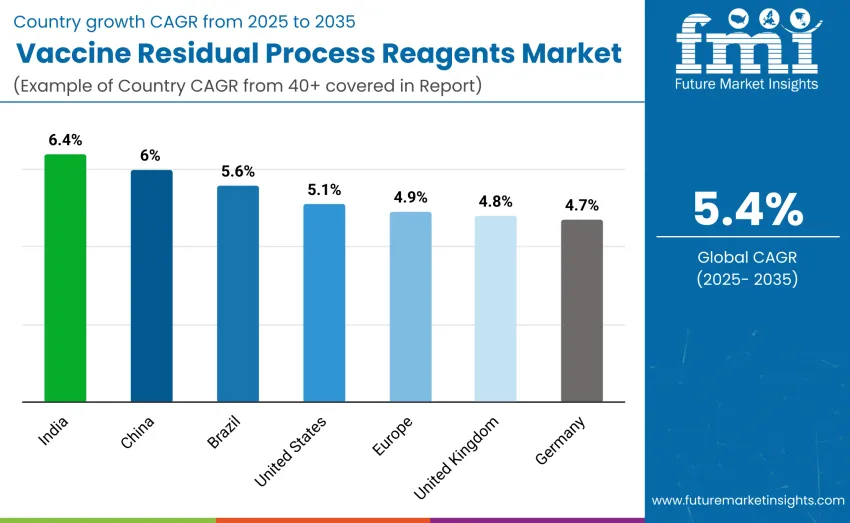
The vaccine residual process reagents market is growing globally, with India leading at a 6.4% CAGR due to government programs promoting local vaccine production and adoption of advanced reagents. China follows with a 6.0% CAGR, driven by expanded vaccine manufacturing and government support for mRNA production. Germany grows at 4.7%, supported by strong manufacturing infrastructure and regulatory standards. Brazil shows a 5.6% CAGR, fueled by expanding vaccine production. The USA maintains a 5.1% growth rate, while the UK shows steady progress at 4.8%, driven by research and manufacturing advancements in vaccine production.
The report covers an in-depth analysis of 40+ countries top-performing countries are highlighted below.
How Are Government Policies and Manufacturing Modernization Accelerating Growth in China?
The vaccine residual process reagents market in China is projected to grow at a CAGR of 6.0% from 2025 to 2035. Growth is primarily driven by national initiatives to modernize vaccine manufacturing facilities, including large-scale adoption of nucleases, inactivation agents, and detergents to optimize DNA removal and virus inactivation processes. Industrial adoption has been facilitated by government-funded programs aimed at strengthening domestic biopharmaceutical infrastructure, with significant investment in mRNA and viral vector vaccine production hubs located in Beijing, Shanghai, Shenzhen, and Hangzhou.
Key market factors:
- Large-scale vaccine manufacturing modernization supported by government policies and industrial adoption of nucleases, inactivation agents, and detergents.
- Integration of automated purification systems and high-quality reagents in mRNA and viral vector vaccine production hubs.
- Policy incentives for domestic reagent production and technology transfer to strengthen biopharma infrastructure.
How Are Biopharma Clusters and Workforce Development Driving Adoption in India?
The vaccine residual process reagents market in India is forecasted to grow at a CAGR of 6.4% through 2035. Expansion is supported by enhanced local manufacturing capacity for mRNA, viral vector, and protein subunit vaccines, underpinned by government programs promoting pharmaceutical infrastructure development and public-private partnerships. Adoption of nucleases, precipitation polymers, and buffer additives has been accelerated by establishment of regional biopharma clusters in Bangalore, Hyderabad, Mumbai, and Pune.
- Expansion of regional biopharma clusters in Bangalore, Hyderabad, Mumbai, and Pune boosting adoption of nucleases, polymers, and buffer additives.
- Workforce skill development through training programs in residual DNA removal, purification, and inactivation processes.
- Government initiatives like Make in India and National Health Mission supporting infrastructure, quality certification, and accessibility to reagents.
How Are Engineering Excellence and Regulatory Standards Supporting Growth in Germany?
Germany's vaccine residual process reagents market is expected to grow at a CAGR of 4.7% through 2035. Growth is driven by engineering excellence in vaccine manufacturing facilities and rigorous regulatory standards under the European Medicines Agency. Adoption of detergents, solubilizers, and LNP/wash auxiliary reagents has been prioritized in production sites located in Berlin, Munich, Hamburg, and Frankfurt, enabling consistent viral vector and protein subunit vaccine quality. Sustainability initiatives, including solvent recycling and energy-efficient purification systems, have been integrated into manufacturing workflows.
Key development areas:
- Advanced R&D-driven innovation optimizing nucleases, inactivation agents, and extraction solvents for improved yield and safety.
- Strong regulatory oversight by the FDA ensuring product reliability, consistency, and compliance.
- Adoption of automated purification systems in commercial and contract development vaccine production hubs.
How Are Manufacturing Modernization and Public Health Initiatives Driving Growth in Brazil?
The vaccine residual process reagents market in Brazil is forecasted to expand at a CAGR of 5.6% from 2025 to 2035. Growth is fueled by modernization of local vaccine production facilities and increasing demand for domestic immunization programs. Adoption of precipitation polymers, inactivation agents, and buffer additives has been supported by public health initiatives and partnerships with international reagent suppliers to ensure high-quality materials are available for mRNA, viral vector, and protein subunit vaccines.
Leading market segments:
- Engineering excellence in vaccine manufacturing facilities ensuring precision and reproducibility in reagent application.
- Adoption of detergents, solubilizers, and LNP/wash auxiliary reagents for viral vector and protein subunit vaccines.
- Integration of sustainable practices including solvent recycling and energy-efficient purification systems.
How Are Advanced R&D and Regulatory Oversight Driving Adoption in the United States?
The USA vaccine residual process reagents market is projected to register a CAGR of 5.1% through 2035. Growth is supported by advanced adoption of automated purification systems and high-performance reagents in both commercial and contract development organizations. Extensive research investment has facilitated innovation in nucleases, inactivation agents, and extraction solvents, optimizing yield, safety, and regulatory compliance. Adoption is concentrated in key vaccine manufacturing hubs in California, Washington, Texas, and New York.
Key market characteristics:
- Expansion of vaccine manufacturing capacity and modernization of local production facilities.
- Cost-efficiency initiatives in process reagent adoption improving operational performance.
- Workforce training programs for biopharma personnel enhancing process knowledge and efficiency.
How Are Advanced Production Facilities and Public Sector Support Enhancing Growth in the United Kingdom?
The vaccine residual process reagents market in the UK is projected to grow at a CAGR of 4.8% through 2035. Expansion is supported by advanced vaccine production infrastructure concentrated in London, Manchester, Bristol, and Edinburgh. High-quality nucleases, detergents, and extraction solvents have been integrated into purification and inactivation workflows to enhance yield and consistency in mRNA and viral vector vaccine production. Public sector support and government-funded research initiatives have accelerated adoption of process reagents.
Market development factors:
- Advanced vaccine production infrastructure supporting integration of high-purity nucleases, detergents, and solvents.
- Government funding and research initiatives accelerating adoption of residual process reagents.
- Collaboration with biotech startups and reagent suppliers promoting technology transfer and innovation.
How Are Creative Economy Investments Advancing Expansion Across Europe?
The vaccine residual process reagents market in Europe is projected to grow from USD 254.8 million in 2025 to USD 408.3 million by 2035, registering a CAGR of 4.9% over the forecast period. Germany is expected to maintain leadership with a 28.5% share in 2025, slightly declining to 27.8% by 2035, supported by advanced vaccine manufacturing infrastructure, robust regulatory compliance under the EMA, and major production hubs in Berlin, Munich, and Hamburg.
France follows with a 22.3% share in 2025, increasing to 22.6% by 2035, driven by strong biotechnology clusters and high-quality reagent adoption in Paris and Lyon. The United Kingdom holds a 19.5% share in 2025, reaching 19.8% by 2035 through expansion of modern vaccine production facilities and public-private collaborations. Italy, Spain, the Netherlands, and the Rest of Europe contribute steadily through localized infrastructure upgrades, workforce training programs, and adoption of advanced process reagents in regional biopharma clusters.
How Competitive Is the Global Vaccine Residual Process Reagents Market and What Defines Its Structure?
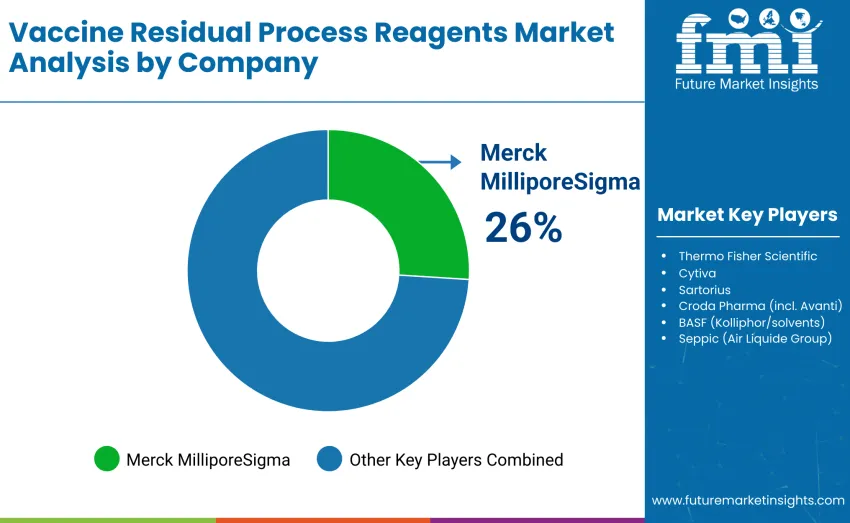
The global vaccine residual process reagents market is moderately concentrated, with 12–15 key players driving most commercial activity. The top three companies, Merck MilliporeSigma (including Benzonase), Thermo Fisher Scientific, and Cytiva, collectively hold roughly 55–60% of the global market share, with Merck MilliporeSigma holding a 26% share. These leaders benefit from established brand reputations, comprehensive product portfolios, and strong regulatory compliance records. Competition is primarily shaped by reagent purity, process compatibility, and scalability for mRNA, viral vector, and protein subunit vaccine production, rather than pricing alone.
Leaders maintain competitive advantages through extensive research investments, high-purity nucleases, inactivation agents, and solvents, as well as integration with automated purification and inactivation workflows. Mid-tier competitors like Sartorius, Croda Pharma (including Avanti), and BASF focus on specialized reagents such as surfactants, lipids, and formulation solvents, with regional penetration strategies. Emerging players such as ArcticZymes, Eastman, NOF Corporation, and Promega drive competition with niche offerings like SAN nucleases, PEG/lipids, and high-quality enzymes.
Competition is particularly fierce in cost-sensitive regions across Asia-Pacific, Latin America, and emerging economies, where pricing pressure drives adoption of alternative suppliers. Innovation in specialized reagents, sustainable manufacturing processes, and workflow integration continues to define competitive positioning.
Key Players in the Vaccine Residual Process Reagents Market
- Merck MilliporeSigma (incl. Benzonase)
- Thermo Fisher Scientific
- Cytiva
- Sartorius
- Croda Pharma (incl. Avanti)
- BASF (Kolliphor/solvents)
- Seppic (Air Liquide Group)
- NOF Corporation (PEG & lipids)
- ArcticZymes (SAN nucleases)
- Eastman (BPL/formulation solvents)
- Promega (nucleases & enzymes)
Scope of the Report
| Items | Values |
|---|---|
| Quantitative Units | USD 972.6 million |
| Reagent Class | Nucleases for Residual DNA Removal, Detergents & Solubilizers, Inactivation Agents, Precipitation Polymers & Flocculants, Extraction Solvents & Phase-Transfer Aids, Buffer Additives & Scavengers, LNP/Wash & Auxiliary Process Reagents |
| Application | mRNA & LNP Vaccines, Viral Vector Vaccines, Protein Subunit & Inactivated Vaccines, Live-Attenuated & Oral Vaccines, Combination/Platform-Agnostic Programs |
| Regions Covered | Asia Pacific, Europe, North America, Latin America, Middle East & Africa |
| Country Covered | USA, Brazil, China, India, Europe, Germany, France, UK |
| Key Companies Profiled | Merck MilliporeSigma (incl. Benzonase ), Thermo Fisher Scientific, Cytiva , Sartorius, Croda Pharma (incl. Avanti), BASF ( Kolliphor /solvents), Seppic (Air Liquide Group), NOF Corporation (PEG & lipids), ArcticZymes (SAN nucleases), Eastman (BPL/formulation solvents), Promega (nucleases & enzymes), Others |
| Additional Attributes | Dollar sales by reagent type and application, regional trends across Asia Pacific, Europe, and North America, competitive landscape of key manufacturers, technical specifications, workflow integration, innovations in reagent chemistry and detection methods, and development of specialized configurations with enhanced sensitivity, specificity, and regulatory compliance |
Vaccine Residual Process Reagents Market by Segments
By Reagent Class:
- Nucleases for Residual DNA Removal
- Detergents & Solubilizers
- Inactivation Agents
- Precipitation Polymers & Flocculants
- Extraction Solvents & Phase-Transfer Aids
- Buffer Additives & Scavengers
- LNP/Wash & Auxiliary Process Reagents
By Application:
- mRNA & LNP Vaccines
- Viral Vector Vaccines
- Protein Subunit & Inactivated Vaccines
- Live-Attenuated & Oral Vaccines
- Combination / Platform-Agnostic Programs
By Region:
- Asia Pacific
- China
- India
- Japan
- South Korea
- Vietnam
- Australia & New Zealand
- ASEAN
- Rest of Asia Pacific
- Europe
- Germany
- United Kingdom
- France
- Italy
- Spain
- Netherlands
- Nordic
- BENELUX
- Rest of Europe
- North America
- United States
- Canada
- Mexico
- Latin America
- Brazil
- Argentina
- Rest of Latin America
- Middle East & Africa
- Kingdom of Saudi Arabia
- Other GCC Countries
- Turkey
- South Africa
- Other African Union
- Rest of Middle East & Africa
Frequently Asked Questions
How big is the vaccine residual process reagents market in 2025?
The global vaccine residual process reagents market is valued at USD 972.6 million in 2025.
What will be the size of the vaccine residual process reagents market in 2035?
The market is projected to reach USD 1,639.8 million by 2035.
How fast will the vaccine residual process reagents market grow between 2025 and 2035?
The market will grow at a CAGR of 5.4% from 2025 to 2035.
Which reagent class leads the vaccine residual process reagents market in 2025?
Nucleases for residual DNA removal lead the market with a 23.7% share in 2025.
Who are the major players in the vaccine residual process reagents market?
Key players include Merck MilliporeSigma, Thermo Fisher Scientific, Cytiva, Sartorius, Croda Pharma, BASF, Seppic, NOF Corporation, ArcticZymes, Eastman, and Promega.
Preview the report firsthand - request a free sample
Get SampleGet the brochure for pricing and purchase details.
Get PDFTable of Content
- Executive Summary
- Regional Level Market Outlook
- Demand-side Trends
- Supply-side Trends
- Technology Roadmap Analysis
- Analysis and Recommendations
- Market Overview
- Market Coverage / Taxonomy
- Market Definition / Scope / Limitations
- Market Background
- Market Dynamics
- Drivers
- Restraints
- Opportunity
- Trends
- Scenario Forecast
- Demand in Optimistic Scenario
- Demand in Likely Scenario
- Demand in Conservative Scenario
- Opportunity Assesment
- Profit Margin Analysis
- Value Chain Analysis
- Raw Material Suppliers
- Reagent Manufacturers
- Mid-Level Participants
- PESTLE and Porter’s Analysis
- Regulatory Landscape
- By Key Regions
- By Key Countries
- Regional Parent Market Outlook
- Technological Innovations
- White-Space Opportunity Assessment
- Market Dynamics
- Regional Level Market Analysis 2020 to 2024 and Forecast, 2025 to 2035
- Historical Market Size USD Million Analysis, 2020 to 2024
- Current and Future Market Size USD Million Projections, 2025 to 2035
- Y-o-Y Growth Trend Analysis
- Absolute $ Opportunity Analysis
- Regional Level Market Analysis 2020 to 2024 and Forecast 2025 to 2035, By Reagent Class
- Introduction / Key Findings
- Historical Market Size USD Million Analysis By Reagent Class, 2020 to 2024
- Current and Future Market Size USD Million Analysis and Forecast By Reagent Class, 2025 to 2035
- Nucleases for Residual DNA Removal
- Detergents & Solubilizers (e.g., polysorbates, zwitterionics)
- Inactivation Agents (BPL, Formaldehyde)
- Precipitation Polymers & Flocculants (PEG, PAEs)
- Extraction Solvents & Phase-Transfer Aids
- Buffer Additives & Scavengers (antioxidants, quenchers)
- LNP/Wash & Auxiliary Process Reagents
- Y-o-Y Growth Trend Analysis By Reagent Class, 2020 to 2024
- Absolute $ Opportunity Analysis By Reagent Class, 2025 to 2035
- Regional Level Market Analysis 2020 to 2024 and Forecast 2025 to 2035, By Application
- Introduction / Key Findings
- Historical Market Size USD Million Analysis By Application, 2020 to 2024
- Current and Future Market Size USD Million Analysis and Forecast By Application, 2025 to 2035
- mRNA & LNP Vaccines
- Viral Vector Vaccines
- Protein Subunit & Inactivated Vaccines
- Live-Attenuated & Oral Vaccines
- Combination / Platform-Agnostic Programs
- Y-o-Y Growth Trend Analysis By Application, 2020 to 2024
- Absolute $ Opportunity Analysis By Application, 2025 to 2035
- Regional Level Market Analysis 2020 to 2024 and Forecast 2025 to 2035, By End User
- Introduction / Key Findings
- Historical Market Size USD Million Analysis By End User, 2020 to 2024
- Current and Future Market Size USD Million Analysis and Forecast By End User, 2025 to 2035
- Vaccine Manufacturers (Innovators & Generics)
- CDMOs & Fill-Finish Providers
- Public Sector Institutes
- Academic & NGO Labs
- Y-o-Y Growth Trend Analysis By End User, 2020 to 2024
- Absolute $ Opportunity Analysis By End User, 2025 to 2035
- Regional Level Market Analysis 2020 to 2024 and Forecast 2025 to 2035, By Region
- Introduction
- Historical Market Size USD Million Analysis By Region, 2020 to 2024
- Current Market Size USD Million Analysis and Forecast By Region, 2025 to 2035
- North America
- Latin America
- East Asia
- South Asia
- Western Europe
- Eastern Europe
- Middle East & Africa
- Market Attractiveness Analysis By Region
- North America Market Analysis 2020 to 2024 and Forecast 2025 to 2035, By Country
- Historical Market Size USD Million Trend Analysis By Market Taxonomy, 2020 to 2024
- Market Size USD Million Forecast By Market Taxonomy, 2025 to 2035
- By Country
- USA
- Canada
- Mexico
- By Reagent Class
- By Application
- By End User
- By Country
- Market Attractiveness Analysis
- By Country
- By Reagent Class
- By Application
- By End User
- Key Takeaways
- Latin America Market Analysis 2020 to 2024 and Forecast 2025 to 2035, By Country
- Historical Market Size USD Million Trend Analysis By Market Taxonomy, 2020 to 2024
- Market Size USD Million Forecast By Market Taxonomy, 2025 to 2035
- By Country
- Brazil
- Argentina
- Rest of Latin America
- By Reagent Class
- By Application
- By End User
- By Country
- Market Attractiveness Analysis
- By Country
- By Reagent Class
- By Application
- By End User
- Key Takeaways
- East Asia Market Analysis 2020 to 2024 and Forecast 2025 to 2035, By Country
- Historical Market Size USD Million Trend Analysis By Market Taxonomy, 2020 to 2024
- Market Size USD Million Forecast By Market Taxonomy, 2025 to 2035
- By Country
- China
- Japan
- South Korea
- By Reagent Class
- By Application
- By End User
- By Country
- Market Attractiveness Analysis
- By Country
- By Reagent Class
- By Application
- By End User
- Key Takeaways
- South Asia Market Analysis 2020 to 2024 and Forecast 2025 to 2035, By Country
- Historical Market Size USD Million Trend Analysis By Market Taxonomy, 2020 to 2024
- Market Size USD Million Forecast By Market Taxonomy, 2025 to 2035
- By Country
- India
- ASEAN Countries
- Australia & New Zealand
- Rest of South Asia
- By Reagent Class
- By Application
- By End User
- By Country
- Market Attractiveness Analysis
- By Country
- By Reagent Class
- By Application
- By End User
- Key Takeaways
- Western Europe Market Analysis 2020 to 2024 and Forecast 2025 to 2035, By Country
- Historical Market Size USD Million Trend Analysis By Market Taxonomy, 2020 to 2024
- Market Size USD Million Forecast By Market Taxonomy, 2025 to 2035
- By Country
- Germany
- UK
- France
- Italy
- Spain
- BENELUX
- Nordic Countries
- Rest of Western Europe
- By Reagent Class
- By Application
- By End User
- By Country
- Market Attractiveness Analysis
- By Country
- By Reagent Class
- By Application
- By End User
- Key Takeaways
- Eastern Europe Market Analysis 2020 to 2024 and Forecast 2025 to 2035, By Country
- Historical Market Size USD Million Trend Analysis By Market Taxonomy, 2020 to 2024
- Market Size USD Million Forecast By Market Taxonomy, 2025 to 2035
- By Country
- Russia
- Hungary
- Poland
- Rest of Eastern Europe
- By Reagent Class
- By Application
- By End User
- By Country
- Market Attractiveness Analysis
- By Country
- By Reagent Class
- By Application
- By End User
- Key Takeaways
- Middle East & Africa Market Analysis 2020 to 2024 and Forecast 2025 to 2035, By Country
- Historical Market Size USD Million Trend Analysis By Market Taxonomy, 2020 to 2024
- Market Size USD Million Forecast By Market Taxonomy, 2025 to 2035
- By Country
- Saudi Arabia
- Other GCC Countries
- Türkiye
- South Africa
- Rest of MEA
- By Reagent Class
- By Application
- By End User
- By Country
- Market Attractiveness Analysis
- By Country
- By Reagent Class
- By Application
- By End User
- Key Takeaways
- Market Structure Analysis
- Competition Dashboard
- Competition Benchmarking
- Market Share Analysis of Top Players
- By Regional
- By Reagent Class
- By Application
- By End User
- Competition Analysis
- Competition Deep Dive
- Merck MilliporeSigma (incl. Benzonase)
- Overview
- Product Portfolio
- Key Financials
- Key Developments
- Global/Regional Footprint
- Strategy Overview
- Marketing Strategy
- SWOT
- Analyst Comment
- Thermo Fisher Scientific
- Overview
- Product Portfolio
- Key Financials
- Key Developments
- Global/Regional Footprint
- Strategy Overview
- Marketing Strategy
- SWOT
- Analyst Comment
- Cytiva
- Overview
- Product Portfolio
- Key Financials
- Key Developments
- Global/Regional Footprint
- Strategy Overview
- Marketing Strategy
- SWOT
- Analyst Comment
- Sartorius
- Overview
- Product Portfolio
- Key Financials
- Key Developments
- Global/Regional Footprint
- Strategy Overview
- Marketing Strategy
- SWOT
- Analyst Comment
- Croda Pharma (incl. Avanti)
- Overview
- Product Portfolio
- Key Financials
- Key Developments
- Global/Regional Footprint
- Strategy Overview
- Marketing Strategy
- SWOT
- Analyst Comment
- BASF (Kolliphor/solvents)
- Overview
- Product Portfolio
- Key Financials
- Key Developments
- Global/Regional Footprint
- Strategy Overview
- Marketing Strategy
- SWOT
- Analyst Comment
- Seppic (Air Liquide Group)
- Overview
- Product Portfolio
- Key Financials
- Key Developments
- Global/Regional Footprint
- Strategy Overview
- Marketing Strategy
- SWOT
- Analyst Comment
- NOF Corporation (PEG & lipids)
- Overview
- Product Portfolio
- Key Financials
- Key Developments
- Global/Regional Footprint
- Strategy Overview
- Marketing Strategy
- SWOT
- Analyst Comment
- ArcticZymes (SAN nucleases)
- Overview
- Product Portfolio
- Key Financials
- Key Developments
- Global/Regional Footprint
- Strategy Overview
- Marketing Strategy
- SWOT
- Analyst Comment
- Eastman (BPL/formulation solvents)
- Overview
- Product Portfolio
- Key Financials
- Key Developments
- Global/Regional Footprint
- Strategy Overview
- Marketing Strategy
- SWOT
- Analyst Comment
- Promega (nucleases & enzymes)
- Overview
- Product Portfolio
- Key Financials
- Key Developments
- Global/Regional Footprint
- Strategy Overview
- Marketing Strategy
- SWOT
- Analyst Comment
- Merck MilliporeSigma (incl. Benzonase)
- Competition Deep Dive
- Assumptions & Acronyms Used
- Research Methodology


