

- Market Size (2026)
- USD 97.5 Mn
- Forecast (2036)
- USD 216.3 Mn
- CAGR (2026 to 2036)
- 8.3%
How big is the Dengue Vaccines Market in 2026?
USD 97.5 million in 2026, reaching USD 216.3 million by 2036 at a 8.3% CAGR
The dengue vaccines market was valued at USD 90.0 million in 2025. The market is set to reach USD 97.5 million by 2026-end and grow at a CAGR of 8.3% between 2026-2036 to reach USD 216.3 million by 2036. Dengvaxia will dominate with a 47.8% share, while Paediatric will lead with a 53.7% share.
Dengue vaccine procurement is shaped by endemic country immunization programs, WHO prequalification timelines, and serotype-specific efficacy evidence. Demand reflects government procurement of licensed dengue vaccines for paediatric and adult populations in tropical and subtropical regions. Buyers include national immunization program managers, PAHO and UNICEF procurement agencies, and private travel medicine providers evaluating serotype coverage, age-group suitability, and cold chain requirements.
Growth reflects increasing dengue burden across endemic regions and expanding vaccine access through WHO prequalification and GAVI support. WHO reported in 2025 that dengue cases continued to rise globally, with over 5 million reported cases sustaining government investment in vaccination programs.
Buyers separate suppliers on serotype coverage, seroprevalence testing requirements, and regulatory approval breadth. Sanofi relies on its licensed Dengvaxia chimeric vaccine, while Takeda gains preference where TAK-003 (Qdenga) where pre-vaccination screening is not required for broader population immunization.
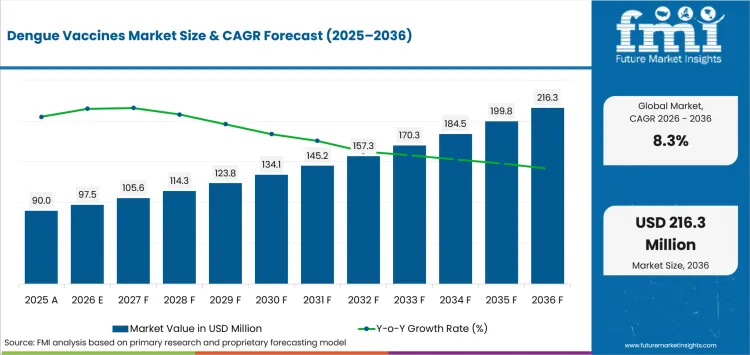
Key Takeaways of Dengue Vaccines Market
- Endemic country immunization programs are expected to sustain dengue vaccine procurement as dengue case burden increases.
- Dengvaxia is expected to account for 47.8% of product demand in 2026 because Sanofi's licensed vaccine maintains first-mover procurement position in seropositive populations.
- Paediatric is projected to hold 53.7% of age group demand in 2026 because children bear the highest dengue hospitalization burden in endemic countries.
- Government Procurement Programs is anticipated to represent 61.6% of distribution demand in 2026, supported by national immunization and PAHO/UNICEF bulk purchasing.
- Thailand leads with a 13.1% CAGR through 2036 as national dengue immunization program expansion sustains vaccine procurement.
- Sanofi is expected to compete through its licensed Dengvaxia position in seropositive population programs.
Analyst Perspective
"Buyers are expected to judge dengvaxia on performance and total cost of ownership rather than headline price. Dengue vaccine adoption is expected to depend on WHO prequalification timelines and national immunization program funding. Suppliers that demonstrate broad serotype coverage with simplified pre-vaccination requirements are likely to secure government procurement contracts. Market success is projected to depend on meeting cold chain logistics and serotype efficacy requirements across endemic country immunization programs."
- Anurag Sharma, Principal Consultant at Future Market Insights
Why is the Dengue Vaccines Market growing?
Rising Dengvaxia and Paediatric demand across healthcare end users
- Dengue-vaccine demand follows national immunization decisions and endemic-country disease burden rather than private-market purchasing.
- Thailand leads growth at 13.1% CAGR as national dengue immunization program expansion sustains vaccine procurement.
- Paediatric holds 53.7% of age group revenue, indicating where standardization is concentrating buyer spend.
Because public programs drive volume, dengue-vaccine spend concentrates with manufacturers whose serotype coverage and pre-vaccination screening fit national immunization and procurement requirements.
How is the Dengue Vaccines Market segmented?
The dengue vaccines industry is segmented by product, age group, end user, distribution channel, technology, and region.
The dengue vaccines market is segmented by product, age group, end user, distribution channel, technology, and region. By product, the market covers Dengvaxia, TAK-003 (Qdenga), and pipeline candidates. By age group, the market covers paediatric and adult. By end user, the market covers direct sales to governments and international organizations, and private healthcare. By distribution channel, the market covers government procurement programs and retail pharmacy. By technology, the market covers chimeric vaccine technology, live attenuated vaccine technology, and subunit and inactivated approaches. Regions include North America, Latin America, Western Europe, Eastern Europe, East Asia, South Asia and Pacific, and the Middle East and Africa.
How does dengvaxia shape demand within the product category?
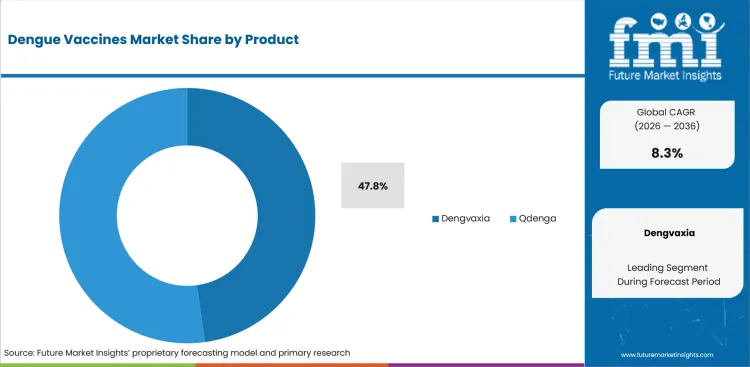
Product selection determines clinical fit, workflow efficiency, and procurement priority across care settings. Dengvaxia anchors the category, keeping buyer spend concentrated where qualification and service support are already established. Demand concentrates here because Sanofi's licensed vaccine maintains first-mover procurement position for seropositive populations.
- Dengvaxia is expected to account for 47.8% of product demand in 2026 because Sanofi's licensed vaccine maintains first-mover procurement position for seropositive populations.
- Chimeric Vaccine Technology is projected to hold 45.5% of technology demand as Dengvaxia's yellow fever backbone chimeric platform remains the established commercial technology.
What supports paediatric age group demand?
Paediatric age group shapes buyer requirements because segment choice here determines clinical fit, workflow efficiency, and procurement priority across care settings. Demand concentrates here because children bear the highest dengue hospitalization burden in endemic countries.
- Paediatric is projected to hold 53.7% of age group demand in 2026 because children bear the highest dengue hospitalization burden in endemic countries.
- Direct Sales To Governments And International Organizations is forecast to represent 58.0% of end-user demand as national immunization programs drive the majority of vaccine procurement.
How do distribution channel and technology shape procurement?
Distribution channel and technology decide who controls the purchase and how the product reaches the account; together they determine clinical fit, workflow efficiency, and procurement priority across care settings. Demand concentrates here because national immunization and PAHO/UNICEF bulk purchasing dominate dengue vaccine procurement.
- Government Procurement Programs is expected to hold 61.6% of distribution demand because national immunization and PAHO/UNICEF bulk purchasing dominate dengue vaccine procurement.
- Live attenuated vaccine technology is gaining share as Takeda's TAK-003 Qdenga expands regulatory approvals without mandatory pre-vaccination screening.
What are the drivers, restraints, and opportunities in the Dengue Vaccines Market?
Near-term procurement is shaped by endemic country dengue burden, WHO prequalification, and serotype coverage evidence.
- Driver: Increasing dengue case burden and hospitalization rates in endemic countries are expected to push government vaccine procurement for national immunization programs.
- Restraint: Pre-vaccination seroprevalence screening requirements for Dengvaxia are likely to slow broad adoption if testing infrastructure limits population coverage.
- Opportunity: Continued GAVI co-financing and expansion of TAK-003 Qdenga's already-achieved WHO prequalification (obtained May 2024) is expected to broaden lower-income endemic country access.
Dengue burden is expected to increase vaccine procurement. WHO reported in 2025 that global dengue case counts continued to rise, with multiple endemic countries expanding immunization program budgets.
Seroprevalence screening requirements are expected to limit Dengvaxia adoption speed. PAHO reported in 2025 that pre-vaccination testing infrastructure remained a deployment barrier in several Latin American endemic countries.
WHO prequalification creates a practical route by enabling GAVI co-financing for endemic countries. Takeda reported in 2025 that its TAK-003 Qdenga vaccine progressed through WHO prequalification review for broader endemic country access.
Which country CAGRs are profiled in the Dengue Vaccines Market?
Thailand 13.1%, China 11.2%, India 10.3%, Indonesia 10.2%, UK 7.1% through 2036
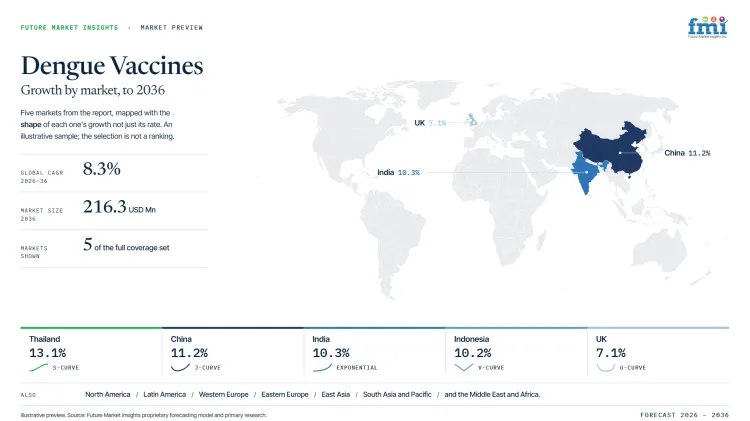
| Country | CAGR (2026 to 2036) |
|---|---|
| Thailand | 13.1% |
| China | 11.2% |
| India | 10.3% |
| Indonesia | 10.2% |
| UK | 7.1% |
Source: FMI's proprietary forecasting model and primary research. 5 of the countries covered in the full report are shown here as a representative subset.
How do country-level CAGRs compare in the Dengue Vaccines Market?
The country comparison spans 6.0 percentage points and reveals three distinct growth groups across the dengue vaccines market. Thailand and China form the upper tier with a 1.9-point difference, while India and Indonesia create a closely aligned middle group separated by only 0.1 percentage point. The United Kingdom remains at the lower end with a 3.1-point gap from Indonesia.
- Thailand leads the comparison at a 13.1% CAGR through 2036, supported by endemic disease burden, public immunization priorities and regional medical-hub investment, which support program-scale vaccine demand.
- China follows at an 11.2% CAGR, remaining 1.9 percentage points below Thailand. Endemic-region programs and regulatory review are shaping the pace of dengue-vaccine introduction.
- India records a 10.3% CAGR, creating a 0.9-percentage-point gap from China. Regulatory-review timelines and program design influence introduction pace, while local approval, endemic-region alignment and supply reliability remain important.
- Indonesia grows at a 10.2% CAGR, only 0.1 percentage point below India. Cold-chain reach and program-funding cycles can constrain rollout beyond priority districts, increasing the importance of supply readiness and program-aligned pricing.
- The United Kingdom records a 7.1% CAGR, remaining 3.1 percentage points below Indonesia. Travel-medicine demand and regulatory approval route dengue-vaccine access through structured public and private channels.
Comparable CAGRs can still produce different market conditions. Differences in endemic disease burden, regulatory timelines, immunization-program funding, cold-chain infrastructure, vaccine coverage requirements and healthcare access influence dengue-vaccine adoption across countries. The full report provides country-level CAGR analysis across major regions and individual markets within the dengue vaccines market.
Country-wise Analysis
- Thai demand for dengue vaccines is shaped by endemic disease priorities and public immunization programs. Travel-medicine positioning and approval breadth shape access. Manufacturers need approval clarity and screening guidance to serve travel and private channels.
- Chinese hospitals procure dengue vaccines through centralized purchasing programs that reward registered, competitively priced products. Demand draws on increasing dengue case burden and hospitalization rates in endemic countries. The Dengue Vaccines Market in China is projected to record an 11.2% CAGR during the assessment period, supported by tertiary hospital expansion and county-level facility upgrades. Cold-chain reach and program-funding cycles constrain rollout beyond priority districts. Manufacturers win with cold-chain-ready supply, program-aligned pricing, and serotype-coverage evidence.
- Indian providers buy dengue vaccines across expanding private hospital chains and cost-sensitive public tenders. Sales in India are forecast to expand at a 10.3% CAGR by 2036, supported by private hospital chain expansion and tertiary care investment. Regulatory-review timelines and program design govern introduction pace. Manufacturers need local approval, endemic-region program alignment, and supply reliability to convert demand.
- Indonesian demand for dengue vaccines scales with public health programs across a dispersed archipelago. The market outlook in Indonesia is anticipated to advance at a 10.2% CAGR over the assessment period, supported by a large endemic burden and expanding public health programs. Travel-medicine positioning and approval breadth shape access. Manufacturers need approval clarity and screening guidance to serve travel and private channels.
- UK providers procure dengue vaccines through NHS frameworks and structured tender cycles. Demand in the United Kingdom is forecast to rise at a 7.1% CAGR over the forecast period, supported by NHS procurement frameworks and structured tender demand. Cold-chain reach and program-funding cycles constrain rollout beyond priority districts. Manufacturers win with cold-chain-ready supply, program-aligned pricing, and serotype-coverage evidence.
Who are the notable companies in the Dengue Vaccines Market?
Sanofi, Takeda Pharmaceuticals, Emergex Vaccines, Indian Immunologicals Ltd., GSK, Merck, Codagenix, and Panacea Biotec are the notable companies shaping this market.
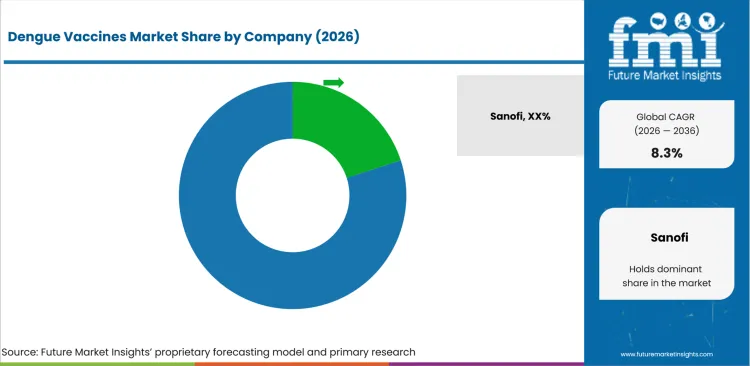
The field concentrates around vaccine manufacturers whose serotype coverage and screening requirements fit national immunization and travel-medicine channels. Global vaccine and pharmaceutical companies compete across Dengvaxia chimeric vaccine, TAK-003 Qdenga live attenuated and Vaccine R&D pipeline throughout established accounts. Dengue vaccine development specialists emphasize T-cell dengue candidate and Codon deoptimized candidate, while regional vaccine manufacturers serve regional demand through Indian vaccine manufacturing. A workable entry is an endemic-region manufacturing or next-generation candidate position. Growth depends on WHO prequalification, national-program alignment, and cold-chain reliability across each launch market. Breadth pays off through portfolios that pair serotype coverage with simplified pre-vaccination screening. A workable entry is an endemic-region manufacturing or next-generation candidate position. Growth depends on WHO prequalification, national-program alignment, and cold-chain reliability across each launch market. Breadth pays off through portfolios that pair serotype coverage with simplified pre-vaccination screening.
- Sanofi and Takeda Pharmaceuticals combine Dengvaxia chimeric vaccine and TAK-003 Qdenga live attenuated across multiple national markets. GSK adds Vaccine R&D pipeline through established account relationships. Their edge comes from licensed serotype coverage and program-aligned supply.
- Emergex Vaccines, Codagenix and Panacea Biotec follow focused routes across T-cell dengue candidate, Codon deoptimized candidate and Vaccine development. Their commercial edge comes from next-generation candidate and regional-manufacturing positions rather than one licensed product.
- Indian Immunologicals Ltd. provides regional coverage through Indian vaccine manufacturing. These firms compete on a focused endemic-market strengths, though reach trails the global vaccine majors.
Competitive Benchmarking: Dengue Vaccines Market
| Company | Portfolio Relevance | Vaccine Focus | Account Access | Service Reach |
|---|---|---|---|---|
| Sanofi | High | Dengvaxia chimeric vaccine | Strong | Global |
| Takeda Pharmaceuticals | High | TAK-003 Qdenga live attenuated | Strong | Global |
| GSK | Medium | Vaccine R&D pipeline | Strong | Global |
| Merck | Medium | Vaccine portfolio | Strong | Global |
| Emergex Vaccines | Medium | T-cell dengue candidate | Moderate | Regional |
| Indian Immunologicals Ltd. | Medium | Indian vaccine manufacturing | Moderate | Regional |
| Codagenix | Medium | Codon deoptimized candidate | Moderate | Regional |
| Panacea Biotec | Medium | Vaccine development | Moderate | Regional |
Source: Future Market Insights competitive analysis, 2026. Ratings reflect relative portfolio relevance, workflow or project fit, service capability, and geographic reach.
Key Developments in the Dengue Vaccines Market
- In May 2024, Takeda's TAK-003 (Qdenga) received WHO prequalification, becoming the second dengue vaccine (after Dengvaxia) to reach that status; by 2026, Qdenga has been approved in 43 countries with more than 32 million doses distributed.
- In 2025, Sanofi announced it would discontinue manufacturing of Dengvaxia due to low global demand, with distribution ending in September 2025 and remaining stock expiring by September 2026; the EU marketing authorization was formally withdrawn in October 2025.
Key Players in the Dengue Vaccines Market
Global vaccine and pharmaceutical companies
- Sanofi
- Takeda Pharmaceuticals
- GSK
- Merck
Dengue vaccine development specialists
- Emergex Vaccines
- Codagenix
- Panacea Biotec
Regional vaccine manufacturers
- Indian Immunologicals Ltd.
Dengue Vaccines Market: Report Scope
| Coverage field | Report scope |
|---|---|
| Market breakdown | Product, age group, end user, distribution channel, technology, and region. |
| Market Definition | Dengue vaccines include chimeric, live attenuated, and subunit vaccine products for paediatric and adult immunization against dengue serotypes, procured through government immunization programs and private healthcare channels. |
| Regions Covered | North America, Latin America, Western Europe, Eastern Europe, East Asia, South Asia and Pacific, and the Middle East and Africa. |
| Countries Covered | Thailand, China, India, Indonesia, Brazil, United Kingdom, and France. |
| Key Companies Profiled | Sanofi, Takeda Pharmaceuticals, Emergex Vaccines, Indian Immunologicals Ltd., GSK, Merck, Codagenix, Panacea Biotec. |
| Forecast Period | 2026 to 2036. |
| Approach | FMI used primary interviews, source validation, and proprietary demand modeling. |
Source: Future Market Insights, analysis driven by proprietary forecasting models and primary research
Dengue Vaccines Market: Research Methodology
| Method | Approach |
|---|---|
| Primary Research |
FMI analysts gathered input from manufacturers, service providers, technology developers, distributors, end users, sourcing teams, and subject-matter experts. Interviews examined purchasing decisions, product or service evaluation, adoption barriers, approval requirements, pricing considerations, and expectations for technical or commercial support. Respondents were also asked what evidence is required before a trial, pilot, or initial order develops into regular purchasing. |
| Desk Research | Desk research covered government statistics, regulatory publications, trade data, industry associations, technical literature, standards, company filings, product information, and official corporate announcements. Sources were reviewed for relevance, publication date, geographic coverage, and consistency with the defined market scope. Claims relating to performance, applications, approvals, capacity, investment, and commercial activity were retained only when supported by credible public evidence. |
| Market Sizing | The market model combined the baseline value with historical performance, segment structure, pricing and volume indicators, adoption levels, company participation, and country-level demand conditions. Forecast assumptions considered economic activity, investment trends, regulatory developments, technology adoption, purchasing cycles, supply availability, and barriers to wider market use. Segment and regional estimates were reconciled before the final market total was calculated. |
| Data Validation | Estimates were checked against multiple independent indicators, including public data, company activity, trade patterns, industry developments, and findings from primary interviews. Validation also tested whether products, services, applications, and company revenues fell within the defined market boundaries. Adjacent categories, unsupported claims, overlapping revenues, and activities without direct market relevance were excluded to reduce double counting and maintain consistency across segments and countries. |
Source: Future Market Insights (FMI) analysis
Market Segmentation Analysis
Dengue Vaccines Market Segmented by Product:
- Dengvaxia
- Live Attenuated Dengue Vaccine
- First Generation Dengue Prevention Solution
- Targeted Seropositive Population Use
- Pandemic Scale Immunization Product
- Improved Disease Burden Reduction
- Public Health Program Integration
- Live Attenuated Dengue Vaccine
- Qdenga
- Tetravalent Dengue Vaccine
- Broad Spectrum Dengue Protection
- Improved Safety Profile
- Next Generation Dengue Immunization
- Expanded Age Group Coverage
- Enhanced Global Adoption Potential
- Tetravalent Dengue Vaccine
Dengue Vaccines Market Segmented by Age Group:
- Paediatric
- Childhood Dengue Prevention Programs
- Reduced Hospitalization Rates
- Improved Pediatric Health Outcomes
- School Based Immunization Initiatives
- Enhanced Community Protection
- Reduced Disease Transmission
- Childhood Dengue Prevention Programs
- Adult
- Adult Dengue Immunization Programs
- Reduced Severe Dengue Risk
- Improved Population Immunity
- Travel Vaccination for Adults
- Enhanced Protection for Endemic Travel
- Improved Preventive Healthcare
- Adult Dengue Immunization Programs
Dengue Vaccines Market Segmented by End User:
- Direct Sales To Governments And International Organizations
- National Immunization Programs
- Large Scale Vaccine Procurement
- Improved Public Health Coverage
- International Health Agencies
- Coordinated Disease Control Initiatives
- Enhanced Vaccine Accessibility
- National Immunization Programs
- Hospitals
- Inpatient Vaccination Programs
- High Patient Throughput Administration
- Improved Clinical Immunization Coverage
- Public And Private Hospitals
- Enhanced Disease Prevention Capability
- Reliable Vaccine Distribution
- Inpatient Vaccination Programs
- Travel Medicine Clinics
- International Travel Vaccination Centers
- Improved Traveler Protection
- Destination Based Immunization Support
- Pre Travel Consultation Clinics
- Enhanced Disease Risk Management
- Improved Patient Awareness
- International Travel Vaccination Centers
- NGOs
- Community Health Campaigns
- Improved Rural Vaccine Outreach
- Enhanced Awareness Programs
- Humanitarian Health Organizations
- Disease Prevention In High Risk Regions
- Improved Vaccination Access
- Community Health Campaigns
Dengue Vaccines Market Segmented by Distribution Channel:
- Government Procurement Programs
- National Immunization Supply Chains
- Large Scale Vaccine Distribution
- Improved Public Health Coverage
- International Health Organization Procurement
- Coordinated Global Vaccine Access
- Enhanced Endemic Disease Control
- National Immunization Supply Chains
- Hospital Procurement
- Hospital Pharmacy Distribution Systems
- Direct Clinical Vaccine Availability
- Improved Patient Access
- Private Healthcare Supply Chains
- Enhanced Vaccination Service Delivery
- Hospital Pharmacy Distribution Systems
- Retail And Pharmacy Channel
- Private Pharmacy Vaccination Services
- Improved Urban Accessibility
- Convenient Outpatient Immunization
- Travel Clinic Pharmacy Networks
- Enhanced Pre Travel Protection
- Improved Patient Convenience
- Private Pharmacy Vaccination Services
Dengue Vaccines Market Segmented by Technology:
- Chimeric Vaccine Technology
- Multi Serotype Protection Vaccines
- Broad Spectrum Dengue Immunity
- Improved Cross Protection Efficiency
- Virus Vector Based Vaccines
- Enhanced Immune System Targeting
- Improved Clinical Efficacy
- Multi Serotype Protection Vaccines
- Live Attenuated Vaccine Technology
- Weakened Virus Strain Vaccines
- Enhanced Immune Response Activation
- Improved Long Term Protection
- Recombinant Vaccine Platforms
- Improved Safety Profile
- Enhanced Scalable Production
- Weakened Virus Strain Vaccines
Dengue Vaccines Market by Region:
- North America
- USA
- Canada
- Mexico
- Latin America
- Brazil
- Chile
- Rest of Latin America
- Western Europe
- Germany
- UK
- Italy
- Spain
- France
- Nordic
- BENELUX
- Rest of Western Europe
- Eastern Europe
- Russia
- Poland
- Hungary
- Balkan & Baltic
- Rest of Eastern Europe
- East Asia
- China
- Japan
- South Korea
- South Asia and Pacific
- India
- ASEAN
- Australia & New Zealand
- Rest of South Asia and Pacific
- Middle East & Africa
- Kingdom of Saudi Arabia
- Other GCC Countries
- Türkiye
- South Africa
- Other African Union
- Rest of Middle East & Africa
Research Sources and Bibliography
- World Health Organization. (2025). Global Dengue Surveillance and Case Burden Report.
- Pan American Health Organization. (2025). Dengue Vaccine Deployment and Pre-Vaccination Screening Assessment.
- Takeda Pharmaceuticals. (2025). TAK-003 Qdenga WHO Prequalification Progress Report.
- Thailand Department of Disease Control. (2025). National Dengue Immunization Program.
- GAVI The Vaccine Alliance. (2025). Dengue Vaccine Co-Financing Framework.
- Central Drugs Standard Control Organisation India. (2025). Dengue Vaccine Regulatory Pathway.
- National Medical Products Administration China. (2025). Vaccine Regulatory Assessment Standards.
- ANVISA Brazil. (2025). Dengue Vaccine Approval and Procurement Standards.
- Indonesia BPOM. (2025). Dengue Vaccine Regulatory and Deployment Framework.
This bibliography uses primary government and company sources.
This Report Answers
- What is the estimated 2026 value of the dengue vaccines market?
- What market value is projected by 2036?
- What CAGR is forecast from 2026 to 2036?
- Which product is expected to account for a notable 2026 share?
- Which countries are profiled for CAGR comparison?
- Which companies are notable in the competitive landscape?
Frequently Asked Questions
How big is the Dengue Vaccines Market in 2026?
The Dengue Vaccines Market is valued at USD 97.5 million in 2026 and is forecast to reach USD 216.3 million by 2036, expanding at a 8.3% CAGR. The Dengue Vaccines Market grew from USD 90.0 million in 2025, with Dengvaxia holding 47.8% of product demand in 2026.
What is the CAGR of the Dengue Vaccines Market from 2026 to 2036?
The Dengue Vaccines Market is projected to grow at a CAGR of 8.3% between 2026 and 2036, supported by increasing dengue burden across endemic regions and expanding vaccine access through WHO prequalification and GAVI support. Dengvaxia holds 47.8% of Dengue Vaccines Market product demand in 2026, while Paediatric leads age group with 53.7% in 2026.
Which product leads the Dengue Vaccines Market?
Dengvaxia accounts for 47.8% of the Dengue Vaccines Market by product in 2026, driven by increasing dengue burden across endemic regions and expanding vaccine access through WHO prequalification and GAVI support. The Dengue Vaccines Market is valued at USD 97.5 million in 2026 and grows at a 8.3% CAGR through 2036, while Paediatric leads age group with 53.7% in 2026.
How much will the Dengue Vaccines Market add between 2026 and 2036?
The Dengue Vaccines Market is set to add USD 118.8 million between 2026 and 2036, growing from USD 97.5 million to USD 216.3 million at a 8.3% CAGR. Paediatric leads age group with 53.7% of Dengue Vaccines Market revenue in 2026, anchoring that incremental demand.
Who are the leading companies in the Dengue Vaccines Market?
The Dengue Vaccines Market profiles 8 key companies in 2026, led by Sanofi, Takeda Pharmaceuticals, Emergex Vaccines, Indian Immunologicals Ltd., and GSK. These suppliers compete across product, where Dengvaxia holds 47.8% of Dengue Vaccines Market demand in 2026. The Dengue Vaccines Market is forecast to reach USD 216.3 million by 2036.
Preview the report firsthand - request a free sample
Get SampleGet the brochure for pricing and purchase details.
Get PDFTable of Content
- Key Takeaways
- Market Size and CAGR
- Top Growth Driver
- Fastest Growing Segment
- Leading Region
- Key Companies
- Emerging Opportunities
- Executive Summary
- Global Market Outlook
- Demand-side Trends
- Supply-side Trends
- Technology Roadmap Analysis
- Analysis and Recommendations
- Analyst Perspective (What is happening? Why now? What should investors know?)
- Key Questions Answered
- How large is the market?
- What is the CAGR?
- What are key trends?
- Which region dominates?
- Who are the leaders?
- Market Overview
- Market Coverage / Taxonomy
- Market Definition / Scope / Limitations
- Research Methodology
- Chapter Orientation
- Analytical Lens and Working Hypotheses
- Market Structure, Signals, and Trend Drivers
- Benchmarking and Cross-market Comparability
- Market Sizing, Forecasting, and Opportunity Mapping
- Research Design and Evidence Framework
- Desk Research Programme (Secondary Evidence)
- Expert Input and Fieldwork (Primary Evidence)
- Tooling, Models, and Reference Databases
- Data Engineering and Model Build
- Quality Assurance and Audit Trail
- Market Background
- Market Dynamics (Drivers, Restraints, Opportunity, Trends)
- Scenario Forecast (Optimistic, Likely, Conservative)
- Impact Analysis
- AI Impact
- Sustainability Impact
- Regulatory Impact
- Technology Impact
- Consumer / Buyer Analysis
- Purchase Drivers
- Adoption Barriers
- Buyer Journey
- Opportunity Map Analysis
- Product Life Cycle Analysis
- Supply Chain Analysis
- Investment Feasibility Matrix
- Value Chain Analysis
- PESTLE and Porter's Analysis
- Regulatory Landscape
- Regional Parent Market Outlook
- Production and Consumption Statistics
- Import and Export Statistics
- Global Market Analysis and Forecast, 2021 to 2036
- Historical Market Size Value (USD Million) Analysis, 2021 to 2025
- Current and Future Market Size Value (USD Million) Projections, 2026 to 2036
- Y-o-Y Growth Trend Analysis
- Absolute $ Opportunity Analysis
- Global Market Pricing Analysis, 2021 to 2036
- Global Market Analysis and Forecast, By Product, 2021 to 2036
- Introduction / Key Findings
- Historical Market Size Value (USD Million) Analysis By Product, 2021 to 2025
- Current and Future Market Size Value (USD Million) Analysis and Forecast By Product, 2026 to 2036
- Dengvaxia
- Live Attenuated Dengue Vaccine
- Pandemic Scale Immunization Product
- Qdenga
- Tetravalent Dengue Vaccine
- Next Generation Dengue Immunization
- Dengvaxia
- Y-o-Y Growth Trend Analysis By Product, 2021 to 2025
- Absolute $ Opportunity Analysis By Product, 2026 to 2036
- Global Market Analysis and Forecast, By Age Group, 2021 to 2036
- Introduction / Key Findings
- Historical Market Size Value (USD Million) Analysis By Age Group, 2021 to 2025
- Current and Future Market Size Value (USD Million) Analysis and Forecast By Age Group, 2026 to 2036
- Paediatric
- Childhood Dengue Prevention Programs
- School Based Immunization Initiatives
- Adult
- Adult Dengue Immunization Programs
- Travel Vaccination for Adults
- Paediatric
- Y-o-Y Growth Trend Analysis By Age Group, 2021 to 2025
- Absolute $ Opportunity Analysis By Age Group, 2026 to 2036
- Global Market Analysis and Forecast, By End User, 2021 to 2036
- Introduction / Key Findings
- Historical Market Size Value (USD Million) Analysis By End User, 2021 to 2025
- Current and Future Market Size Value (USD Million) Analysis and Forecast By End User, 2026 to 2036
- Direct Sales To Governments And International Organizations
- National Immunization Programs
- International Health Agencies
- Hospitals
- Inpatient Vaccination Programs
- Public And Private Hospitals
- Travel Medicine Clinics
- International Travel Vaccination Centers
- Pre Travel Consultation Clinics
- NGOs
- Community Health Campaigns
- Humanitarian Health Organizations
- Direct Sales To Governments And International Organizations
- Y-o-Y Growth Trend Analysis By End User, 2021 to 2025
- Absolute $ Opportunity Analysis By End User, 2026 to 2036
- Global Market Analysis and Forecast, By Distribution Channel, 2021 to 2036
- Introduction / Key Findings
- Historical Market Size Value (USD Million) Analysis By Distribution Channel, 2021 to 2025
- Current and Future Market Size Value (USD Million) Analysis and Forecast By Distribution Channel, 2026 to 2036
- Government Procurement Programs
- National Immunization Supply Chains
- International Health Organization Procurement
- Hospital Procurement
- Hospital Pharmacy Distribution Systems
- Private Healthcare Supply Chains
- Retail And Pharmacy Channel
- Private Pharmacy Vaccination Services
- Travel Clinic Pharmacy Networks
- Government Procurement Programs
- Y-o-Y Growth Trend Analysis By Distribution Channel, 2021 to 2025
- Absolute $ Opportunity Analysis By Distribution Channel, 2026 to 2036
- Global Market Analysis and Forecast, By Technology, 2021 to 2036
- Introduction / Key Findings
- Historical Market Size Value (USD Million) Analysis By Technology, 2021 to 2025
- Current and Future Market Size Value (USD Million) Analysis and Forecast By Technology, 2026 to 2036
- Chimeric Vaccine Technology
- Multi Serotype Protection Vaccines
- Virus Vector Based Vaccines
- Live Attenuated Vaccine Technology
- Weakened Virus Strain Vaccines
- Recombinant Vaccine Platforms
- Chimeric Vaccine Technology
- Y-o-Y Growth Trend Analysis By Technology, 2021 to 2025
- Absolute $ Opportunity Analysis By Technology, 2026 to 2036
- Global Market Analysis and Forecast, By Region, 2021 to 2036
- Introduction
- Historical Market Size Value (USD Million) Analysis By Region, 2021 to 2025
- Current Market Size Value (USD Million) Analysis and Forecast By Region, 2026 to 2036
- North America
- Latin America
- Western Europe
- Eastern Europe
- East Asia
- South Asia and Pacific
- Middle East & Africa
- Market Attractiveness Analysis By Region
- North America Market Analysis and Forecast, By Country, 2021 to 2036
- Historical Market Size Value (USD Million) Trend Analysis By Market Taxonomy, 2021 to 2025
- Market Size Value (USD Million) Forecast By Market Taxonomy, 2026 to 2036
- By Country
- USA
- Canada
- By Product
- By Age Group
- By End User
- By Distribution Channel
- By Technology
- By Country
- Market Attractiveness Analysis
- By Country
- By Product
- By Age Group
- By End User
- By Distribution Channel
- By Technology
- Key Takeaways
- Latin America Market Analysis and Forecast, By Country
- Historical Market Size Value (USD Million) Trend Analysis By Market Taxonomy, 2021 to 2025
- Market Size Value (USD Million) Forecast By Market Taxonomy, 2026 to 2036
- By Country
- Brazil
- Mexico
- Chile
- Rest of Latin America
- By Product
- By Age Group
- By End User
- By Distribution Channel
- By Technology
- By Country
- Market Attractiveness Analysis
- By Country
- By Product
- By Age Group
- By End User
- By Distribution Channel
- By Technology
- Key Takeaways
- Western Europe Market Analysis and Forecast, By Country
- Historical Market Size Value (USD Million) Trend Analysis By Market Taxonomy, 2021 to 2025
- Market Size Value (USD Million) Forecast By Market Taxonomy, 2026 to 2036
- By Country
- Germany
- UK
- Italy
- Spain
- France
- Nordic
- BENELUX
- Rest of Western Europe
- By Product
- By Age Group
- By End User
- By Distribution Channel
- By Technology
- By Country
- Market Attractiveness Analysis
- By Country
- By Product
- By Age Group
- By End User
- By Distribution Channel
- By Technology
- Key Takeaways
- Eastern Europe Market Analysis and Forecast, By Country
- Historical Market Size Value (USD Million) Trend Analysis By Market Taxonomy, 2021 to 2025
- Market Size Value (USD Million) Forecast By Market Taxonomy, 2026 to 2036
- By Country
- Russia
- Poland
- Hungary
- Balkan & Baltic
- Rest of Eastern Europe
- By Product
- By Age Group
- By End User
- By Distribution Channel
- By Technology
- By Country
- Market Attractiveness Analysis
- By Country
- By Product
- By Age Group
- By End User
- By Distribution Channel
- By Technology
- Key Takeaways
- East Asia Market Analysis and Forecast, By Country
- Historical Market Size Value (USD Million) Trend Analysis By Market Taxonomy, 2021 to 2025
- Market Size Value (USD Million) Forecast By Market Taxonomy, 2026 to 2036
- By Country
- China
- Japan
- South Korea
- By Product
- By Age Group
- By End User
- By Distribution Channel
- By Technology
- By Country
- Market Attractiveness Analysis
- By Country
- By Product
- By Age Group
- By End User
- By Distribution Channel
- By Technology
- Key Takeaways
- South Asia and Pacific Market Analysis and Forecast, By Country
- Historical Market Size Value (USD Million) Trend Analysis By Market Taxonomy, 2021 to 2025
- Market Size Value (USD Million) Forecast By Market Taxonomy, 2026 to 2036
- By Country
- India
- ASEAN
- Australia & New Zealand
- Rest of South Asia and Pacific
- By Product
- By Age Group
- By End User
- By Distribution Channel
- By Technology
- By Country
- Market Attractiveness Analysis
- By Country
- By Product
- By Age Group
- By End User
- By Distribution Channel
- By Technology
- Key Takeaways
- Middle East & Africa Market Analysis and Forecast, By Country
- Historical Market Size Value (USD Million) Trend Analysis By Market Taxonomy, 2021 to 2025
- Market Size Value (USD Million) Forecast By Market Taxonomy, 2026 to 2036
- By Country
- Kingdom of Saudi Arabia
- Other GCC Countries
- Türkiye
- South Africa
- Other African Union
- Rest of Middle East & Africa
- By Product
- By Age Group
- By End User
- By Distribution Channel
- By Technology
- By Country
- Market Attractiveness Analysis
- By Country
- By Product
- By Age Group
- By End User
- By Distribution Channel
- By Technology
- Key Takeaways
- Key Countries Market Analysis
- USA
- Pricing Analysis
- Market Share Analysis, 2025
- By Product
- By Age Group
- By End User
- By Distribution Channel
- By Technology
- Canada
- Pricing Analysis
- Market Share Analysis, 2025
- By Product
- By Age Group
- By End User
- By Distribution Channel
- By Technology
- Mexico
- Pricing Analysis
- Market Share Analysis, 2025
- By Product
- By Age Group
- By End User
- By Distribution Channel
- By Technology
- Brazil
- Pricing Analysis
- Market Share Analysis, 2025
- By Product
- By Age Group
- By End User
- By Distribution Channel
- By Technology
- Chile
- Pricing Analysis
- Market Share Analysis, 2025
- By Product
- By Age Group
- By End User
- By Distribution Channel
- By Technology
- Germany
- Pricing Analysis
- Market Share Analysis, 2025
- By Product
- By Age Group
- By End User
- By Distribution Channel
- By Technology
- UK
- Pricing Analysis
- Market Share Analysis, 2025
- By Product
- By Age Group
- By End User
- By Distribution Channel
- By Technology
- Italy
- Pricing Analysis
- Market Share Analysis, 2025
- By Product
- By Age Group
- By End User
- By Distribution Channel
- By Technology
- Spain
- Pricing Analysis
- Market Share Analysis, 2025
- By Product
- By Age Group
- By End User
- By Distribution Channel
- By Technology
- France
- Pricing Analysis
- Market Share Analysis, 2025
- By Product
- By Age Group
- By End User
- By Distribution Channel
- By Technology
- India
- Pricing Analysis
- Market Share Analysis, 2025
- By Product
- By Age Group
- By End User
- By Distribution Channel
- By Technology
- ASEAN
- Pricing Analysis
- Market Share Analysis, 2025
- By Product
- By Age Group
- By End User
- By Distribution Channel
- By Technology
- Australia & New Zealand
- Pricing Analysis
- Market Share Analysis, 2025
- By Product
- By Age Group
- By End User
- By Distribution Channel
- By Technology
- China
- Pricing Analysis
- Market Share Analysis, 2025
- By Product
- By Age Group
- By End User
- By Distribution Channel
- By Technology
- Japan
- Pricing Analysis
- Market Share Analysis, 2025
- By Product
- By Age Group
- By End User
- By Distribution Channel
- By Technology
- South Korea
- Pricing Analysis
- Market Share Analysis, 2025
- By Product
- By Age Group
- By End User
- By Distribution Channel
- By Technology
- Russia
- Pricing Analysis
- Market Share Analysis, 2025
- By Product
- By Age Group
- By End User
- By Distribution Channel
- By Technology
- Poland
- Pricing Analysis
- Market Share Analysis, 2025
- By Product
- By Age Group
- By End User
- By Distribution Channel
- By Technology
- Hungary
- Pricing Analysis
- Market Share Analysis, 2025
- By Product
- By Age Group
- By End User
- By Distribution Channel
- By Technology
- Kingdom of Saudi Arabia
- Pricing Analysis
- Market Share Analysis, 2025
- By Product
- By Age Group
- By End User
- By Distribution Channel
- By Technology
- Türkiye
- Pricing Analysis
- Market Share Analysis, 2025
- By Product
- By Age Group
- By End User
- By Distribution Channel
- By Technology
- South Africa
- Pricing Analysis
- Market Share Analysis, 2025
- By Product
- By Age Group
- By End User
- By Distribution Channel
- By Technology
- USA
- Market Structure Analysis
- Competition Dashboard
- Competition Benchmarking
- Market Share Analysis of Top Players
- By Regional
- By Product
- By Age Group
- By End User
- By Distribution Channel
- By Technology
- Emerging Startups
- Innovation Benchmarking
- Competition Analysis
- Competition Deep Dive
- Sanofi
- Overview
- Product Portfolio
- Profitability by Market Segments
- Sales Footprint
- Strategy Overview
- Marketing Strategy
- Product Strategy
- Channel Strategy
- Tadeka Pharmaceuticals
- Emergex Vaccines
- Indian Immunologicals Ltd.
- GlaxosmithKline
- Merck
- Codagenix
- Panacea Biotec
- Sanofi
- Case Studies
- Success Stories
- Recent Developments
- Competition Deep Dive
- Assumptions & Acronyms Used


