

- Market Size (2026)
- USD 333.9 Mn
- Forecast (2036)
- USD 694.6 Mn
- CAGR (2026 to 2036)
- 7.6%
How big is Diabetic Renal Nutrition Market in 2026?
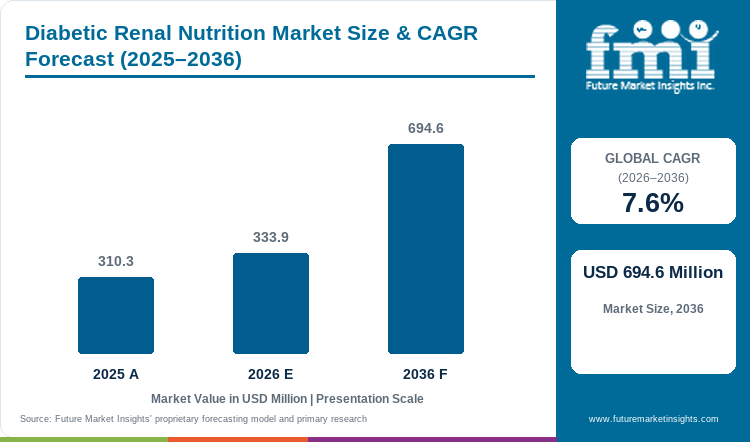
USD 333.9 million in 2026 and USD 694.6 million by 2036 at a 7.6% CAGR.
Sales of diabetic renal nutrition products are estimated to grow at 7.6% from 2026 to 2036, increasing from USD 310.3 million in 2025 to USD 333.9 million in 2026 and reaching USD 694.6 million by 2036. These products address a problem that becomes harder to manage as diabetes and kidney disease overlap. Patients may need to control blood glucose while also watching protein, potassium, phosphorus, calories, and fluid intake. A standard diabetes formula may not meet renal requirements, while a general renal formula may not address glycemic control. That is why diabetic renal products occupy a distinct place within the broader clinical nutrition market.
How that need turns into product use varies by country. In the USA, dietitians can play an active role in diabetes and kidney care, but product payment still depends on the patient's coverage and medical need. In the UK, renal dietitians have a stronger role in deciding how nutrition fits into treatment. Germany has tighter reimbursement rules around enteral nutrition. Japan already has an established nephrology care structure, so sustained use and patient adherence matter more. South Korea is expanding faster as more patients move through specialist kidney-care pathways.
Key Takeaways
- Diabetic CKD creates demand for products that reconcile glycemic management with renal nutrient restrictions as kidney function changes.
- Diabetes-Renal Dual-Adapted ONS is projected to lead Product Type with a 48.3% share in 2026.
- Stage 3 is forecast to account for 51.5% of CKD Stage demand as structured nutrition intervention begins before dialysis for a large patient group.
- Product selection remains patient-specific because protein, potassium, phosphorus, sodium, and fluid targets can change with CKD stage and dialysis status.
- South Korea records the highest profiled country CAGR at 7.9% from 2026 to 2036, followed by USA at 7.3%.
- Abbott, Nestlé Health Science, Fresenius Kabi, Danone Nutricia, Victus, Medtrition, Global Health Products, and B. Braun are among the notable companies serving the market.
Analyst Perspective
“The strongest products will be the ones that continue to fit as kidney disease progresses. A renal claim or diabetes positioning alone is not enough. Suppliers need formulas that match a clear stage of care, can be prescribed or recommended with confidence, and remain easy for patients to use after they leave the hospital.”
- Anurag Sharma, Principal Consultant, Healthcare, Future Market Insights
How is the diabetic renal nutrition market segmented?
Diabetic Renal Nutrition Market is segmented by Product Type, CKD Stage, Product Form, End User, Sales Channel, and Region.
The diabetic renal nutrition market is segmented by Product Type into Diabetes-Renal Dual-Adapted ONS, Low-K Low-GI Snacks, Dual-Adapted Tube Feeds, and Others. CKD Stage covers Stage 3, Stage 4-5 Non-Dialysis, and Dialysis. Product Form includes RTD, Powders, Puddings & Semi-Solids, and Others. End User covers Homecare, Dialysis Centers, Hospitals, Long-Term Care, and Others. Sales Channel includes Hospital Pharmacy, Retail Pharmacy, Online, Institutional Tender, and Others.
Why does Diabetes-Renal Dual-Adapted ONS lead demand within the Product Type category?
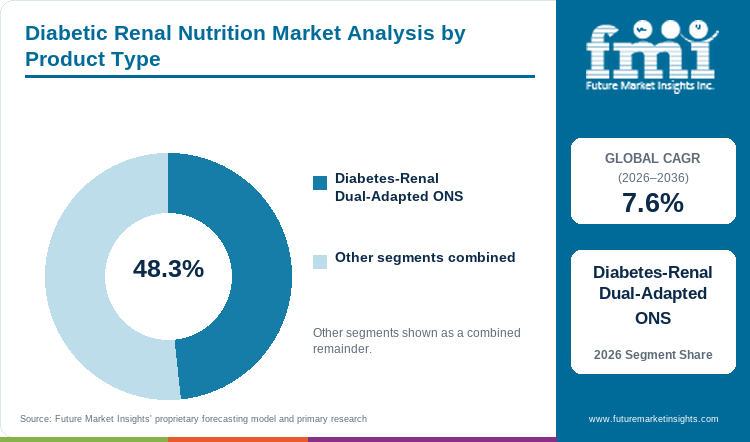
Diabetes-Renal Dual-Adapted ONS leads because it deals with two dietary problems in one product. Patients may need extra calories, but those calories cannot come at the cost of poor glucose control. At the same time, the formula has to fit renal requirements that can change before and after dialysis. Products such as Abbott's Suplena and Nepro show how different protein and mineral profiles can be paired with carbohydrate management for different stages of care. This gives dietitians a more direct option than building a plan around several unrelated products. The same need for disease-specific nutrition is visible across the oral clinical nutritional supplement market, although diabetic renal products have a narrower clinical use case.
- Diabetes-Renal Dual-Adapted ONS is estimated to account for 48.3% of Product Type demand in 2026.
- Dual-adapted formulas reduce the need to assemble separate nutrition products for glycemic control and renal nutrient management.
Why does Stage 3 lead demand within the CKD Stage category?
Stage 3 is often where kidney disease becomes a more active part of diabetes management, but before patients reach dialysis. That creates a large group of people who may need diet changes for a long period. Nutrition teams can begin adjusting protein and minerals while also watching body weight, calorie intake, and glucose control. Later stages are more restrictive, and dialysis can change protein requirements again. Stage 3 therefore combines a broad patient base with a clear reason to introduce more specialized nutrition.
- Stage 3 is forecast to hold 51.5% of CKD Stage demand in 2026.
- Earlier dietitian involvement can create a longer period of product use before dialysis changes the nutrition specification.
Why does RTD lead demand within the Product Form category?
RTD products are easier to use because the serving is already measured and does not need mixing. This matters in hospitals, where staff need consistent nutrient delivery, and at home, where patients may already be following a complicated diet and medication routine. A fixed serving also makes it easier to manage fluid intake and calorie intake together. Powders remain useful when cost, storage, or customization matters, but they require more preparation. Within the wider enteral nutrition market, the same preference for predictable delivery supports ready-to-use formats.
- RTD products are projected to hold 38.4% of Product Form demand in 2026.
- Fixed-volume delivery supports more consistent use across hospitals, dialysis centers, and homecare than formats requiring repeated mixing.
Why does Homecare lead demand within the End User category?
Diabetic CKD is a long-term condition, so most nutrition use eventually happens outside the hospital. Once a dietitian or clinical team has chosen a product, the next challenge is whether the patient can keep using it at home. Products need to be easy to buy again, simple to consume, and practical within an existing meal plan. Caregiver support can also become important as disease severity increases. Growth in therapeutic food delivery for clinical nutrition reflects the wider shift toward managing chronic nutrition needs beyond acute-care settings.
- Homecare is estimated to account for 43.0% of End User demand in 2026.
- Repeat use depends on continuity between dietitian recommendations, discharge instructions, product availability, and the patient's daily routine.
Why does Hospital Pharmacy lead demand within the Sales Channel category?
Hospital pharmacies are important because the first product choice is often made in a controlled clinical setting. Renal dietitians and nutrition teams can review kidney stage, laboratory results, medications, feeding route, and discharge plans before recommending a formula. Hospital formularies also narrow the number of products available to clinicians, which can make initial use more consistent. Retail pharmacies and online channels become more important later, once the patient is familiar with the product and needs regular replenishment.
- Hospital Pharmacy is projected to account for 48.5% of Sales Channel demand in 2026.
- Institutional selection creates a route for clinical evaluation before the product transitions into repeat purchasing through home and retail channels.
What are the drivers, restraints and opportunities in the Diabetic Renal Nutrition Market?
Earlier diabetic CKD identification expands the treatment pool, changing nutrient targets limit standardization, and stage-specific homecare formats create new repeat-use opportunities.
- Driver: Earlier kidney monitoring in people with diabetes increases the number of patients entering structured nutrition management before dialysis.
- Restraint: Protein, carbohydrate, potassium, phosphorus, sodium, and fluid requirements can change with CKD stage, laboratory values, and dialysis status.
- Opportunity: Low-volume RTD and modular products can extend clinically initiated nutrition into homecare while allowing more precise stage-specific adjustment.
Earlier diabetic CKD management expands the addressable nutrition pool
Demand rises when kidney disease is identified before it reaches an advanced stage. In March 2026, CDC reported that 14% of U.S. adults were estimated to have CKD and that four in ten adults with diabetes were estimated to have CKD. Earlier monitoring gives clinicians more time to act when weight loss, poor intake, or tighter renal restrictions begin to affect nutrition. Patients may need more calories without increasing glucose exposure or creating an excessive potassium or phosphorus load. That creates a clear role for nutrition products designed around both conditions.
Changing nutrient targets make one-formula standardization difficult
The main restraint is that the nutrition target is not fixed. A patient who is not on dialysis may need to limit protein, while someone receiving dialysis may need more because treatment can increase protein losses. Potassium, phosphorus, sodium, and fluid targets can also change with laboratory results and disease progression. This means a product that works well at one stage may no longer fit later. Dietitian involvement remains important, and suppliers cannot rely on one formula for every patient. This is one of the features that separates diabetic renal nutrition from much of the broader medical food market.
Care transitions create room for compact and modular formats
The clearest opportunity is to make nutrition easier to continue when patients move from hospital care to home. Low-volume RTD products are useful when fluid intake is limited or appetite is poor. Powders and modular products can help dietitians adjust calories or protein without changing the whole nutrition plan. Products that are simple to carry, consume, and reorder are more likely to remain part of the patient's routine. That gives suppliers a way to turn an initial clinical recommendation into repeat demand.
Which country CAGRs are profiled in the Diabetic Renal Nutrition Market?
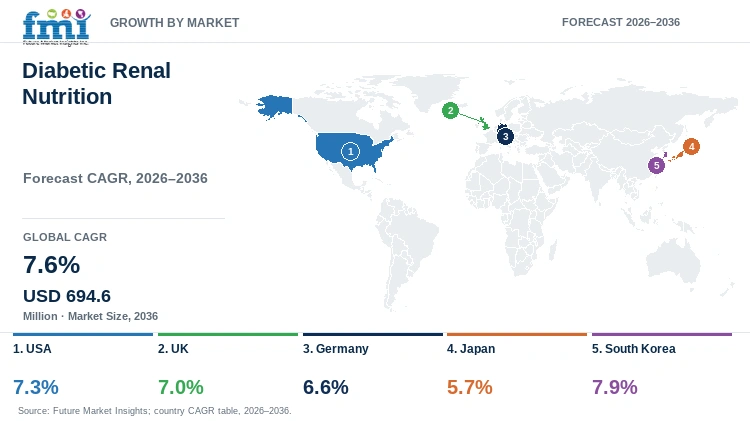
| Country | CAGR |
|---|---|
| USA | 7.3% |
| UK | 7.0% |
| Germany | 6.6% |
| Japan | 5.7% |
| South Korea | 7.9% |
How do country-level CAGRs compare in the Diabetic Renal Nutrition Market?
The five profiled countries show different growth patterns rather than one common adoption curve. South Korea leads at 7.9% CAGR, while USA and UK follow at 7.3% and 7.0%. Germany is projected at 6.6%, and Japan at 5.7%. The gap between these markets reflects differences in specialist care, reimbursement, hospital use, and how easily patients can continue products at home. Growth rate alone does not indicate the size of each national market.
- South Korea exceeds USA by 0.6 percentage points, creating a faster expansion profile for hospital and specialist nutrition channels.
- USA and UK differ by only 0.3 percentage points, but their access models differ because U.S. benefit design and UK formulary pathways shape conversion differently.
- Germany trails UK by 0.4 percentage points as reimbursement qualification and economic appropriateness remain important to covered enteral nutrition.
- Japan's 5.7% CAGR reflects a more mature care environment where suppliers compete more heavily on adherence, stage fit, and practical use.
Country-wise Analysis
- USA: U.S. purchasing spans hospital formularies and dialysis care as well as retail and home replenishment. Demand for Diabetic Renal Nutrition in USA is forecast to expand at 7.3% CAGR from 2026 to 2036. In March 2026, CDC estimated that four in ten U.S. adults with diabetes also had CKD. Medical nutrition therapy supports dietitian involvement, but counseling and product reimbursement can follow different benefit rules. Suppliers therefore need a clear transition from clinical recommendation to repeat home ordering.
- UK: UK adoption is shaped by NHS renal pathways in which specialist dietitians individualize potassium and phosphate advice. Demand for Diabetic Renal Nutrition in UK is forecast to rise at 7.0% CAGR from 2026 to 2036. NICE reviewed its CKD guideline in August 2025 and retained individualized dietary management as part of care. Product adoption therefore depends on whether the formula fits the patient's wider diabetes plan without increasing treatment burden.
- Germany: German buyers operate within a tightly governed statutory reimbursement environment for medically necessary enteral nutrition. Demand for Diabetic Renal Nutrition in Germany is forecast to expand at 6.6% CAGR from 2026 to 2036. In July 2025, the G-BA started an online survey of balanced enteral diets as part of its evaluation of current provision. This keeps clinical purpose and economic appropriateness close to access decisions, favoring products with clear medical positioning and disciplined pricing.
- Japan: Japan's market is anchored in structured nephrology practice and long-term dietary management. Demand for Diabetic Renal Nutrition in Japan is forecast to expand at 5.7% CAGR from 2026 to 2036. The commercial challenge is less about introducing nutrition support and more about securing sustained use when patients already manage multiple dietary restrictions. Compact portions, palatability, and stage-specific nutrient design carry greater weight in this mature setting.
- South Korea: South Korean purchasing is shaped by specialist nephrology pathways as diabetic kidney disease progresses toward kidney failure. Demand for Diabetic Renal Nutrition in South Korea is forecast to rise at 7.9% CAGR from 2026 to 2036. Hospital and specialist nephrology pathways create a concentrated route for disease-specific products as patients move from diabetes management into more advanced kidney care. Clinically usable formulas that address protein and electrolyte requirements without adding unnecessary serving volume can then extend consumption into supervised home use.
Who are the notable companies in the Diabetic Renal Nutrition Market?
Abbott (Glucerna / Nepro), Nestlé Health Science, Fresenius Kabi, Danone Nutricia, Victus, Medtrition, Global Health Products, and B. Braun are notable companies serving this market.
Competition depends on how well a company can match nutrition products to the changing needs of renal patients. Abbott has separate diabetes and renal nutrition brands and offers products for both dialysis and non-dialysis use. Fresenius Kabi combines renal nutrition with oral and tube-feeding products. Nestlé Health Science and Danone Nutricia compete through wider medical nutrition portfolios. B. Braun is closely tied to institutional enteral care, while Medtrition and Global Health Products focus more on concentrated or modular products that can be added to an existing regimen.
- Abbott, Fresenius Kabi, and Nestlé Health Science compete through broad disease-specific clinical nutrition portfolios.
- Danone Nutricia and B. Braun combine specialized nutrition with institutional and enteral-care channels.
- Victus, Medtrition, and Global Health Products participate through more focused diabetes, renal, or modular nutrition propositions.
Competitive Benchmarking: Diabetic Renal Nutrition Market
| Company | Dual-Condition Formulation Evidence | Stage & Modality Coverage | Clinical Channel Depth | Geographic Reach |
|---|---|---|---|---|
| Abbott (Glucerna / Nepro) | High | High | High | North America and broad international clinical nutrition markets |
| Nestlé Health Science | Medium | Medium | High | North America, Europe, Asia-Pacific, Latin America, and other international markets |
| Fresenius Kabi | High | High | High | Europe, Asia-Pacific, Latin America, Middle East, and additional international markets |
| Danone Nutricia | Medium | Medium | High | North America, Europe, Asia-Pacific, Latin America, and other specialized nutrition markets |
| Victus | Unscored | Unscored | Medium | USA and Latin America |
| Medtrition | Medium | Medium | Medium | USA with international clinical distribution |
| Global Health Products | Unscored | Medium | Medium | USA institutional, home, and healthcare channels |
| B. Braun | Medium | Medium | High | Europe and international B. Braun markets |
Dual-Condition Formulation Evidence looks at whether a company's products directly address both renal dietary limits and glycemic needs. Stage & Modality Coverage considers whether the portfolio can serve non-dialysis and dialysis patients through oral or tube-feeding formats. Clinical Channel Depth reflects how widely those products can move through hospitals, pharmacies, enteral-care channels, and home use. High represents broad direct coverage, while Medium indicates a more limited or complementary position.
Key Developments in the Diabetic Renal Nutrition Market
- In March 2026, Fresenius Kabi launched Fresubin Plant-Based Tube Feed in the UK as a ready-to-use 1.5 kcal/ml complete tube feed, expanding the company's institutional enteral nutrition platform.
- In October 2025, Nestlé Health Science entered a strategic partnership with the UC Davis Innovation Institute for Food & Health that includes chronic kidney disease among its nutrition research areas.
- In March 2025, Global Health Products launched LiquaCel HC, a low-volume product providing 250 calories and 20 g of protein per serving, with dialysis nutrition among its supported uses.
Key Players in the Diabetic Renal Nutrition Market
Integrated Disease-Specific Medical Nutrition Platforms
- Abbott
- Fresenius Kabi
- Nestlé Health Science
Clinical Nutrition and Institutional Systems
- Danone Nutricia
- B. Braun
Targeted and Modular Specialty Nutrition Providers
- Victus
- Medtrition
- Global Health Products
Diabetic Renal Nutrition Market - Report Scope
| Coverage field | Report scope |
|---|---|
| Market breakdown | By Product Type, CKD Stage, Product Form, End User, Sales Channel, and Region |
| Quantitative Units | USD Million |
| Market Definition | Market revenue includes disease-specific oral, enteral, snack, semi-solid, and modular nutrition products sold for dietary management of people with both diabetes or glycemic-control needs and chronic kidney disease or renal dietary constraints within the stated segments. It excludes general diabetes-only nutrition, general renal-only nutrition not used for the dual condition, standard foods, drugs, dialysis procedure revenue, counseling fees, and adjacent substitute products. |
| Regions Covered | North America; Latin America; Western Europe; Eastern Europe; East Asia; South Asia and Pacific; Middle East and Africa |
| Countries Covered | USA, UK, Germany, Japan, South Korea, and more than twenty-five additional countries in the full report |
| Key Companies Profiled | Abbott, Nestlé Health Science, Fresenius Kabi, Danone Nutricia, Victus, Medtrition, Global Health Products, B. Braun |
| Forecast Period | 2026 to 2036 |
| Approach | FMI applies a hybrid bottom-up and top-down sizing approach that reconciles product-level sales logic, channel flows, patient and treatment patterns, pricing and mix, and country-specific adoption conditions within the defined market scope. |
Diabetic Renal Nutrition Market - Research Methodology
| Method | Approach |
|---|---|
| Primary Research | FMI analysts gather input from manufacturers, distributors, clinical nutrition specialists, renal and diabetes care professionals, procurement teams, and channel participants. Interviews examine product selection, nutrition requirements, purchase triggers, pricing, channel behavior, and barriers to sustained use. |
| Desk Research | Desk research covers public health statistics, clinical guidance, reimbursement and procurement rules, company filings, first-party product documentation, peer-reviewed literature, and dated corporate announcements relevant to diabetic renal nutrition. |
| Market Sizing and Forecasting | Market sizing combines product revenue logic with patient and treatment pathways, CKD-stage use, product-form mix, channel structure, pricing, and geographic adoption conditions. Forecast assumptions incorporate disease monitoring, clinical nutrition practice, homecare use, and specialized-product development. |
| Data Validation | Findings are cross-checked across clinical, company, channel, and country evidence. Adjacent diabetes-only or renal-only categories are excluded when they do not meet the defined dual-condition use case, and overlapping channel or product revenues are reconciled to avoid double counting and unsupported claims. |
Diabetic Renal Nutrition Market by Segments
Diabetic Renal Nutrition Market segmented by Product Type:
- Diabetes-Renal Dual-Adapted ONS
- Low-K Low-GI Snacks
- Dual-Adapted Tube Feeds
- Others
Diabetic Renal Nutrition Market segmented by CKD Stage:
- Stage 3
- Stage 4-5 (Non-Dialysis)
- Dialysis
Diabetic Renal Nutrition Market segmented by Product Form:
- RTD
- Powders
- Puddings & Semi-Solids
- Others
Diabetic Renal Nutrition Market segmented by End User:
- Homecare
- Dialysis Centers
- Hospitals
- Long-Term Care
- Others
Diabetic Renal Nutrition Market segmented by Sales Channel:
- Hospital Pharmacy
- Retail Pharmacy
- Online
- Institutional Tender
- Others
Diabetic Renal Nutrition Market by Region:
- North America
- United States
- Canada
- Latin America
- Brazil
- Mexico
- Argentina
- Chile
- Western Europe
- Germany
- France
- United Kingdom
- Italy
- Spain
- Benelux
- Nordics
- Eastern Europe
- Poland
- Czech Republic
- Romania
- Hungary
- East Asia
- China
- Japan
- South Korea
- South Asia and Pacific
- India
- ASEAN
- Australia and New Zealand
- Middle East and Africa
- GCC Countries
- South Africa
- Türkiye
- Israel
Research Sources and Bibliography
- American Diabetes Association Professional Practice Committee for Diabetes (2025, December 8). 11. Chronic Kidney Disease and Risk Management: Standards of Care in Diabetes-2026.
- Centers for Disease Control and Prevention (2026, March 31). Chronic Kidney Disease in the United States.
- Centers for Medicare & Medicaid Services (2022, January 1). National Coverage Determination 180.1: Medical Nutrition Therapy.
- Medicare.gov (2026, September 1 accessed). Medical nutrition therapy services.
- National Institute for Health and Care Excellence (2025, August 19 reviewed). Chronic kidney disease: assessment and management, NG203.
- Robert Koch Institute (2025, March 31). Diabetic kidney disease - Adults: Results of the Diabetes Surveillance 2015-2024.
- Gemeinsamer Bundesausschuss (2025, July 1). Bilanzierte Diäten zur enteralen Ernährung: Onlinebefragung bei Herstellern und Fachgesellschaften startet.
- Japanese Society of Nephrology (2024, July 10). CKD Medical Care Guide 2024 publication notice.
- Chung, S. and Korean Society of Nephrology Clinical Practice Guidelines Committee (2023, December 1). Synopsis of the Korean Society of Nephrology 2023 Practical Recommendations for the Management of Diabetic Kidney Disease.
- Nestle Health Science (2025, October 15). Nestle Health Science and University of California, Davis Innovation Institute for Food & Health Announce Strategic Partnership.
- Danone (2025, July 1). Danone completes the acquisition of Kate Farms, enhancing its U.S. specialized nutrition offerings.
- Fresenius Kabi (2026, March 18). Innovating in Plant-Based Nutrition.
- Global Health Products (2025, March 20). Introducing LiquaCel HC: The Convenient Calorie & Protein Solution.
- Abbott Nutrition (2026, September 1 accessed). Nepro with CARBSTEADY and Suplena with CARBSTEADY product information.
- Medtrition (2026, September 1 accessed). RenaMent Product Guide.
This bibliography is provided for reader reference and is not exhaustive. The full report contains the complete reference list and detailed citations.
This Report Answers
- What is the Diabetic Renal Nutrition Market size in 2026 and what value is forecast for 2036?
- Which clinical and care-delivery conditions are supporting demand for diabetic renal nutrition?
- Why does Diabetes-Renal Dual-Adapted ONS lead the Product Type category?
- Why does Stage 3 account for the largest share of CKD Stage demand?
- Why do RTD products lead the Product Form category?
- How do growth rates differ across USA, UK, Germany, Japan, and South Korea?
- Which companies participate across integrated, institutional, and modular diabetic renal nutrition?
- What clinical and reimbursement conditions can limit repeat product use?
Frequently Asked Questions
How big is the Diabetic Renal Nutrition Market in 2026?
The Diabetic Renal Nutrition Market is valued at USD 333.9 million in 2026 and is forecast to reach USD 694.6 million by 2036.
What is the CAGR of the Diabetic Renal Nutrition Market?
The market is projected to expand at 7.6% CAGR from 2026 to 2036 as diabetic CKD management creates demand for nutrition products that address both glycemic and renal requirements.
Which Product Type leads demand in 2026?
Diabetes-Renal Dual-Adapted ONS is projected to lead Product Type with a 48.3% share in 2026 because it combines renal nutrient adaptation with glucose-management requirements within one supervised nutrition format.
Which country has the highest profiled growth rate?
South Korea records the highest profiled CAGR at 7.9% from 2026 to 2036, followed by USA at 7.3% and UK at 7.0%.
Who are the key players in the Diabetic Renal Nutrition Market?
The profiled companies include Abbott, Nestlé Health Science, Fresenius Kabi, Danone Nutricia, Victus, Medtrition, Global Health Products, and B. Braun.
Preview the report firsthand - request a free sample
Get SampleGet the brochure for pricing and purchase details.
Get PDFTable of Content
- Key Takeaways
- Market Size and CAGR
- Top Growth Driver
- Fastest Growing Segment
- Leading Region
- Key Companies
- Emerging Opportunities
- Executive Summary
- Global Market Outlook
- Demand-side Trends
- Supply-side Trends
- Technology Roadmap Analysis
- Analysis and Recommendations
- Analyst Perspective (What is happening? Why now? What should investors know?)
- Key Questions Answered
- How large is the market?
- What is the CAGR?
- What are key trends?
- Which region dominates?
- Who are the leaders?
- Market Overview
- Market Coverage / Taxonomy
- Market Definition / Scope / Limitations
- Research Methodology
- Chapter Orientation
- Analytical Lens and Working Hypotheses
- Market Structure, Signals, and Trend Drivers
- Benchmarking and Cross-market Comparability
- Market Sizing, Forecasting, and Opportunity Mapping
- Research Design and Evidence Framework
- Desk Research Programme (Secondary Evidence)
- Expert Input and Fieldwork (Primary Evidence)
- Tooling, Models, and Reference Databases
- Data Engineering and Model Build
- Quality Assurance and Audit Trail
- Market Background
- Market Dynamics (Drivers, Restraints, Opportunity, Trends)
- Scenario Forecast (Optimistic, Likely, Conservative)
- Impact Analysis
- AI Impact
- Sustainability Impact
- Regulatory Impact
- Technology Impact
- Consumer / Buyer Analysis
- Purchase Drivers
- Adoption Barriers
- Buyer Journey
- Opportunity Map Analysis
- Product Life Cycle Analysis
- Supply Chain Analysis
- Investment Feasibility Matrix
- Value Chain Analysis
- PESTLE and Porter's Analysis
- Regulatory Landscape
- Regional Parent Market Outlook
- Production and Consumption Statistics
- Import and Export Statistics
- Global Market Analysis and Forecast, 2021 to 2036
- Historical Market Size Value (USD Million) Analysis, 2021 to 2025
- Current and Future Market Size Value (USD Million) Projections, 2026 to 2036
- Y-o-Y Growth Trend Analysis
- Absolute $ Opportunity Analysis
- Global Market Pricing Analysis, 2021 to 2036
- Global Market Analysis and Forecast, By Product Type, 2021 to 2036
- Introduction / Key Findings
- Historical Market Size Value (USD Million) Analysis By Product Type, 2021 to 2025
- Current and Future Market Size Value (USD Million) Analysis and Forecast By Product Type, 2026 to 2036
- Diabetes-Renal Dual-Adapted ONS
- Low-K Low-GI Snacks
- Dual-Adapted Tube Feeds
- Others
- Y-o-Y Growth Trend Analysis By Product Type, 2021 to 2025
- Absolute $ Opportunity Analysis By Product Type, 2026 to 2036
- Global Market Analysis and Forecast, By CKD Stage, 2021 to 2036
- Introduction / Key Findings
- Historical Market Size Value (USD Million) Analysis By CKD Stage, 2021 to 2025
- Current and Future Market Size Value (USD Million) Analysis and Forecast By CKD Stage, 2026 to 2036
- Stage 3
- Stage 4-5 (Non-Dialysis)
- Dialysis
- Y-o-Y Growth Trend Analysis By CKD Stage, 2021 to 2025
- Absolute $ Opportunity Analysis By CKD Stage, 2026 to 2036
- Global Market Analysis and Forecast, By Product Form, 2021 to 2036
- Introduction / Key Findings
- Historical Market Size Value (USD Million) Analysis By Product Form, 2021 to 2025
- Current and Future Market Size Value (USD Million) Analysis and Forecast By Product Form, 2026 to 2036
- RTD
- Powders
- Puddings & Semi-Solids
- Others
- Y-o-Y Growth Trend Analysis By Product Form, 2021 to 2025
- Absolute $ Opportunity Analysis By Product Form, 2026 to 2036
- Global Market Analysis and Forecast, By End User, 2021 to 2036
- Introduction / Key Findings
- Historical Market Size Value (USD Million) Analysis By End User, 2021 to 2025
- Current and Future Market Size Value (USD Million) Analysis and Forecast By End User, 2026 to 2036
- Homecare
- Dialysis Centers
- Hospitals
- Long-Term Care
- Others
- Y-o-Y Growth Trend Analysis By End User, 2021 to 2025
- Absolute $ Opportunity Analysis By End User, 2026 to 2036
- Global Market Analysis and Forecast, By Sales Channel, 2021 to 2036
- Introduction / Key Findings
- Historical Market Size Value (USD Million) Analysis By Sales Channel, 2021 to 2025
- Current and Future Market Size Value (USD Million) Analysis and Forecast By Sales Channel, 2026 to 2036
- Hospital Pharmacy
- Retail Pharmacy
- Online
- Institutional Tender
- Others
- Y-o-Y Growth Trend Analysis By Sales Channel, 2021 to 2025
- Absolute $ Opportunity Analysis By Sales Channel, 2026 to 2036
- Global Market Analysis and Forecast, By Region, 2021 to 2036
- Introduction
- Historical Market Size Value (USD Million) Analysis By Region, 2021 to 2025
- Current Market Size Value (USD Million) Analysis and Forecast By Region, 2026 to 2036
- North America
- Latin America
- Western Europe
- Eastern Europe
- East Asia
- South Asia and Pacific
- Middle East and Africa
- Market Attractiveness Analysis By Region
- North America Market Analysis and Forecast, By Country, 2021 to 2036
- Historical Market Size Value (USD Million) Trend Analysis By Market Taxonomy, 2021 to 2025
- Market Size Value (USD Million) Forecast By Market Taxonomy, 2026 to 2036
- By Country
- United States
- Canada
- By Product Type
- By CKD Stage
- By Product Form
- By End User
- By Sales Channel
- By Country
- Market Attractiveness Analysis
- By Country
- By Product Type
- By CKD Stage
- By Product Form
- By End User
- By Sales Channel
- Key Takeaways
- Latin America Market Analysis and Forecast, By Country
- Historical Market Size Value (USD Million) Trend Analysis By Market Taxonomy, 2021 to 2025
- Market Size Value (USD Million) Forecast By Market Taxonomy, 2026 to 2036
- By Country
- Brazil
- Mexico
- Argentina
- Chile
- By Product Type
- By CKD Stage
- By Product Form
- By End User
- By Sales Channel
- By Country
- Market Attractiveness Analysis
- By Country
- By Product Type
- By CKD Stage
- By Product Form
- By End User
- By Sales Channel
- Key Takeaways
- Western Europe Market Analysis and Forecast, By Country
- Historical Market Size Value (USD Million) Trend Analysis By Market Taxonomy, 2021 to 2025
- Market Size Value (USD Million) Forecast By Market Taxonomy, 2026 to 2036
- By Country
- Germany
- France
- United Kingdom
- Italy
- Spain
- Benelux
- Nordics
- By Product Type
- By CKD Stage
- By Product Form
- By End User
- By Sales Channel
- By Country
- Market Attractiveness Analysis
- By Country
- By Product Type
- By CKD Stage
- By Product Form
- By End User
- By Sales Channel
- Key Takeaways
- Eastern Europe Market Analysis and Forecast, By Country
- Historical Market Size Value (USD Million) Trend Analysis By Market Taxonomy, 2021 to 2025
- Market Size Value (USD Million) Forecast By Market Taxonomy, 2026 to 2036
- By Country
- Poland
- Czech Republic
- Romania
- Hungary
- By Product Type
- By CKD Stage
- By Product Form
- By End User
- By Sales Channel
- By Country
- Market Attractiveness Analysis
- By Country
- By Product Type
- By CKD Stage
- By Product Form
- By End User
- By Sales Channel
- Key Takeaways
- East Asia Market Analysis and Forecast, By Country
- Historical Market Size Value (USD Million) Trend Analysis By Market Taxonomy, 2021 to 2025
- Market Size Value (USD Million) Forecast By Market Taxonomy, 2026 to 2036
- By Country
- China
- Japan
- South Korea
- By Product Type
- By CKD Stage
- By Product Form
- By End User
- By Sales Channel
- By Country
- Market Attractiveness Analysis
- By Country
- By Product Type
- By CKD Stage
- By Product Form
- By End User
- By Sales Channel
- Key Takeaways
- South Asia and Pacific Market Analysis and Forecast, By Country
- Historical Market Size Value (USD Million) Trend Analysis By Market Taxonomy, 2021 to 2025
- Market Size Value (USD Million) Forecast By Market Taxonomy, 2026 to 2036
- By Country
- India
- ASEAN
- Australia and New Zealand
- By Product Type
- By CKD Stage
- By Product Form
- By End User
- By Sales Channel
- By Country
- Market Attractiveness Analysis
- By Country
- By Product Type
- By CKD Stage
- By Product Form
- By End User
- By Sales Channel
- Key Takeaways
- Middle East and Africa Market Analysis and Forecast, By Country
- Historical Market Size Value (USD Million) Trend Analysis By Market Taxonomy, 2021 to 2025
- Market Size Value (USD Million) Forecast By Market Taxonomy, 2026 to 2036
- By Country
- GCC Countries
- South Africa
- Türkiye
- Israel
- By Product Type
- By CKD Stage
- By Product Form
- By End User
- By Sales Channel
- By Country
- Market Attractiveness Analysis
- By Country
- By Product Type
- By CKD Stage
- By Product Form
- By End User
- By Sales Channel
- Key Takeaways
- Key Countries Market Analysis
- United States
- Pricing Analysis
- Market Share Analysis, 2025
- By Product Type
- By CKD Stage
- By Product Form
- By End User
- By Sales Channel
- Canada
- Pricing Analysis
- Market Share Analysis, 2025
- By Product Type
- By CKD Stage
- By Product Form
- By End User
- By Sales Channel
- Mexico
- Pricing Analysis
- Market Share Analysis, 2025
- By Product Type
- By CKD Stage
- By Product Form
- By End User
- By Sales Channel
- Brazil
- Pricing Analysis
- Market Share Analysis, 2025
- By Product Type
- By CKD Stage
- By Product Form
- By End User
- By Sales Channel
- Chile
- Pricing Analysis
- Market Share Analysis, 2025
- By Product Type
- By CKD Stage
- By Product Form
- By End User
- By Sales Channel
- Germany
- Pricing Analysis
- Market Share Analysis, 2025
- By Product Type
- By CKD Stage
- By Product Form
- By End User
- By Sales Channel
- United Kingdom
- Pricing Analysis
- Market Share Analysis, 2025
- By Product Type
- By CKD Stage
- By Product Form
- By End User
- By Sales Channel
- Italy
- Pricing Analysis
- Market Share Analysis, 2025
- By Product Type
- By CKD Stage
- By Product Form
- By End User
- By Sales Channel
- Spain
- Pricing Analysis
- Market Share Analysis, 2025
- By Product Type
- By CKD Stage
- By Product Form
- By End User
- By Sales Channel
- France
- Pricing Analysis
- Market Share Analysis, 2025
- By Product Type
- By CKD Stage
- By Product Form
- By End User
- By Sales Channel
- India
- Pricing Analysis
- Market Share Analysis, 2025
- By Product Type
- By CKD Stage
- By Product Form
- By End User
- By Sales Channel
- ASEAN
- Pricing Analysis
- Market Share Analysis, 2025
- By Product Type
- By CKD Stage
- By Product Form
- By End User
- By Sales Channel
- Australia and New Zealand
- Pricing Analysis
- Market Share Analysis, 2025
- By Product Type
- By CKD Stage
- By Product Form
- By End User
- By Sales Channel
- China
- Pricing Analysis
- Market Share Analysis, 2025
- By Product Type
- By CKD Stage
- By Product Form
- By End User
- By Sales Channel
- Japan
- Pricing Analysis
- Market Share Analysis, 2025
- By Product Type
- By CKD Stage
- By Product Form
- By End User
- By Sales Channel
- South Korea
- Pricing Analysis
- Market Share Analysis, 2025
- By Product Type
- By CKD Stage
- By Product Form
- By End User
- By Sales Channel
- Poland
- Pricing Analysis
- Market Share Analysis, 2025
- By Product Type
- By CKD Stage
- By Product Form
- By End User
- By Sales Channel
- Hungary
- Pricing Analysis
- Market Share Analysis, 2025
- By Product Type
- By CKD Stage
- By Product Form
- By End User
- By Sales Channel
- Türkiye
- Pricing Analysis
- Market Share Analysis, 2025
- By Product Type
- By CKD Stage
- By Product Form
- By End User
- By Sales Channel
- South Africa
- Pricing Analysis
- Market Share Analysis, 2025
- By Product Type
- By CKD Stage
- By Product Form
- By End User
- By Sales Channel
- United States
- Market Structure Analysis
- Competition Dashboard
- Competition Benchmarking
- Market Share Analysis of Top Players
- By Regional
- By Product Type
- By CKD Stage
- By Product Form
- By End User
- By Sales Channel
- Emerging Startups
- Innovation Benchmarking
- Competition Analysis
- Competition Deep Dive
- Abbott (Glucerna / Nepro)
- Overview
- Product Portfolio
- Profitability by Market Segments
- Sales Footprint
- Strategy Overview
- Marketing Strategy
- Product Strategy
- Channel Strategy
- Nestlé Health Science
- Fresenius Kabi
- Danone Nutricia
- Victus
- Medtrition
- Global Health Products
- B. Braun
- Abbott
- Abbott (Glucerna / Nepro)
- Case Studies
- Success Stories
- Recent Developments
- Competition Deep Dive
- Assumptions & Acronyms Used


