

- Market Size (2026)
- USD 236.8 Mn
- Forecast (2036)
- USD 353.9 Mn
- CAGR (2026 to 2036)
- 4.1%
How big is Dibutyl Maleate Market in 2026?
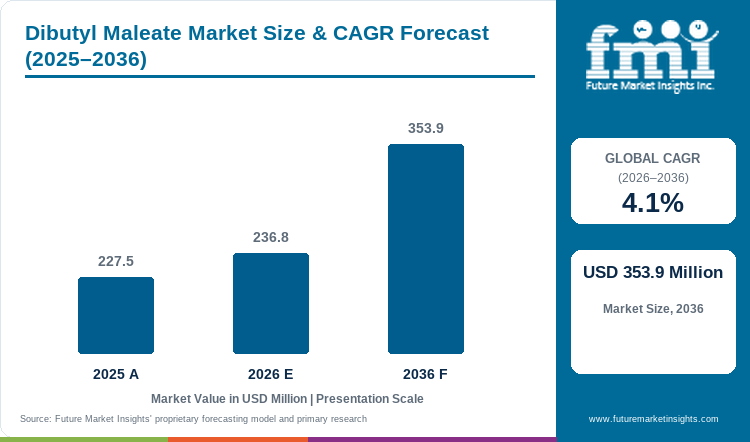
The dibutyl maleate market is valued at USD 236.8 million in 2026 and is projected to reach USD 353.9 million by 2036, expanding at a CAGR of 4.1% over the 2026-2036 period.
The market was valued at USD 227.5 million in 2025. Demand is estimated at USD 236.8 million in 2026 and is projected to reach USD 353.9 million by 2036, reflecting a 4.1% CAGR. The market covers merchant dibutyl maleate sold as a comonomer, intermediate, plasticizing ester or formulation ingredient. Other maleate esters and captive internal transfers fall outside this boundary.
Dibutyl maleate sits within the specialty chemicals market, but demand is tied to the reactions and formulations in which its unsaturated maleate group is useful. ECHA identifies DBM as a registered substance and records commercial identifiers including “RC Comonomer DBM,” reinforcing its role in polymer chemistry. Resin output and formulation activity therefore matter more than broad chemical consumption alone, particularly where DBM is specified for copolymerization or incorporated into coating and adhesive systems.
Key Takeaways
- The market is valued at USD 236.8 million in 2026 and is projected to add USD 117.1 million in value by 2036.
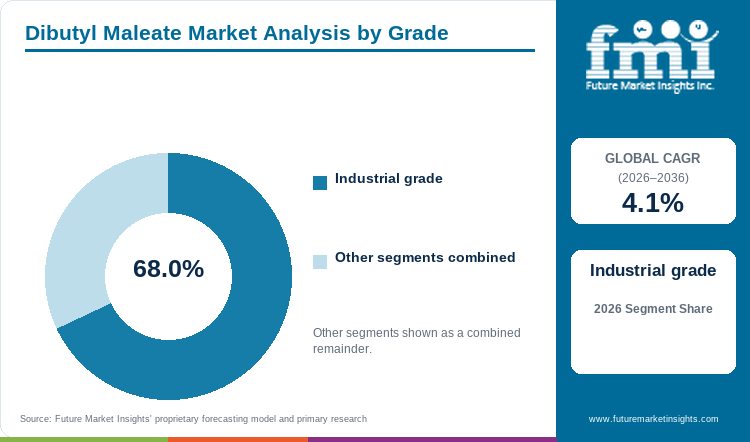
- Industrial grade is projected to account for 68.0% of Grade demand in 2026 because commercial formulations consume DBM at production scale.
- 99.0% and above is projected to account for 61.0% of Purity demand in 2026 because tighter resin and coating specifications support higher-purity material.
- Copolymers and resins are projected to account for 39.0% of Application demand in 2026 because DBM combines reactive unsaturation with ester functionality.
- Competing maleate esters and alternative flexibilizers can replace DBM in formulations that do not require its specific reactivity.
- Key players in this market include Celanese and BASF. Polynt and Mitsubishi Chemical Group are also included. Tokyo Chemical Industry and Merck KGaA form another pair. Thermo Fisher Scientific and Shandong Kexing Chemical complete the group.
Analyst Perspective
“Dibutyl maleate creates value when a formulator needs both reactive maleate chemistry and a flexible ester structure. Purity alone is insufficient when color, acidity or storage stability drifts.”
- Nikhil Kaitwade, Principal Consultant, Future Market Insights
How is the dibutyl maleate market segmented?
The dibutyl maleate market is segmented six ways: by grade, purity, application, end-use industry, sales channel, and region. Industrial grade leads the grade category with 68.0% of 2026 revenue.
The dibutyl maleate market is segmented by grade, purity, application, end-use industry and sales channel. Industrial grade leads grade demand at 68.0% in 2026, while 99.0% and above accounts for 61.0% of purity demand. Copolymers and resins represent 39.0% of application demand, paints, coatings and adhesives account for 46.0% of end-use demand, and direct contracts hold 58.0% of sales-channel demand. These segments reflect how DBM is purchased across production-scale resin systems, formulation-sensitive coating applications and qualified industrial supply relationships.
Why does industrial grade lead dibutyl maleate demand?
Industrial grade sits closest to the requirements of commercial DBM users. The material is consumed as an intermediate in paints, adhesives and films, and Celanese also identifies it for addition reactions. That means buyers need enough control over composition and appearance to protect formulation performance, without paying for analytical-grade specifications that add little value in bulk production. The distinction is visible in the commercial market, where technical DBM specifications commonly control ester content, color, water and acid value rather than purity alone.
- Industrial grade is estimated to account for 68.0% of demand in 2026 as the main consuming applications use DBM as a production-scale intermediate rather than a laboratory reagent.
- Celanese positions DBM directly in paints, adhesives and films, while commercial technical grades are sold against defined ester-content, color and acid-value specifications.
Why does 99.0% and above lead purity demand?
Purity becomes more valuable once DBM enters a controlled polymer recipe. The molecule can participate in addition reactions and is used as a comonomer, so uncontrolled residual material can complicate formulation consistency. Commercial specifications show why buyers look beyond a headline assay: one industrial DBM specification combines 99.0% minimum overall content with limits on dibutyl fumarate, moisture, acid value and color. The specification package, rather than purity in isolation, determines whether a grade is suitable for demanding resin or coating work.
- 99.0% and above is estimated to account for 61.0% of purity demand in 2026 as resin and coating producers require tighter control over the material entering formulation and polymerization processes.
- Commercial DBM specifications can include 99.0% minimum content together with limits for acid value, moisture, color and related ester components, showing that high-purity procurement is tied to a wider quality envelope.
Why do copolymers and resins lead application demand?
DBM has an advantage over a conventional non-reactive plasticizing ingredient because its maleate double bond can take part in polymer chemistry. Celanese specifically describes the material as being used in addition reactions, while patent literature identifies dibutyl maleate among monomers that can be copolymerized with acrylic systems. This allows DBM to become part of the polymer architecture rather than simply remain as a separately dispersed additive, giving resin producers more scope to influence flexibility and film behavior through formulation design.
- Copolymers and resins are estimated to account for 39.0% of application demand in 2026 because DBM can function as a reactive comonomer in addition to serving as an ester intermediate.
- Published acrylic-resin chemistry identifies dibutyl maleate among monomers that can be copolymerized with acrylic monomers, while Celanese describes DBM as suitable for addition reactions and film production.
How do coatings and adhesives shape end-use demand?
DBM reaches coating and adhesive producers through more than one route. It can be used as an intermediate during resin manufacture, then appear in formulations where film flexibility and adhesion matter. Celanese lists paints and coatings together with adhesives as direct DBM applications, and its wider formulation portfolio shows how strongly these markets depend on polymer chemistry tailored to substrate and processing requirements. This makes qualification application-specific: a DBM grade used in one resin system cannot be assumed to behave identically across another binder or curing route.
- Paints, coatings and adhesives are estimated to account for 46.0% of end-use demand in 2026 as DBM participates in resin and film-forming systems serving these formulation-intensive industries.
- Celanese directly lists paints and coatings as well as adhesives among DBM applications, while its industrial adhesive portfolio spans laminating, flooring and packaging systems with different polymer requirements.
Why do direct contracts lead the sales channel?
For larger users, DBM purchasing is tied to specification continuity rather than one-off chemical availability. Celanese publishes dedicated product information and regional sales specifications for DBM, which reflects the documentation expected in industrial supply. Buyers may need the same approved material across repeated batches, while packaging and delivery scale change with plant consumption. Celanese's maleic-acid ester business also maintains separate commercial contacts across the Americas, Europe, China and the rest of Asia, pointing to a sales model built around regional industrial accounts rather than catalog purchasing alone.
- Direct contracts are estimated to account for 58.0% of sales-channel demand in 2026 as high-volume resin and formulation customers place greater value on repeat specifications, supply continuity and established commercial terms.
- Celanese supports its maleic-acid ester portfolio through dedicated regional sales channels, while DBM product pages provide formal product dossiers and sales specifications for industrial customers.
What are the drivers, restraints and opportunities in the Dibutyl Maleate Market?
In the dibutyl maleate market, the key driver is DBM's role as a reactive comonomer and flexible ester in polymer, coating, and adhesive formulations, the key restraint is substitution by alternative maleates and non-phthalate plasticizers in less demanding recipes, and the key opportunity is low-color material with controlled acidity for premium films, coatings, and specialty copolymers.
- Driver: DBM functions as a reactive comonomer and flexible ester in polymers, coatings and adhesives.
- Restraint: Alternative maleates and non-phthalate plasticizers can replace DBM in less demanding recipes.
- Opportunity: Low-color material with controlled acidity can enter premium films and coatings as well as specialty copolymers.
Growth in the coating additives market supports DBM use where formulators need reactive flexibility. Demand depends on the number of qualified recipes rather than a fixed share of total coating output.
DBM competes with dioctyl maleate and fumarates as well as other flexible monomers. Reformulation cost protects current demand. New projects compare price and migration along with cure response and regulatory profile across several chemistries.
The phthalate and non-phthalate plasticizers market creates room for DBM in formulations that combine adhesion and flexibility with controlled film formation. Suppliers can differentiate through low color and low acid value as well as responsive technical service.
Which country CAGRs are profiled in the Dibutyl Maleate Market?
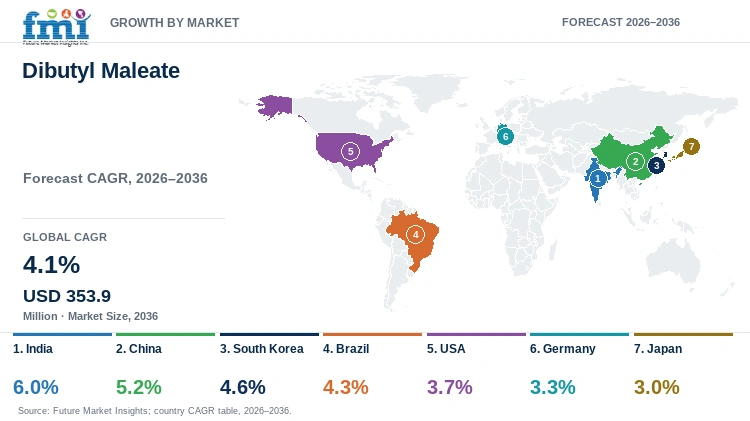
| Country | CAGR |
|---|---|
| India | 6.0% |
| China | 5.2% |
| South Korea | 4.6% |
| Brazil | 4.3% |
| USA | 3.7% |
| Germany | 3.3% |
| Japan | 3.0% |
How do country-level CAGRs compare in the Dibutyl Maleate Market?
The country pattern reflects where DBM can enter resin, coating and adhesive formulations rather than the size of the chemical industry alone. India and China have more room for incremental demand because their chemical and polymer production bases are still expanding. South Korea is more specification-led, while Brazil's case rests heavily on coatings. The USA has a broad installed formulation base. Germany and Japan are more mature, so qualification requirements and substitution economics carry greater weight.
- India: The country's chemical and petrochemical base continues to expand, giving DBM more potential entry points in resins and formulation intermediates. India's Department of Chemicals and Petrochemicals reported 58.6 million tonnes of major chemical and petrochemical production in 2024-25, with polymers accounting for 29.9% of petrochemical output. For DBM suppliers, the opportunity lies in qualifying material into growing polymer and coating recipes rather than relying on general chemical-sector growth.
- China: DBM demand benefits from the scale and continued expansion of chemical manufacturing. China's National Bureau of Statistics reported that output from raw chemical materials and chemical products increased 7.8% in 2025, while rubber and plastic products rose 5.4%. This provides a broad production base for reactive esters, although DBM still has to compete recipe by recipe with other maleates and flexible monomers.
- South Korea: The market is shaped less by broad volume expansion and more by demanding polymer and industrial customers. Korean manufacturing shipments for chemicals and chemical products increased 3.1% in 2024, while rubber and plastics shipments rose 1.7%. In this environment, low color and repeatable formulation behavior can matter more than simply adding supply capacity.
- Brazil: Coatings provide a tangible downstream route for DBM. ABRAFATI reports that Brazil produced almost 2 billion liters of paint in 2024 across architectural, automotive and other industrial applications. That scale creates a sizeable formulation base, but DBM capture depends on where reactive maleate chemistry is retained in coating recipes rather than on total paint output itself.
- USA: The opportunity is spread across an established coating and adhesive manufacturing network. U.S. Census Bureau data identify 1,125 employer establishments in paint and coating manufacturing alone. DBM suppliers therefore face a fragmented qualification environment in which specification history and technical support can influence account retention more than new plant construction.
- Germany: DBM operates against a difficult chemical-industry backdrop. VCI reported German chemical production down 3.3% in 2025, with average chemical-plant utilization at 72.5%. This makes broad volume growth harder to rely on and increases the importance of applications where DBM already has a defined technical role or can withstand comparison with substitute monomers.
- Japan: The market is supported by an established manufacturing base for chemicals and synthetic-resin coatings rather than rapid capacity creation. METI continues to track paints, printing inks and synthetic-resin paints as distinct production categories in its Current Survey of Production. For DBM, that points to a mature formulation environment where material consistency and successful qualification are likely to matter more than simple availability.
Across the key countries in this market, these rates measure revenue within the defined product boundary and do not represent growth of the wider parent industry.
Country-wise Analysis
- India, at 6.0% CAGR through 2036, has the strongest expansion profile in the country set. The underlying opportunity comes from a growing chemical and petrochemical base that gives DBM more potential entry points in resins and formulation intermediates. India's Department of Chemicals and Petrochemicals continues to track polymers as a major part of domestic petrochemical production, which strengthens the addressable base for reactive esters.
- China is projected at 5.2% CAGR through 2036. Scale is the defining feature. In 2025, value added in raw chemical materials and chemical products increased 7.8%, while rubber and plastic products rose 5.4%. That creates a deep production base for DBM, although suppliers still have to win formulation-specific approvals against alternative maleates and other flexible monomers.
- South Korea follows at 4.6% CAGR through 2036. Its opportunity is more specification-sensitive than volume-led. Shipments from chemical manufacturing increased in 2024, while rubber and plastics shipments reached KRW 80.3 trillion. For DBM suppliers, low color and consistent copolymer behavior can therefore carry more weight than simply expanding available tonnage.
- Brazil's 4.3% CAGR reflects a smaller but commercially relevant formulation base. Paint production reached almost 2 billion liters in 2024, giving DBM exposure to architectural and industrial coating activity. Distributor inventories can matter disproportionately because buyers are spread across multiple formulation segments rather than concentrated in a small number of very large resin complexes.
- The USA records a 3.7% CAGR through 2036. This is a mature formulation market with a wide installed customer base. The U.S. Census Bureau counts 1,125 employer establishments in paint and coating manufacturing alone. That fragmentation puts more emphasis on qualification history, documentation and technical service than on rapid additions of new DBM capacity.
- Germany, at 3.3% CAGR, operates against a weaker chemical-production backdrop. German chemical output fell 3.3% in 2025 and average plant utilization stood at 72.5%. In such an environment, DBM growth is more likely to come from applications where its reactive maleate chemistry is already justified than from broad increases in chemical consumption.
- Japan closes the group at 3.0% CAGR through 2036. The market is driven by an established specialty-polymer and coatings base rather than aggressive capacity creation. DBM suppliers therefore compete around repeatability and successful qualification, particularly where low color or controlled acidity is important to the final formulation.
Who are the notable companies in the Dibutyl Maleate Market?
Celanese, BASF, Polynt, Mitsubishi Chemical Group, Tokyo Chemical Industry, Merck KGaA, Thermo Fisher Scientific, Shandong Kexing Chemical are the notable companies profiled in this market.
Direct evidence is strongest where suppliers publish DBM products or applications. Diversified resin and ester producers are scored on relevant chemistry and service reach but remain Low when current public information does not confirm merchant DBM.
- Direct DBM Suppliers: Celanese and Tokyo Chemical Industry. Merck KGaA and Thermo Fisher Scientific are also included.
- Industrial Ester and Resin Platforms: BASF and Polynt. Shandong Kexing Chemical is also included.
- Adjacent Specialty-Chemical Groups: Mitsubishi Chemical Group.
Competitive Benchmarking: Dibutyl Maleate Market
| Company | Direct DBM Evidence | Formulation Support | Supply Reach | Geographic Reach |
|---|---|---|---|---|
| Celanese | High | High | High | Global |
| BASF | Medium | High | High | Global |
| Polynt | Medium | High | High | Global |
| Mitsubishi Chemical Group | Low | High | High | Global |
| Tokyo Chemical Industry | High | Medium | Medium | Global |
| Merck KGaA | Medium | Medium | High | Global |
| Thermo Fisher Scientific | Medium | Medium | High | Global |
| Shandong Kexing Chemical | Medium | Medium | Medium | Asia, export |
High direct evidence requires a named DBM product or application. Medium reflects industrial ester capability or catalog supply. Low denotes adjacent resin chemistry without confirmed merchant DBM.
Key Developments in the Dibutyl Maleate Market
- In 2026, Celanese continued to publish dibutyl maleate for paints and adhesives as well as copolymers and films. This confirms the product's current formulation scope.
- In 2025, European chemical registration resources continued to list dibutyl maleate as a registered industrial substance. This sustains compliance and exposure documentation requirements.
- In 2024, coating formulators continued low-emission product development. This increased scrutiny of every reactive diluent and ester as well as additive used in finished films.
Key Players in the Dibutyl Maleate Market
Direct DBM Suppliers
- Celanese
- Tokyo Chemical Industry
- Merck KGaA
- Thermo Fisher Scientific
Industrial Ester and Resin Platforms
- BASF
- Polynt
- Shandong Kexing Chemical
Adjacent Specialty-Chemical Groups
- Mitsubishi Chemical Group
Dibutyl Maleate Market - Report Scope
| Coverage field | Report scope |
|---|---|
| Market Size | USD 236.8 million in 2026 and USD 353.9 million by 2036 at 4.1% CAGR. |
| Market Definition | Dibutyl maleate sold as an industrial comonomer, specialty ester, formulation ingredient or synthesis intermediate. |
| Segmentation | Grade, purity, application, end-use industry, sales channel and region. |
| Regional Coverage | North America, Latin America, Western Europe, Eastern Europe, East Asia, South Asia and Pacific, and Middle East and Africa. |
| Countries Covered | India, China, South Korea, Brazil, USA, Germany, Japan and more than 20 countries included in the full report. |
| Key Companies Profiled | Celanese, BASF, Polynt, Mitsubishi Chemical Group, Tokyo Chemical Industry, Merck KGaA, Thermo Fisher Scientific, Shandong Kexing Chemical. |
| Forecast Period | 2026 to 2036. |
| Approach | Bottom-up model using resin and coating output, recipe penetration, average dosage, merchant supply and regional realized price. |
Dibutyl Maleate Market - Research Methodology
| Method | Approach |
|---|---|
| Primary Research | FMI analysts gathered input from manufacturers, system integrators, distributors, plant engineers, procurement teams and application specialists. Interviews tested purchasing criteria, replacement cycles, qualification work and technical-service requirements. |
| Desk Research | Desk research covered government statistics, standards, industry associations, technical literature, patents, official product information and corporate announcements. Evidence was screened for scope, date and direct relevance. |
| Market Sizing and Forecasting | Bottom-up model using resin and coating output, recipe penetration, average dosage, merchant supply and regional realized price. |
| Data Validation | Estimates were checked against parent-market activity, installed-base indicators, product specifications and supplier participation. Adjacent products without the defined function were excluded. |
Dibutyl Maleate Market by Segments
Dibutyl Maleate Market segmented by Grade:
- Industrial grade
- High-purity grade
- Laboratory and synthesis grade
Dibutyl Maleate Market segmented by Purity:
- 99.0% and above
- 97.0% to below 99.0%
- Below 97.0%
Dibutyl Maleate Market segmented by Application:
- Copolymers and resins
- Paints and coatings
- Adhesives and sealants
- Plasticizer and formulation uses
- Chemical synthesis
Dibutyl Maleate Market segmented by End-use Industry:
- Paints, coatings and adhesives
- Polymer and resin manufacturing
- Textile and paper treatment
- Other industrial chemicals
Dibutyl Maleate Market segmented by Sales Channel:
- Direct contracts
- Chemical distributors
- Online and laboratory channels
Dibutyl Maleate Market by Region:
- North America
- United States
- Canada
- Latin America
- Brazil
- Mexico
- Argentina
- Chile
- Western Europe
- Germany
- France
- United Kingdom
- Italy
- Spain
- Benelux
- Nordics
- Eastern Europe
- Poland
- Czech Republic
- Romania
- Hungary
- East Asia
- China
- Japan
- South Korea
- South Asia and Pacific
- India
- ASEAN
- Australia and New Zealand
- Middle East and Africa
- GCC Countries
- South Africa
- Türkiye
- Israel
Research Sources and Bibliography
- Celanese. (n.d.; accessed September 23, 2026). Dibutyl Maleate product information.
- European Chemicals Agency. (n.d.; accessed September 23, 2026). Dibutyl maleate substance information.
- PubChem. (n.d.; accessed September 23, 2026). Dibutyl maleate compound summary.
- Organisation for Economic Co-operation and Development. (2023). Chemical safety and exposure resources.
- European Coatings. (2025). Regulatory and technology resources for coatings formulators.
- Future Market Insights. (2026). Coating Additives Market.
- Future Market Insights. (2026). Phthalate and Non-phthalate Plasticizers Market.
This bibliography is provided for reader reference and is not exhaustive. The full report contains the complete reference list and detailed citations.
This Report Answers
- How large is the dibutyl maleate market in 2026 and 2036?
- Which product specification leads demand in 2026?
- What operating condition converts technical need into a purchase?
- Which constraint can delay qualification or replacement?
- How do country growth rates compare across the profiled markets?
- Which companies provide direct or adjacent market capability?
Frequently Asked Questions
How big is the dibutyl maleate market in 2026?
The dibutyl maleate market is valued at USD 236.8 million in 2026 and is projected to reach USD 353.9 million by 2036. The estimate covers revenue within the stated market definition and excludes adjacent equipment or chemicals sold without the required function.
What is the CAGR of the dibutyl maleate market from 2026 to 2036?
The market is projected to grow at 4.1% CAGR between 2026 and 2036. Expansion depends on end-market output together with the rate at which plants adopt higher-specification products.
Which grade leads the dibutyl maleate market?
Industrial grade is expected to hold 68.0% share in 2026 because commercial formulations consume DBM at production scale. Broad formulation use supports industrial-grade volume.
Which countries are projected to record higher growth?
India is projected at 6.0% CAGR, followed by China at 5.2% and South Korea at 4.6% through 2036. The comparison reflects local production investment and the timing of replacement or qualification cycles.
Which companies are active in the dibutyl maleate market?
The profiled group includes Celanese, BASF, Polynt, Mitsubishi Chemical Group, Tokyo Chemical Industry, Merck KGaA, Thermo Fisher Scientific, Shandong Kexing Chemical. Capability differs by product range and application evidence.
Preview the report firsthand - request a free sample
Get SampleGet the brochure for pricing and purchase details.
Get PDFTable of Content
- Key Takeaways
- Market Size and CAGR
- Top Growth Driver
- Fastest Growing Segment
- Leading Region
- Key Companies
- Emerging Opportunities
- Executive Summary
- Global Market Outlook
- Demand-side Trends
- Supply-side Trends
- Technology Roadmap Analysis
- Analysis and Recommendations
- Analyst Perspective (What is happening? Why now? What should investors know?)
- Key Questions Answered
- How large is the market?
- What is the CAGR?
- What are key trends?
- Which region dominates?
- Who are the leaders?
- Market Overview
- Market Coverage / Taxonomy
- Market Definition / Scope / Limitations
- Research Methodology
- Chapter Orientation
- Analytical Lens and Working Hypotheses
- Market Structure, Signals, and Trend Drivers
- Benchmarking and Cross-market Comparability
- Market Sizing, Forecasting, and Opportunity Mapping
- Research Design and Evidence Framework
- Desk Research Programme (Secondary Evidence)
- Expert Input and Fieldwork (Primary Evidence)
- Tooling, Models, and Reference Databases
- Data Engineering and Model Build
- Quality Assurance and Audit Trail
- Market Background
- Market Dynamics (Drivers, Restraints, Opportunity, Trends)
- Scenario Forecast (Optimistic, Likely, Conservative)
- Impact Analysis
- AI Impact
- Sustainability Impact
- Regulatory Impact
- Technology Impact
- Consumer / Buyer Analysis
- Purchase Drivers
- Adoption Barriers
- Buyer Journey
- Opportunity Map Analysis
- Product Life Cycle Analysis
- Supply Chain Analysis
- Investment Feasibility Matrix
- Value Chain Analysis
- PESTLE and Porter's Analysis
- Regulatory Landscape
- Regional Parent Market Outlook
- Production and Consumption Statistics
- Import and Export Statistics
- Global Market Analysis and Forecast, 2021 to 2036
- Historical Market Size Value (USD Million) Analysis, 2021 to 2025
- Current and Future Market Size Value (USD Million) Projections, 2026 to 2036
- Y-o-Y Growth Trend Analysis
- Absolute $ Opportunity Analysis
- Global Market Pricing Analysis, 2021 to 2036
- Global Market Analysis and Forecast, By Grade, 2021 to 2036
- Introduction / Key Findings
- Historical Market Size Value (USD Million) Analysis By Grade, 2021 to 2025
- Current and Future Market Size Value (USD Million) Analysis and Forecast By Grade, 2026 to 2036
- Industrial grade
- High-purity grade
- Laboratory and synthesis grade
- Y-o-Y Growth Trend Analysis By Grade, 2021 to 2025
- Absolute $ Opportunity Analysis By Grade, 2026 to 2036
- Global Market Analysis and Forecast, By Purity, 2021 to 2036
- Introduction / Key Findings
- Historical Market Size Value (USD Million) Analysis By Purity, 2021 to 2025
- Current and Future Market Size Value (USD Million) Analysis and Forecast By Purity, 2026 to 2036
- 99.0% and above
- 97.0% to below 99.0%
- Below 97.0%
- Y-o-Y Growth Trend Analysis By Purity, 2021 to 2025
- Absolute $ Opportunity Analysis By Purity, 2026 to 2036
- Global Market Analysis and Forecast, By Application, 2021 to 2036
- Introduction / Key Findings
- Historical Market Size Value (USD Million) Analysis By Application, 2021 to 2025
- Current and Future Market Size Value (USD Million) Analysis and Forecast By Application, 2026 to 2036
- Copolymers and resins
- Paints and coatings
- Adhesives and sealants
- Plasticizer and formulation uses
- Chemical synthesis
- Y-o-Y Growth Trend Analysis By Application, 2021 to 2025
- Absolute $ Opportunity Analysis By Application, 2026 to 2036
- Global Market Analysis and Forecast, By End-use Industry, 2021 to 2036
- Introduction / Key Findings
- Historical Market Size Value (USD Million) Analysis By End-use Industry, 2021 to 2025
- Current and Future Market Size Value (USD Million) Analysis and Forecast By End-use Industry, 2026 to 2036
- Paints, coatings and adhesives
- Polymer and resin manufacturing
- Textile and paper treatment
- Other industrial chemicals
- Y-o-Y Growth Trend Analysis By End-use Industry, 2021 to 2025
- Absolute $ Opportunity Analysis By End-use Industry, 2026 to 2036
- Global Market Analysis and Forecast, By Sales Channel, 2021 to 2036
- Introduction / Key Findings
- Historical Market Size Value (USD Million) Analysis By Sales Channel, 2021 to 2025
- Current and Future Market Size Value (USD Million) Analysis and Forecast By Sales Channel, 2026 to 2036
- Direct contracts
- Chemical distributors
- Online and laboratory channels
- Y-o-Y Growth Trend Analysis By Sales Channel, 2021 to 2025
- Absolute $ Opportunity Analysis By Sales Channel, 2026 to 2036
- Global Market Analysis and Forecast, By Region, 2021 to 2036
- Introduction
- Historical Market Size Value (USD Million) Analysis By Region, 2021 to 2025
- Current Market Size Value (USD Million) Analysis and Forecast By Region, 2026 to 2036
- North America
- Latin America
- Western Europe
- Eastern Europe
- East Asia
- South Asia and Pacific
- Middle East and Africa
- Market Attractiveness Analysis By Region
- North America Market Analysis and Forecast, By Country, 2021 to 2036
- Historical Market Size Value (USD Million) Trend Analysis By Market Taxonomy, 2021 to 2025
- Market Size Value (USD Million) Forecast By Market Taxonomy, 2026 to 2036
- By Country
- United States
- Canada
- By Grade
- By Purity
- By Application
- By End-use Industry
- By Sales Channel
- By Country
- Market Attractiveness Analysis
- By Country
- By Grade
- By Purity
- By Application
- By End-use Industry
- By Sales Channel
- Key Takeaways
- Latin America Market Analysis and Forecast, By Country
- Historical Market Size Value (USD Million) Trend Analysis By Market Taxonomy, 2021 to 2025
- Market Size Value (USD Million) Forecast By Market Taxonomy, 2026 to 2036
- By Country
- Brazil
- Mexico
- Argentina
- Chile
- By Grade
- By Purity
- By Application
- By End-use Industry
- By Sales Channel
- By Country
- Market Attractiveness Analysis
- By Country
- By Grade
- By Purity
- By Application
- By End-use Industry
- By Sales Channel
- Key Takeaways
- Western Europe Market Analysis and Forecast, By Country
- Historical Market Size Value (USD Million) Trend Analysis By Market Taxonomy, 2021 to 2025
- Market Size Value (USD Million) Forecast By Market Taxonomy, 2026 to 2036
- By Country
- Germany
- France
- United Kingdom
- Italy
- Spain
- Benelux
- Nordics
- By Grade
- By Purity
- By Application
- By End-use Industry
- By Sales Channel
- By Country
- Market Attractiveness Analysis
- By Country
- By Grade
- By Purity
- By Application
- By End-use Industry
- By Sales Channel
- Key Takeaways
- Eastern Europe Market Analysis and Forecast, By Country
- Historical Market Size Value (USD Million) Trend Analysis By Market Taxonomy, 2021 to 2025
- Market Size Value (USD Million) Forecast By Market Taxonomy, 2026 to 2036
- By Country
- Poland
- Czech Republic
- Romania
- Hungary
- By Grade
- By Purity
- By Application
- By End-use Industry
- By Sales Channel
- By Country
- Market Attractiveness Analysis
- By Country
- By Grade
- By Purity
- By Application
- By End-use Industry
- By Sales Channel
- Key Takeaways
- East Asia Market Analysis and Forecast, By Country
- Historical Market Size Value (USD Million) Trend Analysis By Market Taxonomy, 2021 to 2025
- Market Size Value (USD Million) Forecast By Market Taxonomy, 2026 to 2036
- By Country
- China
- Japan
- South Korea
- By Grade
- By Purity
- By Application
- By End-use Industry
- By Sales Channel
- By Country
- Market Attractiveness Analysis
- By Country
- By Grade
- By Purity
- By Application
- By End-use Industry
- By Sales Channel
- Key Takeaways
- South Asia and Pacific Market Analysis and Forecast, By Country
- Historical Market Size Value (USD Million) Trend Analysis By Market Taxonomy, 2021 to 2025
- Market Size Value (USD Million) Forecast By Market Taxonomy, 2026 to 2036
- By Country
- India
- ASEAN
- Australia and New Zealand
- By Grade
- By Purity
- By Application
- By End-use Industry
- By Sales Channel
- By Country
- Market Attractiveness Analysis
- By Country
- By Grade
- By Purity
- By Application
- By End-use Industry
- By Sales Channel
- Key Takeaways
- Middle East and Africa Market Analysis and Forecast, By Country
- Historical Market Size Value (USD Million) Trend Analysis By Market Taxonomy, 2021 to 2025
- Market Size Value (USD Million) Forecast By Market Taxonomy, 2026 to 2036
- By Country
- GCC Countries
- South Africa
- Türkiye
- Israel
- By Grade
- By Purity
- By Application
- By End-use Industry
- By Sales Channel
- By Country
- Market Attractiveness Analysis
- By Country
- By Grade
- By Purity
- By Application
- By End-use Industry
- By Sales Channel
- Key Takeaways
- Key Countries Market Analysis
- United States
- Pricing Analysis
- Market Share Analysis, 2025
- By Grade
- By Purity
- By Application
- By End-use Industry
- By Sales Channel
- Canada
- Pricing Analysis
- Market Share Analysis, 2025
- By Grade
- By Purity
- By Application
- By End-use Industry
- By Sales Channel
- Mexico
- Pricing Analysis
- Market Share Analysis, 2025
- By Grade
- By Purity
- By Application
- By End-use Industry
- By Sales Channel
- Brazil
- Pricing Analysis
- Market Share Analysis, 2025
- By Grade
- By Purity
- By Application
- By End-use Industry
- By Sales Channel
- Chile
- Pricing Analysis
- Market Share Analysis, 2025
- By Grade
- By Purity
- By Application
- By End-use Industry
- By Sales Channel
- Germany
- Pricing Analysis
- Market Share Analysis, 2025
- By Grade
- By Purity
- By Application
- By End-use Industry
- By Sales Channel
- United Kingdom
- Pricing Analysis
- Market Share Analysis, 2025
- By Grade
- By Purity
- By Application
- By End-use Industry
- By Sales Channel
- Italy
- Pricing Analysis
- Market Share Analysis, 2025
- By Grade
- By Purity
- By Application
- By End-use Industry
- By Sales Channel
- Spain
- Pricing Analysis
- Market Share Analysis, 2025
- By Grade
- By Purity
- By Application
- By End-use Industry
- By Sales Channel
- France
- Pricing Analysis
- Market Share Analysis, 2025
- By Grade
- By Purity
- By Application
- By End-use Industry
- By Sales Channel
- India
- Pricing Analysis
- Market Share Analysis, 2025
- By Grade
- By Purity
- By Application
- By End-use Industry
- By Sales Channel
- ASEAN
- Pricing Analysis
- Market Share Analysis, 2025
- By Grade
- By Purity
- By Application
- By End-use Industry
- By Sales Channel
- Australia and New Zealand
- Pricing Analysis
- Market Share Analysis, 2025
- By Grade
- By Purity
- By Application
- By End-use Industry
- By Sales Channel
- China
- Pricing Analysis
- Market Share Analysis, 2025
- By Grade
- By Purity
- By Application
- By End-use Industry
- By Sales Channel
- Japan
- Pricing Analysis
- Market Share Analysis, 2025
- By Grade
- By Purity
- By Application
- By End-use Industry
- By Sales Channel
- South Korea
- Pricing Analysis
- Market Share Analysis, 2025
- By Grade
- By Purity
- By Application
- By End-use Industry
- By Sales Channel
- Poland
- Pricing Analysis
- Market Share Analysis, 2025
- By Grade
- By Purity
- By Application
- By End-use Industry
- By Sales Channel
- Hungary
- Pricing Analysis
- Market Share Analysis, 2025
- By Grade
- By Purity
- By Application
- By End-use Industry
- By Sales Channel
- Türkiye
- Pricing Analysis
- Market Share Analysis, 2025
- By Grade
- By Purity
- By Application
- By End-use Industry
- By Sales Channel
- South Africa
- Pricing Analysis
- Market Share Analysis, 2025
- By Grade
- By Purity
- By Application
- By End-use Industry
- By Sales Channel
- United States
- Market Structure Analysis
- Competition Dashboard
- Competition Benchmarking
- Market Share Analysis of Top Players
- By Regional
- By Grade
- By Purity
- By Application
- By End-use Industry
- By Sales Channel
- Emerging Startups
- Innovation Benchmarking
- Competition Analysis
- Competition Deep Dive
- Celanese
- Overview
- Product Portfolio
- Profitability by Market Segments
- Sales Footprint
- Strategy Overview
- Marketing Strategy
- Product Strategy
- Channel Strategy
- BASF
- Polynt
- Mitsubishi Chemical Group
- Tokyo Chemical Industry
- Merck KGaA
- Thermo Fisher Scientific
- Shandong Kexing Chemical
- Celanese
- Case Studies
- Success Stories
- Recent Developments
- Competition Deep Dive
- Assumptions & Acronyms Used


